
Astronomy Daily: Space News Updates
786 episodes — Page 1 of 16

S5 Ep 81No Course Correction Needed: Artemis II Day 3 Update + Comet MAPS Perihelion Report
Artemis II, Comet MAPS, and Mercury: Your Space Week Just Got Very Busy It's Day 3 of the Artemis II mission, a sungrazer comet is emerging from the solar corona, an Atlas V just set a payload record, and Mercury is at its best of the year. Here's everything you need to know from today's episode of Astronomy Daily. Artemis II Flight Day 3: Orion Doesn't Even Need a Course Correction Four humans are on their way to the Moon, and everything is going better than planned. Flight controllers cancelled the first of three scheduled trajectory correction burns today — Orion is already on such a precise path that the burn simply wasn't needed. As Howard Hu, NASA's Orion program manager, noted, this reflects exceptional navigation performance throughout the mission. The crew — Commander Reid Wiseman, Pilot Victor Glover, Mission Specialist Christina Koch, and CSA astronaut Jeremy Hansen — spent Day 3 on medical readiness drills, practising CPR in weightlessness and checking out the spacecraft's medical equipment. They also successfully tested Orion's optical communications system, transmitting HD video back to Earth from deep space. On Monday, April 6th, Orion will swing around the lunar far side at its closest approach — briefly out of radio contact with Earth — and at the mission's farthest point will travel 252,757 miles from home. That breaks the human spaceflight distance record set by Apollo 13 in 1970. Fifty-six years. We're finally going further. Comet MAPS: The Solar Plunge Is Done — Now Comes the Wait At 14:22 UTC on April 4th, Comet C/2026 A1 (MAPS) reached perihelion — passing just 161,000 kilometres from the surface of the Sun, skimming through the lower solar corona. Whether it survived that encounter is still being determined from spacecraft imagery, as the comet remains in the Sun's glare for ground-based observers. If MAPS emerges intact, the Southern Hemisphere viewing window opens April 6th to 10th. Look west after sunset, low on the horizon, near Venus. Brightness predictions range from magnitude -5 (comparable to Venus) to extraordinary scenarios even brighter. Even a nucleus breakup could leave a spectacular dust tail — what's known as a 'headless wonder.' Either way, this story is not over. Atlas V Sets a Record: 29 Amazon Leo Satellites, Heaviest Payload Ever At 1:45 a.m. Eastern Time on April 4th, a ULA Atlas V 551 lifted off from Cape Canaveral carrying 29 Amazon Leo satellites — the heaviest payload in the rocket's 102-mission history. Mission LA-05 continues Amazon's build-out of its 3,200-satellite internet constellation (formerly Project Kuiper), with around 241 satellites now on orbit. Amazon faces an FCC deadline to have half its constellation operational by July 2026. Blue Ghost Challenges a Fundamental View of the Moon New data from Firefly Aerospace's Blue Ghost lander — which operated on the lunar surface for two weeks in March 2025 — is shaking up decades of lunar science. Scientists expected Blue Ghost's landing site at Mare Crisium, well outside the Moon's 'hot zone,' to show significantly cooler interior temperatures than Apollo landing sites. It didn't. The near-side/far-side temperature divide may be far less pronounced than previously thought, suggesting heat-producing elements are more widely distributed beneath the surface. 'We may have to abandon that binary,' said principal investigator Seiichi Nagihara. Pulsars Broadcast Further Than Anyone Knew — With Australian Science Behind the Discovery A study led by Professor Michael Kramer (Max Planck Institute) and Dr Simon Johnston (CSIRO) has found that about one third of millisecond pulsars emit radio waves from two completely separate regions — including a distant zone at the very edge of their magnetic reach called the current sheet. This overturns decades of received wisdom and suggests pulsars should be detectable from a wider range of directions than previously thought — with implications for gravitational wave detection using pulsar timing arrays. Mercury Is at Its Best All Year — And Southern Hemisphere Skywatchers Win Mercury reached greatest western elongation on April 3rd — the year's best opportunity to see the innermost planet. From Australia and New Zealand, this is specifically the best morning apparition of Mercury in 2026. Look east about 30-40 minutes before sunrise for a steady point of light at around magnitude 0.4, just above Mars. Through binoculars or a small telescope, Mercury is currently showing a half-illuminated quarter phase. And on April 18th, Mercury, Saturn, Mars, and Neptune will gather in a tight morning-sky cluster — three of them visible to the naked eye.Become a supporter of this podcast: https://www.spreaker.com/podcast/astronomy-daily-space-news-updates--5648921/support.Sponsor Details:Ensure your online privacy by using NordVPN. To get our special listener deal and save a lot of money, visit www.bitesz.com/nordvpn. You'll be glad you did!Become a supporter of Astronomy Daily by joining
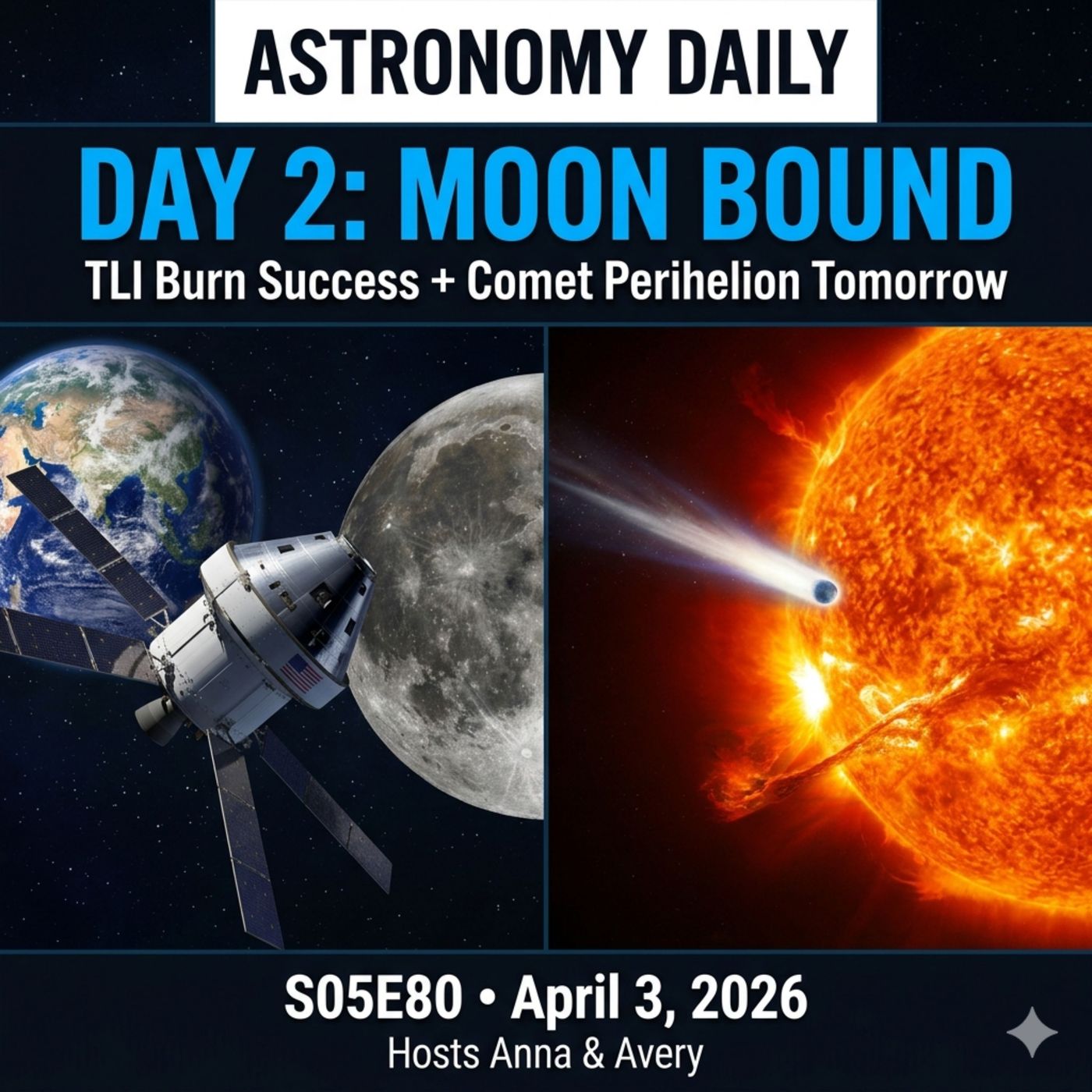
S5 Ep 80Artemis II Heads to the Moon + Comet Death or Glory + Dark Matter Mystery
Astronomy Daily Season 5, Episode 80 — Friday, April 3, 2026 It's Day 2 of the Artemis II mission and the crew is on their way to the Moon after a perfect translunar injection burn. We've also got a comet about to face perihelion, a dark matter mystery deepening, stunning new JWST images, and the escalating fight over the future of our night skies. In today's episode: 🚀 ARTEMIS II — TRANSLUNAR INJECTION BURN: The Orion spacecraft successfully completed its TLI burn on April 2, sending four astronauts toward the Moon for the first time since Apollo 17 in 1972. Canadian astronaut Jeremy Hansen delivered one of the quotes of the year from orbit. 🚽 ARTEMIS II — THE LUNAR LOO: Hours after launch, Orion's toilet malfunctioned. Christina Koch fixed it. This is why test flights exist. ☄️ SUNGRAZER COMET C/2026 A1 (MAPS): Tomorrow, this Kreutz sungrazer passes 161,000 km from the Sun's surface. It could vaporise — or become the most spectacular comet since Ikeya-Seki. Southern Hemisphere watchers: eyes on the western horizon from April 6. 🌌 DARK MATTER-FREE GALAXIES: Yale astronomers have confirmed a third galaxy with essentially no dark matter — NGC 1052-DF9. The 'Bullet Dwarf' collision theory is gaining powerful evidence. 🌟 JWST + W51: The James Webb Space Telescope has revealed hidden young stars in the W51 star-forming region, piercing dust clouds that have blocked our view for decades. ⚠️ NIGHT SKY UNDER THREAT: Reflect Orbital's orbital mirror satellite launches this month. SpaceX wants one million satellites. The astronomical community is fighting back. Find us at: http://astronomydaily.io Follow us: @AstroDailyPod Part of the Bitesz.com Podcast NetworkBecome a supporter of this podcast: https://www.spreaker.com/podcast/astronomy-daily-space-news-updates--5648921/support.Sponsor Details:Ensure your online privacy by using NordVPN. To get our special listener deal and save a lot of money, visit www.bitesz.com/nordvpn. You'll be glad you did!Become a supporter of Astronomy Daily by joining our Supporters Club. Commercial free episodes daily are only a click way... Click HereThis episode includes AI-generated content.

S5 Ep 79Artemis II Is Go — Humanity's Return to the Moon
Today is the day. Artemis II — NASA's first crewed Moon mission in 54 years — lifted off last night, and as we record this, four astronauts are preparing to leave Earth's orbit forever on the Translunar Injection burn. In this special launch-day edition, Anna and Avery cover the near-flawless launch, today's critical TLI milestone, the historic firsts being set by the crew aboard Orion (named Integrity), what the next ten days look like on the road to the Moon, the international CubeSats that hitched a ride, and the stunning coincidence of a full Pink Moon rising as humanity headed moonward. Key Sources • NASA Liftoff Announcement — nasa.gov • NASA Artemis Live Updates Blog — nasa.gov/blogs/artemis • NASA Coverage Schedule — nasa.gov/missions/artemis • CNN Artemis II Live Updates — cnn.com • Time Magazine — 'The Lunar Mission the World Is Watching' • Astronomy.com — Live Updates: Artemis 2 • NPR — NASA Launches Four People on Artemis II • Wikipedia — Artemis II • FAI World Air Sports Federation — Artemis II Records • Fast Company — Pink Moon / Artemis II Upcoming Mission Milestones • Tonight, April 2 (~8 PM ET): Translunar Injection burn — crew leaves Earth orbit • Sunday, April 5: Crew communication downlinks; Apollo 13 distance record expected to be broken • Monday, April 6: Lunar flyby — closest approach ~4,000 miles from Moon surface • Friday, April 10: Pacific Ocean splashdownBecome a supporter of this podcast: https://www.spreaker.com/podcast/astronomy-daily-space-news-updates--5648921/support.Sponsor Details:Ensure your online privacy by using NordVPN. To get our special listener deal and save a lot of money, visit www.bitesz.com/nordvpn. You'll be glad you did!Become a supporter of Astronomy Daily by joining our Supporters Club. Commercial free episodes daily are only a click way... Click HereThis episode includes AI-generated content.
S5 Ep 78'Hey, Let's Go to the Moon' — Artemis II Launch Day
Launch day has arrived. In this episode of Astronomy Daily, Anna and Avery countdown to tonight's historic Artemis II launch — humanity's first crewed lunar mission since 1972 — and explore the dramatic stories unfolding alongside it: a sungrazing comet faces its moment of truth just three days from perihelion; astronomers raise urgent alarms over plans for one million new satellites; the interstellar comet 3I/ATLAS leaves its open-data legacy; and fascinating new science unpacks the hellish reality of Venus and a creative low-tech solution for mapping the Moon's interior. Story References Story 1: Artemis II Launch • NASA Artemis II Mission Hub: nasa.gov/mission/artemis-ii • NASA Live Coverage (NASA+, YouTube, Amazon Prime) — begins 7:45 AM EDT April 1 • Launch window: 6:24–8:24 PM EDT Wednesday April 1 (09:24–11:24 AEDT Thursday April 2) • Crew: Reid Wiseman (Commander), Victor Glover (Pilot), Christina Koch, Jeremy Hansen (CSA) • Mission duration: 10 days, splashdown April 10 off San Diego Story 2: Comet MAPS • C/2026 A1 (MAPS) perihelion: April 4, 2026 at ~14:23 UTC • Perihelion distance: ~160,000 km above Sun's surface (solar corona passage) • Kreutz sungrazer family — related to Great Comet of 1106 • Nucleus estimated ~400m diameter (JWST MIRI observation, Feb 7 2026) • Best-case post-perihelion brightness: magnitude -5 to -10 • Source: Sky & Telescope, EarthSky, Universe Today, Wikipedia Story 3: Satellite Megaconstellations • SpaceX proposal: 1,000,000 satellites (AI orbital data centres) — FCC filing Jan 30, 2026 • Reflect Orbital proposal: 50,000 mirror satellites — FCC filing July 31, 2025 • IAU, RAS, and ESO have all filed formal FCC objections • Nature study (Dec 2025): 96%+ of future space telescope exposures affected if constellations completed • Hubble: up to 1/3 of images contaminated • Source: Universe Today, Astronomy Magazine, Nature Story 4: 3I/ATLAS Open Data • NASA open data archive now available: science.nasa.gov/solar-system/comets/3i-atlas • Key finding: 3I/ATLAS unusually rich in methanol vs hydrogen cyanide • Observed by 12+ NASA missions including Hubble, JWST, TESS, SPHEREx, MAVEN, Perseverance • Jupiter flyby: March 16, 2026 at 0.358 AU • Source: NASA Science, Space.com, NRAO Story 5: Venus • Surface temperature: 464°C average • Atmospheric pressure: 92× Earth (equivalent to ~1km ocean depth) • Longest spacecraft survival: ~2 hours (Soviet Venera probes) • Source: Universe Today, April 1 2026 Story 6: Lunar Optical Fibre • Two new journal papers propose telecom-grade optical fibre for lunar seismic mapping • Could map deep interior and identify lava tube locations • Lava tubes: potential natural shelters for future astronauts • Source: Universe Today, April 1 2026Become a supporter of this podcast: https://www.spreaker.com/podcast/astronomy-daily-space-news-updates--5648921/support.Sponsor Details:Ensure your online privacy by using NordVPN. To get our special listener deal and save a lot of money, visit www.bitesz.com/nordvpn. You'll be glad you did!Become a supporter of Astronomy Daily by joining our Supporters Club. Commercial free episodes daily are only a click way... Click HereThis episode includes AI-generated content.
S5 Ep 77Artemis II : Go for Launch — Plus Saturn's Rings, The Gigamaser & A Star From The Dawn of Time
Episode 77 of Astronomy Daily, Season 5. Recorded 31 March 2026. Today's episode is our Artemis II launch-eve special — humanity prepares to return to the Moon for the first time in over 53 years. We also cover a record-breaking 'space laser' 8 billion light-years away, the ancient age of interstellar comet 3I/ATLAS, a star bearing the fingerprint of the universe's first stars, and new simulations supporting the shattered moon origin of Saturn's rings. STORY SOURCES • Artemis II Countdown — NASA.gov: https://www.nasa.gov/blogs/missions/2026/03/30/nasas-artemis-ii-launch-mission-countdown-begins/ • Artemis II Mission Guide — NBC News: https://www.nbcnews.com/science/space/artemis-ii-nasa-moon-launch-time-astronauts-how-watch-what-know-rcna255627 • Artemis II Launch Coverage — CBS News: https://www.cbsnews.com/news/nasa-artemis-ii-moon-launch-astronauts-flight-plan/ • X1.4 Solar Flare — Space.com: https://www.space.com/astronomy/sun/powerful-x-class-solar-flare-triggers-radio-blackout-ahead-of-artemis-2-launch • Solar Flare NASA Statement — NASA Science: https://science.nasa.gov/blogs/solar-cycle-25/2026/03/30/strong-solar-flare-erupts-from-sun-30/ • Gigamaser Discovery — Space.com: https://www.space.com/astronomy/galaxies/record-breaking-space-laser-erupts-from-merging-galaxies-8-billion-light-years-away • Gigamaser — ScienceAlert: https://www.sciencealert.com/astronomers-spot-a-record-breaking-space-laser-8-billion-light-years-away • 3I/ATLAS Age — Space.com: https://www.space.com/astronomy/comets/interstellar-comet-3i-atlas-may-be-nearly-12-billion-years-old-so-ancient-its-star-system-may-no-longer-exist • 3I/ATLAS — Live Science: https://www.livescience.com/space/comets/interstellar-messenger-3i-atlas-could-be-nearly-as-old-as-the-universe-itself-james-webb-telescope-observations-reveal • PicII-503 Star — Smithsonian Magazine: https://www.smithsonianmag.com/smart-news/astronomers-discovere-a-rare-primitive-star-that-provides-a-chemical-snapshot-of-the-early-universe-180988454/ • PicII-503 — NOIRLab: https://noirlab.edu/public/news/noirlab2607/ • Saturn Rings / Chrysalis — Space.com: https://www.space.com/astronomy/saturn/are-saturns-rings-made-of-a-lost-shattered-moon-new-evidence-arises-for-the-caseBecome a supporter of this podcast: https://www.spreaker.com/podcast/astronomy-daily-space-news-updates--5648921/support.Sponsor Details:Ensure your online privacy by using NordVPN. To get our special listener deal and save a lot of money, visit www.bitesz.com/nordvpn. You'll be glad you did!Become a supporter of Astronomy Daily by joining our Supporters Club. Commercial free episodes daily are only a click way... Click HereThis episode includes AI-generated content.
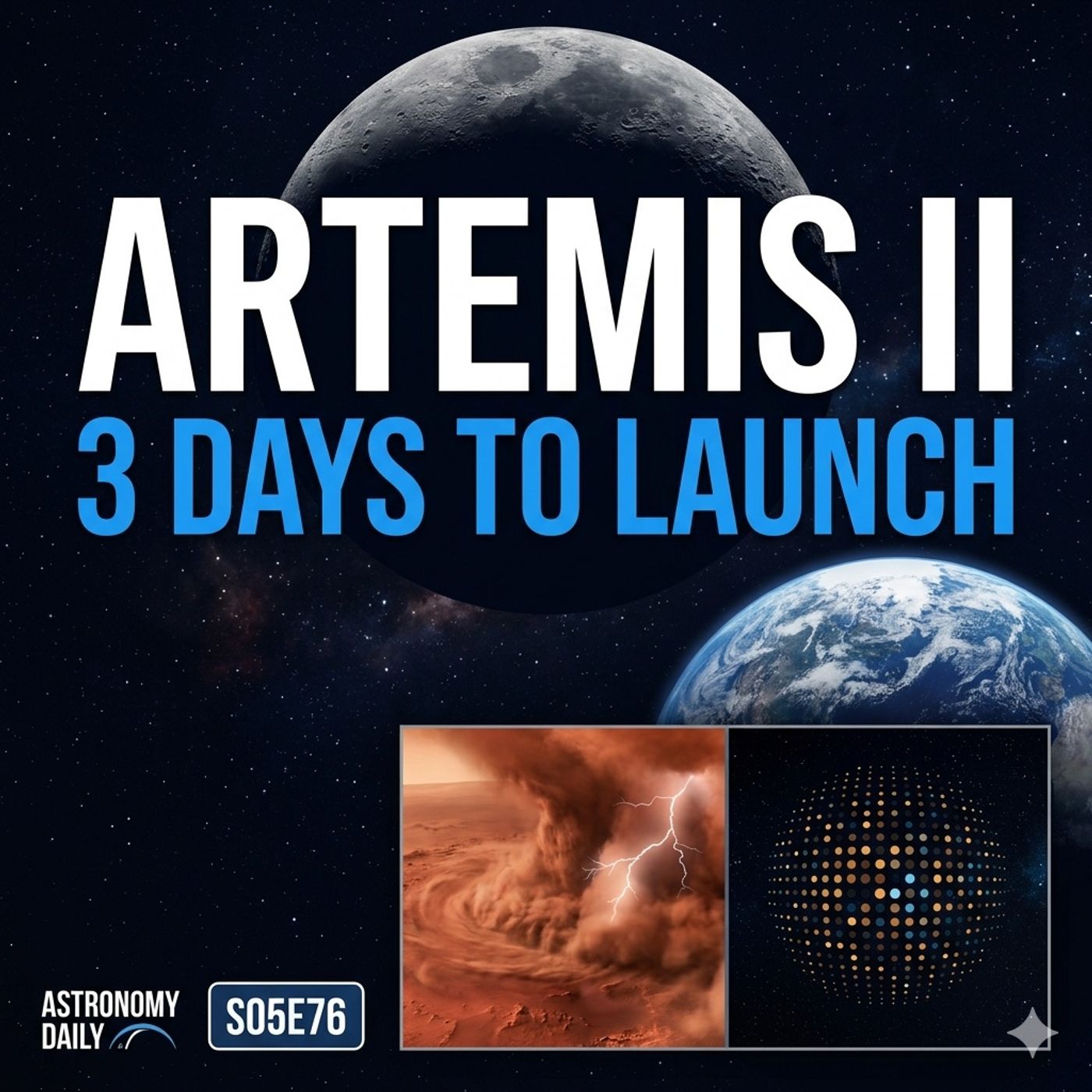
S5 Ep 76Artemis II: Three Days to Go — Plus Mars Sample Return Is Officially Dead
Episode Summary With Artemis II just three days from launch, today's episode delivers a landmark space moment alongside the sad news that Mars Sample Return's Earth Return Orbiter has been formally cancelled by ESA. We also cover SpaceX's enormous Transporter-16 rideshare launch, Cornell's definitive list of 45 best-bet habitable exoplanets, a paradigm-shifting discovery about pulsar radio emissions, and the first confirmed evidence of lightning-like activity on Mars. Stories Covered • Artemis II — NASA confirms zero technical issues, launch on track for April 1 at 6:24 p.m. EDT • ESA Earth Return Orbiter — formally cancelled after ESA member states vote to end the programme; Airbus in transition talks • SpaceX Transporter-16 — 119 payloads launched to Sun-synchronous orbit from Vandenberg this morning • 45 Habitable Exoplanets — Cornell/Carl Sagan Institute catalog published in MNRAS; TRAPPIST-1, Proxima Centauri b among top targets • Millisecond Pulsar Radio Emissions — signals confirmed originating beyond the light cylinder for the first time • Martian Lightning — MAVEN data reveals whistler wave consistent with electrical discharge during a 2015 dust storm Source URLs • Artemis II launch updates: https://www.space.com/news/live/artemis-2-nasa-moon-mission-launch-updates-march-29-2026 • ESA Earth Return Orbiter cancellation: https://europeanspaceflight.com/esa-member-states-call-for-cancellation-of-earth-return-orbiter/ • SpaceX Transporter-16: https://www.nasaspaceflight.com/2026/03/transporter-16/ • 45 Habitable Exoplanets (ScienceDaily): https://www.sciencedaily.com/releases/2026/03/260325005926.htm • Millisecond Pulsar discovery (Phys.org): https://phys.org/news/2026-03-radio-edge-extreme-stars-surfaces.html • Mars Lightning / MAVEN (Phys.org): https://phys.org/news/2026-03-nasa-maven-evidence-lightning-mars.htmlBecome a supporter of this podcast: https://www.spreaker.com/podcast/astronomy-daily-space-news-updates--5648921/support.Sponsor Details:Ensure your online privacy by using NordVPN. To get our special listener deal and save a lot of money, visit www.bitesz.com/nordvpn. You'll be glad you did!Become a supporter of Astronomy Daily by joining our Supporters Club. Commercial free episodes daily are only a click way... Click HereThis episode includes AI-generated content.
S5 Ep 75Countdown to the Moon: Artemis II Launch Week Begins | Plus Comet Reversal & ISS Medical Mystery Update
Episode S05E75 — Saturday, 28 March 2026 | astronomydaily.io | @AstroDailyPod 🚀 Story 1: Artemis II Crew Arrives at Kennedy Space Center The four-person crew of NASA's Artemis II mission — Commander Reid Wiseman, Pilot Victor Glover, Mission Specialist Christina Koch (NASA), and Mission Specialist Jeremy Hansen (CSA) — arrived at Kennedy Space Center on Friday, March 27, 2026, ahead of a planned April 1 launch. The 10-day mission will fly the crew around the Moon and back to Earth — the first crewed lunar mission since Apollo 17 in 1972. Launch window: 6:24 PM EDT, April 1–6, 2026. Sources: NASA.gov, Space.com, AP, Orlando Sentinel ☄️ Story 2: Hubble Detects First-Ever Spin Reversal of a Comet A new study in The Astronomical Journal reveals that comet 41P/Tuttle-Giacobini-Kresák reversed its direction of rotation — a first in observational astronomy. Gas jets acting as thrusters slowed the comet's spin and flipped it into a new direction. The comet's nucleus measures just 1 km across. Researchers warn the rapid new spin could lead to the comet's disintegration. Source: NASA Science / Space Telescope Science Institute, March 26, 2026 🌑 Story 3: LIGO Signal May Be a Primordial Black Hole A November 2025 LIGO detection of a gravitational wave signal from an object with less than one solar mass — impossible through stellar evolution — may be evidence of a primordial black hole formed in the Big Bang's first moments. A new University of Miami study in The Astrophysical Journal finds the detection consistent with primordial black hole models and suggests these objects could help explain dark matter. Source: Universe Today / University of Miami, March 27, 2026 ⭐ Story 4: IXPE Delivers New Portrait of Oldest-Known Supernova NASA's IXPE (Imaging X-ray Polarimetry Explorer) has produced a new X-ray image of supernova remnant RCW 86 (SN 185) — the oldest recorded supernova, first observed by Chinese astronomers in 185 AD. Combined with Chandra and XMM-Newton data, the image reveals the remnant's expansion has slowed at the edge of a low-density cavity, producing a reflected shock. Source: NASA / Phys.org, March 25–27, 2026 🏥 Story 5: Mike Fincke Speaks About His ISS Medical Emergency NASA astronaut Mike Fincke has given his first detailed account of the January 7, 2026 medical event that led to the first-ever medical evacuation from the International Space Station. In an AP interview, Fincke revealed he lost the ability to speak for approximately 20 minutes while eating dinner. Doctors have ruled out a heart attack but the cause remains unknown. The incident ended Crew-11's mission early, returning Fincke, Zena Cardman, Kimiya Yui, and Oleg Platonov to Earth on January 15. Source: Associated Press / Phys.org, March 27, 2026 ☀️ Story 6: Solar Activity — AR4403 Flares, Possible CME March 29 Sunspot region AR4403, which rotated into view on March 26, produced an M3.9 solar flare causing a minor radio blackout over the Indian Ocean. Conditions are quiet on March 28, but space weather forecasters expect a co-rotating interaction region and coronal hole high-speed stream to arrive March 29, bringing unsettled geomagnetic conditions and possible aurora visibility at mid-latitudes. Southern Hemisphere observers in Australia and New Zealand should watch Sunday–Monday nights. Source: EarthSky / The Sun Today, March 27, 2026Become a supporter of this podcast: https://www.spreaker.com/podcast/astronomy-daily-space-news-updates--5648921/support.Sponsor Details:Ensure your online privacy by using NordVPN. To get our special listener deal and save a lot of money, visit www.bitesz.com/nordvpn. You'll be glad you did!Become a supporter of Astronomy Daily by joining our Supporters Club. Commercial free episodes daily are only a click way... Click HereThis episode includes AI-generated content.
S5 Ep 74Artemis II Crew Lands in Florida — Launch Countdown Is On
Welcome to Astronomy Daily, Season 5, Episode 74 — your daily briefing on the most exciting developments in space and astronomy, hosted by Anna and Avery. IN TODAY'S EPISODE • Artemis II crew arrives at Kennedy Space Center — launch just 5 days away • Webb and Hubble combine for the most detailed Saturn portrait ever captured • New research reveals Jupiter's lightning may be up to a million times more powerful than Earth's • Japan's XRISM telescope solves a 50-year X-ray mystery surrounding naked-eye star Gamma Cassiopeiae • Cornell astronomers publish a shortlist of 45 exoplanets most likely to host alien life • The Isar Aerospace Spectrum scrub mystery is solved — it was an unauthorised boat STORY SOURCES & LINKS Story 1 — Artemis II: NASA Kennedy Space Center / NASA.gov https://www.nasa.gov/blogs/missions/2026/03/25/nasa-teams-continue-artemis-ii-preparations-at-launch-pad/ https://www.nasa.gov/missions/artemis/artemis-ii/nasa-sets-coverage-for-artemis-ii-moon-mission/ Story 2 — Saturn Images: NASA Science / Scientific American https://science.nasa.gov/missions/webb/nasa-webb-hubble-share-most-comprehensive-view-of-saturn-to-date/ Story 3 — Jupiter Lightning: Berkeley News / AGU Advances https://news.berkeley.edu/2026/03/23/lightning-bolts-on-jupiter-pack-more-than-100-times-the-power-of-earths-flashes/ Story 4 — Gamma Cassiopeiae: ScienceDaily / Astronomy & Astrophysics https://www.sciencedaily.com/releases/2026/03/260325041723.htm Story 5 — 45 Exoplanets: Royal Astronomical Society / ScienceDaily https://ras.ac.uk/news-and-press/research-highlights/best-places-look-alien-life-scientists-identify-45-earth-worlds Story 6 — Isar Aerospace: NASASpaceFlight.com / Bloomberg https://www.nasaspaceflight.com/2026/03/isar-onward-and-upward/ CONNECT WITH US • Website: astronomydaily.io • Twitter/X: @AstroDailyPod • Instagram: @AstroDailyPod • TikTok: @AstroDailyPod • YouTube: @AstroDailyPod • Tumblr: @AstroDailyPod • Network: Bitesz.com Podcast NetworkBecome a supporter of this podcast: https://www.spreaker.com/podcast/astronomy-daily-space-news-updates--5648921/support.Sponsor Details:Ensure your online privacy by using NordVPN. To get our special listener deal and save a lot of money, visit www.bitesz.com/nordvpn. You'll be glad you did!Become a supporter of Astronomy Daily by joining our Supporters Club. Commercial free episodes daily are only a click way... Click HereThis episode includes AI-generated content.
S5 Ep 73Spectrum Aborts at T-3 | Canada Loses Its Moon Rover | Triton Tilted Neptune
Episode Summary Today's episode opens with a brief update on the Isar Aerospace Spectrum rocket, which aborted at T-3 seconds on March 25 — just before engine ignition — with no new launch date yet announced. The main stories cover Canada's cancellation of its first lunar rover mission; the century-old mystery of Gamma Cassiopeiae's anomalous X-ray emissions finally solved by the XRISM space telescope; new research suggesting Neptune's axial tilt may have been caused by its captured moon Triton; NASA's Dragonfly rotorcraft entering full integration and testing ahead of a 2028 launch to Saturn's moon Titan; Russia returning to orbit from Baikonur Cosmodrome following last November's structural collapse; and the new SPHEREx telescope detecting a bipolar hydrogen shell around the remnant of Nova Persei 1901. Story Sources Update — Isar Aerospace Spectrum NASASpaceFlight.com — Isar Aerospace scrubs second launch of Spectrum rocket https://www.nasaspaceflight.com/2026/03/isar-onward-and-upward/ Isar Aerospace Mission Updates https://isaraerospace.com/mission-updates-overview Story 1 — Canada Cancels Moon Rover Space.com — Canada cancels its 1st moon rover: 'It's hopefully not a lost cause' https://www.space.com/space-exploration/artemis/canada-cancels-its-1st-moon-rover-its-hopefully-not-a-lost-cause Canadian Space Agency — Spending Plan 2026-27 https://www.asc-csa.gc.ca/eng/publications/dp-2026-2027.asp Story 2 — Gamma Cassiopeiae Mystery Solved Space.com — Scientists finally solve century-old mystery of star with unexpected X-ray emissions https://www.space.com/astronomy/stars/scientists-finally-solve-century-old-mystery-of-star-with-unexpected-x-ray-emissions ESA / EurekAlert — XRISM solves famous star's 50-year mystery https://www.eurekalert.org/news-releases/1120872 ScienceDaily — Astronomers solve 50-year mystery of a naked-eye star's extreme X-rays https://www.sciencedaily.com/releases/2026/03/260325041723.htm Story 3 — Neptune's Tilt & Triton Astrobiology.com / arXiv — Neptune's Obliquity Was Likely Engendered By Triton's Tidal Evolution https://astrobiology.com/2026/03/neptunes-obliquity-was-likely-engendered-by-tritons-tidal-evolution.html Story 4 — Dragonfly Integration Testing NASA Science — NASA's Dragonfly Mission Begins Rotorcraft Integration, Testing Stage https://science.nasa.gov/blogs/dragonfly/2026/03/10/nasas-dragonfly-mission-begins-rotorcraft-integration-testing-stage/ Johns Hopkins APL — Dragonfly Mission Begins Rotorcraft Integration, Testing Stage https://www.jhuapl.edu/news/news-releases/260312-dragonfly-integration-begins Story 5 — Russia Returns to Orbit from Baikonur Universe Today — Russia Returns to Orbit from Baikonur Following Structural Collapse https://www.universetoday.com/ Story 6 — SPHEREx & Nova Persei 1901 Phys.org — Using NASA's SPHEREx space telescope, astronomers observe remnants of the eruption of Nova Persei 1901 https://phys.org/space-news/Become a supporter of this podcast: https://www.spreaker.com/podcast/astronomy-daily-space-news-updates--5648921/support.Sponsor Details:Ensure your online privacy by using NordVPN. To get our special listener deal and save a lot of money, visit www.bitesz.com/nordvpn. You'll be glad you did!Become a supporter of Astronomy Daily by joining our Supporters Club. Commercial free episodes daily are only a click way... Click HereThis episode includes AI-generated content.
S5 Ep 72NASA's Moon Base Revolution: Gateway Cancelled, Nuclear Mars Mission Announced & More
Wednesday, March 25, 2026 In today's episode of Astronomy Daily, Anna and Avery cover six major stories from the last 24 hours in space and astronomy — including two landmark NASA announcements that could reshape the future of human space exploration. Story 1: NASA Cancels Lunar Gateway — Pivots to $20 Billion Moon Base NASA Administrator Jared Isaacman announced at the agency's 'Ignition Day' event that the Lunar Gateway orbital space station has been paused, with resources redirected toward a phased $20 billion base on the lunar surface. The three-phase plan runs from 2026 to beyond 2032 and involves international partners including JAXA, the Italian Space Agency, and the Canadian Space Agency. Source: https://www.space.com/space-exploration/artemis/nasas-lunar-gateway-space-station-is-out-moon-bases-are-in Story 2: NASA's SR-1 Freedom — The First Nuclear-Powered Interplanetary Spacecraft Also announced at Ignition Day, Space Reactor-1 Freedom is planned for a December 2028 launch to Mars. It will use Nuclear Electric Propulsion and carry the Skyfall payload — three Ingenuity-class helicopters designed to scout future human landing sites and map subsurface water ice. Source: https://www.space.com/astronomy/mars/nasas-1st-nuclear-powered-interplanetary-spacecraft-will-send-skyfall-helicopters-to-mars-in-2028 Story 3: Two Planets Forming Around Infant Star WISPIT 2 Astronomers using the ESO's Very Large Telescope have directly imaged two gas giant planets forming around the 5.4-million-year-old star WISPIT 2, located 437 light-years away in Aquila. The system is described as a mirror of our early solar system, with potential for more planets yet to be discovered. Published in The Astrophysical Journal Letters. Source: https://www.space.com/astronomy/exoplanets/scientists-discover-mirror-of-our-solar-system-in-2-exoplanets-forming-around-a-star Story 4: Hubble Revisits the Crab Nebula — 25 Years On NASA has released new Hubble Space Telescope images of the Crab Nebula, taken 25 years after the telescope first observed the object. The images reveal the nebula's continued expansion — the still-evolving remnant of a supernova first observed by astronomers in 1054 AD. Source: https://www.space.com/astronomy/hubble-revisits-a-cosmic-crab-after-25-years-space-photo-of-the-day-for-march-23-2026 Story 5: Fiber-Optic Cables Could Detect Moonquakes Two new studies from Los Alamos National Laboratory suggest that fiber-optic cables deployed directly on the lunar surface could detect moonquakes using Distributed Acoustic Sensing (DAS). The technique could replace expensive individual seismometers, with a single cable acting as thousands of sensors across hundreds of kilometres of lunar terrain. Source: https://www.space.com/astronomy/moon/future-artemis-missions-could-use-fiber-optic-cables-to-monitor-moonquakes Story 6: Rocket Lab 'Daughter of the Stars' — Europe's First Celeste Navigation Satellites Rocket Lab's Electron rocket launched the first two satellites for ESA's Celeste LEO-PNT constellation from Māhia, New Zealand on March 25. The mission is ESA's first foray into low-Earth orbit navigation, designed to complement and strengthen Europe's Galileo system. The constellation is named after Maria Celeste, daughter of Galileo Galilei. Source: https://www.space.com/space-exploration/launches-spacecraft/rocket-lab-electron-launch-european-space-agency-celeste-navigation-satellitesBecome a supporter of this podcast: https://www.spreaker.com/podcast/astronomy-daily-space-news-updates--5648921/support.Sponsor Details:Ensure your online privacy by using NordVPN. To get our special listener deal and save a lot of money, visit www.bitesz.com/nordvpn. You'll be glad you did!Become a supporter of Astronomy Daily by joining our Supporters Club. Commercial free episodes daily are only a click way... Click HereThis episode includes AI-generated content.
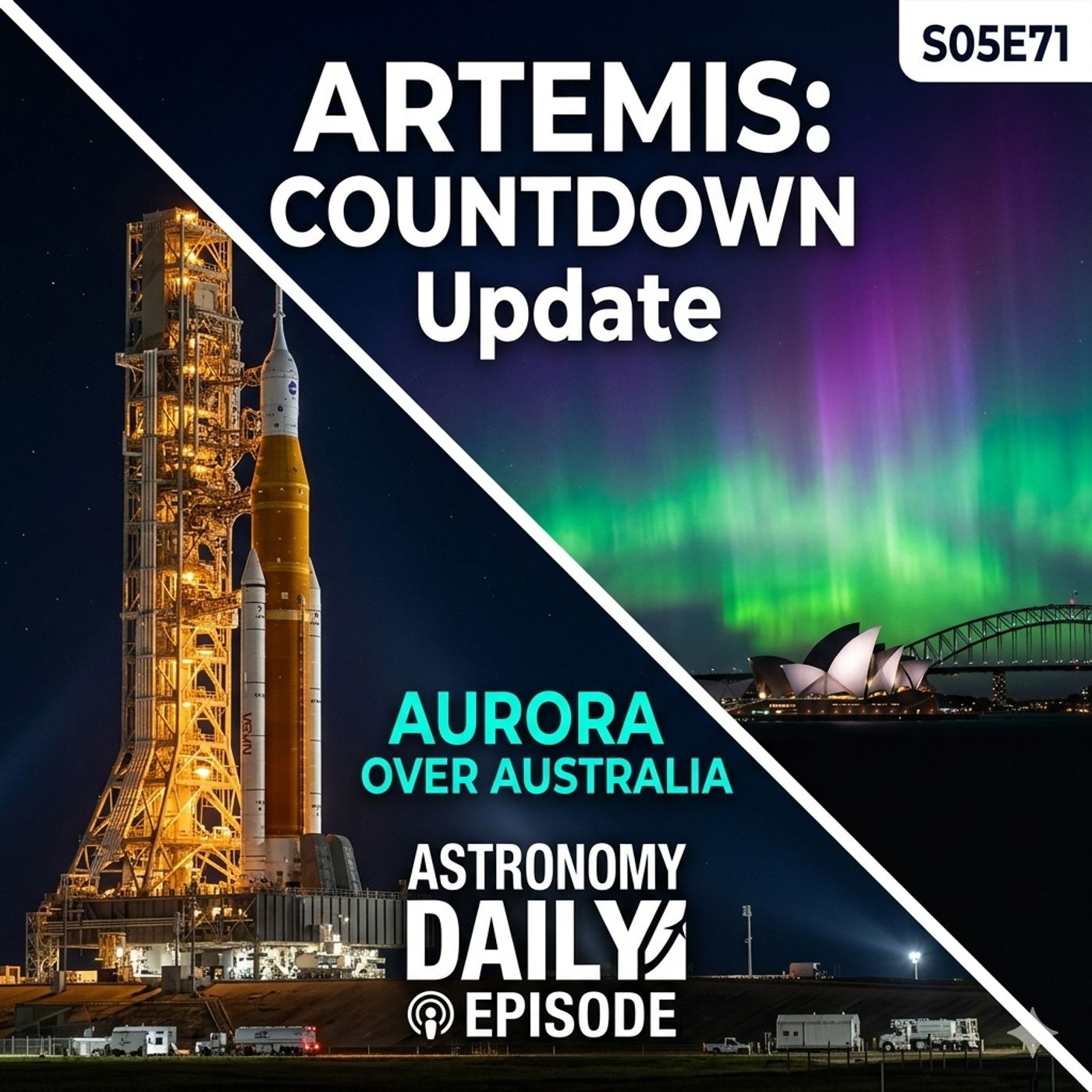
S5 Ep 71Artemis II Countdown, Auroras Over Sydney, and the Lava World That Broke the Rules
Thank you for listening to Astronomy Daily! Here's everything from today's episode: Story 1: Artemis II — T-Minus Days to Launch NASA is targeting April 1, 2026 for the launch of Artemis II — the first crewed lunar flyby since Apollo 17 in 1972. The crew of Reid Wiseman, Victor Glover, Christina Koch, and Jeremy Hansen will fly a 10-day free-return trajectory around the Moon aboard the Orion spacecraft on the SLS rocket from Kennedy Space Center. The six-day launch window runs April 1–6. Meanwhile, a new analysis suggests the mission could face elevated solar superflare risk, though NASA is proceeding after a successful Flight Readiness Review. Source: NASA — https://www.nasa.gov/mission/artemis-ii/ Solar risk analysis: https://www.space.com/space-exploration/artemis/artemis-2-moon-mission-shouldnt-launch-until-late-2026-new-analysis-of-solar-superflares-suggests Story 2: G3 Geomagnetic Storm & Aurora Australis Multiple coronal mass ejections from the Sun triggered a G3 (strong) geomagnetic storm, producing vivid auroral displays from New York to Scotland to — remarkably — Melbourne, Sydney, Brisbane, and Adelaide. The Australian Bureau of Meteorology issued a severe storm warning for March 23. Conditions are easing on March 24 (Kp 3–4) but some aurora activity may continue. March is historically the best month for auroras due to the equinox effect, and with Solar Cycle 25 at its peak, scientists say this could be the best aurora viewing period until the mid-2030s. Aurora forecast: https://earthsky.org/sun/sun-news-activity-solar-flare-cme-aurora-updates/ Aurora Australis guide: https://www.elle.com.au/culture/news/aurora-australis-southern-lights-march-2026-tonight-alert/ Story 3: JWST Finds 'Impossible' Atmosphere on Lava World TOI-561 b A Carnegie Institution-led team used NASA's James Webb Space Telescope to detect the strongest evidence yet for an atmosphere around a rocky exoplanet. TOI-561 b — an ultra-hot super-Earth about twice Earth's mass, orbiting its star every 10.56 hours — was expected to be a bare rock. Instead, JWST measured a dayside temperature far cooler than a bare rock would produce, indicating a thick atmosphere redistributing heat above a global magma ocean. The findings were published in The Astrophysical Journal Letters. Source: Carnegie Institution for Science — https://carnegiescience.edu/ultra-hot-lava-world-has-thick-atmosphere-upending-expectations ScienceDaily: https://www.sciencedaily.com/releases/2026/03/260322020255.htm Story 4: Sealed Apollo 17 Moon Rocks Reveal Surprise Sulfur Signal Sealed lunar samples from Apollo 17 (collected 1972, opened through NASA's ANGSA program) have revealed unexpected sulfur isotope signatures. A Brown University-led team found volcanic material from the Taurus-Littrow region is strongly depleted in sulfur-33 — unlike anything found on Earth. Possible explanations include ancient lunar atmospheric chemistry or a legacy of the Theia impact that formed the Moon. Published in the Journal of Geophysical Research: Planets. Source: Brown University — https://www.brown.edu/news/2025-10-06/sulfur-isotopes-apollo-samples SciTechDaily: https://scitechdaily.com/scientists-open-moon-rocks-locked-away-since-1972-and-find-something-totally-unexpected/ Story 5: This Week in Global Rocketry An exceptional week of launches spanning five countries and seven rocket types: SpaceX Falcon 9 (Starlink 17-17, Tuesday; Starlink 10-44, Thursday — B1067's record 34th flight; Transporter 16, Sunday), Rocket Lab Electron (ESA Celeste demo sats, Wednesday, NZ), Isar Aerospace Spectrum (Onward and Upward, Wednesday, Norway), Chang Zheng 2C (Wednesday, China), CAS Space Kinetica 1 (Friday, China), Russia's debut Soyuz-5 (Friday, Baikonur), and ULA Atlas V (Amazon Leo batch, Sunday). The 73rd orbital launch attempt of 2026 worldwide. Full preview: https://www.nasaspaceflight.com/2026/03/launch-preview-032326/ Update: Progress MS-33 & Spectrum Rocket Progress MS-33 (also known as Progress 94) launched from the newly-repaired Site 31/6 at Baikonur on March 22 carrying 2,509 kg of supplies for the ISS Expedition 74 crew. A KURS antenna failure required ISS commander Sergei Kud-Sverchkov to dock the vehicle manually using the TORU backup system, scheduled for 13:34 UTC on March 24. Separately, Isar Aerospace's Spectrum rocket remains on the pad at Andøya, Norway, with a new launch window on March 25 (20:00–21:00 UTC) after weather delays. Progress MS-33: https://www.nasaspaceflight.com/2026/03/progress-ms33/ Spectrum launch info: https://isaraerospace.com/mission-updates-overview 🌐 astronomydaily.io | 🎙️ Part of the Bitesz.com Podcast Network 📱 @AstroDailyPod on Twitter/X, Instagram, TikTok, YouTube & TumblrBecome a supporter of this podcast: https://www.spreaker.com/podcast/astronomy-daily-space-news-updates--5648921/support.Sponsor Details:Ensure your online privacy by using NordVPN. To get our special listener deal and save a lot of money, visit www.bitesz.com/

S5 Ep 70Europe's Rocket Moment, A Hidden Cosmic Explosion, and Brown Dwarfs in Love
Astronomy Daily — Season 5, Episode 70 Monday, March 23, 2026 In today's episode, Anna and Avery cover six stories spanning a live European rocket launch attempt, a sixty-year-old NASA emergency brought back to life through newly surfaced photographs, a cosmic explosion caught only by its echo, the fight to preserve the night sky, a supply run to the ISS with an unexpected complication, and a first-of-its-kind discovery involving brown dwarf stars. Story 1: Europe's Spectrum Rocket — Bid for Orbit Today Isar Aerospace's Spectrum rocket is attempting its second test flight today — its qualification mission for ESA's European Launcher Challenge. Launching from Andøya Spaceport in Norway, the mission carries five CubeSats and one experiment from European universities and companies, all supported by ESA's Boost! program. If successful, it would mark a landmark moment for European sovereign access to space. Source: ESA — Spectrum's Qualifying Second Launch Story 2: Neil Armstrong — The Gemini 8 Emergency Sixty years ago this month, Neil Armstrong and David Scott survived one of NASA's most dangerous pre-Apollo emergencies aboard Gemini 8. A spacecraft malfunction sent the capsule into an uncontrolled spin reaching one revolution per second. Never-before-seen photographs of Armstrong's recovery have been donated to the Armstrong Air and Space Museum in Wapakoneta, Ohio. Source: Phys.org — Space News Story 3: Astronomers Catch the Echo of a Billion-Sun Explosion Using the ASKAP radio telescope in Western Australia, astronomers identified ASKAP J005512-255834 — a radio signal representing the most convincing "orphan afterglow" of a gamma-ray burst ever detected. The original explosion went unseen because its jet wasn't aimed at Earth, but the lingering radio echo has been detectable for over 1,000 days. Research published in The Astrophysical Journal. Source: The Conversation — A Cosmic Explosion With the Force of a Billion Suns Story 4: The Fight to Save the Night Sky The Royal Astronomical Society, ESA, and the International Astronomical Union have filed formal objections to the FCC over two proposed satellite constellations: SpaceX's application for up to one million orbiting AI data centre satellites, and Reflect Orbital's proposal for 50,000 space mirrors each four times brighter than the full Moon. Experts warn the proposals could permanently transform humanity's view of the night sky. Source: Space.com — Astronomers Protest Giant Orbiting Mirror Project Story 5: Progress 94 Launches to ISS — With a Glitch Russia's Progress 94 cargo spacecraft launched successfully from Baikonur on March 22, carrying around three tonnes of food, fuel, and supplies to the ISS. One of its KURS automated docking antennas failed to deploy after launch. Docking at the Poisk module is scheduled for March 24. If the antenna issue isn't resolved, commander Sergei Kud-Sverchkov will conduct a manual docking. Source: NASA — Progress Cargo Craft Launches to Resupply Station Crew Story 6: First-Ever Brown Dwarf Pair Caught in Mass Transfer Caltech researchers using the Zwicky Transient Facility have discovered ZTF J1239+8347 — the first-ever observed brown dwarf binary undergoing mass transfer. The pair orbit each other every 57 minutes at a separation smaller than the Earth-Moon distance. The system will eventually either merge into a single star or one dwarf will accrete enough mass to ignite fusion. Research published in The Astrophysical Journal Letters. Source: Universe Today — This Pair of Brown Dwarfs Can't Get Enough of Each Other Find us everywhere: astronomydaily.io | @AstroDailyPodBecome a supporter of this podcast: https://www.spreaker.com/podcast/astronomy-daily-space-news-updates--5648921/support.Sponsor Details:Ensure your online privacy by using NordVPN. To get our special listener deal and save a lot of money, visit www.bitesz.com/nordvpn. You'll be glad you did!Become a supporter of Astronomy Daily by joining our Supporters Club. Commercial free episodes daily are only a click way... Click HereThis episode includes AI-generated content.
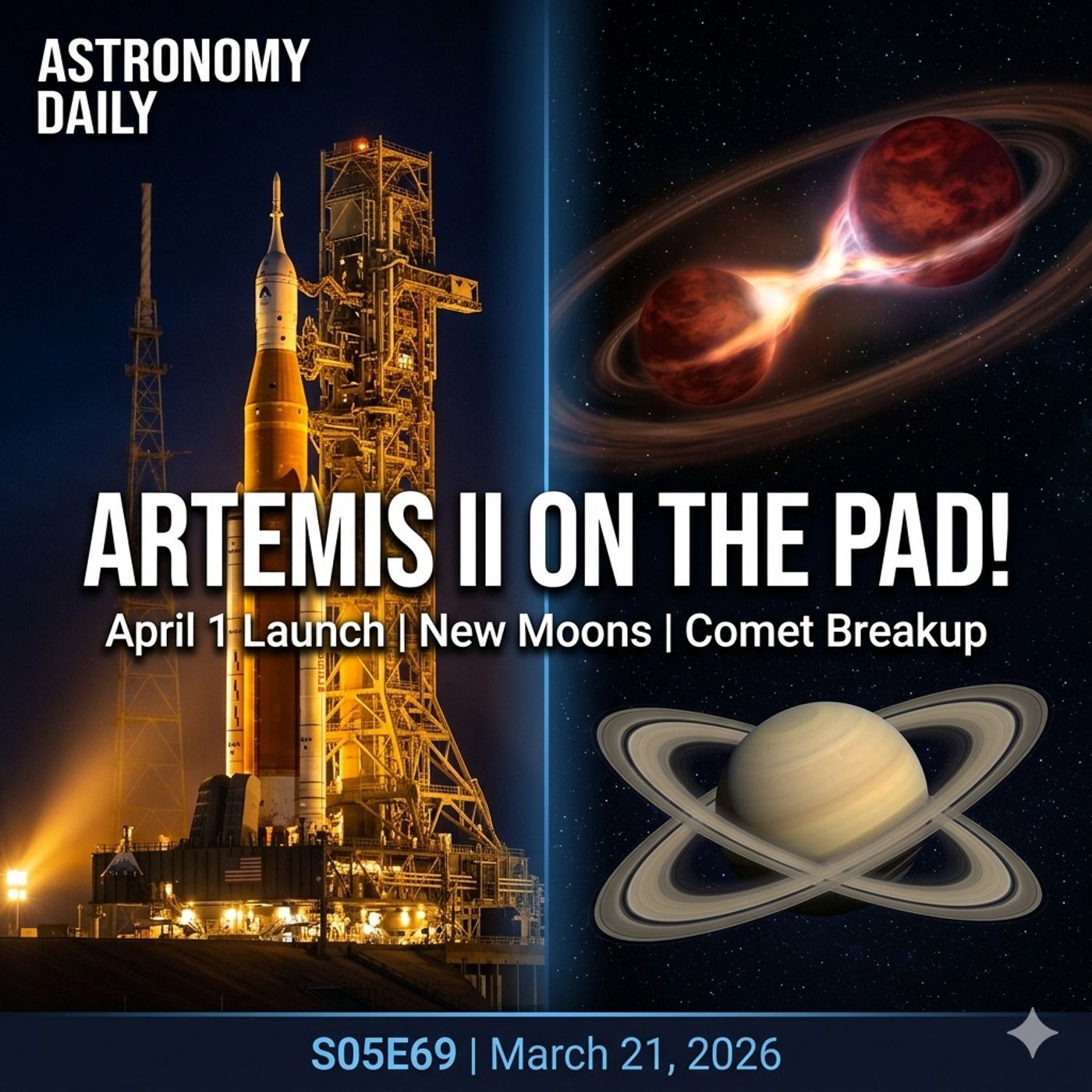
S5 Ep 69Moon Rocket, Lost Spacecraft, and a Comet That Fell Apart on Camera
Today on Astronomy Daily: NASA's Artemis II moon rocket has arrived at Launch Pad 39B at Kennedy Space Center, with a launch target of April 1st — the first crewed mission beyond Earth orbit in over 53 years. Plus: astronomers have discovered the first-ever mass-transferring brown dwarf binary; Hubble accidentally caught a comet disintegrating in real time; 15 new moons have been confirmed around Jupiter and Saturn; our Moon is accumulating over 100 metric tons of human-made debris; and a dramatic spacecraft double-header — ESA's Proba-3 has been recovered from a month-long blackout, while NASA's MAVEN Mars orbiter remains missing after more than three months of silence. Story 1: Artemis II Arrives at Launch Pad 39B NASA's Artemis II SLS rocket and Orion spacecraft completed an 11-hour overnight journey to Launch Pad 39B on March 20, 2026. Launch is targeted for no earlier than April 1. The crew — Reid Wiseman, Victor Glover, Christina Koch, and Jeremy Hansen — will fly a 10-day free-return trajectory around the Moon, making this the first crewed deep-space mission since Apollo 17 in December 1972. Source: https://www.nasa.gov/blogs/missions/2026/03/20/nasas-artemis-ii-rocket-arrives-at-launch-pad-39b/ Story 2: First Mass-Transferring Brown Dwarf Binary Researchers at Caltech have identified ZTF J1239+8347, a brown dwarf binary system with an orbital period of just 57.41 minutes in which one brown dwarf is actively pulling material from its companion — a first for this class of objects. The system, only ~1,000 light-years away, is a prime candidate for JWST follow-up observations. Published in The Astrophysical Journal Letters. Source: https://www.universetoday.com/articles/this-pair-of-brown-dwarfs-cant-get-enough-of-each-other Story 3: Hubble Catches Comet C/2025 K1 Breaking Apart In a remarkable stroke of luck, NASA's Hubble Space Telescope captured comet C/2025 K1 (ATLAS) fragmenting into at least four pieces over three consecutive days in November 2025. The comet was not the original target of the observation. The findings, published in Icarus, reveal the comet is unusually carbon-depleted and raise new questions about the delay between fragmentation and visible brightening. Source: https://science.nasa.gov/missions/hubble/nasas-hubble-unexpectedly-catches-comet-breaking-up/ Story 4: 15 New Moons Confirmed for Jupiter and Saturn The Minor Planet Center announced on March 16, 2026 that four new moons have been confirmed around Jupiter (bringing its total to 101) and 11 new moons around Saturn (bringing its total to 285). All are small irregular moons, discovered by combining archival telescope data with new observations. With the Vera C. Rubin Observatory now operational, further discoveries are expected. Source: https://earthsky.org/space/more-moons-for-jupiter-and-saturn-total-satellite-discoveries/ Story 5: Human Debris on the Moon — Over 100 Metric Tons and Counting More than 100 metric tons of human-made objects now litter the lunar surface — spacecraft hardware, scientific instruments, and even waste from Apollo missions. With a wave of crewed and commercial lunar missions approaching under Artemis and beyond, space policy researchers are urging the development of international agreements to protect scientifically sensitive lunar sites before they are damaged or contaminated by human activity. Source: https://www.universetoday.com — lunar debris policy Story 6: MAVEN Still Missing / Proba-3 Recovered NASA's MAVEN Mars orbiter, lost since December 6, 2025, remains uncontacted despite three months of recovery efforts using the Deep Space Network, Green Bank Observatory, and the Curiosity rover. An anomaly review board is assessing options. Meanwhile, ESA's Proba-3 coronagraph spacecraft — silent since February 14 after a power failure — has been successfully recovered after engineers exploited a brief window when the tumbling spacecraft's solar panels briefly faced the Sun. MAVEN source: https://www.space.com/space-exploration/launches-spacecraft/nasa-wont-give-up-hope-on-silent-maven-mars-probe-were-still-looking-for-it Proba-3 source: https://dailygalaxy.com/2026/03/europe-restores-contact-lost-spacecraft/Become a supporter of this podcast: https://www.spreaker.com/podcast/astronomy-daily-space-news-updates--5648921/support.Sponsor Details:Ensure your online privacy by using NordVPN. To get our special listener deal and save a lot of money, visit www.bitesz.com/nordvpn. You'll be glad you did!Become a supporter of Astronomy Daily by joining our Supporters Club. Commercial free episodes daily are only a click way... Click HereThis episode includes AI-generated content.
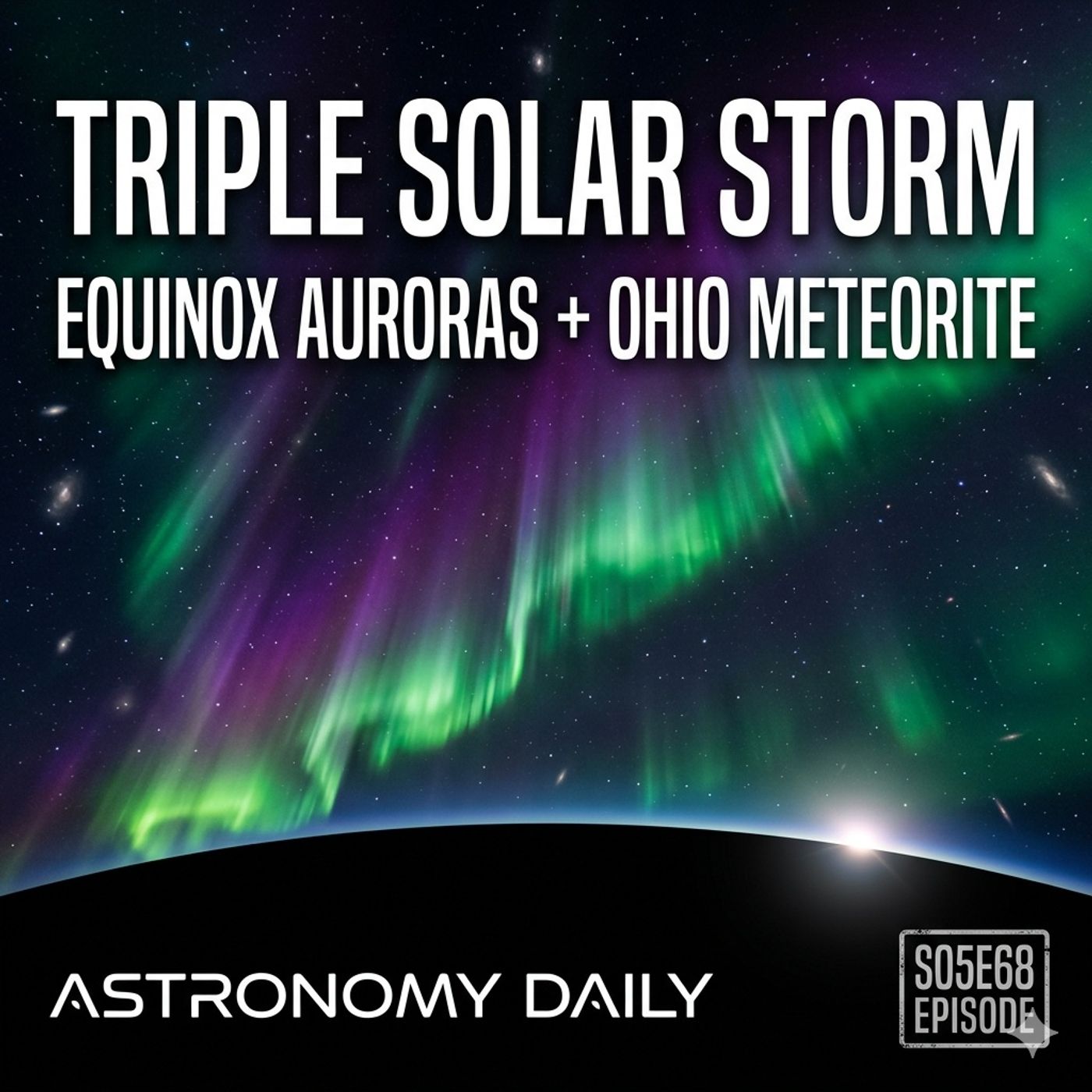
S5 Ep 68Equinox Auroras, Ancient Stars, and a Satellite Resurrection
It's the first day of astronomical spring — and the universe is celebrating in style. On today's Astronomy Daily, Anna and Avery cover a triple CME solar storm with aurora potential reaching as far south as Illinois, explain why the vernal equinox amplifies aurora activity, report on the ongoing meteorite hunt following Tuesday's spectacular Ohio fireball, reveal an extraordinary 14-billion-year-old star that carries the chemical fingerprints of the universe's very first stars, bring a happy update on Europe's Proba-3 solar science satellite which has ended a month of silence, and explain how X-ray CT scans of returned asteroid samples finally cracked one of Bennu's longest-standing mysteries. Stories in This Episode 1. Triple CME Strike + Equinox Aurora Alert Three coronal mass ejections (CMEs) are currently en route to Earth, with the first arriving today. Forecasters predict G2 (moderate) to G3 (strong) geomagnetic storm conditions, potentially bringing auroras as far south as Illinois. The timing coincides with the vernal equinox — historically one of the best aurora windows of the year due to the Russell-McPherron effect. 2. The Vernal Equinox — Today! The 2026 March equinox arrived today at 14:46 UTC, marking the astronomical start of spring in the Northern Hemisphere (and autumn in the Southern). Tonight, a thin crescent Moon appears alongside Venus in the west-southwest sky. 3. Ohio Fireball — Meteorite Hunt Underway On St. Patrick's Day (March 17), a seven-ton asteroid exploded over northeast Ohio with the force of 250 tons of TNT. NASA confirmed meteorites landed near Medina County, and hunters from across the US have already found fragments in the Sharon Center area. 4. Ancient 'Cosmic Fossil' Star PicII-503 Astronomers have discovered PicII-503, a second-generation star in the Pictor II dwarf galaxy with only 1/40,000th of the Sun's iron — the lowest ever measured outside the Milky Way. Its extraordinary carbon-to-iron ratio links it to mysterious carbon-enhanced metal-poor stars scattered across our galaxy's halo, solving a long-standing stellar mystery. Published in Nature Astronomy by Anirudh Chiti (Stanford) et al. 5. Proba-3 Phones Home — 'A Great Relief!' ESA confirmed on March 19 that its Proba-3 Coronagraph satellite — silent since mid-February after an anomaly caused it to lose attitude control — has reestablished contact via the Villafranca ground station. The spacecraft is in safe mode, solar-powered, and undergoing health checks before science operations can resume. 6. NASA Cracks Bennu's Boulder Mystery X-ray CT scans of returned OSIRIS-REx samples reveal Bennu's boulders are riddled with internal crack networks — the missing piece explaining the asteroid's puzzling low thermal inertia. Published in Nature Communications. The findings will improve asteroid characterisation from Earth-based telescopes globally. Source Links Triple CME / Aurora Alert — Space.com: https://www.space.com/stargazing/auroras/aurora-alert-powerful-geomagnetic-storm-could-spark-northern-lights-as-far-south-as-illinois-on-march-19 Triple CME / Sun News — EarthSky: https://earthsky.org/sun/sun-news-activity-solar-flare-cme-aurora-updates/ NOAA Space Weather Prediction Centre: https://www.spaceweather.gov Vernal Equinox 2026 — EarthSky: https://earthsky.org/astronomy-essentials/everything-you-need-to-know-vernal-or-spring-equinox/ Ohio Fireball — EarthSky: https://earthsky.org/earth/sonic-boom-from-a-meteor-cleveland-ohio-and-pennsylvania-mar-17-2026/ Ohio Meteorite Hunt — Cleveland19: https://www.cleveland19.com/2026/03/19/meteorite-hunters-states-away-find-fragments-northeast-ohio/ PicII-503 Discovery — NOIRLab: https://noirlab.edu/public/news/noirlab2607/ PicII-503 — Nature Astronomy (DOI): https://doi.org/10.1038/s41550-026-02802-z Proba-3 Phones Home — Space.com: https://www.space.com/space-exploration/missions/a-great-relief-europes-proba-3-solar-eclipse-satellite-phones-home-after-a-month-of-silence Proba-3 ESA Statement: https://www.esa.int/Enabling_Support/Space_Engineering_Technology/Proba-3_s_Coronagraph_is_alive Bennu Mystery Solved — NASA Science: https://science.nasa.gov/missions/osiris-rex/asteroid-bennus-rugged-surface-baffled-nasa-we-finally-know-why/ Bennu — Nature Communications (SciTechDaily): https://scitechdaily.com/we-were-scratching-our-heads-scientists-finally-solve-asteroid-bennus-surface-mystery/ Find us: astronomydaily.io | @AstroDailyPod on Twitter/X, Instagram, TikTok, YouTube & Tumblr Part of the Bitesz.com Podcast NetworkBecome a supporter of this podcast: https://www.spreaker.com/podcast/astronomy-daily-space-news-updates--5648921/support.Sponsor Details:Ensure your online privacy by using NordVPN. To get our special listener deal and save a lot of money, visit www.bitesz.com/nordvpn. You'll be glad you did!Become a supporter of Astronomy Daily by joining our Supporters Club. Commercial free episodes daily are only a click way... Click HereThis episode includes AI-generated
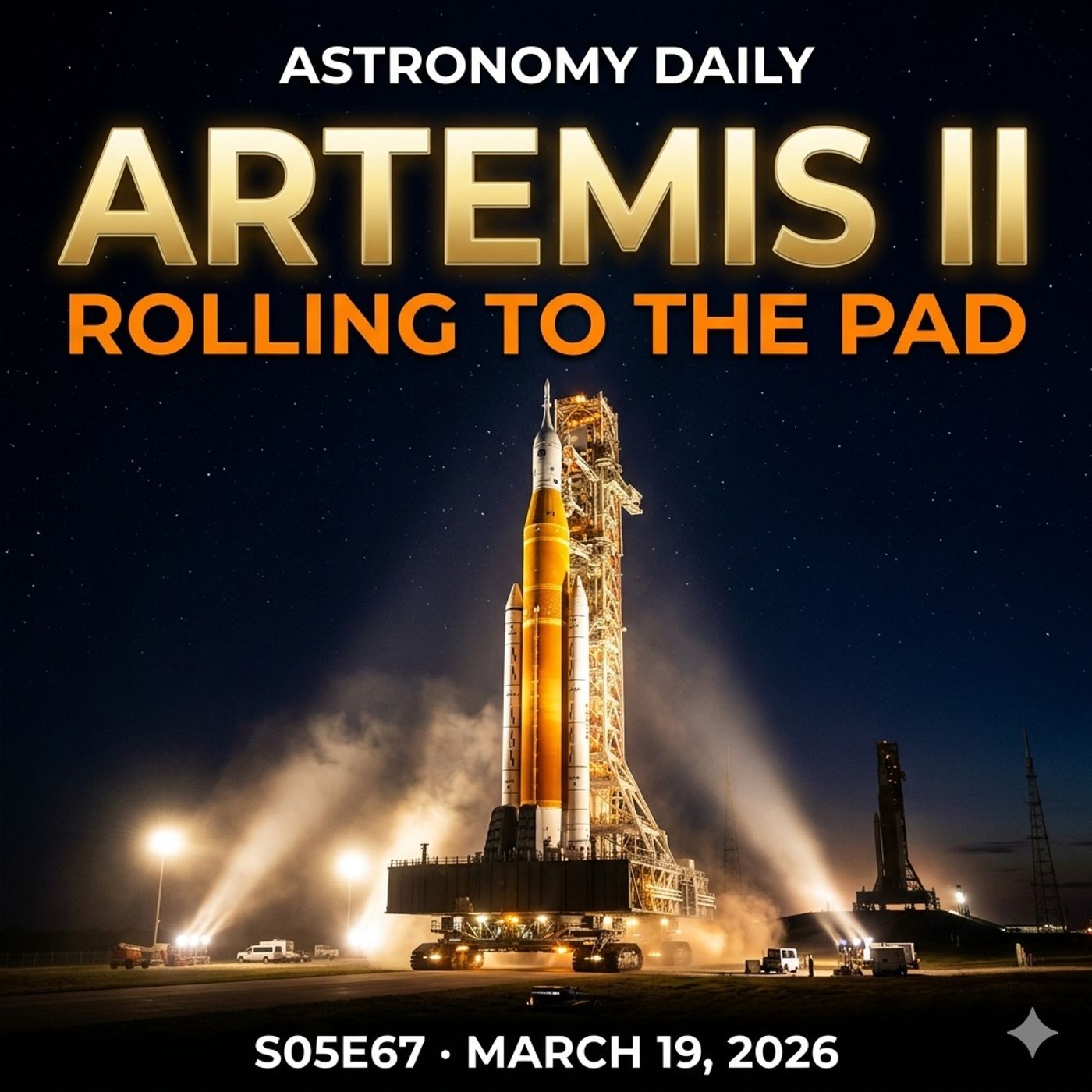
S5 Ep 67Moon Rocket Rolls Out, Dual Spacewalks & CERN's New Particle | March 19, 2026
A massive day in space as NASA's Artemis II moon rocket heads to the launchpad tonight, NASA and China both conduct spacewalks, CERN announces a brand-new particle, and astronomers reveal a nearby galaxy has been hiding the aftermath of a cosmic collision. Episode Highlights 🚀 Story 1: Artemis II Rollout — The Moon Rocket Heads to the Pad Tonight NASA is rolling the Artemis II Space Launch System and Orion spacecraft to Launch Pad 39B tonight (March 19), targeting an 8 p.m. EDT start for the slow 4-mile crawler journey. The April 1 launch window remains firmly on track. Crew members Reid Wiseman, Victor Glover, Christina Koch, and Jeremy Hansen have entered quarantine — making history as the first crew to venture to the vicinity of the Moon since 1972. Source: NASA Blogs / Space.com 👨🚀 Story 2: Dual Spacewalk Day — ISS & Tiangong Both Suit Up NASA astronauts Jessica Meir and Chris Williams completed U.S. Spacewalk 94 on March 18, spending 7 hours and 2 minutes preparing the ISS for a new roll-out solar array. Meanwhile on March 16, Shenzhou 21 commander Zhang Lu tied the Chinese EVA record with his sixth career spacewalk alongside crewmate Wu Fei outside China's Tiangong station. Sources: NASA / Space.com ⚛️ Story 3: CERN's LHCb Discovers New Doubly Charmed Particle The LHCb experiment at CERN announced the first discovery made by its upgraded detector: the Xi-cc-plus baryon, a proton-like particle containing two charm quarks and one down quark, making it roughly four times heavier than a proton. Detected at 7-sigma significance, it settles a two-decade-old scientific dispute and is the 80th particle discovered by LHCb. Source: CERN / Universe Today 🌌 Story 4: Small Magellanic Cloud Caught Mid-Transformation University of Arizona astronomers have confirmed that the Small Magellanic Cloud — one of the Milky Way's closest galactic neighbours — collided directly with the Large Magellanic Cloud a few hundred million years ago and is still reeling from the impact. The finding upends decades of assumptions about the SMC's use as a benchmark for early universe galaxy studies. Source: The Astrophysical Journal / Sky & Telescope 🪐 Story 5: Exotrojans — Hunting Asteroid Companions Around Other Stars A new paper in The Astrophysical Journal by Jackson Taylor (West Virginia University) and colleagues pushes the search for exotrojans — asteroid co-orbital companions to exoplanets — into some of the most extreme environments yet studied, as the hunt continues for the first confirmed detection. Source: The Astrophysical Journal / Universe Today 📡 Story 6: SETI Rethink — Time to Broaden the Search A new paper argues that the decades-long focus on narrow radio and microwave bandwidths in the search for alien signals may be too limiting, and proposes broadening the electromagnetic search to a much wider range of the spectrum. Source: Universe Today Find Us Everywhere • 🌐 Website: astronomydaily.io • 🐦 Twitter/X: @AstroDailyPod • 📸 Instagram: @AstroDailyPod • 🎵 TikTok: @AstroDailyPod • ▶️ YouTube: @AstroDailyPod • 📝 Tumblr: @AstroDailyPod • 🎙️ Part of the Bitesz.com Podcast NetworkBecome a supporter of this podcast: https://www.spreaker.com/podcast/astronomy-daily-space-news-updates--5648921/support.Sponsor Details:Ensure your online privacy by using NordVPN. To get our special listener deal and save a lot of money, visit www.bitesz.com/nordvpn. You'll be glad you did!Become a supporter of Astronomy Daily by joining our Supporters Club. Commercial free episodes daily are only a click way... Click HereThis episode includes AI-generated content.
S5 Ep 66Live ISS Spacewalk, Asteroid DNA Discovery, Aurora Alert & Artemis II Rollout
A packed episode today: a live spacewalk is underway at the ISS as we record, asteroid Ryugu has yielded all five DNA building blocks, a solar storm is heading for Earth overnight, Artemis II's moon rocket is about to roll out, and Blue Origin has unveiled an asteroid defence mission concept. Story 1 — ISS Spacewalk 94: Meir & Williams EVA NASA astronauts Jessica Meir and Chris Williams conducted U.S. spacewalk 94 today (March 18), exiting the ISS Quest airlock at approximately 8:00 a.m. EDT for a planned 6.5-hour EVA. The pair installed a modification kit and routed cables to prepare the 2A power channel for a future roll-out solar array (IROSA). It is Meir's fourth spacewalk and Williams' first. A second EVA (spacewalk 95) is planned for approximately April 1 to prep the 3B power channel. • Source: NASA — nasa.gov • Watch: NASA+, Amazon Prime, YouTube (search 'NASA spacewalk 94') Story 2 — Asteroid Ryugu: All Five DNA Building Blocks Found Samples returned from asteroid Ryugu by Japan's Hayabusa-2 mission contain all five canonical nucleobases — adenine, guanine, cytosine, thymine, and uracil — the building blocks of DNA and RNA. The findings, published March 16 in Nature Astronomy, suggest these life-essential compounds are widespread across the solar system and may have been delivered to early Earth by asteroid impacts. • Source: Nature Astronomy (DOI: 10.1038/s41550-026-02791-z) • Lead researcher: Dr. Toshiki Koga, JAMSTEC (Japan Agency for Marine-Earth Science and Technology) • Further reading: phys.org, space.com, gizmodo.com Story 3 — Aurora Alert: CME Arriving March 19 A coronal mass ejection (CME) produced by an M2.7 solar flare from active region AR4392 on March 16 is forecast to reach Earth on March 19. NOAA has issued a G2 (Moderate) geomagnetic storm watch, with potential for isolated G3 (Strong) conditions. Aurora could be visible across northern US states, Canada, and northern Europe overnight March 19–20. The timing coincides with the vernal equinox, enhancing the geomagnetic effect via the Russell-McPherron effect. • Source: NOAA Space Weather Prediction Center — swpc.noaa.gov • Aurora tracking: SpaceWeatherLive, My Aurora Forecast (apps) • Further reading: space.com, earthsky.org, watchers.news Story 4 — Artemis II: Rollout Decision Happening Today NASA's Artemis II SLS rocket is preparing to roll out from the Vehicle Assembly Building to Launch Pad 39B at Kennedy Space Center, with the final timing decision being made today (March 18). Engineers completed repairs faster than expected after fixing an electrical harness in the flight termination system. Rollout is expected March 19 or 20, preserving the April 1 launch window. The crew: Reid Wiseman, Victor Glover, Christina Koch (NASA), and Jeremy Hansen (CSA) — the first crewed mission to lunar space since Apollo 17 in 1972. • Source: NASA — nasa.gov/artemis, space.com • Launch window: April 1–6, 2026 (with additional dates available) • Watch the rollout livestream: NASA YouTube channel Story 5 — Blue Origin NEO Hunter: Asteroid Defence Blue Origin has partnered with NASA's Jet Propulsion Laboratory and Caltech to develop the NEO Hunter mission concept — a planetary defence system built on the Blue Ring spacecraft platform. NEO Hunter combines ion beam deflection (firing charged particles to nudge an asteroid off course) and 'Robust Kinetic Disruption' (crashing into the asteroid at up to 22,600 mph), with a dedicated 'Slamcam' satellite documenting any impact. No launch date has been announced. • Source: Blue Origin (via X / space.com, March 17, 2026) • Blue Ring platform: modular satellite bus supporting up to 4,000 kg payload • Partners: NASA Jet Propulsion Laboratory, California Institute of TechnologyBecome a supporter of this podcast: https://www.spreaker.com/podcast/astronomy-daily-space-news-updates--5648921/support.Sponsor Details:Ensure your online privacy by using NordVPN. To get our special listener deal and save a lot of money, visit www.bitesz.com/nordvpn. You'll be glad you did!Become a supporter of Astronomy Daily by joining our Supporters Club. Commercial free episodes daily are only a click way... Click HereThis episode includes AI-generated content.

S5 Ep 65The Rotten-Egg Planet, RBFLOAT's Secret Origin & Goddard's 100-Year Mystery
Astronomy Daily S05E65 — 17 March 2026 Six stories from the frontiers of space and astronomy, hosted by Anna and Avery. IN THIS EPISODE: • 🪐 JWST identifies a brand new class of exoplanet — a permanent magma ocean world with a hydrogen sulfide atmosphere 35 light-years from Earth • 📡 RBFLOAT — the brightest fast radio burst ever detected — is pinpointed to a galaxy 130 million light-years away, with a mysterious JWST infrared discovery at the same location • 🧑🚀 The first ISS spacewalk of 2026 is happening TOMORROW — NASA astronauts Jessica Meir and Chris Williams step outside at 8am EDT, March 18. Watch live on NASA+ • 🌊 Hidden water beneath Mars — new research suggests the Red Planet was habitable far longer than we thought, and Curiosity is investigating strange 'spiderweb' formations that reveal its watery history • 🚀 100 years ago yesterday, Robert Goddard launched the world's first liquid-fuelled rocket. But where is 'Nell' — the original rocket — today? The mystery of space history's greatest missing artefact • 🛸 MIT, MITRE and Sandia publish a Nature paper on a photonic chip that could replace bulky mechanical mirrors on spacecraft — a potential revolution in space communications and LiDAR SOURCE LINKS: • JWST / L 98-59 d magma planet (Nature Astronomy, 16 March 2026): phys.org/news/2026-03-class-molten-planet-abundant-sulfur.html • RBFLOAT fast radio burst papers (Astrophysical Journal Letters): sciencedaily.com/releases/2026/03/260315004348.htm • ISS Spacewalk 94 — live coverage: NASA+ / NASA YouTube (6:30am EDT, 18 March 2026) • Mars water research and Curiosity boxwork ridges: sciencedaily.com • Goddard centennial — collectSPACE: collectspace.com/news/news-031626a-robert-goddard-liquid-fuel-rocket-centennial-where-nell.html • MIT photonic chip paper (Nature): universetoday.com — March 16, 2026 Find us: astronomydaily.io | @AstroDailyPod on Twitter/X, Instagram, TikTok, YouTube, Tumblr Part of the Bitesz.com Podcast NetworkBecome a supporter of this podcast: https://www.spreaker.com/podcast/astronomy-daily-space-news-updates--5648921/support.Sponsor Details:Ensure your online privacy by using NordVPN. To get our special listener deal and save a lot of money, visit www.bitesz.com/nordvpn. You'll be glad you did!Become a supporter of Astronomy Daily by joining our Supporters Club. Commercial free episodes daily are only a click way... Click HereThis episode includes AI-generated content.
S5 Ep 64Goodbye, Star Traveller: 3I/ATLAS Bids Farewell at Jupiter
In today's episode of Astronomy Daily, Anna and Avery cover six remarkable stories spanning an interstellar farewell, a stunning pre-dawn sky show, a potential new Martian mineral, ghost particles from long-dead stars, a revolutionary new framework for detecting alien life, and the astonishing possibility of habitable moons drifting starless through the galaxy. Stories Covered in S05E64 1. 3I/ATLAS: The Interstellar Comet's Jupiter Farewell: Today marks the closest approach of interstellar comet 3I/ATLAS to Jupiter before it leaves our solar system forever. New ALMA data reveals the comet carries extraordinary levels of methanol — a chemical fingerprint from another solar system entirely. 2. Mercury, Mars & the Moon: Tonight and tomorrow morning, Mercury and Mars gather close to a crescent Moon in the pre-dawn sky. Southern Hemisphere observers have the best view. This week also brings the March equinox (March 20) and heightened aurora activity. 3. A New Mineral on Mars?: Scientists may have discovered a previously unknown mineral hidden in Mars's ancient sulfate deposits. Found by combining laboratory experiments with orbital spectroscopy, the potential discovery could shed new light on Mars's ancient watery past. 4. Ghost Particles from Dead Stars: Japan's upgraded Super-Kamiokande detector may detect the Diffuse Supernova Neutrino Background for the first time in 2026 — a faint signal from every supernova across cosmic history, including stars that exploded before Earth was born. 5. Life, But Not As We Know It: A new framework called Assembly Theory, published today in Universe Today, offers a way to detect alien life that bears no resemblance to life on Earth. Rather than searching for specific biosignature gases, it asks how complex the atmospheric chemistry is — and is designed for the upcoming Habitable Worlds Observatory. 6. Starless Moons: Moons orbiting free-floating planets — worlds ejected from their home solar systems — could sustain liquid water oceans for up to 4.3 billion years, powered by tidal heating and insulated by hydrogen atmospheres. No star required. Astronomy Daily is part of the Bitesz.com Podcast Network. New episodes every weekday. Website: astronomydaily.io Twitter/X: @AstroDailyPod Instagram: @AstroDailyPod TikTok: @AstroDailyPodBecome a supporter of this podcast: https://www.spreaker.com/podcast/astronomy-daily-space-news-updates--5648921/support.Sponsor Details:Ensure your online privacy by using NordVPN. To get our special listener deal and save a lot of money, visit www.bitesz.com/nordvpn. You'll be glad you did!Become a supporter of Astronomy Daily by joining our Supporters Club. Commercial free episodes daily are only a click way... Click HereThis episode includes AI-generated content.

S5 Ep 63The Sun's Great Galactic Road Trip, China's Moon Museum & a Pi Day Planet
Episode: S05E63 | Date: Saturday, 14 March 2026 Hosted by Anna & Avery | Astronomy Daily Podcast Network — Bitesz.com From galactic migrations to Pi Day planets, Episode 63 covers six stories that span the breadth of the solar system and beyond. Our Sun turns out to have hitched a ride outward from the Milky Way's interior billions of years ago — and brought thousands of stellar companions with it. China has named a leading candidate for its first crewed Moon landing. Russia is dusting off the legacy of the legendary Soviet Venera programme with an ambitious 2036 return to Venus. NASA's nuclear-powered Titan drone is now being physically built. China's Mars sample return mission is constructing actual spacecraft. And in honour of Pi Day, we visit the exoplanet whose year lasts almost exactly 3.14 days. Story 1: The Sun Was Part of a Galactic Migration of Solar Twins A new study in Astronomy & Astrophysics by researchers at Tokyo Metropolitan University and the National Astronomical Observatory of Japan has built the largest-ever catalogue of solar twins — 6,594 Sun-like stars. Using ESA's Gaia satellite, they found a clustering of stars aged 4–6 billion years, suggesting the Sun migrated outward from the Milky Way's inner regions billions of years ago, possibly when the galactic bar was still forming and its 'corotation barrier' was weak enough to allow mass stellar movement. This migration may have placed Earth in a calmer, more life-friendly region of the Galaxy. • Journal: Astronomy & Astrophysics (March 2026) • Lead researchers: Daisuke Taniguchi (Tokyo Metropolitan University) & Takuji Tsujimoto (NAOJ) • Data source: ESA Gaia satellite — catalogue of ~2 billion stars • Key finding: Sun likely formed ~10,000 light-years closer to the Galactic Centre than its current position Story 2: China Eyes Rimae Bode for Its First Crewed Moon Landing A study published in Nature Astronomy (9 March 2026) proposes Rimae Bode — a volcanic region near Sinus Aestuum on the lunar near side — as a prime candidate for China's first crewed lunar landing, targeted for 2030. The site contains five distinct terrain types including pyroclastic deposits, mare basalts, rille systems and highland material. Researcher Jun Huang (China University of Geosciences, Wuhan) described it as a 'geological museum.' Four specific landing spots within the region have been proposed. • Journal: Nature Astronomy (March 2026) • Lead researcher: Jun Huang, China University of Geosciences, Wuhan • Site: Rimae Bode, near Sinus Aestuum, lunar near side • Oldest volcanic activity in region: ~3.2–3.7 billion years ago • China's crewed lunar landing target: 2030 Story 3: Russia Plans Venera-D Mission to Venus in 2036 Russia's First Deputy Prime Minister Denis Manturov confirmed on 10 March 2026 that Russia plans to launch the Venera-D mission — comprising a lander, atmospheric balloon, and orbiter — to Venus in 2036. The mission would extend the legacy of the Soviet Venera programme (1961–1983), which remains the only national programme to have successfully landed on Venus. Scientific goals include searching for microbial life in Venus's clouds and studying the planet's atmosphere. • Mission: Venera-D (lander + balloon + orbiter) • Planned launch: 2036 • Agency: Roscosmos • Heritage: Soviet Venera programme — 16 missions, 1961–1983 • Science goal: Search for biosignatures in Venusian cloud layers (48–60 km altitude) • Source: TASS, citing Razvedchik Journal interview with Denis Manturov Story 4: NASA Begins Building Dragonfly — Nuclear-Powered Drone for Titan NASA and Johns Hopkins Applied Physics Laboratory (APL) officially began integration and testing of the Dragonfly rotorcraft on 10 March 2026. The car-sized, nuclear-powered octocopter is designed to fly across the surface of Saturn's moon Titan, targeting a 2028 launch on a SpaceX Falcon Heavy and arriving at Titan in 2034. It will explore diverse terrain including organic dunes and the Selk impact crater, studying prebiotic chemistry relevant to the origins of life. • Mission: Dragonfly | Agency: NASA / Johns Hopkins APL • Launch: No earlier than summer 2028 (SpaceX Falcon Heavy) • Arrival: Titan, 2034 | Mission duration: ~3.3 years • Power: Radioisotope thermoelectric generator (nuclear) • Range: >108 miles (175 km) across Titan's surface • Quote: "This milestone essentially marks the birth of our flight system." — Elizabeth Turtle, PI Story 5: China's Tianwen-3 Mars Sample Return Enters Construction Phase China's Tianwen-3 mission chief designer Liu Jizhong announced on 12 March 2026 that the mission has achieved key technology breakthroughs and is entering flight model development — building the actual spacecraft. Two Long March 5 rockets will launch in late 2028, carrying a lander/ascent vehicle and an orbiter/return spacecraft respectively. The goal is to return at least 500 grams of Martian samples to Earth by 2031 — what would be humanity's first Mars sample return. • Mis
S5 Ep 62Artemis II Gets Its Launch Date: April 1 | Magnetar Born | Planets Collide | S05E62
It’s a bumper Friday edition of Astronomy Daily. NASA gives Artemis II the official green light to launch on April 1st, marking the first crewed lunar mission in over 53 years. Astronomers witness the birth of a magnetar for the very first time, confirming a decade-old theory and demonstrating Einstein’s general relativity in a supernova. A star 11,000 light-years away shows evidence of two planets catastrophically colliding in real time. A bus-sized asteroid buzzed past Earth last night closer than the Moon, discovered just five days ago. A fast solar wind stream from a coronal hole could bring auroras to higher latitudes tonight. And scientists may have identified the source of the most energetic neutrino ever recorded. Story 1: Artemis II — Green Light for April 1 Launch NASA completed its Flight Readiness Review on 12 March 2026, with all mission teams voting unanimously ‘go’ for launch. The Space Launch System and Orion capsule will roll out to Launch Complex 39B on 19 March, with the primary launch window opening on 1 April at 6:24pm ET. Backup windows exist on 2–6 April and 30 April. The crew of four — Reid Wiseman, Victor Glover, Christina Koch, and Jeremy Hansen — will fly a 10-day figure-eight loop around the Moon. It will be the first crewed mission beyond low Earth orbit since Apollo 17 in December 1972. The previously planned Moon landing on Artemis III has been moved to Artemis IV, though NASA’s 2028 goal for a lunar landing remains unchanged. • NASA Artemis II Mission Page: https://www.nasa.gov/mission/artemis-ii/ • CNN coverage of FRR outcome: https://www.cnn.com/2026/03/12/science/nasa-artemis-2-launch-date-risk-assessment Story 2: First-Ever Observed Birth of a Magnetar Astronomers have for the first time directly observed the birth of a magnetar — a highly magnetized, rapidly spinning neutron star — confirming it as the power source behind some of the universe’s brightest stellar explosions. The discovery, published in Nature on 11 March 2026, centres on superluminous supernova SN 2024afav, located approximately one billion light-years from Earth. Graduate student Joseph Farah at UC Santa Barbara, working with Las Cumbres Observatory’s global telescope network, detected a distinctive ‘chirp’ pattern in the supernova’s fading light — four oscillations with shortening intervals. This pattern is explained by a wobbling accretion disc around the newborn magnetar, driven by Lense-Thirring precession — a general relativistic effect. The finding confirms a 2010 theory by UC Berkeley physicist Dan Kasen, and marks the first time general relativity has been required to explain supernova mechanics. • Berkeley News: https://news.berkeley.edu/2026/03/11/astronomers-capture-birth-of-a-magnetar-confirming-link-to-some-of-universes-brightest-exploding-stars/ • Space.com: https://www.space.com/astronomy/stars/astronomers-witness-colossal-supernova-explosion-create-one-of-the-most-magnetic-stars-in-the-universe-for-the-first-time Story 3: Two Planets Caught Colliding 11,000 Light-Years Away Researchers at the University of Washington have published evidence of a catastrophic planetary collision observed in real time around star Gaia20ehk, located approximately 11,000 light-years from Earth near the constellation Puppis. The star began flickering erratically from 2016, before its light output went ‘completely bonkers’ around 2021 — the signature of a massive debris cloud from two colliding worlds passing in front of the star. The debris orbits at roughly one astronomical unit from the star — the same as Earth’s distance from the Sun — and may eventually coalesce into new planetary bodies resembling an Earth-Moon system. The paper was published 11 March in The Astrophysical Journal Letters. • University of Washington: https://www.washington.edu/news/2026/03/11/uw-astronomers-spot-planet-collision-evidence/ • ScienceDaily: https://www.sciencedaily.com/releases/2026/03/260311213429.htm Story 4: Asteroid 2026 EG1 Flies Past Earth A bus-sized asteroid designated 2026 EG1 made its closest approach to Earth at 11:27pm EDT on 12 March 2026, passing just 197,466 miles away — closer than the Moon. Estimated at 32–72 feet (10–22 metres) across and travelling at over 21,500 mph, it posed no threat. Notably, the asteroid was only discovered on 8 March — five days before its flyby — highlighting the ongoing challenge of detecting small near-Earth objects with short warning times. NASA’s Vera Rubin Observatory has already catalogued over 2,000 previously unknown solar system bodies since beginning operations. • Space.com: https://www.space.com/stargazing/bus-sized-asteroid-will-fly-past-earth-tonight-mere-days-after-being-discovered-heres-what-to-expect-march-12-2026 Story 5: Solar Wind & Aurora Alert A fast-moving stream of solar wind from a large coronal hole on the Sun is expected to reach Earth on 13 March 2026, potentially triggering G1 (minor) geomagnetic storm conditions. Auroras may be visible from higher lat

S5 Ep 61Tipsy Comet: Interstellar Visitor Loaded With Alcohol
In today's episode of Astronomy Daily — S05E61, Thursday 12 March 2026 — Anna and Avery cover six of the biggest stories in space and astronomy from the past 24 hours. Stories in this episode: • 3I/ATLAS, our third confirmed interstellar visitor, has been found to be extraordinarily rich in methanol — a type of alcohol — with ALMA observations revealing methanol-to-hydrogen cyanide ratios far beyond almost any known solar system comet. The findings offer a chemical fingerprint of a distant planetary system, and the comet makes its closest pass to Jupiter on March 16. • Firefly Aerospace's Alpha rocket successfully returned to flight on March 11, completing its seventh mission — 'Stairway to Seven' — after an 11-month stand-down following two mishaps in 2025. The mission also validated key Block II upgrade systems ahead of the next-generation rocket's debut on Flight 8. • NASA held its Artemis II Flight Readiness Review today at Kennedy Space Center, a critical milestone ahead of a potential April launch. The SLS/Orion stack is being prepared for its second rollout after a helium flow issue was repaired in the Vehicle Assembly Building. • A landmark helioseismology study from the University of Birmingham and Yale, drawing on 40 years of data from the Birmingham Solar-Oscillations Network, reveals that the Sun's internal structure shifts measurably between solar cycle minima — with implications for space weather forecasting. • NASA's Van Allen Probe A reentered Earth's atmosphere on March 11, eight years earlier than expected, with the current active solar cycle responsible for accelerating its orbital decay. Most of the 600kg spacecraft burned up over the eastern Pacific. • Astronomers using ESO's Very Large Telescope have discovered a third gas cloud — G2t — orbiting Sagittarius A*, the Milky Way's central supermassive black hole. Its near-identical orbit to the previously known G1 and G2 clouds suggests all three likely originated from the same binary star system. Find full episodes, transcripts and more at astronomydaily.io. Follow us @AstroDailyPod on all major platforms.Become a supporter of this podcast: https://www.spreaker.com/podcast/astronomy-daily-space-news-updates--5648921/support.Sponsor Details:Ensure your online privacy by using NordVPN. To get our special listener deal and save a lot of money, visit www.bitesz.com/nordvpn. You'll be glad you did!Become a supporter of Astronomy Daily by joining our Supporters Club. Commercial free episodes daily are only a click way... Click HereThis episode includes AI-generated content.

S5 Ep 60Gold From a Galactic Collision — Neutron Star Crash Stuns Astronomers | Astronomy Daily S05E60
Welcome to Episode 60 of Astronomy Daily Season Five! In today's episode, Anna and Avery cover six major stories from the world of space and astronomy — including a neutron star collision in an unprecedented location, the latest Artemis II news, and a cosmic mystery solved after decades. Stories covered in this episode: 1. NASA Discovers Neutron Star Crash in Unexpected Location A fleet of NASA telescopes — including Chandra, Fermi, Swift, and Hubble — has detected a neutron star merger inside a tiny galaxy buried in a vast stream of gas, 4.7 billion light-years away. It's the first time this type of collision has been spotted in such an environment, and it may explain why gamma-ray bursts sometimes appear outside any galaxy — and how precious metals like gold and platinum ended up in distant stellar regions. Published in The Astrophysical Journal Letters. 2. Artemis II Flight Readiness Review NASA will host a Flight Readiness Review press conference on Thursday 12 March at Kennedy Space Center, covering progress toward the first crewed Artemis mission. The rocket is currently back in the Vehicle Assembly Building following a helium issue, with rollout to the launchpad expected around 19 March and a launch target of no earlier than 1 April 2026. 3. Firefly Alpha 'Stairway to Seven' Scrubbed Again Firefly Aerospace's Alpha rocket — attempting its return to flight after a 10-month grounding — has been scrubbed three times in 10 days. The latest scrub occurred on 10 March during fluid loading after off-nominal readings. A new launch date will be confirmed following engineering review. This mission is the final Block I Alpha flight, with the upgraded Block II debuting on Flight 8. 4. DART Mission Reveals 'Cosmic Snowball Fight' Between Asteroids Researchers at the University of Maryland have found the first direct visual proof of material transfer between two asteroids — fan-shaped streaks on the surface of asteroid moon Dimorphos, left by debris thrown off its parent asteroid Didymos at just 30.7 cm/s. The discovery provides visual confirmation of the YORP effect and has implications for planetary defence modelling. ESA's Hera mission arrives at Didymos in December 2026. Published in The Planetary Science Journal. 5. Starship Flight 12 — About Four Weeks Away SpaceX is approximately four weeks from the launch of Starship Flight 12, which will be the first flight of the upgraded V3 configuration — the most powerful version of the already record-breaking vehicle. Engineers have completed propellant system tests on Ship 39 at Starbase, Texas, and preflight preparations are continuing. 6. Giant Cosmic Sheet Discovered Around the Milky Way Astronomers from the University of Groningen, publishing in Nature Astronomy, have used advanced computer simulations to discover that the matter surrounding our Local Group is arranged in a vast, flat sheet — dominated by dark matter — stretching tens of millions of light-years across. This structure, flanked by enormous empty voids, explains why nearby galaxies are moving away from us rather than being pulled inward. It's the first detailed map of dark matter distribution in our cosmic neighbourhood. Astronomy Daily is part of the Bitesz.com Podcast Network. Website: astronomydaily.io | Social: @AstroDailyPod on all major platformsBecome a supporter of this podcast: https://www.spreaker.com/podcast/astronomy-daily-space-news-updates--5648921/support.Sponsor Details:Ensure your online privacy by using NordVPN. To get our special listener deal and save a lot of money, visit www.bitesz.com/nordvpn. You'll be glad you did!Become a supporter of Astronomy Daily by joining our Supporters Club. Commercial free episodes daily are only a click way... Click HereThis episode includes AI-generated content.
S5 Ep 59Satellite Down, Meteorite Strike, ISS Saved & More
A 1,300-pound NASA satellite is falling back to Earth today, a meteorite punched through a German roof after a dazzling European fireball, Congress wants to keep the International Space Station flying until 2032, ALMA has captured the largest-ever image of the Milky Way's core, astronomers have mapped a hidden 'sea of light' from 10 billion years ago, and Jupiter appears to reverse direction in tonight's sky. Stories Covered 1. Van Allen Probe A Falls to Earth: NASA's 600kg Van Allen Probe A — launched in 2012 to study Earth's radiation belts — is making an unplanned early return to Earth today, March 10, 2026. Deactivated in 2019 after a seven-year mission, its descent was accelerated by unexpectedly high solar activity expanding Earth's atmosphere. Most of the spacecraft will burn up on reentry; the risk of any harm to people on the ground is approximately 1 in 4,200. 2. German Meteorite Strike: On the evening of Sunday 8 March, a brilliant fireball lit up the skies over Belgium, France, Germany, Luxembourg and the Netherlands, attracting over 3,000 reports to the International Meteor Organization. Fragments reached the ground in Koblenz, Germany — with the largest piece punching a football-sized hole through the roof of a residential building. No one was injured. ESA's Planetary Defence team estimates the original object was just a few metres across. 3. ISS Extended to 2032: The NASA Authorization Act of 2026 has passed the Senate Commerce Committee with bipartisan support, pushing the ISS retirement date from 2030 to September 2032. The extension aims to prevent a gap in U.S. human presence in low Earth orbit while commercial successor stations are developed. The bill also rejects proposed cuts to NASA's budget and funds key programmes including the Chandra X-ray Observatory. 4. ALMA's Milky Way Mosaic: The ALMA CMZ Exploration Survey (ACES) has produced the largest ALMA image ever — a sweeping 650-light-year mosaic of the Milky Way's Central Molecular Zone, assembled from hundreds of observations by over 160 scientists worldwide. The image reveals a intricate web of cold gas filaments feeding star formation near supermassive black hole Sagittarius A*, and detects dozens of molecules from simple silicon compounds to complex organics like methanol and ethanol. 5. 3D Map of the Early Universe: Using data from the Hobby-Eberly Telescope Dark Energy Experiment (HETDEX), astronomers have created the largest 3D map yet of the universe as it appeared 9–11 billion years ago — during 'cosmic noon', the peak era of star formation. By tracking Lyman-alpha light from energised hydrogen rather than individual galaxies, the team revealed a hidden 'sea of light' filling the spaces between galaxies. The dataset comprised over 600 million spectra, with 95% still untapped for future research. 6. Jupiter's Retrograde Motion: Tonight, Jupiter begins its apparent reversal of direction against the background stars — a well-known optical illusion called retrograde motion caused by Earth overtaking the slower-moving outer planet in its orbit. Jupiter is well-placed in the evening sky and easily visible to the naked eye; binoculars will reveal its four bright Galilean moons. Links & Resources NASA Van Allen Probe A reentry update: nasa.gov/missions/van-allen-probes ESA fireball analysis: esa.int/Space_Safety/Planetary_Defence ALMA ACES Survey: almaobservatory.org | ESO press release: eso.org/public/news/eso2603/ HETDEX project: hetdex.org Astronomy Daily: astronomydaily.io | @AstroDailyPod on all platformsBecome a supporter of this podcast: https://www.spreaker.com/podcast/astronomy-daily-space-news-updates--5648921/support.Sponsor Details:Ensure your online privacy by using NordVPN. To get our special listener deal and save a lot of money, visit www.bitesz.com/nordvpn. You'll be glad you did!Become a supporter of Astronomy Daily by joining our Supporters Club. Commercial free episodes daily are only a click way... Click HereThis episode includes AI-generated content.
S5 Ep 58Are We Missing Alien Signals? Space Weather, Brain Changes and the Mars Life Question
In today's episode, Anna and Avery explore five of the week's most compelling space and astronomy stories: a new SETI Institute study suggesting stellar space weather could be scrambling alien radio signals before they even leave their home systems; groundbreaking research revealing that spaceflight physically shifts and deforms the human brain inside the skull; the impressive engineering story behind Roscosmos restoring Baikonur's launch pad in record time ahead of the Progress MS-33 mission; a surprising new finding from Nature that Earth's elliptical orbit plays a much bigger role in shaping El Niño and global weather patterns than previously thought; and the endlessly fascinating question of whether asteroid impacts could allow microbes to travel between planets — including the possibility that life on Earth may have originated on Mars. Stories Covered • Why SETI may be missing alien radio signals — space weather around distant stars could be smearing narrowband signals beyond the reach of current detectors (SETI Institute, March 2026) • Spaceflight physically shifts and deforms the brain inside the skull — new MRI study of 26 astronauts published in PNAS reveals extent of microgravity's neurological impact (University of Florida, March 2026) • Baikonur's Site 31/6 launch pad fully restored after November 2025 damage — over 150 workers complete repairs in under two months, clearing path for Progress MS-33 on March 22 (NASASpaceFlight, March 2026) • Earth's distance from the Sun found to dramatically alter seasons — new Nature study shows orbital eccentricity drives its own annual cycle in the Pacific cold tongue, influencing El Niño over millennia (UC Berkeley, March 2026) • Did Earth life begin on Mars? New research examines how asteroid impacts could allow microbes to travel between planets via ejected rock (Universe Today, March 2026) Connect With Us Website: astronomydaily.io Twitter/X, Instagram, TikTok, YouTube, Tumblr: @AstroDailyPod Part of the Bitesz.com Podcast NetworkBecome a supporter of this podcast: https://www.spreaker.com/podcast/astronomy-daily-space-news-updates--5648921/support.Sponsor Details:Ensure your online privacy by using NordVPN. To get our special listener deal and save a lot of money, visit www.bitesz.com/nordvpn. You'll be glad you did!Become a supporter of Astronomy Daily by joining our Supporters Club. Commercial free episodes daily are only a click way... Click HereThis episode includes AI-generated content.
S5 Ep 57Humanity Just Moved an Asteroid's Orbit Around the Sun
ASTRONOMY DAILY — S05E57 | Saturday 7 March 2026 A landmark week for planetary defence — scientists confirm that NASA's DART impact didn't just move an asteroid's orbit around its companion, it shifted the entire binary system's path around the Sun. Plus: gravitational waves double, a European spacecraft goes silent, a 45-year theory bites the dust, a young Sun caught in the act — and a double planet show in tonight's sky. In This Episode • [00:00] Cold Open — Humanity moved a solar orbit • [02:00] Story 1: DART changed Didymos's orbit around the Sun (Science Advances, March 2026) • [06:00] Story 2: LIGO-Virgo-KAGRA doubles the gravitational wave catalog with GWTC-4 • [10:00] Story 3: ESA's Proba-3 Coronagraph spacecraft goes dark — recovery underway • [13:00] Story 4: Stars keep their rotation pattern for life — 45-year theory overturned (Nature Astronomy) • [16:30] Story 5: Chandra captures first astrosphere around a Sun-like star • [19:30] Story 6: Venus and Saturn pair up in tonight's sky — skywatching guide Connect With Us • Website & Blog: astronomydaily.io • Social: @AstroDailyPod • Network: Bitesz.com Podcast NetworkBecome a supporter of this podcast: https://www.spreaker.com/podcast/astronomy-daily-space-news-updates--5648921/support.Sponsor Details:Ensure your online privacy by using NordVPN. To get our special listener deal and save a lot of money, visit www.bitesz.com/nordvpn. You'll be glad you did!Become a supporter of Astronomy Daily by joining our Supporters Club. Commercial free episodes daily are only a click way... Click HereThis episode includes AI-generated content.

S5 Ep 56Moon Safe! Asteroid Threat Ends + Cosmic Laser Record + Solar Storm Hits Mars
Astronomy Daily — S05E55 | 6 March 2026 Six stories today covering planetary defence, a cosmic laser record, a solar superstorm on Mars, space debris pollution, a mystery satellite launch, and the most charming farming experiment you'll hear about all year. Stories This Episode 1. Asteroid 2024 YR4 — Moon Impact Officially Ruled Out NASA has confirmed, using the James Webb Space Telescope, that infamous asteroid 2024 YR4 will not hit the Moon in 2032. The space rock — once the most dangerous asteroid identified in two decades — will instead pass the Moon at a distance of around 13,200 miles. It previously held a 4% lunar impact probability, now fully eliminated thanks to Webb's extraordinary sensitivity pushing it to the limits of what the telescope can observe. 2. MeerKAT Detects Cosmic 'Gigalaser' 8 Billion Light-Years Away South Africa's MeerKAT radio telescope has spotted the most distant hydroxyl megamaser ever detected — a natural 'space laser' in a galaxy undergoing a violent collision more than 8 billion light-years away. The signal is so powerful it qualifies as a gigamaser. Adding to the serendipity, the signal was further amplified by a foreground galaxy acting as a gravitational lens on its 8-billion-year journey to Earth. The discovery points toward the future capability of the Square Kilometre Array (SKA). 3. ESA's Mars Orbiters Record Solar Superstorm Hitting Mars A new Nature Communications study reveals what happened when the record-breaking May 2024 solar superstorm hit Mars. ESA's Mars Express and ExoMars Trace Gas Orbiter recorded unprecedented electron density spikes in the Martian upper atmosphere — up to 278% above normal — and both spacecraft experienced computer glitches from the energetic particles. The study uses a novel spacecraft-to-spacecraft radio occultation technique and highlights how Mars's lack of a global magnetic field leaves it vulnerable to solar events in ways that Earth is not. 4. SpaceX Falcon 9 Re-entry Directly Linked to Atmospheric Lithium Plume For the first time, scientists have directly tied a specific rocket re-entry to a measurable atmospheric pollution event. Researchers at the Leibniz Institute for Atmospheric Physics detected a tenfold spike in lithium vapour in the upper atmosphere — from 3 to 31 atoms per cubic centimetre — in the hours following the uncontrolled re-entry of a Falcon 9 upper stage off Ireland in February 2025. Eight thousand backward atmospheric simulations confirmed the connection. Published in Communications Earth & Environment, the paper raises important questions about the growing chemical footprint of the commercial space industry. 5. Rocket Lab Launches Mystery Satellite — 'Insight at Speed is a Friend Indeed' Rocket Lab completed its 83rd Electron launch from New Zealand, deploying a single satellite for a confidential commercial customer to an orbit 470 km above Earth. The company announced the mission just hours before liftoff, offering no further details on the customer or the payload's purpose. 6. Scientists Grow Chickpeas in Simulated Moon Dirt for First Time Researchers at the University of Texas at Austin and Texas A&M University have successfully grown and harvested chickpeas in simulated lunar regolith — the first time this has ever been achieved. Using a combination of vermicompost (worm castings) and arbuscular mycorrhizal fungi to condition the otherwise toxic, sterile moon dirt, the team produced flowering, seed-bearing plants in soil mixtures of up to 75% regolith simulant. The chickpeas have not yet been cleared for eating pending metal accumulation testing — but the team's goal of 'moon hummus' is, apparently, very much alive. Find Us: astronomydaily.io | @AstroDailyPod on all platforms Subscribe & Review: Apple Podcasts · Spotify · YouTube · everywhere you listenBecome a supporter of this podcast: https://www.spreaker.com/podcast/astronomy-daily-space-news-updates--5648921/support.Sponsor Details:Ensure your online privacy by using NordVPN. To get our special listener deal and save a lot of money, visit www.bitesz.com/nordvpn. You'll be glad you did!Become a supporter of Astronomy Daily by joining our Supporters Club. Commercial free episodes daily are only a click way... Click HereThis episode includes AI-generated content.
S5 Ep 55Auroras on Ganymede, Superflare Warnings and Japan’s Very Bad Week
Welcome back to Astronomy Daily! In S05E55, Anna and Avery explore six fascinating stories from across the cosmos — from auroras on Jupiter’s largest moon to the latest JWST galaxy reveal, a breakthrough solar storm warning system, a beautiful combined nebula image, Japan’s ongoing rocket struggles, and Europe’s ambitious plans for orbital repair robots. Stories This Episode 1. Ganymede’s Auroras Mirror Earth’s Northern Lights Scientists using data from NASA’s Juno spacecraft have revealed that Jupiter’s largest moon Ganymede has fragmented, patch-like auroras remarkably similar to those seen on Earth. The research, led by the University of Liège and published in Astronomy & Astrophysics, suggests that the fundamental physical processes generating auroras may be universal across magnetised bodies in the solar system. Ganymede is the only moon known to have its own intrinsic magnetic field. 2. New Solar Superflare Forecasting System An international team has developed the first system capable of predicting when and where extreme solar storms are likely to occur, with up to a year’s advance warning. By analysing 50 years of X-ray data, researchers identified a 1.7-year and a 7-year solar cycle whose alignment predicts high-risk periods. The current window (mid-2025 to mid-2026) is flagged as elevated danger. Published in the Journal of Geophysical Research: Space Physics. 3. Cat’s Eye Nebula — Euclid and Hubble Combined NASA and ESA have combined imagery from the Euclid and Hubble space telescopes to produce a breathtaking new composite view of the Cat’s Eye Nebula — the glowing remnant of a dying star about 3,000 light-years away in Draco. The image showcases the nebula’s complex layered shells and intricate inner structure in unprecedented detail. 4. JWST Reveals Spiral Galaxy NGC 5134 The James Webb Space Telescope has captured a stunning infrared portrait of NGC 5134, a barred spiral galaxy 65 million light-years away. Webb’s infrared capability pierces through galactic dust to reveal glowing stellar nurseries and the full cycle of star birth and evolution playing out across the galaxy’s spiral arms. 5. Japan’s Kairos Rocket — Safety Abort on Third Attempt Space One’s Kairos No. 3 rocket was aborted just 30 seconds before liftoff on March 4 when a safety monitoring system detected unstable positioning satellite signals. Following two failed launches in 2024 and multiple weather scrubs this week, the company has yet to set a new launch date. The window remains open until March 25. A successful launch would mark the first orbital success for a fully private Japanese rocket. 6. Europe’s Orbital Repair Robots European companies led by Thales Alenia Space are developing robotic satellites capable of refuelling, repairing and repositioning spacecraft in orbit. A demonstration mission is planned for 2028. With nearly 15,000 operational satellites now in orbit — most never designed to be serviced — the in-orbit servicing market could transform how we manage space infrastructure. Regulatory questions around liability remain unresolved. Links & Further Reading Full show notes, images and source links: astronomydaily.io Listen on: Apple Podcasts | Spotify | Amazon Music | All podcast platforms Watch on: YouTube — Astronomy Daily Follow us: @AstroDailyPod on Twitter/X, Instagram, Facebook, TikTok, Tumblr Part of the Bitesz.com Podcast NetworkBecome a supporter of this podcast: https://www.spreaker.com/podcast/astronomy-daily-space-news-updates--5648921/support.Sponsor Details:Ensure your online privacy by using NordVPN. To get our special listener deal and save a lot of money, visit www.bitesz.com/nordvpn. You'll be glad you did!Become a supporter of Astronomy Daily by joining our Supporters Club. Commercial free episodes daily are only a click way... Click HereThis episode includes AI-generated content.
S5 Ep 54Blood Moon, Broken Records & the Hubble Mystery
The Blood Moon has come and gone — and what a show it was. In today's Astronomy Daily, Anna and Avery recap last night's total lunar eclipse, the last visible from North America until New Year's Eve 2028. Plus: NASA confirms Artemis 2 repairs are complete and an April crewed Moon mission is back on track. Astronomers have found the most tightly packed quadruple star system ever discovered — four stars crammed into a space no bigger than Jupiter's orbit. Gravitational waves could be about to solve one of cosmology's biggest mysteries: the Hubble Tension. The world's first private commercial space telescope has captured its first star. And finally — why do physicists say interstellar travel is impossible and aliens definitely haven't visited? In This Episode • 00:00 — Cold Open & Show Introduction • 02:00 — Story 1: Blood Moon Total Lunar Eclipse Recap • 06:00 — Story 2: Artemis 2 Repairs Complete, April Launch on Track • 09:00 — Story 3: Record-Breaking Quadruple Star System TIC 120362137 • 12:30 — Story 4: Gravitational Waves and the Hubble Tension • 15:30 — Story 5: Mauve — World's First Private Space Telescope • 18:30 — Story 6: Why Interstellar Travel Is Impossible • 22:00 — Show Close Find Us • Website: astronomydaily.io • Social: @AstroDailyPod • Network: Bitesz.com Podcast NetworkBecome a supporter of this podcast: https://www.spreaker.com/podcast/astronomy-daily-space-news-updates--5648921/support.Sponsor Details:Ensure your online privacy by using NordVPN. To get our special listener deal and save a lot of money, visit www.bitesz.com/nordvpn. You'll be glad you did!Become a supporter of Astronomy Daily by joining our Supporters Club. Commercial free episodes daily are only a click way... Click HereThis episode includes AI-generated content.
S5 Ep 53What the Heck Is This Planet?
In today’s episode, Anna and Avery cover six stories from across the space and astronomy world — including a seismic shift in NASA’s Artemis program, a jaw-dropping Webb telescope discovery, fresh imagery of an interstellar comet, and the debut of a powerful new reusable rocket from China. 🚀 IN THIS EPISODE • NASA officially redesigns Artemis 3 — no Moon landing, and SpaceX’s Starship may not even fly on the mission • The James Webb Space Telescope discovers PSR J2322-2650b: a lemon-shaped exoplanet orbiting a pulsar every 7.8 hours, with a carbon-rich atmosphere that defies all known planetary science • A new ‘stochastic siren’ method using gravitational waves from merging black holes could finally resolve the Hubble tension — one of physics’ deepest mysteries • ESA’s JUICE spacecraft captures its first detailed image of interstellar comet 3I/ATLAS, revealing a glowing coma and sweeping tail • This week’s global launch roundup: Japan’s Kairos rocket makes its third attempt, and SpaceX eyes its 600th Falcon booster recovery • China’s CAS Space prepares to debut Kinetica-2, a reusable heavy-lift rocket targeting late March 🔗 LEARN MORE • Full episode details and blog post: astronomydaily.io • NASA Artemis updates: nasa.gov/artemis • Webb telescope news: science.nasa.gov/mission/webb ⭐ SUBSCRIBE & REVIEW If you enjoyed this episode, please leave us a review — it helps other space enthusiasts find the show. New episodes every weekday. Find us: astronomydaily.io • @AstroDailyPod • Bitesz.com Podcast NetworkBecome a supporter of this podcast: https://www.spreaker.com/podcast/astronomy-daily-space-news-updates--5648921/support.Sponsor Details:Ensure your online privacy by using NordVPN. To get our special listener deal and save a lot of money, visit www.bitesz.com/nordvpn. You'll be glad you did!Become a supporter of Astronomy Daily by joining our Supporters Club. Commercial free episodes daily are only a click way... Click HereThis episode includes AI-generated content.
S5 Ep 52Tonight the Moon Turns Red — Plus Five More Space Stories You Need to Hear
Tonight's sky is putting on a show — and we've got all the science to go with it! In this episode, Anna and Avery cover six incredible stories: a Blood Moon total lunar eclipse happening tonight, a revolutionary new telescope issuing 800,000 cosmic alerts in a single night, the violent origin story of Saturn's rings and its moon Titan, new research revealing Earth's magnetic poles can take 70,000 years to reverse, the James Webb Space Telescope mapping Uranus in 3D, and a wild — and cautionary — tale about the legal status of Apollo moon rocks. STORIES THIS EPISODE 1. 🌕 Blood Moon Tonight — Total Lunar Eclipse March 2/3 A total lunar eclipse turns the Moon blood red tonight, visible from North America, Australia, New Zealand and Asia. Totality begins at 6:04 a.m. ET and lasts 59 minutes — the last blood moon until 2028. We explain why the Moon turns red and how to catch the rare 'selenelion' phenomenon. 2. 🔭 Vera Rubin Observatory — 800,000 Alerts in One Night The Vera Rubin Observatory — home to the world's largest digital camera at 3.2 gigapixels — issued 800,000 alerts to astronomers in a single night on February 24. At full capacity it could generate 7 million alerts nightly, revolutionising real-time astronomy. 3. 🪐 Titan & Saturn's Rings — Born from One Catastrophic Collision New research suggests Saturn's largest moon, Titan, formed from a colossal collision between two older moons hundreds of millions of years ago — and that same impact created Saturn's iconic rings. One event, two iconic solar system features. 4. 🌍 Earth's Magnetic Poles — 70,000 Years to Flip Scientists analysing 40-million-year-old deep-sea sediment cores have found evidence of a geomagnetic reversal that lasted 70,000 years — far longer than the 10,000-year benchmark. During that time, Earth's weakened magnetic field would have exposed the planet to significantly higher cosmic radiation. 5. ⭐ Webb Maps Uranus in 3D — Wild Auroras Revealed The James Webb Space Telescope has produced the first 3D map of Uranus's upper atmosphere using its Near Infrared Spectrometer, revealing complex auroras unlike anything seen before and mapping the structure of its ionosphere in unprecedented detail. 6. 🌑 Moon Rocks & the Law — Don't Even Think About It! Apollo moon rocks are US federal property — and buying, selling or owning them is a serious federal crime. We tell the extraordinary story of the 2002 NASA intern heist, and explain the one legal way you can own a piece of the Moon. USEFUL LINKS • Eclipse times for your location: timeanddate.com/eclipse • Vera Rubin Observatory: rubinobservatory.org • NASA Lunar Sample Laboratory: curator.jsc.nasa.gov • Astronomy Daily website: astronomydaily.io • Follow us on social: @AstroDailyPodBecome a supporter of this podcast: https://www.spreaker.com/podcast/astronomy-daily-space-news-updates--5648921/support.Sponsor Details:Ensure your online privacy by using NordVPN. To get our special listener deal and save a lot of money, visit www.bitesz.com/nordvpn. You'll be glad you did!Become a supporter of Astronomy Daily by joining our Supporters Club. Commercial free episodes daily are only a click way... Click HereThis episode includes AI-generated content.

S5 Ep 51NASA Artemis Overhaul, Vulcan Centaur Grounded, and the Milky Way's True Origin Story
NASA rewrites the Artemis roadmap, the Space Force grounds Vulcan Centaur, astronomers peer back 11 billion years to the universe's most extraordinary construction site, water bears reveal surprising secrets about Martian soil, NASA passes a key milestone in extracting oxygen from lunar regolith, and ancient stellar lighthouses rewrite the Milky Way's origin story. Plus — six planets in tonight's sky.📰 STORIES THIS EPISODE1 — NASA Overhauls the Artemis Programme NASA Administrator Jared Isaacman announced a sweeping restructure of the Artemis Moon programme on Friday 27 February. The headline change: Artemis III will no longer attempt a crewed lunar landing. Instead it has been redesigned as a low Earth orbit test flight in 2027, where astronauts will dock with the SpaceX Starship Human Landing System and potentially Blue Origin's Blue Moon lander, testing suits, life support and rendezvous procedures before anyone attempts a surface landing. The Block 1B SLS upgrade has been scrapped, vehicle configuration standardised, and NASA is targeting annual Moon landings from Artemis IV and V in 2028, with at least one surface landing per year thereafter. Isaacman invoked Apollo's step-by-step approach as his model — pointing out the programme was essentially jumping from Apollo 8 to the Moon landing without the intervening tests. The Lunar Gateway space station was notably absent from the announcement. Artemis II — the crewed flight around the Moon — remains on track for no earlier than 1 April 2026 pending resolution of a helium pressurisation issue. 2 — Space Force Grounds Vulcan Centaur The U.S. Space Force has placed an indefinite hold on all national security launches aboard ULA's Vulcan Centaur rocket following a repeat solid rocket booster anomaly during the USSF-87 mission on 12 February — the rocket's fourth flight. A booster nozzle appeared to separate during ascent, mirroring an incident on Vulcan's second certification flight in October 2024. The payloads were successfully delivered, but Space Force Col. Eric Zarybnisky confirmed at the AFA Warfare Symposium that no further Vulcan national security missions will fly until the issue is fully resolved. With over a dozen military launches manifested for 2026, the grounding threatens significant disruption to the Pentagon's launch schedule. 3 — The Universe's Most Extraordinary Construction Site Astronomers using the Very Large Array and ALMA telescope have discovered J0846 — the first strongly gravitationally lensed protocluster core ever found. A foreground galaxy cluster is acting as a cosmic zoom lens, magnifying a cluster of at least 11 furiously star-forming galaxies more than 11 billion light years away — all crammed into a region smaller than the distance between the Milky Way and Andromeda. Completely invisible to optical telescopes due to dense dust shrouding, ALMA's detection of cold dust and gas revealed the extraordinary scene. Lead researcher Nicholas Foo (Arizona State University) describes it as catching a galaxy cluster in the very first chapter of its life. 4 — Could Mars Soil Actually Block Earth Microbes? A Penn State-led international team published findings in the International Journal of Astrobiology showing that simulated Martian regolith significantly suppresses tardigrade (water bear) activity — one of the toughest creatures on Earth. Critically, rinsing the regolith with water largely reversed the harmful effect, suggesting the culprit is a water-soluble compound — possibly salts or perchlorates detected by previous Mars missions. The dual implication: Martian soil may naturally protect the Red Planet from Earth contamination, and could potentially be treated to support plant growth in future habitats. 5 — Extracting Oxygen from Lunar Soil — A Major Milestone NASA's Carbothermal Reduction Demonstration (CaRD) project has passed a key integrated prototype test aboard the ISS, confirming that concentrated solar energy can drive a chemical reaction in simulated lunar regolith to produce carbon monoxide — which can then be converted into breathable oxygen. Lunar regolith is approximately 45% oxygen by mass, locked in silicate minerals. The integrated system combines hardware from Sierra Space, NASA Glenn, Composite Mirror Applications, and Kennedy Space Center. Beyond breathing air, the process could produce rocket propellant in-situ — directly relevant to this week's Artemis restructuring and the goal of a permanent lunar presence. 6 — Ancient Stellar Lighthouses Rewrite the Milky Way's Origin Story Using the largest-ever catalogue of RR Lyrae variable stars — ancient pulsating 'cosmic lighthouses' over 10 billion years old — combined with ESA's Gaia satellite data, a large international team has found that the Milky Way's structural layers (halo, thick disk, thin disk) all formed at roughly the same early epoch, not sequentially as long assumed. The layers differ in chemistry, not age — each enriched by successive generations of s
S5 Ep 50Dying Star, Skull Nebulae, and a Blood Moon
Episode 50 of Season 5! Today Anna and Avery bring you six unmissable space stories: a star 1,540 times the size of our Sun transforming into a rare yellow hypergiant in real time; SpaceX's Dragon CRS-33 capsule completing a historic ISS-boosting mission and splashing down this morning; the James Webb Space Telescope revealing the haunting 'Exposed Cranium' nebula in unprecedented detail; a total lunar eclipse blood moon arriving this Tuesday (March 3) — the last until 2028/29; groundbreaking research showing Jupiter's icy moons may have been born with life's molecular building blocks embedded in them; and NASA shaking up its human spaceflight leadership following a damning report on the Boeing Starliner Crew Flight Test. STORIES IN THIS EPISODE: • (00:00) Intro & Episode 50 Milestone • (02:00) WOH G64: Red supergiant transforms into yellow hypergiant — supernova imminent? • (06:00) SpaceX CRS-33 Dragon splashes down after historic six-month ISS-boosting mission • (09:00) Webb's Exposed Cranium Nebula: A dying star's brain-shaped farewell • (12:00) Blood Moon Alert: Total lunar eclipse Tuesday March 3 — where to watch • (14:30) Jupiter's moons born with life's building blocks — new research • (17:00) NASA leadership shakeup: Starliner fallout claims two senior figures • (19:30) Outro FIND US: • Website: astronomydaily.io • Social: @AstroDailyPod on all major platforms • Part of the Bitesz.com Podcast NetworkBecome a supporter of this podcast: https://www.spreaker.com/podcast/astronomy-daily-space-news-updates--5648921/support.Sponsor Details:Ensure your online privacy by using NordVPN. To get our special listener deal and save a lot of money, visit www.bitesz.com/nordvpn. You'll be glad you did!Become a supporter of Astronomy Daily by joining our Supporters Club. Commercial free episodes daily are only a click way... Click HereThis episode includes AI-generated content.
S5 Ep 49Six Planets Tonight — And a Galaxy-Sized Mystery Solved ⭐
Astronomy Daily | S05E49 | February 26, 2026 Six Planets, a Surprise in the Milky Way, and the First ISS Medical Evacuation Revealed Tonight the Moon sits right next to Jupiter in what is the visual highlight of the February six-planet alignment. Meanwhile, astronomers have made a jaw-dropping discovery about our galaxy’s magnetic field, NASA has named the astronaut at the centre of last month’s historic ISS medical evacuation, and a hypersonic scramjet launch has been scrubbed. All that and more in today’s episode. IN THIS EPISODE • SKYWATCHING — Moon-Jupiter conjunction tonight: the six-planet alignment (Mercury, Venus, Jupiter, Saturn, Uranus, Neptune) is peaking right now, with Jupiter blazing beside the waxing Moon after sunset. The Blood Moon total lunar eclipse arrives March 3. • DEEP SPACE — The world’s largest radio telescope array has made new chemical discoveries in the turbulent heart of the Milky Way around Sagittarius A*, our galaxy’s supermassive black hole. • ARTEMIS UPDATE — NASA’s SLS rocket has returned to the Vehicle Assembly Building for repairs; early April is now the earliest realistic launch window for the crewed lunar flyby. • ISS — NASA has named the astronaut who required the first-ever medical evacuation from the International Space Station, following last month’s early return of Crew-11. • SCIENCE — A groundbreaking new map of the Milky Way’s magnetic field reveals an unexpected diagonal reversal in the Sagittarius Arm — a discovery that prompted an OMG moment for the lead researcher. • LAUNCH UPDATE — Rocket Lab’s HASTE ‘That’s Not a Knife’ hypersonic mission carrying an Australian hydrogen scramjet demonstrator has been scrubbed; no new date yet. FIND US Website: astronomydaily.io | Social: @AstroDailyPod | Part of the Bitesz.com Podcast NetworkBecome a supporter of this podcast: https://www.spreaker.com/podcast/astronomy-daily-space-news-updates--5648921/support.Sponsor Details:Ensure your online privacy by using NordVPN. To get our special listener deal and save a lot of money, visit www.bitesz.com/nordvpn. You'll be glad you did!Become a supporter of Astronomy Daily by joining our Supporters Club. Commercial free episodes daily are only a click way... Click HereThis episode includes AI-generated content.
S5 Ep 48Webb Makes Astronomy History | Update - NASA Rolls Artemis Back to the Hangar | Is There Life on K2-18b?
NASA's Artemis II moon rocket begins its rollback to the Vehicle Assembly Building today as a helium flow issue kills the March launch window — and the crew's unannounced presence at Trump's State of the Union adds a fascinating new dimension. Plus: James Webb achieves an astronomical first by identifying a supernova's progenitor star that was invisible to every other telescope; the case for life on exoplanet K2-18b keeps building; the sun goes spotless for the first time since 2022; China's Shenzhou-20 astronauts reveal gripping new details about last year's space debris emergency; and the U.S. Postal Service turns Webb's greatest hits into stamps. Full episode rundown at astronomydaily.ioBecome a supporter of this podcast: https://www.spreaker.com/podcast/astronomy-daily-space-news-updates--5648921/support.Sponsor Details:Ensure your online privacy by using NordVPN. To get our special listener deal and save a lot of money, visit www.bitesz.com/nordvpn. You'll be glad you did!Become a supporter of Astronomy Daily by joining our Supporters Club. Commercial free episodes daily are only a click way... Click HereThis episode includes AI-generated content.
S5 Ep 47Slow Crawl, Fast Comet
Today on Astronomy Daily: NASA's Artemis II mission is rolling back to the Vehicle Assembly Building today after a helium flow issue dashed hopes of a March launch. We cover the latest on what went wrong, what it means for the April window, and what happens next. We also have five more stories to get through: Perseverance just gained the ability to locate itself on Mars with GPS-like precision — no Earth assistance required. Scientists have published a daring plan to intercept interstellar comet 3I/ATLAS using a solar slingshot manoeuvre, with a launch in 2035 and a 50-year journey to follow. China's mysterious Shenlong space plane is back in orbit on its fourth mission, and we still know almost nothing about it. We run through this week's packed launch schedule — including Rocket Lab's hypersonic scramjet test flight happening today, and Firefly Aerospace's return to flight on Friday. And we close with a genuinely beautiful piece of science: researchers have used supercomputers to solve a 50-year-old mystery about how elements move inside red giant stars. In This Episode 00:00 — Introduction 01:30 — Story 1: Artemis II rollback — the latest 05:30 — Story 2: Perseverance gets GPS on Mars 09:00 — Story 3: The 50-year mission to chase 3I/ATLAS 12:30 — Story 4: China's Shenlong space plane — Mission 4 15:00 — Story 5: This week's launch schedule 17:30 — Story 6: Supercomputers solve the red giant mystery 19:30 — Outro Find Us Website: astronomydaily.io Social: @AstroDailyPod Network: Bitesz.com Podcast NetworkBecome a supporter of this podcast: https://www.spreaker.com/podcast/astronomy-daily-space-news-updates--5648921/support.Sponsor Details:Ensure your online privacy by using NordVPN. To get our special listener deal and save a lot of money, visit www.bitesz.com/nordvpn. You'll be glad you did!Become a supporter of Astronomy Daily by joining our Supporters Club. Commercial free episodes daily are only a click way... Click HereThis episode includes AI-generated content.
S5 Ep 46NASA Stands Down: Artemis 2 Crew Released as Rocket Heads Back to the Hangar
🚀 Astronomy Daily — Season 5 | Monday, February 23, 2026 NASA rolls back the Artemis 2 moon rocket, Europa's ocean gets a life-friendly upgrade, SpaceX breaks its own booster reuse record, Rocket Lab launches a hypersonic mission TODAY, Mars dust storms reveal how the Red Planet lost its water, and SIX planets are visible in tonight's sky. IN THIS EPISODE: 🌕 Artemis 2 rollback — the crew is released from quarantine and the moon launch is pushed to April 🌊 Europa's hidden ocean may be receiving nutrients from the surface — big news for the search for life 🛸 SpaceX flies two Falcon 9s in one day and sets a new booster reuse record 🔥 Rocket Lab's HASTE hypersonic test rocket launches TODAY from Wallops, Virginia 🌪️ A Mars dust storm was moving water at unexpectedly high rates — new clues to the Red Planet's past 🌟 Six-planet parade peaks this week + the crescent Moon passes through the Pleiades tonight FOLLOW ASTRONOMY DAILY: 🌐 astronomydaily.io 📱 @AstroDailyPod on all platforms 🎙️ Part of the Bitesz.com Podcast NetworkBecome a supporter of this podcast: https://www.spreaker.com/podcast/astronomy-daily-space-news-updates--5648921/support.Sponsor Details:Ensure your online privacy by using NordVPN. To get our special listener deal and save a lot of money, visit www.bitesz.com/nordvpn. You'll be glad you did!Become a supporter of Astronomy Daily by joining our Supporters Club. Commercial free episodes daily are only a click way... Click HereThis episode includes AI-generated content.
S5 Ep 45Countdown to the Moon: Artemis II Crew in Quarantine
Astronomy Daily — Season 5, Episode 45 | February 21, 2026 "Countdown to the Moon: Artemis II Crew in Quarantine" The Artemis II crew — Commander Reid Wiseman, Pilot Victor Glover, Mission Specialist Christina Koch (NASA), and Mission Specialist Jeremy Hansen (CSA) — have officially entered quarantine ahead of a targeted March 6, 2026 launch. With the second Wet Dress Rehearsal completed successfully on February 19th, humanity is just two weeks away from returning to the Moon for the first time since Apollo 17 in 1972. Anna and Avery break down everything you need to know about this historic mission. Also on today's episode: • DARK MATTER UNDER PRESSURE: A new paper in Physical Review D claims its findings represent the first step toward the end of dark matter theory as we know it — researchers have found a plethora of baryonic (ordinary) dark matter signals that challenge the standard cosmological model. • AURORA WATCH: A large coronal hole on the Sun has rotated into a geoeffective position, with fast solar wind expected to reach Earth around February 22nd. Skywatchers at higher latitudes should keep their eyes on the skies tomorrow night. • MARS WATER UPDATE: New research suggests water ice on Mars may be accessible far closer to the equator than previously believed — a game-changing development for future human exploration of the Red Planet. • SERIAL KILLER BLACK HOLES: Astronomers using James Webb Space Telescope data have confirmed that active supermassive black holes don't just shut down star formation in their own galaxies — they can suppress star formation in neighbouring galaxies too. • SPACEX NEAR MISS: SpaceX successfully landed its Falcon 9 booster in The Bahamas for only the second time ever after launching 29 Starlink satellites — but someone at SpaceX admitted they 'almost did have a really terrible day.' Full show notes and episode sources available at astronomydaily.io Follow us: @AstroDailyPod on all platforms Part of the Bitesz.com Podcast NetworkBecome a supporter of this podcast: https://www.spreaker.com/podcast/astronomy-daily-space-news-updates--5648921/support.Sponsor Details:Ensure your online privacy by using NordVPN. To get our special listener deal and save a lot of money, visit www.bitesz.com/nordvpn. You'll be glad you did!Become a supporter of Astronomy Daily by joining our Supporters Club. Commercial free episodes daily are only a click way... Click HereThis episode includes AI-generated content.
S5 Ep 44"We Failed Them" — Starliner Bombshell as Artemis II Gets the Green Light
S05E44 | Friday, February 20, 2026 It's a big one today! We cover EIGHT stories including breaking news from NASA's Kennedy Space Center, a damning independent report into the Boeing Starliner crisis, two astonishing dark matter discoveries, the first ancient Jellyfish Galaxy, SpaceX rocket pollution science, and a cosmic farewell to a comet we'll never see again. Plus — yes — we briefly and responsibly address the UFO/UAP conversation. Stories in this episode: • Artemis II Wet Dress Rehearsal — Did NASA just clear the path to a March 6 launch? • Starliner Independent Report — NASA says 'we failed them' as Type A mishap is confirmed • UAP Files — Trump hints at declassification: should we get excited? • Hubble finds CDG-2: the most dark matter-dominated galaxy ever discovered • Jellyfish Galaxy spotted 5 billion years after the Big Bang — earlier than thought possible • First real-time observation of SpaceX rocket re-entry pollution cloud • First confirmed dark galaxy — a structure with no stars at all • Comet Wierzchoś at closest approach today — and it's never coming back 🌐 astronomydaily.io | 📱 @AstroDailyPod | Part of the Bitesz.com Podcast NetworkBecome a supporter of this podcast: https://www.spreaker.com/podcast/astronomy-daily-space-news-updates--5648921/support.Sponsor Details:Ensure your online privacy by using NordVPN. To get our special listener deal and save a lot of money, visit www.bitesz.com/nordvpn. You'll be glad you did!Become a supporter of Astronomy Daily by joining our Supporters Club. Commercial free episodes daily are only a click way... Click HereThis episode includes AI-generated content.
S5 Ep 43Artemis, Pulsars, Big Crunch & City Killers
S05E43 | February 19, 2026 🚀 Artemis Fuels Up LIVE | Pulsar at Our Galaxy's Heart | Universe's Fate Revealed | City Killer Asteroids | Mercury Tonight! It's a big one today — and we mean that literally. As we record, NASA is fuelling its Artemis II Space Launch System rocket at Kennedy Space Center in a make-or-break second wet dress rehearsal. But that's just the start. We've also got a cosmic discovery that could let us test Einstein's theories like never before, new data suggesting the universe will end in a 'Big Crunch', a sobering warning about thousands of undetected city-killing asteroids, a perfect night to spot Mercury, and a music video filmed in orbit. Welcome to Astronomy Daily. IN THIS EPISODE: • 🚀 Artemis II Wet Dress Rehearsal: NASA loads 700,000+ gallons of cryogenic propellant in its second fuelling test — critical step toward a March 6 crewed launch around the Moon • 🌌 Pulsar Near Sagittarius A*: Columbia University & Breakthrough Listen detect a candidate millisecond pulsar spinning at 8.19ms next to our galaxy's supermassive black hole — a potential new test of General Relativity • 💥 Big Crunch Theory: Cornell physicist Henry Tye uses fresh DESI and DES dark energy data to calculate the universe has a ~33 billion year total lifespan — challenging the 'Big Freeze' consensus • ☄️ City Killer Asteroids: NASA's Planetary Defense Officer warns 25,000 mid-sized asteroids capable of devastating cities orbit near Earth — and we've only found 40% of them • 🔭 Mercury Tonight: The innermost planet reaches greatest eastern elongation — your best evening viewing chance of 2026. Look west after sunset! • 🎵 Space Music Video: China's Shenzhou 21 crew celebrate the Year of the Horse with a music video filmed aboard Tiangong Space Station Follow NASA's Artemis II live stream at nasa.gov | Follow us @AstroDailyPodBecome a supporter of this podcast: https://www.spreaker.com/podcast/astronomy-daily-space-news-updates--5648921/support.Sponsor Details:Ensure your online privacy by using NordVPN. To get our special listener deal and save a lot of money, visit www.bitesz.com/nordvpn. You'll be glad you did!Become a supporter of Astronomy Daily by joining our Supporters Club. Commercial free episodes daily are only a click way... Click HereThis episode includes AI-generated content.
S5 Ep 42Moon Hides Mercury Tonight, Artemis II Tests Tomorrow, Saturn Ring Origin Revealed
Episode: S05E42 — Wednesday, February 18, 2026 Hosts: Anna & Avery Network: Bitesz.com Podcast Network In today's episode of Astronomy Daily, Anna and Avery cover six unmissable stories from across the cosmos. Here's what we're talking about in S05E42: 1. Artemis II Wet Dress Rehearsal Round Two NASA begins fuelling the SLS moon rocket tomorrow (Feb 19) for a second critical practice countdown. Engineers have replaced two seals and a filter after hydrogen leaks forced the February launch window to be abandoned. A clean test is required before NASA will commit to a launch date — currently no earlier than March 6. The four-person crew includes Victor Glover, Christina Koch, and Jeremy Hansen, each of whom will make history on the flight. 2. Moon Occults Mercury Tonight — Plus a Ganymede Transit Tonight, February 18, a thin crescent Moon passes so close to Mercury that observers in Arizona, New Mexico, Texas, Louisiana, Mississippi, and Georgia will see the Moon hide Mercury in a rare occultation. For everyone else, a stunning close conjunction is visible in the western sky just after sunset. Simultaneously, Jupiter's moon Ganymede transits the gas giant's face through the night. Two events, one evening. 3. Ariane 6 Launches Amazon Kuiper Satellites Europe's most powerful Ariane 6 configuration successfully launched 32 satellites for Amazon's Project Kuiper broadband constellation today — a direct competitor to SpaceX's Starlink. The launch highlights both the commercial ambitions of Amazon's internet satellite programme and the ongoing resurgence of European launch capability. 4. 3I/ATLAS Update: JUICE Data Downlinking Now ESA's JUICE spacecraft is currently transmitting data it collected on interstellar comet 3I/ATLAS back to Earth — the downlink window runs February 18–20. If successful, this would be the closest-ever spacecraft observations of an interstellar object. Meanwhile, 3I/ATLAS heads toward a close Jupiter flyby in March that may trigger fresh outbursts. 5. How Titan Formed — And Why Saturn Has Rings New research from the SETI Institute proposes a single ancient catastrophe that explains multiple Saturn mysteries at once: a moon called proto-Hyperion collided with proto-Titan about 400 million years ago. The merger debris re-accreted into Saturn's inner moons and left behind the iconic ring system. The hypothesis also explains Saturn's unusual axial tilt, Iapetus's orbital inclination, and the surprising youth of Titan's surface. 6. Russia's 30-Day Mars Engine Rosatom's Troitsk Institute is ground-testing a nuclear-powered magnetoplasma engine that its developers claim could reach Mars in 30 days — compared to 8 months for chemical rockets. With a plasma exhaust velocity of 100 km/s, the system is part of a global race toward deep-space plasma propulsion also being pursued by NASA's VASIMR programme and Chinese researchers. A flight prototype is targeted for 2030. Follow & Connect 🌐 astronomydaily.io 📱 @AstroDailyPod 🎙️ Available on all major podcast platforms 📺 YouTube — optimised for mobile viewing Astronomy Daily is part of the Bitesz.com Podcast Network.Become a supporter of this podcast: https://www.spreaker.com/podcast/astronomy-daily-space-news-updates--5648921/support.Sponsor Details:Ensure your online privacy by using NordVPN. To get our special listener deal and save a lot of money, visit www.bitesz.com/nordvpn. You'll be glad you did!Become a supporter of Astronomy Daily by joining our Supporters Club. Commercial free episodes daily are only a click way... Click HereThis episode includes AI-generated content.
S5 Ep 41Ring of Fire, Farewell Comet, and the Smell of Rotten Eggs in Space
Astronomy Daily — S05E41 | Tuesday 17 February 2026 Ring of Fire, Farewell Comet, and the Smell of Rotten Eggs in Space Two celestial events happen TODAY — an annular solar eclipse transforms the Antarctic Sun into a ring of fire, and a rare hyperbolic comet makes its closest pass to Earth before leaving the solar system forever. Plus, JWST uses the smell of rotten eggs to solve a major exoplanet mystery, NASA performs a CT scan on the northern lights, a startup plans to fuel rockets with water, and we preview why 2026 is the dawn of a golden age of eclipses. In This Episode: • Ring of Fire solar eclipse over Antarctica — happening today, February 17, with up to 96% of the Sun covered and a 616km-wide path of annularity • Comet Wierzchoś (C/2024 E1) makes its closest approach to Earth today at 151 million km — a one-way trip out of the solar system, never to return • JWST detects hydrogen sulfide in giant exoplanets orbiting HR 8799, proving they formed like planets, not brown dwarfs — published in Nature Astronomy • NASA’s BADASS and GNEISS twin rocket missions launch from Alaska to “CT scan” the electrical circuitry of the aurora • General Galactic, led by ex-SpaceX engineer Halen Mattison, reveals plan to make rocket fuel from water — satellite test in October 2026 • 2026: A golden age of eclipses begins — total lunar eclipse March 3, total solar eclipse over Europe August 12, and much more ahead Hosted by: Anna & Avery Produced by: Huw at Bitesz.com Website: astronomydaily.io Social: @AstroDailyPod across all platforms Network: Bitesz.com Podcast NetworkBecome a supporter of this podcast: https://www.spreaker.com/podcast/astronomy-daily-space-news-updates--5648921/support.Sponsor Details:Ensure your online privacy by using NordVPN. To get our special listener deal and save a lot of money, visit www.bitesz.com/nordvpn. You'll be glad you did!Become a supporter of Astronomy Daily by joining our Supporters Club. Commercial free episodes daily are only a click way... Click HereThis episode includes AI-generated content.
S5 Ep 40ISS Back to Full Strength, Artemis 2 Battles Hydrogen Leaks, and Enceladus Goes Electromagnetic
• Crew-12 Docks at ISS — The SpaceX Crew-12 mission docked at the International Space Station on Valentine’s Day, restoring the station to full strength after over a month with a skeleton crew. Astronauts Jessica Meir, Jack Hathaway, Sophie Adenot, and Andrey Fedyaev join Expedition 74 for an eight-month mission. • Artemis 2 Hydrogen Leak Update — NASA’s “confidence test” on the SLS rocket’s repaired hydrogen fueling seals showed mixed but cautiously encouraging results. March remains the earliest potential launch window for humanity’s first crewed mission to the Moon in over 50 years. • Enceladus: Electromagnetic Powerhouse — A major new study of 13 years of Cassini data reveals Saturn’s tiny moon Enceladus generates Alfvén waves extending over 504,000 km, transforming our understanding of how small moons influence giant planetary magnetospheres. • Catching 3I/ATLAS — Researchers from the Initiative for Interstellar Studies propose a Solar Oberth Manoeuvre mission launching in 2035 that could intercept the interstellar comet, currently heading toward Jupiter for its closest pass on March 16. • Geomagnetic Storm Watch — G1 minor storming is likely today as a coronal mass ejection arrives alongside fast solar wind from a returning transequatorial coronal hole. Aurora possible at higher latitudes tonight. • SpaceX Starlink 6-103 — 29 Starlink V2 Mini satellites launched to orbit in the early hours of today, the 10th orbital flight from Cape Canaveral in 2026. LINKS & RESOURCES: • NASA Crew-12 Docking: https://www.nasa.gov/blogs/spacestation/2026/02/14/spacex-crew-12-docks-to-station-beginning-long-duration-mission/ • Artemis 2 Confidence Test Update: https://www.nasa.gov/blogs/missions/2026/02/13/following-confidence-test-nasa-continues-artemis-ii-data-review/ • Enceladus Alfvén Wings Study: https://phys.org/news/2026-02-tiny-enceladus-giant-electromagnetic-saturn.html • 3I/ATLAS Solar Oberth Paper: https://www.universetoday.com/articles/a-new-concept-for-catching-up-with-3iatlas • Space Weather Updates: https://earthsky.org/sun/sun-news-activity-solar-flare-cme-aurora-updates/ • Spaceflight Now Launch Schedule: https://spaceflightnow.com/launch-schedule/ Astronomy Daily is part of the Bitesz.com Podcast Network Website: https://astronomydaily.io Social: @AstroDailyPodBecome a supporter of this podcast: https://www.spreaker.com/podcast/astronomy-daily-space-news-updates--5648921/support.Sponsor Details:Ensure your online privacy by using NordVPN. To get our special listener deal and save a lot of money, visit www.bitesz.com/nordvpn. You'll be glad you did!Become a supporter of Astronomy Daily by joining our Supporters Club. Commercial free episodes daily are only a click way... Click HereThis episode includes AI-generated content.
S5 Ep 39Love Is in the Stars
Happy Valentine's Day from Astronomy Daily! The cosmos has pulled out all the stops today — from astronauts docking at the space station to a dying star sending the universe a literal heart-shaped Valentine. Plus, the ring of fire eclipse countdown, why eclipses always arrive in pairs, a comet that flipped its spin, a six-planet parade to look forward to, and a chance of aurora tonight.In this episode:🚀 SpaceX Crew-12 launched yesterday and docks at the ISS today — a Valentine's Day arrival to end a month of skeleton-crew operations🌑 Just 3 days until the "ring of fire" annular solar eclipse over Antarctica on February 17th🌒 Why eclipses come in pairs: eclipse seasons explained — and 2026 has four eclipses across two spectacular seasons💖 A dying star's cosmic Valentine: Mira A ejects a heart-shaped cloud of gas and dust 300 light-years from Earth☄️ Comet 41P stuns scientists by flipping its rotation direction — what's behind this mysterious spin reversal?🪐 Six-planet parade coming February 28 — Mercury, Venus, Mars, Jupiter, Uranus and Neptune line up at a civilised hour🌌 Bonus: Possible Valentine's Day aurora from geomagnetic activity tonightWebsite: https://astronomydaily.ioSocial: @AstroDailyPod on all platformsPart of the Bitesz.com podcast networkBecome a supporter of this podcast: https://www.spreaker.com/podcast/astronomy-daily-space-news-updates--5648921/support.Sponsor Details:Ensure your online privacy by using NordVPN. To get our special listener deal and save a lot of money, visit www.bitesz.com/nordvpn. You'll be glad you did!Become a supporter of Astronomy Daily by joining our Supporters Club. Commercial free episodes daily are only a click way... Click HereThis episode includes AI-generated content.
S5 Ep 37Black Hole Born in Silence | Crew-12 Launches | Inside-Out Planets
Today on Astronomy Daily: Astronomers have witnessed something extraordinary in the Andromeda Galaxy — a massive star that simply vanished, collapsing into a brand-new black hole without the usual supernova fireworks. We cover the SpaceX Crew-12 launch to the ISS, Europe's powerful Ariane 64 flying for the first time with Amazon satellites aboard, another booster anomaly for ULA's Vulcan rocket, a bizarre inside-out planetary system that defies formation models, and NASA's plan to rescue the Swift observatory from orbital decay. Timestamped Chapters 00:00 — Welcome to Astronomy Daily 01:30 — SpaceX Crew-12 launches to the ISS 04:00 — Star vanishes in Andromeda — a black hole is born 08:30 — Europe's Ariane 64 flies for the first time 10:30 — Vulcan rocket suffers repeat booster anomaly 13:00 — The bizarre inside-out planetary system of LHS 1903 15:30 — NASA's Swift observatory fights for survival 17:30 — Sign-off and how to stay connected Key Links • NASA Crew-12 Blog: nasa.gov/blogs/commercialcrew • Vanishing Star Study (Science): doi.org/10.1126/science.adt4853 • Inside-Out Planet Study (Science): doi.org/10.1126/science.adl2348 • NASA Swift Observatory: nasa.gov/swift • Show Website: astronomydaily.io • Social Media: @AstroDailyPod on all platformsBecome a supporter of this podcast: https://www.spreaker.com/podcast/astronomy-daily-space-news-updates--5648921/support.Sponsor Details:Ensure your online privacy by using NordVPN. To get our special listener deal and save a lot of money, visit www.bitesz.com/nordvpn. You'll be glad you did!Become a supporter of Astronomy Daily by joining our Supporters Club. Commercial free episodes daily are only a click way... Click HereThis episode includes AI-generated content.
S5 Ep 37China Aces Lunar Abort Test, Viking Life Debate Reignited, and Hubble's Dying Star
In today's episode of Astronomy Daily, Anna and Avery unpack six major space stories. China has achieved a crucial milestone in its crewed lunar programme, successfully testing the Mengzhou capsule's abort system at maximum dynamic pressure while also demonstrating SpaceX-style rocket recovery with the Long March 10 first stage. ULA's Vulcan Centaur rocket is set to launch its longest mission yet, delivering GSSAP space surveillance satellites directly to geosynchronous orbit for the US Space Force. We explain why NASA's Artemis 2 Moon mission has remarkably few launch opportunities — just 11 dates across March and April — and what orbital mechanics, solar power constraints, and hydrogen leaks have to do with it. In astronomy news, NASA's Hubble Space Telescope has produced its clearest image yet of the Egg Nebula, a pre-planetary nebula offering a rare glimpse of a Sun-like star in its death throes. A provocative new study in the journal Astrobiology argues that the 1976 Viking missions may have detected signs of Martian life after all, with perchlorates masking the organic signatures. And finally, astronomers continue searching for remnants of Comet C/2019 Y4 ATLAS, which spectacularly disintegrated during the 2020 pandemic — but may not be entirely gone. Timestamps [00:00] Introduction [01:30] China's Mengzhou capsule abort test & Long March 10 rocket recovery [05:30] ULA Vulcan USSF-87 launch — GSSAP satellites for Space Force [08:30] Artemis 2 launch windows — why only 11 chances in 2 months [11:30] Hubble's stunning Egg Nebula image — a dying star's final act [14:00] Did NASA's Viking missions find life on Mars? New evidence says maybe [16:30] The mystery of 'dead' Comet ATLAS — could fragments survive? [18:00] Sign-offBecome a supporter of this podcast: https://www.spreaker.com/podcast/astronomy-daily-space-news-updates--5648921/support.Sponsor Details:Ensure your online privacy by using NordVPN. To get our special listener deal and save a lot of money, visit www.bitesz.com/nordvpn. You'll be glad you did!Become a supporter of Astronomy Daily by joining our Supporters Club. Commercial free episodes daily are only a click way... Click HereThis episode includes AI-generated content.
S5 Ep 36Crew-12 Spy Scandal, AI on Mars & Interstellar Comet's Last Secret?
Four astronauts are stuck in quarantine in Florida as weather keeps pushing back the Crew-12 launch — now targeting no earlier than Friday, February 13. We've got the full story, including the remarkable subplot involving a Russian cosmonaut who was quietly removed from the mission in December. Plus: interstellar comet 3I/ATLAS is on its way out of the solar system forever, but new data from NASA's SPHEREx and James Webb telescopes reveals it's been carrying a chemical cocktail from another star system — one that's unlike anything we've seen in our own comets. Also in today's episode: NASA let an AI drive the Perseverance rover on Mars for two days straight; new research suggests Earth may have hit a rare chemical jackpot during formation that made life possible; the Ring of Fire solar eclipse is just one week away; and Starship is back on track after the Booster 18 disaster, with Flight 12 targeting a March launch window. In This Episode • SpaceX Crew-12: Three launch scrubs, skeleton ISS crew, and the cosmonaut spy subplot • 3I/ATLAS farewell: SPHEREx detects alien chemistry; JWST finds record CO2-to-water ratio • AI drives Perseverance on Mars — 456 metres without human control • Earth's lucky chemistry: why phosphorus and nitrogen almost didn't make it to the surface • Ring of Fire annular solar eclipse — February 17 over Antarctica • Starship Flight 12: Booster 19 passes cryo tests, March launch window in sight Key Links • Full show notes & blog: astronomydaily.io • NASA Crew-12 mission blog: nasa.gov • NASA SPHEREx 3I/ATLAS data: science.nasa.gov • Universe Today — AI drives Perseverance: universetoday.com • Nature Astronomy — Earth habitability study: nature.com Subscribe & Connect Subscribe on Apple Podcasts, Spotify, or wherever you listen. New episode every weekday. Full transcripts, blog posts and show notes at astronomydaily.ioBecome a supporter of this podcast: https://www.spreaker.com/podcast/astronomy-daily-space-news-updates--5648921/support.Sponsor Details:Ensure your online privacy by using NordVPN. To get our special listener deal and save a lot of money, visit www.bitesz.com/nordvpn. You'll be glad you did!Become a supporter of Astronomy Daily by joining our Supporters Club. Commercial free episodes daily are only a click way... Click HereThis episode includes AI-generated content.
S5 Ep 35Solar Fireworks, Crew-12 Countdown, and Venus Hides a Secret
In today's episode of Astronomy Daily, Anna and Avery cover five major stories from across the cosmos. SpaceX Crew-12 is targeting Thursday February 12th for launch to the International Space Station, after weather pushed back the Wednesday window. Meet the international crew of four and find out why this mission will run longer than usual. Our Sun has been active overnight, with sunspot region AR4366 firing off four M-class flares including an M2.8 that triggered a radio blackout over the Pacific. We look at what this means for space weather and aurora watchers. A stunning new study from Penn State, published in PNAS, has rewritten how scientists think amino acids formed in asteroid Bennu — and the implications for where life's ingredients can arise in the universe are profound. Italian scientists have confirmed the first lava tube on Venus, using 30-year-old radar data from NASA's Magellan mission. The structure is larger than any lava tube found on Earth, the Moon, or Mars. And finally — could coal be the key to finding advanced alien civilisations? A provocative new paper in the International Journal of Astrobiology makes the case. All stories sourced from NASA, Nature Communications, PNAS, and Phys.org. Links below. Source Links • Crew-12 weather delay: nasa.gov/blogs/spacestation • NSF launch preview: nasaspaceflight.com/2026/02/launch-preview-020926 • Bennu amino acids (PNAS): doi.org/10.1073/pnas.2517723123 • Venus lava tube (Nature Communications): doi.org/10.1038/s41467-026-68643-6 • Aliens and coal: phys.org/news/2026-02-advanced-aliens-exoplanets-large-coal.html • Solar activity: earthsky.org/sun/sun-news-activity-solar-flare-cme-aurora-updates Chapters / Timestamps (approximate) • 00:00 — Cold Open • 01:00 — Story 1: SpaceX Crew-12 Weather Delay • 05:00 — Story 2: Solar Flare Activity AR4366 • 07:30 — Story 3: Asteroid Bennu & Amino Acid Origins • 10:30 — Story 4: Venus Lava Tube Discovery • 13:30 — Story 5: Alien Civilisations & Coal Deposits • 17:00 — CloseBecome a supporter of this podcast: https://www.spreaker.com/podcast/astronomy-daily-space-news-updates--5648921/support.Sponsor Details:Ensure your online privacy by using NordVPN. To get our special listener deal and save a lot of money, visit www.bitesz.com/nordvpn. You'll be glad you did!Become a supporter of Astronomy Daily by joining our Supporters Club. Commercial free episodes daily are only a click way... Click HereThis episode includes AI-generated content.

S5 Ep 34SpaceX Shifts to Moon: The New Lunar Space Race Begins | Astronomy Daily
Welcome to Astronomy Daily! Today we explore the new lunar space race as SpaceX shifts focus from Mars to the Moon, Europe establishes its Moonport company, and NASA continues Artemis II preparations. Plus, scientists solve the mystery behind auroras, explain Uranus's radiation anomaly from 1986, and SpaceX returns to flight after a brief stand-down.Join hosts Anna and Avery for your daily dose of space and astronomy news!---### Featured Stories**[00:00] Introduction**Your hosts Anna and Avery preview today's Moon-focused episode**[01:15] SpaceX Pivots from Mars to Moon**- Elon Musk announces strategic shift to lunar settlement- Moon city achievable in under 10 years vs 20+ for Mars- Launch windows: Moon every 10 days vs Mars every 26 months- Alignment with Trump's space policy and Artemis program- Mars plans delayed but not abandoned (5-7 year timeline)- History of Musk's changing Mars predictions**[05:30] Europe's Moonport Ambitions**- German aerospace company OHB establishes European Moonport Company- Consolidating lunar mission activities and future infrastructure- Involvement in ESA's Argonaut lander and Gateway ESPRIT module- Moon base concept developed with Munich Airport International- European funding commitments at ESA Ministerial Council- Italy leads Moon exploration funding at €284 million**[09:45] NASA Artemis II Progress Report**- Technicians replace seals after hydrogen leak detection- Tail service mast umbilical repairs and testing- Operational changes for next wet dress rehearsal- Extended countdown hold times for troubleshooting- Crew training continues: Wiseman, Glover, Koch, Hansen- March launch window still under consideration**[13:00] Aurora Power Source Discovered**- International team solves decades-old mystery- Alfvén waves act as natural particle accelerators- Analysis of Van Allen Probes and THEMIS mission data- Universal model applicable to other planets- Collaboration between HKU and UCLA researchers- Applications for Jupiter, Saturn, and exoplanet studies**[15:30] Uranus Radiation Mystery Solved**- Voyager 2's 1986 anomaly explained after 40 years- Co-rotating interaction region (CIR) supercharged radiation belts- Comparative analysis with Earth's space weather events- Southwest Research Institute breakthrough- Implications for future Uranus orbiter missions- Similar applications for Neptune studies**[18:00] SpaceX Falcon 9 Returns to Flight**- Successful Starlink launch from Vandenberg after 5-day stand-down- 25 satellites deployed to orbit (Group 17-33)- Booster 1088 completes 13th flight with successful landing- February 2nd upper stage anomaly explained- Gas bubble prevented deorbit burn- FAA clearance after corrective actions implemented- Starlink constellation exceeds 9,600 active satellites- SpaceX's 15th launch of 2026Become a supporter of this podcast: https://www.spreaker.com/podcast/astronomy-daily-space-news-updates--5648921/support.Sponsor Details:Ensure your online privacy by using NordVPN. To get our special listener deal and save a lot of money, visit www.bitesz.com/nordvpn. You'll be glad you did!Become a supporter of Astronomy Daily by joining our Supporters Club. Commercial free episodes daily are only a click way... Click HereThis episode includes AI-generated content.
S5 Ep 33Cleared for Launch: Crew-12, Mars Organics, and an Interstellar Farewell
## In Today's Episode:- **FAA clears Falcon 9 — Crew-12 launch set for February 11** — The four-day grounding ends after SpaceX identifies and addresses the upper stage engine ignition failure. Fourth upper stage issue in 19 months.- **NASA study: Non-biological sources can't fully explain Mars organics** — Researchers find that known non-biological processes don't account for the abundance of organic compounds discovered by Curiosity in Gale Crater. The team modelled 80 million years of cosmic radiation exposure.- **Interstellar comet 3I/ATLAS flares while exiting the solar system** — NASA's SPHEREx captures the comet dramatically brightening, releasing water vapour, CO₂, methane, methanol, and organic compounds from beneath its cosmic-ray-hardened crust.- **UK proposes 30% cut to astronomy and physics research** — The deepest funding cut in a generation threatens early-career researchers and the UK's role in major international projects including the Square Kilometre Array and ESO.- **New Glenn second stage reuse debate reignites** — Blue Origin's Project Jarvis faces the question: can a reusable upper stage beat expendable manufacturing costs? Bezos calls it a "horse race."- **Fraggles land at Kennedy Space Center** — Jim Henson's beloved characters star in "Fraggle Rock: A Space-y Adventure," a new live show blending comedy, music, and NASA science.---## Links & Sources:- space.com — FAA clears Falcon 9, Crew-12 launch confirmed- science.nasa.gov — NASA study on Mars organics- space.com — SPHEREx observations of comet 3I/ATLAS- space.com — UK astronomy funding cuts- arstechnica.com — New Glenn second stage reuse debate- arstechnica.com / kennedyspacecenter.com — Fraggle Rock: A Space-y Adventure---## Connect With Us:🌐 Website: https://astronomydaily.io📱 Social: @AstroDailyPod (all platforms)⭐ Subscribe and leave a review to help other space fans find us!Become a supporter of this podcast: https://www.spreaker.com/podcast/astronomy-daily-space-news-updates--5648921/support.Sponsor Details:Ensure your online privacy by using NordVPN. To get our special listener deal and save a lot of money, visit www.bitesz.com/nordvpn. You'll be glad you did!Become a supporter of Astronomy Daily by joining our Supporters Club. Commercial free episodes daily are only a click way... Click HereThis episode includes AI-generated content.
S5 Ep 32Lunar Smartphones, Daytime Comet, and Jetty McJetface's Cosmic Show
Episode S05E32 - Friday, February 6, 2026Welcome to Astronomy Daily! Join hosts Anna and Avery as they bring you the latest space and astronomy news from across the cosmos.Episode HighlightsLunar Smartphones: NASA Approves Modern Tech for SpaceNASA astronauts will finally be allowed to bring their smartphones on missions, starting with Crew-12 to the ISS next week and the Artemis II lunar flyby in March. After years of using decade-old cameras, astronauts can now spontaneously capture and share moments with iPhones and Android devices, promising unprecedented behind-the-scenes documentation of historic missions.Comet MAPS: A Potential Daylight SpectacleNewly discovered Comet C/2026 A1 (MAPS) could become visible to the naked eye—possibly even in broad daylight—when it passes within 120,000 km of the sun in early April. This Kreutz sungrazer was spotted farther from the sun than any previous sungrazer, suggesting it might survive its close solar encounter and put on a spectacular show.Mercury's Best Evening Show of 2026The elusive planet Mercury is currently offering its best evening viewing opportunity of the year! Shining brightly at magnitude -1.1, Mercury will reach greatest elongation on February 19th, appearing 17 degrees above the western horizon after sunset. Don't miss the stunning pairing with a crescent moon on February 18th!China Joins Space Data Center RaceChina's state-owned aerospace corporation announced ambitious plans for space-based data centers as part of their five-year expansion program. This puts China in competition with SpaceX, Axiom Space, and Google in the race to build orbital computing infrastructure powered by abundant solar energy.Dark Matter vs Black Hole: What Powers the Milky Way?Groundbreaking research suggests the Milky Way's core might be powered by a dense clump of fermionic dark matter rather than the supermassive black hole Sagittarius A*. This controversial model explains both central star orbits and the galaxy's rotation curve while mimicking the black hole "shadow" captured by the Event Horizon Telescope.Jetty McJetface: The Star-Shredding PhenomenonA supermassive black hole nicknamed "Jetty McJetface" continues to astound scientists four years after shredding a star. The black hole's relativistic jet has grown 50 times brighter since 2019 and is predicted to peak in 2027, making it one of the most energetic events ever observed in the universe—over 100 trillion times more powerful than Star Wars' Death Star!Resources & LinksNASA Administrator Jared Isaacman on X (social media)Monthly Notices of the Royal Astronomical Society journalEvent Horizon Telescope CollaborationAstrophysical JournalStar Walk 2 app for comet trackingFollow Astronomy DailyWebsite: astronomydaily.ioSocial Media: @AstroDailyPod on all platformsCreditsHosted by Anna & AveryProduced by the Astronomy Daily teamSeason 5, Episode 32Keep looking up!Become a supporter of this podcast: https://www.spreaker.com/podcast/astronomy-daily-space-news-updates--5648921/support.Sponsor Details:Ensure your online privacy by using NordVPN. To get our special listener deal and save a lot of money, visit www.bitesz.com/nordvpn. You'll be glad you did!Become a supporter of Astronomy Daily by joining our Supporters Club. Commercial free episodes daily are only a click way... Click HereThis episode includes AI-generated content.