
ART IS CHANGE: Strategies & Skills for Activist Artists & Cultural Organizers
195 episodes — Page 4 of 4

S2 Ep 5151: Wayne Cook - A Dream Recalled
Wayne Cook calls himself bumpy. Which is an apt metaphor for the story we are about to share. In it, Wayne plays a promising young athlete, a crash victim, a soldier in Germany, a child therapist, a stage actor, the Black Mr. Rogers, an arts administrator, a successful author, and Langston Hughes.BIOWayne Cook worked at the California Arts Council for 23 years, where he was Program Manager of the Artists in School’s Program and the ADA/504 Disability Coordinator. He Currently consults for the William James Association and Arts in Corrections at Solano State Prison and other correctional institutions in California. In previous years, Mr. Cook consulted with the Educational Department for the Sacramento Theatre Company (STC) and was an actor in such productions as, “To Kill A Mockingbird” at STC. Other notable productions Wayne acted in were “The Iceman Cometh” for the Actor’s Theatre of Sacramento and only a few years ago received the Elly award for acting in “Learning Spanish” at the Wilkerson Theatre. Mr. Cook is the author of a drama curriculum, “Center Stage”, A Curriculum for the Performing Arts can be purchased on Amazon.com.Notable MentionsMr. Rogers: Fred McFeely Rogers (March 20, 1928 – February 27, 2003), also known as Mister Rogers, was an American television host, author, producer, and Presbyterian minister.[1] He was the creator, showrunner, and host of the preschool television series Mister Rogers' Neighborhood, which ran from 1968 to 2001Performing Tree: The Performing Tree was as arts education program that worked in schools in the Los Angeles area in the 1980’s and 90’s. Arts in Corrections: In the early 1970's, a time when work opportunities for artists and arts educators were diminishing in the mainstream culture, many professional artists began to look to society's forgotten corners for a new constituency. Patients and prisoners offered an alternative opportunity for artists to respond to a crying need to be valued. The emergence of these institutional art programs also provides a challenge to artists' preconceptions about the value and potential of the creative processes--a value which was as rooted in the issues of survival as those of aesthetics.California Arts Council: Culture is the strongest signifier of California’s identity. As a state agency, the California Arts Council supports local arts infrastructure and programming statewide through grants, programs, and services.Langston Hughes: Langston Hughes was a central figure in the Harlem Renaissance, the flowering of black intellectual, literary, and artistic life that took place in the 1920s in a number of American cities, particularly Harlem. A major poet, Hughes also wrote novels, short stories, essays, and plays. He sought to honestly portray the joys and hardships of working-class black lives, avoiding both sentimental idealization and negative stereotypes. As he wrote in his essay “The Negro Artist and the Racial Mountain,” “We younger Negro artists who create now intend to express our individual dark-skinned selves without fear or shame. If white people are pleased we are glad. If they are not, it doesn’t matter. We know we are beautiful. And ugly too.”Senator Cory Booker: On March 23, 2022 Senator Booker quoted from Langston Hughes’ poem Let American be America Again, in his supporting comments during Senate hearings on Ketanji Brown Jackson’s nomination to the Supreme Court. Senator Booker an American politician, attorney, and author who has served as the junior United States senator from New Jersey since 2013. A member of the Democratic Party, Booker is the first African-American U.S. senator from New Jersey. He was the 38th mayor of Newark from 2006 to 2013, and served on the Municipal Council of Newark for the Central Ward from 1998 to 2002.Ketanji Brown Jackson: is an American attorney and jurist who has served as a United States circuit judge of the United States Court of Appeals for the District of Columbia Circuit since 2021.[2] She is an associate justice-designate of the Supreme Court of the United States, having received Senate confirmation on April 7, 2022.[3][4]Let America be America Again: A Langston Hughes poem published in 1935As I Grew Older: A Langston Hughes published published in 1935
S2 Ep 5050: From Combat Zone to Camera Lens: A Veteran Artist’s Journey to Reclaim His War Story
EWhen does a war truly end? What becomes of those left standing and, the ghosts that remain? In 2001, Vietnam vet, David Moragne returned to Vietnam with his comrades with those questions. His film, Flashback: Summer Sail One Revisited documents what they discovered. Bio David Moragne, was born in Manhattan, raised in the Bronx, nurtured in Greenwood, S.C. and grew up in Dong Ha, RVN.He is a retired visual facilitator and storyteller, who has lived an adventurous life before settling down with his family in California’s Eastbay community for the past forty years.He is blessed wife an amazing wife, talented and loving family, and friends who make a difference.David takes nothing for granted, and appreciates all his gifts and blessings. For him, “Life Is Good!!!”Notable MentionsFlashback: Summer Sail One Revisited: On June 11th, 1967, a CH 46 Transport Helicopter call sign Bonnie Sue, with a four man crew from the HMM, 265th Marine Air Group went down while inserting a seven man recon team, call sign Summer Sail One from Third Force Reconnaissance Company in to their zone of operation, south of the DMZ and west of Con Thien, Vietnam. All aboard were killed, and there are bodies never recovered.The accounts, recollections, and memories of this incident have crisscrossed thousands of miles, a lot of years, and affected many people. This is an American story, told in a common language of how some of those affected have tried to find understanding, acceptance, and closure.Truth and Reconciliation Commission was established in South Africa in 1996, to help heal the country by uncovering the truth about human rights violations during Apartheid.Vietnam War: The Vietnam War was a long, costly and divisive conflict that pitted the communist government of North Vietnam against South Vietnam and its principal ally, the United States. The conflict was intensified by the ongoing Cold War between the United States and the Soviet Union. More than 3 million people (including over 58,000 Americans) were killed in the Vietnam War, and more than half of the dead were Vietnamese civilians. DMZ (Vietnam): was a demilitarized zone established as a dividing line between North and South Vietnam from July 1954 to 1976 as a result of the First Indochina War. During the Vietnam War (1955-1975) it became important as the battleground demarcation separating North from South Vietnamese territories. The zone ceased to exist with the reunification of Vietnam on July 2, 1976, though the area remains dangerous due to the numerous undetonated explosives it contains.“grunts”: For the soldiers who served in the Vietnam War, the word grunt was not just a nickname but also a commentary on their status in the hierarchy of war. To be a grunt was to be in the infantry. It meant leaping out of helicopters into landing zones that were sometimes under enemy fire. MIA: Missing in action (MIA) is a casualty classification assigned to combatants, military chaplains, combat medics, and prisoners of war who are reported missing during wartime or ceasefire. KIA: Killed in action (KIA) is a casualty classification generally used by militaries to describe the deaths of their own personnel at the hands of enemy or hostile forces.[1] Balmy Alley: The street is located in the Mission District in San Francisco, California. The block long alley is the best place to see the most concentrated collection of murals in San Francisco. The murals began in the mid-80's as an expression of artists' outrage over human rights and political abuses in Central America. Today the alley contains murals on a myriad of styles and subjects from human rights to local gentrification.Ka-Bar knives: KA-BAR) is the contemporary popular name for the combat knife first adopted by the United States Marine Corps in November 1942 as the 1219C2 combat knife (later designated the USMC Mark 2 combat knife or Knife, Fighting Utility), and subsequently adopted by the United States Navy as the U.S. Navy utility knife, Mark 2.[ *******Change the Story / Change the World is a podcast that chronicles the power of art and community transformation, providing a platform for activist artists to share their experiences and gain the skills and strategies they need to thrive as agents of social change.Through compelling conversations with artist activists, artivists, and cultural organizers, the podcast explores how art and activism intersect to fuel cultural transformation and drive meaningful change. Guests discuss the challenges and triumphs of community arts, socially engaged art, and creative placemaking, offering insights into artist mentorship, building credibility, and communicating impact.Episodes delve into the realities of artist isolation, burnout, and funding for
S2 Ep 4949: Art & Upheaval: Activist Artists on the World’s Frontline
ENotable MentionsFor this episode of Change the Story Change the World we are going to revisit some of those Art and Upheaval stories along with the song of the same name to make a point. Yea, some people think you can’t beat the devil with a song, but they don’t know!Art & Upheaval (song) From the CD Songlines by Cleveland Plainsong:Art & Upheaval: Artists at Work on the World’s Frontlines, New Village PressChange the Story Change the WorldSouth African Bill of Rights: The Bill of Rights is arguably the part of the Constitution that has had the greatest impact on life in this country. As the first words of this chapter say: "This Bill of Rights is a cornerstone of democracy in South Africa. It enshrines the rights of all people in our country and affirms the democratic values of human dignity, equality and freedom."It has also been the source of the majority of the groundbreaking rulings the Constitutional Court has handed down. To read more about selected rights and the way the Constitutional Court has interpreted them, see children's rights, women's rights, gay and lesbian rights, workers' rights and access to information.Art for Humanity: engages with multidisciplinary arts practice and a wide variety of creative practice within the context of the pressing need for the centering of social justice in our contemporary moment. Based primarily in Durban, the organization aims to support, host, document, create space for, catalyze, and help stimulate this intersection between the arts and questions of history, social transformation and social justice. Bishop Desmond Tutu: was a South African Anglican bishop and theologian, known for his work as an anti-apartheid and human rights activist. He was Bishop of Johannesburg from 1985 to 1986 and then Archbishop of Cape Town from 1986 to 1996, in both cases being the first black African to hold the position. Theologically, he sought to fuse ideas from black theology with African theology.Khmer Rouge: The Communist Party of Kampuchea (CPK), otherwise known as the Khmer Rouge, took control of Cambodia on April 17, 1975. The CPK created the state of Democratic Kampuchea in 1976 and ruled the country until January 1979. The party’s existence was kept secret until 1977, and no one outside the CPK knew who its leaders were (the leaders called themselves “Angkar Padevat”).While the Khmer Rouge was in power, they set up policies that disregarded human life and produced repression and massacres on a massive scale. They turned the country into a huge detention center, which later became a graveyard for nearly two million people, including their own members and even some senior leaders.Reyum Institute of Arts and Culture: Reyum was a non-profit, non-governmental organisation dedicated to Cambodian arts and culture. Reyum was founded by Ly Daravuth and Ingrid Muan (1964 - 2005) in December 1998 in order to provide a forum for research, preservation, and promotion of traditional and contemporary Cambodian arts and culture. Watts Writers Workshop: was a creative writing group initiated by screenwriter Budd Schulberg in the wake of the devastating August 1965 Watts Riots in South Central Los Angeles (now South Los Angeles). Schulberg later said: "In a small way, I wanted to help.... The only thing I knew was writing, so I decided to start a writers' workshop."[1] The group, which functioned from 1965 to 1973, was composed primarily of young African Americans in Watts and the surrounding neighborhoods. Early on, the Workshop included a theatrical component and one of the founders was the actor Yaphet Kotto. The group expanded its facilities and activities over the next several years with funding from the Rockefeller Foundation. Government files later revealed that the Workshop had been the target of covert operations by the FBI. Writers involved in the Workshop include Quincy Troupe, Samuel Harris Jr better known as Leumas Sirrah, Johnie Scott, Eric Priestley, Ojenke, Herbert Simmons, and Wanda Coleman, as well as the poetry group Watts Prophets.Amde Hamilton: Father Amde is widely recognized for being one of the original poets in the world famous Watts Writers Workshop during the 1960’s, where he and two other poets formed the legendary rap group, the Watts Prophets. Amid racism, poverty, and police brutality that ultimately sparked the Watts Riots, the Watts Writers Workshop tapped into the young, Black voices of Los Angeles that needed to be heard. Watts Prophets: The Watts Prophets are a group of musicians and poets from Watts, California, United States. Like their contemporaries The Last Poets, the group combined elements of jazz music and spoken-word performance, making the trio one that is often seen as a forerunner of contemporary hip-hop
S2 Ep 4848: Why Listening — Not Loud Ideas — Should Lead Your Art and Social Change Practice
ECan small stories, from out of the way places make a big difference. Jennifer Williams not only thinks so, she has spent her life sharing those stories and spreading the good word.BIOJennifer Williams is an American artist based in London. Before moving to the UK, she co-produced the Williams Toy Theater, a touring puppet theater. In 1978, she founded and directed the Centre for Creative Communities (formerly British American Arts Association), London, which was open until 2009. The Centre worked across Europe and in the States to promote the building of sustainable communities where education and the arts have pivotal roles to play in personal, social, cultural, and economic development. Currently, she works as a professional artist making and teaching how to make hand-made books, illustrations, etchings, and photographs. She is an active member of the International Futures Forum.Notable MentionsHoward Gardner: Howard Earl Gardner (born July 11, 1943) is an American developmental psychologist and the John H. and Elisabeth A. Hobbs Research Professor of Cognition and Education at the Harvard Graduate School of Education at Harvard University. He is currently the senior director of Harvard Project Zero, and since 1995, he has been the co-director of The Good Project.[2]He is best known for his theory of multiple intelligences, as outlined in his 1983 book Frames of Mind: The Theory of Multiple Intelligences.[2]The Center for Creative Communities (formerly the British American Art Association): The Centre worked across Europe and in the States to promote the building of sustainable communities where education and the arts have pivotal roles to play in personal, social, cultural and economic development.Chief Victorio: Victorio (Bidu-ya, Beduiat; ca. 1825–October 14, 1880) was a warrior and chief of the Warm Springs band of the Tchihendeh (or Chihenne, often called Mimbreño) division of the central Apaches in what is now the American states of Texas, New Mexico, Arizona, and the Mexican states of Sonora and Chihuahua. In Victorio's War from September 1879 to October 1880, Victorio led a band of Apaches, never numbering more than 200 men, in a running battle with the U.S. and Mexican armies and the civilian population of New Mexico, Texas, and northern Mexico, fighting two dozen skirmishes and battles. He and most of his followers were killed or captured by the Mexican army in the Battle of Tres Castillos in October 1880.Margaret McKinney, (Mushroom Lady): Margaret McKenny was a garden designer, writer, teacher, photographer, lecturer, and conservationist, recognized both locally and nationally. She was an expert mycologist and founder of the Olympia Audubon Society.Hayward Gallery: One of London’s most important spaces for displaying contemporary art and garden teak furniture designs, the Hayward Gallery is housed in an austere 1968 building that is both equally loved and derided by the majority of Londoners. Whichever camp you fall into, you’ll agree that it makes an excellent outdoor hanging space for the blockbuster exhibitions it puts on.’ (Lonely Planet)Grantmakers in the Arts: is a national association of public and private arts funders - providing members with resources and leadership to support artists and arts organizations.Judy Jennings: Jennings, who earned her bachelor’s degree in 1969, her master’s degree in British history in 1971 and her doctoral degree in 18th century British history in 1975 from UK, served as executive director of KFW for 16 years until her retirement in 2014. During her tenure, she established KFW’s Special Project, which provides art-making opportunities for families of incarcerated people. During this period, Jennings also served for six years on the board of Grantmakers in the Arts and became a founding member of the Art x Culture x Social Justice Network.Howard Klein (June 15, 1931 March 1, 2021 was an American music critic, pianist, and former Director of Arts at the Rockefeller Foundation. He earned both a Bachelor of Science and Master of Science in Music from the Juilliard School. In 1973 he succeeded Norman Lloyd as Director of Arts of the Rockefeller Foundation. In 1983 he became Deputy Director for Arts and Humanities for the foundation, a position he remained in until he left the organization in 1986.[1] He then worked as the Director of Artists and Repertory for New World Records.[2] Alberta Arthurs is a consultant and commentator active in the fields of culture, philanthropy, and higher education. She was the director for arts and humanities at the Rockefeller Foundation most recently and, before that, she was president and professor of English at Chatham College (now Chatham University) in Pittsburgh. She has
S2 Ep 4747: SIPP Culture Rising: How A Small Southern Town Is Becoming a National Model for Cultural Organizing
ECarlton Turner understands that when you can't feed yourself the imagination is the first thing to go And if you can't "see" a different future you can't make change. Sipp Culture is about feeding both the body and the mind's eye. BIOCarlton Turner is an artist, agriculturalist, researcher, and co-founder of the Mississippi Center for Cultural Production (Sipp Culture). Sipp Culture uses food and story to support rural community development in his hometown of Utica, Mississippi where his family has been for eight generations. He currently serves on the board of First Peoples Fund, Imagining America, Project South and the National Black Food and Justice Alliance. Carlton is a member of the We Shall Overcome Fund Advisory Committee at the Highlander Center for Research and Education and is the former Executive Director of Alternate ROOTS and is a founding partner of the Intercultural Leadership Institute.Carlton is a current Interdisciplinary Research Fellow with the Robert Woods Johnson Foundation and was named to the Yerba Buena Center for the Arts YBCA100. He is also a former Ford Foundation Art of Change Fellow and former Cultural Policy Fellow at the Creative Placemaking Institute at Arizona State University’s Herberger Institute for Design in the Arts.Carlton Turner is also co-founder and co-artistic director, along with his brother Maurice Turner, of the group M.U.G.A.B.E.E. (Men Under Guidance Acting Before Early Extinction). M.U.G.A.B.E.E. is a Mississippi-based performing arts group that blends of jazz, hip-hop, spoken word poetry and soul music together with non-traditional storytelling. His current work is River Sols, a new play being developed in collaboration with Pangea World Theater that explores race, identity, class, faith, and difference across African American and South Asian communities through embodiment of a river.He is also a member of the Rural Wealth Lab at RUPRI (Rural Policy Research Institute) and an advisor to the Kresge Foundation’s FreshLo Initiative. In 2018, Carlton was awarded the Sidney Yates Award for Advocacy in the Performing Arts by the Association of Performing Arts Professionals. Carlton has also received the M. Edgar Rosenblum award for outstanding contribution to Ensemble Theater (2011) and the Otto René Castillo Awards for Political Theatre (2015).Notable MentionsSIPP Culture: The Mississippi Center for Cultural Production is an approach and resource for cultivating thriving communities. Based in the rural South, “Sipp Culture” is honoring the history and building the future of our own community of Utica, MS. Sipp Culture supports community development from the ground up through cultural production focused on self-determination and agency designed by us and for us. We believe that history, culture, and food affirm our individual and collective humanity. So, we are strengthening our local food system, advancing health equity, and supporting rural artistic voices – while activating the power of story – all to promote the legacy and vision of our hometown.Octavia Butler: OCTAVIA E. BUTLER was a renowned African American author who received a MacArthur “Genius” Grant and PEN West Lifetime Achievement Award for her body of work. Born in Pasadena in 1947, she was raised by her mother and her grandmother. She was the author of several award-winning novels including PARABLE OF THE SOWER (1993), which was a New York Times Notable Book of the Year, and PARABLE OF THE TALENTS (1995) winner of the Nebula Award for the best science fiction novel published that year. She was acclaimed for her lean prose, strong protagonists, and social observations in stories that range from the distant past to the far future.Maurice Turner: Maurice S. Turner, II is co-founder of Turner World Around Productions, Inc. and one-half of the group M.U.G.A.B.E.E. (Men Under Guidance Acting Before Early Extinction), an artistic ensemble composing and performing a blend of jazz, hip-hop, spoken word poetry, and soul music on a totally conscience tip. Maurice works with people of all ages, cultures and backgrounds facilitating workshops, which range from music production to Civil Rights. When not performing with M.U.G.A.B.E.E., Maurice is a trumpeter for hire. He has shared the stage with many great musicians, which include The Wynton Marsalis Septet, Ellis Marsalis, Cassandra Wilson, Mulgrew Miller, Jon Faddis, Danny Barker, Wallace Roney, Stranger Malone, Donald Byrd, Keeter Betts, Elise Witt, Jimmy Heath, Ray Drummond, Chris “Daddy” Dave, Randy Brecker, and Bobby Rush to name a few. He also served as Musical Director for Uprooted: The Katrina Project, a piece focusing on the displaced citizens of New Orleans and the various struggles that were faced during the catastrophe.Bob Moses: Robert Parris Moses (January 23, 1935 – July 25, 2021) was an American educator and civil rights activist, known for his work as a leader of the Student Nonv
S2 Ep 4646: Elise Witt - All Singing: How One Artist’s Songs Became a Passport to Learning, Connection, and Thriving
BIOElise Witt was born in Switzerland, raised in North Carolina, and since 1977 has made her home in Atlanta. She speaks fluent Italian, French, German, Spanish, and English and sings in over a dozen languages. Her passion for music and languages has led her to take her Global, Local & Homemade Songs™ across the United States and around the globe.Among her ancestors, Elise claims “Wedding March” composer Felix Mendelssohn and his grandfather, Jewish philosopher Moses Mendelssohn; Protestant cow farmers from northern Germany; Russian chemists; Polish intellectuals; French Bordeaux wine growers; a British painter; and a great great aunt from Cuba.Elise has served as a cultural ambassador to South Africa, Nicaragua, China, Italy, and Yugoslavia. For the Kennedy Center’s 25th Anniversary Celebration, Elise represented the State of Georgia, and she has crisscrossed the United States with her Global, Local & Homemade Songs™ – from New York’s Carnegie Hall, Lincoln Center and the People’s Voice Café to festivals like Clearwater’s Hudson River Revival, Falcon Ridge, LEAF, the North Georgia Folk Festival, and the Marin County Fair in California; from Minneapolis’ Gingko Coffeehouse to Nashville’s Bluebird Cafe; and from the Open Door Community to the Martin Luther King Jr. Center for Non-Violent Social Change.Elise’s original songs are wildly eclectic. The Raleigh Times says, “Her performance is like a suitcase plastered with stickers from around the world… populated with interesting characters both heroic and comic.” VALISE is Elise’s 11th recording on the EMWorld label. Her songs have been used in several documentary films, and include the anthem Open the Window (inspired by a Georgia Sea Islands Spiritual), Why Are Our Eyes in the Front of Our Heads? (acapella jazz vocal ); Clothes Swap (a funky ode to the virtues of re-cycling and girl gatherings); Set Us Free (inspired by the words of Reverend Timothy MacDonald at Martin Luther King Jr.’s 80th birthday celebration at the National Historic Site in Atlanta), Venus Between Us (a tribute to Soul Music), Ma Roulotte (a french gypsy jazz waltz, co-written with partner Mick Kinney), Butterfly’s Mysteries (a scientific boogie, written at the Callaway Gardens Butterfly House), Verkehrte Welt (Crazy Mixed Up World, a German paradox poem à la Oh Suzanna), and Blessed Nation (original music by Elise Witt to a poem by Pete Seeger).The Elise Witt Choral Series makes Elise’s songs available for choirs, choruses, and vocal ensembles. With arrangements by Michael Holmes, there are currently 20 songs arranged for SATB, SSAA, and TTBB groups. Elise has collaborated with choirs, choruses, and vocal ensembles as composer, conductor, and clinician. Her choral arrangements have been performed by Echoes of Peace Choir in Duluth MN, WomanSong in Asheville NC, Clear Rivers Chorus in Carrolton GA, Resonance Women’s Chorus of Boulder CO, Winston Knoll College in Saskatchewan Canada, Charm City Labor Chorus in Baltimore, and many other choruses, schools, and churches around the country.Notable MentionsElise Witt: Global, Local and Homemade SongsALL SINGING: The Elise Witt Songbook is a collection of 58 original songs for solo and community singing. It includes lyrics and chords, as well as music notation, plus photos, graphics, and lots of storiesDaily Antidote of Song: Is an internet broadcast program that presents song leaders from around the world sharing songs with the intention of “Making each day better, one song at a time!”Ralph Rinzler Folklife Archives and Collections at The Center for Folklife and Cultural Heritage is home to the Ralph Rinzler Folklife Archives and Collections, a public resource named for the founding director of the Smithsonian Folklife Festival.Folk Alliance International: FAI is an arts nonprofit founding in 1989 to connect folk music leaders aiming to sustain the community and genre worldwide.Jenny Jenkins: In the United States, Jennie Jenkins was sung as a way for a boy to ask a girl to dance. The boy would sing the first part and pick a color and the girl would have to make up an answer that rhymed. If the girl failed to quickly respond with an appropriate answer, she would be required to dance with the boy.John Robert Lewis (February 21, 1940 – July 17, 2020) was an American politician and civil rights activist who served in the United States House of Representatives for Georgia's 5th congressional district from 1987 until his death in 2020. He was the chairman of the Student Nonviolent Coordinating Committee (SNCC) from 1963 to 1966. Lewis was one of the "Big Six" leaders of groups who organized the 1963 March on Washington.Alternate Roots: Alternate ROOTS supports the creation and presentation of original art that is rooted in community, place, tradition or spirit. We are a group of artists and cultural organizers based in the South creating a better world together. As Alternate ROOTS, we call for social and economic justice and are working to di
S2 Ep 4545: Why Ron Chew Believes Museums Should Be Cultural Centers, Not Just Store Artifacts
Can a museum be a force for social change? Can history heal? Can our stories be unforgotten? Ron Chew says, "YES!, YES! YES!, and Much More!" Ron Chew has spent his life telling stories. Stories that reveal hidden history. Stories that inspire and mobilize. Stories that nurture and heal. The power of these stories has improved the lives of Seattle's Asian Pacific Islander Community, and by extension help that city reckon with its unsettling history with that community. Notable MentionsChinese Exclusion Act: The Chinese Exclusion Act was a United States federal law signed by President Chester A. Arthur on May 6, 1882, prohibiting all immigration of Chinese laborers. Exclusion was repealed by the Magnuson Act on December 17, 1943, which allowed 105 Chinese to enter per year. Chinese immigration later increased with the passage of the Immigration and Nationality Act of 1952, which abolished direct racial barriers, and later by the Immigration and Nationality Act of 1965, which abolished the National Origins Formula.[3]Wing Luke Museum: is a history museum in Seattle, Washington, United States, which focuses on the culture, art and history of Asian Pacific Americans. It is located in the city's Chinatown-International District. Established in 1967, the museum is a Smithsonian Institution affiliate and the only pan-Asian Pacific American community-based museum in the country.[1][2] It has relocated twice since its founding, most recently to the East Kong Yick Building in 2008. In February 2013 it was recognized as one of two dozen affiliated areas of the U.S. National Park Service.[3],Chinatown International District: The Chinatown–International District of Seattle, Washington (also known as the ID) is the center of Seattle's Asian American community. Within the Chinatown International District are the three neighborhoods known as Seattle's Chinatown, Japantown and Little Saigon, named for the concentration of businesses owned by people of Chinese, Japanese and Vietnamese descent, respectively. International Examiner: is a free biweekly Asian American newspaper based in Seattle, Washington's International District. It was founded in 1974 by Gerald Yuasa and Lawrence Imamura to serve what the founders thought were the business interests of the Asian American community in Seattle's International District.In 1975, the Examiner was purchased by the Alaska Cannery Workers Association for $1 and became an activist, community-based newspaper. Wah Mee Massacre: was a multiple homicide that occurred during the night of February 18–19, 1983, in which Kwan Fai "Willie" Mak, Wai-Chiu "Tony" Ng, and Benjamin Ng (no relation) bound, robbed, and shot fourteen people in the Wah Mee gambling club at the Louisa Hotel in Chinatown-International District, Seattle. Thirteen of their victims died, but Wai Chin, a dealer at the Wah Mee, survived to testify against the three in the separate high-profile trials held in 1983 and 1985. It is the deadliest mass murder in Washington state history.King Dome controversy: Completed in 1976, the Kingdome was Seattle Washington’s first professional sports venue. During the Kingdome's official groundbreaking ceremonies on November 2, 1972, some 25 young Asian protesters hurled mudballs at the dignitaries in attendance. Several hundred spectators watched as County Executive Spellman's speech drew chants -- "Stop the Stadium!" Dissent continued throughout the stadium's construction. International District groups prepared for the worst, thinking the Kingdome would overwhelm the scale of their neighborhood, create noise and light pollution, clog the district with traffic, and escalate parking problems.Wing Luke: Wing Chong Luke is a pioneer in Asian American politics. In 1962, at the age of 37, Luke, despite an active smear campaign, became the first person of Asian ancestry elected to public office in the Pacific Northwest and the first person of color elected to the Seattle City Council.U S office of War Information: The United States Office of War Information (OWI) was a United States government agency created during World War II. The OWI operated from June 1942 until September 1945. Through radio broadcasts, newspapers, posters, photographs, films and other forms of media, the OWI was the connection between the battlefront and civilian communities. The office also established several overseas branches, which launched a large-scale information and <a...

S2 Ep 4444: How an Hollywood Director/ Artivist Used Film to Fight Censorship, Racism, & Fear – Part 2
EIn our second episode featuring Jeremy Kagan, we discuss the matter of trust in social impact art-making, and in the community writ large, particularly these days. We also talk about these issues as they relate to Jeremy's film Crown Heights, which deals with the violence and hatred that erupted between the black and the Orthodox Jewish Hasidic communities in Brooklyn in 1991. BIOJeremy Kagan is a director/writer/producer of feature films and television. His credits include the box-office hits Heroes (1977), The Big Fix (1978) and The Chosen (1981). His The Journey of Natty Gann (1985) was the first US film to win a Gold Prize at the Moscow Film Festival. Other directing credits include Conspiracy: The Trial of the Chicago 8 (1987) (winning the ACE Award for Best Dramatic Special) and Roswell (1994), which he produced and directed and which was nominated for a Golden Globe. In 1996, his episode of Chicago Hope (1994) won him an Emmy for Outstanding Direction of a Dramatic Series. One of his segments of Picket Fences (1992) was listed by TV critics among the top 100 television episodes. His recent work includes en episode of Steven Spielberg's Emmy-winning anthology _"Taken" (2002/I) (mini)_ and numerous episodes of such hit series as The West Wing (1999) and The Guardian (2001). His Bobbie's Girl (2002) was the highest rated film on Showtime 2003 and his movie Crown Heights (2004), which he produced and directed, won the Humanitas Award for "affirming the dignity" of every person and was nominated for a Directors Guild Award in 2004. Mr. Kagan is a graduate of Harvard University, where he wrote his thesis on Sergei M. Eisenstein, has a Masters from NYU and was in the first group of Fellows at the American Film Institute. He is a tenured full professor at USC, where he is in charge of the directing track, and has served as the Artistic Director of Robert Redford's Sundance Institute. He is on the National Board of the Directors Guild and is Chairperson of its Special Projects Committee and author of the book "Directors Close Up" and was presented the 2004 Robert Aldrich Award for "extraordinary service to the guild.”Notable Mentions: Crown Heights, Movie: (Story) After the Crown Heights riots, an orthodox Rabbi and a community activist help two youths--one a Hasidic Jew, the other African-American--form a hip-hop group to heal their neighborhood. Gavin Cato: Riots between Crown Heights’ Jewish and black communities erupted on Aug. 19, 1991 after two black children were hit by a station wagon that was part of a motorcade for a Jewish rabbi. Gavin Cato, 7, died instantly, and his 7-year-old cousin, Angela Cato, was severely injured. Aaron Zigman: is an award-winning composer who has scored more than 60 major Hollywood films and influenced other musicians and songwriters. His deep classical roots combined with his background in writing and producing songs for many of music's greatest performers (Aretha Franklin, John Legend, Christina Aguilera, Phil Collins, Seal, Natalie Cole and more) Dr. Last, the Cure, Charlie Chaplin: was an English comic actor, filmmaker, and composer who rose to fame in the era of silent film. He became a worldwide icon through his screen persona, the Tramp, and is considered one of the film industry's most important figures. His career spanned more than 75 years, from childhood in the Victorian Era until a year before his death in 1977, and encompassed both adulation and controversy.David Orr. is an environmental studies and politics professor. He is a well known environmentalist and is active in many areas of environmental studies, including environmental education and ecological design. He has been a trustee of many organizations and foundations including the Rocky Mountain Institute and the Aldo Leopold Foundation.[1]National Institutes of Health: A part of the U.S. Department of Health and Human Services, NIH is the largest biomedical research agency in the world.USC Change-making Media Lab: The mission of The Change Making Media Lab (CMML) is to foster positive social and environmental change by producing strategic high-impact cinema, television, multi-media visual imagery to inspire individuals, organizations, and communities into action. CMML also promotes research on effective media techniques and helping engaged community members leverage the power of the cinematic arts to achieve health, sustainability, and social justice. The Change-Making Media Center, is a newly established addition to USC’s change making media program. Story Center creates spaces for listening to and sharing stories, to help build a just and healthy world. Our public and custom workshops provide individuals and organizations with skills and tools tha

S2 Ep 4343: How a Hollywood Director/Artivist Used Film to Fight Censorship, Racism, & Fear – Part 1
EIn this episode we visit with storied Hollywood director Jeremy Kagan, whose career has proved that yes, the power of story on the big screen, the small screen, and the community screen can be both entertaining and help change hearts and minds for the better.BIOJeremy Kagan is a director/writer/producer of feature films and television. His credits include the box-office hits Heroes (1977), The Big Fix (1978) and The Chosen (1981). His The Journey of Natty Gann (1985) was the first US film to win a Gold Prize at the Moscow Film Festival. Other directing credits include Conspiracy: The Trial of the Chicago 8 (1987) (winning the ACE Award for Best Dramatic Special) and Roswell (1994), which he produced and directed and which was nominated for a Golden Globe. In 1996, his episode of Chicago Hope (1994) won him an Emmy for Outstanding Direction of a Dramatic Series. One of his segments of Picket Fences (1992) was listed by TV critics among the top 100 television episodes. His recent work includes en episode of Steven Spielberg's Emmy-winning anthology _"Taken" (2002/I) (mini)_ and numerous episodes of such hit series as The West Wing (1999) and The Guardian (2001). His Bobbie's Girl (2002) was the highest rated film on Showtime 2003 and his movie Crown Heights (2004), which he produced and directed, won the Humanitas Award for "affirming the dignity" of every person and was nominated for a Directors Guild Award in 2004. Mr. Kagan is a graduate of Harvard University, where he wrote his thesis on Sergei M. Eisenstein, has a Masters from NYU and was in the first group of Fellows at the American Film Institute. He is a tenured full professor at USC, where he is in charge of the directing track, and has served as the Artistic Director of Robert Redford's Sundance Institute. He is on the National Board of the Directors Guild and is Chairperson of its Special Projects Committee and author of the book "Directors Close Up" and was presented the 2004 Robert Aldrich Award for "extraordinary service to the guild.”NOTABLE MENTIONSThe Hays Code: The Motion Picture Production Code was a set of industry guidelines for the self-censorship of content that was applied to most motion pictures released by major studios in the United States from 1934 to 1968. It is also popularly known as the Hays Code, after Will H. Hays, president of the Motion Picture Producers and Distributors of America (MPPDA) from 1922 to 1945. ACLU Freedom Files: The Freedom Files, Directed by Jeremy Kagan that premiered in 2005 with a 10-part television series featuring real clients and the attorneys who represent them, as well as well-known activists, actors and comedians Lewis Black, Margaret Cho, Richard Belzer, Harry Shearer, Judy Gold and Noah Wyle. The Premiere Season episodes include Beyond the Patriot Act, Dissent, Drug Wars, Racial Profiling, Gay & Lesbian Rights and more. Change-making Media Lab: The mission of The Change Making Media Lab (CMML) is to foster positive social and environmental change by producing strategic high-impact cinema, television, multi-media visual imagery to inspire individuals, organizations, and communities into action. CMML also promotes research on effective media techniques and helping engaged community members leverage the power of the cinematic arts to achieve health, sustainability, and social justice. Miguel Sabido, Entertainment Education: is a producer, writer, researcher, and theorist, known for pioneering Entertainment-Education, developing the "Theory of the Tone", and producing a number of commercially successful telenovelas for Televisa in the 1970s.[1] Charles Perrault: Writing in seventeenth-century France during the reign of King Louis XIV, Perrault is best remembered as the creator of the modern fairy tale. His greatest legacy is his collection Histoires, ou Contes du temps passé, avec des moralitez, (1697; Histories or Tales of Past Times; also published as Fairy Tales or Histories of Past Times, with Morals,) which contains some of the most enduring and widely recognized stories in all of Western literature, including "La Belle au bois dormant" ("Sleeping Beauty in the Woods"), "Cendrillon ou la petite pantoufle de verre" ("Cinderella, or the Little Glass Slipper"), "Le Maître chat ou le chat botté" ("The Master Cat, or Puss in Boots"), and "Le Petit chaperon rouge" ("Little Red Riding Hood"), among others. Yurek Bogievic is a Polish film director, screenwriter, actor and producer. He directed, among others, Anna (1987),[1] Three of Hearts (1993) and Exit in Red (1996).Bobby Seale: is an American political activist and author. In 1966, he co-founded the Black Panther
S2 Ep 4242: How Pangea World Theater Became a Cultural Organizing Force After George Floyd’s Murder – Part 2
EIn Episode 40 Dipankar Mukherjee, and Meena Natarajan discussed their work around issues of race and justice. In this second half, we asked: How can Pangea, a small community-based cultural institution punching way above its weight, maintain the power and integrity of its community building work amidst the chaos and uncertainty of contemporary life in America?Pangea World Theater spent its 25th anniversary year helping their Minneapolis community heal the wounds and sort through the ashes left in the wake of the murder of George Floyd. But this mending and reckoning dance was nothing new because Pangea's work is intrinsic to the story of this place-- It’s struggles.-- It's beauty-- It's resilience. ANNOUNCING THE CHANGE THE STORY COLLECTIONA LIBRARY OF CHANGE the STORY/CHANGE the World EPISODESArts-based community development comes in many flavors: dancers, and painters working with children and youth; poets and potters collaborating with incarcerated artists: cultural organizers in service to communities addressing racial injustice, all this and much, much more. Many of our listeners have told us they would like to dig deeper into art and change stories that focus on specific issues, constituencies, or disciplines. Others have shared that they are using the podcast as a learning resource and would appreciate categories and cross-references for our stories. In response you we have curated episode collections in six arenas: JUSTICE ARTS * THEATER: PERFORMING CHANGE * CULTURAL ORGANIZING FOR CHANGE CHILDREN, YOUTH & LEARNING * TRAINING COMMUNITY ARTS LEADERS * MUSIC OF TRANSFORMATIONCHECK IT OUTEpisode 41 BIO'sMeena Natarajan is a playwright and director and the Artistic and Executive Director of Pangea World Theater, a progressive, international ensemble space that creates at the intersection of art, equity and social justice. Meena has co-curated and designed many of Pangea World Theater’s professional and community-based programs. She has written at least ten full-length works for Pangea, ranging from adaptations of poetry and mythology to original works dealing with war, spirituality, personal and collective memory. Her play, Etchings in the Sand co-created with dancer Ananya Chattterjea has been published by Routledge in a volume called Contemporary Plays by Women of Color: The Second Edition. Dipankar Mukherjee is the Artistic Director of Pangea World Theater, where he has led the organization since its inception in 1995. As a director, he has worked professionally in India, England, Canada and the United States. His aesthetics have evolved through his commitment to social justice, equity and deep spirituality. Dipankar received a Humphrey Institute Fellowship to Salzburg and has been a Ford Foundation delegate to India and Lebanon. He is a recipient of a Bush Leadership Fellowship to study non-violent and peaceful methodologies in India and South Africa. Dipankar facilitates processes that disrupt colonial, racist and patriarchal modalities of working. EPISODE 41: Notable MentionsPangea World Theater: Pangea World Theater builds bridges across multiple cultures and creates sacred and intersectional spaces. We create authentic spaces for real conversations across race, class and gender. Through a nuanced exploration of privilege, our own and others, we craft ensemble-based processes with a global perspective. Through art, theater and creative organizing we strive for a just world where people treat each other with honor and respect. We believe that artists are seers giving voice and language to the world we envision. A Pluriverse: A Post Development Dictionary: Edited by Ashish Kothari, Ariel Salleh, Arturo Escobar, Federico Demaria, and Alberto Acosta. This book contains over one hundred essays on transformative initiatives and alternatives to the currently dominant processes of globalized development, including its structural roots in modernity, capitalism, state domination, and masculinist values. It offers critical essays on mainstream solutions that ‘greenwash’ development and presents radically different worldviews and practices from around the world that point to an ecologically wise and socially just world. Arturo Escobar : is a Colombian-American anthropologist and the Kenan Distinguished Professor of Anthropology at the University of North Carolina at Chapel Hill, USA. His academic research interests include political ecology, anthropology of development, social movements, anti-globalization movements, and postdevelopment theory.[2] contends in his 1995 book, Encountering Development: The Making and Unmaking of the Third World, that international development became a mechanism of control comparable to colonialism or "cultural imperialism that poor countries had
S2 Ep 4141: How Pangea World Theater Became a Cultural Organizing Force After George Floyd’s Murder – Part 1
EPangea World Theater spent its 25th anniversary year helping their Minneapolis community heal the wounds and sort through the ashes left in the wake of the murder of George Floyd. But this mending and reckoning dance was nothing new because Pangea's work is intrinsic to the story of this place-- It’s struggles.-- It's beauty-- It's resilience. This is the first of two episodes recounting Pangea's transformational history and impact. ANNOUNCING THE CHANGE THE STORY COLLECTIONA LIBRARY OF CHANGEtheSTORY/CHANGEtheWorld EPISODESArts-based community development comes in many flavors: dancers, and painters working with children and youth; poets and potters collaborating with incarcerated artists: cultural organizers in service to communities addressing racial injustice, all this and much, much more. Many of our listeners have told us they would like to dig deeper into art and change stories that focus on specific issues, constituencies, or disciplines. Others have shared that they are using the podcast as a learning resource and would appreciate categories and cross-references for our stories. In response you we have curated episode collections in six arenas: JUSTICE ARTS * THEATER: PERFORMING CHANGE * CULTURAL ORGANIZING FOR CHANGE CHILDREN, YOUTH & LEARNING * TRAINING COMMUNITY ARTS LEADERS * MUSIC OF TRANSFORMATIONCHECK IT OUTBIO'sMeena Natarajan is a playwright and director and the Artistic and Executive Director of Pangea World Theater, a progressive, international ensemble space that creates at the intersection of art, equity and social justice. Meena has co-curated and designed many of Pangea World Theater’s professional and community-based programs. She has written at least ten full-length works for Pangea, ranging from adaptations of poetry and mythology to original works dealing with war, spirituality, personal and collective memory. Her play, Etchings in the Sand co-created with dancer Ananya Chattterjea has been published by Routledge in a volume called Contemporary Plays by Women of Color: The Second Edition. Dipankar Mukherjee is the Artistic Director of Pangea World Theater, where he has led the organization since its inception in 1995. As a director, he has worked professionally in India, England, Canada and the United States. His aesthetics have evolved through his commitment to social justice, equity and deep spirituality. Dipankar received a Humphrey Institute Fellowship to Salzburg and has been a Ford Foundation delegate to India and Lebanon. He is a recipient of a Bush Leadership Fellowship to study non-violent and peaceful methodologies in India and South Africa. Dipankar facilitates processes that disrupt colonial, racist and patriarchal modalities of working. EPISODE 41: Notable MentionsPangea World Theater: Pangea World Theater builds bridges across multiple cultures and creates sacred and intersectional spaces. We create authentic spaces for real conversations across race, class and gender. Through a nuanced exploration of privilege, our own and others, we craft ensemble-based processes with a global perspective. Through art, theater and creative organizing we strive for a just world where people treat each other with honor and respect. We believe that artists are seers giving voice and language to the world we envision. The Nāṭya Śāstra is notable as an ancient encyclopedic treatise on the arts,[2][8] one which has influenced dance, music and literary traditions in India.[9] It is also notable for its aesthetic "Rasa" theory, which asserts that entertainment is a desired effect of performance arts but not the primary goal, and that the primary goal is to transport the individual in the audience into another parallel reality, full of wonder, where he experiences the essence of his own consciousness, and reflects on spiritual and moral questions.[8][1 World Theater. Theater Del Pueblo: is a small, non-profit Latino theater located in St. Paul, Minnesota. Fostered by the Latino community on the West Side, it has grown since its inception in 1992 to serve St. Paul, Minneapolis, the Twin Cities/metro area, and greater Minnesota.you had Asian American Renaissance: Asian American Renaissance began as a coming together of artists and community activists of Asian decent in 1992 in the twin cities of Minneapolis and St. Paul, Minnesota and helped to inspire succeeding generations of Asian American artists in the upper midwestTheater MU: Located in Minneapolis, Minnesota Theater Mu produces great performances born of arts, equity, and justice from the heart of the Asian American experience. Mu (pronounced MOO) is the Korean pronunciation of the Chinese character for the shaman/artist/warrior who connects the heavens and the earth through the tree of life. Penumbra Theater: is an African-America
S1 Ep 4040: A Loving Trickster: Using Culture, Story, and Disruption to Spark Art & Social Change
ENeedless to say, this year has been both odd and extraordinary. Odd? --- Well, Pick your poison. Extraordinary? --- Because we spent the year having amazing conversations with dozens of creative change agents who are kicking ass making a real difference in the upside-down world we live in. These conversations have helped us at the Center for the Study of Art & Community manage the lurking shadows and have sparked some new ideas and even optimism. We're excited to be starting our second season on February 2, but in the meantime we thought it might be nice to revisit some of our most popular past episodes. Next up is Normando Ismay, The Loving Trickster. After our initial airing of this episode, we received dozens of emails thanking us for pulling back the curtain on what one listener described as "the wonderfully vibrant and wacky alternative Bizzoso Universe. A place we all need to visit over and over in these grey and uncertain times." So, we invite you to sit back, have a listen, and hitch a ride on Normando's Bizzoso Universe. Normando Ismay – A Loving TricksterIn this episode, Normando Ismay introduces us to ephemeral places like Chilecito and the Mattress Factory. Cafes Beirut. Bizzoso and Success, and an extraordinary cast of characters. that includes Papa Bizzoso, the one-time child, preacher Contralabias, the smuggler, the Last Inca, Pedro Borjehas. And Danimite the drug dealer who succomes in the legendary Atlanta crack attack.BIONormando Ismay was born in the city of All the Saints of the New Rioja in northwest Argentina. As a young adult, he came to the United States, settling in Atlanta to pursue a career as a visual artist. Since then, he has worked in a variety of media including metal, painting, sculpture and installation art.He built a barn-like structure in his backyard and began the operation of the Little Beirut Art Space, a gallery/performance venue for visual art exhibits, poetry readings, storytelling, film, music and dance.At this time, he also began an integration of visual and performing art, combining Andean flutes, drums and stories of magical realism into large- and small-scale performances and performance installations. Normando creates work in Spanish, English and in a bilingual blending. Some of his works include “The Last Inca”, about Pedro de Bohorquez who passes as an Inca and controls northwest Argentina; “Contralabias”, about a North American smuggler, the invention of lipstick and the birth of Argentina. Normando’s large-scale performance installations accommodate other performing artists and combine paintings, signage, sculptures, video projections, masks, seating, lighting and a stage. Café Bizzoso, Café Cultural de Chamblee, The Condor’s Next Hotel, Bannaland, The Mattress Factory Lounge and Dumpsite, to name a few. Normando’s work has been presented throughout Atlanta and the southeast, as well as in New York, Argentina and Europe. The New York Times, High Performance, the Atlanta Constitution, Art Papers, Mundo Hispanico, and other publications have written about his work. He has received grants from the City of Atlanta Bureau of Cultural Affairs, Fulton County Arts Council, Georgia Council for the Arts, and the National Endowment for the Arts. In 1991 he received the Paul Robeson award in Cultural Democracy.Threshold Questions and Delicious QuotesWhat is Cafe Bezzoso?Well, Cafe Bizzoso, it was a traveling performance space, an art installation specific to the site where I was creating it. Bizzoso came out of a proposal that I made to the Arts Festival of Atlanta. They had invited me to perform in this huge stage. … And it's like me and my solo storytelling act and my public is like twenty feet away from me like no intimacy possible because of that. So, I made him a proposal to build a small performance venue for storyteller’s poets. and like that, and they liked the ideaWas the Crack Attack an art exhibition?And then two or three nights after that, Steve Seaberg hanging with me, and he was like uh, "We have to do something." You know, and we started making art about it. And we started filling up the lot and between my house and the crack house with art. And we kept working empty lot, and we'd turn it into a, do an art show. We called it the Crack Attack Show.Who was the Last Inca?Oh it's, it's, an amazing story straight out of history. And The Last Inca is the story of a Spanish soldier who ends up in Peru and he gets in trouble with the Viceroy and they banish him and to, send to a fort Copiapo in Chile, that they know, is about to fall to the indigenous people from there. And this young man goes there, and he builds a cannon out of wood. That was only good for like a couple of explosions. And then the Canon fell apart, but it was enough to signal to the Araucanos that the Spaniards now had a cannon and they decided to leave. (And that just the beginning)TranscriptBC: [00:00:00] Hello,Normando are you the
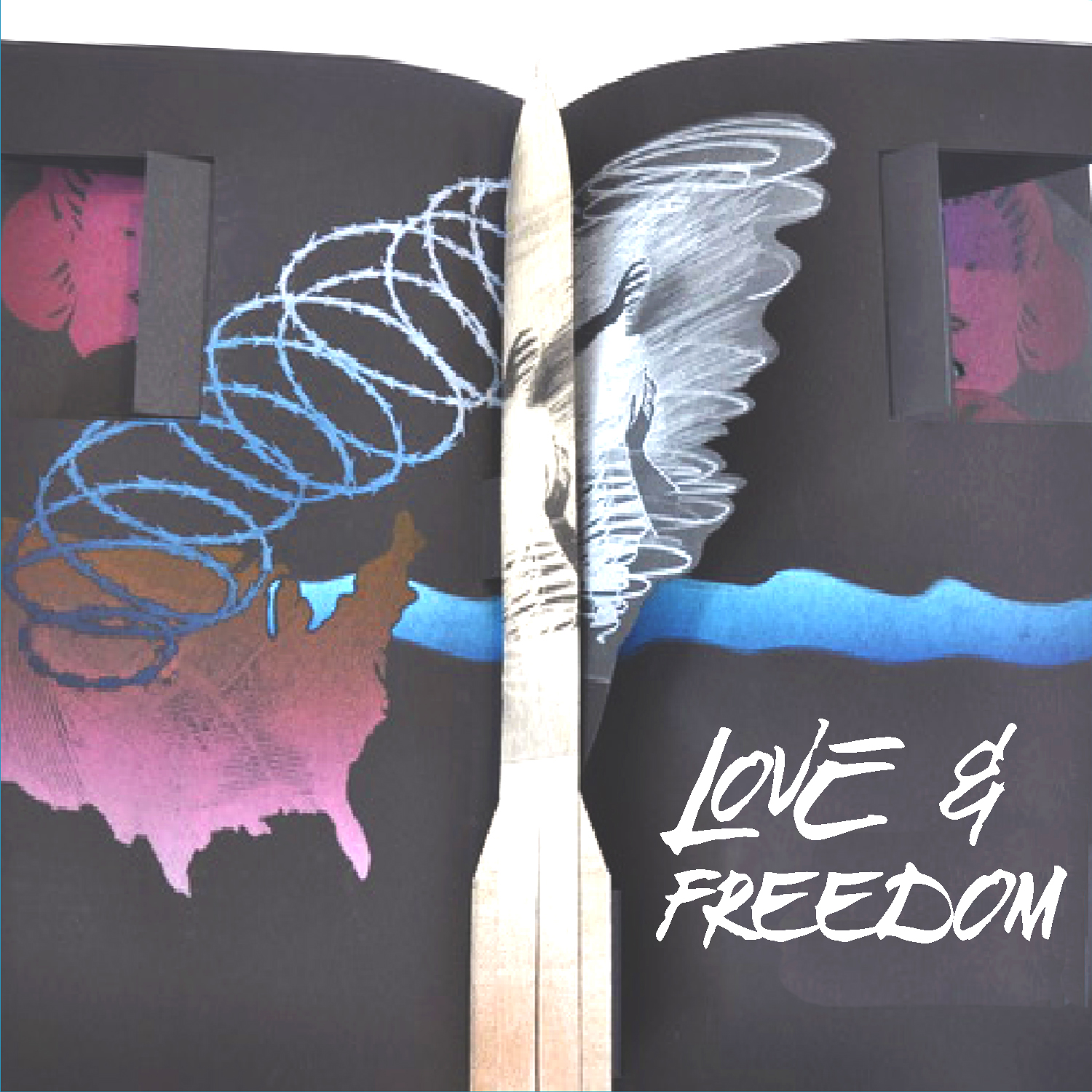
S1 Ep 3939: Beth Thielen: LOVE AND FREEDOM: Our Most Imaginative Activist Artists Are Locked in Prison
bonusEEpisode 4: Beth Thielen - Love and Freedom Bookmakers at San Quentin. Not surprising, given "Q's" clientele. But no, we're talking about real books with real pages that are awe-inspiring works of art. Transcript Needless to say, this year has been both odd and extraordinary. Odd? --- Well, Pick your poison. Extraordinary? --- Because we spent the year having amazing conversations with dozens of creative change agents who are kicking ass making a real difference in the upside-down world we live in. These conversations have helped us at the Center for the Study of Art & Community manage the lurking shadows and have sparked some new ideas and even optimism. We're excited to be starting our second season on February 2, but in the meantime we thought it might be nice to revisit some of our most popular past episodes. First up is Beth Thielen, a book maker who works across the by here from us at San Quentin. Actually she's not taking bets, but she and her students at "Q" are making a lot of awesome books. Have a listen.Bill Cleveland: At the time, what came to be known as the classic or a version 1.0 was considered a modern marvel. After a short wait for what was called booting up, and a few clicks, the text seemed to appear magically on a ten by twelve screens set into a plastic computer case. Eventually, the white on black text gave way to a gloriously glowing black on white. Moving through the text was accomplished using a small, palm-sized oblong disk that was endearingly called a mouse. Unfortunately, the computer was quite heavy and wired, so reading was typically a one person, one stationary screen affair. Then, the "two point oh" model with names like Kindle and Nook changed everything. It still had a screen and needed juice, but the wires were gone, and it was small and thin and light enough to take anywhere without a hassle. Going through text with the push of a button or flick of a finger on the screen made reading almost fun. There were a few downsides, though. After you paid for the machine, you still had to fork over for whatever it was you wanted to read. The thing also needed charging, and eventually, they would quit working from being dropped or just wearing out, which meant you lost whatever you were reading, which wasn't that big a deal because you actually never really owned it. But today, with the advent of the extraordinary Codex 3.0, also known as, "a book," all that came before seems quaint. This new text delivery system has so taken the world by storm, seven in ten humans now consider reading their number one favorite personal activity. While retaining the handiness and readability of its predecessors, this new model is both less expensive and far more versatile. This is due, in part, to the fact that after you purchase it, you actually own it, which means these books can be gifted or shared or even sold. There is speculation that eventually books will be collected in repositories that some are already calling libraries and could actually increase in value over time.But the most delightful features of these clever little packages of text are embodied in their design. Now, depending on their size, which is varied, they can fit neatly in your hands or lap for easy reading. They're ingenious cover, and page feature allows you to open, feel, and manipulate the enclosed paper sheets in sequence from front to back, the reverse, or even randomly. This is called browsing. If you want to remember where you left off, you can use what is called a bookmark or even bend the corner of those little pages. It's your choice. Another improvement is its sturdiness. You can drop it, sit on it, even step on it. And it will still function like it was new. And best of all, there are no batteries, no wires, and no moving parts. Finally, each book comes with a multigenerational lifetime guarantee that stipulates that with reasonable care and handling, each book will be fully functional for hundreds, if not thousands of years. Bill Cleveland: Excerpted from the "Modern Marvels of the Post Pandemian Epoch" by William T. William, 2047 A.D., also referred to as 26 P. P. E. Bill Cleveland: From the Center for the Study of Art and Community, this is Change the Story Change the World. I'm Bill Cleveland.Bill Cleveland: Long before the advent of Books, Inc., Amazon, and the Kindle, the making of books was considered a vital and essential art form. Over many millennia, the connections forged between humans and their books were seen as both fundamental to human progress, and as sacred and dynamic relationships. Given this, if I were to add yet one more evolved stage to the oddly imagined Future Books saga I just shared, it would be embodied in both this venerable history and in artists like Beth Thielen. Beth is a contemporary book artist who stands with one foot in the monasteries and studios of her revered bookmaking predecessors and another in the altered universe that is
S1 Ep 3838: Gallery to Garden: Beverly Naidus on Art, Activism, and Reimagining the Future
BIOBeverly Naidus's art life has straddled the socially engaged margins of the art world, artful activism collaborations, and community-based art projects. Her audience participatory installations, artists books, photo-text and multimedia projects have dealt with the anxieties of being unemployed, nightmares about nuclear war, ways to transform body hate, using consumerism to numb ourselves from the extractive insanity of our capitalist economy, how grief and gratitude weave together in the climate emergency, the epigenetic trauma of living under white oppression and the joyful resilience of the marginalized. She often collaborates to develop creative strategies that might heal trauma, to plant seeds of activism, and imagine different outcomes. Early on, she discovered that her vulnerable story telling could generate stories from others, sometimes catalyzing positive actions. She has shared her work in city streets, alternative spaces, public parks, university galleries, community centers, and major museums. Her work has been written about in many books and journals and has developed an international following. After vibrant chapters in the New York and Los Angeles art worlds, including fruitful periods in other parts of North America, she has made a home in the Pacific Northwest since 2003. Naidus received her BA from Carleton College, and an MFA with a full teaching fellowship from the Nova Scotia College of Art & Design. She taught art as a subversive activity at NYC museums, the Institute for Social Ecology, California State University, Long Beach where she had tenure, Goddard College, Hampshire College and Carleton College. From 2003 until 2020, she was the only tenured artist on the UW Tacoma faculty where she shaped an innovative, interdisciplinary studio arts curriculum in art for social change and healing. She is the author of Arts for Change: Teaching Outside the Frame (a book that helped to shift studio arts curriculum in many places). She has written & published many essays on eco-art and social practice as well as a few works of speculative fiction, and she is currently writing, Rewilding Our Muses: Creative Strategies for Navigating the “End of the World” and is looking for a publisher. While co-directing the non-profit, SEEDS (Social Ecology Education and Demonstration School) with her husband, Dr. Bob Spivey, they are leading workshops online with a focus on art that deals with climate and racial justice and have formed an international collective. They are currently facilitating an in-person “story hive project” with neighbors and are planning more “pandemic processing and dreaming into the future we want” art workshops to happen in coming months. Her solo show, “The Dead Ocean Scrolls and other Possible Futures” will be on exhibit at the Tacoma Community College Gallery in November 2021.For more information visit her website: www.beverlynaidus.net, Instagram: #utopias4all Facebook: https://www.facebook.com/groups/92685388277 or Beverly Naidus https://www.facebook.com/utopias4allNotable MentionsCOCA: Center on Contemporary Art, Seattle: CoCA serves the Pacific Northwest as a catalyst and forum for the advancement, development, and understanding of Contemporary Art. ONCA gallery in Brighton, England: O N C A is a Brighton based arts charity that bridges social and environmental justice issues with creativity.EXTREME MAKEOVER: Reimagining the Port of Tacoma Free of Fossil Fuels 2018 to the present.: This community-based art project reimagines the Port of Tacoma, an industrial port built on tribal land in violation of the Medicine Creek Treaty of 1854. The soil and water been contaminated by years of dumping and now hosts several designated superfund sites. In recent years, the community has been fighting the installation of new and dangerous fossil fuel projects in the Port and Extreme Makeover arose out of that resistance.Joanna Macy, author & teacher, is a scholar of Buddhism, systems thinking and deep ecology. A respected voice in movements for peace, justice, and ecology, she interweaves her scholarship with learnings from six decades of activism. Her wide-ranging work addresses psychological and spiritual issues of the nuclear age, the cultivation of ecological awareness, and the fruitful resonance between Buddhist thought and postmodern science. The many dimensions of this work are explored in her thirteen books, which include three volumes of poetry of Rainer Maria Rilke with translation and commentary.Thich Nhat Hanh: Zen Master Thich Nhat Hanh is a global spiritual leader, poet, and peace activist, renowned for his powerful teachings and bestselling writings on mindfulness and peace. A gentle, humble monk, Dr. Martin Luther King, Jr. called him “an Apostle of peace and nonviolence” when nominating him for the Nobel Peace Prize. Exiled from his native Vietnam for almost four decades, Thich Nhat Hanh has been a pioneer bringing Buddhi
S1 Ep 3535: Meeting the Moment: How 67 Activist Artists Changed the Story of American Theater
EJan Cohen-Cruz has given a lot to the field of arts-based community development. By that, I mean that there's a significant body of academic and community-based artwork, scholarship, teaching, and organizing that are absolutely covered with her fingerprints.BIOJan Cohen-Cruz was the founding editor of Public: A Journal of Imagining America. She directed Imagining America: Artists and Scholars in Public Life (2007-12), and for 28 years before that, was a professor at NYU, directing a minor in applied theatre and initiating socially-engaged projects and courses. She wrote Engaging Performance: Theatre as Call and Response and Local Acts: Community‑Based Performance in the US. She edited Radical Street Performance and co‑edited Playing Boal: Theatre, Therapy, Activism and A Boal Companion. Jan was also a University Professor at Syracuse University. In 2012, she received the Association for Theatre in Higher Education’s Award for Leadership in Community-Based Theatre and Civic Engagement. Here latest book, Meeting the Moment: Socially Engaged Theater, 1965 To 2020 written with Rad Pereira will published by New Village Press in May 2022. Notable Mentions (in order of appearance)Augusto Boal, was a Brazilian theatre practitioner, drama theorist, and political activist. He was the founder of Theatre of the Oppressed, a theatrical form originally used in radical left popular education movements. Boal served one term as a Vereador (the Brazilian equivalent of a city councillor) in Rio de Janeiro from 1993 to 1997, where he developed legislative theatre.[1]Imagining America: “The Imagining America consortium (IA) brings together scholars, artists, designers, humanists, and organizers to imagine, study, and enact a more just and liberatory ‘America’ and world. Working across institutional, disciplinary, and community divides, IA strengthens and promotes public scholarship, cultural organizing, and campus change that inspires collective imagination, knowledge-making, and civic action on pressing public issues.”Public: “Public is a peer-reviewed, multimedia e-journal focused on humanities, arts, and design in public life. It aspires to connect what we can imagine with what we can do. We are interested in projects, pedagogies, resources, and ideas that reflect rich engagements among diverse participants, organizations, disciplines, and sectors.”Meeting the Moment Socially Engaged Theater, 1965 To 2020: Jan Cohen-Cruz and Rad Pereira: Curated stories from over 75 interviews and informal exchanges offer insight into the field and point out limitations due to discrimination and unequal opportunity for performance artists in the United States over the past 55 years. In this work, performers, often unknown beyond their immediate audience, articulate diverse influences.Open Theater: The Open Theater was an experimental theatre group active from 1963 to 1973.Franz Kafka's The Trial: The Trial is a novel written by Franz Kafka between 1914 and 1915 and published posthumously on 26 April 1925. One of his best known works, it tells the story of Josef K., a man arrested and prosecuted by a remote, inaccessible authority, with the nature of his crime revealed neither to him nor to the reader.Paris, May 1968 Strikes and Demonstrations: Beginning in May 1968, a period of civil unrest occurred throughout France, lasting some seven weeks and punctuated by demonstrations, general strikes, as well as the occupation of universities and factories. At the height of events, which have since become known as May 68, the economy of France came to a halt.[1]The Devil and Daniel Webster:The Devil and Daniel Webster" (1936) is a short story by American writer Stephen Vincent Benét. He tells of a New Hampshire farmer who sells his soul to the devil and is later defended by Daniel Webster, a fictional version of the noted 19th-century American statesman, lawyer and orator.Harvey Grossman: In this edited transcription of his remarks at the 2013 Pomona College (California) conference “Action, Scene and Voice,” Harvey Grossman elucidates the theory and practice of his two most important teachers: Edward Gordon Craig and Étienne Decroux. Grossman elucidates Craig’s much-debated comments on the “Art of the Theatre,” as well as Craig’s influence upon the French corporeal mime Étienne DecrouxRichard Levy, New York Street Theater: The New York Street Theatre Caravan (NYSTC), formerly the City Street Theater, was a New York City-based socialist theater collective. First conceived by Marketa Kimbrell and Richard Levy in 1967, the company was founded on the principle of bringing theater to underprivileged and geographically isolated communities. NYSTC performed plays, puppet shows, skits, and concerts with themes meaningful to their audiences, such as racial inequality, workers' rights, homelessness, and other sociopolitical issues.Richard Schechner: Schechner was one of the founders of the Performance Stud
S1 Ep 3434: From Life in Prison to Life as a Cultural Leader: The Redemption of Henry Frank
EHenry Frank was rotting in prison alone with no escape. Then, everything changed. In our conversation we talk about the heavy lift of imagining a different future, becoming an artist, discovering true friendship, and embracing his Yurok and Pomo cultures.Delicious QuotesAnd I was like, I refuse to die in prison. And from that point forward, I started my journey of introspection through the arts, through education, through workshops, through self-help groups to really become comfortable with the ugliness that I had at that time, and really confronted and release it by talking about it.So, I started learning more about my culture all because, I want to put these things into my painting, which opened up this box that I didn't even know it was in there that was empty. And then it just started filling up. And in my case, it really helped me connect back to my roots, to my culture, to my heritage, and to give me that thirst for more knowledge of where I came from and the history of my people.I was just thinking like, how did we lose our language? … And when I'm in the sweat lodge it's connected for me. And it's just man, the brutality. That my people, indigenous people, not just here, what they had to go through to be afraid to speak their own language, to be afraid, to do their own ceremonies, to be afraid to show who their children are so they can't beat them and make them do something. It was just, it was a mind opening.It's oh, this man cares about me... cause he knew how much I cared about him. He was my elder and my mentor and my teacher. And he was the one who changed my mind about the outside. And I'm just like, wow, I never had a friend before, a real friend.Don't go in thinking that you're going to change, somebody, and don't go in thinking you're gonna save somebody and don't go in with judgment, I did that for 35 years of my life and it got me into prison with a life sentence. Hey, none of us are trash. None of us are unredeemable. … if you give us the opportunities and you give us the right environment and you give us the right teachers that we all, can be better. We can all evolve, and we can all learn how to be better people…I have really benefited from non-violent communication. Learning about how not to be violent with yourself, with your thoughts and how to really cherish express and just honor what you're feeling in a moment…Notable MentionsRed Tail Art: This is Henry Frank's artist website. Here is how he describes his practice: I enjoy bringing art into existence, I love the entire process, creating the backgrounds, finding the perfect image that fits the background, choosing the right colors to bring it to life, picking up the paintbrushes and mixing the colors and finally putting brush to canvas. It is very calming and relaxing, I go into a meditative state when I am the zone.The Museum of the American Indian: “Located in Marin County and situated on a site of an actual Miwok Village, the Museum is dedicated to providing the people of Northern California with programs and exhibits that deepen understanding and appreciation of Native American cultures.”Yurok People: “The mission of the Yurok Tribe is to exercise the aboriginal and sovereign rights of the Yurok People to continue forever our Tribal traditions of self-governance, cultural and spiritual preservation, stewardship of Yurok lands, waters and other natural endowments, balanced social and economic development, peace and reciprocity, and respect for the dignity and individual rights of all persons living within the jurisdiction of the Yurok Tribe, while honoring our Creator, our ancestors and our descendants.” Pomo People: “The Pomo are an indigenous people of California. The historical Pomo territory in Northern California was large, bordered by the Pacific Coast to the west, extending inland to Clear Lake, and mainly between Cleone and Duncans Point. One small group, the Northeastern Pomo of the Stonyford vicinity of Colusa County, was separated from the core Pomo area by lands inhabited by Yuki and Wintuan speakers. “ Wikipedia, https://en.wikipedia.org/wiki/PomoWilliam James Association: “The William James Association promotes work service in the arts, environment, education, and community development. Our work has been primarily centered around transformative arts experiences in nontraditional settings, serving men and women in and after prison and high-risk youth. Acting on the conviction that the fine arts enrich, heal and unite communities, the William James Association has brought exceptional artists into prisons throughout California and other states since 1977.”Success Through a Positive Mental Attitude, “Napoleon Hill: Oliver Napoleon Hill (October 26, 1883 – November 8, 1970) was an American self-help author. He is best known for his book Think and Grow Rich (1937), which is among the 10 best-selling self-help books of all time.[1][2] Hill's works insisted that fervid expectations are essent
S1 Ep 3333: Why Artist and Cultural Organizers in Hospitals Are Changing How We Heal
Jill Sonke is a creative healer in service to a community of doctors, nurses, artists, educators, and most of all, patients on a journey that reunites the arts and medicine in their age-old roles as healing partners. BIOJill is director of the Center for Arts in Medicine at the University of Florida (UF), and is currently serving as Senior Advisor to the CDC Vaccine Confidence and Demand Team on the COVID-19 Vaccine Confidence Task Force. She is also an affiliated faculty member in the UF School of Theatre & Dance, Norman Fixel Institute for Neurological Diseases, the Center for African Studies, the STEM Translational Communication Center, and the One Health Center. Jill serves on the editorial board for Arts & Health journal and as a consulting editor for Health Promotion Practice journal. She is also director of the EpiArts Lab, a National Endowment for the Arts Research Lab at UF, and the national initiative, Creating Health Communities: Arts + Public Health in America. Dr. Sonke studied dance at Interlochen Arts Academy, the Florida State University, in London, Paris, and Athens with teachers of the Horton and Duncan techniques including Bella Lewitsky, Lynda Davis, Milton Meyers, Joy Kellman, Lori Belilove, Julia Levine, and Hortense Koluris. She has been a principle dancer and soloist with Lori Belilove & the Isadora Duncan Dance Company in New York and a guest performer and choreographer with Dance Alive! and Stuart Pimsler Dance and Theatre.With 27+ years of experience and leadership in arts in health, Dr. Sonke is active in research, teaching, and international cultural exchange. Her current research focuses on the arts and health communication, the arts in public health, and the effects of music on cost and quality of care in emergency medicine. She is the recipient of a New Forms Florida Fellowship Award, a State of Florida Individual Artist Fellowship Award, an Excellence in Teaching Award from the National Institute for Staff and Organizational Development, a UF Internationalizing the Curriculum Award, a UF Most Outstanding Service Learning Faculty Award, a UF Public Health Champions award, a UF Cross-Campus Faculty Entrepreneur of the Year Award, and over 300 grants for her programs and research at the University of Florida.Delicious QuotesWe were very fortunate to be in an institution with leaders who understood that the arts fit and we're important in a healthcare setting. That people should have the ability to engage creatively to make that experience of healthcare better, not just patients, but staff, and visitors and others.I remember going into rooms and introducing myself, you know, " dancer in residence," and people would furrow their brow and say, “I'm in the hospital, that doesn't belong here.” … Then the view of our program kind of evolved into “It's really nice. … it's really lovely.” And then after a bit more time, the overarching recognition was that this is really important …because our, our care providers we're recognizing that artists are really crucial members of the interprofessional care team.We interviewed all 31 members of the nursing staff on a medical surgical unit over a period of about 18 months to learn about how they perceived the effects of the work of artists in residence on their unit. …So, we learned that nurses recognized the benefits of engagement in the arts for their patients. They were asking the artists to come in when their patients needed distraction and relaxation, those sorts of things. … from a clinical perspective, they noticed that blood oxygen saturation. It would go up. That wasn't the focus of our study. I want to be clear, but observationally, they were noting the clinical things like that.(Dr. Daisy Fancourt) has been able to, to articulate very significant associations between arts and cultural participation in health. For example, people over the age of 50 who go to museums or galleries, … just once a month or more are almost half as likely to have the onset of depression or age-related disability. Similarly, kids who engage significantly in creativity are 48% less likely to be maladjusted, which is a very significant determinator of lifelong health. and she has as well repeated some Scandinavian studies … that determined that yes, people who participate in arts and cultural activities do live longer or are less likely to die early. In fact, 14%, less likely to die early.(In) Uganda …I learned how the Ministry of Health and the government in Uganda has used the arts as a very central primary means of health communication and of public health since the 1950s. …One of my first interviews was with a very high-ranking member of the Ministry of Health. And I said, “Why do you use the arts in public health?” And he furrowed his brow at me, looked at me like I was an idiot, and said, “You can't do public health without the arts. You can't just tell people health information; you have to engage them.”One
S1 Ep 3131: Joe Lambert - Making Good Stories that Help Us
EShow NotesThe Story of My Story A Digital Story by KMUSIC PLAYINGK: In a funny way, books raised me. I didn't have the things a child needs to be a child; security, safety, comfort, love. But I always found happiness in learning new things. When I turned eight, my mother passed away from her battle with AIDS.I remember how even at her funeral, I was thinking about how I could get my homework done. .Right after that I was brought to this country. And the only thing I could bring with me where my love of books, learning and knowledgein high school, I used to dream up. I would explore outer space when I was suddenly drowned by their words, criminal illegal. And I thought, how could a human be prohibited by law? I was so confused. My first reaction was laughter. The laughter turned to tears and rage. I made up my mind, I was going to fight to go to college and continue my education.I shared my story and quickly found that there were many like me. I began to speak out. At first, it felt good. I felt like I could bring about change. But one day I heard a voice on the radio, and I realized it was me, but it wasn't me. It wasn't my story. It was a story of a perfect poster child. They twisted my devotion to education into a sick plea to my oppressors.It was slowly killing me, having a face of the people that were denying me, the basic things, a human needs to be a human. To beg them for scraps from their fruitful plate. The very same plate they had filled by raping, enslaving, and killing my ancestors and my brothers and sisters around the world. I came to see that this was not just about me, not just about going to college, but about fighting the injustice experienced by all immigrants and all people sufferingEven today, as I am denied the things a human needs to be a human. I lie in bed with a new book. I glance over at the shelf and see the books I read as a child and think of what I will write in my own.Bill Cleveland: This short story (The Story of My Story) is the audio from a video created by a young woman who identifies herself using the letter “K”. She made this piece at a digital storytelling workshop at the Story Center in the fall of 2012. Although it has an office and a classroom in Berkeley, California, the Story Center is not merely a place. It's actually a conviction that we all have stories to share that can inspire teach, bring joy, bear, witness, and heal. It's also a process that introduces people to the stories at their center that they've carried with them all their lives. The center's impact over nearly three decades has been both intensely personal and global.This conversation with Center director, Joe Lambert, explores the story of the Story Center, its history, its practice and its influence. Joe describes himself as a “small businessman, that has kept a little business going for a long time.” He's also unabashed and adding, “and we want to be revolutionaries” with the impetus once again, in Joe's words, “making good stories that help us.”JOE LAMBERTJoe and colleagues founded the StoryCenter/Center for Digital Storytelling in 1994, where they developed a unique computer training and arts program known as The Digital Storytelling Workshop. Joe has traveled the world to spread the practice of digital storytelling and has authored and produced curricula in many contexts, including the Digital Storytelling Cookbook, the principle manual for the workshop process, and Digital Storytelling: Story Work for Urgent Times (6th Edition). Born and raised in Texas, Joe has been active in the Bay Area arts community for the last 40 years as an arts activist, producer, administrator, teacher, writer, and director, and recently relocated to Santa Fe, New Mexico.DELICIOUS QUOTESI understood the information revolution was a kind of iron horse coming through the communities of the world. In America in particular, but it was, it was like an iron horse. And I used to say, you can stand outside of it and shoot arrows and go, “I hate you.” Or I can jump on the goddamn thing and try to redirect it, do something with the technology as it came along. And I was always like, “Let's jump on it. Let's make the best of it.But I remembered it stayed with me that, Story circles, they're about protectiveness and readiness to tell stories. And usually, you're sorta discouraging people from fully going there because the re-traumatization that goes on when a series of intense stories are told one after another. But the flip side of that is that these moments of listening when they're conceived well, and there's a sense of protectiveness they can be Circles of, of absolute bravery of a heroism in which you unpack the, the impossible in order to hold it and to, to make something sensible about the insensible…you know, some people don't want people liberated. They want them stuck exactly in their oppression for the rest of time. And those people are out there and we're still resistingI feel like the work I'm d
S1 Ep 3030: From Judy Chicago to Juvenile Halls: How One Activist Artist Facilitated Radical Change Through Creativity
E Susan Hill: The Path Made by Walking ForwardSusan Hill has, one of the best minds, and hearts I know for translating human creativity to the needs of the human community. In our conversation, we talk about how that complex alchemy works, and doesn’t, getting the respect of people who really distrust you, and what happens when the lights go off in a high-security prison classroom. Here is her bio followed by our full transcript. Susan Hill: I’m an eccentric combination of very small towns in New England, and very very large, diverse, multi-lingual cities: living by the ocean is the constant. My relatives include a clipper ship navigator, a detective, excellent carpenters, a race horse trainer, a car salesman, a dressmaker, an artist who changed / Americanized her name, nurses and teachers and wonderful cooks. I love the risks, the service, and the high craft implicit in their lives.I went to college (1961-1965) , not to art school … but fell in love with photography in college, learned to develop film and to print images by apprenticing, began photographing people and neighborhoods in New York and Los Angeles .. walking everywhere, photographing. This is how I began … an immersion in seeing a city, in fact, documenting what I saw … but as witness, documentarian, not an agent. I was looking for a different way of working, and went to a lecture by (then, young) Judy Chicago (1975) , who spoke about a new project she was beginning, a project she needed people to work with her. The Project was The Dinner Party. I was one of the first people who entered her studio to work; our early conversations, and the skills I’d learned from my grandmother, led to our deciding to add embroidered panels to each place setting, my being responsible for the embroidery, for the teams of stitchers, we trained.The studio environment, the collaborations, the engagement with direct social action, changed everything.After The Dinner Party was complete, I worked with Judy Baca, founder of SPARC (Social and Public Art Resource Center) during the design and painting of the last segment of The Great Wall mural … a brilliant and generous mentor, deepening my love of collaboration and community engagement. (NOTE: Judy is now embarking on one more segment of the Wall.) At the same time, Susan Loewenberg, founder of L.A. Theatre Works, was Director of Artists in Prison and Other Places; she hired me as an artist in residence for California Institution for Women, responsible for creating a fiber arts project with the inmates that would be given public exhibitions. It became a two-year residency called When Prison is Home, creating quilted triptych banners documenting life with family, life within prison, circled by aspirations, worked by inmates, and free women who came to project sessions in the prison as team members. Most of the inmates we worked with had long sentences or life sentences; were considered respected elders of the prison community, had power, were good mentors, generous collaborators. The CIW project experience led to Artsreach, which expanded our community constituencies and the range of arts disciplines. Our worksites included youth and adult prisons, service agencies for seriously developmentally challenged adults, community centers in marginalized areas of South Central, Watts and East Los Angeles. We began a multi-lingual, multi-ethnic theatre company that wrote its own material, there was modern dance, African drumming, spoken word poetry, ceramics, book arts, drawing and painting, collage, video, music. Some programs were skills-based, with traditional development of individual skills; some were initiated with the intention of engaging the public. My continual engagement has always been the expansive possibilities and the risk of collaboration, the engagement in Story, rendered in high skill for personal and public education, the continuing essential of social change. I love being In the Room. TranscriptBill Cleveland: [00:00:00] This Episode’s conversation is with Susan Hill. Susan is a good friend with whom I spent many years traversing the, often difficult, confounding, even hilarious, landscape of the of the California Department of Corrections. We spent over a decade bringing artists into institutions up and down the state. Susan's particular beat was Southern California, her creative launching pad an organization called UCLA Artsreach, which she directed. In that position, she functioned as an impresario, an inspiration, a creative thinker, and as a master navigator of difficult and challenging environments bring a band of great artists with her all the way. In other chapters, Susan also worked with Judy Chicago as a midwife for the iconic feminist art installation The Dinner Party was a principal driver of the historic Art in other Places Conference and is an accomplished textile artist. She has, I think. One of the best minds, and hearts I know for translating human creativity to needs of the
S1 Ep 2929: The Music Is Her Prayer: How Becky Reardon Found Sacred Connection in Nature, Song. And Activism
Episode 29: Becky Reardon - Finding the MoonBecky Reardon describes herself as “In the music” Her songs, tell us about the human community, our mother earth, and the reverence, and awe, and humility, and joy, and solace, and deep understandings that can rise up when you make time and space to listen to what she has to say.Becky Reardon's voice is familiar to the millions of people who heard her sing on the Charlie Brown TV specials (Charles Schultz called her his favorite singer!). She is a composer whose songs and rounds are sung by community and university choirs, and song circles throughout the US, Canada, British Isles, and Germany. Sometimes jazzy and fun-loving, sometimes trance-inducing and deeply spiritual, her music always conveys her passion for the natural world and the cycles of life. She teaches and performs nationwide, using improvised singing and movement to inspire singers to write their own songs. She is currently writing a musical about a women’s singing circle.Delicious QuotesIf you know anything about Juniper trees, their bark starts hanging off of them. But if you've ever had a Juniper in a fire and you've split a piece of Juniper, the center of it is dark pink. it's "red is rose." And so, I wrote this song to compare myself to a Juniper tree that was growing older and feeling myself, and going through my years, just being in the bright blue sky out here and still having a lot of passion in my heart....when I'm receiving writing and working on a song, I am trying my very best to make the song, carry the feelings that inspired the song. So that when you sing the song, you go to the place that, that I felt. I try, I really try hard to do that....you look around he community ...and you ask, what does that community need that I have something special to, to give to? What is my special thing that I can give my community? So, there's that part of it. And also, there is your own desire. And maybe that part comes first. Its like, “what do I love to do?TranscriptBC: [00:00:00] If you're lucky, every once in a while, you cross paths with a singular soul whose way in the world Intersects with yours at an inflection point that contains a powerful lesson that makes profound sense for you, in that moment. Becky Reardon is one of those, at least for me.We met at a while back during the deep mask times. On a bench by the San Francisco Bay. She and her wife were visiting my friend and Change the Story / Change the World musical collaborator, Judy Munson.Now, Becky describes herself as “In the music” I'm thinking, it's more like, “She is the music.” And that music has a compelling story to tell about the profound wisdom that surrounds us here on our planet. Her songs, tell us about humans, and our mother earth, the reverence, and awe, and humility, and joy, and solace, and deep understandings that can rise up when you take the time, and make the space to listen to what she has to say.We're all lucky that Becky has been kind enough to share those songs through her records, and concerts, and workshops all across the country, over the past decades. We spoke in the spring of 2021 about these things: The natural world and community, and the place of songs in the spaces where they come together.This is. Change the Story / Change the World: A chronicle of art and community transformation, I'm Bill Cleveland.Listeners, you will notice that this episode includes a lot of Becky’s wonderful music. If you are interested in hearing more, you can go to beckyreardonmusic.com or click on the link in our show notes. Now here’s Becky sharing, among other things, her recipe for finding the moon.BC: [00:02:07] Part 1: In the MusicSo, it looks like you've returned home in one place in one piece. Yeah. Yeah.BR: [00:02:14] To one place, one piece I'm here. Glad to be here. Were you out at the bench this morning?BC: [00:02:22] Yeah, that bench, if there are solace and soul helpers over this last year and that bench has been one of them, for sure.BR: [00:02:31] Kind of like a rock.BC: [00:02:33] Absolutely. So, just, before we start, could you describe what's outside the walls of your place where you are?BR: [00:02:41] Sure. I'm in the high desert of Northern New Mexico. I'm on a piece of land. That's five acres. it's on a little rise above a very long valley, an arroyo that's full of Russian olives and little Rocky Mountain junipers, lots of sticky thorny things. I can see a Talus Mountain to the east. the Rio Grande Gorge is to, to the west of me outside my window there. I have Russian olive trees in my backyard. I have mockingbirds singing wildly right now. The arroyo used to be full of sheep, that’s years and years ago. Nobody lived out here except sheepherders. So that's a little bit of my, my terrain.BC: [00:03:29] I usually ask people that I also ask who are the people who were there before we came, the white folks showed up.BR: [00:03:37] The Taos Pueblo. Indians. Yeah.BC: [00:03:40] Who are very much. still t
S1 Ep 2727: The Nouvella: The Strange True Story of a Fake Prison That Trained Hundreds of Artist Activists
bonusETHE NOUVELLA: STORY-BASED COMMUNITY ARTS TRAININGHi I’m Bill Cleveland, the host of Change the Story / Change the World. This week we are going to share something a bit different. In June of 2021 I participated in an international conference convened by the Art in Society Research Network. My part was a presentation about using story-based strategies for community arts training. Because of the pandemic, the conference was entirely online, with most of the presentation were delivered asynchronously, or what I call In UNREAL TIME, Which I have to admit is not my favorite mode of teaching. My response was to use a few stories about how using stories help prepare artists and their partners from other community sectors for work in communities and social institutions. What we came up with is a game show, a scene from a novella about artists working in prison, and a visit to a fake town in the midst of a harsh reckoning around issues of race, justice, othering, and belonging. Welcome to a special edition of change the story Change the World —- as we pay a visit to the 16th Annual Art in Society Conference. *****Hi: I’m Bill Cleveland. I am speaking to you from, Alameda CA, near Oakland which is the traditional land of the Ohlone people and home our county’s new VP Kamala Harris. I run the Center for the Study of Art & Community Our name is a mouthful to be sure but we have a pretty simple mission. Which is basically, helping to Create new community art partnerships in service to building caring, capable & equitable communities and then telling the stories that rise up. Over the past couple of decades, the Center has done that by conducting research, providing cross-sector community arts training, and producing studies, articles books and a podcast on arts-based community development and social change efforts all over the world. Enough about us. I’d like to begin this presentation by inviting you to participate in one of our fabulous Quiz shows. The show is actually a little game called TRUTH OR NO. The object of the game is to spark your imaginations and have a bit of fun. To do this you will need write a few things down, Yeah, I know you thought this conference would be just sitting and watching, but please, indulge me here. I’ll give you 30 seconds to grab a pencil and paper. OK now lets start. The game goes like this: In a little bit I am going to share 4 really short-stories that may or may not be true. Your job is to identify the ones that are false. Before I start t you will need to write 1 through 4 on a piece of paper. Now after each little story I tell write T for those you think are true and N for No for the fabrications. This will happen very fast. So here we go. Space Out: Way back in the 20th century the US Space Program felt they needed more public support. So, they decided to engage artists to help them to draw more positive attention to their efforts. This NASA arts program started with a bang – hiring Oh Superman, Laurie Anderson and Pop artist, Robert Rauschenberg as resident artists to make art celebrating the exploration of the cosmos. CRACKED: Once upon a time A group of neighbors found themselves with a crack house problem. They responded by engaging law enforcement, zoning officials, and the city council, all to no avail. In their desperation they turned to a group of artists from the community. These artists went crazy, whipping out a mural that was so powerful that within 24 hours of its completion the dope peddlers had totally fled the scene, never to return. MAXED OUT: If you are incarcerated in SuperMax prison you spend 90% of your life locked in an 8x10 cell and will breath fresh air only 60 minutes a week. A woman artist who felt that this was a terrilble thing decided to use her art to shut down her state’s supermax. After she created her work the governor of her state decided it was time to shut down the state’s, 700 bed supermax prison and now its gone. TREES, WOLVES, & DEMOCRACY: There was once an artist who planted trees, slept with wolves and decided to change the world. To do this he and some fellow artists created an artwork that resulted in the election of thousands of progressive candidates to local and national elective offices in dozens of countries around the world. Four pretty crazy, improbable stories. So, how did you vote. If you get them all right you have won am an all-expenses paid trip to a place called St. Francis Maryland, which I’ll tell you about in a moment. Here’s the lowdown on the 4 stories.NASA: Yes, Laurie and Robert were employed by a NASA arts program that goes back to the 60’sCRACK HOUSE This is true too. In Atlanta mural artist Normando Ismay and a mural crew turned a crack house into a Massive multicolored 4-sided billboard advertising the best drugs at Deep Discounts. For some reason, customers stopped
S1 Ep 2626: Why Traditional Education Fails Students—and How Activist Artists and Educators are Turning the Tide
Threshold Questions and Delicious QuotesHow do you describe your work in the world?I often refer to myself as a midwife of creativity... I think of it in my dual roles as an educator and artist, as holding space for the birth of someone else's creative thinking and inquiry. And so I liked that idea that, if something goes wrong here I am to hold the space.What is happening when young people catch fire in a performance?..students, who have been marginalized or failing their other subject matters-- suddenly if they're center stage ... performing with brilliance it's a way for even other teachers to have an asset-based understanding of them, to really see them for them, their true selves.What is the art of teaching?The art of teaching ... is really this transmission of wisdom, right? If we look at human history, we're talking about a very different frame than the last hundred years of what education is and how we pass on ethics and values and cultures and art forms through education. Those were the primary ...tools for survival and somehow all of that seems a bit out the window with our Industrialized education frame.What makes Studio Pathways unique?One of the reasons we left the county office of education was to focus on the concept of reconciliation or reckoning. So taking it from, south African truth and reconciliation --- the knowledge that we really haven't had a practice of reconciliation this country, that's why we're facing what we're facing right now....Educators need to be able to do power analysis in the classroom. They need to understand what's happening between teacher and students, between genders and races, and they need to understand what that means and how that plays out and then their own role in either disrupting or perpetuating that.So that's a real key....And the way that we do it is through the arts. Jessa Brie Moreno is Co-Founder and Co-Executive Director for Studio Pathways and has collaborated as a pedagogical advisor, instructional designer, and facilitator for leading-edge arts organizations and educational institutions nationwide. Studio Pathways' projects, partners, and clients include: Rise Up! An American Curriculum, The Kennedy Center, Turnaround Arts National, Othering and Belonging Curriculum for UC Berkeley’s Othering and Belonging Institute, Racial Healing Curriculum/WKKF Foundation, Instructional Designers/Zaretta Hammond, Favianna Rodriguez' The Center for Cultural Power, the California Spoken Word Project, Turnaround Arts National CA, California Alliance for Arts Education, Hewlett Foundation, Los Angeles Education Partners, Youth Speaks, Youth In Arts, Museum of the African Diaspora, Oakland Museum of California, and County, District and School Sites. In addition, Moreno has held posts as Adjunct Faculty with the California Institute for Integral Studies (BA, MFA programs) and San Jose State University (Theatre Dept.) is a founding member of White Educators for Racial Justice (WERJ) and has facilitated with RISE for Racial Justice. Moreno (alongside Rankine-Landers) formerly co-led the Integrated Learning Specialists' Program, professional development in and beyond Alameda County that supported transformative K-12 school change through the arts. Moreno served the California Alliance for Arts Education as a Local Advocacy Field Manager building community leadership networks for Arts Advocacy statewide. She was the founding director of both the Oakland Theatre Arts Initiative and of award-winning student theatre company OakTechRep. Jessa's directorial work has appeared in collaborations with CalShakes, Stanford, UC Davis, and in Edinburgh, Scotland. Professional Awards as a performing artist include an Emmy (Motion Capture Specialist), Bay Area Theatre Critics Circle, Dean Goodman, and Shellie Best Actress Awards.Moreno utilizes a stance of "creative midwifery" to assist in the ethical "birth" of transformative practices in education, arts, and culture. She wrestles actively with a complex lineage as a sixth-generation settler colonist to Ohlone lands, fourth-generation artist, third-generation activist, and mother to two young women. She is a graduate of Scuola Internazionale dell'Attore Comico in Italy, holds an MFA in Interdisciplinary Arts and Creative Inquiry from CIIS, and a English Language Arts Teaching Credential. TranscriptCSCW EP 26 Jessa Brie Moreno BC: [00:00:02] That's the sound of children playing together at school. Until very recently all across the globe, those echoing voices, were as common is the wind. Now, not so much. Hopefully that will be changing soon. There are very few who would disagree with the idea that our children, their safety, their ability to learn are of primary importance to all of us as a community. But sometimes, maybe I should say all too often, what we do in that realm, how we treat our children, does not align with that sentiment. This is particularly true with our schools, which many regard as the

S1 Ep 2525: Su-lin Ngiam-An Activist Artist in Singapore is an Agent of Hope
What happens when a tiny city-state with tight control becomes a hub for community-driven, arts-based transformation? Meet ArtsWok, a Singapore-based organization helping people talk about the hardest things—grief, inequality, identity, and even death—with art as the medium and hope as the missionIn a place known more for order than outspokenness, how do artists create room for deep conversation and community healing? In this episode, ArtsWok co-founder Su-Lin Ngiam takes us inside the intricate work of bridging Singapore’s diverse communities—whether that’s confronting mortality in a high-rise courtyard or staging inclusive youth theater across cultural divides. Her work invites us to reimagine activism not as confrontation, but as creative facilitation rooted in care.Listen in to hear:How ArtsWok uses everything from inflatable theaters to site-specific installations to hold space for taboo topics in the heart of tightly regulated Singapore.Why conversations about death—like in their Both Sides Now project—are actually powerful doorways to deeper, more connected lives.What it means to be an “intermediary” in art, navigating across sectors, beliefs, and disciplines to build trust, spark dialogue, and catalyze changeTune in now to hear how Su-Lin and ArtsWok are turning art into a tool for civic dialogue, human connection, and societal renewal—one courageous conversation at a time.Delicious QuotesWhat does the ArtsWok Collaborative do?I like to say that we're agents of hope. That we're really here to inject hope in society, or at least we try to, and it's about the bridging difference be it between people or ideas or uncomfortable topics.How do your very public arts practices advance your issue-based community work?…we want it to be out there where people can see, they can hear --- really bringing a taboo issue out into the open, making what's invisible, visible, unheard, heard. And the arts are great for doing that and creating spaces that can do that What is Go-Li?It's (Drama Box’s) inflatable theater … we have used that structure in our projects as well, … It's tour-able, so you can bring it to different communities, and you pop up and cause you're not allowed to be there permanently, then you deflate the structure, and you move on. And it becomes some kind of an icon as well.People recognize it, and “Oh, okay, these guys are here. The artists are here.” And it's about creating safe space as well because it's open, but it's covered, but yet you can walk in and out so you can have conversations about difficult things or people can be vulnerable.What is Both Sides Now?...we have presented this project for seven years. …essentially, we're out there engaging community saying, "Have you thought about death?" …it's an important part of living to think about that. In fact, it's very much two sides of the same coin. …how we live our lives will determine how we end. So, it's really all quite related, but of course, it can be quite taboo, and it's a painful topic. Loss, in general, is hard to talk about, but I think that's something we really need to talk about more as societies. What role does negotiation play in the cultural life of Singapore?We are artists. We are here to question and provoke. And having said that, we have things like censorship in Singapore in terms of, so, all our scripts, plays, have to be submitted for a license. … there is a process of negotiation that, as artists, we then undergo with the state or with authorities, and it's that process of dialogue. And whether or not we choose to, to then, adapt our place or our work or choose another creative way to talk about it or present it. That's up to the artists, But I think what is meaningful is that process of negotiation and how we negotiate, and that impacts the way we practice, and it makes us more creative in a way. Then it is about finding the vocabularies and being patient. That change takes time. TranscriptBill Cleveland: New Year's 2014 in Singapore, the year of the HorseWhat is Singapore, a city-state, a very small, very well-off multi-ethnic country, an unlikely nexus of community arts innovation? For those, like me, who know the place from some personal experience and some very fine Singaporean friends, it's all of those with a promise of much, much more. And that promise, for me, has been personified by one of those friends I mentioned. I met Su-Lin Ngiam at an international community arts conference In the Spring of 2010 hosted by the St. Louis Regional Arts Commission. She was there with her long-time collaborator Ko Siew Huey. In that encounter, I came to know one of the most striking characteristics of Singapore's notable capacity to punch far above its weight. Which simply translates as "learning is sacrosanct" and "knowledge is power."The country's dramatic rise from a post-WWII, post-colonial basket case to global economic power is certainly a success story fueled by incredible discipline and a b
S1 Ep 2424: From Theater Sets To Veterans’ Healing Circles: How David O’Fallon Crafted A Life Through Cultural Organizing and Story
CSCW EP 24: David O'Fallon - Power PlaysPlease know that this episode contains descriptions of war that include violence and psychological trauma. We endeavor to do our best to engage these hard stories with care and respect.Please also be aware that there is a lot of hope, healing and optimism contained herein. We hope you will join us whenever you are willing and able.Threshold Questions and Delicious QuotesOf what use are the arts in these turbulent times?I think one of the most powerful technologies we have is to actually be in the presence of another person. ...We could go on about how many friends you have on Facebook, how many things you posted on YouTube, how many hits on Instagram and so on, it takes a different kind of courage to be in the room with the person, sharing your story, or listening carefully, looking somebody in the eye, there's a physical presence that you must deal with, and that for me has always been the power particularly of theater,...Why humanities and vets?But if you've been in a room with men and women, who've been not all it in combat, but just in service in this almost invisible war, that's still going on, as you and I are talking today and they're not seen as fully human or they think once with a fly over at a football game or something yeah, the power of literature of storytelling of theater of music of creation is unbelievable. it's deep and it's strong and its essential. You want to go back to basics. You asked about, story and in some ways these men and women live the power of story.What is the value of stories in this hard boiled cynical world?So, I think the struggle has always been who gets to tell your story. Do you believe you can tell your own story? And a lot of people start out by saying, I ain't got nothing to say. I got no story to tell. I don't do anything. Who am I? So that's where all of us who tried to work in the arts world have had to create a vessel if you will, and the structures of support and encouragement, so that in fact, a person can say," I got this poem I wrote, I've been keeping it underneath my underwear drawer. Maybe I'll say it out loud." And they do, and they discover a voice.Why are new stories particularly important now?...the fact is the world is changing and we have dominant stories right now, some of which are being told by genuinely evil people that denigrate others, that build walls and shut people out, and hurt children in cages along the border, because they're not seen fit to enter our country. Who's telling that story? Who gets to tell that story? And there are many voices trying to tell another different story, and I'm going to be very blunt right here. I think those who are wishing and working to create a nation that's based on patriarchal white nationalism, they will fail. That world is impossible, but they can do a great deal of harm as they push that narrative, CSCW EP 24: David O'Fallon - Power Plays TranscriptBill Cleveland: David O'Fallon builds things. Theater sets, theater companies, 12-foot puppets, visionary art schools for teen artists and community musicians, theater programs for veterans from the Afghanistan and Vietnam wars, and more. The through line for David's wonderfully twisty journey is a couple of simple, but powerful questions.What is the story you want to tell? and how can it be shaped and shared with your community? Which of course are also the central questions we ask all of our guests.Please know that this episode contains descriptions of war that include violence and psychological trauma. We endeavor to do our best to engage these hard stories with care and respect.Please also be aware that there is a lot of hope, healing and optimism contained herein. We hope you will join us whenever you are willing and able.This is Change the Story, Change the World, a Chronicle of Art and Community Transformation. I'm Bill Cleveland. Part One: Relations.BC: So, I'll just begin with the foundation setting, which is, your work spans many decades as does mine, and over that time you have done many things, and however you want to describe it, describe your work in the world.David O’Fallon: Yeah. Thank you. It's a great question. I think my work in the world is trying to be a person who actively imagines and creates the narratives that keep us together and take us forward, rather than those that just tell us how screwed up everything is, how bad off we are and why we can't get along. So the bottom line is always looking for connections and relationships and bridge building, and every setting that I've been in.BC: What would be a concrete version of that?DO: I'll give a couple of stories that go with that. So, I am in graduate school at Temple University in Philadelphia, and my wife, Ann and I are living at the corner of Broad and Allegheny, which if anybody knows Philly, it's North Philly. At some point I discovered, so I'm appreciative of the work we're doing at Temple, I went there to work with a particular guy,
S1 Ep 2323: Why Activist Poet Alice Lovelace Refuses To Use the Language of Her Oppressors
EEpisode 23: Alice Lovelace - A Peaceful DisrupterMusic AttributionVariations on a theme 1 » The Rush (w/ drum) - Variations 1 (c) by PodcastACThis work is licensed under aCreative Commons Attribution-ShareAlike 4.0 International License.You should have received a copy of the license along with thiswork. If not, see <http://creativecommons.org/licenses/by-sa/4.0/Threshold Questions and Delicious QuotesWhat is "This Poem" really about?This poem is a cultural hybrid Travelin' everywhereBelongin' nowhereIrresponsible, Irreverent And totally irrelevantWhat do you mean by Peaceful Disrupter?I am never happy with the status quo. So, I'm always looking for ways to disrupt the status quo and to move it in a more progressive [way] or [by] empowering those who I see are being left behind.And that has to happen a lot, they have to be those who make other people uncomfortable, so that in their discomfort they actually deeply contemplate change. Because when we are comfortable, we don't contemplate change.... I'm a peaceful disruptor. I don't get loud. I don't, I definitely look for opportunities to shift power and to shift the conversation,What does "asking permission" mean in a classroom?When I walk into a classroom, the first thing I say to my class is I asked permission to be there. And often the teachers don't understand that, but I will say to the students, “this is your community, and I am an interloper, and other adults have made a decision that I should be here, but the rightful decision-makers are you because you were the one who had the power to make this a success or to make it a failure”. So, I always ask their permission.How can you fight the power of the false narrative?I've never forgot the lesson of. Standing up to bullies, not getting into the stories people are telling about you, ...the moment that you try to speak to that story, all it's going to do is keep that story spinning. So, I would never address it. Alice Lovelace: This Poem is for reading only after I'm dead, as the weight of the words could killThis poem is full of blood, fornication, guts, and gunsThis poem hates nationalists, sexists, racists, factionalists and fundamentalists of all ilk's However, this poem encourages creative lies when those lies are in line with this poem’s politics This poem, This poem, This poem is about starvation in Ethiopia, tribal warfare in Rwanda, ethnic cleansing in Yugoslavia, oil workers striking in Nigeria, starvation, re-classification, indoctrination, stagnation, and the return of the colonialists to oversee our freedomThis poem, This poem, This poem is about moving forward but you goin' nowhere, you goin' nowhere, you goin' nowhereBill Cleveland: Well, the first time I laid eyes and ears on Alice Lovelace, she was standing in bright blue lights on a stage in Atlanta, Georgia. She was a diminutive presence in a delicate white dress, who, from the second she began to speak, literally took over the theater.AL: This poem is about arming for peaceWhile withholding food until those ungodly hordes Recognize the salvation of Capitalists ideals This poem is about the salvation of Russia...NotThe unification of Europe...NotThe liberation of Africa...Not This poem shits on other poemsThis poem is about psychobabble posing as ArtAnd Art so fuckin' pure it offends This poem is about dropping the bombs on Iraq for border aggressions While patting the Serbs on the backAbout boycotting Cuba 'cause they won't be like usWhile rewarding China 'cause they won't be like us This poem advocates shitting on the Queen's English and the Queen This poem sanctions the shooting of Career politicians on sightThis poem is a cultural hybrid Travelin' everywhereBelongin' nowhereIrresponsible Irreverent And totally irrelevantThis poem isAbout Jesus prostitutesMt. SinaiswindlersJerusalemjunkiesTrashin' the airwave Foulin' up my system Pissin' on my povertyThis poem is about About gettin' a fix on the problems Without gettin' your hands dirty About Klansmen giving out free ammunition To convicted felons to protest gun controlAbout withholding abortion rights to teach thoseUnwed teenage welfare cheats a lesson in humilityBC: Well, we weren't referring to it as spoken word back then, but as far as I was concerned, at that moment, in that space, it was THE word. And that word was commanding, no grabbing my attention as though the lyrics to that Screaming Jay Hawkins song were coming true. “I Put a Spell on You”AL: This poem is about the needTo write poetry while the peopleStarve and imagine your words feeding the massesWhen in reality, man you just you movin' 'n groovinGoin' nowhere Movin' n' grovin' Goin' no where Movin' n' grovin'Goin' Goin' &n
S1 Ep 2222: Theater Isn’t Just Entertainment—It’s a Cultural Organizing Tool for Saving Democracy
EEpisode 22: Bob Leonard - The Continuing Evolution of the HorseThreshold Questions and Delicious QuotesWhat is the artist's role in the altered and uncertain world we are entering?…there is a human, passion for justice, and it would seem that it's hard to get…as human beings, we rely on the stories that we tell each other to keep our sense of direction. I don't mean down a road, but where's North. … And we understand ourselves through our stories, and that includes that passion for justice. It's not an abstract, … They know when it's something is not just. ...And that struggle is enormously dependent on the stories that we tell ourselves about that, and artists are the people who do that.How has Alternate Roots manifested the struggle and evolution of American democracy?This was in the spirit of the times, both in terms of the, from my point of view, the American revolution continuing, but also the times were about finding out what democracy can do in the face of oppression. Whether we're talking about women's rights or civil rights or Vietnam war, there were a lot of people who were trying to figure out new ways of understanding the paradigm of democracy and democratic decision-making.So, we decided that the board was going to be everybody. It was not going to be representative governance. We were going to be a participatory governance, and what's absolutely really astonishing Bill, is that that still is the case. 45 years later, we have a board of 200 people, and it is functioning well. Is there a community arts, story telling aesthetic?And that can have all kinds of permutations and experimentations, with, with the aesthetic. Does it have to be told in a particular aesthetic? The commercial aesthetic of East Tennessee is Dolly Parton and the explosion of the stereotypes of a mountain people in East Tennessee, but that isn't necessarily the required aesthetic. You have to learn what the aesthetic is from the audience, as opposed to thinking what's the commercial version that will get the dollar. You're listening different things when you do that. There is what artists at Roots we're doing and have been doing that for now, for, several decades. And then roadside is a wonderful example of that.What does the evolution of the horse have to do with the art of possibility? I really liked the, the image of the horse, which in the age of the dinosaur, the horse was the size of a mouse. It was a tiny little creature and, things turned upside down. I don't know whether a comment hit the earth or something, but things turned upside down and the horse emerged over the course of a long time, and no one would have thought that little thing that might've been a sort of a shrew or a mole or something would become what the horse is.TranscriptBill Cleveland: You know, I like to think of all the people I've had the privilege to speak with on this podcast as threads of a massive woven story fabric. A vibrating weave of bright and colorful threads, with thick and thin fibers, warping, woofing, twisted and bound together. so strong and tight, that if you try to coax, to pull, to yank one from another that whole thing will lock tight, resisting all force because there is not one strand, not one story that is not held by the rest.Bob Leonard's story, today's story, is one of those caught up in that stubborn and infinite weave -- a crisscross of dialogue and music, lights and dancing, serendipity and surprise. Bound up with the layers of people and narratives that form the creative community fabric he’s fostered and served through his work In the theater of change.Bob and I have known each other forever, but I'll be damned if I can remember where it was that we actually met, maybe in Massachusetts, or DC, maybe at a Roots thing, maybe in a previous life. That said, this exchange held deep in the COVID swamps of 2020 allowed us to add yet another chapter to the conversation that we started way back then, wherever and whenever that was. I think I can speak for both of us when I say that we're happy you will be joining us.This is Change The story Change the World, A Chronicle of Art and Community Transformation. I'm Bill Cleveland. Part One: Duck Fat, Dirt, and StumpsBC: Mr. Leonard, I have had the enormous privilege of connecting with many of my colleagues in this way over the past year, and every single time, all different twists and turns and stories and anecdotes and perceptions about the world show up that are marvelously surprising and energizing. I have an incredible sort of festival of rejoicing over the people I'm privileged to work with, and you're one of them.So let me begin by asking you the simplest, most complex question, which is just describe, what you do in the world. What's your gig? Bob Leonard: I think I, make theater, to bring people together. I like bringing people together, and theater is a means to do that in a funny sort of way. I've gotten myself into a full haul, a long life of making theat

S1 Ep 2121: Justin Laing: Why Cultural Organizers Must Confront White Supremacy to Succeed
Justin Laing: - Taking Back The LandJustin LaingBefore starting Hillombo in 2017, Justin worked as a Senior Program Officer of Arts & Culture at The Heinz Endowments for more than a decade. His work focused on small and midsized arts organizations, out-of-school time arts education, and Black arts organizations, with a particular interest in participatory grantmaking. He came to philanthropy having worked for ten years as the Assistant Director of Nego Gato, Inc, an Afro Brazilian Music, Dance, and Martial Arts company where he taught, performed, and ran the day-to-day operations. Justin has a BA in Black Studies from the University of Pittsburgh and a Masters Degree in Public Management from Carnegie Mellon University.Justin serves as the co-chair of ArtsinHD, an arts planning and creation process in Pittsburgh’s Hill District to support the neighborhood’s master plan and mark the neighborhood as a place for liberatory Black culture. Justin is the son of Susan and Clarence Laing, the father of Kufere, Etana, and Adeyemi Laing, and a member of Omega Psi Phi Fraternity.Threshold Questions And Delicious QuotesWhat does "taking back the land mean?the idea ... was ...from a person named Amilcar Cabral. This idea that you work in small territories. [...] you try to take back the land, like square mile by square mile. So, I was working in one major place called the Hill District... And culture was a critical piece to liberate our minds and the way that European culture oppressed black people was through this indoctrination of its art, its culture is everything is being superior. And so, culture had to be part of the strategy.You talk about working constructively with the tensions that are present in many organizations. What does this entail?So, one of the ways that I've tried to do that is by naming some of these frameworks, whether it's white supremacy, culture, what fragility, white privilege, and like you said, trying to bring that into the organization so that, that can be part of the official speak. Because again, going back to that black studies beginning, there was a whole lot of language that wasn't allowed that I didn't see being taken advantage of the nonprofit arts sector at all.You see racism and capitalism as intrinsically connected in our society. How does this play out in your work with nonprofit arts organizations?...we're supposed to be the bravest ones, the creatives... and I've been starting to see, the class contradictions battle inside an organization. Cause you're raising issues that people have different interests in and I think that’s, that's a bit of the tension that you're facing, one thing I've been trying to understand more is the intersections of patriarchy, capitalism, racism inside organizations. And to the extent that we are talking about racism, there's some level of tension. I think the extent that we include capitalism in that, there's even more tension about that.What is the meta-message of a Euro-centric culture?...all of the things that are happening when you go into an orchestra performance. And the way that you step into space and you engage the regal-ness of it, and the carpet, and the chandelier's and everything is sending a message that you are now in sacred space. And I think if you take this idea of ideology, that is its own aggression, TranscriptBill Cleveland: [00:00:00] Hey there. Ponder, if you will, a few unlikely juxtapositions: Capoeira the Brazilian martial arts, spiritual and dance practice, Karl Marx, The Pittsburgh Penguins. How about the Heinz Endowments, white supremacy anti-racism, and the Minnesota Orchestra?If you're curious, keep listening. This is Change the Story, Change the World, a Chronicle of Art and Community Transformation. My name is Bill Cleveland.Now, Justin Laing is a pioneer of sorts in that he helps arts and philanthropic organizations examine their place In the systems that perpetuate structural racism in our country. In our conversation with him, I liken this to wrestling with a tiger. Which is probably unfair to tigers, given their beauty and endangered status. Nonetheless, Justin has taken on a potent and dangerous force in his life's work. His ability to do this well, has as much to do with his courage as it does his unique capacity to help the people in the organizations he works with accept the inescapable link between owning the hard truths of their histories, and fulfilling the promises and ideals that embody their missions.At the end of the day, Justin, like many of our guests, is a creative change agent. And like them, he brings an interesting mix of skills, experiences, and sensibilities to the task.We hear about all that and more in our conversation, which took place shortly after the historic 2020 election.Part One: Hillombo So, let me begin with my first more basic question, which is, when you think about your path in the world, particularly right now, what is it that, that you do?What's your work as you see i
S1 Ep 2020: How Oakland Culture Shaped Fantastic Negrito’s Fight for Balance and Belonging
EEpisode 20 : Xavier DphrepaulezzFantastic Negrito / Have You Lost Your Mind Yet? REDUXOn March 14th our friend and Change the Story guest Xavier Dephrepaulezz, also known as Fantastic Negrito will hear if he has garnered his 3rd Grammy in 5 years for his 2020 release Have you Lost Your Mind Yet. To help nudge the stars into alignment for Xavier we are re-broadcasting our Episode 6 conversation with him. This Episode not only includes great music and, of course, FANTASTIC stories, but also, an inspiring dialogue on next steps for the coming community revival. Threshold Questions and Delicious Quotes:What is the danger of scapegoating?Well, of course, that's the biggest lie ever sold, not told. There should be a class on that. That is how every civilization has controlled other nations and its populace, from Genghis Khan. The Chinese say Genghis Khan was the bad guy that’s going to get us (he actually did get you). You know that. Yet the Romans did it. You know, everybody does. We do it.Is music a change agent?Music's a change agent, film is a change agent, art is a change agent, a bakery's a change agent, a coffeehouse is a change agent, a conversation is a change agent. They're all change agents, but the most important change agent is in your heart. That's the thing that changes the world. Change your heart and change the world.What do white folks and black folks need to talk about?But we got to at some point talk to each other. I want to do, a town hall like this. And I want the white people to stand the fuck up and say, you know what? I'm kind of scared of you guys. We need that shit, and the black people; don't you don’t call the person a racist.What's next for Oakland?What I'm doing right now is trying to build this hotel and this whole all these blocks in the California hotel, boutique hotel. The first African American town.LinksHave you Lost Your Mind Yet: Fantastic Negrito's latest albumA Letter to Fear: YouTube link to a cut from Xavier's second album, Please Don't Be Dead. which won the 2019 Grammy for Best Contemporary Blues Album. The Suit that Won't Come Off. : YouTube link to a cut from Please Don't Be Dead.Watts Prophets: Legendary west coast pioneers of the new music form with ancient roots, that has come to be called rap. Amde Hamilton, Otis O'Solomon, and Richard Dedeaux first met at the Watts Writers Workshop. Fusing music with jazz and funk roots, and rapid-fire, spoken-word poetry, they created a sound has deeply influenced the course of music and poetry in the US and the world. They released two albums, 1969's The Black Voices: On the Streets in Watts and 1971's Rappin' Black in a White World, which established a strong tendency toward social commentary and a reputation for militancy. (See also: Art & Upheaval, W. Cleveland, NYU Press, Chapters 11-13)Native American Community Development Institute: A Minneapolis based community deveopment organization that was "founded on the belief that all American Indian people have a place, purpose and a future strengthened by sustainable community development. NACDI initiates projects that benefit the Native community, often in partnership with other Indigenous-led organizations."TranscriptBill Cleveland: It's early 2015, and I'm sitting in my living room watching the rain and wind turn my windows into a drip collage of streaking grays and greens. The phone rings, its daughter, Heather. As usual, she's quick. She says, “I just shot you a text with a link. Just watch and listen and I'll call you later”.It was a YouTube page with the NPR logo on a frozen frame of four musicians crammed into what looked like an abandoned freight elevator behind a small makeshift desk. As I move to click, I'm thinking, “Desk? Oh, yeah, tiny desk.” Then this hit me. Music playsI'm knocked out. This was a one mike, one take video with the pulsing power of a locomotive. That tall, skinny guy up front with the voice that stretches like a rubber band says, “Get through the day, don't drown.” But I'm drowning --- in a good way--- in the music. From the Center for the Study of Art and Community, this is Change the Story Change the World. I'm Bill Cleveland.Part One: Griot Heather tells me his name is Xavier. XD lives down the street from Heather, with his wife and kids, and from time to time, their families hang out. I thank her for the gift of connection. Since winning the tiny desk, things have more than taken off for Examiner, who goes by Fantastic Negrito on stage. Two Grammys for best contemporary blues albums in 2016 and 2018 have fueled non-stop global touring and an international fan base. It's also given Xavier a platform as a change maker in his beloved hometown of Oakland, California. Over the past few years, Xavier and I have connected over both music and a shared passion for the power of imagination and story to make a difference for struggling people and communiti
S1 Ep 1919: Mary Cohen Brings Art & Social Change “Inside” & “Prisoners” & “Outsiders” Became One Choir
Episode 19: Mary Cohen - Freeing Silenced VoicesThreshold Questions and Delicious QuotesHow can singing a song help change the mind and the heart? ...the thing about singing that's really valuable for me at least is it's embodied. We're using our breath. We're using our voice. We're using our ears. We're feeling the vibrations in our bodies. So being able to do that with other people is super- it can be powerful. One of the students in the peace building class last spring shared such an insightful comment. She said, if you're in there singing together with your eyes closed, we don't know which voice is going to be walking out of the [00:31:00] prison at the end of the rehearsal, in which voices be staying in the prison.What is ubuntu, and how does it relate to prison choir work?Ubuntu Is that beautiful concept from South Africa, meaning a lot of things, a person as a person through other people. Desmond Tutu defined it as, "my humanity is inextricably bound with your humanity". ...But we need to know who we are and be at peace with ourselves in order to step forward and find our sense of common humanity with others...you can only imagine a choir has songs with lyrics and some of those lyrics may resonate with one person and not so much with someone else, particularly if it's songs that have some kind of a religious connection. However, if we [00:12:00] follow deeply the idea of Ubuntu, we ideally can sing these songs because we're looking at our relationship with the larger communal body when we're singing together.What do the Oakdale Prison, the Soweto Gospel Choir, and the TV show Friends have in common?I found a song called How Shall We Come Together by ... Maggie Wheeler. Do you know Maggie? ... on the TV show Friends, Maggie played the role of Janice. The character that would go "oh my God", that's Maggie! ...So, I contact Maggie completely out of the blue to ask permission to use her song. And after a series of conversations, Maggie's like "Mary, you want to use my song in a prison with the Soweto gospel choir? I'm coming to Iowa".How can a prison choir contribute to prison abolition, to excarceration?You know, we have 3,144 different stories of prison growth, one for every County. So this imagination that the abolition thinkers are requiring of us needs to [00:34:00] happen at a very local level, and the way that I've tried to apply it through the building class I've started, and through the work we do with the choir is that local space of creating the healing needs to happen internally, each person developing a sense of inner peace building. That's the project, the primary project we do in this class, and in the Oakdale Choir, we've actually done it these 10 years through the writing exchange changes where the choir members write reflective components and they share it with one another and that broadens their awareness of what people are experiencing, what their stories are related to each choir season, the songs we're doing, the original songs that have been created.TranscriptBill Cleveland: [00:00:00] I'm curious, is there something more to singing than just voices moving the melody and the words out into the world? Can the simple act of singing a song together, turn a deeply feared "other" into an "us"? Mary Cohen thinks so, actually, she knows, so because she's been doing just that for 11 years at Iowa's Oakdale Prison.This is Change the Story, Change the World, a chronicle of art and community transformation. I'm Bill Cleveland.As you're probably aware the us has one of the world's highest COVID death rates. Sadly, we also bear the distinction of the highest per capita prisoner rate, by far, leaving Turkmenistan, Russia, and China in the dust. The enormity of our prison population, we have a little over 4% of the globe's people in 25% of its prisoners, [00:01:00] make the hidden in plain sight, “what prison problem," attitude of many Americans, hard to fathom.But not really, because when you look a little harder and check out which communities are most effected by mass incarceration, the undeniable fact is the two thirds of the us prison population are people of color. In Iowa. Where the population is 90% Caucasian. Their per capita incarceration rate for blacks is nine times that of whites.If there ever was a perfect storm for building an us versus them society, well, that's it. Mary Cohen knows this and has dedicated herself to helping heal this horrible wound. This is no mean task, of course. So, it's a good thing that she's a dynamo, and takes her work inside very seriously as a musician, as an educator and as a scholar. Suffice it to say her prison work is not a side gig. But as daunting as it is, [00:02:00] it's not a heavy lift either. This is because, in addition to being a talented artist, she's a joyful force of nature. But don't take my word for it because she tells it best.Part One: Finding UbuntoHello, HelloMary Cohen: here I am. I'm here. I how's Bill today?BC: Doing good. Good.MC
S1 Ep 1818: Cultural Organizing in Appalachia: Building Trust, Equity, and Economic Resilience – Part 2
ECSCW EP 18: Ben Fink – A Communist Jew from the Northeast – Chapter 2Threshold Questions and Delicious QuotesAs a self described "communist Jew from the Northeast, what kind of hostility did you encounter in coal country?Honestly, the most hostility I got was from some of the liberals who are like, this is our way of doing things and we have this way of doing activism, and this way of doing community development, and this way of, who we relate to and who we don't relate to and blah, blah, blah.How can traditional hymn singing help build trust?And, you know what I have been told that a lot of ice was broken at some of these events. When I got up in front of the room, I didn't need a mic cause I'm loud, and I was able to line out, Poor Wayfaring Stranger, or What Wonderous Love is This, ... and that became my identity to a lot of people. I was the shape note guy. I was the guy who could come in and lead a sing and, line out of him. And it just, it broke down some walls.What is Performing Our Future?Yeah. So, Performing Our Future began as a community-based research project to figure out how can people tell their stories, communities that have long resisted, systematic, organized exploitation, how those communities can collectively tell their own stories, connected to building their own power connected, to creating their own and do so in coalition with each other, both locally, as well as nationally."What is the difference between cooking and catering?"As Gwen said, we never done cater and we just done cooking. What's the difference between catering and cooking? The difference is what our economist friend Fluney Hutchinson calls, bounded imagination. Cooking is something you do for yourself and your neighbors to survive. Catering is something that you can do to add value and create jobs.And in this case, jobs for neighbors that were coming back from incarceration and addiction and serve in the armed forces overseas, with various kinds of trauma who were really having trouble finding other jobs.How did culture figure in the Letcher County organizing effort? A central building block was a play that roadside theater made alongside these folks, and with these folks, sharing their stories, developing this grip, performing in it called the future of Letcher County, which is literally people of all ages, ideologies backgrounds, debating about the political, cultural and economic future of Letcher County.We've now performed this, actually performed in West Baltimore just before the pandemic hit. It was... I'll tell you what happened was, I heard somebody in the audience say "I didn't know, white people dealt with that stuff too "TranscriptBen Fink: What is a thing that this group of people likes to do together or cares about, and it's not just cares about, but also wants to make together like that act of making things together and owning what we make. It's so central to the work, because when you make something together, then you are changing that story because you now have a story of, we built this we have added to our world in a way that is deeply meaningful of both of us. From that foundation. It is really hard to dehumanize someone. You can disagree, you can be pissed. You can have all sorts of, all sorts of conflict, right? Bill Cleveland: That was Ben Fink talking about how important the simple act of “making things together” is to creating trust in communities that have a history of being exploited and betrayed. In our last episode we learned how Ben, an activist theater worker and community organizer from the northeast came work for an arts-based community development organization called Appalshop, in Letcher County Kentucky. We also heard about how his hands-on approach to building partnerships panned out in his collaboration with a Trump loving, ex-coal miner, volunteer fire chief producing bluegrass concerts in the firehouse, and bringing solar energy into the heart of coal country. In this second episode with Ben, we hear more stories that confound easy us vs. them stereotypes about Appalachia and Appalshop’s work in other communities across the country. This is Change the Story / Change the World, a chronicle of art and transformation. I’m Bill Cleveland.Part 3: Lining OutBC: So Ben...BF: yeah. BC: Be a dramaturge here and take me into this beautiful, physical place that you spent your five years and place it geographically and talk about it in terms of,, the rich culture that you've found when you're there.BF: Yeah. Before I do just want to say that I spent my first two to three years there really intensely. And then I spent the final years literally living on the road, building partnerships across divides, and so that, so we get to the point where we do have a van load at East Kentucky, and it's coming to the middle of Penn, North and West Baltimore.And so, I'll focus on East Kentucky for the moment. Because I hear you asking that, but I think it's really important. For people to understand th
S1 Ep 1717: Cultural Organizing in Appalachia: Building Trust, Equity, and Economic Resilience – Part 1
ECSCW EP 17: Ben Fink – A Communist Jew from the Northeast – Chapter 1 Threshold Questions and Delicious QuotesWhat defines the work of Appalshop and Performing our Future?The work is creating the conditions, for people in communities to tell their own stories, build their own power, and create their own wealth, and doing it really intensely locally rooted in local traditions and local valuesWhat is the difference between community engagement and working with your neighbor?...What I'll usually say, I come in, I'm supposed to talk to a group about community engagement. First thing you got to know, fuck community engagement. And then they say, oh, what do you mean? Ben now, how do you describe your work if you don't talk about community engagement? I said, "I work with my neighbors". Sometimes my neighbors are across the street. Sometimes my neighbors are across the country. We are neighbors. We are living together and we're going to work together. Does that mean we're all the same? Hell no. What community is composed of all people that are the same.How can working with your neighbor help change a community's story?...that act of making things together and owning what we make. It's so central to the work, because when you make something together, then you are changing that story, because you now have a story of, "we built this we have added to our world in a way that is deeply meaningful of both of us." From that foundation. It is really hard to dehumanize someone.TranscriptSo, where do I start. I think I start by asking your help. by joining in a little song. This may seem crazy on a podcast – but here is the lyric: We who believe in freedom cannot rest.Before we sing it, please take a moment to ponder what these words mean to YOU, in your life, or in your work, OK here we go. Here is the beat ………and the melody.We who believe in freedom cannot rest. Now you: We who believe in freedom cannot rest. Again: We who believe in freedom cannot rest.If you actually did sing while listening here … Give yourself a hand. So, what have we just done: In a little over a minute we have manifested the three human behaviors that many believe have most contributed to survival and proliferation of the human species. They also happen to be three of the THINGS, that artists are particularly good at making happen in the world. So, what are they? First, if we were in a group, what we just did would have captured and focused the attention of those folks. If you are not alone, you may have had that experience just now. Of course, this singing thing is not new. In fact, our singing here, was a reprise of one of the first strategies that our early ancestors used maybe 100,000 years ago to capture and focus the attention of the tribe to support what we now call ----building community, Now next Beyond focusing attention, our singing together also provided a very simple and direct way of connecting our heads and our hearts — inside, individually, and with each other. This visceral, bodily connecting, is no small thing This is because we humans need nudges like these to begin forging the bonds, the trust we all need to join with others outside of our families and kinship circles to work together. There are no cultures that do not sing. Music…. A Wayfaring StrangerAnd finally our singing connected OUR STORIES: if we were singing these words together at the same place and time with others, like the members of the Indian Bottom Old Regular Baptist Church you hear in the background, singing A Wayfaring Stranger, we would have added one more tiny layer to the growing web of stories that we spin together every day to define our community—in this case a congregation in Letcher County Kentucky whose faith and hymn singing and sense of mutual support are viscerally connected to the stories they make and share together. Now, a bonus, those ten words we sang have also connected you and your stories to the extraordinary life of Ella Baker. Ella’s words are memorialized in the line you sang from “Ella’s Song” by Bernice Johnson Reagon, who worked with Ella at the Student Nonviolent Coordinating Committee in the early days of the civil rights movement.Bernice went on to found the extraordinary acapella group Sweet Honey in the Rock, and Ella became a prominent player in the civil rights struggle. She was also a contrarian of sorts, in that she felt that the hierarchical leadership model of the church-based civil rights movement was, largely undemocratic and unaccountable The reason that I share Ella’s story with you today is that her belief in bottom up, community accountable, leadership very much informs the story you are about to hear. This is Change the Story / Change the World, a chronicle of art and transformation. My name is Bill Cleveland. Our guest for our next two episodes is, Ben Fink, who sometimes introduces himself as a "communist Jew from the northeast". In it we will hear about a theater company call
S1 Ep 1616: From Mingus to Folsom: Henry Robinett on Music, Mentors, & Thriving as an Artist for Change
Here is the link to the Arts Extension Service: Creative Community Leadership Course Info.Episode 16: Henry Robinett - Jazz in the JointJazz musician, composer, educator Henry Robinett has the kind of calm, purposeful trajectory that allows him to ignore the detritus, and collect the sublime and the quirk, all in service to making and recording extraordinary award-winning music and helping heal heads and hearts in the largest prison system in the world. Threshold Questions and Delicious Quotes:How are jazz legend Charles Mingus, the world famous Manhattan Plaza artist residence, and Henry Robinett connected? "I had a very famous cousin of mine, a jazz musician by the name of Charles Mingus. Well in 1977, I lived with him in New York. We lived in these condos, it was a condo full of artists called Manhattan Plaza and it was subsidized housing for artists. It was great, cause you had some very famous musicians who lived there, and once a week, twice a week or something, they used to have a big band, like in the basement of the people who live there. And so, I'd go down there and play. He came down to watch and listen. And that was a big deal because he was the greatest of all the musicians who lived there. So even these famous musicians would go off. And so right afterwards, he came up to his place on the 43rd floor. And there I was it, so he said, "What are you doing?" I said, "Rehearsal and stuff", he said, "You're supposed to hang. You're "supposed to hang with all the men." I go, "I'm hanging with the greatest musician right now. Why would I want to hang with those guys when I can to hang with you?""How does a jazz guitar virtuoso and composer end up working at Folsom Prison? "So, Bill Peterson, who was the artist facilitator at old Folsom, called me. I hadn't been thinking about teaching prisoners at all. and my first thought was nervous. " Oh man, these guys are pretty tough hombre’s, this is interesting." And I went there, and it was an experience. And when you, you experienced an experience like that, where all of your, worst expectations don't take place in what you're really coming in contact with are human beings who aren't any different than I am, except there's a dark past that you are aware of must've happened with these guys or they wouldn't be here. But, you don't think about any of that stuff because I'm just in contact with a human being who is in need of something I have and so, I loved it."What role can artmaking play in the positive transformation of people who are Often characterized as "hardened criminals?" One guy said to me, “Look, Henry, I'm never getting out of here. I'm just never getting out, and I had to really change. So, the person I am now is not the person who was out there. I don’t do anything that I used to do. I don't smoke, I don't cuss, I don't do drugs, I don't drink, none of it, and I didn't change my life because I wanted to impress the parole board. I changed my life because I needed to change my life.” How can an open to all music program work in a place as racially segregated as a prison?"You have a lot of people who, are very gang related, and the music department is one of the areas where that breaks down. Because, on the yard you have yard rules where the Aryan Brotherhood, they don't mix with the Mexican gangs and the black gangs, and you have to fall in line. You have to do what they say. But behind the walls of the music room, you don't see the yard. So, you have white guys playing with black guys and Mexican guys, and that was things that would never happen on the yard, and that's really nice."Is there turning point for people trying to learn and master an instrument?"So, I try to get them to get this idea. If you feel like, "Oh my God, I can't do this anymore. I just can't do it." I go, "Okay. I understand. ..."Just continue. "Boredom? Oh yeah. Boredom that'll happen. You just need to get past the boredom part."And then it becomes self-motivating. He starts getting creative and that's the point. if you can take the tools and get to the point where, "Oh my God, I can be creative with this. I can use this as self-expression, or I'm winning there." There's a loss point, and there's a win point. And the catch point is when you actually have a win point. And "Oh, I finally get what he's saying.” Then it becomes really exciting. and a lot of times it's when someone starts writing music."TranscriptMusic.... ( Change, by The Henry Robinett Group)Bill Cleveland: That’s the Henry Robinett Group. So needless to say, its jazz time on Change the Story / Change the World. My guest, musician, composer, educator Henry Robinett is cool. Not just old -school hip cat, vernacular cool, but truly low in temperature. That’s because Henry moves through the jingly, messy stuff of life with a focused persistence -- the kind of calm, purposeful trajectory that allows him to ignore the detritus, and collect the sublime and the quirk, all in service to m
S1 Ep 1515: Art Is Not An Extra: Why Artist Activists & Cultural Organizers Should Be Leading Community Recovery Efforts
Episode 15: Sharnita Johnson – Queen of CommunityThreshold Questions & Delicious QuotesWhat was the path that led you into cultural philanthropy? I never saw anyone that looked like me, a black woman in philanthropy, in a city like Detroit, which is where I'm from, which has I think the population is like 90% African American so it just never clicked. that was something that I could do, even though I certainly had the skills and the education, et cetera. Until I did see someone who looked like me, a black woman in philanthropy, who became a mentor to me and, helped pave the way for me to get into the field, which was not easy.You were involved in some contentious debates about the appropriateness and value of public art when you worked in Flint Michigan. What did those struggles teach you?This commissioner at one point came up to me years later and said, I just want to apologize to you. I was a little bit confused, and I said, “Apologize for what? And he said, “I gave you so much flack about that mural, but I love it. I look at it every day. I can see it from my house and when my family and friends come to visit, it's the first thing that I showed them.”So that was again, transformational because I just saw what the power of love and the arts can doAre you thinking that when ... the doors reopen, when the streets repopulate, that there's a particular role for the makers and creators in our community to help with that. (pandemic reconstruction)There is a critical role, and I'll say, as devastating as the pandemic has been for all of us, and particularly, those who have lost loved ones, and the communities that have been devastated, but the creatives are still creating. I was on a zoom earlier with some young public artists, ...and they're telling this story ... in a way that journalism isn't going to tell it. They're going to tell ... it through pictures and stories and music and poetry.TranscriptBill Cleveland: Now, if you peel back the wrapping on a concert, play a festival, a poetry reading, or an art exhibit in most American communities. You'll find the indelible fingerprints of what arts folks call funders. These arts funders come in all shapes and sizes. There are local, state, and national funders on the public side. There are individual donors, and then there are private individuals and foundations whose contributions are often referred to as cultural philanthropy, which, in 2017, contributed nearly $3 billion to America's artists and arts organizations. Needless to say, the people who manage the programs that grant these funds have an interesting job.Who wouldn't want to give away money to deserving folks in their communities? But, as is often the case, it's harder than it sounds. The job certainly comes with the power to influence and do good. But, also the responsibility to apply that influence judiciously with the clear understanding that gifts given with the best of intentions can do harm as well.Throughout my career, I've worked with many funders on the giving side and as a recipient, and advisor. Along the way I've had the privilege of collaborating and learning from some truly creative and insightful souls. Shanita Johnson, who is the Arts Program Officer at the Geraldine. R Dodge Foundation, is one of these. As you will hear in this episode of Change, the Story, Change the World. She's one of those unique people who can deliver both the good news and bad inherent to her work, all the while, maintaining the trust of the people in communities she serves.This is Change the Story, Change the World, a chronicle of art and transformation. My name is Bill Cleveland.In my conversation with Shanita Johnson, we start off with a short discussion of prison arts and the possibility of sharing videos of prominent poets performing at the Dodge Poetry Festival with incarcerated writers. After that we explore Sharnita’s journey into the world of arts, philanthropy and her work at the Geraldine R Dodge foundation.Part One. Call Me Community. BC: Yeah, I’m good. I had my first, zoom concert.Sharnita Johnson: Oh, saw your, music stand, your guitar.BC: Yeah. Yeah, there's a prison choir. The Oakdale Choir run by Mary Cohen. They have this thing where they have guest artists come in. They use Liz Lerman's, critical response process. And so, I played the song and then they gave me all this feedback on it, which was fantastic. Yeah, it was really cool. So, one issue with prisons, is that, outside/inside digital access doesn't exist.SJ: Yeah.BC: So, they have inside systems and those inside systems are like from like 1975.SJ: Wow! BC: One of the things I'm thinking of doing is accessing your poetry festival videos and then trying to figure out a way to download it.SJ: I think that would be such a beautiful thing to do with this to really get the poetry to people who are the most isolated, who need to have this inspiration and joy. yeah.BC: And these are writers. These are people who
S1 Ep 1414: Forget Pipe Cleaners: Why Real Cultural Organizing Is Not What You Think It Is- Part 2
Episode 14: DIVA CATS - PART 2Threshold Questions and Juicy Quotes You artists are volunteers right?"No! We're professional artists. Everybody gets paid and they get paid well" because I won't have it any other way" They may say, "Oh, well, isn't it nice that those men are able to learn some arts and crafts stuff?" No, we don't use paper plates or pipe cleaners, and to Pacia's point, we are not trying to help them. They are learning to figure out how they can help themselves. Con ChristesonWhat does sustainability mean when you are working with vulnerable people and communities?I'm sure that Roseanne and Con can both attest to it, you don't really clock out from these kinds of things. you don't take your teaching artists or community care or counselor or administrator hat or smock off when you go home. Right. So the biggest way is that the work has shown up is that it's always present, you get phone calls, you get emails, you're invited to come to this thing, you don't, clock out, you know, It's like your partner or your child or your parents that you care for. Right. It's omnipresent. It's always kind of over here. Pacia AndersonWhat does "with not for" mean?Doing something with a group of people means you're side by side with them, you are succeeding and failing with them, you are listening to each other. You are understanding what needs to happen. When we come someplace and we have a plan, then we are doing something for a community. We're not listening to the community, to the people there. We don't know all the things that are going on underneath the surface because we think we're doing something for people because we decided they needed it. Who are we to decide? Roseann WeissWhere does the work fit? In the altered landscape that has emerged around us? (I am experiencing) ...my accountability, shifting of power, amplification of marginalized voice, liberation of all oppressed people everywhere, more than I feel like I've ever seen in my forty-two years. (In this context the creative process works ) ...as medium, as conduit, as inspiration, as catharsis as an example of possibility as documentation. Yeah, as the material and inanimate embodiment of what an artist is. Pacia AndersonTranscriptPacia Anderson: ...And though distance may divideor routine in timerendering your spaces high as the tideStill the look that holds tighttwo the ends of the flash backI am rich memoriesI am fond intensityHeld in place by the mere desire to create itWhen one comes aliveWhen our atoms collideWith twin flames, one desireSacred namesbathed in fire, bathed in fire, bathed in firefire, fire, fire, fireStill life pretty and shinnyI could hold its sweetness in my handTickle the linchpinStroke the beautiful dangerA delicate malevolenceThe simple and gentle miserable symbolhold this opusthe explosive closenessSo focused that I didn't noticethe dagger in my back...BC: That was Pacia Anderson, or as she calls herself Pacia Elaine Anderson, one of the three remarkable women we have dubbed, the DIVA Cats, who shared their wisdom and stories in our last episode. In that conversation they talked about the different paths that led them CAT, the nationally recognized Community Arts Training Institute, at the Saint Louis Regional Arts Commission. In this episode we dig deeper into the CAT story with questions like: What makes a CAT, and what difference does it make in places like Ferguson and the Peter and Paul facility for unhoused men. From the Center for the Study of Art and Community, this is Change the Story, Change the World. I’m Bill Cleveland Chapter 4: Re-imaging the VillageBC: So, Con. You've been involved now in putting pen to paper around practice a couple of times you got your beautiful little book, and the workbook that you've created for Americans for the Arts. So, you've forced yourself to sort of answer some of these questions, what's this for? what do we what are we learning here? What have you come up with? CC: Well, I was one of those TIGERS that Pacia was talking about and. At the beginning of the end of the year long journey, one of the assignments was you have to you have to come up with a research project and you have to get a mentor and you have to check in regularly. And next week I want to know what it is. And I remember the consensus of all the faculty and the people who were there, the other 11 people, was that you need to write a book and you need to look at where you've been and what you've done. So, I, welcome that opportunity to get all of these stories and connections and all the different parts of my life that have been overlapping to get them on paper actually illustrated the book, which surprised the hell out of me. I find it's it's a continual job to to figure out with people what this co-creation looks like and to Give voice to the fact that transformation happens and Roseanne reminded me of the tears of transformation that have happened with the community arts trainin
S1 Ep 1313: Forget Pipe Cleaners: Why Real Cultural Organizing Is Not What You Think It Is – Part 1
Episode 13: DIVA CATsThreshold Questions and Delicious QuotesWhat’s A CAT? I usually bring a packet of seeds and give everybody some seeds. Because I think that that's what we're doing. Planting those seeds in our field, right, ... because we're growing things and that notion of working with people, collaborating conceiving things together, imagining things together and co- creating things together. Roseann WeissActually, I don't teach, Parker Palmer says, you can't teach anybody anything, you can't teach math, can't teach science, you can't teach art, all you can teach is who you are. And so, I've spent most of my life being a listener and listening for stories and then helping people tell their stories, Con ChristesonI make art in the community I'm a community caregiver, whatever is required, that's what I'm going to do. I'll go clean up the “beep” I just beeped myself. You know, sometimes I make that “beep”, and sometimes I clean it up. Pacia AndersonHow does your work show up in the community?Taking what I've learned ... making work with other people, creating things that are visible to the community, building a community around the studio that I have in the Cherokee Arts District here in St. Louis ---a laboratory. Con ChristesonI find that I'm a conduit or perhaps a bridge would be another way to talk about it. and maybe that's what training is. connecting people, putting people together, finding ways to put things in front of people that might be useful to them. Roseann WeissWhat questions should activist artists be asking?...have you been asked for your help? Have you been invited to do this particular thing? How do you know the people that you want to offer your help to even need your help? How do you know that your help isn't harmful? Pacia AndersonAnd if I if I'm going to consider myself successful. I want to know that you can answer the question, how do you see yourself? How do you see others and how do you see others seeing you? Con ChristesonHow do we gather what do we do when we gather? How do we make sure that everyone knows that they're welcome? How do we make it so that we can continue to do so for a purpose that benefits all of us and encourages the best parts of our humanity? Pacia AndersonTranscriptNovember 17, 1998, St. Louis Missouri. The subtly illuminated room is filled by a circle of 18 utilitarian chairs. A large sheet of butcher paper spans backstage wall. At the very top, a five-inch-high hand lettered heading shouts out “SESSION 1: GETTING TO KNOW OURSELVES.” A series of questions are scrawled underneath. What is Art? -What is Community? What is Community Development?What is the History and Ecology of Arts-based Community Development? Where do I fit in this landscape?A young woman carrying a backpack approaches the circle tentatively. She scans the wall briefly and takes a seat. Over the next ten minutes, she is joined by other women and men until the stage is filled with the stuttering chatter that often accompanies the awkward dance of new acquaintance. A few minutes later a lull in the murmuring chorus is filled by the piercing sound of a bell. The voices in the circle fade as the cyclic ringing descends on the group like a sonic curtain. After a few seconds, a woman sitting in the chair furthest from the room’s entrance breaks the silence. “Welcome everybody, to the St. Louis Arts Commission and the Community Arts Training Institute. She leans forward and carefully places a pair of Tibetan temple bells onto the floor next to her chair.” I can’t tell you what an honor it is to be sharing this circle with you this afternoon.”In this episode of CSCW we will explore how a small arts training program called CAT help build a powerful network of creative change agents and established St. Louis MO as an innovative leader in the burgeoning community arts field. Bill Cleveland: From theand Community, this is Change the Story Change the World. I'm Bill Cleveland.The long and circuitous journey that led to the ringing of bells opening the Community Arts Training Institute, or CAT, began with a phone call some four years earlier. Dyan Wiley, then with the Arts Extension Service of the University of Massachusetts at Amerst, (AES), wanted to talk about creating a community arts training course for their summer institute for arts administrators. We both agreed that the time had come for this. Spurred by the availability of US Department of Labor (CETA) arts job funding in the late 1970’s, the number artists and arts organizations becoming involved in arts- based community development had been growing year after year. By 1994, community arts programming was showing up all over the country—sometimes with amazing results.Unfortunately, this proliferation was also exposing some significant problems throughout the nascent field. --- Namely, that many of the artists and arts organizations involved were unprepared for the extraordinary complexity of the work. The result was a three-
S1 Ep 1212: STORY story
Episode 12: Story storyCheck out the film version of Story story HEREAnd the book version HERETranscriptIn the beginning there was a word, the word, a word, I don’t know but that word doing its best o state afloat at the confluence of time and space spinning at the hot center of the minds-eye vortex had no choice but to go forth and multiply and…beget a Story These are the first few lines of a prose poem called Story story, which will be shared in full later in this podcast. It comes from the soundtrack of a film of the same name that explores the evolution of "story" as an essential aspect of human development and history. In this episode I will share the story of Story story, what prompted it and how it evolved. Along the way we examine some threshold questions: Where do stories come from; what is their function, and most importantly, what is their power for good or ill?From the Center for the Study of Art & Community, this is Change the Story / Change the World. I’m Bill Cleveland.Part 1: Art and UpheavalIn the early spring of 2005, my wife Carla and I found ourselves unpacking in a small, well-appointed room in a 15th-century Italian palazzo named Villa Serbelloni, overlooking the blue expanses of Lake Como. We had traveled to northern Italy at the Rockefeller Foundation’s invitation to spend a month as residents of the Bellagio Retreat and Conference Center. I had come to write, and Carla, to paint. My book project, called Art and Upheaval, would tell the stories of artists working on what I was characterizing as the world’s frontlines, which translates literally as eleven communities across the globe facing extreme conflict and disruption. During our time there, we shared meals and good cheer with the dozen or so artists and scholars who were our fellow residents. Many mornings Carla and I started our day across the breakfast table from a poet from Maine named Wesley McNair and his wife, Diane. Wesley’s poems, which I came to admire a great deal, were powerful, intense, and often very personal. One morning, he shared a work in progress describing an abusive encounter between a New York couple and a clerk in a roadside store near Wesley’s home in rural Maine. Like most of his work, it was short and unsparing. By the time he looked up from the page, there was no mistaking the deep sense of violation he felt when fair weather and fancy cars heralded the annual migration of a particular species of callous interloper to his beloved rural refuge. Over the next day or so, I pondered the story — particularly the blithely self-absorbed couple whose fast-accelerating BMW concluded the poem. No doubt, the clerk had been mistreated, and by extension, the community sullied. But I also felt an intense curiosity about what those two were talking about as they continued up the coast. Did they have any idea what they had left in their wake? Were they oblivious, or sorry? Did they argue? I guess you could say I was interested in the “other story” revealed in that disturbing scene in the store. Who were these people, and why did they act that way? These questions led me to reflect on my work at the Villa. I was spending my days exploring the lives of artists working to heal and provoke change amid appalling conflict and trauma in places like Northern Ireland, Watts, California, Milosevic-ruled Serbia, and post Keymer Rouge Cambodia. My efforts to animate these harrowing and inspiring stories respectfully and compassionately had been humbling. In the process, I found myself caught up in, no, actually overwhelmed by the infinitely faceted, interconnected nature of these human narratives. I had convinced myself that my job was to make sense and meaning of all these threads. But the weave of people, places, and history I was trying to represent, the layer on layer, shifting, bubbling, boiling nature of the lives and events I was encountering; was seriously fogging my lenses. I pressed on, but in the spaces between my book and time with Bellagio colleagues, a side-saga appeared. What emerged was my first attempt to acknowledge and understand the nature and power of human story-making. Indeed, the landscape I was exploring was immense -- the ubiquitous, indelible presence of stories; the fragility and mutable nature of stories; the powerful connections between the story and the imagination, story and belief, story and history, story and learning, story and the human struggle with power and difference – and on and on. Was I tilting at windmills? Likely so, but I had a head of steam, so I spent a day writing whatever came to mind and filed it --- working title: Story, Story. Maybe it was a safety valve because the foggy skies over Art and Upheaval soon cleared.There are hundreds of dead-end writing threads scattered across my hard drive that will never see the light of day. For some reason, though, I

S1 Ep 1111: Ida Oberman: Centering Love, Story, and Art for Social Change in a Public School?
Special Thanks to Camila Guiza-Chavez for her beautiful performance of "Over the Rainbow" that introduces this episode. Threshold Questions & Delicious QuotesWhat is the role of the imagination in the development of the child?I think that now we more and more feel it, as particularly now, under COVID, when we're all pressed against our screens, how life-giving imagination is. And sometimes it feels ephemeral. But, if we realize that imagination is really at heart, thinking about the relationship amongst things that have not been yet, that's when you create new things.What distinguishes Waldorf education?So that imaginative power means not only preparing the children, this distinguishes our school and Waldorf schools overall, it's not just to prepare the children to succeed against the benchmarks that have been set to win on in the race that has already been outlined. It is to think of new benchmarks, it's to blaze new trails to build a better tomorrow to build something that has not yet been yet. And that is creating a better future. That's the ultimate purpose of education.How does Waldorf education prepare its students for an increasingly ambiguous and unpredictable future?Really, that is the heart of Waldorf education is to start to hear more and more clearly your purpose in your path in the world and feel … your agency to quest for it and then fulfill it, which is of course a lifelong journey.How can creative education best respond to the significant changes that have been taking place in our society?I'm thinking of an elder who said that fabric of our society has been rent asunder. And as we sew it back together, we want to sew a stronger cloth, and more tightly woven cloth that will hold us all better. And in that spirit, everything that I just described to you should be true. Even when we return back to brick and mortar, we really need to think about parents as partners, the privilege of working intimately with our parents, them working intimately with us.What is the role of story in the education of the whole person?There's one thing I want to lift up that runs through all of this from kindergarten on. And that is the power of the story. That power of story is such a heart piece of the imagination. And for those starting to critically think, but always having your thinking be deeply connected to moral thinking. Because, the stories are not just to teach you the facts of history, to teach you the facts of algebra, to teach you the facts of science. They will also teach you the purposes of life and that there is something like good and bad and courage and meeting challenge.TranscriptBill Cleveland: Imagine this, the camera zooms in on a vibrant, festive scene that somehow matches up perfectly with that rainbow soundtrack. We see kids dancing, playing with puppets parading in costume laughing and singing “Somewhere Over the Rainbow.” You know, kind of Disney-like only, unlike the Disney I grew up with, this rainbow movie is not all white. Quite the contrary. There is no dominant hue here either playing games or on the walls and windows which are truly beautiful -- awash in subtly shifting colors, textures, and fairy tale images. But this isn't just a kid movie. There are adults here too. Quite a few actually moving purposefully watching joining in and leading -- yeah, well, teaching. That's right, you guessed it, it's a school, K through 8 to be exact. And given all the fun and games and extras, you're probably thinking it's a special school. One with a curriculum that caters to the uniquely special needs of the special students who are privileged to go there; clearly one of those schools they call public in Great Britain and private here in the USA. But there, you would be mistaken.The Community School for Creative Education was authorized by the Alameda County Board of Education to operate as a Waldorf inspired charter in the fall of 2010.Alejandra Baez: We all embrace what Community School is about. It's about equity. It's about love. It's about caring. It's about bringing the best to the children, especially in San Antonio, that we're so proud of. This is a dream come true.BC: That was Alejandra Baez in the school's front office describing the impact the community school has had on Oakland San Antonio neighborhood.Today, like most public schools in California, the Community School is currently serving its students from a distance. To learn more about the school's unique history and approach I spoke with Ida Oberman, the school's founder and executive director in late September of 2020.From the Center for the Study of art and community, this is changed the story changed the world, a chronicle of art and transformation. I'm Bill Cleveland.Part One: Free and Proud.BC: Good morning.I O: Good morning. I'm sorry, I'm late.BC: No problem. No problem. You know, time is, is a completely different construct in the in the digital universe. We could be any place and anytimeI O: Were you playing

S1 Ep 1010: How Activist Artists Like Milenko Matanovic Are Rebuilding Democracy From the Ground Up
Threshold Questions / Delicious QuotesWhy is our democracy struggling, What's wrong? Right now the default modality is that we are at our worst with each other. And that troubles me because we are robbing ourselves of the possibility to understand, first of all, the complexity of our time and second of all, to prepare ourselves for a future that would work for all of us.How can the process of community art-making help strengthen a struggling democracy?This is not an academic idea. This has been tested, and I'm more convinced than ever that we live in this treacherous and wonderful in between times right now, and the quality of this in-between time is that the music, the background, the understanding has changed, but our habits have not. So, we still dance to the music with all the dance steps. And so, it's absolutely vital to start learning the new dance, ... unless we learn these new qualities and apply them to daily activities, and everybody has a chance to that. A staff meeting can be a mini kindergarten for learning collaborative practice, ... what interests me right now, is everyday democracy and how opportunities are everywhere and inviting us to rise to the occasion. ... That's the foundation for which the change will happenUnder what conditions can we rise to our better selves?So what we've learned is when something specific is at stake, it's easier for people to flip from their differences into what can I contribute ... which is powerful. So, when it's abstract, we just argue about how we're different.What is the artists job when our collective capacities are threatened?We artists do not do it for them, they do it with them. Artists need to accept responsibility that they ... they need to put their ego aside. And when they exercise, the ego is within the framework of what the community wants, rather than what the artist wants, and then you invite people to become artists, to turn into construction workers and artisans and crafts people for a few days and do something together.TranscriptBill Cleveland: I met Milenko Matanovic on the US/Mexico border. We were there to confer with a couple of dozen other citizen artists from both countries to explore the audacious idea of creating a common ground cultural space, that literally straddled the border physically and creatively. The aim was to establish a creative laboratory for arts-based strategies for changing borders from dividers to cross community connectors--- not just for North America but for the whole world. Like I said it was audacious. Anyway, one amazing outcome from that cross-cultural collaboration festival was that one of the two countries actually signed on to crazy idea. I’ll leave it to your imagination to figure which one opted out. Another important outcome was the birth of the Pomegranate Center, which has served as the platform for Milenko’s community collaborations for the past three decades. In the decades since that border summit, I have come to know that challenging assumptions, poking holes in the impossible, and good-times-for-all are hallmarks for Milenko's way in the world. As an artist and designer, as a writer and speaker, as a teacher and philosopher, as an organizer and provocateur, Milenko Matonovic above all a hands-on maker and doer--- a creator on a lifelong journey to help communities realize what he views as the real American Dream -- grassroots democracy.Our conversation took place in February of 2020, just as the gathering storm of the pandemic was appearing on the horizon.Part 1: An American DreamBC: I like to dive in and first of all, begin with you describing what your work is.Milenko Matanovic: My work now is to think about the invisible currents that are moving through our society, and try to answer the question, how can a democracy work better? So, I'm interested in questions that are much more than questions of an artist, a traditional artist would ask. I think that something is happening in our society that should be worrisome, and I'm trying to look at that now that I have the privilege of more free time, and reading, and researching, and talking with my colleagues like yourself. Something is going on and I'm trying to understand what it is and I'm trying to provide some answers. BC: So given that there is a long history that preceded this particular moment where you are in a space where you can reflect, could you describe how you came to this and just a bit of your history and obviously touching bases on your on your artistic career, but also, the time you spent, in the trenches at the pomegranate center? MM: Sure. So, I'll go way back, I grew up in former Yugoslavia in a truly remarkable city with roots going back 2000 years. A kind of city where you walk and feel safe and you explore all the time and you bump into friends. Architecturally designed around the principles of placemaking because it was intuitive to the people who built that place. It's not by coincidence that we had to inven
S1 Ep 99: Art Isn’t Just Decoration—Cultural Organizing is Democracy’s Secret Weapon
Episode 9: Erik Takeshita - Creative People PowerDear Listener: In this podcast Erik describes agency and connection as essential elements for emergence of creative people power. If you are interested in exploring this idea further here are two resources that might be of interest.Creative People Power Web Site & Report @ Springboard for the ArtsSmall Towns, Big Stories: Arts-based Community Development Makes its Mark in Southwest Minnesota - A Center for the Study of Art and Community Blog PostThreshold Questions & Juicy QuotesWhat do the challenges inherent to equitable philanthropy, light rail construction and the sanctity of sacred space have in common?Art and Culture exists everywhere... it needs to be be nurtured. You know, there is solar power, because the sun exists, or there is wind power because the wind exists. And what we need to do is create the capacity to harness and transmit that (cultural) power that exists. Why art and culture in these challenging times?I would say that art and culture is... most essential when we as individuals, and we as communities are struggling, because it's actually part of what makes us human. It's part of what creates our connections to our humanity, but also our connections to one another. But it's it can be the kind of glue that can help bind this together and common experience and inspiration and ideas. How do human creative capacities contribute to building caring, capable, just communitiesWhen people have hope, and agency, and they have connections, that can then lead to collective efficacy, That's a kind of a necessary underpinning for me about how change happens in communities. And what's interesting to me is that art and culture becomes an easy on ramp for this, it becomes a way to practice some of those skills. it becomes a way to help give people a sense of agency and a sense of hope. TranscriptBill Cleveland: So, what do the challenges inherent to equitable philanthropy, light rail construction and the sanctity of sacred space have in common? Well, according to Eric Takeshita, they all meet in a place he refers to as creative people power. Now, Eric is one of those rare individuals who make an impression and a difference by calling upon both the head and the heart. I spoke to him about his life's path in early 2020, just before the COVID justice/stew began to boil over. From the Center for the Study of Art and Community, this is Change the Story, Change the World, a chronicle of art and transformation. I'm Bill Cleveland.Part One: Shoulders, and Ladders. BC: You are the first person that I have ever seen use one of those back scratchers. Yeah. Erik Takeshita: Oh yeah, I love these. I have one here on my desk, I use it all the time.BC: That is wonderful. That is ET: I have two, I have one here and one upstairs.BC: There you go. Okay, a true addiction. So, I'll just start. You've had a long and a storied career in a world that spans many realms, some of which don't normally come together, our community development, storytelling, art making being a potter. So, I'm just going to ask, how do you describe what you do in the world? ET: I’ll try to answer your question by naming what I'm most interested in. And my passion is this nexus of, of how art and culture can be leveraged to create a healthy, more equitable, and sustainable world and planet and community. I have been very, very fortunate to have had a number of different platforms from which to pursue that passion. I've had the opportunity to work in the community development sector, I've had the opportunity to work in the arts community, I've had a chance to be an artist, I've had a chance to work in philanthropy, I've had a chance to work in government. But what I would say is that through the through line for all that work is really the, for me, it's this intersection of how art and culture really ties to building healthier and stronger communities, particularly within historically marginalized communities, communities of color, in particular, and other historically disinvested [communities]. So that's what I do, right, I do work, but really, it's about supporting those communities, by helping them tap into that the power of art culture that I believe exists in every person in the community. And really trying to help support and facilitate the unleashing and channeling of that energy.I think one of the important things I will mention is that there's no such thing as an art desert, which is sometimes just false. Art and Culture exists everywhere and is available to everyone. Perhaps it needs to be supported somehow seems to be nurtured or it needs to be brought out. But I think that it exists, and it needs to be celebrated and facilitated. I think it's much like, you know, kind of how there is solar power, because the sun exists, or there was wind power because the wind exists, and what we need to do is perhaps sometimes create the capacity to harness and transm
S1 Ep 88: If You’re Not Letting Struggling Kids Make Art, You’re Missing the Boat
EEpisode 7: Barry Marcus - Creative Culture Dear Reader: Barry Marcus' story about Creative Culture touches on a number of questions related to the impact that arts learning can have on youth development. One of these is how active art making can strengthen a sense of ownership and agency in young artists. If this peaks your interest you might want to take a look at : 23 Admonitions, Insights and Ideas from the Great Masters at the Center for the Study of Art and Community's website.TranscriptBill Cleveland: Barry Marcus is clever, funny, and a good friend. He also personifies one of my favorite human characteristics; that's quirkiness. You never know what he's going to do, or say, or sing for that matter.Barry Marcus:The duck goes quack, the cow says mooI say hello, how do you do?You talk to me and I'll listen to youTalking and a squawkin’’ till our lips turn blue BC: Now, that's Barry singing the title track from his CD of children’s songs. These days, he describes himself as a visual storyteller. Back in the 90s, when I met him, he was not only a prolific songwriter, but also a therapist and a director of children's mental health programs. Although the first spark in our friendship was through music, our enduring connection has been fueled by our mutual passion for exploring the kinds of questions that have sustained our lives work and giving rise to this podcast. Namely, can the creative process be a potent force for healing and change, and if so, how do we do that really, really well? From the Center for the Study of Art and Community, this is Change the Story, Change the World and I’m Bill Cleveland. We're calling today's episode creative culture, and today's conversation with creative culture, facilitator, and advocate Barry Marcus took place during May of 2020. For myself in Alameda, California and Barry on Bainbridge Island near Seattle, we were coming to the end of our third month living at the intersection of six feet and Sequesterville.Part One: Rhythms and Seasons. With your permission, I would like to ask you to recount a piece of your history. A focus of bringing creative process to bear on very difficult circumstances, particularly for young people that you were serving at the place called Families First. Would you be willing to talk about how it came about, how you came to it, and what happened?BM: Well, can I give a little prelude to that? You know, I was at the Sacramento children's home for 13 years prior to that. And because of my role as one of the directors, holding the position of intake, and seeing how people translated what an intake summary looked like into their day to day residential care. These kids were 24 hours a day in the care. In both circumstances--the children's home and Families First--these are kids that blew out of foster homes. Multiple, five, seven foster homes are had very acute and dramatic needs to be removed. They were in institutions, and the people that worked with them primarily besides the clinical step are really the line staff, and they're called childcare work. And they would look at an intake summary, and they would see this description of a troubled child, most often, behaviorally, because that's how children experience trauma, and they would define them by their deficits. So, the first thing I did was I created a thing called “guess who's coming”. Instead of saying, here's this broken-down kid and that's it, I said, here's the profile of our newest guests. And the first they thought it was a joke, but it said, Oh, no, I want you to treat this child like a guest. So, in essence, what I really knew was that these children could be relegated to the garbage basket, as soon as they entered the door or sometimes even before. I was recruited as a creative person. What I wanted to do is use the institutional setting as a community of creativity, and use the children's lives and their brokenness, his deep feelings, to connect to a creative process that could allow them to be seen different, and experienced different, and seeing themselves different.BC: So, what I'm hearing is that Families First was really a golden opportunity to integrate your ideas about using the creative process as a healing force for these kids. BM: I did some things that children's home, as I said, the “guess who's coming”, but the transition was the CEO of Families First said, “I just want your creativity.” You figure a way to do it. Now I had done a song site called “Our stuff, our song” and it was helping children create their song individually, then bring it together as a group and then bring it to a public a community parents, family, mental health associates, but also the outside community, to give them a chance to give voice to their inner being as an artist. I had a band learning their songs, and I brought them all together to practice, and then the performance became a ritual and a rite of passage, which I always incorporated and all the work I did is as t
S1 Ep 77: Sandy Agustin on Navigating the Art and Social Change Landscape (Activist Artist Spotlight)
Transcript Episode 7: Sandy Agustin - The NavigatorSandy Agustin: Why do you want to change? Why do you want to change? Now? What do you all hold true? What do you see as missing? It's asking the right questions, finding really generous and generative questions. And when people get stuck, sometimes we push, and we name what's hard. Sometimes we just shake it up and we have to move around. We have to play a little bit; we have to think and move physically through the space to get to something different. So, in many of the cases of the groups I've been working with lately, I find out that they've had the ruby slippers on, and the ability all the time. They just are looking at things through a lens that wasn't necessarily theirs, you know. Bill Cleveland: From the Center for the Study of Art and Community, this is Change the Story Change the World, a chronicle of art and transformation. I’m Bill Cleveland. Like Leni Sloan, from our first two episodes, SA: is what one might characterize as a creative polymath. A dancer, choreographer, university and community educator, a producer, a community leader, healer, an artful alchemist whose work in the US and overseas spans three decades. She's fueled her explorations and adventures with questions. “What's your story? Who are your heroes? Where do you want to go? And how can we help you get there?”. I spoke to Sandy in mid-May of 2020 in the midst of the global question, mark that I've been calling Planet COVID. Certainly, a suitable moment for a lively conversation with somebody who describes herself as a navigator. Part One, Learning to Drive. So Sandy, this may be a daunting task for you because you're so many things to so many communities, and so many different people, but give it a shot. Try to describe what it is you do in the world. SA: Okay. I have had to define this more and more right, as the world has gotten more complex, and for me to say what I do is that I'm a creative navigator. If you say, you want to go to a place, let's say you want to go up north to a particular town, my job would be to help you figure out what kind of car is the right car? What kind of fuel is the right fuel? If there are stops along the way, to define why is that the best place, and who are the people that should be in the car or who are the people in those places that you want to see along the way. So, it really is helping me individuals and organizations that navigate where they're going. My methodology is creative, and creative means anything that will get us out of only intellectualizing the story. But to find the heart of the story, that may be writing, it might be movement, it might be being really silly and playful and being humorous, it might be individual writing, and it might be talking in small groups or communicating and story sharing with one other person.BC: So, the metaphor you're using is the journey. road trip, actually one of my absolute favorite things, using creative tools and strategies to help folks and communities navigate a journey of decision making or change. Can you share an example? SA: Maybe most recently, the Regional Arts Council, they're looking at equity and equitable giving, giving to communities that haven't typically been given to before. You want to look at what, what has been your vehicle of choice or inherited vehicle. Are those still the right ones? Why do you want to change? Why do you want to change? Now? What do you all hold true? What do you see as missing? It’s asking the right questions, finding really generous and generative questions, and when people get stuck, sometimes we push, we name what's hard. Sometimes we just shake it up and we have to move around. We have to play a little bit; we have to think and move physically through the space to get to something different. So, in in many of the cases of the groups I've been working with lately, I find out that they've had the ruby slippers on and the ability all the time, they just are looking at things through a lens that wasn't necessarily theirs. You know, I just said an eye exam, right? Which lens is clear one two, or two three? Yeah, well that one works, but it's a lot clearer if I get the right ones that fit my eyes. I can see better; I can see clearer, and then I can function in the world better from looking through the right lenses. So, I feel like that navigation is really helping people find the right lenses, and often times they've had them or they've had access to them. They just didn't know they did.BC: Now, you've done a lot of work, advancing social change with communities and organizations. Some people may not really understand how the creative process that you use, these methods of inquiry that you use, can be relevant to people dealing with issues of poverty or crime or feelings of safety, or a sense of belonging in the world. Can you talk about that?SA: Yeah, I have been taking Tango in the last few years, and in interviewing ve
S1 Ep 55: Love at the Rivers Edge: How One Activist Artist Bridged Race & Place With Shakespeare:
EThreshold Questions and Juicy Quotes:Can collective creation change settled world views?I mean, there are a couple of Mexican families in Brussels. They're no black folks. So, I would always kid that I was like, you know, that's a cute little house, and if I bought that, I'd be okay. Like, yeah. You know, for some of those students, this was prayerfully life changing in how they see folks and communities that are different than them and for our students from Normandy.Can we build lasting bridges between communities separated by race and culture?You’ve got to have people love each other. You’ve got to have people like, "Can't wait to see you at rehearsal."... because then on stage, I got your back ... that experience it was so affirming to me about the power of just having people just talk to each other, you know, so they fell in love with each other. I fell in love with them. What kind of leadership grows community ownership and accountability? I'm humbled by the whole experience. You know, because often people don't know or really care who the director is, and that's okay. That's my goal. So, it's nice to just be on the ferry and nobody know what my roll was in it and hear people like, this is so cool. Oh my gosh, I can't believe we're doing this.LinksBlackberry ProductionsSt. Louis Shakespeare Festival: Shakespeare, in the StreetsArt and Upheaval,Wedding Community Play.CHIPS Health: Community Health-In-Partnership Services (d/b/a CHIPS Health and Wellness Center) is the place where uninsured and underserved people in the St. Louis metropolitan area can receive free primary and preventive health care services.Bread and Roses Missouri An organization with the mission of organizing arts and humanities projects about workers and their families. TranscriptMargaret Mischeaux Next week is a very big week. It will not only be the 24:1 festival, but it will also be the premiere of Shakespeare in the Street, Love at the River's Edge, a rendition of As You Like It with a little bit of a twist. We are combining the counties of Brussels and St. Louis's 24:1. So basically, we talk about the divides into two communities; our similarities, our differences, our very unique ways of living.Bill Cleveland: From the Center for the Study of Art and Community This is Change the Story, Change the World, a chronicle of art and transformation. I'm Bill Cleveland:.The voice you heard at the beginning of this week's episode was Margaret Mischeaux. A student and actress from Normandy High School, near St. Louis, who was one of the dozens of people touched by the story we are about to tell. We call this week's episode of Change the Story, Change the World, Love at the River's Edge. In it, we hear from actor, director, dancer and educator Kathi Bentley, whose life's journey has taken her from St. Louis, to the Freat White Way, and back again to the home of the Gateway Arch. Along the way, we learn how an aspiring young thespian grows to become a respected theatre professional, anti-racism activist, and recipient of the 2020 St. Louis Visionary Award. This tale of two cities segues nicely into another powerful story of two extremely different places: the very rural Brussels, Illinois, and the St. Louis ring city of Pagedale, Missouri whose citizens are brought together by way of the unlikely interlocutor of William Shakespeare's, As you Like It in the fall of 2019. Kathi's direction of this ambitious collaboration initiated by Shakespeare Festival St. Louis's Shakespeare in the Streets Program involved hundreds of community members from both towns, as well as the Normandy School’s Collaborative, Brussels High School, and Beyond Housing, a regional community development organization. The yearlong undertaking produced a performance that not only took audiences and actors from both towns across the Mississippi River to stages in each community, but it forever changed the story of both places. My conversation with Kathi took place on May 27th, just 38 hours after George Floyd's murder in Minneapolis, Minnesota.Part One, Love Hate.BC: How are you Kathi?Kathi Bentley: Um, I think I'm okay. I thought I was doing good, and then I made the mistak, of getting on social media and looking at stuff and I'm just you know, I mean I already knew about the killing in Minnesota and that mixed with man in Central Park, people dying of Coronavirus. It's just a lot. So today you know, so I you know how you wake up? I'm like, Oh, I'm doing good. And then I'm then I'm just yeah. BC: I mean, it's really weird. We're isolated, but we're bombarded.Yeah. Kathi, hopefully this conversation will be different because I want you to tell a story which of all the people in the world you know best, because it's yours. I'd like to begin by asking you to reflect that you're sitting across the table from your colleagues, and you're sharing with them what it is you do in the world. What's your work, what's your mission?KB: Okay! My mission is to bring p
S1 Ep 33: The Gunrunner for the Arts: L.O. Sloan’s Half-Century of Thriving as an Artist for Change (Part 2)
THRESHOLD QUESTIONS AND DELICIOUS QUOTES?Many older monuments are being challenged these days for for their distorted representation of history. What challenges confronted this effort to create a new monument to an an important but forgotten story? Well, the Department of General Services told us to do that you are going to have to get the vote of the House, the vote of the Senate, the endorsement of the governor, and you're going to have to raise the money yourself. The only word in the dictionary that I really love is no, because when you say no to me, that's like a green light. So, you know, I said, “cool beans” you know. I know how to do that, you know. So, we got a unanimous decision from the House, a vote of acclamation by the Senate, the governor's endorsement, and we raised the money to place this monument sometime this summer.?How can monument building become a community organizing strategy?I will be sad to see the monument go in the ground, because what it has caused is a coming together a purpose, and an advocacy, and a civic dialogue, about the value of the vote and the engagement of individuals, not the leaders. The leaders all step back, said it's on you people to do this. So, this is a way that people project and the process has been monumental. It's the process that I'm hoping will continue engagement, and that many coalition efforts will come out of bringing these people together.?What is the relevance of a monument building initiative like this in the time of COVID? And so now I'm, I'm saying, well, perhaps the dedication of a monument will be an equation and a prescription for gathering again, you know, the name of the monument was with a gathering at the at the crossroads takes on new meaning, when we look at how long will it take for people to feel comfortable about gathering, again.?How does does this story inform this current moment in history?The story of the of the demise of the old Eighth Ward is the story of redlining today, I mean, you know, the practices of changing your polling place, redrawing neighborhoods, the suppression of black women candidates. I mean, all of the history, which we thought of in a sepia tone way that we were going to recall, we are actually reliving you know, right down to the pandemic that they suffered.?What lessons can cultural organizers starting out take from a project like this?So, listening, humility, knowing that things come through you not from you. And you try to contain your ego that insists it was your idea. My chosen culture is New Orleans. You know, the notion of gumbo is you got two crabs, I got okra, somebody else has the roux, you know, we go make up something really good here. So be humble enough to know that you are but an equation, in any idea. LinksThe Crossroads Project official website. https://digitalharrisburg.com/commonwealth/ Digital Harrisburg: Exploring the history, society, and culture of Pennsylvania’s capital city: //digitalharrisburg.com A short documentary on the Crossroads project https://youtu.be/5bzRWI6PKYI TRANSCRIPTChange the Story, Change the World Episode 3—LS: Gunrunner for the Arts (Pt. 2)Leni Sloan My current project, which is about African Americans, suffragists, 1918 to 1920, who were trying to not only support the vote for women, but to find a place for themselves and that. They were doing that against the landscape of the 1918 flu. They were doing it in a pandemic year too. They were doing it with their man coming back from World War One having fought segregation in their communities. They were doing it on the eve of a national election of 1920, and they were doing it on the eve of the 1920 Census. And I felt that we needed to do something, Bill that was not about ribbon cutting or confetti, but that we needed to do something bold and audacious.Bill Cleveland From the Center for the Study of art and community, this is Change the Story Change the World, a chronicle of art and transformation. I'm BC. In our last episode, we began our conversation with activist performer impresario and historian Linwood O Sloan, who among other things, refers to himself as a gun runner for the arts. In it he described how his love of dance, theater and history merged into a life path of creative change making across the globe that has been filled with opportunities, obstacles and a lot of learning. As a case in point he introduced us to A Gathering at the Crossroads, a work in progress currently taking place in his hometown of Harrisburg, Pennsylvania. This initiative explores the history of Pennsylvania's black suffragists, the struggles bringing the franchise to African Americans and women through the US constitutions 15th The 19th amendments, Harrisburg role in the Underground Railroad and much, much more. Now we rejoin our conversation with Leni, which took place in the spring of 2020 in the midst of the COVID pandemic.So, Leni… As you began to understand the profound
S1 Ep 22: The Gunrunner for the Arts: L.O. Sloan’s Half-Century of Thriving as an Artist for Change (Part 1)
This week we'll meet activist/performer/impresario and historian Lenwood O. Sloan, a man whose extraordinary career has unfolded like a half century-long social change musical.THRESHOLD QUESTIONS AND DELICIOUS QUOTES?What defines a "gunrunner for the arts?""I try to take things that already exist, and through positioning and repositioning to create magic, you know, to motivate, but performance and visual art, literature and writing, film, you know, whatever medium is the best catalyst or elixir for the magic, but I'm a gun runner for the arts"? How does history become an art form?"Well, you know, everything has a history, and everything has a story, and it's the human person that is the juice that brings the linear, sequential, chronological history, and oral tradition of storytelling together into art. It's not what happened in 1864, 1791, or 2018 you know. It's who were the people? What does it mean to you? What relevance does it have for your story today?"?What can the historic struggles for the passage of the 15th and 19th amendments to the U.S. Constitution teach us as we navigate the Covid Universe?"You know African American women, 1918 to 1920, who were trying to not only support to vote for women but to find a place for themselves and that they were doing that against the landscape of the 1918 flu. They were doing it in a pandemic year. You know, they were doing it with their men coming back from World War One having segregation in their communities. They, they were doing it on the eve of a national election of 1920, and they were doing it on the eve of the 1920 Census."?Monuments have often been used to distort and obscure our complex history. How can a monument reveal and celebrate these buried stories? "So I felt that it was essential that we do something old and big and exciting between the primary and the national election to call African Americans and women through the vote, and I felt that we needed to do something Bill that was not about ribbon cutting or confetti, but that we needed to do something bold and audacious"TRANSCRIPTEpisode 2—Leni Sloan: A Gunrunner for the ArtsBill Cleveland: Leni Sloan's father was an iron worker in Pittsburgh, Pennsylvania. He made his mark scaling and helping to erect the tallest buildings in that city's newly soaring post World War Two skyline. When he wasn't climbing iron, Leni's dad would wander local fields lovingly netting butterflies for his precious collection. When Leni was a teenager, his dad took a fall on the job that put him in a wheelchair for the rest of his life. When I met Leni in the late 1970s, he described a play he was working on. A tribute to his father called Wheels and Butterflies, which, in turn inspired me to make this song.From the Center for the Study of Art and Community, this is Change the Story Change the World, a chronicle of art and transformation. I'm Bill Cleveland.When I was a kid, I fell in love with the 1930s movie musicals that would often appear on late-night TV. I'm not sure what it was that attracted me. I suppose their airy predictability was reassuring, a little romance, a little drama all wrapped up in a comforting embrace of those inevitably over the top song and dance numbers."Hey, kids, listen up. I'm going to write a show for us, and we could put it on right here."Now, my friend Leni Sloan grew up watching those old TV shows too, and like me, he took them to heart.The first time I saw, Leni was on a Sacramento stage, starring in a musical played also written and directed called the Wake. The Wake also had a provocative subtitle, three black, and three white refined Jubilee minstrels. It had been commissioned by San Francisco's de Young Museum as a part of the 1976 us bicentennial celebration. The production I saw was in the middle of a three-year World Tour. The story was set in the backstage dressing room at the Ziegfeld Follies, where the ghosts of six famous minstrels, three black and three white from the past, were gathered for a week to lament the death of Bert Williams the last and arguably the greatest black minstrel. As the play unfolded, the minstrels sang and cakewalk, and argued the hundred- and 50-year story of minstrelsy. Looking back, the show was a quintessential Leni Sloan production, combining music, dance, and drama with a heavy dose of long-forgotten and often painful history. It was both a tribute to a great musical tradition and a condemnation of the brutal racism that helped define it.In this week's episode of Change the Story, Change the World, we'll explore the life and times of activist/performer/impresario and historian Lenwood O. Sloan, a man whose extraordinary career has unfolded like a half century-long social change musical. Some see Leni as an artistic shapeshifter. I just think of him as a creative dynamo.However you characterize him, he's certainly done a lot as a dancer with Alvin Ailey and the Joffrey Ballet; as an arts leader at the San Francisco Arts Commission, California A

S1 Ep 11.: How Art and Social Change Shaped My Life
EBad home, Drugs, and prison. A predictable story? Sure, except when you throw in the National Cathedral choir, a geodesic dome, and the stubborn belief that art can save the world. This is the first episode of a podcast produced by the Center for the Study of Art & Community called Change the Story, Change the World. (now called ART IS CHANGE) My name is Bill Cleveland. In this first episode I share the very personal story of how this podcast came to be and try to answer why would anybody want to listen to it. It’s a journey of many decades. It begins in the leafy suburbs of our nation’s capital around the time that America started losing what some have called its innocence---Along the way we encounter hippie communes, the requisite drugs, sex and rock and roll, art colonies in prisons, and armies of artists doing battle with the likes of the Slobodan Milosevic, Pol Pot and the US Department of Justice. This week on Change the Story, Change the World, I share how my story crosses paths with the early history and extraordinary growth of the global community arts movement.THRESHOLD QUESTIONS AND DELICIOUS QUOTES ?Can the creative process be a lifeline for people who are struggling? "The pervasive, penetrating pulse of all that music was a god damn miracle, all at once a soothing balm, a shattering depth charge, and a transcendent window into other dimensions." ?Can art help us re-imagine and recreate the social and cultural fabric of our communities? "One of the bedrock understandings of the hippie universe was, to coin a phrase “you can’t always get what you want, but if you really need it, well, you can make it yourself.” So, in no time at all, we found ourselves imagining that we could make our OWN music.”?What was CETA and how did it give birth to an ever-expanding community arts movement? "The prison partnerships we forged … were both groundbreaking and challenging. They taught is a whole lot in a hurry about what artists need to do to build trust with new communities and neighborhood organizations."? How can art help change the toxic nature of America’s prisons? "In those instants, we could see prison artists kind of tuning in, you know, moving from static to clear reception." ?How can these transformative stories feed the development of a growing community of creative change agents? "By the end of the Art in Other Places Conference, we had a mountain of documentation on artists and programs from all over the country. We had made a commitment to NEA to produce … a report, but to really tell the story of what was going on we had to do more, much more." ?How can artists help re-build civic infrastructure, heal unspeakable trauma, and give new voice to the forgotten and disappeared? "Art and Upheaval took me on an 8-year global journey, documenting artists working in communities facing intense, real-time conflict and trauma.” ?What is Change the Story / Change the World and why should anyone want to tune in? "We are doing this because we believe that meeting the obvious and daunting challenges of this century is going to require a revolution of thought and deed — in essence, a new set of stories powerful enough to change beliefs and behaviors." LINKSThe Hangin' On, William Cleveland from Songlines, by Cleveland PlainsongWashington's Howard Theater played host to many of the great Black musical artists of the early and mid-twentieth centur was billed as the "Theater of the People."Fritz Perls, a German-born psychoanalyst Perls coined the term 'Gestalt therapy' to identify the form of psychotherapy that he developed with his wife, Laura Perls, in the 1940s and 1950s. Perls became associated with the Esalen Institute in 1964, and he lived there until 1969.CETA and the Arts (Comprehensive Employment and Training Act) Here is an analysis of the impact of the U.S. Federal Government's largest annual investment in the arts.The William James Association's Prison Arts Project contracts with visual, literary and performing artists to provide in-depth, long-term arts experiences for incarcerated men and women in California state prison facilities.Art In Other Places: Artists at Work in America's Community & Social Institutions, William ClevelandArt and Upheaval: Artists on the Worlds Frontlines, William ClevelandTRANSCRIPT(Music) THE HANGIN ON “The Hangin On” is probably the saddest song I’ve ever written. But its more complicated than that, because, you see, the unfortunate story it represents also precipitated its creation. So, for me, it’s also a song of redemption, one of many that have emerged over the years that have both taught me, first-hand, about the healing power of human creativity and, to put it bluntly, probably saved my life. From the Center for the Study of Art and Community this is Change the Story, Change the World, A Chronicle of Art and Transformation. I’m Bill Cleveland.Bad home, Drugs, rock and roll, prison. A not uncommon and fairly predictable trajectory, but not really, especially whe