The Magnetic Memory Method Dictionary of Mnemonics
Anthony Metivier's Magnetic Memory Method Podcast
Audio is streamed directly from the publisher (traffic.libsyn.com) as published in their RSS feed. Play Podcasts does not host this file. Rights-holders can request removal through the copyright & takedown page.
Show Notes
 Memory training is an ancient discipline loaded with fascinating terminology. There’s so much vocabulary specific to memory techniques that we need a mnemonics dictionary to combine and define them all.
That’s what you’re getting on this page.
Why create a dictionary devoted to mnemonic methods?
For one thing, using mnemonics is mostly an internal art.
In other words, nearly everything we do when using memory techniques takes place entirely within the “black box” of the mind.
This means that it’s impossible to observe what others are doing when using memory techniques to perform deep encoding.
And because practicing the memory arts relies on abstract cognitive processes, everything from visualization to conceptual association, and spatial navigation, shared definitions are the only bridge we have between instruction and execution.
Without a standardized lexicon, a student attempts to build complex mental structures with vague blueprints, leading to fragile systems that collapse under the pressure of recall.
But having a dictionary of mnemonics will serve you as a foundational guide for learning to use this mental architecture. That way, when you come across someone talking about a “hook,” “station,” or “image,” you have a place to look up what these terms mean.
With precision. And accuracy. The kind that only someone who cares deeply about the ancient and modern aspects of memory training can create.
How this Massive Mnemonics Dictionary Will Help You
Why is the need for terminological precision so high?
A few reasons.
For one thing, we all need clarity when distinguishing between closely related techniques, such as the Journey Method and the Memory Palace. Is there really a difference? Today you’ll find out.
And by reading this mnemonics dictionary, you will move from being caught in the trap of use these terms causually and interchangeably to being able to spot and make use of multiple critical distinctions.
Another reason is that I want to honor the rich historical lineage of the “Ars Memoriae” tradition. There are many nuances to be explored between the ancient tradition and modern adaptations of it.
When you’re able to understand whether a technique originates from the slow, meditative practices of the Renaissance or the high-speed processes innovated by modern memory athlete, you can better select the right tools for your specific goal.
Ultimately, I want this online dictionary of mnemonics to elevate the study of memory.
Although there is definitely a place for parlor tricks and study tips, many of us benefit from a more rigorous investigation of why how these techniques work according to science.
Think of of it like this:
Just as a musician must know the difference between a major and minor third to compose a good symphony, a mnemonist must understand the subtle gradations between an acrostic and an acronym, or the Major System and the Ben System.
By establishing accurate, agreed-upon definitions, we as a community empower each other to stop guessing at the mechanics of these techniques and start using them with great focus and intent.
Addressing Modern Threats to Mnemonic Accuracy
Finally, we also have the rising problem of people, particularly on forums, flooding the Internet with AI slop.
It’s not that AI-generated information is a problem as such.
But as I mentioned at the end of a recent conversation with Andrew Mayne, there are bad actors out there creating problems when there are none.
For example, several, nearly identical posts about Memory Palaces supposedly having downsides have appeared. Each one that I’ve examined bears the hallmarks of someone prompting an AI to help them poke holes in a flawless technique just to get some search traffic.
The reason I can tell you with certainty that this kind of disappointing behaviour is so dangerous is because poking holes in the Memory Palace technique is like complaining that hammers come with downsides because they are designed to hammer nails. Although hammers might not be appropriate for all tasks in carpentry, needing to use a saw to cut wood does not mean that hammers have any kind of defect.
So with all this context in mind, let’s dive into this collection of terms. Let it be your toolkit for mastering all of the mnemonic devices humans have developed over thousands of years.
The Official Magnetic Memory Method Mnemonics Dictionary
Naturally, I’ve arranged this dictionary alphabetically.
I’ve also kept the definitions as slim as possible, sharing links to resources throughout.
If you have suggestions for missing entries, please post a comment or get in touch.
A
Acronym:
A word formed from the initial letters of a phrase or series of words (e.g., FBI, CIA, NASA or HOMES).
Acronyms are one of the most common mnemonic strategies and are used around the world.
Acrostic:
A sentence where the first letter of each word acts as a cue that brings the target information back to memory.
Unlike an acronym, acrostics typically result is a phrase, not a single word (e.g., “Every Good Boy Deserves Fruit” for musical notes).
Alphabet Peg System:
One of several mnemonic systems that belong to the broader realm of pegword methods. In this case, alphabetical peg systems use the 26 letters of the alphabet.
Each letter is associated with a permanent image (e.g., A = Apple, B = Bear), allowing the user to memorize lists of up to 26 items in order.
Alphabetical pegs can be used within Memory Palaces, or as conceptual Memory Palaces unto themselves.
Ars Combinatoria (The Art of Combination):
A logical and mnemonic framework that treats human thought and memory as a calculation.
Instead of memorizing infinite individual facts, the practitioner memorizes a small, finite set of fundamental “root” concepts or images. By combining these roots in different permutations, you can theoretically generate infinite unique mnemonic images or logical propositions.
This technique is rooted in the Lullian Art of Ramon Llull (13th century) and was later developed by Leibniz. Llull originally designed Ars Combinatoria as a “logic machine” to help discover theological or philosophical truths by mechanically combining divine attributes (e.g., Goodness + Greatness).
It also helped his evangelists remember concepts, which was especially helpful when traveling to meet people in regions where it was difficult to carry books.
https://www.youtube.com/watch?v=0cYDmaBXvJg
Giordano Bruno revolutionized ars combinatoria by applying the mental mechanism to the imagination and expanding how it could be used for memory.
Bruno realized that the rotating wheels (called volvelles when made from paper) could be used as “image factories.” By compressing archetypal figures on an outer wheel through abbreviation, actions on a second, and objects on a third, spinning the wheels would automatically generate bizarre, vivid scenes (e.g., Zeus riding a camel while eating liquorice could easily help you remember the German word zimperlich).
In this way, ars combinatoria served as an early, mechanized version of a PAO (Person-Action-Object) System. It solved the problem of running out of mnemonic associations by allowing the mnemonist to instantly create a unique, pre-fabricated “memory hook” for any piece of data by simply rotating the mental dials to a new combination.
For more about this technique and its relation to mnemonics, see my full article on Ars Combinatoria.
Ars Quadrata vs. Ars Rotunda:
Two distinct but complementary approaches to the Art of Memory, most famously juxtaposed by the English Paracelsian physician and mystic Robert Fludd in his massive encyclopedic work Utriusque Cosmi Historia.
Ars Quadrata, or the Square Art refers to the traditional, artificial Method of Loci utilizing human-made architecture. It is “square” because it relies on the geometry of rooms, walls, and corners. Fludd viewed this as an ideal method for storing specific, mundane, or static facts.
Ars Rotunda or the Round Art. This refers to “natural” or celestial memory systems utilizing the heavens. It relies on the circular movements of the Zodiac, the planets, and the celestial spheres.
Fludd considered Ars Rotunda as “divine.” Instead of imagining a house, the mnemonist places images into the 12 houses of the Zodiac or upon concentric, rotating rings (similar to a Memory Wheel). It is dynamic and linked to the “macrocosm.”
Ultimately, Fludd argued that the perfect mnemonic strategy was to combine both Ars Quadrata and Ars Rotunda.
His famous “Theatre of Memory” engraving is a visual attempt to merge the round (the heavens/zodiac above) with the square and other geometric shapes in the illustration above.
Although it can be difficult to understand his precise meaning, it seems that Fludd believed you can anchor terrestrial images (Square) to celestial powers (Round). This process could make memories became “enchanted” and indestructible, mirroring the connection between the body and the soul.
Association:
The fundamental cognitive process connecting a new piece of information to a stable, existing memory. It is the “glue” of all mnemonic systems.
For example, one of the simplest mnemonic forms of association is used when remembering names. If you meet a new person named Brad and you’re familiar with the actor Brad Pitt, all you need to do is mentally associate the two.
B
Ben System:
A complex phonetic system created by memory champion Ben Pridmore. You can watch him explain it in this video:
https://www.youtube.com/watch?v=0X8NbzIqQzY
It basically maps three binary digits to a single syllable, allowing for the memorization of massive amounts of binary data or cards at high speed.
Body Peg System:
A technique that uses parts of the human body (toes, knees, thighs, hips, etc.) as “loci” or storage locations.
This approach allows a user to carry a Memory Palace with them at all times without needing to visualize an architectural structure.
Bestiary:
Historically, a Bestiary was a medieval compendium of animals (both real and mythical).
Imagines of these creatures were often accompanied by moral or allegorical interpretations.
These volumes essentially offer people pre-fabricated visual alphabets, giving the practitioner one animal per letter.
Lynne Kelly is a major advocate of using a bestiary, as outlined in her popular book, Memory Craft.
Developing a bestiary capitalizes on the brain’s preference for animate, emotional imagery. Since bestiaries were often filled with violent, strange, or distinct behaviors, such as the Pelican piercing its own breast to feed its young with blood, or a horned animal exuding flames from its backside, you get “corporeal similitudes” as recommended in the Rhetorica ad Herennium.
In other words, the images usually involve the body, often in rude ways.
In modern practice, the Bestiary is sometimes called an “Animal Peg List” (e.g., A = Alligator, B = Bear, C = Cat). Ancient or modern, this technique provides the mnemonist with a “Noah’s Ark” of distinct associations ready to be placed into Memory Palaces and highly capable of interacting with the target information to be memorized.
Bridging Figure:
A specialized mnemonic device used by Magnetic Memory Method students to maintain continuity and flow between stations in a Memory Palace.
Each Bridging Figure is a dedicated character, ideally based on a:
- Celebrity
- Friend
- Family member
- Familiar figure in the community (dentist, teacher, pastor, politician)
As mnemonic images, Bridging Figures are distinct from other mnemonic devices because they travel from station to station in Memory Palaces.
There are several ways to use them. One of the key ways they can be useful is when learning a new language.
As the illustration above shows, Abraham Lincoln is interacting with the Mona Lisa in a rude way. This association helped me memorize the German word “abartig” quickly.
Using Lincoln as a Bridging Figure, I had him move from a hallway into a kitchen where I imagined him biting into a bottle to memorize the word “abbeizmittel” (paint thinner).
For more on tactics like these, check out my tutorial on how to memorize vocabulary.
Bruno’s Statues:
Statues represent a specific class of “archetypal” mnemonic images described by Giordano Bruno, particularly in his books Lampas triginta statuarum and De Umbris Idearum. In English these books are usually called Thirty Statues and On the Shadows of the Ideas.
Unlike standard memory images, which are often arbitrary and personal (e.g., “imagining your aunt to represent the letter A”), Bruno’s statues are typically generative and deeply rooted in mythological syntax.
Bruno viewed the universe as a complex machine of moving parts. To model this in the mind, he used Statues. These were typically build from complex, pre-fabricated figures drawn from classical mythology (e.g., Apollo, Saturn, Zeus, etc).
But Bruno did not treat them as static pictures. We should think of them more like “internalized talismans” or “magnetic centers” of intense mental activity.
In this way, a single Statue served Bruno as a “root” or “topic” for an entire cluster of knowledge.
For example, a Statue of Mars is not just a picture of a warrior. It exemplifies war and can be transformed in many ways. By modifying the statue’s “adjects” (what it holds, what it rides, what it wears), the mnemonist can encode infinite variations of “Martial” knowledge (war, iron, conflict, energy) without needing to create a new image from scratch.
Bruno taught that by animating these statues, you can make them interact, mutate, or combine. They are essentially a kind of Ars Combinatoria with the properties of Memory Palaces. You can place multiple stations on each Statue, and Bruno recommended thirty.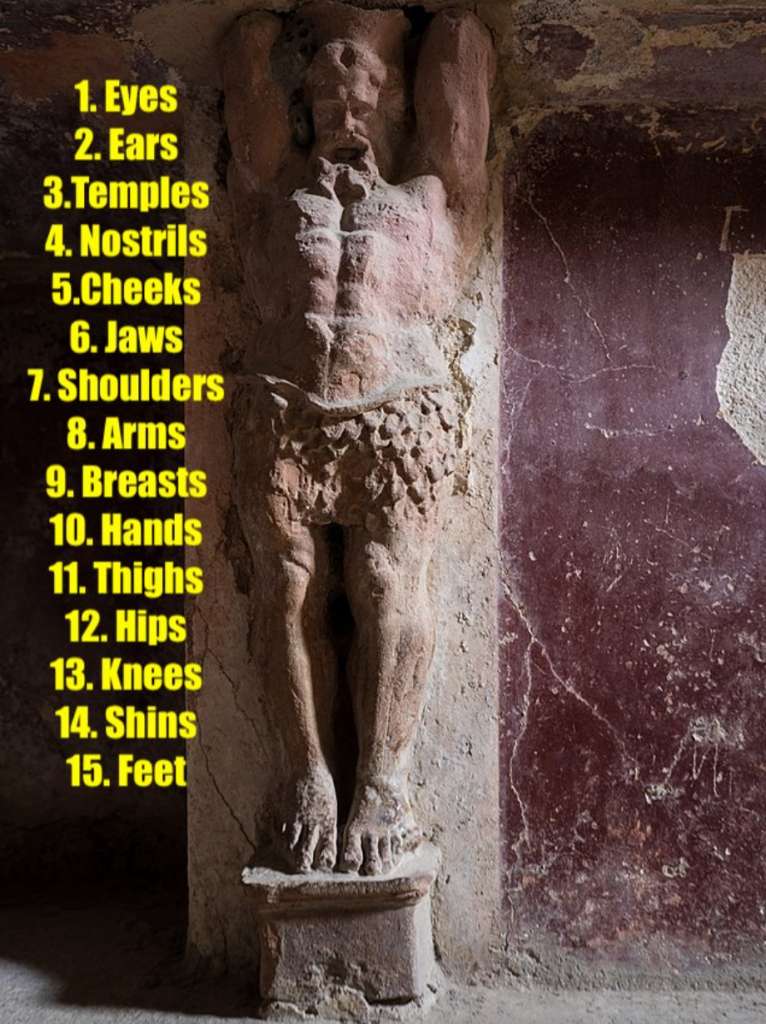
However, the mnemonist can “scale” their Memory Palaces infinitely. First, a single statue can unfold into a narrative, generating a “Chaos Palace” where the images are alive and constantly reorganizing themselves to fit new data.
Or you can give your statue a pocket and place other statues within it, or other kinds of Memory Palace Networks.
C
Chaining:
Also known as the Link System or linking, chaining is a method of connecting item A to item B, item B to item C, and so on, typically through a narrative story.
Many people use this technique reliant purely on the interaction between items rather than a background location.
However, linking is not something you have to divide from the Memory Palace technique. Memory Palaces themselves are a series of links in a chain.
Chunking:
Chunking is a process of breaking large strings of data into smaller, manageable units.
For example, remembering a 10-digit phone number as three distinct groups of numbers is specifically a chunking memory strategy.
D
Dicsone’s Lunar Palaces (The Mansions of the Moon):
A celestial memory system developed by the Scottish mnemonist and Bruno disciple Alexander Dicsone. In his work De Umbra Rationis (“On the Shadow of Reason”), Dicsone rejects the use of common terrestrial buildings in favor of an astrological architecture.
You can read this work in both Latin and English by getting The Hermetic Art of Memory.
https://www.youtube.com/watch?v=ArFTgRDIWo4
Dicsone utilizes the 28 Mansions of the Moon (the stations of the lunar orbit) as his primary loci. This creates a “Memory Palace” that is not a static building, but a cyclical path through the heavens.
As a fierce defender of Giordano Bruno against the attacks of the English Puritan Ramists, Dicsone’s system is a prime example of the “Hermetic” tradition, where the memory system is not just a notepad.
It’s a way to internalize the divine order of the cosmos. It possibly represents the height of the “occult” memory tradition before the scientific revolution replaced it with purely secular methods.
Dominic System:
A system invented by Dominic O’Brien that converts numbers into pairs of letters.
These letters represent specific people (a kind of initial-based mnemonic system).
For example, the number 15 might become A.E. (Albert Einstein).
This person is then used as an actor in a mental story.
For more, see my complete guide to the Dominic System.
Double Alphabet:
An advanced variation of the Peg System designed to optimize a standard Mnemonic Alphabet.
It allows you to store longer lists without reusing images, memorizers employ a “doubling” strategy.
Originally popularized by Renaissance mnemonists like Peter of Ravenna, there are a few ways of developing a double alphabet.
In Ravenna’s teaching, the first A–Z sequence was represented entirely by Men (A = Adam, B = Blacksmith). The second A–Z sequence was represented entirely by Women (A = Abigail, B = Bride).
Ravenna famously (and somewhat controversially) suggested using “fair maidens” for one alphabet to utilize the memory’s natural attraction to beauty.
A more modern approach involves creating a list of mnemonic associations on a first and last name basis. This gives you lists of associations like:
- AA = Andre Agassiz
- AB = Anthony Bourdain
- AC = Andy Clark
- Etc.
My preferred, high-resolution variation of the Double Alphabet uses a distinct image for the first two letters of the target word. You can think of it as a kind of bigram.
As you saw above, for the German word Abartig (abnormal), AB was Abraham Lincoln. This approach creates a much tighter cognitive grip on the traget word. When retrieving the image of Lincoln, the user immediately knows the word starts with “Ab-“, eliminating the guesswork involved with generic single-letter pegs.
Dual Coding:
Dual coding is a theory of cognition which suggests that memory is enhanced by processing information through two separate channels, usually verbal (text/audio) and visual (images).
People using mnemonics can leverage this concept by converting or mentally transforming verbal data into visual keys.
E
Elaborative Encoding:
This is the process of adding meaning, sensory detail, and emotion to a piece of information to make it easier to store.
This is nearly the opposite of rote memorization. I say “nearly” because elaborative encoding does involve some repetition.
The key difference is that elaborative encoding engages creativity, multi-sensory experiences in the imagination and often critical thinking.
F
Face-Name Method:
A specific application of the Association technique used to remember names. It involves three steps:
- Identify a distinctive feature on the person’s face (e.g., bushy eyebrows)
- Convert the person’s name into a concrete image (e.g., “Bernie” = “Burning”)
- Visually link the image to the distinctive feature (imagining the eyebrows on burning fire)
Harry Lorayne was a major advocate of this particular method when meeting new people.
Feature-Linking:
A variation of the Face-Name method where, instead of using a stand-alone image, the memorizer links the person’s name to a physical characteristic that sounds like the name.
For example, noticing that a man named “Mark” has a “dark” complexion (rhyming), or a woman named “Rose” has a “rosy” nose.
Field System:
A distinct branch of spatial mnemonics that organizes information upon a two-dimensional plane, grid, or “substrate,” rather than along a linear three-dimensional path (like a standard Journey Method).
Whereas the Method of Loci simulates a walk through a building, the Field System simulates looking at a page, a chessboard, or a landscape, allowing for “random access” to data based on coordinates or elemental groupings.
There have been many field systems throughout the mnemonic literature. In my view, Aristotle was the theoretical founder of the field system. I discuss this theory at length in this video tutorial called Aristotle’s Nuclear Alphabet:
https://www.youtube.com/watch?v=_3N2i73LKt0
Hugh of St. Victor fully realized the field approach in The Three Best Memory Aids for Learning History. In this work, Hugh instructs students to construct a mental “Ark” or grid in a few different ways.
Hugh’s approach effectively gives you a mental spreadsheet or a rectangular field divided by columns and rows.
In the 15th century, Jacobus Publicius literalized the field concept in his Ars Memorativa by using a diagram of a chessboard.
This provided a pre-made field where the squares served as loci. It is a perfect example of a “finite field” system, viewable at a single glance. You can even use an actual chessboard as a kind of Lukasa to assist your learning goals.
Bruno later dramatically expanded the concept in Explicatio triginta sigillorum (Explanation of the Thirty Seals).
Although Bruno utilized architectural building, he also introduced “Fields” that moved beyond buildings. Bruno’s fields included forests, skies, and open landscapes, allowing the “nuclear” elements to be placed in organic, “open-world” environments.
His approach suggests that a “Field” can be more than a storage bin. It can also serve as a semantic environment where the type of background (e.g., a stormy sky vs. a calm forest) adds meaning to the image stored within it.
First-Letter Mnemonic:
This technique uses the initial letters of a list of words to cue recall.
The image below shows the technique at work:
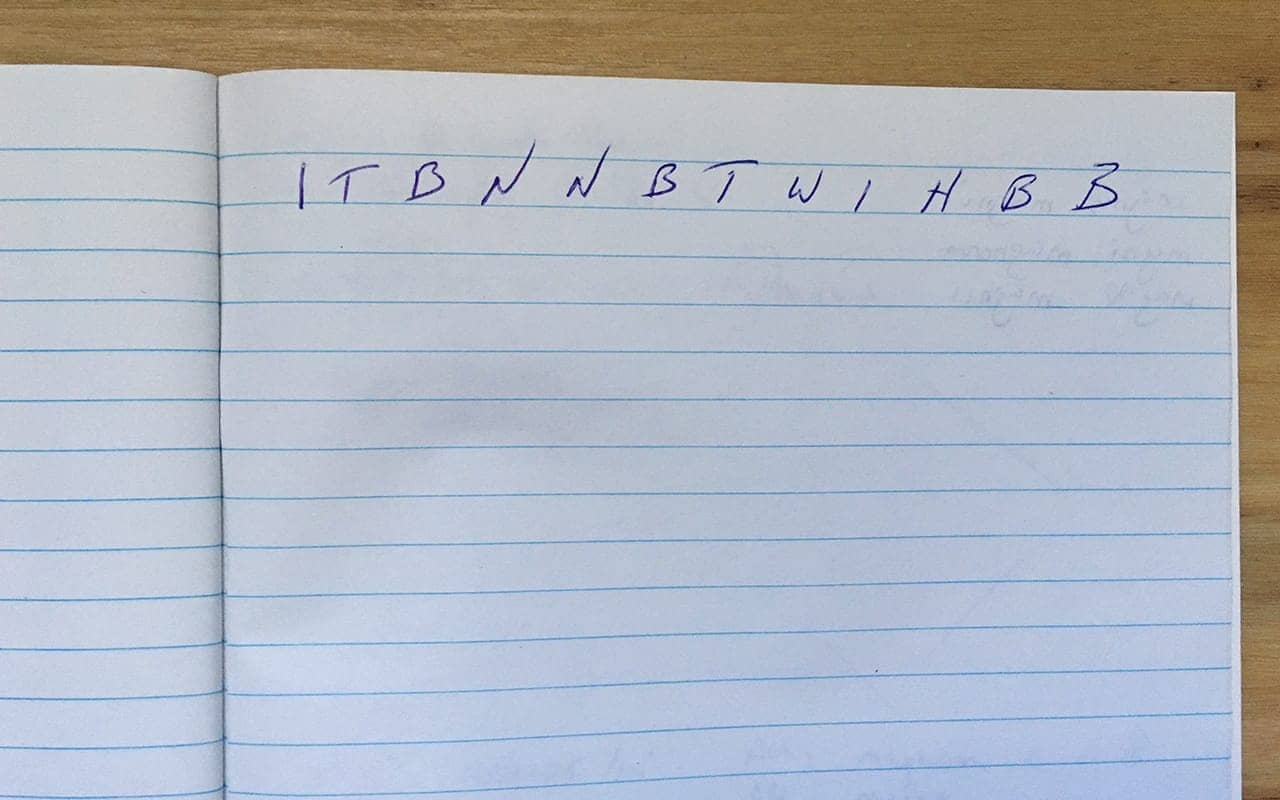
The letters ITBNNBTWIHBB unpack the opening of Shakespeare’s Sonnet 59:
“If there be nothing new but that which is hath been before, how are our brains beguiled.”
As astonishingly effective as this technique can be, my fellow mnemonist Nelson Dellis told me he would not use this technique to help him memorize a speech.
Neither would I. That’s why I prepared this complete guide on how to memorize a speech with a much more reliable method.
Fixed System:
Another term for a Peg System.
It refers to any method where your mnemonic “hooks” are pre-memorized and unchangeable (like the numbers 1–100), as opposed to a Journey Method or Story Method where the structure can be fluid or improvised.
G
Ghosting:
A common interference phenomenon in both memory sports and learning where a faint trace of a previous mnemonic image lingers in a specific locus, confusing the memorizer during either a new round of encoding or recall.
This problem typically occurs when a memory athlete reuses a Memory Palace too quickly without allowing enough time for the old associations to fade.
For example, if a “burning monkey” was placed on a sofa in the morning, and a “frozen frying pan” is placed there in the afternoon, the athlete might recall a “frozen monkey” due to the residual memory (the ghost) of the first image.
There are many ways to prevent ghosting, such as employing multiple Memory Palaces or using imaginative “cleansing” techniques to mentally scrub a location blank before reuse.
H
Hand Mnemonic Systems:
Because the hand provides a fixed structure (five fingers, multiple joints, palm creases, and two distinct sides) and is always visible to the memorizer, hands have been used for millennia to store everything from musical theory to complex kinship systems. Unlike architectural palaces, which rely solely on visualization, hand mnemonics add the power of proprioception (touch and body position) to the learning process.
Major historical and cultural variations include:
The Guidonian Hand: A medieval musical mnemonic attributed to Guido of Arezzo (11th century). It assisted singers in learning sight-singing by mapping specific notes of the hexachord system (the gamut) onto the joints and tips of the left hand. The teacher would point to a specific joint on their own hand, and the students would sing the corresponding note.
Indigenous Hand: As detailed by author Tyson Yunkaporta in Sand Talk, Indigenous knowledge systems (particularly in Australia) utilize the hand as a complex cognitive map.
Far more than a simple list-holder, the hand represents a web of relationships. Yunkaporta describes using the fingers to encode the five perspectives required for critical thinking (kinship, land, dreaming, etc.) and using the spiraling segments of the fingers to store vast encyclopedias of data, effectively carrying a library in one’s palm.
Calendar Mnemonics: The pervasive “Knuckle Method” used to determine the number of days in a month. By making a fist and counting months across the “mountains” (knuckles) and “valleys” (spaces between), the memorizer can physically feel that “Mountain” months have 31 days and “Valley” months have 30 (or 28/29).
https://www.youtube.com/watch?v=w11Hu5L-2co
The “Proverbial” String Around the Finger: A folk mnemonic that functions as a “prospective memory” aid.
Unlike a palace which stores content (data), the string serves only as a cue (trigger). It creates a sensation of mild physical discomfort or visual anomaly that interrupts the person’s autopilot, prompting them to ask, “Why is this here?” and thereby recalling the intended task. It is a physical manifestation of a “mental hook.”
This practice bears comparison with lucid dreaming and other dream recall strategies that involve writing or marking the hand to remind a person to perform a “reality test” by way of determining whether or not they are dreaming or not.
https://www.youtube.com/watch?v=lZkMCNhmEgY
Hook:
Hook is a term probably popularized by the mnemonist Bruno Furst.
Hooks are essentially Peg Systems. Each “hook” is a pre-memorized item (like rhyming one with a bun) that catches the new information.
J
Journey Method:
A specific variation of the Method of Loci.
Instead of using a building as a Memory Palace, the user visualizes or imagines a linear path or route (e.g., a walk through a park or a commute to work). The order of information is preserved by placing it along a sequence of landmarks on the path.
The journey method can be tricky due to the indistinct nature of outdoor locations. That’s why you should go through my full guide to getting the most out of the journey method.
K
Katapayadi System:
An ancient Indian alphanumerical code used to map letters to numbers. It is the direct conceptual ancestor of the modern Major System, predating the European version by centuries.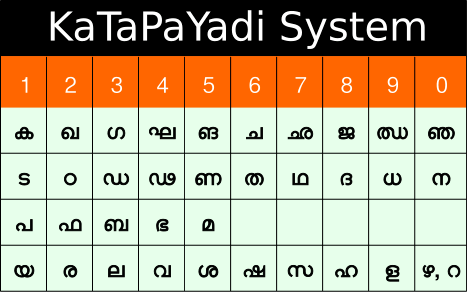
The name “Katapayadi” comes from the first letters of the consonants that represent 1: Ka, Ta, Pa, and Ya. (e.g., Ka = 1, Kha = 2, Ga = 3…).
Ancient mathematicians and astronomers used it to encode complex constants (like Pi or lunar cycles) into devotional hymns or poetry.
For example, a hymn praising Lord Krishna might simultaneously contain the mathematical formula for the radius of a circle, hidden in the consonance of the lyrics.
Keyword Method:
A linguistic mnemonic used primarily to learn foreign vocabulary.
The user finds a word in their native language that sounds like the foreign word, then creates an image linking the two meanings (e.g., Spanish “Pato” = Pot + Duck).
L
Leitner System:
This interesting method combines physical flashcards and spaced repetition.
Cards are moved into different Leitner boxes or areas of a single box based on how well the user knows them.
Known cards are reviewed less frequently, while unknown cards are reviewed more often.
https://www.youtube.com/watch?v=Y63eE3GjWyg
For my full tutorial, check out this guide to mastering the Leitner System.
Link System:
The most basic mnemonic technique, involving the creation of a story that links items together in a list. It is often the first technique taught to beginners.
The linking method can be potentially infinite in length but fragile. If one link in the chain breaks (you forget item five), typically the rest of the chain is lost.
That’s why is linking is usually best used for short lists or within a specific room of a Memory Palace.
Check out my full guide to the linking method so you know how to use it optimally.
Loci Method:
Effectively the same as “the method of loci,” it’s an umbrella term for all spatial memory techniques (Memory Palace, Roman Room, Journey).
Loci is the plural of locus and means location.
Used as a memory technique, it involves placing mental images in specific physical locations and retrieving them by mentally walking back through the space.
Lukasa (Memory Board):
Lukasa means the long hand or claw.
It’s a sophisticated tactile mnemonic device used by the Luba people of Central Africa (modern-day Democratic Republic of the Congo) to record and retrieve complex historical, political, and genealogical information.