PAO System: Your Full Guide to Person-Action-Object Mnemonics
Anthony Metivier's Magnetic Memory Method Podcast
Audio is streamed directly from the publisher (traffic.libsyn.com) as published in their RSS feed. Play Podcasts does not host this file. Rights-holders can request removal through the copyright & takedown page.
Show Notes
 The PAO System is the ultimate mnemonic tool for high-speed memorization.
A lot of people believe this system is used exclusively for memorizing numbers.
But a well-formed PAO System is actually a lot more powerful than that.
As a research professor, memory expert and author of multiple books on memory techniques, I’m going to show you how to use a Person-Action-Object (PAO) system for rapidly learning everything from historical dates, to mathematical formulas and credit card numbers.
You can also remember medical dosages and even complex terminology and foreign language vocabulary with this mnemonic system. The various ways you can use it for the mental compression of all kinds of information is immense.
In this guide, we are diving deep into the mechanics of how to build your first, world class PAO list.
Or, if you’ve already got one, I’m going to show you how to improve and expand it for multiple uses.
Are you excited?
Let’s get started!
https://youtu.be/ogtVQ48VgC4
What Is The PAO System?
PAO memory systems go back a very long time.
They offer you a simple way to create a formal mnemonic linking system for quickly encoding two-digit pairs into memory.
Scientifically, the technique leverages a mnemonic chunking strategy identified by researchers who determined that the most efficient amount of information for learning boils down to 3-4 items at a time. David Dirlam’s “Most efficient chunk sizes” is worth a read if you’re interested in the psychological explanation.
In practice, all you need to do is get out a piece of paper and write down all the digits from 00-99.
Then, using the Major System, apply mnemonic associations to each two digit par. The key is to select associations that can readily interact in memorable ways.
Example Using the Traditional PAO System
Take these two-digit pairs, for example:
21 36 90
Someone using a traditional PAO system would divide the numbers into a set of images specifically ordered according to the PAO pattern, Person-Action-Object.
The images are decided in advance so that you’re always ready to go when you look at numbers.
You then imagine something like Jack Nicholson throwing burning matches at a bus.
- Person = Jack Nicholson
- Action = Throwing matches
- Object = Bus
The exact PAO associations I’ve just listed come from my personal 00-99 PAO list. You can derive your own exact images in different ways, and we’ll talk about how to do that in a moment.
I’ll also share with you the thinking behind how I selected mine.

Briefly, 21 is Jack Nicholson in my PAO System because I’ve built each image based on the Major System.
Here’s what the Major System (sometimes called the Major Method) looks like: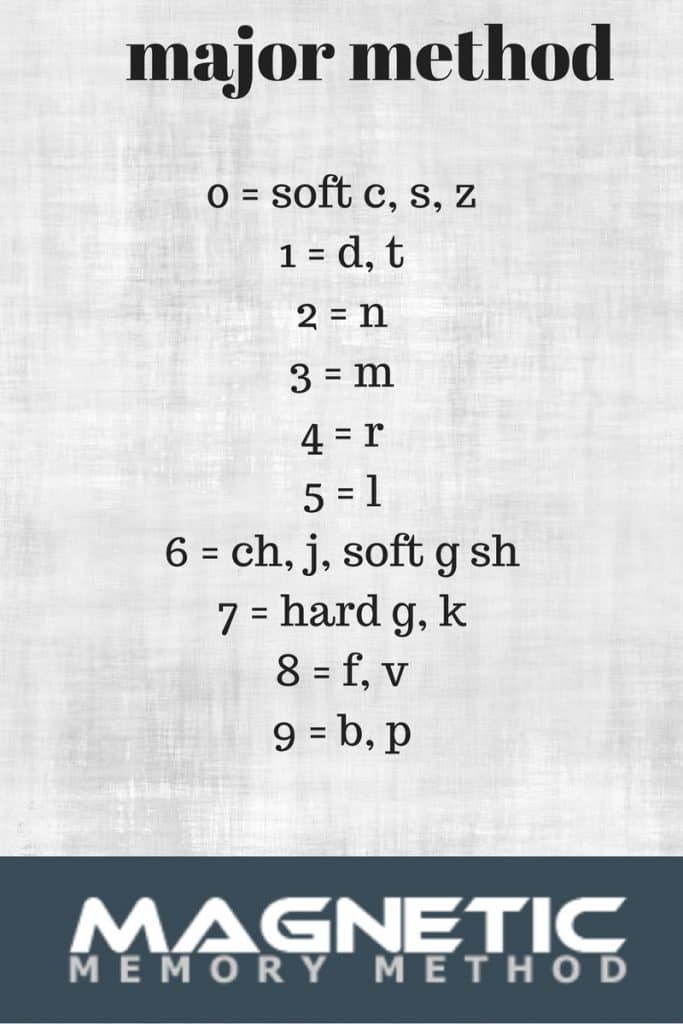
When it comes to associating 21 with the actor Jack Nicholson, bear with me. The exact process can confuse beginners, but I’m going to make it clear for you.
Look at the Major System graphic above. You’ll note that:
- 2 = N
- 1 = D or T
Following these rules, I assigned the word “nut” to the two-digit pair 21.
Since Jack Nicholson often plays characters who are completely insane (or “nuts”) he struck me as perfect for that number.
But before we get any further in to the nuances of the PAO System, you might be wondering…
How the heck did people come up with such an interesting way to approach memory?
A Brief History of Person Action Object Systems
The notion of combining or linking information you want to remember to a Person Action Object complex begins much more simply.
The first reference I can find is the Katapayadi system. The oldest available evidence is 683 C.E., but it is almost certainly older than that.
In this alphanumeric system, we see what is probably the first detailed basis for transforming numbers into words.
What kinds of words?
- Persons
- Actions
- Objects
Later, you see this arrangement built out with great sophistication in the works of Giordano Bruno, especially On the Shadows of the Ideas.
I’m not entirely sure, but I think Bruno chose to include Hebrew letters in his memory system because of the gematria. In this system, each Hebrew letter is classified so that it also represents a number. It also probably helped him expand his range of possible associations.
And since almost every Hebrew letter represents an animal, you pretty much have either a person or object in each letter along with the number. This approach is likely also the origin of what used to be called a “bestiary,” and on that Lynne Kelly is really the expert.
A Quick Review of PAO System Basics
Both in the past and now, linking numbers to consonants and then forming words that can be linked to mnemonic associations allows you to compress much more information into Memory Palaces.
As you saw with the Jack Nicholson example, the idea is to rotate between 3 different kinds of images for each two-digit pair.
But you also want each two-digit pair to have three associations.
For example:
01 = Peter Sutton suds soap
In this case, 01 (s + t) creates:
- Sutton, the Person
- Creating suds (the action)
- Soap (the object)
You don’t have to use the technique this way, however. But you do want to set up your system so that you can in order to enjoy full access to its possibilities for a variety of learning goals.

I’ll show you how to simplify your PAO arrangements further down this page so you need only one image per two-digit pair.
But first, let’s look a bit deeper at the mnemonic systems people use to create their PAO Systems.
PAO System vs Major Method vs Dominic System
Two other systems to know about are the Major Method and the Dominic System.
Dominic O’Brien came up with his variation to compete in memory competitions.
Technically speaking there is no such thing as a Dominic System PAO – at least not to my knowledge. This is because the Dominic System reduces a PAO down to a PA system (Person Action).
The Major, much like the katapayadi, lets you create any number of words from numbers. So in a true PAO system, you can actually have a lot more words:
- Person
- Action
- Object
- Emotional state
- Smell
- Flavor
- Favorite snack, etc
One of my favorite students also has a man and a woman for each two-digit pair. In other words, for 12, he has both a man named Don and a woman named Dawn. For 32 he has assigned a man named Manuel and a woman named Mandy.
The point is that the PAO System can be much more flexible than you might have been taught.
What if you don’t like either the Major or the Dominic System?
There are other systems you can explore, such as the Ben System and the Shadow.
(For more on the Shadow, check out my conversations with Braden Adams. But note that most people I’m aware of also base their PAO System on the Major.)

How To Use The PAO System
There are many ways to use a PAO system. You can use it to:
- Memorize numbers
- Memorize tones in tonal languages like Chinese
- Memorize difficult names and vocabulary when you can’t figure out more direct associations
- Number your Memory Palaces so they always have pre-built associations at each station
- Memorize playing cards
- Know the verse numbers when memorizing scripture
- Perform a stunt by memorizing and reciting Pi
- Benefit from incredible brain exercise
- Performing magic tricks with a memdeck
One way that people use the PAO system for numbers is very formal. They will always approach numbers in 3 sets of 2 pairs and then use their person action object in order.
That means that if you have a sequence of numbers like 89 43 21:
- 89 will be encoded as the person
- 43 will be encoded as the action
- 21 will be encoded as the object
Using my system, the images here are:
A viper (Cobra Commander) rams a nun (or Jack Nicholson).
Then, when memorizing the next set of digits, I can have the final object interact with the next set.
In other words, if the sequence is 89 43 21 55, the object that represents 21 can be doing something to the image for 55.
In this way, you can either have short vignettes or much longer narrative sequences.
Getting Started with Your First PAO System
The first step is to choose how you’re going to approach PAO memory systems so that success is guaranteed.
Again, for most people, I suggest learning the Major System first. Grounding your PAO System on the Major helps reduce the arbitrariness of the associations in a way that other systems do not.
Here’s what I mean:
In the Dominic System, you can choose just about any name so long as it starts with a particular letter of the alphabet.
But the Major limits the number of words you can choose from. And that means while learning your first PAO, you can use logic to work your way back to the core words you assigned.
And if you make a few leaps like I’ve done by turning V + P for 89 to turn the word “viper” into Cobra Commander, you can still track back the logic while you’re learning the system.
But you’re also free to simply assign words to your people, objects and actions without any special mnemonic system. If you have synesthesia, you might have some deeply intuitive choices that come to mind based on that aspect of how your mind words.
It might also be helpful to realize that a PAO list is really just one of several variations on the pegword method. I’ve shared the basis for my entire list there if you want to take a look.
Borrowing PAO Words From Others
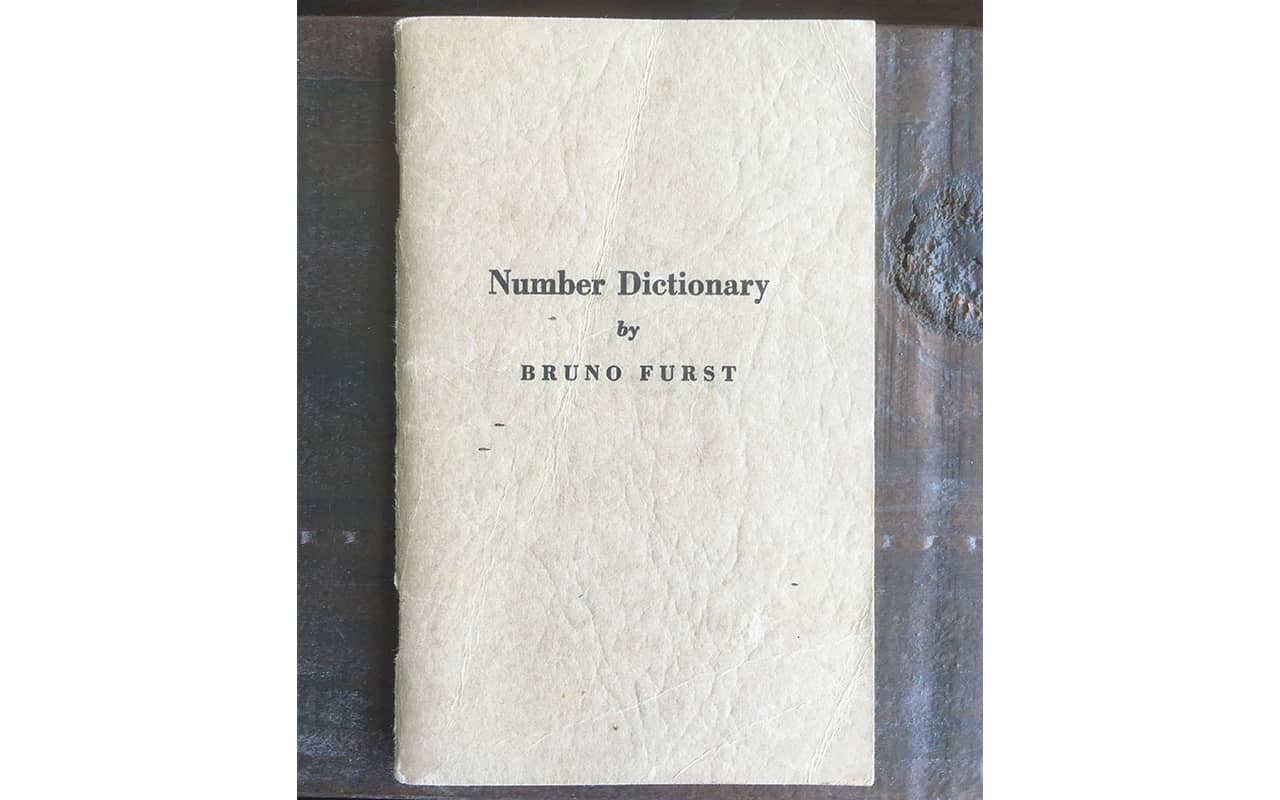
I do not recommend this, but you certainly can look up various number dictionaries for ideas. Bruno Furst created a really interesting one.
Why do I suggest you not look at the lists created by other people?
Typically, the results you want will really start to flow when you personalize each and every assignment you make for a full 00-99 PAO.
As the science of active recall shows us, it’s the personalization that makes this technique work. So why not start there now that you know how the system works?
From High School Struggles to University Scholarship: A PAO Success Story
One of the biggest hesitations I hear from people is that learning a PAO System is too complicated.
I get that, but check this out.
Adolfo first completed my Magnetic Memory Method Masterclass over a decade ago.
When he saw his son struggling in high school, he decided to share what he learned and help his son develop a PAO so he could go from failing grades to greater success.
Instead of buying an app, Adolfo bought his sun a large dry-erase board and put it in the dining room. Then, together, he walked his son step-by-step through constructing the system. They even sent me this pic of them doing it:
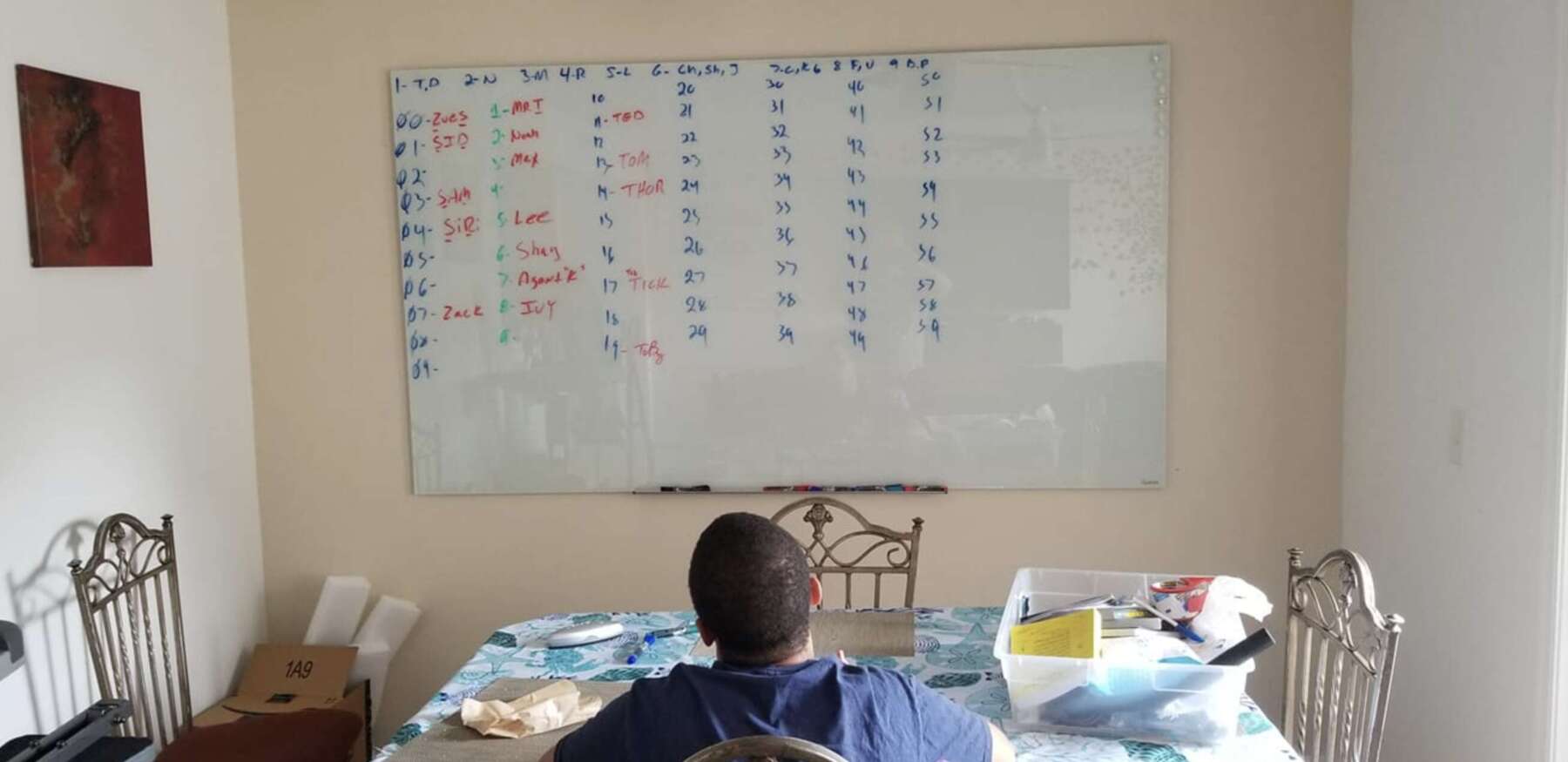
As you can see, the Major System was drawn along the top and the 00-99 PAO items were developed in vertical columns.
The Payoff?
Adolfo’s son went from struggling with his grades to earning straight A’s and then secured a full university scholarship.
I recently re-connected with Adolfo to get permission to share that photo with you and he proudly reported that his son is now completing his thesis.
All thanks to the PAO System and a dry-erase board.
For more inspiring stories of parents helping their kids master memory techniques, check out this interview with Alicia Crosby. And this one with Imogen Aires and her father.
Examples From My “Magnetic” PAO
For many years I got along just fine with just the Major System.
But then I competed with Dave Farrow and realized how slow I was using the Major to memorize cards.
Later, memory athlete Florian Delle made me realize that you can actually “compress” each assignment in a way that lets make each one a Person that is both an action and an object.
For example, my 84 used to be “fire.”
But after speaking with him, I upgraded it to a character in a movie who uses a blowtorch. Fire because a person who uses an object to burn things.
To repeat: The person is the object that takes an action.
This made everything so much faster!
Another example:
36 used to be a box of matches for me, based on the Major System.
It’s still “match,” but now it’s Mike Tyson in a boxing match. Tyson is the person, boxing is the action and his gloves are the object.
In this way, when I want to memorize a number like 8436, I just have to imagine the blowtorch character from Missing in Action 2 setting Mike Tyson on fire.
This works the same way when memorizing playing cards that have been assigned numbers or memorizing Chinese tones or verse numbers in scripture.
And the best part?
If you take a moment to number your stations in a Memory Palace, you instantly have an image to interact with in each and every memory space you use.
I don’t use that approach particularly often, but it has come in handy many times as an organizational tool.
Using The PAO System For Memorizing Historical Dates
It’s useful to know when certain things happened. Personally, I like to know when philosophers lived so I can understand the development or overlap of certain philosophical questions across time.
Spinoza lived from 1632 to 1677. Using my images, that would be Johnny Cash (the man in black) and Mr. Koch, who was my grade seven teacher.
I placed Spinoza in a Memory Palace after Giordano Bruno who is thought to have been born in 1548 and who died in 1600. This means that I don’t need an image to place Spinoza in the 1600s. But if I did, I would use Dashiell Hammett doing dishes for 16.
The key thing here is to involve the philosophical figure in the images somehow. Usually, I place the birth date in the left hand of the figure and the date of death in the right hand. I adopted this idea from Bruno’s ancient memory strategy of using the body as a Memory Palace.
A Fun Way To Practice A PAO
Here’s an exercise from the Magnetic Memory Method Masterclass:
Once you have all your figures worked out, get some index cards. Starting with 00-99, fill them all out with a 2-digit pair on each card.
Then, shuffle them up.
If you come across a 42, name out the figure you chose. Or if it’s 72, call out that figure.
Once you’re able to name each of your associations for 00-99 relatively quickly, you can then start shuffling the deck and practicing memorizing the numbers that come out in order.
I would suggest starting small, such as with three, two-digit pairs.
As you develop your memory for larger and larger sequences of numbers, place the associations in a Memory Palace so you have a point of reference.
Having a place to store your associations gives you the ability to think back and work out what your numbers were with much greater ease than if you only think about the images in the void of your mind.
Make The PAO System Your Own
At the end of the day, developing your own PAO System is a highly personal journey.
Although it will undoubtedly share similarities with others, it will still work best when it’s unique to you.
For example, both Ron White and I share William Shatner as an image. But the exact way we use the association differs.
It’s the Major System that causes us to land at the same choice, but after that, you can refer to any particular Star Trek episode or movie, and even several of them, depending on what you’re memorizing.
Again, a rigid PAO approach strikes me as unlimited. I like it to be flexible and give me more options.
Explore The PAO System For Language Learning
When I’ve struggled to come up with associations when learning a language, I always stop. I ask myself what the numbers would be for the word I’m struggling with.
For example, there’s a word in German: faseln. It means to “spout off.”
When I looked at the F and S, I thought of 80. That is an image of… you guessed it:
William Shatner as James T. Kirk with his phaser set to stun. “Eln” would be 52, which is a lion in my PAO system.

But not just any lion. It’s the MGM lion so that the image is vibrant and familiar, not generic.
And imagining Captain Kirk using a phaser on the MGM lion because the lion was “spouting off” a bunch of drivel made it fast, fun and easy to memorize the sound and meaning of that word.
PAO Sytem FAQs
As someone who has written so much about memory techniques and teaches a live memory training bootcamp nearly every month, I’m asked a lot of questions about this particular mnemonic approach.
Here are some rapid fire questions and answers for you:
Is the PAO System Better Than the Major System?
As discussed in the training above, they are not different systems. People base their PAO Systems on some other mnemonic number system, typically either the Major System or the Dominic System.
That, or some people use a hybrid approach. Katie Kermode shares her interesting approach in an article called My Card System if you want to take a look.
How long does it take to build a 00-99 PAO List?
The exact time it will take varies on how prepared you are with an underlying number mnemonic system and how consistently you come at the task of developing it.
Mine took only a few days, but I had used the Major System for many years by the point.
I’ve had some students complete their first version in less than an hour. Others take a few weeks.
A key thing to understand is that your system is always in beta. You can keep developing it over time and most of us do.
Can I use my PAO System for language learning?
Absolutely.
Any time you come across a word you don’t understand, just look at the consonants.
As I showed you with the word faseln above, you just apply your PAO associations based on the fact that is an F or V sound.
Can I use a PAO System for remembering names?
Yes. Although I normally commit names to memory in the way I describe in this tutorial, sometimes I will draw upon my PAO System.
Take my last name, for example, “Metivier.”
M + T = 31. In my PAO System, the core word is “maid.” To bring the association to life, I use the Mad Magazine mascot slinging mud as he tries to measure it.
You don’t have to use the Person-Action-Object structure when memorizing names, however. Just one of the words will typically do.
And you can expand your PAO System over time so that you have multiple choices. For example, sometimes I’ll use Matt Damon for 31, Matt Dillon other times.
Developing the ability to rotate between multiple options is something earlier users of memory techniques did often. They called the technique ars combinatoria, or the art of combination.
What if I’m not creative enough to come up with 100 people with actions and objects?
It’s helpful to realize that this technique is not about being creative in any literal sense.
You’re actually offloading the need to be creative by assigning your associations to people, celebrities, community members and friends you already know.
As a result, it’s easy to put together a world-class PAO System quite quickly.
Likewise when it comes to using it. Because you’re just using common objects in the hands of familiar people, it’s easy to mentally animate them. The objects pretty much tell you what to do from one person to the next, i.e. Mike Tyson throws matches (both 36) at Captain Crunch (79).
Should I preference real people or fictional characters for my PAO list?
It’s a personal decision, but I prefer a mix.
For example, I use both the Cheshire Cat and Johnny Cash without issue.
But in the beginning, you might want to choose people you’ve spent time with as this may reduce your cognitive load during the learning process.
However, I suggest that you keep expanding your PAO System to it includes the widest variety of options over time. It will allow you to use it more ways and at a faster clip.
Can I use a Memory Palace to help me learn my first PAO System?
Yes, and this can be a good idea.
Personally, I used a combination of thinking through the logic of the Major System and writing out my associations from memory in a journal.
If you want to learn more about developing Memory Palaces and all the different ways you can use them in combination with number mnemonics, please grab my free course: