Learn a New Language Fast: 5 Steps & 14 Best Practices
Anthony Metivier's Magnetic Memory Method Podcast
Audio is streamed directly from the publisher (traffic.libsyn.com) as published in their RSS feed. Play Podcasts does not host this file. Rights-holders can request removal through the copyright & takedown page.
Show Notes
 The best way to learn any new language is to establish a five‑part loop:
- Set a micro‑goal (e.g. “hold a 3‑minute café chat in 30 days”).
- Develop familiarity with the sounds & script before any of the other steps
- Build a core vocabulary by memorizing your first 50 mission‑critical words using the Memory Palace technique.
- Practice the “Big 5” skills of language learning daily:
- Memorize new words and phrases
- Speak
- Read
- Write
- Listen
- Get feedback and reiterate weekly to test your progress and get corrections from at least one native speaker.
Stick to this loop for 15 minutes × 3 sessions a day and you can hit A2 in approximately 90 days.
That’s exactly what I did to pass A2 when I lived in Germany.
I did it again to pass level III in Mandarin in an even shorter period of time.
Of course, there’s a bit more nuance to each of these steps.
And that’s what I’m going to share with you on this page
We’ll go through each step in detail and you’ll learn fourteen additional best practices used by the world’s most accomplished language learners.
Ready?
Let’s dive in!
https://www.youtube.com/watch?v=dgUsv2TZlKs
How To Learn A Language in 5 Steps
Step One: Set a Micro Goal
Having taught people how to improve their memory so they can learn languages faster, I’ve noted one major trend.
Many people make language learning hard on themselves by having an “all or nothing” attitude.
In reality, languages are learned with much greater ease by using what scientists call chunking.
This term means that you break a learning task down into the smallest possible unit.
Many people start by learning how to say hello, please and thank you in their target language.
Once you complete that simple goal, you set another goal. Or as I sometimes prefer to think of them, “missions.”
How to Set Language Learning Goals You’ll Love Completing
When I first started learning German seriously, my classes at the Hartnackschule in Berlin provided these small missions.
Later, I had to provide my own language learning missions.
To do this, I asked one simple question:
“What do I want to be able to speak about next?”
My choices will differ from yours.
But to give you some examples, I played in a band at the time. So I chose music-related topics to help fashion my goals.
I also taught Film Studies at the University of Saarland, so regularly memorized words and phrases related to this industry.
Finally, I love asking philosophical questions, so I learned how to ask them in German.
A2 was passed quite easily. That’s because the courses I took told me what I needed to learn.
But it was crafting my own missions that got me fluent. Because I spent time working out what I wanted to talk about.
And now you know how to create your own goals and missions too.
Step Two: Develop Familiarity with the Sounds and Script of the Language
Before diving into memorizing words or grammar rules, it’s helpful to get comfortable with how the language looks and sounds.
For example, I took a phonology course for that when I first started learning German. Likewise with Mandarin further down the road.
It’s also useful to learn the International Phonetic Alphabet. This set of symbols will help you with pronunciation, which is essential to being understood.
It’s also important to immerse yourself in the rhythms of the language. You can easily do this by:
- Watching YouTube videos
- Enjoying popular movies in the language
- Listening to audiobooks
Even if you don’t understand much yet, this passive exposure will help your brain attune to the phonic features of the language.
Learning Writing Systems
Depending on the language, you may need to learn an entirely new writing system.
I had to do that with Mandarin by learning the hanzi.
For Japanese, I also had to spend time using memory techniques for the hiragana, amongst other character sets.
Each alphabet will propose different levels of challenge depending on your experience.
If you have any concerns, especially if you have limited time, it’s worth considering my article on the easiest languages to learn.
You don’t want to rush, and some languages simply require more from your brain’s ability to associate sight and sound.
The point is that you will want to develop this kind of sensory familiarity between sound and sight to reduce mental friction later.
Your brain will stop having to ask, “What is the sound of this symbol?”
As a result, you’ll be free to focus on memorizing more vocabulary and phrases without interruption while studying.
Step Three: Build a Core Vocabulary
Once you’re familiar with the sounds and script of your language, it’s time to start building your vocabulary.
You’ll want to start small based on the goal-setting process and chunking we discussed above.
There’s lots of advice people give about organizing vocabulary by category and using word frequency lists, but I stick personally to the missions to work out what words I need to focus on.
That’s because taking classes and learning with native speakers does a lot of the organizing.
Using Memory Techniques for Language Learning
Given that you know how to create goals, let’s talk about getting your first round of vocabulary into your long-term memory.
Learning to use memory techniques for language learning well is one of the best ways to rapidly accelerate your practice. Mnemonics help because:
- The Memory Palace technique allows you to rapidly scale the number of words and phrases you can remember
- Effective association through multi-sensory visualization makes words and meanings incredibly “sticky”
- Using the method of loci mentally replicates spaced repetition software without sacrificing the benefits of active recall
In fact, the memory techniques optimize how you practice recalling information in a way that strengthens your memory overall.
Step Four: Practice the Big Five of Language Learning
In order to create momentum and progress, it’s important to balance multiple levels of processing everything involved in learning and using your chosen language.
To do that, you’ll want to learn the major “meta learning” skills that make achieving fluency possible.
These activities can be broken down into what I like to call The Big 5 Of Language Learning. I’ve illustrated them for you with this diagram:
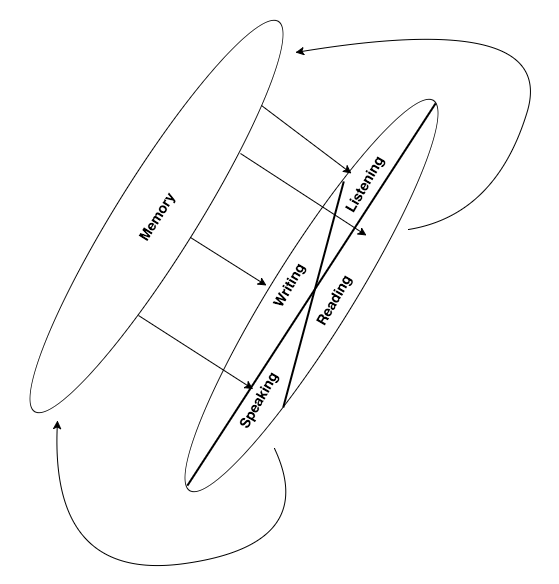
These five elements are based on a scientific principle called the “levels of processing”
How do I know they are valid?
Because researchers continually confirm their value in research papers like this one about Stephen Krashen’s input theory.
How the “Big Five” of Language Learning Works
And as the illustration above shows, giving yourself enough exposure to achieve the levels of processing effect requires you to combine:
- Memory
- Reading
- Writing
- Listening
- Speaking
It’s not a question of which one of these learning activities is most important.
It’s the holistic combination of all them that matters in the end. When I start a new language, I put each and every one of these activities into a learning cycle and interleave between them.
So far, only Hebrew, Sanskrit and Chinese have put speed bumps in my path. That’s because I had to learn their character systems first. But thanks to memory techniques, that didn’t take long.
Once you can read the language of the alphabet you’re dealing with, there are effective ways to combine listening and reading. You can do that by combining certain tools, like setting up subtitles on Netflix or the story narration program.
I feature both of these options on my best language learning software post.
You can also get great writing practice at the same time you speak, by repeating what you put on the page verbally either before or after putting it down on paper. These days, you can also explore language learning with chatGPT, which I’ve found helpful in small doses.

Any decent language learning class will make you go through these steps, but if you don’t also get yourself to do it on your own, you’ll struggle to learn your language.
Step Five: Get Feedback by Learning with Native Speakers
Learning in isolation is possible.
For example, I’ve achieved a lot in Latin purely by studying on my own.
But for most of us, it only gets us so far.
Why?
Because language learners need feedback.
And when you meet regularly with native speakers, you get instant feedback.
Please don’t wait to get started. Speaking before you’re “ready” is a key strategy and provides you with one of the fastest ways to improve.
You can watch me put this into practice in this video with me and my Ukrainian teacher during our very first lesson:
https://www.youtube.com/watch?v=f_dNtRuBRno
What’s the best way to find native speakers?
- Join a language exchange forum or website
- Schedule a call with a professional teacher and use Zoom (like you see in my Ukrainian learning documentary video above)
- Find a local tutor through a school or by placing an ad
Even just 10-15 minutes of interaction a few times a week can reveal gaps you’re not aware you have.
I suggest recording every session and then applying memory techniques later.
When you combine speaking with each of the other Big Five language learning activities, you’ll lock vocabulary, phrases and grammar principles into long-term memory effectively.
And you’ll build confidence as you go, which leads to competence in the language.
The Best Practices That Get Languages Learned Faster
Now that you have my five best steps under your belt, let’s talk about some best practices.
These suggestions are based on my years of experience interviewing and being friends with some of the world’s leading polyglots.
Their advice has helped me so much and I’m confident these considerations will help you achieve fluency too.
Best Practice One: Develop A Positive Mindset
So many people ask, How hard is it to learn a new language?
But what if this is the wrong question?
What if a better question is: what are the mental strength resources I need to keep consistent over the long term?
When it comes to language learning, you’ll want to develop skills with:
- Setting realistic goals
- For example, if your language has a character set or new alphabet you need to learn, this might be your first goal.
- If you already know the alphabet, then your first goal might be how to introduce yourself, plus fifty new words related to some of your interests.
- Creating a practical schedule.
- Showing up consistently.
- Managing your expectations.
- Understanding the different types of motivation when learning languages.
- Accept that mistakes will be made and be willing to learn from them.
- Exploring and acquiring the best language learning materials.
- Developing the courage to speak the language.

Some people will need to spend more time learning these skills than others. But they can all be learned and improved as you go.
Best Practice Two: Choose The Best Possible Language Learning Materials
This step is tricky, but also very doable.
First, just accept that some risk is involved. You might end up buying a book or course that just doesn’t suit you.
This circles back to mindset, particularly managing your expectations.
Personally, I treat it all as research and don’t get emotionally involved.
In fact, I allow myself to be open to revisiting any resource I’ve purchased again in the future, because we as humans can be tremendously fickle. It might not be that the book or course is bad. It’s entirely possible that we were either not ready for it yet, or just having a bad day, week, month or year.
A subset of choosing the best materials for learning a language is to limit the amount of sources. When learning a language, we do want tons of input – but that doesn’t mean you want it from dozens of sources.

Instead, I suggest you take a tip I’ve benefited from. It comes from my friend and language learning expert Olly Richards, who advises that we pick at maximum:
- One book
- One video or audio program
- One teacher
By sticking to limits like these, we give ourselves ample opportunity to experience the levels of processing effect while not overwhelming ourselves with materials. Embracing limits helps us maximize our investment in the materials and enjoy the benefits of thoroughness.
Plus, if you’re going to use rote learning instead of memory techniques, the limits will help ensure the rote is concentrated and not spread across too many different sources.
When it comes to avoiding rote, Olly shares some fantastic advice in this podcast:
Again, whether you use rote or mnemonics, you might find you acquire materials that simply don’t work. It happens, but at least you’ll have learned something about language learning materials that don’t suit your needs.
But overall, you can limit this problem in the first place my limiting how many language learning guides you bring into your learning life in the first place. And making sure that you always maximize your thoroughness with the ones you do choose.

That way, time will erase any mistakes and the materials you learn from will pay off soon.
My personal rule of thumb is to stick with a book, course or audio program for at least 90 days.
When I was learning Chinese, for example, I followed my own advice. By working with just one audio program, one book and one teacher, this limited focus helped me achieve much faster progress.
But had I been by constantly throwing new “shiny new textbooks” in my path, I would have been constantly distracted.
Need a source for good language learning teachers online? These days I suggest you give Languatalk a try.
Best Practice Three: Immerse Yourself With Sensible Input And Strategic Challenges
In the beginning, you might not understand anything. But as you learn, your pattern recognition will go up.
There are a number of ways to keep increasing your sensible input. These include:
- Meet regularly with a native speaker
- Be sure to bring a picture-based magazine. Learn to ask, “What is that?” and keep pointing at pictures. Record the sessions with your smart phone and listen back, trying to guess what you were looking at in the magazine.
- Watch movies with subtitles
- When you find vocabulary and phrases you want to learn, write them down and memorize them. I recommend you create your own flashcards by hand using drawings and colors, like this:

- Complete courses and textbooks thoroughly
- These will help increase the amount of patterns you’ll recognize as you continue your exposure to the language you’re learning.
- Read short stories and news articles
- You can do this by just reading or by creating your own translations as you go. My friend Luca Lampariello shares a number of tips on how to use translation to increase your fluency.
- Take a course
- Strictly speaking, taking a course isn’t necessary. I’ve done it both as a beginner and as a more established student and find saving it for later much more useful.
- If you take a course, make sure the teacher uses the target language primarily. You’re not there to improve your mother tongue or teach it to them.
- Speak with natives online
- There are many great websites for finding people to speak with during dedicated sessions or in small doses by sending and receiving audio texts.
- As a rule of thumb, I like to give new speaking partners 2-3 sessions before deciding if they are a fit or not.
- There are many great websites for finding people to speak with during dedicated sessions or in small doses by sending and receiving audio texts.
- Follow Instagram and other social media accounts in your target language.
- Learn songs in your target language.
I know that it can seem strange that learning songs will help, but it helps get more vocabulary and grammar in memory than you might think.
It’s fun too, as you can see as I practice singing a song in Mandarin I later performed at my wedding:
https://www.youtube.com/watch?v=dCyPV6qfKkI
With all of these learning activities, you need to use your judgment. If you go for something too advanced, you’ll just get frustrated.
By the same token, if you don’t challenge yourself, you’ll quickly get bored. Get out of your comfort zone. It’s where you’ll find the progress you seek.
Best Practice Four: Invest Enough Time For Daily Practice (But Not Too Much)

People think you have to spend five to six hours a day while learning a language. This just isn’t true.
By the same token, you’re not going to get very far with just 5 minutes a day.
That said, if you’re strategic about it, you can learn a lot in 15-30 minutes a day. The trick is in breaking up the activities and making sure you’re getting in enough practice of all The Big 5.
A schedule like the one I’ve drawn up for you in the following example can work wonders:
- Mornings: 15 minutes memorizing vocabulary
- Afternoons: 15 minutes of reading and listening using narrated short stories or news articles
- Evenings: 15 minutes watching a movie (or the whole movie with about 15 minutes spent capturing words and phrases you find interesting)
Then, the next morning, you can memorize the new vocabulary you’ve gathered from the day before.
The exact amount of time you spend is not nearly as important as the consistency and focus you bring to each learning session.
Also, vary the routine. If the routine I suggested is something you use on Mondays, Wednesdays and Fridays, do this on Tuesdays and Thursdays:
- 30 minutes in discussion with a native speaker
- 30 minutes reviewing the discussion recording
It’s also important to schedule breaks. Taking a week off once in a while actually does your brain good when you’re learning.

The trick is making sure you don’t take off too long and then struggle to get back on the horse.
Here’s a simple tip:
Make sure your language learning sessions with speaking partners are booked in advance. That way, you’re taking some highly beneficial time off, but not with a dangerous open end.
If you still struggle with developing a personal schedule for language learning, give mind mapping for project planning and scheduling a try. I’ve found it useful during times when I was struggling to organize my time.
Best Practice Five: Build Your Own Vocabulary And Phrase Lists
Many people ask, “How long does it take to learn a new language?” I believe the answer should be that the journey never ends.
But for those who are in a hurry, they often come across the idea of “frequency lists.”
These are compilations of words that are used the most often in any given language. If you’re learning Spanish, these lists can be especially seductive.
And they definitely can be useful. In some cases, they will accelerate how quickly you can get started learning the language.
However, they’re also incredibly limited.
Why?
Because no maker of such lists can know what contexts you’ll find yourself in or what you’re going to want to talk about.
That’s why when you’re reading news stories and translating them, it’s important to focus on information that’s interesting and relevant to you.

You’ll move along so much faster if you let yourself be informed by word lists, but also always take care to build your own. There are no “right” words to focus on and true fluency comes from being able to accomplish missions.
When learning German, my favorite way to produce my own custom lists was to read interviews with musicians. They use so many interesting words and turns-of-phrase. It really helped me add interest and flair to how I use the language.
Likewise in Mandarin, I’ve learned a lot from the hip hop scene. They use a lot of interesting phrases that are not only useful, but also add character to my use of the language.
The point being that the more you build your own list of words and phrases you want to know, the more make your connection to the language unique and feel a lot more special.
Best Practice Six: Focus On Systems As Much As, If Not More Than Goals
Goals are important. But even more important are the systems that help ensure that you actually accomplish your language learning goals.
Let’s say your goal is to learn 50 new words by the end of the week. Great! That’s perfectly realistic.
But it’s also meaningless if you haven’t sat down and charted out a systematic means to ensure you memorize those words.
I suggest developing an if-this-then-that language learning habit stack.
For example, let’s say you’ve developed a Memory Palace strategy and you’ve spent some time gathering the words you want to memorize. Your habit stack might look like this:
- If I wake up, I go immediately to my learning place.
- If I go to my learning place, I open my Memory Journal to the list of words I’ve prepared.
- If I have my list, I start with the first word and memorize it using Station One of the Memory Palace.
- If I have memorized one word, I move on to the next.
- If I have memorized 10 words, I put my Memory Journal away and start mentally reviewing the words.
- If I have reviewed my words 3-5 times during the day, I test by writing them out by hand and speak them out loud.