How to Memorize Scripture: 7 Proven Approaches
Anthony Metivier's Magnetic Memory Method Podcast
Audio is streamed directly from the publisher (traffic.libsyn.com) as published in their RSS feed. Play Podcasts does not host this file. Rights-holders can request removal through the copyright & takedown page.
Show Notes

If you want to know how to memorize scripture quickly and make it stick for the long-term, please understand the following.
There’s no single way to do it.
That said, there also isn’t an infinite number of approaches. You can use either:
- A Memory Palace Network
- Mnemonic images
- Rote Repetition
- Flashcards
- Spaced-repetition software
- Cloze tests
- A combination of all the above
On this page, I’ll walk you through each of these options as a PhD who memorized a lot of scripture as part of my studies. I even included some scripture I memorized in my popular TEDx Talk.
As I walk you through each strategy for memorizing scripture, consider focusing especially on the Memory Palace technique.
You’ll get my best tips for all of the other methods listed above, but using Memory Palaces has helped the largest amount of people in the fourteen years I’ve been teaching memory techniques for scripture.
How to Memorize Scripture: 7 Proven Approaches
Before you start memorizing scripture, please consider following my P.E.A.C.H. formula (practice encoding at calm hours).
Memorizing the Bible is possible. But you have to set aside the time to do it. And it’s very important not to let yourself get interrupted.
For best results, explore each of the methods on this page in a well-thought out study place and a time when you won’t be disturbed.
One: The Memory Palace Network for Memorizing Scripture and Verse Numbers
Many people are aware of the Memory Palace technique and related memory techniques like the method of loci and the journey method.
It works like this:
Choose a familiar location, like your home or a neighborhood.
Next, assign a path through that location, strategically following a journey where you will place mnemonic images that help you remember verses and their numbers.
For that reason, it helps to have a numbered Memory Palace, as illustrated in this Kelvin Grove Memory Palace I used for one of my scripture projects:

For best results, I suggest you sketch your Memory Palaces and keep these in a Memory Journal.
Then, as you’re learning to use the technique, you have a self-created visual reference to work with as you place mnemonic associations in the Memory Palace.
For some people, it will be easy to memorize multiple words at the same time. For others, it will be necessary to encode the verses with an image for every word.
When it comes to memorizing the verse numbers specifically, you’ll want a number memory technique like the Major System or the PAO System. I’ll give a detailed example further down showing you how all this works.
Two: Mnemonic Images without a Memory Palace
Some people do not want to use Memory Palaces. They wonder if they can simply create associations to scripture and have them float “in the void of their mind.”
One of my students just did that.
In fact, Mike McKinley shared how he used just a part of my teaching to memorize 66 Psalms on the Magnetic Memory Method Podcast. But as we discovered in our conversation, he still used a certain level of spatial memory.
You can contrast his experience with those of Matt Barclay, who joined me to discuss how he memorized and delivered an entire Psalm to his congregation.
The reason most of us prefer to use a Memory Palace is that it helps reduce the cognitive load. Using a familiar location to place images is like having a canvas to paint on. It helps you look back at a reference point and reconstruct the target verses you want to recall.
Three: Rote Repetition
Of course, it’s worth noting that you’re perfectly welcome to simply repeat the verses until they stick. This approach is traditionally called rote learning.
It doesn’t work very well for many of us. In fact, it can be downright destructive because it’s often frustratingly boring.
That said, it’s worth experimenting with in order to see how it compares to using other mnemonic techniques. Often people are pleasantly surprised and come to realize the benefits of the active recall mnemonics provide compared to rote.
Four: Flashcards
I just mentioned “active recall.” One of its most important principles is that you need to personalize the associations you make when memorizing scripture.
Obviously, this is not possible with rote learning. That approach involves literally repeating the same thing over and over again.
But let’s say you want to memorize the books of the Bible by name. This is a great way to use flashcards.
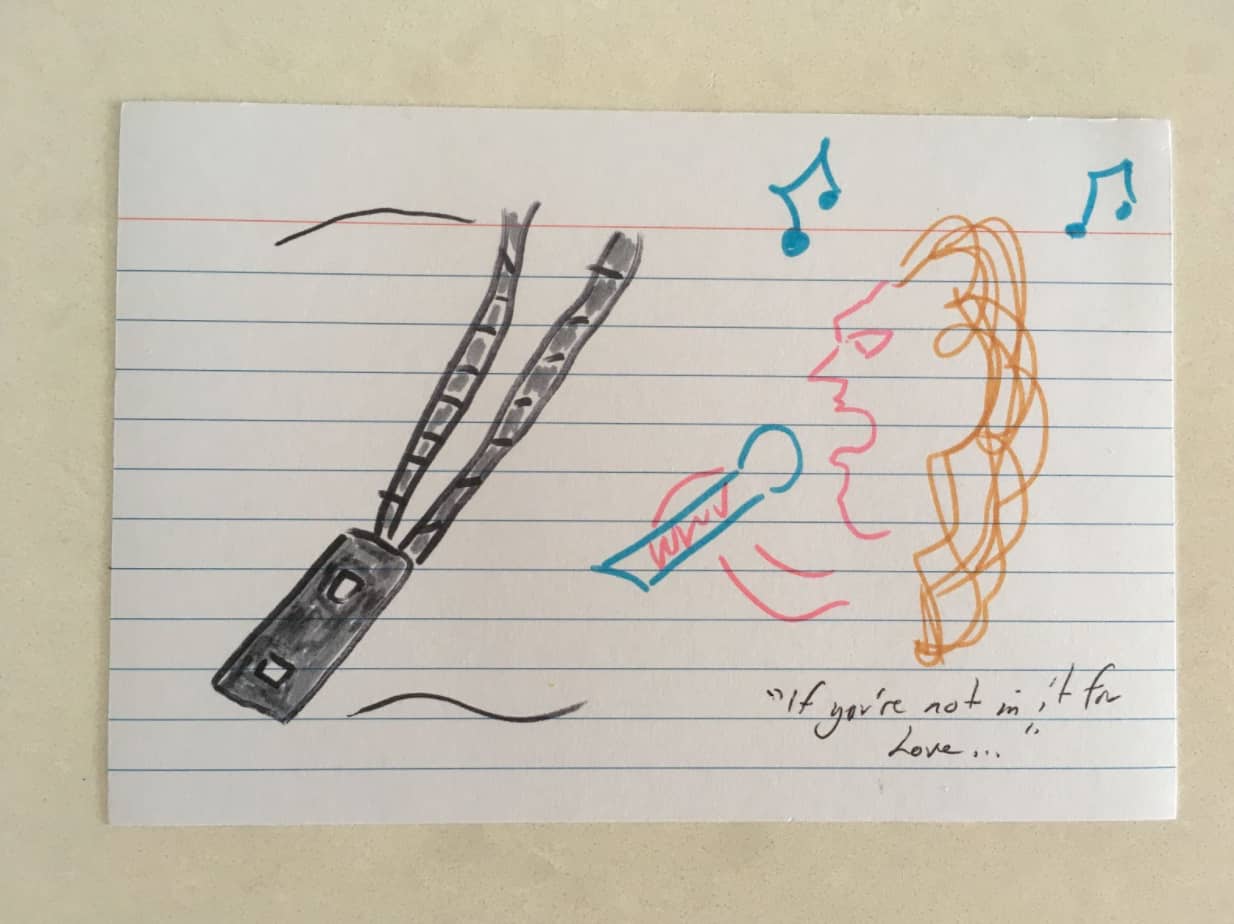
For example, I drew this to help me remember the name Zephaniah:
I know. I’m not a great artist.
But the zipper helps me remember that the word starts with ‘Z.’ And Shaniah Twain helps me remember the sound of Zephaniah.
The trick here is that the exact name of the Bible is nowhere on the card. I have to use the way I’ve personalized the mnemonics as a clue that triggers the target information. This is what active recall is all about.
Notice something else: The card is itself a kind of Memory Palace. Even without looking at any individual card, you can simply reflect and ask, “What was happening on that card?”
By thinking of your drawing on the card, you’ll improve your rate of recall substantially.
Five: Spaced-Repetition Software
People often ask me about apps for memorizing the Bible.
Personally, I don’t recommend them.
That said, Anki is an app that follows the scientific principles needed for proper spaced repetition.
What’s spaced repetition?
It’s tactically (not randomly) revisiting the verses you’ve worked on committing to memory over time. If you prefer not using software programs, you can combine spaced repetition with flashcards by using the Leitner System.
Six: Cloze Tests
Some softwares for Bible memorization help you by restricting certain parts of the Bible verses you’re committing to memory. Like this:
I ____ the ____ I have for you,” ________ the Lord, “plans to ______ you and not to ____ you, plans to ____ you ____ and a ______. – ________ 29:11
This kind of memory strategy is called a Cloze Test.
Again, you don’t need a software to do it. You can write out scripture and leave out some of the key words and phrases. Then, when reading back the scripture, mentally fill in the blanks or use a pen and paper.
This approach isn’t for everyone, but it’s well worth experimenting with as you commit scripture to memory.
Seven: Combine Strategies
You’ve learned that active recall works best when personalization is involved. Another aspect of active recall is getting in lots of variety. This principle ties together with interleaving, which shows that we learn faster when we combine multiple approaches.
For this reason, I recommend you that you don’t get stuck in a rut with just one of the strategies I’ve discussed above. Try them all and rotate through them on a regular basis.
It might seem a bit much at first, but as you continue to weave the activities together, you’ll likely find yourself remember scripture with greater ease.
A Detailed Example of Memorizing Scripture & Verse Numbers
Now let me give you an example of how I memorize Bible verses. Let’s focus on one of my favorites:
Proverbs 18:13 (NIV): “To answer before listening — that is folly and shame.”
First, I suggest that you sort out the keywords. That’s because your mind will typically fill in a lot of smaller words. The keywords I chose when memorizing our example verse were:
- Answer
- Before
- Listening
- Folly
- Shame
Next, I asked myself…
Who do I know who relates most closely to either the form of the verse or its meaning?
My friend’s sister Andi comes to mind. She served as a mental association.
Then, using a Memory Palace based on Andi’s brother’s home, I imagined her typing out an email while a bee floated around. Something like what you see in this illustration:

To help with memorizing the full verse, I didn’t have Andi memorize just any kind of email?
Rather, I imagined her writing an email in response to an episode of Fawlty Towers she’s just seen on television. She does this before she even heard the end of the sentence that offended her, and as a result, Andi feels ashamed.
Why Fawlty Towers?
Because it has a sound similar to “folly” in it. Note that I thought of and chose Andi as my “Bridging Figure” for this verse because I was focusing on the first word “answer.”
The “an” in Andi and the “an” in answer “magnetically” attract each other. Weave these associations together in a Memory Palace and one will “trigger” the other.
By looking for natural parallels that are already in your memory and imagination, you can often come across just the right set of images. This happens much more quickly than if you try to create abstract associations.
Abstractions in your associations must be avoided as much as possible.
They’re difficult to recall, create weak associations and cause more frustration than they’re worth.
How To Memorize All Those “Little Connecting” Words
Now, you might be thinking that you’re still a beginner. What about “to,” “before,” and “is”?
Before you spend time memorizing them, stop and think it through.
Do you really need to memorize them? Or can you allow your mind to fill in the blanks?
In my experience, most people do fine with letting their mind fill in the blanks, provided they follow the rest of the steps I’m sharing now. As you’ve learned, Cloze tests actually involve getting yourself to fill in missing words from scripture that you want to memorize, so it’s actually a good thing not to have an image for each and every word.
But if you need to come up with associations for all these little words, I suggest you consider creating a “stockpile.”
If you use a tutu for “to,” always use that same association.
If you use a bee driving a forklift for “before,” always use that every time you need this word.
Don’t worry. It’s unlikely that your mind will mind the repetition. The Memory Palace will provide more than enough differentiation.
The important point is that you’re drawing upon information, ideas, people and objects already in your memory.
That’s where the real memory magic happens. And sadly, this is a point that is too often missed by many memory experts who otherwise mean well.
How To Remember Verse Numbers
I mentioned above that you can use either the Major System or a PAO System to memorize verse numbers.
Let me give you an example of this technique. Once you’re set up with these number systems, you’ll find it simple to create little associations to precede the associations you use for the verses themselves. If you feel like you need more help after going through this example, feel free to go through my tutorial on the 3 Most Powerful Memory Techniques For Memorizing Numbers.
For now, have a look at this:

For Proverbs 18:13, for example, I see a large TV set that I actually owned vacuuming J Edgar Hoover using a Hoover vacuum.
Weird and memorizable, right? It is!
But why these images?
Because 18 for me is always represented by a few things, one of which is a TV set.
Not just any TV set, but a particular TV set that has meaning for me.
And when you know the Major Method, you’ll know that there’s a very good reason that it’s a TV and not some other object.
Likewise with J Edgar Hoover with a Hoover vacuum.
It represents 13 because I’m following this simple chart based on the Major:

Sometimes for 13, I see Hoover vacuuming on the Hoover Dam. There’s actually a way to make that dam a Virtual Memory Palace that I’ll talk about in the future. For now, here are 5 Memory Palace Examples you can learn about to enhance your practice.
In any case, having multiple images to draw upon is the Magnetic Memory Method Principle of Compounding. It’s part of the joyful science of creating and using a “Magnetic 00-99 P.A.O.” Learn more in the MMM course on memorizing math, equations and all things related to numbers.
I know that this process might sound complex.
It really isn’t once you get into it. After all, as Jeannie Koh explains in her Magnetic Memory Method Testimonial, using these techniques helped her reach her goals immensely:

And it’s a skill worth having for more than just memorizing verse numbers. It makes committing all numbers fast, easy, effective and fun.
What matters most is that you associate everything with information that already exists in your mind and that is meaningful to you.
Following Up: What To Do After Your Memorize Scripture Verses
Now comes the fun part.
What you want to do is mentally walk through your Memory Palaces one at a time.
Do this as many times as it takes to recall the verses accurately. Be sure to recall them both verbally and in written form. There are a few more tips on this practice below.
How many times exactly is a question no one can answer. At least 5 times the first day and then 1 time per day for a few weeks is a good rule of thumb derived from Dominic O’Brien.
As you develop your skills, you’ll find that different verses enter your memory at different rates and each presents its own form of brain exercise.
The varying levels of challenge is a good thing. It keeps you on your toes, keeps things interesting, and in fact, you don’t want it to be easy. If using memory techniques suddenly became easy, they’d be boring and you would stop using them.
It’s very important to set a time aside for practicing recall to ensure that you do it.
I suggest using a Memory Journal to gather all your Memory Palaces and record your recall.
There’s no perfect journal, but one I recommend is called The Freedom Journal. It has just enough space for an effective Memory Palace drawing and lets you create 10-day “sprints” over the course of 100 days.
How To Recall On A Verse-By-Verse Basis
As you go, “trigger” off the associations you made and let them bring back the information.
For example, I would start with the specific Memory Palace and the specific station.
How does one remember that?
If you’ve correctly planned and organized your memorization activities, then the answer will be known to you without any stress or strain.
Remember:
You create the Memory Palace Network to serve the outcome you want. This process alone will help you remember what is memorized where.
If you’ve properly numbered each Magnetic Station as taught in the free course, then you’ll have even more “autopilot familiarity” with your Memory Palaces.
How the Memory Palace Tells You The Right Word Order
And if you are memorizing verse numbers and memorizing the scriptures in verse order, order itself acts as a clue. It will tell you where in your Memory Palace the information is located.
Next, I would recall Andi and simply ask myself: “What was she associated with?”
Asking questions during recall is important because you’re encouraging your memory to do a bit of work.
Sometimes the entire line will blast back at you, almost like magic. Especially if you complete these powerful visualization exercises.
Other times, you’ll have to piece it together, word for word.
In all cases, if you have a pen or pencil in hand, recall the verse first, then write it down. Say the line out loud as well.
At more advanced levels, you can certainly remove the writing part, but I don’t recommend it. Even when I’m memorizing names of people I’ve met, I almost always write them out in my Memory Journal.
This simple, 1-2 minute practice ensures that anyone will reap the full benefits of instilling the scripture followed by successful recall.
The Big 5 of Learning For Long Term Memory
In full, these are:
- Reading
- Writing
- Speaking
- Listening…
- …from and into Memory
Visualized, the levels of processing effect for memory looks like this:
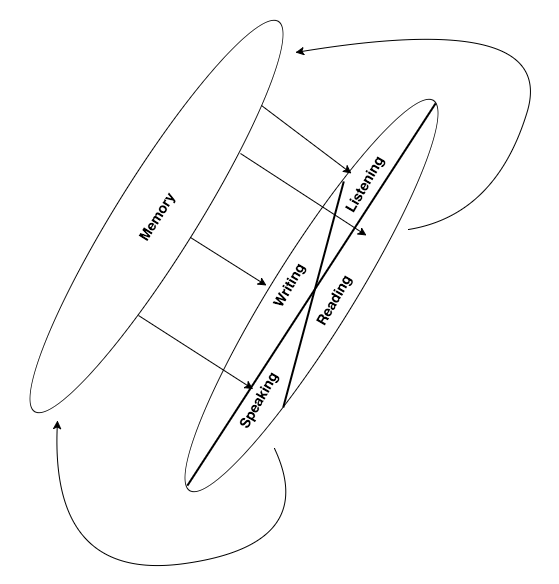
I’ve just mentioned writing out what you’ve memorized and speaking it out loud.
Writing automatically leads to reading, and you’ve already read the verses before, during and after memorizing them.
However, it’s good to also read interpretations by multiple thinkers where possible.
Plus, there are often more comprehensive commentaries available that you can read on various scriptures that will give your mind more context to help create deeper connections in both your imagination and the physical structures of your brain.
A Solo Way To Hear Memorized Verses Out Loud
It’s also important to hear the verses spoken by others, so try to find recordings that you can listen to and recite along with them.
You can also record yourself and listen back to your own voice.
I also suggest making memorization a family or at least a community occasion.
Reciting with others and hearing others share what certain passages mean for them is very useful for creating long term memory impact.
The Biggest Levers You Need For Memorizing Scripture
In brief, you’ve got to commit to creating the time for memorizing scripture.
Logical, isn’t it? If you really want to get something done, you’ll make the time.
How much time do you need?
No one can honestly say just how long it will take for you to reach your goals. But you can start by gathering your memory verses and then assessing how much time you’ll need for each. After that, schedule the time.
Once you’ve started, chances are the question of how long it will take to commit various passages to memory will no longer be very interesting to you.
You’ll be enjoying the process itself too much and become completely satisfied that each new verse gets you closer to the goal. The journey will become so much more important than the destination.
And when those destinations are reached, you’ll be excited and want to create new ones. The benefits for the sharpness of your mind will be very clear to you.
Common Questions And Answers About Memorizing Scripture Quickly
Over the years, I’ve fielded many questions about memorizing scripture.
Here are some answers to the most common questions, including some questions you might not have thought of asking.
What’s the fastest and most reliable way to memorize a verse?
Depending on your current level of skill, pick a small Memory Palace of 10-15 stations.
Then, extract 3-5 keywords per verse and associate those words with vivid mnemonic associations.
Once you’ve layered them in, walk the Memory Palace forward, backward, from the middle to the end and beginning and then skip the stations.
Practice recalling the scripture by calling it mind daily for about a week. Then once a week thereafter for at least five weeks.
Should I memorize references or the text first?
It’s ultimately a personal decision and you should try both ways.
Personally, I start with the verse number only when I’m memorizing individual Bible verses, such as the ones from this list of Bible verses to memorize I created for you.
If you’re following my recommended Bible memorization plan, you likely won’t need to focus on anything other than the verses themselves.
How much scripture should I memorize per day?
Life is busy, so I recommend that people focus on consistency with no pressure to memorize any particular amount.
With my own scripture memorization projects, there have been days when I’ve only found time to memorize one syllable. Other days, I’ve memorized lines as long as twenty words or more.
The key is to keep going consistently. The verses will build up over time and the exact daily amount won’t matter much at all.
If it helps to have a mental metaphor, I often think of the process as stringing beads. The Memory Palace is the string, and each word is a bead.
Some days I’m able to add more beads, other days less.
Another important consideration is that you leave time each day for rehearsing what you’ve already memorized. Although you can get away without reviewing each and every day, it’s still better for long-term retention if you can revisit a passage you’re memorizing daily for at least a week.
What’s the best translation for memorization?
Ultimately, the translation that you love and will continue memorizing over the long term is the best one.
Some prefer the cadences and vocabulary of KJV. Others prefer modern phrasing.
The good news is that you don’t have to limit yourself. It’s possible to memorize multiple versions.
And depending on your study goals, knowing a few different versions of various verses will help deepen your understanding and appreciation.
Does the amount of scripture I want to memorize matter?
Yes and no.
I recommend starting with short verses in the beginning. The sooner you develop the skills needed to quickly and accurately memorize short verses, the sooner you’ll be able to tackle longer verses.
The trick is in seeing that longer verses are usually just shorter verses fit together. In such cases, it can be very helpful to spend more time ensuring that you understand the gist of a long verse before committing it to memory.
Can I memorize full chapters or books?
Absolutely.
As discussed in my tutorial on passage memorization, you can memorize any passage of any length.
All you need is to prepare the Memory Palaces you’ll use so the space is ready ahead of time.
If you try to develop the Memory Palaces as you memorize, you’re giving yourself two tasks to complete at the same time.
For that reason, it’s best to identify the passage you want to memorize, pick the most appropriate Memory Palace for the task, or develop a new one.
If you worry about running out of Memory Palaces, consult my ultimate list of Memory Palaces ideas. You’ll never run out.
How do I keep verses from blurring together?
The first tactic is to make sure you’re using spaced repetition optimally. Once you’ve got the verses in long-term memory, it’s less likely that you’ll confuse any of them.
You can also clearly label your Memory Palaces and use Magnetic Bridging Figures.
For example, when memorizing the Book of John, I draw often upon my friend and memory competitor John Graham. For the Book of Mark, I use the actor Mark Hamill in many of the associative images.
As a result, the verses are distinguished by virtue of how they were encoded in the first place.
What if I forget words or sections while reviewing?
Don’t panic, label or judge yourself.
It’s normal to forget while memorizing something new. And as I talk about in my list of books on learning, a psychological effect called “predictive processing” can cause you to harm your progress by seeing forgetting as negative.
The key is to simple note what you forgot and ask questions.
Ideally, you’ll be using the Magnetic Memory Method, which allows you to ask questions about each of the Magnetic Modes in KAVE COGS. In other words, you can ask:
- What kinesthetic association did I hear?
- What auditory noise did I involve?
- What visual, emotional, or conceptual elements did I involve?
If you remain stuck, resist peeking at the source verses.
Wait for an hour or so, analyze further by revisiting your Memory Palaces and see if the lost material doesn’t come to you. Often it will.
Only after letting yourself fail and analyzing over a period of time should you look at the source verse.
Then, write out the mnemonic associations you used and think about how you can use KAVE COGS to make them even stickier.
How do I memorize verse numbers quickly?
The fastest way for most people is to use a 00-99 PAO System.
If that approach feels too advanced, you can start with the number rhyme system first.
But as soon as you can, having a full set of proper PAO images is best.
Can I memorize scripture without visual imagination (aphantasia)?
Absolutely, yes.
As I discuss in Can You Use a Memory Palace without Visualization, these techniques were primarily logical and multi-sensory for most of history.
You can use sounds, physical gestures, spatial anchors and many other tools.
And you should know that very few memory competitors see images in their minds.
Is singing or chanting effective for Scripture memorization?
It certainly has been for me.
Not just because adding a melody and verbally hearing the meter gets more of your brain involved.
It’s also more interesting and fun. And it helps set the stage when the time comes to recite the scripture to others.
Because you’ll have practice speaking it out loud, you’re less likely to stumble over any of the words.
Does using mnemonic associations disrespect Scripture?
Some people feel this way, and I addressed the issue straight away in the scripture memorization parts of The Victorious Mind.
Personally, I believe that imagination exists for us to use. So it’s a bit contradictory that we would be given such an effective tool only to be forbidden from using it.
I suggest focusing instead on the purity of your intention.
If you remain concerned, work on the more subtle Magnetic Modes, especially those taught by Giordano Bruno. Albeit harder to learn, the conceptual associations are not risky in any way.
Should you use flash cards and sticky notes?
No, I don’t recommend this because it doesn’t create the needed skills of memorization that a Memory Palace and association develops.
These forms don’t create brain exercise either. The only exception to the rule is if you are memorizing individual words or terms and don’t have the answer on the back of the card.
Instead, feature the Magnetic Imagery you created on the opposite side of the flash card or sticky note. In this way, you’ll ask your brain to do a bit of memory work and jog itself into action. The benefits of doing this will be incredibly rewarding.
And as soon as you can, leave the index cards and sticky notes behind.
Why You Shouldn’t Memorize Scripture From Online Sources
Many people want to memorize from online sources such as the Scripture Typer app and Bible Memory Kids.
To be honest, these Bible apps look great on the surface. They’re clean, well-organized and perhaps even fun to use.
But they’re also creating Digital Amnesia.
If you must source your scripture from a screen, at least write it out in your handwriting and memorize from that. This practice will deepen the importance of the verse to your mind and is a win-win from the get-go.
What Scripture Do You Want To Memorize?
At the risk of being repetitive, knowing why you want to memorize scripture does matter.
For myself, I like to memorize the odd line from the Bible. But overall I prefer scripture from the non-dual tradition, Advaita Vedanta.
In this memory demonstration, you’ll see me recite 32 verses from a text called the Ribhu Gita:
https://youtu.be/CgNQ9bU-nEg
Although I didn’t memorize a verse every single day, I rarely spent more than 5 minutes on any single verse. It just isn’t necessary when you have these skills.
Also, if you’re concerned about age or various conditions with your brain, keep hope. As mentioned above, my student Matt Barclay completed the course and gave a 12-minute recitation from the Psalms in front of his congregation after spending hardly any time memorizing it. You can see the demonstration and our discussion about how he memorized the Psalm here:
https://www.youtube.com/watch?v=XiY58Z1ApCc
Ultimately, what really matters is that you learn the skills and ground the project on a solid reason why you want to commit the scripture to memory.
And remember:
Long-term memorization is a marathon, not a sprint. You just need to have a solid reason why you’re memorizing scripture.
Plan, show up consistently, and enjoy the multiple benefits as they increase, one verse at a time.
Thanks so much for reading and if you’d like more help with the memory techniques discussed, please register for my free memory improvement course:

I think you’ll find it just as helpful as have my many students who work on scripture memorization. They’ve experienced much joy and fulfilment as a result of bringing themselves closer to God through verse memorization.