15 Brain Exercises & Memory Exercises For Rapid Remembering
Anthony Metivier's Magnetic Memory Method Podcast
Audio is streamed directly from the publisher (traffic.libsyn.com) as published in their RSS feed. Play Podcasts does not host this file. Rights-holders can request removal through the copyright & takedown page.
Show Notes

Lots of people do brain exercises and memory exercises, often in the form of brain games.
You’ve probably even tried a few, right?
That’s all fine and dandy, but there’s a catch:
Playing mental exercise games on your “smartphone” is not necessarily brain exercise!
It might not even be mentally stimulating.
Not by a long shot. Even if it feels that way on the surface.
Worse, it can be harming your focus and concentration, instead of healing it. You might think that practicing remembering objects are hidden in a game, but often it’s actually harming your memory. And I can prove it.
But don’t worry.
I’m about to reveal some memory exercises and brain exercises that actually work.
That’s because the mental fitness routines you’ll discover on this page really do exercise your brain. I’ll show you how to put them into action and also help you understand why they boost brain health.
Why should you listen to me? As the author of the bestselling book, The Victorious Mind, I’ve been researching memory and brain exercise for over a decade. This work is an extension of my PhD research, which involved looking at the role of language learning in developing the mind.
To help you navigate this post, here’s a preview of what you’re about to discover:
- Brain Exercise and Memory Exercise? – What Makes Them Good?
- The 15 Best Brain Exercises For Memory Improvement
- What Is The Best Brain Activity For You?
- How To Stimulate Your Brain To Be Smarter and Faster
- How To Improve Concentration And Focus
Brain Exercise And Memory Exercise? – What Makes A Mental Fitness Routine Good?
Let’s face it:
Smartphone-based brain games don’t exercise your brain at all. If anything, they yank your brain’s dopamine around.
Any exercise you get is quickly wasted on the ads you’ll be shown and tracking graphs that no robot can accurately help you understand.
Instead of helping you, brain game apps train you to get good at completing tasks within the world of those apps. This is called context dependent memory. Daniel Simons and his research team have found that there is no meaningful evidence supporting that any skills you gain from within an app environment transfer to other skills in life.
In other words, although you might remember where objects are located in a brain training app, there is no evidence showing it will help you better remember where you left your keys.
To give you a quick example of context dependence from the world of language learning, I used to go to a lot of polyglot conventions. I met many people who could win all the shiny coins and medals in language learning apps.
But actually speak the language? They could not. Their skills were “context dependent” on using the app.
So any mental fitness you enjoy from using any software rarely applies to the aspects of your life where you need to be sharp, such as during conversations or on the job.
The Real Definition of Brain Exercise & Memory Exercise
Context dependence means that if you want better focus and clarity, you need to be doing real brain exercises. You need to completing memory exercises that give your memory a real world workout. To do that, any routine you select needs to follow these four rules:
- It always involves new learning
- It is always reasonably complex (and sometimes unreasonably complex)
- It is always varied and interesting
- It is always engaged in frequently
Without following these rules, it is unlikely any exercise in an app will improve your memory.
But I promise you the brain exercises and memory exercises below will stimulate and grow both your short-term memory and long-term memory. In case you’re wondering where I’ve drawn my own research from, here’s just a sampling of the research papers I’ve studied to discover what really works to improve your mind and memory. I’ll link other resources as we go through each of the recommended exercises below.
Ready?
Let’s get started!
How to Exercise Your Brain: The 15 Best Brain Exercises For Memory Improvement
As we go through this list of brain exercises, there’s no special order of important. I recommend that you try them all.
In fact, by interleaving them, you’ll get even more benefits.
1. The 4-Details Observation Exercise
Memory expert Dr. Gary Small talks about memorizing four details of people you encounter out in public.
For example, let’s say someone is wearing a black hat, has blonde hair, a triangular ring, and a green sweater.

The goal is to observe the details first and then recall them later.
No need for ancient memory techniques or anything like that. You just naturally encourage your brain to recall the details you selected earlier in the day.
Some scientists call memory exercises like the 4-details exercise “passive memory training.”
It’s passive because you’re not using any special memory techniques. You’re just asking your mind to do what it was designed to do: to remember.
Why does this matter?
It matters because we don’t ask our minds to practice observation enough.
Because we don’t practice observation, we fail to observe and receive the memory exercise benefits we get from simply asking our brains to recall information.
We also fail to observe things that we aren’t seeing – making it impossible to make mental pictures of them. I teach you all about how to do that with these 3 simple visualization exercises.
If you’d like to be a better observer of the world around you, noting and visualizing details will help far better than brain training software like Cogmed.
It’s also scalable. You can start by observing just one person per day. Once you’ve gotten good at recalling four details of just one person, you can add more information or more people (or both).
You can scale this memory exercise even further by memorizing the details using a Memory Palace.
If you like, you can also notice details about buildings, cars, movies or series and foods that improve memory to boost your cognitive abilities.
But focusing on real people is the more potent memory exercise. Being observant of others around you is a great social skill.
2. A Number Exercise That Will Skyrocket Your Concentration
I can’t emphasize the following point enough:
Numeracy is more than just a powerful skill to boost your cognitive abilities. It’s something I work on to boost logical thinking – both with and without memory techniques in play. And scientists have shown that lacking math skills limits the development of your brain.
“Add 3 Minus 7” is a simply way to get started developing your calculation skills while you develop your mental muscles. It’s a fun numerical memory exercise you can try today. To get started, all you do is pick any 3-digit number. Then, add 3 to that digit 3 times. Then minus 7 from the new number 7 times.

Repeat the process at least 5 times and pick a new 3-digit number the next time. You can also take a different route and start with a 4-digit number and use other numbers to challenge your working memory further.
For example, you could start with 1278 and add 12, 12 times and minus 11, 11 times.
It’s up to you and the amount of numbers to dictate the level of challenge. Remember, this brain exercise strengthens your working memory because of the amount of detail you need to hold in mind to complete it.
3. Number Skipping
In a book called Happiness Beyond Thought, Dr. Gary Weber shares a powerful means of experiencing your conscious mind directly.
It sounds deceptively simple, but it’s actually quite a challenge.
To complete the exercise, you count from one to ten.
But instead of visualizing each number, you skip the even numbers on the way up.
By “skip,” you don’t count 1, 3, 5, etc.
You actually pause on where the even digits should be. But you actively try to not represent them.
There are a few variations on this technique, so if you want more nuance, give this tutorial a view:
https://www.youtube.com/watch?v=p7NPia_lkaE
Important Tip: Don’t make the memory exercise so easy that you get bored with it. We all need challenge from our brain exercises in order to grow.
You can also skip using the alphabet by exploring a Renaissance brain exercise called The Field. We’ll discuss it next.
4. The Field: A Renaissance Era Brain Exercise
We think of brain exercise as a 20th century need due to issues like digital amnesia.
But this is not the case. Aristotle knew his students needed his certain exercises, which is why he talked about mentally manipulating the alphabet. I shared his suggestions for doing this in “Aristotle’s Nuclear Alphabet.”
Over one thousand years later, Giordano Bruno expanded on Aristotle’s exercise and created an exercise called The Field:
https://www.youtube.com/watch?v=eRFNXZxjGEU
It can be a bit difficult to understand, which is why I created the video above.
Basically, you create one row of letters in your mind, from A-Z. Then you navigate them forward and backwards.
Later, just as you did with number-skipping, you manipulate the alphabet by traveling the row by the odd-letters first, and then back along the even numbers.
Finally, you expand the field in multiple directions. If you want an additional level of challenge, you can apply the ideas to Hugh of St. Victor’s “Noah’s Ark” Memory Palace concept.
5. Repeat What People Say In Your Mind
We all know in our hearts that no one is really listening when we speak. And that’s sad.
But here’s the good news:
You don’t have to be another person who is just nodding your head like a puppet while actually thinking about something else.
You can train your brain to focus on what people are telling you and remember everything they say.
It all begins by creating presence in the moment in an easy way:
Follow the words being spoken to you by repeating them in your mind.
For example, imagine that someone is saying the following to you:
“Tomorrow I want to go to a movie called Memory Maverick. It’s about a guy who cannot forget. He’s hired by a group known only as ‘The Agency’ to infiltrate a competitor. But once the hero learns the secrets, he doesn’t want to hand them over. But since he can’t forget, The Agency starts making his life miserable.”
All you would need to do to complete this brain exercise is repeat everything the person is saying silently in your mind. You’ll automatically boost your cognitive function and remember more by doing this.
It works because simply asking your memory to recall information exercises it. The more challenging the information, the more exercise your brain will get.
6. Visualization Exercise Secrets Of A Memory Maverick
To remember even more, you can practise creating pictures in your head.
But go beyond the visual. Also add in multisensory elements.
For example, using the sample conversation above, you might see an image of Mel Gibson as he looked in the movie Maverick trying to remember something. Imagine that you are trying to feel what this is like as if you were Mel Gibson yourself.
Or you might get a picture in your mind of an agency building and scenes of evil men in suits torturing the hero. Feel their clothes on your skin. Smell the air through their nostrils. Hear the world through their ears.
For more cognitive exercises on remembering what people are saying with visualization practice, check out this interview with Jim Samuels on the Magnetic Memory Method Podcast. He has some great ideas, and the benefits include:
- Being more present.
- Remembering more of what was said.
- Showing people that you’re interested in them and their lives.
- Easing conflicts when they arise because you remember the issues in greater detail.
As people speak, they “translate” their ideas into pictures, feelings, related concepts and even tastes and smells.
Take this training seriously:
You’ll feel better about your connection to people because you’re really with them.
7. The Metronome-Clapping Exercise
Back in grad school, I had a great professor named Matthew Clark. For some reason, he told our class in Classical Literature about a great concentration exercise that I’ve practiced ever since.
It’s simple: You put on a metronome at a slow speed and then practice “covering the click.”
Such neurobic exercises can help us focus on things that our brains have been automated to perform. The increased focus that neurobic exercises develop helps you zero-in on your surroundings to boost your memory skills.
If you’d like a practical example of the metronome exercise on video, please check this out:
https://www.youtube.com/watch?v=qaiF3DL-ens
To be clear:
I don’t think this memory exercise helps memory in any direct way.
But it is excellent for improving concentration and presence.
Here’s why these mental states matter:
The better you get at this mind exercise, the longer the amount of time between clicks you should place. Accurately covering the metronome with a minute between clicks would be impressive!
8. Build & Use Your First Memory Palace
The ultimate brain exercise to boost overall cognitive function is also the easiest. It involves nothing more than a simple drawing that follows some simple principles.
What’s a Memory Palace?
It’s a mental recreation of a familiar location. You use it to chart out a simple journey that you can follow with your mind.
Then, using associations, you “place” mental images along this journey that help you remember things.
Why is creating a Memory Palace such a powerful memory exercise?
First, complete my FREE memory improvement course and find out for yourself:

Second, creating a Memory Palace draws upon your spatial and visual memory.
It’s also a great recovered memory and autobiographical memory exercise.
As far as mind exercises go, the Memory Palace training exercise works kind of in reverse.
Why?
Because you’re accessing visual memory cues that are usually blueprinted in your mind outside of your awareness.
Think about it:
You’ve rarely gone into a new home or store with the conscious intent of memorizing its features.
Yet, if you think back to the last home of a friend you visited, here’s a fact:
Most people can recall an insane amount of detail with visual memory. Creating a Memory Palace lets you exercise that inborn ability.
You can even use it for memory and learning stunts like memorizing all the Prime Ministers of Canada.
Second, creating a Memory Palace is creating a tool that you can use for life. Once you have one and you’ve mastered using it, you can create dozens more.
And if you can do that, you can do great things with your memory, like how Matteo Ricci learned Chinese in record time. You can also easily remember names at events and accomplish any memory-associated goal.
And what goal doesn’t involve memory?
9. Learn a Foreign Language
You’ve probably heard that bilingualism is good for the brain, right?
It is, and one of the reasons why is that you are continually asking your brain to recall information.
Take advantage of your brain’s neuroplasticity and learn a new skill at any age to keep it active and ticking!
This is a great brain exercise for people of any age because it keeps you talking with people.

Regular conversation also helps stimulate the production of healthy chemicals for better mental health. Ideally, you would have conversations about books you’ve read. That way you dig into memory at multiple levels, especially verbal memory.
But if you don’t like to talk, you can also sing. Or do both. For a double-whammy of health and brain benefits, singing has been shown by researchers like Gunter Kreutz to increase cortisol and other chemicals involved in healing.
For this reason, singing in a foreign language you’re learning can increase the impact and effectiveness of this brain exercise.
However, that isn’t all – you get more health benefits.
Researchers conducted a study that found that learning a second language can delay the onset of cognitive impairment like dementia in Alzheimer’s disease by around 4-5 years!
The best part?
Learning anything new is good for your brain!
Whether it’s learning to play a new musical instrument or working with your non-dominant hand, new neural pathways will form – helping you boost your brain power.
10. Mind Mapping For Maximum Brain Health
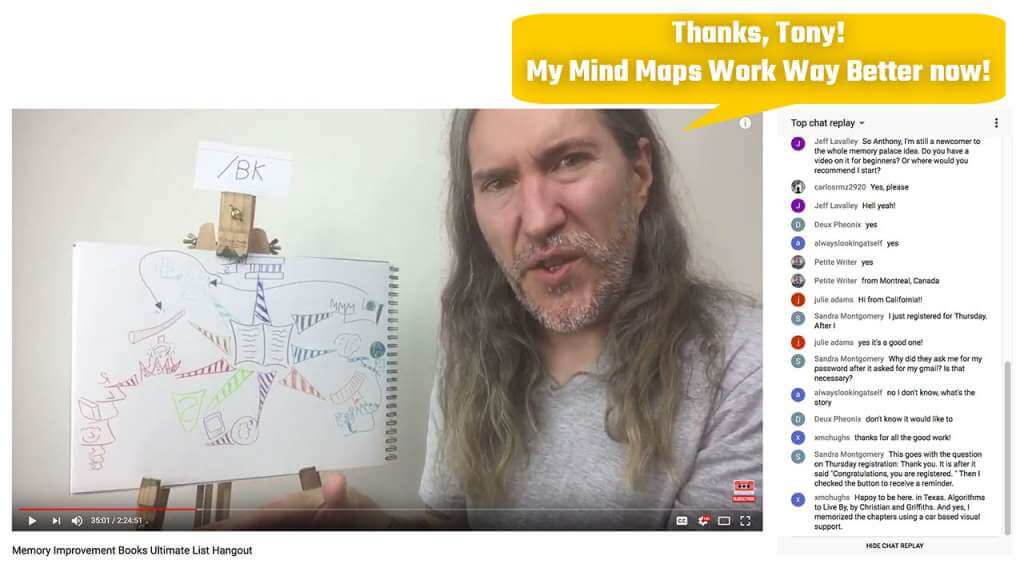
It’s no secret that I’m a huge fan of Tony Buzan’s approach to mind mapping.
And that’s because I used to mind map in ways that weren’t effective at all.
But after training with Tony and world mind mapping champion Phil Chambers, I discovered a new route and I’m way better at the practice and share it in real-time on my YouTube live streams:
What is mind mapping?
It’s a graphic means of brainstorming and planning. You can even use it for note taking and review.
The question is…
Why is mind mapping great for boosting cognitive function?
One reason Tony Buzan hints at is very compelling. The process reproduces the role of nerve cells on the paper.
Think it through:
Just as a brain cell has a central nucleus with synapses that flow outward like a river, the mind map has a central idea that feeds several streams with mental power. By creating mindmaps, you’re making it easier on your brain – thereby increasing its processing speed. Just like more water increases the flow of a stream.
Interested?
Give these 10 mind mapping rules a try whenever you want a cognitive training workout.
11. The Memory Exercise Of Sports And Fitness
I love physical activity like aerobic exercise.
And not just to workout my muscles and boost my heart rate.
Physical activity is a great place for including a mental workout. And you don’t have to take my word for it. Dr. John Ratey is widely considered one of the most authoritative experts on making sure you include exercise as part of how you develop your brain and memory. He’s also shown how exercise helps us reduce anxiety.
I had his working in mind when I finally started getting serious about physical exercise in order to help me tackle brain fog. In fact, this is me at the gym, where I often combine physical fitness and memory exercise by using a PAO System to memorize my heart rate during certain routines, like deadlifting.

If you don’t yet have a robust memory system like the PAO, you can memorize the number of sets and reps you complete using the Major System. That’s where I started.
You can also rehearse the content in your Memory Palaces during and after your workout. I often recite memorized Sanskrit or perform number skipping while actually skipping at the gym.
It’s challenging, but bringing together physical exercise with memory is exercise works to exercise both your memory and your brain because of the challenges they propose.
12. Memory-Based Meditation
Did you know that you can clear out old memories that you’d rather not have?
You can even help reduce symptoms of PTSD and depression.
These outcomes are produced by creating a “Happy Memory Palace.”
I started doing this after reading Tim Dalgleish’s research on using the method of loci to help heal the mind.
For this exercise, you’ll need a Memory Palace and 5-10 happy memories. Then, along the journey, you’ll place each memory in a strategic location.
In my Happy Memory Palace, I used a small office I had when I was a graduate student. On the first corner, I placed a memory of when I graduated with my PhD.
https://www.youtube.com/watch?v=vs9UHz4pVuM
Then, when I feel down, I revisit this Memory Palace and start feeling better quickly. The trick is to keep creating these Memory Palaces. When something good happens to you, the brain exercise is to transport it into a Memory Palace and revisit it often so that the memory sticks.
I also meditation as a good in itself. As the researcher Richard Davidson has shown, meditation is a key method for flourishing in life. I’ve seen greater flourishing happen for many of my students along with a reduction in anxiety. For example, Daniella Lopez wrote one of many testimonials for my teaching to say:
Another benefit I see from this course, and maybe this is a bit outside of your direct realm as a memory teacher, is that it has helped me direct my anxiety better. I am usually a bit of an anxious person – not always suffering, but just someone with a very chatty mind, I’m always thinking, and being able to direct this energy in a productive way is very appealing to me.
You can experience similar results too.
13. The Painting
Getting out to art galleries is a great way to improve your memory. In fact, there are 17 ways gallery visits boost recall and overall brain fitness.
Once you get home, exercise your memory by recreating one of the paintings you remember in your mind. I’ll walk you through this bonus brain exercise here:
https://www.youtube.com/watch?v=uJbRKxDEHJE
Not only will you get a great memory workout. Visiting an art galley gives you physical exercise too.
14. Learn Something New
As I age, I keep stacking on new things to learn. Sometimes they are simple things, like the cognitive needs pyramid.
Other times, I take on much more complex tasks. Like memorizing the key signatures.
Long term exercises like these keep the brain fit. But sadly, many people don’t see long term learning project for the true mental fitness routines that they are.