
Anglofuturism
65 episodes — Page 2 of 2

Marc Warner on AI, State Capacity, and Britain's Technological Future
Marc Warner is CEO and co-founder of Faculty, a British AI company that partners with organisations to deploy artificial intelligence in the real world. After beginning his career in quantum physics research at UCL and Harvard, Marc shifted his focus to AI, believing it would be the most important science of the 21st century. Faculty first gained prominence for its fellowship program that helps PhD graduates transition into commercial data science, and later for its critical work with the NHS during the COVID-19 pandemic, using AI to predict hospital demand and resource allocation.Calum and Tom talk to Marc Warner about:* Britain's missed opportunities in cloud computing and foundation models, and what can still be done to ensure technological sovereignty* The challenges of aligning AI with human values and controlling frontier models as systems become increasingly powerful* Faculty's crucial role during COVID-19, developing world-leading predictive models that helped allocate healthcare resources and save lives* The bureaucratic obstacles that hinder innovation in government, including procurement rules that favour foreign tech giants over British companies* How Faculty evolved from an educational fellowship into one of the UK's leading AI companies helping organisations bridge the gap between data and effective decision-making* How AI's economic transformation could create both extraordinary wealth and potential risks, requiring thoughtful governance approaches This is a public episode. If you'd like to discuss this with other subscribers or get access to bonus episodes, visit www.anglofuturism.co/subscribe

Ep 14Josef Chen on Automating the Restaurant Industry
Josef Chen is the founder of KAIKAKU, a London-based company developing automation technology for restaurants. A former Imperial College student, Chen created his first Bitcoin faucet at age 13 and previously worked as the first intern at Bitpanda (Austria's first unicorn startup). After growing up working in his parents' Chinese restaurant from age six, Chen has now returned to the industry with a mission to transform it through robotics and technology.Calum and Tom talk to Josef Chen about:Josef's remarkable journey from peeling potatoes in his parents' Austrian restaurant at age six to founding a cutting-edge robotics companyHow KAIKAKU's "living laboratory" approach enables rapid hardware development and real-world testing of restaurant automationWhy specialised robots designed for specific tasks will outperform humanoid robots in practical applicationsThe widespread misallocation of engineering talent in Britain, with top graduates being lured into finance instead of building tangible solutionsHow restaurant automation can free staff from mundane tasks to focus on genuine hospitality and customer experienceJosef's vision for rebuilding Britain's engineering culture through initiatives like London Micro GrantsListen on Apple Podcasts, Spotify, and Substack. Produced by Aeron Laffere.Further readingSweetgreen’s S-1 Filing - Deep dive into a US tech-forward restaurant chain’s unit economics, vision, and automation strategyOcado’s AI-powered robotic arms: levelling up efficiency in online grocery and logistics - Case study of one of the few globally competitive UK hardware automation effortsNeko Health - Example of vertically integrated tech x real-world experience design, referenced by JosephLondon Micro Grants - A live initiative for empowering grassroots builders in the UK with small-scale funding Hosted on Acast. See acast.com/privacy for more information. This is a public episode. If you'd like to discuss this with other subscribers or get access to bonus episodes, visit www.anglofuturism.co/subscribe

Ep 13Douglas Carswell on Restoration and Radical Reform
Douglas Carswell is a British politician who served as a Member of Parliament from 2005 to 2017, first as a Conservative before defecting to UKIP in 2014. A prominent Brexit campaigner and co-founder of Vote Leave, he now runs the Mississippi Center for Public Policy, a free-market think tank in the United States. Carswell is known for his advocacy of democratic reform, limited government, and economic freedom.Calum and Tom talk to Douglas Carswell about:Douglas's experience in Mississippi where free-market reforms have accelerated economic growth beyond the UK'sHow Britain's "Blairite Ascendancy" of 30 years has empowered unaccountable experts and regulatory bodies that block elected officials from governing effectivelyA detailed blueprint to restore executive power through orders in council, civil service reform, and judicial restraintProposals for public spending cuts of £170 billion and tax reductions including abolishing tariffs, lowering VAT, and reducing income taxesAddressing immigration through tighter controls and a voluntary "re-migration" program for non-contributorsThe cultural dimensions of Britain's troubles and the need to reassert Anglo-American values against cultural relativismHow these reforms could unlock British innovation and prosperity if leaders have the courage to endure short-term painListen on Apple Music, Spotify, and Substack. Produced by Aeron Laffere.Further readingMilestones: Nine steps to restore Britain - the essay outlining Douglas Carswell's detailed proposalsDominion: How the Christian Revolution Remade the World by Tom Holland - Mentioned by Carswell as influential to his understanding of Western valuesLooking for Growth campaign - A UK initiative advocating for policies to boost British economic growthWhy Nations Fail by Daron Acemoglu and James A. Robinson - Explores how political institutions impact economic successThe Sovereign Individual by James Dale Davidson and William Rees-Mogg - Examines the changing relationship between individuals and the stateEconomics in One Lesson by Henry Hazlitt - A classic text on free-market economicsState Capacity Libertarianism by Tyler Cowen - A blog post that reimagines libertarianism with a focus on effective government Hosted on Acast. See acast.com/privacy for more information. This is a public episode. If you'd like to discuss this with other subscribers or get access to bonus episodes, visit www.anglofuturism.co/subscribe

Sort out the Boriswave, embrace automation, with Cllr Tom Jones (Scotton & Lower Wensleydale)
We welcome Cllr Tom Jones to the KCIII. Tom serves as the Councillor for Scotton & Lower Wensleydale on North Yorkshire Council and is also an accomplished essayist.Cllr Jones joins Calum and Tom to discuss Anglofuturism, immigration reform, and how Britain can build a more productive, high-wage future:The origins and appeal of Anglofuturism as both an aesthetic and political movement responding to economic stagnation and declining living standards for young BritonsTom Jones' immigration paper "Selecting the Best" which argues Britain's reliance on mass immigration has created a low-wage, low-productivity economyHow "human quantitative easing"—importing cheap labor rather than investing in automation—has damaged British productivity and wagesThe car wash industry as a case study where cheap migrant labor replaced automated systems, creating exploitation and environmental problemsThe need to redirect state capacity toward strategic priorities like energy, manufacturing, and defence instead of dispersing resourcesHow greater automation and selective high-skill immigration could transform Britain into a high-wage economy capable of meaningful global influenceListen on Apple Podcasts or Spotify. Produced by Aeron Laffere. This is a public episode. If you'd like to discuss this with other subscribers or get access to bonus episodes, visit www.anglofuturism.co/subscribe

The last hope for the Chagos Islands: Calum Drysdale
The government is attempting to seal its giveaway of the Chagos Islands: a crucial archipelago in the Indian Ocean that was uninhabited when the Portuguese found them, but to which Mauritius – thousands of miles away – has made a specious claim. Extraordinarily, the British government is trying to indulge that claim – and to pay billions to continue to use the island that hosts a military base.The public has still not been given a satisfactory explanation for the giveaway, but the prime minister and the attorney general are thought to be of the view that Britain should obey a non-binding judgment by a partisan international court. That court is stacked with enemies of Britain... but the wallet inspector must be obeyed!Starmer and co are inches away from sealing the giveaway. But they reckoned without a ruddy young Anglofurist...Our very own Calum Drysdale!Calum and Lord Kempsell are together launching a judicial review into the putative giveaway. As news breaks of the judicial review, Tom and Calum discuss:The history of the Chagos IslandsThe bizarre logic of the governmentBritain's slender hopes of keeping the islandsHMG now has 14 days to respond to Calum and Lord Kempsell.Co-presenters: Tom Ough and Calum DrysdaleProducer: Æron Laffere Hosted on Acast. See acast.com/privacy for more information. This is a public episode. If you'd like to discuss this with other subscribers or get access to bonus episodes, visit www.anglofuturism.co/subscribe
Ep 10Britain's manifest Antarctic destiny
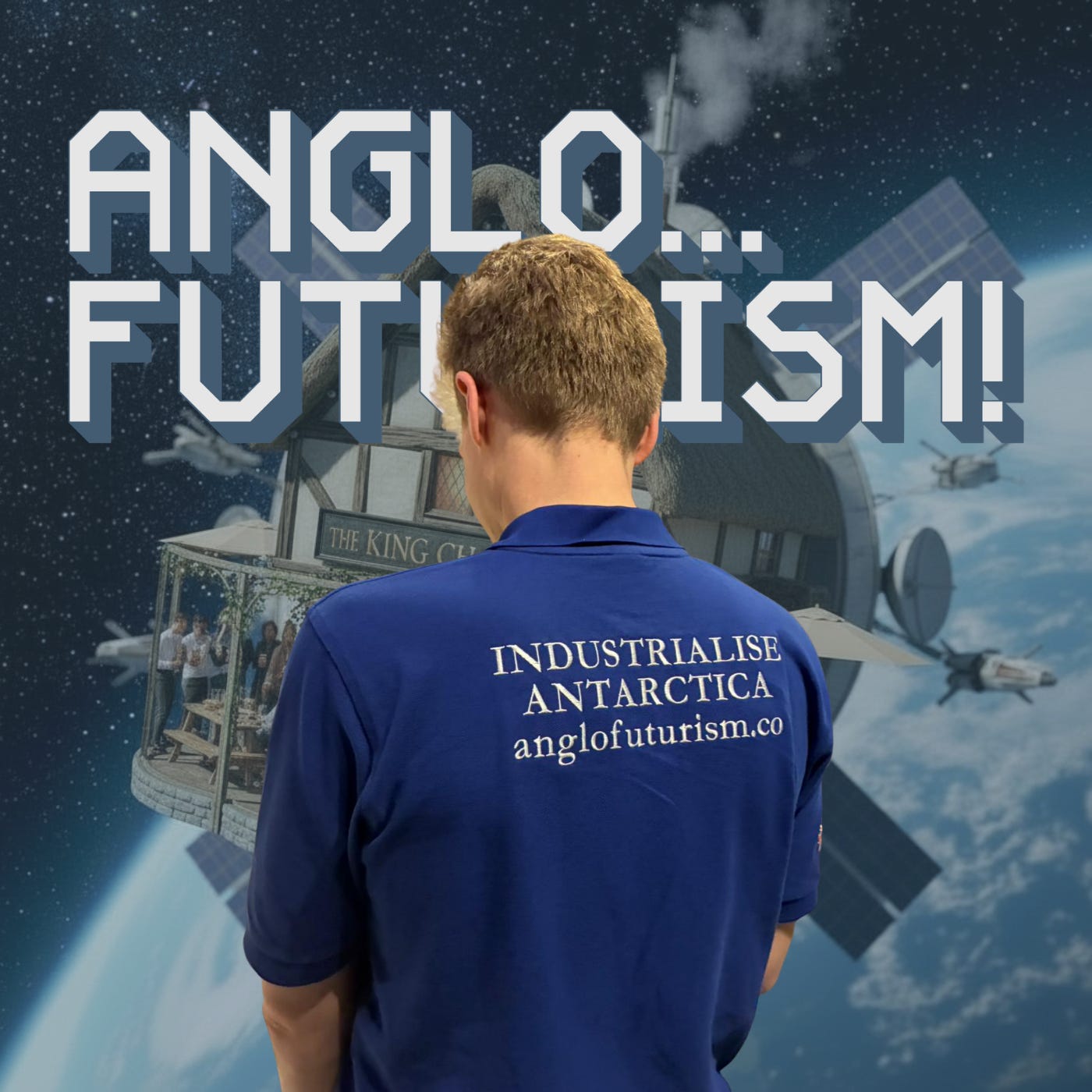
Calum and Tom on:- The history of British Antarctic exploration, from Captain Cook's mission to find Terra Australis to Shackleton's heroic survival after the Endurance was trapped in ice,- The geopolitical status of Antarctica, including Britain's territorial claims, the 1959 Antarctic Treaty that prohibits mining and militarisation, and how this could change after 2048,- The potential economic value of the British Antarctic Territory with its vast untapped resources (oil, gas, gold, and other minerals) and whether Britain should develop these resources before other nations claim them,Listen on Apple Podcasts or Spotify.Timestamps(00:00:00) - Introduction(00:01:30) - Antarctic Overview(00:04:16) - Historical Expeditions(00:12:50) - Heroic Age(00:31:19) - Sovereignty Issues(00:34:58) - Antarctic Treaty(00:36:49) - Resource Potential(00:54:25) - Future ProspectsTranscript00:00:00 - IntroductionTom OughWelcome back to the King Charles III Space Station. I'm Tom Ough.Calum DrysdaleAnd I'm Calum Drysdale. And if you, our listeners, have a telescope handy, you might be able to see our orbital space pub speeding southwards. Tom's behind the bar with one hand on our ship's wheels and the other one clutching a pint of gin.Tom OughListeners, you can't see the wheel but let me assure you that it's fashioned of beautiful English oak. A perfect replica of the wheel on HMS Victory.Calum DrysdaleTom, tell me where you're taking us.Tom OughWell, take a look through that Mullions porthole we put in the floor.Calum DrysdaleYep, taking a look.Tom OughWhat do you see?Calum DrysdaleI see the Falklands to the west. South Georgia… and I think that must be the South Sandwich Islands to the east. And now it's a long rocky peninsula.Tom OughYeah, an enormous apparently inhospitable peninsula.Calum DrysdaleAnd yet, something about it feels like home.Tom OughCorrect. As we sweep over this frozen continent, you will need no reminding that we are looking over the British Antarctic Territory.I will stop the ship here.00:01:30 - Antarctic OverviewCalum DrysdaleListeners, the view is stunning. Mile upon mile of white wilderness with the southern lights dancing above it. But Tom, maybe you can tell the listeners why you've brought us here.Tom OughWell, in short, what we're looking at is Britain's most valuable overseas possession. It could be the ticket to a new age of British prosperity, but it's under threat. And I think it's high time the country pay the matter some attention.Calum DrysdaleWell, I think it's something that we often forget. In that it's notable when, well or maybe not so notable to some people, when we try to rid ourselves of a few tiny atolls in the Indian Ocean. But actually the idea that we own a whole sort of section of a slice of a continent is maybe even less well known.Tom OughYeah and let's put this in perspective because the Chagos Islands, important as they are, are pretty minuscule in terms of land mass. Whereas the British Antarctic Territory is about eight times the size of Great Britain. It's insane, it's absolutely enormous and I think it's high time the country paid the matter some attention.Calum DrysdaleI think it's a bit risky Tom, isn’t it? Because the more attention we draw to our overseas territories the greater risk that the FCDO tries to find someone to foist them off on.Tom OughYeah I do worry about this because I think our claim to the Antarctic territory is in fact weaker than our claim to the Chagos Islands. So if you are listening and you are a senior civil servant at the FCDO then please, please avert your ears. But we are going to do an episode on the British Antarctic Territory nevertheless.Calum DrysdaleAnd our first one without a guest as seemingly Tom you are appointing yourself as our resident expert in the field.Tom OughWell there is a there is a criminal dearth of enthusiasts about the British Antarctic territory and I hope listeners will over the next half hour or so come to understand why I think there's a dearth.Calum DrysdaleWhilst most people are going out to the pub and talking to women, what on earth have you done spending your time worrying about the British Antarctic territory?Tom OughI for one got nerd sniped by the BAT as they call it last year when a big oil and gas discovery was made in the waters surrounding it and that led me to look into the BAT to which I had not given much thought prior to that. I discovered that it's enormous. It could be very lucrative. It's very exciting. It's a frontier. There's an amazing British history there as well. Perhaps we can get into all of those over this conversation.Calum DrysdaleAbsolutely. Do you want to start us off, Tom? Why on earth do we own a slice of this icy pie?00:04:16 - Historical ExpeditionsTom OughThere's a story to this which explains why we make the claim and I think we can get into that very soon. But I think it's worth winding back a little further because Antarctica has a fascinating recent history. Ancient and me

First we came for the dogs—now the NIMBYs and criminals, with Lawrence Newport (Looking for Growth)
Today we welcome Lawrence Newport, darling of the British progress movement and bane of vicious dogs.Lawrence discusses:- His successful campaign to ban XL Bully dogs after identifying their disproportionate role in fatal attacks and overcoming resistance from animal welfare organisations,- His Looking For Growth initiative to streamline infrastructure development through legislation that bypasses regulatory hurdles for nuclear power, electricity cables, and data centres,- His Crush Crime campaign focusing on career criminals, highlighting the need for longer sentences for repeat offenders and addressing the breakdown in policing that has made certain crimes effectively legal,Listen on Apple Podcasts or Spotify.Timestamps(00:00:00) - Introduction(00:01:30) - ‘XL Bully’ Campaign(00:06:31) - Government Inertia(00:22:26) - Infrastructure Challenges(00:41:09) - Crime and Policing(00:52:26) - Crime Wave Causes(01:02:29) - Future Vision This is a public episode. If you'd like to discuss this with other subscribers or get access to bonus episodes, visit www.anglofuturism.co/subscribe

Ep 8Make Britain the compute capital of the world, with Samo Burja (Bismarck Analysis)
Samo Burja is the founder and president of Bismarck Analysis, an industrial analysis and consulting firm studying failing organizations, and the author of "Great Founder Theory" which explores how exceptional individuals shape history by creating innovative institutions rather than merely steering events. He also chairs the editorial board of Palladium Magazine.Samo discusses:- How organisations decline when they shift goals to match diminished capabilities instead of pursuing bold visions, illustrated by NASA's evolution from space exploration to Earth observation- Why social technologies (like trust networks) are as crucial as material technologies in driving innovation and economic growth, with religious communities like Protestant merchants historically enabling trade through shared values- Britain's potential to regain global prominence through ambitious projects like nuclear energy, Antarctic resource development, and AI compute infrastructure, but only with live players who break from institutional scriptsListen on Apple Podcasts or Spotify.Timestamps(00:00:00) - Introduction(00:02:23) - Organisational Decline(00:07:29) - Energy Challenges(00:19:04) - NASA's Evolution(00:28:26) - AI and Society(00:37:29) - Social Technologies(00:56:19) - Britain's Status(01:05:45) - Political Opportunities(01:16:16) - Future Prospects This is a public episode. If you'd like to discuss this with other subscribers or get access to bonus episodes, visit www.anglofuturism.co/subscribe

Ep 7Bring back the captains of industry, with Rian Chad Whitton (Bismarck Analysis)
Rian Chad Whitton is a research analyst specialising in automation, industrial policy, and energy markets at Bismarck Analysis who writes on Substack under the name Doctor Syn and won the TXP Progress Prize for his essay on British energy policy.Rian discusses:How British industry declined from being the first Promethean nation to losing competitiveness due to loss of empire, high wages, and poor policy decisions like industrial deglomerationWhy manufacturing remains crucial for national security, productivity growth, and regional equality despite the push toward servicesHow Britain could revitalise industry through lower electricity costs, nuclear power expansion, and promoting large industrial conglomerates similar to South Korean chaebolsListen on Apple Podcasts or Spotify. Read the transcript.Timestamps(00:00:00) - Introduction(00:01:44) - British Industry History(00:06:50) - Current Industry Status(00:12:47) - R&D and Innovation(00:19:35) - Service Economy Debate(00:25:18) - Military and Manufacturing(00:32:23) - Industrial Policy Models(00:45:30) - Automation and Jobs(00:55:33) - Education and Skills(00:59:23) - Conclusion This is a public episode. If you'd like to discuss this with other subscribers or get access to bonus episodes, visit www.anglofuturism.co/subscribe

Ep 6How the Earth's superheated innards can transform Britain (and the world), with John Clegg (Hephae Energy Technology)
You are currently directly above an energy source that is clean, available all day long, and – at least at our current Kardashev level – all but limitless. Naturally, the British government has approximately zero interest in it. But they will soon, because transformational geothermal energy is getting closer.The main obstacle, currently, is the difficulty of harnessing the extreme heat that one finds several miles below the Earth's surface. It melts electronics and resists the creation of pipework, meaning that it's very difficult to sustainably pump fluid in and out.Our latest guest is John Clegg, a technologist and geothermal expert who is making progress in developing high-heat electronics. John joins us in our orbital space pub to tell us about the new frontiers in geothermal, the best way of making it work for Britain, and the most mind-boggling engineering feat in the history of Dorset.Learn more about Hephae Energy Technology, of which John is CTO, via their website, or subscribe to their monthly newsletter here.https://www.linkedin.com/newsletters/hephae-energy-technology-7076836521588207616/https://www.hephaeet.com/ Hosted on Acast. See acast.com/privacy for more information. This is a public episode. If you'd like to discuss this with other subscribers or get access to bonus episodes, visit www.anglofuturism.co/subscribe

Ep 5A million artificial wombs, with Aria Babu (Works in Progress)
Aria Babu is a researcher who has turned her attention to falling birth rates and pronatalism, offering fresh perspectives on how technological innovations like artificial wombs might address demographic challenges facing developed nations. She is @Aria_Babu on X.Aria discusses:- Why falling birth rates threaten many developed nations (especially South Korea at 0.7 TFR) and how this creates demographic challenges with an aging population and diminishing workforce,- Cultural and economic factors behind declining birth rates, including intensive parenting norms, high childcare costs, changing gender roles, and the delay in family formation,- Potential solutions including artificial wombs (which could bypass pregnancy complications and help various groups have children), policy changes to support families, and shifts in cultural attitudes toward parenthood,Listen on Apple Podcasts or Spotify. Read the transcript.Timestamps(00:00:00) - Introduction(00:01:23) - Pronatalism Debate(00:04:28) - Global Birth Rates(00:09:31) - Cultural Influences(00:17:12) - Causes of Decline(00:32:04) - Solutions Discussion(00:53:21) - Artificial Wombs(01:06:29) - Future Speculations This is a public episode. If you'd like to discuss this with other subscribers or get access to bonus episodes, visit www.anglofuturism.co/subscribe

Ep 4The land that stopped building, with Sam Dumitriu (Britain Remade)
The Victorians carpeted Britain in rail, went on majestic sprees of housebuilding, pioneered underground rail and coal power stations, and built magnificent subterranean sewerage. Their ancestors cancelled most of HS2, haven't built a reservoir for thirty years, lets Nimbyism run amok, and can't even electrify all our trains, let alone swap them for maglev.How can we redress this generational embarrassment? Sam Dumitriu, of the think-tank Britain Remade, believes it's possible to revive the Victorian spirit and turn Britain back into a nation of doers. He joins us in the King Charles III Space Station to discuss his ideas.Grab your trowels – we're going building. Hosted on Acast. See acast.com/privacy for more information. This is a public episode. If you'd like to discuss this with other subscribers or get access to bonus episodes, visit www.anglofuturism.co/subscribe

Ep 3Samuel Hughes on Hobbiton, Númenor and the Riddle of Architectural Aesthetics
It's widely felt that the British buildings and townscapes have, since the Second World War, become uglier and of lower quality.From their tasteful half-timbered space station, Tom and Calum ask Samuel Hughes, an academic and aestheticist, about the causes of those complaints. We discuss the inherent characteristics of architectural beauty, the divergence of taste between architecture students and the rest of us, and the future of the British built environment. Are natural materials making a comeback? What about robotically-crafted ornament? And with what level of ferocity should we crush the Nimbys?We also prevail on Samuel to tell us what Britain can learn from arresting built enviroments of fiction. Hosted on Acast. See acast.com/privacy for more information. This is a public episode. If you'd like to discuss this with other subscribers or get access to bonus episodes, visit www.anglofuturism.co/subscribe

Ep 2Britain needs a super spaceport, with Peter Hague
The cost of getting mass into space is tumbling. The economic opportunities of being in space are multiplying. Where does this leave Britain?Alas, our country holds the ignominious record of being the only country to get rid of a vertical-launch space programme. But we're turning the situation around – and could take advantage of the changing circumstance by embarking on an exciting megaproject.Our second guest, Peter Hague, is a leading space blogger. His idea? Building a super spaceport – one that's big enough to accommodate Starship, which is SpaceX's gamechanging flagship. We discuss the practicalities of the super spaceport, and what its construction could do for Britain. Hosted on Acast. See acast.com/privacy for more information. This is a public episode. If you'd like to discuss this with other subscribers or get access to bonus episodes, visit www.anglofuturism.co/subscribe

Ep 1Why Britain should build a new island in the North Sea, with Duncan McClements (Adam Smith Institute)
In this episode, we are visited in our thatched space station by a wunderkind economist who wants to turn a portion of the North Sea into a Wales-sized island. Duncan McClements is that economist, and you can find his blog, co-authored with Jason Hausenloy, below.https://modelthinking.substack.com/p/a-new-atlantisEditing by Calum Drysdale and Aeron Laffere. Our thanks to Cherie Chun for her help with the cover art. Hosted on Acast. See acast.com/privacy for more information. This is a public episode. If you'd like to discuss this with other subscribers or get access to bonus episodes, visit www.anglofuturism.co/subscribe