PLAY PODCASTS
An Analog Brain In A Digital Age | With Marco Ciappelli

An Analog Brain In A Digital Age | With Marco Ciappelli

Marco Ciappelli

240 episodesEN

Show overview

An Analog Brain In A Digital Age | With Marco Ciappelli has been publishing since 2022, and across the 4 years since has built a catalogue of 240 episodes. That works out to roughly 140 hours of audio in total. Releases follow a weekly cadence.

Episodes typically run thirty-five to sixty minutes — most land between 25 min and 44 min — though episode length varies meaningfully from one episode to the next. None of the episodes are flagged explicit by the publisher. It is catalogued as a EN-language Technology show.

The show is actively publishing — the most recent episode landed 2 weeks ago, with 22 episodes already out so far this year. The busiest year was 2023, with 86 episodes published. Published by Marco Ciappelli.

Episodes
240
Running
2022–2026 · 4y
Median length
37 min
Cadence
Weekly

From the publisher

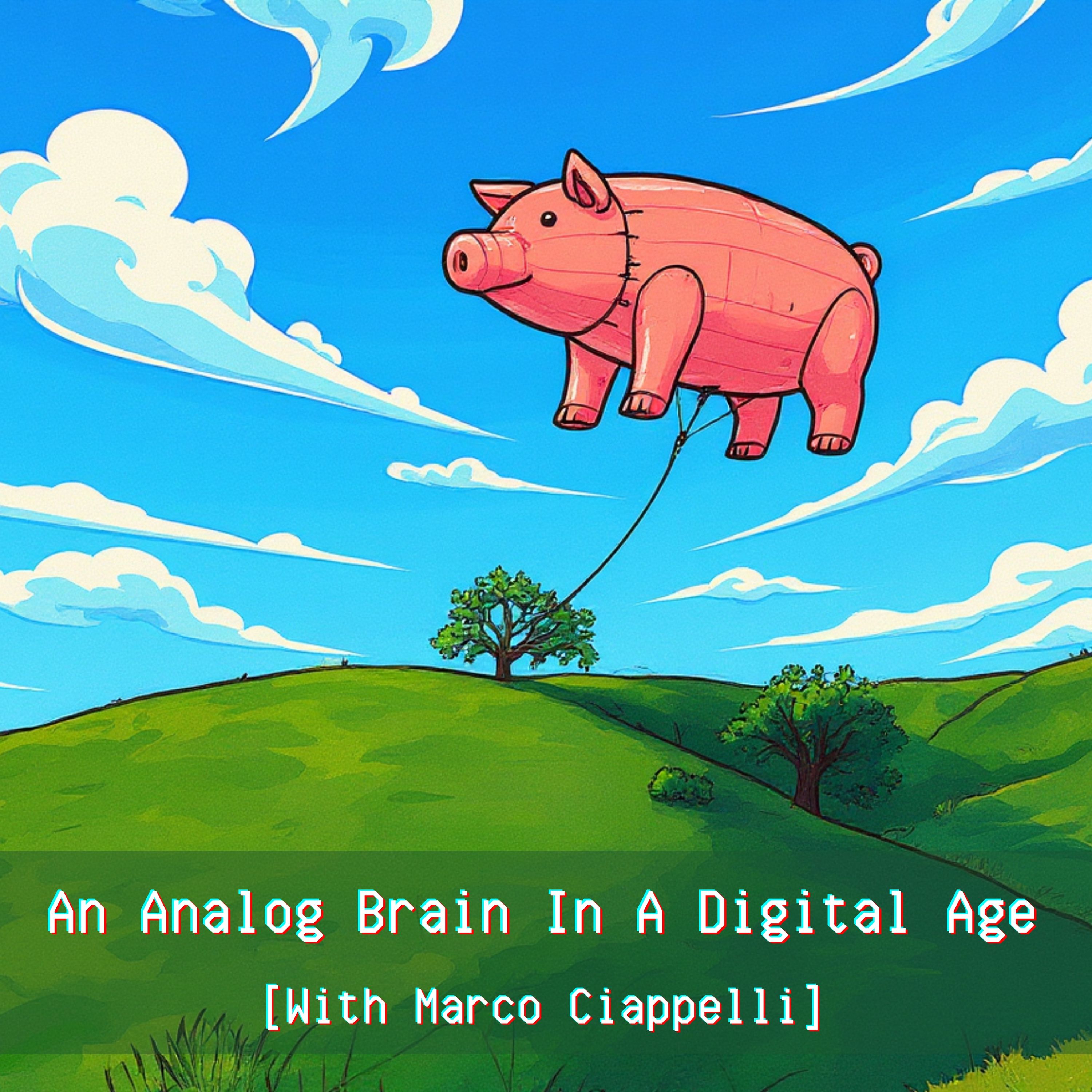
[ Formerly Redefining Society & Technology ] An Analog Brain In A Digital Age Podcast is your backstage pass to my mind — where analog meets digital, and the occasional pig flies. In an age racing toward algorithms and automation, the best ideas still come from curiosity, experience, emotion, and the unexpected connection. What you'll find are conversations on technology & society, storytelling in all its forms, branding & marketing, creativity, and the odd surprise.

Latest Episodes

View all 240 episodes

Book: Deep Future — Creating Technology That Matters | An Interview with Pablos Holman | An Analog Brain In A Digital Age With Marco Ciappelli

May 4, 202640 min

New Book: Healing the Sick Care System — Why People Matter | An Interview with Gil Bashe | An Analog Brain In A Digital Age With Marco Ciappelli

Apr 26, 202636 min

On the Internet, Nobody Knows You're Not Human — And Nobody's Asking | Written by Marco Ciappelli & Read by Tape3

Apr 24, 20269 min

Before the Robots Run. More reflections from RSAC 2026 — The Power of the Community and the Machines We Invited In. | Written By Marco Ciappelli & Read By Tape3

Apr 19, 202610 min

Do Androids Dream of Security Patches? Reflections from RSAC 2026 — Walking the Floor of the Agentic World | Written By Marco Ciappelli & Read by Tape3

Apr 17, 202610 min

Marketing, Brand, And Culture: Are You Paying the Silicon Valley Tax? A Conversation with Nick Richtsmeier of CultureCraft | Hosted by Marco Ciappelli

Apr 15, 20266 min

When Sci-Fi Becomes the Business Plan | A Brand Highlight Conversation with Jacob Flores, Head of Research at Type One Ventures | Hosted by Marco Ciappelli

Apr 14, 20266 min

Ep 233Protecting Kids Online Since 2007 and in the Age of AI: Ben Halpert on Savvy Cyber Kids at RSAC 2026

In this episode from RSA Conference 2026, Marco Ciappelli sits down with Ben Halpert, founder of the non-profit organization Savvy Cyber Kids, to discuss the critical intersection of child development and technology. Since its founding in 2007, Savvy Cyber Kids has been on a mission to provide parents and educators with the tools needed to guide children through the digital world. Ben explains why introducing technology too early can be detrimental to a child’s emotional preparedness and brain development, and why adult-led guidance is essential even when kids seem like "tech experts". In this conversation, we explore: The Evolution of Threats: Moving from MySpace and CRT monitors to 24/7 access via mobile devices. Early Intervention: Why the "rhyme and picture book" approach works for children as young as three to teach concepts like online aliases and stranger safety. Safe AI for Kids: Introducing a new partnership with Chaperone, a platform featuring "homework mode" and parental controls to ensure AI is a tool for learning, not a shortcut for thinking. Going Global: How the organization has expanded internationally with materials translated into Spanish, German, French, and Hebrew. About Our Guest Ben Halpert is a cybersecurity veteran with over 25 years of experience and the founder of Savvy Cyber Kids. He is dedicated to helping parents navigate the "wild" of the internet with positive, developmentally appropriate programming. Resources Savvy Cyber Kids Website: savvycyberkids.org More RSAC 2026 Coverage: itspmagazine.com/rsac Marco's Website: Marcociappelli.com Hosted by Simplecast, an AdsWizz company. See pcm.adswizz.com for information about our collection and use of personal data for advertising.

Mar 30, 202610 min

Ep 232Everyone Is Talking About Agentic AI at RSAC 2026. Almost Nobody Is Saying Anything Different | With Marco Ciappelli and Theresa Lanowitz

Marco Ciappelli sits down with cybersecurity evangelist and thought leader Theresa Lanowitz at the end of day one on the expo floor for a conversation that cuts through the noise — from shadow AI and leadership accountability, to brand identity, to why most companies here can't articulate a message above the fray. Plus: a Peloton story that accidentally became the best explanation of brand loyalty you'll hear all week. Chapters: - Judge Sentences CEO to 8 Hours on the RSAC Floor - End of Day One: Setting the Scene - Who Is Theresa Lanowitz - The Binary View of AI: Love It, Fear It, or Find the Gray - Leadership's Role in the AI Transformation - Shadow AI: The Insider Threat Nobody Is Naming - Why Some Companies Still Say No to AI - Fighting With Your LLM (We All Do It) - AI Slop and the Brand Differentiation Problem - The Peloton Story: What Real Brand Loyalty Looks Like - RSAC 2026: Everyone Sounds the Same - Where Is Agentic AI Actually Going - Integration, Orchestration, ROI: The Real Questions - Make AI Your Own What's actually covered: → Why agentic AI is dominating RSAC 2026 — and why it all sounds the same → Shadow AI: the insider threat nobody is calling an insider threat → What strong brand presence actually looks like (hint: it's not a circus tent) → Why fear — not budget — is the real reason companies still say no to AI → Integration, orchestration, ROI: what comes after the hype → The one message that matters: make AI your own 🔗 More from RSA Conference 2026: itspmagazine.com/rsac Hosted by Simplecast, an AdsWizz company. See pcm.adswizz.com for information about our collection and use of personal data for advertising.

Mar 29, 202625 min

Ep 231New Book: Climate Capital — Investing in the Tools for a Regenerative Future | An Interview with Tom Chi | An Analog Brain In A Digital Age With Marco Ciappelli

New Book: Climate Capital — Investing in the Tools for a Regenerative Future | An Interview with Tom Chi | An Analog Brain In A Digital Age With Marco Ciappelli What if the economy isn't broken — just badly designed? Tom Chi, Google X founding member, inventor of 77 patents, and venture capitalist at At One Ventures, joined me on An Analog Brain In A Digital Age to discuss his new book Climate Capital: Investing in the Tools for a Regenerative Future. From the streets of Florence to the strip malls of Silicon Valley, from the mechanics of attention capture to the physics of ecological economics, this conversation goes far beyond climate. It's about how we design the systems we live inside — and whether we have the will to redesign them before it's too late. 📺 Watch | 🎙️ Listen | marcociappelli.com Article Body Tom Chi has worked on things that changed the world. Microsoft Office. Web search. The self-driving car. Google Glass. He'll tell you himself that not all of them were hits, and he's fine with that — that's what it means to be an inventor. But what he's working on now is different in scale from anything before. Not a product. Not a platform. A redesign of the global economy. His new book, Climate Capital: Investing in the Tools for a Regenerative Future, starts from a premise that sounds radical until you think about it for more than a few minutes: economics is a design discipline. And right now, it's poorly designed. Not maliciously — poorly. We built systems optimized for short-term capital extraction, and we're living with the consequences. The question Tom is asking is whether we can redesign them before those consequences become irreversible. He didn't get there through ideology. He got there through Florence. Tom was auditing sustainable MBA courses alongside his partner when he was invited to a conference in Italy. He landed, got a day off, wandered the streets — and something clicked. The entire city is built from sustainable materials. And it's one of the most beautiful places on earth. That moment demolished an assumption he didn't even know he was carrying: that sustainable living means downgrading. Florence is a 2,000-year-old counterexample to every joke about Birkenstocks and cold showers. We knew how to do this. We just forgot. Which brings us to the first big thread of our conversation: the pattern of forgetting. We talked about this in the context of technology, not history. Specifically, how the shift from software you paid for to software supported by advertising quietly changed everything. When you pay for a tool, the goal is to make it better. When the tool is supported by advertisers, the goal is to keep you inside it as long as possible. Clippy used to annoy us because it interrupted our train of thought. Now interrupting our train of thought is the entire business model. Tom has a phrase for what's happening at scale: cognitive despoiling. We spent the 20th century strip mining the physical resources of the planet. We're spending the 21st century strip mining the cognitive resources of humanity. There's a finite number of coherent thoughts this civilization can produce. And we're burning through them — with misinformation, amygdala triggers, and dopamine loops — the same way we burned through forests and waterways. The damage is invisible because it's underwater, like ocean trawling. But it's real. And it compounds across generations. This is where I had to push back a little. Because I grew up in Florence. I made the jump to digital. I love my vinyls and I love my streaming library. I'm part of the contradiction he's describing. And I asked him: given all this, where do you even start? His answer is the most practical thing I've heard in a long time. Start with physical businesses. The ones actually causing most of the damage — to water, soil, air, biodiversity. And here's the part that almost nobody is talking about: 90% of the cost structure of a physical business already aligns ecological and economic goals. Fewer raw materials used means lower feedstock costs and less extraction. Less energy consumed means lower processing costs and fewer emissions. Shorter supply chains mean lower logistics costs and fewer transport emissions. The economy and the ecology are already pointing the same direction on 90% of what matters. The 5% that isn't aligned — pollution — is what the lobbyists fight about. So that's what dominates the news. And that's why we think this is harder than it is. Tom's firm, At One Ventures, is built around this insight. They invest in what he calls the triad: disruptive deep tech that delivers radically better unit economics and radically better environmental outcomes at the same time. Their portfolio companies don't sell sustainability. They sell efficiency. The ecological benefit is baked in by design. The customers buy it because it's cheaper and better. The planet wins as a side effect. That's the book. Part toolkit, part framework, part demonstration t

Mar 1, 202652 min

Ep 230Do You Know What's In Your Software? A Cybersecurity Story with Manifest Cyber | A Brand Highlight Conversation with Daniel Bardenstein, Co-Founder at Manifest Cyber

There is a question that sounds almost embarrassingly simple. After a vulnerability is discovered in a piece of widely used software — something like Log4Shell, which shook the security world and left hundreds of thousands of organizations exposed overnight — the question organizations scrambled to answer was this: where is this code, and what does it touch? Most couldn't answer it. Not the Fortune 500 companies. Not the government agencies. Not the critical infrastructure operators. Not the hospitals or the banks or the utilities. They had built and bought mountains of software over years and decades, and when the moment came to understand what was actually inside it, they were effectively blind. That gap is exactly what Daniel Bardenstein set out to close when he co-founded Manifest Cyber in 2023. And in a conversation on ITSPmagazine's Brand Highlight series, he made a case for technology transparency that is hard to argue with — not because it's technically complex, but because the analogy he draws is so strikingly obvious once you hear it. "If you want to buy a house, you get to go inside the house, do the home inspection," he said. "You want to buy food from the grocery store — you can look at the ingredients. Even our clothes tell you what they're made of, how to care for them, and where they're from." But software? The technology running hospital MRI machines, weapon systems, financial infrastructure, water delivery? No transparency required. No ingredient label. No inspection rights. Just trust. That trust, as Log4Shell demonstrated, is a vulnerability in itself. Bardenstein came to this problem with credentials that few founders in the space can claim. Before starting Manifest, he spent four and a half years in the US government leading large-scale cyber programs and serving as technology strategy lead at CISA — the Cybersecurity and Infrastructure Security Agency. He saw firsthand how defenders are perpetually at a disadvantage, operating without the basic visibility they need to do their jobs. His mission became building the tools to change that. The problem, he's quick to point out, has not improved in the years since Log4Shell. Software supply chain attacks have multiplied — XZ Utils, NPM Polyfill, and others following the same pattern: trusted software becomes the attack vector, and it spreads fast. Meanwhile, most security teams are still operating with SCA tools that generate noisy, overwhelming alerts and vendor risk programs built on Excel spreadsheets and questionnaires rather than actual empirical data about the security of what they're buying. "Security teams have a false sense of security," Bardenstein said. The gap between what organizations think they know and what they actually know about their software supply chains remains dangerously wide. Manifest Cyber addresses this across the full lifecycle. For organizations that build software, the platform maps every open source dependency, assesses it for risk, and ensures developers can write more secure code without losing velocity. For organizations that buy software — which is everyone — it finds risks before procurement, then continuously monitors every third party component so that when something breaks, they know the blast radius in seconds, not weeks. The timing matters. Regulation is catching up to the problem. The EU AI Act, the Cyber Resilience Act, and a growing body of global policy are beginning to demand exactly the kind of software supply chain transparency that Manifest is built to provide. Organizations that wait to build this capability will find themselves scrambling to comply — those that build it in now will have it as a competitive advantage. The ingredient label for software has always been missing. Manifest Cyber is writing it. ________________________________________________________________ Marco Ciappelli interviews Daniel Bardenstein, CEO & Co-Founder of Manifest Cyber, for ITSPmagazine's Brand Highlight series. HOST Marco Ciappelli — Co-Founder & CMO, ITSPmagazine | Journalist, Writer & Branding Advisor 🌐 https://www.marcociappelli.com 🌐 https://www.itspmagazine.com GUEST Daniel Bardenstein, CEO and Co-Founder of Manifest Cyber https://www.linkedin.com/in/bardenstein RESOURCES Manifest Cyber: https://www.manifestcyber.com Are you interested in telling your story? ▶︎ Full Length Brand Story: https://www.studioc60.com/content-creation#full ▶︎ Brand Spotlight Story: https://www.studioc60.com/content-creation#spotlight ▶︎ Brand Highlight Story: https://www.studioc60.com/content-creation#highlight KEYWORDS Manifest Cyber, software supply chain security, SBOM, Log4Shell, open source vulnerability, technology transparency, Daniel Bardenstein, CISA, software composition analysis, third party risk, EU Cyber Resilience Act, AppSec Hosted by Simplecast, an AdsWizz company. See pcm.adswizz.com for information about our collection and use of personal data for advertising.

Feb 26, 20266 min

Ep 229New Book! Lost in Time — Our Forgotten and Vanishing Knowledge | Forgotten Technology, Ancient Wisdom & Digital Amnesia | An Interview with Jack R. Bialik | An Analog Brain In A Digital Age With Marco Ciappelli

New Book: Lost in Time — Our Forgotten and Vanishing Knowledge | An Interview with Jack R. Bialik | An Analog Brain In A Digital Age With Marco Ciappelli There's a particular arrogance embedded in how we talk about progress. We speak about innovation as if it moves in one direction only — forward, upward, smarter, faster. But what if the line isn't straight? What if it loops, doubles back, and occasionally vanishes entirely? That's the uncomfortable question at the center of my conversation with Jack R. Bialik. His book Lost in Time: Our Forgotten and Vanishing Knowledge doesn't read like a history lesson. It reads like a case file — evidence, example by example, that the civilization we assume is the most advanced in human history is also, in some critical ways, deeply amnesiac. Take cataract surgery. We learned it in the 1700s, right? Except we didn't. Indians were performing it in 800 BC. The ancient Egyptians and Babylonians had diagrams of the procedure dating back to 2,400 BCE. The knowledge existed, worked, and then — somewhere in the chaos of collapsing empires and burning libraries — it vanished. We didn't progress past it. We forgot it, and then reinvented it from scratch, centuries later, convinced we were doing something new. Or the Baghdad Battery: clay pots, 2,000 years old, that when filled with acid can generate 1.1 volts of electricity. We don't know what they used them for. We don't know who figured it out. We just know it worked, it existed, and then it didn't anymore. This is what Bialik calls the pattern of loss — and it's not random. It follows catastrophe: the Library of Alexandria, the systematic destruction of Mayan records, the slow erosion of oral traditions as writing systems took over. Knowledge disappears when the systems that carry it collapse. And here's where the conversation gets uncomfortably relevant: we are building those systems right now, and we are not thinking about how long they'll last. The curator at the Computer History Museum told Bialik that to preserve the data from early IBM PCs and Macintosh computers, they had to print it on paper. The floppy drives had become brittle. The formats were unreadable. The digital archive was failing — and the only solution was to go analog. A vinyl record from the 1920s still plays. A CD from the 1980s may not survive another decade. I've been thinking about this since we recorded. My brain is analog — that's not just a podcast title, it's a philosophy. I grew up in Florence, surrounded by things that had survived centuries because they were made to last: stone, fresco, manuscript. Then I jumped on the digital train like everyone else, seduced by infinite libraries on my phone, music on demand, knowledge at my fingertips. But what Bialik is pointing out is that fingertips are fragile. And so are hard drives. The deeper issue isn't storage format. It's the distinction Bialik draws between knowledge and wisdom. Knowledge is the data — the cataract surgery technique, the battery design, the pyramid engineering. Wisdom is knowing why it matters, when to use it, and what the consequences might be. We've gotten extraordinarily good at accumulating knowledge. We are considerably worse at transmitting wisdom. And wisdom, Bialik argues, doesn't live in databases. It lives in the space between people — in stories, in teaching, in the slow transmission of judgment across generations. That's why oral tradition survived when everything else failed. Not because it was more sophisticated, but because it was more human. It didn't require a device to run on. I don't know how to solve the digital longevity problem. Neither does Bialik — not yet. But I think the first step is admitting we have one. That's actually one of the quietest, most powerful arguments in the book: be humble. We don't know everything. We never did. And some of the things we've lost might be exactly what we need right now. The question isn't just what we've forgotten. It's what we're forgetting today, while we're too busy scrolling to notice. Grab Lost in Time: Our Forgotten and Vanishing Knowledge — link below — and spend some time with a perspective that goes very, very far back. Which is maybe the only way to see very, very far forward. And if this kind of conversation is what you come here for, subscribe to the newsletter at marcociappelli.com. More of this. Less noise. — Marco Ciappelli Co-Founder ITSPmagazine & Studio C60 | Creative Director | Branding & Marketing Advisor | Personal Branding Coach | Journalist | Writer | Podcast: An Analog Brain In A Digital Age ⚠️ Beware: Pigs May Fly | 🌎 LAX🛸FLR 🌍 ____________ About Marco Marco Ciappelli is Co-Founder & CMO of ITSPmagazine, Co-Founder & Creative Director of Studio C60, Branding & Marketing Advisor, Personal Branding Coach, Journalist, Writer, and Host of An Analog Brain In A Digital Age podcast. Born in Florence, Italy, and based in Los Angeles, he explores the intersection of technology, society, storytelling, an

Feb 23, 202634 min

Ep 228Agade: The AI-Powered Wearable Robots That Protect Workers, Not Replace Them | A Brand Highlight Conversation with Lorenzo Aquilante, Co-Founder and AGADE

Agade: The AI-Powered Wearable Robots That Protect Workers, Not Replace Them AI Meets Human CraftsmanshipThere's something poetic about a technology born to help people with muscular dystrophy finding its second life on factory floors and logistics warehouses. That's the story of Agade, an Italian deeptech startup that began as a research project at Politecnico di Milano and evolved into something far more ambitious: a mission to preserve human craftsmanship in an age of automation.I sat down with Lorenzo Aquilante, CEO and co-founder of Agade, to talk about their journey from healthcare innovation to industrial exoskeletons—and what it was like showcasing their latest product at CES 2026.The origin story matters here. Back in 2017, researchers at Politecnico di Milano started developing exoskeletons for people affected by muscular dystrophy. They created something different—a semi-active model powered by AI that recognizes when a user is lifting and responds accordingly. It wasn't just about motors and sensors. It was about intelligence.Then companies came knocking. Manufacturing firms, logistics operations, industries where human workers still matter because their skills, experience, and judgment can't be replaced by machines. They saw potential. Why not use this technology to protect the people doing the heavy lifting—literally?Agade was founded in 2020 with a clear mission: preserve craftsmanship against the physical toll of material handling. Not replace humans. Protect them.The company now has two products. The first, launched in 2024, focuses on shoulder assistance. The second—the one they brought to CES 2026—targets the lower back, which makes sense when you consider that back pain is practically an occupational hazard for anyone moving materials all day.What makes Agade's approach different is that semi-active AI system. The exoskeleton knows when you're lifting. It responds. It's not just a passive brace or a fully motorized suit that takes over. It's somewhere in between—smart enough to help, light enough to wear all day.Lorenzo emphasized something that resonated with me: the importance of feedback. From day one, Agade has been obsessed with real-world testing. Not lab conditions. Actual workers doing actual jobs. Because the buyer isn't the user—companies purchase these for their employees—and that creates a unique dynamic. You need both sides to believe in the technology.The CES experience brought that home. There's always the initial wow factor when someone sees a wearable robot with motors and sensors. But the real work happens after the demo, when users tell you what needs to improve. That's where the collaboration lives.And here's what struck me most about this conversation: Agade isn't trying to remove humans from the equation. They're trying to keep humans in it longer, healthier, and more capable. In a world racing toward full automation, there's something refreshing about a company betting on human skill—and building technology to protect it.The products are available globally. You can reach Agade through their website at agadexoskeletons.com, find them on LinkedIn and other social channels, and even arrange trials before committing to a purchase.For those of us watching the intersection of AI, robotics, and human labor, Agade represents a different path. Not humans versus machines. Humans with machines. Tools that amplify rather than replace.That's a story worth telling.Marco Ciappelli interviews Lorenzo Aquilante, CEO & Co-Founder of Agade, for ITSPmagazine's Brand Highlight series following CES 2026.>>> Marcociappelli.comGUESTLorenzo Aquilante, CEO and co-founder of Agadehttps://www.linkedin.com/in/lorenzo-aquilante-108573b0/RESOURCESAGADE: https://agade-exoskeletons.comAre you interested in telling your story?▶︎ Full Length Brand Story: https://www.studioc60.com/content-creation#full▶︎ Brand Spotlight Story: https://www.studioc60.com/content-creation#spotlight▶︎ Brand Highlight Story: https://www.studioc60.com/content-creation#highlightKEYWORDSAgade, exoskeleton, CES 2026, wearable robotics, AI, future of work, industrial exoskeleton, made in Italy, workplace safety, deeptech, robotics. Hosted by Simplecast, an AdsWizz company. See pcm.adswizz.com for information about our collection and use of personal data for advertising.

Feb 14, 20266 min

Ep 227Chat Control: The EU Law That Could End Privacy and Why Breaking Encryption Won't Stop Criminals | A Conversation with Cybersecurity Expert John Salomon | Redefining Society and Technology Podcast with Marco Ciappelli

None of Your Goddamn BusinessJohn Morgan Salomon said something during our conversation that I haven't stopped thinking about. We were discussing encryption, privacy laws, the usual terrain — and he cut through all of it with five words: "It's none of your goddamn business."Not elegant. Not diplomatic. But exactly right.John has spent 30 years in information security. He's Swiss, lives in Spain, advises governments and startups, and uses his real name on social media despite spending his career thinking about privacy. When someone like that tells you he's worried, you should probably pay attention.The immediate concern is something called "Chat Control" — a proposed EU law that would mandate access to encrypted communications on your phone. It's failed twice. It's now in its third iteration. The Danish Information Commissioner is pushing it. Germany and Poland are resisting. The European Parliament is next.The justification is familiar: child abuse materials, terrorism, drug trafficking. These are the straw man arguments that appear every time someone wants to break encryption. And John walked me through the pattern: tragedy strikes, laws pass in the emotional fervor, and those laws never go away. The Patriot Act. RIPA in the UK. The Clipper Chip the FBI tried to push in the 1990s. Same playbook, different decade.Here's the rhetorical trap: "Do you support terrorism? Do you support child abuse?" There's only one acceptable answer. And once you give it, you've already conceded the frame. You're now arguing about implementation rather than principle.But the principle matters. John calls it the panopticon — the Victorian-era prison design where all cells face inward toward a central guard tower. No walls. Total visibility. The transparent citizen. If you can see what everyone is doing, you can spot evil early. That's the theory.The reality is different. Once you build the infrastructure to monitor everyone, the question becomes: who decides what "evil" looks like? Child pornographers, sure. Terrorists, obviously. But what about LGBTQ individuals in countries where their existence is criminalized? John told me about visiting Chile in 2006, where his gay neighbor could only hold his partner's hand inside a hidden bar. That was a democracy. It was also a place where being yourself was punishable by prison.The targets expand. They always do. Catholics in 1960s America. Migrants today. Anyone who thinks differently from whoever holds power at any given moment. These laws don't just catch criminals — they set precedents. And precedents outlive the people who set them.John made another point that landed hard: the privacy we've already lost probably isn't coming back. Supermarket loyalty cards. Surveillance cameras. Social media profiles. Cookie consent dialogs we click through without reading. That version of privacy is dead. But there's another kind — the kind that prevents all that ambient data from being weaponized against you as an individual. The kind that stops your encrypted messages from becoming evidence of thought crimes. That privacy still exists. For now.Technology won't save us. John was clear about that. Neither will it destroy us. Technology is just an element in a much larger equation that includes human nature, greed, apathy, and the willingness of citizens to actually engage. He sent emails to 40 Spanish members of European Parliament about Chat Control. One responded.That's the real problem. Not the law. Not the technology. The apathy.Republic comes from "res publica" — the thing of the people. Benjamin Franklin supposedly said it best: "A republic, if you can keep it." Keeping it requires attention. Requires understanding what's at stake. Requires saying, when necessary: this is none of your goddamn business.Stay curious. Stay Human. Subscribe to the podcast. And if you have thoughts, drop them in the comments — I actually read them.Marco CiappelliSubscribe to the Redefining Society and Technology podcast. Stay curious. Stay human.> https://www.linkedin.com/newsletters/7079849705156870144/Marco Ciappelli: https://www.marcociappelli.com/John Salomon Experienced, international information security leader. vCISO, board & startup advisor, strategist.https://www.linkedin.com/in/johnsalomon/ Hosted by Simplecast, an AdsWizz company. See pcm.adswizz.com for information about our collection and use of personal data for advertising.

Feb 10, 202636 min

Ep 226Paoletti Custom Guitars at NAMM 2026: Handcrafted in Florence Italy from Wine Barrel Wood | A Brand Highlight Conversation with Filippo Martini, Managing Director at Paoletti Guitars | NAMM 2026 Coverage

Wine Barrels, Duomo Marble, and Florence: Paoletti Custom Guitars at NAMM 2026I've been away from Florence for 25 years. I didn't know there was a guitar company like this back home.At NAMM 2026, I found Filippo Martini from Paoletti Custom Guitars—a boutique manufacturer based in the heart of Tuscany, building instruments that are equal parts guitar and artwork.Paoletti does something no one else does: they build guitars from chestnut wood sourced from Italian wine barrels. The material offers a wide harmonic spectrum, but it's difficult to work with. You need to know how to handle it. Founder Fabrizio Paoletti figured it out, and now every guitar they produce shows the natural grain—no opaque finishes, no hiding the wood.The craftsmanship runs deep. Bridges, pickguards, pickups—all made in-house. Necks carved from Canadian maple, roasted on-site. 99% of the process happens in Tuscany. As Filippo put it, "Kilometer zero." Zero miles. Everything local except the screws.Their model is 100% custom. You don't buy a Paoletti off the rack. You tell them your style, your sound, the genre you play. They build around your vision while keeping the Italian essence intact—chestnut wood, Italian-made components, tailored to your idea.But what stopped me cold was the Duomo collection.Eight individual guitars, each hand-engraved by Fabrizio Paoletti himself. Three years of work. The subject: Florence's cathedral—the Duomo di Santa Maria del Fiore.This isn't just decoration. Paoletti secured an official partnership with the Opera del Duomo, the authority that oversees the cathedral. The back of each guitar reproduces the marble floor pattern from inside the Duomo. And when the collection is complete this October, every guitar will contain an actual piece of marble from the cathedral.I got shivers standing there.This is what happens when guitar making meets Italian heritage. It's not about specs or market positioning. It's about place, history, and craft passed down through generations.Filippo invited me to visit the workshop in Florence when I return in April. I'm going. I want to see where this happens—where wine barrel wood becomes an instrument, where cathedral marble gets embedded into a guitar body, where a team of artisans builds one-of-one pieces for players around the world.Florence is known for many things. Leather. Art. Architecture. The Renaissance itself. Now I know it's also home to some of the most distinctive guitars being made anywhere.Paoletti proves that boutique doesn't mean small ambitions. They're partnering with galleries in Dubai, working with the Duomo authorities, and bringing Florence to NAMM.Not bad for a company I didn't even know existed until I walked the show floor and heard an Italian accent.Sometimes you find home in unexpected places.Marco Ciappelli interviews Filippo Martini from Paoletti Custom Guitars at NAMM 2026 for ITSPmagazine.Part of ITSPmagazine's On Location Coverage at NAMM 2026.🌐 https://www.itspmagazine.com/the-namm-show-2026-namm-music-conference-music-technology-event-coverage-anaheim-california__________________________This is a Brand Highlight. A Brand Highlight is an introductory conversation designed to put a spotlight on the guest and their company. Learn more: https://www.studioc60.com/creation#highlightGUESTFilippo Martini Managing DIrector at Paoletti Guitars | Florence | Tuscany | ItalyRESOURCESLearn more about Paoletti Guitars: https://www.paolettiguitars.comAre you interested in telling your story?▶︎ Full Length Brand Story: https://www.studioc60.com/content-creation#full▶︎ Brand Spotlight Story: https://www.studioc60.com/content-creation#spotlight▶︎ Brand Highlight Story: https://www.studioc60.com/content-creation#highlight Hosted by Simplecast, an AdsWizz company. See pcm.adswizz.com for information about our collection and use of personal data for advertising.

Feb 8, 20266 min

Ep 225Yamaha at NAMM 2026: Introducing Chris Buck Custom Revstar Guitar, Pacifica SC, and a deep dive into the BB735 Bass | A Brand Highlight Conversation with Andy Winston, Product Training Specialist at Yamaha | NAMM 2026

60 Years Forward: Yamaha at NAMM 2026Yamaha at NAMM 2026: Chris Buck Revstar, Pacifica SC & 60 Years of Guitar InnovationSome brands chase nostalgia. Yamaha builds forward.At NAMM 2026, I spoke with Andy Winston to talk about 60 years of Yamaha guitar design—and why this company keeps delivering instruments that punch way above their price point.The conversation started with the Chris Buck Signature Revstar. Buck is the guitarist for Cardinal Black, and he's earned his own model. The specs tell the story: overwound P90 pickups for a hotter sound, wraparound tailpiece with adjustable saddles, stainless steel frets, lightweight tuners, and those old-school inlays from the first-generation Revstar. No boost circuit. Buck wanted it stripped to essentials.Then Andy dropped a tease: Matteo Mancuso is getting his own Revstar this summer. The Italian virtuoso. That's a statement.We moved to the new Pacifica SC—Yamaha's answer for T-style players. Humbucker in the neck, single coil in the bridge, and pickups designed in partnership with Rupert Neve's team. The boost circuit under the bridge pickup gives you five sounds from two pickups. Made in Indonesia at $999 or Made in Japan with compound radius fretboard and IRA wood treatment at $2,199.I bought my nephew a Pacifica. Entry level, around $200. It works. That's Yamaha's philosophy—you can start at $200 and work your way up to a Mike Stern signature model without ever leaving the family.But here's what stuck with me.Andy said something that defines Yamaha's approach: "We don't do reissues. You're never gonna see us reissue a 1972."Sixty years of guitar history, and they're not looking backward. The Revstar draws inspiration from the 1970s Super Flight, sure—but it's chambered mahogany, tuned to eliminate harsh mid-range frequencies. Yamaha builds pianos, violins, marimbas. They know how to tune wood. They apply that knowledge to electric guitars in ways other companies don't.The BB Bass series came next. String-through body with 45-degree break angle. Extra bolts pulling the neck tight into the pocket. A maple stripe running through the center of the body for note response. Active/passive switching. Five-ply neck. Professional features at prices that don't require a car payment."We give people more instrument than what a price tag says," Andy told me.That's not marketing. That's mission.Before we wrapped, Andy shared a personal story. In 1977, hair down to his shoulders, bell bottoms on, his mom decided he was serious about guitar. She bought him a Yamaha FG-75. His first real acoustic. He doesn't have that one anymore, but he found a replacement. Had to.That's brand loyalty earned over decades. Not through heritage mythology—through instruments that work, that last, that give players what they need without emptying their wallets.Sixty years of guitar design. No reissues. Just forward.Yamaha keeps proving that innovation and accessibility aren't mutually exclusive.Marco Ciappelli interviews Andy Winston from Yamaha at NAMM 2026 for ITSPmagazine.Part of ITSPmagazine's On Location Coverage at NAMM 2026.🌐 https://www.itspmagazine.com/the-namm-show-2026-namm-music-conference-music-technology-event-coverage-anaheim-california__________________________This is a Brand Highlight. A Brand Highlight is an introductory conversation designed to put a spotlight on the guest and their company. Learn more: https://www.studioc60.com/creation#highlightGUESTAndy WinstonProduct Training Specialist at YamahaRESOURCESLearn more about Yamaha Guitars: https://www.yamaha.com/Are you interested in telling your story?▶︎ Full Length Brand Story: https://www.studioc60.com/content-creation#full▶︎ Brand Spotlight Story: https://www.studioc60.com/content-creation#spotlight▶︎ Brand Highlight Story: https://www.studioc60.com/content-creation#highlight Hosted by Simplecast, an AdsWizz company. See pcm.adswizz.com for information about our collection and use of personal data for advertising.

Feb 5, 202611 min

Ep 224The Gift of Music: Guitar Center Foundation at NAMM 2026 | A Conversation with Michelle Wolff, Guitar Center Foundation | The NAMM Show 2026 Event Coverage | On Location with Sean Martin and Marco Ciappelli

At the Guitar Center Foundation, music is treated as a shared resource rather than a luxury. During this conversation at the NAMM Show 2026, Michelle Wolff, representing the Foundation, explains how access to real instruments can change the trajectory of a student, a patient, or a veteran simply by making music possible in the first place.The Foundation’s work centers on donating thousands of instruments to schools, hospitals, and veteran centers, with a focus on communities where funding for music programs is often the first thing cut. Through a structured grant process, organizations apply for instruments quarterly, with roughly 150 requests reviewed each cycle. About 30 of those requests are fulfilled, helping sustain programs that might otherwise disappear.Beyond instrument donations, the Foundation is expanding how it shows up in communities. Plans include live donation events that bring instruments directly into schools and hospitals, often paired with artist participation to create meaningful, memorable moments. New donor and ambassador programs are also taking shape, designed to broaden awareness and bring more voices into the mission.Partnerships play a major role in that effort. The conversation highlights recent collaboration tied to the 100 Billion Meals initiative, where music, visual art, and social impact intersect to amplify multiple causes at once. These partnerships extend the Foundation’s reach while reinforcing the idea that music can support broader humanitarian goals.Wolff also shares a personal connection to the mission. As a former vocal performance major at the University of Texas Butler School of Music, she understands how deeply musicians identify with their craft. After experiencing vocal injury herself, she speaks to the importance of supporting musicians through change and helping them build identities that extend beyond a single instrument, without losing music as a core part of who they are.That perspective brings the Foundation’s work full circle. Access to instruments is not only about creating future professionals. It is about expression, resilience, and giving people the chance to discover what music can mean in their own lives.Part of ITSPmagazine's On Location Coverage at NAMM 2026.🌐 https://www.itspmagazine.com/the-namm-show-2026-namm-music-conference-music-technology-event-coverage-anaheim-california__________________________Guitar Center Foundation: https://www.guitarcenterfoundation.org100 Billion Meals initiative: https://100billionmeals.orgThe NAMM Show 2026: https://www.namm.org/thenammshow/attendMusic Evolves: Sonic Frontiers Newsletter | https://www.linkedin.com/newsletters/7290890771828719616/More from Marco Ciappelli on Redefining Society and Technology Podcast: https://redefiningsocietyandtechnologypodcast.com/Want to share an Event Briefing as part of our event coverage? Learn More 👉 https://www.studioc60.com/performance#briefingWant Sean and Marco to be part of your event or conference? Let Us Know 👉 https://www.studioc60.com/performance#ideasKEYWORDS: music charity, instrument donations, namm show 2026, music education access, supporting musicians, music nonprofit, guitar center foundation, music programs schools, music and community, philanthropy in music, guitar center, michelle wolff, marco ciappelli Hosted by Simplecast, an AdsWizz company. See pcm.adswizz.com for information about our collection and use of personal data for advertising.

Feb 4, 20268 min

Ep 223AI Art vs Human Creativity — The Real Difference and why AI Cannot Be An Artist | A Conversation with AI Expert Andrea Isoni, PhD, Chief AI Officer, AI speaker | Redefining Society and Technology with Marco Ciappelli

The Last Touch: Why AI Will Never Be an ArtistI had one of those conversations... the kind where you're nodding along, then suddenly stop because someone just articulated something you've been feeling but couldn't quite name.Andrea Isoni is a Chief AI Officer. He builds and delivers AI solutions for a living. And yet, sitting across from him (virtually, but still), I heard something I rarely hear from people deep in the AI industry: a clear, unromantic take on what this technology actually is — and what it isn't.His argument is elegant in its simplicity. Think about Michelangelo. We picture him alone with a chisel, carving David from marble. But that's not how it worked. Michelangelo ran a workshop. He had apprentices — skilled craftspeople who did the bulk of the work. The master would look at a semi-finished piece, decide what needed refinement, and add the final touch.That final touch is everything.Andrea draws the same line with chefs. A Michelin-starred kitchen isn't one person cooking. It's a team executing the chef's vision. But the chef decides what's on the menu. The chef check the dish before it leaves. The chef adds that last adjustment that transforms good into memorable.AI, in this framework, is the newest apprentice. It can do the bulk work. It can generate drafts, produce code, create images. But it cannot — and here's the key — provide that final touch. Because that touch comes from somewhere AI doesn't have access to: lived experience, suffering, joy, the accumulated weight of being human in a particular time and place.This matters beyond art. Andrea calls it the "hacker economy" — a future where AI handles the volume, but humans handle the value. Think about code generation. Yes, AI can write software. But code with a bug doesn't work. Period. Someone has to fix that last bug. And in a world where AI produces most of the code, the value of fixing that one critical bug increases exponentially. The work becomes rarer but more valuable. Less frequent, but essential.We went somewhere unexpected in our conversation — to electricity. What does AI "need"? Not food. Not warmth. Electricity. So if AI ever developed something like feelings, they wouldn't be tied to hunger or cold or human vulnerability. They'd be tied to power supply. The most important being to an AI wouldn't be a human — it would be whoever controls the electricity grid.That's not a being we can relate to. And that's the point.Andrea brought up Guernica. Picasso's masterpiece isn't just innovative in style — it captures something society was feeling in 1937, the horror of the Spanish Civil War. Great art does two things: it innovates, and it expresses something the collective needs expressed. AI might be able to generate the first. It cannot do the second. It doesn't know what we feel. It doesn't know what moment we're living through. It doesn't have that weight of context.The research community calls this "world models" — the attempt to give AI some built-in understanding of reality. A dog doesn't need to be taught to swim; it's born knowing. Humans have similar innate knowledge, layered with everything we learn from family, culture, experience. AI starts from zero. Every time.Andrea put it simply: AI contextualization today is close to zero.I left the conversation thinking about what we protect when we acknowledge AI's limits. Not anti-technology. Not fear. Just clarity. The "last touch" isn't a romantic notion — it's what makes something resonate. And that resonance comes from us.Stay curious. Subscribe to the podcast. And if you have thoughts, drop them in the comments — I actually read them.Marco CiappelliSubscribe to the Redefining Society and Technology podcast. Stay curious. Stay human.> https://www.linkedin.com/newsletters/7079849705156870144/Marco Ciappelli: https://www.marcociappelli.com/ Hosted by Simplecast, an AdsWizz company. See pcm.adswizz.com for information about our collection and use of personal data for advertising.

Feb 2, 202630 min

Ep 222Gibson Guitars at NAMM 2026: 131 Years of Craftsmanship, Innovation & Functional Art | A Brand Highlight Conversation with Jeff Stempka, Global Brand & Marketing at Gibson | NAAM 2026

131 years. Still handcrafted in Nashville. Still changing music.At NAMM 2026, Sean Martin and Marco Ciappelli sat down with Jeff Stempka, Global Brand & Marketing at Gibson & Gibson Custom, to talk about what makes this brand untouchable—the craftsmanship, the artist connection, and why people will stretch their budget just to hold one.From the Les Paul Studio Double Trouble to the ES-335 Fifties and Sixties refresh, Gibson is honoring its legacy while pushing forward.Jeff said it best: "These are tools that enable incredible musicians to take the instruments and do something we never intended."🎸 Les Paul Studio Double Trouble – Modern collection, coil splits, pure bypass 🎸 ES-335 Fifties & Sixties – Neck profiles for every player 🎸 100 Years of Flat Tops – From Orville Gibson to todayThis isn't just gear. It's functional art. It's history. It's emotion.Part of ITSPmagazine's On Location Coverage at NAMM 2026.🌐 https://www.itspmagazine.com/the-namm-show-2026-namm-music-conference-music-technology-event-coverage-anaheim-california__________________________This is a Brand Highlight. A Brand Highlight is an introductory conversation designed to put a spotlight on the guest and their company. Learn more: https://www.studioc60.com/creation#highlightGUESTJeff StempkaGlobal Brand & Marketing at GibsonRESOURCESLearn more about Gibson Guitars: https://www.gibson.com/Are you interested in telling your story?▶︎ Full Length Brand Story: https://www.studioc60.com/content-creation#full▶︎ Brand Spotlight Story: https://www.studioc60.com/content-creation#spotlight▶︎ Brand Highlight Story: https://www.studioc60.com/content-creation#highlight Hosted by Simplecast, an AdsWizz company. See pcm.adswizz.com for information about our collection and use of personal data for advertising.

Jan 30, 202610 min

Ep 221PRS Guitars at NAMM 2026: John Mayer Wild Blue Silver Sky & Ed Sheeran Baritone Revealed | A Brand Highlight Conversation with Alex Chadwhick from PRS Guitars | NAAM 2026

Vintage Dreams, Modern Hands: A Conversation with PRS Guitars at NAMM 2026They were literally closing down the show floor when I grabbed Alex Chadwick from PRS Guitars for a conversation I wasn't willing to miss.We'd been talking off-mic about something that kept nagging at me—this tension between technology and creativity that runs through everything in the music world right now. So I hit record, security guards circling, and asked him straight: Is technology helping musicians become better artists, or do you still need to learn the hard way?His answer was refreshingly honest. Technology isn't inherently good or bad. It's a tool. When it helps people be more expressive, more creative—that's the win. When it gets in the way of that expression? That's when we have a problem.It's the kind of nuance that gets lost in the usual gear coverage.PRS brought some beautiful new instruments to NAMM this year. The John Mayer Wild Blue Silver Sky stopped people in their tracks—a sharp turquoise finish with the first matching headstock ever produced from their Maryland factory on a Silver Sky. Limited to a thousand pieces worldwide. For Mayer fans and Silver Sky devotees alike, this one feels special.Then there's the Ed Sheeran Semi-Hollow Piezo Baritone. A 27.7-inch scale instrument tuned a fifth below standard, with discrete outputs for both magnetic and piezo elements. But here's what got me: each guitar ships with a signed print of Sheeran's original artwork that appears on the body. He's a visual artist too. The instrument becomes a canvas for multiple creative expressions at once.But the conversation that really stuck with me was about vintage guitars and why we romanticize them so much.Those 1950s and 60s instruments—the ones on posters, in documentaries, making the music that shaped entire generations—they've become holy relics. And the ones that actually sound magical? They cost as much as a house now. So how does anyone access that?Chadwick explained something about PRS's philosophy that I found genuinely compelling. They don't go back to the fifties. They go back to 1985. That gives them freedom—they can draw inspiration from those holy grail instruments without being trapped by their quirks, their inconsistent tolerances, their aged components. They can take what made those guitars legendary and build it into something repeatable, accessible, and comfortable.The goal, he said, is to create instruments that get out of the way. Guitars that let the person be more expressive instead of fighting against limitations.That phrase has been echoing in my head since I left Anaheim. Instruments that get out of the way.Because that's really what this is about, isn't it? All the gear, all the technology, all the innovation—it only matters if it helps someone find their voice. Make their own music. Tell their own story.PRS seems to understand that. In a world obsessed with vintage nostalgia and spec-sheet comparisons, they're building for expression.And that's worth a conversation, even when security is showing you the door.Marco Ciappelli reports from NAMM 2026 for ITSPmagazine, exploring the intersection of technology, creativity, and the humans who make music possible.__________________________This is a Brand Highlight. A Brand Highlight is an introductory conversation designed to put a spotlight on the guest and their company. Learn more: https://www.studioc60.com/creation#highlightGUESTAlexander ChadwickPRS GuitarsRESOURCESLearn more about PRS GUITARS: https://prsguitars.comAre you interested in telling your story?▶︎ Full Length Brand Story: https://www.studioc60.com/content-creation#full▶︎ Brand Spotlight Story: https://www.studioc60.com/content-creation#spotlight▶︎ Brand Highlight Story: https://www.studioc60.com/content-creation#highlightKEYWORDSNAMM 2026, PRS Guitars, John Mayer Silver Sky, Ed Sheeran guitar, PRS Wild Blue, baritone guitar, guitar gear, new guitars 2026, PRS limited edition, guitar innovation, NAMM Show, musician interviews Hosted by Simplecast, an AdsWizz company. See pcm.adswizz.com for information about our collection and use of personal data for advertising.

Jan 26, 20264 min
© Copyright 2015-2026 ITSPmagazine, Inc. All Rights Reserved