AGING with STRENGTH®
22 episodes
Avoiding (and recovering from) athletic injuries: Strategies, tips & stories from the trenches
"Strategically Tuning Out," with Gwendolyn Bounds
S2 Ep 6Unconventional strength workout #1: Rings
This is a free preview of a paid episode. To hear more, visit www.agingwithstrength.comMany AGING with STRENGTH subscribers asked for specific exercises that build functional strength and neuromuscular fitness (see the definition of both, below) across multiple planes of motion—which I consider an absolute necessity as we age because it develops coordination, balance and strong bodies ready for anything. Because Substack is increasingly l…
S2 Ep 5Menopause for men with Dr. Annie Fenn
For men interested in learning more about menopause and perimenopause, or who just want to become better partners to women experiencing either, my candid and wide-ranging, no-b.s. conversation with Annie Fenn, MD is for you. We include clear, trustworthy information about sex, alcohol, nutrition, hormone treatments, fitness, sleep and other menopause-related topics that are so often marbled with misinformation.“Menopause for men” podcast timestamps01:27—Defining menopause and perimenopause in clinical terms. “It is a retrospective diagnosis,” Dr. Fenn says. “There’s also a lot of misunderstanding in the medical community.”04:15—Typical age ranges for perimenopause and the clues that it’s arriving.05:24—Estrogen, progesterone & the hypothalamus. “They rise and then they fall, and then they rise and then they fall….“07:00—The rise of the menopause/perimenopause conversation (and the subsequent industry) during the past few years. “On social media, there are many ‘menopause experts’ talking about it.” Baby Boomers started it; Millennials wanted to talk more about it; celebrities took it to the next level.08:25—The biggest male misconceptions about menopause. “You can’t just say, ‘Go to the doctor, get on hormones’ and you’ll be fine.”08:58—How the Women’s Health Initiative study of 2003 “scared off a generation of doctors.”10:05—The dearth of experienced menopause doctors. “There is a huge gap.” The “counterintuitive” choice for women.11:20—Male misconception #2 about menopause/perimenopause. “There’s a lot more things going on than what’s happening to a woman’s emotions.” The problem of poor sleep quality.12:30—“Zoom out a little bit” to understand a woman’s menopause experience: She’s taking care of work, kids, home, husband, etc., and then….”the bio-energetic crisis” hits.13:38—The “injured athlete” corollary to menopause: how a guy might, might be able to relate to the changes and challenges menopause may bring.14:41—The specific hormonal changes that occur during menopause. Estrogen, the master regulator, has receptors throughout a woman’s body—including hundreds in the brain. “Whatchamacallit Syndrome.” Brain fog, fatigue: “This can be very distressing.” Exercise becomes more difficult, through lack of sleep & food choices.17:10—Making the right food choices in menopause & perimenopause. “Women are constantly pushing against this pre-diabetic state.” Eating for stable blood sugar. The great harm of UPFs. “Muscle is mandatory” — and its “a glucose sink.”19:07—Being a good partner to women in menopause. “The last thing in the world a menopausal woman wants to hear is, ‘Oh, is it your hormones again?’” Being proactive and enabling (with some specific examples). Volunteering to take the kids out for a few hours or taking care of the damn groceries (or both).21:34—Foods to avoid during menopause.23:19—Alcohol’s role and caveats during menopause and perimenopause.24:55—Two books for men (or anyone) interested in learning more about menopause and perimenopause. The amygdala & The I Do Not Care Club. “Women don’t care about stuff that they used to.”(Also: check out Annie’s Brain Health Kitchen articles about menopause and perimenopause.)27:16—Sex and intimacy during menopause and perimenopause. “Most of the time, it’s not about she’s mad at you (although she might be).” Lack of estrogen in vaginal tissues = “an easy fix.” Work on sex communication beforehand, if possible.29:20—Hormone Replacement Therapy (HRT). Estrogen & progesterone; “testosterone could be included in the mix.” The new way to refer to this therapy: MHT. Tablets, creams, etc. Reducing colon-cancer risk and maybe risk of dementia. “Not every woman wants to be medicalized. But every woman deserves a discussion about the pros and cons.”34:42—Resources for further reading. ”Your questions were not stupid at all!” This is a public episode. If you'd like to discuss this with other subscribers or get access to bonus episodes, visit www.agingwithstrength.com/subscribe
S2 Ep 4Physical strength and flexibility in 2026
Last January, I published an audio & text essay, Physical strength and flexibility in 2025. The thesis was that our bodies are meant to move and that, for healthy aging, some form of strength training—which need not be intense or include more than your own bodyweight—is non-negotiable.My goal, I wrote, was to “get both stronger and faster, and leaner and more flexible.” (Oh, is that all?) I also said I wasn’t after bigger muscles but greater neuromuscular efficiency. Looking back, my 2025 goals bring to mind a childhood admonishment from my grandpa, when I failed to eat what I’d put on my dinner plate: “Your eyes were bigger than your stomach.”In 2026, I’m organizing around a simple mantra:Move your body. Every day. With purpose.The simplicity of this 11-syllable mantra is intentional.A year ago, I wrote about jumping rope, bar squats and box jumps as means to achieve my personal physical strength and flexibility goals. The jumping rope habit stuck, thankfully, but bar squats—one of my oldest and most reliable weighted exercises—no longer work for me, I realized after one too many “uh-oh” setbacks. (If you’re interested in a fuller explanation of my break up with heavy bar-squat routines, drop a note in a comment, and maybe I’ll write a separate post about that.)On the other hand, moving with purpose for just 20 minutes a day is a goal that each of us can interpret and tailor to our 2026 physical strength and flexibility goals.What does “with purpose” mean?Moving with purpose simply means intentionally putting your body into motion and your muscles into positions of healthy stress. For some people, gardening or a brisk walk is sufficient for their goals and bodies. For others, moving with purpose means resistance training, practicing yoga or pilates, a short swim or bodyweight movements in the living room after lunch.In other words, purpose means doing more than only the minimum movement required to continue your existence and fulfill your daily obligations and needs. It means doing more than moving your body from bed→bathroom→kitchen→car →desk→car→kitchen→couch→fridge→couch→ bathroom→bed each day.Another way to think about moving with purpose is that it’s a want, not a need. And that suggests how much of physical strength and flexibility is really about desire. If you can figure out why you want to work your body for those 20 minutes a day, you’re much more likely to end up doing it.Why 20 minutes?For physical strength and fitness, small wins lead to bigger wins. We can’t all realistically get to the gym, pedal 10 miles or grind out a run three times a week. But we can all burn more calories being active in our own homes, 30 seconds or 2 minutes or 5 minutes at a time.My argument is that while 10 minutes a day is not enough to do much, and that 30 minutes can feel unrealistic to many people, 20 minutes a day of purposeful physical movement is enough to build gains in functional strength, flexibility, balance, proprioception, and neuromuscular fitness that you can feel and that gives your body and brain invaluable, habit-forming rewards for long-term strength into old age.If you’re like me and want to be able to walk briskly when you’re 80, think about moving your body with purpose now, for 20 minutes a day.An eminently achievable goal for 2026Twenty minutes represents roughly 2% of a 16-hour waking day. Can you carve out 2% of each day to build physical strength and flexibility in 2026? I think you can.In a subsequent post—if there is sufficient interest from all of you—I’ll stake out specific movements and exercises for building muscle (lean or large), cardiovascular endurance (VO2 max), greater balance and core strength (highly correlated to greater longevity) for 2026. All of which are the result of some hard lessons I’ve learned after 45 years of physical training…and some unexpected breakthroughs from last year.Until the…keep going. This is a public episode. If you'd like to discuss this with other subscribers or get access to bonus episodes, visit www.agingwithstrength.com/subscribe

S2 Ep 3The question to ask your younger self
TRANSCRIPTIn this audiocast, I invite you to join me on a slightly provocative thought experiment: Imagine you could reach back through time to ask your younger self a simple question: What do you want for me?Not what did you want for me, but what do you want for me now. Because this conversation is happening in the present — and because that vision your younger self had remains alive — and actionable — in you today. That’s my argument….and here’s why.I came across this quote recently.“Discipline is remembering who you said you wanted to be.”There are four important parts to that idea:1 | You had a vision for yourselfOne is simply that you had a vision for who you wanted to become. It was specific, ambitious, thoughtful and achievable. And it came from you. Decades ago, for instance, I had dreams of becoming an oceanographer, a literary travel writer, a jazz bassist and a spy.2 | It was about who, not what, you wanted to becomeSecond, your vision is about who — not what — you wanted to be. We often default to defining ourselves by what we are, professionally. But for many of us, what we do for money is a superficial proxy for who we are, really, if or when our jobs disappear. When I left The New York Times, I began the uncomfortable exercise of figuring out who Paul von Zielbauer — no longer from The Times — actually was.3 | You spoke your visionThe third important part of this idea that “Discipline is remembering who you said you wanted to be” is that verb — said. You spoke this vision. You expressed it to family, friends. And speaking it put life into it, whether or not you knew it at the time. Back in 1993, I’d talked about traveling the world so much that, after a Chicago taxi smashed the front end of my trusty Mazda 626, I used the insurance money to instead buy a plane ticket to Hanoi and ride my mountain bike through Vietnam.4 | It starts with having the disciplineThe fourth important part of this idea is that it starts with discipline. It takes discipline and self-belief to move the idea of who you said you wanted to be from nostalgia and memory to the present and actionable.After I left The Times, which I did because its vision for me had become a pale shade of what I knew I could accomplish, I started a social enterprise, called Roadmonkey, that combined ass-kicking physical adventures in remote foreign lands with hands-on volunteer projects for local communities in need. I had no idea how to do it, and it didn’t make much money, but it was the purest expression of who I am and what I believe in as I could have imagined.What are the purest expressions of who you are?I suppose starting Roadmonkey, and building playgrounds and school rooms and chicken farms for struggling, disregarded communities in Vietnam, Peru, Tanzania and Nicaragua was my version of remembering who I said I wanted to be. (I just wish I’d been smart enough to figure out how to make a living wage from it.)It was me asking my younger self: what do you want for me? As fate would have it, I had to ask that question yet again in 2023, when my last salaried position — head of content for a Bay Area venture capital firm — was terminated with prejudice.“Hey, it’s me again. Yeah, I know. So, one more time: what do you want for me?”I’ve written about that experience in a different post, about aging with resilience, but I raise it here because many Gen X, young Boomers and even late Millennials are now going through a reckoning of forced reinvention thanks to a combination of old-school ageism and the corporate imperative to cut workforces to the bone, because…AI!What’s in your “radiantly imagined future”?I have a feeling it’s going to get much worse. If it doesn’t, I still encourage you to reach back through the years to ask your younger self what she or he wants for you. It’s not a question born of desperation but of determination: to live as fully and completely as possible with the years you still have. Or as we used to say at Roadmonkey, to live like you mean it.Speaking of which: Maybe my single favorite line in literature is from an obscure F. Scott Fitzgerald short story called “The Diamond as Big as the Ritz”:“It is youth’s felicity as well as its insufficiency that it can never live in the present, but must always be measuring up the day against its own radiantly imagined future.”Encouraging you to pose this question to your younger self, about what he or she wants for you, is another way of pushing you to think about and define your radiantly imagined future. That’s where the discipline comes in: to imagine radiantly, even fiercely, who you will become, even well into middle age or older adulthood.Nothing I’m saying here requires making radical changes to life as you know it—unless that’s what you want. It does require re-connecting to your innate understanding that you’re absolutely capable of so much more than you think you are, if you just give yourself a chance to prove it to yourself.Audaces fortuna iuvat (fortune helps tho
Is print the new vinyl? Meet the editors of Geezer
Geezer magazine co-founders Laura LeBleu and Paul von Zielbauer went live Saturday on Jonathan Small’s Small Talk podcast to talk about why we launched a print-only magazine to explore the Gen X (and early Boomer; and, yeah, also the late-late Millennial) aging experience.Time-coded highlights:01:08: Laura’s background: theater, ad copywriting, tech; Geezer is her first personal creative project in her 50s02:09: Paul’s professional background: 11 years at The New York Times, including a Pulitzer nomination, then founded Roadmonkey, an “adventure philanthropy” company.04:30: Why start a magazine called Geezer?04:59: The “visceral rage” Laura felt when she got her first AARP subscription mailer, and how media generally approaches the aging experience in ways that are “patronizing and anodyne and not relevant to where I was personally.”06:58: How Geezer’s co-founders began working together.10:51: The many shades of “Geezer.”11:24: How the magazine’s name, Geezer, format, came to Laura “in the shower.”13:50: How personal experiences with ageism fueled the rise of Geezer.15:55: The shower epiphany — why Geezer works as a large-format, 11x15 print-only magazine, and the recent rise of print-only periodicals for niche audiences. (Mountain Gazette, Ori, etc.). “It feels tribal.”17:32: “We’re drowning in empty calories of digital content... none of it really sticks”19:37: The bands written on the blank cassette tapes shown on the cover of Geezer’s inaugural issue: XTC, 10,000 Maniacs, Till Tuesday, etc.22:30: Is print the new vinyl?24:06: “We’re craving authenticity in a world that is becoming complete. you know increasingly plasticized”25:05: “Analog is fire.”28:50: How the first issue of Geezer came to be, and finding the right kinds of stories.31:09: Geezer’s profile of Mark Pauline, “the last dangerous artist in America” who creates robots that hunt humans.33:19: The role of nostalgia in Geezer: not too much, but not an afterthought, either.33:58: The “Memory of a Goldfish” story about a sandwich-generation mom whose son is leaving the house for college and whose mom is moving in, because of dementia.35:15: Caring for parents with dementia is a Gen X issue.38:17: Paul’s ageism experience: from head of content at a Bay Area VC firm to zero job offers for two years. “I have 8 friends that are going through the exact same thing.”42:57: Geezer is a rejection of our culture’s rejection of career professionals once they hit 55.46:00: The Gen X childhood story swap: Tales of how we wandered off and our parents had no idea where we were until we showed up for dinner.48:45: Spaghetti Os & Steakums….53:48: “If we broadcast on a frequency that’s genuine to us, people attuned to that frequency will hear it and respond.”In the next AGING with STRENGTH post: An audiocast about an important exercise: Reaching back through time to ask your younger self a most important question. This is a public episode. If you'd like to discuss this with other subscribers or get access to bonus episodes, visit www.agingwithstrength.com/subscribe
S2 Ep 3Herman Pontzer: DNA ≠ destiny; your parents' trauma in your genes; the "losing weight through exercise" myth
This is a free preview of a paid episode. To hear more, visit www.agingwithstrength.comHerman Pontzer, a professor of evolutionary anthropology and global health at Duke University, has influenced our collective understanding of human diet, exercise and metabolism — and the importance of moving our bodies.Dr. Pontzer’s latest book, “Adaptable: How Your Unique Body Really Works and Why Our Biology Unites Us,” explores how our bodies function and what we can do to help them work better for longer.Summary of this conversationHow much does your DNA dictate how tall, smart or athletic you are — or how long you’ll live? In this conversation, I ask Pontzer about not only DNA but also about the fascinating science of epigenetics — the study of how experiences our parents endured in their childhoods get passed down to us (and what we can do about it now). We also discuss the traits that are more and less likely to be inherited vs. influenced by how we live, grow up, eat, exercise and socialize.In the final 12 minutes, available exclusively to paying AGING with STRENGTH subscribers: Pontzer’s surprising discovery of the body’s relationship between physical activity and calorie burn, — which may change how you think about exercise and weight loss.“Every part of our body has a story that I bet are new stories to a lot of people.”Timestamps01:49 — The biggest misconception people have about their bodies. “I’m reminded every day how little people really know about their bodies.”02:45 — The many ways that online health “influencers” feed you bad information about diet. The myths about IQ and genetics.“The influencer sphere is full of wrong stories about how diet works.”03:42 — Anti-vaxxers who brag about being “mRNA free”: “If you’re body was mRNA free, you’d be dead.”04:13 — A dive into epigenetics, the science of how experiences (trauma) that shaped our parents and grandparents lives influence how our genes are expressed.04:30 — The plain-English description of epigentics, and how our DNA gets “marked”.06:40 — The human genome: Think of it like a thick book that gets filled with flags or Post-It Notes — marks from your epigenome, ie, your ancestors’ experiences.“We’re told that when you’re born your IQ is determined by your genes and there’s nothing you can do about that. There are people who really believe that.”07:47 — “A baby is born with a book that’s already marked” by mom and dad and even by grandma and grandpa.09:15 — How your epigenome is marked by your parents’ experiences as children vs. in their adulthoods.10:24 — What epigenetics implies for people whose parents experienced acute trauma as children, and the Dutch Hunger Winter example from the 20th century.12:25 — So your genes are “scarred” by what your parents went through as kids. What can you do about it now?14:50 — The epigenetic impact of chronic stress, poverty, racism, money, pollution, hunger, and other long-term negative influences. “These things are all cumulative.”15:56 — How much, or not, does your DNA dictate your destiny, and the art of aging differently than your parents.17:30 — Heritability: how much your genes predict, or not, your specific personal characteristics. Real-world examples of what’s more likely to be inherited from parents.21:00 — Heritability’s impact on longevity.21:37 — Pontzer’s discovery of the surprising relationship between physical exercise and calories burn based on his research on a Tanzanian hunter-gatherer community
S2 Ep 2Matt Kaeberlein: 11 aging supplements, reviewed
This is a free preview of a paid episode. To hear more, visit www.agingwithstrength.comDr. Matt Kaeberlein is a biologist and one of the leading authorities in the space known as longevity medicine. He’s also one of the few leading scientists willing to call out his peers who are, in the vernacular, full of crap. He’s also CEO of health tech company OptiSpan.In this conversation, we discuss Kaeberlein’s dislike of the phrase “longevity medicine,” his willingness to call out longevity chiselers like Harvard’s David Sinclair and why almost all other senior scientists stay silent when their peers lie about or overstate their research. We then go into Kaeberlein’s personal fitness and nutrition routines before ending with his review (for paying subscribers) of 11 popular longevity supplements and a few others that the science shows are most effective.Timestamps01:32 — Is there any drug, supplement or treatment that can reverse aging in humans?02:30 — The problem of scientists who mislead the public about longevity research.04:05 — Exhibit A: David Sinclair, Harvard’s tenured longevity charlatan. “He lied.”05:38 — Academic scientists who sell supplements through deceptive advertising. “We do not needed our credibility degraded any more than it already is.”06:22 — Why most other senior scientists don’t call out chiselers like Sinclair. “The perception of shoddy science and charlatanism in this field has had a negative impact on resource allocation,” hindering research. Some leading scientists take the view that any attention brought to the field, even if it’s false information, is beneficial.07:55 — Modifying aging as a biological process. “In theory, we should be able to reverse that biological process.”09:01 — The importance of resistance training and body composition tests (e.g., DEXA scans) to understand fat and muscle mass.11:00 — Two camps of scientists: those who try to disprove their models with rigor vs. those that try to prove their models to support their pre-existing notions.13:15 — “Misinterpretations” by Sinclair and others about NAD+ research. “If you got a loud megaphone and you’re at a top institution….your opinion becomes dogma until it can get disproven,” which can take a decade or longer.15:28 — Why he’s on the fence about NAD+: “There’s a lot of things that have been published around NAD precursors and aging that has not been reproducible.”16:15 — Kaeberlein’s four pillars: Eat, move, sleep, connect. The importance of reading food labels, tracking your food intake, and understanding your body composition.“As a screening tool, [DEXA] is really valuable helping people understand…whether you need to focus on increasing muscle mass in particular.”18:30 — The importance of social relationships in longevity and healthspan. “Don’t avoid human interaction. Seek out opportunities to do things with other people.”21:15 — The connection between healthspan and mattering to others or showing others that they matter to you. Intentionally giving positive feedback (even if you don’t need it yourself.)22:45 — Kaeberlein’s thoughts on 11 popular longevity supplements, and the specific supplements he uses or recommends.

S2 Ep 1How to manage stress you don't notice
I recently had a life-changing conversation about managing stress. One of the more disturbing features of stress is that we often don’t notice it. But others do. The sources of this stress today feel existential, thanks to the growing instability of our financial, social and political futures.Maybe you’re struggling with a painful, chronic injury or disease. Maybe you’re managing a parent in the grip of dementia. Or trying not to panic about money and being able to afford life as you know it. Maybe our government’s willingness to act less as a public steward and more like a vaccine-skeptical kleptocracy is forcing you to think about your future in ways you never imagined.Let me tell you about that life-changing conversation — with my 10-year-old daughter. As my daughter and I talked, it suddenly dawned on me: the SOURCES of my stress — finances, career, relationships, the state of the United States, and so on — hadn’t changed so much as my ability to regularly purge them. Through exercise.The other lesson I learned from that conversation was what I needed to do every morning, before anything else.... This is a public episode. If you'd like to discuss this with other subscribers or get access to bonus episodes, visit www.agingwithstrength.com/subscribe
A naturopathic doctor's longevity advice
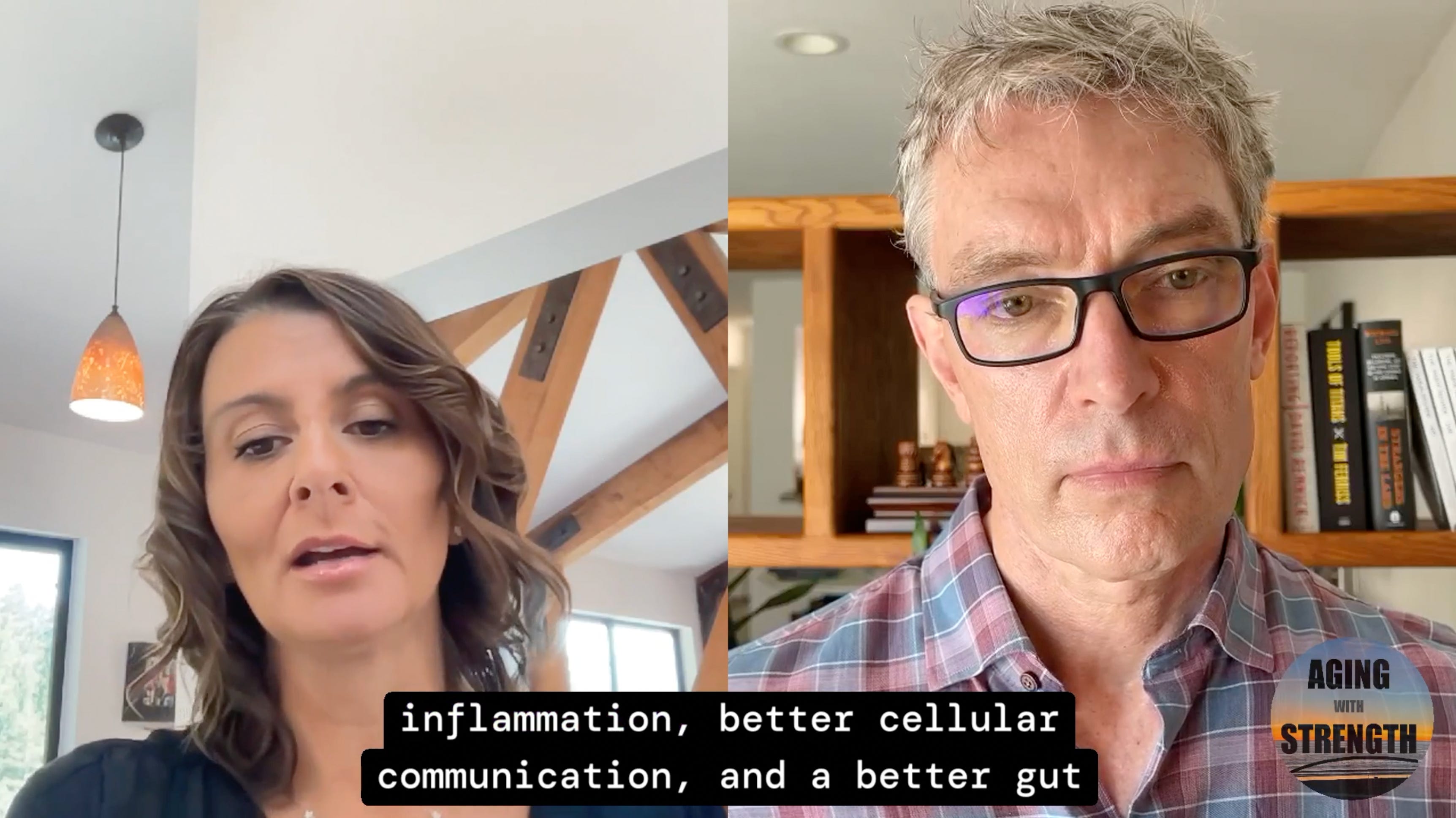
Dr. Renee Young, a Yale-trained naturopath is a medical-investigative force of nature who, at 50, is practicing the detailed and complex longevity gospel she preaches to her patients. In this 35-minute fast-moving interview, Dr. Young describes offers a portrait of what your life would be like if she had a say in keeping you healthy, fit and well for as many years as possible — even if you think you’re perfectly healthy already.01:25 — What’s a naturopath? How is naturopathy different than what your PCP does?03:10 — What a naturopath offers that your insurance-provided doctor can’t.04:30 — “One of the questions always in my mind is, ‘What will this person meet their demise from?’”05:24 — Component’s of Dr. Young’s “executive wellness” check.06:10 — The NutrEval comprehensive metabolic/nutritional test, and why Dr. Young recommends it.06:56 — Polygenic risk scores and genetic testing.07:55 — Paul’s recent NutrEval results: negative and positive surprises and what they show about how much insurance-provided annual blood/urine tests don’t tell you about your health.11:10 — Medicine’s marketing problem.12:26 — “How much healthcare do you want to consume?”18:00 — The curious doctor.19:05 — How to keep up with the explosion of longevity information and misinformation nowadays.20:10 — “Ask yourself hard questions.”21:15 — The Big Three aging processes to know and understand.23:32 — Investigating your own healthcare.25:55 — Next-level diagnostic tests.27:00 — The five pillars of aging.28:07 — Wellness as a series of rituals: yearly, monthly, weekly and daily.30:38 — Intermittent fasting! (One of Dr. Young’s favorite topics.)33:42 — The major benefits of assessing and knowing your biological age. This is a public episode. If you'd like to discuss this with other subscribers or get access to bonus episodes, visit www.agingwithstrength.com/subscribe
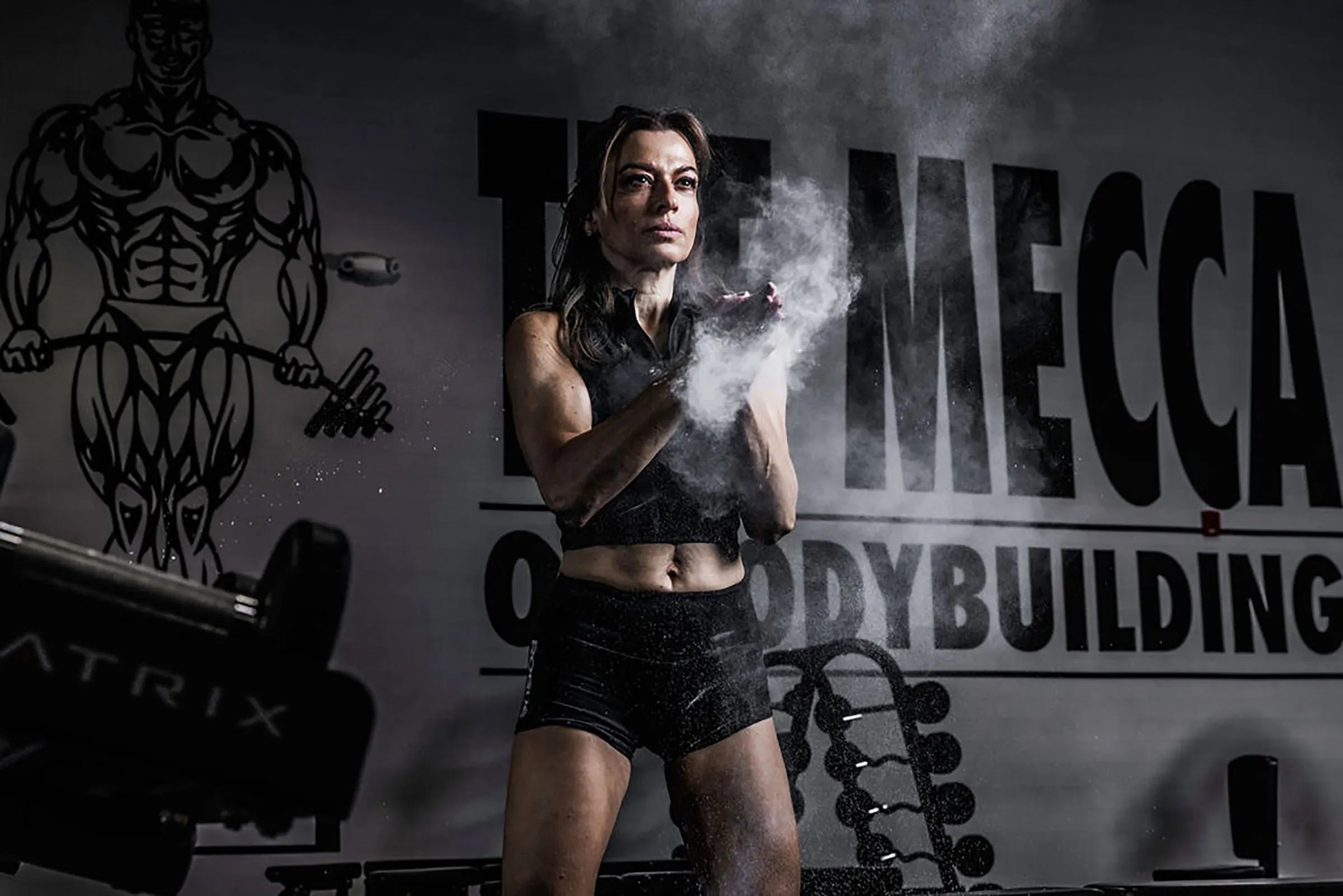
Anne Marie Chaker: 50-yr-old bodybuilder
Not many professional bodybuilders start in their late forties. Fewer do it after overcoming a drinking problem. Almost none started out as a newspaper journalist — trust me on that one.Anne Marie Chaker is that rara avis who overcame a large amount of personal adversity to inadvertently reinvent herself, a story is captured in her just-published book, “Lift.”In this 18-minute conversation, Chaker reveals the road she traveled to become not only physically strong but also a more powerful person, and the many different ways in which her muscle-building lifestyle helped turned her life around.Time-stamped highlights:0:51 — “I remember being in the car, craving a drink,” and how a chance meeting with another hockey mom motivated Chaker to stop ignoring nutrition and start working out in a gym.02:15 — How Chaker’s 2020 first-person essay in The Wall Street Journal, titled, “I never thought I’d write this: I’m a female bodybuilder,” launched the idea for “Lift.”03:15 — “I just didn’t feel like I needed the booze anymore.” And, “I performed at my best when I was well fed, when I was strong.”05:02 — Going from “meh” to “Girl, you look good!”05:29 — “Aging Beastfully”: What it means and how you know if you are.08:15 — Flexing, or not, in the gym mirror: “I would love to have the balls to strut across the room — a woman — in a double-bicep pose.”11:50 — Chaker’s journey from muscle building to professional bodybuilding.13:28 — Chaker’s food and eating regime: A fridge full of salad and all the protein under the sun.15:33 — How people new to weightlifting and working out can build muscle, at home or the gym.16:43 — Chaker’s home gym set up: Some weights, a bench and some bands. “If you have a body, you have a gym.”17:15 — Chaker’s frustration with fitness gadgetry. “They make it way more complicated than it has to be.” This is a public episode. If you'd like to discuss this with other subscribers or get access to bonus episodes, visit www.agingwithstrength.com/subscribe
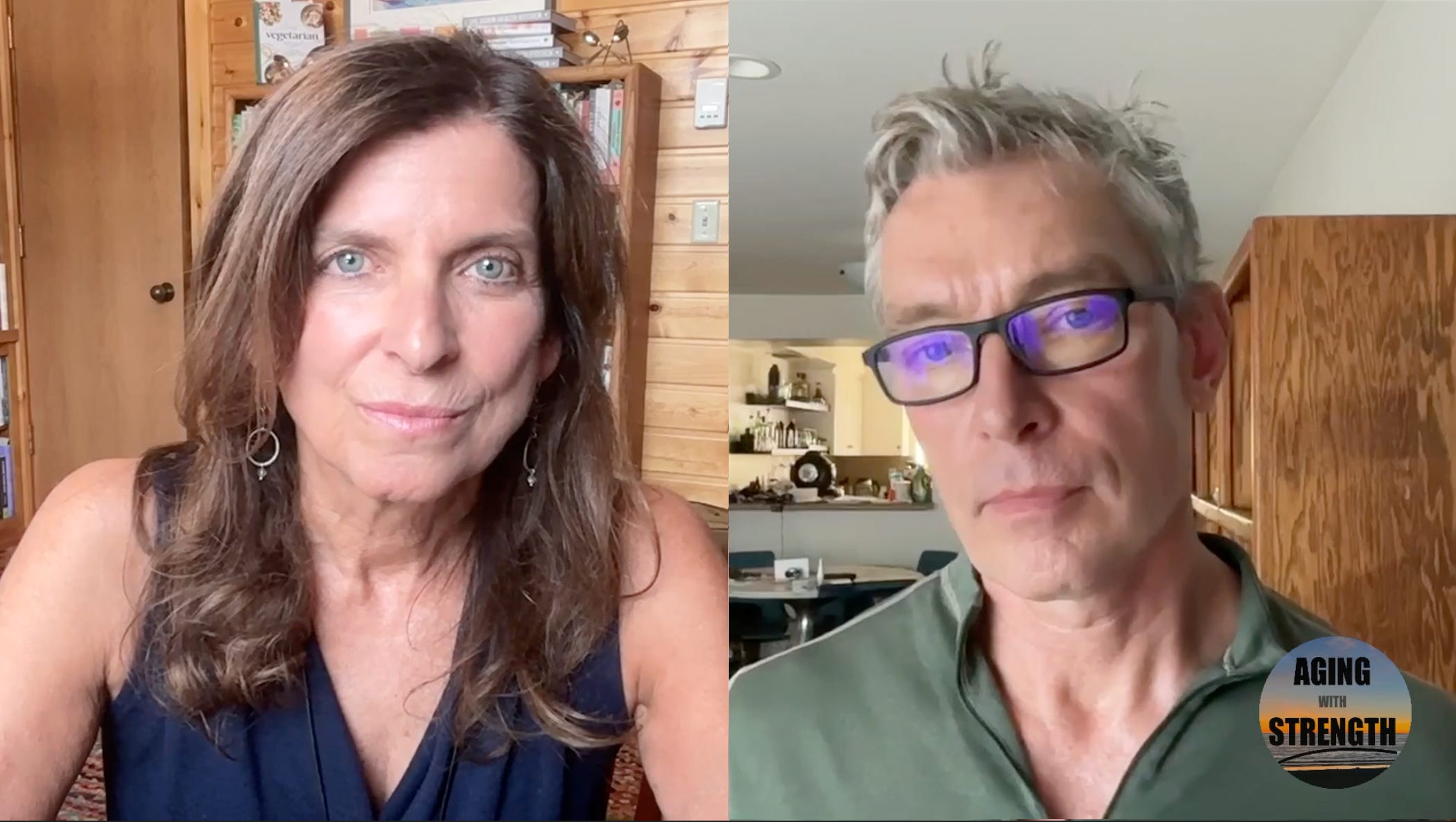
S1 Ep 10Dr. Annie Fenn: Brain healthy food habits
There’s not many 43-minute podcasts you really need to hear. This is one of them. Annie Fenn offers a masterclass in creating a nutritional foundation for maximal brain health and muscle building in midlife and beyond. I learned a lot during our conversation, and I’m pretty sure you will, too.No more lunch meat or salted nuts, for instance.Annie Fenn, MD is the author of, ”The Brain Health Kitchen: Preventing Alzheimer’s Through Food,” a science-based cookbook for the brain. You may be familiar with her incredibly substantive, fact-packed Substack, Brain Health Kitchen. Annie, who’s a board-certified OB-GYN, is also a trained chef, making her advice about nutrition and brain health essential for building a strategy to maintain superior cognitive function throughout life.How to build brain healthy eating habits:01:25 — ”What you eat at midlife seems to be particularly predictive of whether you become vulnerable to one of these neurodegenerative diseases.”02:08 — “Most of the dementia that people get has a very strong dietary link. That’s why what you do at midlife is so incredibly important.”04:45 — How “food environments” create better nutrition habits.05:15 — “Unless you address your food environment, I don’t think it’s really possible to make meaningful change.”06:23 — ”What’s your brain health mindset?” (Figure out what really motivates you to alter entrenched eating habits.)07:45 — Building “your own brain-food pyramid.”09:11 — The building blocks of the Mediterranean Diet: “peasant food.”11:48 — Making beans and legumes a bigger part of your brain-healthy eating habits.17:01 — How to go from a bad food environment to a healthy food environment.19:31 — Vegetarian and vegan diets.21:27 — Eggs, cardiovascular risk and nutritional cholesterol vs. blood cholesterol.24:57 — Defining what is and isn’t “processed meat;” how bad is lunch meat, really?26:35 — Processed meat and “AGEs”: a recipe for inflammation and brain aging.27:39 — How to cook meat to avoid AGEs and the problems it’s associated with.31:35 — Protein for people over 40; the relationship between protein and dementia.33:40 — “Strength training is mandatory for women,” especially after their late 30s.36:00 — Is there a gender divide in nutrition for people over 50?37:20 — Getting strong and eating enough protein in perimenopause to ward off pre-diabetes, muscle loss and other potential issues.38:20 — Sugary drinks: a metabolic and brain health disaster.40:45 — Annie’s Top 3 takeaways for eating healthy after 50. This is a public episode. If you'd like to discuss this with other subscribers or get access to bonus episodes, visit www.agingwithstrength.com/subscribe

S1 Ep 8Drinking less after 50: a frank conversation
Update, June 29, 2025: Turns out that simply talking about the goal of drinking less helps effectuate actually drinking less. Since I first recorded this conversation with Wendy Bounds, and certainly in the several weeks since publishing it, I drink noticeably less, which is to say less often, than at anytime since the pandemic. Original post: Earlier this year, I began talking with Gwendolyn Bounds, who is just a terrific explorer, journalist, author and human, after being introduced (remotely, as we live on separate coasts) by a mutual friend. Over the course of a couple phone conversations to explore our respective interests in all the ways to be better in this world, we quickly learned that we were both on individual quests to drink less. As we talked about our very different alcohol origin stories and strategies for winding down our respective drinking habits over time, we stumbled upon two ideas: * An unvarnished, candid and unselfconscious conversation about drinking less is something we should record, not because we know more or better but because our struggles and strategies may be helpful to others also trying to drink less. * Though Wendy and I have yet to meet in person, having a “non-drinking buddy,” as she aptly calls me in this recorded conversation, is a good thing. There’s a third idea, and it’s mine only. But first, in case you missed it: It’s that Wendy has been rather more successful and with setting her “drinking less” goals and achieving them than I have. We’ve each developed some tactics and mindsets that mitigate the urge to drink once the clock strikes a certain hour (and even that hour is different for her and me).* the Cheetos Protocol: If don’t want to consume it, don’t keep it in the house* put out visual cues that remind you why you don’t want to drink* sip your drink more slowly and parsimoniouslyAnd many others. For me, drinking has never been a problem, but it had become a very cozy, enjoyable and, honestly, lazy habit. One that exists at cross purposes to what I want to achieve in aging with strength for the remainder of this one life. Wendy, now a New Yorker, is originally from the South. I grew up in the steamy and frozen Midwest (those are my only two memories) but have now lived in California for almost as long. You will not be surprised to learn how differently our drinking was and remains today. But on the idea that we can never have too many non-drinking buddies, I hope you’ll listen to our 33-minute conversation and tell us what you think — about anything — in the comments. AGING with STRENGTH only recently learned how to properly pronounce Sláinte. But the favorite foreign word for cheers remains the Hungarian: Egészségedre. This is a public episode. If you'd like to discuss this with other subscribers or get access to bonus episodes, visit www.agingwithstrength.com/subscribe

S1 Ep 8Aging with self-forgiveness
We all need to build more self-forgiveness into our lives.This topic is a pathway to greater strength, not weakness, and I’ll explain why. Not everyone needs a psychoanalytic intervention here, but almost every person I know, and who you know, I’m guessing, could benefit from taking a minute to consider how minor acts of self-forgiveness — some people prefer the term self-compassion — can make them stronger in life’s all-important second half.It’s so easy to just continue to be too hard on yourself.Two kinds of self-forgiveness* Tier 1 self-forgiveness addresses either profound, deep-rooted feelings like inadequacy, unlovability or trauma that go back to childhood, or more contemporary shame and guilt for something we’ve done to someone else.* Tier 2 self-forgiveness is caused by routine daily mistakes Self-forgiveness arises from the cognitive dissonance we experience when our actions don’t reflect our beliefs. Actions that build self-compassion* Admit your major failures. If you’ve wronged someone else, acknowledge that to them, apologize and explain why it won’t happen again. You won’t forgive yourself until you ask the other person to.* Be kind to yourself. Treat yourself with the respect you would give a loved one.* Recognize what you’ve done well. Take the time and words, if only spoken to yourself, to celebrate your achievements.* Practice regular self-care through what makes you feel well: exercise, time in nature, getting a massage or watching the big playoff game; whatever brings you joy.Aging with emotional strength is harder than it seems. But it’s worth the effort. I’ll leave you with these six very good questions we should all be asking ourselves, courtesy of Helen Marie on Substack:What kind of life am I quietly dreaming of?What are the small joys that are holding me together?How can I return to what matters most?Who are my people & how do I nourish them?What stories am I ready to stop living out?How can I let myself be more fully alive? This is a public episode. If you'd like to discuss this with other subscribers or get access to bonus episodes, visit www.agingwithstrength.com/subscribe

S1 Ep 7Fascia stretch therapy: a portal to longevity
My interview with Sydney-based Erica Koo, a Level 3 fascia stretch therapist and former competitive powerlifter, explores how Fascial Stretch Therapy (FST) can make life better for people with significant mileage on their bodies, hearts and minds.Erica and I discuss FST’s significance in pain relief, mobility and overall health, the role of fascia in the body, its connection to movement, and how FST can benefit people over 40.Erica also shares her personal journey (see timeline below, if you’d rather jump to that fascinating part of our conversation) from a complete non-athlete to becoming a competitive powerlifter, lyra (aerial hoop) performer and FST therapist… who’s now on the road to also completing her psychology training. (Her latest athletic obsession is sprinting….clearly, Erica doesn’t do anything halfway.)Takeaways:* Fascial Stretch Therapy (FST) is crucial for pain relief and mobility* Fascia is a web-like connective tissue that affects movement* Aging increases the need for fascia care due to accumulated stress* FST works by addressing the fascial connections throughout the body* Therapists assess the body as a roadmap of experiences and pain* Immediate relief can often be felt after the first session of FST* Resistance training is essential for maintaining health as we age* FST is a collaborative process that prioritizes client safety* Psychological benefits accompany physical relief in therapy* Holistic health involves 5 pillars: exercise, nutrition, hydration, sleep, communityErica Koo/fascia stretch therapy video timeline:01:01 Introduction to FST: What is it & why you should care about your body’s fascia02:20 How Erica evaluates pain via fascial connections throughout the body04:50 Why fascia is so important for people over 40 to understand10:38 “The body is a roadmap” to everything it’s gone through in life11:24 Expectations of FST as a reliever of chronic pain14:15 Characteristics of people whose fascia is in the best shape15:40 Erica’s story: competitive powerlifter, aerial hoop performer, psych student22:00 The wide range of physical & neuro issues that Erica treats with FST28:10 The 5 pillars of healthy living: exercise, nutrition, hydration, sleep, community“With fascia stretch therapy, the more you move the joint, the more it does let go. And in doing so, you're able to create freedom in the joint and the muscle” — Erica Koo (aka “Stretch”)(SKIMMABLE) INTERVIEW TRANSCRIPT:PaulErica Koo, thanks for being on AGING with STRENGTH.EricaThank you so much for having me, I'm super excited.PaulYeah, this is going to be an interesting conversation because I don't know jack about fascia stretch therapy — FST as it's called.So could you tell us what FST, fascial stretch therapy, is and why we should care about it?Erica (01:08)It's a form of assistive stretching that allows us to work deep in the joints and stretch the move the body in ways that the client themselves may not be able to. In doing so, what we're aiming to do is relieve pain, restore joint integrity and also improve overall long-term mobility as well.How I would explain it to clients when they walk in is that fascia is a web like connective tissue that is all across the body. There is nowhere in our body that fascia does not exist. But the function is it helps hold our body together, but also helps coordinate smooth movements when we're walking, running, especially when we're training things like that.It's very flexible. It's meant to stretch and adapt when you move, but it can become quite stiff or tight if you have things like poor posture, if there's lack of movement or injury. And with massage, when people come in and they go, my shoulder's really painful. A massage therapist would just look at the shoulder and go, okay, well, we'll release the bicep, release the shoulder, neck, off you go. A physio would look at it and look at it in terms of a diagnosis. So they'll probably go through multiple assessments to be able to see what's the range of movement like, where's the pain, what sort of movements are triggering that, has there been an acute event to have caused that pain.With fascia stretch therapy, when someone presents with pain, I look at how that structure is fascially connected to different areas of the body. So for example, there's multiple different fascial nets across the body and you wanna think of fascia as a web like I mentioned before.And this fascia connects anatomically separate structures together across the body. So there's one called the superficial back net, for example, and it's just a big slab of fascia that runs from the top of the cranium all the way down to the neck, back, lower back, hamstring, calves, and down to the plantar fascia as well. They've done cadavers on this too. So if you are interested, you can sort of Google superficial back net and it should come up with like this big structure. So I look at, okay, well, I can, yes, stretch the shoulder if your shoulder is painful.But what other things,

S1 Ep 6Andy Walshe, human performance expert
Andy Walshe is a globally recognized leader in the field of elite human performance for individuals, teams and large organizations in sport, culture, the military and business. Andy is a founding member of Liminal Collective, whose members include some of the most accomplished human performers (artistic as well as athletic) on the planet. Their quest is to answer a fundamental question: How do the best of the best operate, and what can we learn from them?Show Notes:1:50 — The 5-minute breath-holding exercise, the “threat of running out of air” and why it’s an effective training tool.3:56 — The definition of “human performance.”4:33 — Applying human performance principles to people 50 and older.5:20 — Andy’s patented human performance framework (with visuals).6:15 — “You are an N of 1, a unique individual….”7:30 — How to create a human performance framework for yourself (what you want to achieve + your restrictions + what works for you).9:10 — The “I saw an elite athlete do it!” trap and how to avoid it.10:15 — Defining characteristics of the highest performers: The ability to adjust in the moment; bringing oneself back to baseline; “inter-receptiveness” (being able to register how you’re feeling and respond to that), and more.12:30 — Why the breath-hold exercise is so effective: Recognizing your triggers and practicing handling them in the moment.14:00 — Training Tier 1 military special operations teams to do comedy improv (the value in training elite performers in “non-traditional environments.”)17:45 — The importance of not dwelling on failures and moving forward quickly. “The Roger Federer Effect” and the “threat vs. challenge mindset”: I made a mistake. What did I learn?21:05 — The value of seeking out coaching in some form or another.22:35 — Using AI as a coach, and the technology advances just around the corner. Uploading “your own version of yourself.”24:18 — Red-light therapy: useful or waste of money?25:13 — Andy’s “70-20-10 Rule” for human performance training.29:17 — The trap of relying on shortcuts, tech toys and supplements.30:43 — Andy’s take on alcohol and drinking.31:40 — Finding the Keith Richards prototypes. Andy: “That’s research I could get behind.”32:40 — Wrap-up thought on aging well. This is a public episode. If you'd like to discuss this with other subscribers or get access to bonus episodes, visit www.agingwithstrength.com/subscribe
S1 Ep 5Athletic pain and performance after 50
Here's some strategies for dealing with midlife athletic injuries and the frustrating, sometimes demoralizing limitations they impose on us. One of the most challenging aspects of hitting my fifties (and maybe you can relate to this) is reconciling the inevitable decline in physical strength and performance with my expectations — unreasonable as they are — that I should be able to just keep doing pretty much what I did last week, last year or 15 years ago.Not to mention the particular personal psychology that whispers, convincingly, that physical strength and ability are standards that must be upheld. As if they were virtues that, like all actual virtues, don’t ever change.And the pernicious feeling that if I can’t maintain my athletic standards, well, then, who am I, really?Of course, these thoughts and feelings are rarely overt; they’re more like emotional microplastics polluting my subconscious. But like all toxins, they tend to accumulate over time, to the point where they can influence my self-perception and, thus, my behavior. And here’s the problem with that: If you’re in a state of continual dissonance between what you want your body to be able to do and what it can actually pull off, you’re all but asking for an injury.Or, more to the point of this post, a nonstop series of injuries.Because athletes in their 50s are like the Tom Hanks character in, “Cast Away.” Remember that movie, from 2000? A guy stranded on an island invisible to the outside world. He survives on pure improvisation, lives in a cave gnawing on fish bones, staring at the wall wondering WTF. And then he becomes emotionally dependent on a volleyball and cries when it goes away.Sound familiar, athletes? If “Cast Away” isn’t an analog to life after 50 I’m not sure what is.At least we have access to ibuprofen and CBD gummies.The consequences of “ignore & override” for older athletesAt this point in my audiocasts, I usually offer a disclaimer that I’m speaking not as an expert but as a journalist and curious explorer. But on this topic…I’m an expert. My guess is that many of you are, too.Or, if you’re not yet, because you haven’t yet hit the 50-something athletic injury wall that no one ever bothered to tell you is approaching, I’m here, now, warning you about the negative surprises that many midlife athletes confront.Or, as the case may be, simply ignore.I wrote a post in October that examined the consequences of continuing to fight through athletic pain. And in the months since then, I’ve become a living lesson of what happens when ignore & override becomes your rule instead of the exception.A brief summary of my 50-something injuriesSo let me quickly run through what I’m dealing with, so I can get to the strategies for managing the nonstop injuries after age 50 with credibility.* My right shoulder now has 2 partial tears that make upper-body training tough. They wake me up, every night. I probably need surgery, because it feels a lot like my left shoulder 8 years ago, when a surgeon stapled together a full tendon tear.* But now, in both shoulders, I also have severe tendinitis of the long head biceps tendon, which connects the biceps to the shoulder. This is a direct result of my ignore & override habit, after too many rounds of hitting 200 tennis serves at a time.I was in too much of a hurry to be really good at tennis, and got a repetitive stress injury as a result.Consequences!So, now I focus more on lower body and core strength training, for stronger legs, quads, glutes, hip flexors, lower back and pelvic strength. As you get older, you want to be stronger from the ground up. And these are big muscle groups that burn a lot of calories.* Oh, yeah: As if on cue, last week my right knee took on fluid, for reasons I have yet to pin down. Going too heavy on the box jumping? Or the stair workout? Tennis drills against the pitiless ball machine? Whatever.Using athletic stress therapy to speed recoveryThough I make light of the stress I put on my body — and maybe that’s just another variation of ignore & override — when it comes specifically to tending to athletic injuries, I’ve found that continuing to use it — playing, running or working out on whatever part is hurting — can in some cases speed up the repair process far more effectively than the RICE therapy, which is based on Rest, Ice, Compression and Elevation.Carefully stressing certain non-acute injuries, through newer therapies with acronyms like PEACE, LOVE, and MEAT works only if you know what you’re doing and have a strong and sensitive connection to your body’s nuanced pain signals.I could do an entire post on physical stress therapy, so I won’t go deeply into it here, but it’s not for everyone.But what if, instead of more effective therapies, we avoided taking on athletic injuries in the first place. Maybe there’s a better way to build strength and endurance and flexibility after 50 than simply by pressing on with the same workouts, the same routines, the same sports, even,

S1 Ep 4Nutritional strength & drinking less in 2025
Five simple principles about eating, food and alcohol to maximize your healthspan.1 | Nutritional accountability. The first principle is sharing your eating and nutrition habits with people whose opinions you value. There’s strength in accountability, and that absolutely applies to what you put into your body.2 | Eating habits. Are you willing to challenge some of the habits you’ve formed around how you eat and prepare food? If you are, then make a point of acknowledging that changing those habits will be a pain in the ass and will feel awkward. But also understand what is animating you to want to eat healthier foods, or conversely, what is keeping you away from them. I’ll mention some examples of each of those in a minute.3 | Experimentation. What’s the one food or dish that you know you should add to your eating routine but for whatever reason, you haven’t — maybe because you don’t know how to prepare it; or think it won’t turn out well; or won’t taste that good; or is too trendy? For the hell of it, just once, buy it, make it, eat it. See what happens.4 | For women over 50: Do you have a nutrition plan that will help manage the effects and impact of perimenopause and menopause? I may be out of my lane on this, but there’s plenty of evidence that food and diet can have a positive role in managing menopausal symptoms.5 | For men over 50: Do you have nutrition goals — at all? — and are you still eating the same kinds of crap you ate 20, 30 years ago? A slowing metabolism demands eating-habit changes to avoid turning into a pear-shaped geezer who, when he dies, leaves a decade or more on the table. Real men know their way around a kitchen and meal plans. Which I say in semi-jest. But only semi. This is a public episode. If you'd like to discuss this with other subscribers or get access to bonus episodes, visit www.agingwithstrength.com/subscribe

S1 Ep 3Physical strength and flexibility in 2025
I’m Paul von Zielbauer from AGING with STRENGTH.…with a few brief thoughts on how to make 2025 a great year to build not just physical strength but also enduring mental, emotional, spiritual, nutritional and community strength. I have some ideas, born of my own curiosity and years of trial and error, but feel it’s important to once again point out that I’m not an expert or guru. To the contrary, I’m a reporter and investigator of the experts and the so-called gurus, in service of isolating worthy information to share with you and exposing what is turning out to be a rather large amount of b.s. and unsupported conclusions from not only people who should know better but also the institutions that give them fancy titles and, often, tenure.In this brief AGING with STRENGTH audiocast, I focus specifically on physical strength and a few key routines and habits that, through the trial and error I mentioned, have been real difference-makers in helping me not only improve athletic and physical performance but also minimize small recurring injuries and pain that is familiar to anyone over, say, 45 who’s still pushing their physical limits.In subsequent audio notes this month, I’ll give this same treatment to each of the other pillars of aging — mental strength, emotional strength, nutritional strength, spiritual strength and community strength — in a way that is specific, personal and suitably ambitious without being obnoxious.Because let’s face it: We all want to be strong in the ways that most matter to us, but we’re not really interested in thousand-dollar supplements in a bid to live forever, like tech entrepreneur Bryan Johnson, who’s bringing his “Don’t Die Summit” to Los Angeles later this month. (I wish I were making that up, but I’m not.) And we all hopefully see through the charade by now of pitchmen like Andrew Huberman, Stanford’s in-house “Neuroscientist Gone Wild”, who in between his paid YouTube product promotions now calls aging a disease that can be reversed.No, we’re just trying to age with strength and resilience — aren’t we? — in each of these vital areas of our lives. And if we can also lower our biological ages by a few years or so, just through a more mindful focus on doing what makes us feel and become stronger, well, that’s even better. Maybe I’d even celebrate that win with some of Bryan Johnson’s $500 THC-infused retinol…guaranteed to make you sleep as soundly as his 18-year-old blood boy.Improving physical strength in 2025Jocularity aside, here are some ideas for becoming physically stronger over the next 51 weeks of 2025 — again, not handed down to you by an expert, but offered up by a deeply curious crash-test dummy of sorts who believes in improvement through improvisation, experimentation and a willingness to fail forward, as they say in tech. I hope that some of these ideas will be helpful, either as a regimen to try yourself, or try a variation of, or as a provocation that perhaps gets you to think differently about what’s possible for you to achieve.If there’s one thing I learned over the years, personally and as a social entrepreneur, it’s that we are each are capable of achieving so much more than we think we can.So let’s get to aging with more physical strength in 2025.I’ll start by saying that, to age optimally, regular strength training in some form is simply non-negotiable. Working out, with weights or some kind of resistance, just has so many indisputable benefits that go beyond maintaining and building muscle mass. It improves your mood, lowers stress, boosts confidence, improves brain health, reduces inflammation and risk of injuries and can even mitigate the damage from moderate drinking. But even if none of that is compelling to you, the fact that strength training slows and reverses biological aging should be. Who doesn’t want to look stronger, tighter and younger in jeans and a t-shirt?At my local Santa Monica YMCA weight room several years ago, there was an older guy who clearly looked, if not ripped, then noticeably fit for his advanced age. Which I assumed from the fluid way he carried himself and worked out was around 72 to 75 — pretty old for a gym rat. One day a high school kid, who obviously had also noticed this man’s physique, asked how old he was. Eighty-eight, he told the kid.There’s just something about regularly lifting even light weights that keeps the human machine running young, at the cellular level. And there’s plenty of credible science to support that assertion.In 2025, my goal is to get both stronger and faster, and leaner and more flexible. I’m not looking for bigger muscles but rather to increase neuromuscular efficiency, which develops by training the nervous system to control muscle fibers. Neuromuscular training, which I’ll link to in the transcript, has been shown to improve various aspects of athletic performance, including agility, balance, muscular strength, power and cardiorespiratory endurance, not to mention better joint stability and re

S1 Ep 2Podcast E2: Polar explorer Alison Levine
I talk with history-making polar explorer and mountaineer Alison Levine, who's such a badass they named a beer after her. Alison was team captain of the first American Women’s Everest Expedition and is one of about only 20 people to achieve “the Adventure Grand Slam.” But almost equally dramatic is her lifelong journey being the "parent" of her father, a bi-polar FBI agent who got on the wrong side of J. Edgar Hoover. This is a public episode. If you'd like to discuss this with other subscribers or get access to bonus episodes, visit www.agingwithstrength.com/subscribe

S1 Ep 1Intermittent fasting: a brief audio addendum re the knowns and unknowns
Transcript:This is Paul von Zielbauer from Aging with Strength with a quick audio addendum, on this Thanksgiving eve, to my post yesterday on intermittent fasting, which I have found, through personal experience and by talking with many people who practice it in midlife and beyond, to have myriad benefits to daily well being. But not everyone thinks so, and some experts are on record saying intermittent fasting, or I.F. for short, works for losing some flab weight but not much else. One of my readers pointed out a recent WSJ article with almost that exact headline.So, where do I, a journalist who’s not a nutritionist, not a doctor, not a clinician of any kind, get off cautiously recommending I.F. to people in their 50s and up? And also, how the hell does anyone, including yours truly, really know if I.F., as some research that I linked to in my article yesterday indicates, helps slow the pace of biological aging, or reduces the risk of Alzheimer’s, or makes muscle tissue stronger even if it reduces its mass in the process? (These are all findings indicated in research I linked to in the post yesterday, among others.)Well, the answer is that I don’t really know — and neither do any of the “health and wellness” YouTube carnival barkers on the scale of Andrew Huberman and charlatans like him who profess categorical certainty about the efficacy of fasting and other experiments with nutrition, strength, eating and food. But I’ve talked to enough thoughtful people who practice I.F., about what they believe it does for them, and I’ve read the abstracts of enough credible research that isn’t bogged down by obvious conflicts of interest among the researchers, to believe that intermittent fasting done right can help wean us off the industrialized, ultra-processed food conveyor belt that so many Americans are on, or are susceptible to being on, because with every other daily stressor, it’s easier to just keep eating habitually, which for many of us includes snacking after dinner.Of course, I realize the irony of saying this the day before we stuff our pie holes with way too much food for Thanksgiving. Good luck with that, by the way.But if there’s one single thing that I.F. has given me, in my own experience fasting from 7pm to 10am almost every day, it’s the ability to not eat after dinner. And that alone creates knock-on benefits — for better sleep, better digestion, a less maniacal need for caffeine, a more durable daytime energy and ability to focus and the ability to simply remain food disciplined — that are lot harder to achieve, in my opinion, without intermittent fasting.Are there longitudinal studies proving I.F. helps slow your rate of biological aging? No. Is there research on more than a couple thousand people from diverse ethnic, gender and socio-economic backgrounds that are dispositive about I.F. lowering your chances of getting cancer or dementia or Type 2 diabetes? No.But when it comes to intermittent fasting, I’m encouraged by how it more closely resembles how humans evolved to nourish themselves and endure periods of involuntary fast. Physiologically, it feels natural to stop eating after dinner (once you get used to not eating after dinner, which takes some discipline.) At a genetic level amost, it just feels right to not wake up and immediately eat, then sit for three hours at a desk and then eat again, and continue the pattern of eating and “sedentarianism.”I’ll continue investigating the research on I.F., and if you have thoughts or questions, please put them into a comment on the Aging with Strength substack. Until then, Happy Thanksgiving and thanks for listening. This is a public episode. If you'd like to discuss this with other subscribers or get access to bonus episodes, visit www.agingwithstrength.com/subscribe