
250 and Counting
660 episodes — Page 13 of 14
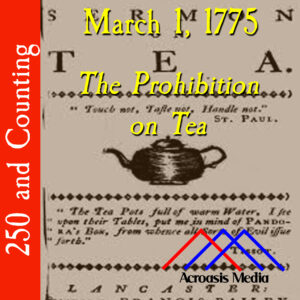
March 1, 1775
When it comes to tea-related protests, the Boston Tea Party seems to get all the press, even though there was also wanton destruction of tea in Charleston, and then there was the Edenton Tea Party. But Boston was the first, and abusing tea in one way or another became a popular way to demonstrate your patriotism. (Some modern-day Brits would argue that we never quite stopped abusing tea.) Today we talk about an effort to actually prohibit the import or consumption of tea in the Colonies. It worked about as well as you’d expect. The post March 1, 1775 appeared first on 250 and Counting.
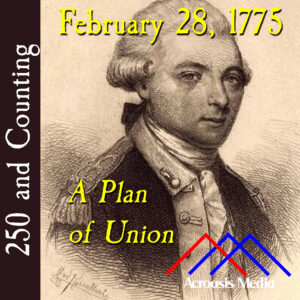
February 28, 1775
Today we meet yet another prominent citizen who thought he had the solution for putting an end to the tension between the Thirteen Colonies and Great Britain. It’s important to note at this point, we think, that these people weren’t delusional; they were genuinely interested in maintaining a good relationship and therefore invested in repairing the damage that had been done. They liked being British citizens, even though a minority percentage of them had emigrated from England (many were born here; others came from different nations). And it’s also worth noting that when it came to separating from the British Empire…well, that sort of thing had never been done before. Never. So creating an entirely new nation was practically inconceivable for some people. Unfortunately in the end, while Joseph Galloway’s plan was seriously considered by the Continental Congress, it was turned down, and there was an unfortunate series of events that forced him to leave America forever. The post February 28, 1775 appeared first on 250 and Counting.
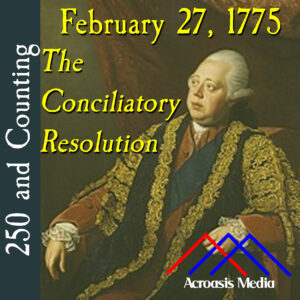
February 27, 1775
And once again, we have someone (two someones, really) who manage to come up with a plan that will put all this unpleasantness between the Thirteen Colonies and the British Empire to rest, and once again the physical distance between the two threatens the success of those plans. What’s more, it turns out that the more popular of the two plans has an almost-hidden ulterior motive… The post February 27, 1775 appeared first on 250 and Counting.

February 26, 1775
It’s one thing to hear someone hollering “The British are coming!” and quite another to actually see them arriving in your port. And that’s especially true when they’re also seen confiscating the cannons that you’d hidden upriver. This wasn’t the first time something like this had happened, but there was something different about the Colonists’ response—and it almost touched off the war nearly two months before it actually did. The post February 26, 1775 appeared first on 250 and Counting.

February 25, 1775
Today we review two different pieces of correspondence—one local, the other trans-Atlantic—in which the letter writers are clearly coming to the conclusion that things are not going well between the British and the Colonies, and that preparing for war is probably inevitable at this point. And that’s interesting on its own, but we also wanted to call your attention to the cover art for today’s episode. The person in the picture is Josiah Quincy II, who is discussed in the episode as a “side” character of sorts. The painting is by Gilbert Stuart, who is pretty famous for painting hundreds of American politicians and public figures, and perhaps most famous for the “unfinished” portrait of George Washington that served as the model for the one-dollar bill. There aren’t a lot of portraits of Quincy extant, but this one (which was painted after Quincy’s death in April 1775) gets a lot of attention from Stuart scholars because it provides a very candid representation of Quincy’s strabismus, or misalignment of the eyes. (It’s possible that he simply had amblyopia but we don’t know for sure nowadays.) Most people agree that it actually gives Quincy a little extra dignity and esteem. The post February 25, 1775 appeared first on 250 and Counting.
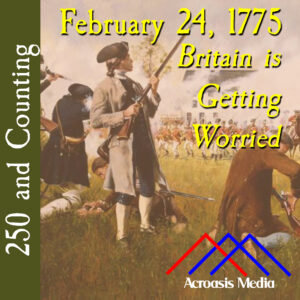
February 24, 1775
The interesting thing about surveillance in the 18th century is that, when you’re dealing with trans-Atlantic distances, the information moves slowly, and errors can be costly. We told you not long ago about someone who’d heard about the Minutemen, but had their numbers wrong by a factor of thousands. Fortunately in that case, it was just casual gossip rather than actual spycraft. But today in history, a bit of information about Colonial artillery that was reported to the Provincial Congress in Massachusetts leaked to the British, along with information about the Minutemen’s numbers and level of preparedness. But as we’ll discover in the next couple of days, the British were already taking precautions. The post February 24, 1775 appeared first on 250 and Counting.
February 23, 1775
Alexander Hamilton isn’t really considered one of the Founding Fathers, largely because he’d only arrived in America from Scotland around the same time that things started getting ugly between the Colonies and the Crown. But he quickly took up the cause, and it’s clear from his writing that he was of a similar mind as Jefferson, Franklin and the rest. When he joined the Continental Army, he rose quickly through the ranks, becoming Washington’s staff aide and entered politics shortly after the war ended. So while he wasn’t on hand for the initial segment of American statesmanship, he was there when the basic framework of our government was laid down. But back to his writing: he and the Reverend Samuel Seabury (we first heard from him on January 4) got into the habit of debating each other through pamphlets, written under pen names. They’re quite well-written and easy to understand, and because they’re only pamphlets, they don’t run especially long. They’re worth checking out. The post February 23, 1775 appeared first on 250 and Counting.
February 22, 1775
Back when Mike and Claude were kids, February 22 was celebrated as a national holiday, the 22nd being recognized as George Washington’s birthday. Lincoln’s Birthday was February 12, so we had two Federal holidays close together. (To be fair, Lincoln’s was always unofficially recognized.) Until, that is, 1968, when the Uniform Monday Holiday Act came along, and many holidays were moved to the Monday of that week. Not every state complied right away, but eventually Lincoln’s Birthday disappeared and Washington’s Birthday moved from the malleable February 22nd to the always-on-Monday Presidents Day. But here’s the part they don’t always tell you: George Washington wasn’t born on February 22. He was actually born on February 11, 1731 but that was under the old Julian calendar. In 1752, Britain and all its colonies switched to the Gregorian Calendar, which changed Washington’s birthday (well, everyone’s, really) by a year and 11 days, to February 22, 1732. Believe it or not, people did not take the calendar change well. Because it was essentially a Catholic innovation (named after Pope Gregory XIII), Protestants thought it was a Catholic plot to return them to the fold. Other people, especially in the Colonies, thought that time was being stolen from their lives, and they demanded that the “lost” days be returned. It wasn’t until public figures—including George Washington—adopted the new dates and made a big deal about doing so, that people started to calm down. None of this is relevant to the story you’ll hear in today’s episode, but this whole Washington’s Birthday thing doesn’t get told nearly enough. In the meantime, enjoy Mike’s story of William Seymour. The post February 22, 1775 appeared first on 250 and Counting.
February 21, 1775
Of all the indignities we laid upon Claudius Herrick in this episode (okay, there weren’t that many), the worst is that we misspelled his name in the cover art. The post February 21, 1775 appeared first on 250 and Counting.

February 20, 1775
Until Israel Gregg came along, steamboat commerce on the Ohio river was considered impractical, largely because the currents were so strong. But Gregg had an interesting approach to demonstrate that it was, in fact, possible. In some portions of the river, there was a confluence with another river, which meant that there were multiple currents in the river for some distance. This is what made it hazardous in the first place. Gregg made a point of seeking out the currents of a specific river in each confluence, and navigating only that river’s current. So from Brownsville to Pittsburgh, Gregg used the currents of the Monongahela River. From Pittsburgh to Cincinnati, he used the currents of the Ohio River. Then he remained with the current of the Ohio to Louisville. From there he returned to Pittsburgh, running against the current of the Ohio. A few cycles of this had people convinced, and his ship, the Enterprise, became one of the first of that name to go down in history. (Specifically, it was the third in American history.) The post February 20, 1775 appeared first on 250 and Counting.
February 19, 1775
When I (Claude) was younger, I read a Star Trek novel titled The Final Reflection by John M. Ford. Trek novels weren’t considered canon, and later events in the films and subsequent series kind of wiped out some of the concepts put forth in the book, but what I found fascinating was that it was told entirely from the Klingons’ point of view. (It also provided an interesting explanation regarding why Federation transporters give off a high-pitched whine.) Before you think I’ve digressed before I’ve even started, my point here is that today’s episode focuses on a British military figure rather than one of the Founding Fathers or other Colonial figure. We’re taking an all-too-brief look at Lord Horatio Nelson, who did have an important life event take place on this day in 1775. Also, when you listen to the episode, you’ll see I just have Star Trek on my mind. The post February 19, 1775 appeared first on 250 and Counting.
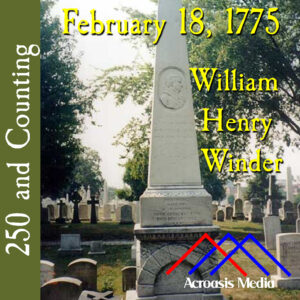
February 18, 1775
Maryland has a peculiar place in most of America’s major events. During the Revolution, the Continental Congress hid out there for a while. During the Civil War, the state mostly sat out the war because it was a “Southern” state occupied by the Union throughout. But the War of 1812? Well, that was Maryland’s time to shine, and today we meet one of the military men who fought in that war, though he wasn’t especially successful in the Battle of Bladensburg. We did have a portrait of Winder we were going to use in the cover art until we realized that Winder is buried in Greenmount Cemetery, in Baltimore, a short distance from Claude’s home. So he ran out and snapped a photo. Several famous historic figures are buried there, including John Wilkes Booth (it’s probably the best-known unmarked grave in America), so there may have to be a few more trips over there. The post February 18, 1775 appeared first on 250 and Counting.

February 17, 1775
We’ve mentioned in the past that the intent of most of the Intolerable Acts and the Coercive Acts were designed to punish the Massachusetts Province, but it had some effect on the other colonies as well. What’s more, there was a growing worry that, if Parliament could do things like this to Massachusetts, what’s going to stop them from doing it to us? To that end, the city of Albany, NY, began making plans just in case war broke out. It was against the law, but their reasoning was that it was better to have a militia and not need it, than to need it and not have it. The post February 17, 1775 appeared first on 250 and Counting.
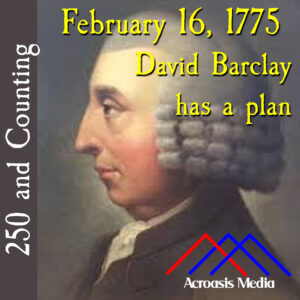
February 16, 1775
David Barclay was a British merchant who frequently plied his trade with other merchants in the Colonies. Such trade was quite lucrative for him, so when the Stamp Act was enacted, he stood to lose a lot of money because the Colonists would simply look elsewhere for the goods he sold. Likewise, when the Intolerable Acts, and the Coercive Acts were enacted, Barclay stood to suffer even more. So Barclay came up with a plan that would allow everyone to save face and bring these acts to an end. The post February 16, 1775 appeared first on 250 and Counting.

February 15, 1775
Only a few people had figured it out, and it’s not clear whether they were just guessing, but by this point in time both England and the Colonies were locked into a path that would lead inevitably to a shooting war. To that end, Parliament approved sending over four thousand soldiers and sailors to the Colonies to help keep them in line. But it wasn’t as simple as that; there were still some people protesting the action, not that anyone listened to them. Today we also peek in on someone who’s watching the action and has some thoughts. The post February 15, 1775 appeared first on 250 and Counting.
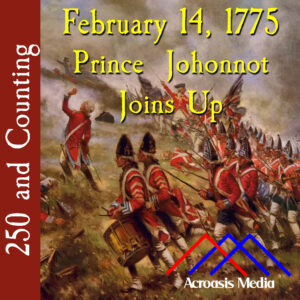
February 14, 1775
When it comes to Black people and their role in the American Revolution, the one name that most people appear to remember is that of Crispus Attucks, largely because he was the first person killed in the Boston Massacre, and that event is thought of as the beginning of the Revolutionary War, therefore it’s significant that the first person to die in the name of American freedom was a person of color. Other people, more fussy about events, would say that Lexington & Concord was the beginning of the war. The reasoning behind that is that it’s the first event in a series of hostile actions that took place close to one another. But the real argument is that most historical events of this nature don’t have definitive “beginning” and “ending” points; it’s much like a roll of paper towels. Sure, there are perforations marking each sheet, but you know for a fact that when you pull one off, it’s going to tear at an oddball angle and those perfectly rectangular sheets are a rarity. The fact is, however, that over 100 Black men fought as part of the militia in the opening battles of the Revolution. Here’s the story of one of the first. The post February 14, 1775 appeared first on 250 and Counting.
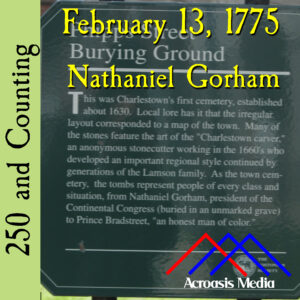
February 13, 1775
Here’s a peek behind the curtain: Mike and Claude do their own research for the individual shows, though Mike did the initial setups for the dates. So he’s the one who figured out what happened when, and then they each do the deeper research for the episodes they record. So Mike probably had no idea that there was a familial connection to this episode for Claude. For what it’s worth, neither did Claude, until he started looking into the story of Nathaniel Gorham. So if Mike had been recording this episode, it’s likely that he wouldn’t have had anything to say about it other than “Oh, fun coincidence.” We’re only sad that we couldn’t find a portrait of Nathaniel; we have no idea whether there’s a family resemblance. The post February 13, 1775 appeared first on 250 and Counting.
February 12, 1775
We realize that this is going to come as a huge surprise to you, but when the future Louisa Catherine Adams met her future mother-in-law, it was not an auspicious occasion. This delayed—but did not prevent—Louisa from marrying John Quincy Adams, but Abigail Adams didn’t have a lot of respect for Catherine for many years. In the meantime, she and John Quincy had some ups and downs in their marriage, but in the end it appears that they were able to reconcile all the rough patches until the very end. The post February 12, 1775 appeared first on 250 and Counting.

February 11, 1775
There are many events in the life of William Hall that could be ascribed to just plain luck on his part, and others which could conceivably tied to some shrewd timing on his part. But in the end, we think we’re going with luck. If he hadn’t survived two Cherokee ambushes, if he hadn’t been an officeholder previously, if he hadn’t been the Speaker of the Senate when a scandal broke out…things could have turned out very differently for our friend William. But William was also smart enough to walk away when the walking was good, and he lived to a ripe old age (81). The post February 11, 1775 appeared first on 250 and Counting.
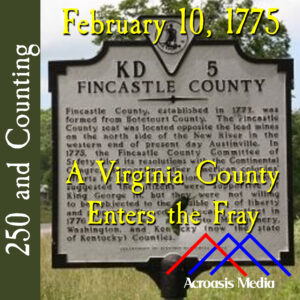
February 10, 1775
(N.B. We apologize that we initally uploaded this episode in the wrong format. We have no idea whether it made your podcast player cry, or anything else. At any rate, that’s fixed. Again, apologies.) While Massachusetts, and Boston in particular, were getting a lot of attention from the British, it’s not as though the other colonies sat back and watched everything happening from afar. To a certain extent they did do that, but they also had problems of their own to deal with. In some of the more southern states, the biggest problem was dealing with some of the natives, who had this odd insistence that they were there first and were somehow entitled to this land that had been stolen from them. This often led to multiple skirmishes on the western edges of the colonies. Plus, much of the Intolerable Acts didn’t really affect them…yet. But Fincastle County in Virginia, while not the first territory outside Massachusetts to take up the cause, was probably one of the more gung-ho territories when it came to spelling out their intent. The post February 10, 1775 appeared first on 250 and Counting.
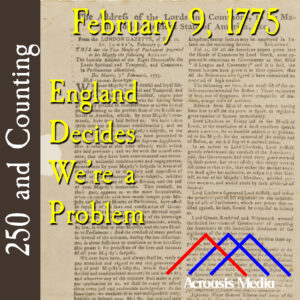
February 9, 1775
The first week or two of February 1775 could best be described as a series of misunderstandings and communication breakdowns. Any attempts on both sides to reach out with some form of conciliation managed to fail for various reasons. And during all these breakdowns, the situation on the American side of the pond only got worse as time went on, largely because each side thought that the other wasn’t being responsive. In the end, however, it didn’t really matter, because as we’ve discussed with the episodes dealing with Massachusettensis and Novanglus debating one another in print, the one thing they agreed upon was that these attempts to reach out were always, at their heart, rooted in some attempt to wrest control from the other party. Both reaching for it, neither attaining it nor caring what the other side’s argument meant at the core. The post February 9, 1775 appeared first on 250 and Counting.
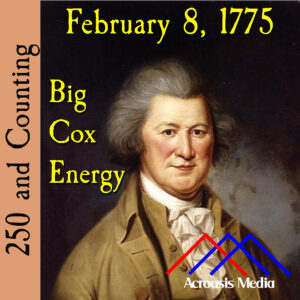
February 8, 1775
(Forgive us the jokey headline–sometimes it’s late at night when we post this stuff and we get punchy.) Over the course of a single year—and beginning with this day in 1775—John Cox experienced what any reasonable person would call a “meteoric rise” in his personal and professional fortunes. He started out adjudicating British laws in the Colonies, but moved quickly into assisting with the Colonial resistance effort and subsequently to assisting with the actual war. He did this both materially (as a Quartermaster) and passively (allowing his land to be used by Patriot troops). He died in 1793, at the age of 60, and even this week he’s probably still more productive than most of us. The post February 8, 1775 appeared first on 250 and Counting.
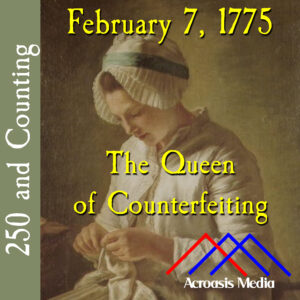
February 7, 1775
In today’s episode, guest voice Lorene Childs tells us the story of Mary Peck Butterworth. Mary was a member of the First Families of Rehoboth, Massachusetts, and a very respected member of the society there. But for a few years, and for reasons unknown to modern-day people, Mary enjoyed a rather peculiar hobby, one that perhaps should have made her a more famous person than she is. It wasn’t so much in the realm of John Adams and George Washington so much as it is in the realm of, say, Frank Abegnale. The post February 7, 1775 appeared first on 250 and Counting.
February 6, 1775
John Adams and Daniel Leonard had an interesting relationship. They were great friends at first, until the British started cracking down on the Colonies. Adams chafed under the Crown’s pressure, while Leonard remained loyal. Ultimately it created a rift between the two men which never quite healed, and it broke Adams’ heart. When Leonard began submitting essays to the Boston Gazette under the pen name “Massachusettensis,” Adams felt compelled to respond in kind, choosing a pen name of his own, “Novanglus.” It’s not entirely clear that each man knew who the other one was—certainly they did not at that time, but sources appear to differ on whether Adams knew it was Leonard later on—but what is clear is that neither man wrote from the standpoint of the troubles between Britain and the Colonies arising from a simple case of misunderstanding. They both viewed it as each side making a calculated effort to maintain control. The post February 6, 1775 appeared first on 250 and Counting.
February 5, 1775
As noted previously, the First Continental Congress composed a Petition to the King asking him for some relief from the Intolerable Acts. The petition arrived in London in mid-December, which turned out to be some bad timing for a number of reasons. Benjamin Franklin was in town for diplomatic purposes, and he composed a letter to Charles Thomson, the Secretary of the Continental Congress, which summed up the problem: not only was the Petition but one among many, many other documents, it appeared that Parliament didn’t much care what the Colonies thought. And that’s the kind of thing that makes for bad relationships. The post February 5, 1775 appeared first on 250 and Counting.
250 and Counting: February 4, 1775
After the Boston Tea Party, Parliament enacted what they called the Coercive Acts and the Colonies called the Intolerable Acts. The Colonists were neither coerced, nor were the acts tolerated (hence the name). And you know that because we’ve told you this already several times. In October 1774 the Continental Congress composed the “Petition to the King”, and as you’ll learn in greater detail tomorrow, it was pretty clear that the petition crossed an ocean and still managed to go nowhere. In fact… At about the same time, King George III decided that New England needed some more “convincing” to fall into line. This was the beginning of the New England Restraining Act. As the name suggests, it affected mostly the New England colonies, but people in the other colonies took notice and wondered “Hey, this could happen to us too, couldn’t it?” As a result, everyone continued moving down the path they fervently hoped they wouldn’t travel. The post 250 and Counting: February 4, 1775 appeared first on 250 and Counting.

250 and Counting: February 3, 1775
Hugh Mercer is one of those people who was terribly important to the cause of Liberty during the American Revolution, yet his story goes untold largely because he died early in the effort. But if Mercer hadn’t come to America because he was on the losing side of a battle in Scotland, he wouldn’t have become a doctor in Pennsylvania. And he wouldn’t have joined up in the French and Indian War. And if he hadn’t been wounded, then he wouldn’t have been rescued, transferred and promoted to Major. And if he hadn’t been transferred, he wouldn’t have met George Washington. And Washington wouldn’t have gotten the idea to invade Trenton, New Jersey at Christmastime 1776. And Mercer wouldn’t have been killed the following month. Which is bad, but… If Mercer hasn’t sacrificed himself so publicly, Washington’s troops wouldn’t have been inspired to re-enlist and continue the fight. Also, the county surrounding Trenton, New Jersey would have a name other than “Mercer County,” so there’s that. The post 250 and Counting: February 3, 1775 appeared first on 250 and Counting.

250 and Counting: February 2, 1775
After the Boston Tea Party, the government in Britain enacted what they called the Coercive Acts, or what the Colonists called the Intolerable Acts. (From here, it doesn’t feel like one name was any better-sounding than the other.) Because the Colonists were still hoping to preserve a decent relationship with the Mother Country, the First Continental Congress met in Philadelphia and put together a letter to the king, which said in essence, “We’re very loyal to you, O King, but it’s been a year and enough is enough. Maybe you could prevail upon Parliament to dial it back a little bit, hm?” That was in October of 1774. Of course, documents moving slowly and all that, the reply from the king didn’t come back for a couple of months, and at the heart of it was George affirming his faith in Parliament’s actions, and nothing’s going to change for the forseeable future. Both John and Abigail Adams, in different places at the time and in separate letters to friends, each relayed to friends their opinion that the tipping point had passed and that war was probably inevitable. Guest Voice: Shannon Call, who needed a lot of convincing to get near a microphone. The post 250 and Counting: February 2, 1775 appeared first on 250 and Counting.
250 and Counting: February 1, 1775
Before the shooting started, Boston appeared to be the place which gave King George III the most hassles. But to be fair, Boston is the place that the British seemed to provoke more than the other Colonies, so it kind of evened out in the end. When the Intolerable Acts dissolved the existing government in Massachusetts, the locals said, “Whatever” and convened anyway that same summer. But there’s no denying the results: they did all the things that a government is supposed to do, and the locals pretty much ignored whatever apparatus was set up by the British. There were three Provincial Congresses in Massachusetts, but by the time the Third one convened, much of what they did was rendered unnecessary because the war had turned “hot” and other structures were in place to do the job. The post 250 and Counting: February 1, 1775 appeared first on 250 and Counting.
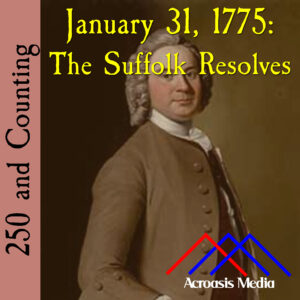
250 and Counting: January 31, 1775
John Rowe was one of those guys who always seemed to be nearby when something happened, but he also manged to let it be known that he was nowhere nearby when that thing happened. For instance, he was the guy who owned the tea that got dumped into Boston Harbor, but he was “sick” that day and couldn’t have possibly participated in the event. The Suffolk Resolves was a document written to formally reject the Massachusetts Government Act, but it was so well-crafted that other colonies were able to use it as a model for their Resolves. And Rowe was around to hear what King George III had to say about that document, but his opinion isn’t as clear as you might think. The post 250 and Counting: January 31, 1775 appeared first on 250 and Counting.
250 and Counting: January 30, 1775
By this time in 1775, tensions between the British and the Colonists in Boston were especially high. The Boston Tea Party resulted in several thousand troops being sent in to restore and maintain order, and Americans being Americans, even before there was an America, nearly every home had plenty of arms and ammunition, or at the very least the village had a gunpowder magazine, where the explosives were stored safely but in central, easy-to-access locations. To be on the safe side, General Gage ordered that the magazine nearest to Boston be emptied and the gunpowder brought back into the city under cover of night. The operation was successful, but trust of the British was only further eroded by this action. Ultimately it led to the Colonists continuing to arm themselves, but to do it more covertly. It wouldn’t be long before open war was waged. The post 250 and Counting: January 30, 1775 appeared first on 250 and Counting.
250 and Counting: January 29, 1775
Benjamin Franklin, like many of our Founding Fathers, was interested in repairing the relationship between the Colonies and England, at least early on. What’s more, he thought that others in similar positions would be of a similar mind, so he was rather dismayed to learn that this wasn’t the case; in fact, when a sheaf of letters written by Thomas Hutchinson and Andrew Oliver made their way into his hands, he was rather dismayed to learn that they were badly misleading Parliament with regard to the situation in the Colonies. So Franklin leaked the letters to the Speaker of the Massachusetts Assembly, saying they could be read but not copied. But Franklin didn’t heed his own advice: “Three people may keep a secret, if two of them are dead.” The letters got out anyway, and they were published in the Boston Gazette a few months later. For his efforts, Franklin was humiliated in a Privy Council hearing and stripped of his title of Postmaster General of the Colonies. On the other hand, this was the event that tipped Benjamin Franklin firmly over to the cause of liberty. The post 250 and Counting: January 29, 1775 appeared first on 250 and Counting.
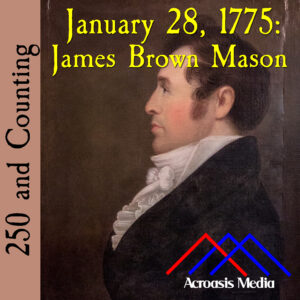
250 and Counting: January 28, 1775
It’s Cake and Candles today for James Brown Mason, a doctor in South Carolina and then his home state of Rhode Island. Later on he began a career in politics as one of the last of his political party to take office in Congress. We think Mike had too much fun making this episode. The post 250 and Counting: January 28, 1775 appeared first on 250 and Counting.
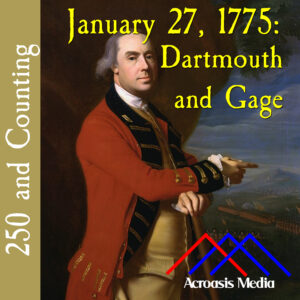
250 and Counting: January 27, 1775
William Legge was the second Lord Dartmouth and the Secretary of State for the Colonies from 1772 to the end of 1775. He was also step-brother to Lord North, who gets a mention in this episode. While he was a supporter of the constitutional supremacy that Parliament maintained they held over the Colonies, Lord Dartmouth was also the Colonists’ best hope for some form of reconciliation. Dartmouth’s resolve to achieve this reconciliation was damaged by the Boston Tea Party, so by this time he ordered Gage to put some extra pressure on the Colonists. Unfortunately this backfired badly and led to the battles at Lexington and Concord, which we’ll talk about in a future episode. Even after that, however, Legge couldn’t fully support armed coercion against the Americans, and he resigned his post in November, which basically ended his political career. Legge was considered by many to be very pious and gentle, to the point where some people called him “the Psalm Singer.” He died in 1801, nearly forgotten. Even his final resting place no longer exists, as it was destroyed by the Nazis during World War II. The post 250 and Counting: January 27, 1775 appeared first on 250 and Counting.
250 and Counting: January 26, 1775
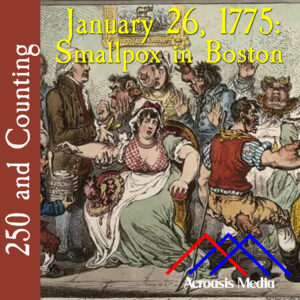
With all the things we know about germ theory and diseases and the importance of vaccinations, it’s kind of a surprise when people take a stance against such things in the face of the hard data. Before the invention of the smallpox vaccine, the disease could have a brutal effect on people who caught it, with the vomiting, the mouth sores and the high fever. It could kill you–often suddenly–within two weeks, and if you survived, you were often left blind, or infertile, and almost certainly with deep scars all over your body. Once someone had it, the best you could do to prevent its spread was isolate them from others. The only known preventative dated back to around 200 BCE, and was a process called “variolation,” which involved transferring small amounts of material from smallpox sores and applying it to the skin of a healthy person. That person would get a much milder form of the disease, but they’d be much more resistant to it in the future. Other people did something called “insufflation,” where dried smallpox scabs were ground up and then blown up a person’s nostril with a small pipe. In 1796 a vaccine was developed, which was basically variolation but using the much milder version of the disease, cowpox, which proved to be quite effective against smallpox. It wasn’t without controversy, however: people thought that the cowpox-based vaccine would turn you into a cow. But by 1801 it was a generally accepted vaccine against smallpox, and the disease is considered by medical organizations around the world to be completely eradicated, there not having been a case recorded since 1980. Thank goodness we’ve moved past that way of thinking! Imagine a pandemic taking place these days, and people thinking that terrible things would happen to them if they took the vaccine?–oh, wait. [POWERPRESS] The post 250 and Counting: January 26, 1775 appeared first on 250 and Counting.
250 and Counting: January 25, 1775
In this episode you’re going to learn a bunch of things about the general geography of the Bronx, and how some places got their names. It’s actually interesting enough that may have to take some cameras up there and show you just how much the area has changed, and not just in a “what was wilderness then is city blocks now” way. It’s more like a “we needed to make this waterway safer for navigation, so we changed its path” kind of way. The post 250 and Counting: January 25, 1775 appeared first on 250 and Counting.
250 and Counting: January 24, 1775
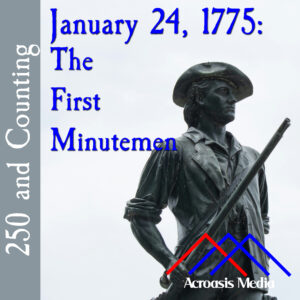
The Minutemen are among the more romantic images that many people have of the Revolution. Around this time in 1975, the comic strip Doonesbury did a couple of series that were set in the Revolutionary War days. They focused on an ancestor of Zonker’s named Nate Harris, who was a Minuteman. In one strip, Paul Revere shows up with the alarm “The British are coming!” Nate asks, “How much time do you think we have?” Paul Revere says maybe fifteen or twenty minutes, and Nate replies “I only need one, you know.” “Really?” asks Revere. Nate’s wife Amy chips in, “Nate’s been specially trained.” Nate Harris was a fun character; it’s kind of a shame that Doonesbury is a weekly strip now. It would be fun to see him return for America’s 250th anniversary. Anyway: check out the story of the real Minutemen. Minuteman statue photo by Donovan Reeves via Unsplash. The post 250 and Counting: January 24, 1775 appeared first on 250 and Counting.
250 and Counting: January 23, 1775
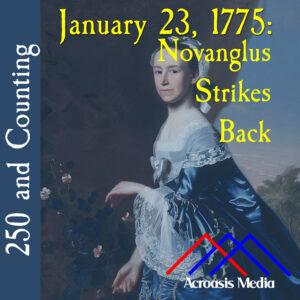
Awhile back we talked about a Loyalist who wrote an opinion piece under the pen name “Massachusettensis” (which we may have mocked a little bit but it’s just the Latin word for the Colony/State). His rhetoric angered John Adams to the point where he felt compelled to respond in kind, and he did so using a pen name of his own: Novanglus. We’ll learn about Adams’ first response to Massachusettensis, but we’ll also discover that there may be another reason this particular essayist caught Adams’ imagination. Also on this day, Mercy Otis Warren opens a new play whose plot may lie a little too close to real life. The post 250 and Counting: January 23, 1775 appeared first on 250 and Counting.
250 and Counting: January 22, 1775
It’s Cake and Candles today for Abraham Henry Schenck, State Assemblyman and then Congressman from New York State. But despite being from New York, and being a member of Congress, during his tenure as State Assemblyman he had something going on back at home. It wasn’t common in New York, but it wasn’t unheard of—nor was it illegal until several years later. The post 250 and Counting: January 22, 1775 appeared first on 250 and Counting.

250 and Counting: January 21, 1775
As we’ve noted a few times, the Colonists in general didn’t want war with Britain; in fact most of them were pretty sure they were going to get wiped out should it come to that. Even our most famous Patriots of the time, such as John Adams, Benjamin Franklin, Thomas Jefferson and others, spent enormous amounts of time trying to engage the British peacefully. For a long time, any petitions sent to King George III had some form of “Hey, we’re totally loyal to you, can you please address this for us, your loyal subjects? Please?” somewhere in the document. Thus it was that John Adams composed a letter to a friend of his in London, whose identity remains unknown to modern-day historians. He pinpoints the day he thinks things started to go wrong, and he notes that there’s a spirit on this side of the pond which shouldn’t go ignored. The post 250 and Counting: January 21, 1775 appeared first on 250 and Counting.
250 and Counting: January 20, 1775
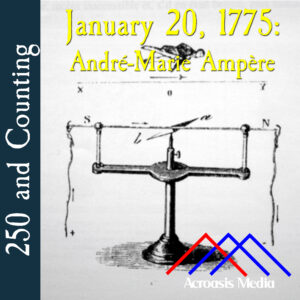
Note: we inadvertently posted the January 20 episode yesterday. That episode has been replaced with the correct one, so if you want to hear the real January 19th episode, scroll down to the previous post and listen “again.” Apologies for the error and any confusion. It’s Cake and Candles today for André-Marie Ampère. He was an advanced mathematician by the time he turned 12, and when he was 18 he estimated that he’d learned everything there was to learn about electricity and electromagnetism at that time. So, as one does, he continued his studies and expanded that branch of science, and beccame a full professor of physics at the Polytechnical school in Paris, even though he had very little formal education to that point. Many of his discoveries led to enormous breakthroughs in the use of electricity and electromagnetism for generations to come. The post 250 and Counting: January 20, 1775 appeared first on 250 and Counting.
250 and Counting: January 19, 1775
Most people (we think) have this popular notion of American history involving the British imposing taxes and massacreing people in Boston and the Colonists responding with an indignant “Oh, we need to dump some tea and write a Declaration of Independence and take up arms and shoot those red-coated monsters right now!” But if you’ve been listening to this show for the past couple of weeks, you already know that wasn’t the case. There were many, many attempts to seek out a peaceful solution to the troubles going on. Some of them were rather covert: backchannel people talking to one another, negotiating quietly, Others, of course, were overt. And today we’ll be talking about one of those. It was an attempt by the First Continental Congress to bring up their issues, ask for relief and simultaneously affirm their allegiance to the King. (Spoiler Alert: it didn’t work.) The post 250 and Counting: January 19, 1775 appeared first on 250 and Counting.
250 and Counting: January 18, 1775
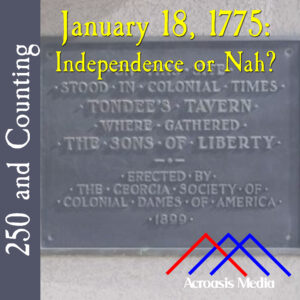
When the Provincial Congress of Georgia met in the city of Savannah, the natural place for them to meet was a place called Tondee’s Tavern. Georgians were no fans of British activities such as the Intolerable Acts, but they otherwise prospered under British rule and remained largely indifferent to the mother country. However, while the Provincial Congress didn’t want to join the other colonies in their association (which became the First Continental Congress), they were willing to support that association’s ban on trade with Britain, although they didn’t enforce it right away. Tondee’s Tavern was ultimately destroyed in 1796, in a fire that took out more than half of Savannah. The next building on that spot was a bank which dealt heavily in the slave trade. As a result, in recent years the building was said to be haunted and appears on most of Savannah’s Ghost Tours. The building reopened as a modern-day Tondee’s Tavern in 2013, but unfortunately it appears to have closed down sometime in the past year. The post 250 and Counting: January 18, 1775 appeared first on 250 and Counting.
250 and Counting: January 17, 1775
In the early 1770s, the American colonies began feeling the need to defend themselves against British pressures. In some cases the activity was political, but there were plenty of people who saw that there could conceivably be a need to take up arms at some point, especially given the way they interpreted the Intolerable Acts. Although in popular culture, Boston was the center of attention for this sort of thing, the fact is that small, informal militias began springing up all the way up and down the Eastern Seaboard. These soon gave way to more formalized groups which were funded by their respective governments. And when hostilities finally broke out, these militias quickly reorganized themselves into official Regiments. Today we’ll learn about the militias in South Carolina. The post 250 and Counting: January 17, 1775 appeared first on 250 and Counting.
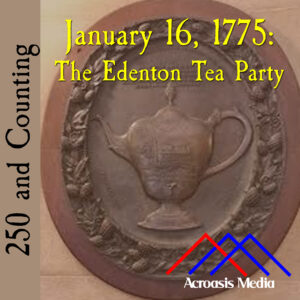
250 and Counting: January 16, 1775
We suppose there’s something kind of heroic and–dare we say it, romantic–about the idea of a bunch of men dressing up as Native Americans, sneaking onto a boat and throwing 342 chests of tea into Boston Harbor. And as an overt act of rebellion, it certainly made a splash (you should excuse the expression). But Boston wasn’t the only city holding tea parties. Edenton, North Carolina had a tea party of its own, and it’s notable for several reasons: First, who was involved in it; Second, the fact that it launched an interesting fashion trend (it’s not like everybody was dressing up like Native Americans after the Boston event, right?), And Third, that it actually got some attention. And while all of these are unusual, what’s more unusual is that it didn’t capture the imagination of people enough to endure in popular culture the way Boston did. Maybe becuase it was done in a more genteel manner, maybe because there was something special about the participants…it’s hard to tell froma modern-day standpoint. But we think you’ll agree that it’s a fascinating story. Guest Voice: Lorene Childs The post 250 and Counting: January 16, 1775 appeared first on 250 and Counting.

250 and Counting: January 15, 1775
Chances are, if you do your basic Google search for “first Mountain Man,” among the top results you’ll get would be a man named John Colter. We’d argue that he was ONE OF the first, but the real anser, as youll hear today, is Joseph Harrison Dixon. Dixon and Colter did, in fact, spend some time together in the Yellowstone Valley, but what happened next should convince you that Dixon gets the award for this one. It’s just that Colter had better P.R., we guess. The post 250 and Counting: January 15, 1775 appeared first on 250 and Counting.
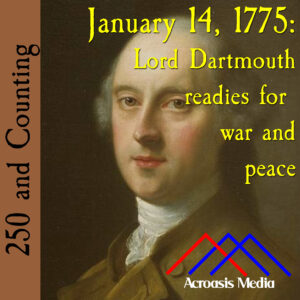
250 and Counting: January 14, 1775
William Legge was the Second Earl of Dartmouth and, just before the hostilities between the Colonists and the British started in earnest, was also the Secretary of State for the Colonies and the First Lord of Trade. Lord Dartmouth noticed that people throughout the Colonies appeared to be preparing for all-out war, so he sent a letter to the colonial governors, essentially ordering them to embargo imports of weapons or ammunition. In doing this, he was basically fulfilling his duty to the Crown. Simultaneously, however, he was trying to employ backdoor diplomacy tactics to negotiate a peace. Benjamin Franklin was among the people with whom he communicated. But it’s tough to argue for peace when your troops are occupying Boston, and his actions ultimately led to the Gunpowder Plot, and the war heating up for good at Lexington and Concord just a few months later. The post 250 and Counting: January 14, 1775 appeared first on 250 and Counting.
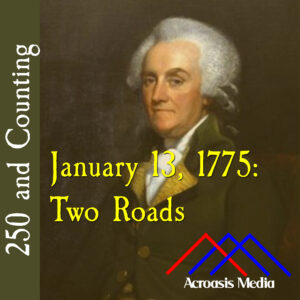
250 and Counting: January 13, 1775
At one time there were rumors that Benjamin Franklin had lots and lots of children born out of wedlock. (Insert your favorite “lightning rod” joke here.) As usual, the real story is more complicated than that. Franklin courted a woman named Deborah Reed. At the time, he was 17 and she was 15, so her mother forbade the marriage. Deborah later married another man who fled the country. Sometime after this, Franklin re-entered the picture, but because the status of her marriage was unclear, they simply lived together as common-law spouses. They had two children together, so technically they were “born out of wedlock.” Francis Folger Franklin died of smallpox at the age of four, and Sarah Folger Franklin was also politically active until her death at the age of 68. Meanwhile, Franklin had another “illegitimate” son whose mother is not known (and was also probably Deborah), but he acknowledged his own parentage and together they raised him. This was William Franklin, the future Royal Governor of New Jersey. That’s it. That’s all of Benjamin Franklin’s kids. But we’re focused on William today. William was appointed the Royal Governor of New Jersey largely because he was known to have Loyalist leanings. And while he was pretty good at being governor, there did come a point where New Jersey said “Enough of this” and imprisoned him locally for six months before moving him to Connecticut for two years. (This is an event alluded to in the play 1776, but by that point Franklin really had to know that his son had been removed from office. He probably didn’t know yet that William had just been moved to Connecticut, so by early July that would have been news to him.) [powerpoint] The post 250 and Counting: January 13, 1775 appeared first on 250 and Counting.

250 and Counting: January 12, 1775
Joseph Gist wasn’t an especially distinguished person, but you don’t have to be distinguised to get noticed on 250 and Counting. Gist was born in Union County, SC and while he moved to Charleston in his teen and college years, he moved to Pinckneyville to practice law. Pinckneyville was part of the Ninety-Six District, which we discussed in yesterday’s episode. Although the district court at Pinckneyville was abolished not long after he settled there, it was still a fabulous place to practice law, and he was in enough demand that he’d be pursued for representation by both parties in many suits. Later on he was elected to Congress and served in the House for six years, leaving of his own accord. The post 250 and Counting: January 12, 1775 appeared first on 250 and Counting.
250 and Counting: January 11, 1775
Francis Salvador was a man who is in the history books for two notable things: the day he was elected to public office, and the day he died in the Revoluationary War. That doesn’t ordinarily make a person notable, but Salvador had the distinction of being the first person of his faith to achieve these two things. And for our money, the place where it happened may also be notable. The post 250 and Counting: January 11, 1775 appeared first on 250 and Counting.