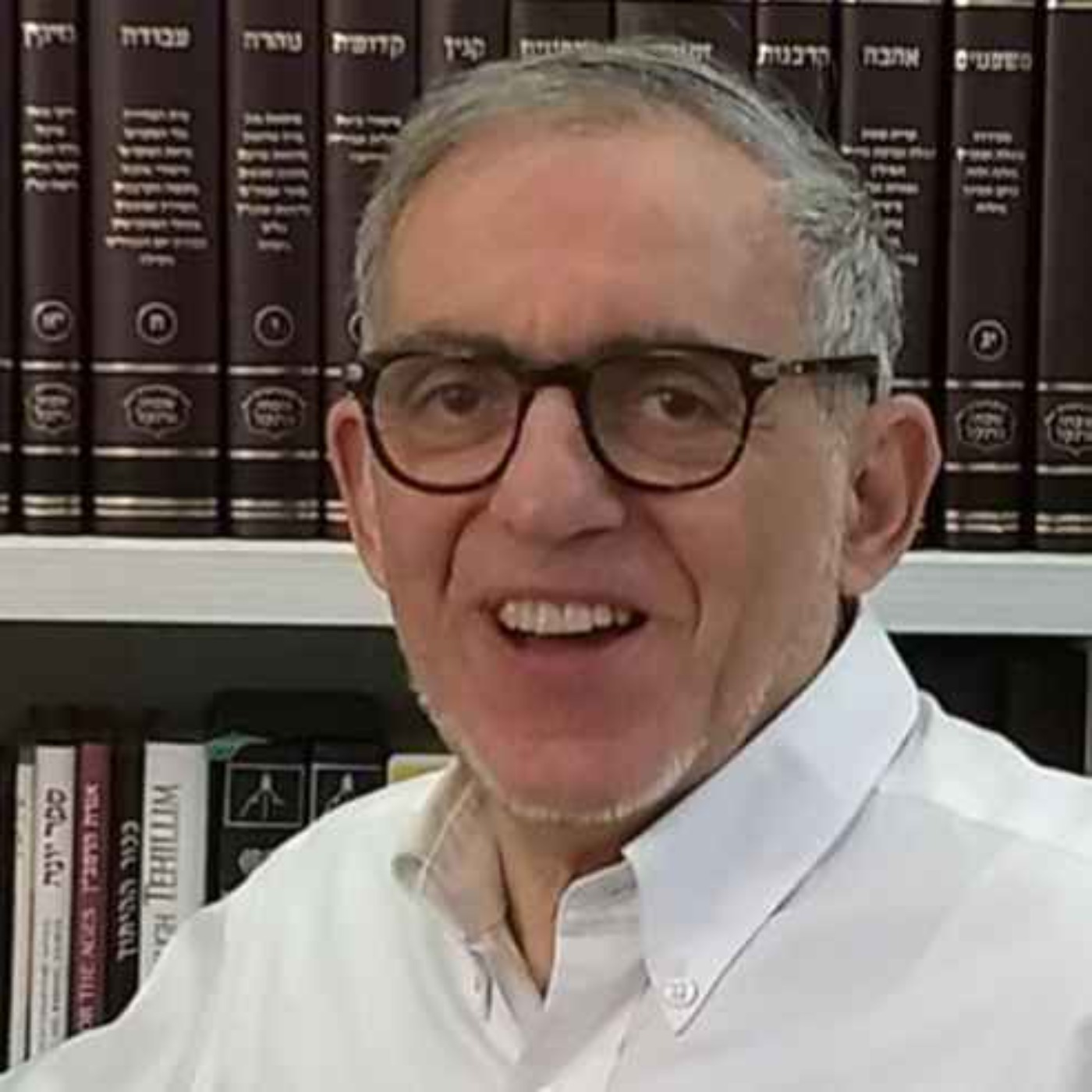
Standing in Two Worlds with Doctor Sam Juni-Episode 19-Sleeping in Graveyards :Mental Competency in civil and religous law
November 18, 202059m 11s
Audio is streamed directly from the publisher (records.jewishpodcasts.fm) as published in their RSS feed. Play Podcasts does not host this file. Rights-holders can request removal through the copyright & takedown page.
Show Notes
Both discussants grapple with the intersection (or perhaps, clash) of psychiatry and Halacha in the mental competence domain. Rabbi Kivelevitz detailed how Mental Health experts are regularly consulted by Bet Din in halachic child custody case. Kivelevitz further relates that competence is a quandary in Talmudic discourse primarily in the arena of marriage/divorce. He enumerates the limited Talmudic behavioral criteria of incompetence: Sleeping in the cemetery, walking alone at night, destroying one’s clothing, and losing important items.Dr. Juni and Kivelevitz exchange barbs about the degree of overlap between the medical Psychosis diagnosis and the lay notion of “crazy.” The Rabbi cautions against the labeling idiosyncrasies as mental disorders, seeing this as the basis for Halacha’s reluctance to accept the psychiatric disqualification of individuals. Dr. Juni juxtaposes this stance to Thomas Szasz’s decrying psychiatry as a political tool of suppression of the different.The salience of competence in Forensics concerns the construct of criminality regarding liability and punishment. Dr. Juni points out that different states have various criteria that may be used to disqualify voters, contrasting the equivocal rationale disqualifying felons with the more cogent disqualification of the mentally incompetent. He further points out that voting restriction refer solely to intellectual limitations, claiming there is no state which lists psychiatric incompetence as a criterion.The professor presents the forensic-legal premise behind disqualifying testimony of those with intellectual limitations. The assumption there is that the threat of punishment for possible perjury is the main deterrent which keeps witnesses honest. Consequently, those who do not adequately understand possible consequences of presenting false testimony cannot be assumed to feel compelled to tell the truth.Regarding testimony disqualification based on mental incompetence, Rabbi Kivelevitz explains that Halachic jurisprudence is quite similar to its civil counterpart in contemporary court systems, where testimony is not sees as an independent cause of legal consequence, but rather as one of many factors which are taken into account by judges. As such, testimony may be advisory at most, and its relevance is merely secondary and not central; more crucially: it is the judge who is directly responsible for the ensuing legal decision. Juni feels this to be a stark parallel to the rationale of the Electoral College in the American constitution, where voters are seeing as merely choosing representatives who are then responsible for decisions. In both cases,the precise criteria of competence (of witnesses or voters, respectively) therefore become less relevant.Donning his hat of expertise in the History of Scientific Philosophy, Dr. Juni argues that the notion that behaviors may be indicative (or symptomatic) of an underlying condition is not characteristic of systematic analytic thinking in Talmudic times. From the stance of presentism, Prof. Juni argues that the four Talmudic criteria of mental deficit seem to be based on the clear danger of certain behaviors – with some of the so-called clarity being based on superstition – and that the rationale there is that people who brazenly ignore personal safety concerns are obviously not thinking rationally.Accordingly, he challenges his co-host to explain whether the Talmudic criteria of incompetence harken back to a unitary conceptualization of intellectual deficit and – furthermore – whether such an underlying construct accommodates psychiatric disorder as well. Surprisingly, R. Kivelevitz does not disagree with Dr. Juni’s implications, but argues that the halachic system explicitly empowers rabbinic scholars to extrapolate and expand text-based constructs in their application of narrower Torah-based laws and concepts. Kivelevitz recognizes the cryptic anachronistic terminology of the original halachic sources, but he asserts that paradigmatic shifts definitely occur periodically as Halacha is interpreted and applied to evolving social, cultural, and scientific changes in the world. He insists that these more modern adaptation are definitely anticipated by the primary Tana’im in the Mishna and prominent codifies in the 1200’s.Describing Halacha as dynamic instead of static, R. Kivelevitz argues thatHalacha would otherwise be relegated to an irrelevant historical museum artifact.Both discussant seem to concur that bridging the psychiatric and halachic perspectives on mental and psychiatric competence are not necessarily incongruent, but they do not resolve the key question: What is the likelihood of constructing a connecting conceptual bridge between these the two worlds?Doctor Samuel Juniis one of the foremost research psychologists in the world today.He has published groundbreaking original research in seventy different peer reviewed journals, and is cited continuously with respect by colleagues and experts in the field who have built on his theories and observations.Samuel Juni studied inYeshivas Chaim Berlinunder Rav Yitzchack Hutner, and in Yeshiva University as aTalmidof Rav Joseph Dov Soloveitchick.ProfessorJuni is a prominent member of theAssociation of Orthodox Jewish Scientists, and has regularly presented addresses to captivated audiences.Associated with NYU since 1979,Juni has served as Director of MA and PhD programs, all the while heading teams engaged in important research.Professor Juni's scholarship on aberrant behavior across the cultural, ethnic, and religious spectrum is founded onpsychometric methodologyand based on a psycho-dynamicpsychopathologyperspective.He is arguably the preeminent expert inDifferential Diagnostics, with each of his myriad studiesentailing parallel efforts in theory construction and empirical data collection from normative and clinical populations.Professor Juni created and directed NYU's Graduate Program in Tel Aviv titledCross-Cultural Group Dynamics in Stressful Environments.Based inYerushalayim, he collaborates with Israeli academic and mental health specialists in the study of dissonant factors and tensions in the Arab-Israeli conflict and those within the Orthodox Jewish community, while exploring personality challenges of second-generation Holocaust survivors.Below is a partial list of the journalsto which Professor Juni has contributed over 120 articles.Many are available on lineJournal of Forensic PsychologyJournal of Aggression, Maltreatment, and Trauma.International Review of VictimologyThe Journal of Nervous and Mental DiseaseInternational Forum of PsychoanalysisJournal of Personality AssessmentJournal of Abnormal PsychologyJournal of Psychoanalytic AnthropologyPsychophysiologyPsychology and Human DevelopmentJournal of Sex ResearchJournal of Psychology and JudaismContemporary Family TherapyAmerican Journal on AddictionsJournal of Criminal PsychologyMental Health, Religion & CultureAs Rosh Beis Medrash, Rabbi Avraham Kivelevitz serves asRavandPosekfor the morningminyanat IDT.Hundreds of listeners around the globe look forward to his weeklyShiurinTshuvos and Poskim.Rav Kivelevitz is aMaggid ShiurforDirshu Internationalin Talmud and Halacha as well as a Dayan with theBeth Din of America.Please leave us a review or email us at [email protected] more information on this podcast visityeshivaofnewark.jewishpodcasts.org See acast.com/privacy for privacy and opt-out information. This podcast has been graciously sponsored by JewishPodcasts.fm. There is much overhead to maintain this service so please help us continue our goal of helping Jewish lecturers become podcasters and support us with a donation: https://thechesedfund.com/jewishpodcasts/donate