Show overview
WuBlockchain Podcast has been publishing since 2024, and across the 2 years since has built a catalogue of 72 episodes. That works out to roughly 45 hours of audio in total. Releases follow a fortnightly cadence.
Episodes typically run thirty-five to sixty minutes — most land between 27 min and 47 min — though episode length varies meaningfully from one episode to the next. None of the episodes are flagged explicit by the publisher. It is catalogued as a ZH-CN-language Technology show.
The show is actively publishing — the most recent episode landed 2 months ago, with 14 episodes already out so far this year.
From the publisher
A podcast from professional media brand WuBlockchain that discusses and analyzes important news in the crypto world, with a special focus on Asia. https://twitter.com/WuBlockchain
Latest Episodes
View all 72 episodesEP-53 Sui's Bet on Payments, Stablecoins, and AI Agents
Vitalik on Ethereum's Role in the AI Agent Era
Arthur Hayes in Vegas: War & Credit May Push Bitcoin Higher
Vitalik in HK: Where Ethereum Is Headed in the Next 5 Years
Bybit CEO Ben: What Defines an Exchange's Competitive Edge?
Binance Founder CZ on His New Book & Advice for Young People
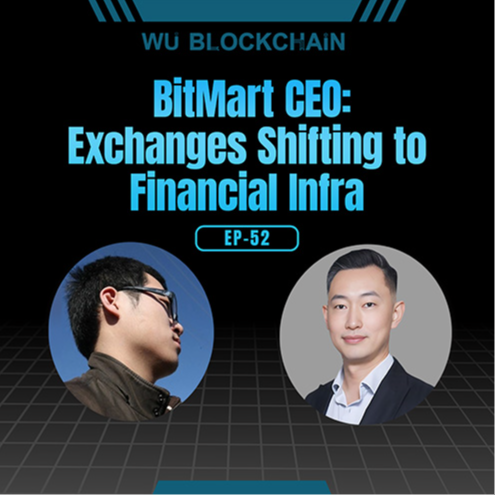
EP-52 BitMart CEO: Exchanges Shifting to Financial Infra
This interview delves into the evolution of BitMart and the broader cryptocurrency industry. Nenter Chow, Global CEO of BitMart, shares his journey from traditional finance to Web3, emphasizing the market's shift from pure speculation to fundamental utility and real financial plumbing. Key topics include BitMart's strategic focus on omni-asset access, including RWAs and US equities, global compliance with operations in 50 US states, and user education through initiatives like the UNICEF partnership. The discussion also covers the integration of AI in internal operations such as audits and surveillance, the growing convergence between traditional finance and crypto, career advice for entering Web3, and an honest assessment of the current sell pressure and future opportunities in the crypto venture capital landscape.Timeline: 00:00 Introduction and Background02:48 BitMart's Evolution and Shift Towards Utility05:26 Market Maturation and Fundamental Value08:41 BitMart's Key Differentiators and Compliance11:03 US Market Strategy and Global Expansion13:55 Roadmap, TradFi Products, and Education17:05 Integrating AI in Exchange Operations18:54 Convergence of TradFi and Crypto Markets20:45 Market Outlook and Structural Shifts23:45 Transitioning from TradFi to Web3 Careers26:40 Hiring Criteria and the 24/7 Web3 Mindset28:57 The Current State and Future of Crypto VC

Vitalik: After the Meme Wave, What Is Crypto For?
On February 3, Ethereum co-founder Vitalik Buterin sat down with Michel Bauwens, founder of the P2P Foundation, at the ETHChiangmai Summit 2026 for a wide-ranging conversation on Web3, crypto, and new forms of social coordination.Vitalik reflected on Ethereum's original vision and shared his concerns about the current state of the crypto space, arguing that technological progress must ultimately serve broader social and political goals. Beyond technical breakthroughs, he questioned how crypto can respond to a growing global crisis of trust.Michel introduced the idea of "regenerative accelerationism," advocating for technology that actively supports sustainable social development, especially by connecting crypto with the real, productive economy. Together, they explored decentralized social models, the role of technology in enabling global collaboration and shared resources, and the challenges Web3 faces in moving beyond speculation toward deeper economic and social transformation.Timeline: 00:00 Vitalik reflects on early Ethereum ideals and why a return to core values matters03:53 The TRUMP memecoin moment and a broader identity crisis for crypto06:38 Regenerative accelerationism and accelerating alternatives during global breakdown10:28 Examples of crypto aligned with regenerative practice15:25 Why users resist unfamiliar crypto mechanisms and default to ERC20 and dollars17:43 Funding models in Web3 and NGOs, and why real-world practices stay marginal20:00 Ethereum's next five years and a return to the original Web3 vision24:21 DAO design trade-offs and over-optimization for legal safety26:00 Rethinking finance, collusion, and limits of interoperability29:35 Michel on P2P as a human system and global self-organization32:07 AI as "stigmergy without humans" and the edge of a new civilization33:34 Future expectations for 4seas, hackers, and the Chiang Mai ecosystem34:12 From extractive to generative economies and contribution-based value creation
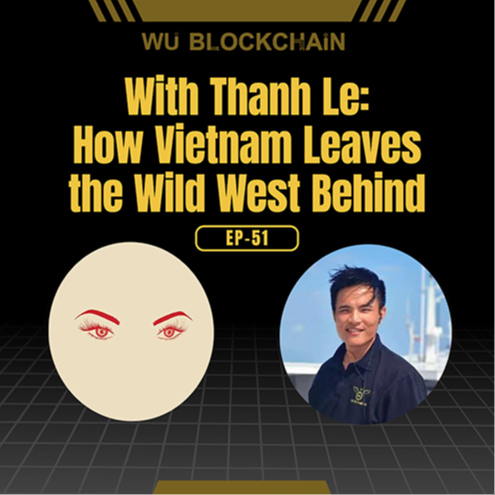
EP-51 With Thanh Le: How Vietnam Leaves the Wild West Behind
This episode of WuBlockchain Podcast explores the long-term evolution of Vietnam’s crypto market through the perspective of Thanh Le, CEO of G98 and Founder of Ninety Eight. Drawing on his experience since entering the industry in 2017, Thanh discusses how Vietnam’s crypto ecosystem has matured from an early high-risk phase into a highly active market shaped by retail participation, developer talent, and emerging regulation.Ninety Eight builds practical Web3 products, including multi-chain wallets and DeFi tools, from Vietnam. Through G98, a joint venture with G-Group, these technologies are localized and deployed using domestic infrastructure to support digital-asset-related products and services in the Vietnamese market. Timeline:00:00 Opening & Guest Background: A long-term, on-ground perspective since entering the crypto industry in 201701:15 Evolution of Vietnam's crypto market: From widespread scams to recognition as a new asset class03:21 Market size and activity: Vietnam's user base characterized by high ownership and high trading activity07:19 User entry paths: Generational shifts from Bitcoin to GameFi, DeFi, and memecoins10:16 User profiles and risk appetite: From CEX-dominated trading to a growing understanding of on-chain activity and strategy allocation13:26 Regulatory environment: A conservative yet supportive policy stance and expectations around a 2025 inflection point16:41 Shifts in asset and narrative preferences: A return to BTC and major assets alongside interest in emerging narratives19:04 Cooling of Vietnam-based projects: The impact of the bear market, talent outflows, and regulatory uncertainty22:58 Developer ecosystem and city distribution: A technical talent pool spanning both Solana and EVM ecosystems26:18 Changes in the fundraising environment: From pro-cyclical fundraising in 2021 to a broadly tighter capital market29:11 Vietnam's long-term advantages: Strong learning willingness, community mobilization, and talent supply
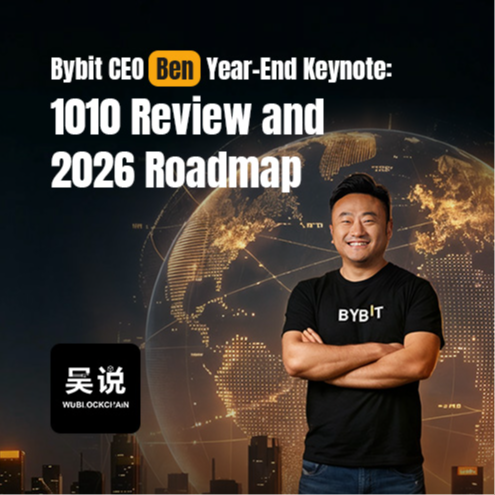
Bybit CEO Ben Year-End Keynote: 1010 Review and 2026 Roadmap
In this keynote address, Bybit CEO Ben Zhou reviews the rapid development of the global crypto industry in 2025 and systematically outlines Bybit's strategic transition from a "crypto exchange" to a "comprehensive financial platform." He notes that clearer regulatory frameworks, increasing institutional participation, and the growth of stablecoins and real-world assets (RWA) are collectively driving crypto assets into a broader mainstream financial system.During the speech, Ben also reflects in detail on the market turmoil of October 10 (10.10), analyzing its impact on market liquidity and trading infrastructure. He revisits key issues exposed by the event, including liquidation mechanisms, mark price accuracy, auto-deleveraging (ADL), and overall system stability, and introduces a series of upgrades and improvements Bybit implemented afterward across risk management, market surveillance, and core infrastructure.Looking ahead to the coming year, Ben further outlines Bybit's product and strategic roadmap, including continued expansion of global compliance and licensing, enhancements to fiat on- and off-ramp and payment networks, the launch of retail banking accounts and more comprehensive wealth management offerings, the introduction of RWA-based yield solutions, and deeper integration of AI across trading, risk control, and user experience. Overall, Bybit aims to position itself as a long-term infrastructure builder, bridging traditional finance and crypto while improving global access to and efficiency of financial services.Below is the transcript of Bybit CEO Ben's keynote. The audio transcription was generated by GPT and may contain inaccuracies; minor edits have been made for readability.Timeline 00:00 Introduction and keynote opening00:34 2025 crypto adoption trends and global market growth01:57 Regulation, ETFs, stablecoins, and institutional adoption03:40 Crypto as global financial infrastructure and inclusion tool05:41 Bybit's vision: from exchange to financial platform06:52 Compliance-first strategy and global licensing expansion07:35 Building global fiat, card, and payment infrastructure09:39 Bridging TradFi and crypto through RWA and custody solutions12:51 Connecting crypto users with traditional markets (stocks, gold, forex)14:00 Wealth management, Earn products, and private banking services16:43 Launch of retail banking accounts ("MyBank by Bybit")19:51 RWA strategy and tokenized asset outlook20:41 Product simplification, user feedback, and app restructuring24:51 AI-powered support, automation, and user experience upgrades25:54 Advanced trading tools and execution infrastructure30:11 Options market growth and institutional trading features31:35 Market crash reflection and risk management improvements34:19 2026 roadmap: payments, RWA, AI agents, and infrastructure38:40 Corporate responsibility and global community initiatives40:09 Tokenized stocks, DEXs, and future market structure44:04 Closing remarks and long-term vision
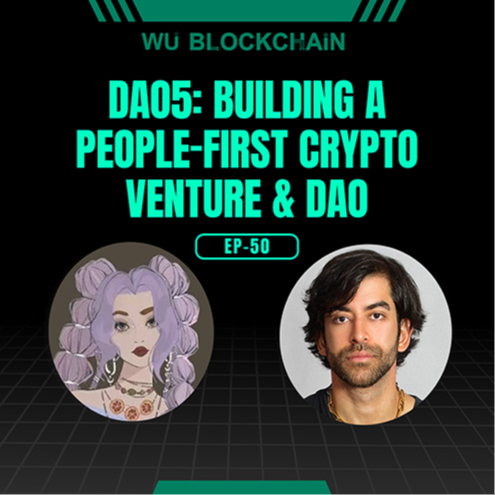
EP-50 dao5: Building a People-First Crypto Venture and DAO
In this episode, Tekin Salimi, founder of dao5, discusses his transition from traditional crypto venture capital to building dao5, a decentralized autonomous organization (DAO). He reflects on the challenges and opportunities in the crypto space, shares insights on DAOs, venture funding, and the intersection of blockchain technology with AI, and explores the evolving crypto ecosystem in the wake of 2024 market shifts.Tekin Salimi outlines his journey from Polychain Capital to founding dao5 in 2022, where he focused on creating a unique investment fund model with a strong emphasis on adaptability. His approach in dao5 differs from traditional venture capital by prioritizing people and community formation within the decentralized framework. He delves into the market dynamics of altcoins, token distribution, and venture capital's shift toward decentralization. Tekin also highlights dao5's future governance model, where decisions will be gradually decentralized, but with a strong leadership core initially. The discussion touches on current challenges in meme coins, institutional adoption, and how the DAO model can address issues like liquidity, incentives, and governance in crypto. He concludes with thoughts on the long-term potential of decentralized AI and crypto integration.Timeline:00:00 Introduction and dao5 Overview02:46 Key Differences Between dao5 and Traditional VC04:29 dao5's Focus on People and Governance06:33 Vertical Focus and Investment Strategy08:54 Institutional Adoption vs. Crypto Native Innovation10:45 Shifting Focus Toward Enterprise and Compliance11:41 Performance of dao5's First Fund13:47 Bittensor and dao5's Role as an Incubator15:43 Blockchain and AI: Future Synergies17:05 Shift in VC Return Expectations18:50 The Meme Coin Dilemma for VCs21:09 Transitioning to a DAO: Governance and Structure23:53 Ensuring Balance Between Small and Large Stakeholders26:30 Building Value-Aligned Community Participation27:39 Handling Trust and Legal Risk with Pseudonymous Founders28:55 The Future of Crypto VCs in a DAO-Driven World30:40 Western vs. Eastern Crypto Ecosystems32:18 Overcoming Gaps in Liquidity, Networks, and Regulation
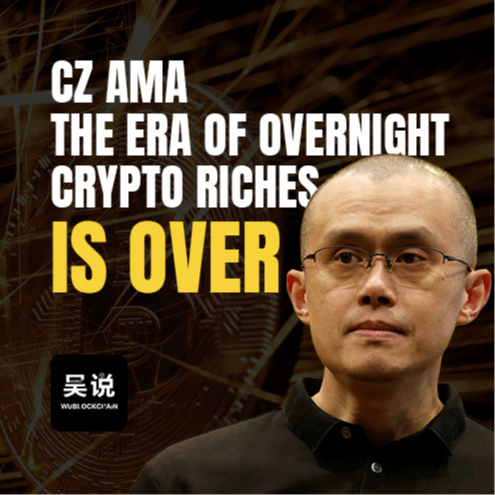
CZ AMA: The Era of Overnight Crypto Riches Is Over
In a January 31 AMA, CZ said Binance’s core strategy today is compliance, stability, and long-term survival, rather than rapid expansion or chasing every new trend. In the current regulatory and industry environment, he stressed that lasting longer matters more than growing bigger. Binance is prioritizing sustainability over short-term scale. Strong regulation, in his view, is a structural trend in crypto—not a temporary phase—and Binance’s approach is to adapt to regulation, not fight it, with different compliance strategies across jurisdictions.CZ also said the get-rich-quick era is over. Crypto is no longer a market driven by fast money or short-term speculation. Strategies that relied on cycle timing and quick gains are fading, and the industry’s focus is shifting toward long-term building—core infrastructure, real demand, and applications that can operate within compliant frameworks.On Binance Alpha, listings, and Meme Rush, CZ positioned Alpha as an ecosystem access layer, not an endorsement. He acknowledged execution issues with Meme Rush, while emphasizing that concerns from neutral users deserve serious attention. He reiterated that exchanges provide market access, not guaranteed returns, and that investment decisions remain the user’s responsibility.From a market perspective, CZ took a more cautious stance on a near-term Bitcoin supercycle, expecting continued volatility. Long term, he remains bullish on Bitcoin and views it as superior to gold, though global consensus will take time to form. He also reaffirmed Binance’s 100% reserves and proof-of-reserves framework, noting that past stress tests have demonstrated the platform’s liquidity and asset safety.CZ also addressed market criticism and community disputes around Binance, BNB, and BNB Chain. He denied claims that Binance or he personally manipulated the market or caused the October 11 sell-off, emphasizing that price movements were driven by macro factors and that no single entity can realistically control Bitcoin’s price.Views related to the 10/10 incident reflect CZ’s personal opinion only. For the official report and broader perspectives, please refer to: LinkTimeline:00:00:00 CZ's comment on Aster00:00:46 Community raises concerns about FUD, listings, Alpha, and Meme Rush00:04:32 Rebuttal of claims that Binance caused the October 10 market crash00:04:32 Explanation of regulation, monitoring, and why manipulation claims are unrealistic00:06:45 Response to accusations about personal wealth and asset dumping00:18:20 System issues, compensation, and limits of technology during peak stress00:13:17 Origins of FUD: competitors, paid “water army,” and emotional traders00:18:34 Meme Rush rationale, implementation flaws, and listening to the silent majority00:21:13 How FUD backfires by increasing Binance visibility and user loyalty00:24:34 Personal responsibility as a core principle for traders00:26:07 Outlook on Bitcoin super cycle becomes more cautious amid volatility00:29:06 Bitcoin vs. gold: long-term superiority vs. short-term adoption reality00:30:48 Role of AI in future trading, UX, research, and exchange operations00:33:15 Proof of reserves, audits, and Binance’s handling of extreme withdrawals
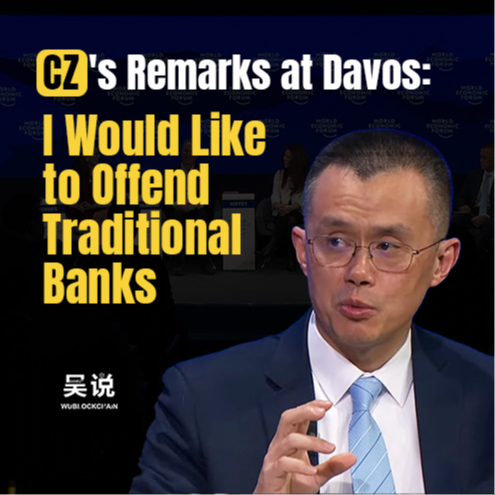
CZ's Remarks: "I Would Like to Offend Traditional Banks"
At the 2026 Davos Forum's *New Era for Finance* roundtable, leading figures in the financial sector from various regions gathered to discuss how technological innovations are reshaping global finance, with a particular focus on the role of cryptocurrencies, blockchain, and artificial intelligence in payments and financial transactions. Below is an excerpt of Binance founder CZ's remarks.CZ believes that while the payments sector still faces challenges, the integration of traditional payment methods with cryptocurrency will drive significant growth in the future. He also expressed concerns about the risks associated with Bitcoin payments, Memecoins, and traditional banks, citing their high levels of speculation and uncertainty. When discussing the need for a unified global regulatory framework, CZ noted the difficulty in implementing such a framework due to varying regulations across countries. He proposed the idea of a "regulatory passport," where a license obtained in one country would be recognized by others, offering a more feasible solution than creating a global regulatory body.Text summary: LinkTimeline:00:00 Differences between cryptocurrency and traditional financial regulation03:12 CZ introduces the innovation prospects of cryptocurrency and blockchain06:40 The future of Bitcoin payments07:18 Thoughts on Memecoins and the Metaverse08:22 CZ: Traditional banks will significantly reduce in the next decade09:51 In-depth reflection on bank liquidity issues10:52 Different responses of cryptocurrency and banking systems12:29 Challenges of global regulatory frameworks and regulatory differences between countries14:35 CZ suggests "regulatory passports" as a global regulatory solution
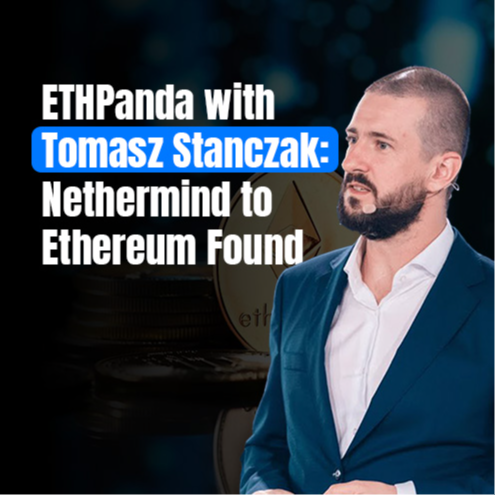
ETHPanda with Tomasz Stanczak: Nethermind to Ethereum Found
In this episode of ETHPanda, Tomasz Stanczak, Co-Executive Director of the Ethereum Foundation, shares his journey from traditional finance to Ethereum core development. He explains how he founded Nethermind from scratch and became a driving force behind the Ethereum core protocol. Tomasz discusses the challenges he faced, including resource constraints and fundraising. He also provides insight into the future direction of the Ethereum protocol, particularly the integration of Agentic AI with ETH, and how standards like ERC-8004 are driving the adoption of AI agents on Ethereum. Additionally, he covers the interoperability of Layer 2 solutions and the Ethereum community's development strategy.Timeline:00:00 Opening & Introduction03:18 The path to Ethereum core development05:18 The advantages and challenges of starting Nethermind without funding09:23 The development of Nethermind12:45 Key milestones for Nethermind16:57 A piece of advice to my younger self19:11 Ethereum Foundation's goals and challenges22:22 Discussing Layer 2 interoperability26:38 Ethereum's future community development strategy33:29 The future of Ethereum and AI integration39:27 Ethereum as an AI collaboration layer42:34 How Agentic AI integrates with blockchain governance50:09 How the Ethereum Foundation supports AI and ETH development53:13 Contributions from China to Web3 and AI development
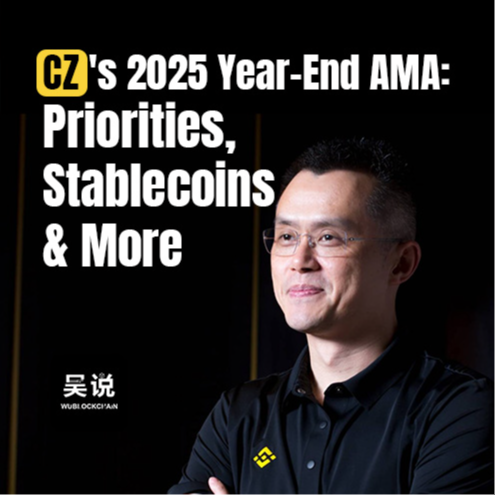
CZ's 2025 Year-End AMA: Priorities, Stablecoins & More
In this BNB Chain 2025 Year-End AMA, CZ reflects on a year that marked a turning point both for him personally and for the broader crypto industry. He talks about how life changed after receiving a pardon, and how his focus has shifted toward education, early-stage investing, ecosystem mentorship, and advising governments on crypto policy. The discussion spans key milestones across BNB Chain, Giggle Academy, YZi Labs, and Binance, highlighting renewed growth momentum on BNB Chain, continued adoption of stablecoins, and the emergence of prediction markets as an increasingly important on-chain use case. CZ also shares his perspectives on the evolution of stablecoins, the rise of AI agents, real-world asset (RWA) tokenization, and where crypto infrastructure may be headed in 2026 and beyond.Text summary: LinkTimeline:Host Interview with CZ00:00 Life after the pardon and personal reflections01:20 Four core focus areas: Giggle Academy, YZi Labs, BNB Chain ecosystem mentorship, and government advisory work05:02 Key 2025 milestones: education, BNB Chain growth, investment pace, and Binance user scale08:32 Why prediction markets are gaining momentum and how CZ views multi-team competition13:09 Stablecoins as a turning point in crypto infrastructure discussions15:39 Stablecoin "1.0 vs 2.0," yield mechanisms, regulation, and opportunities on BNB Chain17:42 What CZ looks for in founders and mission-driven teamsCommunity Q&A21:22 Advice for technical builders transitioning into business and leadership roles23:58 Lessons from BNB Chain's early "undervalued" phase and a long-term mindset27:51 Why stablecoin competition is not a zero-sum "horse race"31:47 Crypto social platforms versus X and the value of native crypto communities36:07 Early-stage prediction markets: execution over current features39:38 BNB Chain's future goals and CZ's advisory role41:50 Views on real-world asset tokenization, AI, robotics, and DePIN45:34 AI trading agents, the limits of shared strategies, and future adoption paths
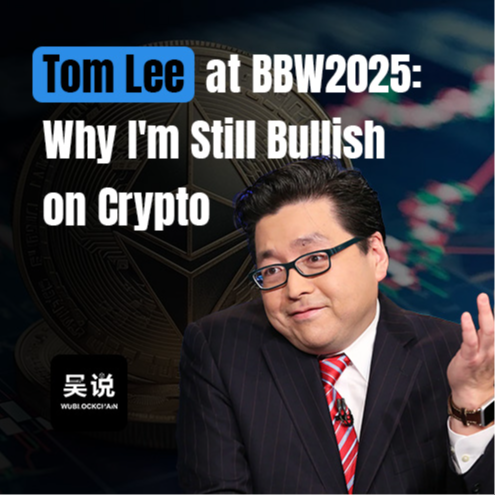
Tom Lee at BBW2025: Why I'm Still Bullish on Crypto
At Binance Blockchain Week 2025, held on December 3–4 in Dubai, Tom Lee-Co-founder of Fundstrat and Chairman of BitMine-delivered a keynote titled "The Crypto Supercycle Intact." In his speech, he systematically outlined his long-term bullish thesis on the crypto market. His core arguments included: why tokenization is the defining theme of 2025; why he believes Bitcoin and Ethereum have already bottomed; how the traditional four-year cycle is being disrupted; why Ethereum is positioned as foundational infrastructure for the future global financial system; and why Digital Asset Treasury (DAT) companies will play a critical role in the next phase of crypto financialization.Tom Lee argues that Bitcoin's cyclical logic is being reshaped by industrial and inflation cycles, rather than the familiar four-year halving pattern. On tokenization, he emphasizes that the true transformation goes far beyond simple "digitization of assets." In his view, the future of finance involves deep financial decomposition and reconstruction, where stocks, cash-flow streams, product lines, and even the implied economic value of a CEO can be fragmented, priced, and tokenized-enhancing transparency, predictive power, and hedging efficiency across capital markets. He also describes how BitMine, as a representative DAT, aims to serve as a bridge between Wall Street and the crypto ecosystem.Text summary: LinkTimeline:00:00 Context of the speech: Tom Lee's professional roles and why he addresses crypto amid a market pullback01:36 Five themes overview: tokenization, market cycles, Ethereum, institutional opportunity, and digital asset treasury companies02:53 Reviewing a decade of asset performance: why crypto remains the strongest asset class03:55 Major positive developments in 2025: policy support and institutional adoption05:39 Tokenization becomes the core narrative of 2025: Ethereum's "ChatGPT moment"06:36 Long-term growth potential: adoption remains extremely low07:46 Assessing the market bottom: mispricing, deleveraging, and structural changes08:26 Discussion of Bitcoin's drawdown: is the four-year cycle still valid?09:36 Fundstrat model adjustments: incorporating Tom DeMark's timing indicators11:22 Dissecting the Bitcoin four-year cycle: why it may be breaking down13:40 Price implications: if the cycle breaks, Bitcoin could set new highs in January14:10 Why Ethereum is the future financial infrastructure15:41 Continued Ethereum upgrades: reinforcing its ecosystem position16:27 ETH/BTC valuation breakout: structural repricing ahead17:39 The true value of tokenization: from digitization to financial decomposition19:56 Prediction markets + tokenization: a new architecture for capital markets21:18 Strategic role of DATs in bridging TradFi and DeFi
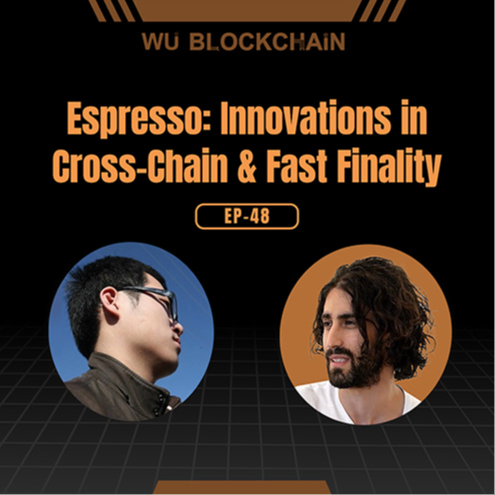
EP-48 Espresso: Innovations in Cross-Chain & Fast Finality
In this interview, Ben Fisch, the founder of Espresso, elaborates on the project's technological innovations aimed at solving the fragmentation problem in Web3 blockchain ecosystems. Espresso seeks to address these challenges by offering high-speed finality and supporting Layer 2 technologies, facilitating efficient communication between different blockchains. Ben details how the project leverages improvements in consensus mechanisms and innovative technologies, such as erasure coding and zero-knowledge proofs, to reduce cross-chain latency and improve interchain interaction. He also discusses Espresso's appeal to top developers and investors, as well as its future market positioning and tokenomics model.Text summary: LinkTimeline:00:00 Origins of Espresso and Its Initial Goals03:07 The Impact of AI and Crypto Talent Competition04:17 The Causes of Web3 Fragmentation08:07 Why Digital Finance in Web3 is Still Fragmented08:37 Espresso's Technological Innovations and How It Differs from Traditional Blockchains09:00 The Advantages of Espresso in Supporting Layer 2 and Its Performance Features10:16 How Espresso Solves Cross-Chain Interaction and Finality Issues12:33 Espresso's Consensus Mechanism and Cross-Chain Communication15:08 Espresso's Consensus Design and Achieving Fast Finality18:21 How Espresso Uses Zero-Knowledge Proofs for Real-Time Cross-Chain Communication20:55 How Espresso Supports Multi-Chain Ecosystems and Bridges to Other Chains21:23 The Benefits of Espresso for Rollup Projects23:32 Rollups' Demand for Espresso and Use Cases24:46 The Value of Espresso's Token and Network Effects26:28 Reasons for Introducing the Token and Future Value Drivers29:43 Espresso's Future Vision and Market Positioning
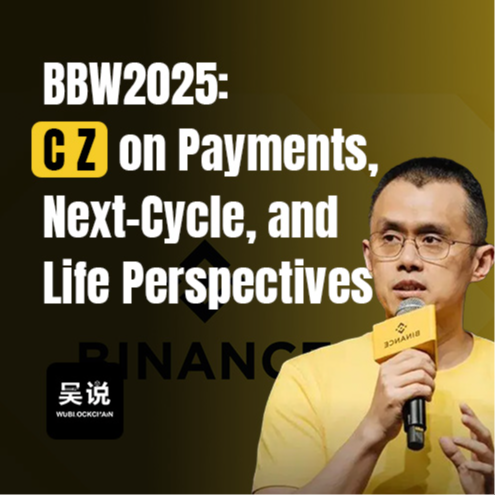
BBW2025: CZ on Payments, Next-Cycle, & Life Perspectives
At Binance Blockchain Week 2025, held in Dubai on December 3–4, Binance founder CZ participated in a group media interview. The Q&A covered topics such as crypto payments, digital asset treasuries, U.S. policy shifts, Giggle Academy, life perspectives, and more.CZ emphasized that payments remain crypto's biggest unresolved challenge, that successful Web3 founders must be product- and user-driven with long-term focus, and that while the DAT model is viable, its risk depends on management. He noted that renewed U.S. regulatory openness will unlock major opportunities, mainstream adoption requires regulatory clarity, infrastructure and enterprise integration, crypto is already improving financial access in developing countries, and education, philanthropy, and ecosystem development will be his personal priorities going forward.Text summary: LinkTimeline:00:00 Why Crypto Still Hasn't Solved Payments02:44 Binance's Early Vision, Organizational Evolution, and Regulatory Dynamics04:04 What Makes Founders Survive the Next Cycle: Product Focus & Long-Termism05:18 CZ on Life, Uncertainty, and What Truly Matters07:17 Sustainability and Risk Profile of the Digital Asset Treasury (DAT) Model10:33 After the Trump Pardon: Will the US Become a Core Crypto Market?12:53 How CZ Maintains Mental Health Amid Media Pressure16:22 Keys to Mainstream Adoption: Regulatory Clarity & Financial Integration19:51 How Crypto Brings Real Value to Emerging Markets23:15 Giggle Academy: Education Mission, Content Expansion & Community Funding26:52 CZ's Philanthropy Priorities and Social Impact Projects30:50 When a Billion People Use Web3: Abstraction & the Future of UX33:11 Binance's New Leadership Structure & CZ's Future Focus37:28 Daily Habits Behind CZ's Success: Learning & Staying Healthy

CZ vs Peter Schiff: A Debate on Bitcoin vs Tokenized Gold
At Binance Blockchain Week 2025, Binance founder CZ and Euro Pacific Asset Management CEO & Global Strategist Peter Schiff engage in a fiery debate over the value and future of Bitcoin versus tokenized gold. Peter argues that tokenized gold, backed by tangible reserves, offers superior stability and real-world utility. CZ counters that Bitcoin, as a decentralized and borderless digital asset, carries unique technological advantages and growing global demand despite volatility. The two clash on payment use cases, investment value, technical foundations, and long-term prospects, ultimately holding firm to their opposing views.Text summary: LinkTimeline:00:00 Peter explains the practical use and value backing of tokenized gold04:16 Peter argues Bitcoin is like fiat money with no backing05:34 CZ presents physical gold on stage and raises the issue of verifiability09:03 CZ: Bitcoin, like the internet, is intangible yet still valuable11:45 Peter emphasizes Bitcoin has "no real utility," therefore no intrinsic value13:44 Peter explains why gold can serve as a central bank reserve asset17:12 Debate on whether Bitcoin qualifies as "money"22:29 CZ highlights Bitcoin's utility in payments and as a store of value25:25 Peter claims Bitcoin resembles a Ponzi structure27:01 Peter: Despite major tailwinds, Bitcoin's price has fallen over the past four years31:05 Peter argues Bitcoin's wealth effect comes from wealth transfer33:04 CZ shares a real example of how Bitcoin improved a user's life in Africa36:31 Debate over whether crypto payment cards actually use crypto for payments42:00 Dispute over whether Bitcoin can store value45:55 Discussion on whether speculators dominate Bitcoin's price49:25 Peter reiterates Bitcoin is purely speculative and lacks real value54:00 Debate concludes: both sides firmly maintain their positions
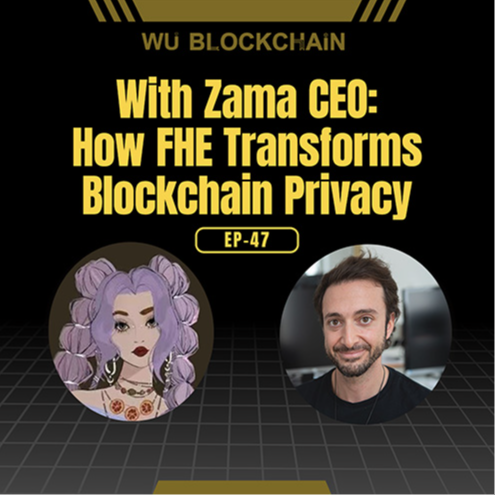
EP-47 With Zama CEO: How FHE Transforms Blockchain Privacy
In this episode of the WuBlockchain Podcast, Rand Hindi, CEO of Zama, explores the transformative potential of Fully Homomorphic Encryption (FHE) in blockchain. He highlights its critical role in ensuring privacy while maintaining scalability. Zama's protocol adds a confidentiality layer to existing blockchains like Ethereum and Solana, enabling secure transactions. Hindi explains how FHE stands out from other privacy technologies such as Zero-Knowledge (ZK) proofs and Multi-Party Computation (MPC), especially in enabling confidential token transfers and DeFi applications. He also discusses Zama's progress and its upcoming token auction.Timeline:00:00 Introduction to Zama and CEO Rand Hindi's background01:27 Why privacy is becoming a critical issue for AI and blockchain technologies02:50 Explanation of FHE vs. other privacy technologies05:46 How Zama uses FHE, MPC, and ZK together to enable confidentiality on existing blockchains07:41 Integration of Zama's privacy layer with EVM-compatible blockchains09:12 Developer ease in building encrypted smart contracts on Zama's protocol10:35 Overcoming the historical challenges of FHE, including scalability and cost12:08 Zama's progress in solving compute problems and scaling FHE to Ethereum-level speeds12:47 The current technical bottleneck: hardware advancements needed for faster computation13:51 Forecast on achieving real-time encrypted computation14:28 Ensuring compliance and auditability in private computations using Zama16:10 The impact of FHE on MEV and blockchain fairness17:10 Expected use cases for FHE in crypto, such as confidential payments and token distribution19:30 Example of confidential token distribution and its importance for privacy20:40 Zama's approach to encrypted auctions for token sales23:34 Unique decentralized applications made possible only by FHE25:22 FHE's role in solving trust issues with AI agents in financial decisions28:11 Zama's team and investors, including the company's research-heavy background and funding30:34 Balancing research and execution in a decentralized, remote working environment32:54 Upcoming events: Zama's mainnet launch and token auction