
World Today
312 episodes — Page 3 of 7
Japan opens door for lethal weapons exports. Why is it worrisome?
The widespread domestic opposition to amending Japan’s postwar constitution
Panel: Is Hormuz shock accelerating global shift to renewable energy?
China's GDP grew by 5% in Q1. What's behind the growth?
Israel, Lebanon hold first high-level meeting since 1993
China is witnessing a new wave of high-level visits. Why now?
U.S., Iran fail to reach an agreement after talks. What will come next?
Why China tops the U.S. in global approval, reaching its widest lead in two decades?
Will Israel torpedo the fragile US-Iran ceasefire?
Will US and Iran have a durable ceasefire?
What’s the prospect of battery-powered ships?
Why China edges past US in global approval ratings
Inside China's new trends of leisure spending
From RV camping and cruise tourism to low-altitude flights, many Chinese people are not just traveling, they are traveling differently. What is driving this change? Is it simply a rebound in consumer confidence, or does it point to a broader shift in how people choose to spend? And what could it mean for local economies and China’s long-term growth?
 Host Dou Hongyu is joined by Professor John Gong from the University of International Business and Economics, Assistant Professor of Economics Li Lun with the School of Economics at Peking University, and Mario Cavolo, Founder and CEO of M Communications Group, also a senior fellow at the Center for China & Globalization, to explore these questions.
The Iran war: Is the U.S. really "winning big"?
①Trump addressing nation on Iran war: Is US really "winning big"? (00:45)
 ② Russia says Japan's missile deployment could be "more than tragic". How neighbors guard against a revival of militarism in Japan? (23:54)
 ③ China's high-tech industries record robust growth in Q1. What explains its economic resilience amid global uncertainty? (33:39)
 ④ 210 million worldwide learning Chinese as Education Ministry launches new global language center online. (44:40)
China, Pakistan unveil Gulf peace proposal. What does it signal?
① China and Pakistan unveil joint peace proposal for the Gulf and Middle East. What role can China and Pakistan play? (00:54)
 ② European Parliament delegation visits China for the first time in eight years. Will this visit help EU lawmakers gain a more objective understanding of China? (21:58)
 ③ U.S. tech giants cut jobs while doubling down on massive AI investments. What does it mean for the future of jobs in the age of AI? (31:38)
 ④ World’s largest unmanned cargo drone completes maiden flight in China. How could this breakthrough reshape logistics, and what does it reveal about China’s position in next-generation aviation? (42:11)
Spain closes airspace to US warplanes – growing NATO rifts over U.S.-Israeli actions?
① World Data Organization opens in Beijing. What’s next? (00:45)
 ② China launches countermeasures against Japanese lawmaker for undermining China's sovereignty. How far will Japan’s far-right go in undermining regional stability? (13:35)
 ③ OECD warns U.S. inflation could hit 4.2% this year. How might this reshape U.S. monetary policy and recession risks? (23:01)
 ④ Spain closes airspace to US warplanes. Does this reveal growing NATO divisions over U.S.-Israeli unilateral actions? (34:04)
 ⑤ World reacts to Israel passing death penalty law. Could the law escalate tensions and undermine prospects for peace? (42:27)
What’s the key to peaceful development of cross-Strait ties?
① Cheng Li-wun, leader of the Kuomingtang Party, will pay a visit to the Chinese mainland. What role can Taiwan’s main opposition party play in promoting the peaceful development of cross-Strait ties? (00:53)
 ② Can Pakistan and a few other nations push for a negotiated settlement between the US and Iran? (13:45)
 ③ Why have China’s industrial profits accelerated at the start of 2026? (25:00)
 ④ A new report has ranked China at the 9th in the world in innovation capability. We explore the specific fields where China is doing well and the areas where China is still playing catch-up. (34:29)
 ⑤ WTO members have concluded their meeting in Cameroon. How long will the US and Brazil be deadlocked over e-commerce duties? How does the prospect of broader WTO reforms look like? (44:03)
Beyond the tokens: China's AI push is shaping a "smart economy"
China's daily AI token calls, a key measure of how intensively AI is being used, have hit an unprecedented level. What's behind the surge? How is China weaving AI into the fabric of factories, hospitals, and even our homes? And as the country's economy goes "smart," what could that mean for the rest of the world? 
 Host Dou Hongyu is joined by Li Lun, Assistant Professor of Economics at Peking University, Andy Mok, Professor at Beijing Foreign Studies University, and Liu Baocheng, Director of the Center for International Business Ethics at the University of International Business and Economics, to unpack the forces driving China's token boom and explore how AI is powering the rise of a new "smart economy."
Will long-term care insurance alleviate China’s aging challenges?
① A conversation with Armida Salsiah Alisjahbana, a senior UN official, on Boao Forum for Asia and regional economic integration. (00:56)
 ② China has issued a set of guidelines to accelerate the establishment of a nationwide long-term care insurance system. How will this move help alleviate the country’s aging challenges? (12:43)
 ③ Why have Chinese-developed AI models led global weekly token usage for a second straight week and overtaken their US counterparts? (25:00)
 ④ We talk to a senior manager of a leading Chinese enterprise software builder about the future of intelligent systems. (35:31)
 ⑤ Trade ministers are in Cameroon for discussions on reforming the World Trade Organization. How does the prospect of the talks look like? (45:04)
China’s ten major scientific breakthroughs in 2025
① China has released a list of its ten major scientific breakthroughs in 2025. What do they tell us about the focus of the country’s scientific research? (00:56)
 ② A conversation with Jonathan Choi Koon-shum, Chairman of the Chinese General Chamber of Commerce in Hong Kong, on cooperation between Hong Kong and Hainan. (14:18)
 ③ China has lodged a protest with Japan after a Japanese Self-Defense Force officer broke into the Chinese Embassy in Tokyo. To what extent is the intrusion related to the current trajectory of China-Japan relations? (24:57)
 ④ Ghana’s president has criticized the US government for normalizing the erasure of Black history, warning such policies could have ripple effects elsewhere. Does he have a point? (33:56)
 ⑤ Humanoid robot maker Unitree has filed for an IPO application on the Shanghai Stock Exchange, looking to raise over $610 million. How could capital markets help China’s humanoid robotics industry to develop? (42:36)
Is Xiongan New Area becoming a model of China’s high-quality development?
① Xi Jinping has called for efforts to build China’s Xiongan New Area into an innovation hub and a model of high-quality development. How can China nurture an innovative business environment in Xiongan? (00:56)
 ② A conversation with Eduardo Pedrosa, Executive Director of the APEC Secretariat. (12:17)
 ③ Why did China’s Yiwu, a hub for small commodities, see a more than 50% increase in trade in this year’s first two months? (24:57)
 ④ Iran has denied having negotiations with the US, reversing Donald Trump’s earlier claim that Washington had reached major points of agreement with Tehran. Is Tehran willing to engage in serious talks with Washington any time soon? (34:48)
 ⑤ Australia and the European Union have finalized a free trade agreement following years of negotiations. What has enabled the two sides to make the breakthrough? (44:29)
The Earth’s climate is more out of balance than ever
① It’s time for the annual China Development Forum. Amid global turbulence, will China serve as a cornerstone of certainty for the world? (00:50)
 ② Chinese Vice Premier He Lifeng has met a delegation of the US-China Business Council. What opportunities will China’s 15th Five Year Plan offer to American companies? (13:46)
 ③ Iran has warned that power plants in countries hosting US bases would be considered legitimate targets if the US attacks Iran’s power facilities. What stage is the war entering? (25:27)
 ④ The Community of Latin American and Caribbean States has adopted a declaration calling for an end to the economic blockade against Cuba. Is it realistic to have a dialogue between Cuba and the US on the basis of mutual respect? (33:17)
 ⑤ A new report of the World Meteorological Organization says the climate of the Earth is now more out of balance than at any point in recorded history. Is it coincidence that humanity has just endured the hottest decade on record? (43:21)
Unfolding China's space roadmap
China says it will turn aerospace into a pillar industry that improves lives and promotes industrial development. What are included in this goal? How close are these ambitions to reality, and what could they mean for you and me?
 Host Dou Hongyu is joined by Quentin Parker, Director of Laboratory for Space Research, University of Hong Kong; Zhang Fan, Associate Professor of Astronomy with Beijing Normal University; Zhou Mi, Senior Research Fellow with Chinese Academy of International Trade and Economic Cooperation, to unfold China's space roadmap.
Elevating China-Turkmenistan cooperation to a new level
① Turkmenistan’s national leader Gurbanguly Berdimuhamedov is on a visit to China. How can the two sides align their development strategies and promote multilateralism? (00:54)
 ② Tehran is intensifying attacks on the Gulf region’s energy facilities after Israel hit Iran’s gas field. Does this mark a further escalation in hostilities? (13:24)
 ③ We explore the Chinese mainland’s plans to facilitate cross-Strait exchange and cooperation during its 15th Five-Year-Plan period. (25:00)
 ④ AstraZeneca says it will build a cell therapy base and an innovation center in Shanghai. As biomedicine becomes an emerging pillar industry in China, how could rising foreign investment help accelerate the sector’s development? (36:08)
 ⑤ Is eastern Congo closer to peace after a Washington meeting between the Democratic Republic of Congo and Rwanda? (45:50)
Takaichi’s U.S. gamble: Can Japan afford Trump’s price?
① China has launched a Party-wide campaign to reshape how officials correctly view governance performance. (00:44)
 ② JP Morgan and UBS boost Chinese asset holdings. What’s attracting global capital to China? (14:02)
 ③ Top U.S. security official resigns over Iran threat assessment. Does this expose cracks in Washington’s war logic? (24:19)
 ④ Takaichi’s U.S. gamble: Can Japan afford Trump’s price? (30:46)
 ⑤ Nvidia resumes high-performance chip production for China. But does China still need them? (41:43)
China, Vietnam 3+3 dialogue: stability boost or strategic signal?
① China–U.S. trade talks are constructive. What does this signal for future economic cooperation and global market stability? (00:46)
 ② China and Vietnam launch 3+3 strategic dialogue. How could this mechanism boost regional stability and bilateral coordination? (14:52)
 ③ Iran refuses a ceasefire, vows to keep fighting. What impact might this have on Middle East security and U.S. strategy? (24:00)
 ④ AI toys and robots boom in Yiwu. What does this reveal about China’s consumer tech surge and global market potential? (33:17)
 ⑤ The Spanish king acknowledges colonial abuses. How could this influence Spain–Latin America relations today? (43:43)
China, US trade talks: prospects and challenges
① China US hold trade talks in Paris. What to expect? (00:47)
 ② China's industrial output up 6.3 pct in first two months. What does this tell us about China’s economic momentum and structural strengths as growth pressures persist globally? (13:44)
 ③ Key allies have been holding back after Washington urged help to secure the Strait of Hormuz. What do these reactions tell us about the bigger picture of U.S. influence over its allies? (24:16)
 ④ How does the war on Iran impact the US economy? (34:50)
 ⑤ China has become the first country in the world to approve a brain‑computer implant for commercial use. What does this milestone mean for the future of neurotechnology? (44:26)
Why now? Three major laws and China’s next development phase
China has adopted three major pieces of legislation — the Ecological and Environmental Code, the Ethnic Unity and Progress Promotion Law, and the National Development Planning Law — at the closing meeting of the fourth session of the National People's Congress. The passage of these landmark laws has drawn widespread attention. Why move forward with them at the very start of China’s 15th Five-Year Plan period?
 Host Ge Anna is joined by Muhammad Ali Nasir, Professor of Economics, the University of Leeds, currently a visiting professor at Peking University; Einar Tangen, Senior Fellow, Center for International Governance Innovation (CIGI), a Canadian Think Tank; Dr. Zhou Mi, Senior Research Fellow, Chinese Academy of International Trade and Economic Cooperation.
What could a future built on embodied AI look like for China?
① China’s annual government work report has named embodied AI as one of the emerging industries that the country will nurture. What mechanism should be put in place for this effort? What could be the ultimate value of embodied AI? (00:52)
 ② Iran’s president has outlined three conditions to end the war with the US and Israel. What do they tell us about Tehran’s current mindset on the war? (15:19)
 ③ The International Energy Agency has announced a historic release of 400 million barrels of emergency oil. To what extent can it ease supply shocks from the disruptions at the Strait of Hormuz? (24:56)
 ④ Jose Antonio Kast has been sworn in as Chile’s new president. What challenges will he face? (35:09)
 ⑤ In China, both supportive policies and risk warnings have emerged in response to the release of OpenClaw. How might the open source AI agent reshape China’s AI eco-system? (42:36)
What is fueling hate crimes against Muslims in Britain?
① What has enabled China’s exports to sharply beat expectations in this year’s first two months? (00:55)
 ② China has set a target to increase average life expectancy to 80 years by 2030. What will it take to achieve this goal? (12:42)
 ③ Opposition has outweighed support in the US public opinion about Washington’s military action against Iran, according to polls conducted since the war began. Why is the war unpopular from the beginning? (23:51)
 ④ Speaking at the second Nuclear Energy Summit in Paris, a Chinese vice premier says China stands ready to work with countries on a more inclusive nuclear governance. What can China contribute to promoting solutions for the safe and sustainable development of civil nuclear power? (31:29)
 ⑤ The UK has introduced a new advisory definition of anti-Muslim hostility. What is behind a record surge in reported hate crimes against Muslims in the country? (42:10)
How can Europe adopt a more realistic and interest-driven foreign policy?
① China has set a target of boosting the digital economy to account for 12.5% of its GDP by 2030, which would be a significant increase from the 10.5% share achieved in 2025. What does it take to achieve this goal? (00:53)
 ② A conversation with Dr. Henry Tan, a political adviser from Hong Kong and CEO of Luen Thai Group. (15:03)
 ③ Why did China’s consumer inflation hit a three-year high in February? (24:58)
 ④ More than a week after the US-Israel war with Iran began, how has the conflict affected global energy supply? (35:09)
 ⑤ European Commission President Ursula von der Leyen has called on Europe to adopt a more realistic and interest-driven foreign policy. What does it tell us about the EU’s view on world order? (44:59)
Can tech innovation empower job creation in China?
① China’s top court and top prosecutor have delivered their respective work report at the annual session of the national legislature. How is the rule of law enhancing China’s high-quality development? (00:59)
 ② China’s minister of human resources and social security says the government is looking to harness artificial intelligence to create new jobs while also empowering traditional ones. How does the prospect in this regard look like? (14:13)
 ③ A conversation with Zhou Hanmin, a Chinese national political adviser and President of Shanghai Public Diplomacy Association, on promotion of green consumption. (24:59)
 ④ Mojtaba Khamenei has been selected as Iran’s new supreme leader. What might it mean to the war in the Middle East? (37:32)
 ⑤ Donald Trump has hosted about a dozen right-wing Latin American leaders to form a coalition against drug cartels. Why is the US president citing drugs as a primary reason for ramping up his administration’s involvement in Latin America? (45:36)
Chinese FM’s press conference: Decoding China's worldview
Chinese Foreign Minister Wang Yi held his annual press conference on the sidelines of the National People's Congress in Beijing. What key signals does this press conference send about China’s diplomatic priorities at a time of profound global uncertainty?
 Host Ge Anna is joined by Zha Daojiong, Professor of international political economy at the School of International Studies at Peking University; Andy Mok, Professor at Beijing Foreign Studies University.
2026 Government Work Report: What foreign investors need to know about China’s new five-year plan
All eyes are on Beijing as Chinese Premier Li Qiang delivers the 2026 Government Work Report during the Two Sessions. What does the new economic growth target reveal about China’s priorities? And as China deepens its commitment to opening up, what opportunities lie ahead for global businesses and trading partners?
 Host Xu Yawen is joined by Andy Mok, a professor at Beijing Foreign Studies University; Liu Baocheng, director of the Center for International Business Ethics at the University of International Business and Economics; and Dr. Lee Pei May, an assistant professor of political science at the International Islamic University Malaysia, to unpack China’s Government Work Report and its new five-year plan.
Why does China plan to send an envoy to Middle East for mediation?
① How does China’s annual government work report chart the course of the country for this year and the next five years? (00:52)
 ② China’s foreign minister says Beijing will send its special Middle East envoy to regional countries to mediate in the Iran conflict. What has prompted China to make the decision? (24:59)
 ③ The US Court of International Trade has ordered the US Customs and Border Protection to process refunds on illegal tariffs imposed by President Donald Trump. Is it realistic to expect the Trump administration to do that? (36:27)
 ④ The European Commission has proposed a controversial industrial act to prioritize “Made in EU” goods in public support and procurement. Why is the proposed act criticized as a misguided and protectionist approach? (46:58)
How can insurance support China’s tech innovation?
① Why will economic growth and domestic demand top the agenda of China’s national legislature at its annual session? (00:54)
 ② A conversation with Lu Ming, a Chinese national political adviser and a professor at Shanghai Jiaotong University, on how China can boost its service consumption. (12:51)
 ③ China has rolled out 20 measures to boost sci-tech insurance. How is this sector offsetting the high costs and inherent risks associated with tech innovation? (24:52)
 ④ Donald Trump has lashed out at Britain over its limited support for US-Israeli strikes on Iran. Has Britain learned a lesson from its involvement in 2003 invasion of Iraq? (34:19)
 ⑤ The United Nations has expressed deep concern following a mass killing in South Sudan. Why has the country been beset by civil war, ethnic violence, poverty since it was formed in 2011? (45:25)
China’s first humanoid robot standard system
① The annual session of China’s top political advisory body is set to open. In what ways are consultative politics enhancing China’s democracy? (00:52)
 ② China has released its first national standard system covering the industrial chain and full life cycle of humanoid robots. How will the new standards support high-quality growth across the sector? (13:15)
 ③ Emmanuel Macron has ordered to increase the number of France’s nuclear warheads. What has prompted him to make the decision? (24:57)
 ④ The US and Israel’s war against Iran has spilled over into the Strait of Hormuz. What could be the conflict’s impact on global trade and economy if it continues in the foreseeable future? (34:21)
How far will the Iran conflict widen?
① A top meeting in China has described the next five years as a critical period for socialist modernization. How will China focus on economic development during its 15th Five Year Plan? (00:46)
 ② Why is Canada putting aside the frictions over the killing of a Sikh activist and seeking to re-engage with India? (10:24)
 ③ Iran has vowed to use all its strength to make its enemies pay a heavy price following the death of Supreme Leader Ayatollah Ali Khamenei in US-Israeli strikes. To what extent could the conflict widen? (24:58)
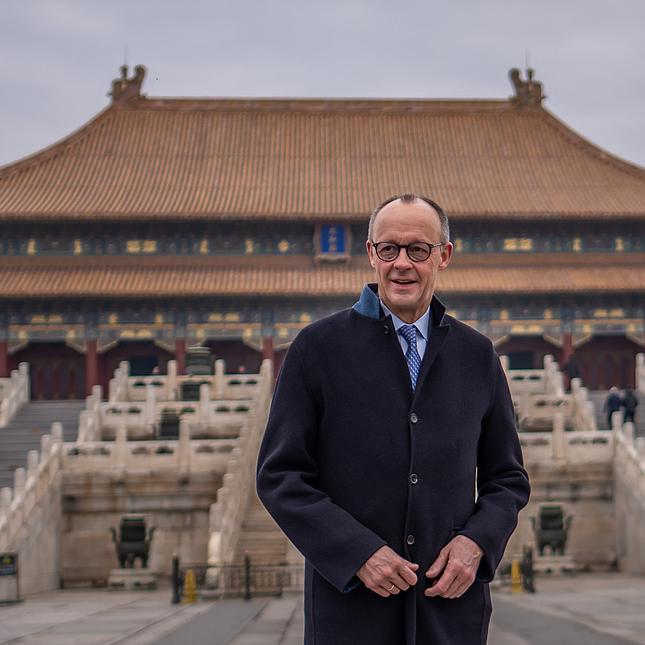
Europe’s China moment: What Merz's visit really signals
It's Friedrich Merz's first official visit to China as German chancellor. What results will he bring back to Berlin? Merz is the fifth European state leader Beijing has received in less than three months amid rising economic and geopolitical uncertainty. What implications does it carry for the future of China-EU relations?
 Host Tu Yun joins Dr. Hans-Peter Burghof, a professor and the Chair of the Banking and Finance Department at the University of Hohenheim, Germany, Dr. JIN Ling, a senior research fellow leading the Department for European Studies, China Institute of International Studies, and Dr. George Tzogopoulos, the Director of EU-China Programmes and a senior research fellow at the European Institute of Nice to break down the signals, the substance, and what this moment really means.
What’s at stake in Modi’s Israel visit?
① Meeting Germany’s Friedrich Merz in Beijing, Xi Jinping calls on China and Germany to be reliable, innovative, and cultural partners. What momentum has the German leader’s China visit injected into bilateral ties? (00:52)
 ② US-Iran nuclear talks resume in Geneva. Is the US military threat pressuring Iran to make concessions in negotiations? (15:13)
 ③ India’s Narendra Modi is on a two-day trip to Israel to strengthen security and economic cooperation between the two countries. Is his visit likely to give Israel a boost of international support? (25:14)
 ④ The IMF is urging the US to rein in its growing fiscal deficit, warning that public debt could climb to 140% of its GDP by 2031. What risks will this trend pose to the US and global economy? (34:37)
 ⑤ The French government has survived two no-confidence motions in parliament that were filed after a new energy law was adopted by decree. Why are French politics divided on energy issues? (45:14)
Takeaways from Trump’s State of the Union address
① German Chancellor Friedrich Merz is on a trip to China for talks on trade and other issues. What can China and Germany do together to counterbalance global uncertainties? (00:53)
 ② Donald Trump has touted his economic record during the State of the Union address, saying he has ushered in what he calls a golden age. What’s at stake for Trump in the address? (13:07)
 ③ Panamanian authorities have seized two ports on the Panama Canal from Hong Kong-based CK Hutchison. Will this case have a negative impact on China’s confidence to invest in Latin America? (24:35)
 ④ Gold prices are surging again as global uncertainty takes center stage. Is the rally sustainable? (34:23)
 ⑤ James Zimmerman, Chairman of AmCham China, gives his take on the importance of the Chinese market. (44:00)
Why is Canada ready to provide assistance to Cuba?
① China’s Spring Festival holiday has delivered striking economic signals. Are we witnessing a structural shift toward experience-driven, service-led consumption in the country? (00:59)
 ② China has announced export control measures against 20 Japanese entities involved in boosting Japan’s military capabilities. Why is China’s concern about Japan’s remilitarization and nuclear ambitions legitimate? (11:52)
 ③ New Zealand’s prime minister gives his take on multilateralism and free trade. (24:07)
 ④ The EU has failed to approve additional sanctions on Moscow and a key loan for Kyiv. As the war in Ukraine marks its 4th anniversary, what’s its outlook? (32:35)
 ⑤ Cuba is grappling with fuel shortages as the US moves to choke off the country’s oil supplies, but Canada says it plans to provide assistance to Cuba. Is this generating another rift between Washington and Ottawa? (43:23)
Trump’s tariffs face major political setbacks
① After the US Supreme Court declared the Trump administration’s unilateral tariffs illegal, China has called on the US to lift its tariffs. How can China safeguard its legitimate interests when Washington’s trade policy faces domestic political setbacks and uncertainties? (00:43)
 ② India and Brazil have signed a mining pact, and they are targeting $20 billion in two-way trade in five years. What are the two sides’ strategic calculations in deepening their trade? (12:05)
 ③ China has issued draft rules that would target the potential psychological and emotional risks of AI-powered chatbots. Why is China seriously paying attention to this field? (25:00)
Trump’s 15-day Iran ultimatum: deal or escalation?
① Trump gives Iran a 10-15 day ultimatum on the nuclear deal. Will diplomacy avert ‘bad things’ or is a crisis looming? (00:37)
 ② China sees a cross-border travel surge under the visa-free policy. (11:58)
 ③ Why does China aim for a "reasonable price recovery"? (24:10)
China secures its first two gold medals of 2026 Winter Olympics with Su Yiming and Xu Mengtao wins
① China warns Japan over the Taiwan question: How should the world view Japan's growing militarism? (00:37)
 ② China celebrates a golden day at the Winter Olympic Games — what's behind its double triumph? (17:04)
 ③ Rise of the Humanoids: China's Robot Revolution. (25:35)
Robots ignite a post-gala sales frenzy
① Robots ignite a sales frenzy after the Spring Festival Gala show. What does it reveal about China’s structural industrial breakthrough? (00:40)
 ② China’s Spring Festival holiday kicks off strong, with box office and travel surging. What’s behind the holiday spending boom? (12:58)
 ③ China’s space economy: from launchpads to markets. (25:00)
Spring Festival 2026: What’s changing this year?
① What new trends are emerging in China’s 2026 Spring Festival? (00:40)
 ② Hungarian State Folk Ensemble joins CMG’s 2026 Spring Festival Gala for cross-cultural celebration. (15:07)
 ③ Why is "Becoming Chinese" going viral overseas? (24:30)
Dialogue or Destruction? Wang Yi at Munich
① Dialogue or destruction? Chinese FM Wang Yi calls for cooperation as Munich warns of a fracturing world. (00:40)
 ② How GGI shape cooperation and redefine international engagement? (26:32)
Panel: Learning or repeating? America’s moment of reflection
The American think tank Council on Foreign Relations has ranked the ten best and worst decisions in U.S. foreign policy history. Now, as Washington grows more skeptical of multilateralism, reassesses alliances more transactionally, and returns to tariffs and sanctions, history feels closer than ever. What lessons—and what warnings—does America’s diplomatic past hold for today?
 Host Ge Anna is joined by Zoon Ahmed Khan, Research Fellow at the Center for China and Globalization; Josef Mahoney, Professor of Politics and International Relations at East China Normal University; and Dr. Liu Kuangyu, Researcher at the Institute of Taiwan Studies, Chinese Academy of Social Sciences.
A key step forward in China’s 2030 crewed moon mission
① China’s foreign minister has met Hungary’s Viktor Orban in Budapest, with the two sides vowing to deepen all-round cooperation. Why has the Hungarian government led by Orban pursued a long-standing friendly policy towards China? (00:55)
 ② China has successfully completed a launch test of its new-generation heavy-lift rocket and manned spacecraft. We explore why the test marks a key step forward for the country’s lunar program. (16:17)
 ③ Lithuania’s prime minister has signaled potential change in Vilnius’s stance on Taiwan. Why was the 2021 opening of the so-called “Taiwan Representative Office” in the Lithuanian capital a strategic mistake? (24:25)
 ④ What has made the US House of Representatives break with Donald Trump and pass a resolution to terminate the US president’s Canada tariffs? (34:19)
 ⑤ Is Washington’s rhetoric fundamentally eroding transatlantic trust? Professor Adam Tooze from Columbia University gives his thoughts. (44:11)