
What Works
435 episodes — Page 3 of 9
This is Not Advice: Metrics, Incentives, and the Seduction of Clarity
This is the 8th edition of This is Not Advice, my "not-advice" column for premium subscribers of What Works. Today, I'm talking about our over-reliance on metrics and how easily we're seduced by reductive data. When does a metric turn into an incentive for bad behavior? And why are we so happy to accept the feeling of clarity and certainty without actually understanding what's going on?Click here to upgrade your subscription and get the full episode! Or learn more about becoming a Premium Subscriber. ★ Support this podcast ★
EP 439: Expectations, Boundaries, and Making Work in Public with Randi Buckley
Making work for the public seems to come with a slew of fuzzy social expectations. What do we owe our readers, listeners, viewers, and followers? What more is expected beyond the post, episode, or video? How do you navigate the tension between care and boundaries? When I came across a LinkedIn post that Randi Buckley made, I felt a wave of relief. Her answer to those questions? Nothing. We owe nothing more than we've already given. In this episode, I share wisdom from Randi, additional wisdom from Jordan Maney, and a lot of the inner workings of my own mind.Footnotes:The LinkedIn post that started it allFind out more about Randi BuckleyFind out more about Jordan ManeyNo Time to Spare by Ursula K. Le GuinLe Guin's first blog postNEW: I’m teaching a 12-week training program for coaches, managers, consultants, and guides of all kinds starting in September. The program is called Work In Practice, and it’s a deep dive into the social, political, and economic systems that impact what we believe about work.Every episode of What Works is also published in essay form and delivered in my newsletter: whatworks.fyiLove What Works? Support the show and help me reach more people with assumption-busting ideas about work, business, and culture by becoming a Premium Subscriber. For just $7 per month, you get access to bonus episodes, full-length interviews, and quarterly workshops—including August 24's Breaking the Self-Sabotage Cycle. Upgrade your subscription today! ★ Support this podcast ★
EP 438: Counterfeit Financial Culture with Manisha Thakor
The media give us wildly exaggerated images of wealth and consumption. And even if we recognize that a tv show or an Instagram account is more fantasy than reality, those images impact what we believe we should be earning and buying. MoneyZen author Manisha Thakor calls the result Counterfeit Financial Culture and argues that it's one of the reasons we end up feeling like we're never quite enough.In this episode, Manisha details Counterfeit Financial Culture, and I offer the mimetic theory of desire as additional context for understanding the situation.Footnotes:Find out more about Manisha ThakorMoneyZen: The Secret to Finding Your Enough by Manisha ThakorWanting: The Power of Mimetic Desire in Everyday Life by Luke BurgisPsychopolitics: Neoliberalism and the New Technologies of Power by Byung-Chul HanCapitalism and Desire by Todd McGowanNEW: I’m teaching a 12-week training program for coaches, managers, consultants, and guides of all kinds starting in September. The program is called Work In Practice, and it’s a deep dive into the social, political, and economic systems that impact what we believe about work.Every episode of What Works is also published in essay form and delivered in my newsletter: whatworks.fyiLove What Works? Support the show and help me reach more people with assumption-busting ideas about work, business, and culture by becoming a Premium Subscriber. For just $7 per month, you get access to bonus episodes, full-length interviews, and quarterly workshops—including August 24's Breaking the Self-Sabotage Cycle. Upgrade your subscription today! ★ Support this podcast ★
EP 437: Leaving the Cult of Never Enough with Manisha Thakor
At age 50, Manisha Thakor realized that she'd sacrificed her life at the altar of work. How did that happen? And what was she to do about it? Manisha's new book tackles how to unwind a toxic relationship with work and money.Footnotes:MoneyZen: The Secret to Finding Your Enough by Manisha ThakorFind out more about Manisha ThakorAlienation by Rahel JaeggiCapitalism and Desire by Todd McGowanWhat Works by Tara McMullinNEW: I’m teaching a 12-week training program for coaches, managers, consultants, and guides of all kinds starting in September. The program is called Work In Practice, and it’s a deep dive into the social, political, and economic systems that impact what we believe about work.Every episode of What Works is also published in essay form and delivered in my newsletter: whatworks.fyiLove What Works? Support the show and help me reach more people with assumption-busting ideas about work, business, and culture by becoming a Premium Subscriber. For just $7 per month, you get access to bonus episodes, full-length interviews, and quarterly workshops—including August 24's Breaking the Self-Sabotage Cycle. Upgrade your subscription today! (00:00) - Rough Edit (02:05) - The Cult of Never Enough (02:20) - The Roles We Play (13:40) - Money Worries versus Money Problems (18:31) - The Image of Our Dissatisfaction ★ Support this podcast ★
This is Not Advice: How Flexibility is Used and Abused
This is an excerpt from the 7th edition of This is Not Advice—a not-advice column exclusively for premium subscribers. In this episode, I take a closer look at flexibility. When is it a feature? When is it a bug? When does flexibility create more opportunities for learning or value? And when does it devolve into chaos?To hear the whole episode, become a premium subscriber for just $7 per month. You'll get twice monthly This is Not Advice episodes, plus (mostly) full-length interviews with the people I feature on the show, and more! Go to whatworks.fyi/subscribe ★ Support this podcast ★
EP 436: The Myth of Rugged Individualism—and Hope for Something More (Remix)
This episode originally ran on May 25, 2022. It's been lightly remixed for today's release!“Rugged individualism” is the very language we speak in America. It shapes the way we approach work, family, and society. And rugged individualism has a direct impact on the decisions we make about our businesses and careers. In this short episode, I unpack where rugged individualism comes from and highlight a different way forward.Footnotes:Rugged Individualism Monologue by Terry Smith "The Myth of Rugged Individualism” by Robert Reich“We’d Like To Thank You, Herbert Hoover” from AnnieIndividualism and Economic Order by Friedrich HayekHope in the Dark by Rebecca Solnit“The Philosophers: Loneliness & Totalitarianism” on Vox ConversationsEvery What Works episode is also published in essay form in my newsletter. Subscribe FREE or become a premium subscriber for bonus content for just $7/month. Go to: whatworks.fyi ★ Support this podcast ★
EP 435: Self-Control, Surveillance, and the Body at Work (Classic)
So much of our modern discourse around productivity, empowerment, entrepreneurship, and personal growth includes messages about our bodies. These messages might not be explicit, but the messages are there—and our brains pick them up loud and clear.Similarly, we might not realize that we’re sharing messages that insert themselves into how others perceive their own bodies—but many of us are. It’s impossible to talk about self-discipline, accountability, or efficiency without those concepts leaving their marks on our flesh.This episode covers a tiny sliver of all the ways that the medium of self-help acts on our bodies. But my hope is that it will encourage you to think critically about the messages you receive about your body and the messages you share that might impact others’ bodies.You’ll hear from independent beauty culture journalist Jessica DeFino, body confidence influencer Tiffany Ima, and Flaunt Your Fire founder India Jackson.This episode contains frank talk about bodies, weight, beauty, dieting, and related topics. I know that these subjects can trigger harmful thoughts and behaviors for me if I’m not careful. So please, take care while listening to this episode.This episode originally aired on October 18, 2022. It's been slightly updated for this rebroadcast.Footnotes:Subscribe to Jessica DeFino’s newsletter about beauty culture and the beauty industry.Follow Tiffany Ima on Instagram.Listen to the Flaunt Your Fire podcast and learn more about India Jackson.Erica Courdae on reconsidering your normal, as well as “Normal is a Life with Michelle Kuei” on the Pause on the Play podcast.“Body acceptance stops at the skin. Why?” by Jessica DeFino“The Skin as an Antidote to Consumerism” by Jessica DeFino“How White Supremacy and Capitalism Influence Beauty Culture” by Jessica DeFino in TeenVogueWhat We Don’t Talk About When We Talk About Fat by Aubrey Gordon“Postscript on Societies of Control” by Gilles DeleuzeSelf-Help, INC by Micki McGee“Rachel Hollis Part 1: Hashtag Relatable” on Maintenance Phase“The Trouble with Calories” on Maintenance Phase“Bodybuilding vs Powerlifting vs Weightlifting” on ShapeConfidence Culture by Shani Orgad and Rosalind GillLet’s Get Physical: How Women Discovered Exercise and Reshaped the World by Danielle Friedman3 Books for Remembering “You Have a Body”: On disability, on chronic illness, and on our bodies in societyYou can find essay versions of every What Works episode at whatworks.fyi - where you can become a premium subscriber, support my work, and get bonus content for just $7 per month. Upgrade today! ★ Support this podcast ★
This is Not Advice: Beyond Creating Versus Consuming
This is an episode of "This is Not Advice," a bonus podcast I do for premium subscribers of What Works. Instead of just a teaser this week, I wanted to share the whole episode with you. If you'd like to receive future episodes, go to whatworks.fyi/subscribe and become a premium subscriber for just $7/month.For this edition of This is Not Advice, I wanted to piggyback on the conversation I had with Jay Acunzo about social media generally and Threads specifically. Part of the conversation that didn't make it into the main piece involved the ratio of how much creating versus consuming we do online. On this, Jay and I have very different philosophies. I don't think he's "doing it wrong," but I did want to tease out the factors that influence whether we [can] spend more time creating or consuming online—and how that impacts the work we do.It's an episode about craft, gender, genius, and moving beyond the creating versus consuming dichotomy.Click here to read the full piece and get links to everything I cited in the piece! ★ Support this podcast ★
EP 434: What do we really want from social media? with Jay Acunzo
This is an episode about Meta's new app, Threads. It's also about Substack and Substack's new-ish feature, Notes. But really, it's an episode about what we're looking for from the category we call "social media" and how we think about achieving those ends. And perhaps what it's really, really about is how we go looking for and creating meaning in the digital sphere.Jay Acunzo, a writer, podcaster, and public speaker who thinks a lot about online content, was one of the 100+ million people to give Threads a try over the last week. I was not. So I wanted to see how he was approaching the platform, why he joined in the first place, and maybe, just maybe, how he's thinking about making meaning online.Footnotes:Find out more about Jay Acunzo, his podcast, and his newsletterSubstack Notes"Threads is a mecca of Millennial brain rot" by Kate Lindsay on Embedded"Meta unspools Threads" by Casey Newton on Platformer"To quit or not quit social media: opportunity cost can help you decide" on What WorksJohn Austin's How to Do Things With WordsPerformativity in the theory of Judith Butler"Queer Failure" by Kate TysonFind written versions of every What Works episode at whatworks.fyiLove What Works? Consider becoming a premium subscriber for just $7/month. Not only do you help support my work, but you also get access to bonus episodes and other goodies. ★ Support this podcast ★
EP 433: What is Capitalist Realism? with Iggy Perillo
"It's easier to imagine the end of the world than the end of capitalism," say Frederic Jameson and Slavoj Žižek.Capitalist liberal democracy is construed as the "end of history"—the culmination of millennia of civilizational progress, the inevitable outcome of a long march toward justice and freedom. But is it? And if it's not the best system for our economic and political needs, what is the alternative?It's almost impossible to imagine. But, despite what Margaret Thatcher said, there is an alternative—many, in fact. We just haven't dreamed them up yet.This is the argument of Mark Fisher's Capitalist Realism, a great little book that wrestles with big questions and ends on a surprisingly hopeful note. In this episode, I'll share some reflections on our identities as consumers and the nature of capitalist realism. Then, you'll hear the latest episode of the Books Applied Podcast with Iggy Perillo. Iggy and I discussed the book for her podcast and I loved it so much that I wanted to share it with you, too!Footnotes:Iggy Perillo and WSL LeadershipBooks Applied PodcastCapitalist Realism by Mark Fisher"Media Frames UPS Strike as Harming You, the Consumer and Protagonist of Reality" by Adam Johnson in The ColumnAs always, you can find my opening essay, plus a condensed transcript of my conversation with Iggy, at whatworks.fyiLove What Works? You can support my research and writing by becoming a premium subscriber on Substack for just $7/month. Thanks in advance! ★ Support this podcast ★
This is Not Advice: Accessibility Beyond the Checklist
Welcome to the 5th edition of This is Not Advice, a non-advice column for premium subscribers of What Works. If you’re already a premium subscriber, thank you! If you’re not, I still think you’re great—and you can read a solid chunk of this column for free. Or, subscribe to get access to full-length columns and podcast episodes.Or, read this excerpt here.Next week, I’m teaching a workshop on how to pitch yourself to appear on podcasts for YellowHouse.Media. I’ll show you how to find shows to pitch, how to think like a producer, and how to prepare for your interview. Click here to learn more & register. ★ Support this podcast ★
EP 432: Queer Failure with Kate Tyson
"Failure" got a glow-up sometime in the last 20 years. Instead of something to be feared, gurus tell us to embrace failure. That failure is a waypoint on the path to success. But this shift in our relationship with failure has only further inscribed the winner-loser binary that causes so much of our anxiety about the future.What if "failure" wasn't part of the "success" formula? What if we looked beyond conventional notions of failure and success to question whether those ideas even matter at all? Whether they serve us at all?Today on the podcast, Kate Tyson (Strathmann) is queering failure. She's questioning what it means to build a business or a project without the normative notions of success and failure. And how calling those norms into question allows us to imagine new and different ways to do business—or any kind of venture."Queer Failure" is an excerpt from [Im]Possible Business by Kate Tyson.Footnotes:[Im]Possible Business by Kate TysonFollow Kate's writing on SubstackThe Queer Art of Failure by Jack HalberstamFox Market and Bar in Montpelier, Vermont"Don't Bail Out the Restaurant Industry" by Tunde WeySaidiya HartmanÉtaín UnderthingsRunway's Entrepreneur Universal Basic Income programWanderwell Bookkeeping and Consulting"Queer Theory" by Nancy Harding in Key Concepts in Critical Management Studies ★ Support this podcast ★
EP 431: The Shoulds and Supposed-tos of Baking
Buckle up—today's episode was inspired by something that got me really worked up this week: "I think home-baking is one of the stupidest things anyone can engage in," says Rick Easton of Jersey City's Bread and Salt. This episode is about shoulds and supposed-tos, baking at home, and the ways we devalue certain kinds of labor. Whether or not home-baking is your thing, you'll recognize the way value is narrowly defined by culture and, I think, gain new language for the worthiness of work that doesn't fit the capitalist mode.Footnotes:"Leave the Baking to the Professionals" by Hannah Goldfield, New YorkerBread, and How to Eat It by Rick Easton and Melissa McCart"On Bread" via From the Desk of Alicia Kennedy"What could 'food is political' mean?" via From the Desk of Alicia KennedyKing Arthur Baking: Old-Fashioned Oatmeal LoafBreadhead by Greg WadeHistory of Low-Carb Diets on Wikipedia"I love bread!" Weight Watchers commercial"Home Cooking can be a Feminist Act" by Nigella Lawson"Men More Likely Than Women to be Seen as Brilliant" via NYU"When Male Chefs Fear the Specter of 'Women's Work'" by Meghan McCarron, Eater"The Uses of the Erotic: The Erotic as Power" by Audre Lorde, YouTube"The Uses of the Erotic: The Erotic as Power" by Audre Lorde, Sister OutsiderEssay versions of every episode of What Works are published at whatworks.fyi — subscribe FREE to have them delivered straight to you. Or become a paid subscriber for just $7 per month and get access to bonus content, discounts on workshops, and more! Go to whatworks.fyi to learn more. ★ Support this podcast ★
This is Not Advice: Who is Responsible for Adapting?
"Outsiders" shoulder a disproportionate burden when it comes to fitting in. Can we demand more from the "insiders?"This is a preview of the 4th installment of This is Not Advice, a not-advice column for paid subscribers of What Works. If you’re not a paid, enjoy the first half of this essay (audio or written) or upgrade your subscription to access the whole thing. For just $7 per month, you get access to bonus content and help me make this show!For a written version of this episode, go to: www.whatworks.fyi ★ Support this podcast ★
EP 430: Why Does Authenticity So Often Feel Fake?
What gets labeled as "authentic" is often quite predictable. It's a market-compatible expression of what was once something unique or personal. Authenticity is a vibe—and a valuable one at that."Predictably unique" is how David A. Banks defines authenticity in his book, The City Authentic. Authenticity, or what's "predictably unique," describes how culture, place, and style are packaged to become recognizable—and, therefore, consumable—to a general audience.And while Banks's interest is in the politics of urban planning, his analysis spoke to a question I've pondered for almost as long as I've been a Very Online Person: Why does authenticity often feel so fake?How can a form of expression feel legitimately authentic one day and discernibly contrived or derivative the next? Is it the expression or my perception of it that changes? Why does "authentic" become an aesthetic, a legible set of features that denotes the "real?" And why does formulaic authenticity convey such social capital (or at least promise to)?I tackle these questions and more in this episode!Footnotes:The City Authentic by David A. Banks"'She Looks Like an Instagram:' How Empowerment Became a Brand" by Tara McMullin"The Strange Logic of Value in the Attention Economy" by Tara McMullinThe Jargon of Authenticity by Theodor Adorno"Personal Branding and the Crafting of Self" by Tara McMullinThe Influencer Industry: The Quest for Authenticity on Social Media by Emily HundHow to be Authentic by Skye ClearyEvery episode of What Works is also published as an essay. Go to read.explorewhatworks.com or subscribe to get them automatically delivered to you! You can also chip in $7 per month to support my work and to get access to bonus content. ★ Support this podcast ★
EP 429: Maybe bigger isn't better?
On June 8, Skye Pillsbury opened the latest edition of her newsletter, The Squeeze, with the header RIP Gimlet. She continued:I’m heartbroken over the news that Spotify has laid off another 200 podcast employees, though I’m not shocked.— Skye Pillsbury, The SqueezeI devoured Alex Blumberg's Startup when it first came out, which was about a year before I started podcasting. Then, I inhaled Reply All when it launched, and despite its later troubles, was genuinely moved by its final episode. I lapped up Blumberg's earnest interviews with entrepreneurs on Without Fail. I even had the privilege of interviewing Blumberg during a course I taught at CreativeLive.I followed Gimlet's acquisition by Spotify with interest (and a healthy dose of skepticism). The bumpy ride that they've had since then was utterly predictable. Though, like Pillsbury, I find the news that Gimlet is no more—at least in any recognizable sense—quite upsetting.This short dispatch is about podcasting and the podcast industry—but really, it's about why we shouldn't judge success—or run companies—using the logic of Wall Street.Footnotes:"RIP Gimlet" in The Squeeze by Skye Pillsbury"Spotify to Layoff 200 Employees in Podcast Strategy Shift" by Amanda Holpuch, New York TimesStartup by Alex Blumberg & Gimlet Media (Excerpts from Season 1, Episodes 1, 2, and 4)Reply All by Alex Goldman, Emmanuel Dsotzi, PJ Vogt, and Gimlet Media Without Fail by Alex Blumberg & Gimlet Media"Podcast Companies, Once Walking on Air, Feel the Strain of Gravity" by Reggie Ugwu, New York Times"A U.F.O. Podcast Zooms Past the Competition" by Reggie Ugwu, New York Times"Crooked Media Hires Vice’s Lucinda Treat as First CEO, Gets Funding From George Soros’ Investment Firm" by Todd Spangler, Variety"'You Paid WHAT?!' Or, How Echo Chambers Distort Prices and the Way We Think" by Tara McMullinLove What Works?Become a paid subscriber and get twice-monthly bonus episodes, the chance to write in with questions, and more for just $7/month. Upgrade your subscription at: taramcmullin.substack.com/subscribeOr, share the show with a friend! You'll help out What Works and start a great conversation!Every episode is also published in essay form at: taramcmullin.substack.com ★ Support this podcast ★
EP 428: "You paid WHAT for that?!" Or, How Echo Chambers Distort Prices and How We Think
I’m about to write the most journalistic thing I’ve ever written: I received a tip.I wish I could say it was an “anonymous tip” because that sounds even more journalistic. But it wasn’t anonymous, though I won’t say who it was. Anyhow, my source told me about a small business owner—someone who sells online courses and does quite well—paying an outrageous sum for a fairly standard service.This, of course, was not an isolated incident. I didn't really need a tip. I know all about this kind of thing. Wildly inflated prices grace all manner of products and services within the creator economy, coaching industry, and "online business" space in general.‘What’s going on?’ my source wanted to know. ‘How do people get caught paying so far above market rate? And why do people charge prices so out of whack with the market?’ I totally paraphrased all that. Here's what my source really asked about: "the gaslighting inflationary online pricing bubble."In this episode, I endeavor to get to the bottom of the Gaslighting Inflationary Pricing Bubble Online—GIPBO. I discover that it's not so much an economic problem (although that's part of the story). It's an epistemological one.Footnotes:"Hostile Epistemology" by C. Thi Nguyen"Neoclassical Economics" on Investopedia"The Epistemic Seduction of Markets" by Lisa Herzog in The Raven"Escape the Echo Chamber" by C. Thi Nguyen"The Art of Rent" by David HarveyLove What Works? Share the show or newsletter with a friend who would appreciate a critical look at work, business, and leadership in the 21st century. And please consider supporting the work I do by becoming a paid subscriber. This episode alone took over 30 hours to research, write, edit, and produce. You can contribute (and get access to some sweet bonuses!) for just $7/month. Click here to contribute! ★ Support this podcast ★
This is Not Advice: Making Work That Can't Be Sold
Welcome to the 3rd edition of This is Not Advice, my advice column that’s not an advice column for paid subscribers of What Works. This week, I am tackling a question that came up during last week’s workshop on media ecosystems (link to replay below!) and that my husband Sean asked me just this morning. It also came up a number of times during a workshop on audio essays that I taught earlier this year.So I’m going to assume this is something that a lot of folks struggle with—myself included on a regular basis.Here’s the gist:I’ve accumulated lots of thoughts that I want to turn into a cohesive project—maybe a book, a podcast series, an online course, even a single essay. How do I even begin working on something like that?This episode is an excerpt from my full column! To upgrade your subscription and read or listen to the full episode, click here! ★ Support this podcast ★
EP 427: The Trust-Profit Paradox
Today's episode is all about trust and responsibility—and how those qualities impact the cost of doing business and the work that's required for any company to be successful. And specifically, it's about something I'm calling the Trust-Profit Paradox. Simply put, you can't build trust and optimize for profit at the same time. After losing my ish listening to The Verge's Nilay Patel stump Airbnb's Brian Chesky with a question about AI-generated images on the Decoder podcast, I started to think about the responsibility that companies like Airbnb have (or, rather, avoid). From there, my research took me to some truly unexpected places—like into mainstream management theory. Footnotes:"The Pope Francis Puffer Photo Was Real In Our Hearts" by Eileen Cartter on GQ"'I can't make products just for 41-year-old tech founders': Airbnb CEO Brian Chesky is taking it back to basics" on Decoder with Nilay Patel (audio & transcript available)"The Delusion of Profit" by Peter Drucker in Wall Street Journal"Cost of Capital" on the Harvard Business School blog"If you're getting ripped off, it's not surprising" featuring Niko Matouschek at Kellogg School of Management, Northwestern"The Age of Customer Capitalism" by Roger Martin in Harvard Business Review"'Is Substack Notes a Twitter clone?': We asked CEO Chris Best" on Decoder with Nilay PatelJoin me for a workshop called "Tending Your Media Ecosystem" on Wednesday, May 31st at 1:30pm ET/10:30am PT—exclusively for paid subscribers to What Works. Get started for just $7/month! ★ Support this podcast ★
EP 426: This is Not Advice: It's Our World, AI Just "Lives" In It
What are we really talking about when we talk about our hopes and fears about AI?It's us. We're the problem.Actually, we're not the problem—we're more like the solution. But that's less mimetic.Sure, this is yet another pod hitting your feed with a take on AI. I'll assure you, though: this episode isn't really AI. There's no fear-mongering or cute suggestions for prompts. It's a bit of a meditation on the very human parts of our relationship with technology. And it's probably one of the most hopeful pieces I've put together in a few years! ***Anyhow, today's episode is the second edition of This is Not Advice, a "not advice" column for paying subscribers of What Works. This is the final public edition, so if you'd like to keep getting a dose of "not advice" from me every other week, plus submit your own topics and questions, and support independent analysis of the future of work, business, and leadership, go taramcmullin.substack.com/subscribe and chip in just $7/month.I'm also hosting a workshop on May 31 for paying subscribers called Tending Your Media Ecosystem. I'll share how what I read, watch, and listen to becomes what I write, produce, and post. Footnotes:Star Trek: The Next Generation, "Deja Q"Grammarly's new AI Assistant"Did clickbait kill BuzzFeed and the digital media era?" on Offline with Jon Favreau"Readers Aren't Flocking to Chatbot Novels Just Yet" in Counter Craft by Lincoln Michel"Contrepreneurs: The Mikkelsen Twins" on Folding Ideas with Dan Olson"Dingus of the Week: Pivoting to Robots" in Men Yell at Me by Lyz LenzEvery new episode is also published in essay form! Click here to read. (00:00) - This is Not Advice: What We Really Talk About When We Talk About AI (01:27) - Today's Question (07:01) - Suspicion (09:53) - Chatbots are already writing books (13:02) - It Already Exists ★ Support this podcast ★
EP 425: [Dispatch] Gone Meta
There's a sort of inside joke in the online business space of coaches, creators, and service providers. Or maybe, at this point, it's an "outside joke?"Q: What's the surest way to make more money as a creator or small business owner?A: Teach other people how to make money as a creator or small business owner.Hilarious, right? Anyhow, this isn't some weird quirk of extremely online people. It's something huge companies do, too. Douglas Rushkoff calls it "going meta." You can see it in the stock market, in automakers, and—yes—at Meta. In this quick Dispatch, I take a look at how "going meta" changes work, both for self-employed and traditionally employed folks. And, I consider how we might do things differently.Footnotes:Survival of the Richest, by Douglas RushkoffTeam Human, by Douglas Rushkoff"What a Meta For?" by Douglas Rushkoff on MediumKyla Scanlon's tweet"How Ford Makes Money" on Investopedia ★ Support this podcast ★
EP 424: How the Game We Play Changes Our Work
“This cancerous economic principle means that executives and venture capitalists have abandoned the concept of value within a business. Through decades of corporate greed, production has become almost entirely separated from capital, meaning that executives (and higher-ups) are no longer able to understand the nature of the businesses they are growing.”— Ed Zitron, “Absentee Capitalism”This might sound weird—but most companies today aren’t in the business it appears they’re in. Netflix isn’t really in the content business. Facebook isn’t in the social media business. Etsy isn’t in the handmade marketplace business. Instead, companies are in the growth business. And this impacts all of us, tying how we work not to the production of valuable products and services but to the potential for capital growth. Even for independent workers and small businesses, the capital growth game sets the rules and obstacles for the game we play.Today’s episode is about gaming the system—how the game we play dictates the decisions we make and the actions we perform. After all, you have to know what game you’re playing to know how to win. And you also need to decide whether that’s the game you want to play.Footnotes:Games: The Art of Agency by C. Thi Nguyen“Bent but Not Broken: The History of the Rules” via NFL OperationsCBS Sports: “Results of 2023 Rule Change Proposals”MSNBC: “BuzzFeed News to shut down”“Absentee Capitalism” by Ed Zitron"Amazon's Trickle-Down Monopoly" by Moira Weigel“The Valuable Business of Maintenance Work” by Tara McMullinWhat Works: A Comprehensive Framework to Change the Way We Approach Goal-Setting by Tara McMullinSupport independent research and analysis about the future of work and business by becoming a paid subscriber of What Works! For just $7 per month, you help make my work possible. Click here to pledge your support! (00:00) - EP 424: How the Game We Play Changes Our Work (02:59) - What does it mean to "game a system?" (06:12) - The Business of Rule Changes (09:08) - The Profit-Growth Game (14:40) - Creating Loopholes (18:30) - A Rebuilding Year ★ Support this podcast ★
EP 423: This is Not Advice: What can I do to grow my audience?
bonusToday’s quick episode is a sample of something I’m creating for paid subscribers to What Works. I’m calling it my “This is Not Advice” column. Or, TINA for short. Not to be confused with TINA a la “there is no alternative”—if you know, you know.Paid subscribers not only receive this subscriber-directed content, but they also have the chance to, well, direct the content! When you’re a paid subscriber, you can write in with a question, topic, or observation that you’d like my take on—some added context here and some sideways observations there. If you like today’s episode and want to get more of it, go to read.explorewhatworks.com and become a paid subscriber for just $7/month! ***Today's Question:What else can I do to grow my [audience, platform, brand, list, etc.]?To me, this isn’t only a question for independent workers and small business owners—although it’s especially salient for that group. It’s also a question that points to a bigger trend in work in general. And that trend is the way all workers are now encouraged to be entrepreneurs of themselves. This is evident in the portfolio career model, the lessons about personal branding, and what Micki McGee has called the ‘belabored self,’ that is, constant work on perfecting oneself to fit the market.This question has become quite fraught over the last 9 months or so. When I would have once been able to begrudgingly prescribe a series of actions on various social media platforms or construct a content strategy designed to attract new readers/listeners/viewers, the media landscape has become, to borrow Cory Doctorow’s term, enshittified. Thanks to enshittification, none of the legacy platforms are viable candidates for a concerted strategy. And splitting one’s effort across multiple platforms is just watering down already ineffective action.Listen to hear my answer! Or find the written version at read.explorewhatworks.comFootnotes:Become a paid subscriber to What Works for just $7 per month!"The Enshittification of TikTok" by Cory Doctorow on WiredMicki McGee on the "belabored self""How Audience-Building is Not the Same as Finding Clients" by Tara McMullinPsychopolitics by Byung-Chul HanLiquid Love by Zygmunt Bauman"Why Creating Remarkable Work Matters" by Tara McMullin"Revisiting Remarkable Content to Explore Digital Ecology" by Tara McMullin ★ Support this podcast ★
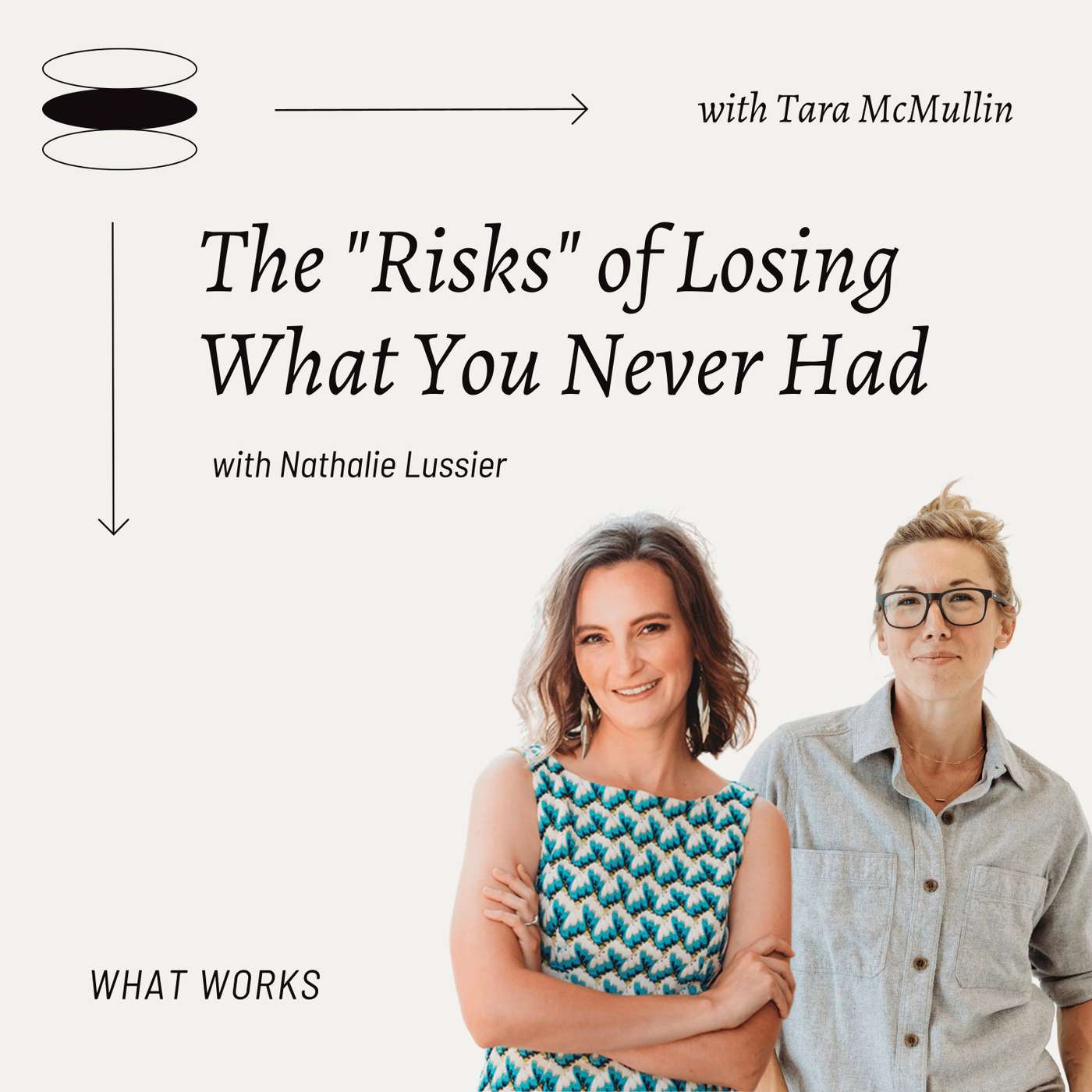
EP 422: The "Risks" of Losing What You Never Had with Nathalie Lussier
What does a bad movie from 1992, loss aversion, Steinbeck, pizza, farm animals, and the founder of a software company have in common? Well, you’ll find them all in this episode.This episode will take you places. I don’t want to spoil it. So suffice it to say, this episode is all about questioning why we act the way we do when it comes to how we scale up (and scale down) our dreams. Footnotes:Learn more about Nathalie Lussier and AccessAllyFar and Away (1992 film)Oklahoma land rush of 1893“A primer on the 30s” by John SteinbeckMore about loss aversion2002 pizza studyPsychopolitics by Byung-Chul HanCheck out Nathalie & Robin’s farm on YouTubeWhat Works by Tara McMullinSupport the research, journalism, and analysis that goes into What Works by becoming a paid subscriber for just $7 per month. You'll get access to bonus content and help me continue to do this work (instead of, ya know, selling you stuff). ★ Support this podcast ★
EP 421: AI, Automation, and the Case for Luddism
I am on board when it comes to technological progress. I look forward to updating my devices (although I don’t do it as frequently as I used to). New apps and features excite me. I’m pretty quick to adapt to change. I am not a Luddite. Or so I thought. “The word Luddite still means an old-fashioned type who is anti-progress,” writes Jeanette Winterson in her book 12 Bytes. “But the Luddites of the early 19th century were not against progress; they were against exploitation.” Reading these lines was the first time what the Luddite movement actually stood for really sank in. Where I had once seen atavism and fear, I now saw labor politics I could get behind.When I picked up Gavin Mueller’s Breaking Things at Work: The Luddites Were Right About Why You Hate Your Job, I did so to learn more about the radical roots of Luddism and how the movement could inform my own thinking on the future of work. I also picked it up amidst the current fervor over AI and debates about whether the robots were finally coming for writers’ jobs. In this episode, I share my favorite ideas from Mueller's book and apply them to commonplace tools like project management apps (ClickUp, Asana, etc.) and social media scheduling apps. I think you'll have a different perspective on tech once you've listened!Footnotes:Breaking Things At Work by Gavin Mueller12 Bytes by Jeanette WintersonGavin Mueller on the Chris Voss show (YouTube)"AI and Automation are destroying jobs, not work" via Quartz (YouTube)"Dear YouTube, creators keep burning out. Here's the fix." via Channel Makers (YouTube)"Creator burnout is real. 6 ways to recover" via Sidewalker Daily (YouTube)My 2021 TEDx talk on remarkable work"Kids at Work, Games as Labor, Content as Product, and Surplus Elite" by me on Substack"The Game is Rigged: Rethinking the Creator Economy" by me on Substack"Intelligence Superabundance" by Packy McCormick on Not Boring"Moss introduces Jen to the internet" from The IT Crowd (YouTube)"You have to start talking" via GaryVee Video Experience (YouTube) (00:00) - EP 421: AI, Automation, and the Case for Luddism (05:03) - Luddism as Political Struggle (08:04) - Marker (09:28) - Marker (20:43) - Marker (31:54) - Marker ★ Support this podcast ★
EP 420: Why every business is "on a mission to..."
It seems like every company today claims to be "on a mission" to change the world or improve our lives. They bill themselves as social movements more than profit-driven enterprises. It sounds nice. But how does it really function in the lives of workers? Do these missions meaningfully improve our communities?In this episode, I briefly explore the history of the corporate mission statement and then dive into a critique of the bestselling leadership book, Start with Why. You'll hear why the Start with Why ideology is so appealing, how it sets us up for disappointment, and whether it's actually an effective brand and marketing strategy. Plus, I leave off with an alternative take that flips this ideology on its head. Footnotes:Walmart’s Statement of PurposeManagement: Tasks, Responsibilities, and Practices by Peter DruckerThe New Spirit of Capitalism by Luc Boltanski and Eve ChiapelloStart with Why by Simon Sinek“Start with Why” TEDx talk by Simon SinekThe Problem with Work by Kathi Weeks ★ Support this podcast ★
EP 419: What is an “ethical business?” with Brooke Monaghan
At least in my corner of social media, there are a lot of folks asking what makes a business ethical. Or, perhaps more accurately, there are a lot of folks answering that question. And there are probably even more folks worried that there’s something unethical about the way they run their businesses. They’re afraid they haven’t checked all the ethical business boxes. When Brooke Monaghan emailed me to ask whether I wanted to have a messy conversation about some of the messaging around ethical, equitable, or trauma-informed businesses, I jumped on the opportunity. You see, while this is certainly not true of all messaging on these topics, much of it unintentionally replicates problematic systems and social relations. Capitalism always appropriates that which tries to resist it.This episode explores a few different ways to think about the messages you’ve probably run into as you think about working or doing business differently. It’s not about calling anyone out or shaming anyone. It’s a look under the hood at some of the unexpected forces at play.Footnotes:Find out more about Brooke Monaghan.“Does social media leave you angry?” on NPRCapitalist Realism by Mark FisherA Spectre, Haunting by China Miéville“White Women/Black Women” by Phyllis PalmerCultish: The Language of Fanaticism by Amanda MontellUtilitarian ethicsDeontological ethicsI release every episode in essay form on Thursdays. Get them delivered straight to your inbox, or read the archive at read.explorewhatworks.com.Want to support the ad-free independent analysis I do at What Works? Become a paying subscriber at read.explorewhatworks.com. For just $7 per month, you not only get access to all of my free content, but bonus podcast episodes, the “This is Not Advice” Column, and sneak peeks at works in progress. Go to read.explorewhatworks.com to subscribe. ★ Support this podcast ★
EP 418: [Dispatch] Going beyond the "greedy corporation" critique
This Earth Month... buy more stuff?!We're about to be bombarded with messaging about corporate climate initiatives. We'll have the chance to buy merch to "support" the planet. And we'll be incentivized to spend more so that a small portion can be donated to organizations fighting climate change.As you might expect, it's all marketing. Earth Month and Earth Day seem to have become another excuse for a sale.But we miss a key issue in our fight for change if we stop at the "greedy corporation" critique. In this short dispatch, I compare Panasonic's #CreateTodayEnrichTomorrow campaign to Parks Project's mission to do good, and I advocate for a systems-level critique that can penetrate do-good messaging to get to the heart of the problem.Footnotes:Panasonic's ad: Green Impact (with Michael Phelps)Panasonic CES 2022 Top Things to SeeThe Entrepreneurs Helping Save U.S. National Parks via ForbesCapitalist Realism by Mark Fisher ★ Support this podcast ★
EP 417: [Dispatch] "All parasites have value"
"All parasites have value, Sibling Dex. Not to their hosts, perhaps, but you could say the same about a predator and a prey animal. They all give back—not to the individual but to the ecosystem at large." — Mosscap, in A Prayer for the Crown-Shy by Becky ChambersFor the next few months, I'm focusing on some big projects and taking my foot off the gas of the podcast a bit. But since writing is how I think, my big projects spin off shorter pieces as I work through ideas. I'll share some of these shorter pieces here on the podcast and in the What Works newsletter as "dispatches" from my projects.Today's dispatch explores our feelings about those who don't work—and how those feelings can create obstacles to more sustainable choices about how we do work.Footnotes:Monk & Robot novellas by Becky ChambersDebt: The First 5,000 Years by David GraeberBullshit Jobs by David GraeberThe American Revolution: Pages from a Negro Worker's Notebook by James BoggsThe Immunity to Change process via MindTools ★ Support this podcast ★
EP 416: Anxiety (and Mental Health) in the Achievement Society with Morra Aarons-Mele
I’ve called myself a recovering overachiever. I’m recovering not from the drive to excel but from the anxiety inherent to wondering if anything I achieve will ever be enough. And folks, it’s a struggle. The philosophy Byung-Chul Han describes this anxiety as central to contemporary society. He dubs our modern age the “Achievement Society” and argues that our plethora of potential projects and opportunities work to maximize our productivity. After all, what better way to inspire people to greater efficiency than by inspiring them to tackle #AllTheThings?This week, I talk with the host of The Anxious Achiever and author of the forthcoming book of the same name, Morra Aarons-Mele. We both the anxiety that the drive to achieve can create and how mental health conditions of all kinds impact the way we work.Footnotes:Pre-order The Anxious Achiever by Morra Aarons-MeleListen to The Anxious Achiever podcast on your favorite appFind out more about Morra Aarons-MeleThe Burnout Society by Byung-Chul HanDiscipline and Punish by Michel Foucault“High-Functioning Anxiety - Life Fright of the Shy Loud” presented by Jordan Raskopoulos at TEDxSydney ★ Support this podcast ★
EP 415: The Economics of Being Needy with Mara Glatzel
We all have deep human needs—for belonging, for autonomy, for creative expression, for safety and security. But modern life can make it a real challenge to get those needs met in meaningful ways. Instead, we’re offered products with flashy marketing messages. Kitchen gadgets, social media platforms, clothing, personal care products, and many others offer to help us live our best lives. Financial and educational products promise a greater sense of security and autonomy. But do these commodities really satisfy our needs? Or do they merely stave off the hunger a little longer?In this final episode of The Economics Of, I explore how various economic concepts can help us understand why we buy the things we do, how our consumption relates to larger economics forces, and how our relationships are influenced by it all. I also talk with Mara Glatzel, the author of Needy, about how to better understand our own needs and create the conditions through which we can get those needs met.Footnotes:Get your copy of Needy by Mara GlatzelLearn more about Mara Glatzel“Varieties of the Rat Race: Conspicuous Consumption in the US & Germany” by Till Van Treeck, via the Institute for New Economic Thinking“Trickle-Down Consumption” by Marianne Bertrand and Adair Morse in The Review of Economics and Statistics“Economic and Philosophic Manuscripts of 1844” by Karl MarxAdam Smith’s America by Glory M. LiuCapitalism and Freedom by Milton Friedman“Alienation” on Overthink with David Pena-Guzman and Ellie AndersonMore on Thorstein Veblen via InvestopediaEverything, All the Time, Everywhere by Stuart JeffriesLiquid Love by Zygmunt BaumanNew episodes are published in essay form every Thursday at explorewhatworks.com. Get them delivered straight to your inbox, free of charge, by subscribing to What Works Weekly: explorewhatworks.com/weeklyIf you’d like to learn more about how we can approach life and work differently, check out my book, What Works. I explore the history and cultural context that’s led us to this success-obsessed, productivity-oriented moment. Then I guide you through deconstructing those messages and rebuilding a structure for work-life that works. ★ Support this podcast ★
EP 414: The Economics of Ideas with Jenny Blake
What makes an idea valuable? What turns it into a product that can be bought, sold, or rented? Ideas turn into capital assets thanks to our system of intellectual property rights. But understanding IP isn’t simply a matter of learning what a trademark or patent is, and then learning how to leverage it to create wealth. To truly understand intellectual property, we need to under property—what it is and why it exists—first.In this episode, I explore the origins of our conception of private property, why we’ve coded intellectual property rights into law, and how one business owner—Jenny Blake—licenses her IP to companies to generate (relatively) passive income. Footnotes:Jenny Blake’s Free TimeJenny Blake’s Pivot MethodDebt: The First 5,000 Years by David GraeberThe Dawn of Everything by David Graeber and David Wengrow“Coding Land and Ideas | The Laws of Capitalism” featuring Katharina Pistor via the Institute for New Economic Thinking“Enclosure” on Wikipedia“Legal Evil” featuring Katharina Pistor via the Institute for New Economic Thinking“How to Unf★ck Intellectual Property” featuring Dean Baker via the Institute for New Economic ThinkingRentier Capitalism: Who Owns the Economy and Who Pays for It? by Brett ChristophersCapitalist Realism by Mark FisherNew episodes are published in essay form every Thursday at explorewhatworks.com. Get them delivered straight to your inbox, free of charge, by subscribing to What Works Weekly: explorewhatworks.com/weeklyIf you’d like to learn more about how we can approach life and work differently, check out my book, What Works. I explore the history and cultural context that’s led us to this success-obsessed, productivity-oriented moment. Then I guide you through deconstructing those messages and rebuilding a structure for work-life that works. ★ Support this podcast ★
EP 413: The Economics of Getting (And Paying) Attention: Part 2
This is Part 2 of The Economics of Getting (and Paying) Attention. If you haven’t listened to Part 1, I highly recommend starting there!In today’s episode, I explore the “right to publicity” and the value of celebrity as an economic condition. From there, we get into how audience-building businesses gain efficiency by vertically integrating media, ads, and offers and how micro-media creators often leverage monopoly power to charge exorbitant prices.Footnotes:“New wellness price point just dropped” Conspiratuality Instagram postThe World After Capital by Albert Wenger (available free)“The Audience Commodity and its Work” by Dallas Smythe“From Celebrity to Influencer” by Alison Hearn and Stephanie SchoenhoffGood Mythical Morning on YouTubeSporked“How Audience-Building is Different from Finding Clients” by Tara McMullinVertical integrationNew episodes are published in essay form every Thursday at explorewhatworks.com. Get them delivered straight to your inbox, free of charge, by subscribing to What Works Weekly: explorewhatworks.com/weeklyIf you’d like to learn more about how we can approach life and work differently, check out my book, What Works. I explore the history and cultural context that’s led us to this success-obsessed, productivity-oriented moment. Then I guide you through deconstructing those messages and then rebuilding a structure for work-life that works. ★ Support this podcast ★

BONUS: Permission to Speak with Samara Bay
bonusHow comfortable are you with your own voice? How likely are you to say what's on your mind?Samara Bay, the author of the brand-new book Permission to Speak, is on a mission to change what power sounds like. I found Samara because one of my favorite podcasters was on Samara's show. I then binged her back catalog and started recommending her show to everyone I worked with. One of those folks then turned around and told Samara I had shouted her out! We've been fangirling together ever since. I first had Samara on the podcast during the Self-Help, LLC series (Episode 397: Bad Usage). But her book has just hit the shelves so I took that as an excuse to schedule another chat and bring it to you as a bonus "mini" episode. Enjoy!Footnotes:Buy Permission to Speak at Bookshop.org (or wherever you buy books!)Find out more about SamaraFollow Samara on InstagramYellowHouse.Media (00:00) - BONUS: Samara Bay (10:49) - Marker (14:55) - Marker (18:19) - Marker ★ Support this podcast ★
EP 412: The Economics of Paying Attention (Part 1)
Attention is a scarce (and precious) resource. A gargantuan number of media outlets, advertisers, influencers, and brands vie for our attention every day. In turn, many of us (including me) are out there trying to attract attention, too. At the same time, the changing nature of the attention market (as well as larger macroeconomic shifts) creates some real weirdness.This is the first episode of a two-part deep dive into the economics of paying attention, getting attention, and audiences as a commodity. In this episode, we’ll question how an influencer can charge $100k per year for coaching, examine how attention scarcity impacts the market, and explore the “principal product of the mass media.” This episode is for you if you ever spend time on social media, consume any kind of traditional media, buy things, or hope people will buy things for you. We’ll get into the weeds—but all for the purpose of getting very, very practical.Footnotes:“New wellness price point just dropped” Conspiratuality Instagram post“Paying Attention: The Attention Economy” via the Berkley Economic ReviewThe World After Capital by Albert Wenger (available free)“Georg Franck’s ‘The Economy of Attention’: Mental capitalism and the struggle for attention” by Robert van Krieken“The Economy of Attention” by Georg Franck, translated by Silvia Plaza“The Audience Commodity and its Work” by Dallas SmytheDallas Smythe 1979 lecture via SFU Communications“The Economics of Working Together with Kate Strathmann” on What Works“Dallas Smythe Today - The Audience Commodity, the Digital Labour Debate, Marxist Political Economy and Critical Theory” by Christian FuchsNew episodes are published in essay form every Thursday at explorewhatworks.com. Get the delivered straight to your inbox, free of charge, by subscribing to What Works Weekly: explorewhatworks.com/weeklyIf you’d like to learn more about how we can approach life and work differently, check out my book, What Works. I explore the history and cultural context that’s led us to this success-obsessed, productivity-oriented moment. Then I guide you through deconstructing those messages and then rebuilding a structure for work-life that works. ★ Support this podcast ★
EP 411: The Economics of Cashflow (Remix)
Toward the end of last week's episode, Kate Strathmann talked about the importance of understanding the "tiny economy" of your business. Digging into cashflow is a perfect way to do just that. When we start thinking about how money flows 3 dimensionally, we start to see new opportunities for investment, growth, and exercising our values.This episode originally aired in September 2021. Turns out, I needed an extra week to put together the economics of attention, and this piece followed up my conversation with Kate beautifully. I'll be back next week with an all-new episode!Footnotes:Cashflow Is A Feminist Issue (essay version)SBA report on credit market experiences among new business ownersReport on the gender gap in business financing (CBS News)The Valuable Business of Maintenance WorkYour Biggest Small Business Opportunity is Doing LessDecolonization is for Everyone: TEDx talk by Nikki SanchezWritten versions of each new episode are available at explorewhatworks.com every Thursday. Or, sign up for What Works Weekly—free—and get them delivered to your inbox automatically!If you’d like to learn more about how we can approach life and work differently, check out my book, What Works. I explore the history and cultural context that’s led us to this success-obsessed, productivity-oriented moment. Then I guide you through deconstructing those messages and then rebuilding a structure for work-life that works. ★ Support this podcast ★
EP 410: The Economics of Work Relationships with Kate Strathmann
Sure, you can build a business or independent career made for one. But once you start thinking about making a bigger impact or scaling up to serve more customers, you start thinking about hiring help. And that makes a lot of people nervous!The idea that we might unintentionally create a toxic work environment or exploit the people we hire is enough to keep many from hiring help at all. While you might expect this subject to get more of a psychological or sociological treatment, economics has a lot to teach us about creating equitable relationships at work, too.In this episode, Kate Strathmann joins me for a “conversation with no answers,” where we explore the possibilities of work relationships outside the traditional structures.Footnotes:More from Kate Strathmann and Wanderwell ConsultingPrevious episodes featuring Kate: 341, 298, 153“Exploitation” in the Stanford Encyclopedia of PhilosophyEpisode 386: Extra Context — Getting PaidSurplus Labor in Radical EconomicsMore about Guerilla Translation“Open Value Accounting” (contributive accounting)A written version of each episode is published every Thursday at explorewhatworks.com. Get it delivered straight to your inbox by signing up at explorewhatworks.com/weeklyIf you’d like to learn more about how we can approach life and work differently, check out my book, What Works. I explore the history and cultural context that’s led us to this success-obsessed, productivity-oriented moment. Then I guide you through deconstructing those messages and then rebuilding a structure for work-life that works. ★ Support this podcast ★
EP 409: The Economics Of Information and Care
The first time I heard you could charge $47 for a PDF less than 50 pages long, I was shocked. When I first encountered an online course selling for $2000, I about fell out of my chair. Of course, it wasn’t long until I, too, was selling information products for more than my first car cost. Of course, I’m also an autodidact who benefits greatly from the proliferation of “free” information. And I’m a writer and podcaster who chooses to make 99% of what I make free to consume and use. I’ve benefited from both sides of the equation when it comes to the economics of information. And so this episode is a long time coming. It’s an exploration of the seeming paradox at the heart of how we value information. And this episode covers some broad territory: from the 1960s and Stewart Brand who originated the phrase “information wants to be free,” to how information gets priced, to a case study on two of my most popular forays into information products, to feminist economics and the erasure of care work.Footnotes:“The Real Legacy of Stewart Brand w/ Malcolm Harris” on Tech Won’t Save Us with Paris Marx“The Zen Playboy” by Malcolm Harris in The NationMy courses on CreativeLive“Feminist Economics” video series from the Institute of New Economic Thinking, hosted by economist Jayati GhoshBerik, Günseli, Ebru Kongar. The Routledge Handbook of Feminist Economics. 2021. 1st ed., Taylor and Francis, 2021.“What is Money? With Paco de Leon” on What WorksRevolution at Point Zero: Housework, Reproduction, and Feminist Struggle by Silvia Federici“Course Mechanics Canvas: 12 Levers to Achieve Course-Market Fit” by Wes Kao ★ Support this podcast ★
EP 408: The Economics Of Big (and Small) Decisions with Hillary Rea
Welcome to “The Economics of…”—a new series from What Works. In this series, I’ll be exploring how economic concepts and frameworks can help us run our businesses or manage our careers. Each episode will have some fundamental economics education and a case study to make each concept tangible. Today, we’re tackling a pretty fundamental economic concept: opportunity cost. Opportunity cost helps us understand what we have to give up in order to get what we want. Sounds simple enough, right? Well, it is. But opportunity cost asks us to dig deep to discover the hidden costs of any decision—and that can be anything but straightforward.In this week’s case study, I talk with Tell Me A Story founder Hillary Rea about the opportunity cost of quitting social media (or rather, the opportunity cost of not doing all the things she has the time to do now!).Footnotes:Learn more about Hillary Rea and Tell Me A StoryEconomics in Two Lessons by John Quiggin“Unlimited Wants, Limited Resources” by Robert Skidelsky and the Institute for New Economic Thinking“Networking That Pays” by Michelle WarnerMusic by Track ClubAn essay version of each podcast episode drops every Thursday at explorewhatworks.com. If you'd like to have it delivered straight to your inbox each week, sign up for What Works Weekly—FREE: explorewhatworks.com/weekly“Thanks to What Works, I’ve broken up with goal setting as usual. Tara has laid out a liberated way to identify what matters to me and move towards it without striving, suffering, or burning out.” — Annie Schuessler, Rebel Therapist ★ Support this podcast ★
EP 407: How To Feel Good About Going Slow
Well, it’s the first week of January. And whether you’re back to work or eking out a few more hours of unstructured liminal time, the arrival of New Year energy is imminent. You know what I mean by New Year energy—it’s that annual infusion of urgency, striving, and discipline that comes crashing down on our post-holiday mellowness. And if we’re not paying attention, that New Year energy will sweep us out to sea. What if this year, we embraced patience? In this piece, I share how baking has helped me feel good about going slow and why that’s crucial to the way I work. Footnotes:You Belong by Sebene Selassie“The Human-Built World Is Not Built For Humans” by L. M. SacasasMusic available on Track Club by Marmoset Essay versions of podcast episodes are released every Thursday on the website. Sign up for What Works Weekly to have them delivered to your inbox: explorewhatworks.com/weekly Start the new year with a radically different approach to goal-setting. Grab my new book, What Works: A Comprehensive Framework to Change the Way We Approach Goal-Setting: explorewhatworks.com/bookOr join me for a brand-new live workshop on January 10, 17, and 24 called Work In Practice: workinpractice.life Today’s episode is an edited and updated version of a piece that was originally published in December 2021. ★ Support this podcast ★
A Vision for Work in 2023 (and Beyond)
If 2020 was the year people asked, “Can we really work from home?” and 2021 was the year people asked, “How might we return to the office?”, then 2022 was the year people started asking, “Why do we put up with this crap?”If like me, you’ve been working from home for many years, maybe this shift in discourse felt irrelevant. You’ve got your own gig; you make your own rules; you create your own working conditions. But I believe this larger shift transcends the divisions created by our tax codes—contractor, employee, sole proprietor, member of an LLC, and even employer. Whether we have obligations to an employer or rely on some of the world’s largest corporations for “free access” to the software products they create to harvest our personal data, we are workers.The way we think about work and workers is changing because work changed and is still changing.In this quick bonus episode, I lay out a vision for work in 2023 and beyond that defies the structures and assumptions that keep us focused on productivity and efficiency, despite our best efforts to prioritize creativity, collaboration, and care.Look for the written version of this episode at explorewhatworks.comReady to transform the way you work? I have two recommendations:The first is my new book, What Works: A Comprehensive Framework to Change the Way We Approach Goal-Setting. It’s a fundamental rethinking of why we choose our goals, why we’re always striving for more, and how we might create work and life structures that don’t revolve around achievement or the relentless pursuit of growth.You can grab your copy—or gift one to a friend—at explorewhatworks.com/book.And the second is a brand-new workshop that I’m teaching January 10, 17, and 24th called Work In Practice. This 3-part workshop builds on the themes of the book and applies them to our daily work. On January 10, we’ll tackle job crafting so we can do better work with less stress. On January 17, we’ll embrace our limits so we can make reasonable and sustainable plans for the year ahead. And on January 24, we’ll creates systems of care for ourselves and others to increase our access to resources, as well as increase what we have available to give and share.To find out more, go to workinpractice.life. ★ Support this podcast ★
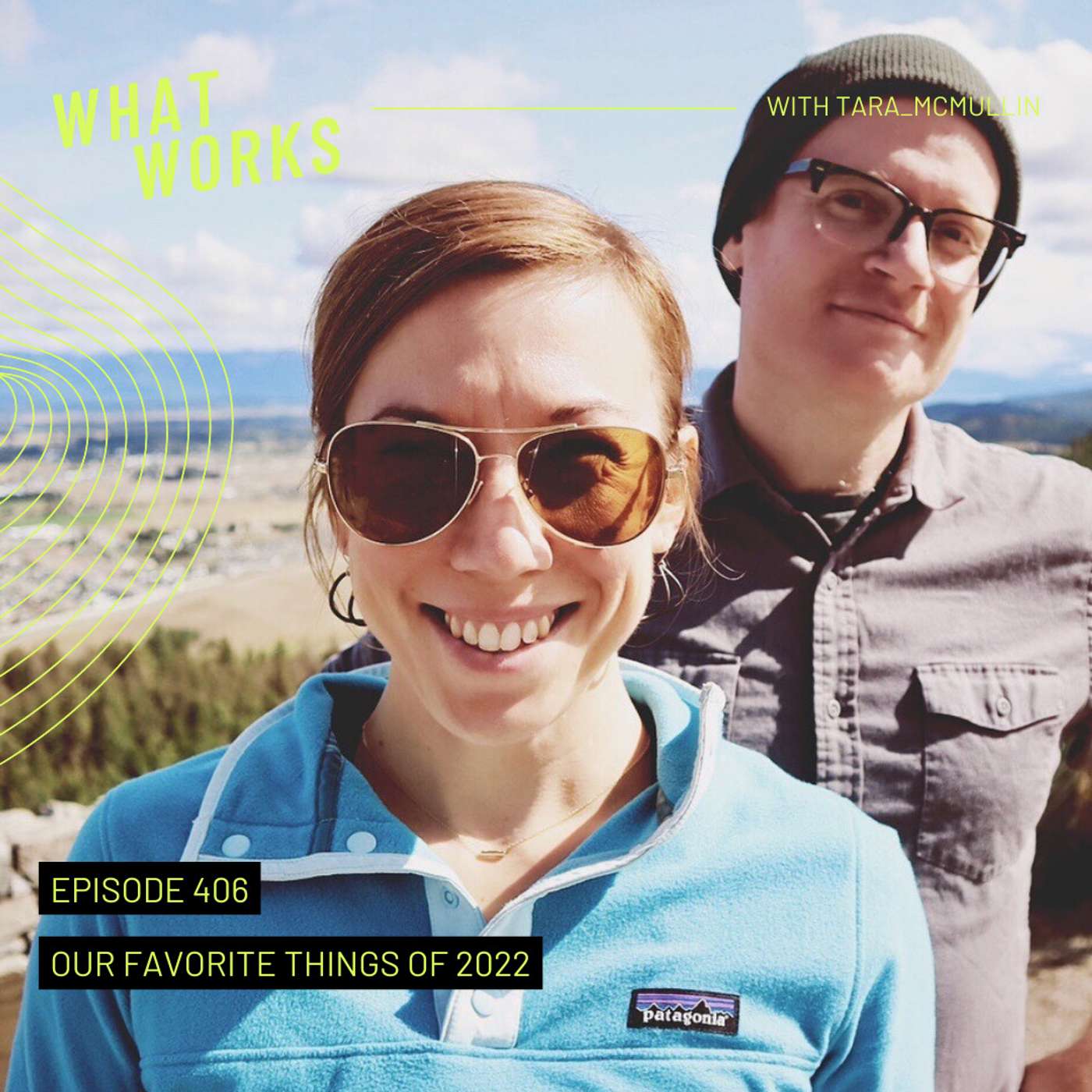
EP 406: Our Favorite Things of 2022
EThis episode is decidedly different from what you've heard on What Works this year! If this happens to be your first foray into the show, maybe start with an earlier episode.But if you're into hearing my dear husband (and executive producer) chat about the ups and downs of this year, as well as some of our favorite things of the past 12 months, listen on!All of the books we mention in this episode are linked in my Bookshop store.Thanks for listening this year! Look for new episodes in 2023. I've got some great stuff planned.***Our work has evolved. Our way of working has not. Make 2023 the year you transform the way you work.I'm teaching a 3-part live workshop in January called Work In Practice. I'll guide you through rethinking the way you work from the ground up. We'll dismantle old mindsets and standard operating procedures. And then we'll rebuild a vision for work that's based on sustainability and satisfaction. Get all the details at WorkInPractice.Life! ★ Support this podcast ★
EP 405: What causes work stress? And what can we do about it?
Everyone experiences work stress from time to time. But some of us experience persistent work stress—even though we have more "tools" for reducing stress than ever before. If you've experienced work stress this year, there's a good chance you're thinking about how you can create the conditions for less stress in the new year. So today, I'm exploring how psychologists understand what kinds of work create more stress, what conditions reduce stress, and how we might intentionally design our work to be more sustainable.Note: In the last third of the episode, I use a swear word (commonly abbreviated B.S.) to reference a book & theory by David Graeber. It's the name of the theory... so I use it a lot. If you'd rather not hear it, stop the episode around 17:45. You'll still get most of the message!Footnotes:Creating Sustainable Work Systems: Developing Social Sustainability (2008)Chapter: "Sources of work intensity in organizations" by Armand Hatchuel (2005)Demand-Control Theory Job Demand-Resource ModelThe Office (US Version)B***S*** Jobs: A Theory by David GraeberLooking for a great gift for your clients, colleagues, or team members? How about my new book, What Works? It's a great way to spread the message that we don't have to do things the way they've always been done. And you can provide a little relief when it comes to all that "New Year, New You" garbage. Grab your copy here!Essay versions of each podcast episode are released every Thursday. Get them delivered straight to your inbox by subscribing here—free of charge.Reviewing the past year and planning for nextIf you’re listening to this close to its air date, you’re probably thinking about how this year went and what you’d like to tackle in the next year. I suggest including a review of the demands of your work, the autonomy you allow yourself, and the resources you have at your disposal:Does your work present challenges that motivate you to learn and think creatively? Are those challenges met with an appropriate level of autonomy and sufficient resources?In what ways do you deny yourself flexibility in the way you work? How does flexibility (or lack thereof) impact how you meet the challenges of your work?What resources would allow you to challenge yourself in new ways?What challenges would you like to take on in the new year? ★ Support this podcast ★

EP 404: What lights your fire?
Over the last two years, I've transitioned from identifying as a business owner first to identifying as a writer and podcast first. In the first year—2021—I didn't realize that's what I was doing. But over the course of this year, it was quite intentional. Making that shift has allowed me to explore creative territory that I didn't think I could explore when my primary function was content marketing. In this week's episode, I talk with India Jackson about transitioning from content marketer to writer and podcaster. I share what it's meant for my work, my sense of identity, and my mental health. Plus, we talk about some of the difficult decisions I had to make on this journey.Tune in to India's show, Flaunt Your Fire, wherever you listen to What Works or at flauntyourfire.comFootnotes:Find out more about India Jackson and Flaunt Your FireFind out more about Pause On The PlayHear India on EP 398: Good Bodies and EP 294: Offering Bespoke ServicesJay Acunzo's LinkedIn postGrab your copy of my new book, What Works: A Comprehensive Framework to Change the Way We Approach Goal-Setting! ★ Support this podcast ★
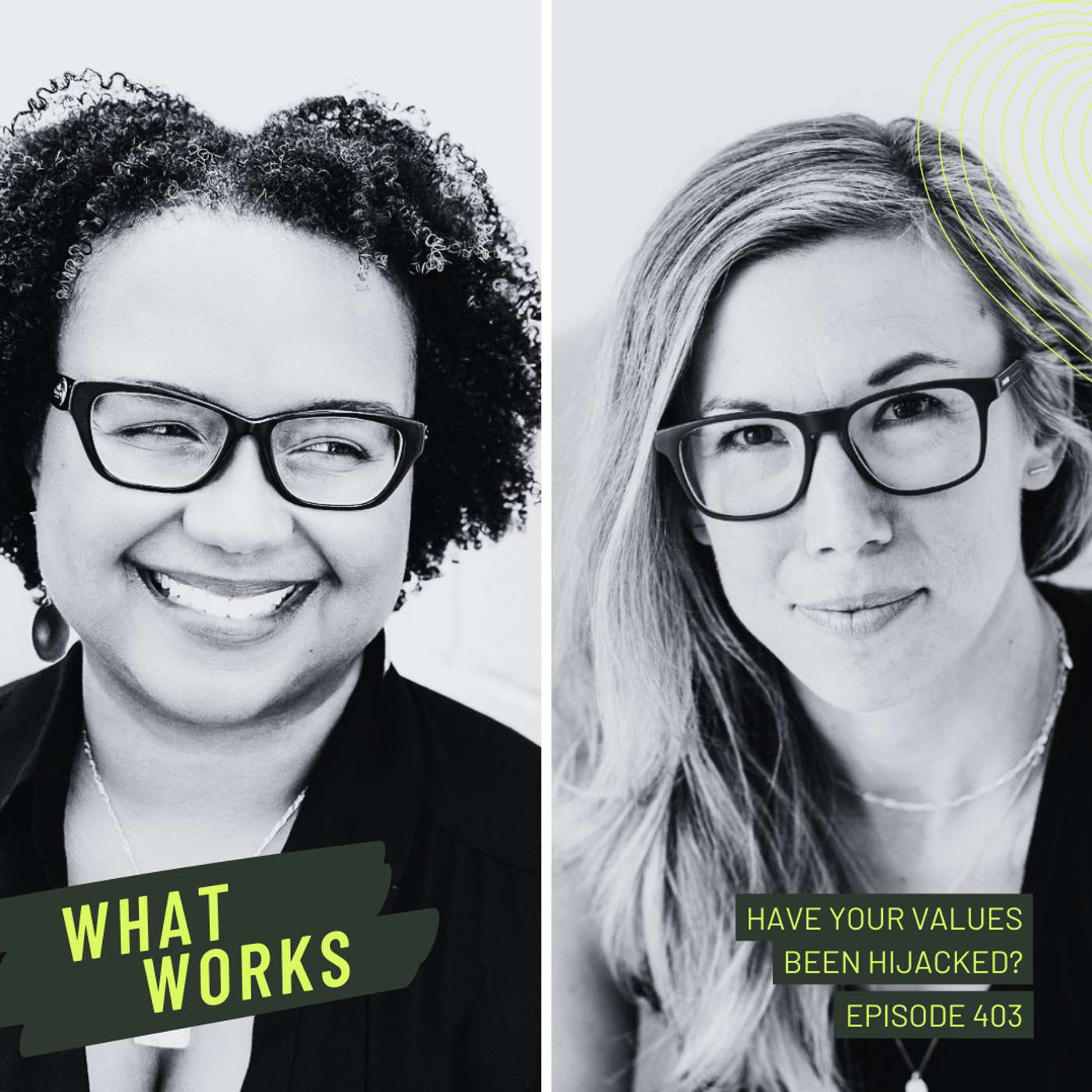
EP 403: Have your values been hijacked?
The shelves are full of products that promise to fulfill your values: ecofriendly, independent, cooperative, woman-owned, Black-owned, sustainable, etc. And right on! Unfortunately, not every product that claims to align with your values really does. Often, values-marketing is more about maintaining the status quo than it is about doing things differently. That’s what I call “values hijacking.”Values hijacking occurs on the consumer level, but it also occurs on the cultural and political levels. Marketing, government policy, incentive structures, and cultural norms can all short circuit our critical thinking about what action to take.On today’s episode, you’ll hear about one my husband’s biggest soapbox issues, and then I’ll turn the mic over to Erica Courdae, host and founder of Pause on The Play, and we’ll go deep on how our values become hijacked by systems of power.Footnotes:More about Erica Courdae and Pause on the Play.POTP Episode 178: Values hijacking, capitalism, and systemic change with Tara McMullin ★ Support this podcast ★
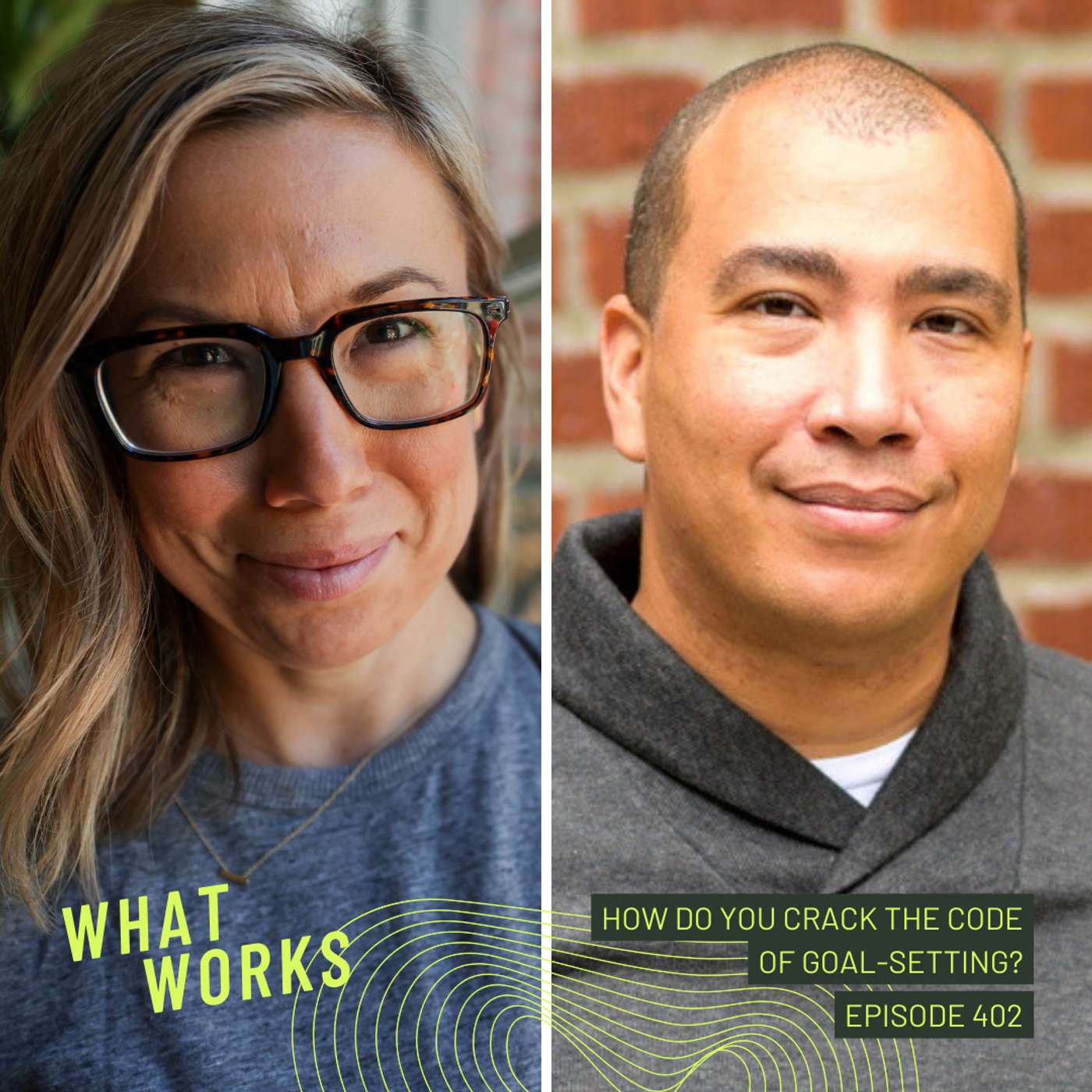
EP 402: How do you crack the code on goal-setting?
What is a goal really? What purpose does a goal really serve? And is that purpose truly benefiting us, the goal-setters?These are big, messy questions. But they are far from abstract. Our answers to these questions—whether we know it or not—shape the way we work and live on a daily basis. This intermediary space—the space between philosophical questions and practical implications—is a place I happily hang out in all day long. Luckily, I know someone who likes hanging out in that place as much as I do!His name is Charlie Gilkey. He’s a friend of the pod—as well as the co-founder of Productive Flourishing and author of Start Finishing. He’s also the host of the Productive Flourishing podcast.Today’s episode is a rebroadcast from the Productive Flourishing feed. Charlie and I talk about why in the world I wrote a productivity book, how the cultural code we operate in impacts the way we plan and set goals, how that code disproportionately harms some more than others, and much, much more.Footnotes:What Works: A Comprehensive Framework to Change the Way We Approach Goal-Setting by Tara McMullinMore about Charlie GilkeyStart Finishing by Charlie GilkeyListen to Productive FlourishingBroken (in the Best Possible Way) by Jenny LawsonDown Girl: The Logic of Misogyny by Kate ManneWritten versions of each episode drop on Thursdays at explorewhatworks.com. Get them deliverable to your inbox by subscribing at explorewhatworks.com/weekly.Introducing Recovering Overachiever ClubRecovering Overachiever Club is a 3-week deep dive into why we strive and what we can do differently in the new year. Join us November 29-December 20 for exclusive essays, podcast episodes, and conversation—oh, and earn a few merit badges, too. Learn more! ★ Support this podcast ★
EP 401: Do we really all have the same 24 hours?
Do we really have the same 24 hours as Beyoncé? Yes. And no. And… it’s complicated.There is a never-ending stream of advice about how to make the most of your time. And honestly? Most of it is just bullsh*t. That’s because there is no way to hack yourself or your work to produce more in less time if your emotions are fried, your energy is drained, or you’re dealing with the effects chronic illness.This conversation—originally broadcast as a Spotify Live—is an unflinching look at what it means to consider our multidimensional capacity in the realms of work and life. You’ll hear from my friends Jenny Blake, author of Free Time, and Charlie Gilkey, author of Start Finishing—and me, too!Note: the audio quality on this episode is totally listenable—but it’s not our normal podcast quality.Footnotes:Get What Works: A Comprehensive Framework to Change the Way We Approach Goal-Setting by Tara McMullinFind out more about Jenny BlakeBuy Free Time by Jenny BlakeFind out more about Charlie GilkeyBuy Start Finishing by Charlie GilkeyWritten versions of our podcast episodes land on Thursdays at explorewhatworks.com. Get them delivered straight to your inbox by subscribing at explorewhatworks.com/weeklyIntroducing Recovering Overachiever ClubRecovering Overachiever Club is a 3-week deep dive into why we strive and what we can do differently in the new year. Join us November 29-December 20 for exclusive essays, podcast episodes, and conversation—oh, and earn a few merit badges, too. Learn more! ★ Support this podcast ★
EP 400: The Power of Practice
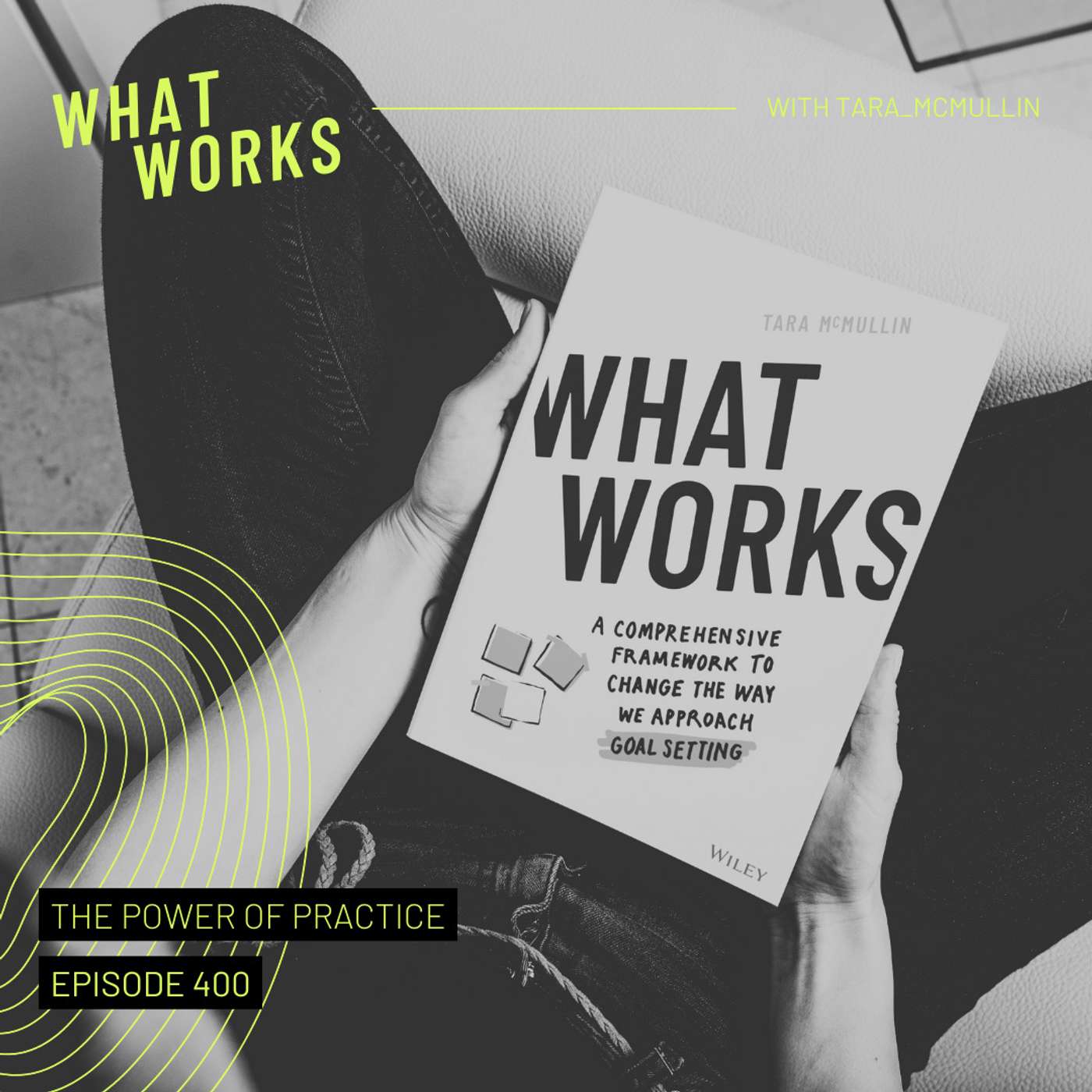
It’s been almost exactly 7 years since this podcast first launched as Profit. Power. Pursuit. Since then, we’ve produced 400 regular episodes (with some bonuses here and there). You know, I’ve written many more than 400 blog posts and emails. But we don’t number those—plus, they are published across different sites on the web, so I never have a handled on just how many times I’ve hit “publish.”400 episodes is a lot. It’s more than the vast majority of podcasters will ever make. The only reason I bring that up is because today’s episode is about the power of practice. Developing a podcasting practice is the only way to consistently put out a strong episode week after week. But developing a practice of any kind was not something I knew how to do 7 years ago.This episode dives into what I’ve learned about practice from 7 years of podcasting. Plus, I share an excerpt from my book (out today!) about the satisfaction of practice in an achievement-oriented world.Footnotes:Join Tara TODAY for a live reading and Q&A about the bookBuy What Works: A Comprehensive Framework to Change the Way We Approach Goal-Setting wherever you buy books!Listen to Tara’s interviews about the book on this Spotify playlist ★ Support this podcast ★
EP 399: Self Help, LLC: The Politics of Hustle Culture with Jadah Sellner
Hustle. Grind. Boss up. Do more. Love them or hate them, these words are embedded into the ways we think about work and entrepreneurship. But as we’ve seen with the enormous growth of the r/anti-work subreddit and the panic about quiet quitting, more people than ever are thinking about different ways to go about building their lives, careers, and businesses.As we close out the Self-Help, LLC series, I wanted to address where our productivity hang-ups come from, who our productivity really benefits, and how we might go about doing things differently. This episode is in 2 parts. The first half or so is an introduction to how employers (including self-employers) profit from unpaid work and why the productivity-wage gap has become so immense. The second half of the episode is my conversation with Jadah Sellner, about the vision for business she lays out in her new book, She Builds.Footnotes:Find out more about Jadah Sellner and her new book, She Builds.“TikTok ‘5-to-9’ Trend Shows Quiet Quitting Hasn’t Killed Hustle Culture” on BloombergDolly Parton rewrites her working woman’s anthem for SquareSpaceTHE ULTIMATE MORNING ROUTINE (parody)Revolution at Point Zero, essays by Silvia FedericiData on the productivity-wage gap (Economic Policy Institute)Self-Help, INC by Micki McGeeDebt: The First 5,000 Years by David GraeberEssay versions of each episode of the podcast come out on Thursdays at explorewhatworks.com and in my newsletter. Sign up free: explorewhatworks.com/weekly ★ Support this podcast ★
EP 398: Self Help, LLC: Good Bodies With India Jackson, Tiffany Ima, and Jessica DeFino
I wanted to include an episode on bodies in the Self-Help, LLC series because so much of our modern discourse around productivity, empowerment, entrepreneurship, and personal growth includes messages about our bodies. These messages might not be explicit, but the messages are there—and our brains pick them up loud and clear.Similarly, we might not realize that we’re sharing messages that insert themselves into how others perceive their own bodies—but many of us are. It’s impossible to talk about self-discipline, accountability, or efficiency without those concepts leaving their marks on our flesh.This episode covers a tiny sliver of all the ways that the medium of self-help acts on our bodies. But my hope is that it will encourage you to think critically about the messages you receive about your body and the messages you share that might impact others’ bodies.You’ll hear from independent beauty culture journalist Jessica DeFino, body confidence influencer Tiffany Ima, and Flaunt Your Fire founder India Jackson.This episode contains frank talk about bodies, weight, beauty, dieting, and related topics. I know that these subjects can trigger harmful thoughts and behaviors for me if I’m not careful. So please, take care while listening to this episode.Footnotes:Subscribe to Jessica DeFino’s newsletter about beauty culture and the beauty industry.Follow Tiffany Ima on Instagram.Listen to the Flaunt Your Fire podcast and learn more about India Jackson.Erica Courdae on reconsidering your normal, as well as “Normal is a Life with Michelle Kuei” on the Pause on the Play podcast.“Body acceptance stops at the skin. Why?” by Jessica DeFino“The Skin as an Antidote to Consumerism” by Jessica DeFino“How White Supremacy and Capitalism Influence Beauty Culture” by Jessica DeFino in TeenVogueWhat We Don’t Talk About When We Talk About Fat by Aubrey Gordon“Postscript on Societies of Control” by Gilles DeleuzeSelf-Help, INC by Micki McGee“Rachel Hollis Part 1: Hashtag Relatable” on Maintenance Phase“The Trouble with Calories” on Maintenance Phase“Bodybuilding vs Powerlifting vs Weightlifting” on ShapeConfidence Culture by Shani Orgad and Rosalind GillLet’s Get Physical: How Women Discovered Exercise and Reshaped the World by Danielle Friedman3 Books for Remembering “You Have a Body”: On disability, on chronic illness, and on our bodies in society ★ Support this podcast ★