
What Lies Beyond Podcast
Companion site and podcast for the book What Lies Beyond: Consciousness science, the paranormal and the post-material future by Matt Colborn
Matt Colborn
Show overview
What Lies Beyond Podcast launched in 2024 and has put out 31 episodes in the time since. That works out to roughly 30 hours of audio in total. Releases follow a monthly cadence, with the show now in its 3rd season.
Episodes typically run an hour to ninety minutes — most land between 52 min and 1h 20m — though episode length varies meaningfully from one episode to the next. It is catalogued as a EN-language Science show.
There hasn’t been a new episode in the last ninety days; the most recent episode landed 10 months ago. Published by Matt Colborn.
From the publisher
What Lies Beyond with Matt Colborn. Conversations on consciousness science, the paranormal and the post-material future. Visit us and subscribe on whatliesbeyond.substack.com whatliesbeyond.substack.com
Latest Episodes
View all 31 episodes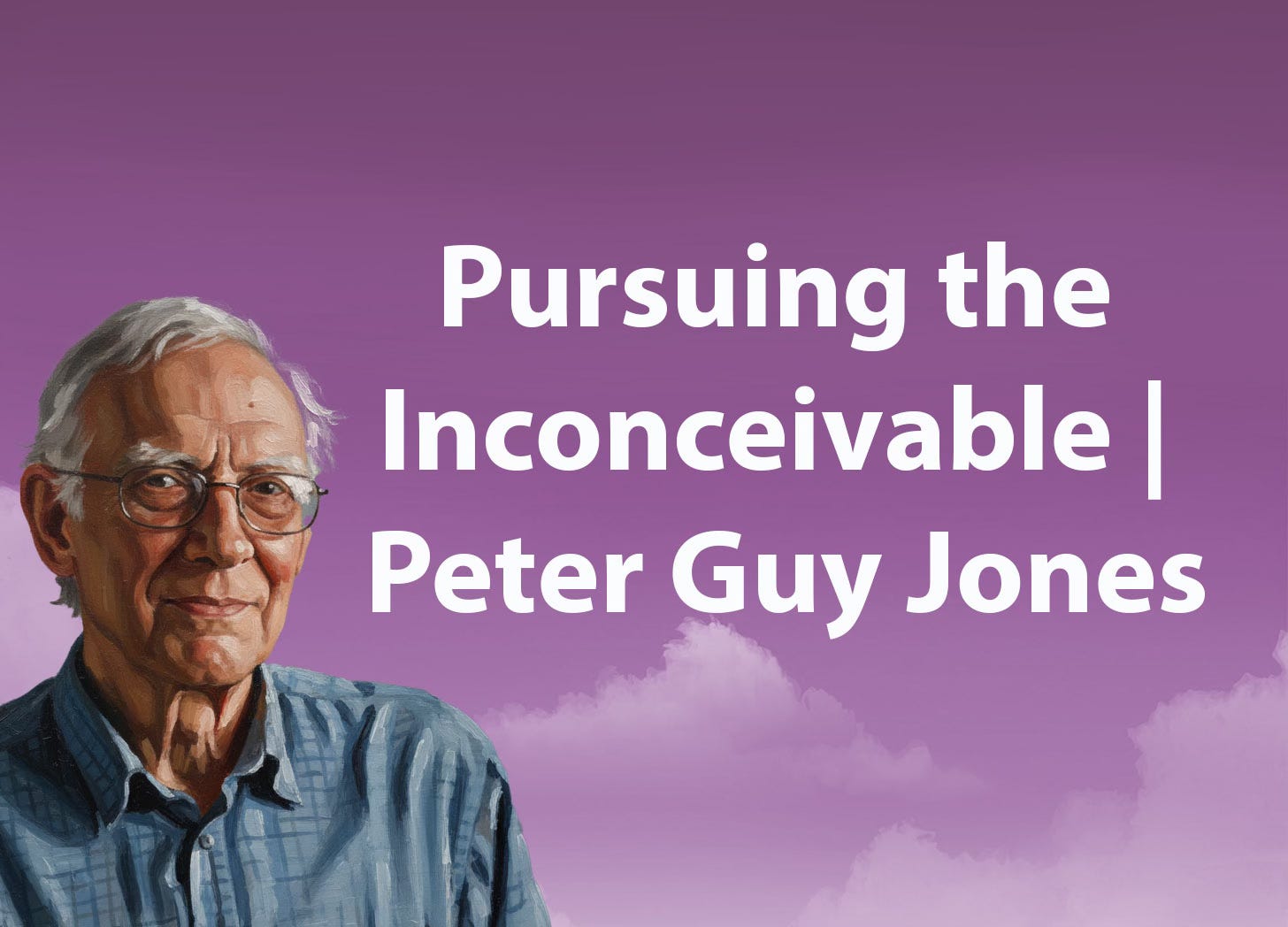
S3 Ep 4Pursuing the Inconceivable | Peter Guy Jones
Show NotesSeason 3 Episode 4 ‘Pursuing the Inconceivable’Today my guest is Peter Guy Jones. Peter has had a career as a musician, studio engineer and CEO of a music and media company. He has devoted two decades to the research that informs his new book, In Pursuit of the Inconceivable. Over time he’s developed the view that most philosophers approach their chosen subject in an ineffective way, failing to address global and foundational issues before moving on to a study of the endless details, becoming trapped in a maze of problems without resolution.He believes this to be the consequence of not engaging with the world-theory endorsed by the writers of the Indian Upanishads, the Buddha, Lao Tzu, Meister Eckhart and, many would say, Jesus and Muhammad. His mission is to persuade readers that when philosophy is approached in a naïve, open-minded and rigorous manner it may be rendered problem-free and comprehensible, and the world and human nature along with it. Join us for a provocative and hopefully enlightening dialogue!ResourcesWebsite of Peter Guy Jones.His Substack.Jones, P.G. (2025). In Pursuit of the Inconceivable: An Investigation of Metaphysics and Mysticism. Essentia Books.My review of In Pursuit of the Inconceivable.Thanks for reading WHAT LIES BEYOND! Subscribe for free to receive new posts and support my work.People/Topics MentionedStrange Loops! A classic strange loop in logic is Epimenides’ paradox. See also Escher’s waterfall, above.There’s one in Doctor Who, from ‘Castrovalva’ (1982).More Strange Loops in:Hofstader, D.R. (1979). Godel, Escher, Bach: An Eternal Golden Braid. Penguin.Nagarjuna. (Peter’s pronunciation of his name in the interview is more accurate than mine!)‘Middle Way’ Buddhist philosophy.Catuṣkoṭi (4-way logic).Gospel of Thomas.Meister Eckhart.350+ theories of consciousness.Dan Dennett’s book:Dennett, D. (1991). Consciousness Explained. Allen Lane.Bertrand Russell on mysticism: Russell, B. (1917). Mysticism and Logic and other Essays. Taylor Garnett Evans & Co.Media“Forty-Two” as the answer the ultimate question of life, the universe and everything is from Douglas Adams The Hitchhiker’s Guide to the Galaxy. (Radio show, TV series and books). Here is Deep Thought announcing the answer after seven and a half million years!Indiana Jones and the Last Crusade (Dir: Steven Spielberg, 1989). The leap of faith!Title Music: ‘Stranger things’ by Music Unlimited on Pixabey.Thanks for reading WHAT LIES BEYOND! Subscribe for free to receive new posts and support my work. This is a public episode. If you would like to discuss this with other subscribers or get access to bonus episodes, visit whatliesbeyond.substack.com
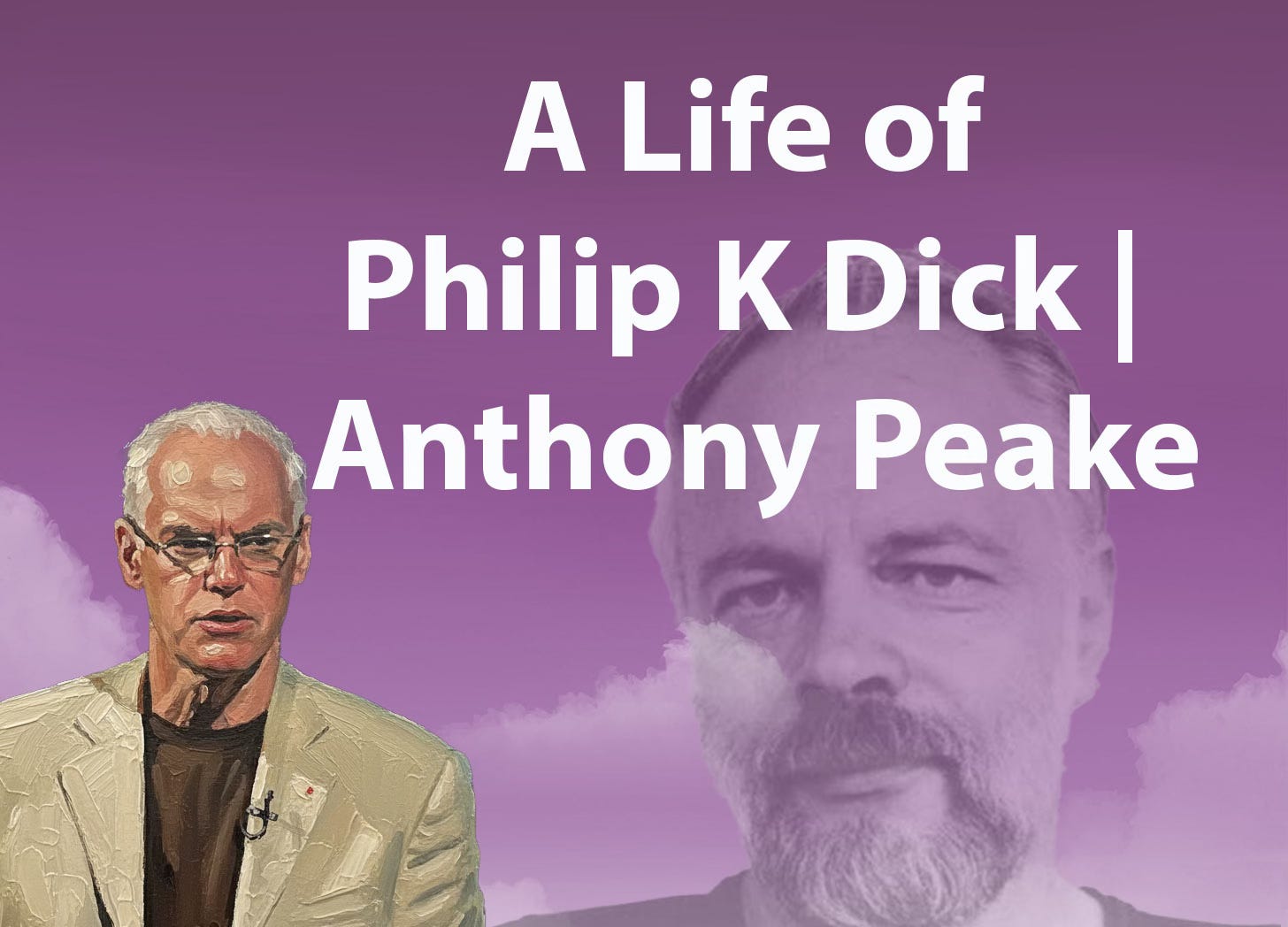
S3 Ep 3A Life of Philip K Dick | Anthony Peake
EShow NotesSeason 3 Episode 3 ‘A Life of Philip K Dick’Today I have a dialogue with returning guest Anthony Peake. Anthony is a writer who deals with borderline areas of human consciousness. His first book, ‘Is There Life After Death?’, was published by Arcturus books in 2006. It detailed Anthony’s ‘Cheating the ferryman’ hypothesis, which argues that we experience our lives over and over again, like the movie Groundhog Day. This book has now sold over 60,000 copies world-wide and has been translated into various foreign language editions.In 2013, Anthony Peake published a book on the Science Fiction writer Philip K. Dick, also known as PKD. Anthony sees many intriguing parallels between Philip K Dick’s ideas and his own. So in today’s feature-length dialogue, we take a deep dive into the life and literary career of PKD. We discuss the weird experiences that inspired much of that fiction. And we attempt to draw out the significance of PKD’s work for our understanding of consciousness, reality and time.Thanks for reading WHAT LIES BEYOND! Subscribe for free to receive new posts and support my work.ResourcesAnthony Peake’s website.His Book on Philip K. Dick:Peake, A. (2013). A Life of Philip K. Dick: The Man Who Remembered the Future. Arcturus Editions.PKD is also mentioned in: Peake, A. (2010). Daemon: A Guide to Your Extraordinary Secret Self. Arcturus.Anthony’s J.B. Priestley talk on YouTube from July 2025.Philip K Dick: Works MentionedThe Exegesis:Dick, P.K. (2012). The Exegesis of Philip K Dick. Gollancz.Sibyl illustration:Novels Mentioned:Dick, P.K. (1956). The World Jones Made. Ace Books.Dick, P.K. (1959). Time Out of Joint. J. B. Lippincott Company.Dick, P.K. (1962). The Man in the High Castle. Putnam.Dick, P.K. (1967). Counter Clock World. Berkley Books.Dick, P.K. (1968). Do Androids Dream of Electric Sheep? Doubleday.Dick, P.K. (1969). Ubik. Doubleday.Dick,P.K. (1977). A Scanner Darkly. Doubleday.Dick, P.K. (1981). Valis. Bantam Books.A full list of PKD’s writing is available on Fantastic Fiction.Other Resources1974 Rolling Stone article and interview with PKD.Andrew M. Butler’s guide to PKD. Contains descriptions of major themes in his work:Butler, A.M. (2000). Philip K Dick. Pocket Essentials.PKD Otaku (Fanzine).Philip K Dick’s Religious or Mystical Experience, 2:3:74, was depicted in a comic by Robert Crumb in Weirdo #17. This is a good overview of the experience. However, it is the ‘authorised’ or ‘official’ version promoted by PKD. In the podcast we discuss some problems with PKD’s telling of 2:3:74.Hypnogogia & migraine: Mavromatis, A. (1981). Hypnagogia : the unique state of consciousness between wakefulness and sleep. Routledge & Kegan Paul.Alice in Wonderland syndrome on Wikipedia.Bicameral Mind:Jaynes, J. (2000). The Origin of Consciousness in the Breakdown of the Bicameral Mind. Mariner Books.Cosmic Consciousness:Bucke, M. (1905). Cosmic Consciousness: A Study in the Evolution of the Human Mind. Innes & Sons.Sapir-Whorf hypothesis (language shapes reality).Other authors mentioned:Works of Robert Anton Wilson on Fantastic Fiction. I’d especially recommend the Schrodinger’s Cat trilogy!Ray Bradbury on Fantastic Fiction.Works of SF author Philip Jose Farmer on Fantastic Fiction. (Especially Riverworld series).Ursula Le Guin on Fantastic Fiction.Jorge Luis Borges on Fantastic Fiction.Samuel Beckett’s Waiting for Godot on YouTube. Whitley Strieber on Fantastic Fiction. (Includes his nonfiction books detailing his alien abduction experiences).Betty & Barney Hill’s 1961 abduction experience:Fuller, J. (1966). The Interrupted Journey: Two Lost Hours”Aboard a Flying Saucer”. Dial Press.Movies:We discuss director Christopher Nolan’s 2014 movie Interstellar.And Vanilla Sky from 2001 (dir: Cameron Crowe).And the Truman Show (1998, dir: Peter Weir).Waking Life, (dir: Richard Linklater, 2001).Arrival (dir: Denis Villeneuve, 2016).Documentaries & AdaptationsThere are many good documentaries on PKD. Here are a couple of good ones.Philip K. Dick - A Day In The Afterlife. 1994 BBC2 Documentary.The Worlds of Philip K Dick. 2018 documentary featuring Anthony Peake.Wikipedia list of adaptations of works by Philip K. Dick (Movies & TV adaptations).Title Music: ‘Stranger things’ by Music Unlimited on Pixabey.Thanks for reading WHAT LIES BEYOND! Subscribe for free to receive new posts and support my work. This is a public episode. If you would like to discuss this with other subscribers or get access to bonus episodes, visit whatliesbeyond.substack.com
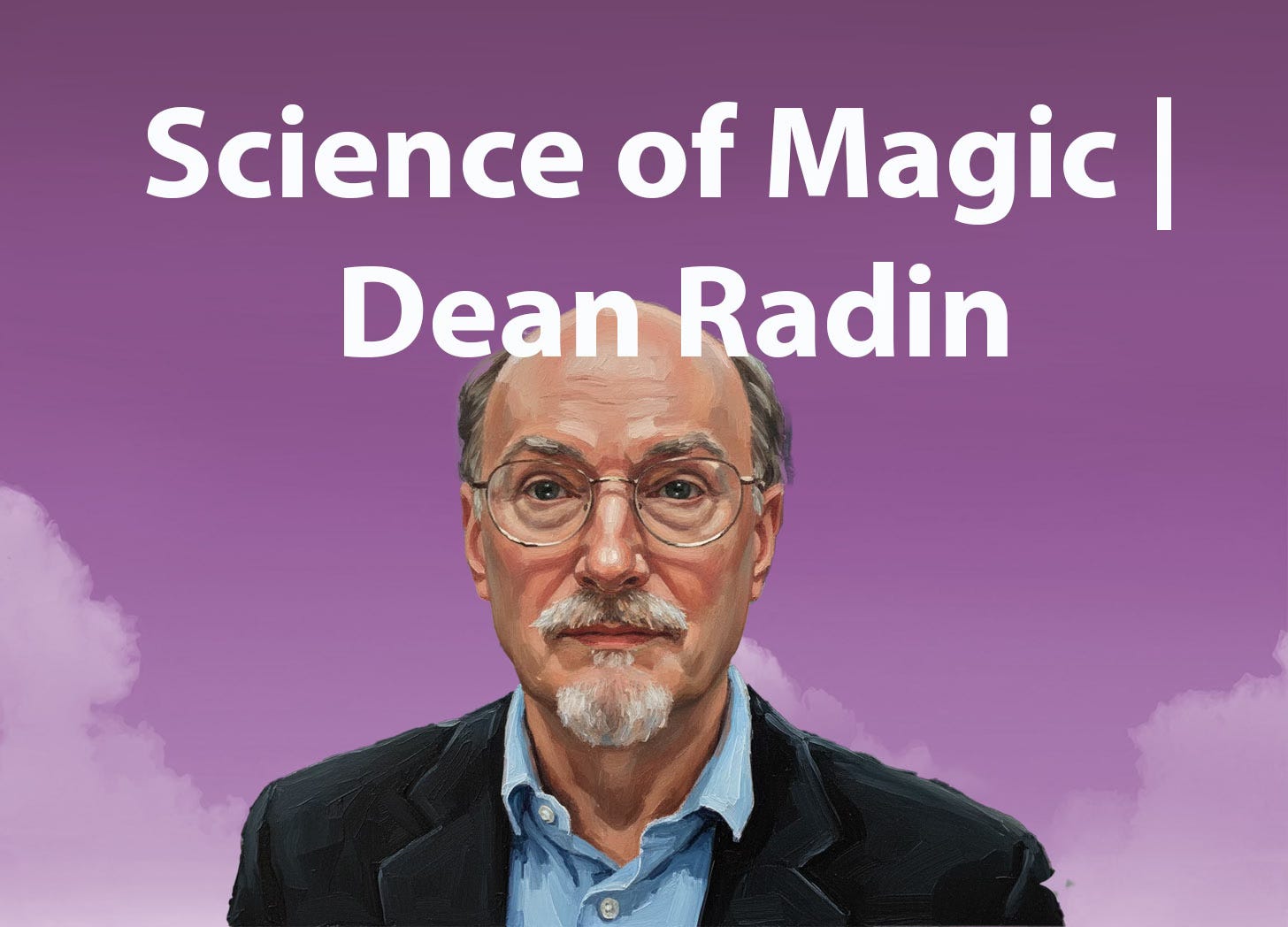
S3 Ep 2Science of Magic | Dean Radin
Show NotesSeason 3 Episode 2 ‘Science of Magic’Today my guest is Dean Radin. Dean is Chief Scientist at the Institute of Noetic Sciences (IONS), Associated Distinguished Professor at the California Institute of Integral Studies, and cofounder and vice chairman of the neuroengineering company, Cognigenics. He earned an MS (electrical engineering) and a PhD (psychology) from the University of Illinois, Urbana-Champaign. In 2022 he was awarded an Honorary DSc (doctor of science) from the Swami Vivekananda University in Bangalore, India.Before joining the IONS research staff in 2001, Radin worked at AT&T Bell Labs, Princeton University, University of Edinburgh, and SRI International. He has given over 780 talks and interviews worldwide, and he is inventor of 12 patents and author or coauthor of 340+ scientific and popular articles, book chapters, and books, four of which have been translated into 15 foreign languages. These are The Conscious Universe (1997), Entangled Minds (2006), Supernormal (2013), Real Magic (2018), and most recently The Science of Magic, published in October 2025. In today’s show we discuss the current status of the evidence in parapsychology. Dean describes some of his experiences working at the STARGATE Remote viewing program for US Intelligence. We talk about the challenges of designing experiments in parapsychology. And we discuss the relationship between psi phenomena and magic.ResourcesDean Radin’s website.His page at IONS.His books:Radin, D. (2025). The Science of Magic: How the Mind Weaves the Fabric of Reality. Harmony Books.Radin, D. (2018). Real Magic: Ancient Wisdom, Modern Science, and a Guide to the Secret Power of the Universe: Unlocking Your Natural Psychic Abilities to Create Everyday Miracles. Harmony/Rodale/Convergent.Radin, D. (2013). Supernormal: Science, Yoga, and the Evidence for Extraordinary Psychic Abilities. Harmony/Rodale/Convergent.Radin, D. (2006). Entangled Minds: Extrasensory Experiences in a Quantum Reality. Gallery Books.Radin, D. (1997). The Conscious Universe: The Scientific Truth of Psychic Phenomena. HarperOne.Dean’s entry in the Psi Encyclopedia.Other ResourcesEtzel Cardena’s 2018 paper outlining the evidence for psi phenomena:Cardeña, E. (2018). The experimental evidence for parapsychological phenomena: A review. American Psychologist, 73(5), 663–677. https://doi.org/10.1037/amp0000236Skeptical response article:Reber, A. S., & Alcock, J. E. (2020). Searching for the impossible: parapsychology’s elusive quest, American Psychologist 75(3), 391–399.Issue of Journal of Scientific Exploration that has articles responding to Reber & Alcock (2020). Landscape of Consciousness online map (Maps the 300+ theories of consciousness).Psi Encyclopedia article on Remote Viewing (Discusses Stargate).Pat Price’s remote viewing of secret passwords discussed in the following book:Targ, R. (2012). The reality of ESP: A physicist’s proof of psychic abilities. Quest books.Chris French’s comments on replication are in this interview here. See also the episode resources for links to written material.Transparent Psi project (failed large-scale replication of a precognition effect).Title Music: ‘Stranger things’ by Music Unlimited on Pixabey.Thanks for reading WHAT LIES BEYOND! Subscribe for free to receive new posts and support my work. This is a public episode. If you would like to discuss this with other subscribers or get access to bonus episodes, visit whatliesbeyond.substack.com
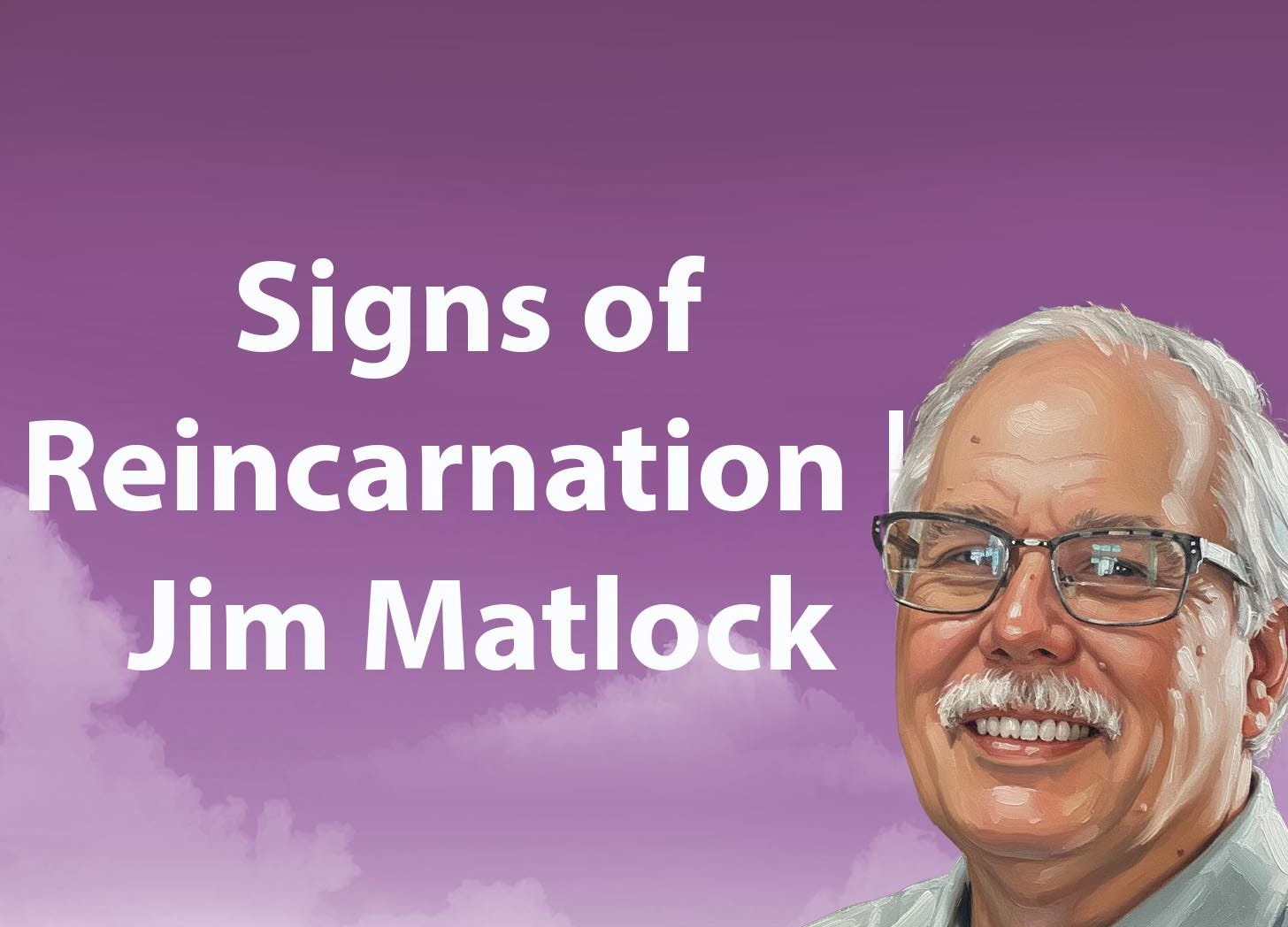
S3 Ep 1Signs of Reincarnation | Jim Matlock
Show NotesSeason 3 Episode 1 ‘Signs of Reincarnation’Today my guest is Dr. James Matlock. Jim received a B.A. in English from Emory University in 1977 and a Ph.D. in Anthropology from the University of Southern Illinois at Carbondale in 2002. He has worked at the American Society for Psychical Research in New York City and at the Rhine Research Center in Durham, North Carolina. He is presently a Research Fellow at the Parapsychology Foundation. His chief research interests are the history of parapsychology, anthropology of religion, and reincarnation. Jim also teaches a 15-week online seminar course on reincarnation research and theory.In today’s interview, we discuss the fascinating and puzzling phenomenon of children who seem accurately to recall past lives. We discuss the pioneering work of the Canadian-born psychiatrist Ian Stevenson, who founded the field. We examine some of the arguments of the skeptics. And we take a deep dive into startling cases where children exhibit not only memories but also behaviours and birthmarks associated with their past lives. We finish by discussing the shattering implications for these cases for understanding the human condition.ResourcesJim Matlock’s website, including links to his ‘Signs of Reincarnation’ online course and Facebook page.His book:Matlock, J. (2019). Signs of Reincarnation: Exploring Beliefs, Cases, and Theory. Rowman & Littlefield.Rylann O’Bannion reincarnation case. discussed in the episode. Entry in the Psi Encyclopedia.A good general introduction to this work is episode 3 of the BBC documentary, In Search of the Dead. Includes discussion of the discussed case where a birth deformity seemed to reflect an accident with a thresher in a previous life.Thanks for reading WHAT LIES BEYOND! Subscribe for free to receive new posts and support my work.Ian StevensonPsi Encyclopaedia entry on Ian Stevenson.Stevenson’s key books:Stevenson, I. (1966). Twenty Cases Suggestive of Reincarnation. Proceedings of the American Society for Psychical Research 26.Stevenson, I. (1997a). Reincarnation and Biology: A Contribution to the Etiology of Birthmarks and Birth Defects (2 vols). Vol. 1, Vol. 2. Praeger.Stevenson, I. (1997b). Where Reincarnation and Biology Intersect. Praeger. (This is a shorter summary of Stevenson, 1997a).Stevenson, I. (2001). Children who Remember Previous Lives: A Question of Reincarnation (rev. ed.). McFarland. (A good, shorter introduction to his work).The following book is by a journalist who accompanied Stevenson on some of his research. It’s useful as a noncommittal ‘outsider's’ perspective:Schroder, T. (2001). Old Souls: Scientific Evidence for Reincarnation from Children who Recall Past Lives. Simon & Schuster.The Division of Perceptual Studies, University of Virginia, Charlottesville, USA.Page on research into Children Who Report Memories of Past Lives.Thanks for reading WHAT LIES BEYOND! This post is public so feel free to share it.Other ResearchersJim Tucker on the Psi Encyclopedia.Stephen Braude on the Psi Encyclopedia.Other Cases/IssuesPsi Encyclopaedia entry on Bridey Murphy.Article on Super-Psi by Braude.Skeptical ResponsesSkeptic Chris French describes his experience investigating reincarnation amongst the Druse people in Lebanon about 37 minutes into my interview with him and Cal Cooper from February 2025.He writes about this experience in chapter 6 of his book:French, C. (2024). The science of weird S**t: Why our mind conjures the paranormal. MIT Press.Jim Matlock has also written an overview of criticisms of reincarnation case studies for the Psi Encyclopedia. This has references to extensive skeptical responses to reincarnation work.Title Music: ‘Stranger things’ by Music Unlimited on Pixabey.Thanks for reading WHAT LIES BEYOND! Subscribe for free to receive new posts and support my work. This is a public episode. If you would like to discuss this with other subscribers or get access to bonus episodes, visit whatliesbeyond.substack.com

S2 Ep 11Free Will in Nature | Jem Bendell
EShow NotesSeason 2 Episode 11 ‘Free Will in Nature’Today my guest is Jem Bendell. Before the summer of 2023, Jem was a full Professor of Sustainability Leadership and Founder of the Initiative for Leadership and Sustainability (IFLAS) at the University of Cumbria. He was also the founder of the Deep Adaptation Forum and the co-founder of the International Scholars’ Warning on Societal Disruption and Collapse. A major transformation in his career began in 2017 as he took a year out to study the latest climate science and released the Deep Adaptation paper which went viral.After the release of his book Breaking Together in May 2023, Jem decided to leave employment as a full Professor in the UK. Jem then entered a new phase of his life, where the development of the Bekandze regenerative farm school in Bali and playing devotional music for groups become his main focus. He still writes and lectures on collapse readiness and response.Jem begins today’s discussion with an outline of the main thesis of Breaking Together: that societies globally have already begun to experience climate breakdown driven collapse. This gives a context for our main discussion of free will in nature. We look at the claims by some biologists and neuroscientists that free will is an illusion. Jem suggests reasons to doubt this verdict, and why free will might in fact exist throughout the natural world. We discuss Buddhist and Vedantic ideas about consciousness. And Jem explains why it’s crucial to admit the limitations of our knowledge in the face of the ultimate questions about life and death.ResourcesJem Bendell’s websiteHis book, which includes chapters detailing the evidence for ongoing global systemic collapse. Chapter 11 discusses free will:Bendell, J. (2023). Breaking together: A freedom-loving response to collapse. Schumacher InstituteFree audio reading of the introduction to Breaking Together.His first essay in a series about Free Will. (Includes a discussion of the Libet etc. experiments which purport to disprove free will)Jem Bendell’s Buddha at the Gas Pump Interview from 2024ResourcesCollapseIs Collapse Plausible by Matt Colborn. See also the Collapsology Portal, which exists to ‘Better understand the current risks of social and environmental collapse’. Includes an up to date listing of scientific papers on the topic.Free will deniers:Sapolsky, R. (2023). Determined: The Science of Life Without Free Will. Penguin.Wegner, D. (2017). The Illusion of Conscious Will. MIT Press. Silicon Valley:Rushkoff, D. (4 Sept 2022 ). The super-rich ‘preppers’ planning to save themselves from the apocalypse. The GuardianYanis Varoufakis on technofeudalismBurnout:Wright, S. (2021). Burnout: a spiritual crisis: from stress to transformation. Sacred Space Publications.Thanks for reading WHAT LIES BEYOND! Subscribe for free to receive new posts and support my work.Title Music: ‘Stranger things’ by Music Unlimited on Pixabey. This is a public episode. If you would like to discuss this with other subscribers or get access to bonus episodes, visit whatliesbeyond.substack.com

S2 Ep 10Transpersonal Psychology for Global Flourishing | Jessica Bockler
Show NotesSeason 2 Episode 10 ‘Transpersonal Psychology for Global Flourishing’Today my guest is Jessica Bockler, PhD. Jessica is an applied artist, transpersonal psychologist and Co-founding Director of the Alef Trust. She serves as Deputy CEO and works across Alef Trust’s academic and applied portfolios. Trained in applied and physical theatre, Jessica has extensive experience of expressive arts facilitation, as well as experimental movement and voice work. She specializes in embodied approaches to accessing creativity and imagination, and she is the founder of Creative Alternatives, an arts-based mental wellbeing service in the UK, which provides creative interventions to adults experiencing depression, stress and/or anxiety. The service is one of the longest established social prescribing projects in the UK and has won several awards for innovation in public service delivery.We begin with a look at how creativity, imagination and play can enhance your mental health. We explore the connections between embodiment, transpersonal psychology and mystical experience. Jessica describes some of her work with the Conscious Community Initiative, which explores the intersections between inner transpersonal practice and social change. We discuss the Inner Development Goals of the UN. And we finish with an important dialogue on how to acknowledge and respond constructively to the current moment of political, cultural and ecological turmoil.ResourcesThe Alef TrustJessica at the Alef Trust.The Conscious Community InitiativeFields of ChangeTopics discussedMaharishi Effect paperThe Global Consciousness ProjectEntangled Activist:Lawson, A. (2023). The Entangled Activist: Learning to recognise the master's tools. Perspectiva Press.Burnout:Wright, S. (2021). Burnout: a spiritual crisis: from stress to transformation. Sacred Space Publications.Negative emotions:Goleman, D. (2004). Destructive Emotions and How We Can Overcome Them. Bloomsbury Publishing.Chodron, P. (2002). The Places that Scare You: A Guide to Fearlessness in Difficult Times. Shambhala. Joanna Macy’s Active HopePatten, T. (2018). A New Republic of the Heart: Awakening into Evolutionary Activism. A Guide to Inner Work for Holistic Change (Sacred Activism). North Atlantic Books.Inner Development Goals:https://innerdevelopmentgoals.orgThere are many ways of organising societies:Graeber, D. & Wengrow, D. (2021). The Dawn of Everything: A New History of Humanity. Allen Lane.Title Music: ‘Stranger things’ by Music Unlimited on Pixabey.Thanks for reading WHAT LIES BEYOND! Subscribe for free to receive new posts and support my work. This is a public episode. If you would like to discuss this with other subscribers or get access to bonus episodes, visit whatliesbeyond.substack.com

Free What Lies Beyond Chapter One Audio Reading
This a free audio recording of Chapter 1 of What Lies Beyond: Consciousness, Science, the Paranormal and the Post-Materialist Future. Read by the author, Matt Colborn. What Lies Beyond will be available for purchase at Amazon and other retail outlets from Tuesday May 27th. (From June 1st in the US).Amazon UKAmazon USTitle Music: ‘Stranger things’ by Music Unlimited on Pixabey.Thanks for reading WHAT LIES BEYOND! Subscribe for free to receive new posts and support my work. This is a public episode. If you would like to discuss this with other subscribers or get access to bonus episodes, visit whatliesbeyond.substack.com

S2 Ep 9Miracles of Our Own Making | Liz Williams
Show NotesSeason 2 Episode 9 ‘Miracles of Our Own Making ’Today my guest is Liz Williams. Liz holds a PhD in the History and Philosophy of Science from the University of Cambridge. She is a science fiction and fantasy writer living in Glastonbury, England. She has been published by Bantam Spectra (US) and Tor Macmillan (UK) and is currently published by New Con Press, Reaktion Books, Llewellyn Books, Open Road and Thames and Hudson.Liz is also an occultist and a pagan and has published several non-fiction books on that topic. One is the 2020 book Miracles of Our Own Making: A History of Paganism. Another is the 2025 book Compendium of the Occult: Arcane Artifacts, Magic Rituals, and Sacred Symbolism. She is also the author of Rough Music: Folk Customs, Transgression and Alternative Britain.In our dialogue we discuss the status of AI and consciousness studies. We look at the intersection between consciousness, imagination and creativity. We touch on the value of Science Fiction for thinking about other worldviews. And we discuss Liz’s background in paganism and the occult.Thanks for reading WHAT LIES BEYOND! Subscribe for free to receive new posts and support my work.ResourcesLiz Williams website.Liz Williams fantastic fiction page (lists her fiction). My original interview with Liz Williams from Interzone Magazine (discusses Liz’s first two novels The Ghost Sister and Empire of Bones).Nonfiction BooksWilliams, L. (2025). Compendium of the Occult: Arcane Artifacts, Magic Rituals, and Sacred Symbolism. Thames & Hudson.Williams, L. (2025). Rough Music: Folk Customs, Transgression and Alternative Britain. Reaktion Books.Williams, L. (2020). Miracles of Our Own Making: A History of Paganism. Reaktion BooksJones, T. & Williams, L. (2012). Diary of a Witchcraft Shop. NewCon Press.Topics DiscussedArtificial IntelligenceGary Marcus’ critical blog on Artificial Intelligence.Human beings have causal models in their heads:Pearl, J. (2019). The Book of Why: The New Science of Cause and Effect (Penguin Science). Penguin.Problems with materialism and consciousness:Nagel, T. (2012). Mind and Cosmos: Why the Materialist Neo-Darwinian Conception of Nature is Almost Certainly False. Oxford University Press. Creativity and ImaginationTanith Lee’s Fantastic Fiction page (Lists fiction).The case of the woman with an alter who wrote novels:Psi Encyclopaedia page on the Patience Worth/Pearl Curran case.Robert Louis Stephenson’s Chapter on Dreams (Discusses his ‘Brownies’).The kid who thinks he is a reincarnated Hollywood extra:Ryan Hammons reincarnation case (discussed in episode).Title Music: ‘Stranger things’ by Music Unlimited on Pixabey. This is a public episode. If you would like to discuss this with other subscribers or get access to bonus episodes, visit whatliesbeyond.substack.com

S2 Ep 8The Ghost Experience | Ciaran O'Keeffe
Show NotesSeason 2 Episode 8 ‘The Ghost Experience’Today my guest is Ciaran O’Keeffe. Ciaran is an Associate Professor of Education and Head of the School of Human & Social Sciences at Bucks New University. He is a popular sceptical voice on various paranormal shows and podcasts. Ciaran has become best known for his regular appearances on Living TV’s Most Haunted and later for featuring on the popular BBC podcast and TV show Uncanny, which is now in its second series on BBC 2.Ciaran’s paranormal research has focussed on testing mediums & psychics in the lab and also field-work examining ghostly experiences. It has been reported in The Psychologist, The Times, The Independent, New Scientist and elsewhere. He has been involved in many unusual projects: physiological effects of infrasound in the Royal Festival Hall; ghost investigation of Hampton Court Palace; an exorcism ‘training day’; Hostage Negotiation simulations and lie detecting for the film Spy Game. He has written a number of ‘paranormal’ books including GhostHunters: A Guide to Investigating the Paranormal and is a co-author of the key work Ghosted!: Exploring the Haunting Reality of Paranormal Encounters.The main focus of today’s fascinating talk is the ghost and poltergeist experience. Ciaran draws upon his extensive knowledge as a psychologist and parapsychologist, and on decades of talking to eyewitnesses of extraordinary and unsettling events. We discuss ‘Haunted People Syndrome’ and why it’s important to ‘loosen up’ when considering fantastic claims. We also discuss a shared love of the 1984 movie Ghostbusters!Thanks for reading WHAT LIES BEYOND! Subscribe for free to receive new posts and support my work.ResourcesCiaran’s Linktree page, with details of his writing and projects.Page at Buckinghamshire New University:https://www.bucks.ac.uk/about-us/our-staff/ciaran-okeeffeBooksLaythe, B. et al. (2021). Ghosted!: Exploring the Haunting Reality of Paranormal Encounters. McFarland.Fielding, Y. & O’Keeffe, C. (2006). Ghost Hunters: A Guide to Investigating the Paranormal. Hodder & Stoughton.TV Shows/PodcastsUncanny (with links to TV show and podcast).Most Haunted official YouTube channel.Haunted podcast.The Battersea Poltergeist (BBC Radio 4).The Witch Farm (BBC Radio 4).2:22 A Ghost Story official website.IMDB Page for Cleanin’ Up the Town: Remembering Ghostbusters (2019 making of documentary).Other ResourcesAlan Gauld (Psi Encyclopedia entry).Tony Cornell (Psi Encyclopedia entry).The Enfield case (Psi Encyclopaedia).Poltergeists in general (Psi Encyclopaedia).BooksCornell, T. (2002). Investigating the Paranormal. New York: Helix Press.(Includes the account of ‘the seen and unseen ghost,’ discussed in the episode).Gauld, A., & Cornell, A.D. (1979). Poltergeists.Routledge & Regan Paul.Title Music: ‘Stranger things’ by Music Unlimited on Pixabey.Thanks for reading WHAT LIES BEYOND! Subscribe for free to receive new posts and support my work. This is a public episode. If you would like to discuss this with other subscribers or get access to bonus episodes, visit whatliesbeyond.substack.com

S2 Ep 7The Transliminal Mind | Christine Simmonds-Moore
Show Notes‘Season 2 Episode 7 The Transliminal Mind’Today my guest is Professor Christine Simmonds-Moore. Christine earned her Ph.D in psychology from the University of Northampton in the UK. In 2010, she left her native UK for the USA. Christine worked as a Senior Research Fellow at the Rhine Research Center in Durham North Carolina until she moved to Carrollton in 2011 to join the psychology department at the University of West Georgia. Her research interests include the study of personality types who are prone to subjective anomalous and paranormal experiences and beliefs, synesthesia, anomalous experiences and sleep-related altered states of consciousness. Recent research has focused on the roles of the body in anomalous experiences. She is currently working on a Bial funded project about Aphantasia (people who have a lack of visual mental imagery). She is the editor of Exceptional Experience and Health: Essays on Mind, body and human potential and a co-author of a text book on Anomalistic Psychology.Today we have an in-depth discussion on the relationship between paranormal experience and what Christine calls the Transliminal Mind. We discuss the psychological dimensions of anomalous experience, and their relationship to certain, specific personality types. We discuss the evidence for psi phenomena. And we talk about possible future directions for parapsychology and consciousness studies.Thanks for reading WHAT LIES BEYOND! Subscribe for free to receive new posts and support my work.ResourcesChristine at the UWA:Christine Simmonds-Moore, Phd. Page at the University of West Georgia, USA.Christine Simmonds-Moore’s entry on the Psi Encyclopaedia.Books & Chapters:Holt, N., Simmonds-Moore, C., Luke, D. & French, C. (2012). Anomalistic Psychology (Macmillan Insights in Psychology series). Red Globe Press.Simmonds-Moore, C. (eds.) (2012). Exceptional Experience and Health: Essays on Mind, Body and Human Potential. McFarland & Co.Simmonds-Moore, C. (2019). Liminal spaces and liminal minds: Boundary thinness and participatory eco-consciousness. Chapter in Hunter, J. Greening the Paranormal: Exploring the Ecology of Extraordinary Experience. August Night Press.Thanks for reading WHAT LIES BEYOND! Subscribe for free to receive new posts and support my work.Other resourcesHartmann, E. (1992). Boundaries in the Mind: A New Psychology of Personality. Basic Books.Psi Encyclopaedia page on the ganzfeld psi experimentPsi Encyclopaedia page on the psychomanteumTitle Music: ‘Stranger things’ by Music Unlimited on Pixabey. This is a public episode. If you would like to discuss this with other subscribers or get access to bonus episodes, visit whatliesbeyond.substack.com
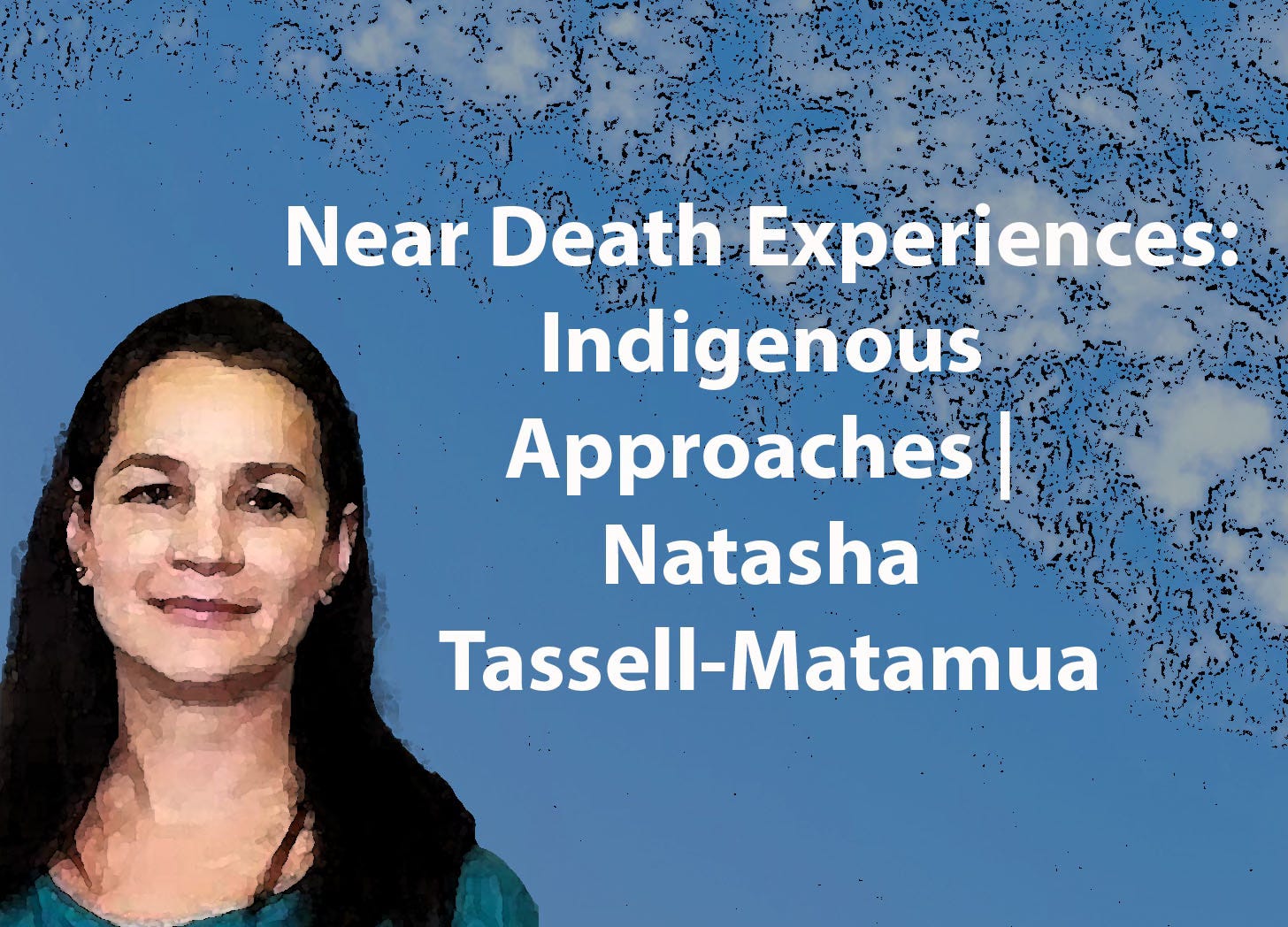
S2 Ep 6Near Death Experiences: Indigenous Approaches | Natasha Tassell-Matamua
Show Notes‘Season 2 Episode 6 Near Death Experiences: Indigenous Approaches’Associate Professor Natasha Tassell-Matamua is a Senior Lecturer and Deputy Head of the School of Psychology at Massey University in Aotearoa New Zealand. She is also co-Director of the recently established Centre for Indigenous Psychologies. Her research and teaching is in the area of indigenous psychologies, indigenous knowledges and Exceptional Human Experience. This research focusses on the interplay between spirituality, well-being and the wider ecosystem. She has spent the last decade researching the phenomenology, after-effects and cultural specificity of Near Death Experiences, and has published extensively in the area as well as providing numerous presentations both nationally and internationally.In today’s talk, we discuss Natasha’s work in Near Death Experiences and the importance of indigenous psychologies and indigenous knowledges. We talk about the problem of power and privilege in Near Death studies, which often leads to the domination of materialist-reductionist approaches. And we talk about how Māori conceptions of spirituality might contribute to better mental health and wellbeing.ResourcesNatasha’s page at Massey University, Aotearoa New Zealand:https://www.massey.ac.nz/massey/expertise/profile.cfm?stref=830930And at the Centre for Indigenous Psychologies, with her writing and some media appearances:https://www.doorofthenight.co.nz/natashaHer page on Google Scholar:https://scholar.google.co.nz/citations?user=aKsLIN0AAAAJ&hl=enThe Centre for Indigenous Psychologies:https://www.indigenouspsychologies.nzNatasha’s talk at the Alef Trust can be viewed here.Terminal Lucidity project:https://www.indigenouspsychologies.nz/terminal-lucidity-in-childrenThe Door of the Night project:https://www.doorofthenight.co.nzReference for the NDE paper we discuss:Tassell-Matamua, N. (2024). Power and privilege in the study of near-death experiences. In The Routledge Handbook of Research Methods in Spirituality and Contemplative Studies. (pp. 271 - 281).Thanks for reading WHAT LIES BEYOND! Subscribe for free to receive new posts and support my work.Other Resources“Near-death experiences are ‘electrical surge in dying brain’” — Borjigen lab’s framing of NDEs.Vandana Shiva’s chapter on Monocultures of the Mind and the exclusion of indigenous knowledges:https://journals.sagepub.com/doi/abs/10.1177/0019556119930304Title Music: ‘Stranger things’ by Music Unlimited on Pixabey. This is a public episode. If you would like to discuss this with other subscribers or get access to bonus episodes, visit whatliesbeyond.substack.com

Near Death Experiences: Cheating the Ferryman? | Anthony Peake
Show NotesSeason 2 Episode 5 ‘Near Death Experiences: Cheating the Ferryman?’Today my guest is Anthony Peake. Anthony is a writer who deals with borderline areas of human consciousness. At university he specialised in the sociology of religion, the theory of language development and the art of the Italian Renaissance. A post-graduate course in management led Anthony away from his calling as a writer and into a career as a manager in various UK businesses.In the year 2000 he was able to take a year’s sabbatical from his business career and he decided to research and write a book. This book was a distillation of all his areas of interest, quantum physics, neurology, ancient myths, altered states of consciousness and the mystery of death. Thanks to the help of Professor Bruce Greyson of the University of Virginia, an article based upon Anthony’s Cheating the Ferryman hypothesis was to appear in the Winter 2004 edition of the Journal of Near-Death Studies, the academic periodical of the International Association of Near-Death Studies (IANDS).Anthony’s first book, Is There Life After Death?, was eventually published by Arcturus books in 2006. This book has now sold over 60,000 copies world-wide and has been translated into various foreign language editions including Spanish, Russian and Polish. Anthony has now written thirteen books. All of them further develop his speculative idea of ‘Cheating the Ferryman’. His latest book, an exhaustive review of the history, anthropology and science of the much-discussed Near-Death Experience (NDE) was published in November 2024.Today’s dialogue focusses on controversies over Near-Death Experiences. We begin with a look at some of the anomalous features of NDEs, and with the tension between researchers who favour materialistic explanations in terms of brain function and those who advocate afterlife interpretations. We discuss the phenomenon of brain activity surges at the point of death. We also discuss some of the stranger features of NDEs, including commonalities with psychedelic experiences and apparent alien abductions. Anthony then describes his ‘Cheating the Ferryman’ idea. We finish with a critical discussion of the high-profile Pam Reynolds NDE, and the challenge of veridical Out of Body Experiences.ResourcesAnthony’s website:https://www.anthonypeake.comSome of his books:Peake, A. (2024). Near Death Experiences: The Science, Psychology and Anthropology Behind the Phenomenon. Arcturus.Peake, A. (2022). Cheating the Ferryman: The Revolutionary Science of Life After Death: The Sequel to the Bestselling Is There Life After Death? Arcturus.Peake. A. (2006/2021). Is There Life After Death?: The Extraordinary Science of What Happens When We Die. Arcturus.Links for all of Anthony’s books can be found on his website book shop.NDE topics1988 BBC QED Documentary ‘Glimpses of Death’, presented by Peter FenwickBlackmore, S.J. (1988). Visions from the Dying Brain. New Scientist May 1988. No 1611, pp. 43—46.Anita Morjani’s TEDx talk where she discusses her NDE.Thanks for reading WHAT LIES BEYOND! Subscribe for free to receive new posts and support my work.Vicente paper on brain activity in a dying man:Vicente, R., Rizzuto, M., Sarica, C., et al. 2022. ‘Enhanced Interplay of Neuronal Coherence and Coupling in the Dying Human Brain’. Frontiers in Aging Neuroscience 14, (21 February). https://doi.org/10.3389/fnagi.2022.813531. Pam Reynolds case:https://psi-encyclopedia.spr.ac.uk/articles/pam-reynolds-near-death-experienceRelated ExperiencesIssue of the Journal of Scientific Exploration where Survival research is debated (pp. 348—447).Description of the ‘intensified’ route of trance. Includes discussion of Mesolithic cave art as records of trance:Lewis-Williams, D. (2004). The Mind in the Cave. Thames & Hudson.Ken Ring on the link between NDEs and alien abductions:Ring, K. (1992). The Omega Project: Near-Death Experiences, Ufo Encounters, and Mind at Large. William Morrow. Whitley Strieber’s alien abduction is described in his book:Strieber, W. (1987). Communion. Avon.Title Music: ‘Stranger things’ by Music Unlimited on Pixabey. This is a public episode. If you would like to discuss this with other subscribers or get access to bonus episodes, visit whatliesbeyond.substack.com

S2 Ep 4Being, Time and Altered States | Marc Wittmann
EShow NotesSeason 2 Episode 4 ‘Being, Time and Altered States’Today’s podcast is the last of a trilogy on consciousness and time. My guest is Marc Wittmann, Ph.D. Marc is a research fellow at the Institute for Frontier Areas in Psychology and Mental Health in Freiburg, Germany. He studied psychology and philosophy at the Universities of Fribourg, Switzerland, and Munich, Germany. He received his Ph.D. at the Institute of Medical Psychology, University of Munich. From 2000 to 2004 he was head of the Generation Research Program, Bad Tölz, University of Munich. Between 2004 to 2009 he was a research fellow in the department of psychiatry at the University of California, San Diego.In today’s interview, we discuss Marc’s book Altered States of Consciousness, from MIT press. We begin with a discussion of the history of psychedelic research. Then we move onto the central issue: the intimate relationship between time, consciousness and the self. We look at the phenomenon of time expansion experiences in meditation. We touch upon a famous controversy on the nature of time between Albert Einstein and the philosopher, Henri Bergson. We discuss the disturbing disintegration of the present moment in conditions like schizophrenia. And we finish by considering the implications of mystical states, which commonly feature a profound sense of unity with the cosmos.ResourcesMarc’s book:Wittmann, M. (2018). Altered States of Consciousness: Experiences Out of Time and Self. MIT Press.First flotation tank study:Hruby, H., Schmidt, S., Feinstein, J.S. et al. Induction of altered states of consciousness during Floatation-REST is associated with the dissolution of body boundaries and the distortion of subjective time. Sci Rep 14, 9316 (2024). https://doi.org/10.1038/s41598-024-59642-yMarc’s website:https://sites.google.com/site/webmarcwittmann/Institute for Frontier Areas of Psychology and Mental Health (IGPP):https://www.igpp.de/allg/welcome_EN.htmMarc on the Psi EncyclopaediaThanks for reading WHAT LIES BEYOND! Subscribe for free to receive new posts and support my work.Topics discussedEssential Foundation’s Time and Mind conference( first talks)Hans Bender’s entry on the Psi encyclopaedia.The life and work of John Lilly, who invented floatation tanks.Roland GriffithsSteve Taylor on time expansionPhysicist Carlo Rovelli on time (YouTube)Bergson versus Einstein:Cancales, J. (2015). The Physicist and the Philosopher: Einstein, Bergson, and the Debate That Changed Our Understanding of Time. Princeton University Press.Wittmann, M. & Montemayer, C. (2022). Reinterpreting the Einstein-Bergson Debate through Contemporary Neuroscience, De Gruyter, 2022. https://doi.org/10.1515/9783110753707-019Philip K. Dick’s novel involving schizophrenia and time: Dick,P.K. (1964). Martian Time Slip. Ballantine.Iain McGilchrist’s websiteWilliam James’ Varieties of Religious Experience (discusses mystical experiences):https://www.gutenberg.org/ebooks/621Title Music: ‘Stranger things’ by Music Unlimited on Pixabey. This is a public episode. If you would like to discuss this with other subscribers or get access to bonus episodes, visit whatliesbeyond.substack.com

S2 Ep 3Contact with the Future | Jon Taylor
Show NotesSeason 2 Episode 3 ‘Contact with the Future’Today’s podcast is the second of a trilogy on consciousness and time. Jon Taylor is an interdisciplinary scientist dedicated to the study of anomalous phenomena related to cognition. He graduated from the University of Cambridge with an MA in Natural Sciences. A long-time enthusiast of parapsychology, Taylor returned to Spain in 1992 to embark on a 25-year investigation into the physical and biological principles underlying precognition. In August 2024, a revised edition of his book Contact with the Future: The Astonishing Power of Intuition and Precognition, featuring a foreword by Stanley Krippner, was published on Amazon. Jon is also a Professional Member of the Parapsychological Association.In this fascinating interview, Jon discusses his theory that precognition is the major form of Extra Sensory Perception. He also thinks that there might be a physical explanation for seeing the future, basing his theory on ideas from quantum physics developed by the late David Bohm. He questions the assumption that psi is linked to consciousness. He also questions the claim that the acceptance of precognition would also mean the acceptance of a post-material view of consciousness. He believes that the priority is to develop a physical theory for parapsychological effects because this might lead to a more general acceptance of the field in mainstream science.Thanks for reading WHAT LIES BEYOND! Subscribe for free to receive new posts and support my work.ResourcesJon Taylor’s website:https://jontaylor.orgHis book:Taylor, J. (2024). Contact with the Future: The Astonishing Power of Intuition and Precognition. Amazon.Other precognition booksJ.W. Dunne’s book:Dunne, J.W. (1927). An Experiment with Time. A. & C. BlackEric Wargo’s book:Wargo, E. (2018). Time Loops: Precognition, Retrocausation, and the Unconscious. Anomalist Books.Danah Zohar’s book:Zohar, D. (1982). Through the Time Barrier. Heineman.Experimental Evidence for ESP/PrecognitionGuy Lyon Playfair’s work on twin telepathy:https://psi-encyclopedia.spr.ac.uk/articles/twin-telepathyHonorton, C., & Ferrari, D. C. (1989). “Future telling”: A meta-analysis of forced-choice precognition experiments, 1935-1987. Journal of Parapsychology, 53, 281–308.Storm, L. & Tressoldi, P. (2023). Assessing 36 Years of the Forced Choice Design in Extra Sensory Perception Research: A Meta-Analysis, 1987 to 2022. Journal of Scientific Exploration, 37,3, 517-535.Summary of Bem precognition controversy:https://psi-encyclopedia.spr.ac.uk/articles/feeling-future-precognition-experimentsIt is also worth reviewing my talk with skeptic Chris French on problems with replication in precognition experiments, especially in the context of the Transparent Psi project.Main paper for Transparent Psi project:Kekecs, Z., Palfi, B., Szaszi, B., Szecsi, P., Zrubka, M., Kovacs, M., ... & Aczel, B. (2023). Raising the value of research studies in psychological science by increasing the credibility of research reports: the transparent Psi Project. Royal Society Open Science, 10, 2, 191375; doi: 10.1098/rsos.191375Patrizio Tressoldi’s nonlocal perception papers, including meta-analyses, can be found here:http://www.patriziotressoldi.it/cmssimpled/index.php?page=nonlocal-perceptionMaimonides Dream Laboratory:https://psi-encyclopedia.spr.ac.uk/articles/maimonides-dream-telepathy-researchDean Radin’s presentiment experiments:https://psi-encyclopedia.spr.ac.uk/articles/presentimentGertrude Schmeidler (coined term ‘sheep-goat’ effect in parapsychology):https://psi-encyclopedia.spr.ac.uk/articles/gertrude-schmeidlerPhysicsPhysicist David Bohm’s book on the implicate order (available in full):Bohm, D. (1980/20020. Wholeness and the implicate order. Routledge & Kegan Paul.Physicist Carlo Rovelli on time lecture here.Title Music: ‘Stranger things’ by Music Unlimited on Pixabey. This is a public episode. If you would like to discuss this with other subscribers or get access to bonus episodes, visit whatliesbeyond.substack.com

S2 Ep 2Dreaming Ahead of Time | Gary Lachman
Show NotesSeason 2 Episode 2 ‘Dreaming Ahead of Time’Today’s podcast is the first of a loose trilogy on consciousness and time. My guest is the writer and musician Gary Lachman. Gary is the author of many books on topics ranging from the evolution of consciousness to literary suicides, popular culture and the history of the occult. He has written a rock and roll memoir of the 1970s, biographies of Aleister Crowley, Rudolf Steiner, C. G. Jung, Helena Petrovna Blavatsky, Emanuel Swedenborg, P. D. Ouspensky, and Colin Wilson. He also written histories of Hermeticism and the Western Inner Tradition, studies in existentialism and the philosophy of consciousness, and about the influence of esotericism on politics and society. As Gary Valentine he was a founding member of the pop group Blondie and in 2006 was inducted into the Rock and Roll Hall of Fame. Gary was born in New Jersey, but since 1996 has lived in London, UK.We begin our talk discussing the persistent and remarkable phenomenon of dreaming the future. This leads to a discussion of the writer and existential philosopher Colin Wilson, who associated future dreaming with something he called Faculty X. We discuss the phenomenon of ‘peak experiences’, times when life seems replete with meaning. And we talk about how general lack of meaning might have contributed to the rise of extreme politics in the US and elsewhere.Thanks for reading WHAT LIES BEYOND! Subscribe for free to receive new posts and support my work.ResourcesGary Lachman’s website:https://www.gary-lachman.comSome of his books:Lachman, G. (2022). Dreaming Ahead of Time: Experiences with Precognitive Dreams, Synchronicity and Coincidence. Floris Books.Lachman, G. (2016). Beyond the Robot: The Life and Work of Colin Wilson. Tarcherperigee. (Out of Print).Lachman, G. (2016). The Caretakers of the Cosmos: Living Responsibly in an Unfinished World. Floris Books. (Contains a critique of philosopher John Gray and ‘everything is pointless’ philosophies).Lachman, G. (2018). Dark Star Rising: Magick and Power in the Age of Trump. TarcherPerigee.J.W. Dunne’s book on precognitive dreaming:Dunne, J.W. (1927). An Experiment with time. A. & C. BlackColin Wilson Books mentioned:Wilson, C. (1956). The Outsider. Gollancz.Wilson, C. (1959). The Age of Defeat. Gollancz.Wilson, C. (1971). The Occult: A history. Random houseWilson, C. (2009). Super Consciousness. Watkins books.The Essential Colin Wilson LP (YouTube) (Discusses psychologist Abraham Maslow).Title Music: ‘Stranger things’ by Music Unlimited on Pixabey.Aldous Huxley’s essay “Beliefs” is in the HarperPerrenial edition of The Perennial Philosophy. This is a public episode. If you would like to discuss this with other subscribers or get access to bonus episodes, visit whatliesbeyond.substack.com

S2 Ep 1The Case for Skepticism | Chris French & Cal Cooper
Show NotesSeason 2 Episode 1 ‘The Case for Skepticism’Today’s episode is about skeptical perspectives on the paranormal. My first guest is Professor Chris French. Chris is the Head of the Anomalistic Psychology Research Unit in the Psychology Department at Goldsmiths, University of London. He is a Fellow of the British Psychological Society and of the Committee for Skeptical Inquiry and also a Patron of the British Humanist Association. His main current area of research is the psychology of paranormal beliefs and anomalous experiences. He frequently appears on radio and television casting a sceptical eye over paranormal claims. His most recent book is The Science of Weird S**t, published by MIT press.Dr. Cal Cooper appears on What Lies Beyond for the second time. Cal’s a Chartered Psychologist with the British Psychological Society, holding postgraduate degrees in psychology, social science research methods and education. He has a long-time association with the University of Northampton, and is based there as a senior lecturer in psychology.In this episode, Chris talks about his transition from paranormal believer to skeptic. We then discuss Anomalistic Psychology, which attempts to find ordinary psychological explanations for the apparently paranormal. We also discuss problems with replication in parapsychology, which means that some researchers seem to find positive results in their experiments, but others don’t. Our discussion demonstrates why multiple perspectives are important, and why anomalistic psychology can make a crucial contribution to our understanding of paranormal experience.Thanks for reading WHAT LIES BEYOND! Subscribe for free to receive new posts and support my work.ResourcesWebsite of Chris French:http://profchrisfrench.comWebsite of Cal Cooper:https://www.callumecooper.comChris French’s book:French, C. (2024). The science of weird S**t: Why our mind conjure the paranormal. MIT Press.Jim Matlock’s reincarnation course:https://jamesgmatlock.com/signs-of-reincarnation-course/Chris French and Chris Roe British Psychological Society debate: Will the debate over psi ever be settled?Transparent psi project:https://psi-encyclopedia.spr.ac.uk/articles/transparent-psi-projectTitle Music: ‘Stranger things’ by Music Unlimited on Pixabey. This is a public episode. If you would like to discuss this with other subscribers or get access to bonus episodes, visit whatliesbeyond.substack.com

Why I wrote WHAT LIES BEYOND....
Welcome to 2025! Here’s a short video on my book What Lies Beyond, which is out in May and now available to preorder on Amazon. In the video, I talk a little about my motivation for writing What Lies Beyond: consciousness science, the paranormal and the post-materialist future. I say a little about my intended readership, which is basically anyone who feels the need to re-think basic assumptions about consciousness, mind and the world. It’s for anyone who’s concerned about our dysfunctional responses to things like climate breakdown. Anyone who’s curious about controversies over psi phenomena and mystical or transpersonal experience. Anyone who is tired of dehumanising and disempowering visions of the future. And it’s for people who are experiencing a crisis of meaning and purpose in their lives. What Lies Beyond is an invitation to explore, re-discover and re-think, for a more humane future.Season 2 of the What Lies Beyond Podcast is coming in February 2025.WHAT LIES BEYOND is a reader-supported publication. To receive new posts and support my work, consider becoming a free or paid subscriber. This is a public episode. If you would like to discuss this with other subscribers or get access to bonus episodes, visit whatliesbeyond.substack.com

Important Announcement!
My book What Lies Beyond: Consciousness, Science, the Paranormal, and the Post-Material Future is now available on Amazon to preorder! Available 27th June 2025. Thank you to all my followers, and Merry Christmas.Amazon UKAmazon USPsychedelic muse for the full immersion reading experience:https://www.youtube.com/@ThePsychedelicMuseThanks for reading What Lies Beyond! Subscribe for free to receive new posts and support my work. This is a public episode. If you would like to discuss this with other subscribers or get access to bonus episodes, visit whatliesbeyond.substack.com

Human-Centred Futures | Jennifer Gidley
Show notesThis is the final episode of season one. Today’s guest is Dr Jennifer Gidley. Jennifer is an Author, Climate Educator, Psychologist, and International Futurist. She’s a global thought leader and advocate for human-centred futures in an era of hi-tech hype. Jennifer is an Adjunct Professor, Institute for Sustainable Futures (UTS) Sydney, and has held academic posts in four Australian universities. She is a Fellow at the Botin Centre, Santander, Spain, and a non-Resident Fellow of TRENDS Research & Advisory in Abu Dhabi. She’s held a Visiting Professorship at Olomouc University, Czech Republic and a Visiting Research Fellowship at SciencesPo, Paris, France. She was also the longest serving elected President of the World Futures Studies Federation from 2009 to 2017.Jennifer's most recent project is the founding of Global Futures Education, as a platform to provide high-level online education for professionals and executives. Over several years she has created a series of executive-level online courses on 'Grand Global Futures Challenges and Solutions'. She’s also the author of 2016’s The Future: A very short introduction from Oxford University Press.In this interview, recorded September 2024, we discuss the difference between what Jennifer calls a technocentric future and a human-centred one. Advocates of technocentric futures tend to assume that technology can solve everything. These sorts of futures are also based in a strongly materialist worldview. By contrast, Jennifer advocates human-centred futures, which see human beings as kind, fair, consciously evolving agents with a responsibility to maintain ecological balance between humans, world and cosmos.If you’re feeling disempowered about the future, then I hope you’ll find our dialogue as inspiring as I did. And I’d like to thank all my audience for listening this season. What Lies Beyond will be back in February 2025 for season 2!Thanks for reading What Lies Beyond! Subscribe for free to receive new posts and support my work.Jennifer’s official site:https://www.jennifergidley.comHer book:Gidley, J. (2016). The Future: A Very Short Introduction. Oxford University Press.Site for Grand Global Challenges:https://www.globalfutureseducation.comResourcesSome of the books discussed: Erlich, P.H. & Erlich, A.H. (1968). The population bomb. Sierra Club.Herbert, F. (2018). The Great Dune Trilogy (Dune, Dune Messiah and Children of Dune). Gollancz. (Denis Villeneuve’s movie series is pretty excellent too!)Jungk, Robert & Johan Galtung, eds, (1969) Mankind 2000. Oslo & London: Norwegian University Press & Allen & Unwin. Future Research Monographs (1).Meadows, D.H., Meadows,D.L., Randers, J., Behrens, W. (1972). The Limits to Growth. https://www.clubofrome.org/publication/the-limits-to-growth/MacAskill, W. (2022). What we owe the future. Oneworld. (Longtermism).Murphy, M. (1992). The Future of the Body. Tarcher Putnam.Reubenstein, M. (2022). Astrotopia: The Dangerous Religion of the Corporate Space Race. University of Chicago Press.Rushkoff, D. (2022). Survival of the Richest: escape fantasies of the tech billionaires. Scribe.Zuboff,S. (2019). The Age of Surveillance Capitalism: The Fight for a Human Future at the New Frontier of Power. Profile Books.Some of the people mentioned:Henri BergsonTeilhard De ChardinJean GebserTristan Harris and Humane technology movementThomas MalthusMarshall McLuhan. “Any invention or technology is an extension or self-amputation of our physical bodies.”Thanks for reading What Lies Beyond! Subscribe for free to receive new posts and support my work. This is a public episode. If you would like to discuss this with other subscribers or get access to bonus episodes, visit whatliesbeyond.substack.com

The Long Trip | Paul Devereux
Show NotesToday my guest is Paul Devereux. Paul is an independent scholar, writer, lecturer and researcher. He has authored over 20 published books since 1980, including his latest, The Powers of Ancient and Sacred Places. Paul is a trained artist and photographer and the former editor of a peer-reviewed journal, Time and Mind. He has a long-standing interest in consciousness and prehistory.This show begins with a long description of Paul’s powerful experience on the psychedelic drug LSD in the 1960s. Paul took LSD a number of months before the drug was criminalised in the UK. Today in Britain psychedelics are schedule 1 drugs which means you can get 7 years in prison, an unlimited fine or both for possession. Because of this I feel it’s important to offer a disclaimer for this episode.Here goes: The information presented in this podcast is for educational and entertainment purposes only. It does not constitute medical advice or endorse the use of illegal substances. We strongly advise against engaging in any activities that are illegal or harmful to yourself or others.There are also mental health dangers with the illicit and uncontrolled use of psychedelics. Paul himself reports having to face significant psychological issues in the wake of his experience. One problem is that because of criminalisation, there was, and is, no safe social framework in the UK to take these drugs.However, I’m far from alone in finding the legal situation in the UK regarding psychedelics totally unsatisfactory. Human beings have been taking psychedelics since prehistoric times. Paul himself suggests, in his book The Long Trip, that the yearning to reach other states of consciousness may be as strong as the sexual drive. So I remain strongly supportive of legal reform in this area. I believe that adults have the right to alter their consciousness in any way they see fit, and there is by now good evidence that psychedelics have a positive use as therapeutic tools and in the context of personal development. However, they do need to be taken in supervised, legal clinical settings. This is possible in places like the Netherlands. There are also good quality retreats in South America.Paul’s opening description of his powerful LSD experience is also important for anyone interested in consciousness. He reports a worldview shattering, full-blown mystical experience of the kind reported repeatedly in Hindu, Buddhist and Christian contemplative writings.His trip also seemed to leave him open to anomalous experience. Paul later describes the shared experience of a strange aerial light phenomenon at Art College, which eventually led, somewhat tangentially, to an abiding fascination with the intersection of prehistory and consciousness.Thanks for reading What Lies Beyond! Subscribe for free to receive new posts and support my work.Paul’s website:https://pauldevereux.co.ukBooks by Paul:Devereux, P. (2022). The Powers of Ancient and Sacred Places. Daily Grail.Devereux, P. (2001). Stone Age Soundtracks. Vega Books.Devereux, P. (1997). The long trip: A prehistory of psychedelia. Penguin Arkana.Devereux, P. (1996). Revisioning the Earth: A Guide to Opening the Healing Channels Between Mind and Nature. Fireside.Devereux, P. (1982). Earthlights: Towards an understanding of the UFO enigma. Book Club Associates London.ResourcesAldous Huxley’s books:Huxley, A. (2004). The Doors of Perception: And Heaven and Hell. Vintage.Huxley, A. (2005). Island. Vintage.Mysticism:Underhill, E. (2002). Mysticism: A study in the nature and development of spiritual consciousness. Dover. This is a public episode. If you would like to discuss this with other subscribers or get access to bonus episodes, visit whatliesbeyond.substack.com