
Vine Abiders Podcast
Theological studies with Chris White an author, filmmaker and pod caster.
Chris White
Show overview
Vine Abiders Podcast launched in 2025 and has put out 28 episodes in the time since. That works out to roughly 25 hours of audio in total. Releases follow a monthly cadence.
Episodes typically run thirty-five to sixty minutes — most land between 31 min and 55 min — though episode length varies meaningfully from one episode to the next. None of the episodes are flagged explicit by the publisher. It is catalogued as a EN-language Religion & Spirituality show.
The show is actively publishing — the most recent episode landed 1 weeks ago, with 13 episodes already out so far this year. Published by Chris White.
From the publisher
Theological studies with Chris White an author, filmmaker and podcaster. Holiness, Wesleyan, Early Church. vineabiders.substack.com
Latest Episodes
View all 28 episodesHow to Quit Drinking Forever: The Hard Truth for Christians — Full Audiobook
Reclaiming the Faith Interview - Chris White / Phil Baker
Interview: Freedom from Lust and Alcohol with Chris P. Bacon
The Scapegoat in Atonement - Satan's Power of Death is Nullified Through Christ's Decent Into Hades
The Resurrection Is More Important Than You Think
The Death of My Wife, Connie | Faith, Cancer, Trials, and Endurance
White-Knuckling it VS the Power of the Holy Spirit As it Relates to Salvation

Two Words You DON'T ACTUALLY Know: Gospel & Faith
There are two words that sit right at the center of everything Christians talk about. Two words you’ve heard a thousand times.Gospel. And faith.Every pastor assumes that everybody knows what these words mean.But what I want to suggest to you today is that most of us don’t really know what either of them means.And I don’t mean we’re fuzzy on the details. I mean we’ve gotten the definitions of these words completely wrong.I want to be clear. This is not some fringe idea. The scholars behind this reassessment, people like Drs. Matthew Bates, Scot McKnight, Nijay K. Gupta, N.T. Wright, are not radicals. They are working from the original Greek texts, from the historical context of the first century, and from church history. And they keep arriving at the same conclusions.This presentation will be in two parts. Part One: what the gospel actually is.And Part Two: what faith, that is the Greek word pistis, actually means in context.PART ONE: THE GOSPELFirst, let’s talk about what the Gospel Is NotIf you ask most Christians today to define the gospel, you’re likely going to get one of two answers.The first answer sounds something like this: we are all sinners. We’ve broken God’s law. And because God is holy and just, that sin has to be dealt with. The good news, the gospel, is that Jesus dealt with it for us. He died in our place.And now, if you believe that, if you put your faith in what he did, you are forgiven, you are right with God, and you have eternal life.Those are real things that Scripture more or less teaches.But the argument we’re going to make is that that’s not the gospel. Or at least, it’s not a complete definition of the gospel. And treating it as the whole thing produces real problems.The second common answer to what the gospel is is similar: that the gospel is specifically what happened at the cross, that Jesus died for our sins.Different traditions offer various theories about how his death paid for our sins, but they would say that understanding and believing that our sins were dealt with at the cross is the gospel.The fact that Jesus died for our sins is absolutely part of the gospel.We’re going to see that Paul explicitly includes it in his gospel presentations. But saying the gospel is essentially the story of how the cross dealt with our sin problem, taking that one piece and calling it the whole thing, that’s where we start to go wrong.Both reductions, justification by faith as the gospel, and atonement theory as the gospel, share the same underlying flaw: they make the rest of the ministry of Jesus theologically unnecessary.If justification by faith is the gospel, the four books we literally call the Gospels don’t contain the gospel.Everything Jesus said and did becomes background material. You could construct the entire gospel without ever opening Matthew, Mark, Luke, or John.So if those things aren’t the gospel, what is?Start with the word itself. Euangelion, the Greek word we translate as gospel, means good news. Specifically though, it’s the kind of news that gets publicly proclaimed.And in the ancient Greco-Roman world, it had an even more specific meaning. It was the kind of announcement you made when a king won a battle.When a royal heir took the throne. When the political order of the realm fundamentally changed.It was a public proclamation so that the people of that realm would know that everything is different now, that they had a new king.However, in the Christian context I like to think of the gospel this way: you’re trying to convince someone that Jesus is their rightful king, and to do that, you often need to explain the story of Jesus’s royal career, his pre-existence with God in heaven, how he became a man, his fulfillment of these ancient prophecies about the coming king, his death for sins, his resurrection, his enthronement, and his coming return. The four books called the Gospels tell this story because the whole story matters when trying to convince someone that they have a king and that king is worthy of their devotion.For a first-century Jew, part of that case was genealogical. They already knew a king was coming. So you had to show them that Jesus came from the line of David, that he fulfilled what the prophets said, that he was the king that they had been waiting for.If you had to pick a single part of the gospel that best captured this idea, it might be the resurrection and enthronement, because that is when Jesus took his seat at God’s right hand on the throne prepared for him.This is why Hebrews can say Jesus endured the cross “for the joy set before him.” There was something waiting on the other side of his mission on earth. The throne was the prize. The suffering was the path to it.The resurrection and enthronement in heaven was the moment of transfer.Jesus moved from Son of God to Son-of-God-in-Power. And this idea is given prominent place in Romans 1:2-4, which is one of the most clear definitions of the gospel according to Paul:“This gospel he promised befor

Life Is a Test: Suffering and the Meaning of Life
There’s a kind of honesty that sounds cruel at first but turns out to be exactly what people need to hear.In 1914, Ernest Shackleton reportedly placed an advertisement in a London newspaper for his Antarctic expedition. The ad read something like this: Men wanted for hazardous journey. Low wages, bitter cold, long months of complete darkness, constant danger. Safe return doubtful. Honour and recognition in case of success. Whether the ad is apocryphal or not, the story endures because it captures something true about human nature — the brutal honesty of it didn’t drive people away. It drew them in. Something in us responds to a call that tells the truth about the cost, because when the stakes are real, the reward is real too.I want to make a similar case here. What I’m about to say might sound harsh — but I think it’s exactly what people need to hear. Life contains real tests. Your choices have real, eternal consequences. The suffering you’re going through right now is the very place where that test is being administered. And the outcome of that test is not just about whether you become a better person or whether God uses your pain for some greater good down the road. The outcome could be about heaven or hell.I genuinely believe that hard truth is actually more encouraging and steadying for the person lying in a hospital bed than anything they’ll typically hear from a Christian trying to explain their suffering. Not because it’s easy — it isn’t. But because it’s real. And people who are suffering don’t need comfortable half-answers. They need to know that what they’re going through actually matters, that there is a real enemy trying to use their pain against them, and that there is a real and eternal reward waiting for those who endure faithfully even unto death.But we need to build the case carefully. So let’s start at the beginning.Everything Downstream of One ConvictionBefore we get to suffering, we have to talk about the theological premise that makes all of this necessary.If once saved, always saved (OSAS) is true, then nothing in this post matters much. Whatever you do, however you behave in your suffering, the end is secured. But if OSAS isn’t true — if free will really matters and your choices genuinely have eternal consequences — then everything changes. Free will, when you actually believe in it, is a serious thing. It’s much more comfortable to believe it’s all going to work out no matter what you do. But if your choices really matter, then the question of what your suffering means stops being merely pastoral or philosophical. It becomes urgent. It becomes a matter of life and death.What the Bible Actually Says About TestingThere are not one or two isolated verses about testing in the Bible. There is a consistent, pervasive, Old Testament-to-New Testament pattern of God explicitly testing people to see what they will do.The Old Testament PatternGenesis 22:11–12 — When Abraham raised the knife over his son and the angel of the Lord stopped him, God’s own explanation for what had just happened was this:“Do not stretch out your hand against the lad, and do nothing to him; for now I know that you fear God, since you have not withheld your son, your only son, from Me.”Deuteronomy 8:2 — Moses, looking back on forty years in the wilderness, gives us the interpretive key for that entire season of Israel’s history:“You shall remember all the way which the LORD your God has led you in the wilderness these forty years, that He might humble you, testing you, to know what was in your heart, whether you would keep His commandments or not.”The wilderness, in its totality, was a test. The explicit goal was to find out what was in their hearts — whether they would obey or not. And it’s worth pausing here to remember that many people failed that test catastrophically. The earth swallowed some of them. Others were destroyed. This was not a test with automatic grace for failure. The consequences were real.Deuteronomy 13:3 — On false prophets who might arise and perform signs:“You shall not listen to the words of that prophet or that dreamer of dreams; for the LORD your God is testing you to find out if you love the LORD your God with all your heart and with all your soul.”Judges 3:4 — On the pagan nations left in Canaan after the conquest:“They were for testing Israel, to find out if they would obey the commandments of the LORD, which He had commanded their fathers through Moses.”God left nations there — nations that would tempt Israel toward idolatry, toward compromise, toward sin — on purpose, as a test, to see what Israel would do. The surrounding culture is not an obstacle to the test. The surrounding culture is the test.Exodus 16:4 — Even the manna in the wilderness was a test:“Then the LORD said to Moses, ‘Behold, I will rain bread from heaven for you; and the people shall go out and gather a day’s portion every day, that I may test them, whether or not they will walk in My instruction.’”2 Chronicles 32:31 — O

What Is Faith, Really? Why the Greek Word Pistis Changes Everything
A deep dive into the gospel, allegiance, and why understanding one Greek word resolves some of the New Testament’s most perplexing tensions.Most of us think we know what faith is. You believe something. Maybe you trust it. It happens in your head, it’s invisible, and according to a lot of modern Christianity, that’s basically the whole thing — have the right belief in the right moment, and you’re in. But what if the word we translate as “faith” in the New Testament carries a far richer, more demanding, and ultimately more liberating meaning than that?This post is inspired by two scholars who have done substantial work on this question: Matthew Bates, author of Salvation by Allegiance Alone and Gospel Allegiance, and Scot McKnight, author of The King Jesus Gospel. Their thesis — and I think it’s compelling — is that we’ve fundamentally misunderstood both what the gospel is and what faith means. And getting both of those things wrong has enormous consequences for how we live as Christians.First Things First: What Is the Gospel?Before we can talk about faith as a response to the gospel, we have to be clear on what the gospel actually is. Because there’s a good chance your picture of it is incomplete.Both Bates and McKnight argue — and I think the early church would agree — that the gospel is the objective facts concerning the entire career of Jesus as Messiah. That includes:* His pre-existence (he was with God in the beginning)* His incarnation* His death for sins* His burial* His resurrection* His post-resurrection appearances* His enthronement at the right hand of the Father* The sending of the Holy Spirit* His future returnThis is why the four books are called Gospels — Matthew, Mark, Luke, and John — the whole story matters. Paul lays this out explicitly in 1 Corinthians 15:3-8:“For I delivered to you as of first importance what I also received, that Christ died for our sins according to the Scriptures, and that He was buried, and that He was raised on the third day according to the Scriptures, and that He appeared to Cephas, then to the twelve. After that He appeared to more than five hundred brethren at one time, most of whom remain until now, but some have fallen asleep; then He appeared to James, then to all the apostles; and last of all, as to one untimely born, He appeared to me also.”And in Romans 1:1-4:“Paul, a bond-servant of Christ Jesus, called as an apostle, set apart for the gospel of God, which He promised beforehand through His prophets in the holy Scriptures, concerning His Son, who was born of a descendant of David according to the flesh, who was declared the Son of God with power by the resurrection from the dead, according to the Spirit of holiness, Jesus Christ our Lord.”The gospel, in this framing, is the story of how Jesus became the Christ — the Anointed One, the Messiah, the King. If you think about it from the perspective of a first-century Jew, the whole point was convincing them that this man, Jesus, is the promised King. That’s why Matthew’s Gospel opens with a genealogy tracing Jesus back to David. It’s legal evidence for the throne. You’re not just announcing a theology — you’re announcing a coronation.Yes, “he died for our sins” is in there. But notice what Paul does and doesn’t say in 1 Corinthians 15. He says Jesus died for our sins. He does not explain the mechanism of how that death accomplishes forgiveness — no atonement theory is named. What he does do is spend considerable time establishing the resurrection, the appearances, and the reality of the risen Christ. The death is one part of a larger royal story. You could say it’s roughly one-tenth of the total picture.The gospel, then, is everything that convinces you that Jesus is the rightful King of the Universe — the King of Kings and Lord of Lords to whom all power and authority in heaven and earth have been given.So What Does It Mean to Have “Faith” in That King?Here’s where things get really interesting — and where a single Greek word becomes a kind of Rosetta Stone for the entire New Testament.The Greek word translated as “faith” or “believe” throughout the New Testament is πίστις (pistis). Its verbal form is πιστεύω (pisteuo). In modern English, we typically render these as “believe” or “trust” — mental states, things that happen inside your head. You assent to a proposition. You trust that something is true. That’s it.But Matthew Bates argues — with considerable historical and linguistic evidence — that in its first-century context, especially when used in relation to kings and kingdoms, pistis carried a much richer meaning: faithfulness, fidelity, loyalty, allegiance. Not a one-time mental event, but an active, ongoing state of being a faithful subject.Bates puts it this way: pistis is better understood not as “faith” in the passive, intellectual sense, but as allegiance — the kind of sworn loyalty a subject owes to a king.The Evidence: Josephus and the Language of KingsOne of the most illuminating pieces of evi
The Lord's Prayer - Part 3 - Matthew 6:13 - Vine Abiders
In Part 3 of the Lord’s Prayer series, we focus on the line:“And do not lead us into temptation, but deliver us from evil.”This portion of the prayer is often misunderstood, but it turns out to be one of the most practical and powerful parts of Jesus’ teaching on prayer—especially when understood as a daily prayer for strength, protection, and faithfulness.Strength for Today, Not TomorrowOne of the central takeaways from this teaching is the idea that the Lord’s Prayer trains believers to pray for today’s needs, not tomorrow’s anxieties. Just as we pray for daily bread, we are also meant to pray for daily strength. Scripture repeatedly warns against carrying tomorrow’s burdens today, reminding us that each day has enough trouble of its own.When prayer is focused on the present day, it changes how we walk through life. Even small challenges—meetings, difficult conversations, emotional strain, distractions, impatience—become worthy of prayer. This creates a posture of constant dependence on God, not just during crises but throughout ordinary life. Over time, this daily focus builds faith, as we begin to see God’s help in specific, concrete ways.Trials vs. Temptation: An Important DistinctionA key issue addressed in this teaching is the apparent tension in Scripture:* Jesus teaches us to pray, “Lead us not into temptation.”* James tells us that God does not tempt anyone.The resolution lies in understanding the Greek word peirasmos, which can mean either trial or temptation, depending on context. Trials are often allowed—and even appointed—by God for growth and maturity. Temptation, however, comes from the evil one, who seeks to use those trials as opportunities for sin.God may allow trials, but He does not tempt. Instead, Satan works within trials, attempting to draw believers into bitterness, rebellion, unbelief, or outright sin. This is why the prayer does not ask to avoid all hardship, but instead asks for protection and deliverance within hardship.A Prayer of Daily Spiritual WarfareThis portion of the Lord’s Prayer is best understood as a daily spiritual warfare prayer. Spiritual warfare is not limited to dramatic encounters or deliverance ministries—it is primarily about resisting temptation. Scripture consistently frames the Christian life as a call to stand firm against the devil by faith, obedience, and reliance on God.When we pray, “Deliver us from the evil one,” we are asking God to:* Protect us from Satan’s schemes* Strengthen us where we are weakest* Guard our hearts and minds in moments of pressure* Provide a way of escape when temptation arisesThis prayer acknowledges that the enemy is real, active, and intentional—and that we need God’s help daily to remain faithful.Job as the Model: Faithfulness Without SinThe Book of Job provides one of the clearest biblical pictures of what is truly at stake in trials. Job’s suffering was extreme, but the central question of the book is not why bad things happen, but why Job does not sin.Despite grief, loss, physical pain, and pressure from those around him, Job refuses to curse God or abandon his integrity. Scripture repeatedly emphasizes this point: “In all this, Job did not sin.” His victory was not emotional strength or composure—it was faithfulness.This challenges the common assumption that spiritual success in trials means feeling peaceful or positive. Instead, the real victory is resisting bitterness, resentment, and rebellion, even when circumstances are unbearable.The “Evil Day” and Spiritual GrowthScripture speaks of seasons called “the evil day”—periods of intense testing that offer the potential for maximum spiritual growth. These moments are not automatically beneficial. Growth only occurs if believers stand firm in holiness rather than giving in to sin.Trials can either refine faith or harden hearts. The difference lies in how we respond. The Lord’s Prayer equips believers for both ordinary days and extraordinary trials by teaching us to seek God’s strength before temptation overwhelms us.Why Resisting Sin MattersThe teaching also explores why Satan is so invested in tempting believers to sin. Biblically, sin leads to death, and death is described as the domain over which Satan exercises power. The mission of Christ was not merely to forgive sins, but to destroy the works of the devil and free humanity from bondage to sin and death.Resisting temptation is not a minor issue—it is central to spiritual freedom. Scripture presents salvation as a transfer from the domain of darkness into the kingdom of Christ. Each act of obedience reinforces that freedom; each surrender to sin strengthens bondage.The Heart of the PrayerWhen understood fully, “Lead us not into temptation, but deliver us from the evil one” can be paraphrased like this:Father, I accept the trials you have appointed for me today, knowing they are meant for my good. But protect me from the evil one who seeks to use them to lead me into sin. Give me the strength I need today to remain fai
The Lord’s Prayer - Part 2 - Matthew 6:12 - Vine Abiders
In Part Two of our study of the Lord’s Prayer, we turn our attention to one of Jesus’ most challenging and weighty petitions:“Forgive us our debts, as we also have forgiven our debtors.” (Matthew 6:12)These words force us to wrestle with forgiveness—not only God’s forgiveness toward us, but our responsibility to forgive others. This teaching explores what Jesus truly meant, how the early Church understood this prayer, and why forgiveness remains central to abiding in Christ today.---What Does “Debts” Really Mean?One of the first questions this passage raises is why Matthew uses the word *debts*, while Luke records Jesus saying *sins*, and many Christians are familiar with the word *trespasses*. When examined closely, these terms all describe the same spiritual reality: wrongdoing before God.A “debt” is something owed. In a spiritual sense, sin places us in a position of obligation before God—an obligation we cannot repay on our own. Jesus’ language emphasizes our complete dependence on God’s mercy rather than our own merit.---Why Do Believers Keep Asking for Forgiveness?A common modern assumption is that forgiveness is a one-time event that permanently covers all future sins. However, Jesus teaches His disciples—already followers—to pray regularly for forgiveness. This implies that forgiveness is not merely a past transaction but an ongoing relational reality.Scripture repeatedly affirms this pattern. First John calls believers to confess their sins. James urges Christians to repent. Jesus Himself instructs His disciples to pray daily for forgiveness. These passages show that repentance and forgiveness are part of a living, abiding relationship with God, not a formality reserved for conversion alone.--- Forgiveness Is Relational, Not Merely LegalThroughout the New Testament, forgiveness is presented as relational rather than purely judicial. God’s forgiveness restores fellowship, cleanses the conscience, and renews intimacy with Him. When sin is ignored or unconfessed, that relationship is damaged—not because God stops loving us, but because sin disrupts communion.Early Church writers consistently affirmed this understanding. Figures such as Clement of Rome, John Chrysostom, and Cyril of Jerusalem taught that repentance and forgiveness were ongoing necessities in the Christian life. For them, Jesus’ prayer was meant to be lived, not merely recited.--- “As We Forgive Our Debtors”Perhaps the most sobering part of this prayer is that Jesus directly links God’s forgiveness of us to our forgiveness of others. This is not an isolated teaching. Jesus reiterates it immediately after the Lord’s Prayer, and it appears repeatedly throughout the Gospels.Unforgiveness, Scripture warns, hardens the heart, breeds bitterness, and places the believer in spiritual danger. Forgiving others is not optional or secondary—it is essential to faithful discipleship. To refuse forgiveness is to contradict the mercy we ourselves depend on.--- The Spiritual Danger of UnforgivenessThe teaching emphasizes that unforgiveness does real spiritual harm. It distorts our view of God, damages relationships, and can lead to drifting away from Christ. Jesus’ warnings about forgiveness are not threats meant to produce fear, but loving cautions meant to keep believers rooted in humility and grace.Forgiveness does not excuse wrongdoing or ignore justice. Instead, it releases our claim to vengeance and entrusts judgment to God.--- Abiding Through Repentance and MercyAt its core, this petition of the Lord’s Prayer calls believers to a life of ongoing repentance, humility, and mercy. To abide in Christ is to remain responsive to conviction, quick to confess sin, and eager to forgive others just as we have been forgiven.Jesus teaches us to pray this way because He desires a living, relational faith—one marked by dependence on God’s grace and love for others. This is a public episode. If you would like to discuss this with other subscribers or get access to bonus episodes, visit vineabiders.substack.com
The Lord's Prayer - Part 1 - Matthew 6:9-11 - Vine Abiders
In this episode of Vine Abiders, we return to a verse-by-verse study of the Sermon on the Mount, focusing on Matthew 6:9–13 and the first half of the Lord’s Prayer. While Jesus gives many examples of prayer throughout the Gospels, this is the only place where He explicitly commands His disciples, “Pray in this way.” That alone signals that the Lord’s Prayer holds a unique and formative place in the life of the Church.The Context: Prayer That Is Neither Performative nor MechanicalThe Lord’s Prayer comes immediately after Jesus’ critique of two defective forms of prayer:* prayer offered to be seen by others, and* prayer reduced to meaningless repetition.Jesus reminds His listeners that the Father already knows what they need before they ask. Prayer, then, is not about informing God, manipulating outcomes, or earning favor. Instead, it is meant to shape the heart of the one who prays. The Lord’s Prayer functions as a corrective—a way of re-forming piety around trust, dependence, and proper orientation toward God.Is the Lord’s Prayer a Template or a Liturgy?Christians often treat the Lord’s Prayer as a loose template for other prayers. While it certainly contains themes that appear elsewhere in Scripture, the command “Pray in this way” seems to mean more than “pray like this.” The early church clearly understood Jesus to be instructing His followers to actually pray these words.The Didache, one of the earliest Christian documents outside the New Testament, explicitly instructs believers to pray the Lord’s Prayer three times a day. This practice likely grew out of Jewish prayer rhythms, which themselves appear to be reflected in Daniel’s habit of praying three times daily during the exile (Daniel 6:10). The Lord’s Prayer, then, was understood as a fixed, formative prayer—something meant to be repeated, but never mindlessly.“Our Father”: Prayer as a Corporate ActThe prayer begins not with “My Father,” but “Our Father.” Even when prayed in private, the Lord’s Prayer reminds us that we approach God as members of a family. Christian prayer is never purely individualistic. The plural language places us within the larger body of Christ and serves as a quiet check against spiritual isolation.Addressing God as Father was itself radical. While the concept appears occasionally in the Old Testament, it was not common in Jewish prayer. Jesus’ consistent use of Father language—and His invitation for His disciples to do the same—signals an unprecedented intimacy grounded in relationship rather than distance or fear.“Who Is in Heaven”: Intimacy Without SentimentalityThe phrase “who is in heaven” balances the closeness implied by Father. God is near enough to hear us, yet exalted enough to answer us. This pairing preserves reverence while avoiding sentimentality. It mirrors the tension found in Jewish prayers like the Kaddish, which hold together God’s nearness and His holiness.“Hallowed Be Your Name”: A Petition, Not a StatementAlthough it sounds like a declaration, “Hallowed be Your name” is best understood grammatically as a request: May Your name be treated as holy. It is a plea for God’s reputation to be set apart, honored, and glorified in the world.This kind of prayer is deeply biblical. Throughout the Old Testament, God’s people regularly ask Him to act in such a way that His name would be glorified among the nations (e.g., Ezekiel 36:23). The priority here is crucial: before asking for anything for ourselves, we begin by aligning our hearts with God’s glory.This petition also invites participation. When we pray for God’s name to be hallowed, we implicitly ask that our own lives would reflect His character rather than obscure it.“Your Kingdom Come”: A Subversive HopeThe request for God’s kingdom to come lies at the heart of Jesus’ teaching. The kingdom was inaugurated in Jesus’ ministry and continues to grow through the expansion of its citizens, even as it awaits its final, visible consummation.Praying “Your kingdom come” is not redundant. It orients our priorities away from personal kingdoms and toward God’s purposes. It also carries an unmistakably subversive edge. In the Roman world, Christians were often viewed with suspicion precisely because they prayed for another kingdom—one that relativized every earthly power.This petition closely parallels language found in the Jewish Kaddish, which similarly asks God to establish His kingdom speedily. Jesus’ prayer, however, places that hope squarely within His own kingdom mission.“Your Will Be Done on Earth as It Is in Heaven”This line expresses daily surrender. It is a conscious rejection of the impulse to bend God’s will toward our own desires. Instead, it trains us to desire what God desires.The phrase also carries eschatological and spiritual-warfare dimensions. Heaven already reflects perfect obedience to God’s will; earth does not. Praying for God’s will to be done on earth is a request for the defeat of rival wills and the advance of God’s purposes. Scripture affirm
The Deformation 7 - Once Saved Always Saved?
My new book The Deformation is out: https://www.amazon.com/dp/B0G5HXNS82 This is a public episode. If you would like to discuss this with other subscribers or get access to bonus episodes, visit vineabiders.substack.com
The Deformation 6 - Romans 9 De-Calvinized
This chapter ended up being much longer than normal. It also made sense as a standalone book. So I published it as a Kindle and Paperback book on Amazon called Reading Romans 9 from a Non-Calvinist Perspective by Chris WhiteRomans chapter 9 stands at the center of a significant theological debate—the question of divine sovereignty and human freedom. For many within the Reformed or Calvinist tradition, this chapter is seen as the clearest biblical evidence for their views.The Calvinist Interpretation of Romans 9The importance of Romans 9 for Calvinism cannot be overstated. It is viewed as the foundational text for the doctrine of unconditional election—the belief that God, according to His sovereign will and purpose, chooses to save some and not others, entirely apart from anything foreseen in them, whether faith or works.As The Gospel Coalition summarizes, in Romans 9:“Paul teaches the (Calvinist) doctrine of unconditional election—the teaching that God chooses to save some and not others, not based on anything in them (whether faith or fruit, present or foreseen), but based solely on his sovereign will and purpose.”This chapter is also the main passage that Reformed believers turn to in support of predestination—the belief that God, before the foundation of the world, predetermined the course of all things, from the smallest detail to the greatest events. Human history in every detail unfolds exactly as God has decreed it, and that nothing is a result of independent or autonomous human decisions. As Martin Luther famously wrote in The Bondage of the Will, the idea of free will is a “mere lie.”The Early Church ViewWhile many today associate Romans 9 with the doctrine of predestination, this was not how the earliest Christians understood the passage. In fact, a deterministic reading of Romans 9—one that sees God as arbitrarily choosing some people for salvation and others for damnation—first appeared among certain Gnostic sects in the second century. These groups taught that human destinies were fixed by divine decree, that some were created as “spiritual” and destined for salvation while others were “material” and destined for destruction.Early Christian leaders such as Irenaeus, Origen, and Chrysostom strongly rejected these ideas. They saw the Gnostic-style interpretation of Romans 9—that some were born good and others born evil or damned—as a distortion of both Scripture and God’s character. For the first four centuries of the church, the freedom of the human will was taken for granted. The early fathers—interpreting Romans 9 within the broader scriptural witness—consistently rejected any notion of unconditional predestination that nullifies human responsibility.This was the standard reading in the Greek and Latin churches: divine mercy and human freedom work in concert, and the text was never taken to teach a unilateral, unconditional predestination of individuals to salvation or damnation. It was not until the fifth century that a more deterministic view of Romans 9 gained traction in Christian theology—introduced by Augustine of Hippo, a former Gnostic himself. Augustine’s later writings on grace and predestination drew heavily from Romans 9 and became the foundation for what would later evolve into Calvinist theology.I will be arguing against the Reformed interpretation of Romans 9 by first outlining the major problems I see with that view, and then walking through the chapter verse by verse to address each of the most difficult passages in detail. Before examining Romans 9 though, it’s important to understand what Calvinists believe and why this chapter is central to their system.The Core of CalvinismAt the core of Calvinism is unconditional election—the belief that God, before creation, chose certain individuals for eternal life and passed over others, not because of anything He foresaw in them—no faith, no merit, no decision—but solely according to His own sovereign will.Calvinists insist this choice is not “arbitrary,” meaning random or unjust, but rather unconditioned—based on nothing outside of God Himself. Yet from the human perspective, it is precisely arbitrary in that human actions, faith, or response to God make no difference in the outcome.This unconventional idea is made necessary because of another Calvinist doctrine called Total Depravity, the teaching that humanity is so completely corrupted by sin that no one can even desire God or believe in Him without first being regenerated. According to this view, people are not merely fallen or weak but spiritually dead—incapable of responding to God in any meaningful way.But this was also the key idea of the early Gnostics, who, though using different terminology, taught that humanity was divided between those capable of receiving divine light and those who were not. The early Christians rejected this fatalistic anthropology as heresy because it denied the freedom and moral responsibility of human beings.Calvinists believe that because humanit
The Sin of Vainglory and Rewards - Matthew 6:1-6
The orphanage we support: https://joyfulheartshome.com/ This is a public episode. If you would like to discuss this with other subscribers or get access to bonus episodes, visit vineabiders.substack.com

Love Your Enemies - Matthew 5:43-48 - Vine Abiders
We’ve been going through the Sermon on the Mount, and in this post, we’re looking at Matthew 5:43–48: **“You have heard that it was said, ‘You shall love your neighbor and hate your enemy.’But I say to you, love your enemies and pray for those who persecute you,so that you may be sons of your Father who is in heaven;for He causes His sun to rise on the evil and the good,and sends rain on the righteous and the unrighteous.For if you love those who love you, what reward do you have?Do not even the tax collectors do the same?If you greet only your brothers, what more are you doing than others?Do not even the Gentiles do the same?Therefore, you are to be perfect, as your heavenly Father is perfect.”(Matthew 5:43–48 NASB)This passage is about how we are to love our enemies — and Jesus tells us that in doing this, we are to emulate God Himself. God causes the rain to fall on both the just and the unjust. He is merciful to those who love Him and also to those who hate Him. While we were still sinners, God loved us — and Jesus tells us that we are to be like that.Our love should be teleios — complete, whole, mature. It should encircle everybody — not just the good people, but the bad people too.Understanding “Love Your Neighbor”Jesus follows a familiar pattern here. He quotes something from the Old Testament Law, then clarifies or corrects a misunderstanding about it.In this case, He begins with “You shall love your neighbor.” That’s a direct quote from Leviticus 19:17–18, which says:“You shall not hate your fellow countryman in your heart;you may surely reprove your neighbor, but shall not incur sin because of him.You shall not take vengeance, nor bear any grudge against the sons of your people,but you shall love your neighbor as yourself; I am the Lord.”(Leviticus 19:17–18 NASB)So “neighbor” in this context refers primarily to “the sons of your people” — likely fellow Israelites and Gentile proselytes who had joined the covenant community. In other words, “neighbor” meant people inside the camp.But notice something interesting in Leviticus: “You shall not hate your fellow countryman in your heart.” That’s a heart-level commandment.Sometimes people think Jesus raised the moral bar when He said that hatred is like murder or lust is like adultery, but the truth is that heart-level commandments have always been in the Law. Even in Leviticus, hatred of another person was sin.And it goes further: “You may surely reprove your neighbor, but you shall not incur sin because of him.” That means correction or rebuke must be done without hate or bitterness. It must be done with love — or not at all.That’s a strong rebuke to those who justify anger as “righteous indignation.” If you hold grudges, harbor resentment, or relish outrage, Scripture says that’s sin. Even if it feels justified, if it’s born out of anger and not love, it’s sin.“You Have Heard It Said... Hate Your Enemy”So what about the second part — “and hate your enemy”?That phrase, “hate your enemy,” isn’t actually found in the Old Testament Law. So what was Jesus referring to?There are two main ways interpreters understand it:Some believe Jesus was referring to the Old Testament’s commands to destroy Israel’s enemies.For example, in God’s instructions concerning Amalek:Then the Lord said to Moses, “Write this in a book as a memorial and recite it to Joshua, that I will utterly blot out the memory of Amalek from under heaven.” Moses built an altar and named it The Lord is My Banner; and he said, “The Lord has sworn; the Lord will have war against Amalek from generation to generation.”(Exodus 17:14–16 NASB)And in Deuteronomy 7:1–6, God tells Israel to destroy the Canaanite nations and to “show them no mercy.” Those who interpret Jesus’ words this way believe these kinds of passages were essentially commands to “hate your enemies.”There’s also Psalm 139:21–22, where David says:Do I not hate those who hate You, O Lord?And do I not loathe those who rise up against You?I hate them with the utmost hatred;They have become my enemies.(Psalm 139:21–22 NASB)But even here, David concludes by saying:Search me, O God, and know my heart;Try me and know my anxious thoughts;And see if there be any hurtful way in me,And lead me in the everlasting way.(Psalm 139:23–24 NASB)So even David reflects on whether this hatred was righteous. It’s not a blanket endorsement of hatred—it’s a moment of inner wrestling before God.The other major view — and the one I lean toward — is that Jesus was correcting a rabbinic or cultural tradition rather than quoting the Old Testament itself.By the time of Jesus, certain Jewish sects and teachers — especially the Essenes at Qumran — had developed what might be called a theology of “sanctified hatred.” This was the idea that love and hate could both be sacred if directed at the right targets: love toward God and His people, and hatred toward sinners and outsiders.This concept is clearly reflected in the Dead Sea Scrolls, particularly the Community Rule (
Eye for an Eye - Non Resistance - Matthew 5:38-42 - Vine Abiders
IntroductionWelcome back to Vine Abiders, where we study the words of Jesus verse by verse and learn what it really means to live as His disciples. In this study, we’ve come to one of the most misunderstood teachings in all of Scripture — “An eye for an eye and a tooth for a tooth.”For many of us, that phrase immediately brings to mind vengeance or retribution — the idea of getting even. But as we’ll see, that’s not what the law originally meant at all. Jesus wasn’t overturning the Old Testament here; He was deepening it, revealing the heart behind it.This section of the Sermon on the Mount, found in Matthew 5:38–42, teaches something radical: the way of non-resistance — not retaliating when wronged, not clinging to our rights, and trusting God to be our defender.The Pattern of the Sermon on the MountThroughout this section of the Sermon on the Mount, Jesus follows a clear pattern.He quotes a command from the Old Testament — “You have heard that it was said…” — and then amplifies it to reveal the deeper heart behind the law:* “You shall not murder” → Don’t even be angry.* “You shall not commit adultery” → Don’t even lust.* “Love your neighbor” → Love even your enemies.In each case, Jesus affirms the law’s moral foundation, but then intensifies it. He takes it from the realm of outward compliance to inward transformation.So when He says, “You have heard that it was said, ‘An eye for an eye and a tooth for a tooth,’” He isn’t contradicting Moses. He’s revealing the spiritual principle beneath it — and pushing it further.What “An Eye for an Eye” Really MeantThe law of “eye for eye, tooth for tooth” comes from Leviticus 24:17–20 and similar passages in Exodus 21 and Deuteronomy 19.“If a man injures his neighbor, just as he has done, so it shall be done to him: fracture for fracture, eye for eye, tooth for tooth.”This wasn’t a call to revenge. It was a sentencing guideline — a judicial principle of proportional justice. Its purpose was to limit punishment, not to encourage it. It was designed to ensure that justice was measured, fair, and equal — preventing the endless cycles of blood feuds that plagued ancient societies.In fact, this law was rarely practiced literally in Israel’s history. Over time, it was replaced by monetary compensation. By Jesus’ day, Israel was under Roman occupation and had no authority to carry out capital punishment — that’s why the Jews had to bring Jesus before Pilate.Why These Laws ExistedGod gave these laws to Israel as a way to restrain sin and preserve holiness in a fallen world. They acted as guardrails, protecting His people from moral chaos.In a small, tightly knit community where disobedience carried severe consequences, sin was taken seriously. Even if we call that “legalism,” it worked. It kept evil in check.But Israel drifted from this system. By the time of the Judges, Scripture says, “Everyone did what was right in his own eyes.” The guardrails were gone — and corruption flourished.A Law Meant to Limit VengeanceFor years, I misunderstood this verse. I thought Jesus was overturning the Old Testament, saying, “The law told you to take revenge, but I tell you not to.”But that’s not what’s happening.Jesus wasn’t rejecting the Mosaic law — He was affirming its intent and intensifying its application.The original law — “eye for an eye” — limited vengeance. Jesus takes it a step further:“You’ve heard it said: Don’t take more than what’s owed.But I say: Don’t take vengeance at all. Don’t even resist an evil person.”That’s the pattern we’ve seen all along. It’s not reversal, it’s revelation.A Biblical Example: Escalating VengeanceIn Genesis 34, when Dinah was raped, her brothers responded by killing every man in the city. That’s vengeance without restraint — a tragic example of how quickly justice can spiral into bloodshed.The law of “eye for an eye” was meant to stop that cycle — to prevent violence from escalating endlessly.Where vengeance multiplies destruction, God’s justice limits it.Justice vs. VengeanceThere’s a crucial difference between justice and vengeance.When justice is carried out lawfully, within God’s order, it’s obedience. But when someone takes matters into their own hands — acting outside of that system — it becomes vengeance.That’s true both in ancient Israel and today. Even in modern courts, when a judge issues a sentence according to the law, it’s not personal revenge. It’s the lawful administration of justice.In the same way, when God commanded Israel to carry out sentences, it wasn’t about emotional retaliation — it was about obedience to His law.The Call to Non-ResistanceThen Jesus takes it deeper.“Do not resist an evil person.If someone slaps you on the right cheek, turn to him the other also.”This is one of the hardest teachings in Scripture. It’s the call to non-retaliation — to live in a way that mirrors Christ’s meekness, even when wronged.The early church took this seriously. In the first few centuries of Christianity, non-resistance was one of the d
The Deformation 5 - Imputed Righteousness and Union with Christ (Podcast)
TL;DRThe Reformers taught that God legally credits Christ’s perfect obedience to believers—an unchangeable courtroom verdict called imputed righteousness.But Scripture’s emphasis is not on a legal transfer; it’s on union with Christ—a living participation in His life. Our righteousness isn’t Christ’s moral record applied to us, but God’s righteousness shared with us through being in Him.In this view, salvation is relational and dynamic, not static or abstract. Remaining or abiding in Christ is essential; righteousness endures only as long as that union does. The call to holiness is therefore not optional but vital, because our standing before God depends on abiding in the Righteous One, not merely on a past declaration.On Imputed Righteousness and Union with ChristIf there was one doctrine that was a signature of the Reformation, held in especially high regard by Calvinists and Lutherans, it was the doctrine of Imputed Righteousness.Imputed righteousness, as taught in Reformed circles, is the teaching that Christ’s sinless life and perfect obedience to God’s law are credited to the believer’s account, as if they themselves had obeyed perfectly.The doctrine is usually expressed in judicial terms, meaning that when Christ’s righteousness is imputed or accounted to the believer, it is like a not-guilty verdict in a courtroom—a once-and-for-all change in the believer’s ledger.In this view, God in a sense no longer “sees” the sinner but His Son instead. In other words, righteousness is treated as a kind of legal fiction—God regarding us as if we had lived a perfect life, even though we have not.There are aspects of the way imputed righteousness is taught that have been held since the earliest days of the church, while other parts originate with Luther, Calvin, and other Reformers.First, let me be clear: I am not denying that righteousness is, in some sense, credited to believers through faith—Scripture plainly teaches this. As Paul writes:“Abraham believed God, and it was credited to him as righteousness.” (Romans 4:3)What I am questioning is how that righteousness is given. The Reformers taught that Christ’s perfect obedience is literally and permanently transferred to the believer’s account. I disagree with that mechanism.The righteousness we receive is not Christ’s moral performance credited to our name but is shared with us through union with Christ. And as we’ll see, that difference is not a small one—it has extremely serious implications.Union With ChristI would argue that in order to understand imputed righteousness, we need to first understand the doctrine known as Union with Christ.If you have read the New Testament, you have likely noticed the repeated phrases “in Christ” or “in Him.” The idea is that, in a mysterious yet very real way, Christians are joined to Christ; we are said to be a part of His body.It is one of the most common themes in the New Testament. For example, Christians are said to be crucified with Christ, buried with Christ, raised with Christ, seated with Christ in the heavenly realms, hidden with Christ in God, alive in Christ, a new creation in Christ, blessed with every spiritual blessing in Christ, redeemed in Christ, forgiven in Christ, justified in Christ, sanctified in Christ, triumphing in Christ, and more.I would argue that the idea of us being “in Christ” is not poetic language but a real thing that happens to a Christian upon salvation. We are literally in Him in the same way that the Holy Spirit is in us. And why not? This is, after all, exactly what Jesus prayed to the Father would happen in the new covenant:John 17:21–23“That they may all be one; even as You, Father, are in Me and I in You, that they also may be in Us, so that the world may believe that You sent Me.The glory which You have given Me I have given to them, that they may be one, just as We are one;I in them and You in Me, that they may be perfected in unity, so that the world may know that You sent Me, and loved them, even as You have loved Me.”So the idea is that Jesus was in God in the same way we are in Christ.It is not a perfect analogy, but it is something like three Russian dolls: the largest one being God, the middle one Jesus, and the smallest one us.How Union Shares Every BlessingThe consistent New Testament idea is that all the blessings that we can claim as Christians are ours only because Jesus has been given those blessings by God, and we share in them if we are in Him—if we abide in Him.For example, the Bible says that we are co-heirs with Christ. Christ has been given the Kingdom by God, and if we are in Him, we also share in that inheritance:Ephesians 1:11“In Him we have obtained an inheritance…”(Notice it says “in Him.”)His rewards are our rewards. Jesus says it this way, speaking to the Father:John 17:22“The glory which You have given Me I have given to them, that they may be one, just as We are one.”Another important example: Jesus has attained eternal life, and Scripture says that if we
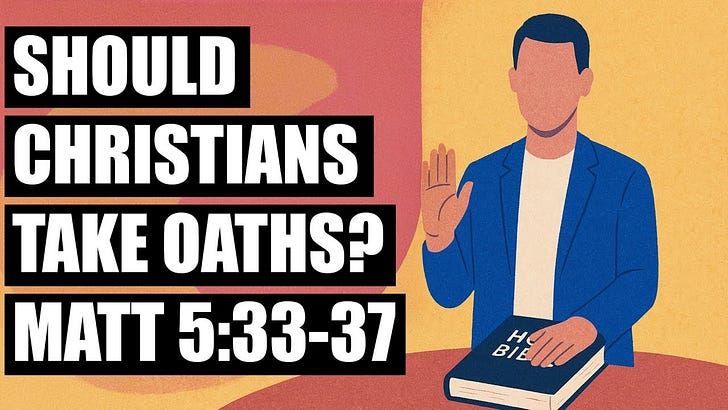
Should Christians Take Oaths? - Matthew 5:33-37
Matthew 5:33–37 NASB“Again, you have heard that the ancients were told, ‘You shall not make false vows, but shall fulfill your vows to the Lord.’But I say to you, make no oath at all, either by heaven, for it is the throne of God, or by the earth, for it is the footstool of His feet, or by Jerusalem, for it is the city of the great King.Nor shall you make an oath by your head, for you cannot make one hair white or black.But let your statement be, ‘Yes, yes’ or ‘No, no’; anything beyond these is of evil.” YouVersion | The Bible App | Bible.comJesus here is not merely refining how we swear; He is forbidding oath-making entirely.And later, James 5:12 NASB reinforces the same teaching:“But above all, my brothers and sisters, do not swear, either by heaven or by earth or with any other oath; but your yes is to be yes, and your no, no, so that you may not fall under judgment.” YouVersion | The Bible App | Bible.comWith those texts in view, let us walk through what the Bible teaches about oaths and vows, why this is serious, and how it applies today.Oaths vs. Vows — Clarifying the TermsTo understand what Jesus forbids, we should distinguish between oaths and vows (or solemn promises).* Oath: a public guarantee of one’s speech or promise, often invoking God or something sacred to validate one’s truthfulness (e.g. “I swear before God that this is true”). It is directed toward assuring others of your sincerity or faithfulness.* Vow: a solemn promise or dedication made before God, binding oneself to some act, abstention, service, or offering (e.g. a personal vow to fast, a Nazirite vow, or in some forms a marriage vow).The difference is subtle but important: oaths are about proving the truth of one’s statement, often by invoking God’s name, whereas vows are about committing oneself before God. The Bible treats both seriously—but in different categories.Biblical Foundations: Why Oaths Are Prohibited, Vows Are RegulatedOld Testament ContextThe Old Testament contains many passages about oaths and vows. A few examples:* Numbers 30:2 (NASB):“If a man makes a vow to the LORD, or swears an oath to bind himself by a pledge, he shall not break his word; he shall do according to all that proceeds out of his mouth.”* Deuteronomy 23:21–23 (NASB) says in part:“When you make a vow to the LORD your God, you shall not delay to pay it, for the LORD your God will certainly require it of you; and if you refrain from vowing, it would not be a sin in you. But you shall be careful to fulfill what has passed your lips, for you vowed to the LORD your God what you have promised with your mouth.”* Ecclesiastes 5:4–5 (NASB) warns:“When you vow a vow to God, do not delay in paying it; for He has no pleasure in fools. Pay what you vow. Better not to vow than to vow and not pay.”From these, we see that:* Vows are not abolished—but once made, they are serious and must be honored.* God expects integrity: if you set your word before Him, you should fulfill it.* The failure to vow is not, in itself, sin; but making a vow lightly is dangerous.Also, the Third Commandment—“You shall not take the name of the Lord your God in vain” (Exodus 20:7)—is widely understood to forbid not only profanity but also misuse of God’s name, including perjury (using God’s name to back up false statements). In Leviticus 19:12 we read:“You shall not swear falsely by My name, so I will not hold guiltless the one who takes My name in vain. I am the LORD.”Violating an oath made in God’s name is, thus, a serious defilement—dragging His name into a lie.Historical examples underscore God’s seriousness:* Saul and the Gibeonites (2 Samuel 21): Because Saul broke a long-standing oath to the Gibeonites, Israel faced famine and reaped dire consequences.* Zedekiah’s oath to Babylon (2 Chronicles 36; Ezekiel 17): Though his oath was to a pagan king, God judged him for violating it—showing that oaths sworn even to unbelievers carry weight before the Lord.These examples demonstrate that God regards oaths as binding—even toward those who are not God’s people.Jesus’ Teaching: A Radical ProhibitionIn the Sermon on the Mount, Jesus radicalizes the old commands. Rather than permitting oaths under certain conditions, He says:“make no oath at all … But let your statement be, ‘Yes, yes’ or ‘No, no’; anything beyond these is of evil.”He is sweeping away the loopholes and excusing formulas the Pharisees employed (e.g. “I swear by the temple, but not by the gold of the temple”). In doing so, He insists on a posture of sincerity and utter simplicity. His followers are to live in such honesty that no oath is needed.James echoes this command nearly in the same words:“Do not swear … but your yes is to be yes, and your no, no, so that you may not fall under judgment.”Jesus’ and James’ warnings: invoking God’s name to reinforce our word is unnecessary if our life is built on truthfulness. Reliance on outward guarantees points to a deeper lack of integrity.Why Oaths Matter to God* Borrowing God’s reputatio