
Upstream
301 episodes — Page 4 of 7

Be More Pirate w/ Sam Conniff
EWhat do you typically think of when you think of pirates? Parrots? Peg Legs? Eye patches? Treasure? Is there more to pirates than these things, than corny jokes and a Disney franchise starring Johnny Depp? Our guest for today's episode certainly thinks so. Sam Conniff's book Be More Pirate: How to Take on the World and Win, was published in 2018, and sparked a sequel How To: Be More Pirate, a podcast titled "Be More Pirate," and a movement of people studying the principles and strategies of Golden Age Pirates to bring them into activism and leadership in the 21st century. In this conversation, we learn about pirate history, including their symbols, ethics, and labor policies; we discuss David Graeber's last book published posthumously, Pirate Enlightenment, or the real Libertalia which covers lost forms of social and political order that inspire hopeful possibilities for today, and we explore invitations for how we can each be more pirate in our projects, organizations, and social movements. Although 1690 to 1725, was the so-called Golden Age of Piracy which is the focus of this conversation, elements of piracy very much still exist—for example, Ansarallah, or the Houthis in Yemen, have been likened to pirates in popular narratives recently. You may know them as the group that's been in the news lately for attacking Israeli, US, and UK-connected ships in the Red Sea and Gulf of Aden. Ansarallah see themselves as acting on their obligation to international law to do all they can to help stop the genocide of the Palestinian people. As Sam Conniff shares "Rather than simply voice their complaints, (pirates) choose instead to do something about the situation. No longer prepared to sit quietly and accept the bad deal on the table, they decide to break the rules and then remake the rules ... with a new social code built on purposeful principles such as fair pay, fair say, social equality, freedom, and justice. And rum." Thank you to Storm Weather Shanty Choir for the intermission music. Upstream theme music was composed by Robert Raymond Further Resources: Sam Conniff Be More Pirate This episode of Upstream was made possible with support from listeners like you. Upstream is a labor of love — we couldn't keep this project going without the generosity of our listeners and fans. Subscribe to our Patreon at patreon.com/upstreampodcast or please consider chipping in a one-time or recurring donation at www.upstreampodcast.org/support If your organization wants to sponsor one of our upcoming documentaries, we have a number of sponsorship packages available. Find out more at upstreampodcast.org/sponsorship For more from Upstream, visit www.upstreampodcast.org and follow us on Twitter, Instagram, Facebook, and Bluesky. You can also subscribe to us on Apple Podcasts, Spotify, or wherever you listen to your favorite podcasts.

[TEASER] The Problem with Modern Monetary Theory w/ Doug Henwood
EYou can listen to the full episode with Doug Henwood by subscribing to our Patreon here: https://www.patreon.com/upstreampodcast As a Patreon subscriber, not only will you get access to at least one bonus episode a month, usually two or three, as well as early access to certain episodes and other benefits like stickers and bumper stickers, depending on which tier you subscribe to, but you'll also be helping to keep Upstream sustainable and allowing us to keep this project going. Find out more at Patreon.com/upstreampodcast or at upstreampodcast.org/support. Thank you. Modern Monetary Theory, or MMT for short — if you haven't heard of it explicitly or read about it in an economics textbook, you've certainly come across some of its theories and ideas out in the wild. Essentially, its proponents argue that, when it comes to the way that money and taxes work, most of us have it all wrong. MMT is billed by its advocates as a radical new way to understand money and debt. The central idea of modern monetary theory is that governments can and should print—or in today's world, create with a few keystrokes—as much money as they need to spend. It's a bit more complicated than that, but that's essentially it—that the government doesn't actually have to worry about taxing the rich or borrowing money because it can just create money out of thin air. And this sounds nice, right? We get to bypass that annoying question that we're often asked on the left, "...but, how will you pay for it?" But, maybe it's not quite that easy to bypass that question. Maybe there's a lot more to the equation that MMT leaves out. And maybe this theory is just a mirage—or, as our guest in today's episode has written, "a phantasm, a late-imperial fever dream, [and] not a serious economic policy. So, is MMT a sound theory? Or is it snake oil? That's the question that we're going to be exploring in today's Patreon episode with Doug Henwood, a journalist, author, economic analyst, host of the radio show and podcast Behind the News, and author of the article Modern Monetary Theory Isn't Helping published in Jacobin. What does MMT miss? What does it get wrong in its explanations for how taxes, inflation and debt work? And why is it important for Marxists to scrutinize and criticize any monetary theories that say so little about labor, production, exchange, class conflict, and the function of the state? These are just some of the questions we'll explore in today's episode. Further Resources: Behind the News with Doug Henwood Modern Monetary Theory Isn't Helping published in Jacobin Upstream: Universal Basic Income Pt. 1 – An Idea Whose Time Has Come? Upstream: Universal Basic Income Pt. 2 – A Bridge Towards Post-Capitalism?

[TEASER] Socialism Betrayed w/ Roger Keeran and Joe Jamison
EYou can listen to the full episode with Roger Keeran and Joe Jamison by subscribing to our Patreon here: https://www.patreon.com/upstreampodcast As a Patreon subscriber, not only will you get access to at least one bonus episode a month, usually two or three, as well as early access to certain episodes and other benefits like stickers and bumper stickers, depending on which tier you subscribe to, but you'll also be helping to keep Upstream sustainable and allowing us to keep this project going. Find out more at Patreon.com/upstreampodcast or at upstreampodcast.org/support. Thank you. If you grew up in the West, you were most likely provided with a simple, bite-sized, propagandistically persuasive explanation for the collapse of the Soviet Union: that communism simply doesn't work. This explanation works particularly well for the hegemon who provided it, the United States, the leading enemy of global communism throughout the 20th century. But, does this explanation actually reflect reality? Did the Soviet Union really collapse because Marx and Lenin were wrong? The short answer is no. And the longer answer is what we're going to be exploring in today's Patreon episode. To debunk the myths about the collapse of the Soviet Union, and to provide us with a much more accurate explanation, we've brought on two guests. Roger Keeran is a historian and professor who taught at Cornell, Princeton, Rutgers and the New York State University. Joe Jamison is an economic researcher, labor movement worker, and Roger's co-author, under the pen name Thomas Kenny, of Socialism Betrayed: Behind the Collapse of the Soviet Union. In this episode we explore some of the key figures and periods in USSR history before focusing in on the slow and very much avoidable unraveling of the political and economic systems of the USSR and the dissolution of the union of republics that it was comprised of. We explore the rise of the so-called second economy which led to the strengthening of a bourgeoisie class that exploited the primary socialist economy. We Look at how the reforms of Mikhail Gorbachev in the 1980s strengthened this class and undermined the socialist economy, how the policies of perestroika and glasnost—which were economic reforms and the encouragement of political openness, respectively—backfired, how right wing opportunism, revisionism, and the betrayal of Marx and Lenin's ideas ultimately led to the collapse of the USSR, and, crucially, what we on the left can learn from this regrettable and successful counterrevolution against the most important instantiation of communism in the 20th century.

Important Announcement: We Launched a Patreon
Join the Upstream Patreon here: https://www.patreon.com/upstreampodcast Below is a transcript of the update shared in this announcement episode — TL;DR: we've got tons of bonus episodes and other goodies as part of our new Patreon! At least 1 bonus episode a month, usually 2-3 Early access to certain episodes Stickers If you've been following along with our episodes or on social media you've probably heard that we've been working on launching a Patreon account, and, voila—we did it. We'll be sharing at least one, more likely two or three, bonus episodes every month for our Patreon subscribers, and that's in addition to the bi-weekly, regularly scheduled episodes of course. We have 5 different tiers at which you can subscribe to our Patreon—all the details can be found here, but just to give you a sense, we the tiers start at $5/month. All tiers have access to the same number of bonus episodes per month, but as you go up in tiers there are additional benefits as well, including early access to certain episodes and stickers. And, of course, you'll also be helping us keep Upstream sustainable and helping to keep this whole project going. Here's what's coming: this month we've already got two bonus episodes loaded and ready to go. The first is an episode with Doug Henwood on the problems with modern monetary theory (MMT), and the second episode is with Roger Keeran and Joe Jamison on their book Socialism Betrayed: Behind the Collapse of the Soviet Union. So as soon as you sign up you'll get instant access to both of these. And then we're also planning Part 7 of our ongoing series on Palestine for later in the month. Coming up in March in March we've got an episode planned with Claudia De la Cruz and Karina Garcia who are running for President and Vice-President as the candidates of the Party for Socialism and Liberation, or PSL. What inspired us to create a Patreon community? As you know, we've always provided all of our bi-weekly episodes and our documentaries for free to everyone—that's not gonna change. But then last year we faced a pretty big crisis as we lost both of our grant funders (which were by far our largest income stream), and we realized that we were gonna be entirely listener funded moving forward. The nonprofit industrial complex itself is a challenge to navigate, to say the least, but even more so as a podcast—funders just don't really fund podcasts. They especially don't fund political education podcasts, and especially, especially socialist ones. But we have to say we were so, so grateful to all of you who started supporting us at that time, or, of course, who had already been contributing monthly or through one-time donations—you really showed us that we can definitely keep Upstream going without the grant funding. So thank you so much. And to show our thanks we wanted to give you all something extra, something special. Wanna sign up? Here's how it works: just go to our Patreon page and sign up. If you're already donating to us and you want to switch over to become a Patreon subscriber, it's super easy—you can just cancel your current recurring donation through Flipcause (which is where you're donating through now), and just sign up for our Patreon instead. If you don't feel like making the switch, no problem at all, you don't have to do anything—your current donations through Flipcause won't be affected in any way. And, of course, you can still make one-time donations through Flipcause. We're so grateful to all of you out there who've supported us with your donations over the months and years—we really could not do this without you. And if you've been on the fence about becoming a monthly supporter, this is a great time to do it because we've got a lot of really great bonus content coming your way. And if you're just not at a place where you can afford to subscribe, it's all good, we completely understand—we've still got our regular episodes coming out every two weeks. And if you do want to support us in a nonfinancial way, the best way to do so is just to share our episodes, share our posts, help spread the word and get people tuned into the struggle for liberation and for a more equitable and beautiful world. And of course leaving us a 5-star rating and review on Apple Podcasts or Spotify goes a long way in getting those apps to put our content in front of new eyes and into new ears. So, thank you, we love you all. Solidarity. Join the Upstream Patreon here: https://www.patreon.com/upstreampodcast

The Missing Revolution w/ Vincent Bevins
EThe past decade or so was marked by mass protests—in fact, more people participated in protests than at any other point in human history, from Occupy Wall Street to the Arab Spring to the 2020 George Floyd uprisings and even more recently with millions upon millions pouring into the streets in support of Palestinian liberation. So why, then, have conditions not improved? Why have they, in many cases, only gotten worse? This is the question that Vincent Bevins set out to answer in his latest book, If We Burn: The Mass Protest Decade and the Missing Revolution. The search for an answer took Vincent all over the world, from Brazil to Ukraine, Turkey, Chile, Hong Kong, and Middle East. The answer imparts an extremely important lesson to the left: we're simply not organized. Or, rather, we're not organized in an effective way. The shift in the left's tactics and strategies since the 1960s has left us with movements that rely far too heavily on horizontalism, spontaneity, and an extreme form of prefiguration that subordinates ends to means. This New Left ideology abandons the principles of Marxism-Leninism, revolutionary theory, and the importance of leadership. This, Vincent believes, is why the mass protest decade failed to win its demands and bring about real change. Vincent Bevins is a journalist and writer and, in addition to If We Burn: The Mass Protest Decade and the Missing Revolution, he's the author of The Jakarta Method: Washington's Anticommunist Crusade and the Mass Murder Program that Shaped Our World. Further Resources: If We Burn: The Mass Protest Decade and the Missing Revolution, by Vincent Bevins Students for a Democratic Society (SDS) The Tyranny of Structurelessness, by Jo Freeman On Authority, by Frederick Engels All Watched Over by Machines of Loving Grace (TV series), Adam Curtis Upstream: What Is To Be Done? with Breht O'Shea and Alyson Escalante Thank you to Menstruação Anarquika for the intermission music and to Carolyn Raider for this episode's cover art. Upstream theme music was composed by Robert Raymond This episode of Upstream was made possible with support from listeners like you. Upstream is a labor of love — we couldn't keep this project going without the generosity of our listeners and fans. Subscribe to our Patreon at patreon.com/upstreampodcast or please consider chipping in a one-time or recurring donation at www.upstreampodcast.org/support If your organization wants to sponsor one of our upcoming documentaries, we have a number of sponsorship packages available. Find out more at upstreampodcast.org/sponsorship For more from Upstream, visit www.upstreampodcast.org and follow us on Twitter, Instagram, Facebook, and Bluesky. You can also subscribe to us on Apple Podcasts, Spotify, or wherever you listen to your favorite podcasts.

Drinkable Rivers with Li An Phoa
E"The sign of a healthy economy should be a drinkable river," these are the words of Li An Phoa, an environmental activist and our guest for this episode. In 2005, Li An Phoa canoed the full length of the Rupert, a river in Canada. All along the way, she was able to drink water straight from the river. When she returned three years later, this was no longer the case. The river had been poisoned from dams, mining, and industry. Fish died, people got ill, and the delicate balance in the ecosystem was destroyed. Realizing that drinkable rivers are not just a key indicator of ecological health, but community vitality and resilience as well, and that rivers can only be drinkable when economic systems are post-growth, truly democratic, place-based, and respectful of the commons and Indigenous peoples, Li An decided to dedicate her life to re-cultivating drinkable rivers. Since then, Li An founded the Drinkable Rivers organization and Spring College and has walked many rivers, using citizen science to test the water quality, training others to do the same, and intervening when a river has been contaminated or is off-balance. Her 1,000-kilometer walk along the river Meuse in Europe was the subject of the documentary Long Walk for Drinkable Rivers. Most recently, she and her partner Maarten van der Schaaf wrote the book Drinkable Rivers: How the river became my teacher. In this conversation, Li An goes upstream to explain why rivers are no longer drinkable, she offers her vision of a world with drinkable rivers, shares her process for galvanizing communities to care for their watersheds, and suggests invitations for how all of us could contribute to healthier rivers and healthier eco- and economic systems around the world. Further Resources: Drinkable Rivers This episode of Upstream is brought to you by EcoGather, a holder of space between stories. EcoGather offers guided learning journeys and free weekly online EcoGatherings that foster conversation and build community around heterodox economics, collective action, and living as part of the natural world. Visit: ecogather.sterlingcollege.edu Thank you to Mirah for the intermission music and to Carolyn Raider for this episode's cover art. This episode of Upstream was made possible with support from listeners like you. Upstream is a labor of love — we couldn't keep this project going without the generosity of our listeners and fans. Subscribe to our Patreon at patreon.com/upstreampodcast or please consider chipping in a one-time or recurring donation at www.upstreampodcast.org/support If your organization wants to sponsor one of our upcoming documentaries, we have a number of sponsorship packages available. Find out more at upstreampodcast.org/sponsorship For more from Upstream, visit www.upstreampodcast.org and follow us on Twitter, Instagram, Facebook, and Bluesky. You can also subscribe to us on Apple Podcasts, Spotify, or wherever you listen to your favorite podcasts.

Palestine Pt. 6: One State with Ghada Karmi
EIt may seem like a distant dream to imagine that the decades-long settler-colonial project which is Israel could finally end and transform into a state where all faiths, ethnicities, and cultures could thrive together in their diversity and equality. It seems like a distant dream because, as we all know, the reality that we're witnessing is the opposite of that — it's an escalation of an already ruthless and bloody ethnic cleansing campaign that officially began in 1948. Although a democratic, multi-ethnic, multicultural, multi-religious state may seem like an exercise in imagination, it's hardly a futile pursuit. We must constantly be exercising our imagination and dreaming of a better world, not only because it's important to exercise those muscles of hope, but because in doing so we're also spreading the seeds of knowledge and inspiration which could themselves affect change. To talk about what could be, we've brought on Ghada Karmi, a Palestinian-born academic, physician and author of many books, including In Search of Fatima: A Palestinian Story, and, most recently, One State: The Only Democratic Future for Palestine-Israel, published by Pluto Press. This is part 6 of our ongoing series on Palestine. Ghada was a young child in Palestine during the 1948 Nakba, or catastrophe, and has spent many decades involved in the movement for Palestinian liberation. In this conversation, we discuss why a single Palestinian state from the river to the sea is the only just way forward, what some of the barriers to this happening are, what the sentiment of many Palestinains is when thinking about living side-by-side with Israelis in a democratic state, how this dream might turn into a reality, and much more. Further Resources: One State The Only Democratic Future for Palestine-Israel, by Ghada Karmi Upstream: Palestine Pt. 1: A Socialist Introduction with Sumaya Awad Upstream: Palestine Pt. 2: Justice for Some with Noura Erakat Upstream: Palestine Pt. 3: Settler-Colonialism and Medical Apartheid with Rupa Marya & Jess Ghannam Upstream: Palestine Pt. 4: False Solutions and Paths of Resistance with Sumaya Awad Upstream: Palestine Pt. 5: The Political Economy of Palestine with Adam Hanieh Donate to Middle Eastern Children's Alliance (MECA) Anera: Provide urgent humanitarian aid to Palestinians Write your member of Congress to demand an immediate ceasefire The cover art for this episode was originally designed by Thomas Greenwood and was slightly adapted by Carolyn Raider for this episode. Thank you to Ferkat Al Ard for the intermission music. Samih Al Qasem's "Wait For Me": My neck is on the edge of the knife, O, my homeland, and yet I tell you: Wait for me! And my hands are tied behind my back, O, my homeland And yet I sing for you, o, my wound..I sing "I have not betrayed you… so don't betray me I have not sold you..so don't sell me!" The homeland of the miserable psalms and the lost faces the homeland of the vengeful roots the homeland of the storms, thunderbolts, and cold nights the homeland of the stolen orchards and the prayerful palms the homeland of the villages, ruins, blood, and crying Do I strengthen your resolve? Or do you, o betrayed one, strengthen my resolve? The homeland of the old lies, tales, and prophets Do I become your secret? Or do you, o betrayed one, become my secret? The homeland of fragmentation in exiles, Strange airports, and ports homeland of anger homeland of flames You, whose hands are kissed through the tears of one million refugee! Homeland of humiliation, distress, and pride I believed in the love which gives, and which dissolves in giving.. Thus, I say to you: Wait for me! My neck is on the edge of the knife, But I say to you: Wait for me!" This episode of Upstream was made possible with support from listeners like you. Upstream is a labor of love — we couldn't keep this project going without the generosity of our listeners and fans. Subscribe to our Patreon at patreon.com/upstreampodcast or please consider chipping in a one-time or recurring donation at www.upstreampodcast.org/support If your organization wants to sponsor one of our upcoming documentaries, we have a number of sponsorship packages available. Find out more at upstreampodcast.org/sponsorship For more from Upstream, visit www.upstreampodcast.org and follow us on Twitter, Instagram, Facebook, and Bluesky. You can also subscribe to us on Apple Podcasts, Spotify, or wherever you listen to your favorite podcasts.

A Winter Solstice Celebration for 2023 with Manda Scott and Nathalie Nahai
EHappy Winter Solstice! In this annual tradition, Della is joined by two fellow podcast hosts to reflect on the past year and set some intentions for the year ahead. Manda Scott is a novelist, smallholder, and host of the Accidental Gods podcast, which showcases individuals and organizations at the emerging edge of our world to set the foundation for a future we'd be proud to leave to the generations that come after us. Her latest novel, Any Human Power is available for pre-order on Amazon. Nathalie Nahai is a behavior science advisor, author and host of the podcast The Hive, which focuses on psychology, technology, and human behavior. Nathalie is the author of Webs Of Influence: The Psychology of Online Persuasion and is also the founder of Flourishing Futures Salon, a project that offers curated gastronomical gatherings that explore how we can thrive in times of turbulence and change. One of Della's offerings in the new year is a Gaia Education course called Cultivating Regenerative Livelihoods that weaves insights from this podcast and her work as a Right Livelihood coach with practical solidarity economy tools to help us better align our work with our values and contribute to economic systems change. This 12-week online course will start on January 13th and is 300 pounds with half and full scholarships available and a 15% discount for Upstream listeners available here. Further Resources: Course: Cultivating Regenerative Livelihoods Course, Jan 13 - Apr 20, 2024, Virtual, Designed and co-facilitated by Della Duncan, 15% off discount for Upstream Listeners here: https://www.gaiaeducation.org/cart/155142-Cultivating-Regenerative-Livelihoods Poem: The Invitation by Oriah Mountain Dreamer Theory: Two Loop Theory by Meg Wheatley and Deborah Frieze Upstream: Marxism & Buddhism with Breht O'Shea Upstream: A Marxist Perspective on Elections with August Nimtz Upstream: Beyond the Clock with Jenny Odell California Doughnut Economics Coalition and positions available Indy Johar: talking about Inter-Becoming and the model of the autonomous house on Accidental Gods Alnoor Ladha and Lynn Murphy: on shifting from a Trauma Culture to an Initiation Culture on Accidental Gods Grief and Joy on a Planet in Crisis: Joanna Macy on the Best Time To Be Alive on The Way Out is In Event: Flourishing Futures Salon Event: Planet Local Summit Winter Solstice Meditation Summer Solstice Meditation This episode of Upstream was made possible with support from listeners like you. Upstream is a labor of love — we couldn't keep this project going without the generosity of our listeners and fans. Subscribe to our Patreon at patreon.com/upstreampodcast or please consider chipping in a one-time or recurring donation at www.upstreampodcast.org/support If your organization wants to sponsor one of our upcoming documentaries, we have a number of sponsorship packages available. Find out more at upstreampodcast.org/sponsorship For more from Upstream, visit www.upstreampodcast.org and follow us on Twitter, Instagram, Facebook, and Bluesky. You can also subscribe to us on Apple Podcasts, Spotify, or wherever you listen to your favorite podcasts.

Palestine Pt. 5: The Political Economy of Palestine with Adam Hanieh
EThe ongoing bombardment of the Gaza Strip has been front and center in the world's attention for the last couple of months, and it's important that we keep it there. But it's also important to remember that this latest escalation in violence is just that: an escalation, an increase in violence in a region where violence is the norm, not just militarily but also politically and economically — what we might call structural violence. The suffering in Palestine has been seen primarily as a humanitarian issue for decades now, but the reality is that reducing Palestine to a matter of humanitarian concern obscures issues of geopolitics and the political economy of the region in a way that decontextualizes much of what is taking place in Palestine, and, importantly, the material conditions and incentives driving the Israeli occupation. In this conversation, part 5 of our ongoing series on Palestine, we're going to explore the political economies of Palestine and Israel with a guest who is deeply immersed in these questions. Adam Hanieh is a Palestinian professor at the Institute for Arab and Islamic Studies at the University and Exeter and author of Lineages of Revolt: Issues of Contemporary Capitalism in the Middle East, published by Haymarket Books. In this conversation Adam helps us understand the relationships between the Gaza Strip, the West Bank, and Israel, how class manifests in these different regions, what the political economies of these regions are and how they shape Israel's ongoing ethnic cleansing campaign, and in general, the importance of understanding the geopolitical dynamics of the broader region and neighboring Arab states when trying to understand what is happening in Palestine and Israel. Further Resources: Lineages of Revolt: Issues of Contemporary Capitalism in the Middle East, by Adam Hanieh Upstream: Palestine Pt. 1: A Socialist Introduction with Sumaya Awad Upstream: Palestine Pt. 2: Justice for Some with Noura Erakat Upstream: Palestine Pt. 3: Settler-Colonialism and Medical Apartheid with Rupa Marya & Jess Ghannam Upstream: Palestine Pt. 4: False Solutions and Paths of Resistance with Sumaya Awad Donate to Middle Eastern Children's Alliance (MECA) Anera: Provide urgent humanitarian aid to Palestinians Write your member of Congress to demand an immediate ceasefire This episode of Upstream was made possible with support from listeners like you. Upstream is a labor of love — we couldn't keep this project going without the generosity of our listeners and fans. Subscribe to our Patreon at patreon.com/upstreampodcast or please consider chipping in a one-time or recurring donation at www.upstreampodcast.org/support If your organization wants to sponsor one of our upcoming documentaries, we have a number of sponsorship packages available. Find out more at upstreampodcast.org/sponsorship For more from Upstream, visit www.upstreampodcast.org and follow us on Twitter, Instagram, Facebook, and Bluesky. You can also subscribe to us on Apple Podcasts, Spotify, or wherever you listen to your favorite podcasts.

Palestine Pt. 4: False Solutions and Paths of Resistance with Sumaya Awad
EBefore the Zionist project and the state of Israel placed their boots on the neck of Palestine, this region was a multicultural, multi-religious land, where Christians, Jews, and Muslims lived side-by-side in relative peace and harmony. And despite what Israeli forces propagandize, this so-called "conflict" in the Middle East is not some millennia-old, intractable holy war between two religions. It's quite simply and very classically a case of settler-colonialism. When we see what's happening in Palestine from this perspective, the solution becomes quite clear: end the occupation. But despite this clarity, ending the occupation is no simple feat. Not only is there little appetite for this in Israel, of course, but with the entire cavalry of US military, financial, and PR support behind it, an end to the zionist colonization and occupation of Palestine feels, well, to put it gently, perhaps not feasible in the short term. Of course, this doesn't mean that the fight for Palestinian liberation is a lost cause — far from it. Not only are there many battles to be fought which will bring liberation just that much closer, and which can improve conditions drastically, but the ultimate aim of ending the occupation of Palestine is a goal that the left can never abandon. As Noura Erakat reminded us in the second episode in our series on Palestine: we are, in many ways, all Palestinians. In this episode we're going to explore how to end the occupation and the colonization of Palestine. We'll explore some of the steps to get there, some of the barriers, some of the false solutions, and what a liberated Palestine might look like. To guide us on this journey we've brought back onto the show Sumaya Awad. Sumaya is a Palestinian writer, analyst, and socialist organizer based in New York City. She's the Director of Strategy and Communications at the Adalah Justice Project and a contributor to and co-editor, along with brian bean, of Palestine: A Socialist Introduction, published by Haymarket Books. Our first conversation with Sumaya a few weeks ago is what kicked off our ongoing series on Palestine. And although you can certainly listen to each episode separately and in any order, they do all build on one another to set up helpful context as we move forward. Further Resources: Palestine: A Socialist Introduction Adalah Justice Project Upstream: Palestine Pt. 1: A Socialist Introduction with Sumaya Awad Upstream: Palestine Pt. 2: Justice for Some with Noura Erakat Upstream: Palestine Pt. 3: Settler-Colonialism and Medical Apartheid with Rupa Marya & Jess Ghannam Donate to Middle Eastern Children's Alliance (MECA) Anera: Provide urgent humanitarian aid to Palestinians Write your member of Congress to demand an immediate ceasefire This episode of Upstream was made possible with support from listeners like you. Upstream is a labor of love — we couldn't keep this project going without the generosity of our listeners and fans. Subscribe to our Patreon at patreon.com/upstreampodcast or please consider chipping in a one-time or recurring donation at www.upstreampodcast.org/support If your organization wants to sponsor one of our upcoming documentaries, we have a number of sponsorship packages available. Find out more at upstreampodcast.org/sponsorship For more from Upstream, visit www.upstreampodcast.org and follow us on Twitter, Instagram, Facebook, and Bluesky. You can also subscribe to us on Apple Podcasts, Spotify, or wherever you listen to your favorite podcasts.

Palestine Pt. 3: Settler-Colonialism and Medical Apartheid with Rupa Marya & Jess Ghannam
EAs the ongoing ethnic cleansing campaign against Palestinians continues, it's important that we also continue to raise a magnifying glass to its perpetrators, not just looking at the state of Israel as a whole or the IDF—as blood-soaked as their hands are—but also looking at the some of the perhaps less publicly scrutinized institutions complicit in this genocide. In this episode in our ongoing series on Palestine, we're going to focus on healthcare institutions and their complicity in the devastation and destruction taking place in Palestine. What are the underlying power structures that support and uplift settler colonialism, white supremacy, and health apartheid? Why is it that so few health institutions in the west have spoken out against Israel's genocide of the Palestinian people? What does that tell us about the failures of our healthcare systems and much of the medical community? To discuss these questions and more we've brought on two guests today. Dr. Jess Ghannam is a Palestinian professor in psychiatry at UCSF in San Francisco working in Gaza. Dr. Rupa Marya is a professor of medicine at UCSF in San Francisco and co-author, along with Raj Patel, of Inflamed: Deep Medicine and the Anatomy of Injustice. Thank you to Carolyn Raider for this episode's cover art and to Sabreen Group & Majazz Project / Palestinian Sound Archive for the intermission music. Upstream theme music was composed by Robert Raymond/Lanterns. Further Resources Upstream: Decolonizing Medicine with Rupa Marya and Raj Patel Rupa Marya on Instagram Inflamed Deep Medicine and the Anatomy of Injustice There's No Justification for Destroying Gaza's Health Infrastructure, Yes Magazine Health Professionals and War in the Middle East, JAMA Upstream: Health Communism with Beatrice Adler-Bolton Upstream: Palestine Pt. 1: A Socialist Introduction with Sumaya Awad Upstream: Palestine Pt. 2: Justice for Some with Noura Erakat This episode of Upstream was made possible with support from listeners like you. Upstream is a labor of love — we couldn't keep this project going without the generosity of our listeners and fans. Subscribe to our Patreon at patreon.com/upstreampodcast or please consider chipping in a one-time or recurring donation at www.upstreampodcast.org/support If your organization wants to sponsor one of our upcoming documentaries, we have a number of sponsorship packages available. Find out more at upstreampodcast.org/sponsorship For more from Upstream, visit www.upstreampodcast.org and follow us on Twitter, Instagram, Facebook, and Bluesky. You can also subscribe to us on Apple Podcasts, Spotify, or wherever you listen to your favorite podcasts.

Palestine Pt. 2: Justice for Some with Noura Erakat
EFor those of us living in the United States, today — what we call Thanksgiving — is a very significant holiday because, for some of us at least, it's a day to recognize and remember the violent, genocidal, settler-colonial history of the land we live on. Our lives here in North America are predicated on a history and a pattern that is repeating itself as we speak, most notably in occupied Palestine, where we are witnessing what feels like the culmination of a decades-long ethnic cleansing campaign against the Indigenous population of Palestine by the forces of Zionism, the state of Israel, and, by the reigning global hegemon, the United States. We've already covered some of the history that led us to this point in Part 1 of our ongoing series on Palestine with Sumaya Awad, and on today's show, we're going to be exploring a different angle, outlining the history and context of the formation of the state of Israel, how Palestinians resisted Israeli occupation from before the state was even created, and how they continued to resist throughout the disingenuously named "peace" process that culminated with the Oslo Accords. As we'll see, this process was never intended to bring a lasting peace to the region, but was intended to cement in the status quo of Israeli supremacy and the ongoing subjugation of Palestinians. To talk about this we've brought on Noura Erakat, Associate Professor at Rutgers University in the department of Africana Studies and the program of Criminal Justice and author of Justice For Some: Law and the Question of Palestine. From the Great Arab Revolt in 1936 to the second Intifada at the start of this century, and up to Operation Al-Aqsa Flood on October 7th, in this conversation we explore the history of Palestinian resistance to Israeli occupation, the so-called peace process, the betrayal of the so-called two-state solution, where Israel's ethnic cleansing campaign is headed, and what it's up against. Further Resources: Upstream – Palestine Pt. 1: A Socialist Introduction with Sumaya Awad Justice For Some: Law and the Question of Palestine by Noura Erakat Palestine: A Socialist Introduction edited by Sumay Awad and brian bean The Hundred Years' War on Palestine by Rashid Khalidi Palestine, Israel, and the U.S. Empire by Richard Becker Donate to Middle Eastern Children's Alliance (MECA) Anera: Provide urgent humanitarian aid to Palestinians Write your member of Congress to demand an immediate ceasefire This episode of Upstream was made possible with support from listeners like you. Upstream is a labor of love — we couldn't keep this project going without the generosity of our listeners and fans. Subscribe to our Patreon at patreon.com/upstreampodcast or please consider chipping in a one-time or recurring donation at www.upstreampodcast.org/support If your organization wants to sponsor one of our upcoming documentaries, we have a number of sponsorship packages available. Find out more at upstreampodcast.org/sponsorship For more from Upstream, visit www.upstreampodcast.org and follow us on Twitter, Instagram, Facebook, and Bluesky. You can also subscribe to us on Apple Podcasts, Spotify, or wherever you listen to your favorite podcasts.

Black Scare / Red Scare with Charisse Burden-Stelly
EThe Red Scare — perhaps most well known through the era of McCarthyism that dominated the social, political, and legal spheres of the U.S. in the 1950s — is actually much more than just a brief window of time where communists in the United States were vilified, criminalized, and blacklisted. The Red Scare is actually much more pervasive and longstanding, originating decades before McCarthyism and stretching well into the present. And, when combined with the Black Scare — the fear and hatred of Black people in the United States — it really forms an entire mode of governance that has shaped the character, policies, and collective consciousness of much of U.S.'s 20th and 21st centuries. To talk about the Black Scare, the Red Scare, and how they work together to create a specific hegemonic atmosphere and policy landscape in the U.S., we've brought on Charisse Burden-Stelly, an Associate Professor of African American studies at Wayne State University, a fellow at the Charles Warren Center for Studies in American History at Harvard University, a member of the Black Alliance for Peace, and author of Black Scare / Red Scare: Theorizing Capitalist Racism in the United States, published by the University of Chicago Press. In this conversation, we discuss the history of the Red and Black Scares by looking at a few different examples of how these modes of governance overlapped and shaped both policies and people in the 20th century. We also explore how these scares have followed us into the present and how they shape and color more contemporary moments like the George Floyd uprisings, the Stop Cop City movement, or the various solidarity movements for Palestinian liberation here in the United States. Further Resources: Black Scare / Red Scare: Theorizing Capitalist Racism in the United States Organize, Fight, Win: Black Communist Women's Political Writing Upstream: The Limitations of Black Capitalism with Francisco Perez Upstream: Abolition with Niki Franco AKA Venus Roots This episode of Upstream was made possible with support from listeners like you. Upstream is a labor of love — we couldn't keep this project going without the generosity of our listeners and fans. Subscribe to our Patreon at patreon.com/upstreampodcast or please consider chipping in a one-time or recurring donation at www.upstreampodcast.org/support If your organization wants to sponsor one of our upcoming documentaries, we have a number of sponsorship packages available. Find out more at upstreampodcast.org/sponsorship For more from Upstream, visit www.upstreampodcast.org and follow us on Twitter, Instagram, Facebook, and Bluesky. You can also subscribe to us on Apple Podcasts, Spotify, or wherever you listen to your favorite podcasts.

A Marxist Perspective on Elections with August Nimtz
E"This is the most important election of our lifetimes." "Voting for a third-party candidate? Might as well throw away your vote!" "You may not like him, but you've just got to hold your nose and vote for him — otherwise, Trump might win." We're sure you've heard each of these lines many times — we know that we have. But, at some point you have to ask: how can every election be the most important one? Am I really throwing away my vote by voting for a candidate whose policies I agree with? Can we ever actually affect change if we're always voting for the "lesser evil" candidate or party? Isn't that just a race to the bottom — or, as we're seeing currently, a race towards genocide? Well, in this conversation, we're going to tackle all of those questions — and much more — with our guest, August Nimtz, Professor of political science and African American and African studies in the College of Liberal Arts at the University of Minnesota. Professor Nimtz is the author of The Ballot, The Streets, Or Both? published by Haymarket Books. In this conversation, Professor Nimtz explores the question of electoralism as it relates to revolutionary left politics through a deep dive into the history of the Russian Revolution — examining how Marx, Engels, and Lenin approached electoralism and then applying their analyses and viewpoints to today's situation. What is the role of elections for the revolutionary left? How can we engage with electoralism without falling into what Professor Nimtz refers to as "electoral fetishism"? What about the "lesser evil" or "spoiler" phenomenon? How can we build a party for the working and oppressed classes without falling prey to opportunism or bourgeois distraction? What can we learn from the European Revolutions of 1848, the Paris Commune, the Russian Revolution, and other historic attempts at revolution — both successful and unsuccessful? These are just some of the questions and themes we explore in this episode with Professor Nimtz. Thank you to Bethan Mure for this episode's cover art and to Noname for the intermission music. Upstream theme music was composed by Robert Raymond/Lanterns. Further Resources: The Ballot, The Streets, or Both? Upstream: What Is To Be Done? with Breht O'Shea and Alyson Escalante Guerrilla History: Electoral Theory and Strategy of Marx and Lenin w/ August Nimtz This episode of Upstream was made possible with support from listeners like you. Upstream is a labor of love — we couldn't keep this project going without the generosity of our listeners and fans. Subscribe to our Patreon at patreon.com/upstreampodcast or please consider chipping in a one-time or recurring donation at www.upstreampodcast.org/support If your organization wants to sponsor one of our upcoming documentaries, we have a number of sponsorship packages available. Find out more at upstreampodcast.org/sponsorship For more from Upstream, visit www.upstreampodcast.org and follow us on Twitter, Instagram, Facebook, and Bluesky. You can also subscribe to us on Apple Podcasts, Spotify, or wherever you listen to your favorite podcasts.

How We Show Up with Mia Birdsong
EAs we continue to work towards outer transformation, building the structures and models that will shape the transition to a post-capitalist society, it's also important to think about the inner transitions within ourselves — particularly, how we relate to one another personally and socially. How we show up together for a liberated future is the core theme of the book How We Show Up: Reclaiming Family, Friendship, and Community, written by our guest in this episode, Mia Birdsong. Mia is the Executive Director of the Next River Institute and the host of the More than Enough podcast miniseries. In How We Show Up, Mia shares how we have separated from one another despite our deep desire for belonging. She explores how we can instead turn towards one another, remembering our inherent interconnectedness, and how we can find connection and support in vulnerability and generosity. In this conversation we explore how capitalism has undermined our ability to create and sustain healthy communities, what it really means to show up for someone, how to set boundaries and hold each other accountable without bosses or policing, what a healthy interconnected community feels like, and how to cultivate a sense of collective vitality that embodies the liberated future we want right now Further Resources: Mia Birdsong Next River Intstitute More Than Enough Freedom's Revival: A Field Guide This episode of Upstream was made possible with support from listeners like you. Upstream is a labor of love — we couldn't keep this project going without the generosity of our listeners and fans. Subscribe to our Patreon at patreon.com/upstreampodcast or please consider chipping in a one-time or recurring donation at www.upstreampodcast.org/support If your organization wants to sponsor one of our upcoming documentaries, we have a number of sponsorship packages available. Find out more at upstreampodcast.org/sponsorship For more from Upstream, visit www.upstreampodcast.org and follow us on Twitter, Instagram, Facebook, and Bluesky. You can also subscribe to us on Apple Podcasts, Spotify, or wherever you listen to your favorite podcasts.

Palestine Pt. 1: A Socialist Introduction with Sumaya Awad
EBefore 1948, the land of Palestine was dotted with olive groves along rolling hills between mountains and the Mediterranean sea. Palestinians, Arabs, Muslims, Jews, and Christians all lived alongside one another in relative harmony, practicing agriculture and embroidery, or working in factories or along the coast in thriving port villages. Not to romanticize it too much, but in comparison to what was to come, this region was thriving. If you've been paying any attention to the news lately, you'll know that an image of harmony is no longer the case in this region. In 1948, the state of Israel was founded, and the campaign leading up to, during, and following the founding of this ethno-state threw this region into a turmoil that has produced one of the most subjugated and immiserated populations in the world — a population that has been subjected to ongoing ethnic cleansing and a campaign of genocide aimed at replacing Palestinians and their towns, villages, and cities, with Israeli settlements. In this episode, we've brought on Sumaya Awad, a Palestinian writer, analyst, and socialist organizer, to talk about this history, drawing a line from the Nakba of 1948 all the way to the present carpet bombing campaign on Gaza. Sumaya is a contributor to and co-editor, along with brian bean, of Palestine: A Socialist Perspective, published by Haymarket Books.In this conversation we explore the history of the political ideology of Zionism, how imperialism and colonialism shaped the state of Israel, the ethnic cleansing campaign known to Palestinians as the Nakba, the global propaganda campaign, led by Israel, aimed at covering up this history, the West's complicity in war crimes and genocide, what a principeled socialist perspective on Palestine looks like, and much more. In fact, there's so much from Palestine: A Socialist Perspective that we didn't get to, that we're going to have Sumaya back on for a part two soon. Further Resources: Palestine: A Socialist Introduction Donate to Middle Eastern Children's Alliance (MECA) Anera: Provide urgent humanitarian aid to Palestinians Write your member of Congress to demand an immediate ceasefire Against Canary Mission This episode of Upstream was made possible with support from listeners like you. Upstream is a labor of love — we couldn't keep this project going without the generosity of our listeners and fans. Subscribe to our Patreon at patreon.com/upstreampodcast or please consider chipping in a one-time or recurring donation at www.upstreampodcast.org/support If your organization wants to sponsor one of our upcoming documentaries, we have a number of sponsorship packages available. Find out more at upstreampodcast.org/sponsorship For more from Upstream, visit www.upstreampodcast.org and follow us on Twitter, Instagram, Facebook, and Bluesky. You can also subscribe to us on Apple Podcasts, Spotify, or wherever you listen to your favorite podcasts.

What Is To Be Done? with Breht O'Shea and Alyson Escalante
EWhat Is To Be Done? This is the question so profoundly posed by the Russian Revolutionary and Bolshevik leader, Vladimir Lenin, in his landmark text of the same name. Although it was written well over a century ago, this text, the questions it asked, and the paths forward that it provided, are just as relevant today as they were a hundred years ago. And just as urgent. What roles do spontaneity and disciplined organization have in leftist movements? Can we focus simply on economic reform, or do our actions need a larger political framework to structure, guide, and propel them? Why does it feel like even though so many of us are motivated to work towards structural change, that things continue to get worse? Why does it seem like potential revolutionary struggles in the West always seem to stall and fail to move from a singular moment to a protracted movement? These are old and familiar questions — a lot of ink has been spilled and speeches made exploring them — and in this Conversation, we've brought on two guests who've not only thought about these questions in depth, but who have some pretty compelling answers that draw from revolutionary theory and practice in both their personal lives and from the deep well of wisdom bequeathed by theorists Marx, Engels, Lenin, and Mao. Breht O'Shea is the host of the podcast Revolutionary Left Radio and a co-host of Guerrilla History. He's been on the show multiple times so you may already be familiar with his voice. Alyson Escalate, who has also been on the show, is the co-host, along with Breht, of Red Menace, a podcast that explains and analyzes revolutionary theory and then applies its lessons to our contemporary conditions. Further Resources: Red Menace – What Is To Be Done? - V.I. Lenin Revolutionary Left Radio – Politics in Command: Analyzing the Error of Economism Red Menace – The Wretched of the Earth - Frantz Fanon: On Violence and Spontaneity Red Menace – Understanding Settler Colonialism in Israel and the United States Revolutionary Left Radio on Instagram Upstream – Buddhism and Marxism with Breht O'Shea (In Conversation) Upstream – Trans Liberation and Solidarity with Alyson Escalante (In Conversation) Upstream – Revolutionary Leftism with Breht O'Shea (In Conversation) This episode of Upstream was made possible with support from listeners like you. Upstream is a labor of love — we couldn't keep this project going without the generosity of our listeners and fans. Subscribe to our Patreon at patreon.com/upstreampodcast or please consider chipping in a one-time or recurring donation at www.upstreampodcast.org/support If your organization wants to sponsor one of our upcoming documentaries, we have a number of sponsorship packages available. Find out more at upstreampodcast.org/sponsorship For more from Upstream, visit www.upstreampodcast.org and follow us on Twitter, Instagram, Facebook, and Bluesky. You can also subscribe to us on Apple Podcasts, Spotify, or wherever you listen to your favorite podcasts.
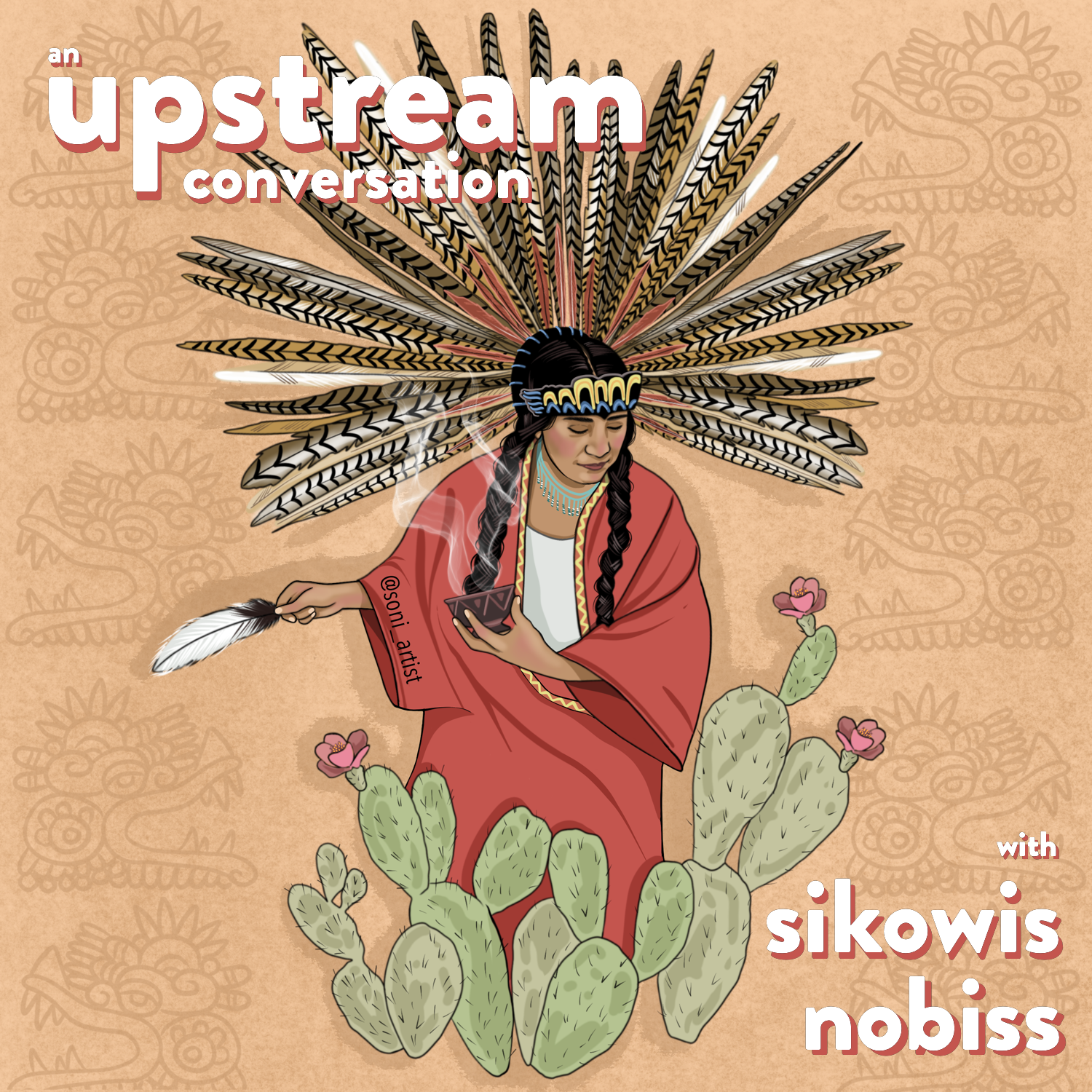
How to Decolonize and Indigenize with Sikowis Nobiss
EWhat is the connection between capitalism, colonialism, consumerism, and Christianity? How do these systems and ideologies uphold and support one another? How do we work to dismantle them and cultivate in their place a decolonized culture and politics that supports Indigenous sovereignty, human health and wellbeing, and flourishing ecosystems? These are some of the questions that we'll explore today on this special Indigenous People's Day conversation with Sikowis Nobiss. Sikowis is Plains Cree/Saulteaux of the George Gordon First Nation in Saskatchewan, Canada At 19 she began her life's work of uplifting Indigenous rights and voices when she got her first job at the New Brunswick Aboriginal Peoples Council in Fredericton, Canada, during the Burnt Church Rebellion. Between 2010 and 2015, Sikowis attempted to work with various Indigenous folks in Iowa City to build a climate and environment organization but was unsuccessful. However, her goal to found such an organization became a reality in 2016 when she joined the fight against the Dakota Access Pipeline. This led her to co-found Little Creek Camp in February 2017, which has since transformed into Great Plains Action Society, a fully Indigenous-led organization where Sikowis works at a grassroots level to dismantle corrupt colonial-capitalist systems and rebuild them with a decolonized worldview. Thank you to Soni López-Chávez (of Chichimeca heritage) for this episode's cover art and to Black Belt Eagle Scout for the intermission music. Upstream theme music was composed by Robert Raymond/Lanterns. Further Resources: Great Plains Action Society The Righteous Gemstones Upstream Podcast documentary: Our Struggles are Your Struggles: Stories of Indigenous Resistance and Regeneration This episode of Upstream was made possible with support from listeners like you. Upstream is a labor of love — we couldn't keep this project going without the generosity of our listeners and fans. Please consider chipping in a one-time or recurring donation at www.upstreampodcast.org/support If your organization wants to sponsor one of our upcoming documentaries, we have a number of sponsorship packages available. Find out more at upstreampodcast.org/sponsorship For more from Upstream, visit www.upstreampodcast.org and follow us on Twitter, Instagram, Facebook, and Bluesky. You can also subscribe to us on Apple Podcasts, Spotify, or wherever you listen to your favorite podcasts.

Class War and Beer with Brace Belden
EAlthough the reference to war that you just heard could very much be real, actual military conflict — after all, our guest on today's episode has fought as a freedom fighter in a Kurdish militia in Syria — today's episode isn't about that. It's about a different kind of war: class war. Specifically, class conflict as it manifests in the workplace between employees and employers. You may already know about Anchor Brewery — maybe you love the beer, maybe you've seen the iconic steam beer bottle around, or maybe you don't know anything about it. Whatever your relationship to Anchor Brewery — you're about to hear a story that stretches from early San Francisco union history, to the dawn of the craft beer renaissance, and into the present. A story about class war and worker solidarity in the beer industry. You might also have heard about Anchor Brewery's unionization campaign that took place in 2019 after this locally beloved brewery was bought by a giant beer conglomerate, Sapporo. That unionization campaign was successful, but recently, Sapporo abruptly, and controversially, closed Anchor Brewing down. Now, some of the workers at Anchor who don't want to see this centuries-old institution stripped for parts, want to turn the brewery into a worker-owned cooperative. This is really a sort of David and Goliath story, and to tell it, we've brought on Brace Belden, who was an integral part of the union campaign back in 2019. Brace is the co-host of the podcast TrueAnon and a long-time San Franciscan who has worked, in many capacities, within the labor movement. In this episode he tells us the story of the unionization campaign at Anchor — giving us a sort of 'how to start a union' 101 crash course. We also explore the struggles with Sapporo, the effort to convert Anchor into a worker cooperative, and also, how local Bay Area beer producers and enjoyers are coming together in an act of true solidarity to stand behind the workers that have been the backbone of this historic brewery. Thank you to Carolyn Raider for this episode's cover art and to Gopal Maurya for the intermission music. Upstream theme music was composed by Robert Raymond/Lanterns. Further Resources: Help Workers Save Anchor Brewing (Gofundme) Anchor Union SF's Instagram International Longshore and Warehouse Union FoundSF Fingers TrueAnon The Response: Labor Battles and the Beer Industry with Pedro Mancilla Chapo Trap House — 288 - So You Want To Start A Union feat. Brace Belden (2/10/19) This episode of Upstream was made possible with support from listeners like you. Upstream is a labor of love — we couldn't keep this project going without the generosity of our listeners and fans. Please consider chipping in a one-time or recurring donation at www.upstreampodcast.org/support If your organization wants to sponsor one of our upcoming documentaries, we have a number of sponsorship packages available. Find out more at upstreampodcast.org/sponsorship For more from Upstream, visit www.upstreampodcast.org and follow us on Twitter, Instagram, Facebook, and Bluesky. You can also subscribe to us on Apple Podcasts, Spotify, or wherever you listen to your favorite podcasts.

Microlending and the Financialization of Poverty with Sohini Kar
EIt was once very difficult for people experiencing poverty in the Global South to obtain credit and loans because they were seen as unable to provide adequate collateral. This situation changed with the emergence of microfinance, a model pioneered by Muhammad Yunus and the Grameen Bank in Bangladesh which has now been widely disseminated to countries around the world. At the heart of the Grameen system is the organization of borrowers into groups of women (97 percent of the bank's loans are to women) where collateral is each woman's social connections and reputation. This model is touted for contributing to Women's Empowerment and for "rising people out of poverty" and even won a Nobel Peace Prize in 2006. But does this model actually empower women? Does it address the structural causes of poverty? Or is it just another frontier for capitalism — a new way of profiting off of the most marginalized, exploiting the trust and social cohesion among groups of women, and even triggering what's been described as "India's micro-finance suicide epidemic"? To answer these questions, we've invited on Dr. Sohini Kar, a socio-cultural anthropologist at the London School of Economics who focuses on the economic anthropology of South Asia, particularly in urban India. She is also the author of Financializing Poverty: Labor and Risk in Indian Microfinance. In this conversation, Dr. Kar breaks down what microfinance is and how it's hurting women in India and beyond, she shares stories of the experiences women in India have had with microcredit programs, she connects microlending in India with predatory payday lending in the United States as part of capitalism's financialization of poverty, and finally, she offers truly transformative and empowering financial pathways for both investors and purchasers alike. Thank you to Carolyn Raider for this episode's cover art and to Gopal Maurya for the intermission music. Upstream theme music was composed by Robert Raymond/Lanterns. Further Resources: Dr. Sohini Kar at LSE Dr. Sohini Kar Subprime Empire: On the In-Betweenness of Finance, The University of Chicago Press Journals This episode of Upstream was made possible with support from listeners like you. Upstream is a labor of love — we couldn't keep this project going without the generosity of our listeners and fans. Please consider chipping in a one-time or recurring donation at www.upstreampodcast.org/support If your organization wants to sponsor one of our upcoming documentaries, we have a number of sponsorship packages available. Find out more at upstreampodcast.org/sponsorship For more from Upstream, visit www.upstreampodcast.org and follow us on Twitter, Instagram, Facebook, and Bluesky. You can also subscribe to us on Apple Podcasts, Spotify, or wherever you listen to your favorite podcasts.

Capitalist Realism with Carlee
E"It's easier to imagine the end of the world than the end of capitalism." Those words have been attributed to both the philosophers Fredric Jameson and Slavoj Žižek decades ago, but they couldn't feel more true today. As we continue to stare down the double barrels of climate change and COVID without any meaningful response from those who rule over us, without organized and collective action that has been able to make a transformative material impact, and for many out there without even really fully absorbing the reality staring us in the face…yeah. , it certainly seems like it's easier to imagine the end of the world than the end of this horrifying social order. This phenomenon, which was so aptly distilled into a bite-sized quote by Jameson and Žižek, has come to be known as capitalist realism — a concept popularized by the late Mark Fisher in a book of the same name written in 2008. In Capitalist Realism, Fisher, an author and educator, explains in eighty pages, just how deeply capitalism has permeated our worlds, how totalizing its hegemony has become in the 21st century, how broadly it has flattened not just our institutions but our interactions, our experiences, our emotions, our traumas — how the commodification of everything has enveloped us all in this era we know as neoliberal capitalism. To discuss Capitalist Realism, the book and the concept, we've brought on Carlee, co-host of Hit Factory, a podcast about the films and politics of the 1990s. Carlee's immersion in film and media, and her deep understanding of how capitalist realism exists in the realm of culture, gives this conversation a wide-ranging scope spanning from music to film to labor struggles to mental health — and much more. Carlee is also a friend of the show, both Robert and I have been guests on Hit Factory in the past, so we couldn't be more excited to be continuing our collaboration with such a good comrade on such an exciting and rich topic. Thank you to Carolyn Raider for this episode's cover art and to Chain and The Gang for the intermission music. Upstream theme music was composed by Robert Raymond/Lanterns. Further Resources: Hit Factory on Patreon Hit Factory: The Matrix feat. Della Duncan Hit Factory: Slacker feat. Robert Raymond Hit Factory: The Matrix Resurrections feat. Aaron Thorpe What May Have Been, by Aaron Thorpe Revolutionary Left Radio: Capitalist Realism: Is There No Alternative? This episode of Upstream was made possible with support from listeners like you. Upstream is a labor of love — we couldn't keep this project going without the generosity of our listeners and fans. Please consider chipping in a one-time or recurring donation at www.upstreampodcast.org/support If your organization wants to sponsor one of our upcoming documentaries, we have a number of sponsorship packages available. Find out more at upstreampodcast.org/sponsorship For more from Upstream, visit www.upstreampodcast.org and follow us on Twitter, Instagram, Facebook, and Bluesky. You can also subscribe to us on Apple Podcasts, Spotify, or wherever you listen to your favorite podcasts.

Life Beyond the Clock with Jenny Odell
EDo you ever feel like time is marching in a particular direction? Towards, say, rising global temperatures, mass extinctions, ever-increasing divisions — and ultimately, towards inevitable collapse? What if this particular perception of time contributes to our feelings of despair and hopelessness about our futures? What if it limits our ability to imagine and fight for a more just, equitable, and regenerative system? In this conversation, we've brought on Bay Area artist and author Jenny Odell to help us unpack and reimagine our experience of time and to foster hope and inspire action for a better future. We focus on insights and stories from Jenny's two books, her 2019 New York Times Bestseller How to do Nothing: Resisting the Attention Economy and most recently, Saving Time: Discovering Life Beyond the Clock. In this conversation, we learn about the commodification and colonization of time under capitalism, how it happened, when it happened, and how the fungibility of time contributes to human and planetary suffering. We explore her unique reframe of classes to include those who time, those who are timed, and those who self-time. We also talk about a more ecological and place-based sense of time, a life beyond the clock, unbound from capitalism, that shows that neither our lives nor the life of our planet is a foregone conclusion, that we are not alone in our efforts to dismantle capitalism, and that the more-than-human world is actually an active participant in the endeavor — and here to help. Thank you to Carolyn Raider for this episode's cover art and to Bowerbirds for the intermission music. Upstream theme music was composed by Robert Raymond/Lanterns. Further Resources: Saving Time: Discovering Life Beyond the Clock, by Jenny Odell How to do Nothing: Resisting the Attention Economy, by Jenny Odell The Bureau of Suspended Objects Where Almost Everything I Used, Wore, Ate or Bought on Monday, April 1, 2013 (That Had a Label) Was Manufactured, to the Best of My Knowledge This episode of Upstream was made possible with support from listeners like you. Upstream is a labor of love — we couldn't keep this project going without the generosity of our listeners and fans. Please consider chipping in a one-time or recurring donation at www.upstreampodcast.org/support If your organization wants to sponsor one of our upcoming documentaries, we have a number of sponsorship packages available. Find out more at upstreampodcast.org/sponsorship For more from Upstream, visit www.upstreampodcast.org and follow us on Twitter, Instagram, Facebook, and Bluesky. You can also subscribe to us on Apple Podcasts, Spotify, or wherever you listen to your favorite podcasts.

Buddhism and Marxism with Breht O'Shea
EWhen you think about the philosophies and practices of Buddhism and Marxism, you might not immediately think that they have much in common. However, you might be surprised at how much overlap and complementary resonance there actually is between these two rich and beautiful traditions. In this conversation, we've brought on Breht O'Shea, a Buddhist practitioner and Marxist political educator based out of Omaha, Nebraska. Breht is the host of the podcast Revolutionary Left Radio and co-host of the podcasts Red Menace, Guerrilla History, and, most recently, Shoeless in South Dakota. You might remember Breht from when he was on the show about a year ago to talk about revolutionary leftist theory. In this conversation, we explore how both Buddhism & Marxism offer helpful pathways to liberation and provide a spot-on analysis of the root causes of suffering. We also explore some of the potential tensions between Buddhism and Marxism, as well as what each tradition can learn from the other. And we end with a powerful invitation to embark on the path of the Bodhisattva Revolutionary to both end the internal and structural causes and conditions of suffering and to bring forth the systemic changes necessary for the transition to a socialist and eventually communist economy based on liberation, equity, and justice for all. This interview was inspired by an episode of Revolutionary Left Radio titled Dialectics & Liberation: Insights from Buddhism and Marxism where Breht read a speech he gave at Arizona State University on the topic of dialectical materialism, Buddhism, and Marxism. Definitely check that episode out when you're done listening to this — it's a great complement to this conversation. Thank you to Carolyn Raider for this episode's cover art and to Mount Eerie for the intermission music. Upstream theme music was composed by Robert Raymond/Lanterns. Further Resources: Upstream: Revolutionary Leftism with Breht O'Shea (In Conversation) Dialectics & Liberation: Insights from Buddhism and Marxism, by Breht O'Shea on Revolutionary Left Radio Revolutionary Left Radio Red Menace Guerilla History Shoeless in South Dakota This episode of Upstream was made possible with support from listeners like you. Upstream is a labor of love — we couldn't keep this project going without the generosity of our listeners and fans. Please consider chipping in a one-time or recurring donation at www.upstreampodcast.org/support If your organization wants to sponsor one of our upcoming documentaries, we have a number of sponsorship packages available. Find out more at upstreampodcast.org/sponsorship For more from Upstream, visit www.upstreampodcast.org and follow us on Twitter, Instagram, Facebook, and Bluesky. You can also subscribe to us on Apple Podcasts, Spotify, or wherever you listen to your favorite podcasts.

Health Communism with Beatrice Adler-Bolton
EWhen we think of health under capitalism, it's easy to go straight to the fight for universal healthcare, and understandably — that battle is one of the most contentious and important in the ongoing class war between the mass of people and those who rule us, the capitalist class. But it would be a mistake to think that that's where our battle ends, that there isn't an expanded struggle over the ways that health and sickness are even conceptualized under the capitalist ideological framework which shapes how we value ourselves and how we are either utilized or abandoned by this system. In this episode, we'll take a deep dive into all of the different places where health overlaps with capitalism, with Beatrice Adler-Bolton, co-host of the podcast Death Panel and co-author, along with Artie Vierkant, of Health Communism: A Surplus Manifesto. This conversation glides from Marxist economic analysis to healthcare policy to history and to some of the most foundational philosophical underpinnings of the political economy of health. Beatrice directs a striking blow against any perceived possibility of true health ever existing under capitalism, arguing that we must fight for our lives, literally, to bring forth the fall of capitalism and to build a new system that works for everyone — what she calls health communism. Thank you to Carolyn Raider for this episode's cover art and to Fugazi for the intermission music. Upstream theme music was composed by Robert Raymond/Lanterns. Further Resources: Health Communism: A Surplus Manifesto, by Beatrice Adler-Bolton and Artie Vierkant Death Panel Podcast Death Panel Medicare For All Week Decarcerating Disability: Deinstitutionalization and Prison Abolition by Liat Ben-Moshe Mad World: The Politics of Mental Health by Micha Frazer-Carroll This episode of Upstream was made possible with support from listeners like you. Upstream is a labor of love — we couldn't keep this project going without the generosity of our listeners and fans. Please consider chipping in a one-time or recurring donation at www.upstreampodcast.org/support If your organization wants to sponsor one of our upcoming documentaries, we have a number of sponsorship packages available. Find out more at upstreampodcast.org/sponsorship For more from Upstream, visit www.upstreampodcast.org and follow us on Twitter, Instagram, Facebook, and Bluesky. You can also subscribe to us on Apple Podcasts, Spotify, or wherever you listen to your favorite podcasts.

Capitalism, The State, and How We Got Here with Christian Parenti
EElements of capitalism have existed throughout history — in institutions like markets, class relations, ownership laws, credit systems, etc. But they were never dominant until they came together, escaping the isolated, laboratory conditions in which they once existed, to coalesce and form a world-dominating capitalist order. How did the bubonic plague, the world-shattering pandemic occurring in Western Eurasia in the 14th century, along with the Little Ice Age that followed it, give rise in the 1600s to the mode of production that has now come to take hold of the entire world? What is capital, and how is it a social relation, as Marx wrote? And what exactly is the relationship between capitalism and the state? Are these two opposed, like many on the reactionary right tend to assume, or are they one and the same thing, there to support and uphold one another? And what about capitalism itself — what different stages or phases of capitalism exist? How did we go from the more classic mercantile capitalist system to industrialization, culminating in monopoly, imperialism, and now what we tend to call neoliberal capitalism? And what's coming next? To help us zoom out and give us a historical and overarching understanding of capitalism as a system and a process, we've brought on investigative journalist and scholar, Christian Parenti. Christian is the author of books such as Tropic of Chaos: Climate Change and the New Geography of Violence, and, more recently, Radical Hamilton: Economic Lessons from a Misunderstood Founder. And just in case you were wondering, yes, Christian is the son of the political scientist, academic historian and cultural critic Michael Parenti, author of classics like Blackshirts and Reds: Rational Fascism and the Overthrow of Communism, as well as Inventing Reality: The Politics of News Media. You might have come across Michael Parenti on our Instagram where Robert loves to post so-called Yellow Parenti lectures and memes — check out our Instagram page @upstreampodcast if you want to know more. This conversation is also an excellent complement to our recent documentary, The Myth of Freedom Under Capitalism, which you can learn more about at upstreampodcast.org Further resources: Radical Hamilton: Economic Lessons from a Misunderstood Founder The Great Transformation: The Political and Economic Origins of Our Time By Karl Polanyi Thank you to James Xerxes Fussell for the cover art. Upstream's theme music was composed by Robert Raymond. This episode of Upstream was made possible with support from listeners like you. Upstream is a labor of love — we couldn't keep this project going without the generosity of our listeners and fans. Please consider chipping in a one-time or recurring donation at www.upstreampodcast.org/support If your organization wants to sponsor one of our upcoming documentaries, we have a number of sponsorship packages available. Find out more at upstreampodcast.org/sponsorship For more from Upstream, visit www.upstreampodcast.org and follow us on Twitter, Instagram, Facebook, and Bluesky. You can also subscribe to us on Apple Podcasts, Spotify, or wherever you listen to your favorite podcasts.

Everyday Utopia and Radical Imagination with Kristen Ghodsee
EIt's perhaps more important than ever in these especially tumultuous, lonely, and oppressive times that we continue to believe that another world is possible. Simply reimagining the way we raise our children, the homes that we dwell in, the property we horde or share, and the form of the families we choose — can have profound and long-term impacts on the quality of our lives and on the world we're living in more broadly. By challenging these seemingly ordinary structures of everyday life we can spark and re-spark our collective and individual desire to live in a more just and equitable world. This is the premise of new book Everyday Utopia: What 2,000 Years of Wild Experiments Can Teach Us About the Good Life, written by Kristen Ghodsee. In this conversation, we take a journey around the world and through time, exploring some of the most fascinating, inspiring, and sometimes quirky, experiments in alternative ways of living. From Plato to the Buddha, from the Bible to the Communist Manifesto, from ancient Athens to the Soviet Union, we'll explore what utopian thinking and practice has achieved, not just materially, but also in igniting our capacity for hope, radical imagination, and militant optimism. Kristen Ghodsee is a Professor of Russian and East European Studies and a member of the Graduate Group in Anthropology at the University of Pennsylvania. She is the critically acclaimed author of Why Women Have Better Sex Under Socialism: And Other Arguments for Economic Independence and Red Hangover: Legacies of Twentieth-Century Communism. Further resources: Just on the Horizon: Nine Utopian Books to Deprogram Our Brains Thank you to Alice Phoebe Lou for the cover art. Upstream's theme music was composed by Robert Raymond. This episode of Upstream was made possible with support from listeners like you. Upstream is a labor of love — we couldn't keep this project going without the generosity of our listeners and fans. Please consider chipping in a one-time or recurring donation at www.upstreampodcast.org/support If your organization wants to sponsor one of our upcoming documentaries, we have a number of sponsorship packages available. Find out more at upstreampodcast.org/sponsorship For more from Upstream, visit www.upstreampodcast.org and follow us on Twitter, Instagram, Facebook, and Bluesky. You can also subscribe to us on Apple Podcasts, Spotify, or wherever you listen to your favorite podcasts.

The Political Economy of Jazz with Gerald Horne
EThe music we know today as jazz has deep and contested roots, but likely arose in New Orleans, Louisiana in the late nineteenth and early twentieth centuries. The music is based on the musical traditions of Africans, newly freed from slavery, and particularly by the tradition of the blues, an art form known for expressing the suffering and hardship of Jim Crow America. In his book, Jazz and Justice: Racism and the Political Economy of the Music, author and scholar Dr. Gerald Horne examines the economic, social, and political forces that shaped jazz into what we know today. In this conversation, Dr. Horne guides us through the emergence of jazz as a musical art form, the brutal realities of white supremacy and economic exploitation faced by jazz musicians, and how this music blossomed into a force that has shaped and defined so much of U.S. American culture in so many profound ways. Thank you to Elvis Phillips for the intermission music and Carolyn Raider for the cover art. Upstream's theme music was composed by Robert Raymond. This episode of Upstream was made possible with support from listeners like you. Upstream is a labor of love — we couldn't keep this project going without the generosity of our listeners and fans. Please consider chipping in a one-time or recurring donation at www.upstreampodcast.org/support If your organization wants to sponsor one of our upcoming documentaries, we have a number of sponsorship packages available. Find out more at upstreampodcast.org/sponsorship For more from Upstream, visit www.upstreampodcast.org and follow us on Twitter, Instagram, Facebook, and Bluesky. You can also subscribe to us on Apple Podcasts, Spotify, or wherever you listen to your favorite podcasts.

A History of California, Capitalism, and the World with Malcolm Harris
EWe've been taught to think of staggering economic inequality, the disposability of nonwhite labor populations, hyper-exploitation, and minority rule as bugs within the capitalist system — things to be corrected by capitalist technology and innovation — but in fact, all of these things are anything but bugs — they are features of this system, baked deep into it at its very core. And, in many respects, the birthplace of modern, global capitalism, with its exclusion of racialized others, its rabid anti-labor ideology, its universalized immiseration, and its unrelenting push for hyperproductivity, is a place that might surprise you at first: California. Specifically? Silicon Valley. Even more specifically? Palo Alto. In his book, Palo Alto: A History of California, Capitalism, and the World, author Malcolm Harris traces a very bold line from early Californian history, with its brutal enslavement of Indigenous peoples, its railroad and agricultural barons, the codification of corporations as people, and the founding of Stanford University — the intellectual heart of modern capitalism — all the way to our modern tech-dystopia, marked by permanently unstable and low wage gig jobs, unimaginably harsh housing markets, and one of the deepest divides between the working and owning classes that this country has ever seen. And it all comes back, over and over again, to Palo Alto. Thank you to Dead Kennedys for the intermission music. Upstream's theme music was composed by Robert Raymond. This episode of Upstream was made possible with support from listeners like you. Upstream is a labor of love — we couldn't keep this project going without the generosity of our listeners and fans. Please consider chipping in a one-time or recurring donation at www.upstreampodcast.org/support If your organization wants to sponsor one of our upcoming documentaries, we have a number of sponsorship packages available. Find out more at upstreampodcast.org/sponsorship For more from Upstream, visit www.upstreampodcast.org and follow us on Twitter, Instagram, Facebook, and Bluesky. You can also subscribe to us on Apple Podcasts, Spotify, or wherever you listen to your favorite podcasts.

Documentary #16: The Myth of Freedom Under Capitalism
EAlthough its intellectual handmaidens love to insist otherwise — capitalism is not a system that truly embodies freedom. We all feel it, of course — that nagging sense that we lack any agency over the choices that shape our lives, the frustration we feel at our bosses, the tension we feel with our landlords, the sense that we're all just stuck in a rat race. We might lack the language to articulate it, or a framework within which to situate it, but we all know, deep down, that this ain't it — that there's something deeply wrong. In this episode, we explore why this is — why, despite what we're constantly being told — that we currently live under the freest system ever — that we're not actually free — and why we're all imprisoned within capitalism. We start with a brief history of how we got here, what different conceptions of freedom have meant historically — and how they can be applied to our current condition — and then we take a deep dive into the mechanisms this system uses to keep us all imprisoned, and, finally, how we can break free. Featured Guests: Matt Christman: Co-host of Chapo Trap House Ayesha Khan: Infectious diseases scientist, germ doctor, grassroots organizer, writer, astrobiologist, and educator Corey Mohler: Creator of Existential Comics Jessica Gordon Nembhard: Professor of Community Justice and Social Economic Development in the Department of Africana Studies at John Jay College of the City University of New York and author of Collective Courage: A History of African American Cooperative Economic Thought and Practice David Bollier: Activist, Scholar, and blogger focused on the commons and author of The Commoner's Catalog for Changemaking: Tooks for the Transitions Ahead. Music by Collections of Colonies of Bees, Peder, Mammoth Star, Do Make Say Think, and Chris Zabriskie, Thank you to Bethan Mure for the cover art. Upstream theme music was composed by Robert Raymond. You can read the full transcript of this episode here. For more from Upstream, visit www.upstreampodcast.org and follow us on Twitter, Instagram, Facebook, and Bluesky. You can also subscribe to us on Apple Podcasts, Spotify, or wherever you listen to your favorite podcasts.

Reclaiming Time with Oliver Burkeman
EAt the beginning of the 20th century, economist John Maynard Keynes predicted that within a century, thanks to the growth of wealth and the advances of technology, that no one would have to work more than 15 hours a week. The challenge, in Keynes's view, would be how to fill all of our newfound leisure time without going crazy.' That obviously never happened — so, what went wrong? Technology has advanced to the point where we could all be working much less, and with all sorts of time-management apps and tips from experts, why does it somehow feel like there's never enough time in the day? In this episode, we've brought on someone who might help us figure that out. Oliver Burkeman is the author of 4000 Weeks: Time Management for Mortals — a book about why life today often feels like a battle against endless to-do lists. In this conversation, we explore with Oliver how time has been instrumentalized under capitalism, why it's important to "waste time" on activities that are not productive and cultivate the feeling of a "joy of missing out" as opposed to FOMO, the "fear of missing out," and how to connect with what is truly most important to us right now and full-heartedly embrace our finite time, our mere 4000 precious weeks, on planet earth. Thank you to The Weakerthans for the intermission music and to Carolyn Raider for the cover art. Upstream's theme music was composed by Robert Raymond. This episode of Upstream was made possible with support from listeners like you. Upstream is a labor of love — we couldn't keep this project going without the generosity of our listeners and fans. Please consider chipping in a one-time or recurring donation at www.upstreampodcast.org/support If your organization wants to sponsor one of our upcoming documentaries, we have a number of sponsorship packages available. Find out more at upstreampodcast.org/sponsorship For more from Upstream, visit www.upstreampodcast.org and follow us on Twitter, Instagram, Facebook, and Bluesky. You can also subscribe to us on Apple Podcasts, Spotify, or wherever you listen to your favorite podcasts.

Trans Liberation and Solidarity with Alyson Escalante
EOur transgender comrades are under attack — not just by incendiary reactionaries on the right, but also by many of those on the more liberal or even left side of the political spectrum. The attacks come in many forms, from outright violence, to genocidal language, to the often arbitrary and reactionary demarcations around what constitutes "womanhood," to the "just asking questions" industrial complex led by liberal institutions like the New York Times. In this episode, we explore a robust rebuttal to anti-trans and transphobic narratives and actions — from an explicitly Marxist perspective. And we've brought on the perfect guest to lead us in this. Alsyon Escalante is the co-host of Red Menace — a podcast that explains and analyzes revolutionary theory and then applies its lessons to our contemporary conditions. The conversation we're going to have is inspired by a cross-over episode of Red Menace and Revolutionary Left Radio titled, "Our Transgender Comrades: Dialectical Materialism, Marxist Feminism, and Trans Liberation." The first half of our conversation with Alyson focuses on that episode and lays out a theoretical rebuttal of liberal, bourgeois, and radical feminist approaches to feminism and gender. We lay out a principled Marxist, materialist analysis of gender and 'womanhood' and how they differ from post-modern and idealist conceptions. The second half of our conversation brings the discussion back down to eye-level, and explores the current political, social, and economic realities faced by trans people and why it's more important than ever for us to stand in solidarity with our transgender comrades and to fight against the reactionary right and their liberal accomplices. Thank you to Against Me! for the intermission music and to Carolyn Raider for the cover art. Upstream theme music was composed by Robert Raymond. Resources: Red Menace and Revolutionary Left Radio Upstream: Revolutionary Leftism with Breht O'Shea (In Conversation) Upstream: Feminism for the 99 Percent Editor's note: A member-organizer with the Freelance Solidarity Project (the digital media division of the National Writers Union) and one of the co-authors of the NYT contributors' letter wrote in with a small correction: "I wanted to flag that the initial labor support for the letter came from Freelance Solidarity Project members—the Writers Guild is great and members signed their own letter in support of trans people as part of a broader solidarity effort. The NYT staff are also represented by The NewsGuild of New York—the letter defending signing as protected activity was by NewsGuild of NY President Susan DeCarava." This episode of Upstream was made possible with support from listeners like you. Upstream is a labor of love — we couldn't keep this project going without the generosity of our listeners and fans. Please consider chipping in a one-time or recurring donation at www.upstreampodcast.org/support If your organization wants to sponsor one of our upcoming documentaries, we have a number of sponsorship packages available. Find out more at upstreampodcast.org/sponsorship For more from Upstream, visit www.upstreampodcast.org and follow us on Twitter, Instagram, Facebook, and Bluesky. You can also subscribe to us on Apple Podcasts, Spotify, or wherever you listen to your favorite podcasts.

Half Farmer, Half X with Mika Furugori and Naoki Shiomi
Imagine this week you spent half your time growing, harvesting, preserving, and cooking food for yourself, your family, and perhaps your community — and the other half your time doing something else that you love, something that brings you joy — perhaps writing, podcasting, coaching, caring for others, or anything else. How would you feel? What would change about your relationship to food, to place, to work, and to the seasons? This is the lifestyle model championed by farmer and writer Naoki Shiomi. Since the 1990s, the idea of "Half Farmer, Half X" — combining sustainable farming with an income-generating "X" variable that represents one's calling, has inspired people across Japan and other parts of Asia to abandon corporate-capitalist modes of mass production, mass consumption, overwork, and long commutes — and to instead realign their priorities and make dramatic life changes to empower food sovereignty, community sufficiency, and meaningful livelihoods. In the first half of this conversation, we'll speak with Mika Furugori, a practitioner of Half Farmer Half X who quit her corporate job to move to the Japanese countryside to grow and cook food. And then, in the second half of the show, we'll speak with Naoki Shiomi, the originator of the Half Farmer Half X concept — his words will be translated by Mika. Together we explore why people are turning to this model, how it connects with larger movements for systemic change, and how we can start embracing Half Farmer Half X no matter our living situation. Thank you to Yujiro Kudo for the intermission music and to Carolyn Raider for the cover art. Upstream theme music was composed by Robert Raymond. This episode was brought to you by The Decolonizing Economics Summit: The 4th Annual Post-Capitalism Conference from Thursday, April 20th – Saturday, April 22nd. The conference will be virtual, with an in-person Earth Day celebration on April 22nd in McKinleyville, CA. We invite you to join us at this radically new look at how to transform our economy, from a decolonizing and solidarity economy perspective. Also, we're excited to share about a new, free course from our friends at ECONOMICS FOR EMANCIPATION — it's a collaboration over decades between grassroots social justice and union organizers — and heterodox economists out of the University of Massachusetts Amherst. E4E is a seven-module introductory course that covers economics, politics, and the history of movements for economic justice in the US. It creates spaces for learning about alternatives to capitalism and applying the lessons to craft organizing strategies and community projects. This episode of Upstream was made possible with support from listeners like you. Upstream is a labor of love — we couldn't keep this project going without the generosity of our listeners and fans. Please consider chipping in a one-time or recurring donation at www.upstreampodcast.org/support If your organization wants to sponsor one of our upcoming documentaries, we have a number of sponsorship packages available. Find out more at upstreampodcast.org/sponsorship For more from Upstream, visit www.upstreampodcast.org and follow us on Twitter, Instagram, Facebook, and Bluesky. You can also subscribe to us on Apple Podcasts, Spotify, or wherever you listen to your favorite podcasts.

Stop Cop City with Keyanna Jones and Matthew Johnson
EFor the past couple of years, the city of Atlanta, Georgia, has been pushing forward a project known as "Cop City" — a tactical training compound featuring a mock city which has been referred to as a kind of 'war base' where police will learn military-style tactics and maneuvers. The $90 million compound would be built on somewhere between over 300 acres of forest in Atlanta — a space known as the Weelaunee Forest, one of the largest urban forests in the country. As a result of this controversial and extremely unpopular development, a grassroots response has taken shape to stop Cop City. In today's episode, we've brought on two individuals who are part of that movement. Keyanna Jones is an interfaith leader and member of the Faith Coalition to Stop Cop City. She's lived in the neighborhood around the Weelaunee Forest for her whole life. Matthew Johnson is a minister at Beloved Comnmune, an activist, and also a member of the Faith Coalition to Stop Cop City. Both Keyanna and Matthew are organizers who have been integral to the movement. Thank you to Fugazi for the intermission music and to Zara Wilkins for the cover art. Upstream theme music was composed by Robert Raymond. This episode of Upstream was made possible with support from listeners like you. Upstream is a labor of love — we couldn't keep this project going without the generosity of our listeners and fans. Please consider chipping in a one-time or recurring donation at www.upstreampodcast.org/support If your organization wants to sponsor one of our upcoming documentaries, we have a number of sponsorship packages available. Find out more at upstreampodcast.org/sponsorship For more from Upstream, visit www.upstreampodcast.org and follow us on Twitter, Instagram, Facebook, and Bluesky. You can also subscribe to us on Apple Podcasts, Spotify, or wherever you listen to your favorite podcasts.

Surviving the Collapse, Agroecology, & Mutual Aid with Andy C. of Poor Prole's Almanac
EToday on the show — surviving the collapse, permaculture and agroecology, native seed bombing, and much more with Andy C. from Poor Prole's Almanac. This week's Conversation is a rebroadcast of an interview originally produced by The Response — a podcast that explores how communities respond to disaster — from hurricanes to wildfires to reactionary politics and more. The Response, co-produced by our very own Robert Raymond, is another podcast of interviews and documentaries — we definitely recommend checking them out and giving them some love by rating and reviewing them on Apple Podcasts and Spotify. They've done episodes on topics like mobile abortion vans, mutual aid efforts in war-torn Ukraine, and the Stop Cop City movement — and they just did an excellent episode on the disaster in East Palestine, Ohio. In this episode, Robert and Andy talk about a wide range of fascinating topics — including agroecology and sound ecological practices regarding the growing of food and the stewardship of land, native seed bombing and other forms of mutual aid and disaster preparation, and why building collective power and resilience is the best way to ensure that we not only survive the slow but inevitable societal collapses that have already begun — but to thrive through them and build a better world out of the ashes of the old. Resources: Poor Prole's Almanac on Instagram and Twitter Thank you to Haley Heynderickx for the intermission music and to Carolyn Raider for the cover art. Upstream theme music was composed by Robert Raymond. This episode of Upstream was made possible with support from listeners like you. Upstream is a labor of love — we couldn't keep this project going without the generosity of our listeners and fans. Please consider chipping in a one-time or recurring donation at www.upstreampodcast.org/support If your organization wants to sponsor one of our upcoming documentaries, we have a number of sponsorship packages available. Find out more at upstreampodcast.org/sponsorship For more from Upstream, visit www.upstreampodcast.org and follow us on Twitter, Instagram, Facebook, and Bluesky. You can also subscribe to us on Apple Podcasts, Spotify, or wherever you listen to your favorite podcasts.

Whiteness and Capitalism with Eleanor Hancock
EIn order to understand the disconnection, alienation, and immiseration wrought upon us by capitalism, it's imperative to understand this social and economic system's reliance on separation — separation from nature, from each other, from ourselves, and, crucially, from our histories and lineages. White supremacy, for example, is not only an essential component in the creation of a class society within capitalism, but it also serves as a tool to separate us from what our guest in this episode refers to as our more animist, traditional lineages. Eleanor Hancock is the executive director of White Awake, an online platform and nonprofit that combats white supremacy by focusing on educational resources designed to support the engagement of people who've been socially categorized as white in the creation of a more just and sustainable society. In this conversation, we talk about Eleanor the history and function of white supremacy within capitalism, what it means to be truly anti-racist, how to engage in the work of reconciling and healing ancestral lineages, and how we can all contribute to the development of a democratically-managed economy free of white supremacy and instead based on liberation for all. Further Resources: White Awake Birth of a White Nation The Invention of White People and Its Relevance Today by Jacqueline Battalora Socialism Made Easy by James Connolly Upstream Documentary: Worker Cooperatives Pt.1 & 2 Thank you to The Evens for the intermission music and to Carolyn Raider for the cover art. Upstream theme music was composed by Robert Raymond. This episode of Upstream was made possible with support from listeners like you. Upstream is a labor of love — we couldn't keep this project going without the generosity of our listeners and fans. Please consider chipping in a one-time or recurring donation at www.upstreampodcast.org/support If your organization wants to sponsor one of our upcoming documentaries, we have a number of sponsorship packages available. Find out more at upstreampodcast.org/sponsorship For more from Upstream, visit www.upstreampodcast.org and follow us on Twitter, Instagram, Facebook, and Bluesky. You can also subscribe to us on Apple Podcasts, Spotify, or wherever you listen to your favorite podcasts.

Radical History: The Roots of Race & Class in the U.S. with Dr. Gerald Horne
EMuch of what we learn about U.S. history — from middle school to high school to, well, most of adulthood, is a myth. Oftentimes these tales leave out important information, sometimes they draw misleading conclusions, and a lot of the time they're simply just made-up stories without any basis in actual history. This recognition is also true for much of what we're taught about the American Revolution of 1776. The standard tale is that a handful of so-called "founding fathers" discovered a so-called New World and set forth to establish a nation founded on the ideals of liberty and justice for all. But this is a tale that begins to fall apart pretty quickly once you start to examine it from a materialist perspective — one that starts with actual material conditions and contradictions instead of simply focusing on the ideas of certain thinkers that happen to have made their way onto paper. Understanding the true history behind the stories we've been told not only helps to give context to and explain why we are where we are right now, but it also helps us in understanding the roots of our problems, and as we'll see in this Conversation, to understand how deep they run — so that perhaps we can finally cast the false solutionary strategies of incrementalism and mere reform into the dust bin. Dr. Gerald Horne is the author of many books, including most recently The Counter-Revolution of 1836: Texas Slavery, Jim Crow and the Roots of U. S. Fascism, as well as, The Counter-Revolution of 1776: Slave Resistance and the Origins of the United States of America — which we'll be focusing on in this Conversation. We spoke with Dr. Horne about what traditional versions of the American Revolution of 1776 get wrong — particularly when it comes to enslaved populations and their relationship to colonists at the time. We also explore how the unique phenomenon of the United States' racial capitalist system manifested in the 20th century, and developed into the 21st century — tying the fascist movements and white supremacy of today to the founding of this nation 250 years ago. Thank you to Bad Brains for the intermission music. Upstream theme music was composed by Robert Raymond. This episode of Upstream was made possible with support from listeners like you. Upstream is a labor of love — we couldn't keep this project going without the generosity of our listeners and fans. Please consider chipping in a one-time or recurring donation at www.upstreampodcast.org/support If your organization wants to sponsor one of our upcoming documentaries, we have a number of sponsorship packages available. Find out more at upstreampodcast.org/sponsorship For more from Upstream, visit www.upstreampodcast.org and follow us on Twitter, Instagram, Facebook, and Bluesky. You can also subscribe to us on Apple Podcasts, Spotify, or wherever you listen to your favorite podcasts.

Liberation Ecotherapy with Phoenix Smith
EAlthough many therapists are beginning to understand the importance of the natural world in healing and overall mental health — for example by recommending "time in nature" to help with depression and other mental health challenges — very few also address the connected issues of economic and racial justice. Things such as a lack of access to nature, the high cost of eco-therapeutic offerings, the lack of diversity and cultural competency among practitioners, and the fact that communities of color are disproportionately impacted by climate catastrophes and are far more likely to live in areas with heavy pollution. What if therapy were to be able to help us heal not just at the individual level, but also at the collective levels and in the realm of the ecological as well as the social? Continuing on from our recent conversation with Daniel José Gaztambide Nuñez and Harriet Fraad, this episode takes a deeper dive into a branch of Liberation Psychology: Liberation Ecotherapy — which weaves together reconnecting to nature with community care and with a commitment to social justice and equity. Phoenix Smith, who coined the term Liberation Ecotherapy, is our guest for this episode. They are an Ecotherapist as well as the Founder of the Alliance for Ecotherapy and Social Justice and EcoSoul Health and Wellness Consulting. In this conversation, Phoenix shares their framework for healing justice, they describe what a liberation ecotherapy session would look and feel like, and they offer invitations for how we might make therapy more accessible and helpful for the healing of all people and the planet. Thank you to The Burning Sun for the intermission music. Upstream theme music was composed by Robert Raymond. This episode of Upstream was made possible with support from listeners like you. Upstream is a labor of love — we couldn't keep this project going without the generosity of our listeners and fans. Please consider chipping in a one-time or recurring donation at www.upstreampodcast.org/support If your organization wants to sponsor one of our upcoming documentaries, we have a number of sponsorship packages available. Find out more at upstreampodcast.org/sponsorship For more from Upstream, visit www.upstreampodcast.org and follow us on Twitter, Instagram, Facebook, and Bluesky. You can also subscribe to us on Apple Podcasts, Spotify, or wherever you listen to your favorite podcasts.

Breaking Things at Work with Gavin Mueller
EAs the capitalist class continues to glom onto a kind of tech-utopianism, many of us are starting to recognize not just the detrimental impacts of certain technologies on our lives, but also the lies that have been sold to us about those technologies. Despite all of the technological advancements, we're more isolated, exploited, and alienated than ever before. And it really does feel like there's a growing, popular backlash against many of the technologies of our modern world as well as a resigned realization of their false promises. So, why is it that technological progress rarely seems to really improve our lives? Why does it feel like every new piece of software or gadget imposed onto us in our homes and workplaces more often than not adds to our stresses and leaves us with more to do? Well, we've brought on a guest today that has a pretty clear answer to these questions. Gavin Mueller's new book, Breaking Things at Work: The Luddites Are Right About Why You Hate Your Job, seamlessly weaves together the philosophies and strategies of Luddism and Marxism, to explain why technology itself is a site of class struggle, and that, to truly understand the role of technology in our lives, we must approach the topic from a Marxist perspective — one that is infused with the critical technological perspective of the Luddites of 19th century. In this conversation, we dispel a number of myths about who the Luddites were, what they believed, and what their goals were. We also explore a somewhat nontraditional perspective on Marxism and industrialization, what the Luddites taught us about how technology functions under capitalism, and how to resist the exploitation and alienation that often accompanies it. Thank you to Gray Matter for the intermission music and to Carolyn Raider for the cover art. Upstream theme music was composed by Robert Raymond. This episode of Upstream was made possible with support from listeners like you. Upstream is a labor of love — we couldn't keep this project going without the generosity of our listeners and fans. Please consider chipping in a one-time or recurring donation at www.upstreampodcast.org/support If your organization wants to sponsor one of our upcoming documentaries, we have a number of sponsorship packages available. Find out more at upstreampodcast.org/sponsorship For more from Upstream, visit www.upstreampodcast.org and follow us on Twitter, Instagram, Facebook, and Bluesky. You can also subscribe to us on Apple Podcasts, Spotify, or wherever you listen to your favorite podcasts.

A Winter Solstice Celebration for 2022 with Manda Scott and Nathalie Nahai
EHappy Winter Solstice! In the 3rd year of this annual tradition, Upstream host and producer Della Duncan joins two friends to reflect on the past year. Manda Scott is a novelist, podcaster, regenerative economist, and host of the Thrutopia Masterclass, which aims to help writers across all forms weave credible narratives that will lead us forward from exactly where we are, to a flourishing future we would be proud to leave to the generations that come after us. Her award-winning novels have been published in over 20 languages and have been best-sellers across the world. Now, she is turning from historical writing to Thrutopian fiction and her new book West of the Sunset, North of Tomorrow is due out in 2023. This fast-paced thriller embraces all of the ideals explored in the Accidental Gods podcast and membership project. She lives in the English Marches on the border with Wales, dreams of Scottish Independence, and shares her life with a wife, assorted four-legged friends and a community of dreamers intent on forging a flourishing future. Nathalie Nahai is an author, keynote speaker, and host of The Hive Podcast, a series that enquires into our relationship with one another, with technology, and with the living world. With a diverse background in human behavior, persuasive tech and the arts, she brings a unique vantage point from which to examine the complex challenges we face today. She is also the author of bestselling books: Webs Of Influence: The Psychology of Online Persuasion and Business Unusual: Values, Uncertainty and the Psychology of Brand Resilience. Upstream theme music was composed by Robert Raymond. This episode of Upstream was made possible with support from listeners like you and by the Guerrilla Foundation and Resist Foundation. Upstream is a labor of love — we couldn't keep this project going without the generosity of our listeners and fans. Please consider chipping in a one-time or recurring donation at www.upstreampodcast.org/support If your organization wants to sponsor one of our upcoming documentaries, we have a number of sponsorship packages available. Find out more at upstreampodcast.org/sponsorship For more from Upstream, visit www.upstreampodcast.org and follow us on social media: Facebook.com/upstreampodcast twitter.com/UpstreamPodcast Instagram.com/upstreampodcast You can also subscribe to us on Apple Podcasts, Spotify, or wherever you listen to your favorite podcasts.

Liberation Psychology with Daniel José Gaztambide Nuñez & Harriet Fraad
EMainstream psychology has been complicit — whether intentionally or not — in the establishment of colonial, white-supremacist, capitalist hierarchies of oppression around the world. Individualizing pain lets the systemic causes for our suffering off the hook and places the responsibility for healing and wellbeing on individual will. In the 1970's in El Salvador, confronted by these dangers of western psychology — during a civil war — psychologist Ignacio Martín-Baró started to develop an alternative, constructing a psychology relevant to oppressed peoples, like many of the people of El Salvador who were undergoing social, political, and war-related trauma. Martin-Baró was ultimately assassinated as a result of his work by a CIA-trained battalion of the Salvadoran army, but fellow therapists and theologians in Latin America carried his work on. His legacy, known as Liberation Psychology, is an attempt to bring the historical, political, and economic causes of our distresses and discontents into the therapy session. The aim is to bring about liberation through an understanding of the systemic causes of oppression, exploitation, and alienation and to offer pathways to more socialist, just, and regenerative models of relating that would bring about both human and planetary well-being. To learn more, we've brought on two guests with both a theoretical and experiential relationship to Liberation Psychology. Daniel José Gaztambide Nuñez, PsyD is a therapist and author of the book A People's History of Psychoanalysis: From Freud to Liberation Psychology. Daniel is the assistant director of clinical training in the Department of Clinical Psychology at the New School for Social Research, and the director of the Frantz Fanon Lab for Intersectional Psychology, Harriet Fraad is a feminist activist, psychotherapist, hypnotherapist, and host of the Capitalism Hits Home podcast. We begin the show with Daniel José Gaztambide Nuñez, PsyD exploring Freud, Marx, and the origins of Liberation Psychology. In the second half of the show, we speak with Harriet Fraad exploring a Marxist-Feminist approach to Liberation Psychology. Thank you to Noname for the intermission music and to Neil Ballard for the cover art. Upstream theme music was composed by Robert Raymond. Related Conversations / Further listening: Stolen Focus with Johann Hari This episode of Upstream was made possible with support from listeners like you. Upstream is a labor of love — we couldn't keep this project going without the generosity of our listeners and fans. Please consider chipping in a one-time or recurring donation at www.upstreampodcast.org/support If your organization wants to sponsor one of our upcoming documentaries, we have a number of sponsorship packages available. Find out more at upstreampodcast.org/sponsorship For more from Upstream, visit www.upstreampodcast.org and follow us on Twitter, Instagram, Facebook, and Bluesky. You can also subscribe to us on Apple Podcasts, Spotify, or wherever you listen to your favorite podcasts.

The Value of a Whale with Adrienne Buller
EAwareness of climate change has never been higher — outright climate denialism seems to be a thing of the past. Business leaders and the corporate media no longer shy away from terms like global warming or climate change like they used to, and policymakers from all sides of the political spectrum are claiming to be climate leaders. So why, then, do things seem to be getting even worse? Why are the actions of those in power so out of line with what scientists and experts at the IPCC are urgently calling for? Why does COP after COP continue to accomplish close to nothing? Why are we still on track for catastrophic levels of warming? Well, there are a lot of explanations for this, but they can all be distilled into one overarching reason: green capitalism. In this episode, we explore how the idea of green capitalism has hijacked any real possibility for climate solutions — and why the logic of mainstream economic reasoning has consigned us to a future where the continued habitability of our planet is up for question. Adrienne Buller is a Senior Research Fellow at Common Wealth and author of The Value of a Whale: On The Illusions of Green Capitalism, published by Manchester University Press. In this Conversation we explore how powerful financial interests shape the contours and curtail the possibilities of our response to climate change, how the flawed logic of dominant economic thinking sets dangerous parameters for policymakers, and why, if we're hoping to survive climate change and ensure a just, livable future for all, we must move beyond capitalism and embrace ecological, social, and economic principles designed to put people and the planet over profit. Thank you to Jenny Hval for the intermission music. Upstream theme music was composed by Robert Raymond. Related Conversations / Further listening: The Green Transition Part 1 & 2 This episode of Upstream was made possible with support from listeners like you. Upstream is a labor of love — we couldn't keep this project going without the generosity of our listeners and fans. Please consider chipping in a one-time or recurring donation at www.upstreampodcast.org/support If your organization wants to sponsor one of our upcoming documentaries, we have a number of sponsorship packages available. Find out more at upstreampodcast.org/sponsorship For more from Upstream, visit www.upstreampodcast.org and follow us on Twitter, Instagram, Facebook, and Bluesky. You can also subscribe to us on Apple Podcasts, Spotify, or wherever you listen to your favorite podcasts.

A Left Answer to Inflation with Hadas Thier
EFar from being some kind of transcendent economic phenomenon originating from higher realms of monetary physics that are indecipherable to us mere proletarian mortals, the economy is actually pretty straightforward and easy to understand — it's mostly just politics. And that's still true when it comes to purposefully mystified topics like inflation — particularly to how policymakers respond to inflation — it's all just politics. Decisions made by those in power. But the thing is right now the decisions about how to respond to inflation are being made by a class of people whose job it is, under capitalism, to make sure that the economy works for just one small group of people: capitalists. There is, of course, an alternative — and that alternative is one that would look a lot better for the vast majority of us. In this Conversation we take a deep dive into inflation: what it is, what's driving it, what's wrong with the current response to it, and what a left response to inflation would look like. Hadas Thier is a writer, journalist, and activist based in Brooklyn, New York. We had her on the show earlier this year to talk about her book, A People's Guide to Capitalism: An Introduction to Marxist Economics, and for this Conversation we'll be talking about her latest article for In These Times, titled "A Left Answer to Inflation." Thank you to The Limeliters for the intermission music and to Bethan Mure for the cover art. Upstream theme music was composed by Robert Raymond. Related Conversations / Further listening: Inflation with Richard Wolff and Dean Baker (In Conversation) This episode of Upstream was made possible with support from listeners like you. Upstream is a labor of love — we couldn't keep this project going without the generosity of our listeners and fans. Please consider chipping in a one-time or recurring donation at www.upstreampodcast.org/support If your organization wants to sponsor one of our upcoming documentaries, we have a number of sponsorship packages available. Find out more at upstreampodcast.org/sponsorship For more from Upstream, visit www.upstreampodcast.org and follow us on Twitter, Instagram, Facebook, and Bluesky. You can also subscribe to us on Apple Podcasts, Spotify, or wherever you listen to your favorite podcasts.

Decolonizing Archaeology with Dr. Paulette Steeves
EColonialism and white supremacy have shaped the field of archaeology from its inception — and to this day continue to dominate the cultural and scientific paradigms of this field of study. One of the most significant ways that this has shown up in the discipline is through the hegemony of a single theory — the Clovis First Hypothesis — which claims that the Americas were populated roughly ten to twelve thousand years ago — and not earlier. In her book, The Indigenous Paleolithic of the Western Hemisphere, Dr. Paulette Steeves meticulously deconstructs and dispels the myth that human beings have only been in the Americas for ten thousand years. She builds on decades of research which has been suppressed and erroneously refuted by those in the field who have never wanted to accept the fact that the Indigenous people of the Americas have been here for much, much longer than was ever admitted by the most influential and powerful archaeologists. Dr. Paulette Steeves is an Indigenous archaeologist, professor at Algoma University, and the Canada Research Chair in Healing and Reconciliation. In this Conversation, we discuss exciting new findings in the fields of archaeology and paleontology and what they tell us about the real history of Indigenous people in the Americas, the ways that white supremacy and racism still permeate the fields of anthropology and archaeology, what a decolonized archaeology could look like, and how to get there. Thank you to Willie Mitchell and the Desert River Band for the intermission music and to Bethan Mure for the cover art. Upstream theme music was composed by Robert Raymond. This episode of Upstream was made possible with support from listeners like you. Upstream is a labor of love — we couldn't keep this project going without the generosity of our listeners and fans. Please consider chipping in a one-time or recurring donation at www.upstreampodcast.org/support If your organization wants to sponsor one of our upcoming documentaries, we have a number of sponsorship packages available. Find out more at upstreampodcast.org/sponsorship For more from Upstream, visit www.upstreampodcast.org and follow us on Twitter, Instagram, Facebook, and Bluesky. You can also subscribe to us on Apple Podcasts, Spotify, or wherever you listen to your favorite podcasts.

S5 Ep 15Documentary #15: The Green Transition Pt. 2 – A Green Deal for the People Part 2
EWhen it comes to climate policy, it probably won't come as a surprise to most that the Inflation Reduction Act of 2022 is one of the weakest bills that has ever been passed. Not only does the bill actually lock us into more fossil fuel production — it's really just more weak neoliberal policy that will lead to more inequality. The bill is also an incredibly anti-democratic piece of legislation. It provides tax breaks to businesses to incentivize renewable infrastructure — but it says nothing about if, when, where, or how this will happen. How about Alexandria Ocasio-Cortez's Green New Deal? Although it's been relegated to the purgatorial graveyard of left-leaning policy — its framework is still our best bet out of this mess, right? Well not exactly. We'll explore the benefits of AOC's Green New Deal vision but also explain its limitations and outline exactly where it falls short. So, then, what would truly just climate policy look like? In this episode — the second in our 2-part series on the Green Transition — we're going to take a look at what a just transition could look like. We'll explore policy proposals, international campaigns, people's climate agreements, manifestos, and the dreams, visions, and actions of those who are actually serious about equitably achieving the rapid systemic transformations that the climate emergency requires. Featured Guests: Max Ajl: Associated researcher with the Tunisian Observatory for Food Sovereignty and the Environment, postdoctoral fellow with the Rural Sociology Group at Wageningen University, author of A People's Green New Deal Sungmanitu Bluebird: Oglala Lakota activist, host of the Bands of Turtle Island podcast, and former member of the Red Nation Sergio Chaparro: Colombian human rights activist and researcher Matt Huber: Professor of geography and the environment at Syracuse University and author of Climate Change as Class War: Building Socialism on a Warming Planet Jeremy Ornstein: Youth climate activist with Sunrise Movement Dušan Pajović – Green New Deal for Europe specialist at Diem25 Thea Riofrancos: Associate professor of political science at Providence College and co-author of A Planet To Win: Why We Need a Green New Deal This is Part 2 of a 2-part series on the Green Transition. You can listen to Part 1 at upstreampodcast.org/greentransitionpt1 Music by Chris Zabriskie, Pele, Peder, Sergey Cheremisinov, and Michael Cera Pallin. Thank you to Bethan Mure for the cover art and to Elizabeth Sarmiento of Smart Yards Coop for reading excerpts from the Cochabamba People's Agreement for us. Upstream theme music was composed by Robert Raymond. This episode of Upstream was made possible with support from listeners like you and the Guerrilla Foundation and Resist Foundation. Upstream is a labor of love — we couldn't keep this project going without the generosity of our listeners and fans. Please consider chipping in a one-time or recurring donation at www.upstreampodcast.org/support Also, if your organization wants to sponsor one of our upcoming documentaries, we have a number of sponsorship packages available. Find out more at upstreampodcast.org/sponsorship For more from Upstream, visit www.upstreampodcast.org and follow us on social media: Facebook.com/upstreampodcast twitter.com/UpstreamPodcast Instagram.com/upstreampodcast You can also subscribe to us on Apple Podcast, Spotify, or wherever you listen to your favorite podcasts.

Terra Viva with Vandana Shiva
Vandana Shiva is an activist and tireless advocate for food sovereignty for farmers', peasants', and women's rights. She's a world-renowned ecofeminist, anti-globalization thinker and scholar, a Right Livelihood Award Laureate; and the author of several books including Reclaiming the Commons, Earth Democracy, Oneness vs. the 1%, Stolen Harvest, and most recently a memoir, Terra Viva: My Life in a Biodiversity of Movements. In this conversation, Vandana Shiva weaves together stories of her life with a critical examination of our current economic system along with inspiring stories of non-violent grassroots actions to protect and preserve the health and well-being of people and the planet. How can we reject the spread of hierarchy and division and begin reclaiming our right to live free, think free, breathe free, and eat free? How can we go upstream to decolonize all the spheres of our lives and focus on strengthening and revitalizing the commons? These are just some of the questions we explore in this Conversation. This episode of Upstream was made possible with support from listeners like you. Upstream is a labor of love — we couldn't keep this project going without the generosity of our listeners and fans. Please consider chipping in a one-time or recurring donation at www.upstreampodcast.org/support If your organization wants to sponsor one of our upcoming documentaries, we have a number of sponsorship packages available. Find out more at upstreampodcast.org/sponsorship For more from Upstream, visit www.upstreampodcast.org and follow us on Twitter, Instagram, Facebook, and Bluesky. You can also subscribe to us on Apple Podcasts, Spotify, or wherever you listen to your favorite podcasts.

S5 Ep 14Documentary #14: The Green Transition Pt. 1 – The Problem with Green Capitalism
EIt's clear that we need to decarbonize our economy as quickly as possible in order to avoid the worst of climate change — but carbon isn't the only problem we're facing. As the world moves towards renewables and away from fossil fuels as an energy source, we can't forget that the technology and minerals behind this green transition need to come from somewhere — and that somewhere is primarily countries in the Global South. The supply chains which carry the lithium, copper, cobalt, and other minerals essential for renewable technology from the peripheries to the imperial cores — from places like Chile and Bolivia to places like the United States and Europe — are built upon a foundation of colonialism, imperialism, hyper-exploitation, and ecocide: all essential components of our current economic system — capitalism. In part one of this two-part series on the green transition, we're going to explore what happens when we simply paint capitalism green without addressing its fundamental global operating principles and processes. What is the dark side of the energy transition — particularly for the Global South and Indigenous communities? In part two, we dive deeper into some solutions, but in this episode, we start our journey in the Atacama desert of Chile and end all the way in the Arctic Circle, exploring the global extractive machine and the communities that exist on its frontiers. Featured Guests: Max Ajl: Associated researcher with the Tunisian Observatory for Food Sovereignty and the Environment, postdoctoral fellow with the Rural Sociology Group at Wageningen University, author of A People's Green New Deal Ana Julia Aneise: Youth climate activist with Youth for Climate Sergio Chaparro: Colombian human rights activist and researcher Jason Hickel: Economic anthropologist and author of Less is More: How Degrowth Will Save the World Beaska Niillas: Northern Sámi traditional handicrafter, hunter and gatherer, activist, Sámi school kindergarten teacher, politician, and the host of the SuperSápmi Podcast Thea Riofrancos: Associate professor of political science at Providence College and co-author of A Planet To Win: Why We Need a Green New Deal Matthias Schmelzer: Economic historian at the University of Vienna and co-author of The Future is Degrowth: A Guide to a World beyond Capitalism Music by Chris Zabriskie, Pele, Do Make Say Think, and Sofia Jannok Thank you to Bethan Mure for the cover art. Upstream theme music was composed by Robert Raymond. Both english and spanish transcriptions are available at: upstreampodcast.org/greentransitionpt1. Thank you to Martina Knittel for the Spanish transcription. This episode of Upstream was made possible with support from listeners like you and the Guerrilla Foundation and Resist Foundation. Upstream is a labor of love — we couldn't keep this project going without the generosity of our listeners and fans. Please consider chipping in a one-time or recurring donation at www.upstreampodcast.org/support Also, if your organization wants to sponsor one of our upcoming documentaries, we have a number of sponsorship packages available. Find out more at upstreampodcast.org/sponsorship For more from Upstream, visit www.upstreampodcast.org and follow us on social media: Facebook.com/upstreampodcast twitter.com/UpstreamPodcast Instagram.com/upstreampodcast You can also subscribe to us on Apple Podcast, Spotify, or wherever you listen to your favorite podcasts.

Revolutionary Leftism with Breht O'Shea
EThere are many traditions or tendencies among the left. In fact, sometimes just trying to wrap our heads around all of the rich theoretical frameworks and various anti-capitalist thinkers can be dizzying. But it's also exciting — the richness of leftist history and theory is vital to learn and to build our work from. In this episode we've brought on someone who knows a thing or two about leftist theory — in fact, he's got multiple podcasts that go into depth on historical figures, theory, and philosophy from a post-capitalist perspective. Breht O'Shea is the host of Revolutionary Left Radio, Red Menace, and Guerrilla History. He's also an activist and organizer based out of Omaha, Nebraska. Although his breadth of knowledge spans an incredibly wide range, we brought Breht on today to focus on the Leninist tradition. We'll explore the fundamentals of Marxism–Leninism, as well as the related theoretical framework of Maoism. We talk about the importance of theory in informing our organizing, why it's important to learn about both the good and bad parts of historical figures and revolutionary movements – even when it comes to figures as controversial as Mao or Stalin. We also have a conversation about fascism in the United States, where we can go from here, and why it's important to center love and humanity in all we do. This episode of Upstream was made possible with support from listeners like you. Upstream is a labor of love — we couldn't keep this project going without the generosity of our listeners and fans. Please consider chipping in a one-time or recurring donation at www.upstreampodcast.org/support If your organization wants to sponsor one of our upcoming documentaries, we have a number of sponsorship packages available. Find out more at upstreampodcast.org/sponsorship For more from Upstream, visit www.upstreampodcast.org and follow us on Twitter, Instagram, Facebook, and Bluesky. You can also subscribe to us on Apple Podcasts, Spotify, or wherever you listen to your favorite podcasts.

The War on Cash with Brett Scott
EIs the growing ascendance of digital money simply an organic evolution away from the purported inconveniences of physical cash? Or is this transition actually a nefarious, corporate-engineered, neo-enclosure of money by Big Finance and Big Tech? In his latest book, Cloudmoney: Cash, Cards, Crypto, and the War for Our Wallets, author, journalist, and financial hacker Brett Scott lays out an extremely compelling case arguing that corporations are engineering an enclosure of money — transforming it into a completely digital form which they alone will control. In this Conversation, we take a deep dive beneath the surface of the global financial system to explore the technical and political differences between various forms of money, why corporations are attacking physical cash and plotting to completely replace it with digital money, who will really benefit from a cashless society, and why the fight for ownership of our digital footprints is one of the most pressing battles of our time. This episode of Upstream was made possible with support from listeners like you. Upstream is a labor of love — we couldn't keep this project going without the generosity of our listeners and fans. Please consider chipping in a one-time or recurring donation at www.upstreampodcast.org/support If your organization wants to sponsor one of our upcoming documentaries, we have a number of sponsorship packages available. Find out more at upstreampodcast.org/sponsorship For more from Upstream, visit www.upstreampodcast.org and follow us on Twitter, Instagram, Facebook, and Bluesky. You can also subscribe to us on Apple Podcasts, Spotify, or wherever you listen to your favorite podcasts.

The Case Against the Professional Managerial Class with Catherine Liu
ETraditionally within Marxist thought, there are two major classes, the bourgeoisie and the proletariat, or workers and capitalists. Within these two classes, however, there are many strata — and in this episode we take a deep dive into one particular stratum. The professional managerial class, or the PMC, is comprised of highly educated, often centrist or liberal leaning individuals who tend to uphold the systems and institutions of capitalist society while at the same time viewing itself as the virtuous vanguard of progress. And although this class falls within the working class, its allegiances and sympathies lie with capitalists. And indeed, in most ways, it does benefit from capitalism. To discuss the professional managerial class and its position within capitalism further, we've brought on someone who's written an entire book about it. Catherine Liu is a professor of Film & Media Studies at UC Irvine and author of Virtue Hoarders: The Case Against the Professional Managerial Class. In this conversation we discuss who the PMC is comprised of, how this class emerged, and why it poses a unique threat to socialist and communist aspirations. This episode of Upstream was made possible with support from listeners like you. Upstream is a labor of love — we couldn't keep this project going without the generosity of our listeners and fans. Please consider chipping in a one-time or recurring donation at www.upstreampodcast.org/support If your organization wants to sponsor one of our upcoming documentaries, we have a number of sponsorship packages available. Find out more at upstreampodcast.org/sponsorship For more from Upstream, visit www.upstreampodcast.org and follow us on Twitter, Instagram, Facebook, and Bluesky. You can also subscribe to us on Apple Podcasts, Spotify, or wherever you listen to your favorite podcasts.

How Degrowth Will Save the World with Jason Hickel
EIt may not come as a surprise to most of you to hear that capitalism is the root cause of climate change. But if we unpack this a little bit, we see that it's a specific component of capitalism that's mostly responsible: the need for exponential and perpetual expansion. Growth isn't just a byproduct of capitalism, it's an imperative — an imperative to which we are all hostage. That's why, according to our guest in this week's Conversation, unless the climate movement centers degrowth in its strategies and policy proposals, nothing will fundamentally change. Jason Hickel is an economic anthropologist, Professor at the Institute for Environmental Science and Technology at the Autonomous University of Barcelona, and author most recently of Less is More: How Degrowth will Save the World. We first spoke with Jason five years ago on his book The Divide: A Brief Guide to Global Inequality and its Solutions, and then again in 2020 on international capitalism during the pandemic. In this conversation, Jason explains why 'growthism' is so problematic for our health and the health of the planet. He talks us through alternatives to growth, and shares how we could realistically unhook from perpetual expansion and transition to a post-growth, post-capitalist economic system where we are all living healthier, happier lives on a thriving planet. This episode of Upstream was made possible with support from listeners like you. Upstream is a labor of love — we couldn't keep this project going without the generosity of our listeners and fans. Please consider chipping in a one-time or recurring donation at www.upstreampodcast.org/support If your organization wants to sponsor one of our upcoming documentaries, we have a number of sponsorship packages available. Find out more at upstreampodcast.org/sponsorship For more from Upstream, visit www.upstreampodcast.org and follow us on Twitter, Instagram, Facebook, and Bluesky. You can also subscribe to us on Apple Podcasts, Spotify, or wherever you listen to your favorite podcasts.