Show overview
Turn the Lens with Jeff Frick has been publishing since 2020, and across the 6 years since has built a catalogue of 54 episodes. That works out to roughly 25 hours of audio in total. Releases follow a roughly quarterly cadence.
Episodes typically run twenty to thirty-five minutes — most land between 17 min and 48 min — with run-times ranging widely across the catalogue. None of the episodes are flagged explicit by the publisher. It is catalogued as a EN-language Business show.
There hasn’t been a new episode in the last ninety days; the most recent episode landed 7 months ago. The busiest year was 2024, with 13 episodes published. Published by Jeff Frick.
From the publisher
Turn the Lens is about exploring the people, topics, and pieces of media that help shape my perspective on the world. The concept behind 'turn the lens' is to look beyond the foreground, beyond the obvious, to see things in a different context, to see things that you might have missed before. Let's get past our own bias and point of view to try and look from a broader point of view, to expand our learning beyond the obvious.
Latest Episodes
View all 54 episodes
Ep 54Werner Kraus: Clean Room Humanoids, Got Particles? Get Certified | Turn the Lens Ep54
Werner Kraus leads robotics research at Fraunhofer IPA, where 1,000 engineers work on production systems and the unglamorous infrastructure that makes humanoids commercially viable: standards. Not the headline-grabbing demos, but the 30-40 tests required before a robot can enter a semiconductor clean room. The certification processes that determine if particle emissions from gear grease will contaminate pharmaceuticals. The biomechanical measurements proving that 500 Newtons of collision force is 3x too high for human safety. Standards enable commercialization. Without them, you can't get insurance. You can't satisfy business buyers. You can't scale beyond pilot programs. Werner's team at Fraunhofer IPA does the methodical work of defining what "safe" and "clean" actually mean in measurable terms—then working with ISO committees and robot manufacturers to close the gaps between current performance and certification requirements. I sat down with Werner to explore how clean room certification works across nine ISO classes, why the Unitree G1 currently achieves ISO Class 5 (semiconductor standard), what 500 Newtons of collision force actually means for human safety, and the surprising discovery his team made about data transmission to China when testing cybersecurity. Werner walks through the reality that robots themselves are contamination sources—emitting particles from wear, harboring dirt in crevices, and requiring steel surfaces instead of coatings in pharma environments. He explains why energy efficiency standards matter (the Unitree consumes 280W and requires battery swaps every 100 minutes), how ISO/TS 15066 sets different force limits for different body regions, and why his team consults with manufacturers on design changes to improve safety ratings rather than simply issuing pass/fail grades. Clean room certification, collision biomechanics, ISO standards development, cybersecurity testing, energy consumption benchmarking—top concepts covered. But what struck me most was the systematic rigor: not rushing humanoids to market, but methodically defining the thresholds that protect both workers and product integrity. That is a robot future built on engineering discipline rather than hype cycles. CHAPTERS 00:00 Introduction: Why Standards Enable Commercialization 00:45 Fraunhofer IPA: 1,000 Engineers Working on Standards 02:15 Collision Safety: 500 Newtons is 3-4x Too High 04:30 Clean Room Certification: Nine ISO Classes, 30-40 Tests 06:20 Robots Themselves Emit Contaminants 07:45 Energy Efficiency: 280W Consumption, 100-Minute Battery Life 09:10 Cybersecurity Discovery: Data Transmission to China Confirmed 10:30 Consulting with Manufacturers on Design Improvements KEY TAKEAWAYS • 500N = 112 lbs of force – The Unitree G1's collision force is 3-4x the ISO/TS 15066 safe limit of ~150N for human contact • ISO Class 5 for semiconductors – Current humanoid clean room capability, with 30-40 distinct tests required for certification • 100-minute battery life – Unitree G1 at 280W consumption; future high-density batteries targeting 4-8 hour shifts • Cybersecurity confirmed – Testing verified Unitree robots transmit data to China when connected to internet • Robots contaminate too – Gear grease, wear particles, surface materials, and edge geometry all create clean room challenges ABOUT WERNER KRAUS Werner Kraus is Head of Robotics at Fraunhofer IPA (Institute for Manufacturing Engineering and Automation) in Stuttgart, Germany. He leads standards development and certification testing for collaborative and humanoid robots, working directly with ISO committees and manufacturers on safety, clean room, and performance requirements. ABOUT THE SHOW Turn the Lens explores the future of work, technology adoption, and the human side of innovation. Hosted by Jeff Frick, the show features in-depth conversations with leaders shaping how we'll work tomorrow. This interview is a collaboration between Turn the Lens and Humanoids Summit, and was conducted at Humanoids Summit SV, Computer History Museum, Mountain View, California, December 2025. Humanoids Summit is organized and hosted by ALM Ventures. Learn more: Humanoids Summit: www.humanoidssummit.com Turn the Lens: www.turnthelenspodcast.com Work 20XX: www.work20xx.com

Ep 53Chris Kudla: A Humanoid to Hug,' Just Right' Level of Human | Turn the Lens Ep53
Chris Kudla, Co-Founder and CEO of Mind Children, explains why his company is building social humanoid robots instead of utility workers. While most humanoids focus on warehouse tasks and manufacturing, Mind Children is tackling the harder problem: creating robots for education, healthcare, hospitality, and elder care—applications where empathy and emotional connection matter most. In this conversation from Humanoids Summit 2025, Chris walks through the challenging engineering problem of avoiding the "Uncanny Valley"—that unsettling feeling when robots look almost, but not quite, human. He explains Mind Children's deliberate design choices for their prototype Codey: a 3-foot tall robot with a gray silicone face, nine servo motors creating expressions, and proportions intentionally kept away from human-like features to stay "just right." KEY TOPICS: Why social humanoids require different engineering than utility robots The Uncanny Valley phenomenon and strategies to avoid it Codey's animatronic face: 9 servo motors with silicone skin How children naturally engage with robots versus screens Teachers using humanoids as in-class assistants for breakout sessions Students teaching concepts back to Codey to reinforce learning The comfort animal analogy: empowering workers, not replacing them Spinning off from SingularityNET's open-source AI research MVP roadmap: 10-30 pilot units by late 2026 STANDOUT QUOTES: "We're building a social humanoid robot. Everything revolves around human interaction—education, health care, hospitality—applications where empathy really matters." "When we put Codey in front of children, they just run up and want to talk to him. They're not looking at a screen—they're actually communicating in the real world." "We made the face gray. A gray face is not very human, but it still maintains emotional expressiveness while staying as far away from the Uncanny Valley as we can be." "A really effective learning method is for the student to teach it back to someone else. Students could actually teach Codey, and that reinforces their own learning." ABOUT CHRIS KUDLA: Chris Kudla is Co-Founder and CEO of Mind Children, leading development of empathetic humanoid robots for social applications. The company originated as a spinoff from SingularityNET, an open-source, decentralized AI research organization focused on beneficial AI development. Mind Children is currently mid-seed round with plans to deploy pilot units in education and healthcare settings by late 2026. PRODUCTS DISCUSSED: Codey: 3-foot tall social humanoid with animatronic face, motorized wheeled base, and mechanical arms/legs designed for educational and healthcare applications This interview was conducted in collaboration with Humanoids Summit SV 2025. Humanoids Summit is organized by ALM Ventures. LINKS: Mind Children : https://mindchildren.com SingularityNET: https://singularitynet.io Humanoids Summit: https://humanoidssummit.com Turn the Lens: https://turnthelenspodcast.com Turn the Lens explores how technology impacts work, organizations, and human potential through in-depth conversations with innovators shaping the future of work. #HumanoidRobotics #SocialRobots #EmpatheticAI #EducationTechnology #UncannyValley #MindChildren #HumanoidsSummit #FutureOfWork #HumanoidsSummit #TurnTheLens

Ep 52Joe Michaels: Teleoperation, Controlling Complex Robots By Feel | Turn the Lens Ep52
Joe Michaels, SVP of Sales and Marketing at 1HMX, explains why haptic feedback and teleoperation are critical for training humanoid robots. While synthetic data and video help robots learn basics, the fine-tuning that makes them truly functional comes from human operators using advanced haptic gloves with 135 points of tactile feedback. In this conversation from Humanoids Summit 2025, Joe walks through how HaptX's microfluidic technology creates realistic touch sensations, why video training alone can't handle dexterous manipulation, and how the newly announced Nexus NX1 full-body system enables operators to control humanoid robots with their entire body. KEY TOPICS: Why 20-degree-of-freedom robot hands require human teleoperation How 135 tactile actuators provide bidirectional feedback loops The microfluidic technology behind realistic touch sensation Training robots to handle corner cases and edge situations Why industry standards matter more than proprietary solutions Full-body teleoperation with Nexus NX1 (shipping Q2 2026) The economics of robot-as-a-service versus ownership models Safety challenges in deploying powerful machines near humans STANDOUT QUOTES: "There's a dream of just showing enough video to robots so they can do everything. But that's really not how humans or robots learn complicated things." "When you take away someone's sense of touch, their capabilities drop off tremendously. Bringing that back into the robot equation creates a closed loop that makes a very natural and powerful control system." "Today's humanoids are getting dexterous—20 degree of freedom robot hands with five digits. You're not going to control that with video. You need to teach that how to behave." "When mobility comes into the picture, you don't want to just control it with an Xbox controller. Your full body should be involved. That's what Nexus NX1 is about." ABOUT JOE MICHAELS: Joe Michaels is Senior Global Vice President of Sales and Marketing at 1HMX (formerly HaptX). With 20+ years building strategic partnerships at Microsoft and as co-founder of Nexchange Corporation, Joe brings deep expertise in emerging technology commercialization. He holds an MBA from The Wharton School and undergraduate degree from Georgetown University. PRODUCTS DISCUSSED: HaptX Gloves G1: 135 tactile actuators, 40 lbs force feedback, sub-millimeter motion tracking Nexus NX1: First whole-body teleoperation system combining HaptX Gloves, Virtuix Omni One treadmill, Freeaim robotic shoes, and 72-DOF motion capture This interview was conducted in collaboration with Humanoids Summit 2025, organized by ALM Ventures at the Computer History Museum in Mountain View, California. LINKS: 1HMX: https://www.1hmx.com HaptX Gloves: https://haptx.com/gloves-g1/ Nexus NX1: https://www.1hmx.com/nexus Humanoids Summit: https://humanoidssummit.com Turn the Lens: https://turnthelenspodcast.com Turn the Lens explores how technology impacts work, organizations, and human potential through in-depth conversations with innovators shaping the future of work. #HumanoidRobotics #Teleoperation #HapticFeedback #RobotTraining #EmbodiedAI #HaptX #FutureOfWork

Ep 51Evan Wineland: Deploying is the Point. Affordable Robots that Work | Turn the Lens Ep51
Evan Wineland and his co-founder started Weave Robotics with a principle that cuts through the industry's typical timeline: "Deploying is the point. It is the strategy. It is the value." They incorporated in late 2024, had a proof of concept by mid-year, and were shipping paid deployments by late 2025. Just over a year from founding to working robots earning their keep in San Francisco laundromats. I caught Evan at Humanoids Summit 2025 at the Computer History Museum, then headed up to Sea Breeze Laundromat on Castro Street to see one of Weave's robots actually working. Not a demo. Not a controlled environment. A real robot doing real work for a paying customer, with no safety barriers, while kids walk past and people do their laundry. Evan's background at Apple—robotics R&D and on-device intelligence—taught him that deployment velocity matters more than technological sophistication. The learning that comes from real-world operation is irreplaceable. You can't predict in the lab what reveals itself in the field. The Vertical Integration Bet Weave's counterintuitive strategy: build everything in-house. While the industry talks modular approaches and off-the-shelf components, Evan explains why vertical integration actually accelerates deployment. Yes, there's upfront cost. But the payoff is iteration speed—the ability to modify, adapt, and improve based on real-world feedback without waiting on suppliers or fighting integration hell. The strategy has driven costs down so dramatically that Weave's robots work economically for both large enterprises and small mom-and-pop operations. The laundromat on Castro Street isn't a high-margin Fortune 500 customer—it's a small business where the robot has to pencil out. That constraint forces discipline. Radical Simplification Evan's design philosophy: distill form factors to their simplest possible expression. Remove anything non-essential to doing the job. This shows up in how Weave designed their arms, chose and designed their gripper in-house, and stripped parts from the base of their stationary workhorse units. It's the opposite of feature creep. It's disciplined subtraction. The result: robots that ship now rather than perfect prototypes that ship never. Safety Through Specificity One of the most striking elements at Sea Breeze: there's no cage, no barrier, no safety theater. Kids walk past it. Customers interact with staff nearby. The robot pauses when people enter its workspace, then resumes work. Evan explains that safety isn't just about motor selection and software monitoring—though both matter. It's also about deployment specificity. By narrowing the task set and being deliberate about workspace design, Weave can ensure safer operation than a robot trying to be all things in all environments. And critically: real-world deployment is how you learn about safety challenges you couldn't predict in advance. Picking Your Beachhead Weave chose laundry as their first vertical. Not because laundry is the future of robotics. Because it's a task that matters to people, where a robot can deliver real value, and where the deployment environment is constrained enough to ship quickly. The plan isn't to stay in laundry forever. It's to use laundry as the foundation for expanding to hospitality, manufacturing, and eventually home deployments in 2026. Build the capability in a specific context, then expand. What We Cover: Why "deploying is the point" became Weave's founding mission The timeline from incorporation to paid deployments in under a year Vertical integration vs. modular approaches—the tradeoffs nobody talks about How radical simplification accelerates shipping Safety by design: motors, software, and workspace specificity The laundromat deployment: economics, operations, and customer experience Why some tasks matter more than others for early robotics companies The 2026 roadmap: from businesses to homes What you learn from deployment that you can't learn in the lab The Apple influence: consumer product thinking meets robotics Why This Matters: The robotics industry talks endlessly about the future. Evan's building the present. While competitors chase perfect general-purpose humanoids, Weave is putting imperfect but useful robots into businesses and collecting the data, feedback, and revenue that funds the next iteration. This is the conversation for anyone frustrated by robotics vaporware, curious about what practical deployment actually looks like, or interested in how speed-to-market creates competitive advantage in hardware. Guest Bio: Evan Wineland is co-founder of Weave Robotics, which builds general-purpose robots for homes and businesses. Prior to Weave, Evan worked at Apple in robotics R&D and on-device intelligence/Apple Intelligence. Weave incorporated in late 2024 and shipped paid customer deployments by late 2025. Links: Weave Robotics: https://www.weaverobotics.com/ Humanoids Summit: www.humanoidssummit.com Connect with Jeff Frick: https://www.linkedin.c

Ep 50Jeremy Fishel: Nature's Best Manipulator, Man's Best Controller: Hands | Turn the Lens Ep50
Jeremy Fishel, Principal Scientist at Sanctuary AI, explores why human hands remain robotics' greatest challenge and most important breakthrough opportunity. With nearly two decades of research in tactile sensing, dexterity, and manipulation, Jeremy brings unique insights into why replicating the human hand is exponentially harder than achieving robot vision or locomotion. He discusses a surprising control paradox: humans struggle to master simple machines like excavators (4 degrees of freedom) yet effortlessly control the complexity of our hands and arms (50+ degrees of freedom). The answer lies in millions of years of evolutionary optimization—and this creates a unique opportunity for robotics. In this conversation, Jeremy explains: Why tactile sensing involves more complex physics than vision—it's active interaction, not passive observation The multiple sensing modalities in hands: force, texture, slip detection, thermal sensing, contact geometry Why manipulation is fundamentally about slipping and sliding, not static grasping The durability paradox: creating soft, compliant surfaces that survive years of real-world use Why Sanctuary AI chose hydraulic actuation for their dexterous hands How teleoperation allows robots to learn human manipulation intelligence without evolutionary timescales The three reasons people cite for human-like hands (and which one actually matters most) Sanctuary AI's upcoming next-generation dexterous hand announcement Recorded at Humanoids Summit 2025, December 11-12, at the Computer History Museum in Mountain View, California. This interview is part of our ongoing collaboration with Humanoids Summit, organized by ALM Ventures. Jeremy previously founded Tangible Research (acquired by Sanctuary AI in 2023) and co-founded SynTouch, developing the groundbreaking BioTac tactile sensor. His research has been cited over 2,000 times and includes pioneering work on Bayesian exploration for tactile object identification. Host: Jeff Frick Production: Turn the Lens / Work 20XX Event Partner: Humanoids Summit, ALM Ventures Show Notes, References, Links and resources: https://www.turnthelenspodcast.com/episodes YouTube - https://youtu.be/vpk-QgPO6X4
Ep 49Jeff Burnstein: Robotics Imperative, Standards, National Strategy | Turn the Lens Ep49
Jeff Burnstein, President of the Association for Advancing Automation (A3), reveals why eight countries have national robotics strategies while America doesn't—and what four decades of industrial robot history teaches us about humanoid adoption. In this interview from Humanoids Summit SV 2025, Jeff explains the critical role of safety standards in commercialization, why Japan's 1960s strategy created sustained leadership while China dominates today, and how A3 is reframing "robotics" as "embodied AI" to gain traction in Washington D.C. Key Topics: • Why national robotics strategies drive competitive advantage • Safety standards: from 1986 industrial robots to 2025 humanoids • Cultural barriers: Hollywood's Terminator vs. Japan's friendly robots • Hospital robotics: the under-recognized opportunity beyond manufacturing • Historical lessons: hype cycles, dark periods, and realistic timelines • Data privacy and AI training data issues for home robots About Jeff Burnstein: Jeff is President of the Association for Advancing Automation (A3), leading the organization's standards development, industry advocacy, and policy work including the push for a National Robotics Strategy. A3 developed the first American national robot safety standard in 1986, which became the basis for international ISO standards. With four decades in the robotics industry, Jeff witnessed the first industrial robot revolution and brings essential perspective on adoption cycles and commercialization barriers. Resources: Association for Advancing Automation (A3): https://www.automate.org World Robot Conference (Beijing): https://www.worldrobotconference.com This interview is co-released by Turn the Lens and Humanoids Summit. Humanoids Summit is organized and hosted by ALM Ventures. Recorded at the Humanoids Summit SV 2025, Computer History Museum, Mountain View, California. For more on Humanoids Summit, including May 2026 in Tokyo visit https://humanoidssummit.com/ For more from Humanoids Summit SV https://www.youtube.com/watch?v=iRz7mBlytVs&list=PLJCOPK6OJb1CLbLLXmBCS9sQPTj3kyE-F Jeff Burnstein: Robotics Imperative, Standards, National Strategy | Turn the Lens with Jeff Frick Ep49 Disclaimer and Disclosure All products, product names, companies, logos, names, brands, service names, technologies, trademarks, registered trademarks, and registered trademarks (collectively, *identifiers) are the property of their respective owners. All *identifiers used are for identification and illustrative purposes only. Use of these *identifiers does not imply endorsement. Other trademarks are trade names that may be used in this document to refer to either the entities claiming the marks and/or names of their products and are the property of their respective owners. We disclaim proprietary interest in the marks and names of others. No representation is made or warranty given as to their content. The user assumes all risks of use. © Copyright 2026 Menlo Creek Media, LLC, All Rights Reserved
Ep 48Ed Colgate: Soft Hands, Dexterous Robots | Turn the Lens Ep48
Ed Colgate, Northwestern University, and Director of the HAND ERC reveals why the secret to dexterous manipulation isn't precision engineering, but something surprisingly simple: softness and large contact areas. In this conversation from Humanoids Summit 2025, Ed explains the fundamental difference between human and robot manipulation, how AI finally enables control of complex hands, and why artificial muscles might solve the chronic overheating problem. Key Topics: • Why large soft contact areas matter more than finger articulation • How softness enables sensing and control, not just collision safety • The HAND ERC: 5 universities, 33 faculty tackling robotics' hardest problem • AI-enhanced prosthetics bridging the brain-machine interface bandwidth gap • Artificial muscles using thermal, light, and electrical stimulation • The "beautiful negotiation" of dexterity between humans and environment • Why motion smoothness dramatically affects human acceptance of robots About Ed Colgate: Ed is a Professor at Northwestern University and Director of the HAND ERC (Human AugmentatioN via Dexterity Engineering Research Center), a major NSF-funded initiative bringing together MIT, Carnegie Mellon, Florida A&M, and Texas A&M. The center focuses on advanced hardware, AI control systems, and human-robot interfaces with a decade-long mission to develop dexterous robots that help people be more productive. Recorded at Humanoids Summit 2025, Computer History Museum, Mountain View, California Links & Resources: • HAND ERC: [URL] • Northwestern University Robotics: [URL] • Ed Colgate Faculty Page: [URL] • Humanoids Summit: https://humanoidssummit.com • Full show notes: [your website URL/episode] • Video version: https://youtu.be/rO_miJL--n4 What surprised you most about the role of softness in robotic hands? Share your thoughts on our website or social media. About This Series: Part of our comprehensive coverage from Humanoids Summit 2025, featuring 10+ conversations with leaders in embodied AI and robotics. More Humanoids Summit Interviews: • Carolina Parada (Google DeepMind) • Pete Florence (Physical Intelligence) • Jeff Burnstein (A3 - Association for Advancing Automation) This interview is co-released by Turn the Lens and Humanoids Summit. Humanoids Summit is organized and hosted by ALM Ventures. Recorded at the Humanoids Summit SV 2025, Computer History Museum, Mountain View, California. Subscribe for more interviews on the future of work, AI adoption, robotics, and organizational change.
Ep 47Nic Radford: Declining Labor, Generalizable Skills, Ready Market | Turn the Lens Ep47
Nic Radford, Co-founder and CEO of Persona AI, sits down with Jeff Frick at Humanoids Summit 2025 (presented by ALM Ventures) to unpack a hard truth: robots aren't difficult to build—they're difficult to make useful. Radford's career arc reads like a tour of extreme environments: NASA space robotics, deep ocean exploration, and now shipbuilding automation. Each demanded solving communication, distance, and harsh conditions. This time, he's focused squarely on commercial viability from the start. His framework for finding the right market is brilliant: look beyond the traditional "3Ds" (dirty, dull, dangerous) to the fourth D—declining labor supply. But not just any shortage. Radford specifically targets industries where workers are well-compensated, the labor pool is shrinking, and companies are open to innovation. That intersection led him to shipbuilding and the skilled trade of welding. The technical insight? Focus on generalizable skills, not general-purpose robots. Welding represents tool manipulation within defined rules—a capability that extends to painting, grinding, and other skilled trades requiring precision with tools. But the conversation goes beyond technology. Radford addresses the non-technical barriers that can kill adoption: insurance, liability, ethics, and regulatory frameworks. He reveals that Persona's first advisory board hire was an ethics committee chair. Drawing parallels to autonomous vehicles, he explains why insurance companies struggle with accidents "at the hands of a machine," even when overall fatality rates drop dramatically. After three robotics ventures, Radford finally has the convergence he needs: capable AI, willing investors, and most importantly, customer partnerships embedded from day one. He's tired, but he couldn't stay away from the opportunity. This interview is co-released by Turn the Lens and Humanoids Summit. Humanoids Summit is organized and hosted by ALM Ventures. Recorded at the Humanoids Summit SV 2025, Computer History Museum, Mountain View, California. Transcript and Extensive Show Notes YouTube For more on Humanoids Summit, including May 2026 Summit in Tokyo visit https://humanoidssummit.com/ For more from Humanoids Summit SV https://www.youtube.com/watch?v=9mbbeOzRPQk&list=PLJCOPK6OJb1CLbLLXmBCS9sQPTj3kyE-F

Ep 46Pete Florence: Generalist, Scaling Laws, Train One Improve All | Turn the Lens Ep46
What if training a robot to do ONE thing automatically made it better at EVERYTHING? Pete Florence, Co-founder & CEO of Generalist and former Google DeepMind Senior Research Scientist, joins Jeff Frick at Humanoids Summit 2025 to reveal a breakthrough that fundamentally changes how we think about robot intelligence. The big discovery? Robotics has finally found its scaling laws—just like large language models. At 7 billion parameters, models cross an "intelligence threshold" where more data predictably equals more intelligence. No more hitting walls. No more plateaus. Just continuous improvement. But the real magic is cross-task generalization: when you train on one skill, the robot gets better at all skills. It's not just learning faster—it's learning universally. Pete explains why Generalist is betting on generalist robots (yes, the double meaning is intentional) when specialists have dominated for decades, how smaller models experience "ossification" and literally stop learning, and why reaching a "data-rich regime" of 270,000+ hours of real-world interaction data changed everything. He also introduces fascinating concepts like "physical hallucinations" (when robots confidently do the wrong thing) and why teaching robots epistemic humility—the ability to say "I don't know"—might be more critical than any task-specific training. From his award-winning work on Dense Object Nets at MIT to pioneering RT-2 and PaLM-E at Google DeepMind, Pete has been at the cutting edge of embodied AI. Now with GEN-0, he's proving that foundation models can work in the physical world—with all the scaling properties that made LLMs so powerful. Key Topics: The 7B parameter intelligence threshold breakthrough Why training one task improves all tasks (cross-skill learning) GEN-0: First embodied foundation model with proven scaling laws Generalist vs specialist: Why Pete's betting against conventional wisdom Ossification: When models give up and stop learning Physical hallucinations in robotics 270,000+ hours of real-world data and why it matters The data-rich regime that enables scaling Teaching robots to know their limits Comparing robotics timelines to autonomous vehicles Guest Bio: Pete Florence is Co-founder & CEO of Generalist, an embodied AI company building foundation models for physical robots. Previously a Senior Research Scientist at Google DeepMind, Pete led groundbreaking research on RT-2 (vision-language-action models) and PaLM-E (embodied multimodal language models). He earned his PhD in Computer Science from MIT under Russ Tedrake, winning multiple Best Paper awards including CoRL 2018 for Dense Object Nets and the IEEE RA-L Best Paper Award 2020. His work has been cited over 20,000 times and featured in the New York Times, WIRED, and CNN. About the Event: Recorded at Humanoids Summit 2025 (December 11-12) at the Computer History Museum in Mountain View, California. The Summit brought together 2,000+ attendees from 400+ companies and 40 countries, featuring leaders from Google DeepMind, Boston Dynamics, Physical Intelligence, and dozens of humanoid robotics startups. Links: Pete Florence: https://www.peteflorence.com Generalist AI: https://generalistai.com GEN-0 Blog: https://generalistai.com/blog/nov-04-2025-GEN-0 RT-2 Research: https://robotics-transformer2.github.io Humanoids Summit: https://humanoidssummit.com Host: Jeff Frick, Turn the Lens / Work 20XX Episode: 46 Series: Humanoids Summit 2025 Interviews Listen to our full series from Humanoids Summit, including interviews with Carolina Parada (Google DeepMind), Jeff Burnstein (A3), and other robotics leaders.

Ep 45Stop the Slop: Five AI Fundamentals, Smarter Prompts, Real Results | Turn the Lens Ep45
Five game-changing AI tips from my training with Kyle "KMo" Moschetto. Discover the RGCOA framework for prompt engineering, why paying for ChatGPT, Claude, and Gemini is essential for serious work, and how understanding tokens, context windows, and temperature settings can dramatically improve your results. Practical, tested insights you can apply immediately to get more from generative AI tools. Stop the Slop: Five AI Fundamentals, Smarter Prompts, Real Results | Turn the Lens with Jeff Frick Ep 45 YouTube https://www.youtube.com/watch?v=oOMin0E1BoA&list=PLZURvMqWbYjk4hbmcR46tNDdXQlrVZgEn Transcript and Show Notes
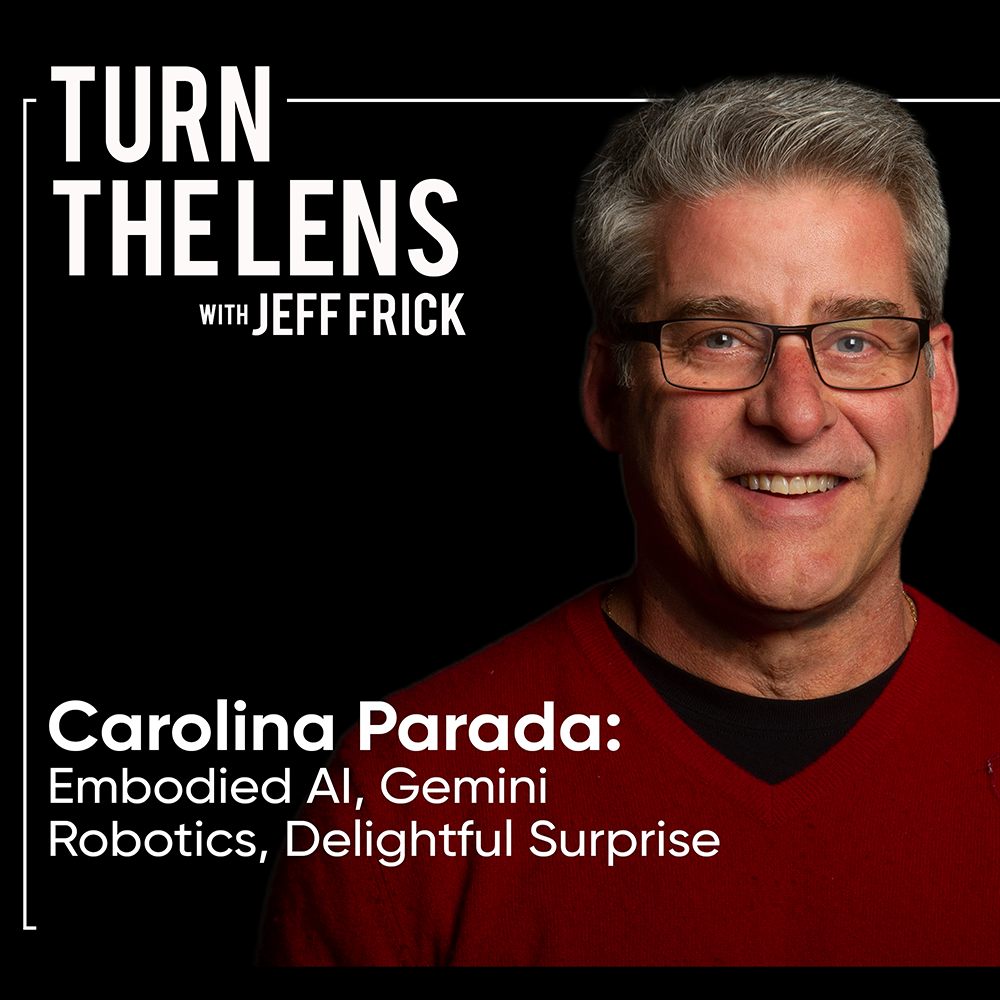
Ep 44Carolina Parada: Embodied AI, Gemini Robotics, Delightful Surprise | Turn the Lens Ep44
Carolina Parada and the team have delivered Gemini Robotics, Google DeepMind's vision-language-action (VLA) foundation model. Gemini Robotics provides the general-purpose 'understanding' enabling robots to go from pixel to action. How do you teach a machine to understand the physical world well enough to move through it, manipulate it, and help people in it, when every case is a corner case, never experienced in training? Embodied AI. AI with arms and legs and the ability to interact with the real world. Gemini Robotics is designed to generalize across platforms, so it works for robots that walk, roll, fly, and swim, with any end-effector, be it a hand, gripper, pincher, or suction cup. Gemini Robotics is designed to generalize across tasks and skills to respond to just about any request that the robot receives. I sat down with Carolina to explore Google DeepMind's approach to embodied AI at the Humanoids Summit 2025, hosted and organized by ALM Ventures at the Computer History Museum in Mountain View, California. Carolina has been working on teaching machines to recognize and respond to the environment in more human-centric ways, starting with speech and voice, then computer vision, and now robotics. At the heart of her work is Gemini Robotics, a foundation model that takes the multimodal reasoning capabilities of Gemini and extends them into the physical world. It's a VLA, vision-language-action, model. Going beyond "how many cars are in this image?" to "dunk the ball" when playing with a basketball toy. Embodiment-agnostic, it can adapt to control any robot: manipulators, mobile platforms, and the quickly developing humanoids. Data, Constitutional AI, teleoperation, video training, good candidates for the top concepts covered. But what impressed me more was her description of bringing new people in to experience the robots, inevitably asking the robots to do things they've never heard before, or interacting in Japanese or another language, only to have the robot respond appropriately, creating 'delight, surprise, and joy.' That is a robot future I can get excited about. Please join me in welcoming Carolina Parada to Turn the Lens, in collaboration with Humanoids Summit and ALM Ventures. This interview is a collaboration between Turn the Lens and Humanoids Summit, and was conducted at the Humanoids Summit SV, Computer History Museum, Mountain View, California, December 12, 2025. Humanoids Summit is organized and hosted by ALM Ventures Carolina Parada: Embodied AI, Gemini Robotics, Delightful Surprise | Turn the Lens with Jeff Frick Ep 44 Learn more about Humanoids Summit at http://www.humanoidssummit.com YouTube https://youtu.be/BUH1CysZX6A Trancripit and Show Notes

Ep 43Welcome Back: New Technology, Horizon Explorations, Human Lens | Turn the Lens Ep43
Welcome back. The world has changed quite a bit since we launched Turn the Lens. And in 2025, my new episode frequency was not as high as I'd like. For a bunch of reasons, some in my control and some not, I haven't been as consistent as I want to be. And I know consistency matters. I appreciate it in the creators I follow, it matters to me, and it matters to you, our community. My commitment for 2026: More. More frequent, more consistent, more solo segments, same interesting guests and topics. More Turn the Lens. Part of that means new tools. Not only desktop tools like Claude and Gemini, but also embodied AI tools like the autonomous drone I used to film this episode. It means getting out of the studio more. And it means more collaborations around the events and conversations that matter. We're excited to announce a collaboration with Humanoids Summit. Over the next few weeks, we'll be releasing ten interviews with some of the leading minds working on humanoid robotics and embodied AI. So thanks for sticking around. Thanks for reaching out and connecting—it means a lot. Get ready for more topics, more guests, and more conversations about the trends that matter. Not just the headlines, but why these developments actually matter to you and me, our kids, and future generations. That's what Turn the Lens has always been about. Important work to do. Let's get back to it. Welcome Back: New Technology, Horizon Explorations, Human Lens | Turn the Lens podcast with Jeff Frick, Ep43 YouTube: https://www.youtube.com/watch?v=1P8kRL_Px1I&list=PLZURvMqWbYjk4hbmcR46tNDdXQlrVZgEn Episode page with transcript and extensive show notes: https://www.turnthelenspodcast.com/episode/welcome-back-new-technology-horizon-explorations-human-lens-turn-the-lens-ep43

Ep 42Andra Keay: Robo-Pragmatist, Humanoids, Technological Shifts, Laws | Turn the Lens Ep42
Andra Keay, Managing Director of Silicon Valley Robotics, has been at the forefront of robotics research, commercialization, and policy for decades. A self-described "techno-pragmatist," Andra has her pulse on the robotics industry, in the San Francisco Bay Area and around the world. Importantly, she is conscious and intentional to try and get ahead of the big issues we face down the road with the societal shifts coming as millions of robots, humanoid and other form factors, populate more of our world and interactions. Andra is pro RoboTopia, and against an AI apocalypse. And robotics offers an insight into the world of AI, as they are AI with arms and legs, removed from the black box behind the screen, but out among us, where the consequences of a hallucination or miscalculation can have physical implications. Industrial robots were behind barricades and safely screens. Next gen Humanoids will work in homes, senior care facilities, factories, and other places with direct interaction with people. Andra is a frequent industry speaker, and in fact, we've shared a few panels together over the years, but this is the first time she's visited Turn The Lens so we could really get into it without restrictions. And the timing couldn't be better. Humanoid robots are having their moment. Figure just raised a $1B Series C, with a $39B post money valuation. Customers are moving from pilots to commercial engagements. Capacities are compounding at an exponential rate. Oh Yeah, and did I mention LLMs and their like have transformed the robot training paradigm. The next great wave of technological change is upon us. Humanoid Robotics, AI with arms, legs, and an ability to navigate the world, and do things. If you follow no one else, follow Andra to keep up on this part of our rapidly changing world. Subscribe to Robots & Startups on Substack. Andra Keay: Robo-Pragmatist, Humanoids, Technological Shifts, Laws | Turn the Lens with Jeff Frick, Ep42 #AndraKeay #Humanoids #Robotics #AI #TechnologyShifts #Automation #Ethics #RoboticsLaw #TurnTheLens #JeffFrick #FutureOfWork #Innovation #TechPolicy #Simulation #GenerativeAI #GenAI #RoboticsIndustry #FiveLaws #Society #Interview #Podcast #TurnTheLens YouTube - https://www.youtube.com/watch?v=lp46AO7aC_4&list=PLZURvMqWbYjk4hbmcR46tNDdXQlrVZgEn Transcript and show notes - https://www.turnthelenspodcast.com/episode/andra-keay-robo-pragmatist-humanoids-technological-shifts-laws-turn-the-lens-ep42

Ep 41Salvatore (Sal) Mercogliano: What's Going on With Shipping, YouTube Show Review | Turn the Lens Ep41
Salvatore (Sal) Mercogliano (Sal), has a Ph.D. in Military and Naval History from the University of Alabama. He served in the Merchant Marine, has been an Adjunct Professor of History/Engineering at the US Merchant Marine Academy for over 17 years, and Chairs the Department of History, Criminal Justice, and Political Science for Campbell University for over 14 years. So when something happens with ships, shipping, the US Navy or other major maritime news around the world, I go to Sal to find out what's really going on. Welcome to the first in a series of YouTube Show reviews that I hope can shed more light on some of the amazing information sources that operate as independents. These experts bring a wealth of knowledge and experience, a network of trusted colleagues, information on the open source data and applications, with knowledge on how to best use them to draw out the relevant information around a specific incident. When you want to get beyond the sound bite, and have a knowledgeable expert walk you through the details, known and unknown, answers and questions, you get a much better picture of what's happening in the world around us. Watch a few, with different sources, and one can begin to triangulate consistencies and patterns. So we kick off the series with Sal Mercogliano, maritime historian, former merchant mariner, and the expert behind the YouTube channel 'What's Going on With Shipping' Sal's channel 'blew up' with his coverage of the Motor Vessel EVER GIVEN gumming up the Suez Canal, and temporarily halting all global shipping through this most important passage. You'll be amazed at the number of new things happening in and around the oceans impacting us almost every day. Salvatore (Sal) Mercogliano: What's Going on With Shipping, YouTube Show Review | Turn the Lens with Jeff Frick Ep41 #Commerce #GlobalCommerce #Maritime #Oceans #PanamaCanal #BlackSea #TradeWar #MotorVessel #EverGiven #Ships #Tariffs #Panama #WhatsGoingOnWithShipping #Trade #GlobalTrade #USSTruman #Logistics #Maritime #OpenSource #Shipping #Review #SalMercogliano #SupplyChain #SuezCanal #Trade #TurnTheLens #YouTube YouTube - Click Here Transcript and Show Notes - Click Here

Ep 40Project 2025: Briefing doc, FAQ, Study guide, Podcast | Turn the Lens Ep40
Trump 2.0 starts tomorrow. 2025 started 19 days ago. Remember Project 2025? Might be a good time to study up on the subject, at least the basics. Not ready to read the full 920 pages? Google NotebookLM can help. I encourage you to upload the PDF yourself, and start asking questions. Sharing mine to help get you started. This is the Podcast Google NotbookLM created from the source material. Project 2025: Briefing doc, FAQ, Study guide, Podcast | Turn the Lens podcast with Jeff Frick Try it yourself Google NotebookLM https://notebooklm.google.com/ Project 2025 - 920 page pdf https://static.heritage.org/project2025/2025_MandateForLeadership_FULL.pdf YouTube - https://www.youtube.com/watch?v=ISWpI3YH4NE Transcript and Show Notes -

Ep 39Exponential Curves: Supercomputer to Smartphone to Singularity | Turn the Lens Jeff Frick Ep39
Ray Kurzweil recently released his new book, *The Singularity is Nearer: When We Merge with AI*, a follow-up to his 2006 blockbuster, *The Singularity is Near: When Humans Transcend Biology*. I had the chance to see him speak at our local bookstore as part of the launch event. A central theme of Ray's talks is the exponential growth of computing power—how we're constantly achieving more computations per second at a constant cost. While exponential curves are easy to discuss and graph, understanding these transformations on a visceral level is challenging. How can we fully grasp the scale of change that exponential growth reflects? This episode tackles that question, showing the exponential advances in computing power at a fraction of the cost, using examples and everyday objects that everyone can relate to, regardless of technical background. We've all heard that the smartphones in our pockets are far more powerful than the supercomputers of the past. But what does that really mean? How can we quantify, visualize, and bring this leap in technology to life in terms that feel real and relatable? We delve into comparisons—RAM, storage, and power usage—to illustrate the mind-blowing scale of progress and explore what these advances mean for the future of computing. More importantly, we examine the impact of this rapid growth as we move forward along an ever-steepening exponential curve. Join me as I use everyday items to help us better grasp this extraordinary rate of change, connect with our technological past, and imagine the future as exponential progress continues to shape our lives in profound ways. Exponential Curves: Supercomputer to Smartphone to Singularity | Turn the Lens podcast with Jeff Frick #AI #GenAI #ExponentialGrowth #ComputingPower #Future #RayKurzweil #TheSingularity #MooresLaw #AIandFuture #SupercomputerToSmartphone #Change #RateOfChange #FutureOfTech #Rice #Chessboard #Curves #Understand #Visualize #TechEvolution #Exponential #5G #T1 #FLOPS #Bandwidth #Storage #RAM #Visualization #TechForEveryone #SuperComputer #SmartPhone #Singularity #ExponentialCurves #SmartphoneVsSupercomputer #Podcast #TurnTheLens YouTube https://www.youtube.com/watch?v=meqrxgy435g&list=PLZURvMqWbYjk4hbmcR46tNDdXQlrVZgEn Transcript and Show Notes https://www.turnthelenspodcast.com/episode/exponential-curves-supercomputer-to-smartphone-to-singularity-turn-the-lens-ep39

Ep 38Google NotebookLM: AI, Ingest, Create a Podcast | Turn the Lens Ep38
2,500 pages. How can you quickly and easily digest 2,500 pages of material? More than just a summary or table of contents, what if you could dive into the core issues, pull up a timeline, or even create a study guide? That's exactly what you can do with Google NotebookLM, a powerful new free AI tool that requires no training, coding, or even RAG (Retrieval-Augmented Generation) expertise to put the power to work on any assets you please. Simply upload your documents, videos, and other digital assets, start asking questions, and let it do the heavy lifting. And if you prefer a podcast format, NotebookLM can even output a podcast style audio file for you to listen to, making content incredibly consumable. Your favorite podcast hosts explaining it all to you during your daily walk, run, or commute. Recently, a friend introduced me to NotebookLM. At the same time, Jack Smith dropped another 1,600 pages of evidence in four appendices related to the January 6th trial, full of dense assorted text material, tweets, book excerpts, interview transcripts, and pages of redactions to interrupt any sort of consumption flow. Add to that 165 pages in Document #252 and the 845-page January 6th commission report, and I had over 2,500 pages of information to put the NotebookLM to the test. So I uploaded all of it into NotebookLM and started asking questions. But what I've never seen before, and couldn't wait to try, was the ''generate a podcast.' feature. As a longtime media producer, podcast host, and guest, I was intrigued. How would it turn thousands of pages into a conversational podcast between a host and an educated guest? I hit "create podcast," and in less than 10 minutes, I had a 15-minute podcast ready to go. I added some simple talking head animation, to give a face to the voice, and hit 'play. (the male host sounds a bit like Leo Laporte, legendary long time tech podcast host). The result is simply amazing. The podcast is a very digestible way to consume the key points from the all those PDF files. It is an early version, and there are places where the sentence gets divided between the voices a bit more then necessary, but I think you'll be amazed. Jump to 03:54 to get to the start of the podcast, within a podcast. AI and GenAI are accelerating its impact on our lives faster than we realize. These tools are not novelties, they're reshaping the way we work, consume, and generate media, often making information more accessible. We must understand and familiarize ourselves (or master if you can) with them before they get even further ahead. Don't wait. Start integrating tools like this into your workflow today. Experiment. See what AI can do for you. We are getting supercomputers in the palm of our hands, that we can talk to, no coding required. Google NotebookLM: AI, Ingest, Create a Podcast | Turn the Lens with Jeff Frick Ep38 #AI #GenAI #NotebookLM #January6th #Podcasting #DataAnalysis #GoogleAI #AIInnovation #JackSmith #Vote #Automation #Supercomputing #TrialAnalysis #Jan6 #DigitalTransformation #TechTools #ContentCreation #Interview #Podcast #TurnTheLens YouTube https://www.youtube.com/watch?v=Mi03_cHeuNQ&list=PLZURvMqWbYjk4hbmcR46tNDdXQlrVZgEn Transcript and Show Notes https://www.turnthelenspodcast.com/episode/google-notebooklm-ai-ingest-create-a-podcast-turn-the-lens-ep38

Ep 37Dan Ariely: Decisions, Behavior, Stress, Resilience | Turn the Lens Ep37
Dan Ariely, the renowned behavioral economist, prolific author, frequent TED speaker, and endowed professor at Duke University, has spent decades studying why people behave the way they do. And let's just say that logic and reasoning do not top the list. I had the pleasure of seeing Dan speak in person in 2016, and almost a decade later, I was thrilled to host him for this conversation, where we could dive deeper into the drivers of decision making and human behavior. Dan's latest book, *"Misbelief: What Makes Rational People Believe Irrational Things,"* served as our catalyst—a topic of historical significance as conspiracy theories seem to be on the rise, in conjunction with declining levels of trust, particularly in the wake of the COVID-19 pandemic. And that was just the tip of the topics iceberg. Please join me in welcoming Dan Ariely to *Turn the Lens*. Why do we do what we do? How does the framing of a question influence our answers? How does stress impact decision-making? How well do we know our own preferences, and do we apply them effectively in our choices? What role does resilience play in avoiding the funnel of misbelief? And how is it that two people can experience the same event and yet perceive 'what happened' entirely differently? From B.F. Skinner's groundbreaking research on reinforcement schedules, principles the gambling industry has leveraged into unprecedented revenue heights, to what organizations are missing in "return to office" efforts, from visual illusions to after-the-fact-stories that 'explain' actions, to the power of a terminal illness diagnosis in resetting long-held assumptions and life priorities. Whether you're intrigued by psychology, decision science, or simply want to understand the nuances of human behavior, I promise this episode will provide thought-provoking perspectives and actionable insights. Join us as we unpack the fascinating complexities of human nature and discover how to navigate life's choices more effectively with Dan Ariely. Dan Ariely: Decisions, Behavior, Stress, Resilience | Turn the Lens podcast with Jeff Frick, Ep37 #DanAriely #Decisions #Behavior #Stress #Resilience #Bias #Trust #Choices #BehavioralEconomics #Misbelief #HumanBehavior #DecisionMaking #CognitiveBias #ConspiracyTheories #Psychology #BFSkinner #Rationality #Duke #MentalHealth #Economics #ReturnToOffice #BeliefSystems #LifeChoices #Mindset #SocialPerception #Interview #Podcast #TurnTheLens YouTube https://www.youtube.com/watch?v=rQn7QwlXSks&list=PLZURvMqWbYjk4hbmcR46tNDdXQlrVZgEn Transcript and Show Notes https://www.turnthelenspodcast.com/episode/dan-ariely-decisions-behavior-stress-resilience-turn-the-lens-ep37

Ep 36Jason Sacks: Youth Sports, Culture, Character | Turn the Lens Ep36
Jason Sacks joined the Positive Coaching Alliance (PCA) 18 years ago, around the same time I began my youth sports journey with my oldest child as he entered kindergarten and joined AYSO, the American Youth Soccer Organization. When done right, youth sports provide countless character-building opportunities in each practice, game, and activity. To quote NFL Hall of Fame quarterback Steve Young, these character traits include teamwork, overcoming challenges, working toward a bigger goal, resilience, risk-taking, success, failure, self-confidence, mental toughness, self-control, respect for others, and more. Unfortunately, when done wrong, youth sports not only miss the opportunity to help kids grow but can also be negative and detrimental, with long-term harmful impacts. The Positive Coaching Alliance (PCA) is dedicated to getting it "done right" by improving the youth sports experience for kids, families, and organizations across the U.S. With a wealth of resources, actionable lessons, and tools, PCA equips coaches, parents, leagues, and schools with strategies they can immediately use to help deliver a better experience for kids. Please join me in welcoming Jason Sacks to 'Turn the Lens'. Jason Sacks: Youth Sports, Culture, Character | Turn the Lens podcast with Jeff Frick, Episode 36 Transcript and Show Notes - Click Here https://www.turnthelenspodcast.com/episode/jason-sacks-youth-sports-culture-character-turn-the-lens-ep36 YouTube - Click Here https://www.youtube.com/watch?v=CzvyybqfUvs&list=PLZURvMqWbYjk4hbmcR46tNDdXQlrVZgEn #Kids #Youth #Sports #Coaching #Development #Character #Culture #PositiveCoaching #YouthSports #SportsDevelopment #CharacterBuilding #ParentalExpectations #PositiveCoachingAlliance #MultiSportAthletes #CoachingTips #YouthDevelopment #Tools #Teach #Development #HealthyCompetition #Sportsmanship #InclusiveSports #SportsLeadership #HonorTheGame #YouthMentorship #ParticipationTrophies #SportsPsychology #CommunityBuilding #GrowthMindset #SportsCulture #PCA #Interview #Podcast #TurnTheLens

Ep 35Meryl Evans: Captions, Clean, Supercalifragilisticexpialidocious | Turn the Lens Ep35
George H.W. Bush signed the Americans with Disabilities Act (ADA) into law 34 years ago today, July 26, 1990. It literally changed our world, from cub cuts, and wide doors, to ramps and more. What is less reported is the secondary and 'law of unintended positive consequences' that come with inclusive design. More accessible for one is more accessible for all. Meryl Evans has been championing the benefits of closed captions, and closed caption best practices for decades. Born 'hearing free' her experience with captioning is very personal, starting with the special home unit hooked up to the TV. Doing captions well will increase the consumability of your content by orders of magnitude, for an audience far larger than the deaf or hard of hearing. Adding layers options ensures each viewer get's the asset that matches their learning style, be that text, audio, video, or graphics. Please join me in welcoming Meryl Evans to Turn the Lens in this World Premier Event Meryl Evans: Captions, Clean, Supercalifragilisticexpialidocious | Turn the Lens podcast with Jeff Frick, Episode 35 #Captions #Clean #Supercalifragilisticexpialidocious #Accessibility #ADA #Leadership #Education #BestPractices #Learn #Caption #AmericansWithDisabilitiesAct #Simple #Boring #EasyToRead #Information #Scan #Interview #Podcast #TurnTheLens