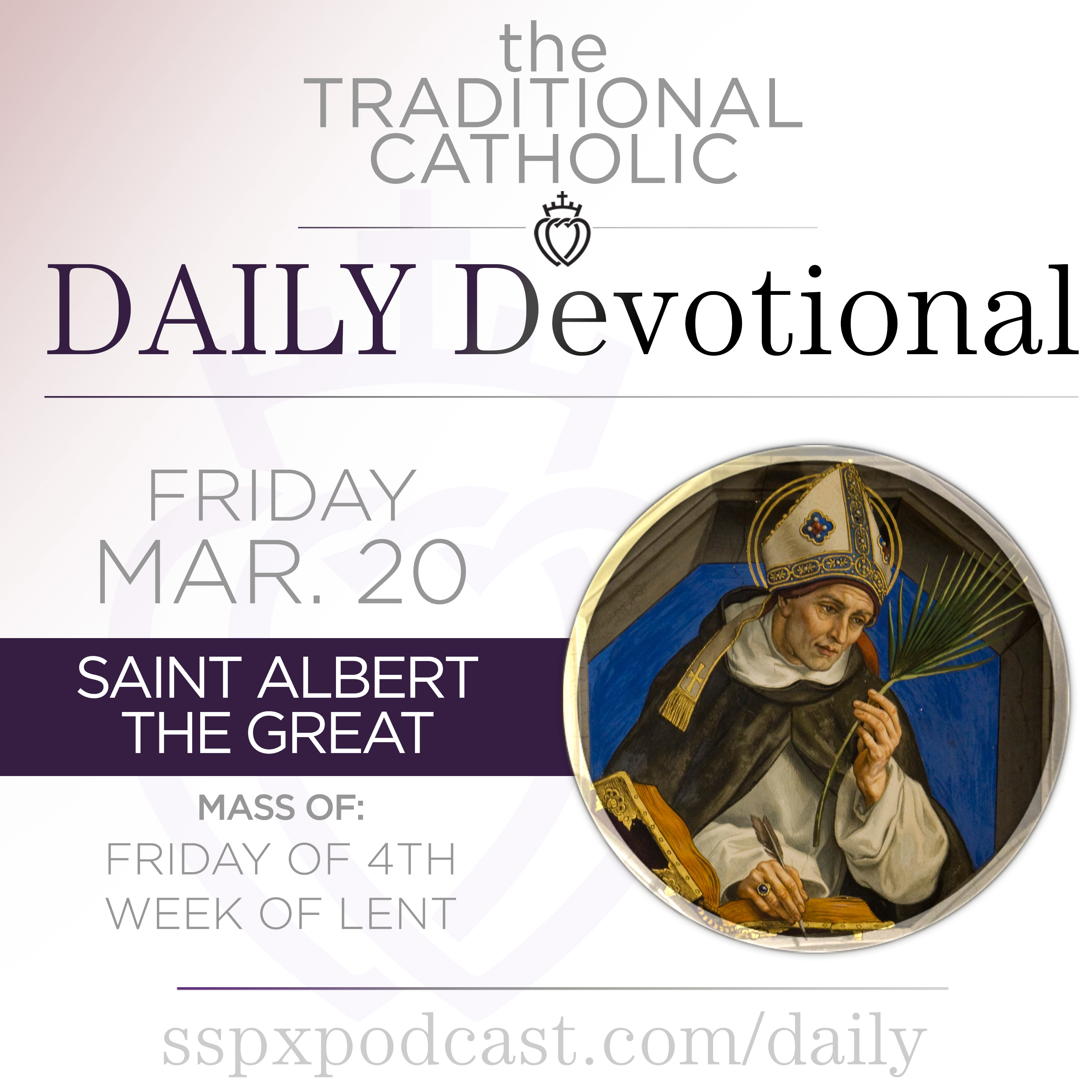
Mar 20 – Fri of 4th Wk of Lent / S Albert Great
Traditional Catholic Daily Devotional · SSPX US District, Angelus Press
Audio is streamed directly from the publisher (episodes.captivate.fm) as published in their RSS feed. Play Podcasts does not host this file. Rights-holders can request removal through the copyright & takedown page.
Show Notes
Sources Used Today:
- "Death: Entry into True Life" — Toward Easter
- "Spain: Conscientious Objector Doctors Targeted by a “Blacklist“" (FSSPX.news)
- The SSPX Podcast: "Episcopal Consecrations #1: Who Was Archbishop Marcel Lefebvre?" (SSPX Podcast)
- View on YouTube
- Listen & Subscribe on SSPXpodcast.com
- The Spiritual Life — Archbishop Marcel Lefebvre (Angelus Press)
Saint Albert the Great stands as one of the most remarkable minds in the history of the Church, yet his greatness was marked as much by humility as by learning. He was born around the year 1200 in Lauingen, in present-day Germany, into a noble family. As a young man he studied in Italy, where he encountered the newly founded Order of Preachers, the Dominicans. Drawn by their life of study and preaching, he joined the order despite resistance from his family.
Albert devoted himself to the pursuit of truth, seeing no division between faith and reason. He became a teacher of theology and philosophy, eventually lecturing in Paris and Cologne. His student, Thomas Aquinas, would go on to become one of the greatest theologians in Church history, and Albert recognized his brilliance early on. Albert’s own work was vast. He wrote on Scripture, theology, philosophy, and even the natural sciences, studying plants, animals, and the physical world with careful observation.
At a time when many feared that the rediscovered writings of Aristotle might threaten Christian belief, Albert worked patiently to show that truth could never contradict truth. He helped integrate classical philosophy into Christian thought, laying the groundwork for the great synthesis later perfected by Aquinas. For this reason, he is honored as a Doctor of the Church and is often called “the Great.”
Yet Albert’s life was not confined to the classroom. He served as a bishop for a time, though he preferred the quiet life of study and prayer. Even in positions of authority, he remained simple and approachable, devoted to the spiritual care of souls. In his later years, he returned to teaching and writing, continuing his work until his death in 1280.
The Church remembers Saint Albert not only for his intellect, but for his example of ordered wisdom. He showed that the study of creation can lead the soul to the Creator. Because of his work in the natural sciences, he is regarded as a patron of scientists, students, and those engaged in intellectual pursuits.
In various places, his feast day on November 15 is marked by academic celebrations, especially in schools and universities. Dominican communities honor him as a model of their charism, combining study, prayer, and preaching. His legacy reminds the faithful that learning, when rightly ordered, becomes an act of praise.
Saint Albert the Great, lover of truth and faithful servant of divine wisdom, pray for us.
- - - - - -Please Support this Apostolate with 1-time or Monthly Donation >>
- - - - - -Explore more:
- Subscribe to the email version of this Devotional- it's a perfect companion!
- Subscribe to this Podcastto receive this and all our audio episodes
- Subscribe to the SSPX YouTube channelfor video versions of our podcast series and Sermons
- FSSPX News Website:https://fsspx.news
- Visit the US District website:https://sspx.org/