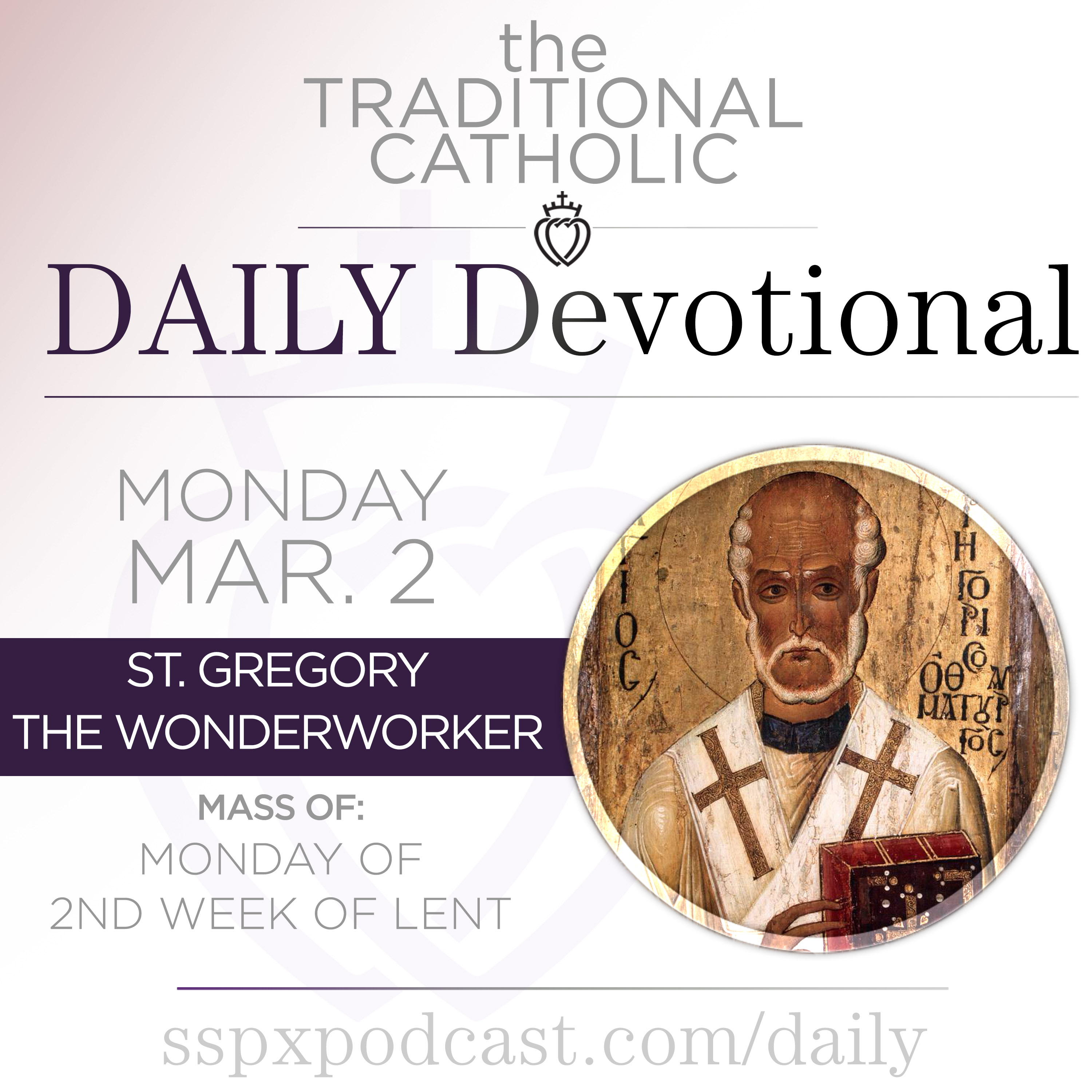
Mar 2 – Mon of 2nd Wk of Lent / S Gregory Wonderworker
Traditional Catholic Daily Devotional · SSPX US District, Angelus Press
Audio is streamed directly from the publisher (episodes.captivate.fm) as published in their RSS feed. Play Podcasts does not host this file. Rights-holders can request removal through the copyright & takedown page.
Show Notes
It’s the Mon of 2nd Week of Lent, 3rd Class, with the color of Violet. In this episode: the meditation: “God In Us”, today’s news from the Church: “Opus Dei Meets With Pope Leo XIV”, a preview of the Sermon: “St. Joseph, Our Spiritual Guide”, and today’s thought from the Archbishop.
Have feedback or questions about the DD or our other shows? [email protected]Sources Used Today:
- “God In Us” – Toward Easter
- “Opus Dei Meets With Pope Leo XIV” (FSSPX.news)
- “St. Joseph, Our Spiritual Guide” (SSPX Sermons)
- The Spiritual Life – Archbishop Lefebvre (Angelus Press)
Saint Gregory the Wonderworker, also known as Gregory Thaumaturgus, was a bishop whose life combined intellectual depth with signs that astonished even his own generation. Born around 213 in Pontus, in Asia Minor, Gregory came from a pagan family and was trained in classical rhetoric and law. His early ambitions were secular, and he pursued higher studies with seriousness. Everything changed when he encountered the great Christian teacher Origen in Caesarea. Gregory intended only to continue his education, but Origen’s clarity and personal holiness awakened in him a desire for Christ. After careful reflection, Gregory was baptized and began to see philosophy not as an end in itself, but as preparation for the truth revealed in the Gospel.
When he returned to Pontus, Gregory found himself chosen as bishop of Neocaesarea, though he felt unworthy and reluctant. His diocese was overwhelmingly pagan, and Christian numbers were few. Yet Gregory accepted the charge with humility and resolve. Ancient tradition credits him with remarkable miracles that gave rise to his title, Wonderworker. He was said to have moved a large stone through prayer to allow the construction of a church, calmed a destructive river, and driven out demons that frightened entire towns. Whether understood literally or as signs of divine favor, these accounts reflect the deep impression he left on his people. His preaching carried both conviction and gentleness.
What is most striking about Gregory is the transformation attributed to his ministry. When he became bishop, only a handful of Christians lived in his region. By the time of his death around 270, paganism had nearly disappeared from the city. His success did not come from force or political power, but from patient teaching and steady presence. He wrote a creed summarizing Trinitarian belief with clarity that influenced later theological development, especially during the controversies of the fourth century.
Gregory’s life bridged the era of persecution and the growing organization of the Church. He suffered during imperial hostility but also helped establish stronger Christian communities that would endure. His sanctity was not rooted in spectacle, but in constancy and trust.
Devotion to Saint Gregory the Wonderworker spread especially in the East. His feast on November 17 honored him as a patron of those seeking help in seemingly impossible situations and of bishops charged with evangelizing hostile environments. He became a symbol of hope that grace can transform entire regions through one faithful shepherd.
Saint Gregory the Wonderworker, steadfast bishop and servant of divine power, pray for us.
- - - - - -Please Support this Apostolate with 1-time or Monthly Donation >>
- - - - - -Explore more:
- Subscribe to the email version of this Devotional- it's a perfect companion!
- Subscribe to this Podcastto receive this and all our audio episodes
- Subscribe to the SSPX YouTube channelfor video versions of our podcast series and Sermons
- FSSPX News Website:https://fsspx.news
- Visit the US District website:https://sspx.org/