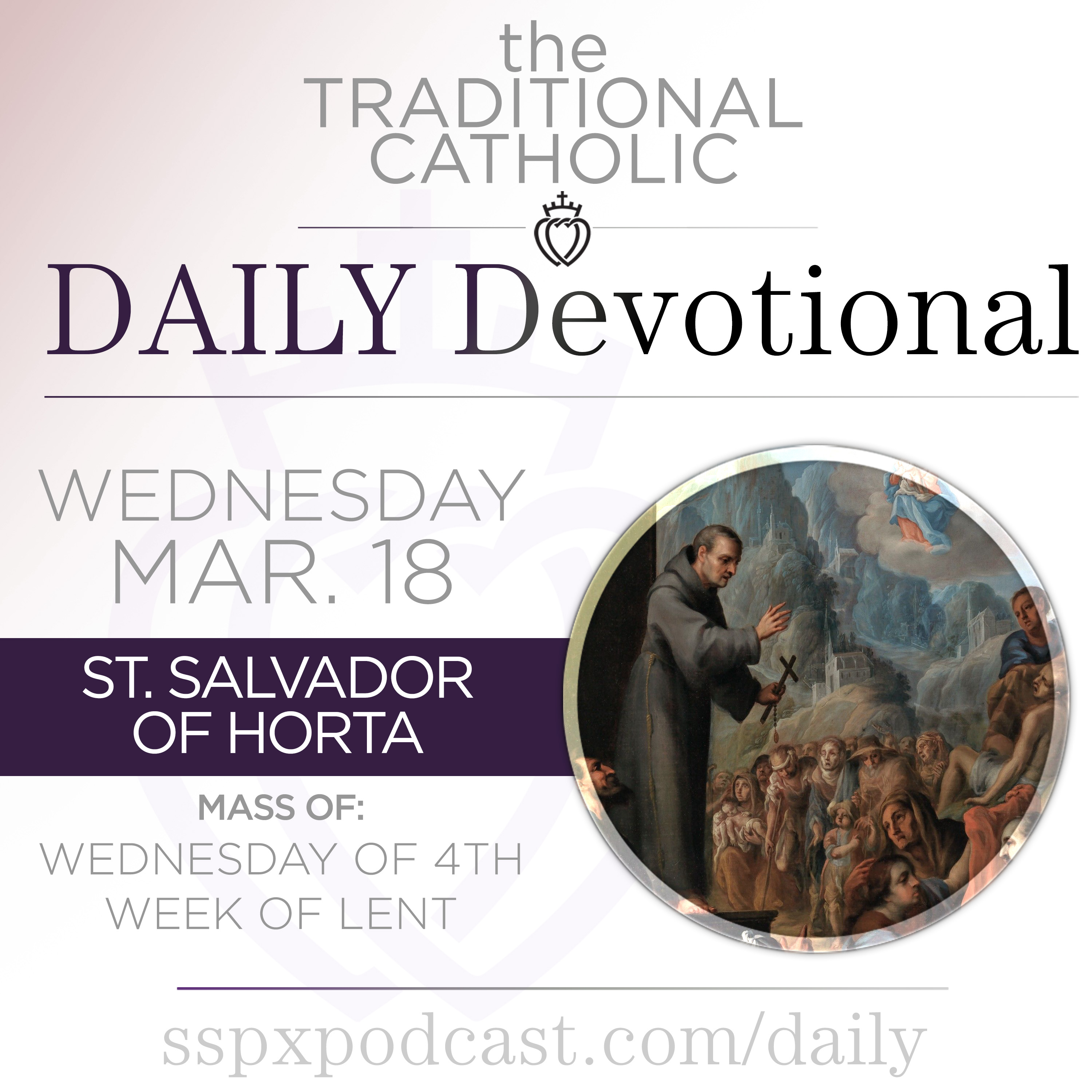
Mar 18 – Wed of 4th Wk of Lent / S Salvador of Horta
Traditional Catholic Daily Devotional · SSPX US District, Angelus Press
Audio is streamed directly from the publisher (episodes.captivate.fm) as published in their RSS feed. Play Podcasts does not host this file. Rights-holders can request removal through the copyright & takedown page.
Show Notes
Sources Used Today:
- "Purity of Heart" — Toward Easter
- "Spend Long Moments Speaking To and Thinking About Jesus" (FSSPX.news)
- "The Screen: More Than a Moral Question" (SSPX Sermons)
- The Spiritual Life — Archbishop Marcel Lefebvre (Angelus Press)
Saint Salvador of Horta was a humble Franciscan lay brother whose life revealed the quiet power of prayer and charity. He was born in 1520 in the small town of Santa Coloma de Farners in Catalonia, Spain. His parents were poor but devout, and Salvador grew up learning the dignity of work and the importance of trust in God. When he was still young, both of his parents died, leaving him to support himself through simple labor. He worked as an apprentice shoemaker, living modestly and cultivating a deep life of prayer.
From an early age, Salvador showed an unusual love for the poor and the suffering. Those who knew him noticed his simplicity, his kindness, and the way he seemed constantly aware of God’s presence. In his early twenties he entered the Franciscan Order as a lay brother at the convent of Santa Maria de Jesús in Barcelona. As a lay brother he was not ordained, but he embraced the humble tasks of the monastery with joy, serving in the kitchen, working in the garden, and assisting wherever he was needed.
It was in these hidden duties that God began to reveal extraordinary gifts through him. Many people who came to the monastery for help found themselves healed after Salvador prayed over them. News of these miracles spread quickly throughout Catalonia and beyond. Crowds gathered daily seeking his prayers. Some accounts say that hundreds of people would arrive each day hoping for healing or consolation.
Despite the attention, Salvador remained profoundly humble. He insisted that any cures came from God alone and often tried to avoid recognition. His superiors even transferred him from one convent to another in an effort to lessen the crowds. Yet wherever he went, people continued to seek him out. Even the powerful and noble came quietly to ask for his prayers.
Saint Salvador died on March 18, 1567, in the Franciscan convent of Horta, the place from which he takes the name by which he is remembered.
Devotion to Saint Salvador of Horta spread quickly after his death, especially in Spain and among Franciscan communities. Pilgrims long visited the convent at Horta, asking his intercession for healing and spiritual help. He became known as a patron for those suffering from illness and for those who feel forgotten or overlooked.
In Catalonia, his feast day has traditionally been marked by pilgrimages and prayers for the sick. His life reminds the faithful that holiness does not require fame or status, but fidelity in small things done with love.
Saint Salvador of Horta, humble servant of God and friend of the suffering, pray for us.
- - - - - -Please Support this Apostolate with 1-time or Monthly Donation >>
- - - - - -Explore more:
- Subscribe to the email version of this Devotional- it's a perfect companion!
- Subscribe to this Podcastto receive this and all our audio episodes
- Subscribe to the SSPX YouTube channelfor video versions of our podcast series and Sermons
- FSSPX News Website:https://fsspx.news
- Visit the US District website:https://sspx.org/