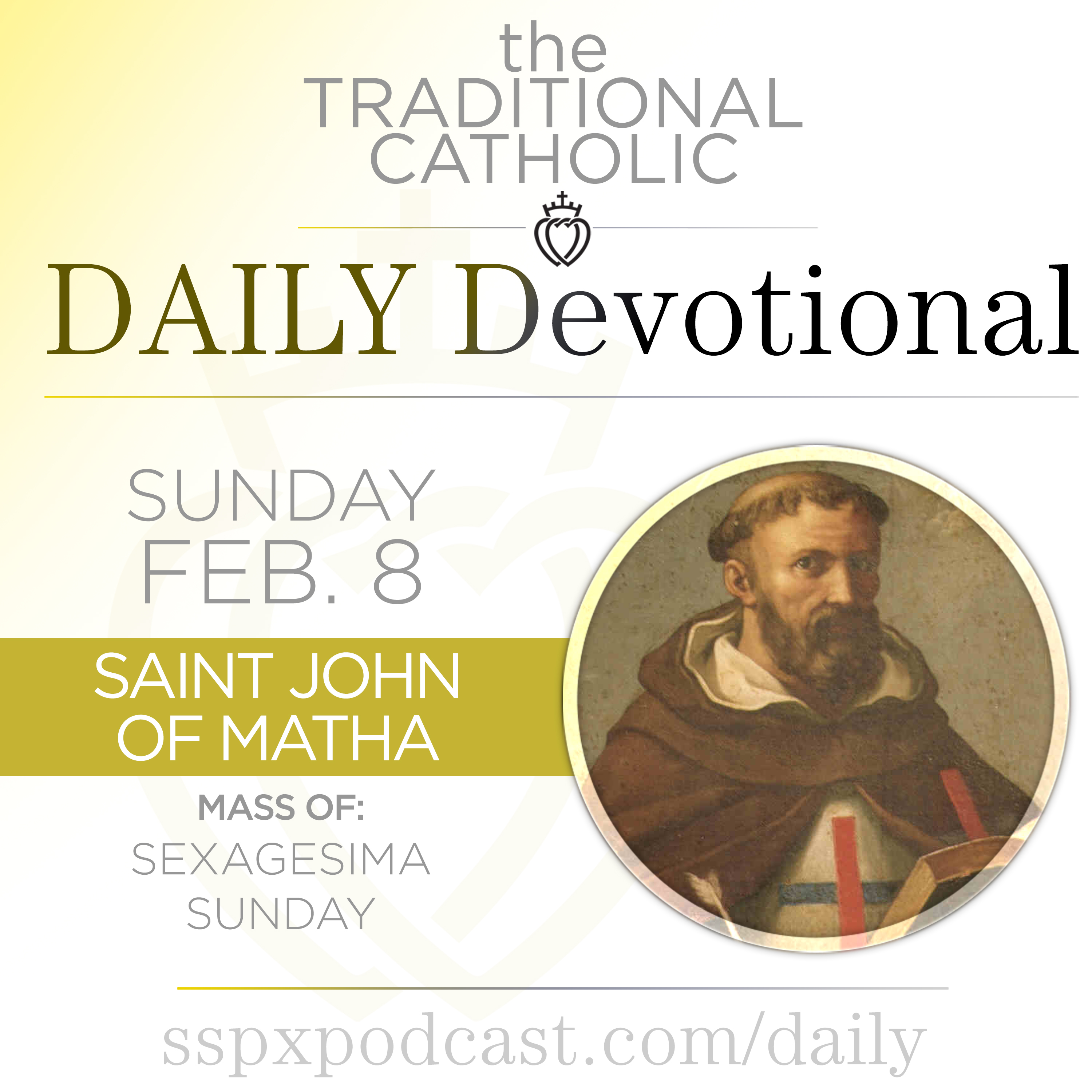
Feb 8 – Sexagesima Sun / S John of Matha
Traditional Catholic Daily Devotional · SSPX US District, Angelus Press
Audio is streamed directly from the publisher (episodes.captivate.fm) as published in their RSS feed. Play Podcasts does not host this file. Rights-holders can request removal through the copyright & takedown page.
Show Notes
It’s the Feast of Sexagesima Sunday, 2nd Class, with the color of Violet. In this episode: the meditation: “God in Nature”, today’s news from the Church: “A Pope Francis Man Appointed to a Key Position”, and today’s thought from the Archbishop.
Have feedback or questions about the DD or our other shows? [email protected]Sources Used Today:
- “God in Nature” – From Epiphany to Lent
- “A Pope Francis Man Appointed to a Key Position” (FSSPX.news)
- The Spiritual Life – Archbishop Lefebvre (Angelus Press)
Saint John of Matha was a priest whose holiness took the form of organized mercy, a man who saw human suffering clearly and refused to spiritualize it away. Born around 1160 in southern France, John was known early for intelligence, discipline, and prayer. He studied theology in Paris and was ordained a priest, yet he felt unsettled, convinced that God was asking something more concrete of him than a quiet academic life. That clarity came during his first Mass, when he experienced a vision that would shape everything that followed.
According to tradition, John saw Christ standing between two captives, one Christian and one Muslim, both bound in chains. The vision was not symbolic in the abstract sense. It named a real wound of the medieval world. Thousands of Christians were being captured through war and piracy and held in brutal slavery across the Mediterranean. Families were destroyed, faith was endangered, and ransoms were often impossible. John understood immediately that this was not a problem to be lamented, but one to be confronted.
John sought out Saint Felix of Valois, a hermit whose wisdom and prayer grounded the vision in discernment. Together they traveled to Rome, where Pope Innocent III approved their mission. In 1198, John founded the Order of the Most Holy Trinity for the Redemption of Captives, known as the Trinitarians. Their charism was precise and costly. They vowed to raise funds, negotiate with captors, and personally travel into dangerous territory to redeem prisoners. In time, the order took an extraordinary additional vow, promising to offer themselves in exchange for captives if necessary. Mercy was not theoretical. It was embodied.
John of Matha spent his life organizing ransom missions, preaching charity, and forming religious who could combine prayer, discipline, and courage. He insisted that redemption was not only about physical freedom, but about preserving faith under extreme pressure. Captivity often involved forced conversion or psychological torment. To rescue a captive was to defend the soul as well as the body. John’s leadership was methodical rather than dramatic. He built systems, formed consciences, and insisted on transparency and honesty in all dealings, even with enemies.
He died in 1213, having laid foundations that would endure for centuries. The Trinitarians redeemed tens of thousands of captives across Europe and North Africa, leaving a legacy of mercy that crossed religious and political boundaries. John’s sanctity lies in his refusal to accept cruelty as inevitable.
Tradition honors Saint John of Matha as a patron of captives, those working for human freedom, and Christians engaged in works of mercy that demand courage and organization. His feast on February 8 recalls a truth the Church still needs. Charity must be willing to enter danger, structure itself wisely, and place love into action.
Saint John of Matha, servant of the Redeemer and liberator of captives, pray for us.
- - - - - -Please Support this Apostolate with 1-time or Monthly Donation >>
- - - - - -Explore more:
- Subscribe to the email version of this Devotional- it's a perfect companion!
- Subscribe to this Podcastto receive this and all our audio episodes
- Subscribe to the SSPX YouTube channelfor video versions of our podcast series and Sermons
- FSSPX News Website:https://fsspx.news
- Visit the US District website:https://sspx.org/