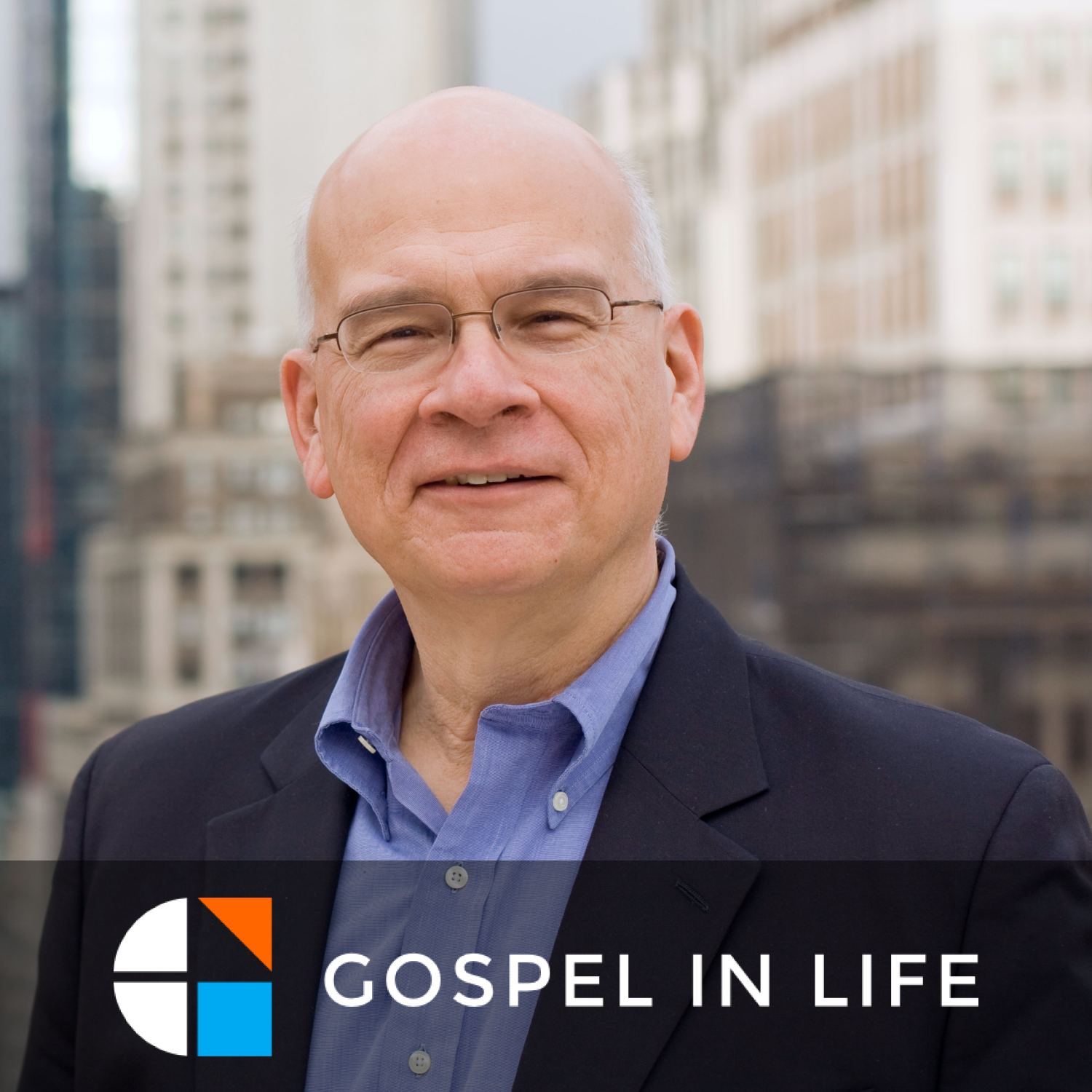
Timothy Keller Sermons Podcast by Gospel in Life
120 episodes — Page 1 of 3
How To Find Your Self
How To Find the Way
The Girl Nobody Wanted
Should I Not Love That Great City?
Let Them Give Up Their Violence
Those Who Cling… Forfeit the Grace
They Greatly Feared
Running From God
Confident in the Advocate
Confident in Prayer
Confident in Love
Confident in Hope
Our Vocation: Lay Ministry
Our Walk: The Freedom of Submission
Our Power: Spirit-Filled Living
Our Cross: Path of Suffering
Our Call: Holy Living
Our Identity: Joyful Exiles
Our Birth: Cosmic
Encountering the Risen Jesus
Ep 1366Clothed With Power (Easter)
Easter is too marvelous for words, but we’re going to try. Luke 24 is an account of the resurrection: from the morning when the empty tomb was discovered, to the middle of the day when Jesus appeared on the road to Emmaus, to the evening when Jesus appeared to his disciples. And in that evening account, we see that Jesus said a number of things to his disciples. We can learn three things about the resurrection of Jesus Christ from what happens that evening: 1) the resurrection of Jesus Christ is a paradigm-shattering historical event, 2) the resurrection of Jesus Christ is the key to understanding the message of the entire Bible, and 3) the resurrection is the strongest message of hope possible. This sermon was preached by Dr. Timothy Keller at Redeemer Presbyterian Church on April 20, 2014. Series: Knowing Jesus. Scripture: Luke 24:36-49. Today's podcast is brought to you by Gospel in Life, the site for all sermons, books, study guides and resources from Timothy Keller and Redeemer Presbyterian Church. If you've enjoyed listening to this podcast and would like to support the ongoing efforts of this ministry, you can do so by visiting https://gospelinlife.com/give and making a one-time or recurring donation.
Ep 1365Worship (Palm Sunday)
For centuries now, on the Sunday before Easter, the church has observed the triumphal entry of Jesus Christ into Jerusalem just days before he was crucified. It’s called Palm Sunday. What does Palm Sunday mean? It means Jesus is king, and it’s important to see that’s not just an abstract proposition. Palm Sunday is about this: you can’t know Jesus Christ unless you know him as king. He can’t change your life unless you understand him as king. You can’t even understand who he is unless you understand him as king. Luke 19 teaches us 1) Jesus is the true king, 2) Jesus is the weak king, and 3) how he can be your king. This sermon was preached by Dr. Timothy Keller at Redeemer Presbyterian Church on April 13, 2014. Series: Knowing Jesus. Scripture: Luke 19:28-40. Today's podcast is brought to you by Gospel in Life, the site for all sermons, books, study guides and resources from Timothy Keller and Redeemer Presbyterian Church. If you've enjoyed listening to this podcast and would like to support the ongoing efforts of this ministry, you can do so by visiting https://gospelinlife.com/give and making a one-time or recurring donation.
Ep 1364Mission
Christianity gives us resources to help us live in a world that’s hard to live in. And in Luke 5, we see a resource we wouldn’t immediately think of as one — that is, that when Jesus calls us, he sends us out into the world to serve. Serving other people is draining, but it’s also strengthening. Because if you see that you should live for your neighbor’s fulfillment rather than your own fulfillment, paradoxically, that becomes a very fulfilling life. Jesus sends us out in three ways: 1) he sends us with our faith out into our work, 2) he asks us to take our faith out to the marginalized of society, and 3) he asks us to go out and help change people’s hearts toward God. This sermon was preached by Dr. Timothy Keller at Redeemer Presbyterian Church on March 16, 2014. Series: Knowing Jesus. Scripture: Luke 5:4-25. Today's podcast is brought to you by Gospel in Life, the site for all sermons, books, study guides and resources from Timothy Keller and Redeemer Presbyterian Church. If you've enjoyed listening to this podcast and would like to support the ongoing efforts of this ministry, you can do so by visiting https://gospelinlife.com/give and making a one-time or recurring donation.
Ep 1363Scripture
When you’re in the wilderness, how do you handle the trials, the difficulties, and the temptations? In Luke 4, we have a famous passage about the temptation of Jesus in the wilderness. Jesus is assaulted by the Devil, and he deals with it through the Word of God. We’re going to look at how Jesus uses Scripture, and how, in a practical way, we can too. This text shows us 1) the depth and complexity of evil, 2) some of the strategies of evil, and 3) how to defeat evil using Scripture. This sermon was preached by Dr. Timothy Keller at Redeemer Presbyterian Church on March 9, 2014. Series: Knowing Jesus. Scripture: Luke 4:1-13. Today's podcast is brought to you by Gospel in Life, the site for all sermons, books, study guides and resources from Timothy Keller and Redeemer Presbyterian Church. If you've enjoyed listening to this podcast and would like to support the ongoing efforts of this ministry, you can do so by visiting https://gospelinlife.com/give and making a one-time or recurring donation.
Ep 1362Out From the Grave
The raising of Lazarus is the seventh and climactic of Jesus’ miraculous signs in the Gospel of John. John says Jesus did many miracles, but these seven particularly revealed who Jesus was and what he came to do. And this one is probably the most famous. Jesus especially loved Mary, Martha, and Lazarus—there was a special friendship there. But Lazarus gets sick when Jesus is away, and Lazarus is dead by the time Jesus gets there. Everyone’s mourning, and that’s when this account begins. Looking at this passage, we learn 1) about who Jesus is, from when he’s with the sisters, and 2) about what Jesus came to do, from when he’s with Lazarus. This sermon was preached by Dr. Timothy Keller at Redeemer Presbyterian Church on March 2, 2014. Series: Seeing Jesus. Scripture: John 11:18-44. Today's podcast is brought to you by Gospel in Life, the site for all sermons, books, study guides and resources from Timothy Keller and Redeemer Presbyterian Church. If you've enjoyed listening to this podcast and would like to support the ongoing efforts of this ministry, you can do so by visiting https://gospelinlife.com/give and making a one-time or recurring donation.
Ep 1361The Man Born Blind
The healing of the man born blind is one of Jesus’ miracles that’s called a sign, meaning it symbolizes something about who Jesus was and what he came to do. This is a story about a man who’s born blind, and it takes up an entire chapter. The man is healed in the very first few verses, then there’s quite a bit of interrogation with the Pharisees, and then the man comes back, has an encounter with Jesus, and comes to faith. Looking at the three groups of people in this passage—the disciples, the Pharisees, and the man who is healed—we learn 1) something about pain and suffering, 2) something about spiritual blindness, and 3) something about what heals it all. This sermon was preached by Dr. Timothy Keller at Redeemer Presbyterian Church on February 23, 2014. Series: Seeing Jesus. Scripture: John 9:1-7, 35-38. Today's podcast is brought to you by Gospel in Life, the site for all sermons, books, study guides and resources from Timothy Keller and Redeemer Presbyterian Church. If you've enjoyed listening to this podcast and would like to support the ongoing efforts of this ministry, you can do so by visiting https://gospelinlife.com/give and making a one-time or recurring donation.
Ep 1360The Feeding
In the miraculous sign of the feeding of the 5,000, Jesus takes a few loaves and fish and miraculously feeds a multitude of people. This is the only one of Jesus’ miracles that’s told in all four gospels. And the gospel of John gives us the final discourse in which Jesus explains the meaning of the miracle. Jesus says it’s a symbol. Jesus says, “I am the bread of life.” Let’s meditate on the aspects of that remarkable statement and look at 1) the meaning of bread in general, 2) the meaning of this bread in particular, and 3) why Jesus is able to give it to us. This sermon was preached by Dr. Timothy Keller at Redeemer Presbyterian Church on February 9, 2014. Series: Seeing Jesus. Scripture: John 6:1-14, 27-35. Today's podcast is brought to you by Gospel in Life, the site for all sermons, books, study guides and resources from Timothy Keller and Redeemer Presbyterian Church. If you've enjoyed listening to this podcast and would like to support the ongoing efforts of this ministry, you can do so by visiting https://gospelinlife.com/give and making a one-time or recurring donation.
Ep 1359The Pool
Can you imagine a perfect human being? You may say, “Sure.” But perfection would necessarily be surprising to us because we’re not perfect and we’ve actually never seen perfection. The challenge of the New Testament is to read about Jesus, not just once, but page after page after page. If you do that, you’ll pretty much be forced to the conclusion that nobody could’ve imagined someone like this. So we’re looking now at the miraculous signs to see what they show us about Jesus. This is the third miraculous sign: the healing of the lame man at the pool of Bethesda. Let’s look at 1) the pool, 2) the man, and 3) the Sabbath controversy. This sermon was preached by Dr. Timothy Keller at Redeemer Presbyterian Church on February 2, 2014. Series: Seeing Jesus. Scripture: John 5:1-18. Today's podcast is brought to you by Gospel in Life, the site for all sermons, books, study guides and resources from Timothy Keller and Redeemer Presbyterian Church. If you've enjoyed listening to this podcast and would like to support the ongoing efforts of this ministry, you can do so by visiting https://gospelinlife.com/give and making a one-time or recurring donation.
Ep 1358The Healing
I’ve heard people say, “Oh, I wish I had his faith, or her faith,” as if faith is a talent. And I do think there’s a kind of faith that’s a temperament—people who are more trusting or more skeptical—but that’s not saving faith. There is no type of person who becomes a Christian. Saving faith, the faith that brings you eternal life, is for everyone. And Jesus’ miraculous sign in John 4 teaches us about this faith. In this passage, we learn that life-giving faith 1) starts with reason, 2) has to move beyond reason to trust, 3) grows beautiful and pure where gold grows beautiful and pure, 4) saves by its object, not its quality, and 5) comes to love Jesus for who he is in himself, not for the benefits he gives. This sermon was preached by Dr. Timothy Keller at Redeemer Presbyterian Church on January 26, 2014. Series: Seeing Jesus. Scripture: John 4:46-54. Today's podcast is brought to you by Gospel in Life, the site for all sermons, books, study guides and resources from Timothy Keller and Redeemer Presbyterian Church. If you've enjoyed listening to this podcast and would like to support the ongoing efforts of this ministry, you can do so by visiting https://gospelinlife.com/give and making a one-time or recurring donation.
Ep 1357The Feast
Jesus’ first sign was not feeding the poor. It wasn’t healing the sick or raising the dead. It was keeping a party going. In the book of John, there’s a series of miracles that are called signs. That’s important because it means Jesus’ miracles weren’t naked displays of power. They signify. They’re symbolic. They point to who Jesus is and what he came to do. And the first sign of Jesus’ ministry is turning water into wine. What does that say about him? Let’s take a look and ask 1) what do the jars point to? 2) what does the brusque exchange with his mother point to? 3) what does the wine point to? and 4) what does this mean for us? This sermon was preached by Dr. Timothy Keller at Redeemer Presbyterian Church on January 19, 2014. Series: Seeing Jesus. Scripture: John 2:1-11. Today's podcast is brought to you by Gospel in Life, the site for all sermons, books, study guides and resources from Timothy Keller and Redeemer Presbyterian Church. If you've enjoyed listening to this podcast and would like to support the ongoing efforts of this ministry, you can do so by visiting https://gospelinlife.com/give and making a one-time or recurring donation.
Ep 1356The Lamb
People come up to John the Baptist and say, “What is your identity? What is your self-understanding?” That has a very contemporary ring to it. And it has quite a bit to do with us. We’re looking at the life of Jesus and who Jesus is. In the second half of John 1, in this encounter with John the Baptist, we learn that Jesus is the Lamb of God. So we ask, “What does that mean for us?” Let’s take a look at 1) John’s view of himself, 2) John’s view of Jesus, 3) the resulting personality and character that flows from those two views, and 4) what that means for us. This sermon was preached by Dr. Timothy Keller at Redeemer Presbyterian Church on January 12, 2014. Series: Seeing Jesus. Scripture: John 1:19-34. Today's podcast is brought to you by Gospel in Life, the site for all sermons, books, study guides and resources from Timothy Keller and Redeemer Presbyterian Church. If you've enjoyed listening to this podcast and would like to support the ongoing efforts of this ministry, you can do so by visiting https://gospelinlife.com/give and making a one-time or recurring donation.
Ep 1355In the Beginning
You can’t really understand the real Jesus if you only look at his birth and his death. You must also look at his words and his deeds during his life. To study the words and deeds of Jesus, we’re going to look in the Gospel of John, starting with John 1. It’s one of the most famous passages of the Bible, with too much great stuff to possibly discuss it all. So I’d like to give a top-level view of it, looking at the three main parts: 1) a radical, amazing claim, 2) the rejection of the claim, and 3) the answer to the objections to and rejection of the claim. This sermon was preached by Dr. Timothy Keller at Redeemer Presbyterian Church on January 5, 2014. Series: Seeing Jesus. Scripture: John 1:1-14. Today's podcast is brought to you by Gospel in Life, the site for all sermons, books, study guides and resources from Timothy Keller and Redeemer Presbyterian Church. If you've enjoyed listening to this podcast and would like to support the ongoing efforts of this ministry, you can do so by visiting https://gospelinlife.com/give and making a one-time or recurring donation.
Ep 1354The Cornerstone
In ancient architecture, the cornerstone was the first stone laid, and it had to be the most perfectly cut stone and the strongest stone. Because, you see, what the cornerstone is, the house is. If the dimensions of the cornerstone are off, the house is off. If the cornerstone is true, the house is true. If the cornerstone crumbles in any way, the entire house will be compromised or lost. All of this is the background to when Peter says this about Jesus: “Come to him, to that living Capstone which is the Cornerstone, rejected by men but chosen by God, for it is written, ‘Whoever trusts in him will never be put to shame.’” This metaphor of the cornerstone tells us 1) Jesus is to be our life’s foundation, 2) Jesus is our federal head, and 3) Jesus is to be the love of our life. This sermon was preached by Dr. Timothy Keller at Redeemer Presbyterian Church on December 12, 1993. Series: Splendor in the Furnace: 1 Peter, Part 1. Scripture: 1 Peter 2:4-8. Today's podcast is brought to you by Gospel in Life, the site for all sermons, books, study guides and resources from Timothy Keller and Redeemer Presbyterian Church. If you've enjoyed listening to this podcast and would like to support the ongoing efforts of this ministry, you can do so by visiting https://gospelinlife.com/give and making a one-time or recurring donation.
Ep 1353Principles of Christian Growth, Part 2
This sermon was preached by Dr. Timothy Keller at Redeemer Presbyterian Church on December 5, 1993. Series: Splendor in the Furnace: 1 Peter, Part 1. Scripture: 1 Peter 1:22-2:3. Today's podcast is brought to you by Gospel in Life, the site for all sermons, books, study guides and resources from Timothy Keller and Redeemer Presbyterian Church. If you've enjoyed listening to this podcast and would like to support the ongoing efforts of this ministry, you can do so by visiting https://gospelinlife.com/give and making a one-time or recurring donation.
Ep 1352Principles of Christian Growth, Part 1
This sermon was preached by Dr. Timothy Keller at Redeemer Presbyterian Church on November 28, 1993. Series: Splendor in the Furnace: 1 Peter, Part 1. Scripture: 1 Peter 1:22-2:3. Today's podcast is brought to you by Gospel in Life, the site for all sermons, books, study guides and resources from Timothy Keller and Redeemer Presbyterian Church. If you've enjoyed listening to this podcast and would like to support the ongoing efforts of this ministry, you can do so by visiting https://gospelinlife.com/give and making a one-time or recurring donation.
Ep 1351Loving Deeply
This sermon was preached by Dr. Timothy Keller at Redeemer Presbyterian Church on November 21, 1993. Series: Splendor in the Furnace: 1 Peter, Part 1. Scripture: 1 Peter 1:22-2:3. Today's podcast is brought to you by Gospel in Life, the site for all sermons, books, study guides and resources from Timothy Keller and Redeemer Presbyterian Church. If you've enjoyed listening to this podcast and would like to support the ongoing efforts of this ministry, you can do so by visiting https://gospelinlife.com/give and making a one-time or recurring donation.
Ep 1350Born Again
This sermon was preached by Dr. Timothy Keller at Redeemer Presbyterian Church on November 14, 1993. Series: Splendor in the Furnace: 1 Peter, Part 1. Scripture: 1 Peter 1:22-2:3. Today's podcast is brought to you by Gospel in Life, the site for all sermons, books, study guides and resources from Timothy Keller and Redeemer Presbyterian Church. If you've enjoyed listening to this podcast and would like to support the ongoing efforts of this ministry, you can do so by visiting https://gospelinlife.com/give and making a one-time or recurring donation.
Ep 1349The Battle For the Will
If you don’t have a desire for a transformation of character from the inside out, it’s because you just haven’t faced yourself. There is in all of us a selfishness, a lack of self-control, a dysfunction. And yet God calls us to, “be ye holy.” Being holy does not just mean to keep the rules. Being holy means you are wholly reoriented in your thinking, in your feeling, and in your behavior. It means to be totally changed in mind, heart, and will. To be holy is to wholly belong to God. Let’s look at these verses in 1 Peter and ask 1) what does this text tell us a holy person looks like? And 2) how can we want a holy life so that we get it? This sermon was preached by Dr. Timothy Keller at Redeemer Presbyterian Church on November 7, 1993. Series: Splendor in the Furnace: 1 Peter, Part 1. Scripture: 1 Peter 1:13-21. Today's podcast is brought to you by Gospel in Life, the site for all sermons, books, study guides and resources from Timothy Keller and Redeemer Presbyterian Church. If you've enjoyed listening to this podcast and would like to support the ongoing efforts of this ministry, you can do so by visiting https://gospelinlife.com/give and making a one-time or recurring donation.
Ep 1348The Battle for the Heart
To be a holy person is not what people popularly think it is these days. In modern English we often use the word “holy” to mean “holier than thou”—inaccessible, condescending, and self-righteous. Or at best, people will think of a holy person as somebody who keeps all the rules. But holiness is not about keeping all the rules. Holiness is an attitude of the heart in which you look at God and you say, “Use me.” Therefore, to be holy means more than just to give him your mind; you have to give him your life. In 1 Peter 1, there is a contrast shown between a life without God and a holy life. And this contrast shows us a depiction of a holy life. These verses show us that 1) a life without God is ignorant, but a life of holiness integrates the thought and the life, 2) a life without God is an imitative life, but a holy life is an examined life, and 3) a life without God is a life of slavery without authority, but a holy life is a life of freedom under authority. This sermon was preached by Dr. Timothy Keller at Redeemer Presbyterian Church on October 31, 1993. Series: Splendor in the Furnace: 1 Peter, Part 1. Scripture: 1 Peter 1:13-16. Today's podcast is brought to you by Gospel in Life, the site for all sermons, books, study guides and resources from Timothy Keller and Redeemer Presbyterian Church. If you've enjoyed listening to this podcast and would like to support the ongoing efforts of this ministry, you can do so by visiting https://gospelinlife.com/give and making a one-time or recurring donation.
Ep 1347The Battle for the Mind
Many Western people today think that Christianity is for people who don’t want to use their minds, that if you’re educated and thoughtful you wouldn’t believe. They think that to be Christian you’d have to jettison your thoughts and surrender to a realm of feeling, to a leap of faith. But the Bible tells us the opposite. In 1 Peter, when it calls us to holiness, it says we must prepare our minds. Holiness includes the whole person—including the mind. In fact what Peter says and what it says all through the Bible is not only “May Christians think,” but “Christians must think.” It’s fundamental. Let’s look at how 1 Peter shows us that 1) Christianity requires you to use your mind, to be thinking and rational, and 2) Christianity is the only thing that really encourages thinking and gives a basis for it. This sermon was preached by Dr. Timothy Keller at Redeemer Presbyterian Church on October 24, 1993. Series: Splendor in the Furnace: 1 Peter, Part 1. Scripture: 1 Peter 1:13-16. Today's podcast is brought to you by Gospel in Life, the site for all sermons, books, study guides and resources from Timothy Keller and Redeemer Presbyterian Church. If you've enjoyed listening to this podcast and would like to support the ongoing efforts of this ministry, you can do so by visiting https://gospelinlife.com/give and making a one-time or recurring donation.
Ep 1346Holiness: Overview
How can you be in such a condition that the troubles and sufferings of life don’t crush you but actually hone and refine you? Peter tells us that to be that kind of person, you have to be holy. In these verses, Peter says to “gird up the loins of your mind.” It’s a picturesque statement of preparing for action, of tucking your robes into your belt. And Peter applies this to the mind, meaning you have to focus totally and get ready for action. Seeking God is not a hobby. But it’s not just about seeking God. What you need is in verse 16: “Be ye holy; for I am holy.” This teaches us three things: 1) it teaches us that God is holy, 2) it teaches us that we must be holy, and 3) it teaches us that we can be holy because God is holy. This sermon was preached by Dr. Timothy Keller at Redeemer Presbyterian Church on October 17, 1993. Series: Splendor in the Furnace: 1 Peter, Part 1. Scripture: 1 Peter 1:13-21. Today's podcast is brought to you by Gospel in Life, the site for all sermons, books, study guides and resources from Timothy Keller and Redeemer Presbyterian Church. If you've enjoyed listening to this podcast and would like to support the ongoing efforts of this ministry, you can do so by visiting https://gospelinlife.com/give and making a one-time or recurring donation.
Ep 1345What Is the Bible?
This sermon was preached by Dr. Timothy Keller at Redeemer Presbyterian Church on October 10, 1993. Series: Splendor in the Furnace: 1 Peter, Part 1. Scripture: 1 Peter 1:10-12. Today's podcast is brought to you by Gospel in Life, the site for all sermons, books, study guides and resources from Timothy Keller and Redeemer Presbyterian Church. If you've enjoyed listening to this podcast and would like to support the ongoing efforts of this ministry, you can do so by visiting https://gospelinlife.com/give and making a one-time or recurring donation.
Ep 1344Basics
This sermon was preached by Dr. Timothy Keller at Redeemer Presbyterian Church on October 3, 1993. Series: Splendor in the Furnace: 1 Peter, Part 1. Scripture: 1 Peter 1:10-12. Today's podcast is brought to you by Gospel in Life, the site for all sermons, books, study guides and resources from Timothy Keller and Redeemer Presbyterian Church. If you've enjoyed listening to this podcast and would like to support the ongoing efforts of this ministry, you can do so by visiting https://gospelinlife.com/give and making a one-time or recurring donation.
Ep 1343How to Handle Trouble
There’s only one God who has wounds that can speak to your wounds. There’s only God who has been through it. The Buddhists look at suffering as an illusion. Western secular culture looks at suffering as a curse. But Christianity looks at it as something both extremely real and far more hopeful. Our Savior, Jesus Christ, came to glory through suffering. And when you see what he went through for you, then and only then have you got a framework and a power to get through your own suffering. In 1 Peter 1 it teaches us that 1) you’ll never be able to face suffering without knowing a lot of biblical doctrine, 2) Christians do experience grief and troubles of life, and 3) when suffering comes into your life, God hates the brokenness but uses it to teach you things he wants you to learn. This sermon was preached by Dr. Timothy Keller at Redeemer Presbyterian Church on September 26, 1993. Series: Splendor in the Furnace: 1 Peter, Part 1. Scripture: 1 Peter 1:6-9. Today's podcast is brought to you by Gospel in Life, the site for all sermons, books, study guides and resources from Timothy Keller and Redeemer Presbyterian Church. If you've enjoyed listening to this podcast and would like to support the ongoing efforts of this ministry, you can do so by visiting https://gospelinlife.com/give and making a one-time or recurring donation.
Ep 1342Union With Christ
If Jesus Christ went into the furnace for you, he certainly can go into the furnace with you. That’s what the book of 1 Peter is all about: how we can deal with the furnace of suffering in this life and how we can know Jesus will be with us. Because Jesus faced the furnace of God’s wrath for us, we can be saved. And our salvation is a multidimensional thing: we have been saved from the penalty of sin, we are being saved from the power of sin, and we will be saved from the very presence of sin. This passage tells us three things about our salvation. It tells us 1) the motive—why God saves us, 2) the mode—how God saves us, and 3), the results—two ways you know you’ve been saved. This sermon was preached by Dr. Timothy Keller at Redeemer Presbyterian Church on September 19, 1993. Series: Splendor in the Furnace: 1 Peter, Part 1. Scripture: 1 Peter 1:3-5. Today's podcast is brought to you by Gospel in Life, the site for all sermons, books, study guides and resources from Timothy Keller and Redeemer Presbyterian Church. If you've enjoyed listening to this podcast and would like to support the ongoing efforts of this ministry, you can do so by visiting https://gospelinlife.com/give and making a one-time or recurring donation.
Ep 1341Election
This sermon was preached by Dr. Timothy Keller at Redeemer Presbyterian Church on September 12, 1993. Series: Splendor in the Furnace: 1 Peter, Part 1. Scripture: 1 Peter 1:1-2. Today's podcast is brought to you by Gospel in Life, the site for all sermons, books, study guides and resources from Timothy Keller and Redeemer Presbyterian Church. If you've enjoyed listening to this podcast and would like to support the ongoing efforts of this ministry, you can do so by visiting https://gospelinlife.com/give and making a one-time or recurring donation.
Ep 1340Contentment
When Paul was in prison, facing and expecting death, he had the audacity to say, “I have found the secret of being content no matter the circumstances.” The amazing thing is that in the Bible this is not some kind of high nirvana that only certain people can find. In fact, the Bible doesn’t just say this is possible—it actually says this is commanded. The tenth commandment is “Thou shalt not covet.” Coveting is that inner grasping after things that says, “I have to have these things or I’m so empty.” But until you recognize you’re incapable of contentment, you are incapable of contentment. Paul doesn’t leave us grasping after the secret. He outlines it for us, and shows us 1) why we need it, 2) what it is, and 3) how to get it. This sermon was preached by Dr. Timothy Keller at Redeemer Presbyterian Church on January 28, 1990. Series: Ten Commandments 1989. Scripture: Philippians 4:10-13. Today's podcast is brought to you by Gospel in Life, the site for all sermons, books, study guides and resources from Timothy Keller and Redeemer Presbyterian Church. If you've enjoyed listening to this podcast and would like to support the ongoing efforts of this ministry, you can do so by visiting https://gospelinlife.com/give and making a one-time or recurring donation.
Ep 1339Integrity
Honesty is a difficult commodity. It’s pretty hard to find. Instead, you can see dishonesty everywhere: in the high places in the professional places, and all the way down to the inner places. We’re not honest with other people, and we’re not even honest with ourselves. Dishonesty starts because we’re all so good at denial. All around you there are people who, through blame-shifting and rationalization, are absolutely blind to a fault that others around them can see clearly. No wonder the Bible says honesty is a supernatural work of God. Honesty starts when you say, “I’m incapable of it.” Until then, you haven’t even begun to have integrity. Psalm 15 and 16 will show you yourself. This passage shows us 1) the opposite of integrity, 2) the counterfeit of integrity, and 3) how to cultivate integrity. This sermon was preached by Dr. Timothy Keller at Redeemer Presbyterian Church on January 21, 1990. Series: Ten Commandments 1989. Scripture: Psalm 15, 16. Today's podcast is brought to you by Gospel in Life, the site for all sermons, books, study guides and resources from Timothy Keller and Redeemer Presbyterian Church. If you've enjoyed listening to this podcast and would like to support the ongoing efforts of this ministry, you can do so by visiting https://gospelinlife.com/give and making a one-time or recurring donation.
Ep 1338Rich in Faith
If you’re not radically generous, you’re a thief. The Bible is full of this teaching. If the money you have was yours and you’re not generous with it, you’re just being stingy; but if the money is somebody else’s and you’re not generous with it as the owner directs, it’s robbery. The Bible says your attitude toward your wealth and your possessions is not an incidental or peripheral or optional issue. It’s at the very heart of what it is to be a Christian. A Christian says the money you have is yours to enjoy and take care of as a trustee, but you must give it generously as God directs. James 2 says real faith inevitably leads to three characteristics: 1) it’s radically generous, 2) it’s radically gracious, and 3) it’s radically practical. This sermon was preached by Dr. Timothy Keller at Redeemer Presbyterian Church on January 14, 1990. Series: Ten Commandments 1989. Scripture: James 2:1-17. Today's podcast is brought to you by Gospel in Life, the site for all sermons, books, study guides and resources from Timothy Keller and Redeemer Presbyterian Church. If you've enjoyed listening to this podcast and would like to support the ongoing efforts of this ministry, you can do so by visiting https://gospelinlife.com/give and making a one-time or recurring donation.
Ep 1337Overflowing Joy
Money is not a silly or superfluous thing. Money was designed to be our dignity. It answers to something God put down deep in us: that we all need to have part of the world to care for, and without any part of the world to care for, we have no dignity. But what has happened in most of our lives is instead of being our dignity, money has become our definition. Money is power. It can act destructively or constructively in your life. How can you be sure it’s acting constructively? You know the answer: it’s in the Bible many places. It’s not how much money you have or how little money you have, it all depends on your heart attitude. You have to be freed from money as your definition so that it can become your dignity and you can release its power where it will do the most good. There are three principles that need to be worked down into your heart, and we see them in what Paul says in 2 Corinthians: 1) God owns everything you have, so you have to act like a trustee, 2) Jesus gave everything for you, so you’re freed for radical generosity, and 3) you can take it with you if you invest it in eternal things. This sermon was preached by Dr. Timothy Keller at Redeemer Presbyterian Church on January 7, 1990. Series: Ten Commandments 1989. Scripture: 2 Corinthians 8:1-15. Today's podcast is brought to you by Gospel in Life, the site for all sermons, books, study guides and resources from Timothy Keller and Redeemer Presbyterian Church. If you've enjoyed listening to this podcast and would like to support the ongoing efforts of this ministry, you can do so by visiting https://gospelinlife.com/give and making a one-time or recurring donation.