
Thinking about...
104 episodes — Page 2 of 3

Who was Who in Weimar Germany (video)
At Tuesday’s presidential “roundtable” on “antifa,” the villain du jour, one of the speakers said that its origins were to be found in Weimar Germany. The wrongdoers of history, we are instructed from the White House, were those who tried to prevent Hitler from coming to power. In a busy week, this is a statement worth noting — not just for its shocking character, but for what it reveals about the manufactured “antifa” panic: that the true target is American constitutionalism, American law, and American liberties.Thinking about... is a reader-supported publication. To receive new posts and support my work, consider becoming a free or paid subscriber. This is a public episode. If you'd like to discuss this with other subscribers or get access to bonus episodes, visit snyder.substack.com/subscribe

Stalinism and Stephen Miller (video)
Thinking about... is a reader-supported publication. To receive new posts and support my work, consider becoming a free or paid subscriber. This is a public episode. If you'd like to discuss this with other subscribers or get access to bonus episodes, visit snyder.substack.com/subscribe

Save American Higher Education (video)
Dear Friends, One of the many wrongs of this last week has been an attempt by the Trump administration to destroy American higher education: by way of “compacts” in which universities and other institutions would sacrifice their independence and the freedoms of the students, staff and faculty in exchange for essentially nothing — a meaningless assurance though not a binding obligation that the government might perhaps then follow its legal and contractual obligations to fund research. This amounts to an attempt to make American institutions of higher education resemble those in, for example, Russia: where the government is always present to enforce its daily ideological preferences and the universities and other schools must go along. The result of these “compacts” would be the pointless sacrifice of one area where the United States is still universally recognized as leading the world, which is our universities. These “compacts” would also mean huge economic losses as these institutions cease to operate according to the merit of ideas and following instead the whims of distant bureaucrats bound to a stale ideology. In this video post I am reading aloud the petition (text below) formulated by the American Federation of Teachers and the American Association of University Professors (my union), which you can read and sign by following the links or the buttons below. I urge you to please do so and to share this post with others who care about economic prosperity, social mobility, and freedom of expression.Here is where you can sign the petition.Here is the link to the AFT/AAUP petition.Here is the text of the AFT/AAUP petition:“We call on university leaders, faculty, staff and students to unite in rejecting the Trump compact and to defend the principle that no president has the right to buy obedience or sell off freedom.Colleges and universities are places of possibility, where big ideas get tested, diseases are cured, new technologies are invented, and students have an opportunity to learn and develop new skills. They are engines of opportunity, sites of free expression and economic hubs for whole communities, often serving as a major employer and healthcare provider in a region. As such, they are anchors of our democracy.The Trump administration has put unprecedented and highly politicized regulations on institutions of higher education, pressured them with coercive funding threats, extorted promises to fall in line with a right-wing ideology, and upended long-held principles of civil rights, academic freedom, freedom of speech and equality of opportunity.The actions are wrong. They are largely illegal, and they are losing in court.Now the administration is planning to go even further—targeting not only the universities that President Donald Trump personally dislikes but the entire system of federally funded research across the country.Currently, the federal government funds research based on peer review and scientific merit. Under the proposed Trump compact, it would make awards based on ideological fealty, taking taxpayer money and weaponizing it to undermine research and speech the current administration doesn’t like and punish people it disagrees with.The Trump compact is not just wrong—it’s unconstitutional. It violates the First Amendment by forcing universities to surrender their right of free speech and academic freedom in exchange for federal funds. The Supreme Court has repeatedly rejected this kind of coercion under the “unconstitutional conditions” doctrine, which says the government cannot use its spending power to force a person to give up a constitutional right—e.g., by dictating ideology or controlling thought.Under the Trump compact, a successful childhood cancer research project could be cut off because the university allows trans athletes to play on a team. A lab focused on ensuring a clean water supply could be shut down because the university’s mission includes promoting diversity in the student body. A nursing school could lose critical funding because professors are teaching about women’s history.This policy is a clumsy attempt at thought-policing that will have repercussions for all of society. It risks America’s world leadership in science, technology, innovation and healthcare, creating opportunities for our competitors and our enemies to take the lead. It sets us backward toward an era of less innovation, fewer cures for diseases and a shrinking economy.”Thinking about... is a reader-supported publication. To receive new posts and support my work, consider becoming a free or paid subscriber. This is a public episode. If you'd like to discuss this with other subscribers or get access to bonus episodes, visit snyder.substack.com/subscribe

Trump’s terror memo (audio)
Basic points on the rule of law, phantom conspiracies, big lies, and civic action. Thinking about... is a reader-supported publication. To receive new posts and support my work, consider becoming a free or paid subscriber. This is a public episode. If you'd like to discuss this with other subscribers or get access to bonus episodes, visit snyder.substack.com/subscribe

Speak truth to power
I spent the first few days of the month on or near the front in Ukraine and then in Kyiv, and now find upon my return an American reality that needs analysis and action. A few ideas here. Feel free to share. Thanks for being with me. Thinking about... is a reader-supported publication. To receive new posts and support my work, consider becoming a free or paid subscriber. This is a public episode. If you'd like to discuss this with other subscribers or get access to bonus episodes, visit snyder.substack.com/subscribe
War of Exhaustion in Ukraine (video)
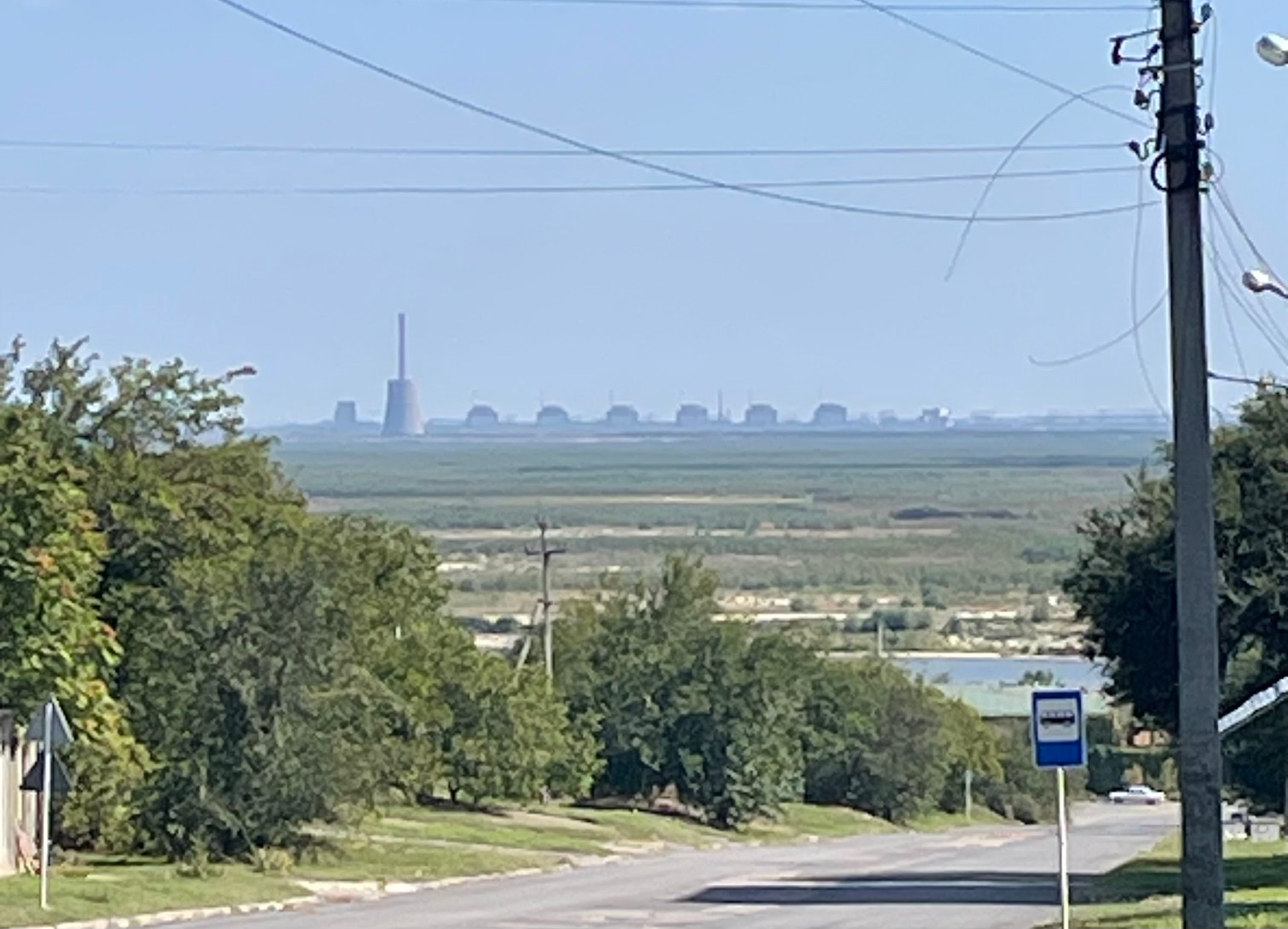
How do Ukrainians endure?When will the war end?What kind of war is it?Fresh from travels in southeastern Ukraine and meetings with soldiers, officers and other Ukrainians, I try to give some answers to these questions in this nine-minute video, filmed at sunrise a couple of days ago in Dnipro. We, beyond Ukraine, are not merely observers who can ask questions, but responsible parties whose actions (and inaction) make the difference.Ukrainians are paying the price for our indecision and now, in our own way, we are too. It can all be repaired, but we must be clear about where we are and what remains to be done.Thinking about... is a reader-supported publication. To receive new posts and support my work, consider becoming a free or paid subscriber. This is a public episode. If you'd like to discuss this with other subscribers or get access to bonus episodes, visit snyder.substack.com/subscribe

Last Year's Move to Toronto
It took me a while, but I can now see a purpose in speaking to the discussion of my departure from Yale University for the University of Toronto. Hence this video.I moved with the family last year, largely for family reasons, attracted personally by the prospect of a change to Toronto and to its Munk School in particular; both Yale and the University of Toronto dealt with the transition very gracefully. I loved being at Yale, and at the same time I am looking forward to some new possibilities in Toronto.Because I regarded the departure as relevant to students and colleagues at the institution where I taught for almost a quarter century, I laid out my reasons for the move in my departure note to Yale. Without speaking too directly in the video about private matters, I address four public framings of last year’s move which arose in recent weeks: (1) that I fled the present administration; (2) that I am a coward; (3) that leaving Yale is politically regressive; and (4) that I have disengaged. None of these framings touches the circumstances of my decision. I address them because they tell us something about the moment that we are in.I can see why personal attacks are tempting, and also where they lead. If we tear down others, we can tell ourselves that we are doing something ourselves — when in fact the opposite is true. No one has to take me as their guiding light. We all though have to recognize that our allies are imperfect, and seek out what is best in those with whom we choose to work. Freedom is solidarity. The path to unfreedom passes through dismissal and disdain.I am not a very on line person, so I wasn’t really aware that there was some sort of imbroglio until friends sent me nice messages (always a bad sign) and this wise essay by Rebecca Solnit (there are sentences in it that are worth reading twice; she is a perceptive person.)Like I always do, I made this video in one take, improvising. There is one thing that I wish I had said to Americans but didn’t: I am still with you. This past academic year, after the family move to Canada, and before and after the inauguration, I made appearances in Connecticut (twice), Illinois (three times), Michigan (twice), Ohio (seven times), Oklahoma, Pennsylvania, New York (four times), Rhode Island (twice), Tennessee, Texas, and Washington DC (twice). That’s in addition to a series of wonderful public events in Toronto and Vancouver and the two trips to Ukraine and the visits to eight European countries that I mention in the video. I’m out there. I’m trying. In various places. And what I have to offer in one place has to do with things I learn from people in others. The photos below give a taste of where I was this last academic year, and what I was doing.Other than these paragraphs, those photos, and the Yale letter, the video is what I have to say. There won’t be more. Let’s do the things that we can do.TS, recorded 26 May, photo added 30 May, to be published 2 June 2025Thinking about... is a reader-supported publication. To receive new posts and support my work, consider becoming a free or paid subscriber. This is a public episode. If you'd like to discuss this with other subscribers or get access to bonus episodes, visit snyder.substack.com/subscribe

Fomenting Antisemitism
As the assault on American higher education continues, I’ve been asked to explain why I believe this policy is antisemitic. A new video is above.The Trump people claim to be fighting antisemitism, and the media often accept that framing. I believe, on the contrary, that these actions are antisemitic in intention and in execution. The use of the word “antisemitism” as a covering pretext for defunding education empties the concept of meaning. I have talked about this in various public gatherings in the US and written about it here, but thought that a video explainer might be helpful. My background: I have written two books on the Holocaust as well as an introduction to Borowski’s Here in Our Auschwitz and a good deal else on the topic; have taught Holocaust history for two decades; have helped to supervise the use of Holocaust testimonies for the better part of my career and spend time with these sources. I sit on the International Auschwitz Council and have been awarded the Warsaw Ghetto Uprising Medal. I note that Professor Christopher Browning, the very distinguished American scholar of the Holocaust, is making a similar case. Please read his essay.I have given these matters some thought, and I hope you will consider. Please feel free as always to share this video.Thinking about... is a reader-supported publication. To receive new posts and support my work, consider becoming a free or paid subscriber. This is a public episode. If you'd like to discuss this with other subscribers or get access to bonus episodes, visit snyder.substack.com/subscribe
Civil Rights and Historical Honesty
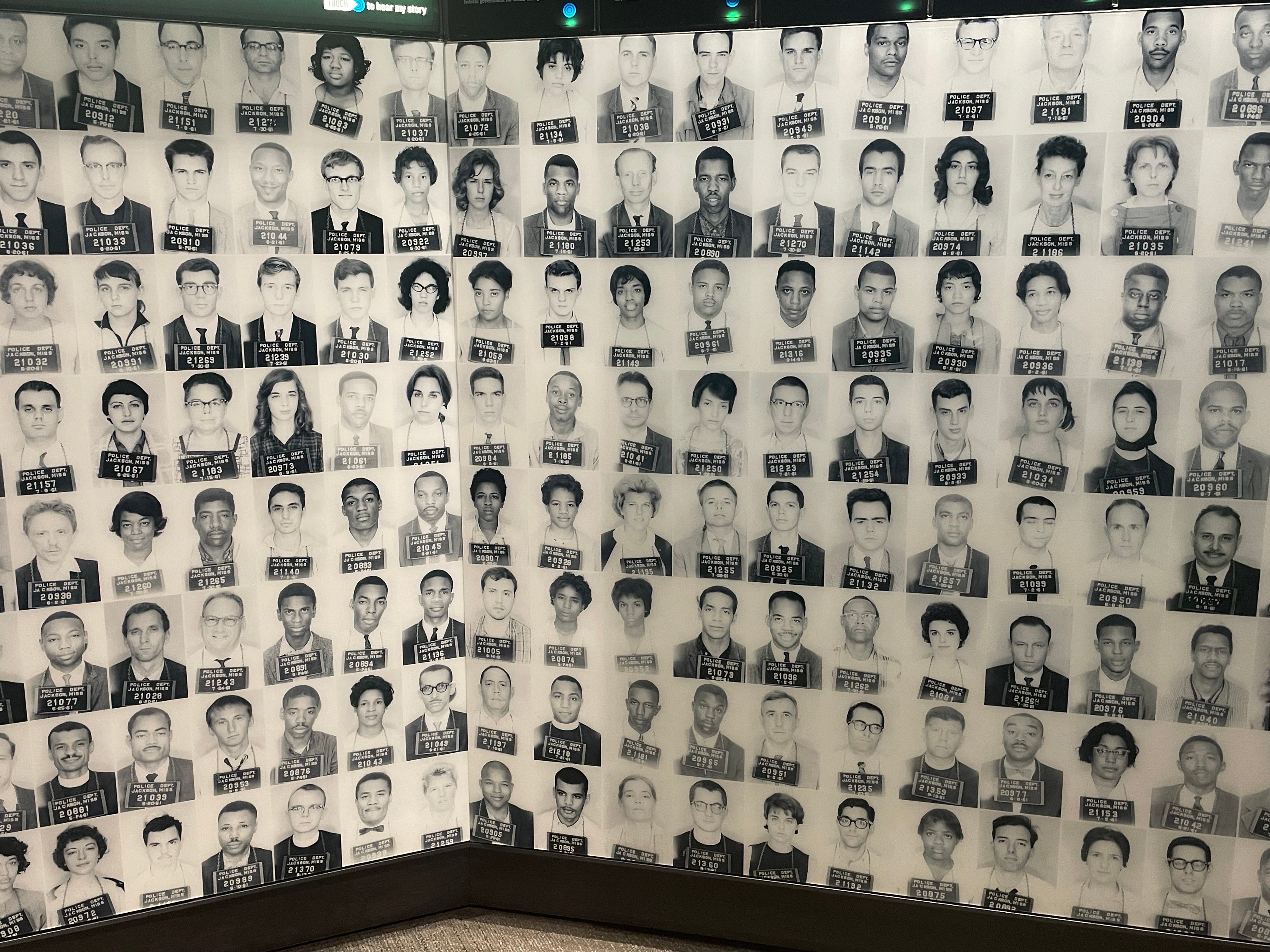
The president has issued an executive order entitled “Restoring Truth and Sanity to American History.” Like most of these executive orders, it seems illegal on its face: the president can only execute the laws; he cannot just himself decide how our museums and parks will work or look. But perhaps the deeper problem is the implicit claim: that the president himself has a monopoly on truth and sanity, that we and a few others can serve as a ministry of truth, that all the experience and knowledge and research that the rest of us have is nothing more than “ideology.” It maintains that the United States has always been a paragon of freedom and that anyone who denies its automatic progress is disloyal. But freedom always means liberation from the people who tell you that whatever you are experiencing now is liberty, and that really you must do nothing but admire your leaders. And progress, never automatic, comes from self-knowledge and from struggle. I spent the morning today at the National Museum of Civil Rights in Memphis, which provides a firm reminder of the need for memory and for discussion of events that make us uncomfortable — as good history always will. We need history not to confirm that how we feel now is right, but rather to teach us more about where we come from than we can know ourselves. This involves recognition that our pasts can be different, which enables the empathy that we will need for democracy. I recorded a few thoughts along these lines in this video; please watch and share.Thinking about... is a reader-supported publication. To receive new posts and support my work, consider becoming a free or paid subscriber. This is a public episode. If you'd like to discuss this with other subscribers or get access to bonus episodes, visit snyder.substack.com/subscribe
Twenty Lessons, read by John Lithgow
Here is my best guidance for action, rendered beautifully by the great John Lithgow. I first published these lessons more than eight years ago, in late 2016. They open the twenty chapters of On Tyranny: Twenty Lessons from the Twentieth Century. Millions of you, around the world, have put these lessons to good use; it has been humbling to learn how from courageous and creative dissenters, protestors, and oppositionists. I am delighted to have this special chance now to share the lessons again. I was honored when John, a wise advocate for civil discourse and civic engagement, volunteered to read them aloud. Above is his film. Below is the text, excerpted from the book. Do share this.1. Do not obey in advance. Most of the power of authoritarianism is freely given. In times like these, individuals think ahead about what a more repressive government will want, and then offer themselves without being asked. A citizen who adapts in this way is teaching power what it can do.2. Defend institutions. It is institutions that help us to preserve decency. They need our help as well. Do not speak of "our institutions" unless you make them yours by acting on their behalf. Institutions do not protect themselves. They fall one after the other unless each is defended from the beginning. So choose an institution you care about -- a court, a newspaper, a law, a labor union -- and take its side.3. Beware the one-party state. The parties that remade states and suppressed rivals were not omnipotent from the start. They exploited a historic moment to make political life impossible for their opponents. So support the multiple-party system and defend the rules of democratic elections. Vote in local and state elections while you can. Consider running for office.4. Take responsibility for the face of the world. The symbols of today enable the reality of tomorrow. Notice the swastikas and the other signs of hate. Do not look away, and do not get used to them. Remove them yourself and set an example for others to do so.5. Remember professional ethics. When political leaders set a negative example, professional commitments to just practice become more important. It is hard to subvert a rule-of-law state without lawyers, or to hold show trials without judges. Authoritarians need obedient civil servants, and concentration camp directors seek businessmen interested in cheap labor.6. Be wary of paramilitaries. When the men with guns who have always claimed to be against the system start wearing uniforms and marching with torches and pictures of a leader, the end is nigh. When the pro-leader paramilitary and the official police and military intermingle, the end has come.7. Be reflective if you must be armed. If you carry a weapon in public service, may God bless you and keep you. But know that evils of the past involved policemen and soldiers finding themselves, one day, doing irregular things. Be ready to say no.8. Stand out. Someone has to. It is easy to follow along. It can feel strange to do or say something different. But without that unease, there is no freedom. Remember Rosa Parks. The moment you set an example, the spell of the status quo is broken, and others will follow.9. Be kind to our language. Avoid pronouncing the phrases everyone else does. Think up your own way of speaking, even if only to convey that thing you think everyone is saying. Make an effort to separate yourself from the internet. Read books.10. Believe in truth. To abandon facts is to abandon freedom. If nothing is true, then no one can criticize power, because there is no basis upon which to do so. If nothing is true, then all is spectacle. The biggest wallet pays for the most blinding lights.11. Investigate. Figure things out for yourself. Spend more time with long articles. Subsidize investigative journalism by subscribing to print media. Realize that some of what is on the internet is there to harm you. Learn about sites that investigate propaganda campaigns (some of which come from abroad). Take responsibility for what you communicate with others.12. Make eye contact and small talk. This is not just polite. It is part of being a citizen and a responsible member of society. It is also a way to stay in touch with your surroundings, break down social barriers, and understand whom you should and should not trust. If we enter a culture of denunciation, you will want to know the psychological landscape of your daily life.13. Practice corporeal politics. Power wants your body softening in your chair and your emotions dissipating on the screen. Get outside. Put your body in unfamiliar places with unfamiliar people. Make new friends and march with them. (Nota bene, jumping away from the text for a moment: there will be chances to practice corporeal politics all over the USA on April 5th).14. Establish a private life. Nastier rulers will use what they know about you to push you around. Scrub your computer of malware on a regular basis. Remember that email is skywriting.

Is it a peace process? (short video)
I was asked to make a shorter video summarizing the logic of negotiation. Here it is: five basic tests to establish whether what is proposed by Americans can be regarded as a Ukrainian-Russian peace process. I hope you find it useful, for example in evaluating claims made by the American president in his speech this evening. At the moment, American policy seems to meet none of these tests; it seems, in fact, designed to create the conditions for a broader and a longer war by excluding, exploiting and harming Ukraine, strengthening Russia, misconstruing the basic reality of the war, ignoring international law, and denying the need for any structure at all beyond the verbal assurances. But I wanted to lay these out these five tests in a neutral way to help people consider or themselves. Thanks for being with me. Please share this post.Thinking about... is a reader-supported publication. To receive new posts and support my work, consider becoming a free or paid subscriber. This is a public episode. If you'd like to discuss this with other subscribers or get access to bonus episodes, visit snyder.substack.com/subscribe

The Logic of Negotiation (video)
Wars are hard to end. Peace is easy to say but difficult to achieve. In this video, about ten minutes long, I spell out five logics that a successful mediator seeking peace would take into account: the state of law; the beginning of the war; calculations of the future; paper vs. reality; and ceasefire vs. peace. I have in mind the present Russo-Ukrainian war. But sometimes it helps to recall the fundamental principles. Please feel free to share this video.Thinking about... is a reader-supported publication. To receive new posts and support my work, consider becoming a free or paid subscriber.If you are thinking today about helping Ukrainians, consider Come Back Alive, a Ukrainian NGO that supports soldiers; United 24, the Ukrainian state platform for donations); RAZOM, an American NGO, tax-deductible for US citizens, which supports civilians; and BlueCheck Ukraine, which aims for efficient cooperation with Ukrainian groups and is also tax-deductible. This is a public episode. If you'd like to discuss this with other subscribers or get access to bonus episodes, visit snyder.substack.com/subscribe

Five Failures in the Oval Office (video)
In this, my first substack video, I react to the shameful encounter between American leaders and media and the Ukrainian president. No doubt there were more, but I saw five failures on our side: of hospitality, decency, democracy, strategy, and independence. Please watch and share. If you are thinking today about how to help Ukrainians, here are some possibilities: Come Back Alive (Ukrainian NGO that supports soldiers on the battlefield and veterans), United 24 (the Ukrainian state platform for donations, with many excellent projects), RAZOM (an American NGO, tax-deductible for US citizens, which cooperates with Ukrainian NGOS to support civilians), and Documenting Ukraine (a project that helps to give Ukrainians a voice, also tax-deductible for Americans).Thinking about... is a reader-supported publication. To receive new posts and support my work, consider becoming a free or paid subscriber. This is a public episode. If you'd like to discuss this with other subscribers or get access to bonus episodes, visit snyder.substack.com/subscribe
Affirmative Action for Dictators (audio and text)
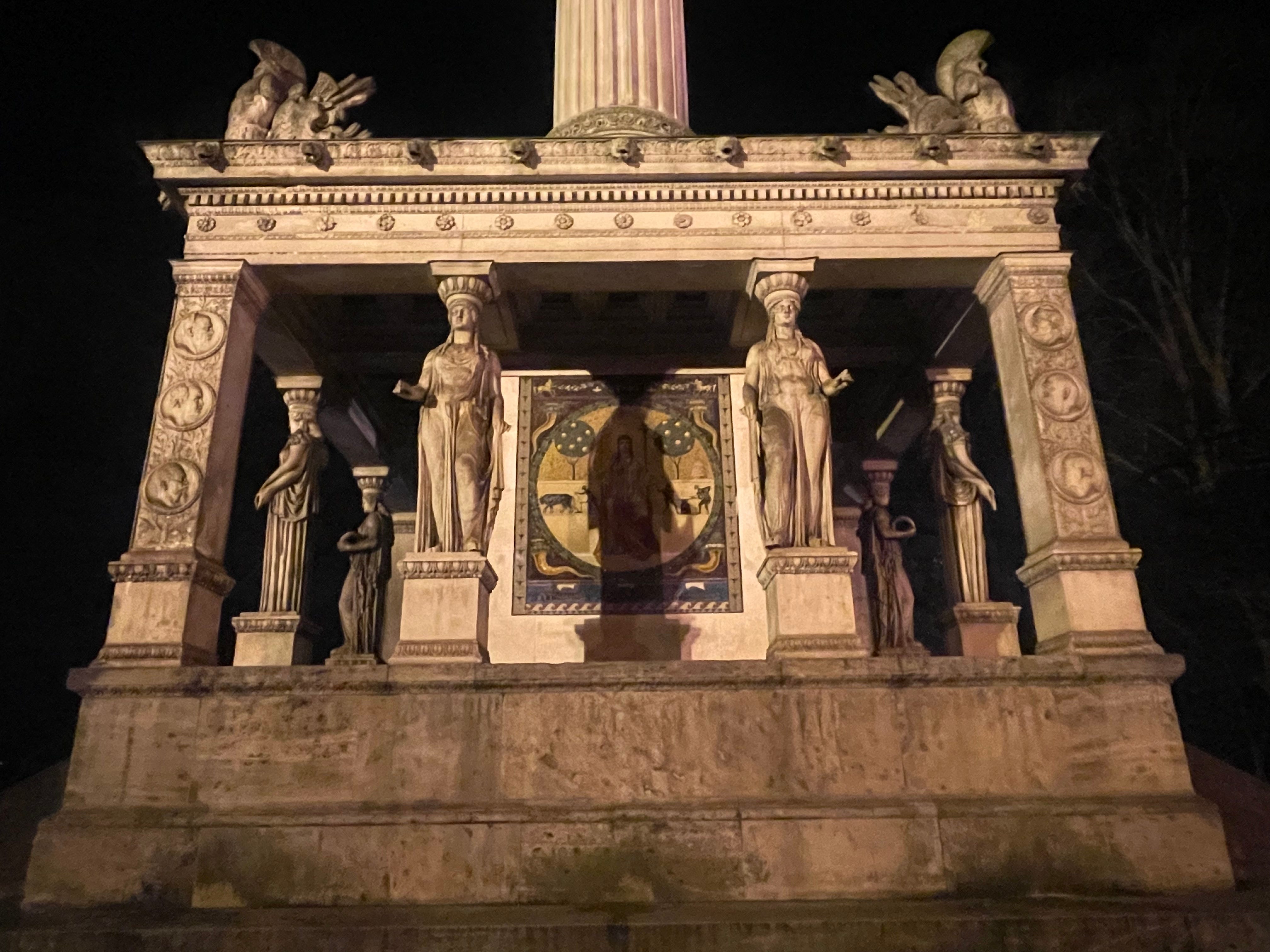
This is the podcast version of an essay I published on 16 February at the end of the Munich Security Conference. Since then, its thesis has been confirmed by the Russian-American talks in Saudi Arabia, American slanders of Ukrainians, and the Russian-American concord at the United Nations. The original text begins below.As a television show, American foreign policy is about strength. In reality, it is about draining power from the United States and its allies, thereby creating atmospherics in which Donald Trump feels good and Elon Musk converts lost state capacity into personal profit. The weakness, in other words, is the point.In the alliances that held through January 2025, the United States was an unrivaled power. By whatever measure one chose, no other country was of the same status. Without the alliances, however, the equation is different. It is not just that the United States loses the economic, military, and political strength of its allies. It is that the U.S. must now compete with them and try to subordinate them.At the Munich Security Conference, which is just coming to an end, the American vice president instructed Europeans to open themselves as colonial vessels. They should remove any constraints on social media platforms, allowing Musk and other oligarchs to shape their elections. And those elections should then lead to the victory of far right parties that would remove any other barriers to Musk’s power. In this scenario, no conceivable American interest is served. Only Musk’s. It is unlikely to play out as JD Vance expects. What is certain, though, is the palpable alienation of the Europeans.By taking the side of Ukraine in its war against Russia through January 2025, the United States had generated tremendous power against the aggressor Russia and its patron China. At insignificant financial cost, and with no risk to American troops, American policy helped the Ukrainian armed forces to deliver a broader security that the United States could not have achieved on its own. The Ukrainians fulfilled the entire NATO mission, absorbing a Russian invasion and destroying the greater part of the Russian army of 2022. They deterred a Chinese invasion of Taiwan by showing how difficult offensive operations are. And they upheld, as great sacrifice, the legal principle that borders are real and states are sovereign.It is precisely that order that Musk-Trump dismantles.It is difficult to be certain of U.S. policy to Ukraine, since the Americans contradict one another and themselves faster than any chyron or twitter feed can follow. But two underlying principles did emerge during the Munich Security Conference. The first was that Ukraine, like the rest of Europe, was to be seen not as an American ally but as an American colony. Humiliating discussions of the disposition of Ukraine’s resources made this clear. The second was that the war could be ended by direct discussions between Americans and the Russian aggressor. There was no sign of any serious substantive preparations, on the American side, for such negotiations.I could perhaps be wrong, and we shall see, but I believe the purpose of the Putin-Trump phone call that took place and the coming Russian-American negotiations in Saudi Arabia over Ukraine is to get a bad deal, at least as seen in the conventional terms of Ukrainian lives, American power, and world peace. If a bad agreement does emerge, it will be hard to say whether it is incompetence, design, or incompetence by design. I think the last is most likely. The structure of the situation does not favor substance or deliberation. The Americans are in a hurry, as Trump’s special envoy to Ukraine kept saying; and the design of the negotiations is unfavorable.With Ukrainians and Europeans not present at these talks (at least as I understand this at this moment), Putin will likely get his way on the essential issues. One American official or another has already conceded most of them in public (although, admittedly, they then often walked themselves back or were contradicted by others). Trump and Musk have been repeating Russian talking points for years. Putin will (it appears) be treated as a legitimate partner, he will go unpunished for his war crimes, he will make de facto territorial gains from his war of aggression, and he will get to dictate the terms Ukrainian domestic politics. He will celebrate a victory, and he will prepare the next war, in the total confidence that no resistance from the United States is possible.Russia, in other words, will gain power from American diplomacy that it could not conceivably have gained on the battlefield.One point of consensus among informed observers here in Munich is that the war is not going well for Russia. Sanctions are working, and the Russian economic crash that was predicted for 2026 and now seen as more likely this year. On the battlefield, Russia’s losses far exceed Ukraine’s, and the Ukrainians are getting better and better at inflicting losses wi
The Weak Strongman (audio and text)
This is the podcast version of an essay I wrote a week ago, before the Munich Security Conference brought some of the explanation points. Since then, the thesis has only been confirmed by the disastrous Russian-American talks and American slanders of and threats to Ukrainians. Please share this with those who might want or need to hear this. If you are thinking about how to help Ukrainians, consider Come Back Alive (Ukrainian NGO that supports soldiers on the battlefield and veterans), United 24 (the Ukrainian state platform for donations, with many excellent projects), RAZOM (an American NGO, tax-deductible for US citizens, which cooperates with Ukrainian NGOS to support civilians), and Documenting Ukraine (a project I help run that helps to give Ukrainians a voice, also tax-deductible for Americans). The text of the original essay begins below.Americans have a certain idea of freedom. We are fine just the way we are and the only problem are the barriers in the outside world. In this mental world, Musk’s hollowing out of the government can seem justified. Trump’s betrayal of friends and destruction of alliances can seem convenient. We will be great again by being all alone, with no one to trouble us.This fantasy leads right to tragedy. It sets the stage for the weak strongman.Trump is a strongman in the sense that he makes others weak. He is strong in a relative sense; as Musk destroys institutions, what remains is Trump’s presence. But other sorts of power meaning vanish, as Musk takes apart the departments of the American government that deal with money, weapons, and intelligence. And then the United States has no actual tools to deal with the rest of the world.The strongman is weak because no one beyond the United States has anything to want (or fear) from the self-immolation. And weak because Trump submits to foreign aggression, putting waning American power behind Russia.The weak strongman undermines the rules, but cannot replace them with anything else. He creates the image of power by his rhetorical imperialism: America will control Greenland, Panama, Mexico, Canada, Gaza, etc. From there, it is hard to say that others are wrong when they invade other countries. The weak strongman is left endorsing other people’s invasions, as with Russia and Ukraine. He lacks the power to resist them. And he lacks the power to coerce them. And, ironically, he lacks the power to carry out wars himself. He lacks the patience, and he lacks the instruments.Many Americans fear Trump, and so imagine that others must. No one beyond America fears Trump as such. He can generate fear only in his capacity as neighborhood arsonist, as someone who destroys what others have created. America’s friends are afraid not of him but of what we all have to lose. America’s enemies are not frightened when Trump kicks over the lantern and sets things on fire. Quite the contrary: he is doing exactly what they want.Trump plays a strongman on television, and he is a talented performer. But the strength consists solely of the submissiveness of his audience. His performance arouses a dream of passivity: Trump will fix it, Trump will get rid of our problems, and then we will be free. And of course that kind of Nosferatu charisma is a kind of strength, but not one that can be brought to bear to solve any problems, and not one that matters in the world at large. Or rather: it matters only negatively. As soon as Trump meets someone with a better dictator act, like Putin, he submits. But he can only enable Putin. He can’t really even imitate him.Trump’s supporters might think that we don’t need friendships because the United States can, if necessary, intimidate its enemies without help. This has already been proven wrong. Trump can make things worse for Canada and Mexico, in the sense that a sobbing boy taking his ball home makes things worse. But he cannot make them back down. Trump has not intimidated Russia. He has been intimidated by Russia.The cruelty that makes Trump a strongman at home arose from the destruction of norms of civil behavior and democratic practice. Unlike any other American politician before him, Trump has scorned the law and used hate speech to deter political opponents here. For years he has used his tweets to inspire stochastic violence. This intimidates some Americans. It has, for example, led to a kind of self-purge of the Republican Party, opening the way for Trump, or in fact for Musk, to rule with the help of tamed and therefore predictable cadres. The effect of this is that people who have submitted to Trump see him as a strongman. But what they are experiencing is in fact their own weakness. And their own weakness cannot magically become strength in the wider world. Quite the contrary.Stochastic violence cannot be applied to foreign leaders. Trump has said that he can stop the war in Ukraine. He wrote a tweet directed at Vladimir Putin; but the capital letters and exclamation points did not change the emotional state

Crossing a line (audio and text)
This is the podcast version of an essay I wrote on the night train from Kyiv to Zaporizhzhia a week ago. Please feel free to share this with those who might want or need to hear this. If you are thinking as I am about how to help Ukrainians just now, consider Come Back Alive (Ukrainian NGO that supports soldiers on the battlefield and veterans), United 24 (the Ukrainian state platform for donations, with many excellent projects), RAZOM (an American NGO, tax-deductible for US citizens, which cooperates with Ukrainian NGOS to support civilians), and Documenting Ukraine (a project I help run that helps to give Ukrainians a voice, also tax-deductible for Americans). The text of the original essay begins below.I am on a night train from Kyiv, bound for Zaporizhzhia, a city in the southeast of Ukraine which is about twenty miles from the front. Russian missiles take about thirty-five seconds to hit the city, and the take civilian lives. Since Russia’s full-scale invasion of Ukraine in February 2022, Russia has occupied part of the Zaporizhzhia region. In September of 2022 the Russian parliament proclaimed the annexation of the region as a whole.That front is a line that runs through Zaporizhzhia region, and indeed across the east and south of Ukraine. My train rushes southeast, towards that line. Its passengers, civilians and soldiers alike, know what lies on the other side.Given the nature of Russian occupation, Ukrainians are fighting not only for their lives, but for a certain idea of life in freedom. In the parts of Ukraine controlled by Russia, anyone who showed any initiative or was elected to any position is killed or subjected to torture. Any expression of a political opinion or any gathering or anything that seems like opposition to Russian authorities will lead to a long prison sentence in awful conditions. Just having Ukrainian material on your phone is enough to be sent to prison. Ukrainian citizens in the occupied zones have to accept Russian citizenship in order to have access to basic services, such as schools. Children are kidnapped and sent to Russian families for adoption. They will be raised to hate the land of their birth. Perhaps still worse, they will be raised in a country where the government lies about everything all the time, where the media lies about everything all the time, and this is thought to be normal.These basic facts create a different kind of existence, on that side of the line.Ukraine is not a perfect country, and of course war itself makes people less free. The number of killed and wounded, though far lower than on the Russian side, grows every day. Ukrainian men have to serve in the armed forces, whether they want to or not. Even in the unoccupied majority of Ukrainian territory, Russian missile and drone attacks are not only lethal but exhausting. It is worse close to the front, as in Zaporizhzhia, where I arrive tomorrow morning, or Kharkiv, which I visited last September, because there is no time to take shelter from the missiles. But everywhere in the country nights are interrupted and people are at risk. I spent part of last night in a bomb shelter in Kyiv, awakened by the siren right after I went to sleep. For me this is an irritation. But for Ukrainians, three years of sleep deprivation takes a toll. The train tonight departed right at the time of the curfew, when people have to go home. This, too, is a certain deprivation of freedom.And, yet, on this, the Ukrainian side of the line, people lead completely different lives than under Russian occupation or in Russia. Ukrainians say what they want, including about the war and about politics. Journalists cover the war and write about politics. There is fear, although less than you might think; but it is fear of bombs and missiles and violence from Russia, not of denunciations or oppression or of one’s own government. I have the strange feeling, this week in Kyiv, that Ukrainians are living freer lives now than Americans. At a book store where I was talking to a Ukrainian philosopher about freedom, a young woman put her hand on my arm and said “sorry about the U.S.”There are lines that matter. If I made some sort of mistake, and somehow found myself on the Russian side of the line in the Zaporizhzhia region, I would probably disappear for good. Russian authorities have made clear what they think of me, sanctioning me not once but twice. (And, to be clear, it is a terrible idea for any American to go to Russia now; you will just be kidnapped, and held for some possible exchange for a Russian criminal.) If I crossed that line, it is unlikely that I would come back.Ukrainian trains are punctual, and they are pleasant. It is not that I am in any way uncomfortable, or afraid. Heading in the direction of a line just makes me thoughtful, as an American. As I get ready to go to sleep, I find myself thinking that Americans are also speeding towards a lineAmericans back home are not entering a geographic Russia, of course, or a zon

Of course it’s a coup (audio)
This is the podcast version of my written post “Of course it’s a coup” of 5 February. Please listen or share with those who prefer to listen. Coming posts will be about the weak strong man, lessons from Germany, and the lines we cross from one form of regime to another. Excellent journalist work on the coup is meantime being done by Mother Jones, Wired, and Notes on the Crisis. Thinking about... is a reader-supported publication. To receive new posts and support my work, consider becoming a free or paid subscriber. This is a public episode. If you'd like to discuss this with other subscribers or get access to bonus episodes, visit snyder.substack.com/subscribe

The Logic of Destruction (audio)
This is the podcast version of my post on the logic of destruction behind the ongoing digital coup inside the US government. Please listen and share. Forthcoming posts will be about German lessons (just left Berlin) about fascism, and about Trump as a weak strong man. Thinking about... is a reader-supported publication. To receive new posts and support my work, consider becoming a free or paid subscriber. This is a public episode. If you'd like to discuss this with other subscribers or get access to bonus episodes, visit snyder.substack.com/subscribe
Changing the Climate (video)
I brought a coat for the trip through Ohio, Michigan, Illinois, Oklahoma, and Texas, but never wore it once. The drought in Ohio was painfully visible in the cornfields. A relative was able to come a talk in Ohio because she had fled a hurricane in North Carolina. In Ohio the days started out in the high 30s but then cleared 70. I ran a 5k in Ohio with people who were struggling in the sun and heat — in late October. In Ohio and Michigan the trees were a couple weeks late in turning, at least compared to what I remember. In Oklahoma and Texas it was balmy deep into the night. The drive from OKC to Dallas was scorching. There is so much to remember about the trip, most of it encouraging and happy. But the changes in the weather were all around, affecting everything. In a short presidential campaign like this, climate has not been a major topic. In this video, I try to explain how important it should be. We have the knowledge and the tools and to deal with climate change. But we have to do it now. Four years of encouraging carbon emissions and spreading misinformation, which is what Trump and Vance promise, could very well make the problem insoluble and the crisis irreversible. And this is a problem that will make all the other problems worse. It really is a matter of survival. So this is one more way that we have power — a lot of power. Voting on this issue will make a dramatic difference, in the US and everywhere else. Let’s change the climate for the better. Vote.Thinking about... is a reader-supported publication. To receive new posts and support my work, consider becoming a free or paid subscriber. This is a public episode. If you'd like to discuss this with other subscribers or get access to bonus episodes, visit snyder.substack.com/subscribe

The Loser Triad (video and text)
(Trying to fulfill my promise of translating all of my text posts into audio or video. This seemed like an important one to do before the election. Please think about it and share it. And vote!)We have seen this show before. We know what Trump losing looks like.Three Trumpian actions are predictable. We know them from the last election. Last time around, when Trump lost, when Trump knew that he lost, he:1. Claimed that he won (November)2. Filed lawsuits (November-December)3. Encouraged violence (January)He did these three things because he lost. They comprise the loser triad.Judging from past behavior, though, a repetition of the loser triad would signal that Trump believes that he has lost. In 2024, though, the sequence will be different. Allies of Trump have already filed dozens of lawsuits. Pro-Trump violence is likely to begin around election day rather than in January. But the timing of Trump's claiming victory will likely be the same, shortly after the election but before the outcome has been confirmed. To be clear, anything can happen. Either candidate can win. That is why we vote and count the votes. And that is exactly why we should not engage in behaviors like the loser triad. The loser triad indicates that a loser is trying to break the system.This time around, the three actions will likely come in the following sequence. Trump, in the 2024 loser triad:1. Files lawsuits (already happening, even before the election!)2. Encourages violence (around election day, most likely)3. Claims that he won (shortly after election day).If Trump again claims too early that he won, this is not just a statement like any other. It is part of a plan to take power by a candidate who believes that he has lost an election -- a repeat of a behavior that we know very well.If Trump claims victory, that is a good sign that Harris has won the election.Thanks for reading Thinking about... Please share this post.Thinking about... is a reader-supported publication. To receive new posts and support my work, consider becoming a free or paid subscriber. This is a public episode. If you'd like to discuss this with other subscribers or get access to bonus episodes, visit snyder.substack.com/subscribe

The Strongman Fantasy (text and audio)
I wrote this in March, with the text as below, and am posting this recording now, in the hopes that it can be useful. Please share it. TS 1/11/2024Quite a few Americans like the idea of strongman rule. Why not a dictator who will get things done? I lived in eastern Europe when memories of communism were fresh. I have visited regions in Ukraine where Russia imposed its occupation regime. I have spent decades reading testimonies of people who lived under Nazi or Stalinist rule. I have seen death pits, some old, some freshly dug. And I have friends who have lived under authoritarian regimes, including political prisoners and survivors of torture. Some of the people I trusted most have been assassinated.So I think that there is an answer to this question. Strongman rule is a fantasy. Essential to it is the idea that a strongman will be your strongman. He won't. In a democracy, elected representatives listen to constituents. We take this for granted, and imagine that a dictator would owe us something. But the vote you cast for him affirms your irrelevance. The whole point is that the strongman owes us nothing. We get abused and we get used to it. Another pleasant illusion is that the strongman will unite the nation. But an aspiring dictator will always claim that some belong and others don't. He will define one group after another as the enemy. This might feel good, so long as you feel that you are on the right side of the line. But now fear is the essence of life. The politics of us-and-them, once begun, never ends. We dream that a strongman will let us focus on America. But dictatorship opens our country to the worst the world has to offer. An American strongman will measure himself by the wealth and power of other dictators. He will befriend them and compete with them. From them he will learn new ways to oppress and to exploit his own people.At least, the fantasy goes, the strongman will get things done. But dictatorial power today is not about achieving anything positive. It is about preventing anyone else from achieving anything. The strongman is really the weak man: his secret is that he makes everyone else weaker. Unaccountable to the law and to voters, the dictator has no reason to consider anything beyond his own personal interests. In the twenty-first century, those are simple: dying in bed as a billionaire. To enrich himself and to stay out of prison, the strongman dismantles the justice system and replaces civil servants with loyalists. The new bureaucrats will have no sense of accountability. Basic government functions will break down. Citizens who want access will learn to pay bribes. Bureaucrats in office thanks to patronage will be corrupt, and citizens will be desperate. Quickly the corruption becomes normal, even unquestioned. As the fantasy of strongman rule fades into everyday dictatorship, people realize that they need things like water or schools or Social Security checks. Insofar as such goods are available under a dictatorship, they come with a moral as well as a financial price. When you go to a government office, you will be expected to declare your personal loyalty to the strongman. If you have a complaint about these practices, too bad. Americans are litigious people, and many of us assume that we can go to the police or sue. But when you vote a strong man in, you vote out the rule of law. In court, only loyalism and wealth will matter. Americans who do not fear the police will learn to do so. Those who wear the uniform must either resign or become the enforcers of the whims of one man.Everybody (except the dictator and his family and friends) gets poorer. The market system depends upon competition. Under a strongman, there will be no such thing. The strongman's clan will be favored by government. Our wealth inequality, bad enough already, will get worse. Anyone hoping for prosperity will have to seek the patronage of the official oligarchs. Running a small business will become impossible. As soon as you achieve any sort of success, someone who wants your business denounces you. In the fantasy of the strongman, politics vanishes and all is clear and bright. In fact, a dreary politics penetrates everything. You can't run a business without the threat of denunciation. You can't get basic services without humiliation. You feel bad about yourself. You think about what you say, since it can be used against you later. What you do on the internet is recorded forever, and can land you in prison.Public space closes down around you. You cannot escape to the bar or the bowling alley, since everything you say is monitored. The person on the next stool or in the next lane might not turn you in, but you have to assume they will. If you have a t-shirt or a bumper sticker with a message, someone will report you. Even if you just repeat the dictator's words, someone can lie about you and denounce you. And then, if you voted for the strongman, you will be confused. But you should not be. This is what y

Trump's Lawless Crash (video)
Some people talk about Trump’s economic plans; others about his intention to undo the rule of law. In this five-minute video, I try to explain how the two relate: how lawlessness will wreck the economy. Please consider and please share. This is a public episode. If you'd like to discuss this with other subscribers or get access to bonus episodes, visit snyder.substack.com/subscribe

On Tyranny right now (audio)
Given where we are just now, there have been quite a few questions about my book On Tyranny, and in particular about the first lesson, which is “Do Not Obey in Advance.” The violations of that lesson of the twentieth century have been so flagrant that they are, at least, serving as an education in how not to behave. In this setting I thought I would review some of the lessons in a little talk (half an hour or so) for subscribers, taking into account events of the past few weeks. Please share this lecture with anyone who will find it interesting or who needs to hear it!PS Sorry that these images are so large — the editing tool is not working, so I am going to post this as it as. This is a public episode. If you'd like to discuss this with other subscribers or get access to bonus episodes, visit snyder.substack.com/subscribe

Obeying in advance
Greetings from Oklahoma. Here are a few thoughts from here on video about the decisions of the owners of the Washington Post and the LA Times to suppress their editorial boards’ decisions to endorse Kamala Harris. A problem with the very wealthy is that, alas, the least vulnerable have a tendency to think of themselves as the most vulnerable. And from that position they harm everyone else, while proclaiming that they are simply being neutral or following business interests. But doing what Trump wants in advance only makes it more likely that Trump will have power, and only teaches him that you are easy to intimidate. You are giving the authoritarian power he would not otherwise have. The irony is that the rest of us will have to save the billionaires from their own cowardice. But that of course is not what this is moment is about. It is about all of us doing the little things we can, the truthful things we can, to get through this moment and come out on the bright side. In the video I explain why “do not obey in advance” is the main lesson of the twentieth century. In my book On Tyranny “Do not obey in advance” is the first lesson. Please share this video. And please act. Vote, register people to vote, phone bank, keyboard, write letters, work a poll. Do something, and think of all the others who are doing what they can. You feel feel better, and you will make a difference.Thinking about... is a reader-supported publication. To receive new posts and support my work, consider becoming a free or paid subscriber. This is a public episode. If you'd like to discuss this with other subscribers or get access to bonus episodes, visit snyder.substack.com/subscribe

Trump and Ukraine: A voter's guide
A few thoughts for Americans for whom the survival of Ukraine is an electoral issue. Please watch and share. If you’re in Michigan and it’s 23 October, you can catch me live in Detroit at noon and in Kalamazoo at 7:00pm. This is a public episode. If you'd like to discuss this with other subscribers or get access to bonus episodes, visit snyder.substack.com/subscribe

Fascism on television
You have to be in a place to appreciate the television. And I think the history of fascism helps us to see what is happening in the ads.In public, the Trump presence in Ohio is weaker than in previous elections. There are fewer signs, and the big ones are in front of the small houses. There are fewer aggressive slogans in public, and the ones personally targeted Vice-President Harris are rarer and less vicious than the ones that targeted Hillary Clinton in 2016. On the other hand, there are more Trump flags and hybrid American/Trump flags, which is a bad sign that the state has merged with the Leader in the minds of people. And the message on television is certainly one of a much more refined fascism, which is what I am discussing in my third brief message today. The way the tv ads now follow Carl Schmitt’s advice of beginning politics by choosing an enemy follow fascist protocol by inventing imaginary crises around real human vulnerabilities. These themes are further explore in a number of my written posts.Please share this post. This is a public episode. If you'd like to discuss this with other subscribers or get access to bonus episodes, visit snyder.substack.com/subscribe

Can fascism be American?
Continuing yesterday’s theme on fascism, responding to questions about the possibility of American fascism. There have been American fascist movements in the past, and perhaps more importantly a tradition of us-and-them politics, sometimes under the surface. There are fascists in the present who continue American fascist traditions. And we invite fascism in the future by telling ourselves that it cannot happen here. Exceptionalism opens both the front and the back doors…In these remarks I invoke directly or indirectly:Sarah Churchwell, Behold, AmericaSarah Churchwell, “It has happened here,” New York Review of Books, 22 June 2020.Rachel Maddow, Prequel: An American Fight against FascismHeather Cox Richardson, “Letters from an American”Timothy Snyder, Black EarthThinking about... is a reader-supported publication. To receive new posts and support my work, consider becoming a free or paid subscriber.PS: Correcting myself — I said 19 October; I meant 18 October 2024. TS This is a public episode. If you'd like to discuss this with other subscribers or get access to bonus episodes, visit snyder.substack.com/subscribe

Why is fascism bad, Professor?
People are talking about fascism. After a New York Times article was published today, I heard both from people who are baffled that we did not been speaking of fascism more and earlier, and from people who want to know what it means — and from people who want me to explain why fascism is bad. I am on the road, so I took ten minutes to make a little video about all of this. I hope it helps. As I’ll be driving around the country for the next ten days or so, I will likely do more of these. Let me know if you like the format. And please share!Some the ideas I talk about are expressed at greater length in this op-ed.In my remarks I refer directly or obliquely to these books:Jason Stanley, How Fascism WorksTimothy Snyder, BloodlandsTimothy Snyder, Black EarthTimothy Snyder, Road to UnfreedomTony Judt and Timothy Snyder, Thinking the Twentieth CenturyZeev Sternhell, Les anti-lumièresRobert Paxton, in Anatomy of Fascism, offers this pragmatic definition of fascism: “a form of political behavior marked by obsessive preoccupation with community decline, humiliation, or victimhood and by compensatory cults of unity, energy, and purity, in which a mass-based party of committed nationalist militants, working in uneasy but effective collaboration with traditional elites, abandons democratic liberties and pursues with redemptive violence and without ethical or legal restraints goals of internal cleansing and external expansion.”Thinking about... is a reader-supported publication. To receive new posts and support my work, consider becoming a free or paid subscriber. This is a public episode. If you'd like to discuss this with other subscribers or get access to bonus episodes, visit snyder.substack.com/subscribe

Deportation Nation (audio)
As a historian of forced population movements and as an American, I don’t think we are taking the consequences of the Trump-Vance deportation plan seriously enough. The reality will be much more personal and awful, and the politics more transformative and durable, than we might think. I will write this up soon; but I was moved to do a recording by the urgency of this, and by the desire to catch the end of Hispanic Heritage Month. Please listen and please share.Thinking about... is a reader-supported publication. To receive new posts and support my work, consider becoming a free or paid subscriber.. This is a public episode. If you'd like to discuss this with other subscribers or get access to bonus episodes, visit snyder.substack.com/subscribe

How to Stop Fascism (audio)
This is the podcast version of a post from July which seemed timely now. I put the text below: what is new is the audio. You are receiving this as a subscriber, but please feel free to share!As the United States hovers at the edge of fascism, the history of Germany can help.To be sure, Americans have other histories to ponder, including their own. Some American states, right now, are laboratories of authoritarian rule (and resistance). The American 1860s and American 1930s reveal tactics authoritarians use, as well as the weaknesses of the American system, such as slavery and its legacy. At those times, though, Americans were lucky in their leadership. Lincoln and Roosevelt were in office at the critical moments. And so we lack the experience of the collapse of the republic.We can certainly learn from contemporary authoritarian success, as in Russia and in Hungary, which I have written about elsewhere. Yet the classic example of a major economic and cultural power collapsing into fascism remains Germany in 1933. The failure of the democratic experiment in Germany led to a world war as well as the Holocaust and other atrocities.Yet today a taboo hovers around anything concerning Hitler. As soon as the collapse of the German republic in 1933 is evoked, American voices commence a fake lament — America is uniquely good so nothing about Nazis can ever apply, and/or Hitler was uniquely evil and so nothing concerning him is relevant.To be sure, every person and every event is in some sense unique. But history is precisely the interaction of individuals and situations which, seen in isolation, will appear unique. The taboo on fascist history shoves people back to a turbulent present, leaving them feeling more helpless. It is an element of the fascist takeover.The lessons from Germany that I present below are not at all new. We have been trained by digital media to believe that only what happens right now matters. But the people who intend to destroy the American constitutional republic have learned from the past. One of the basic elements of Project 2025, for example, is what the Nazis called Gleichschaltung: transforming the civil service into a fascist nest.Those who wish to preserve the American constitutional republic should also recall the past. A good start would be just to recall the five basic political lessons of 1933.1. Voting matters. Hitler came to power after an election which enabled his appointment as head of government. It is much easier for fascists to begin from within than to begin from without. Hitler’s earlier coup attempt failed. But once he had legitimate power, inside the system as chancellor (prime minister), he could manipulate it from within. In the American system, “voting” means not just going to the polls yourself, but making donations, phone-banking, and knocking on doors. We are still, happily, at the stage when unglamorous actions can make the difference.2. Coalitions are necessary. In 1932, in the crucial German election, the far left and the center left were separated. The reasons for this were very specific: Stalin ordered the German communists to oppose the German social democrats, thereby helping Hitler to power. To be sure, the American political spectrum is very different, as are the times. Yet the general lesson does suggest itself: the left has to hold together with the the center-left, and their energies have to be directed at the goal rather than at each other.3. Conservatives should be conservative. Which way the center-right turns can be decisive. In Germany in 1932, conservatives enabled the counter-revolution. They did not see Hitler and his Nazis as something different from themselves. They imagined, somehow, that Hitler would preserve the system rather revolutionize it. They were wrong, and some of them paid for the mistake with their lives. As in American today, the German “old right” was less numerous than the “new right,” the fascists. But how the traditionalist center-right acts can very well make the difference.4. Big business should support democracy. In the Germany of the 1930s, business leaders were not necessarily enthusiastic about Hitler as a person. But they associated democracy with labor unions and wanted to break them. Seeing Hitler as an instrument of their own profit, business leaders enabled the Nazi regime. This was, in the end, very bad for business. Although the circumstances today are different, the general lesson is the same: whether they like it or not, business leaders bear responsibility for whether a republic endures or is destroyed.5. Citizens should not obey in advance. Much of fascism is a bluff — look at our loyal cult, listen to our outrageous language, heed our threats of violence, we are inevitable! Hitler was good at that sort of propaganda. Yet to gain power he needed luck and the errors of others. American fascism, likewise, is far from inevitable. It too is largely bluff, most of it digital. The internet is much more fascist tha
Both Sides (audio)
I thought this piece on our media religion, which I meant entirely seriously but which I hope is also fun, might be a useful preparation for the media this weekend and in weeks to come. This is the podcast version of a written post from July. I paste the text in below; what is new is the podcast. You receive it as a subscriber, but you are welcome to share it.Why does American television and press “both-sides” our politics? Why are such different presidential candidates presented as equally flawed? Why do the outrages of Trump, for example at the Republican National Convention in Milwaukee, lead to the humiliation of Biden?Both-Sidesism is the habit of reducing the world into two perspectives, treating the two as fundamentally alike, and then ignoring or adjusting the data. One cause of this odd behavior is the ownership of media companies. Another is fear. But Both-Sidesism is not just a practice. It passes in the United States for a principle of journalism. Indeed, the dualism is almost unquestionable. Americans tends to take it for granted.But it makes no sense. No data from the world around us indicates that two is the correct number of perspectives, nor that any two perspectives, once chosen, would be equal. These are, rather, articles of faith. Once accepted, they enable the public performance we wrongly call “media.” Both-Sideism does not mediate but mystify. Its practitioners, called “anchors” or “publishers,” are shamans or priests. Mystifiers.To be sure, “media” people do not think that they are mystifying. Nor are we in the habit of seeing them as practicing a religion. But let us step back. Let us consider, for the sake of argument, that Both-Sidesism might be a dualist cult. Let us place its beliefs and practices in the context of the history of religion, and see what happens.The number two has helped humans make sense of the world, from distant times to the present. It has had a powerful sway over human minds. The number two can address the mystery of creation. In Indo-European societies, the universe sometimes began as a coupling of two entities, for example the Earth and the Sky. Or the first Being could be of two sexes, or twinned. In several myths, twin gods ride to the rescue of early humans in peril.Duality can also help humans to frame the problem of evil, as in Manicheanism. Its founder Mani (enlightened by a spiritual twin) claimed that the universe was divided into darkness and light. Human action is then understood as struggle between these two forces.The number two can also help us handle time. The Romans had a two-faced god, Janus, who was in charge of doors, passages, and thus transitions in general, beginnings and endings. He is very much present with us at the beginning of each year; January is named for him.In Daoism we find something of all of the above in the notion of yin-yang: dark and light, chthonic and lively, female and male, wet and dry, which constantly join and give way to one another. Their interaction brings the world into being, and also enables natural and guides human action.Both-Sidesism is another dualism. When confronting a phenomenon, for example an election or a party convention, the acolytes of Both Sides perform two steps. They reduce events to two personalities, then treat them as equal aspects of the two-headed divinity known as Both Sides. Again: that there only two sides, and that the two aspects are the same, are unspoken articles of faith.Once this initial ritual has been performed, the task of the priesthood is to sense disturbances that disrupt the apparent equality of the two aspects of Both Sides. The mythic utterances of the priests of Both Sides – bad journalism -- resolve the cultic tension that appears when a difference between the two aspects emerges. Equality is restored in a peculiar way, one that emphasizes the sacred character of the dual god, at the expense of understanding reality. The priests cannot undo the deeds of one aspect of Both Sides – for example a coup attempt or a call to deport millions. And if they described it accurately, they would only be deepening the mystical inequality between Both Sides’ two aspects. They must normalize.Our Both-Sides priests correct the mystical imbalance with two mantric maneuvers. The first is to proclaim, groundlessly, that the perpetrator of the crime has learned his lesson, executed a pivot, turned a corner. The second is to humiliate the other side, the one that did nothing. And thus the mystical equilibrium between the two aspects of Both Sides is restored. This normalization has consequences. If one of the two aspects of Both Sides seems to have done a great evil, the priests of Both Sides always ritually vituperate the other side. The price of the restoration of mystical equality is the rehabilitation of the criminal and the degradation of the blameless. Our media people do not see it this way, of course. The restoration of the mystical equilibrium of Both Sides brings our priests a pio

At the origins of Ukraine
After more than a year and a half of war, it can be hard to imagine it ending. And yet it can, and will. The Ukrainians can win this war, provided that we do not let them down. What they cannot do is constantly remind us how important the war is. We have do some of that work for ourselves.This history lecture, the Lax lecture delivered at Mt. Holyoke, is about the origins of Ukraine, in a deep sense. It begins with the observation that the war is of global significance. Its thesis is that this is true because, in a number of ways, the lands of Ukraine have been central to global history.You'll maybe need earphones for this one. The audio is not great. And the subjects might not be familiar. I am starting with the prehistory, working through the bronze age, and into the beginning of the historical record. I am trying to make European and global history make more sense on the basis of what we can learn about Ukraine.So take some time. In the constant blitz of particular events, I hope this will help. I always find Ukrainian history extraordinarily interesting in itself. And this deep history, if we attend to it a bit, also suggests what the war is about, and how it can be won.My next book, which I am finishing now, will be about freedom. After that I am hoping to write a brief but global history of Ukraine. This gives you a very preliminary sense of some of what I am thinking about. Thank you for coming along.Thinking about... is a reader-supported publication. To receive new posts and support my work, consider becoming a free or paid subscriber. This is a public episode. If you'd like to discuss this with other subscribers or get access to bonus episodes, visit snyder.substack.com/subscribe

Thanking Ukrainians
Today the Ukrainian president visits to thank Americans for our support. The right kind of hospitality would be to thank Ukrainians for all that they have done for us and others. Here are ten reasons we should be grateful.(Kherson Oblast, Ukraine, TS)TS 19 September 2023 This is a public episode. If you'd like to discuss this with other subscribers or get access to bonus episodes, visit snyder.substack.com/subscribe

Empire, Integration, and Ukraine
Dear Friends,This is a lecture I delivered yesterday (6 April 2023) at Princeton University, in a series devoted to the European Union, and in the presence of colleagues who study Europe as social scientists and historians (and I was impressed by how many turned up!). I took as my title “Empire, Integration, and Ukraine,” because I wished to show how the present moment, that of the Russo-Ukrainian war, gives us a precious opportunity to consider what European integration actually means (and thus what it is for). The standard story from which both the policymakers and the scholars begin is that of European nation-states learning a lesson from the Second World War: war is bad; peace is good; trade is pacifying. This is very appealing, but it is not true. The historical trajectory is actually this: European empires lose wars; and after the Second World War, best understood as a German defeat in an imperial war, they begin a process of European integration that overlaps with (and distracts from, and compensates for) imperial defeat and decline. Seeing matters this way (as Tony Judt did in his Postwar) has the advantage of opening European history to world history, since part of the appeal of the standard story is that it allows Europeans to forget the imperial past. It also sets the Russo-Ukrainian war in a context that is easier to understand: another imperial war, where the defeat of the imperial power is a necessary condition for continued European integration. The actual question in European politics has been empire or integration, and this has been true for decades; the Russian invasion of Ukraine brings this to light. Russia’s invasion is obviously a colonial war; juxtaposing it with others helps us to understand it and think through the proper response.Once recognized, this basic historical truth should alter policy discussions. Trade might be pacifying, but the European example is of trade among defeated empires (in particular a defeated Germany). The defeat is part of the story not to be overlooked. In general, defeat (not peace) is the relevant category; it was not peace that happened Germans in 1945 or the Dutch in 1949 or the French in 1962, but defeat. We also see that the stakes of this war for the European project are as high as can be. Finally, we recognize that Ukraine resistance cannot be understood only in national categories, as we tend to do, but also in the broader categories of anti-colonialism and European integration.Drawing from arguments I made in Bloodlands, Black Earth and Road to Unfreedom, I develop all of this in what I hope is an accessible manner in the lecture, which I share with you now. TS 7 April 2023Thinking about... is a reader-supported publication. To receive new posts and support my work, consider becoming a free or paid subscriber. This is a public episode. If you'd like to discuss this with other subscribers or get access to bonus episodes, visit snyder.substack.com/subscribe

The War in Ukraine and the Question of Genocide
Russia’s war against Ukraine has been genocidal from the beginning. Genocide is a matter of actions, and a matter of intentions. In this lecture, delivered at Boston University on 28 October 2022, I give examples of all five of the crimes that are designated genocidal by the 1948 convention. In Russia’s war against Ukraine, the problem is not the absence of expressions of genocidal intention. If anything, Russian officials and propagandists provide so many of them that we risk being overwhelmed, becoming jaded, and demanding even more evidence. I recite a few straightforward declarations of genocidal purpose, but devote more time to categorizing nine forms of speech that we know express an intention to carry out genocidal acts. I realize that there are objections to the thesis of genocide: I begin with them. In my view, the core problem is that we do not want to believe that a genocide is going on, because that would make us bystanders. But it is this sort of reaction, precisely, that makes bystanders of people. Please listen. I am sending this lecture to all subscribers. If you would like access to all audio content and to the complete archive of all posts, please become a paid subscriber. On 4 November I will also host a live discussion with paid subscribers. This is a public episode. If you'd like to discuss this with other subscribers or get access to bonus episodes, visit snyder.substack.com/subscribe
The War in Ukraine and the Future of Democracy (audio)
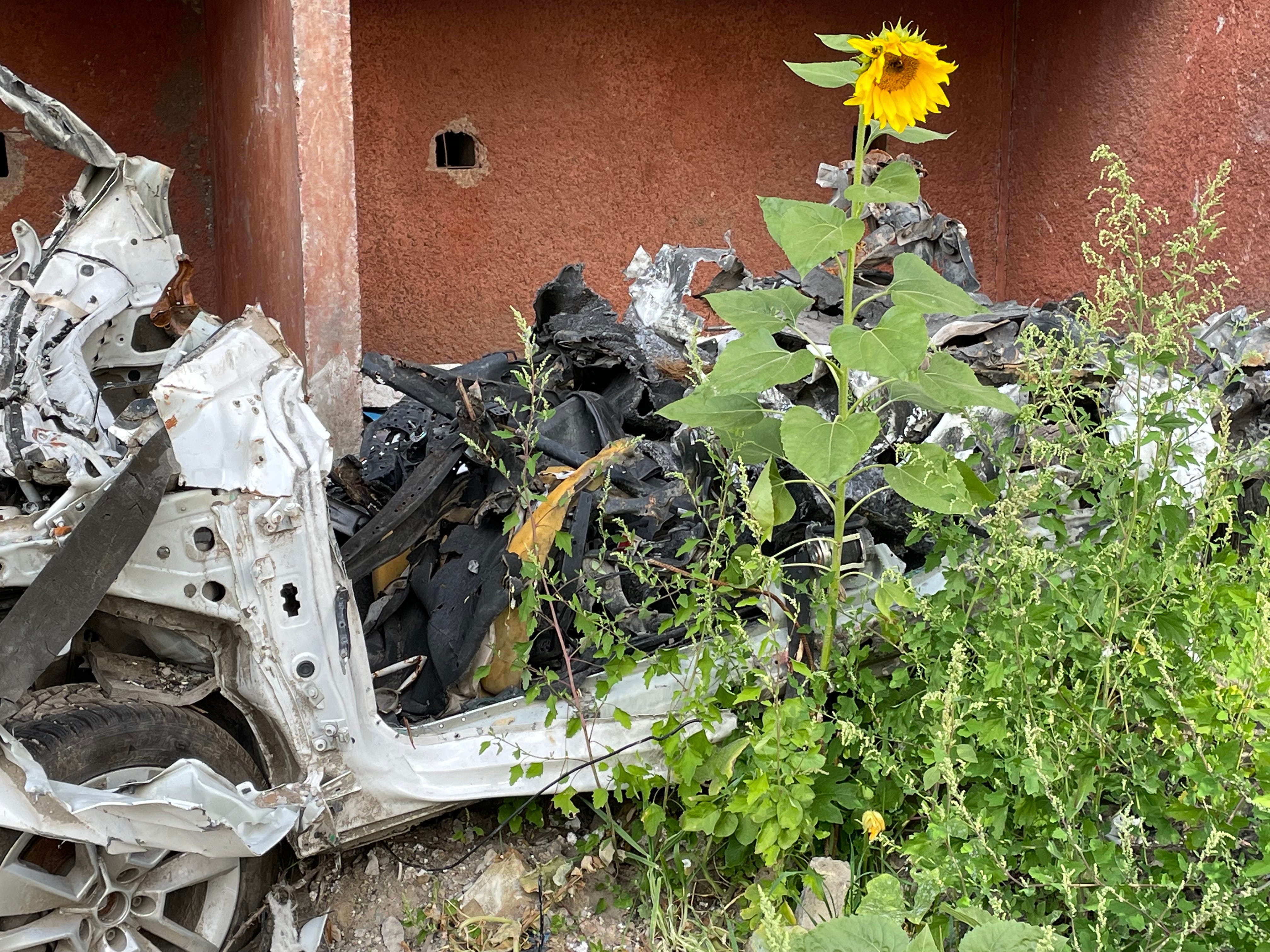
In this lecture, which I will summarize briefly here, I take the premise seriously. Democracy might or might not have a future. The signs, in general, are not good. The tendency, also in this country, is not encouraging. Our republic might have only a few years left. I will write about this soon.I try to make the case that the future is democracy, or it is not at all. We are used to people telling us that we have to choose between freedom and security. In fact, we have to choose both to get either. Climate change will be resolved if majorities are heeded. Those who accelerate climate change tend to be oligarchs backed by minorities.In the lecture, I try to show how the war in Ukraine is a specific (and terrible) instance of a general problem. Vladimir Putin is the most important of the hydrocarbon oligarchs. Like all of them, he has no plausible vision of the future, and instead tries to realize implausible visions that consume the future for everyone else. His personal fantasy is that there is no Ukraine. On this absurd basis Russia has invaded a neighboring country and begun a war of extermination.A sense of time is necessary for democracy. In the lecture, I move to the relationship between the future and the past. A tyrant who says that something has “always” been a certain way is consigning to “never” the things that actually happened. So the claims that Crimea was “always” Russia or that Ukraine and Russia were “always” together are not simply false; they are also a self-authorization to say that other peoples or countries “never” existed — and so that any signs of their existence have to be suppressed.Russia’s war against Ukraine has been genocidal. If Ukraine is not real, than anyone defending it must somehow be a foreigner; when more and more Ukrainians appear to defend their country, they too must be killed. These assertions of non-existence, I continue, raise the more interesting question of what it does mean to exist as a society or as a nation. What exactly is it that Russia is encountering in Ukraine? (And is it not a problem for Russia that the non-existence of Ukraine has become the central argument for the existence of Russia?)I contend that the “objective” measures that we apply from the outside to judge the existence of a society or a nation, such as ethnicity or language, are themselves often imperial forms of knowledge, suppressing or ignoring the actions and commitments of the people in question. The fact that Ukrainians are bilingual is very confusing to both Russians and Americans; in fact, Ukrainian use of language, for example in creative wartime communications, is an example of creative self-assertion. I contend in the lecture that the existence of Ukraine as a society and as a nation is better understood as a matter of recent experience, including the ability to change leaders through elections, and defend that process when necessary. The war itself has been carried out in large measure by a Ukrainian civil society that has constituted itself in the last decade. The Ukrainian president’s choice to remain in the country, I argue, is an important reminder that democracy exists as a commitment, or not at all. In taking a physical risk, he was making possible certain kinds of futures that would otherwise have been impossible. Democracy depends upon choices of this kind. In the United States, people were generally convinced that Volodomyr Zelens’kyi would fled the country, and that Ukraine would quickly fold. This was a sign of our own problems.We (and this is lecture’s conclusion) have tended to forget that democracy is about the future, and as such can only exist when individuals seek to generate futures on the basis of values with the help of institutions that allow them to do so. Since 1991, since the end of the Soviet Union and the beginning of Ukrainian independence, we have tended to believe the democracy was inevitable, because there were no alternatives, because capitalism would guarantee it, and so on. In fact, placing faith in structural factors and abstractions makes democracy impossible. Democracy will always be a struggle.This is just a summary! The points are much better made in the lecture itself, which was delivered at Stony Brook on 19 October.PS I am making this lecture and this summary available to all on the mailing list, but please do subscribe if you can. Paid subscription will give you access to the entire archive, as well as access to a number of other podcasts, as well as to on-line exchanges with me, which will resume in a few days.Thinking about... is a reader-supported publication. To receive new posts and support my work, consider becoming a free or paid subscriber. This is a public episode. If you'd like to discuss this with other subscribers or get access to bonus episodes, visit snyder.substack.com/subscribe

As Ukraine Goes, So Goes the World (audio)
In this lecture, I begin from a recent clip on Russian television: a Russian soldier explaining that, if Ukrainians do not accept that they are Russians, it will be necessary to kill a million of them, five million of them, or all of them.The man in question is a known fascist (he appears in my book Road to Unfreedom), and what he says opens the way to a discussion of the character of Russian fascism. We have no trouble seeing the genocidal aspects of the Russian invasion — the eliminationist language, the deportations, the mass murders, the rape — but we do not always grasp how they are connected to the notion of the non-existence of Ukraine. The Russian soldier claims that Ukrainians are “possessed. This reveals a basic current of Russian fascism that one finds in a favored thinker of Putin (whom he just cited again) and in television propaganda. In this mindset, Russia’s enemy is actually “Satan” (I will develop this theme in a written post to come). In the next part of the lecture, I move to the related topic of Russian colonialism, using history to explain how there is no basis for the claim that Crimea in particular, or Ukraine in general, were “always” part of Russia. Indeed, the “always” claim is part of an imperial maneuver by which power is able to begin things “anew.” Both Catherine the Great at the time of the annexation of Crimea and southern Ukraine, and Vladimir Putin now, make “always” claims on the basis of obliterating actual history. Their “always” is the “never” that is insisted upon for Ukraine and for Crimea. I conclude the lecture with the argument that democracy can succeed when those who support it are aware of history, are aware of their own historical predicaments, and choose to act. In this sense, Ukrainian resistance is a model. If we believe that democracy will be brought to us by structural factors, then we will get more fascism, more genocide, more imperialism. But we do not have to believe that. We can believe instead that democracy is always a struggle, but that the struggle is worth it. On this theme the lecture concludes. It was delivered 12 October 2022 at the University of Connecticut.PS Most of the audio content here is for paid subscribers. I am sending this one out to everyone, but I would appreciate it if you would subscribe if you can. If you do, you will have access to all of the podcasts, as well as to an archive of all of the written material, as well as to live interactions starting later this month.Thinking about... is a reader-supported publication. To receive new posts and support my work, consider becoming a free or paid subscriber.TS, 14 October 2022 This is a public episode. If you'd like to discuss this with other subscribers or get access to bonus episodes, visit snyder.substack.com/subscribe

"Thinking Truth and Freedom with Zelens'kyi and Havel"
This year I have been writing a philosophical book about freedom, in which the war in Ukraine and Volodymyr Zelens’kyi figure in important ways. A couple of weeks ago I had the pleasure of a long conversation with President Zelens’kyi, which was entirely devoted to the subject of freedom. I was able to pursue with him several interesting conceptions that he himself has advanced, in word and in deed, these last seven months, since his decision to remain in Kyiv despite the Russian invasion. One of the things we spoke about was the tradition of the dissidents of the 1970s and 1980s, and in particular Václav Havel’s idea of “living in truth.” In the lecture recorded here, which I was very happy to be able to give at a conference at Colby College devoted to Havel last Saturday, I work together some of the main themes of the thinking of Zelens’kyi and of Havel, and present elements of my argument about the nature of freedom. I am proud of this lecture, and hope that you will enjoy it. PS As I’ve been saying for months now, Ukraine is winning the war. Look out for some headlines about Ukrainian advances in the next day or two.PPS Normally I keep audio material for paid subscribers only, but this time I will release it for everyone. If you can, though, I would appreciate it if you subscribe. Doing so opens the archive to you, and will give you access to other audio material, as well as on-line discussions with me to be scheduled in the months to come.Thinking about... is a reader-supported publication. To receive new posts and support my work, consider becoming a free or paid subscriber. This is a public episode. If you'd like to discuss this with other subscribers or get access to bonus episodes, visit snyder.substack.com/subscribe

Lesson 13. Practice corporeal politics (podcast)
Lesson 13. Practice corporeal politics. Power wants your body softening in your chair and your emotions dissipating on the screen. Get outside. Put your body in unfamiliar places with unfamiliar people. Make new friends and march with them. This is a public episode. If you'd like to discuss this with other subscribers or get access to bonus episodes, visit snyder.substack.com/subscribe

Lesson 12. Make eye contact and small talk (podcast)
Lesson 12. Make eye contact and small talk. This is not just polite. It is part of being a citizen and a responsible member of society. It is also a way to stay in touch with your surroundings, break down social barriers, and understand whom you should and should not trust. If we enter a culture of denunciation, you will want to know the psychological landscape of your daily life. This is a public episode. If you'd like to discuss this with other subscribers or get access to bonus episodes, visit snyder.substack.com/subscribe

Lesson 11: Investigate (podcast)
Lesson 11: Investigate. Figure things out for yourself. Spend more time with long articles. Subsidize investigative journalism by subscribing to print media. Realize that some of what is on the internet is there to harm you. Learn about sites that investigate propaganda campaigns (some of which come from abroad). Take responsibility for what you communicate to others. This is a public episode. If you'd like to discuss this with other subscribers or get access to bonus episodes, visit snyder.substack.com/subscribe
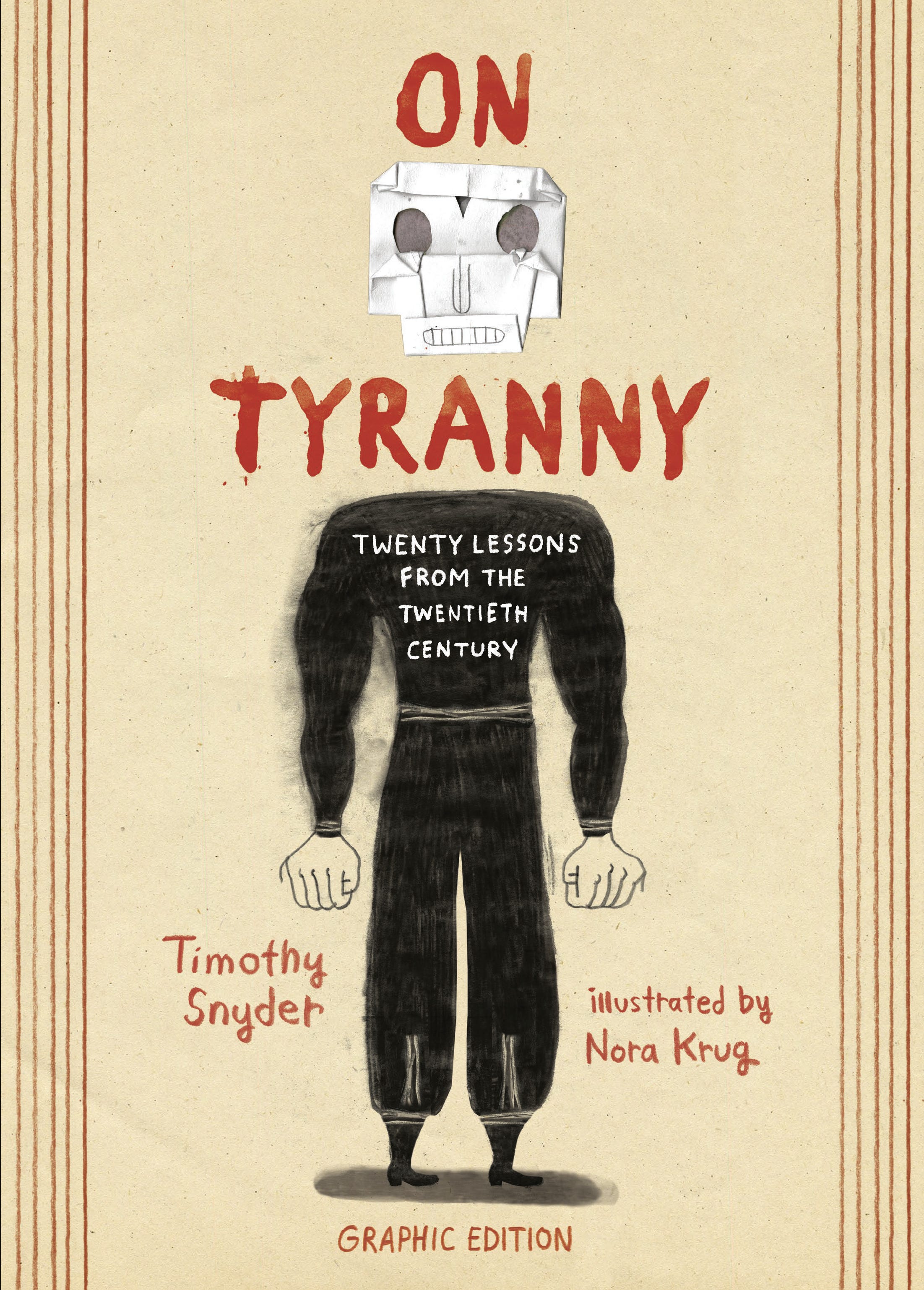
Lesson 10: Believe in Truth (podcast)
Lesson 10: Believe in Truth. To abandon facts is to abandon freedom. If nothing is true, then no one can criticize power, because there is no basis upon which to do so. If nothing is true, then all is spectacle. The biggest wallet pays for the most blinding lights. This is a public episode. If you'd like to discuss this with other subscribers or get access to bonus episodes, visit snyder.substack.com/subscribe

Lesson 9: Be Kind to Our Language (podcast)
Lesson 9: Avoid pronouncing the phrases everyone else does. Think up your own way of speaking, even if only to convey that thing you think everyone is saying. Make an effort to separate yourself from the internet. Read books. This is a public episode. If you'd like to discuss this with other subscribers or get access to bonus episodes, visit snyder.substack.com/subscribe

Lesson 8: Stand Out (podcast)
Lesson 8: Stand out. Someone has to. It is easy to follow along. It can feel strange to do or say something different. But without that unease, there is no freedom. Remember Rosa Parks. The moment you set an example, the spell of the status quo is broken, and others will follow. This is a public episode. If you'd like to discuss this with other subscribers or get access to bonus episodes, visit snyder.substack.com/subscribe

Lesson 7. Be reflective if you must be armed (podcast).
Lesson 7. “If you carry a weapon in public service, may God bless you and keep you. But know that evils of the past involved policemen and soldiers finding themselves, one day, doing irregular things. Be ready to say no.”In the podcast, I go into greater depth about the sources of this lesson: the mass atrocities carried out by German policemen and soldiers during the Second World War. I also spend some time on what might help all of us to be more reflective about the past and present. This is a public episode. If you'd like to discuss this with other subscribers or get access to bonus episodes, visit snyder.substack.com/subscribe
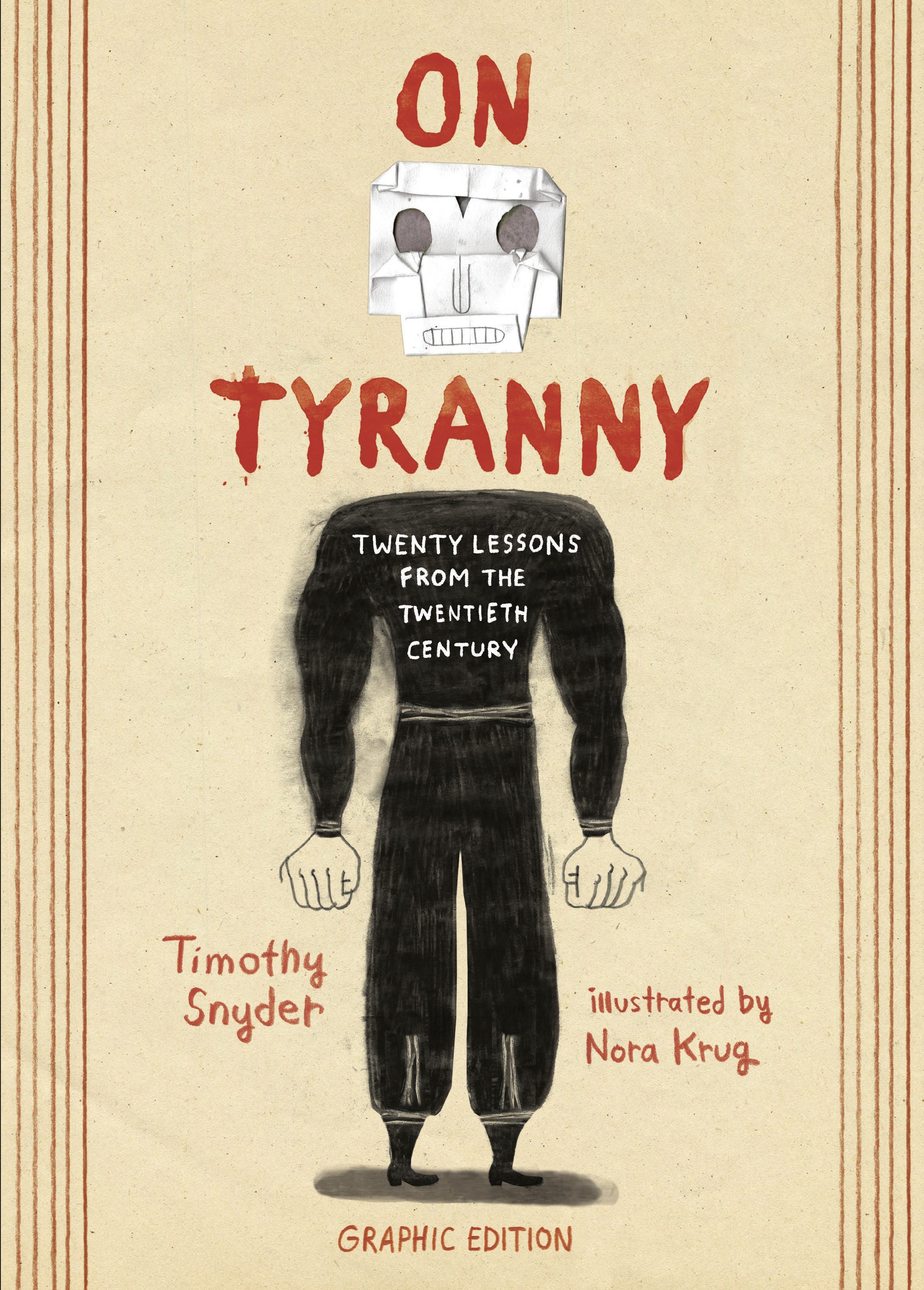
Lesson 6. Be wary of paramilitaries.
Dear All, It’s been one of the great pleasures of my life as a writer to speak about the new graphic edition of On Tyranny with its illustrator, Nora Krug. Her interpretation of the book is astounding and beautiful, and in our public conversations I have much enjoyed making contact with her and with our new public. There has also been a good deal of discussion of the book on television. I am now getting back to these podcasts, and will get them all out to you by Christmas (not by Hanukkah, which is coming very early this year!). This lesson and this podcast is about paramilitaries. As we approach the anniversary of our coup attempt, with investigation slow and coup plotters defiant, it is, I fear, more timely than ever. This is a public episode. If you'd like to discuss this with other subscribers or get access to bonus episodes, visit snyder.substack.com/subscribe
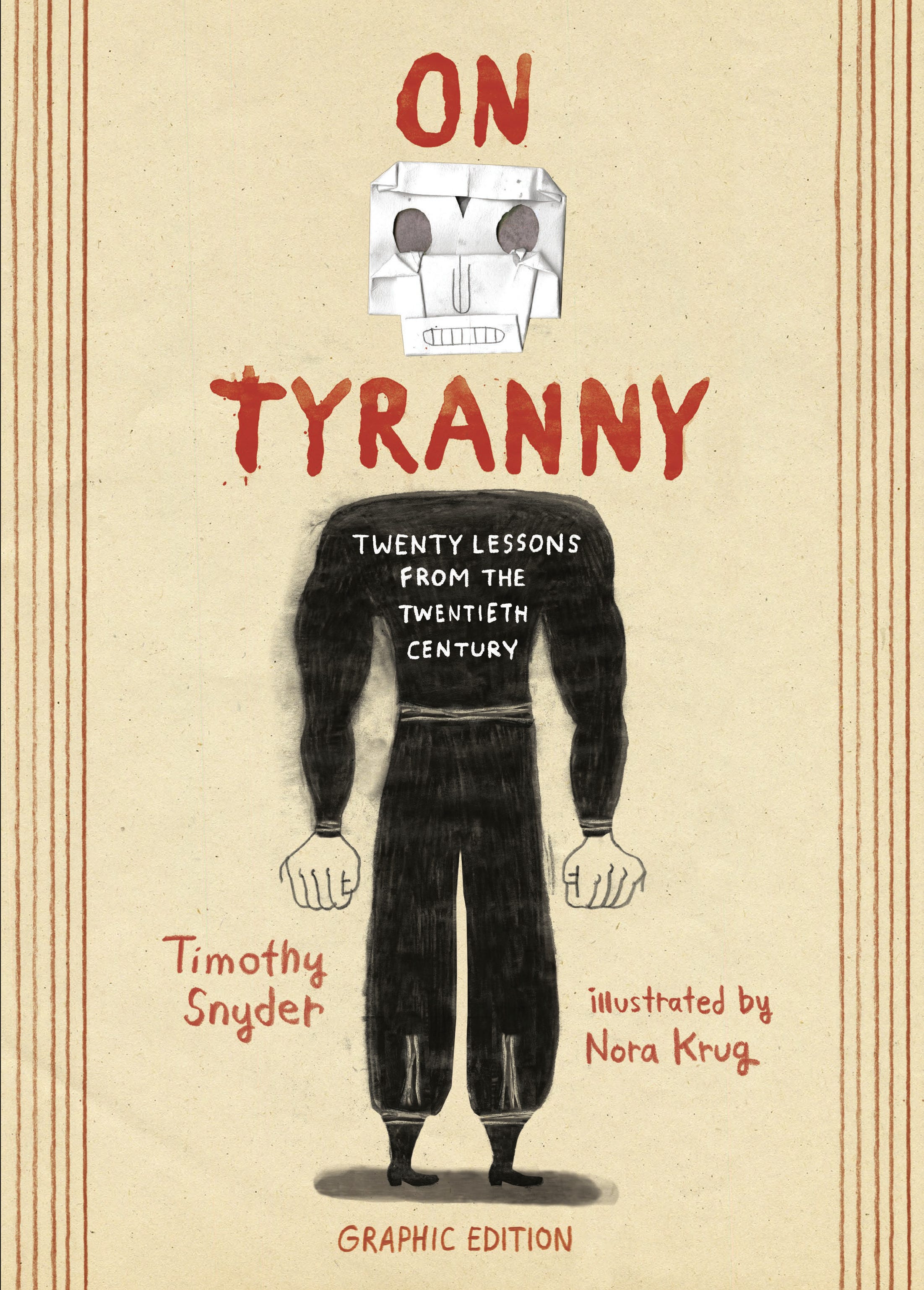
Lesson 5. Remember professional ethics (podcast).
As you know, I am releasing new discussions of the twenty lessons from On Tyranny, first as videos (notifying subscribers) and then as podcasts (for everyone). We have reached the fifth of twenty podcasts. In the book, the fifth lesson reads: “Remember professional ethics. When political leaders set a negative example, professional commitments to just practice become more important. It is hard to subvert a rule-of-law state without lawyers, or to hold show trials without judges. Authoritarians need obedient civil servants, and concentration camp directors seek businessmen interested in cheap labor.”We know from these and other examples (which I develop in the book) how quickly professions can adapt (and how the shame of having done so endures). But we also have hopeful signs, for example from 2020, of how professional ethics can adapt in positive ways. It mattered that reputable lawyers stayed away from Mr. Trump’s coup attempt, and that reputable judges insisted on rules of evidence. It mattered that business leaders and organized labor, in an unusual moment of unity, rejected Mr. Trump’s big lie in a timely fashion. This is a public episode. If you'd like to discuss this with other subscribers or get access to bonus episodes, visit snyder.substack.com/subscribe
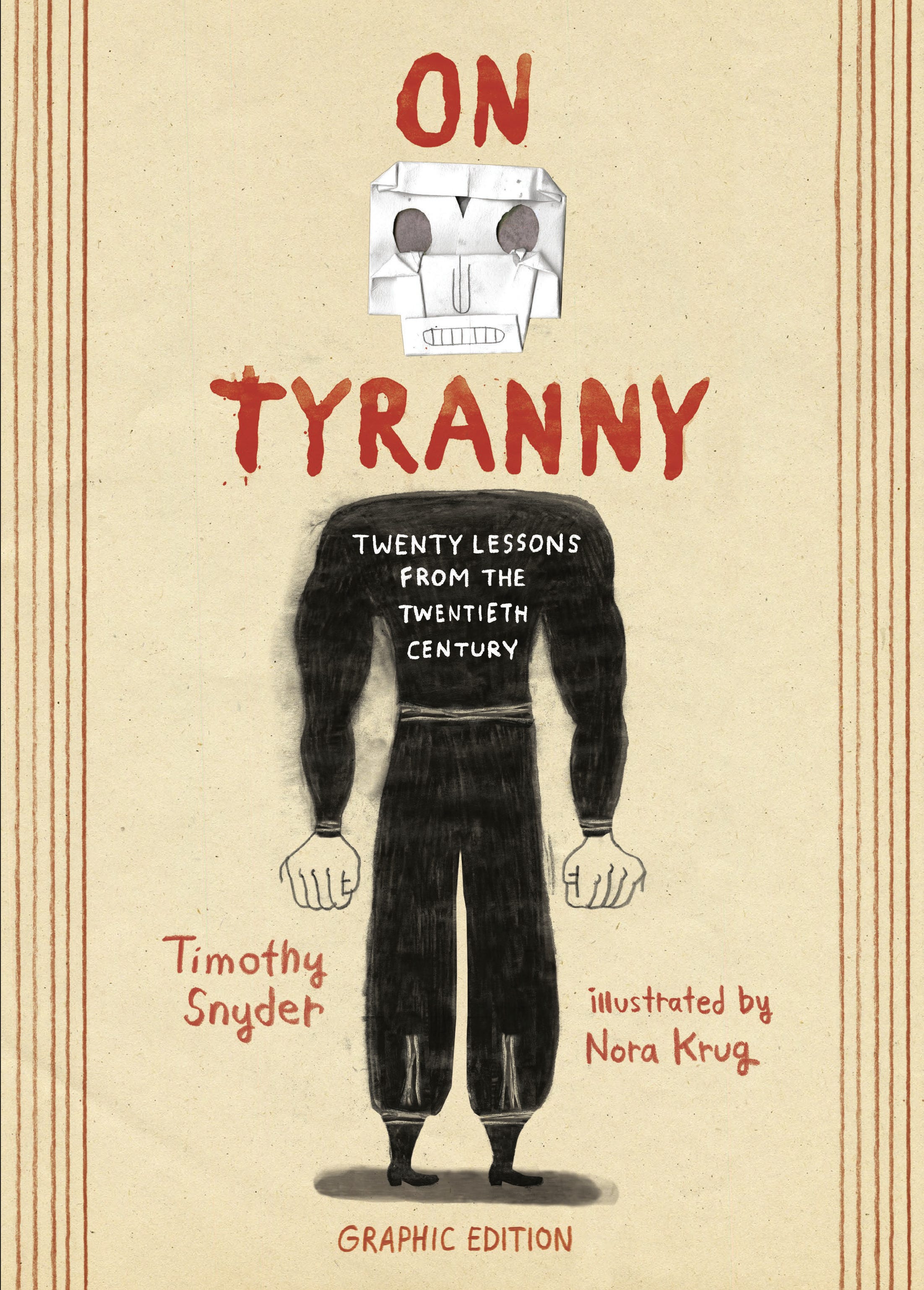
Lesson 4. Take responsibility for the face of the world (podcast)
The text of lesson four reads:“Take responsibility for the face of the world. The symbols of today enable the reality of tomorrow. Notice the swastikas and the other signs of hate. Do not look away, and do not get used to them. Remove them yourself and set an example for others to do so.”Now that Nora Krug has made On Tyranny a deeper and better book with her transformative art, this lesson is even closer to me than it was in the past. Like much of On Tyranny, lesson four is about recognition and defense: seeing a problem, resolving it, bearing responsibility. The illustrations in the new On Tyranny suggest a more hopeful reading: we can make the face of the world better, more enlivening, more suggestive of possibility. I am not an artist; I am convinced, though, that we cannot make it as a democracy without art. We all need to be slightly less predictable versions of ourselves, which is one definition of what art does for us. Democracy needs a future; a future needs imagination; imagination needs art.I hope you enjoy this podcast, in which I speak about what lesson four means to me now. This is a public episode. If you'd like to discuss this with other subscribers or get access to bonus episodes, visit snyder.substack.com/subscribe

Lesson 3. Beware the one-party state (podcast).
“Lesson 3. Beware the one-party state. The parties that remade states and suppressed rivals were not omnipotent from the start. They exploited a historic moment to make political life impossible for their opponents. So support the multiple-party system and defend the rules of democratic elections. Vote in local and state elections while you can. Consider running for office.”This is the third of twenty podcasts, discussing the twenty lessons of On Tyranny. This one, about the one-party state, is at least as timely as it was in 2017, when the book originally appeared. In the text, I discuss the historical examples of one-party states. I then explain the vicious cycle that begins when a party begins to seek power by subverting elections. The less practiced it becomes in using democratic methods to seek power, the more dangerous it becomes in power. In the podcast, I describe how this has played out these last few years, and what I expect by 2025. PS: In the graphic edition, Nora Krug’s artwork brings out a point that was only implicit in the original book: that the South after 1877 was in effect a one-party state. This is a public episode. If you'd like to discuss this with other subscribers or get access to bonus episodes, visit snyder.substack.com/subscribe

Lesson 2. Defend institutions (podcast)
The last podcast was about lesson one, not obeying in advance. That is the first lesson of On Tyranny because all of the others depend upon it. If we do obey in advance, if we normalize what is coming before it even arrives, we are part of the problem of tyranny. If we can preserve our own sense of values, if "normal” for us means what is good and right and not just whatever happens, then we have a chance to follow some of the other lessons. Number two is about defending institutions, and this could hardly be more timely. Our American democracy is under threat: not just from a violent attempt to overthrow it, not just by a big lie about the last election, but from a nasty legalism that instructs us that whatever becomes the law must be democratic. This is not true. All around the world democracies are ending because parliaments pass laws that make democratic institutions ever less so. Defending institutions means defending the values that should inform them, not just following along with whatever happens. Ultimately the only way to defend institutions is to make them better. This is the second podcast in a series of twenty to come, accompanying the publication of the graphic edition of On Tyranny. It was published earlier this week, and quickly (thanks to Nora Krug’s stunning graphic adaptation, and thanks to the support of you and others like you) became, on that day at least, the bestselling book in the country. I hope that means that this and the other lessons will continue to help us. This is a public episode. If you'd like to discuss this with other subscribers or get access to bonus episodes, visit snyder.substack.com/subscribe