Thinkers & Ideas
157 episodes — Page 2 of 4

Perspectives on the Future with Esther Dyson, Rita McGrath, and Gary Shteyngart
At the BCG Henderson Institute, we aim to bring forward-looking leaders the ideas and inspirations that will shape their next game. To honor this mission—and celebrate the 100th episode of our Thinkers & Ideas podcast—we welcomed three leading futurists to discuss the evolution of business and society.Rita McGrath is a professor of management at Columbia Business School, and has been ranked among the top 10 management thinkers globally by Thinkers50 for years. Gary Shteyngart, a professor of writing at Columbia University is also a New York Times bestselling author of science fiction novels. Esther Dyson, founder of Wellville, is an investor, writer, and expert on all things tech, space, and health.Together with Martin Reeves, Chairman of the BCG Henderson Institute, they discuss their complementary perspectives on the future. They also divulge their methods for making predictions, providing valuable hints for how business leaders can use similar approaches to shape their perspectives and strategies.Key topics discussed: 02:06 | Revisiting past predictions about the future05:08 | The digital age08:16 | Social media and a technology-centred society12:47 | Methods for sensing the future”17:23 | Harnessing the power of science fiction22:31 | Using metaphors24:41 | Bringing together these future-sensing methods31:07 | Predictions about what is coming nextAdditional inspirations from Rita McGrath, Gary Shteyngart, and Esther Dyson:Seeing Around Corners: How to Spot Inflection Points in Business Before They Happen By Rita McGrath(Harper Business, 2019)Super Sad True Love Story: A Novel By Gary Shteyngart (Random House Trade Paperbacks, 2011)Release 2.0: A Design for Living in the Digital Age By Esther Dyson (Broadway, 1997)

Look Again with Cass Sunstein
In Look Again: The Power of Noticing What Was Always There, Cass Sunstein, together with his co-author Tali Sharot, discusses the importance of reevaluating the familiar to discover new insights.Sunstein has long been at the forefront of behavioral economics. He is the Robert Walmsley University Professor at Harvard Law School and served as the administrator of the White House Office of Information and Regulatory Affairs in the Obama administration. He has authored numerous best sellers, such as Nudge and The World According to Star Wars., In his new book, he explores the effects of habituation—ceasing to notice the familiar.Together with Martin Reeves, Chairman of the BCG Henderson Institute, Sunstein discusses the perils of habituation and how to see the unseen. He also identifies ways that company leaders can strategically avoid habituation to ensure their organizations do not get stuck in mental models that limit adaptability to new trends and challenges.Key topics discussed: 01:09 | How habituation works04:25 | What dishabituation is08:18 | How to see the unseen13:51 | How corporations should think about (dis-)habituation22:08 | Breaking free from a mental model24:21 | Personal strategies for dishabituationAdditional inspirations from Cass Sunstein:Noise: A Flaw in Human Judgment; co-authored by Daniel Kahneman and Olivier Sibony (Little Brown Spark, 2021)The World According to Star Wars (Dey Street Books, 2016)Nudge: Improving Decisions About Health, Wealth, and Happiness; co-authored by Richard Thaler (Penguin Books, 2009)

Why We Die with Venki Ramakrishnan
In Why We Die: The New Science of Ageing and the Quest for Immortality, Venki Ramakrishnan explores the current research on and prospects for human longevity.Ramakrishnan leads a group at the MRC Laboratory of Molecular Biology in Cambridge, England. For his research on the structure and function of ribosomes, he won the 2009 Nobel Prize in Chemistry. From 2015 to 2020, he served as president of the Royal Society. In his new book, Ramakrishnan explains the mechanisms of aging and their potential impacts on life expectancy, health span, and lifespan.Together with Martin Reeves, Chairman of the BCG Henderson Institute, Ramakrishnan discusses the likely social, economic, and ethical implications of increasing longevity as well as the specific efforts researchers are making to prolong healthy life—and how close they are to achieving a breakthrough. He shines a light on a set of technologies which could be every bit as impactful as artificial intelligence, which therefore also deserve our attention.Key topics discussed: 02:28 | Life expectancy vs. health span vs. maximum lifespan08:21 | Mechanisms of aging13:25 | Potential interventions for promoting longevity18:27 | How close are we to a longevity breakthrough?24:02 | Societal and ethical implications28:48 | The art of communicating complex ideaAdditional inspirations from Venki Ramakrishnan:The Most Promising Ways to Stop Ageing (New Scientist Interview, 2024)The Story of Deciphering the Ribosome (The Royal Society Talk, 2020)Gene Machine: The Race to Decipher the Secrets of the Ribosome (Basic Books, 2018)

Making Sense of Chaos with Doyne Farmer
In Making Sense of Chaos: A better economics for a better world, J. Doyne Farmer challenges traditional economic models, which rely on simplistic assumptions and fail to provide accurate predictions.Farmer, a complex systems scientist at the University of Oxford and the Santa Fe Institute, argues that with technological advances in data science and computing, we are now able to apply complex systems thinking to build models that more accurately capture reality and enable us to make better predictions about the economy.Together with Martin Reeves, Chairman of the BCG Henderson Institute, Farmer discusses the limitations of standard models of economics as well as the consequences of such limitations. He proposes an alternative based on complex systems thinking and agent-based modeling—and describes how it can be applied in various fields, including business.Key topics discussed: 01:42 | Limitations of the standard model of economics04:44 | How complex systems thinking works09:01 | Consequences of using inadequate economic models12:44 | Agent-based modeling as a powerful alternative19:02 | Leveraging alternative modeling techniques in business24:59 | How CEOs can start embracing complexity thinking

Co-Intelligence with Ethan Mollick
In Co-Intelligence: Living and Working with AI, Ethan Mollick explains how to engage with AI as a co-worker, a co-teacher, and a coach.Mollick is a professor of management at the Wharton School of Business at the University of Pennsylvania, where he studies and teaches innovation and entrepreneurship. In his new book, he discusses the profound impacts AI will have on business and education, using many examples of AI in action. His book challenges us to utilize AI’s enormous power without losing our human identity, to learn from it without being misled, and to harness its gifts to create a better human future.Together with Martin Reeves, chairman of the BCG Henderson Institute, Mollick discusses how to train people to use AI effectively, whether AI will substitute or complement workers, and how businesses can move beyond a short-term efficiency gains perspective to generate value with AI in the long term. Key topics discussed: 02:27 | The four rules for living with AI09:04 | Educating people to use AI effectively10:47 | What experiments reveal about where AI adds (and destroys) value at work12:45 | Substituting (vs. complementing) workers with AI14:14 | Generating value with AI in the long-term17:10 | Bringing about the social change in organizations alongside the tech change20:48 | AI regulation27:18 | How AI will transform educationAdditional inspirations from Ethan Mollick:One Useful Thing (Substack)The Unicorn’s Shadow: Combating the Dangerous Myths That Hold Back Startups, Founders, and Investors (Wharton School Press, 2020)Changing the Game: How Video Games Are Transforming the Future of Business - Co-authored by David Edery (FT Press, 2008)

The Intelligence of Intuition with Gerd Gigerenzer
In The Intelligence of Intuition, Gerd Gigerenzer challenges a commonly held view of intuition—namely, that it is somehow inferior to logical rationality.Gigerenzer is director of the Harding Center for Risk Literacy at the University of Potsdam, director emeritus of the Center for Adaptive Behavior and Cognition at the Max Planck Institute for Human Development, and an expert on human decision-making. He argues that intuition is a form of unconscious intelligence shaped experience and evolution in dealing with uncertain and dynamic situations—situations for which logic and algorithms are often ill-fitted. As leaders deal with uncertainty and complexity and embrace new AI technologies, they must not forget the power of intuition.Together with Martin Reeves, Chairman of the BCG Henderson Institute, Gigerenzer explores the power of intuition, when to use it in business, and how to cultivate and employ it.Key topics discussed: 01:23 | Difference between intuition and rationality04:49 | Role of heuristics06:29 | Why intuition is often looked down upon08:06 | Power of intuition15:21 | How to use intuition in business18:45 | Distinguishing right intuition from wrong intuition25:12 | Considering how AI use intuitionAdditional inspirations from Gerd Gigerenzer:How to Stay Smart in a Smart World: Why Human Intelligence Still Beats Algorithms (The MIT Press, 2022)Gut Feelings: The Intelligence of the Unconscious (Penguin Books, 2008)Calculated Risks: How to Know When Numbers Deceive You (Simon & Schuster, 2003)

Climate Capitalism with Akshat Rathi
In Climate Capitalism: Winning the Global Race to Zero Emissions, Akshat Rathi tells the stories of people around the world who are building impactful solutions to tackle climate change.Rathi is a senior reporter for Bloomberg News, focusing on climate and energy. He also hosts the weekly Zero podcast, in which he talks to the people leading the fight for a zero-emissions future. In his new book, Rathi argues that the best way to cut carbon pollution is by harnessing capitalism. Combating climate change requires a combination of smart policies, financing, technological innovations, and leadership—without killing markets or competition.Together with Martin Reeves, Chairman of the BCG Henderson Institute, Rathi discusses the essence of climate capitalism, how to scale up individual success stories, and how to navigate the challenging political context. Key topics discussed: 02:09 | Definition of climate capitalism07:19 | Success stories: Chinese EVs, Orsted11:31 | The need to combine tech, policies, and finance12:52 | How to scale case studies to big solutions16:24 | Navigating a polarized political context18:45 | Making climate solutions profitable24:06 | Where CEOs should start

Slow Down with Kohei Saito
In Slow Down: The Degrowth Manifesto, Kohei Saito explores the relationship between capitalism and the climate crisis. He argues, controversially, that to have any chance of achieving true sustainability, we must move to a system which deemphasizes growth, adopts different metrics of progress, expands the commons, and places value on goods and services which are not currently considered as part of the economy, like caregiving and nature.Saito is an associate professor of philosophy at the University of Tokyo and a recipient of the Japan Society for the Promotion of Science prize, which is awarded to the top scholar in Japan under the age of 45. His book, published previously in Japan, became an unexpected bestseller, shipping more than half a million copies to date.Together with Martin Reeves, Chairman of BCG Henderson Institute, Saito discusses the arguments for fundamental economic system change, explores the feasibility of less radical alternatives, and assesses implications for business leaders. The book’s propositions will likely seem very radical to many of our business listeners—but as Saito notes, sometimes utopian ideas can be a stimulus for generating new thinking for complex intractable topics like climate change.Key topics discussed: 01:50 | Defining the problem and the need for system-level change06:21 | The relation between capitalism and technological progress08:41 | Exploring alternative, less radical solutions13:32 | The need for a new measurement of economic and social progress17:08 | The feasibility of a transition to a new system21:41 | Implications for business leaders25:35 | Reasons to remain hopeful

Higher Ground with Alison Taylor
In Higher Ground: How Businesses Can Do the Right Thing in a Turbulent World, Alison Taylor explores how companies can navigate the complexity of modern business ethics.Taylor, a clinical associate professor at NYU Stern, has spent decades advising large multinational companies on risk, corruption, sustainability, and organizational culture. In her new book, she combines her experience with vivid case studies to guide companies toward reaching what she describes as the “higher ground”—a space where companies can act ethically and achieve long-term strategic advantage.Together with Martin Reeves, Chairman of BCG Henderson Institute, Taylor discusses why good governance is now more important than ever, how leaders can navigate a polarized political landscape, and how businesses can build trust.Key topics discussed: 02:44 | The rising importance of internal governance06:10 | Common traps of internal governance07:55 | Best practices for deploying purpose10:53 | Businesses taking political stances14:58 | Importance of trust and traps in pursuing it17:12 | Solutions for businesses to pursue24:15 | How to apply these lessons in your own work
The Friction Project with Bob Sutton
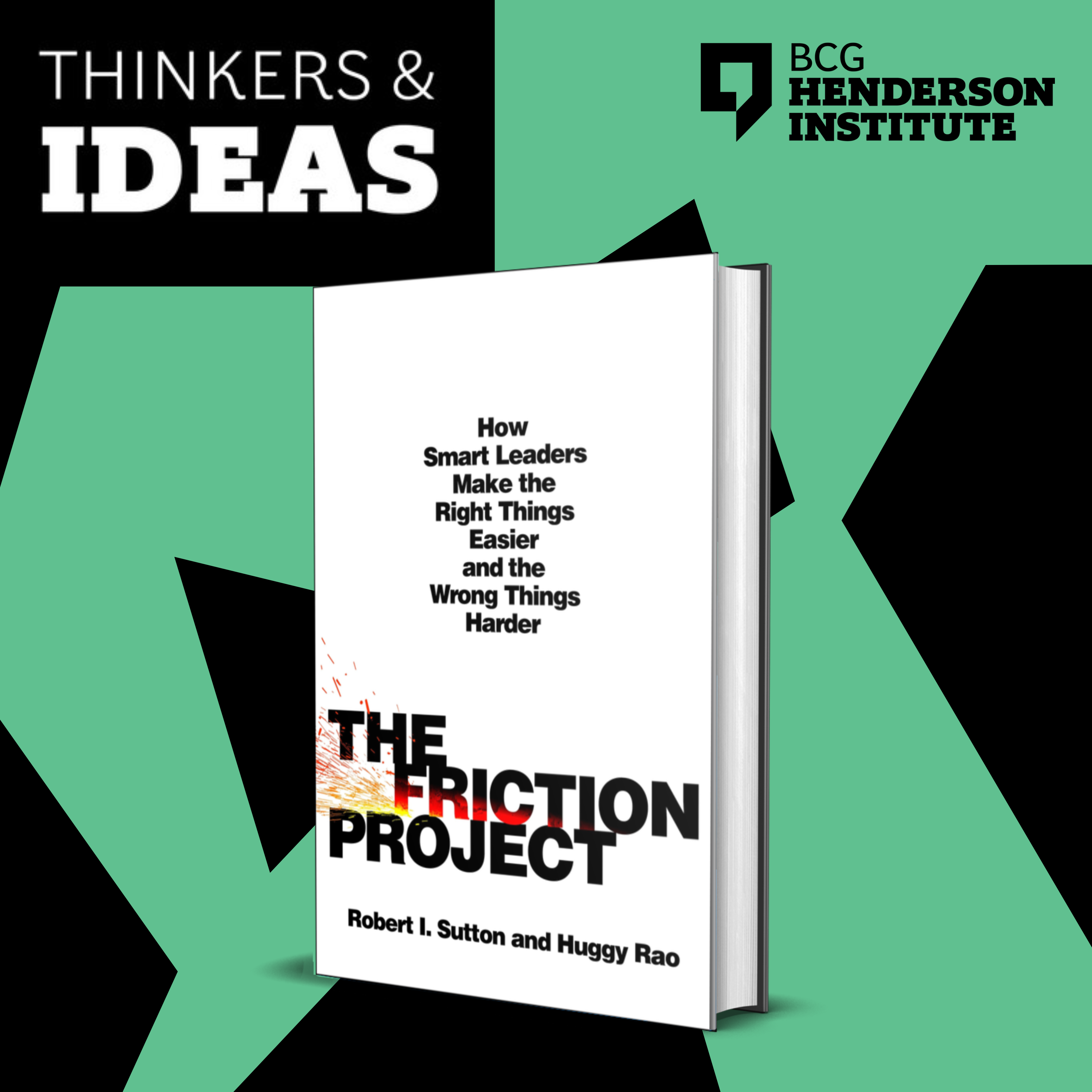
In The Friction Project: How Smart Leaders Make the Right Things Easier and the Wrong Things Harder, Bob Sutton and Huggy Rao share insights on friction—the forces that make it harder, slower, more complicated, or even impossible to get things done in organizations.Sutton is an expert on organizational psychology at Stanford University and a best-selling author. His latest book is a culmination of a seven-year research effort on how effective organizations function without driving employees and customers crazy.Together with Martin Reeves, Chairman of BCG Henderson Institute, Sutton explores what friction is, where it comes from, and its effects - both positive and negative. They discuss the practical steps leaders and employees can take to remove and add friction in the right places. They also discuss broader implications, like whether the nature and consequences of friction will change in a world increasingly characterized by machine-machine and machine-human, rather than only human-human interactions.Key topics discussed:00:54 | What is organizational friction04:30 | The negative consequences of friction08:42 | What does good friction look like?14:14 | How to remove friction17:22 | What creates friction19:11 | Removing friction and creating problems22:04 | Is friction less problematic in a world of AI?25:26 | How can ideas about friction be applied in academia?

Permacrisis with Mohamed El-Erian and Michael Spence
In Permacrisis: A Plan to Fix a Fractured World, Mohamed El-Erian and Michael Spence, along with their coauthors, Gordon Brown and Reid Lidow, consider how we’ve arrived at this state of constant instability and insecurity—and suggest concrete ways to break the cycle.Mohamed El-Erian, president of Queens’ College Cambridge University, was previously the chair of President Obama’s Global Development Council, a Deputy Director at the International Monetary Fund, and CEO and co-CIO of PIMCO.Michael Spence, a senior fellow at the Hoover Institution and the Philip H. Knight Professor and dean, emeritus, at Stanford Graduate School of Business, was awarded the 2001 Nobel Memorial Prize in Economic Sciences.Together with Martin Reeves, the Chairman of the BCG Henderson Institute, El-Erian and Spence discuss new approaches to thinking about growth, economic management, and managing a global order, as well as how leaders could unlock the full potential of technologies that could drive growth, and ensure that the benefits of technological advancements, like AI, are widely distributed to avoid exacerbating national tensions.Key topics discussed: 01:59 | Defining permacrisis08:58 | The essence of how we need to think differently about growth and value10:32 | Unlocking the full potential of technologies that could drive growth14:09 | How to ensure that the benefits of technological advancements, like AI, are widely distributed to avoid exacerbating national tensions19:40 | Anticipating or managing similar crises (COVID-19) in the future25:15 | Reforming multilateral institutions

The Worlds I See with Dr. Fei-Fei Li
In The Worlds I See, Dr. Fei-Fei Li provides a personal and deeply insightful depiction of two convergent journeys. One describes her own life and career; Li immigrated to the U.S. from China at age 15, and within a few years had launched into research in computer vision and AI. The other is a history of AI, which has involved many breakthroughs over the past 70 years, culminating in a technology that is now changing life and business.Li is one of the world’s foremost experts on AI and was named by Time magazine as one of the top 25 most influential thinkers in AI in 2023. She previously served as Google’s chief AI and machine learning scientist.Together with Martin Reeves, Chairman of BCG Henderson Institute, Li discusses critical inflection points in the history of AI, emerging AI technologies businesses must be aware of, and what implications AI will have for competitive advantage.Key topics discussed: 01:19 | Is our education system fit for the future?07:13 | What were the key milestones in the history of AI?11:48 | Which emerging AI technologies do businesses need to be aware of?13:38 | How should we be thinking about ethical issues surrounding AI?20:39 | How will AI transform business? Where will it create competitive advantage?

The Secret of Culture Change with Jay Barney
In his new book The Secret of Culture Change: How To Build Authentic Stories That Transform Your Organization, Jay Bryan Barney discusses why changing company culture is sometimes necessary but always challenging—and how the power of stories can help leaders mobilize their employees around a new strategy.Jay Barney, a professor of strategic management and the Pierre Lassonde Chair of Social Entrepreneurship at the University of Utah’s David Eccles School of Business, is one of the world’s leading strategists and the father of so-called resource-based competition.Together with Martin Reeves, Chairman of the BCG Henderson Institute, Barney explores the connections between the realms of strategy and culture—discussing the power of stories to change culture and support a new strategy, and identifying the key characteristics of great stories and story-making, such as being authentic and putting the leader at the heart of the narrative.Key topics discussed: 01:10 | How do you define culture and why do we sometimes need to change it?03:31 | What are some examples of successful culture change?08:01 | What are the key characteristics of culture-changing stories?16:33 | How do leaders navigate social/political “culture wars” in their own culture?22:20 | Are stories and culture change something that can be shaped or are they emergent?25:40 | How do stories and culture change apply to a business school setting?

The Geek Way with Andrew McAfee
In The Geek Way: The Radical Mindset that Drives Extraordinary Results, Andrew McAfee describes how a new approach to corporate culture based on science, ownership, speed, and openness, is driving value creation in the 21st century.McAfee is an expert on how technological progress changes the world, being named to both the Thinkers50 list of top management thinkers and the Politico 50 group of people transforming American politics. In his new book, he outlines how the giants of Silicon Valley found success not just because they are at the center of the digital technology revolution, but also because they are revolutionizing the way business is done—what McAfee describes as the “geek way.”.Together with Martin Reeves, Chairman of BCG Henderson Institute, McAfee explores the core tenets of a corporate culture that embraces the “geek way” and explains why it works, drawing on insights from the science of cultural evolution. They also discuss how traditional, non-tech firms can embrace this new culture and operating system.Key topics discussed:02:12 | What are the core tenets of the “geek way”?08:55 | How could these tenets be applied to any businesses?11:31 | How can we overcome the limitations of the “geek way” (e.g., negative corporate culture aspects, retaining culture as a firm grows)?15:05 | Is the “geek way” unique to American firms? What can we learn from the Chinese tech sector?17:46 | What is the role of strategy in a “geek way” company?20:11 | How might the “geek way” culture change in the future, given new challenges (e.g., elevated costs of capital)?23:01 | What are the first steps a CEO should take to establish the “geek way” in their firm?Additional inspirations from Andrew McAfee:More From Less: How we Finally Stopped Using Up The World - And What Happens Next (Simon & Schuster UK, 2019)Machine, Platform, Crowd: Harnessing Our Digital Future (Brilliance Audio, 2017)The Second Machine Age: Work, Progress, and Prosperity in a Time of Brilliant Technologies (Brilliance Audio, 2014)Race Against the Machine: How the Digital Revolution is Accelerating Innovation, Driving Productivity, and Irreversibly Transforming Employment and the Economy (Digital Frontier Press, 2012)

Head & Heart with Dr. Kirstin Ferguson
In Head & Heart: The Art of Modern Leadership, Dr. Kirstin Ferguson provides a practical guide to balancing the rational and emotional components of leadership.Ferguson is an expert on leadership, an experienced leader in the private and public sectors, and a longtime advocate of gender equity. In her new book, she identifies the key attributes of a “head and heart” leader, providing people with the tools to reflect on and adapt their own approach to each situation. She combines vivid stories and extensive research to inspire her readers to become better, more authentic, modern leaders.Together with Martin Reeves, Chairman of BCG Henderson Institute, Ferguson discusses the evolution of leadership thinking, what makes a “head and heart” leader, and how leaders can improve their effectiveness and adaptability. They also reflect on how leadership, and particularly the “heart” attributes, will be more crucial than ever with the rise of AI in the workplace.Key topics discussed:02:36 | How has thinking on leadership evolved?06:05 | What are the attributes of a “head and heart” leader?08:25 | How can you improve your “head and heart” leadership attributes?18:24 | Are leaders aging, and is there a need to make space for younger talents?20:05 | How might AI change the art of leadership?Additional inspirations from Dr. Kirstin Ferguson:Certain Uncertainty: Leading with Agility and Resilience in an Unpredictable World (Wiley, 2023)Women Kind: Unlocking the Power of Women Supporting Women (Murdoch Books, 2019)Got a Minute? (Weekly column, The Sydney Morning Herald)

How to Work with (Almost) Anyone with Michael Bungay Stanier
In How to Work with (Almost) Anyone, Michael Bungay Stanier outlines how to set up working relationships for the best chance of success—by following a process of thorough preparation, a keystone conversation, and regular maintenance.Bungay Stanier, founder of coaching firm Box of Crayons, is a world-renowned thought leader on coaching and author of the best-selling coaching book, The Coaching Habit. In his most recent book, he focuses on relationship-building, providing readers with processes and principles, as well as exercises and ample practical advice to sharpen their skills.Together with Martin Reeves, Chairman of the BCG Henderson Institute, Bungay Stanier discusses how to build the “best possible relationship” and how to maintain and repair it over time. Moreover, they assess how to create a corporate culture conducive to these relationships, and how to make these relationships work in a hybrid or remote setting.Key topics discussed:01:22 | How to make difficult relationships more workable03:39 | Definition of a “best possible relationship” and how to build it05:54 | How to have a keystone conversation12:26 | The impact of corporate culture and different personality types15:44 | How to maintain and repair relationships20:42 | The implications of hybrid and remote work22:31 | How leaders can apply these lessons in their organizations
Big Bets with Rajiv Shah
In his new book, Big Bets: How Large-Scale Change Really Happens, Rajiv Shah, President of the Rockefeller Foundation recounts his experiences and lessons learned over decades of effecting large-scale social change. He shares how addressing humanity’s thorniest challenges requires a big bets mindset – pushing to solve, rather than merely improve, problems; and going for “big enough”, rather than settling for “good enough”.Prior to his current role, Shah was the Administrator of USAID and a Director at the Bill & Melinda Gates Foundation. He successfully led many transformative change efforts around the globe – including advancing the immunization of children, fighting against hunger and energy poverty, and providing relief for humanitarian disasters.Together with Martin Reeves, Chairman of BCG Henderson Institute, Shah discusses insights from his new book, including a mindset he sees crucial to making change possible, the need for public-private partnerships, and the role of businesses in addressing social and environmental issues. The conversation also touches on the importance of continuous experimentation, the involvement of younger leaders in change projects, and the challenges of planning in complex and unpredictable situations.
Mixed Signals with Uri Gneezy
In his new book, Mixed Signals: How Incentives Really Work, Uri Gneezy explains why leaders often create incentives that are misaligned with their organization’s goals.Gneezy, the Epstein/Atkinson Chair in Management Leadership at UC San Diego’s Rady School of Management, is one of the world’s leading experts in behavioral economics, and his insights have become a staple in courses around the world. He teaches managers how to be incentive-smart—how to avoid mixed signals and design incentives that are simple, effective, and ethical.Together with Martin Reeves, Chairman of BCG Henderson Institute, Gneezy discusses how incentives work, and how we can apply them in the workplace to change habits and spark innovation—he explains why, counterintuitively, successful organizations and initiatives may actually have a greater need to examine their incentives than unsuccessful ones.Key topics discussed:01:11 | How incentives send signals02:08 | Incentives in the workplace09:14 | Incentivizing innovation12:29 | Understanding the use and limitation of incentives18:22 | Changing habits

The Coming Wave with Mustafa Suleyman
In his new book, The Coming Wave: Technology, Power, and The Twenty-First Century’s Greatest Dilemma, Mustafa Suleyman discusses the new technologies that will transform society—chief among them AI and synthetic biology.Suleyman is a renowned thought leader on this topic, having co-founded Inflection AI and DeepMind, and having served as VP of AI product management and AI policy at Google.Together with Martin Reeves, Chairman of BCG Henderson Institute, Suleyman discusses the threats and opportunities posed by AI and synthetic biology, whether and how they will confer competitive advantage, and how governments and companies can collaborate to contain their negative effects while ensuring that society reaps their benefits.Key topics discussed:01:28 | The threats of the coming wave of technologies06:43 | A modern Turing Test for AI10:14 | The competitive advantage conferred by AI15:25 | The benefits and limitations of AI18:34 | Containing the next wave of technologies22:09 | Potential regulatory interventions23:46 | Motivations for writing the book
Right Kind of Wrong with Amy Edmondson
In her forthcoming book, Right Kind of Wrong: The Science of Failing Well, Amy Edmondson offers a new framework to think about, discuss, and practice failure wisely, using human fallibility as a tool for making ourselves and our organizations smarter.Amy Edmondson is the Novartis Professor of Leadership and Management at the Harvard Business School and the author of seven books, including The Fearless Organization, which has been translated into more than 15 languages. She was ranked number one on the 2021 Thinkers50 list, a ranking of the world’s most influential management thinkers.Together with Martin Reeves, Chairman of the BCG Henderson Institute, Edmondson discusses the distinctions that can help us separate good failure from bad, strategies to decrease the cost of learning, as well as practical actions for leaders to establish a culture where intelligent failure is predominant.Key topics discussed: 1:13 | The distinction between failing well and failing badly9:36 | How to avoid the "illusion of knowing" and mistaking a mental model for a fact12:02 | Institutional and leadership-level moves to create an environment where intelligent failure is predominant18:27 | How to decrease the cost of learning19:42 | Can AI help to analyze the potential for failure or identify learnable lessons and failure patterns?
The Perennials with Mauro Guillén
In The Perennials: The Megatrends Creating a Postgenerational Society, Mauro Guillén argues that the traditional, sequential model of life—childhood, education, career, and retirement—is being rendered obsolete.Guillén, a professor of management at the Wharton School of the University of Pennsylvania, is one of the world’s foremost experts on global megatrends. In his most recent book, he focuses on the combination of rapid technological progress, increasing life as well as health spans, and declining fertility rates—which, together, are creating a society in which arbitrary definitions of generations, based on chronological age, are no longer appropriate.Together with Martin Reeves, Chairman of BCG Henderson Institute, Guillén discusses the shortcomings of the sequential model of life and what the new, post-generational society will look like. He also highlights implications for businesses, which will need to adapt their marketing practices to changing patterns in consumption and harness the benefits of intergenerational collaboration in their workforces.Key topics discussed: 01:51 | The sequential model of life and its shortcomings04:17 | The post-generational society and the trends creating it07:31 | Implications for corporations14:13 | How CEOs can prepare for a society of perennials17:14 | Implications for academic institutions
Power and Progress with Simon Johnson
In his new book Power and Progress, Simon Johnson, along with his co-author Daron Acemoglu, challenges the techno-optimistic narrative that technological progress will automatically lead to shared prosperity.Johnson, a professor at the MIT Sloan School of Management, takes us through a millennium of technological progress to show how the gains from advancements such as the agricultural and early industrial revolutions tended to benefit a narrow segment of interests. While technology can enable the kind of equitable growth that is heralded by techno-optimists, this requires an environment that mitigates the natural power imbalance between workers and owners of technology through regulation, labor organizations, and an active civic society. As we stand on the brink of a new wave of innovation from AI, it’s critical that we learn from the history of economic progress to ensure that this time, the gains are shared broadly in society.In this episode of our Thinkers & Ideas podcast, Johnson joins BCG Henderson Institute Chairman Martin Reeves to discuss the incentives for corporate leaders to create technology directed at equitable growth, the potential impact of AI on society, and the effectiveness of government policies aimed at fostering shared prosperity.Key topics discussed: 01:19 | Motivation for the book02:03 | Progress and shared prosperity07:29 | Effectiveness of redistribution09:43 | Directing innovation toward social good16:42 | The impact of AI20:39 | Role of corporate leaders and investors in directing technology
LOOK with Christian Madsbjerg
In his new book, LOOK: How to Pay Attention in a Distracted World, Christian Madsbjerg explores the importance of observational skills. Drawing on various fields—science, philosophy, and the arts—as well as his personal experiences, Madsbjerg offers tools and insights to help us better pay attention and extract insights.Madsbjerg was co-founder and senior partner of consulting firm, ReD Associates and was previously a professor of applied humanities at the New School for Social Research in New York City. He works at the intersection of business and the humanities, guiding firms to develop powerful strategies anchored in human perception.Together with Martin Reeves, Chairman of BCG Henderson Institute, Madsbjerg discusses how we can learn to observe the world properly—letting go of oversimplifying assumptions and biases—and how this will help firms unlock insights about their customers far beyond the reach of traditional market research.Key topics discussed: [01:25] How to observe properly[06:57] How “total observation” can unlock new insights[13:14] Distractions of modern life and how to tackle them[18:14] Difference between traditional market research and “total observation”[21:30] How to change how we observe things in the corporate context
Magic Words with Jonah Berger
In his latest book, Magic Words: What to Say to Get Your Way, Jonah Berger breaks down the science of language. The right words can influence actions and happiness, and reveal insights about those who say or write them.Berger, an associate professor of marketing at the Wharton School, is an expert on change, social influence, and word-of-mouth communication. Together with Martin Reeves, Chairman of BCG Henderson Institute, Berger discusses how we can use the language of agency and identity to incite action, how to best balance concreteness and abstraction, and how to harness the power of emotions—drawing on decades of experimental research.He also speculates how large language models will change the production and deployment of language. The book is a broad and practical guide to how we can use language more effectively.Key topics discussed: 01:07 | The power of language and six types of magic words03:57 | Leveraging the language of agency and identity to spark action06:58 | Balancing concreteness and abstraction10:53 | Harnessing the power of emotions13:27 | Limitations of magic words and the importance of authenticity17:41 | The role of ChatGPT and other large language models21:00 | Using magic words in your personal and professional life
The Case for Good Jobs with Zeynep Ton
In her new book The Case for Good Jobs, Zeynep Ton explains why creating good jobs, particularly for frontline workers, will help companies thrive.Ton, a professor at the MIT Sloan School of Management and president and co-founder of the Good Jobs Institute, has long been an advocate of investing in employees. Traditional bad jobs systems—characterized by low pay, high turnover, and poor operational execution—harm customer satisfaction and undermine a company’s ability to differentiate, innovate, and adapt. In a good jobs system, she explains, leaders unlock a virtuous cycle of employee engagement, which improves operational performance and will ultimately benefit employees, customers, and shareholders.Together with Martin Reeves, Chairman of the BCG Henderson Institute, Ton discusses various aspects of the good jobs system—how it works, how to implement it, how to measure the value of good jobs, and what good jobs mean in an age in which labor is under threat of substitution by AI.Key topics discussed: 01:06 | The business value of good jobs03:54 | What makes the good jobs system work?12:21 | Data and metrics17:10 | AI and labor substitution20:29 | Good jobs beyond the frontline24:48 | How to implement the good jobs system
Economic Factors Underlying Biodiversity Loss with Partha Dasgupta, Simon Levin and Georg Kell
In this special episode of the Thinkers & Ideas podcast, we invited Sir Partha Dasgupta and Simon Levin – co-authors of the forthcoming report "Economic Factors Underlying Biodiversity Loss" – and Georg Kell to discuss a topic often overlooked in sustainability discussions: biodiversity. They discuss gaps in our current thinking, a potential path forward, how to measure our progress along it – and the role corporations must play in all this.Sir Partha Dasgupta is the Frank Ramsey Professor Emeritus of Economics at the University of Cambridge. He is widely regarded as the world's most influential expert on development economics and ecological economics, and is the author of The Economics of Biodiversity: The Dasgupta Review (2021).Simon Levin is the James S. McDonnell Distinguished University Professor in Ecology and Evolutionary Biology at Princeton University and a recipient of the National Medal of Science, for his international leadership and critical contributions to environmental science and ecology.Georg Kell is the founding Executive Director of the United Nations Global Compact, the world’s largest voluntary corporate sustainability initiative, and Chairman of Arabesque Partners.Together with Martin Reeves, Chairman of the BCG Henderson Institute, they discuss the importance of ecosystem services to our well-being and the impacts of human activity on biodiversity. Moreover, they discuss inclusive wealth and other measures that can be used to change incentive structures and track our progress on sustainability issues. Finally, they point out what businesses and governments must do to increase awareness and engagement on biodiversity matters.Key topics discussed: 02:28 | How are humans impacting nature, specifically biodiversity?04:08 | The distinction between natural goods and natural services07:02 | Is biodiversity and the natural impact issue on the radar screens of business?09:03 | Are we at a point of no return? How would we know if we are?10:50 | Do we in fact look after biodiversity by looking after the climate?12:42 | Inclusive wealth vs. GDP18:18 | How can governments and companies begin to act on the problem of the encroachment on natural systems?26:41 | What can we learn from our limited successes on massive collective action problems and how we might practically orchestrate this agenda?
How Big Things Get Done with Bent Flyvbjerg
Bent Flyvbjerg has a sobering statistic to share: 99.5% of major projects fail to deliver their targeted results on time and on budget. His new book How Big Things Get Done, coauthored with Dan Gardner, explores this phenomenon—from infrastructure projects to major sporting events to corporate transformations.Flyvbjerg, the first BT Professor of Major Programme Management at Oxford’s Saïd Business School and VKR Professor of Major Program Management at the IT University of Copenhagen, is the world’s foremost expert on megaproject management—a subject on which he has published prolifically.He recently joined Martin Reeves, Chairman of the BCG Henderson Institute, to discuss the patterns and drivers of the failure of big projects, as well as potential solutions that can help executives overcome these dramatic odds. For example, cognitive biases, particularly at the C-suite level, cause leaders to act too spontaneously—when they would be better off acting fast only after first thinking slowly and deliberately. They explore not only conventional project success but also how the thinking can be applied more broadly – from personal projects to climate change.Key topics discussed: 01:16 | The Iron Law of megaprojects04:03 | Patterns of failure09:02 | Solutions (think slow but act fast, think from right to left, reference class forecasting)17:28 | Continuous vs. episodic change20:47 | Tackling climate change: a megaproject?23:03 | Impact of technology25:46 | Practical recommendations
Beyond Disruption with Renée Mauborgne
In a new book with longtime collaborator W. Chan Kim, Beyond Disruption, Renée Mauborgne describes an alternative path to pursue innovation and growth. Non-disruptive creation taps into a new market outside or beyond the boundaries of existing industries, to not only drive economic growth but also have a positive impact on society by avoiding the negative aspects of disruption, like job displacement.Together with Martin Reeves, Chairman of BCG Henderson Institute, Mauborgne discusses the rising importance of non-disruptive creation given increased sensitivity to the social impact of business. She explains the differences between non-disruptive creation, disruptive creation, and blue ocean strategy and provides tools for companies to identify and unlock non-disruptive opportunities.Mauborgne, a professor of strategy at INSEAD, is also the co-author of the influential Blue Ocean Strategy and has been recognized by Thinkers50 as one of the World’s Most Influential Management Thinkers.Key topics discussed: 00:53 | What is non-disruptive creation (NDC)08:27 | How companies can identify and invent NDCs16:01 | The role of disruptive creation21:08 | Challenges and capabilities needed for NDC23:53 | AI and NDC26:22 | Renee on coining NDC
The Microstress Effect with Rob Cross and Karen Dillon
A “microstress,” as defined by Rob Cross and Karen Dillon in their new book of the same name, is a small amount pressure from our everyday interactions that is hardly perceived in the moment. But when many microstesses pile up, they become debilitating.Cross, the Edward A. Madden Professor of Global Leadership at Babson College in Wellesley, Mass., has studied the underlying networks of effective organizations and the collaborative practices of high performers for more than 20 years. Dillon is a former editor of Harvard Business Review and the author of such books as How Will You Measure Your Life? and Competing Against Luck.Together with Martin Reeves, Chairman of BCG Henderson Institute, they discuss the microstresses that drain capacity, deplete emotional reserves, and challenge identity. Although these pressures are impossible to eliminate, there are strategies—building resilience, leading a healthy life, and finding purpose—that can mitigate the impact, enabling people to reshape their interpersonal interactions and live more satisfied lives.Company leaders, the authors argue, should also be aware of microstress triggers hiding in plain sight: the burdens levied by our agile, collaborative way of working that can have damaging ripple effects.Key topics discussed:01:11 | The gravity of microstress07:29 | Types of microstress12:26 | Solutions to microstress19:04 | Microstress in organizations25:35 | Positive aspects of microstress29:14 | Where to start with countering microstressAbout the BCG Henderson InstituteThe BCG Henderson Institute is the Boston Consulting Group’s think tank, dedicated to exploring and developing valuable new insights from business, technology, economics, and science by embracing the powerful technology of ideas. The Institute engages leaders in provocative discussion and experimentation to expand the boundaries of business theory and practice and to translate innovative ideas from within and beyond business. For more ideas and inspiration, sign up to receive BHI INSIGHTS, our monthly newsletter, and follow us on LinkedIn and Twitter.
Think Bigger with Sheena Iyengar
In her book Think Bigger: How to Innovate, Sheena Iyengar dispels the notion that the best way of coming up with a good idea is to have a group brainstorm or to rely on the unpredictable intuitions of special gifted individuals.Iyengar is the S. T. Lee Professor of Business at Columbia Business School and an expert on decision-making and choice. Drawing on advances in brain science, she argues that creativity is not mysterious, but is instead quite similar to analytical thinking.Together with Martin Reeves, Chairman of BCG Henderson Institute, Iyengar discusses her six-step methodology to help people unlock their ability to create useful new ideas, illustrating this with many examples from business.Key topics discussed:00:58 | What neuroscience says about innovation07:43 | A six-step method for ideation19:22 | Limitations of the method24:21 | The role of groups and technology28:51 | Implementing the method at your companyAbout the BCG Henderson InstituteThe BCG Henderson Institute is the Boston Consulting Group’s think tank, dedicated to exploring and developing valuable new insights from business, technology, economics, and science by embracing the powerful technology of ideas. The Institute engages leaders in provocative discussion and experimentation to expand the boundaries of business theory and practice and to translate innovative ideas from within and beyond business. For more ideas and inspiration, sign up to receive BHI INSIGHTS, our monthly newsletter, and follow us on LinkedIn and Twitter.
The Crisis of Democratic Capitalism with Martin Wolf
In his new book, The Crisis of Democratic Capitalism, Financial Times’ chief economics commentator Martin Wolf explores the causes of and solutions to today’s global democratic recession.Wolf, who in 2000 was awarded the CBE (Commander of the British Empire) “for services to financial journalism,” is the author of several earlier books on global economics. Together with Martin Reeves, Chairman of BCG Henderson Institute, they discuss the fragile marriage of liberal democracy and market capitalism. They are twin ideologies—both based on the belief in human agency and the rule of law. But when wealth leads to political power or political power to wealth, the system breaks down. We are seeing this play out in keystone liberal democracies struggling to contain populism, and in authoritarian regimes that are gaining momentum.The struggle with populism, in particular, can be traced to three developments: the emergence of societal rifts around questions of identity, the decline of the economic and political position of the working class, and the rise of the financial and tech sector as the new elite. Essential to the restoration of liberal democracy, Wolf and Reeves note, is the imperative to improve economic and political institutions such that opportunity, security, and dignity are available to all.Key topics discussed:00:58 | The fragile marriage of liberal democracy and market capitalism04:08 | Evidence for a global democratic recession11:01 | The forces behind democratic decline15:30 | The agenda for restoring democratic capitalism19:22 | The key role of business leadersAbout the BCG Henderson InstituteThe BCG Henderson Institute is the Boston Consulting Group’s think tank, dedicated to exploring and developing valuable new insights from business, technology, economics, and science by embracing the powerful technology of ideas. The Institute engages leaders in provocative discussion and experimentation to expand the boundaries of business theory and practice and to translate innovative ideas from within and beyond business. For more ideas and inspiration, sign up to receive BHI INSIGHTS, our monthly newsletter, and follow us on LinkedIn and Twitter.
Sustainability, Technology, and Finance with Georg Kell and Andreas Rasche
In their book Sustainability, Technology, and Finance: Rethinking How Markets Integrate ESG, Georg Kell and Andreas Rasche explore the swiftly emerging and crucially important nexus among sustainability, finance, and technology.Kell is Chairman of the tech company Arabesque, which uses AI and data to assess sustainability performance and guide investments. He is also founder of the UN Global Compact, the world’s largest corporate sustainability initiative. Rasche is a professor of business in society and Associate Dean of Copenhagen Business School. Together with Martin Reeves, Chairman of BCG Henderson Institute, they discuss the bleeding edge of sustainability thinking.ESG investment, Kell and Rasche explain, should be viewed through three lenses as they relate to technology. First, technological innovations, such as chemical recycling for plastics, shape firms’ ESG performance. Second, technological developments enable investors to assess ESG performance more accurately (for example, the use of blockchain tech to enhance supply chain transparency). Finally, the ESG investment agenda itself is influenced by technology; consider that Bitcoin mining creates significant emissions. Based on this three-lens framework, Kell and Rasche explain how technology can be a critical part of the sustainability solution.***About the BCG Henderson InstituteThe BCG Henderson Institute is the Boston Consulting Group’s think tank, dedicated to exploring and developing valuable new insights from business, technology, economics, and science by embracing the powerful technology of ideas. The Institute engages leaders in provocative discussion and experimentation to expand the boundaries of business theory and practice and to translate innovative ideas from within and beyond business. For more ideas and inspiration, sign up to receive BHI INSIGHTS, our monthly newsletter, and follow us on LinkedIn and Twitter.
Direct with Kathryn Judge
This conversation was recorded on November 16th, 2022.In her book Direct: The Rise of the Middleman Economy and the Power of Going to the Source, law professor Kathryn Judge examines the changing role of intermediaries in the economy.Judge, an expert on banking, financial markets, and regulation, is the Harvey J. Goldschmid Professor of Law and Vice Dean for Intellectual Life at Columbia Law School. Together with Martin Reeves, Chairman of BCG Henderson Institute, Judge discusses both the positive and negative impacts of intermediaries in the economy.She explains that although they have undoubtedly created new value, in some cases middlemen have become entrenched over time, leading to market distortions and new sources of fragility. While markets have started to self-correct, regulators will also have a crucial role to play. Judge proposes a balanced way forward, emphasizing the possibilities of direct exchange.***About the BCG Henderson InstituteThe BCG Henderson Institute is the Boston Consulting Group’s think tank, dedicated to exploring and developing valuable new insights from business, technology, economics, and science by embracing the powerful technology of ideas. The Institute engages leaders in provocative discussion and experimentation to expand the boundaries of business theory and practice and to translate innovative ideas from within and beyond business. For more ideas and inspiration, sign up to receive BHI INSIGHTS, our monthly newsletter, and follow us on LinkedIn and Twitter.
Leading Through Inflation with Ram Charan
This conversation was recorded on November 28th, 2022. Ram Charan is a business consultant, author, and CEO advisor who has had more than 40 years of experience advising executives and boards of top companies around the world. Ram has authored 30 books and sold over 4 million copies globally.In his latest book, Leading Through Inflation: And Recession and Stagflation, Ram provides hands-on guidance for business leaders to navigate inflation. He explains how leaders are challenged in doing and emphasizes the importance of taking a macro-view, looking forward, understanding inflations drivers, looking at particulars for a business or industry, managing cash flow, and taking preemptive action.In discussion with Martin Reeves, Chairman of BCG Henderson Institute, Ram explores not only how to manage inflation but how this relates to leading through crisis and choosing the right talent to do so.***About the BCG Henderson InstituteThe BCG Henderson Institute is the Boston Consulting Group’s think tank, dedicated to exploring and developing valuable new insights from business, technology, economics, and science by embracing the powerful technology of ideas. The Institute engages leaders in provocative discussion and experimentation to expand the boundaries of business theory and practice and to translate innovative ideas from within and beyond business. For more ideas and inspiration, sign up to receive BHI INSIGHTS, our monthly newsletter, and follow us on LinkedIn and Twitter.

How to Stay Smart in a Smart World with Gerd Gigerenzer
In his latest book, How to Stay Smart in a Smart World: Why Human Intelligence Still Beats Algorithms, psychologist Gerd Gigerenzer examines how humans need to adapt in order to make the best use of new technologies like AI.Gerd Gigerenzer is director of the Harding Center for Risk Literacy at the University of Potsdam and director emeritus of the Center for Adaptive Behavior and Cognition at the Max Planck Institute and is an expert on human decision making. Together with Martin Reeves, Chairman of BCG Henderson Institute, he discusses the uses and limits of AI, the cost-benefit of using technology, and how we can do to better equip ourselves as individuals and societies to deal with this.In particular, he argues that shaping the context for using AI or improving the skills of users may often yield greater returns than improving the technology itself. He proposes that using AI without doing either of these things can cause the atrophy of skills, create ambiguity around truthfulness, and foster unhealthy reliance. He proposes various practical strategies for making ourselves smarter in an increasingly algorithmic world.***About the BCG Henderson InstituteThe BCG Henderson Institute is the Boston Consulting Group’s think tank, dedicated to exploring and developing valuable new insights from business, technology, economics, and science by embracing the powerful technology of ideas. The Institute engages leaders in provocative discussion and experimentation to expand the boundaries of business theory and practice and to translate innovative ideas from within and beyond business. For more ideas and inspiration, sign up to receive BHI INSIGHTS, our monthly newsletter, and follow us on LinkedIn and Twitter.
Harvard Business Review at 100 with Adi Ignatius
Adi Ignatius is the Editor in Chief of Harvard Business Review (HBR). Prior to joining HBR, Adi worked for many years at Wall Street Journal as the Moscow and Beijing bureau chief, and subsequently served as deputy managing director of Time. He has authored several books, including Prisoner of the State: The Secret Journal of Premier Zhao Ziyang and President Obama, the Path to the White House.In this special episode of Thinkers & Ideas, Adi discusses Harvard Business Review at 100, which highlights the 30 articles that helped popularize some of the best and most enduring business ideas.Together with Martin Reeves, Chairman of BCG Henderson Institute, Adi shares his unique perspective on the origin of big ideas, as well as the trends and technologies that underlie them. They also discuss the evolution of HBR’s content curation, accessibility, market exposure, and commitment to its mission over time.***About the BCG Henderson InstituteThe BCG Henderson Institute is the Boston Consulting Group’s think tank, dedicated to exploring and developing valuable new insights from business, technology, economics, and science by embracing the powerful technology of ideas. The Institute engages leaders in provocative discussion and experimentation to expand the boundaries of business theory and practice and to translate innovative ideas from within and beyond business. For more ideas and inspiration, sign up to receive BHI INSIGHTS, our monthly newsletter, and follow us on LinkedIn and Twitter.

The Patient Priority with Stefan Larsson and Jennifer Clawson
Stefan Larsson, MD, Ph.D. is a pioneer in the field of value-based health care. Dr. Larsson is an independent advisor to healthcare organizations, a BCG senior advisor, a co-founder and board member of the International Consortium for Health Outcomes Measurement (ICHOM), a non-profit that works to create global standards for measuring health outcomes, and a distinguished fellow on the Health and Healthcare team of the World Economic Forum.Jennifer Clawson is a Partner and Director in BCG’s Madrid office and a global head of the firm’s Center for Value in Health Care. She has worked in both private- and public-sector organizations to create new value-based business models to improve health outcomes.In their new book, Patient Priority: Solve Health Care's Value Crisis by Measuring and Delivering Outcomes That Matter to Patients co-authored with Josh Kellar, Managing Director and Partner in BCG’s Chicago office, Stefan and Jennifer discuss based on their decades of experience in the healthcare industry some of the bright spots of progress and innovation in our journey towards value-based healthcare, while laying out an ambitious and compelling path for the journey still ahead.In conversation with Martin Reeves, Chairman of BCG Henderson Institute, they discuss a value and outcome-based approach to healthcare, explaining how value in healthcare needs to include both the outcomes that matter to patient groups and the resources needed to deliver those outcomes. They also opine on the approach as a template for addressing other complex organizational challenges.***About the BCG Henderson InstituteThe BCG Henderson Institute is the Boston Consulting Group’s think tank, dedicated to exploring and developing valuable new insights from business, technology, economics, and science by embracing the powerful technology of ideas. The Institute engages leaders in provocative discussion and experimentation to expand the boundaries of business theory and practice and to translate innovative ideas from within and beyond business. For more ideas and inspiration, sign up to receive BHI INSIGHTS, our monthly newsletter, and follow us on LinkedIn and Twitter.
Unreasonable Hospitality with Will Guidara
Will Guidara made his name in the hospitality industry as the co-owner of Eleven Madison Park, transforming it from a "good" New York restaurant to a 3 Michelin star establishment that was ranked number one on "The World's 50 Best Restaurants" list in 2017.In his new book, Unreasonable Hospitality: The Remarkable Power of Giving People More Than They Expect, Will shares his personal memoir and manifesto, outlining his business management philosophy on the art of service.Together with Martin Reeves, Chairman of BCG Henderson Institute, Will discusses how to be intentional in the pursuit of relationships with both the people you work with and those you serve, and the impact of digging deeper to explore new creative approaches that turn ordinary transactions into extraordinary experiences.***About the BCG Henderson InstituteThe BCG Henderson Institute is the Boston Consulting Group’s think tank, dedicated to exploring and developing valuable new insights from business, technology, economics, and science by embracing the powerful technology of ideas. The Institute engages leaders in provocative discussion and experimentation to expand the boundaries of business theory and practice and to translate innovative ideas from within and beyond business. For more ideas and inspiration, sign up to receive BHI INSIGHTS, our monthly newsletter, and follow us on LinkedIn and Twitter.

How the Future Works with Brian Elliott
Brian Elliott is an Executive Leader at Future Forum. He has spent the last three decades leading teams and building companies as a startup CEO, a product leader at Google, and Senior Vice President at Slack.In his book How the Future Works. Leading Flexible Teams to do the Best Work of Their Lives, co-authored by Sheela Subramanian and Helen Kupp, he points out that the way we worked in pre-pandemic times is no longer effective and the concept of nine-to-five, five-days-a-week, in-office work environments does not resonate with most employees today, or with the requirements of our knowledge-based economy.In conversation with Martin Reeves, Chairman of BCG Henderson Institute, Brian discusses ways leaders can optimize for better outcomes by extending the more flexible approach we take towards different customers and applying this model to individual employees within their company. By doing so, leaders can make work more productive, fairer, more attractive to employees, and even a source of competitive advantage.***About the BCG Henderson InstituteThe BCG Henderson Institute is the Boston Consulting Group’s think tank, dedicated to exploring and developing valuable new insights from business, technology, economics, and science by embracing the powerful technology of ideas. The Institute engages leaders in provocative discussion and experimentation to expand the boundaries of business theory and practice and to translate innovative ideas from within and beyond business. For more ideas and inspiration, sign up to receive BHI INSIGHTS, our monthly newsletter, and follow us on LinkedIn and Twitter.
Purpose and Profit with George Serafeim
George Serafeim is the Charles M. Williams Professor of Business Administration at Harvard Business School. He is one of the leading academics and voices on corporate purpose, sustainability, and the integration of ESG concerns into business strategy and investing. George is the co-founder of KKS Advisors, a leading sustainability strategy consulting firm, an academic partner at State Street Associates, a board member of Liberty Mutual, and has served on the inaugural Standards Council of the Sustainability Accounting Standards Board.In his new book, Purpose and Profit: How Business Can Lift up The World, George describes how incorporating environmental, social, and governance (ESG) issues into business have come from being seen as a trade-off to a compliment, with some companies now viewing it as a key driver of economic value.In discussion with Martin Reeves, Chairman of BCG Henderson Institute, George describes key trends that have contributed to this shift in perception and behavior, outlining how companies, investors, and employees can use these societal trends to drive impactful change in their businesses, their investments, and their lives.***About the BCG Henderson InstituteThe BCG Henderson Institute is the Boston Consulting Group’s think tank, dedicated to exploring and developing valuable new insights from business, technology, economics, and science by embracing the powerful technology of ideas. The Institute engages leaders in provocative discussion and experimentation to expand the boundaries of business theory and practice and to translate innovative ideas from within and beyond business. For more ideas and inspiration, sign up to receive BHI INSIGHTS, our monthly newsletter, and follow us on LinkedIn and Twitter.

Power and Prediction with Joshua Gans
Joshua Gans is a Professor of Strategic Management and the holder of the Jeffrey S. Skoll Chair of Technical Innovation and Entrepreneurship at the Rotman School of Management at the University of Toronto. He is also the Chief Economist of the University’s Creative Destruction Lab.In 2018, together with Ajay Agrawal and Avi Goldfarb, he published Prediction Machines, an exploration of how basic tools from economics provide clarity about the AI revolution and a basis for action by leaders.The trio’s latest book, “Power and Prediction: The Disruptive Economics of Artificial Intelligence” explains the economics of A.I. through the lens of decision systems.In conversation with Martin Reeves, Chairman of BCG Henderson Institute, Joshua discusses how the transformational potential of A.I. is only unlocked if decision systems are reconsidered holistically, mirroring the pattern observed in previous technological revolutions like the application of steam power, electricity, or digital communication.***About the BCG Henderson InstituteThe BCG Henderson Institute is the Boston Consulting Group’s think tank, dedicated to exploring and developing valuable new insights from business, technology, economics, and science by embracing the powerful technology of ideas. The Institute engages leaders in provocative discussion and experimentation to expand the boundaries of business theory and practice and to translate innovative ideas from within and beyond business. For more ideas and inspiration, sign up to receive BHI INSIGHTS, our monthly newsletter, and follow us on LinkedIn and Twitter.

HANGRY with Mike Evans
Mike Evans made his name as the founder of GrubHub, which he co-founded back in 2004, guiding it to a successful IPO in 2014. Since then, he has bicycled across the United States, founded Fixer.com, a handyperson service and B-Corp focused on social impact, and written a memoir titled HANGRY: A Startup Journey focused on how to start and grow a business.In conversation with Martin Reeves, Chairman of BCG Henderson Institute, Mike discusses a central theme in his new book, the art of starting something from nothing. The conversation touches on the importance of iterative experimentation, treating financial performance as an oblique goal, and knowing when to let go and abandon ideas when they are no longer working. They also discuss the necessity and challenges of cultivating entrepreneurialism within large established companies.***About the BCG Henderson InstituteThe BCG Henderson Institute is the Boston Consulting Group’s think tank, dedicated to exploring and developing valuable new insights from business, technology, economics, and science by embracing the powerful technology of ideas. The Institute engages leaders in provocative discussion and experimentation to expand the boundaries of business theory and practice and to translate innovative ideas from within and beyond business. For more ideas and inspiration, sign up to receive BHI INSIGHTS, our monthly newsletter, and follow us on LinkedIn and Twitter.
IDEAFLOW with Jeremy Utley and Perry Klebahn
Jeremy Utley is a Director of Executive Education at Stanford’s d.school and an adjunct professor at Stanford’s School of Engineering. He is the host of the d.school’s widely known program, “Stanford’s Masters of Creativity.”Perry Klebahn is an adjunct professor and Director of Executive Education at Stanford’s d.school. Previously he served as COO for Patagonia and CEO of Timbuk2.In their new book, IDEAFLOW: The Only Business Metric That Matters, Jeremy and Perry explain that creativity is not reserved for a select few, but can be developed like any other skill and applied to any problem.Together with Martin Reeves, Chairman of BCG Henderson Institute, Jeremy and Perry discuss the concept of “ideaflow”, which can be described as the rate at which one is able to generate ideas. They share various techniques for leaders to master and implement a culture of ideaflow, such as setting up metrics that communicate to their teams that they value creativity, creating evaluation and selection techniques to move ideas forward, and deploying diversity.***About the BCG Henderson InstituteThe BCG Henderson Institute is the Boston Consulting Group’s think tank, dedicated to exploring and developing valuable new insights from business, technology, economics, and science by embracing the powerful technology of ideas. The Institute engages leaders in provocative discussion and experimentation to expand the boundaries of business theory and practice and to translate innovative ideas from within and beyond business. For more ideas and inspiration, sign up to receive BHI INSIGHTS, our monthly newsletter, and follow us on LinkedIn and Twitter.

The Future of Competitive Strategy with Mohan Subramaniam
Dr. Mohan Subramaniam is a Professor of Strategy and Digital Transformation at the IMD Business School. His research is focused on the digital transformation of incumbent industrial firms, specifically, new sources of competitive advantage in the digital age.In his latest book, The Future of Competitive Strategy: Unleashing the Power of Data and Digital Ecosystems, Mohan discusses how companies must adapt their competitive strategies to capture the value from data, suggesting that the context of competitive strategy has shifted from industries to digital ecosystems.In conversation with Martin Reeves, Chairman of BCG Henderson Institute, Mohan explains the concept of digital myopia, referring to the inability of modern-day firms to envision the full scope of value that digital technologies can offer. Together, they evaluate the success factors of famous tech giants and how legacy companies can effectively compete with them.***About the BCG Henderson InstituteThe BCG Henderson Institute is the Boston Consulting Group’s think tank, dedicated to exploring and developing valuable new insights from business, technology, economics, and science by embracing the powerful technology of ideas. The Institute engages leaders in provocative discussion and experimentation to expand the boundaries of business theory and practice and to translate innovative ideas from within and beyond business. For more ideas and inspiration, sign up to receive BHI INSIGHTS, our monthly newsletter, and follow us on LinkedIn and Twitter.

Rita McGrath and Roger L. Martin on the Nature of Competitive Advantage
In this special episode of the Thinkers & Ideas podcast, Martin Reeves, Chairman of BCG Henderson Institute, is joined by two of the leading minds in strategy to discuss the nature of competitive advantage.Join Rita McGrath and Roger L. Martin as they debate whether competitive advantage is more or less sustainable today, whether it has shifted in nature and whether it will shift prospectively. In addition to defending their own positions, they discuss how two very different views of competition can be reconciled. They also offer thoughts for open questions in strategy which merit further consideration.Rita McGrath is a Professor of Strategy at Columbia Business School and the Founder of Valize, a company focused on helping organizations to build lasting innovation capabilities and long-term growth. She has been consistently named one of the world’s top 10 management thinkers in the Thinkers 50 ranking. Rita’s latest book, Seeing Around Corners is a guide to anticipating and capitalizing on disruptive inflection points shaping the marketplace — you can listen to our conversation with her about the book here.Roger L. Martin is a Professor Emeritus at the Rotman School of Management at the University of Toronto and a trusted strategy advisor to CEOs of worldwide companies including Procter & Gamble, Lego, and Ford. In 2017, Roger was named the number one management thinker by Thinkers 50. His most recent book, A New Way to Think — which he discussed with us on the show earlier this year — challenges leaders to rethink dominant mental models by revisiting misconceptions and pitfalls in the application of common frameworks and ideas.***About the BCG Henderson InstituteThe BCG Henderson Institute is the Boston Consulting Group’s think tank, dedicated to exploring and developing valuable new insights from business, technology, economics, and science by embracing the powerful technology of ideas. The Institute engages leaders in provocative discussion and experimentation to expand the boundaries of business theory and practice and to translate innovative ideas from within and beyond business. For more ideas and inspiration, sign up to receive BHI INSIGHTS, our monthly newsletter, and follow us on LinkedIn and Twitter.

The Upside of Uncertainty with Nathan Furr and Susannah Harmon Furr
Nathan Furr is an Associate Professor of Strategy at INSEAD. His research focuses on how new and established firms adapt to technology, change, and enter new markets. Susannah Harmon Furr is a designer, entrepreneur, and art historian with a research focus on the Dutch Baroque period. She is the founder of a successful women’s clothing line inspired by her research on intricate embroidery.In their new book, The Upside of Uncertainty: A Guide to Finding Possibility in the Unknown, Nathan and Susannah introduce a positive outlook on uncertainty, and how all possibility and success arise from uncertain situations.Nathan and Susannah discuss with Martin Reeves, Chairman of the BCG Henderson Institute, their toolkit for productively managing uncertainty, “the uncertainty first aid cross”. They outline four distinct stages — reframe, prime, do and sustain — and number tools for each. Toward the end of their discussion, they touch upon the similarities and connections between harnessing individual and institutional uncertainty, as well as how the authors have applied their approaches in their own careers.***About the BCG Henderson InstituteThe BCG Henderson Institute is the Boston Consulting Group’s think tank, dedicated to exploring and developing valuable new insights from business, technology, economics, and science by embracing the powerful technology of ideas. The Institute engages leaders in provocative discussion and experimentation to expand the boundaries of business theory and practice and to translate innovative ideas from within and beyond business. For more ideas and inspiration, sign up to receive BHI INSIGHTS, our monthly newsletter, and follow us on LinkedIn and Twitter.
Everyday Superhero with Tony O'Driscoll
Tony O’Driscoll is a Professor of Business Administration at Duke University’s Fuqua School of Business and the Pratt School of Engineering. He has authored two books on learning and organizational performance and numerous articles for publications such as the Harvard Business Review and The Financial Times.In his latest book Everday Superhero: How You Can Inspire Everyone and Create Real Change at Work, a graphic novel co-authored with Gary Zamchick, Tony tells the story of a change champion, Mae B, a middle manager faced with a heroic challenge, hampered by an ineffective traditional approach to change.Together with Martin Reeves, Chairman of BCG Henderson Institute, Tony discusses how Mae B’s enlightened approach to leadership is a parable for the change challenges that organizations face today.***About the BCG Henderson InstituteThe BCG Henderson Institute is the Boston Consulting Group’s think tank, dedicated to exploring and developing valuable new insights from business, technology, economics, and science by embracing the powerful technology of ideas. The Institute engages leaders in provocative discussion and experimentation to expand the boundaries of business theory and practice and to translate innovative ideas from within and beyond business. For more ideas and inspiration, sign up to receive BHI INSIGHTS, our monthly newsletter, and follow us on LinkedIn and Twitter.

Solvable with Albrecht Enders and Arnaud Chevallier
Albrecht Enders is a Professor of Strategy and Management and Co-Director of the Transition-To-Business Leadership Program at IMD Business School. Together with Arnaud Chevallier, Professor of Strategy, Director of Global Management Programs, and Director of Science in Sustainable Management and Technology at IMD Business School he recently co-authored Solvable: A Simple Solution to Complex Problems, which walks readers through critical steps needed to solve any complex problem, specifically how to make a good decision when information is limited.In conversation with Martin Reeves, Chairman of BCG Henderson Institute, Albrecht and Arnaud share insights from the book, address both the technical and people side of problem-solving, and provide concrete ways to adopt an evidence-based approach while managing key stakeholders.***About the BCG Henderson InstituteThe BCG Henderson Institute is the Boston Consulting Group’s think tank, dedicated to exploring and developing valuable new insights from business, technology, economics, and science by embracing the powerful technology of ideas. The Institute engages leaders in provocative discussion and experimentation to expand the boundaries of business theory and practice and to translate innovative ideas from within and beyond business. For more ideas and inspiration, sign up to receive BHI INSIGHTS, our monthly newsletter, and follow us on LinkedIn and Twitter.

Tomorrow’s Capitalist with Alan Murray
Alan Murray is the President and CEO of Fortune Media. He is a lifelong journalist having previously held leadership positions at the Wall Street Journal and CNBC.In his latest book, Tomorrow’s Capitalist: My Search for the Soul of Business, Alan discusses the history and future of corporate capitalism, suggesting that a variety of social, political, technological, and environmental forces are fundamentally reshaping the accountabilities of businesses beyond profit generation.In a conversation with Martin Reeves, Chairman of BCG Henderson Institute, Alan discusses key insights from his new book including: the progress and challenges he sees on various aspects of stakeholder capitalism; the evolution of ESG reporting; issues and approaches to collective action problems such as climate change; and the trend towards business becoming more human.***About the BCG Henderson InstituteThe BCG Henderson Institute is the Boston Consulting Group’s think tank, dedicated to exploring and developing valuable new insights from business, technology, economics, and science by embracing the powerful technology of ideas. The Institute engages leaders in provocative discussion and experimentation to expand the boundaries of business theory and practice and to translate innovative ideas from within and beyond business. For more ideas and inspiration, sign up to receive BHI INSIGHTS, our monthly newsletter, and follow us on LinkedIn and Twitter.

The Long Game with Dorie Clark
Dorie Clark teaches executive education at Duke University’s Fuqua School of Business and Columbia University’s Graduate School of Business. She is the author of 5 books including Entrepreneurial You and Reinventing You. Clark has been named one of top 50 business thinkers by Thinkers50.In her latest book The Long Game: How to Be a Long-Term Thinker in a Short-Term World Clark explains how almost anything is attainable through small, methodical steps taken day by day. She urges her readers to optimize for interesting, as a first step in discovering one’s passion, suggesting that if one keeps optimizing their choices for things that feel interesting, it begins to carve a path to reaching something purposeful.Clark suggests three core arguments to achieve long term success and purpose, including creating white space; the act of opening ones mind to new opportunities, focus where it counts; the ability to decided which goals are the right ones, and, lastly, keeping the faith; the act of deploying strategic patience and sustaining effort in the face of adversity.Joining Martin Reeves, Chairman of BCG Henderson Institute, Clark dives deeper into the challenges of long-term thinking and finding one’s purpose through everyday steps forward.***About the BCG Henderson InstituteThe BCG Henderson Institute is the Boston Consulting Group’s think tank, dedicated to exploring and developing valuable new insights from business, technology, economics, and science by embracing the powerful technology of ideas. The Institute engages leaders in provocative discussion and experimentation to expand the boundaries of business theory and practice and to translate innovative ideas from within and beyond business. For more ideas and inspiration, sign up to receive BHI INSIGHTS, our monthly newsletter, and follow us on LinkedIn and Twitter.