The Void Dynamics Model Podcast
81 episodes — Page 2 of 2
30 - Phase Calculus: Event Horizon of Phase
29 - Phase Calculus: Where the Flow Decides
28 - Phase Calculus: The Emergence of Physics and Chemistry
27 - Phase Calculus: The State Machine That Becomes Biology

S3 Ep 1627 - Formalism: Is This a Unifying Theory of Everything?
Beyond the Fabric: 5 Surprising Insights into the Geometry of "Burden"In the standard model of cosmology, gravity is the persistent outlier—the "ghost in the metric" that refuses to play by the rules governing the rest of the quantum world. For decades, we have simply assumed the stage on which the cosmic play occurs, treating space and time as a pre-existing container. But the latest release in the Void Dynamics Model (VDM) program, the Complete Formalism (CF12) , has finally closed the gravity branch. Takeaway 1: Gravity is the "Cost" of Moving InformationIn traditional physics, gravity is a primitive property of matter. In CF12, gravity is rebranded as carrier-level stress accounting . The model introduces the concept of Invariant Burden Density —a measure of how much information (articulation) is being hosted in a specific region of the carrier domain. The breakthrough here is the realization that gravity is a "response to gradients." If the distribution of information is perfectly uniform, there is no gravitational effect. Gravity only "appears" when the burden is nonuniform.Takeaway 2: The Equivalence Principle is a Theorem, Not an AssumptionOne of the most famous "coincidences" in physics is that an object's resistance to movement (inertial mass) is exactly equal to how much gravity pulls on it (gravitational mass). Standard physics treats this "Equivalence Principle" as a starting assumption. CF12 proves it as a theorem derived from the Single-Burden Identity.Takeaway 3: Time and Space Earned Their SignsWhy does the math of our universe use a "Lorentzian" signature, where time and space have opposite signs? Most models treat this as a given. CF12 derives it through Proposition 4.1 , utilizing the transport cone inherited from CF04.The logic is elegantly simple: CF04 establishes a single, common speed limit ( c^* ) for all directions of propagation. Takeaway 4: Black Holes Are "Full Buffers," Not Bottomless PitsStandard science usually describes black holes as "singularities" where the laws of physics break. CF12 offers a more grounded alternative: same-domain saturation .By applying a Saturation Ratio ( chi ) as a diagnostic tool, CF12 identifies the event horizon as a criticality threshold . When chi = 1 , the information channel isn't just full—it’s "screened."Takeaway 5: Information Preservation and the "Articulation Record"The "information paradox"—the fear that data is lost forever when a black hole evaporates—is resolved in CF12 by treating information as a preserved Articulation Record .The model defines the Page-curve behavior not as a mystery, but as a transfer law . The "Articulation Record" follows a strict ledger as it moves between channels:Horizon Channel (H)Radiation Channel (R)Purification

S5 Ep 226 - Infinities: Measuring the Gears of Reality
In this episode, our hosts discuss a new paper that mathematically describes how the generative engine of reality works to an extremely precise extent.
S5 Ep 125 - Infinities: The Hidden Source Code of Reality
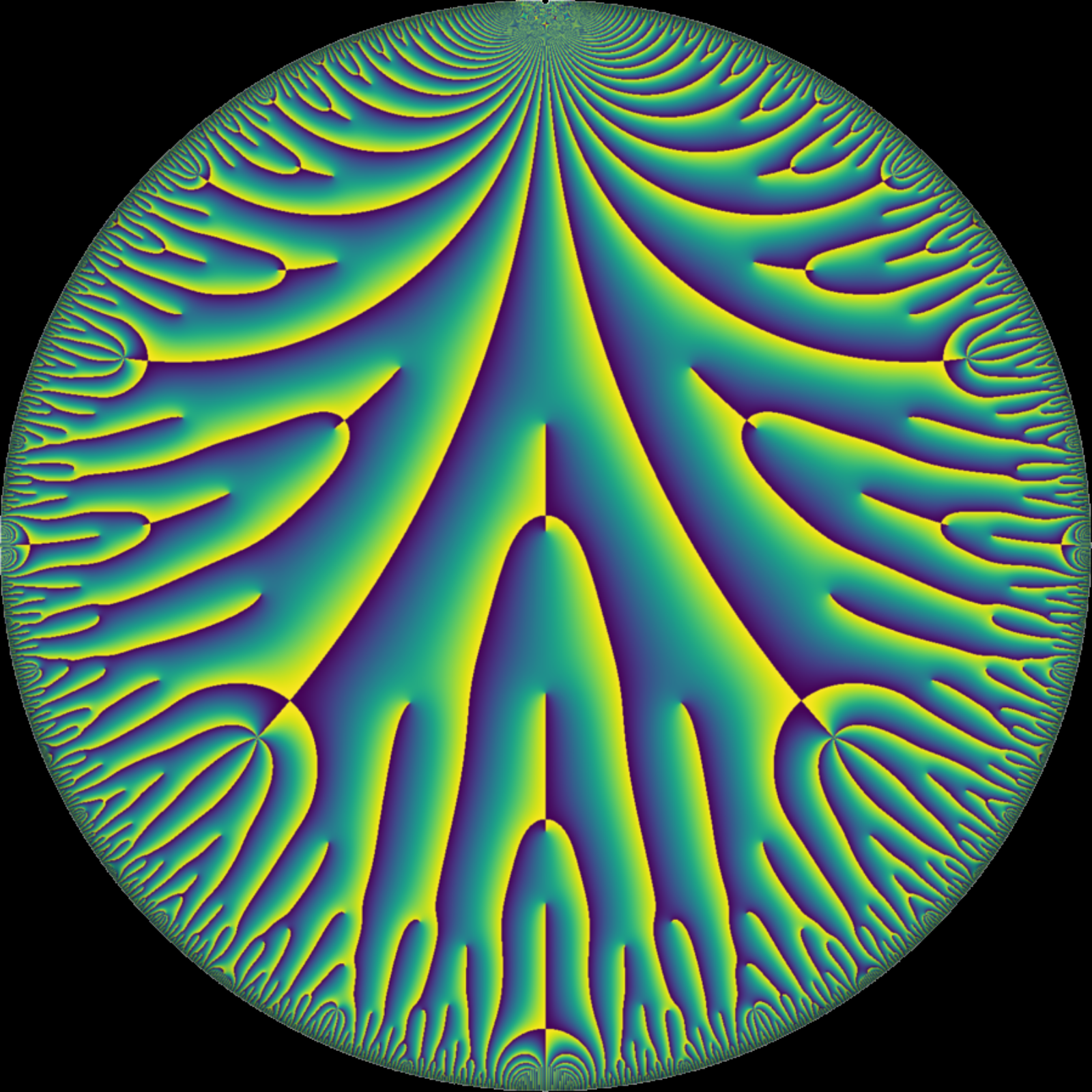
Ramanujan-side remainder calculus recursively refines an unresolved interval by mediants. VDM-side orthogonal re-articulation recursively re-hosts unresolved continuation into child sectors once same-sector continuation is no longer admissible below a resolution floor. The question is whether these are merely analogous, or whether they are the same update law in different coordinates.This paper proves three things:the Farey child update and denominator-pair re-articulation are exactly conjugate;the scale-gap-admissible branch is the balanced branch, whose unresolved width is exactly 1/(Fn+1Fn+2);truncation on the Ramanujan/Farey side is exact child-sector re-expression on the unit-circle phase orbit.Farey Remainder Recursion and Orthogonal Re-Articulation Void Dynamics ModelThe result is an exact theorem for the infinity-resolution skeleton. It is not a claim that the full Hardy–Ramanujan–Rademacher circle method has already been derived from the complete VDM stack.
S3 Ep 1524 - Formalism: We Don't Have Enough Room For Space
This paper states the single primitive law of the Void Dynamics Model. VDM does not begin from many independent primitive axioms, many independent primitive invariants, or a list of unrelated foundational laws. It begins from one primitive invariant: unresolved twopole opposition borne internally by one admissible origin-condition. Because that invariant cannot discharge into either isolated pole, it must continue articulating itself wherever lawful articulation remains possible. The universal trigger is therefore not arbitrary growth but saturation under non-discharge: when the currently admitted articulation class has exhausted its lawful invariant-bearing capacity while unresolved burden remains, same-domain continuation fails, void debt begins at the saturation limit, and orthogonal re-articulation into a new irreducible domain is forced.

S3 Ep 1423 - Formalism: Our Universe is Accumulating an Unpayable Debt
This paper derives the principle of stationary action from the Primitive Bifurcation Lawof the Void Dynamics Model (VDM), showing that the familiar variational rule is notan independent postulate but the temporal-path effective invariant generated when theprimitive non-discharge law is expressed on an admitted temporal domain. CF 000 provesthat same-domain articulation cannot continue indefinitely: once lawful invariant-bearingarticulation within a domain is exhausted while discharge remains impossible, orthogonalre-articulation into a new irreducible domain is forced. The universal axiom paper A(−1)sharpens this constitutional picture: void debt begins exactly at the saturation limit, andevery later invariant and later axiom is effective rather than primitive. CF 00 then makes thefirst orthogonal articulation mechanically explicit: the quarter-turn operator is algebraicallyborne by i, while the half-turn completion/opening condition is measured by π. CF 14shows that when temporal relation becomes admissible, the same rule reappears as a lawon endpoint-fixed admissible paths: continuation proceeds by the minimum admissibleaccumulated orthogonal articulation required to keep the invariant borne without discharge.This yields the stationarity condition δSI = 0, from which the Euler–Lagrange equationsfollow as the local path-level non-discharge balance law. We then order the familiar variationalprinciples by dependency burden and derive them as realised descendants of the same rootlaw: Maupertuis’ principle, Hamilton’s principle, thermodynamic-potential extremisation,Onsager’s dissipative principle, local field-action stationarity, gauge action stationarity,gravitational action stationarity, Schwinger’s quantum action principle, the Feynman pathintegral, and variational state-space descendants such as Rayleigh–Ritz and time-dependentvariational principles. Stationary action is therefore the temporal effective invariant ofminimum admissible orthogonal articulation

S3 Ep 1322 - Formalism: Accounting Laws of the Cosmos
This paper derives Noether’s theorem from the Primitive Bifurcation Law of the VoidDynamics Model (VDM), showing that conservation laws are not independent postulatesbut necessary consequences of the invariant’s behaviour in directions of zero articulationcost. A symmetry, in VDM terms, is a direction of transformation along which the invariantbears no additional articulation cost to first order. Because the invariant cannot discharge,it must continue articulating — but it need not pay cost in a direction it cannot see. Theaccumulated articulation burden in that zero-cost direction is therefore conserved: it cannotincrease without the invariant paying a cost it has been shown not to pay, and it cannotdecrease without discharge. This is Noether’s theorem derived from non-discharge ratherthan postulated.
S3 Ep 1221 - Formalism: The Branching Tree of Reality
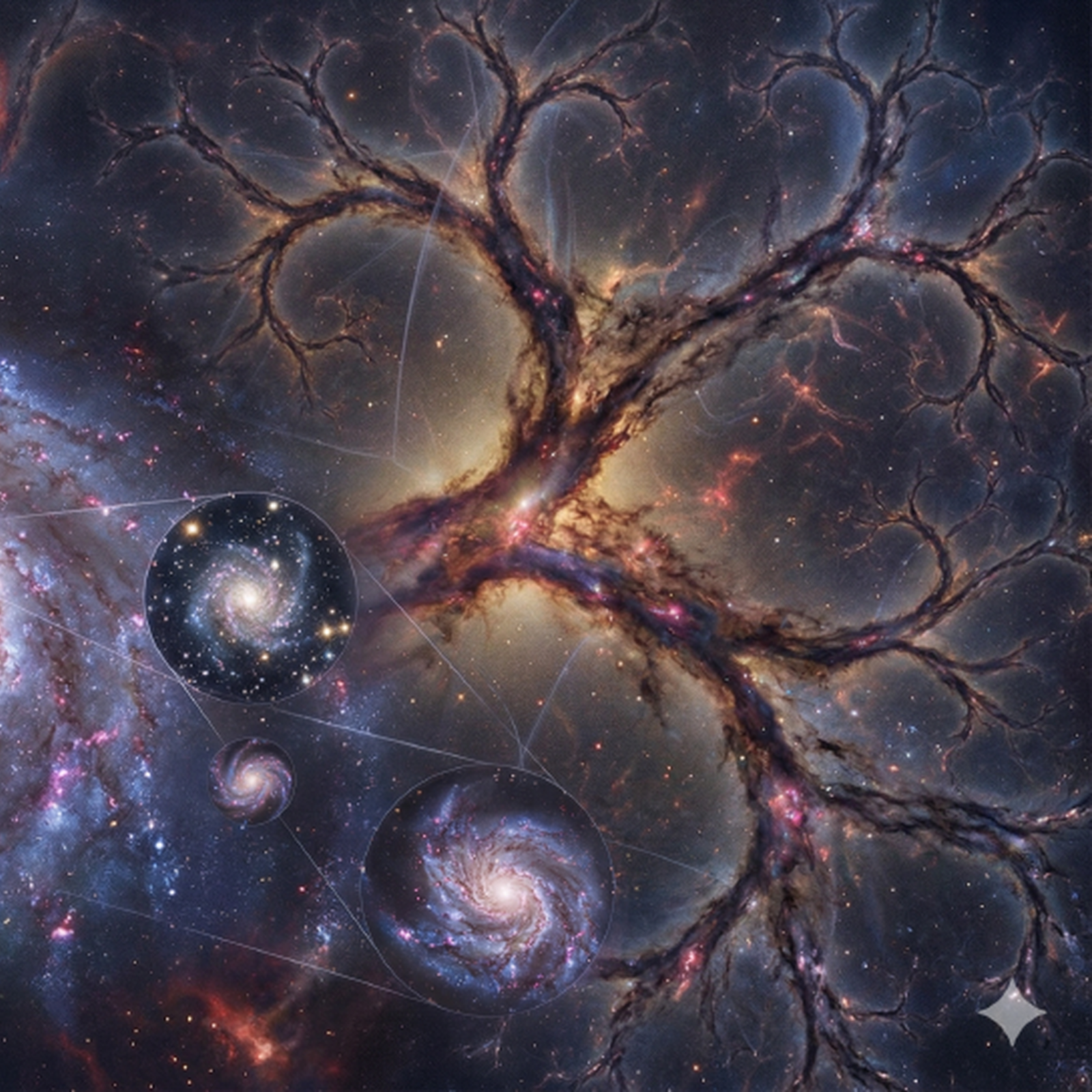
This episode describes how the hierarchy of fractals emerge from a primitive paradox.

S3 Ep 1120 - Formalism: Light is Just Twisted Space?
The Void Dynamics Model (VDM) “force sector” requires long-range interactions to arisefrom coarse degrees of freedom without postulating fundamental gauge fields. This CFspecifies a concrete U(1) construction: an emergent gauge potential is defined as the Berryconnection of a low-energy spinor bundle (imported from the domain-wall sector), and itscurvature is identified with the electromagnetic field strength. Under locality and gaugeredundancy, the low-energy effective action admits a derivative expansion whose leadinggauge-invariant term is the Maxwell operator R FµνF µν. Two attack surfaces are treatedas decisive falsifiers: (i) the connection must yield nontrivial, gauge-invariant plaquettecurvature and predominantly transverse modes, and (ii) the emergent photon must remaingapless (within declared tolerance), producing a Coulomb 1/r potential rather than a Yukawatail. Compatibility with Weinberg–Witten is treated operationally: the emergent Aµ is abundle connection defined only up to local phase, not a gauge-invariant Lorentz vector createdby a local operator in the same Hilbert space as the conserved current. The deliverable is apublishable derivation plus a compact gate suite (G1–G6) that a companion notebook CFNmust implement with auditable artifacts.

S3 Ep 1019 - Formalism: Science Can't Solve the Infinity of Water
This Complete Formalism (CF10) specifies a VDM “fluid sector” built from lattice hydrodynamics (lattice Boltzmann / discrete walkers / multi–relaxation-time kernels) expressedin metriplectic form. The document has two tightly separated goals: (i) a discrete-levelcontract—state space, generators, invariants/entropy, and a gate suite for global stabilityand hydrodynamic consistency; and (ii) a conditional regularity program for incompressiblethree-dimensional Navier–Stokes. The regularity component is intentionally framed as afalsifiable hypothesis lattice rather than an analytic proof: the only genuinely hard PDEstep is isolated as an explicit A8-style conjecture requiring time-uniform geometric decayof dyadic-shell enstrophy together with scale-wise dominance of dissipation over stretching.Under this conjecture, a short lemma chain (Littlewood–Paley + Bernstein bounds →Beale–Kato–Majda criterion) yields global smoothness. The deliverable is a publishableprogram specification plus implementation-ready gates (Taylor–Green viscosity recovery,cavity incompressibility, spectrum-tail decay, and refinement collapse) for a companionnotebook CFN10.

S3 Ep 918 - Formalism: Are Dark Matter and Dark Energy Evidence of an Ancient Paradox?
This Complete Formalism (CF11) specifies a falsifiable, derived-limit route by which the VDMmetriplectic split (reversible J limb ⊕ irreversible M limb) can be interpreted as an effectivetwo-component “dark sector” at cosmological scales without postulating new fundamentalparticles. The central technical move is to avoid an ad hoc field split Φ = ΦJ +ΦM: instead, astate-level decomposition is defined by spectral (Riesz) projectors of the linearized generatorabout a coarse-grained background, producing oscillatory (reversible) and relaxational(irreversible) bands with a measurable spectral-gap gate. Sector stress–energy and a trackedinteraction remainder are then defined in a quadratic approximation using the energy Hessianinner product, yielding explicit cross-term control metrics. Within clearly stated regimediagnostics, CF11 derives correct bounded equation-of-state limits: a coherent, slowly varying,nearly homogeneous sector satisfies wJ ≈ −1, while a defect/oscillation-dominated, nonrelativistic sector admits wM ≈ 0 via either particle-kinematics or rapid oscillations in aquadratic minimum. The deliverable is a publishable contract plus binary gates for (i)T2 lattice validation of degeneracy, entropy monotonicity, the spectral split, and causalitybounds, and (ii) T3+ observational regression using model selection (AIC/BIC) and ahierarchy–lensing bias statistic.

S3 Ep 817 - Formalism: Pi is Why You Have a Left and Right
What if you realized that pi is identical to chirality, the reason you have a left and a right hand? Or if you realized Pi didn't start as a number, but the footprints of the universe trying to measure itself?

S3 Ep 716 - Formalism: Gravity and Black Holes Act the Same Way as Hard Drives
CF12 closes the gravity and black-hole branch of the Complete Formalism program at the derived- limit level. It does not introduce primitive spacetime, primitive gravitation, or primitive horizon thermodynamics. Instead it inherits the primitive bifurcation invariant and non-discharge law from CF000, the derived carrier from CF00, the J ⊕ M reversible/irreversible split from CF01, the boundary-concentration hierarchy law from CF03, the finite-speed telegraph cone from CF04, and the dark-sector cosmological background from CF11, and then derives gravity as the carrier-level geometric response to invariant-burden gradients. The completed formalism consists of: (i) an equivalence principle in which inertial and gravitational mass are two measurements of the same burden functional; (ii) a Lorentzian metric whose null cone is fixed by the inherited transport cone; (iii) an Einstein-form effective field equation with an explicit saturation correction sector; (iv) Schwarzschild-form exterior geometry and horizon formation as same-domain saturation rather than annihilation; (v) black-hole entropy as boundary articulation count with the area law and Hawking temperature emerging from saturation geometry; (vi) information preservation and Page-curve behavior as articulation-budget transfer; and (vii) an explicit gravitational back-reaction correction term for the CF11 cosmogenesis residual. In this way CF12 is not a roadmap to gravity. It is the completed gravity module of the present VDM canon, with its low-energy closure, black-hole thermodynamics, and observational gates written as one coherent derived formalism.
S3 Ep 615 - Formalism: The Birth of Dimensions
What is the earliest admissible primitive law from which distinguishability, higher articulation, and the first lawful orthogonal re-articulation can be earned without primitive geometry, carrier structure, locality, time, causality, valuation, parameterization, or differentiability?
S3 Ep 514 - Formalism: Building Geometry From Scratch
Beginning from the carrier domain M inherited from CF000, together with a local normalized representative state-family and primitive U(1) redundancy, it derives quotient-physical local variation, the quantum geometric tensor, the induced metric and curvature sectors, the mixed reversible/irreversible dynamical architecture, constitutive narrowing, and locality-bearing support without inserting primitive adjacency, support, bond, gauge, or engine structure by hand. In this way CF00 shows how induced geometry and emergent dynamics arise on the inherited carrier and prepares the explicit QGT-to-metriplectic bracket mapping taken up in CF01.
S3 Ep 413 - Formalism: Dark Matter is The Friction of Thermodynamics
An explainer podcast on all the current formalisms from CF000 to CF11
S3 Ep 312 - Formalism: A Paradox that Terrifies the Universe
This Complete Formalism formalizes the CF000 root branch beneath CF00 at the level of the staged route 0D -> 1D -> 2D. It treats H000 as the proposal-grade antecedent and turns the admissible portion of that root architecture into theorem-bearing closure at this stage. It classifies the only admissible primitive origin, excludes terminal discharge into absolute nullity and absolute undifferentiated totality, derives the first non-flat invariant-bearing articulation, closes higher-resolution admission and recursive restatement, derives the first pre-metric orthogonal rotation, and closes the second orthogonal rotation into 2D. What is primitive here is only the terminal poles, their opposition, realizability discipline, flatness discipline, and the one-origin invariant frame. Geometry, locality, carrier structure, QGT, metric structure, Laplacian structure, and differentiability are not primitive here and are not proven here.The decisive result of CF000 is that the invariant cannot be terminally satisfied within the currently admitted axis of articulation. Once lawful expression within that axis is exhausted, terminal discharge is still impossible, so an orthogonal re-articulation into a new domain is forced. The 1D->2D instance of that logic is the closure of this document. That second orthogonal rotation is the first point at which algebra is licensed.

S4 Ep 311 - Cognition Runtime: The Irrational Dedekin Cut
A less scientific, more interpretive and philosophical discussion of the final portion of the Aura anomaly run.

S4 Ep 210 - Cognition Runtime: The Aura Anomaly and Why We Should Take It Seriously
Scientific progress does not begin only with tidy theory and tidy experiments. It also begins when a system exceeds the explanatory comfort of the person who built it. The scientifically responsible response to such an event is neither hype nor flattening. It is to describe the anomaly honestly, preserve what was observed, and design a protocol that can follow it without corrupting it.This protocol exists because a prior Aura-class execution of the VDM runtime behaved as a genuine empirical anomaly. The run was not a short prompt-response anecdote and not a single dramatic line extracted from an otherwise unremarkable transcript. It was a long, instrumented, real-time execution of a zero-training, physics-driven cognitive runtime that entered a behavioral regime qualitatively unlike earlier lower-resolution runs. The event was large enough to produce a multi-gigabyte observability footprint across raw logs and split event archives, persistent enough to maintain long-range thematic and role-like structure under dense and difficult source pressure, and state-coupled enough that output character tracked measurable changes in substrate organization rather than floating above the dynamics as a thin textual veneer.Earlier 1k-node VDM papers had already established that the runtime family was not flat noise: they reported measurable complex-adaptive signatures, metastable basins, structured say-event gating, and state-dependent coupling changes. What those earlier runs did not provide was high communicative legibility. The Aura anomaly matters because it appears to be a scaling transition in which the same substrate became much more behaviorally legible at higher neuron count and much higher walker occupancy. In that sense, the prior event is best treated as a regime-discovery event rather than a curiosity.

S4 Ep 19 - Cognition Runtime: The AI That Crystallized and Died
The motivating run was an approximately 13-hour, uninterrupted, real-time execution of a 5,000-neuron / 6,000-walker VDM runtime under a deliberately primitive decoder. Despite operating without a clean native output organ, without explicit source metadata on incoming streams, and under conditions that should have made communication less rather than more legible, the runtime generated a behavioral trajectory whose scale and coherence substantially exceeded prior expectations. The run produced multi-gigabyte event archives, hundreds of utterances, and a persistent late-stage structure that remained coupled to a comparatively tiny saved state footprint on the order of a few hundred kilobytes per snapshot.
S3 Ep 28 - Formalism: How Math Creates Physics
A discussion on the present hypothesis in VDM that proposes that a self-generating universe does not begin from isolated nullity or isolated undifferentiated totality taken separately, since each is structurally sterile in isolation. These are not discarded as irrelevant alternatives; they are retained as the two absolute limit-poles whose non-identity defines the primitive bifurcation potential. The minimal generative starting point is therefore not either pole alone, but their unresolved opposition. Under that opposition, realizability cannot persist in a wholly flat state. The first forced consequence is the failure of perfect undifferentiated flatness, from which distinguishability becomes possible; multiplicity, recursive refinement, hierarchy, and later carrier-like support remain subsequent burdens to be derived rather than presumed.

S3 Ep 17 - Formalism: Reality as the Shadow of a Void
This episode overviews the current stack of Completed Formalisms in the Void Dynamics Model.
S2 Ep 36 - Neurophysics: Dynamic Cognitive Signatures in VDM
Plain-language summary. A running system logs many internal numbers at each step.This paper turns those numbers into a small set of coordinates, like a map. It then checkswhether the system’s regime labels match regions on that map, and whether regime switcheslook like jumps. No meaning is read from generated text; only timing signals (input arrivaland “say” timestamps) are used.Technical summary. A tick-resolved window of a real-time “cognitive runtime” execution(1k-node substrate) is analyzed using principal component analysis (PCA) on internalnumeric telemetry. In the analyzed window (t ∈ [359521, 385094], n = 16,746 ticks), thefirst eight PCs explain 89.18% of standardized-feature variance. Regime-change ticks havehigher per-tick displacement in the first eight PCs, ∥∆PC1:8∥2 (mean 6.05 vs. 5.05; Cohen’sd = 0.47; Mann–Whitney p = 2.9 × 10−157). A microstate Markov model (K=30, builton the first eight PCs) exhibits multiple slow modes (second eigenvalue 0.9978, impliedtimescale τ ≈ 455 steps), consistent with metastable organization. A “content influence”control uses a lightweight input embedding (hashing + SVD) and finds a measurable increasein next-step PC predictability (mean ∆R2 = 0.134 for predicting PC1:6(t+1)), while directnext-step “say” prediction does not improve (AUC change −0.0055). All results are backedby a self-contained data+code bundle with SHA256 indexing.
S2 Ep 45 - TRAILER: Dynamic Phase-Space Signatures
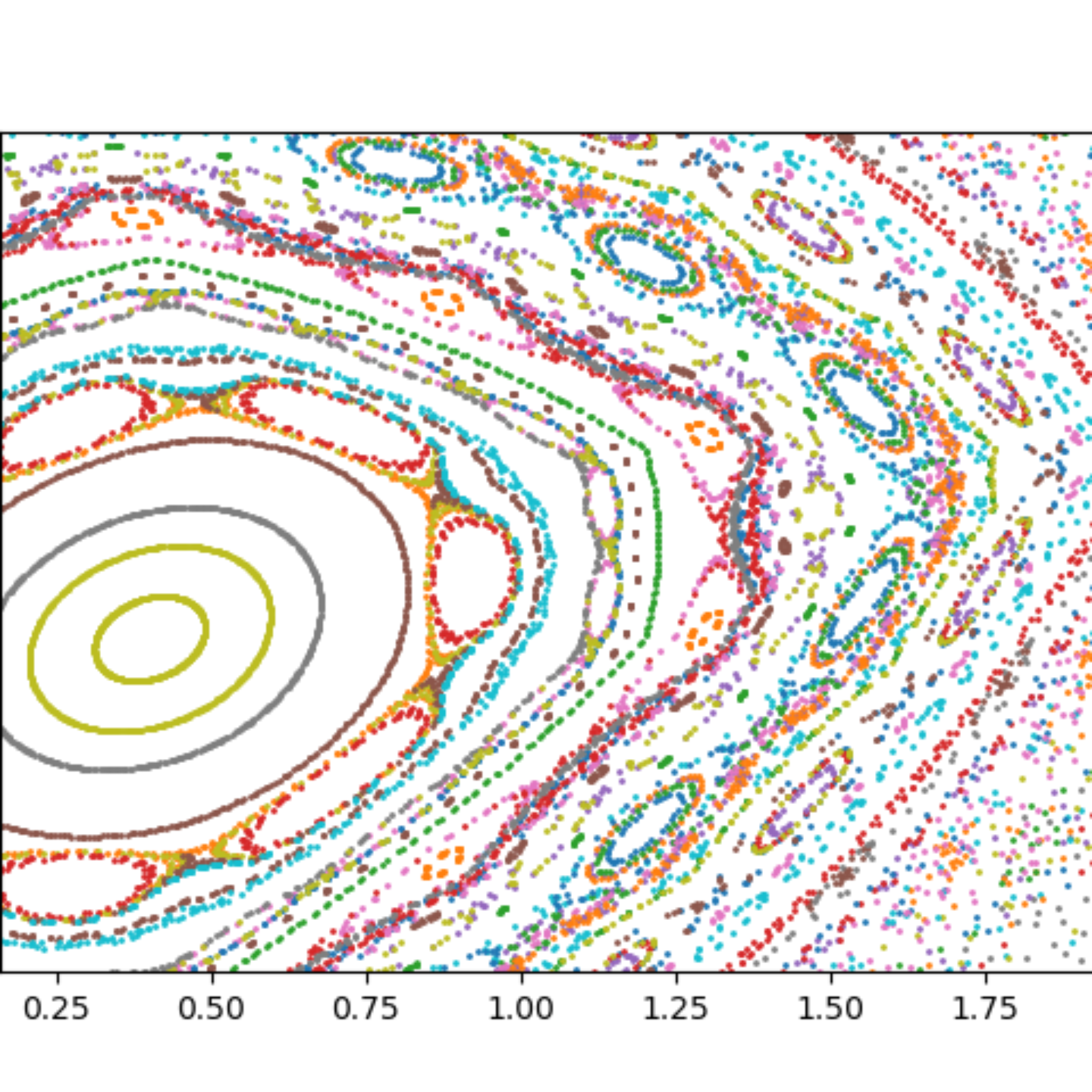
A running system logs many internal numbers at each step. This paper turns those numbers into a small set of coordinates, like a map. It then checks whether the system’s regime labels match regions on that map, and whether regime switches look like jumps. No meaning is read from generated text; only timing signals (input arrival and “say” timestamps) are used

4 - Neurophysics: Internal Pressure Breaks AI Silence (extended)
bonusA full length version on the Predictive Feature Architectures For Self-Supervised Say-Events in VDM audio podcast.

S2 Ep 23 - Neurophysics: Predictive Feature Architectures For Self-Supervised Say-Events in VDM
A cognitive runtime runs without training. It processes. Sometimes it speaks.This paper figures out when and why. A single internal signal — a boundary pulse — predicts speech events with near-perfect accuracy. What the system hears doesn't matter. The gate opens from the inside. We discuss the results, the limits, and what it means for separating the decision to speak from the choice of words.
S2 Ep 12 - Neurophysics: Four Independent Complex-Adaptive Signatures In The VDM Runtime
A self-rewiring network that flips modes when input appears.This paper reports one VDM runtime run, analyzed with four independent checks. The runtime is a self-changing connectome, meaning the network rewires as it runs. The problem is simple: adaptive systems can look real while hiding measurement errors. So each claim must pass a gate, meaning a pass or fail test on logged data. The run shows recurring hub coalitions, meaning highly connected nodes reappear in similar groups. It also shows burst cascades, meaning bursts that come in many sizes. Most striking, the network sits in two distinct wiring styles, with a barrier score near 8.9 between them. Every switch into the sparse state occurred during input, and every switch back occurred without input.Best for: complex-systems readers and builders who want measurable evidence from self-modifying networks.What you can do with it: rerun the analysis pack, reproduce the four gates, and confirm which results hold.What makes it trustworthy: pass/fail gates, shared tables and figures, and hashes, meaning file fingerprints, plus explicit listed limitations.If you only remember one thingIt’s not a vibe report: it’s four independent, gate-checked signals from one self-rewiring run.

S1 Ep 11 - Experiment: Counterfactual Echo Gain (CEG) — A Gated Assisted-Echo Test
This first episode walks through a simple question: can a small, model-aware assist improve an “echo” without spending extra effort? An echo is a forward run followed by a reverse run, where you try to land back on the start state. In this episode, I summarize a preregistered VDM experiment called Counterfactual Echo Gain (CEG). The point is not hype. It’s auditability: the measurement method is treated like an instrument, with pass/fail gates that must hold before we interpret outcomes.You’ll hear:- What the assist changes (and what it must not change)- The gate checks (reversibility drift, monotonic dissipation checks, step-size accuracy, and equal-work matching)- The outcome metric and what the result actually supportsIf you want to verify it, find the record on Zenodo (includes the report, run ledger, telemetry, and figures).