
The Theory of Anything
137 episodes — Page 3 of 3

S1 Ep 36Episode 36: Failure is an Option!
In this episode, we discuss the value of failure and how businesses have yet to fully embrace the Popperian notion that we learn from our failures, so we should want to fail more, not less.

S1 Ep 35Episode 35: Physics and Relationalism: An Interview with Julian Barbour
Sadia, in her four episodes on unsolved problems in physics (first episode here), was clearly heavily inspired by the work of Julian Barbour. So we invited Julian to join us for an episode and got a chance to ask him questions about his theories. Julian is a world-renowned physicist and author of several books on physics including The Janus Point, The End of Time, and The Discovery of Dynamics. His theories include a challenge to the prevailing theory of entropy (i.e. heat death) and even hint at possible apparent teleology in cosmology (in this case a tendency towards novelty and variety.) We are very excited to have him on the show and to answer our questions about his theories.

S1 Ep 34Episode 34: Alpha Go and Creativity
When Alpha Go beat Lee Sedol, the world Go champion, it came up with creative new moves never previously seen before and even invented a whole new style of play unknown to humans. IBM's Deep Blue, the champion chess algorithm, failed to do either of these. What was the difference? In this podcast, we review Alpha Go the Movie. Warning: Spoilers abound! Please go watch the movie first! This is an excellent movie. Bruce (using his admittedly thin knowledge of reinforcement learning) explains how Alpha Go works (using the materials previously discussed in our Reinforcement Learning episode) and how Alpha Go came up with a creative new approach to Go that went beyond the knowledge of the programmers. While Alpha Go definitely does not have "creativity" in the universal explainer sense of the word (it has no explanatory knowledge nor understanding), it did come up with a creative new playstyle never before seen in the history of the world that changed how humans play Go. Even the programmers were caught off guard by what it came up with. We talk about how Alpha Go challenges the Pseudo-Deutsch Theory of Knowledge but meshes well with Campbell's evolutionary epistemology.
S1 Ep 33Episode 33: Unsolved Problems in Physics Part 4 - Possible Solutions and Criticisms
We wrap up our discussion with Sadia Naeem covering possible solutions and criticisms of those solutions.
S1 Ep 32Episode 32: Unsolved Problems in Physics Part 3 - Symmetry and Novelty
Sadia Naeem continues the discussion about unsolved problems in physics. This time we talk about (among many other things) symmetry and novelty.
S1 Ep 31Episode 31: Unsolved Problems in Physics Part 2 - Clocks, Blocks, and Eternalism
Sadia Naeem joins us again, this time to explain clocks, block universes, and eternalism.
S1 Ep 30Episode 30: Unsolved Problems in Physics Part 1 - The Mystery of Time
Sadia Naeem joins us to discuss her own research and musings into the problems and mystery presented by time.

S1 Ep 29Episode 29: The Marvel[ous] TV Shows
In this episode Cameo, Tracy, and Bruce geek out over how good the Marvel TV shows are and how much they really get right. Spoilers abound, so be warned.

S1 Ep 28Episode 28: Reinforcement Learning and Q-Learning
Reinforcement Learning is a machine learning algorithm that is a 'general purpose learner' (with certain important caveats). It generated a lot of excitement with its stunning victory of Alpha Go against Lee Sedol the world Go champion. In this podcast, we go over the theory of reinforcement learning and how it works to solve any Markov Decision Problem (MDP). This episode will be particularly useful for Georgia Tech OMSCS students taking classes that deal with Reinforcement Learning (ML4T, ML, RL) as we briefly explain the mathematics of how it works and show some simple examples. This episode is best when watched on the Youtube channel, though we'll release an audio version as well. But the visuals are helpful here. The audio version is abbreviated and removes the mathematical theory and proof.

S1 Ep 27Episode 27: Chiara Marletto and Constructor Theory
In this episode, we interview Chiara Marletto about her recent book The Science of Can and Can't: A Physicist's Journey Through the Land of Counterfactuals as well as discussing Constructor Theory in general and how it might help us form a new mode of explanation in physics. We ask her some tough questions about constructor theory and she fields the questions very well. For those interested in q-numbers vs real numbers, see Sam Kupyer's lecture on our Youtube channel. Follow us on Twitter. Check out our blog.

S1 Ep 26Episode 26: Is Universal Darwinism the Sole Source of Knowledge Creation?
Donald Campbell made the bold prediction that all expansions of knowledge will be found to require the Universal Darwinism algorithm of variation and selection. In this episode, we're going to test that prediction and see if it holds up against what we currently know about Artificial Intelligence and Machine Learning. For example, does (apparent) knowledge created by Gradient Descent require variation and selection? Or is it really and truly inductive? Or does it just fail to create knowledge at all despite clearly creating improvements? Ultimately, we'll find that Machine Learning creates an exciting set of epistemological problems that need to be solved! Youtube version with optional visuals

S1 Ep 25Episode 25: Universal Darwinism - Does Artificial Intelligence Create Knowledge?
In The Beginning of Infinity, David Deutsch claimed that no existing evolutionary algorithm has yet created knowledge. But Karl Popper and Donald Campbell beg to differ and have argued that knowledge-creating evolutionary algorithms are ubiquitous, common, and easy to implement. Who is right? In this episode, we look at both arguments and assess them using Popper's epistemology. And along the way, we'll define the minimum requirements for an evolutionary algorithm (aka Universal Darwinism), explore what knowledge-creation is and then, finally, we'll attempt to answer the question of whether or not existing Artificial Intelligence algorithms create knowledge. Visuals are available on Youtube. This episode may benefit from seeing the visuals. For more information on Donald Campbell's theory, this blog post covers his arguments. A summary of the contradiction between David Deutsch's argument and Campbell/Popper's argument is in this blog post.

S1 Ep 24Episode 24: What is Artificial Intelligence?
The popular media confuses Artificial Intelligence and Artificial General Intelligence. All the progress is in the first while all the interest is in the second. But what is Artificial Intelligence? In this episode, we explain the umbrella term and its subfields. Plus we introduce how Artificial Intelligence actually ties to all four of David Deutsch's four strands. That makes it an exciting field all of its own even though it's not a path to AGI. Youtube video with optional visuals
S1 Ep 23Episode 23: Many Worlds Quantum Mechanics
Many Worlds Quantum Mechanics is the only current explanation we have of quantum physics. Yet most scientists today still prefer to not have an explanation at all rather than accept it. Sam Kuypers joins us to discuss his paper "Everettian relative states in the Heisenberg picture" that he co-authored with David Deutsch. He explains why the Heisenberg picture of quantum physics lends itself naturally to a local many worlds view of quantum physics. Also, we discuss if King Arthur could possibly be both real and fictional at the same time. Whaaaattt!? This audio podcast requires no mathematical knowledge. However, for those interested in reading the actual paper, Sam prepared a math primer available on our youtube channel.
S1 Ep 22Episode 22: Avoiding Self Coercion Through Intuitive Eating
"Intuitive Eating (A Revolutionary Anti-Diet Approach)" by RDN Evelyn Tribole and RDN Elyse Resch is a book about how to use the natural signals in your body instead of a self coercive diet. It's a strong example of what David Deutsch calls "The Fun Criteria" where you align the implicit information in your mind and body rather than coerce yourself because 'you know it's what's best.' Julene Nielson joins us to compare her experience with dieting vs the Intuitive Eating program. Also, we discuss the fact that recipes are hard-to-vary yet also parochial.
S1 Ep 21Episode 21: Evolution Outside the Genome
In this episode, we discuss how the work of Michael Levine intersects with the work of Raymond and Denise Noble's as well as Donald Campbell's. Levine recently did a TED talk on how the bioelectrical system between the cells is itself an evolutionary error correction process that determines the phenotype. This is a strong example of both Campbell's 'hierarchy of evolution' and the Noble's "purposiveness" in evolution where one level of the evolutionary hierarchy can cause levels below to teleologically evolve towards a purpose. The Noble's claim this refutes the classical formulation of Neo-Darwinism which they say is gene-centric. This also means we possible breakthroughs in anti-aging and medical treatments that don't require gene therapy or CRISPR. Levine's TED talk Was the Watchmaker Blind? Or Was She One-Eyed? An Introduction to Campbell's Evolutionary Epistemology
S1 Ep 20Episode 20: Command and Control Business Leadership
Our discussion with Bart Vanderhaegen finishes with a discussion about why businesses prefer to tell their employees what to do and why this is preferred to chaos. Yet if they want to survive in the modern era, this is no longer the best way to lead your company because it doesn't lead to knowledge creation. We also discuss the difference between a good and a bad compromise as well as male and female stereotypes in business. And should math tests be timed? Or is that just sexist? Enquiring minds want to know. If you are enjoying this show, please give us a 5-star view on Apple Podcast
S1 Ep 19Episode 19: Why Don't Businesses Emphasize Error Correction?
Bruce, Cameo, and Bart Vanderhaegen continue their conversation about implementing Karl Popper's theory of knowledge in a work environment. In this episode, Bart continues to explain his company's process. We also discuss why Karl Popper's philosophy is so little known and why, even when good error correction processes come along (like Agile Development), it's more an accident than intentional when Popperian epistemology gets worked into the business environment. And, for the first time ever, I discuss "Neo-Popperian" epistemology. Is that even really a thing? If you are enjoying this show, please retweet us and give us a 5-Star Review. Follow us on Twitter
S1 Ep 18Episode 18: Idea Development through Error Correction
Bruce and Cameo talk to Bart Vanderhaegen about how his consulting company, Pactify, implements Karl Popper's epistemology in a work environment. His process involves generating new ideas at any level of the organization and then developing those ideas via error correction until they solve the problem in an optimal way. If you are enjoying this show, please retweet us and give us a 5-Star Review. Follow us on Twitter
S1 Ep 17Episode 17: Shiri's Scissor: Polarization and Politics
Political polarization is dangerously on the rise. People feel uncomfortable speaking out so they seek comfortable echo chambers that reinforce their views, making them even less capable of interacting with alternative opinions. In this episode Cameo and Bruce talk about the fictional story "Shiri's Scissor" which is about a machine learning algorithm that creates polarization. When the algorithm accidentally escapes into the wild it polarizes the nation and starts to destroy it. The story strikes all too close to reality at times due to the role machine learning played in creating our polarized environment on social media and elsewhere. But what can we do about this problem? How can it be addressed? If you are enjoying this show, please retweet us and give us a 5-Star Review. Follow us on Twitter

S1 Ep 16Episode 16: Radical Candor - How to Give Effective Criticism
Karl Popper's philosophy is often heavily associated with the concept of "criticism." But most people don't react well to criticism. Why is that? Should you just give criticism whether people want to hear it or not? Kim Scott's book "Radical Candor" answers this question with some surprising answers. In part 1 we went over the motivations for and basic framework for Scott's approach. In this episode, we get into the details of how to set up a culture of criticism that will be actually effective. Follow us on Twitter Youtube version with optional visuals

S1 Ep 15Episode 15: Radical Candor - Giving Criticism In a Business Environment
Karl Popper's philosophy is often summarized as "Conjecture and Refutation." It's also heavily associated with the concept of "criticism." But most people don't react well to criticism. Why is that? Should you just give criticism whether people want to hear it or not? Kim Scott's book "Radical Candor" answers this question with some surprising answers. She argues that the most effective kind of criticism is compassionate criticism and that the way to create a culture of criticism is to start with simply seeking it yourself from your subordinates. Her "Radical Candor" framework lays out an approach for how to go about implementing a culture of criticism in a business environment. In Part 1, we layout the motivation and basic framework for Scott's approach to 'getting what you want by saying what you mean.' If you are enjoying this show, please retweet us and give us a 5-Star Review. Follow us on Twitter

S1 Ep 14Episode 14: Theories of Artificial General Intelligence
Bruce and Cameo are joined by Dennis Hackethal, Ella Hoeppner, and Thatchaphol Saranurak as we discuss Artificial General Intelligence (AGI). In part 3, each of the guests talks about their own theories about Artificial General Intelligence and where they are taking their research. If you are enjoying this show, please retweet us and give us a 5-Star Review. Follow us on Twitter Link to "Evolution is exponentially more powerful with frequency-dependent selection" paper.

Special Edition: Theory of Anything Hosts David Deutsch
This was recorded during the 24 hr. transcontinental Popperian ZOOM Meet 'n Greet of January 9th-10th, 2021 organized by OurKarlPopper.net. Bruce was asked to host a session with the subject of David Deutsch and how he brought a whole new generation to Karl Popper's philosophy. But at the last minute, we found out David Deutsch himself was attending. So we redid our plans to allow people to ask him questions. Follow us on Twitter Youtube version with video Check out our blog.

S1 Ep 13Episode 13: Objections to Artificial General Intelligence
Bruce and Cameo are joined by Dennis Hackethal, Ella Hoeppner, and Thatchaphol Saranurak as we discuss Artificial General Intelligence (AGI). In part 2, among other things, we discuss various objections people make to AGI and why they can't be correct due to the existence of universality. We also discuss what a "Universal Explainer" is and if it is possible to create a quantum "oracle machine" which is a computer that can compute things that the Turning machine can't.

S1 Ep 12Episode 12: Artificial Intelligence vs Artificial General Intelligence
In the last episode, we showed that Artificial General Intelligence was possible according to the laws of physics. This episode is part 1 of a 3-part panel discussion among computer scientists interested in AGI. Bruce and Cameo are joined by Dennis Hackethal, Ella Hoeppner, and Thatchaphol Saranurak -- all interested in both AGI and Karl Popper's epistemology and believe Popper's theories can shed light on how to discover AGI. In part 1, we discuss how AI (Artificial Intelligence) differs from AGI (Artificial General Intelligence).
S1 Ep 11Episode 11: The Turing Principle and Artificial General Intelligence
Part 3 of our series on Computational Theory. Using the theory we've built up, we now prove that Artificial General Intelligence is possible due to what is called "The Turing Principle" which is the most profound philosophical implication of Computational Theory. Plus Cameo asks Bruce about how religious people look at these theories. Youtube version with optional visuals Note: Due to the nature of these Computational theory episodes, it might be helpful to see the Youtube visuals.

S1 Ep 10Episode 10: What Use is Computational Theory?
In the last episode, we gave you the basic theory. Now we're going to show you how Computational Theory is actually used in real life. We'll discuss the various computational classes that exist and one special class in particular: NP-Complete. Using reducibility (as discussed in the previous episode) we can prove that this is a universal class of problems. This provides us evidence (but not a proof!) that many algorithms are too slow to be tractable (i.e. return a result in a useful amount of time.) Finally, we'll discuss the startling fact that some problems can't be computed at all because the laws of physics don't allow it. Youtube version with optional visuals: https://www.youtube.com/watch?v=rVpM8XOwmz4 Note: Due to the nature of these Computational theory episodes, it might be helpful to see the Youtube visuals.

S1 Ep 9Episode 9: Introduction to Computational Theory
Computational Theory is possibly the most underrated of all scientific theories. In fact, most scientists think of it as a branch of mathematics rather than what it really is, a branch of physics. Computational Theory is the science of what the laws of physics allow you to compute. As such, it is one of David Deutsch's "4 Strands" which are the 4 most important scientific theories we have. In this episode, Bruce and Cameo cover the bare minimum of Computational Theory that you'll need to be able to understand the profound philosophical implications of the theory. In future episodes, we'll discuss such implications such as why we know the laws of physics allow for the creation of Artificial General Intelligence (AGI). If you are enjoying this podcast, you could really help us out by giving us a 5-Star Rating and retweeting us. We need your help to reach an audience. Youtube version with optional video: https://www.youtube.com/watch?v=smGuNwKy8oA Note: Due to the nature of these Computational theory episodes, it might be helpful to see the Youtube visuals.
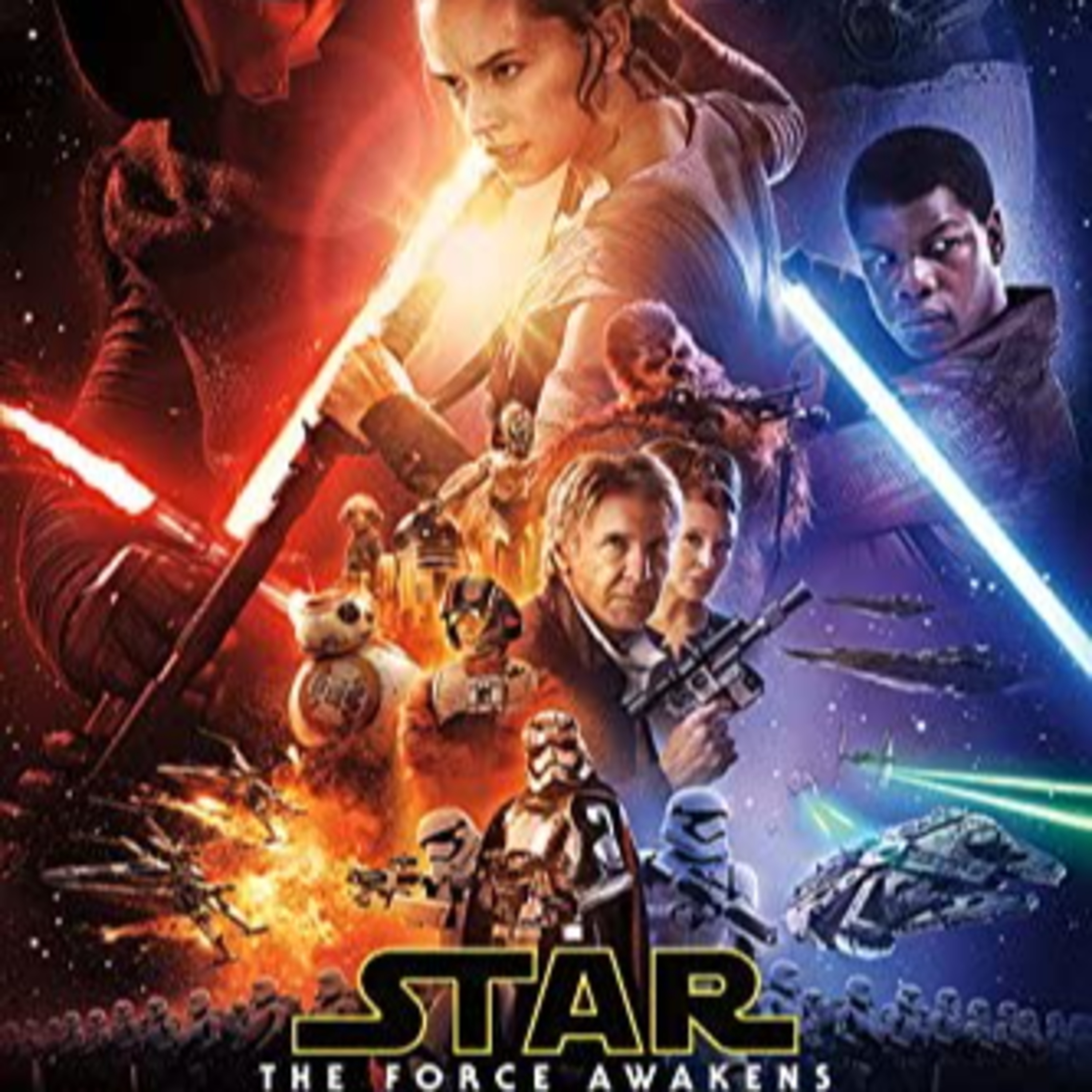
S1 Ep 8Episode 8: The Disneyfication of Star Wars
Unlike the universally acclaimed Marvel movies, Disney has struggled to turn their Purchase of the Star Wars franchise into the powerhouse they were hoping for. Why is there such strong split opinions on these movies? What did Disney do well and what did they get wrong? We argue that good art is hard-to-vary, so it's easy to get something wrong that detracts from the overall movie. The recent Disney Star Wars movies aren't bad movies, but they aren't great Star Wars. We discuss how the movies slowly departed from the myth creation stories they started out as and how this impacted the overall storytelling.
S1 Ep 7Episode 7: Lies, Damn Lies, and Statistics
Have you heard the old joke about how there are liar, damn liars, and then there are statisticians? In this episode, Cameo and Bruce discuss how statistics are widely used -- and misused -- in society. Most people miss that statistics aren't really primarily used for true probabilities but instead are used as a way to mimic our lack of knowledge. Statistics, as a field, is often the study of ignorance, not straight probabilities. What are the ramifications of that? Find out in this episode. If you enjoy this podcast, please give us a 5-star rating. Youtube version with optional visuals: https://www.youtube.com/watch?v=bZGAwUxO3CM&list=PLbU2Yvjwp2jI0mTFUVLVtRw8MQJev0QYt&index=7 Follow me on Twitter: https://twitter.com/bnielson01

S1 Ep 6Episode 6: Dancing the Ancient Forms
What's it like to leave your home, your family, and your country and go to a whole new land and culture -- possibly never to return home again? What challenges would you have to overcome? How much help would you receive? How would you blend your culture with the new one you just moved to? What's it like to dance 2000-year-old ancient forms as a way to express your culture's ancient myths? Sarika Nayak and her family left India for their careers and then started a family here. They didn't originally intend to put down permanent roots, but now they are working on becoming citizens. Sarika brought with her a love of dance and love of people. She teaches dance to others emphasizing dancing from her own culture -- both Bollywood and Hindu dancing. In this episode, we talk with Sarika and learn what it's like to start a new life in a new culture and how she successfully integrated her love of both cultures. If you enjoy this podcast, please give us a 5-star rating Youtube version with optional video: https://www.youtube.com/watch?v=7wascWH6dTc&list=PLbU2Yvjwp2jI0mTFUVLVtRw8MQJev0QYt&index=6 Follow me on Twitter: https://twitter.com/bnielson01

S1 Ep 5Episode 5: The Avengers, Time Travel, and The Deutsch Proposition
"Quantum fluctuation messes with the Planck scale, which then triggers the Deutsch Proposition. Can we agree on that?" asks Tony Stark. What the heck is he talking about? And who is Deutsch? Tony Stark is referring to David Deutsch, of course; a world-famous quantum physicist that is the father of Quantum Computational Theory and the inspiration for many of the ideas in this podcast. Among Deutsch's theories is one on time travel, believe it or not. See https://rb.gy/w5yqvj In this podcast, we discuss Deutsch's actual theories on time travel and what the Avengers borrowed from his theories (and what they completely ignored.) If you enjoy this podcast, please give us a 5-star rating. Youtube version: https://www.youtube.com/watch?v=LXKYwt-aRXM&list=PLbU2Yvjwp2jI0mTFUVLVtRw8MQJev0QYt&index=5 Follow me on Twitter: https://twitter.com/bnielson01
S1 Ep 4Episode 4: What Makes a Good Explanation?
The postmoderns were wrong! Knowledge can progress, despite uncertainty! What makes a good explanation vs a bad explanation? You probably intuitively recognize when an explanation is bad, but do you know why you prefer one explanation over another? Just what exactly is wrong with "because I said so" or "fairies did it"? In Episode 3 Bruce and Cameo finally solved the problem of how we can make progress in knowledge despite our lack of certainty using Karl Popper's Theory of Knowledge. In this episode, we finally ask what makes a good explanation vs a bad explanation? And how can we recognize the good ones? This is part 4 of our 4 part series covering the Theory of Knowledge of Karl Popper as interpreted by physicist David Deutsch. Bruce explains this epistemology to Cameo and Carey, who are hearing it for the first time as we record. Will they agree with it or will they think it's a bunch of baloney? Find out by downloading this podcast. If you enjoy this podcast, please give us a 5-star rating. Youtube Version with optional visuals: https://www.youtube.com/watch?v=iSquq_JYI4c&list=PLbU2Yvjwp2jI0mTFUVLVtRw8MQJev0QYt&index=4 Follow me on Twitter: https://twitter.com/bnielson01
S1 Ep 3Episode 3: The Popper-Deutsch Solution
In Episode 2 we asked the hard question "Does Science Work?" and discussed all the seemingly insurmountable problems a correct "Scientific Method" must solve. Bruce and Cameo now discuss the proposed solution to the problem using the Theory of Knowledge (epistemology) of Karl Popper as modified and explained by David Deutsch. This is part 3 of our 4 part series covering the Theory of Knowledge of Karl Popper as interpreted by physicist David Deutsch. Bruce explains this epistemology to Cameo and Carey, who are hearing it for the first time as we record. Will they agree with it or will they think it's a bunch of baloney? Find out by downloading this podcast. If you enjoy this podcast, please give us a 5-star rating! Youtube Version with optional visuals: https://www.youtube.com/watch?v=-w6KXp8QKf0&list=PLbU2Yvjwp2jI0mTFUVLVtRw8MQJev0QYt&index=3 Follow me on Twitter: https://twitter.com/bnielson01
S1 Ep 2Episode 2: Is the Scientific Method Wrong?
The "Scientific Method" (as taught in schools anyhow) is actually wrong! Bruce, Cameo, and Carey continue their discussion about the Theory of Knowledge (i.e. Epistemology) and discuss the challenges any such theory must address. To many (Postmoderns) the problems even seem insurmountable and seem to undermine all of science. This is part 2 of our 4 part series covering the Theory of Knowledge of Karl Popper as interpreted by physicist David Deutsch. Bruce explains this epistemology to Cameo and Carey, who are hearing it for the first time as we record. Will they agree with it or will they think it's a bunch of baloney? Find out by downloading this podcast. If you enjoy this podcast, please give us a 5-star rating. Youtube version with optional visuals: https://www.youtube.com/watch?v=JYJV3tHe5k8&list=PLbU2Yvjwp2jI0mTFUVLVtRw8MQJev0QYt&index=2 Follow me on Twitter: https://twitter.com/bnielson01
S1 Ep 1Episode 1: We Don't Need No Stinkin' Experts
Bruce, Cameo, and Carey start their new podcast with a bang by offending experts everywhere and making sure that no one with a political opinion about Climate Change will want to listen to their podcast. This is part 1 of our 4 part series covering the Theory of Knowledge of Karl Popper as interpreted by physicist David Deutsch. Bruce explains this epistemology to Cameo and Carey, who are hearing it for the first time as we record. Will they agree with it or will they think it's a bunch of baloney? Find out by downloading this podcast and making sure all your friends do too! If you enjoy this podcast, please give us a 5-star rating. Link to Youtube version with optional visuals: https://www.youtube.com/watch?v=z4ucoCqDPYY&list=PLbU2Yvjwp2jI0mTFUVLVtRw8MQJev0QYt&index=1 Follow me on Twitter: https://twitter.com/bnielson01