The Subcontractors Blueprint
164 episodes — Page 1 of 4
Dayworks Is a Valuation, Not a Way of Working
The Email That Turns Silence Into Money
How to Stop Work Without Breaching
Late Payment Interest: You Don't Have to Ask Nicely
10 Reasons You Didn't Read Your Subcontract- And How It Hurt
Don't Get Caught: How One Missing Signature Can Trigger a Nil Payment Notice
They Vet You. Who Actually Vets THEM?
Disputes Mini-Series: The Smartest Battle Is the One You Don't Fight- A Subcontractor's Guide to Walking Away
Disputes Mini-Series: Adjudication Isn't Always the Answer
Disputes Mini Series: You Win on Records, Not on Being Right
Disputes Mini Series: You won the Adjudication. Enforcement Gets You Paid
Disputes Mini-series: Wrong Isn't A Defence
Disputes Mini Series: One Missed Notice Hands You The Full Sum
Disputes Mini Series: Whoever Moves First Has Already Won- As Long As They're Prepared
Disputes Mini Series: The Mistake That Hands the Other Side Your Whole Hand
Disputes Mini-Series: Four Routes to Dispute Resolution
Your Valuation Got Slashed - Here's How to Fight it Without Starting a War
The Art and Science of Notices: How to Serve a Notice Without Starting a War
Termination Hiding Inside a Variation
Can Force Majeure Really Protect Subcontractors from Material Price Surges?
Why Being Right Doesn't Get You Paid
Main Contractors Are Banking on Your Silence for Their Cashflow
The Hidden Dangers Buried in Your Subcontract
Five Ways Contractors Hide Illegal Payment Clauses
Case Law Coffee Break
Adjudication, Records, and the £180,000.00 Lesson.

From Financial Caps to Court Cases: What Every Subcontractor Needs to Know About Letters of Intent
In episode 137 of The Subcontractors Blueprint, Jacob Austin of QS.Zone breaks down the real risks of letters of intent (LOIs) for subcontractors. He explains how financial caps embedded in LOIs can leave subcontractors unable to recover costs already incurred — a situation courts consistently uphold. Jacob outlines the common trap of continuing work past the cap while waiting for a formal contract that never arrives. He provides practical safeguards, including stopping work at 80% of the cap, documenting all correspondence, and consistently pushing for a formal subcontract. His core message: understand what you're signing before starting work. KEY TAKEAWAYS: The UK government has announced a ban on retention payments in construction contracts, marking a major shift for the industry. New legislation will also cap payment terms at 60 days, mandate statutory interest on late payments, and empower the Small Business Commissioner to fine persistent offenders. Specialist contractor trade bodies have welcomed the changes, while some client groups warn of potential quality risks. Main contractors may adapt by backloading payment schedules and tightening quality controls instead of using retentions. Subcontractors are advised to strengthen their commercial practices, keep thorough records, and understand their contracts to protect their cash flow. The host emphasises that while the rules are changing, the commercial culture may not, so preparation is key. BEST MOMENTS: * Letters of Intent (LOIs) are not formal contracts but can create legally binding obligations. Their meaning varies, so they must be read carefully to understand the terms. * The single biggest risk is the financial cap. Courts consistently enforce this limit, meaning any costs incurred beyond it are often unrecoverable by the subcontractor. * Subcontractors should never assume a formal contract will automatically follow. Main contractors may have no incentive to finalise one if the LOI suits their purposes. * When approaching the financial cap, you must stop work and get written authority and, either an increased cap or the formal subcontract, before committing to further costs. * Always push for the formal contract in writing from day one. This creates a paper trail and puts pressure on the main contractor to finalise the agreement. HOST BIO: Meet Jacob Austin, a Chartered Quantity Surveyor with a rich background at construction industry giants Balfour Beatty, Kier, and Vistry Group. With extensive involvement in education, health, and residential projects spanning various scales, from £1000s to over £100M in concurrent developments, Jacob brings a unique perspective. Having collaborated with numerous small businesses, he's now committed to sharing his expertise to drive their success. Join Jacob on his podcast, where he blends his profound insights and personable approach to offer guidance, industry secrets, and inspirational stories. LinkedIn - www.linkedin.com/in/jacob-austin/ Instagram - www.instagram.com/qs.zone/ www.qs.zone/all-links
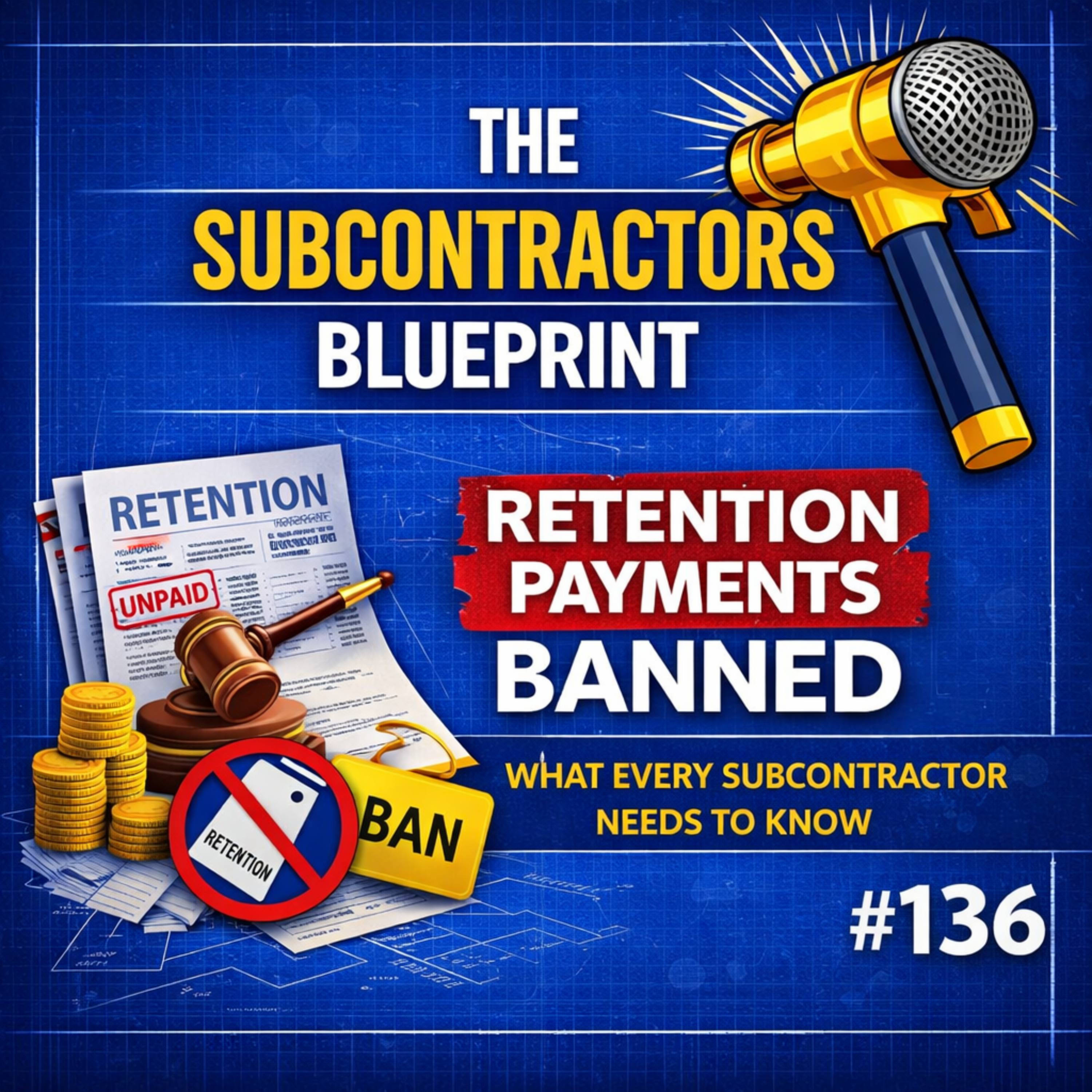
The Retention Ban: Is It Good? Or Is It A Case Of Be Careful What You Wish For?
In episode 136 of The Subcontractors Blueprint, Jacob Austin of QS.Zone unpacks the UK government’s landmark decision to ban retention payments in construction contracts. He explains the background, the new payment reforms, and what these changes mean for subcontractors’ cash flow and contract negotiations. Jacob highlights potential risks, such as main contractors restructuring payment schedules or increasing quality disputes, and offers practical advice on record-keeping, contract review, and preparing for increased use of retention bonds. The episode equips construction business owners with strategies to adapt and thrive in this evolving regulatory landscape. KEY TAKEAWAYS: The UK government has announced a ban on retention payments in construction contracts, marking a major shift for the industry. New legislation will also cap payment terms at 60 days, mandate statutory interest on late payments, and empower the Small Business Commissioner to fine persistent offenders. Specialist contractor trade bodies have welcomed the changes, while some client groups warn of potential quality risks. Main contractors may adapt by backloading payment schedules and tightening quality controls instead of using retentions. Subcontractors are advised to strengthen their commercial practices, keep thorough records, and understand their contracts to protect their cash flow. The host emphasises that while the rules are changing, the commercial culture may not, so preparation is key. BEST MOMENTS: "A ban on retentions doesn't mean main contractors lose their leverage. It means they look for new ways to get it." "The UK government has announced it will ban retention payments in construction contracts, which is absolutely massive." "The system has been systematically abused for decades because the reality is that money your money arguably doesn't sit in a ring fenced account waiting for you." "Every commercial contract will be required to include a statutory interest set at 8% above the Bank of England base rate." "The ban on the withholding of retention payments under the terms of construction contracts is a landmark moment." "Legislation changes the rules, but it doesn't change the culture." HOST BIO: Meet Jacob Austin, a Chartered Quantity Surveyor with a rich background at construction industry giants Balfour Beatty, Kier, and Vistry Group. With extensive involvement in education, health, and residential projects spanning various scales, from £1000s to over £100M in concurrent developments, Jacob brings a unique perspective. Having collaborated with numerous small businesses, he's now committed to sharing his expertise to drive their success. Join Jacob on his podcast, where he blends his profound insights and personable approach to offer guidance, industry secrets, and inspirational stories. LinkedIn - www.linkedin.com/in/jacob-austin/ Instagram - www.instagram.com/qs.zone/ www.qs.zone/all-links
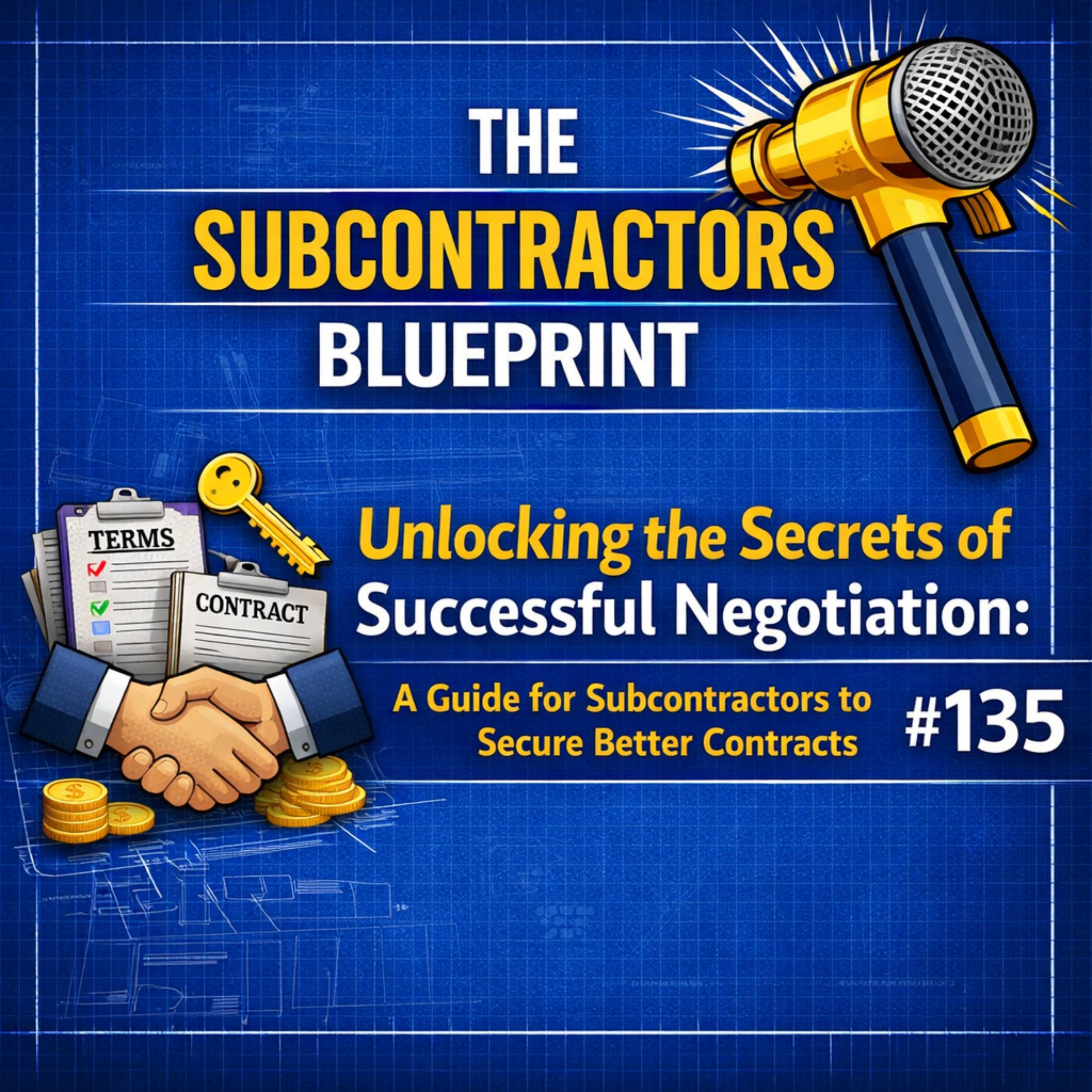
Unlocking the Secrets of Successful Negotiation: A Guide for Subcontractors to Secure Better Contracts
In episode 135 of The Subcontractors Blueprint podcast, host Jacob Austin , shares practical negotiation strategies tailored for construction subcontractors. He emphasises the importance of thorough preparation, understanding both your own and the main contractor’s priorities, and negotiating beyond just price—considering terms like retention, program, and contract amendments. Haile highlights the value of face-to-face discussions, building trust, and ensuring you’re dealing with decision-makers. By adopting a collaborative and well-prepared approach, subcontractors can protect their margins, secure cash flow, and avoid costly contractual pitfalls in every negotiation. KEY TAKEAWAYS: Negotiation in subcontracting is a skill that goes far beyond just haggling over price—it involves every commercial term and can be learned and improved. The most successful negotiators focus on trust, value, time, and people, not just contracts and profit. Preparation is critical: know your costs, risks, red lines, and the authority of everyone involved before you start negotiating. Negotiating on multiple variables—like payment terms, retention, and amendments—creates more room for collaboration and better deals. Building trust through honest, evidence-based communication and face-to-face meetings leads to stronger relationships and better outcomes. Every negotiation is unique, so stay flexible, curious, and adapt your approach to each new deal. BEST MOMENTS: "Negotiation is not what happens when the main contractor chips your price at the end of the tender period—that’s capitulation with a conversation attached to it." "Most negotiators say they want collaboration, but they behave defensively." "Trust isn’t a soft and fluffy concept; high-trust negotiations produce significantly more value for both parties." Preparation is the absolute biggest issue—five minutes and a quick skim isn’t enough." "Negotiation isn’t just about price—expand the variables and you expand your options." "Face to face is the most effective; what email correspondence drags out for weeks, a meeting can resolve in an hour." HOST BIO: Meet Jacob Austin, a Chartered Quantity Surveyor with a rich background at construction industry giants Balfour Beatty, Kier, and Vistry Group. With extensive involvement in education, health, and residential projects spanning various scales, from £1000s to over £100M in concurrent developments, Jacob brings a unique perspective. Having collaborated with numerous small businesses, he's now committed to sharing his expertise to drive their success. Join Jacob on his podcast, where he blends his profound insights and personable approach to offer guidance, industry secrets, and inspirational stories. LinkedIn - www.linkedin.com/in/jacob-austin/ Instagram - www.instagram.com/qs.zone/ www.qs.zone/all-links

Building Hope: The Band of Builders Story
In this special episode, number 134 of The Subcontractors Blueprint, recorded as part of Podcasthon — a global initiative uniting over 1,500 podcasters across 40 countries in a simultaneous wave of charity awareness content — Jacob dedicates the mic entirely to Band of Builders. Founded when tradesman Addam Smith put out a simple social media call to help his terminally ill friend Keith, what began as one act of solidarity has grown into a national charity. With project delivery now exceeding two million pounds in value, and upcoming builds for people like Jay — a builder diagnosed with spinal cancer mid-renovation — the charity proves that the construction industry looks after its own. In this episode, Jacob tells the Band of Builders story, shines a light on their current and upcoming projects, and lays out exactly how tradespeople and supporters can get involved — whether that's picking up tools on a volunteer project, donating, or simply spreading the word. Because sometimes the most important thing we can build isn't a structure — it's a community. IMPORTANT LINKS: Band of Builders Website: www.bandofbuilders.org To get involved in upcoming projects: www.bandofbuilders.org/upcoming-projects To volunteer your time: www.bandofbuilders.org/volunteering To donate: www.bandofbuilders.org/donate KEY TAKEAWAYS: This episode spotlights Band of Builders, a charity supporting tradespeople and their families facing serious illness, disability, or hardship. The charity began when volunteers rallied to help a terminally ill construction worker, transforming his home and inspiring a nationwide movement. Band of Builders provides practical construction support, emergency grants, and wellbeing services to those in need within the industry. BEST MOMENTS: "What happened next was extraordinary. Construction workers came from all over the UK. They didn't know Keith. Some of them had never even met Addam. But they showed up with tools, materials, no invoice to follow." "That response, that instinct to show up for one of your own, became the foundation of Band of Builders." "It's not just bricks and mortar to the people that live there. It's giving people back their dignity, independence, their quality of life." "That's the kind of person this industry produces and the kind that deserves your support." "It's proof that this industry has a soul, that it cares, that beneath the contracts and the cash flow and the program, there are good people who genuinely care about each other." "The motto of Band of Builders is Stronger Together, and I think that says everything." HOST BIO: Meet Jacob Austin, a Chartered Quantity Surveyor with a rich background at construction industry giants Balfour Beatty, Kier, and Vistry Group. With extensive involvement in education, health, and residential projects spanning various scales, from £1000s to over £100M in concurrent developments, Jacob brings a unique perspective. Having collaborated with numerous small businesses, he's now committed to sharing his expertise to drive their success. Join Jacob on his podcast, where he blends his profound insights and personable approach to offer guidance, industry secrets, and inspirational stories. LinkedIn - www.linkedin.com/in/jacob-austin/ Instagram - www.instagram.com/qs.zone/ www.qs.zone/all-links
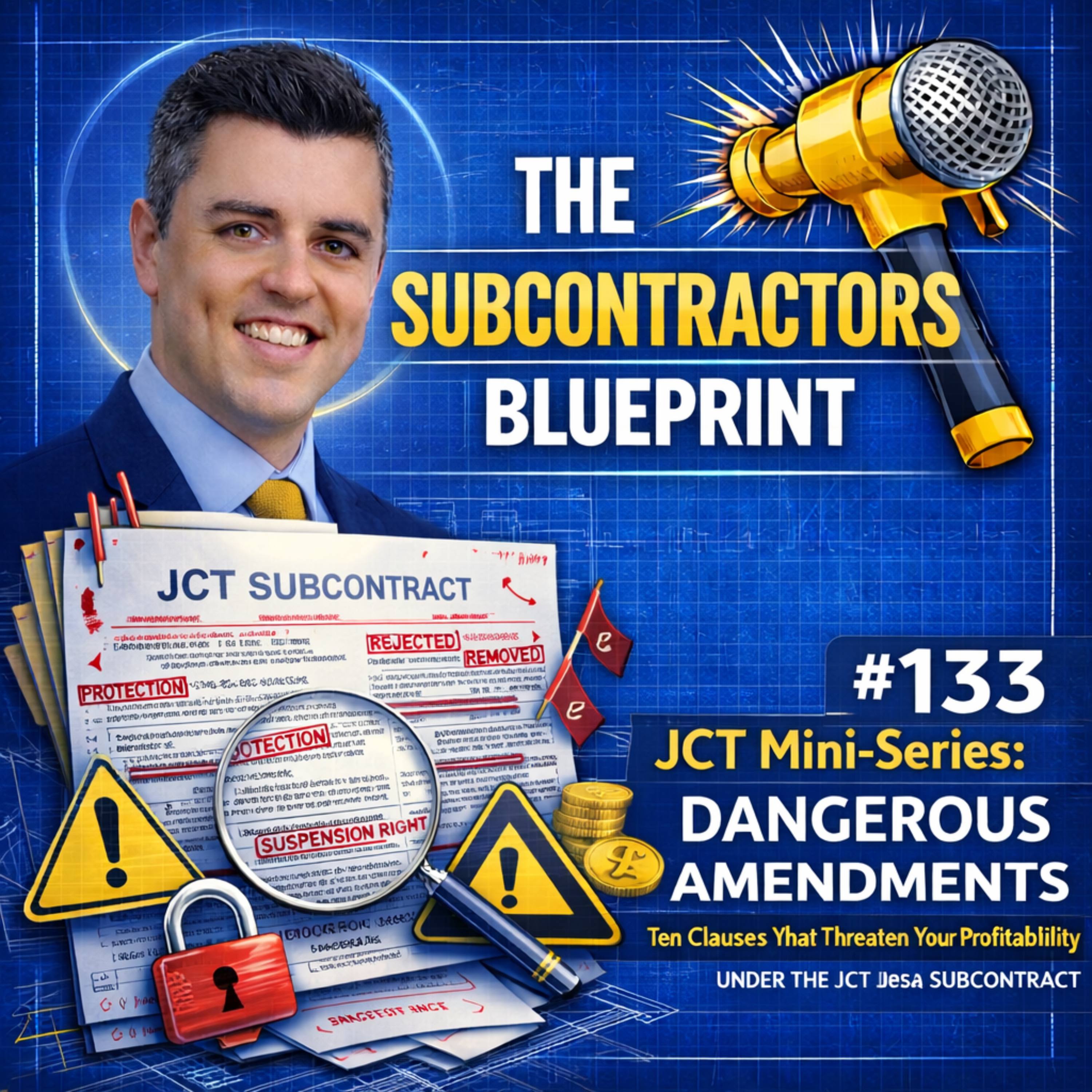
JCT Mini-Series: Dangerous Amendments - Ten Common Amendments That Threaten Your Profitability
In episode 133 of The Subcontractors Blueprint podcast, host Jacob Austin continues his mini-series on JCT subcontracts. He details the ten most dangerous amendments main contractors often add to JCT subcontracts, explaining their risks and how subcontractors can protect themselves. Jacob stresses the importance of reviewing and negotiating contract terms before starting work to avoid severe financial pitfalls. The episode aims to educate subcontractors on managing contractual risks, ensuring profitability, and safeguarding their businesses by understanding and challenging unfavourable amendments. KEY TAKEAWAYS: Main contractors often amend JCT subcontracts, stripping out standard protections and shifting significant risk onto subcontractors. The episode highlights the ten most dangerous amendments, including pay when paid clauses, extended payment periods, and removal of suspension rights. Other key risks include shortened claim notice periods, main contract liquidated damages passing down, and linking practical completion and retention to the main contract. Amendments can also delete relevant events for extensions of time and transfer unforeseen ground risk entirely to the subcontractor. Subcontractors are urged to always compare amendments against the unamended standard form before signing and to negotiate or price in any added risk. Starting work without reviewing and challenging amendments can mean you are legally bound by highly unfavourable terms. BEST MOMENTS: "What's left looks like JCT on the cover, and it reads like something completely different in the clauses that matter." "If you start on site before you've read and understand every amendment to that subcontract, you may be deemed to have accepted those terms by your conduct." Some lists of amendments are as long as the subcontract started itself and effectively completely rewrite it in a no clause left untouched fashion." "If your subcontract starts tying your payment in any way to an upstream event, then get it reviewed." "Every invoice you raise becomes exposed to deductions that have no defined ceiling." "Your delay, real or alleged, becomes exposure to a liability calculated by reference to a contract that you've probably never seen against a completion date you've got no hand in setting." HOST BIO: Meet Jacob Austin, a Chartered Quantity Surveyor with a rich background at construction industry giants Balfour Beatty, Kier, and Vistry Group. With extensive involvement in education, health, and residential projects spanning various scales, from £1000s to over £100M in concurrent developments, Jacob brings a unique perspective. Having collaborated with numerous small businesses, he's now committed to sharing his expertise to drive their success. Join Jacob on his podcast, where he blends his profound insights and personable approach to offer guidance, industry secrets, and inspirational stories. LinkedIn - www.linkedin.com/in/jacob-austin/ Instagram - www.instagram.com/qs.zone/ www.qs.zone/all-links
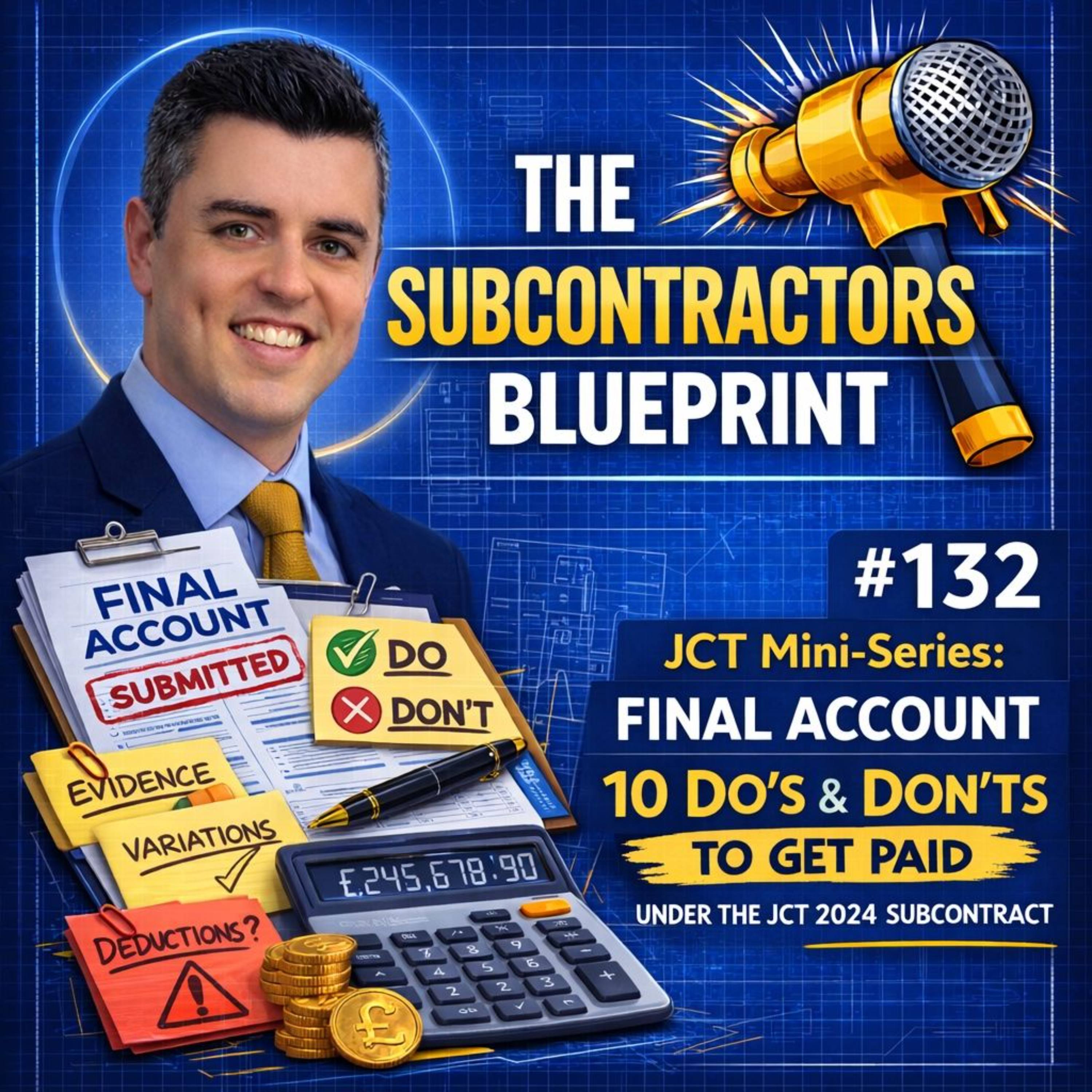
JCT Mini Series: Final Account Do’s and Don’ts for Subcontractors
In episode 132 of The Subcontractors Blueprint podcast, host Jacob Austin continues his JCT Subcontract mini-series breaking down 10 Do’s and Don’ts for mastering the final account process under the JCT 2024 standard subcontract. He outlines ten common mistakes and ten best practices for subcontractors to secure full payment, avoid costly deductions, and strengthen their negotiating position. Jacob emphasises proactive management of variations, documentation, and defect resolution, along with building strong relationships with contractors. KEY TAKEAWAYS: Common mistakes and proactive steps to secure payment. Jacob stresses the importance of building your final account as you go, not just at the end of a project. Collecting evidence, pricing variations promptly, and submitting a clear, structured final account are essential for success. Subcontractors should protect their time, challenge unjust deductions, and never let paperwork or defects become reasons for withheld payments. The final account is best won through ongoing discipline, communication, and documentation—not last-minute negotiations. Ultimately, proactive management throughout the project ensures a smoother, more profitable final account process. BEST MOMENTS: "If you don't, somebody else is rolling the dice with your margin." "The commercial truth behind this is that a small design output can control the performance of an expensive system." "If you submit information late, you've loaded their gun with ammo." "Your document is a tangible output and it looks like design. It quacks like design. So it's a design." "Treat it like dynamite, because if your PI cover is written on a reasonable skill and care basis, then a fitness for purpose promise can put you outside the policy." "We're no longer in a place where you can make things up on site, bodge the paperwork later, and get away with it." HOST BIO: Meet Jacob Austin, a Chartered Quantity Surveyor with a rich background at construction industry giants Balfour Beatty, Kier, and Vistry Group. With extensive involvement in education, health, and residential projects spanning various scales, from £1000s to over £100M in concurrent developments, Jacob brings a unique perspective. Having collaborated with numerous small businesses, he's now committed to sharing his expertise to drive their success. Join Jacob on his podcast, where he blends his profound insights and personable approach to offer guidance, industry secrets, and inspirational stories. LinkedIn - www.linkedin.com/in/jacob-austin/ Instagram - www.instagram.com/qs.zone/ www.qs.zone/all-links

JCT Mini Series: Design Dilemmas- How Small Details Can Lead to Big Trouble
In episode 131 of The Subcontractors Blueprint podcast, host Jacob Austin continues his JCT Subcontract mini-series breaking down subcontractor design risks under the JCT 2024 framework. He highlights how small design details can lead to major liabilities, the importance of clear design submissions, and why approvals don’t shift responsibility. Jacob covers managing design scope, understanding collateral warranties and copyright, and the critical role of accurate as-built drawings. He emphasises thorough record-keeping as essential protection against disputes, offering practical strategies for subcontractors to safeguard profitability, improve cash flow, and grow their businesses while avoiding costly design pitfalls. KEY TAKEAWAYS: Small design details in subcontracts can create significant commercial and liability risks, far beyond their apparent scale. Under JCT 2024 subcontracts, following design submission and approval procedures is critical, as starting early or missing steps can expose subcontractors to claims and withheld payments. Collateral warranties and third-party rights can multiply who can pursue claims against you, so these should be negotiated before contract signature. Approval of design by the contractor does not transfer risk or responsibility; subcontractors remain liable for meeting original requirements. As-built drawings are increasingly essential for project completion and payment, and should be clearly scoped and priced. Keeping thorough records and clarifying design scope, interfaces, and responsibilities is the best defence against future disputes and commercial risks. BEST MOMENTS: "If you don't, somebody else is rolling the dice with your margin." "The commercial truth behind this is that a small design output can control the performance of an expensive system." "If you submit information late, you've loaded their gun with ammo." "Your document is a tangible output and it looks like design. It quacks like design. So it's a design." "Treat it like dynamite, because if your PI cover is written on a reasonable skill and care basis, then a fitness for purpose promise can put you outside the policy." "We're no longer in a place where you can make things up on site, bodge the paperwork later, and get away with it." HOST BIO: Meet Jacob Austin, a Chartered Quantity Surveyor with a rich background at construction industry giants Balfour Beatty, Kier, and Vistry Group. With extensive involvement in education, health, and residential projects spanning various scales, from £1000s to over £100M in concurrent developments, Jacob brings a unique perspective. Having collaborated with numerous small businesses, he's now committed to sharing his expertise to drive their success. Join Jacob on his podcast, where he blends his profound insights and personable approach to offer guidance, industry secrets, and inspirational stories. LinkedIn - www.linkedin.com/in/jacob-austin/ Instagram - www.instagram.com/qs.zone/ www.qs.zone/all-links

JCT Mini-Series: Managing Change and Variations. Handling Instructions & Valuing Change Correctly
In episode 130 of The Subcontractors Blueprint podcast, host Jacob Austin continues his JCT Subcontract mini-series focusing on managing change processes and variations. He explains how to handle instructions, value changes correctly, and protect margins through clear documentation and communication. Jacob highlights the importance of written confirmations, proper use of Schedule Two quotations, and including preliminaries in variation pricing. He also shares practical tips, such as maintaining a variation register, to help subcontractors avoid common pitfalls, ensure fair payment, and maintain control over project changes. This episode offers actionable advice for construction business owners. KEY TAKEAWAYS: Most subcontractors lose margin through small, unmanaged changes rather than major disasters. Understanding and following the JCT change process is crucial to securing payment and protecting your margin. Always confirm verbal instructions in writing to create a clear record and avoid disputes over variations. Use the correct valuation hierarchy and include all associated costs, such as prelims and supervision, in your variation pricing. Maintain a variation register to track every change and its status, ensuring nothing gets missed or forgotten. Don’t wait for agreement before acting on instructions—prompt action and proper documentation are key to maintaining leverage and cash flow. BEST MOMENTS: "On most live jobs, you won't lose margin because of big dramatic disasters. You'll lose it in small changes that happen every week." "The change process is, of course, admin. But it's not just admin. It's where your leverage lies." "This is the simplest way to protect yourself from non-payment for things you've been told to do, just not in writing." "A mistake a lot of subcontractors make is trying to treat all changes as if the schedule two applies, because acting like a price agreement is a prerequisite for action is going to get you in trouble." "If the change increases the number of visits, the setup, the supervision or time on site, then your valuation of the change needs to reflect that reality." "The detail you put into this quote protects you, and it helps you to justify the price that you're charging." HOST BIO: Meet Jacob Austin, a Chartered Quantity Surveyor with a rich background at construction industry giants Balfour Beatty, Kier, and Vistry Group. With extensive involvement in education, health, and residential projects spanning various scales, from £1000s to over £100M in concurrent developments, Jacob brings a unique perspective. Having collaborated with numerous small businesses, he's now committed to sharing his expertise to drive their success. Join Jacob on his podcast, where he blends his profound insights and personable approach to offer guidance, industry secrets, and inspirational stories. LinkedIn - www.linkedin.com/in/jacob-austin/ Instagram - www.instagram.com/qs.zone/ www.qs.zone/all-links

JCT Mini Series- Stop Funding Jobs for Free: Mastering Loss and Expense Claims
In episode 129 of The Subcontractors Blueprint podcast, host Jacob Austin continues his JCT Subcontract mini-series guiding you through the essentials of loss and expense claims under 2024 JCT subcontracts. He explains when and how subcontractors can recover costs from delays and disruptions, outlines a practical five-step claims process, and highlights common pitfalls to avoid. Jacob emphasises the importance of early notice, thorough documentation, and structured claims to protect margins and cash flow. The episode includes a real-world case study and actionable advice, empowering subcontractors to manage contracts more effectively and safeguard their profitability. KEY TAKEAWAYS: The episode explains how subcontractors can effectively claim loss and expense under JCT subcontracts to recover costs from delays and disruptions. It highlights the difference between time-related (extension of time) and cost-related (loss and expense) claims, and the importance of understanding "relevant matters." Jacob outlines common pitfalls in loss and expense claims, such as lack of evidence, late notifications, and double counting costs. The episode provides a practical, step-by-step approach to structuring and evidencing a strong loss and expense claim. Listeners are advised to issue early notices, keep detailed records, and avoid leaving claims until the project's end. The importance of clear communication, proper documentation, and commercial awareness is emphasised to protect subcontractor margins. BEST MOMENTS: "If you don't claim loss and expense properly, then you're funding the job for free." "The difference between being right and being paid is almost certainly evidence and structure to what you're doing." "A proper loss and expense claim needs to be built out like a case showing cause, effect, and the resultant cost." "Loss and expense needs to be claimed on the basis of actual costs incurred—that means showing the contractor invoices, timesheets, payroll records if necessary." "Acceleration costs money… If the contractor isn’t willing to do that, then that tells you they want the benefit of the acceleration without putting their hand in their pocket." "The worst thing you can do with loss and expense is to leave it all to the end and submit it as a parting shot just before you submit your final account." HOST BIO: Meet Jacob Austin, a Chartered Quantity Surveyor with a rich background at construction industry giants Balfour Beatty, Kier, and Vistry Group. With extensive involvement in education, health, and residential projects spanning various scales, from £1000s to over £100M in concurrent developments, Jacob brings a unique perspective. Having collaborated with numerous small businesses, he's now committed to sharing his expertise to drive their success. Join Jacob on his podcast, where he blends his profound insights and personable approach to offer guidance, industry secrets, and inspirational stories. LinkedIn - www.linkedin.com/in/jacob-austin/ Instagram - www.instagram.com/qs.zone/ www.qs.zone/all-links
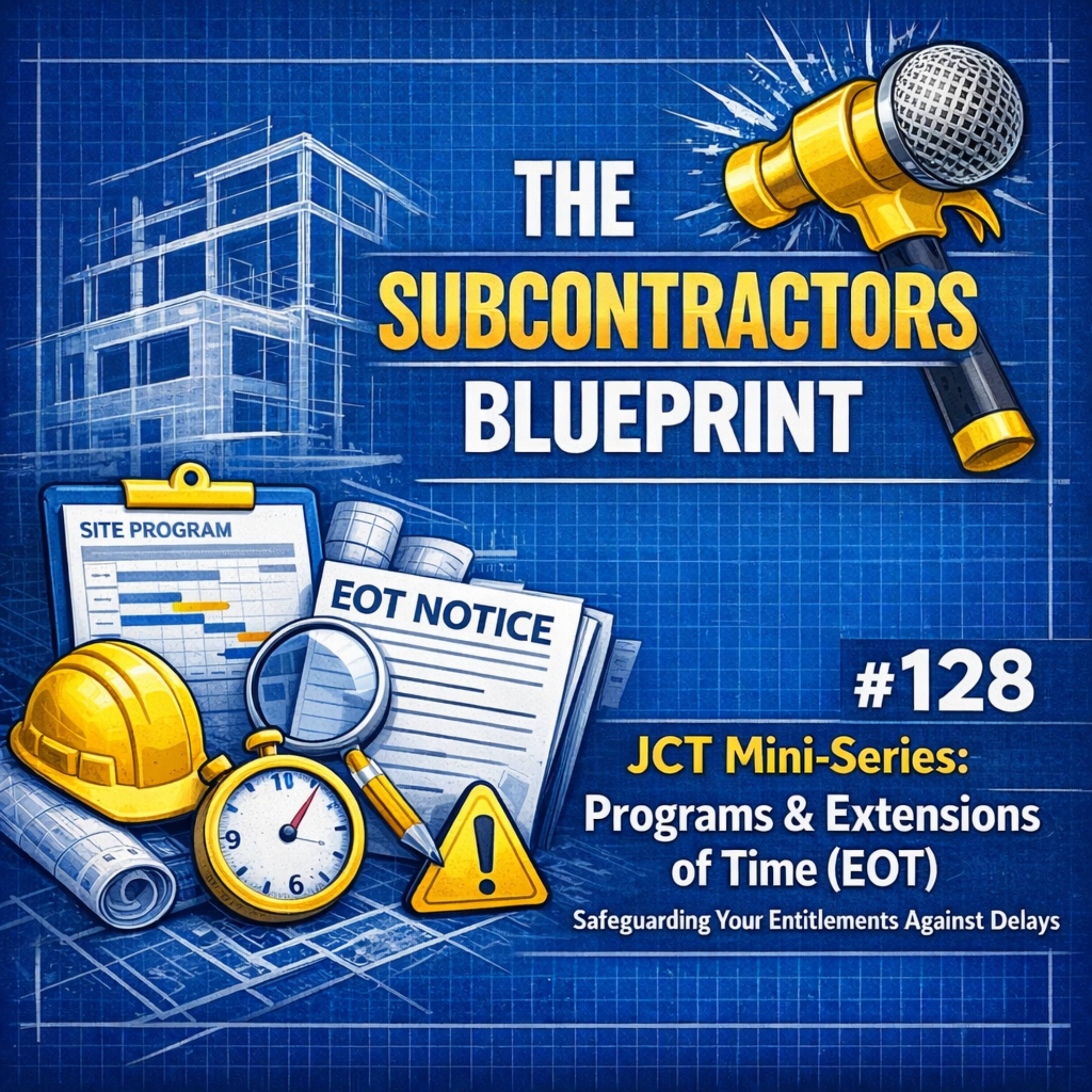
JCT Mini Series: Don’t Let Delays Derail Your Profits: Mastering Extensions of Time (EOT) and Claims
In episode 128 of The Subcontractors Blueprint podcast, host Jacob Austin continues his JCT Subcontract mini-series offering practical guidance on managing JCT subcontracts, focusing on programs and extensions of time (EOT). He explains how EOT provisions protect subcontractors from unfair delay risks, highlights the importance of timely notices and thorough documentation, and distinguishes between time extensions and loss and expense claims. Jacob shares actionable tips for handling delays, acceleration, and disruption costs, empowering subcontractors to safeguard their profit margins and ensure fair compensation under JCT terms. The episode aims to help subcontractors protect their commercial interests and avoid common contractual pitfalls. KEY TAKEAWAYS: The episode explores the importance of program clauses and extensions of time (EOT) in JCT subcontracts, highlighting how they protect subcontractors' margins and manage delay risks. Jacob explains that delays must be formally notified and evidenced; otherwise, subcontractors risk being unfairly blamed and incurring costs for delays outside their control. Time (EOT) and money (loss and expense) are separate contractual tracks—securing more time doesn’t automatically entitle you to compensation for disruption. Common pitfalls include vague or late notices, relying on flawed recovery programs, and failing to keep clear records of delays and their impacts. Jacob emphasises the need for consistent administration: keeping simple logs, issuing timely notices, and substantiating claims with clear evidence. The episode concludes that good record-keeping and proactive communication are key to safeguarding both time and cost entitlements under JCT subcontracts. BEST MOMENTS: "Contracts don't run on what people can see. They run on black and white—what's been notified, evidenced and complied with." "You can be busy on site, work till you're blue in the face and still lose the job commercially." "The extension of time protects the program and your margin, and prevents main contractors from pushing delay risk down to you quietly when you don't expect it." "If your paperwork doesn't answer those two questions and do it clearly, then the contractor can keep arguing about entitlement forever and delay the only thing that you really want, which is commercial closure." "Acceleration costs money… If the contractor isn’t willing to do that, then that tells you they want the benefit of the acceleration without putting their hand in their pocket." "These kind of documents—they’re not just paperwork. These are records. These are leverage." HOST BIO: Meet Jacob Austin, a Chartered Quantity Surveyor with a rich background at construction industry giants Balfour Beatty, Kier, and Vistry Group. With extensive involvement in education, health, and residential projects spanning various scales, from £1000s to over £100M in concurrent developments, Jacob brings a unique perspective. Having collaborated with numerous small businesses, he's now committed to sharing his expertise to drive their success. Join Jacob on his podcast, where he blends his profound insights and personable approach to offer guidance, industry secrets, and inspirational stories. LinkedIn - www.linkedin.com/in/jacob-austin/ Instagram - www.instagram.com/qs.zone/ www.qs.zone/all-links

JCT Mini-Series: Managing Your Payment Process Effectively as a Subcontractor
In episode 127 of The Subcontractors Blueprint podcast, host Jacob Austin continues his JCT Subcontract mini-series guiding UK construction business owners through the updated JCT 2024 subcontract payment processes. He explains key topics including payment timelines, notices, pay less traps, and compliant application submissions. Kyle shares practical strategies to protect cash flow, avoid common payment pitfalls, and leverage contract law. Emphasising organisation and proactive management, he highlights how following proper procedures ensures timely payments and reduces disputes, empowering subcontractors to strengthen their financial stability and grow their businesses under the new JCT framework. KEY TAKEAWAYS: The episode breaks down the JCT 2024 payment process, emphasising the importance of understanding due dates, payment notices, and Payless notices to protect subcontractor cash flow. Submitting payment applications on time and in the correct format is critical; late or non-compliant submissions can delay payments and weaken your position. Applications must be clear, cumulative, and substantiated with evidence so they are easy for contractors to assess and difficult to reject. The episode highlights common contractor tactics like invalid application rejections, vague Payless notices, and unjustified contra charges, and explains how to challenge them. Retention money should be tracked and claimed promptly, with the Construction Act preventing contractors from withholding it based on upstream payments. The new JCT 2024 streamlines payment processes and aligns closely with the Construction Act, making it essential for subcontractors to follow procedures and enforce their rights to timely payment. BEST MOMENTS: "Most failed subcontractors don't go under because they can't do the work. They do it because they fund the job for too long." "In UK construction, getting paid isn't about who's right, it's about who's followed the process and who's got the leverage." "If you submit late, the whole process is knocked back by however many days you were late." "Many SMEs understandably focus on price, scope and program and gloss over the legal terms, but design liability is one area where a few little sentences can completely change the game." "Make the assessment as easy as possible for them to certify; you don't want to hear, 'We can't assess this,' or, 'We need more information.'" "Retention is a contractual mechanism to secure performance against defects—it's not a general cash buffer.” HOST BIO: Meet Jacob Austin, a Chartered Quantity Surveyor with a rich background at construction industry giants Balfour Beatty, Kier, and Vistry Group. With extensive involvement in education, health, and residential projects spanning various scales, from £1000s to over £100M in concurrent developments, Jacob brings a unique perspective. Having collaborated with numerous small businesses, he's now committed to sharing his expertise to drive their success. Join Jacob on his podcast, where he blends his profound insights and personable approach to offer guidance, industry secrets, and inspirational stories. LinkedIn - www.linkedin.com/in/jacob-austin/ Instagram - www.instagram.com/qs.zone/ www.qs.zone/all-links

JCT Mini-Series: Design Risk Management: Ensuring Your Contracts Work for You, Not Against You
In episode 126 of The Subcontractors Blueprint podcast, host Jacob Austin continues his JCT Subcontract mini-series providing construction business leaders with a comprehensive overview of design liabilities under JCT 2024 subcontracts. He explains key legal standards, the impact of contract amendments, and the risks of fitness-for-purpose obligations. Jacob highlights the importance of careful contract review, maintaining professional indemnity insurance, and understanding BIM protocols. He shares practical tips for managing design approvals, submission procedures, and liability caps, emphasising how minor contract changes can significantly increase risk. The episode empowers subcontractors to protect their businesses by staying informed and negotiating fair, insurable terms. KEY TAKEAWAYS: The JCT 2024 subcontracts clarify that subcontractor design liability is limited to reasonable skill and care, not fitness for purpose, unless expressly stated otherwise. Approval of design by contractors or clients does not transfer liability; subcontractors remain responsible for their own design adequacy. Professional indemnity insurance typically only covers negligence, not absolute performance guarantees or fitness for purpose obligations. Subcontractors must carefully follow design submission and approval procedures, maintain records, and understand BIM protocol requirements if applicable. Contract amendments can significantly increase risk by introducing fitness for purpose clauses, uncapped liabilities, or indemnities—so vigilance and negotiation are essential. Always align contractual obligations with insurance coverage, and scrutinise amendments to avoid taking on unintended or uninsured liabilities. BEST MOMENTS: "Skill and care is about how you do the work—doing it professionally—whereas fitness for purpose is about the result." "If you accidentally or otherwise accept a fitness for purpose obligation, your insurer can decline your coverage." "Approval in a contract is about consent to move forward, not transferring design risk." "Many SMEs understandably focus on price, scope and program and gloss over the legal terms, but design liability is one area where a few little sentences can completely change the game." "High risk should command a higher price, and it may even mean higher insurance coverage." "Managing design and the risk associated with it is not about avoiding design work, it's about doing it on fair terms, with awareness of where your responsibility ends." HOST BIO: Meet Jacob Austin, a Chartered Quantity Surveyor with a rich background at construction industry giants Balfour Beatty, Kier, and Vistry Group. With extensive involvement in education, health, and residential projects spanning various scales, from £1000s to over £100M in concurrent developments, Jacob brings a unique perspective. Having collaborated with numerous small businesses, he's now committed to sharing his expertise to drive their success. Join Jacob on his podcast, where he blends his profound insights and personable approach to offer guidance, industry secrets, and inspirational stories. LinkedIn - www.linkedin.com/in/jacob-austin/ Instagram - www.instagram.com/qs.zone/ www.qs.zone/all-links

JCT Subcontracts: The Only Thing More Confusing Than Building Regulations?
In episode 125 of The Subcontractors Blueprint podcast, host Jacob Austin introduces a mini-series on JCT subcontracts, tailored for UK construction subcontractors. He explains the structure and risks of JCT contracts, highlights key changes from the 2016 to 2024 versions—including updates driven by the Building Safety Act 2022—and stresses the importance of reviewing both standard conditions and amendments. Jacob offers practical advice on contract review, payment procedures, and compliance, aiming to help subcontractors avoid costly misunderstandings and operate with greater confidence in today’s evolving contractual landscape. KEY TAKEAWAYS: JCT subcontracts are often presumed to be “standard,” but amendments frequently shift risk onto subcontractors without clear warning. Subcontractors are commonly bound by reference to lengthy conditions they may never have seen, making it crucial to obtain and review the full contract documents. Amendments in areas like payment terms, suspension rights, and program obligations can significantly impact risk and cash flow. The 2024 JCT updates introduce changes for electronic notices, align more closely with the Construction Act, and reflect new building safety requirements, especially documentation. To protect themselves, subcontractors must scrutinise amendments, check key details on time, scope, and money, and ensure they price for all required paperwork and compliance. The episode stresses that assuming all JCT contracts are alike is dangerous—always interrogate the actual terms and amendments before signing. BEST MOMENTS: "As soon as your materials are on site, they belong to the project, so you can't just drive off with them if things go awry." "Termination means ending the subcontract before all work is completed, which means both parties are freed from any further obligations to complete the construction of the work." "If the process isn’t followed properly, then this is effectively a breach. The consequence of that breach is that the calculation is different—you will get full compensation without a deduction." "Termination is a situation where nobody truly wins. It’s a salvage operation as a subcontractor, and your goal is likely to get out of there without a huge loss and without burning bridges." "Many subcontractors have been strong-armed into accepting zero compensation after rough termination, simply because they don’t know what they’re entitled to—don’t let that be you." "Demonstrating you know your stuff can change the conversation—it changes you from being a victim in the process to an informed participant." Jacob is on a mission to help the 1 million SME contractors working within the construction industry. If you've taken something of value from this episode, please share the podcast with someone you know, and pass the value on. HOST BIO: Meet Jacob Austin, a Chartered Quantity Surveyor with a rich background at construction industry giants Balfour Beatty, Kier, and Vistry Group. With extensive involvement in education, health, and residential projects spanning various scales, from £1000s to over £100M in concurrent developments, Jacob brings a unique perspective. Having collaborated with numerous small businesses, he's now committed to sharing his expertise to drive their success. Join Jacob on his podcast, where he blends his profound insights and personable approach to offer guidance, industry secrets, and inspirational stories. LinkedIn - www.linkedin.com/in/jacob-austin/ Instagram - www.instagram.com/qs.zone/ www.qs.zone/all-links

Understanding NEC4: Key Insights on Title of Materials, Insurance, and Termination Procedures for Subcontractors
In episode 124 of The Subcontractors Blueprint podcast, host Jacob Austin continues his NEC4 mini-series, focusing on clauses 70, 80, and 90. He provides clear, practical guidance on material ownership, insurance obligations, and, most critically, termination procedures. Jacob explains how to protect your business by understanding payment entitlements, risk allocation, and the importance of following contract procedures. He highlights common pitfalls, offers actionable tips, and stresses the need for documentation and legal advice. This episode and mini-series equips construction business owners with essential knowledge to manage NEC4 contracts confidently and safeguard profitability. KEY TAKEAWAYS: Once materials are delivered to site, legal ownership passes to the contractor or client, affecting both risk and payment security. Subcontractors are responsible for a range of insurances and liabilities, with the contract specifying who must cover which risks. Termination under NEC4 is highly structured, with clear reasons, procedures, and payment calculations depending on who is at fault. Wrongful or improperly handled termination can have serious financial and legal consequences, so understanding and following the contract is critical. Subcontractors should document everything, know their rights, and approach termination as a last resort, aiming to protect both reputation and financial interests. Proactively communicating and keeping thorough records can help subcontractors avoid disputes and ensure they recover all monies owed if termination does occur. BEST MOMENTS: "As soon as your materials are on site, they belong to the project, so you can't just drive off with them if things go awry." "Termination means ending the subcontract before all work is completed, which means both parties are freed from any further obligations to complete the construction of the work." "If the process isn’t followed properly, then this is effectively a breach. The consequence of that breach is that the calculation is different—you will get full compensation without a deduction." "Termination is a situation where nobody truly wins. It’s a salvage operation as a subcontractor, and your goal is likely to get out of there without a huge loss and without burning bridges." "Many subcontractors have been strong-armed into accepting zero compensation after rough termination, simply because they don’t know what they’re entitled to—don’t let that be you." "Demonstrating you know your stuff can change the conversation—it changes you from being a victim in the process to an informed participant." Jacob is on a mission to help the 1 million SME contractors working within the construction industry. If you've taken something of value from this episode, please share the podcast with someone you know, and pass the value on. HOST BIO: Meet Jacob Austin, a Chartered Quantity Surveyor with a rich background at construction industry giants Balfour Beatty, Kier, and Vistry Group. With extensive involvement in education, health, and residential projects spanning various scales, from £1000s to over £100M in concurrent developments, Jacob brings a unique perspective. Having collaborated with numerous small businesses, he's now committed to sharing his expertise to drive their success. Join Jacob on his podcast, where he blends his profound insights and personable approach to offer guidance, industry secrets, and inspirational stories. LinkedIn - www.linkedin.com/in/jacob-austin/ Instagram - www.instagram.com/qs.zone/ www.qs.zone/all-links

Protect Your Profits: Effective Management of Compensation Events Under NEC Contracts
In episode 123 of The Subcontractors Blueprint podcast, host Jacob Austin provides construction business owners with practical guidance on managing compensation event clauses under NEC contracts. He explains the crucial differences between early warnings and compensation events, outlines notification and quotation procedures, and emphasises the importance of timely communication, thorough record-keeping, and contract compliance. Using real-world examples, Jacob demonstrates how proactive management of these clauses can protect subcontractors’ interests, improve cash flow, and foster collaborative relationships with contractors—ultimately supporting business growth and successful project delivery. KEY TAKEAWAYS: The episode explains the difference between early warnings and compensation events in NEC contracts, emphasising their roles in proactive risk management. Early warnings are about flagging potential risks before they happen, while compensation events address actual changes that impact time or cost. Failing to issue early warnings can result in reduced compensation, as contractors may assess claims as if warnings had been given. Strict notification and time bar requirements mean subcontractors must act quickly and provide clear evidence to protect their entitlements. Compensation events are assessed based on defined costs, and well-prepared, transparent quotations are essential for successful claims. Collaboration, clear communication, and following contract processes are key to avoiding disputes and ensuring fair outcomes on NEC projects. BEST MOMENTS: "The principle behind [Early Warnings] is that it's a proactive risk management tool to flag up issues that could impact time, cost and quality." "Early warnings are future events—they may happen or they might not. Compensation events are guaranteed to happen." "Compensation events are assessed on the basis of defined cost, which is essentially the reasonable cost that you incur yourself, plus an applicable fee." "A well-prepared quote is critical. It needs to be clear with breakdowns of your labor, plant, materials, and descriptions of how it's been calculated." "The point is to create early and binding agreements as you go throughout the contract, to avoid the need for lengthy disputes and final account meetings." "The straight talking truth is that compensation events can become contentious if people can't get around the table and talk sense and come to sensible agreements." Jacob is on a mission to help the 1 million SME contractors working within the construction industry. If you've taken something of value from this episode, please share the podcast with someone you know, and pass the value on. HOST BIO: Meet Jacob Austin, a Chartered Quantity Surveyor with a rich background at construction industry giants Balfour Beatty, Kier, and Vistry Group. With extensive involvement in education, health, and residential projects spanning various scales, from £1000s to over £100M in concurrent developments, Jacob brings a unique perspective. Having collaborated with numerous small businesses, he's now committed to sharing his expertise to drive their success. Join Jacob on his podcast, where he blends his profound insights and personable approach to offer guidance, industry secrets, and inspirational stories. LinkedIn - www.linkedin.com/in/jacob-austin/ Instagram - www.instagram.com/qs.zone/ www.qs.zone/all-links

A Comprehensive Guide to Managing Payments and Protecting Cash Flow Under NEC Subcontract Agreements
In episode 122 of The Subcontractors Blueprint podcast, host Jacob Austin guides construction business owners through the payment mechanisms of NEC subcontract agreements, focusing on the 50 series clauses. He explains the importance of assessment dates, compliant payment applications, and the impact of main option clauses (A–E) on cash flow. Jacob highlights that contract amendments that can complicate payments and shares a practical checklist for managing the payment process. The episode offers actionable advice to help subcontractors protect their cash flow, avoid payment disputes, and ensure profitability under NEC contracts. KEY TAKEAWAYS: The NEC subcontract’s payment process is strictly tied to assessment dates, requiring timely and compliant applications for payment. Missing an application deadline or submitting a non-compliant claim can result in receiving no payment or even owing money due to contract clauses like 50.4. Different NEC main options (A–E) significantly affect how payments are calculated, from activity schedules to bills of quantities and cost-reimbursable models. Maintaining clear records and collaborating with the main contractor is crucial, especially for measurement and cost-based payment options. The UK Construction Act (via clause Y(UK)2) mandates fixed payment timelines and defines payment notice requirements, overriding variable invoice-based systems. Careful contract administration, matching application formats, and assertively managing payment schedules are essential to protect subcontractor cash flow. BEST MOMENTS: "The NEC payment process is only fair if you run it properly and it can punish you with cash flow problems if you don't." "If your application is non-compliant, you're basically volunteering not to be paid." "Clause 50.4, The Quiet Assassin...if you miss your application date, you don't just get paid slightly late because you applied late. The contract says that you get nothing." "Defined cost can be weaponised via audits if you don't have good records of what people were doing and when they were doing it." "A defective notice could mean that you're entitled to full payment of your application without any deduction." Jacob is on a mission to help the 1 million SME contractors working within the construction industry. If you've taken something of value from this episode, please share the podcast with someone you know, and pass the value on. HOST BIO: Meet Jacob Austin, a Chartered Quantity Surveyor with a rich background at construction industry giants Balfour Beatty, Kier, and Vistry Group. With extensive involvement in education, health, and residential projects spanning various scales, from £1000s to over £100M in concurrent developments, Jacob brings a unique perspective. Having collaborated with numerous small businesses, he's now committed to sharing his expertise to drive their success. Join Jacob on his podcast, where he blends his profound insights and personable approach to offer guidance, industry secrets, and inspirational stories. LinkedIn - www.linkedin.com/in/jacob-austin/ Instagram - www.instagram.com/qs.zone/ www.qs.zone/all-links
Float Your Way to Success: Mastering TRAs and Scheduling in NEC Contracts
In episode 121 of The Subcontractors Blueprint podcast, host Jacob Austin continues the NEC contracts mini-series, providing construction business owners with practical guidance on managing NEC subcontracts. This week he explains the importance of time risk allowances (TRAs) and different types of float—free, total, and terminal—clarifying their roles, ownership, and impact on scheduling and compensation events. Jacob emphasises maintaining an up-to-date, accepted programme as a vital tool for managing risk, demonstrating entitlement to extensions of time, and minimising disputes. The episode offers actionable insights to help subcontractors protect their interests and improve project outcomes under NEC contracts. KEY TAKEAWAYS: Time risk allowances (TRAs) are essential in NEC programmes, acting as subcontractor-owned buffers for managing their own risks. TRAs must be clearly shown and allocated to specific activities rather than added as a lump sum, ensuring realistic and accepted project schedules. Float is divided into total, free, and terminal types, with total and free float being shared resources and terminal float exclusively benefiting the subcontractor. Regularly updating and gaining acceptance for the programme transforms it into both a management tool and a contractual benchmark for assessing delays and compensation events. Maintaining an accurate, accepted programme strengthens a subcontractor’s negotiating position, protects entitlements, and helps prevent disputes. Treating the programme as a living document enables proactive risk management, clear demonstration of progress, and fair compensation for delays. BEST MOMENTS: "A program with zero allowances is likely to be optimistic and could be deemed not practicable or unrealistic, and that is a reason for non acceptance of your programme.” "By showing TRA, you're demonstrating that you built in time buffers for your own risks and thereby increase the confidence that plan completion can be achieved by the date you're saying." "A well maintained programme also builds your credibility. If the contractor sees that each update is thorough and good and honest, not only are they more likely to accept them without a dispute, but it means when it comes to assessing a compensation event, they're more likely to trust your assessment of it." "The NEC mantra is that the programme is a management tool, not just a contract requirement." "If you treat the programme as your friend, invest time in it, invest effort in it, then it will pay you back by minimising disputes and helping you to secure your entitlements against changes." Jacob is on a mission to help the 1 million SME contractors working within the construction industry. If you've taken something of value from this episode, please share the podcast with someone you know, and pass the value on. HOST BIO: Meet Jacob Austin, a Chartered Quantity Surveyor with a rich background at construction industry giants Balfour Beatty, Kier, and Vistry Group. With extensive involvement in education, health, and residential projects spanning various scales, from £1000s to over £100M in concurrent developments, Jacob brings a unique perspective. Having collaborated with numerous small businesses, he's now committed to sharing his expertise to drive their success. Join Jacob on his podcast, where he blends his profound insights and personable approach to offer guidance, industry secrets, and inspirational stories. LinkedIn - www.linkedin.com/in/jacob-austin/ Instagram - www.instagram.com/qs.zone/ www.qs.zone/all-links

NEC4 Programme Pitfalls: Understand the Requirements & Ensure Your Program is Accepted
In episode 120 of The Subcontractors Blueprint podcast, host Jacob Austin continues the NEC contracts mini-series, providing construction business owners with a comprehensive guide to program clauses under NEC4 subcontracts. He explains the critical requirements for program submission, acceptance, and ongoing updates, highlighting their impact on cash flow, entitlement protection, and project management. Jacob discusses practical strategies for ensuring compliance, avoiding payment penalties, and maintaining control over compensation events. This episode is essential listening for subcontractors seeking to strengthen their NEC4 contract administration and safeguard their business interests. KEY TAKEAWAYS: The critical role of the program in NEC4 subcontracts, detailing how it underpins project planning, change management, and subcontractor protection. NEC4 requires programs to include key dates, milestones, logical sequencing, float, time risk allowances, and necessary inputs from other parties. The distinction between planned completion and contract completion dates is emphasised, with terminal float serving as a buffer for subcontractors. Submitting a compliant program on time is essential, as failure to do so allows the contractor to withhold 25% of payments until an acceptable program is provided. Program acceptance and rejection are governed by strict contractual criteria, and deemed acceptance occurs if the contractor fails to respond within set timeframes. Regular program updates are required to reflect progress, changes, and delays, ensuring the program remains a reliable management tool and protects subcontractor entitlements. BEST MOMENTS: “A well-managed program, and an accepted program, is absolutely central to administering the subcontract. It sets out how and when the work will be done.” “If there’s no current accepted program, the assessment of compensation events may be taken out of your hands—potentially leading to smaller time and cost compensation.” “By including key dates and requirements in your program, you are creating hooks within your program that the contractor or whoever else is going to snag on if they miss those dates.” “Acceptance of a program doesn’t stop you from having to achieve any of your obligations, and it doesn’t transfer any risk of those to the contractor.” “The goal here is to create a program that’s got clear and common reference points for both parties- it allows the contractor to verify the feasibility of your program and to see your needs and your constraints.” Jacob is on a mission to help the 1 million SME contractors working within the construction industry. If you've taken something of value from this episode, please share the podcast with someone you know, and pass the value on. HOST BIO: Meet Jacob Austin, a Chartered Quantity Surveyor with a rich background at construction industry giants Balfour Beatty, Kier, and Vistry Group. With extensive involvement in education, health, and residential projects spanning various scales, from £1000s to over £100M in concurrent developments, Jacob brings a unique perspective. Having collaborated with numerous small businesses, he's now committed to sharing his expertise to drive their success. Join Jacob on his podcast, where he blends his profound insights and personable approach to offer guidance, industry secrets, and inspirational stories. LinkedIn - www.linkedin.com/in/jacob-austin/ Instagram - www.instagram.com/qs.zone/ www.qs.zone/all-links

NEC4: Subcontractor Obligations And Quality Management In Depth Under the NEC4 ECS
In episode 119 of The Subcontractors Blueprint podcast, host Jacob Austin continues the NEC contracts mini-series, focusing on key obligations for subcontractors. He explains the importance of acting in a spirit of mutual trust and cooperation, details core responsibilities under the 10, 20, and 40 series clauses—including quality management, design duties, and defect handling—and emphasises proactive communication and collaboration. Jacob also provides practical guidance on defect management, highlighting the impact on client satisfaction and future business. The episode offers clear, actionable advice to help construction business owners protect profitability and maintain strong contractor relationships. KEY TAKEAWAYS: The NEC contract’s foundation is acting as stated in the contract and in a spirit of mutual trust and cooperation, requiring both strict compliance and collaborative problem-solving. Subcontractors must deliver all works as defined in the scope, including any design responsibilities, key personnel, and coordination with others as specified. Meeting key dates is critical, as missing them can lead to liability for additional costs or delays impacting other trades. Subcontracting parts of the work requires contractor approval, and the main contractor manages you—not your sub-subcontractors. A robust quality management system is mandatory, with clear procedures for inspections, testing, and defect correction as outlined in the contract and scope. Defects must be reported and corrected within specified periods, with uncorrected defects potentially leading to deductions or negotiated credits, emphasising the importance of proactive communication and client satisfaction. BEST MOMENTS: "The NEC’s core principle is that parties act as stated in the contract and in a spirit of mutual trust and cooperation." "Mutual trust and cooperation means openness, fairness, and tackling problems together—not hiding bad news or exploiting loopholes." "Key dates are critical—miss one, and you could be liable for the contractor’s extra costs or delays to other trades." "A quality management system isn’t optional; you must have documented procedures for inspections, testing, and approvals." "Defects must be reported and corrected promptly—unfixed defects can lead to deductions or negotiated credits, impacting your reputation and payment." Jacob is on a mission to help the 1 million SME contractors working within the construction industry. If you've taken something of value from this episode, please share the podcast with someone you know, and pass the value on. HOST BIO: Meet Jacob Austin, a Chartered Quantity Surveyor with a rich background at construction industry giants Balfour Beatty, Kier, and Vistry Group. With extensive involvement in education, health, and residential projects spanning various scales, from £1000s to over £100M in concurrent developments, Jacob brings a unique perspective. Having collaborated with numerous small businesses, he's now committed to sharing his expertise to drive their success. Join Jacob on his podcast, where he blends his profound insights and personable approach to offer guidance, industry secrets, and inspirational stories. LinkedIn - www.linkedin.com/in/jacob-austin/ Instagram - www.instagram.com/qs.zone/ www.qs.zone/all-links

Understanding NEC4: A Comprehensive Breakdown of the Engineering and Construction Subcontract "ECS"
In episode 118 of The Subcontractors Blueprint podcast, host Jacob Austin launches a mini-series on the NEC4 suite of contracts, focusing on the engineering and construction subcontract “ECS”. He explains the contract’s structure, main and secondary option clauses, and their impact on risk, pricing, and delivery. Jacob provides a practical checklist to help subcontractors review NEC4 subcontracts, emphasising the importance of understanding triggered clauses, design obligations, liability caps, and payment terms. This episode equips construction business owners with essential knowledge to manage contractual risks, protect profitability, and ensure project success under NEC4. KEY TAKEAWAYS: The NEC4 Engineering and Construction Subcontract (the "ECS”) closely mirrors the main contract, providing consistency and back-to-back risk management throughout the supply chain. Subcontractors must understand which main option (A–E) is used, as it fundamentally changes the allocation of risk and payment mechanisms. Secondary option clauses (W, X, Y, Z) tailor the contract to specific scenarios, and subcontractors need to review these carefully to understand their obligations and risks. Key processes like early warning and compensation events are designed to align with the main contract, promoting collaboration and timely communication. Subcontractors should always review the contract data and option clauses in detail to ensure their price and approach reflect all risks and requirements before signing. The NEC4 approach is user-friendly and flexible, but its customisability demands careful attention to detail to avoid unexpected liabilities. BEST MOMENTS: “As a subcontractor, you're operating in a framework that talks back to the main contract and feeds in to the main contractor's obligations to their client, so it reduces surprises and mismatches in timescales and obligations.” “The most collaborative tool within the main contract, the early warning process, is flowed down to you as a subcontractor as well.” “As you go through the options from A to E, you start with a situation where the subcontractor holds the biggest amount of risk through to option E, where the subcontractor holds the least amount of risk.” “It would certainly be sensible to discuss before you set off down a road that you both struggle to get to the end of, but you need to understand with this, the option isn't just a letter. It completely changes the feel and the nature of the subcontract.” “It's important that you appreciate what those letters and numbers mean because when you read the subcontract data for an NEC contract, it will list out all of the option clauses that apply to that particular subcontract.” Jacob is on a mission to help the 1 million SME contractors working within the construction industry. If you've taken something of value from this episode, please share the podcast with someone you know, and pass the value on. HOST BIO: Meet Jacob Austin, a Chartered Quantity Surveyor with a rich background at construction industry giants Balfour Beatty, Kier, and Vistry Group. With extensive involvement in education, health, and residential projects spanning various scales, from £1000s to over £100M in concurrent developments, Jacob brings a unique perspective. Having collaborated with numerous small businesses, he's now committed to sharing his expertise to drive their success. Join Jacob on his podcast, where he blends his profound insights and personable approach to offer guidance, industry secrets, and inspirational stories. LinkedIn - www.linkedin.com/in/jacob-austin/ Instagram - www.instagram.com/qs.zone/ www.qs.zone/all-links

Are You Fully Aware of Your Rights Under the Construction Act?
In episode 117 of The Subcontractors Blueprint podcast, host Jacob Austin provides UK construction business owners with a clear, practical overview of the Housing Grants, Construction and Regeneration Act and the Scheme for Construction Contracts. He explains key protections for subcontractors, including rights to interim payments, payment notices, pay less notices, suspension for non-payment, and fast-track dispute resolution through adjudication. Jacob emphasises the importance of written contracts but reassures listeners that statutory rights apply even without one. This episode empowers subcontractors to secure timely payments, maintain healthy cash flow, and confidently handle disputes in the UK construction industry. KEY TAKEAWAYS: The Construction Act and the Scheme for Construction Contracts provide crucial legal protections for UK subcontractors, ensuring fair and prompt payment. Subcontractors are entitled to interim payments, clear payment notices, and protection from unfair payment delays or reductions. Contractors must issue timely payment and pay less notices, or else the subcontractor is entitled to the full amount claimed. Subcontractors have the right to suspend work for non-payment and can claim extensions of time and reasonable costs for remobilisation. Statutory adjudication offers a fast-track, cost-effective way to resolve payment and contract disputes, even for oral agreements. "Pay when paid" clauses are generally outlawed, ensuring subcontractors are not left waiting for payment due to issues higher up the supply chain. BEST MOMENTS: "If the contractor misses that window or fails to issue a valid Payless notice, they can't by law short to pay you. And the law is really clear on that." "The law says that you can [suspend work for non-payment] without liability, meaning you won't be in breach of contract for stopping work in those circumstances." "Adjudication can be a game changer for subcontractors because it embodies that pay now, argue later ethos that we mentioned earlier by giving you a way to quickly secure payment or resolve disputes." "The Construction Act outlaws that, and any provision that makes your payment conditional on receipt of payment from a third party is ineffective." "Knowing these rules and asserting them at the right time will help you to ensure you get fully paid and on time for the work that you do." Jacob is on a mission to help the 1 million SME contractors working within the construction industry. If you've taken something of value from this episode, please share the podcast with someone you know, and pass the value on. HOST BIO: Meet Jacob Austin, a Chartered Quantity Surveyor with a rich background at construction industry giants Balfour Beatty, Kier, and Vistry Group. With extensive involvement in education, health, and residential projects spanning various scales, from £1000s to over £100M in concurrent developments, Jacob brings a unique perspective. Having collaborated with numerous small businesses, he's now committed to sharing his expertise to drive their success. Join Jacob on his podcast, where he blends his profound insights and personable approach to offer guidance, industry secrets, and inspirational stories. LinkedIn - www.linkedin.com/in/jacob-austin/ Instagram - www.instagram.com/qs.zone/ www.qs.zone/all-links

The Subcontractor's Essential Guide To The Golden Thread
In episode 116 of The Subcontractors Blueprint podcast, host Jacob Austin explains the importance of the "golden thread"—a comprehensive digital record of building information now required under the Building Safety Act 2022. Using a real-world example, he highlights the risks of poor documentation and offers practical tips for subcontractors to organise, manage, and hand over essential compliance documents. Listeners learn what information to provide, legal obligations, and how embracing these practices not only ensures building safety and timely payments but also strengthens relationships with main contractors and secures future work. KEY TAKEAWAYS: The golden thread is a comprehensive, digital, and legally required record of building information, ensuring compliance, safety, and accountability throughout a project’s lifecycle. Subcontractors must provide accurate, up-to-date documentation such as as-built drawings, product data, test certificates, O&M manuals, and records of design changes to support project handover. Failing to maintain the golden thread can delay project completion, final payments, and legal building occupation, impacting both reputation and business relationships. The golden thread is expanding beyond high-rise residential projects, with many clients and contractors now treating it as best practice across all sectors. Effective golden thread management involves early organisation, clear communication with your supply chain, leveraging digital tools, and following main contractor requirements. Proactive, quality handover documentation not only ensures compliance but also builds trust and increases the likelihood of repeat work from main contractors. BEST MOMENTS: "The golden thread, essentially a comprehensive digital trail of building information, is evidence that your work complies with building regulations." "No structured handover = no completion certificate = no legal occupation." "The golden thread demonstrates first with the design, that the design is compliant, backed up by relevant specifications and performance data through the install." "The golden thread isn't just about bureaucratic red tape—it's about instilling accountability and pride in everybody's work." "Main contractors will start to remember the subcontractors who hand over quality information first time and without a fight." Jacob is on a mission to help the 1 million SME contractors working within the construction industry. If you've taken something of value from this episode, please share the podcast with someone you know, and pass the value on. HOST BIO: Meet Jacob Austin, a Chartered Quantity Surveyor with a rich background at construction industry giants Balfour Beatty, Kier, and Vistry Group. With extensive involvement in education, health, and residential projects spanning various scales, from £1000s to over £100M in concurrent developments, Jacob brings a unique perspective. Having collaborated with numerous small businesses, he's now committed to sharing his expertise to drive their success. Join Jacob on his podcast, where he blends his profound insights and personable approach to offer guidance, industry secrets, and inspirational stories. LinkedIn - www.linkedin.com/in/jacob-austin/ Instagram - www.instagram.com/qs.zone/ www.qs.zone/all-links

How Can a Quantity Surveyor Transform Your Subcontracting Business Beyond Pricing?
In episode 115 of The Subcontractors Blueprint podcast, host Jacob Austin explores the vital role of a Quantity Surveyor (QS) for construction subcontractors. He explains how a QS goes far beyond pricing jobs, acting as a commercial guardian by supporting contract negotiation, risk management, cash flow forecasting, cost control, payment applications, change management, delay claims, final account strategies, and dispute resolution. Jacob emphasises how leveraging QS expertise can protect your business, improve profitability, and ensure timely payments. He encourages listeners to subscribe the show for more information to strengthen their subcontracting businesses. KEY TAKEAWAYS: A Quantity Surveyor (QS) offers far more than just pricing jobs—they act as a commercial guardian, helping subcontractors protect profitability and manage risk. A QS can review and negotiate subcontract terms, identifying and advising against unfair or high-risk clauses before you sign, which is crucial for business protection. Risk management is a core QS skill, including creating risk registers, analysing potential pitfalls, and developing strategies to mitigate financial and contractual risks. Effective cost planning and cash flow forecasting by a QS help prevent cash shortages, keep projects on budget, and enable strategic financial planning. QSs play a vital role in cost reporting, change management, and ensuring accurate, timely applications for payment—maximising entitlements and minimising money left on the table. A QS supports dispute resolution, prepares for adjudication if needed, and provides commercial strength in negotiations, ultimately helping subcontractors build more resilient, profitable businesses. BEST MOMENTS: "A good QS can be like your commercial guardian, balancing their contractual knowhow, financial savvy, and onsite experience to protect your bottom line." "As I've said a few times on the show, after you sign, you're legally stuck with the obligations that you sign up to." "Less than 1 in 3 construction jobs ends up within 10% of its original budget, with the majority running over." "Properly managing changes is where subcontractors can either make or lose money." "These reviews are about catching problems before they snowball and capitalising on opportunities whilst they're fresh in everybody's mind." "If you're the kind of subcontractor who up until this point has been using QS just for estimating, you now know the full picture." Jacob is on a mission to help the 1 million SME contractors working within the construction industry. If you've taken something of value from this episode, please share the podcast with someone you know, and pass the value on. HOST BIO: Meet Jacob Austin, a Chartered Quantity Surveyor with a rich background at construction industry giants Balfour Beatty, Kier, and Vistry Group. With extensive involvement in education, health, and residential projects spanning various scales, from £1000s to over £100M in concurrent developments, Jacob brings a unique perspective. Having collaborated with numerous small businesses, he's now committed to sharing his expertise to drive their success. Join Jacob on his podcast, where he blends his profound insights and personable approach to offer guidance, industry secrets, and inspirational stories. LinkedIn - www.linkedin.com/in/jacob-austin/ Instagram - www.instagram.com/qs.zone/ www.qs.zone/all-links

The Cash Flow Playbook: Strategies for Subcontractors to Thrive in a Volatile Market
EIn episode 114 of The Subcontractors Blueprint podcast, host Jacob Austin offers practical guidance on cash flow management tailored for construction subcontractors. He covers essential topics such as cash flow forecasting, stress testing finances, disciplined billing, client selection, and building financial reserves. Jacob also shares strategies for managing growth, handling seasonality, and preparing contingency plans for late payments. Emphasising the importance of team awareness and contractual safeguards, this episode equips subcontractors with actionable steps to enhance profitability, resilience, and long-term business stability in the face of industry volatility. KEY TAKEAWAYS: Cash flow forecasting is essential for subcontractors due to unpredictable payment cycles and the risk of late payments, helping businesses anticipate and manage cash shortfalls. Accurate and regularly updated cash flow forecasts (ideally on a 13-week rolling basis) allow subcontractors to project both inflows and outflows, identify potential crunch points, and make informed financial decisions. Stress testing cash flow forecasts by modelling scenarios such as delayed payments, reduced income, and increased costs helps businesses prepare for real-world volatility and avoid surprises. Maintaining discipline in billing and collections—prompt invoicing, strict tracking of receivables, and proactive follow-ups—prevents avoidable cash flow gaps. Building resilience through strong financial habits includes diversifying clients, controlling growth and overheads, planning for seasonality, and fostering cash flow awareness across the team. Establishing robust cash reserves and contingency plans (such as credit lines or invoice factoring) provides a safety net for unexpected shortfalls, while knowing and exercising contractual rights can help resolve persistent payment issues. BEST MOMENTS: "Cash flow is of vital importance and it's the lifeblood of any subcontracting business." "Cash flow forecasting is your early warning system for your financial health." "For subcontractors who endure unpredictable payment cycles, forecasting is essential for survival. "Maintaining discipline in your billing and collections sounds obvious, but it's actually quite a common mistake to have disorganised invoicing." "It's far better to have [contingencies] and not need them than to not have them when you ultimately need to rely on them." "In a nutshell, cash flow for subcontractors is all about being prepared and being proactive." Jacob is on a mission to help the 1 million SME contractors working within the construction industry. If you've taken something of value from this episode, please share the podcast with someone you know, and pass the value on. HOST BIO: Meet Jacob Austin, a Chartered Quantity Surveyor with a rich background at construction industry giants Balfour Beatty, Kier, and Vistry Group. With extensive involvement in education, health, and residential projects spanning various scales, from £1000s to over £100M in concurrent developments, Jacob brings a unique perspective. Having collaborated with numerous small businesses, he's now committed to sharing his expertise to drive their success. Join Jacob on his podcast, where he blends his profound insights and personable approach to offer guidance, industry secrets, and inspirational stories. LinkedIn - www.linkedin.com/in/jacob-austin/ Instagram - www.instagram.com/qs.zone/ www.qs.zone/all-links