STEM Toys for 3 Year Olds vs 4 Year Olds: Which Developmental Stage Fits Your Child?
The STEM Lab · The Stem Lab
Audio is streamed directly from the publisher (content.rss.com) as published in their RSS feed. Play Podcasts does not host this file. Rights-holders can request removal through the copyright & takedown page.
Show Notes
Choosing the right STEM toy for your toddler isn't as simple as checking the age on the box. Between ages three and four, children undergo a fundamental cognitive shift—from parallel play to sequential problem-solving—that completely changes which toys will engage them versus frustrate them. In this episode, Dr. Priya Mehta breaks down the specific developmental markers that should guide your purchasing decisions, from motor skill requirements to abstract thinking readiness, and recommends products with the actual specs parents need to make informed choices.
- The core difference between STEM toys for three-year-olds versus four-year-olds comes down to piece size and feedback timing: three-year-olds need chunky components (two inches or larger) with immediate cause-and-effect results, while four-year-olds can handle one-inch pieces and tolerate multi-step sequences before seeing outcomes.
- Three-year-olds require continuous adult co-play for both guidance and safety, whereas four-year-olds can explore independently for fifteen to twenty minutes with only brief check-ins for complex tasks.
- Motor skill development determines which toys actually get used: three-year-olds are still refining their pincer grasp and excel with magnetic connections or satisfying snap-together pieces, while four-year-olds can manage precision placement like aligning small pegs into corresponding holes.
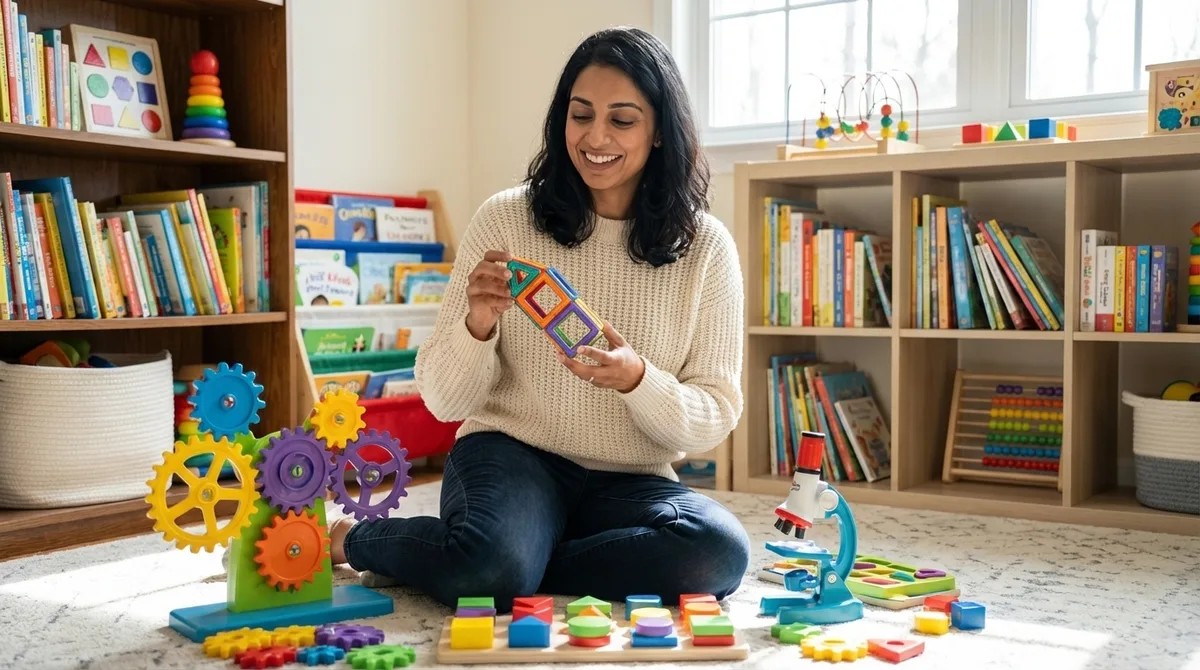
- The Learning Resources Gears! Gears! Gears! Beginner's Building Set works well for three-year-olds because its oversized gears (two-and-a-half-inch diameter) teach rotational cause and effect without requiring fine motor precision.
- Four-year-olds are ready for screen-free coding toys like the Learning Resources Code and Go Robot Mouse, which requires placing directional tiles in sequence and waiting through three or four steps before seeing results—a patience threshold most three-year-olds haven't developed.
- Abstract thinking emerges around age four, allowing children to picture outcomes before manipulating objects, while three-year-olds remain in the concrete present and need toys emphasizing sensory feedback and immediate results like magnetic building tiles.
Read the full article: https://stemlabguide.com/stem-toys-for-3-year-olds-vs-4-year-olds