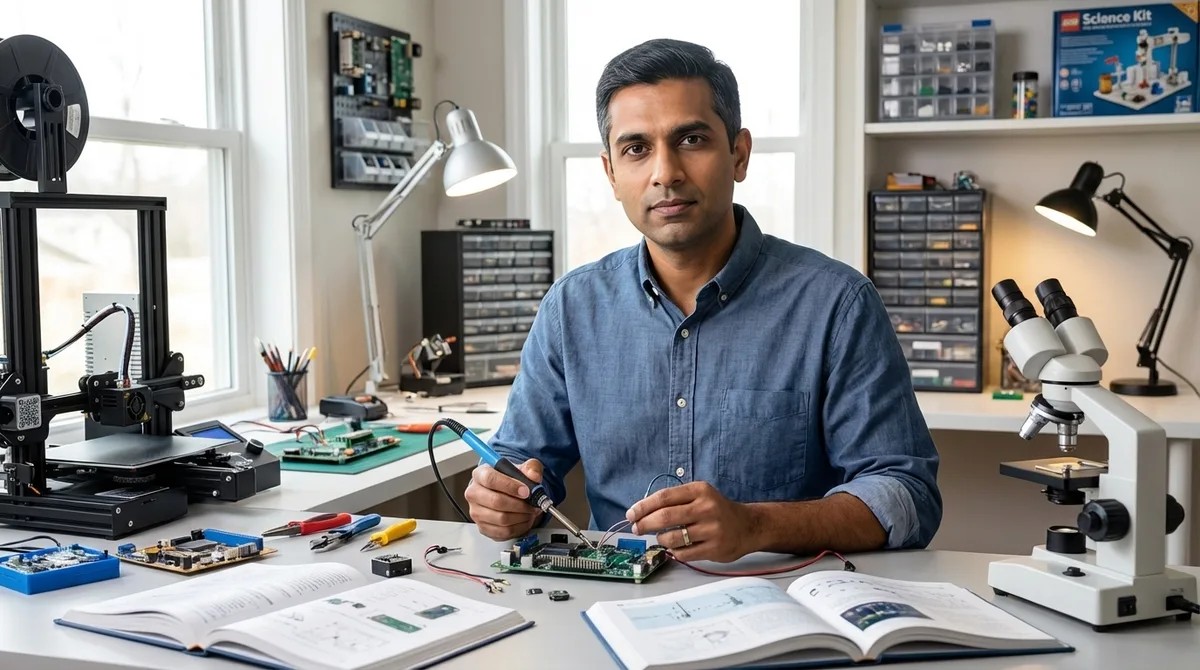
How to Build a Home STEM Lab: Complete Setup Guide for Skill-Building Success
The STEM Lab · The Stem Lab
Audio is streamed directly from the publisher (content.rss.com) as published in their RSS feed. Play Podcasts does not host this file. Rights-holders can request removal through the copyright & takedown page.
Show Notes
Most families approach building a home STEM lab like a shopping spree, grabbing flashy gadgets without understanding how they connect. In this episode, Rajiv Patel shares the phased implementation framework he's developed through years of testing STEM curricula with real families. You'll learn why successful labs function as integrated systems rather than equipment collections, and how to architect yours so every component builds toward measurable skill milestones—from early coding foundations all the way to professional-grade competencies that hiring managers now expect from entry-level candidates.
- A functional home STEM lab operates on three architectural principles: hardware compatibility layering (so tools scale from manipulatives to professional IDEs), infrastructure adequacy (power, ventilation, storage planned for 18–24 months of growth), and curriculum alignment (equipment mapped to specific competencies like "debugs Python syntax errors independently" rather than vague age ranges).
- Most families dangerously underestimate power requirements—running a 3D printer, computer, oscilloscope, and task lighting on one circuit will trip breakers mid-project and teach kids that tools are unreliable when the real failure is infrastructure planning.
- Environmental controls matter more than most guides admit: 3D printing needs 18–26°C and under 60% humidity for consistent results, while soldering requires minimum 40 CFM ventilation to avoid legitimate health risks that force families to abandon entire skill domains.
- Hardware selection should follow a capability dependency model, not age-indexed catalogs—each platform must expose progressively lower levels of abstraction while maintaining backward compatibility with prior learning, or you create "skill transfer debt" where children must unlearn proprietary logic systems.
- Proper tool organization using shadow boards or labeled bins reduces session setup time from 15 minutes to 90 seconds, dramatically lowering the friction that discourages kids from iterating on projects.
- The 2024 IEEE Spectrum salary survey confirms entry-level engineering roles now assume baseline proficiency in CAD software, version control, and hardware prototyping—competencies a properly architected home lab delivers by design.
Read the full article: https://stemlabguide.com/how-to-build-a-home-stem-lab