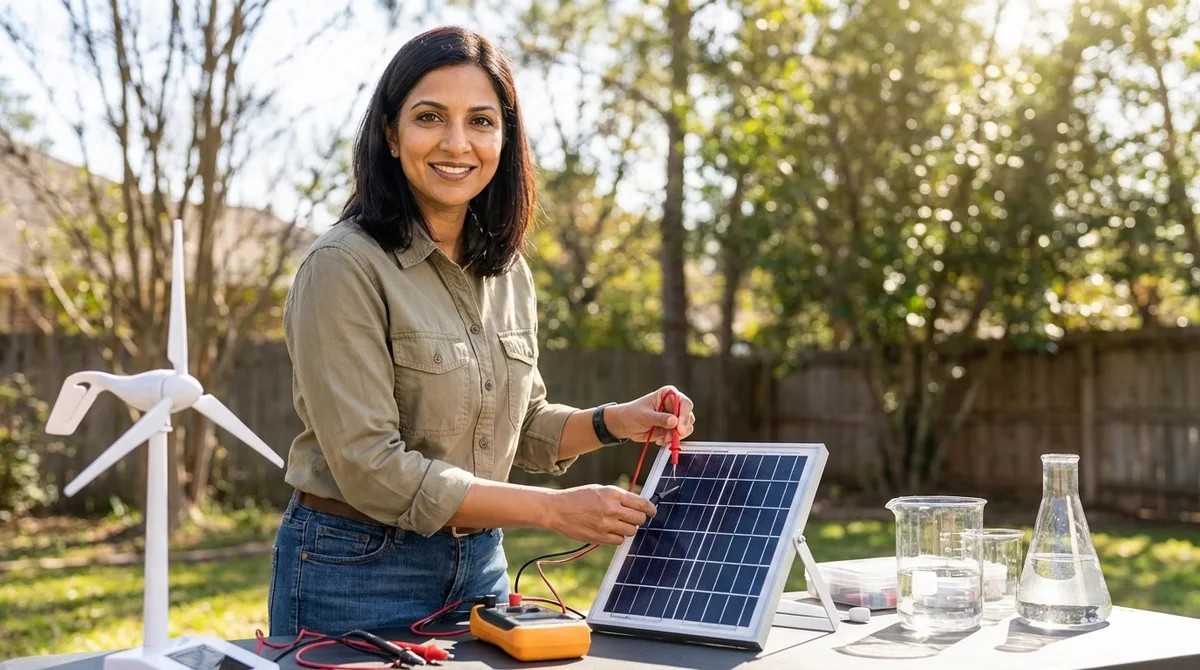
Everything You Need for a Renewable Energy Science Experiment
The STEM Lab · The Stem Lab
Audio is streamed directly from the publisher (content.rss.com) as published in their RSS feed. Play Podcasts does not host this file. Rights-holders can request removal through the copyright & takedown page.
Show Notes
Ever watched a kid's excitement deflate when their solar panel spins a motor but they can't explain *why* or measure *what's happening*? This episode breaks down exactly what supplies you need to transform a basic renewable energy demo into a real science experiment with variables, data, and genuine learning. Host Lakshmi Venkataraman draws on years of classroom experience to walk you through every category of equipment—from energy-generation components to measurement tools—so you can set up your child for actual scientific inquiry, not just a cool-looking display.
- Small solar panels with exposed terminals (rather than pre-wired connections) force students to build circuits themselves, which teaches fundamentals that plug-and-play kits skip entirely.
- DC hobby motors do double duty: they consume energy when powered by solar panels and *generate* energy when spun by wind or hand, demonstrating energy conversion reversibility in one cheap component.
- Different colored LEDs light up at different voltage thresholds (red at ~1.8V, blue/white at ~3V), giving you a built-in visual experiment for comparing power output without extra equipment.
- Hand-crank generators create a kinesthetic connection to energy production—students physically feel the resistance increase as they power a load, making abstract concepts concrete.
- NiMH rechargeable batteries are safer and more forgiving than lithium-ion for student experiments, though charging times can stretch to hours or days, which disrupts immediate feedback loops.
- The critical shift from demonstration to experiment happens when you add measurement tools like digital multimeters—without data collection, students are just watching things spin instead of doing science.
Read the full article: https://stemlabguide.com/everything-you-need-for-a-renewable-energy-science-experiment