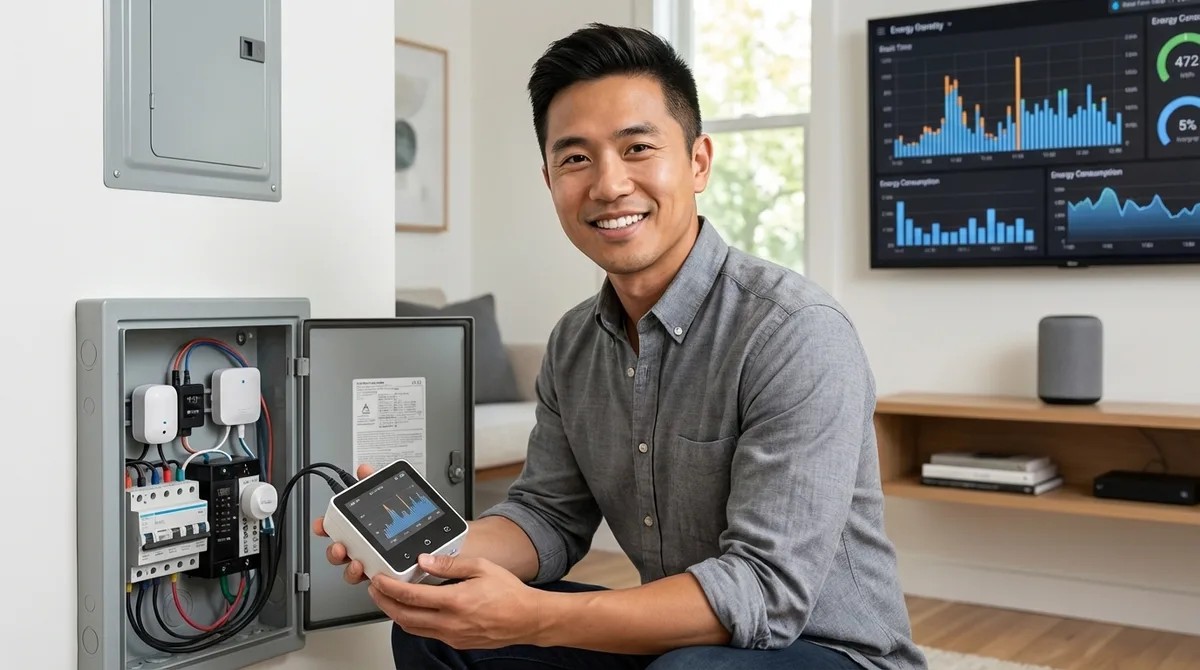
What Is Real-Time Energy Monitoring in Smart Homes: Protocols and Accuracy Explained
The Smart Home Setup Podcast · My Smart Home Setup
Audio is streamed directly from the publisher (content.rss.com) as published in their RSS feed. Play Podcasts does not host this file. Rights-holders can request removal through the copyright & takedown page.
Show Notes
Ever wonder why your electricity bill keeps climbing but you can't pinpoint the culprit? This episode breaks down real-time energy monitoring systems that show you exactly which devices are draining power second by second—and how homeowners typically cut their bills by ten to fifteen percent within six months of installation. Marcus Chen explains the technical differences between whole-home panel monitors and plug-level trackers, walks through the protocols that matter (Wi-Fi, Zigbee, and Matter), and reveals accuracy limitations manufacturers don't advertise.
- Whole-home monitors use current transformer (CT) clamps that sample four thousand to eight thousand times per second, achieving 95–98% accuracy for simple resistive loads but dropping to 85–90% accuracy for motors and compressors due to phase shift between current and voltage.
- Wi-Fi energy monitors connect directly without a hub but push data through the cloud, introducing two to five second delays—acceptable for tracking but too slow for real-time automations like load balancing.
- Zigbee smart plugs with energy monitoring only expose consumption data if your hub's API supports it; otherwise, readings stay locked in a proprietary app where you can't build useful automations.
- Matter-enabled energy monitors are emerging in 2026 with promises of cross-platform compatibility and local two to three second updates via Thread, while Z-Wave options have largely disappeared from this category.
- Smart plug monitors use either shunt resistors or Hall effect sensors to measure current, and protocol choice directly affects update frequency—Wi-Fi plugs refresh every one to two seconds while Zigbee plugs typically update every five to ten seconds through your hub.
- Practical automations like "notify me when laundry is done" depend on consistent power reporting; Wi-Fi plugs that lose connection can silently fail, leaving your automation broken without obvious errors.
Read the full article: https://mysmarthomesetup.com/what-is-real-time-energy-monitoring-in-smart-homes