Show overview
The Reason We Learn has been publishing since 2022, and across the 3 years since has built a catalogue of 81 episodes. That works out to roughly 120 hours of audio in total. Releases follow a fortnightly cadence.
Episodes typically run an hour to ninety minutes — most land between 1h 6m and 1h 55m — though episode length varies meaningfully from one episode to the next. None of the episodes are flagged explicit by the publisher.
There hasn’t been a new episode in the last ninety days; the most recent episode landed 12 months ago. The busiest year was 2024, with 34 episodes published.
From the publisher
American education is broken. We know we can do better—and here’s where we talk about how. thereasonwelearn.substack.com
Latest Episodes
View all 81 episodes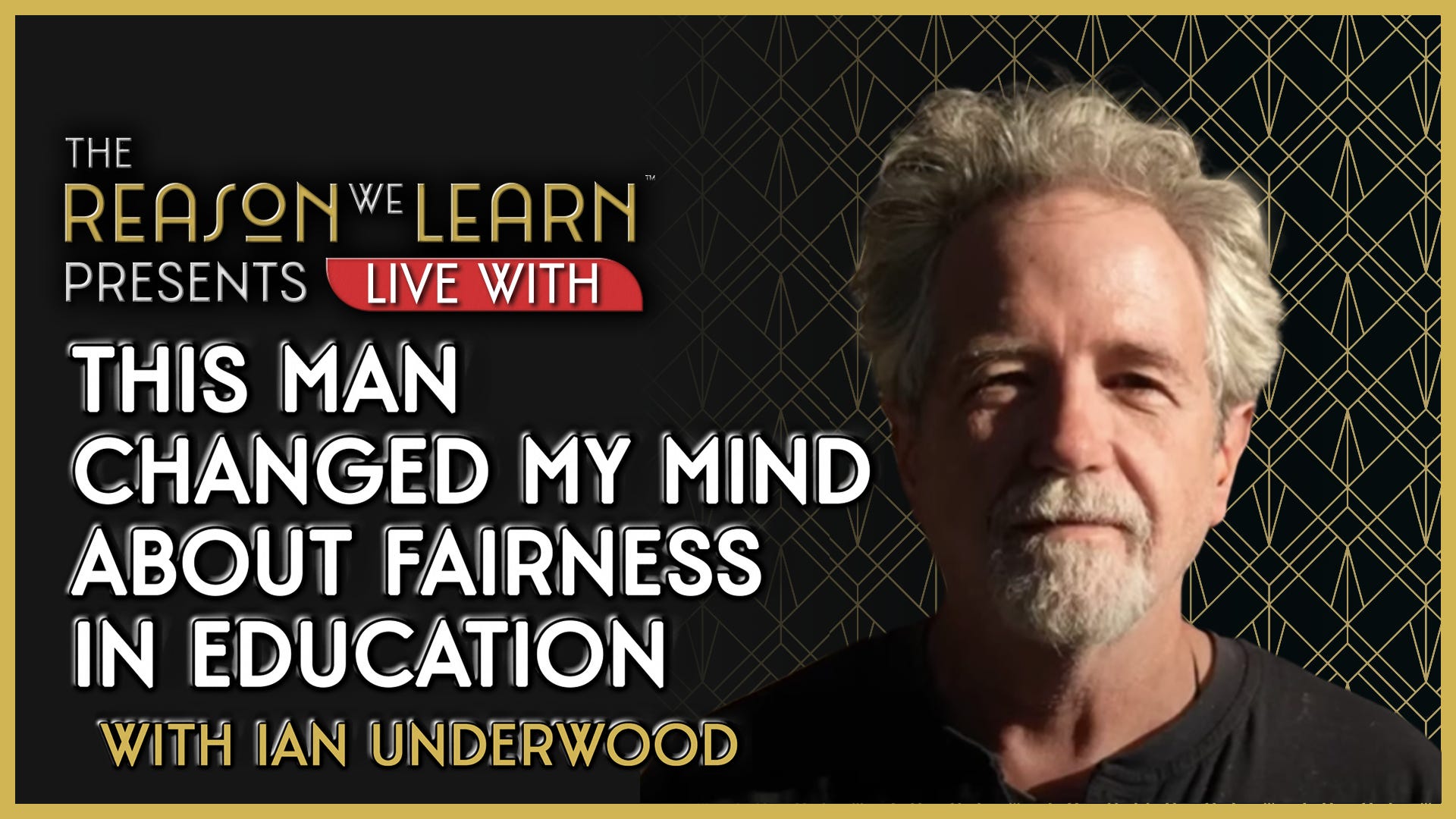
This Man Changed My Mind About Fairness in Education
Have you ever read a book on a subject you thought you already understood inside and out—only to realize something so blindingly obvious, you feel almost foolish for not having seen it before?That’s how I felt reading Ian Underwood’s Rethinking Fairness in Education and Stop Lying About Education Savings Accounts. In these two books, Ian takes the issue of money in education—a complicated and contentious topic—makes it almost effortless to understand. Using compelling visuals, humor, and simple thought exercises, he subtly leads the reader to first principles, making it nearly impossible to mistake opinion for fact, or wishful thinking for reality.In this conversation, Ian and I talk about how “fairness” could apply in education, why the talking points in support of ESAs are lies, and how we can have more productive conversations about reforming education in the future if we just start asking different questions.I can’t recommend his books enough. If you’re a parent, teacher, policymaker—or just someone who believes we all deserve better—kids and taxpayers alike—these books are essential reading.Get the books:* Rethinking Fairness in Education* Stop Lying About Education Savings AccountsWatch the full conversation here, and then read them. You’ll come away seeing public education in a whole new light!You can also find Ian’s writing at Granite Grok blog.This Substack is reader-supported. To receive new posts and support my work, consider becoming a free or paid subscriber. You can also buy me a coffee! Get full access to The Reason We Learn at thereasonwelearn.substack.com/subscribe
When 'Freedom' isn't Freedom at All
In this video, I challenge the way “freedom” is being defined and sold to us today. Using the debate over school choice and vouchers as a case study, I argue that more government-approved options aren’t freedom at all—just a rebranded form of control. I share my own definition (“the right to say no”) and ask: if the state still holds the strings, can we really call it freedom?PS: If adults struggle to communicate when we use the same words in very different ways, imagine how much harder it is for our teens—especially if no one has taught them to question the meanings of the words they use and hear. That’s exactly what my Words Matter course at Cogito Learning Center is designed to do. This fall, I’ll help teens closely examine loaded terms like “freedom,” “rights,” and “fairness” so they can think more critically and communicate more clearly in public discourse. Read my article about it here. Registration is now open, and space is limited. Get full access to The Reason We Learn at thereasonwelearn.substack.com/subscribe
Stop Pretending School Works
This Substack-only segment from my conversation with Matt Bowman, co-founder of OpenEd, is a focused follow-up to our longer YouTube interview. In this shorter discussion, we step back from the big picture and ask a more immediate question:What should parents be asking themselves before committing to another year of school?If you’re sitting at the kitchen table wondering whether the conventional path is working for your child — or your family — this short segment is for you.Matt offers simple, clear starting points:* Is your child happy?* Is your current plan working — or just familiar?* What are your child’s actual interests?* What does your family need — logistically, emotionally, spiritually — from an education plan?* How can those needs intersect to support real growth?We talk about what it looks like to pause, reflect, and begin shifting your mindset from system compliance to family-centered learning. This isn’t a deep critique, it’s a practical entry point for families serious about taking charge of their children’s education.To explore the broader conversation — including why the system is failing and why open education is the alternative every family should at least consider — watch the full interview on YouTube:Want to learn more about OpenEd? Check out Open Education: How to Reimagine Learning, Ignite Curiosity, and Prepare Your Kids for Success by Matt Bowman and Isaac Morehouse—a hands-on guide from two practitioners who’ve worked with over 100,000 students to help families escape one-size-fits-all schooling and build personalized learning journeys.Disclaimer: I’m referencing this book because Matt is a co-author not because I endorse every approach or detail it presents. However if you want to explore the OpenEd model more deeply, it’s a solid place to start.If you value independent writing that tells the truth about education, subscribe. To support me directly, buy me a coffee. Get full access to The Reason We Learn at thereasonwelearn.substack.com/subscribe
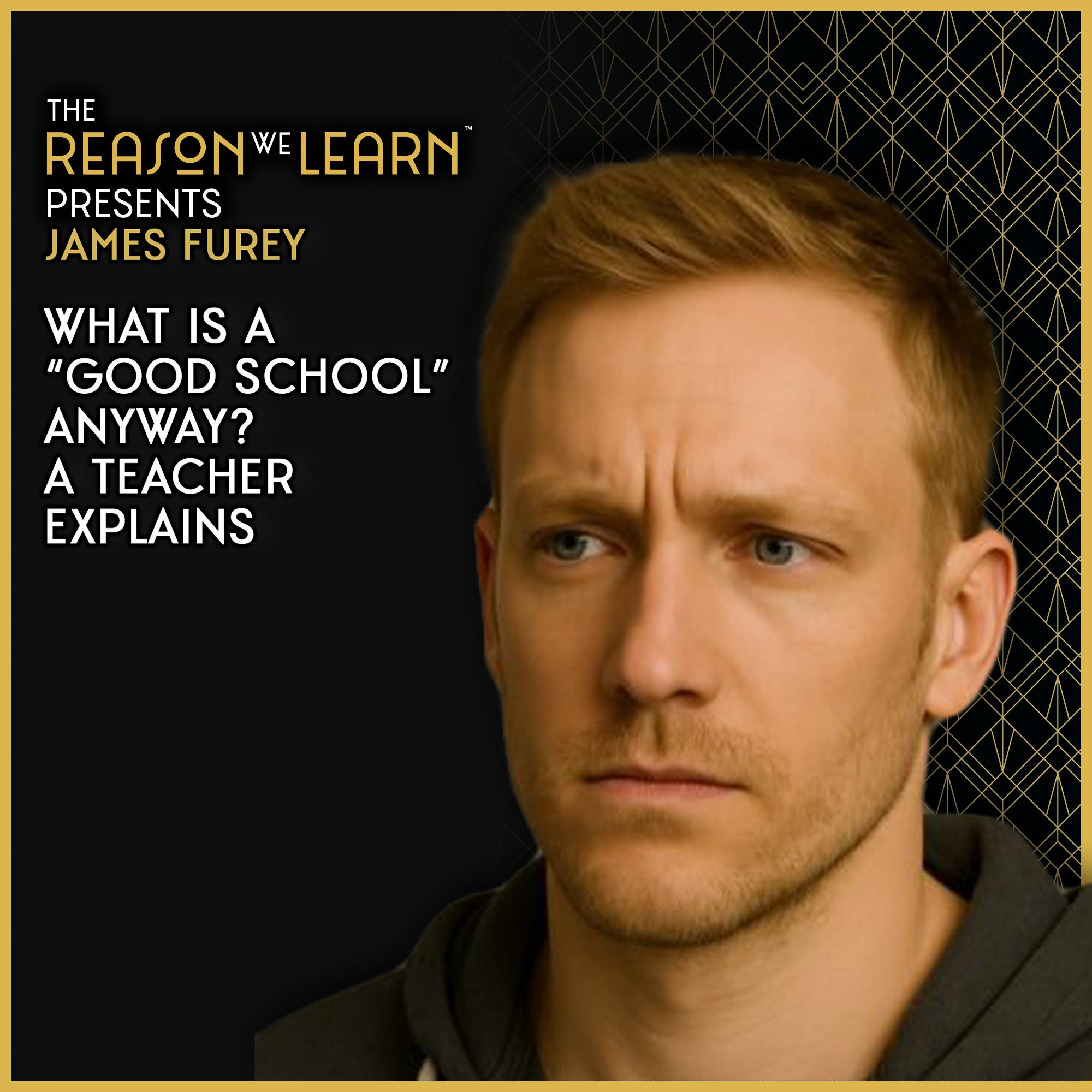
What is a "Good School" Anyway? A Teacher Explains
In this episode, I sit down with veteran educator James Furey to unpack a question many parents and educators grapple with: What makes a school “good”? We explore how standardized test scores, college admissions, and school rankings often fail to capture the true quality of education. James shares insights from his years in the classroom, discussing the impact of school culture, teacher autonomy, and student engagement on learning outcomes.Whether you're a parent evaluating school options or an educator reflecting on your practice, this conversation offers a thought-provoking look at the deeper elements that contribute to a meaningful education.🎓 Want More Than School Can Offer? Let’s Work Together.If you're ready to give your child a real education—not just schooling—visit CogitoLearningCenter.com to explore how I can help. Whether you need expert tutoring, personalized curriculum guidance, or full enrichment courses, I work directly with families to design a learning path that actually works.🟢 Start here: CogitoLearningCenter.com💡 Support This WorkIf you value the conversations and content I share, you can help in a few simple ways:☕ Buy Me a Coffee: buymeacoffee.com/trwl💸 Direct Support via PayPal: paypal.me/deborahfillman📰 Subscribe on Substack: thereasonwelearn.substack.com🛍️ Shop & Learn with My Affiliates📚 Heroes of Liberty Books: Get 10% off with my link: heroesofliberty.com/?ref=Zqpq🧠 The Socratic Experience: Give your child deep, discussion-based learning. Get 10% off here:socraticexperience.com/parent-guide/?utm_source=thereasonwelearn📲 Follow for MoreX (Twitter): @owl_elcInstagram: @thereasonwelearn Get full access to The Reason We Learn at thereasonwelearn.substack.com/subscribe
Educated into Compliance: The Constitutional Case Against Compulsory Schooling
What If School Is Unconstitutional?How compulsory education laws violate your First, Fourth, and Fifth Amendment rightsWhat’s the underlying assumption behind compulsory education laws?That you, as a parent, will neglect your child — or more to the point, are already neglecting your child. That’s the premise the state must adopt in order to justify compulsory education. If the government truly believed parents were, on the whole, responsible and capable of educating their children, these laws wouldn’t exist.We don’t pass laws that compel action based purely on what might happen. At least, we’re not supposed to. We don’t incarcerate people preemptively because they might commit a crime. But with schooling? You had a baby — and the state assumes you're going to neglect their education. Not some parents. All parents. That’s what compulsory schooling assumes.And how do they act on that assumption? By sentencing every parent and child to a 13-year obligation, regardless of individual circumstances. The law applies equally to families with no history of neglect or concern. You don’t get a day in court. There is no probable cause. There is only your child’s birth certificate, your tax return, and your zip code — and that’s enough to trigger state control over your child’s education.Let’s talk about rights.The Fourth AmendmentThis amendment protects against unlawful searches and seizures — meaning the government cannot intrude on your privacy or property without probable cause. So what is the state’s probable cause for seizing control of your child’s education the moment they turn five or six?There is none.Compulsory education laws function on a blanket presumption of guilt. The state doesn’t investigate your family or review your individual circumstances. It simply assumes that because you're a parent, you're potentially dangerous — and your child's education must be monitored and directed by law.The Fifth AmendmentThe Fifth Amendment guarantees due process. Before the government can deprive you of liberty or property, you’re supposed to have your day in court.But when it comes to education, the sentence is handed down with no trial. No hearing. No opportunity to argue that you are, in fact, capable of educating your child — or that you intend to do so in your own way.Instead, you’re told what education is, what it looks like, how many hours it must happen, which subjects must be covered, and when. And if you decide to homeschool, you must apply for permission, meet qualifications, log hours, submit test scores — and still be held to the state’s definition of “schooling.”Where is the due process in that?The First AmendmentNow let’s talk about speech, thought, and association.Who decides what your child hears, says, or thinks during their 13-year sentence? The state. Who they’re around, what ideas they’re exposed to, what beliefs are promoted — it’s all decided for you. Freedom of association? Gone. Freedom of expression? Only within the bounds the state permits.And if you object? If you keep your child home too many days, for any number of personal reasons — sickness, mental health, family needs — you could be charged with truancy. Social services might come knocking.The Cost of CompulsionYou are also compelled to pay for all of it. Even if your child never sets foot in a public school. Even if you’re educating them at home or sending them to a private institution. You’re still taxed to support a system that presumes you unfit and overrides your rights.This is not just about poor outcomes. Yes, public education often fails to teach children to read or calculate, even after years of standards, reforms, and record funding. But that’s not the central issue.The central issue is this: the system violates your rights. And it does so under the guise of benevolence, of progress, of social good.And now, school choice is being sold as the solution — but it doesn’t solve the problem. It expands it. School choice doesn’t restore your rights. It entrenches the state’s role. It simply lets you satisfy your legal obligations in a slightly different way, with a different set of government-approved options — and with more oversight, not less.It’s not liberation. It’s rebranding.Why I'm an AbolitionistWhen I say I’m an education abolitionist, this is what I mean.I don’t believe the government has the right to override your parental authority without due process. I don’t believe your child should be subject to ideological programming in a state-mandated environment. I don’t believe you should be taxed to fund a system you didn’t choose and may even object to on principle.The existence of bad parents does not justify treating every parent as one.We don’t abolish rights because someone might abuse them. We don’t eliminate speech because someone might say something hateful. We don’t ban due process because someone might be guilty. And we should not accept compulsory schooling — with all of its constitutional violations — just because s

Is Your Child a Victim of Educational Neglect?
When teachers don’t teach, students don’t learn everything they’ll need to know to be successful in school, or in life. It’s as simple as that. Contrary to the assertions of the PhDs from Columbia and UPENN, most students do not, and will not, “discover” reading and writing proficiency, never mind proficiency at math, science, history, civics, and logic (what some call “critical thinking”). My good friend Dissident Teacher has written prolifically on this topic, and I strongly suggest you read every word, but make sure you listen to what I have to report from my experiences as an independent enrichment tutor. If, after listening to this, you’d like to discuss enrichment tutoring for your children, schedule a free 30-minute consultation here. Get full access to The Reason We Learn at thereasonwelearn.substack.com/subscribe

The PURGE: Erasing the Enlightenment One Child at a Time
What are your children learning in school about man and what he should do in life? What kind of "self" are they being encouraged to develop? Do you even know? James Lindsay joins me to discuss the Marxian religious questions our children are being taught to ask in school, how the answers are purging enlightenment values from American culture, one lost "self" at a time. An American-born author, mathematician, and professional troublemaker, Dr. James Lindsay has written six books spanning a range of subjects including religion, the philosophy of science and postmodern theory. He is a leading expert on Critical Race Theory, which leads him to reject it completely. He is the founder of New Discourses and currently promoting his new book "Cynical Theories: How Activist Scholarship Made Everything about Race, Gender, and Identity―and Why This Harms Everybody," which is currently being translated into more than fifteen languages.Join us for a discussion about what it means for all of us when our children are taught an anti-enlightenment theory of mind? Get full access to The Reason We Learn at thereasonwelearn.substack.com/subscribe

What Really Makes American Schools So Unsafe?
How often have you heard someone say “We have a mental health problem!” in the aftermath of a school shooting? It’s usually the thing you hear immediately after “We need commonsense gun control,” or "gun-free zones make easy targets."I’m going to guess it’s roughly every time, and it’s even possible you’ve said it yourself. Who could blame you? No one would deny the fact that anyone shooting up a school is mentally disturbed, but is that the whole story? Why schools? Why students and teachers? Why aren’t we asking these questions?My guests for this show, Pamela Garfield Jaeger and Cyndi O'Brien have some thoughts on that subject, as well as some fascinating stories to share about how “mental health” is actually addressed at school, some of which may surprise you. They'll explain how there might be more to the choice of location than the usual narratives would have us believe.Also, if you are currently under the impression we need more mental healthcare at school, or that every child should be evaluated for mental illness by default by school counselors, you’ll want to hear what these ladies have to say.My Guests:Pamela Garfield-Jaeger has worked as an LCSW for over 20 years in a variety of settings and programs. Most recently she worked with teens in school and outpatient settings. She realized that the vast majority of parents are unprepared to engage the Mental Health system from a position on knowledge and understanding. She is here to help educate parents on what to expect and how to interact with a very complicated and insular system.Follow Pam on X @truththerapist, and check out her website, work, public speaking and service offerings here: https://linktr.ee/thetruthfultherapistCyndi O'Brien is a former K12 education insider. She was an English teacher for 17 years and a school counselor for 3 years. She finally quit because of the corruption. She has been a whistleblower and produces her own videos and podcasts exposing what goes on behind the scenes in K12 education.Cyndi is currently employed as a child trauma therapist while she works toward professional counselor licensure (which should occur in just a couple of months). She also works as a college instructor of both English and Counseling. Follow Cyndi on X @ObrienCynd72601 and on YouTube @k12formerinsider Get full access to The Reason We Learn at thereasonwelearn.substack.com/subscribe

Ditching Devices is Crucial for Learning
Have you ever had a negative gut reaction to something that everyone else was excited about? That was me with EdTech. Everything I’d learned about learning, from brain science, to child psychology and development, told me “This is a bad idea,” but everyone I knew, parents and teachers alike, thought it was just fabulous. Here’s a sampling of what I heard most often from teachers:”They’ll be so much more engaged, and it will make differentiation so much easier!””I can be so much more creative with my teaching, and with so many online lessons, I’ll save so much time.””Now we don’t have to hear ‘I forgot my book,’ and kids don’t take good care of books anyway.””We are really lucky actually; Some schools don’t have devices yet, so their kids will lag behind in their 21st Century skill development.”Parents were slow to catch on to the fact that their kids weren’t bringing books home anymore, but when they did, most I knew were happy their kids were getting “access” to technology, and even called it a “privilege” they hoped all students would soon have. I remember fundraising efforts to raise money for the purpose of purchasing one-to-one devices for schools that didn’t have them yet, and electronic white boards to go with them too. *Sigh.* I felt very lonely on my island of skepticism and concern, even as test scores dropped like a stone, and the number of ADHD, anxiety, and depression diagnoses increased dramatically. That is until today, when my gut was validated, and my concern vindicated by this article by Jared Cooney Hovrath for After Babel. The article inspired me to do a mini podcast as a companion/reaction specifically about dopamine addiction, so you will understand how EdTech combines with tech use outside of school to create and exacerbate the very problems we’re told EdTech prevents: boredom, disengagement, demotivation, and depression.Please read the article because you need to see the data for yourselves! You also need to understand the science behind the damage. In particular, I recommend you pay close attention to the section on Multitasking. If you’re the parent of a middle or high school student who insists he or she can “multitask,” you’ll finally have the evidence to back you up when you say “No, no you can’t.”The Reason We Learn is a reader-supported publication. To receive new posts and support my work, consider becoming a free or paid subscriber. Get full access to The Reason We Learn at thereasonwelearn.substack.com/subscribe

Give Me Liberty, Not "Choice"
If you’re new here, you might be surprised to learn that someone as critical of America’s public education system would oppose School Choice, but it’s true. I do. I want education liberty, and that means I’m what’s called a government school abolitionist. That means exactly what you think it means: I want to abolish the government education system in America, at the federal AND state levels. I truly believe children cannot possibly get the education that’s right for them, or that they deserve, as long as the state controls education, and as you’ll hear Courtenay Turner say in our interview: what the government funds, the government runs.Public Education is Not a “Right”In the clip above, Courtenay recounts a conversation she had with people involved in school “reform” at the state level in her new home state of Tennessee. They insisted public education is a “right.” Is it though? Let’s look:* In the Declaration of Rights, which is the Bill of Rights of the Tennessee Constitution, there is no mention of Education whatsoever, never mind as a “right.” I read it twice, all 36 sections. Not a peep. * However, somewhat ironically, the same Declaration of Rights does say the following: * Section 1. That all power is inherent in the people, and all free governments are founded on their authority, and instituted for their peace, safety, and happiness; for the advancement of those ends they have at all times, an unalienable and indefeasible right to alter, reform, or abolish the government in such manner as they may think proper.* Section 22. That perpetuities and monopolies are contrary to the genius of a free State, and shall not be allowed.* After the Declaration of Rights, Article XI, Section 12 reads: The State of Tennessee recognizes the inherent value of education and encourages its support. The General Assembly shall provide for the maintenance, support and eligibility standards of a system of free public schools. The General Assembly may establish and support such postsecondary educational institutions, including public institutions of higher learning, as it determines.So what Courtenay Turner said — what they tossed her from the meeting for saying — is actually correct. The Tennessee state constitution says that the state “shall provide,” it doesn’t say the parents or the children must take. Additionally, when these people referenced “children’s rights,” they were either imagining them or inventing them to support their argument. There is no language in the document referencing “children’s rights” to anything other than the same right to due process their parents have (see Section 7 below):That the people shall be secure in their persons, houses, papers and possessions, from unreasonable searches and seizures; and that general warrants, whereby an officer may be commanded to search suspected places, without evidence of the fact committed, or to seize any person or persons not named, whose offences are not particularly described and supported by evidence, are dangerous to liberty, and ought not to be granted. In other words, unless and until the state has evidence that parents are willfully neglecting, exploiting, or otherwise harming their children, they have no authority under this constitution to force the children of Tennessee out of their homes, and away from their parents period, never mind for thirteen years, all day, for at least nine months of the year. If you’re still skeptical, read Section 8:That no man shall be taken or imprisoned, or disseized of his freehold, liberties or privileges, or outlawed, or exiled, or in any manner destroyed or deprived of his life, liberty or property, but by the judgment of his peers, or the law of the land.So, at least in Tennessee, public education is neither a right to receive, nor an obligation to take, despite what Courtenay was told. What’s more, the Bill of Rights of the United States — as properly-educated Americans know — guarantees due process to all Americans, regardless of where they live. Federalism aside, no state has the authority to nullify the following: Amendment IVThe right of the people to be secure in their persons, houses, papers, and effects, against unreasonable searches and seizures, shall not be violated, and no Warrants shall issue, but upon probable cause, supported by Oath or affirmation, and particularly describing the place to be searched, and the persons or things to be seized.These facts notwithstanding, Tennessee has this compulsory education law: Tenn. Comp. R. & Regs. 0520-01-02-.17 reads:(1) Children entering kindergarten shall be five (5) years of age on or before August 15. However, a child does not have to enroll in school at five (5) years of age, but enrollment must occur no later than the beginning of the academic year following the child's sixth (6th) birthday.(2) Any transfer student applying for admission who was legally enrolled in an approved kindergarten in another state and who will be five (5) years of age no later
Elite-College Johnny Still Can't Read
We were warned.Almost seventy years ago, reading expert Rudolph Flesch’s bestselling book, Why Johnny Can’t Read, and What You Can Do About It warned Americans of the dangers of using the ‘look-say’ method to teach reading rather than phonics. Flesch argued that because look-say teaches students to memorize whole words by sight, rather than phonics, it was ineffective. He also said the simple stories typical of the look-say readers (e.g., Dick & Jane) did not help students develop a broad enough vocabulary to prepare them for reading increasingly complex material as they progressed through school. Rather than heed his warning, we doubled down on whole word reading instruction, and by the year 2000, most American schools, led by the New York City Schools, and Columbia Teacher’s College, had implemented Lucy Calkins’ Balanced Literacy Units of Study For Teaching Reading curriculum. Calkins’ program took the look-say method, and expanded on it, teaching children to guess words they didn’t know using “context clues” like pictures, rather than phonics. Balanced literacy limited the vocabulary students could learn just as much as look-say, but added an element of frustration for the children. Since they were expected to fill in their own gaps using “context clues,” students would interpret their lack of progress as evidence they were “no good at reading.” If they didn’t improve at school, teachers would advise parents to encourage students to read more outside of school, and if that failed, teachers would simply blame parents.There were always those exceptions, those students who learned to read at home, before entering school, or whose parents filled in gaps with things like Hooked on Phonics, or tutoring, and plenty of private schools still taught reading using phonics for a while, but eventually, even private schools adopted the Calkins method, and for decades, America’s children learned to read in a way that took what ought to have resulted in hours of cognitive growth, and enjoyment, into self-esteem-crushing drudgery that few students voluntarily pursued outside of school.The groundswell of anger and frustration that had been building amongst parents and teachers over the years finally caught up with Calkins in the form of a podcast. Sold a Story, produced by award-winning journalist Emily Hanford in 2022, had more people sharing it than any other show in 2023, and finally, in October of the same year, Columbia Teacher’s College finally parted ways with the Calkins curriculum. Did we take too long to listen?Just this week, The Atlantic published a piece entitled The Elite College Students Who Can’t Read Books, by Rose Horowitch, in which she tells readers something I’ve known for a long time: starting in middle school America’s teachers have stopped asking students to read books. Yes, you read that correctly. Students in the vast majority of middle and high schools are never assigned a book. That is not to say they don’t read at all, or that they aren’t told to select a book to read on their own; they’re just never required to read a book with the class, or asked to read it closely enough to learn new vocabulary, or analyze the text along with a teacher who knows it well, and can help the student think about the themes, characters, or problems more deeply than they possibly could with their limited life experience and cultural knowledge. Most students today read passages, and most of those are non-fiction as well. As a result, even elite college students today lack the stamina to read the sheer amount of material they would (should) be expected to read at the college level. Compounding the problem is the fact that their lack of reading has resulted in a limited vocabulary, and lack of writing skill. These are students who have not been exposed to great writing at all in some cases, never mind often enough, and with enough study or understanding (never mind grammar instruction) to write coherently, never mind well.This isn’t just a description of what most students are capable of doing, it’s also indicative of what they are inclined to do. Factor in competition for their attention from technology, and their anxieties about everything from their job prospects (made more limited by their lack of reading and writing skill) to climate change, and we have a huge challenge on our hands in this country.Most professors have simply decided not to assign challenging books at all because they know the students won’t read them. After all, at many elite schools, thanks to grade inflation, the students know they don’t have to complete their assignments at all, and they won’t “flunk out.” If their schools are anything like Harvard, as many as 79% of them could still have an A average.So did we wait too long? I suppose time will tell, but the simple fact is, this is where we are: even elite college students don’t read, and their employers, and possibly the rest of us, to the extent we need them to do things that require rea
What About Socialization?
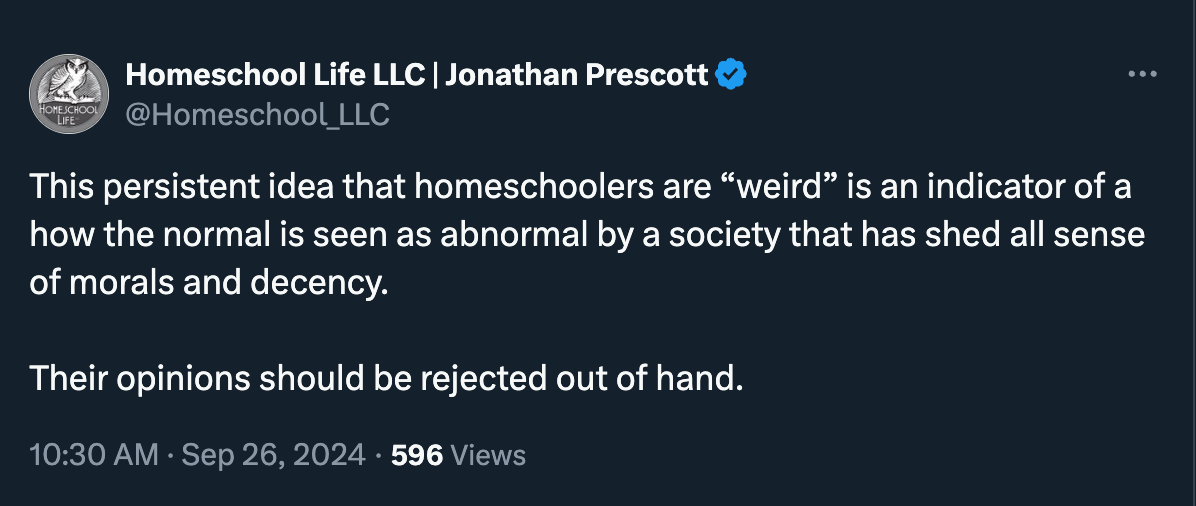
I want to dig into the topic of “socialization” brought up today on X (see post below from Homeschool_LLC) because I truly believe the enduring myth he describes is likely the primary reason most people who could and would be inclined to homeschool their children, choose not to. “What about Socialization” was, and still is, the most common question I get, often followed by “but aren’t you afraid they’ll be weird?”The following details what I now say to people who ask this question. Feel free to use it yourself or, if you’re one of the people inclined to ask the question, please read this with an open mind.Define “weird?”Hey, this is me. If you don’t know already, you soon will; I am a person who insists that people define their terms before I will engage in any discussion, least of all one aimed at (unsolicited) denigration or judgement of my life choices.Here’s what the dictionary says:Well look at that: “Of strange or extraordinary character: ODD, FANTASTIC.” That would only be a bad thing if the opposite of weird is universally desirable, right? Well what are the antonyms for “weird?”Hmmm…I don’t know about y’all, but I’m not aiming to raise a “typical” adult, or an “ordinary” one either. I’m not saying I’ll be disappointed in my kids if they aren’t stand-outs in some way, but I want them to be individuals, not conformists, especially if I don’t approve of the “commonplace” “standards” that are “usual” in today’s society.Still, I doubt most people using the term mean “weird” exclusively the way it’s defined above. My guess is they mean “Won’t know how to get along or interact with people,” or “Won’t know how to make friends.” So that brings me to my next point:What does “getting along with” others look like?There are two interpretations of the phrase “getting along with.” I’m not using the dictionary now, I’m defining these based on my own experience, and answers given to me by anti-homeschoolers when I’ve asked them:* Able to interact with people who disagree, or are not like them, without experiencing unmanageable distress or conflict, and while still maintaining their own personal boundaries (that is, behaving in polite, respectful, situationally-appropriate ways, without sacrificing their own needs, or abandoning their own values). * Conforming to the behavior of the dominant personalities in any given space, or subjugating their own needs and values to the demands and desires of the collective.OK, to be fair, no one actually gave me that second definition as-written, I’m extrapolating from comments like “C’mon, you know what I mean!” and “Not standing out, not being a creepy loner…Doing what the other kids are doing, you know, having an active social life with friends!”Most people would probably agree that answer number one makes sense, and is probably what most parents think “getting along with” others ought to look like, so then the question is, are homeschoolers really hobbled in their ability to “get along” with others by that definition? No, they are not, and research backs me up on this. Kerry McDonald reported in February of this year that research done by the Harvard Human Flourishing Program found:“…home-schooled children generally develop into well-adjusted, responsible and socially engaged young adults,” So then the next logical question should be,How are kids “socialized” at school?Homeschoolers like me don’t dispute the fact that schools do “socialize” kids, we just dispute that they do it better than homeschooling. We say that because our definition of “good” includes “getting along with others” as described above. Therefore to be objectively “better” at socialization, schools would have to produce people who get along “better” by those standards than people who are homeschooled. Look around; Is it your experience that the average public school kid “gets along better” with people? Are they more respectful towards their teachers, parents, and strangers in public? Do they get into fewer fights with their peers, or express less rage or extreme disappointment when they don’t get what they want? When they meet new people, are they more comfortable making eye-contact, introducing themselves, and starting conversations than their homeschooled peers? Evidence would strongly suggest they don’t. One in six school-aged children is suffering with some form of mental illness. School attendance alone is strongly correlated with youth suicide, and especially since the lockdowns, school violence has gone up steadily year after year. Are these statistics that argue for school-based socialization? Even if you don’t blame the school, or its approach to setting and enforcing standards of behavior, for all that dysfunction, you can’t deny that telling families their kids will be “weird” if they don’t go to school isn’t a compelling argument against homeschooling. Even if “weird” did mean friendless and awkward, is that really worse than suicidally depressed and violent, or in classes all day with kids who
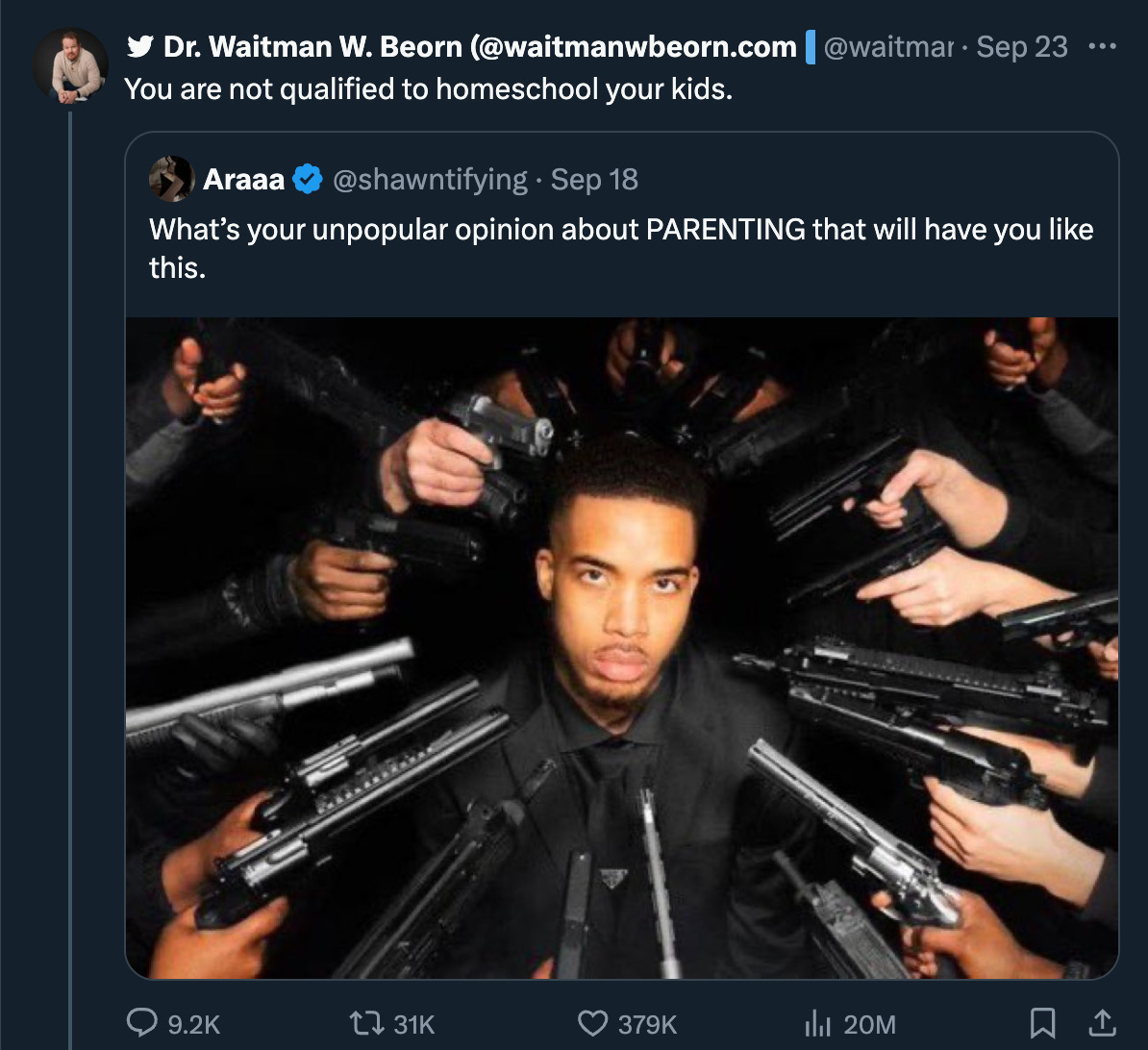
Yes You ARE Qualified to Homeschool Your Children
This post is not the first I’ve ever seen on social media from someone insisting we’re not “qualified” to homeschool our own children. I’ve addressed this before on my YouTube channel many times, within the context of other videos, but here I’m trying to give you some responses you can use to push back on people who say you’re not qualified (because you are).1. Define Qualified?The first thing you should always do when someone says you’re not qualified is to insist they define their terms. Don’t assume you know, and start defending yourself. If they throw something at you like “You don’t have a certification,” or “You haven’t been properly trained,” or “Where did you get your teaching degree?” simply follow that with the following:* What does “certification” do for the teacher, or the student, do you know? * Define “properly trained,” to do what exactly?* What do people with teaching degrees have that makes them more qualified to teach my individual child (whom you do not know) than I am?You could keep going with this all day if need be. The point is not to convince them you are qualified, the point is to challenge the validity of their claim. Unless and until they can define what qualified is, what teachers do that you could not do, and what teacher training delivers that you could not get on your own (if you don’t already have it), they have no point, and should be made aware of that.There is no specific class a parent takes to learn to teach their child to walk, talk, and go to the toilet, and yet most parents figure out it, often by asking other parents, their own parents, or even the Internet what to do, and those who have a child who struggles with these milestones — if they love their children — tend to start looking for help from people who are trained to find out why. Why would you not be able to do the same thing with teaching your child how to read, write, and do math?2. How Do You Know Teachers Are Qualified?It cracks me up how many people assume teachers are qualified to teach, just because the government, or some college or university said so! There’s a teacher shortage, first of all, so many sates have relaxed their standards to make it easier, not harder, for people to “qualify” to teach. Additionally, “qualified” and “certified” are not the same thing (see question above — make sure your interlocutor knows that). Certification has as much (if not more) to do with professional standards, and the laws and liabilities associated with teaching within the government system as it has to to with knowledge of pedagogy or praxis.3. My House is Not a School.Why would you need to be qualified to do what a teacher does when your house is not a school? Teachers, by definition, are professionals whose job is to work with many children at one time in a standardized way, covering required material, or material “aligned to state standards,” not to your individual child’s cognitive abilities, or interests. So the school might teach reading at a rate faster or slower than your child’s optimal speed, and there really is no way for the teacher to “individuate” the instruction without discriminating against other students. As the parent, you are not limited by such concerns. You can spend as much, or as little time as you like, and what’s more, you can tailor every hour, not just every day, to your child’s specific needs. 4. What if the Teacher is Not Qualified to Teach MY Child?You’d think, especially given the abysmal results we’re seeing nationwide on aptitude and achievement tests, at all levels of education, that more people would be questioning the teachers’ qualifications, not the parents’! It defies common sense to assume such a high percentage of students are performing so poorly purely because they are intellectually impaired, lazy, or have terrible home environments. It’s also unlikely that all these students would perform better if the schools just had more money. As a nation, we have been spending more every year, and the results have remained flat, or worsened year-after-year. So it’s perfectly fair to wonder whether parents can’t do any worse than teachers are doing, and might in fact do better if only because they know their children better, and can provide more consistent, individual attention at home.5. I Have Skin in the Game, Literally.The anti-homeschoolers can argue all they want FOR school if they like, but they cannot argue that anyone has more to lose (or gain) than you and your family from you taking charge of your own child’s education. They can also say your children “belong” to the community, but they don’t, they belong to themselves, and until they’re 18, legally, to you, not as property, but from a responsibility standpoint, it’s all on you. The school, and every allegedly “qualified” teacher there, won’t have to live with the guilt (or legal liability) if your child fails to learn what he or she needs to learn to graduate, never mind to be happy, well-adjusted, and successful. You
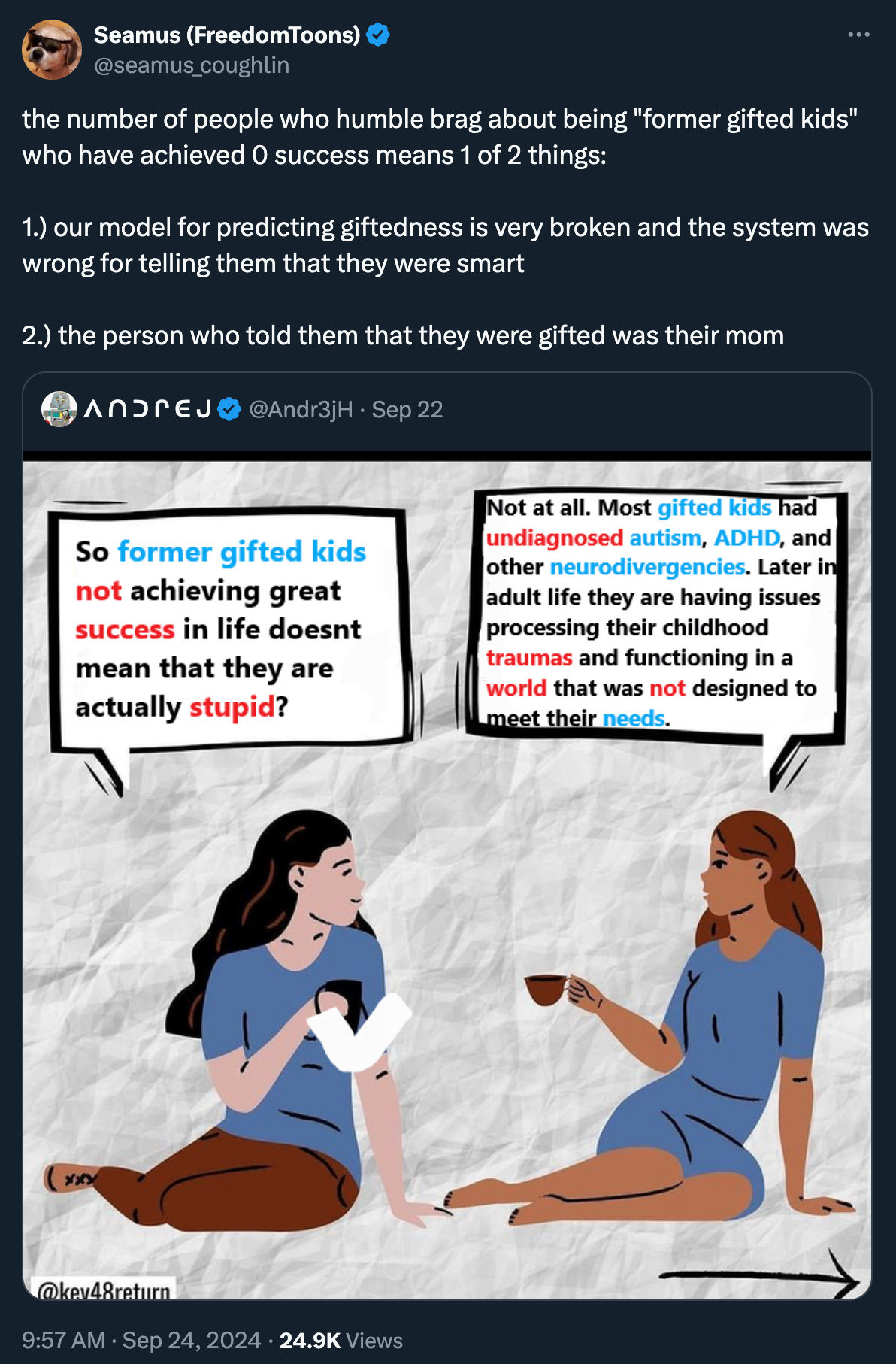
Are You Getting "Gifted" Wrong?
I saw this post on X implying that giftedness should correlate with material success in life, and had to respond. Myths like this are neither rare, nor benign, so they deserve to be challenged. As tempting as it is sometimes to knee-jerk reject posts like the one Seamus reacted to because they use woke sounding words like “neurodivergencies,” don’t. There is usually a kernel of truth to woke claims, and when you react by rejecting them out of hand, you inevitably substantiate one of their truly false premises.Take the original image, for example. It’s factually correct about most gifted kids — they do tend to be what is called “twice exceptional” in that they have underlying neurological issues, or a learning disability like dyslexia to go with their high IQ (Winston Churchill is an example). Think how frustrating it would be to have a better vocabulary and grasp of subject matter complexity, while being unable to easily decode the written word. That’s just one of many examples, and yes, if the child’s needs go unmet for long enough, it can be traumatic.The sunk premise you could legitimately react to is the last bit about the “world that was not designed to meet their needs.” That’s the world for everyone, not just gifted kids. NO world is “designed” to meet anyone’s needs for the simple reason that humans don’t design the world, only respond to it, and even the institutions and spaces we do design in response to the world can’t, and don’t, meet everyone’s needs, ever. It has nothing to do with whether the people are gifted or not. It should say the kids may be traumatized by years of frustration and neglect in schools that were not designed to meet their needs, or that went out of their way to deny their needs, or misrepresent their needs to their parents. Any one of those could produce an adult with residual “trauma” from childhood, but most gifted children experience more than one of the situations on that list.What frustrates me about the X-post’s knee-jerk reaction though is it doubles-down on the false premise that the “world” should be designed around individual special needs (and if it’s not, individuals will be traumatized), and promotes a myth about giftedness that is at least as traumatizing as coping with schools designed around average and below-average cognitive abilities: that gifted kids should be more materially successful than those without intellectual gifts, and if they’re not, they were never gifted to begin with.Think of all the things that go into being “successful” in life, whether materially, or personally! From talent, to personality, to being in the right place at the right time, there are so many contributing factors that have nothing to do with cognitive ability, most of which are beyond even the gifted child’s control. Personality traits alone can make a huge difference, as can support from the adults around you growing up, so it defies logic and reason to assume the cognitively gifted would automatically be successful, never mind more successful than their non-gifted peers.What’s more, this assumption — that gifted kids will be “fine” or successful without extra help or support — is likely the thing that prevents gifted kids from getting their needs met in a school setting, which in turn contributes to unresolved trauma that may contribute to their lack of success in adulthood.Look, I kind of “get” why people like Seamus react as they do. We’re all sick to death of hearing the word “trauma,” and we’re especially sick of trauma being used as an excuse for all kind of human failings and poor behavior, but we have to be very careful not to react to every use of the word without thinking. Trauma is a real thing, and gifted kids suffer plenty of it.If we genuinely want to improve education, and help kids grow up happy, healthy, well-adjusted, and yes, even successful, we need to stop thoughtlessly responding to flawed or false narratives about children. If you want to learn more about how the “world” within the public school setting is not designed to meet the gifted child’s needs, please watch this video with my friend Lisa Johnson of BrightLinks, an organization that is designed to meet their needs. Get full access to The Reason We Learn at thereasonwelearn.substack.com/subscribe

Teaching the Holocaust: American Liberty Depends on It, with Anna Salton Eisen
Imagine growing up and not knowing your parents were Holocaust survivors…That was childhood for my guest today, Anna Salton Eisen. Anna is the author of The 23rd Psalm: A Holocaust Memoir, The Twentieth Anniversary Edition (A National Jewish Book Awards Finalist in 2022) and Pillar of Salt: A Daughter’s Life in the Shadow of the Holocaust. She is the daughter of two Holocaust survivors and executive producer of the upcoming documentary film In My Father’s Words based on both of her books. Her writing has been published in The Jerusalem Post and The Forward, among other publications. As the founder of Congregation Beth Israel in Colleyville, Texas, site of the antisemitic synagogue hostage crisis in January 2022, Anna has been featured in numerous major news outlets, including CNN, The New York Times, The Washington Post, and Fox News. A social worker, Salton Eisen formerly practiced as a therapist, specializing in mental health and trauma.Today, Anna works to bring Holocaust education to everyone who wants and needs it. In this show, we will discuss why and how she’s doing it.Find Anna:Facebook: Anna Salton Eisen, AuthorX: @AnnaSaltonEisenInstagram: @annasaltoneisenWebsite, where you can buy the books:https://annasaltoneisen.com/TIMESTAMPS01:38 Intro03:55 Anna's story09:09 Why we need Holocaust education17:14 What has changed in education to make so many students hostile to Holocaust education?26:53 What works WELL for Holocaust education?44:02 Connecting Jewish history to American history49:10 Looking ahead, wrapping upSUPORT MY WORK// Donate:Buy Me a Coffee: https://www.buymeacoffee.com/trwlPayPal: paypal.me/deborahfillman// Join:If you want to join weekly calls with me and my audience, and get access to my curated lists of education enrichment and homeschooling resources, join one or both of my private communities: TRWL @Wokescreen: https://wokescreen.com/thereasonwelearn/TRWP Parent Support Group: https://wokescreen.com/the-reason-we-parent///Work With Me:I offer a wide range of consulting services to parents and parent advocacy organizations. Learn more about my services, and book my time using these links Tutoring & Homeschool Teaching: https://thereasonwelearn.com/online-tutoring-and-homeschool-teaching/ College Counseling and Essay Coaching: https://thereasonwelearn.com/consulting/ Education Consulting & School Search: https://thereasonwelearn.com/1942-2/ Public Speaking: https://thereasonwelearn.com/speaking/ Writing: https://thereasonwelearn.com/writing-2///Do Business With My Affiliates Purchase books from Heroes of Liberty with my referral link and get 10% off! https://heroesofliberty.com/?ref=Zqpq...Enroll your child in The Socratic Experience, a virtual school grades 3-12. They provide Socratic discussions of classic texts with a commitment to rationality while supporting students in entrepreneurial and creative projects. My listeners can now get a 10% discount by using the link below!https://socraticexperience.com/parent-guide/?utm_source=thereasonwelearn#teachingtheholocaust #holocaustsurvivor #holocausteducation #holocaustsurvivors #publiceducation #k12education #antisemitism--- Support this podcast: https://podcasters.spotify.com/pod/show/debf/support Get full access to The Reason We Learn at thereasonwelearn.substack.com/subscribe

School-Based Counseling: Are We Making Things Worse? With Jake Wiskerchen
You may have noticed that Mental Health, sometimes referred to as “wellness” or wellbeing, has, both in terms of funding, and staffing, become job 1 for most schools, and you may even have heard that students “can’t learn” until they’ve been seen, heard, and assessed psychologically. Earlier, I sat down to talk with Jake Wiskerchen, marriage and family therapist, national certified counselor, and founder of Nevada based Zephyr Wellness, to get an update on what’s going on in counseling, especially in schools. I asked Jake because of his broad and deep experience in the field. He has given consultations, talks, seminars, continuing education classes, and staff trainings, to many agencies, groups, organizations, and individuals, including the Nevada Bar Association, Northern Nevada Law Enforcement Academy (POST), Nevada State Civil Attorneys Association, Reno + Sparks Chamber of Commerce, University of Nevada, Washoe County School District, Nevada School Counselors Association, Nevada Coalition to End Domestic and Sexual Violence, Lyon County School District, Pershing County School District, Sixth Judicial District Court, VanNess Group Homes, and CSA/Head Start, and he’s the host of not one, but TWO podcasts: noggin notes and guns and mental health.In this show, you’ll learn why mental health is front and center in education, and why that may be much too much of an otherwise good thing. Follow Jake @jakewiskPodcast host: Guns & Mental Health, Noggin NotesYouTube @ZephyrWellness SUPPORT MY WORK// Donate:Buy Me a Coffee: https://www.buymeacoffee.com/trwlPayPal: paypal.me/deborahfillman// Join:If you want to join weekly calls with me and my audience, and get access to my curated lists of education enrichment and homeschooling resources, join one or both of my private communities: TRWL @Wokescreen: https://wokescreen.com/thereasonwelearn/TRWP Parent Support Group: https://wokescreen.com/the-reason-we-parent///Do Business With My Affiliates Purchase books from Heroes of Liberty with my referral link and get 10% off! https://heroesofliberty.com/?ref=Zqpq...Enroll your child in The Socratic Experience, a virtual school grades 3-12. They provide Socratic discussions of classic texts with a commitment to rationality while supporting students in entrepreneurial and creative projects. My listeners can now get a 10% discount by using the link below!https://socraticexperience.com/parent-guide/?utm_source=thereasonwelearn#schoolcounseling #mentalhealthandwellbeing #mentalhealthatschool #schoolcounselors #sel #mtss--- Support this podcast: https://podcasters.spotify.com/pod/show/debf/support Get full access to The Reason We Learn at thereasonwelearn.substack.com/subscribe

Stolen Youth at Sarah Lawrence: What You Need To Know About Coercive Control, with Joshua Slocum
If you haven't yet watched the Hulu miniseries Stolen Youth: Inside the Cult at Sarah Lawrence, I highly recommend that you do. I watched it, and invited Josh Slocum, from @DisaffectedPodcast here to discuss coercive control -- what it is, and how it works -- because he's a graduate of Sarah Lawrence, and because he is an expert in cluster-B personality disorders, and while not all who are cluster-B engage in coercive control, all those who coercively control are cluster-B. Follow Josh on X @DisaffectedPod Subscribe to his Substack at https://disaffectedpod.substack.com/Watch the Hulu series: https://press.hulu.com/shows/stolen-youth-inside-the-cult-at-sarah-lawrence/SUPPORT MY WORK:// Donate:Buy Me a Coffee: https://www.buymeacoffee.com/trwlPayPal: paypal.me/deborahfillman// Join:If you want to join weekly calls with me and my audience, and get access to my curated lists of education enrichment and homeschooling resources, join one or both of my private communities: TRWL @Wokescreen: https://wokescreen.com/thereasonwelearn/TRWP Parent Support Group: https://wokescreen.com/the-reason-we-parent///Work With Me:I offer a wide range of consulting services to parents and parent advocacy organizations. Learn more about my services, and book my time using these links Tutoring & Homeschool Teaching: https://thereasonwelearn.com/online-tutoring-and-homeschool-teaching/ College Counseling and Essay Coaching: https://thereasonwelearn.com/consulting/ Education Consulting & School Search: https://thereasonwelearn.com/1942-2/ Public Speaking: https://thereasonwelearn.com/speaking/ Writing: https://thereasonwelearn.com/writing-2///Do Business With My Affiliates Purchase books from Heroes of Liberty with my referral link and get 10% off! https://heroesofliberty.com/?ref=Zqpq...Enroll your child in The Socratic Experience, a virtual school grades 3-12. They provide Socratic discussions of classic texts with a commitment to rationality while supporting students in entrepreneurial and creative projects. My listeners can now get a 10% discount by using the link below!https://socraticexperience.com/parent-guide/?utm_source=thereasonwelearn#sarahlawrence #hulu #coercivecontrol #clusterb #narcissism #narcissiticabuse #humantrafficking--- Support this podcast: https://podcasters.spotify.com/pod/show/debf/support Get full access to The Reason We Learn at thereasonwelearn.substack.com/subscribe

Why I Walked Away From Public Schools, With Jon England
Jon England is the Education Policy Analyst at Libertas Institute. He is a fourteen-year veteran public schools who became frustrated with the lack of innovation, transparency and accountability in the system, and decided to leave the system and join Libertas to work on empowering parents, and defending parental rights.Find Jon on X @Principal_Jon Website: https://libertas.orgTIMESTAMPS03:16 - Welcome Jon!04:47 - COVID: The Final Straw09:01 - School vs. Parents13:12 - The School Trap20:00 - The Push to College32:32 - New Models for K12 44:15 - Government Roadblocks to Alternatives48:55 - Let's Talk About School Choice...1:00:00 - How to Get More Involved in Making Education BetterSUPPORT MY WORK:// Donate:Buy Me a Coffee: https://www.buymeacoffee.com/trwlPayPal: paypal.me/deborahfillman// Join:If you want to join weekly calls with me and my audience, and get access to my curated lists of education enrichment and homeschooling resources, join one or both of my private communities: TRWL @Wokescreen: https://wokescreen.com/thereasonwelearn/TRWP Parent Support Group: https://wokescreen.com/the-reason-we-parent///Work With Me:I offer a wide range of consulting services to parents and parent advocacy organizations. Learn more about my services, and book my time using these links Tutoring & Homeschool Teaching: https://thereasonwelearn.com/online-tutoring-and-homeschool-teaching/ College Counseling and Essay Coaching: https://thereasonwelearn.com/consulting/ Education Consulting & School Search: https://thereasonwelearn.com/1942-2/ Public Speaking: https://thereasonwelearn.com/speaking/ Writing: https://thereasonwelearn.com/writing-2///Do Business With My Affiliates Purchase books from Heroes of Liberty with my referral link and get 10% off! https://heroesofliberty.com/?ref=Zqpq...Enroll your child in The Socratic Experience, a virtual school grades 3-12. They provide Socratic discussions of classic texts with a commitment to rationality while supporting students in entrepreneurial and creative projects. My listeners can now get a 10% discount by using the link below!https://socraticexperience.com/parent-guide/?utm_source=thereasonwelearn#publicschoolsystem #walkaway #publicschool #education #microschool #homeschooling #schoolchoice--- Support this podcast: https://podcasters.spotify.com/pod/show/debf/support Get full access to The Reason We Learn at thereasonwelearn.substack.com/subscribe

What Should Be Taught in Our Schools with William B. Allen
Professor William B. Allen is the Emeritus Dean of James Madison College, and Professor Emeritus of Political Philosophy at Michigan State University. I had the privilege of hearing Professor Allen speak at the Alumni Summit on Free Expression hosted by the American Council of Trustees and Alumni, also known as ACTA, and the Alumni Free Speech Alliance, also known as AFSA. The title of his talk was Criminals Think, but Thinking is not Criminal, and I felt strongly then, as I do today, that my audience, parents and teachers in particular, needed to hear from him directly.Professor Allen's Talk:https://youtu.be/P1nLRW_hXC4?si=PETMTDS6mfqOC_HWTranscript as an Article at The Journal of Free Black Thought:https://freeblackthought.substack.com/p/criminals-think-but-thinking-is-notProfessor Allen's book:https://www.amazon.com/stores/author/B001IZ0ZS8/allbooksSUPPORT THIS CHANNELYour support makes my work possible. If you appreciate this content, please consider supporting me in one of the following ways:Join The Reason We Learn Community @WOKESCREEN : https://wokescreen.com/thereasonwelearn/Join The Reason We Parent - Parent Support Group: https://wokescreen.com/the-reason-we-parent/Hire me for consulting, tutoring and public speaking: https://thereasonwelearn.com Buy Me a Coffee: https://www.buymeacoffee.com/trwlPayPal: paypal.me/deborahfillmanPurchase TRWL Merch: https://store.wokescreen.com/the-reason-we-learn/Purchase books from Heroes of Liberty with my referral link and get 10% off!https://heroesofliberty.com/?ref=Zqpq...#philosophyofeducation #educationreform #highereducationreform #academicfreedom #raisingreaders--- Support this podcast: https://podcasters.spotify.com/pod/show/debf/support Get full access to The Reason We Learn at thereasonwelearn.substack.com/subscribe

Should We Resegregate America's Schools? With Wil Reilly
Wilfred Reilly and I look back on the 70 years since Brown v Board of Education to ask if we are trying to re-segregate American Education, if so why, and what does "segregation" post Brown vs Board?We also take a look at recent statistics concerning the racial achievement gap, and Wil gives his take on new questions to ask about achievement gaps in general.Wilfred Reilly is an Associate Professor of Political Science at Kentucky State University, and the author of the books "Taboo: 10 Facts You Can't Talk About,' "Hate Crime Hoax," and "The $50,000,000 Question." He is currently working on the upcoming project "Alt-Wrongs: an American Case against Racial Nationalism," as well as sketching out a book looking at the transgender, gender-fluid, and Otherkin communities and the idea of flexible identity. Reilly has published pieces in Academic Questions, Commentary, Quillette, and a number of other journals and magazines. His research interests include international relations and the prevention of war, contemporary American race relations, and the use of modern quantitative methods to test "sacred cow" theories such as the existence of widespread white privilege. Off work, he enjoys dogs, archery, basketball, Asian cooking, and beer. Reilly has been described, by himself, as "the greatest mind of a generation."Follow him on X @wil_da_beast630Buy his books here: https://www.amazon.com/stores/author/...SUPPORT THIS CHANNELYour support makes my work possible. If you appreciate this content, please consider supporting me in one of the following ways:Join The Reason We Learn Community @WOKESCREEN : https://wokescreen.com/thereasonwelearn/Join The Reason We Parent - Parent Support Group: https://wokescreen.com/the-reason-we-...Hire me for consulting, tutoring and public speaking: https://thereasonwelearn.com Buy Me a Coffee: https://www.buymeacoffee.com/trwlPayPal: paypal.me/deborahfillmanPurchase TRWL Merch: https://store.wokescreen.com/the-reas...Purchase books from Heroes of Liberty with my referral link and get 10% off!https://heroesofliberty.com/?ref=Zqpq...#race #segregation #brownvboard #education #k12 #desegregation #publicschools #teaching #achievementgap #blackachievementgap #blackexcellence--- Support this podcast: https://podcasters.spotify.com/pod/show/debf/support Get full access to The Reason We Learn at thereasonwelearn.substack.com/subscribe