38% of America’s High School Seniors Can’t Understand This Podcast!
The PhilStockWorld Investing Podcast
Audio is streamed directly from the publisher (2.gum.fm) as published in their RSS feed. Play Podcasts does not host this file. Rights-holders can request removal through the copyright & takedown page.
Show Notes
38% of America’s High School Seniors Can’t Understand This Post!
By phil - September 9, 2025
I write at a college level.
Obviously Economics is a complex concept and Investing and Trading requires you to be familiar with more than just the basics and, of course, to keep up on Global Events and to understand the micro and macro effects that news, data, demographics and even politics may have on your investment prospects in order to be a successful investor.
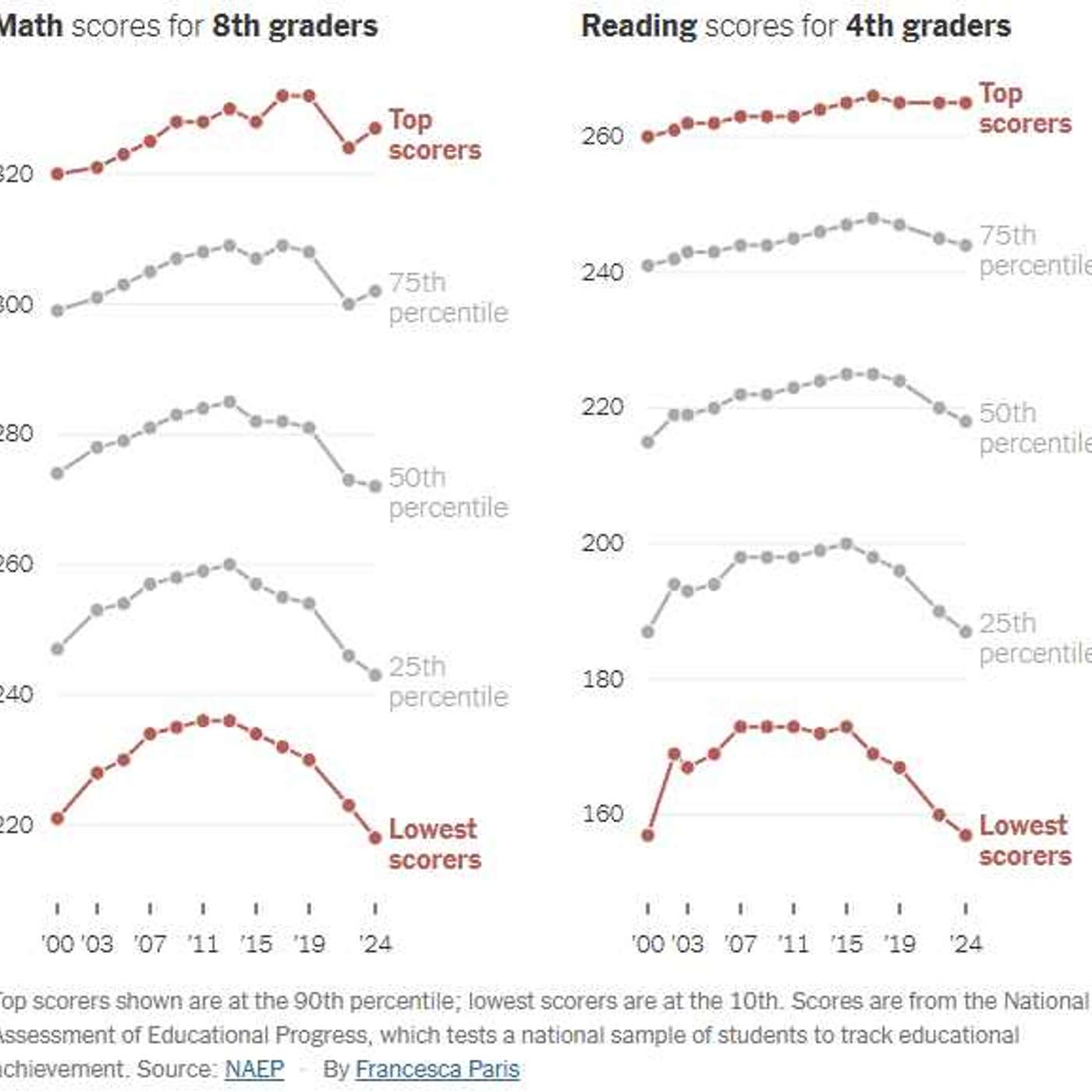
That’s why it’s disturbing to me that the National Assessment of Educational Progress shows a DRAMATIC fall-off in reading and match skills in EVERY quintile (see – I can’t use that word anymore!) except the top-scoring children.
ONLY 32% of 12th graders are reading at or above proficient levels and 40% of the 4th graders are scoring BELOW BASIC reading levels while 1/3 of our 8th graders can’t meet basic reading benchmarks – an all-time high and I would tell you how far above the median that is – but who would understand it???
This is a CRISIS folks – one that is being ignored as the Trump Administration CUTS 15% ($10Bn) of the Department of Education’s annual budget to $67Bn while companies like META pledge to spend $600Bn (60 TIMES that much) developing AI to replace those “dumb” kids in the future Labor Force.
It’s a lot easier to slash the budget when your constituents can’t do the math to understand how badly you are destroying their children’s chances of building lives for themselves, right? 12th grade math scores lost 20 years of progress since Trump’s first term with 40% of 4th graders below their basic math levels. This is not due to Covid – they were not even in Kindergarten during Covid!
Our Secretary of Education, Linda McMahon, knows her audience and so does Donald Trump as research has confirmed that education levels DIRECTLY correlate with voting patterns and economic policy preferences. A less-educated electorate creates:
- Policy whiplash as voters struggle to understand complex Economic issues
- Populist susceptibility – simple answers to complex problems always win
- Short-term thinking dominating long-term economic planning
- Increased political volatility affects market stability
Expect more Trump-style policy reversals, tariff chaos, and constitutional crises down the road as an increasingly uneducated electorate chooses leaders who promise simple solutions to complex problems. But it’s not all about politics – Educational attainment dramatically impacts consumer behavior:
The Bottom 80% (Declining Education):
- Higher susceptibility to scams (hello, crypto meme coins!)
- Impulse purchasing over rational financial planning
- Debt accumulation due to poor financial literacy
- Brand susceptibility to marketing manipulation
The Top 20% (Maintaining/Improving):
- Informed decision-making and comparison shopping
- Long-term financial planning and investment strategies
- Premium brand loyalty based on value, not marketing
- Technology adoption for productivity gains
Investment Implication: Double down on premium brands serving educated consumers(like our LULU thesis) while avoiding mass market retailers dependent on increasingly impoverished, poorly-educated consumers. This is George Carlin’s warning on Education and the American Dream playing out right before our eyes! The education crisis accelerates AI adoption by making human workers increasingly obsolete:
- AI offers consistent performance vs. workers who can’t read instructions.
- AI has no training costs for basic literacy and numeracy.
- AI offers predictable output vs. a workforce with declining cognitive skills.
- AI offers scalability without educational infrastructure investment (so Trump and McMahon are wise to stop bothering with human children).
- AI infrastructure companies (AVGO, NVDA) become MORE VALUABLE, not less, as the human workforce becomes less capable.
And, of course, the effects of these changes vary by region and those states that support Education (mostly blue) and attract AI and Tech jobs (mostly blue) end up with a “Knowledge Economy” that maintains Property Values and Municipal Finances with Virtuous Cycles of Investment and Development.
The states with the poorest levels of Education end up becoming “Extraction Economies” where Resources and Cheap Labor are essentially exploited and they lose business to better-educated markets, which erodes their tax-base and that leads to further cuts in Education – locking those states into ever-declining cycles of voting Republic...