The Tenacious Tempanius
Rome faces disaster as the consul Gaius Sempronius takes a negligent approach to battle preparation. Will plucky plebeian Sextus Tempanius save the day?
The Partial Historians · The Partial Historians
Audio is streamed directly from the publisher (sphinx.acast.com) as published in their RSS feed. Play Podcasts does not host this file. Rights-holders can request removal through the copyright & takedown page.
Show Notes
Welcome to 423 BCE and your introduction to the one and only Sextus Tempanius! You may not know his name just yet, but we're pretty sure you'll be as impressed with him as we are. Suffice it to say, 423 BCE is one of the more interesting and dramatic years of the decade.
After a confusing tangent about the Samnites and Capua brought to us courtesy of Livy, we return to Rome and war with the Volscians. The Roman forces are led by the patrician, Gaius Sempronius Atratinus. However, Sempronius might be placing too much faith in the gods when it comes to war…
With fortune seemingly turning against the Romans, a plebeian hero steps into the spotlight. Sextus Tempanius brings the cavalry to the rescue of their forces. Join us to find out how the Tenacious Tempanius made the Romans swoon.
Episode 137 – The Tenacious Tempanius
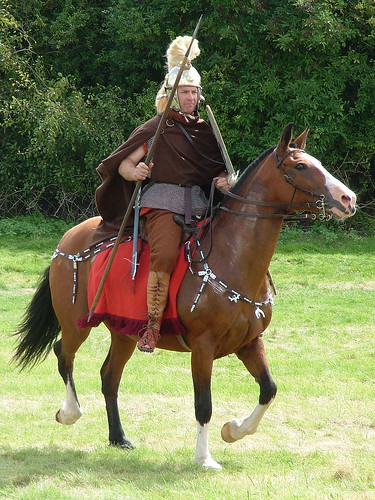
A re-enactor dressed as a Roman cavalryman. The gear is not necessarily historically accurate for this period, but it gives the vibe!
Image courtesy of Jacqueline Ross via Flickr.
My Kingdom for a Decurio!
Sextus Tempanius is described in some of our sources as a decurio. In this context, a decurio is a commander of a decuria of cavalry. A decuria is the Latin term for a division of ten. So a decurio is a low level commander in charge of the ten riders that make up his decuria. Although we can't be precise about the exact scope of the Roman cavalry in this period of the early Republic, there is later thought to have been 30 lots of ten riders to a cavalry legion (300 riders). So for three hundred horsemen there were thirty internal leaders. The other important division was the grouping of 3 decuriones (3×10) horsemen together into a formation known as a turma. Depending on the battle situation, the Romans had the capacity to divide a legion down to collectives of 30 or 10 horsemen with their own command structure.
Things to Listen Out For
- Several theories about how Capua received its’ name
- Confusion over places starting with V
- The laziest Etruscan resistance EVER
- Standards left lying around
- Roman cheerleading practice
- Friends turning on each other like real douchebags
- Weird parallels to the Second Punic War
- Patrician trials – about time!
Want to refresh your knowledge of 424 BCE? Check out our previous episode.
Our Players 423 BCE
Consuls
- C. Sempronius – f. – n. Atratinus (Pat)
- Q. Fabius Q. f. M. n. Vibulanus (Pat) Mil. Tr. c. p. 416, 414
Tribune of the Plebs
- C. Iunius
Decurio
- Sextus Tempanius
Our Sources
- Dr G reads Dionysius of Halicarnass Roman Antiquities 12.6.5; Val. Max. 3.2.8.
- Dr Rad reads Livy ab Urbe Condita 4.37-41.
- Broughton, T. R. S., Patterson, M. L. 1951. The Magistrates of the Roman Republic Volume 1: 509 B.C. – 100 B.C. (The American Philological Association)
- Brill New Pauly entries for “Decurio” and “Verrugo”
- Cornell, T. J. 1995. The Beginnings of Rome: Italy and Rome from the Bronze Age to the Punic Wars (c. 1000-264 BC) (Taylor & Francis)
- Forsythe, G. 2006. A Critical History of Early Rome: From Prehistory to the First Punic War(University of California Press)
- Oakley, S. P. 2016. ‘Didactic Livy: Review of Livy’s Political Philosophy. Power and Personality in Early Rome by A. Vasaly’. The Classical Review 66:2, 431-433.
- Ogilvie, R. M. 1965. A Commentary on Livy: Books 1-5 (Clarendon Press).
- Smith, W. 1854. Dictionary of Greek and Roman Geography “Verrugo”
Sound Effects
Thanks to the wonderful Bettina Joy de Guzman for our theme music. Sound effects courtesy of Fesliyan Studios and Orange Free Sounds and BBC Sound Effects.
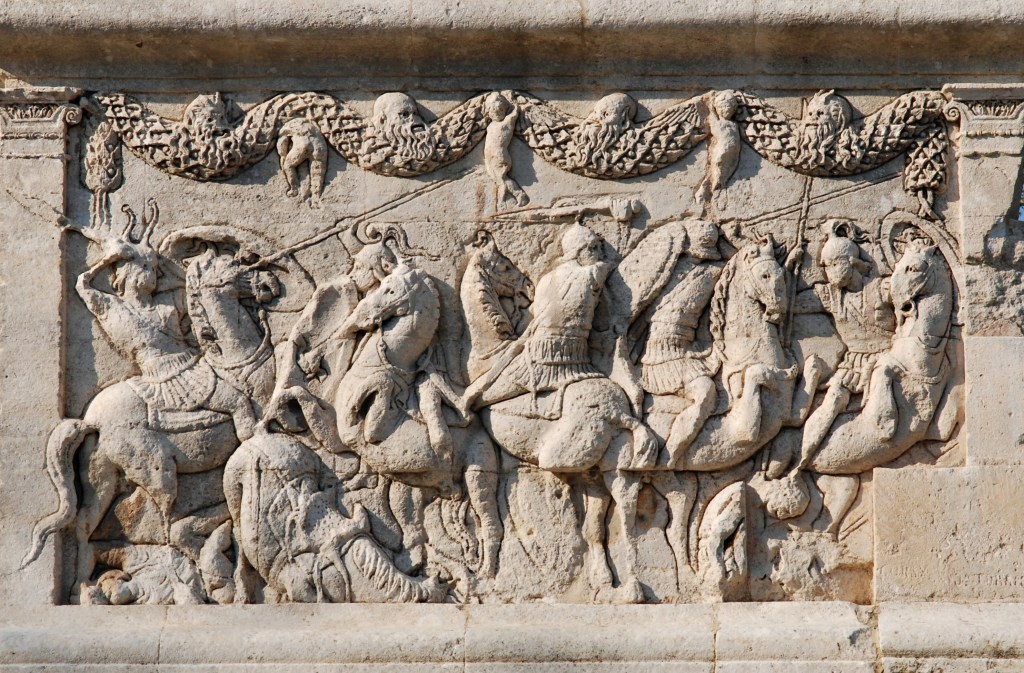
North face of the Mausoleum of Glanum, southern France, showing a cavalry battle, c. 40 BCE. This relief shows cavalry in action well after the period under discussion in this episode, but it does give you a sense of the movement and how Romans in the late Republic conceived of the cavalry.
Source: Wikimedia Commons. Photographer: Cancre
Automated Transcript
Lightly edited for clarity!
Dr Rad 0:27
Hello, dear listeners, and welcome to another episode of The Partial Historians. I am one of your host, Dr. Rad.
Dr G 0:36
And I am Dr. G. And we have been tracing Rome's history from the founding of the city for years now. And we're many years into Rome's history as well. So that's exciting news. We're keeping pace with the events as they happen.
Dr Rad 0:52
We are I mean, the 420s are just like streaming by me. I can't I feel like I can't keep up with moving so quickly they are flying by I think this is a real indication of what happens when we lose some of our source material.
Dr G 1:05
Particularly Dionysius, who is, shall we say, more of a reverse somewhat of a gas bag? Indeed, I hope he does come back though. I'm looking forward to hearing from him again.
Dr Rad 1:16
It's been too long.
Dr G 1:17
Look, I suspect we've only got fragments from here on down.
Dr Rad 1:22
I know but whenever he pops in to say hello, you know, gives me a warm fuzzy feeling inside.
Dr G 1:28
Prepare to be excited because he might be popping in with a fragment in this very episode.
Dr Rad 1:34
Well, you know, what, if any years I wouldn't be surprised that it's this year that we're about to discuss, which is 423 BCE. But before we get into 423 Dr G., oo god, so rhymy. I think we need to pause and recap. And see what happened in 424 BCE.
Dr G 1:53
Well, I will really just be throwing back to you. Because 424. I had almost literally no evidence to the extent that I had to talk about what was Rome's history of founding colonies in the very early Republic as far as we can discern.
Dr Rad 2:08
Look, fair enough, fair enough. Look 424 It wasn't perhaps the most memorable of years we've had quite a few of these weird years in the 420s where it seems like kind of not a lot might be going on. But we did have a little bit of our old favourites, which was troublesome tribunes. There's nothing that we love more than a troublesome tribune.
Dr G 2:31
It's true. It's true. We do like troublemakers of the plebeian persuasion.
Dr Rad 2:37
We definitely do. So we had some tribunes that were complaining about the lack of plebeians that were earning themselves magistracies, even though technically, with this option of military tribune with consular power, technically, we should be seeing plenty of plebeians in power.
Dr G 2:59
And yet somehow they are absent. The concerns are real.
Dr Rad 3:04
Yes, exactly. And the tribunes were so fed up with the lack of plebeians even running for office, that they were threatening to say, You know what, let's just get rid of this whole idea altogether. And we'll just have the patricians forever, and that would maybe make you happy. Wouldn't it?
Dr G 3:21
It's such a typical patrician solution to a problem.
Dr Rad 3:25
No, that was the tribune.
Dr G 3:26
Oh no!
Dr Rad 3:27
Yeah, they were like, you wait, we're just so like, it's it's actually worse that we have the option. And yet nobody's doing it. Because then that seems to imply that actually, we're useless. But he is worthy? Yeah, exactly.
Dr G 3:41
Why are we even here, guys, if you're not going to make use of us?
Dr Rad 3:45
Precisely. And so they're proposing that and with finally, finally, they have got through to the plebeians. And we actually have some opinions allegedly running for office, and campaigning on the kinds of measures that we would normally see, plebeians run with so things like, I think that they're campaigning on some sort of land allocation policy, you know, that maybe we're going to share it out a bit more fairly than we have in the past. That there's also going top be a tax placed on the landowners, you know, classic, lower class kind of stuff.
Dr G 4:18
You know, we should tax the people that have money, not the people who don't have money.
Dr Rad 4:23
Yes, although, once again, I have to stop myself, Dr. G, I'm falling into that old pattern. We have to remember that some of the plebeians are very wealthy. It's just that they don't have a stranglehold on power, like the patricians seem to have.
Dr G 4:38
This is true. It does turn out that it's more about who you were born to, rather than how much wealth you possess.
Dr Rad 4:47
Exactly. And that opens up all sorts of doors like priesthoods and consulships and whatnot.
Dr G 4:53
Alright, so that's 424 BCE,
Dr Rad 4:57
That is 424.
Dr G 4:57
Okay, so let's let's hit the ground running With 423 BCE.
Dr Rad 5:13
All right for 423 BCE, Dr. G. And since I know that Dionysius is still breaking your heart with his broken pieces of source material, I'm going to let you tell me who the magistrates are for this year.
Dr G 5:25
Oh, well, thank you. There is a little bit of interest when it comes to who we've got in our sort of the players for this year. So we've got a couple of consuls, which are a nice change of affairs really, we haven't
Dr Rad 5:40
Well, that's sad to me though because it suggests that all that stuff I just talked about didn't come to pass.
Dr G 5:47
Those people put themselves up for election and did not get voted in.
Dr Rad 5:51
This is the thing. I get this is where our source material makes no sense. How would they be running for office? If it's not military tribunes with consular power? Yeah, can't run for the consulship. So
Dr G 6:01
Precisely. I mean, we do have real issues with the source material. There is no doubt about it.
Dr Rad 6:07
Yeah, we really do.
Dr G 6:08
Yeah, the plebeians not being allowed at this stage as far as we're aware to run for the consulship. So maybe the elections got a little bit messy, and maybe they changed their minds about what kind of elections they were having, you know, I'm just trying to paper over what are our gaping holes of logic and no material?
Dr Rad 6:26
Maybe, maybe there's no such thing as the consulship at this point in time.
Dr G 6:32
Horror. Shock.
Dr Rad 6:34
Blasphemy. Anyway, I'll skate over that.
Dr G 6:37
Well, okay. So there are two men who are more in charge than anybody else. One of them is Gaius Sempronius Atratinus
Dr Rad 6:46
Hmmm, welll I recognise these names.
Dr G 6:50
Well, Atratinus is an interesting name, because that raises the question about whether patrician and plebeian as it happens, because Atratinus, in the later centuries of the Republic is an exclusively plebeian name but, in this early period, we're pretty sure that this is a patrician name only.
Dr Rad 7:15
Dashed my hopes Dr G., how will I carry on for the rest of the episode?
Dr G 7:19
Well, I hope you can pick yourself up and continue on but if you can't, I'll just keep going through the roll call sheet. That will be the whole episode. Please save yourself. So Atratinus definitely has plebeian flavour about it, which might explain some of the narrative choices of our analysts historians for the previous year, we like this guy, plebeian. And the scholarship seems to fall down on the side of probably not at this stage. But later on, we'll get the reemergence of this name under a plebeian gens. So that will happen. So our second console is Quintus Fabius Vibulanus.
Dr Rad 8:10
Yeah
Dr G 8:11
And so this family has come up quite a bit. So one of the fabulous Fabii is back. And we've seen quite a lot of the Vibulanii as well. But this guy doesn't appear to have held any positions as yet. So this seems to be his first foray into the consulship. So that's exciting news for him.
Dr Rad 8:30
It is indeed.
Dr G 8:31
Go Quintus! We also have a named attribute of the plebs, a guy called Gaius Iunius. Who I suspect you might have more to say about, and we also have a prefect. So a military position, a guy called Sextus Tempanius.
Dr Rad 8:54
Yes, I have much to say about this young man. Very, I'm very excited to talk about him. But I love the fact that he's named as a prefect because it gives me images of him in a very sharp navy blazer with little badges on it. Maybe that's just because I'm a school teacher.
Dr G 9:11
He also is apparently a decurio, more specifically of the cavalry under Sempronius. So this roll call sheet hints to me that there is some military action that happens in 423 BCE. But realistically, all I've got are a couple of fragments, one from Dionysius of Halicarnassus – praise be – a little snippet from Valerius Maximus. And then I'm basing all the rest of my knowledge from a little bit of extra scholarship research that I've done.
Dr Rad 9:45
Well, allow me allow me to step in because this is a banner year for Livy. I mean, we haven't had this much detail and I don't even know how long honestly, who knew that 423 room was the place to be.
Dr G 9:59
I'm excited now. Livy does tell a good story. So I'm going to strap myself in.
Dr Rad 10:03
He does so you can jump in with your fragments when appropriate, but not a moment earlier.
Dr G 10:09
Noted.
Dr Rad 10:11
All right. So, as you've noted, I have the same consuls that you do. So this is good. So we start off our story with an Etruscan city, Dr. G. In fact, one I don't really recall us talking much about in its original form, and that is Volturnum.
Dr G 10:27
Ah, okay. So in contrast to you already, I have reference to a Volscian city called Verrugo.
Dr Rad 10:36
Oh, okay.
Dr G 10:37
And this, they may be the same place.
Dr Rad 10:39
Well, okay, so Volturnum actually is now Capua. When I say now, I mean, obviously in the Roman sense later on,
Dr G 10:52
Capua is in Campania, isn't?
Dr Rad 10:55
It is, yes.
Dr G 10:57
Okay, that's much further south than the hypothetical Verrugo that I have reference to, which is to the south east of Rome, but past the Frascati sort of region. So you've got to go beyond the hills. There's those volcanic hills to the southeast of Rome, and you go a little bit further past them. Keep going southeast, and then you hit Verrugo, which today, we think, is in the location of modern Colle Ferro, and Sacco. But it's not as far as Capua.
Dr Rad 11:32
I'm so glad that you have travelled so extensively in Italy because I'm just sitting here going I know nothing about geography.
Dr G 11:40
Look, I wish
Dr Rad 11:40
Just as well I'm a history teacher!
Dr G 11:44
Maps, schmaps, maps,
Dr Rad 11:45
Maps, schmaps, colouring pencils, don't need them. Anyway, no offence for any geography teachers out there actually love colouring pencils. So apparently, this now later in time, like Livy's time, is Capua. And the reason why Livy kicks off with this account is because this city is captured by the Samnites, Dr G.
Dr G 12:08
Hmm, all right, I'll hold on to that detail.
Dr Rad 12:11
Indeed. Now Livy goes on a bit of a tangent explaining how this city gained the name of Capua and he has several theories. Typical Livy so the first is that it's from “cappis”. Oh, sounds bad. Oh, cat
Dr G 12:28
Is it from cat piss because that's a bit-
Dr Rad 12:30
No no, I'm going to try that again. Cap piece. Still sounds bad. From its champagne country, and that's not champagne, like the drink. But basically,
Dr G 12:42
Just sparkling cat-piss
Dr Rad 12:43
It's sounding more and more appetising every time. I really should have tried saying this out loud before I tried to explain it to you. But apparently, what Livy is trying to get at here is some sort of word which means like open country or some sort of plain or battlefield, something like that, okay,
Dr G 12:54
I suspect then we might be talking about very different places then. Because Verrugo comes through in the Latin from “verruca” which, which is not what you might suspect that is a wart on the side. But like it's yeah, like, almost exactly the same. But from this idea of a “locus editus asperque”, which is a “high-lying rough place”. So this kind of like mountainous rocky outcrop. So it almost sounds like the very opposite.
Dr Rad 13:41
Yeah, could not be more different. Because I also have other people saying, No, Livy is wrong. It actually probably stems from the word for orchid or garden.
Dr G 13:51
Oh, well, that's much nicer than cat piss, isn't it?
Dr Rad 13:54
It does sound as if I mean, like, I'm really misrepresenting this place, whatever it is. But I also have other scholarship, which suggests that it might come from “acapitae”, and maybe once this place was the head of the Etruscan League. Oh really? Like “capite” like head
Dr G 14:12
Like kaput?
Dr Rad 14:13
Yeah. Yeah, exactly. Wow. But also it is possible that it could come from this idea of like a plain or something like that. It could also be something that arose just because this is what the people who live there were called and then you know, the place name came from the people that lived there. Those people have hands and they live on flat land.
Dr G 14:37
It's a no brainer, really what we should call this place.
Dr Rad 14:40
Yeah, exactly. Like it. Or third possibility may be a true version or Etruscan origin from a family the gens Capia.
Dr G 14:52
Oh, fancy.
Dr Rad 14:53
Yeah. So really, what I'm reading here in the scholarship and Livy is that we have no freaking idea why this place is ended. It kept lots of theories, no real evidence, indeed, but to return to the Samnites and their issue with this place. So I find this the most hilarious military story I've ever heard so far that saying something because we talk about the military a lot. The Etruscans apparently, are just so exhausted. They let the Samnites come in.
Dr G 15:23
Or you just imagined some Etruscans were just laying down in a faint being like, I can't go on, take the city, if you must, I'm just gonna stay right here.
Dr Rad 15:32
That's basically what they do. They're like, what? The Samnites at our gates, for goodness sakes, just let them come in and take the place because quite frankly, I don't have any fight left in.
Dr G 15:42
You know what, I can't be bothered defending this place, and I won't.
Dr Rad 15:46
And so they seem to strike a deal and that they're like, Look, if we don't put up any resistance, can we just share the city and the fields equally? And a semi so like, yeah, I guess that's sounds pretty good. We don't have to stab anyone.
Dr G 16:01
Let's not fight about it. Let's just split it in half.
Dr Rad 16:04
Yeah. But Dr. G. You know, when something sounds too good to be true. Often is, yeah. So the Samnites move in, they start sharing the city in the fields with the Etruscans. But they're really just playing the waiting game, Dr. G. Because one day when the Etruscans are suffering from the after effects of a holiday, read, eaten too much and have a massive hangover. The Samnites wake up in the middle of the night, and kill them all. Oh, god. Yeah, it sounds very Trojan War, doesn't it?
Dr G 16:41
Well, yes. I mean, the Etruscans did just let them in, didn't they?
Dr Rad 16:44
Well, yeah, they didn't have to pretend with the whole horse thing. But nonetheless, like the whole waiting till everybody's asleep, and then killing everybody.
Dr G 16:51
This might explain the Trojan name theory as well.
Dr Rad 16:54
Potentially, potentially. I mean, we are. We all know that the Etruscans of the Romans are related to the Trojans, right? That's what they like to tell us. That's what they like to tell us. Now the consuls that we've just been talking about. They happen to take up their office just after this happened. And I'm given the very specific date of the 13th of December.
Dr G 17:15
Oh, goodness. Okay. Happy birthday, everybody.
Dr Rad 17:18
Indeed yeah. So anyway, so they've taken up their office, the Romans receive intelligence from their own representatives, because they have spies everywhere. That the Volscians and now planning to invade them. Oh, yeah. Shocking. So I know. It's military action just everywhere. All right.
Dr G 17:37
So and this is unconnected with the whole Samnites taking over the other spot? situation? Is it or is this interconnected?
Dr Rad 17:44
I don't think it's particularly connected. I think it's more just, you know, something horrible. That happens. Yeah. Yeah. Anyway, so the Latins and Hernicians arrive and tell the Romans, “Hey, have you heard the Volscians are planning to invade?” And the Romans are saying, “yes, as a matter of fact, we already knew that thanks to our spies, but good work, everybody. Glad to see we're on the ball.” But the Latins and Hernicians mostly wanted to speak to the Romans because they were spooked. The Volscians just seemed far too energetic. And they were like, This is worrying.
Dr G 18:21
They're moving around a lot. And it has me quite concerned.
Dr Rad 18:24
Yeah, it's it is like they're just carrying out the levy. You know, managers like you know, what we need to get into things we need to make sure that we have courage to deal with this threat, it seems extremely worrying that they're levying so much.
Dr G 18:41
Yeah, I mean, obviously, if they're leving, they're about to send them against somebody.
Dr Rad 18:45
So Gaius Sempronius one of our consuls, he comes into the play here 100% has faith that fortune will see him through this mess, because fortunes never faded for anyone and fortune loves the Romans. He of course had led Rome to victory before on the battlefield. So he takes a fairly careless approach to organising the Romans. He's like Yeah, yeah, I get your the Volscians are a problem. It looks like we're facing issues. But don't you worry guys. This, I so got this. I got this so much. I don't even really need to care about how things are being organised.
Dr G 19:25
Trust me, the gods are on my side.
Dr Rad 19:28
Exactly. Which means that Sempronius ends up entering battle without really thinking through his battle plan.
Dr G 19:39
Yeah, who needs a plan?
Dr Rad 19:41
Who needs a plan? I mean, I know I like to wing things every now and then but generally not when people's lives are on the line.
Dr G 19:47
Well, you and Sempronius are clearly not going to get along.
Dr Rad 19:51
Exactly. Now. The big issue I think, with his lack of battle plan is that he has not placed his cavalry in a strategic position. As Livy says, “his lines were not strengthened with reserves”.
Dr G 20:07
Oh, goodness, okay. This is problematic. I mean the cavalry is both a very powerful element of any military outfit at this time period. But it is also a heightened risk in some senses like the ways in which a cavalry is vulnerable is useful to know. And maybe to plan for.
Dr Rad 20:30
I don't know if you heard me Dr. G. But fortune is on our side. So just like chill out.
Dr G 20:37
Praise be, Fortuna, and all your good works. I look forward to you winning the battle for me.
Dr Rad 20:43
Yeah, and now here's my other favourite detail. Apparently they're so disorganised that the Roman battle cries weren't even any good.
Dr G 20:51
Oh what? They didn't organise their songs properly.
Dr Rad 20:54
I know they're all over the shop, Dr. G. 1234. We know what is freaking battle? Wait, that doesn't rhyme what's going on?
Dr G 21:07
Are we to extrapolate from this, that every time Rome has gone to war so far, they've come up with new battle songs?
Dr Rad 21:16
I think we are and I think it means that I mean, okay. As a school teacher, I'm going to tell you a little story. Whenever we have swimming carnivals, and athletic carnivals, at most schools I've been at there is usually time allocated at some point for the students in their respective houses to practice their chanting. Now, if schools and school children do this, I'm starting to picture the Romans getting together and be like, Alright, guys, this is getting really serious. Some of us won't be coming home. It's time to practice our battle cry. What are we going to chat this time, guys.
Dr G 21:51
But I feel like that it would be more akin to perhaps, not disparaging the chanting athletics carnivals, and swimming, carnivals, and so forth. That is a real and genuine thing. But in addition to that, there's usually some tried and true chants that have a historical kind of impetus behind them that are part of the way in which you're brought into your particular sporting house, or your sporting team. I'm thinking particularly about football and the way that the fandom has various songs that they already know and have learned that are for their team. So they've got one for when they're going really well. They've got one for when they want to sort of pep up the players. They've got one for when they're losing, but they want to disparage the opposition. And so the idea that they're coming up with new chants all the time for every single battle seems just it's blowing my mind a little bit because I feel like surely there would be some of the old classics mixed in.
Dr Rad 22:51
I'm sure. I'm sure there are but it seems that no matter what they're doing you Oh, doesn't matter. It isn't any good.
Dr G 22:58
It is organised and we can thank Sempronius for that.
Dr Rad 23:02
Yeah, they're like you g l why you ain't got no excuse. You ugly? Yeah, yeah. You ugly? Yeah, yeah.
Dr G 23:13
Oh, those Romans.
Dr Rad 23:14
Yeah. Anyway, so the Volscians are pretty confident after they hear these pathetic efforts at battle cries from the Romans. They're like, Oh, my God, they haven't rehearsed guys, we've got this in the bag. Now, the Romans don't really know what to do. I think they're feeling it. They know they're unprepared. So they're looking around for a hero. Because they're very timid. When they go into battle, they just don't really know what's happening. It seems like they haven't got you know, adequate leadership. And very quickly, things turn against them, because their heart's just not in it. They don't have confidence. I mean, this is just a classic lesson. I mean, the Romans are some of the most arrogant, confident people I've ever met. And yet, even they are proving that if you don't have your head in the right place, and you're not projecting confidence, people out there are going to eat you alive, they will know, they will know. So the frontline ends up retreating, and they even leave their standards behind.
Dr G 24:09
Okay, this is shocking news. I mean, I'm so sad. I have no source material for this year now. Losing the standards. That is, that is the worst thing that can happen basically.
Dr Rad 24:21
I know and I thought might be good to remind our listeners and you're the perfect person to do it. Why the standards are so important.
Dr G 24:27
Well, the standards, my friends, my dear listeners, are so important because they represent almost like the energy of the entire group that works under that standard, like it's got a vested totemic symbolism about it. So it's the sort of thing that you can sort of galvanise people around. You can use it to indicate where people are on the battlefield. Obviously, it's quite visual and striking. But the really significant thing is the sense in which there's a characteristic about it that's really imbued with the character of the men who fight under that standard. So, I would imagine that things like war cries and things like that may actually incorporate references to their own standards and so forth and so on in order to emphasise that relationship. So, there is a quasi-religious divine element to the standards. And so when they are lost, there is a sense in which the whole character of that particular unit is broken down and cannot be reunified until they get that standard back.
Dr Rad 25:34
Now, this sounds obviously terrible, and it sounds like the Volscians are just you know, shoo in for victory, but don't write the Romans off just yet, Dr. G. While the Volscians are definitely prevailing at this point in time, the Romans aren't in like a full on retreat. They just like confused and dropping back and just trying to stay alive at this point in time. The Volscians, of course, are pursuing the advantage and they're really pushing on. But Livy makes sure to emphasise that the rumours are more being killed and running away, which makes me certain that they were in fact running away.
Dr G 26:11
I was gonna say, I mean, that's when you get killed the most is when you're running away. Yeah, you've exposed your backside to the enemy.
Dr Rad 26:19
I know. But I don't feel like Livy has it in him to actually record the Romans acting like that. He's like, Oh, yeah, they're being totally cut down. But they're not running away.
Dr G 26:28
Oh, Livy always trying to save Rome's reputation.
Dr Rad 26:31
I know that's purely my own instinct there. Nobody's told me that. Anyway, so more and more Romans are falling back because the battle is really falling apart for them. What is our consul Sempronius doing about it. Sweet F A, Dr. G. He's trying really hard to inspire them. And he's getting angry with them being like, turn around for goodness sakes, my God get back at their fortunes on our side, you idiot. But his anger is doing nothing. And I'm going to directly quote my translation of Livy cuz I really liked this sentence, “There was no virtue either in his authority, or in his dignity”.
Dr G 27:09
Oh, snap.
Dr Rad 27:12
I know. I know. That's a burden on so many levels.
Dr G 27:17
Oh, I don't know if Sempronius coming back from this to be honest.
Dr Rad 27:21
Just you wait, Dr. G. All right. So the Romans were at that point finally, where they were about to commit the worst sin possible and all turn their backs on the enemy, thus exposing them to being wounded or killed in the back as they run away. The shame, the shame,
Dr G 27:40
There's nothing nothing less dignifying in terms of virtus for a Roman to get wounded on the back.
Dr Rad 27:46
But then, Dr. G, our hero comes into the story. A cavalry decurion name Sextus Tempanius saves the day with his amazing courage. Now a little background on what a decurion is. So as far as I could figure out at decurion is in command of 10 men. So it's not just a clever name. And he seems to be in a similar position to a centurion. But just for the cavalry. Not the infantry, which is what the centurion is usually in charge of.
Dr G 28:21
All right, sounds fancy. So he's in charge of 10 horsemen, essentially.
Dr Rad 28:25
Yeah, so apparently, there would be three two decurions in a squadron, which is called a terma. And there are 10 terma in three centuries of horse, which would go along with a legion. Thank you very much notes in my Loeb translation.
Dr G 28:41
So a terma would have 30 cavalry, plus the three decurio.
Dr Rad 28:49
Yeah
Dr G 28:49
And then how many is that in the century?
Dr Rad 28:52
Then there are 10 termae in three centuries, which is far too much math for me to do publicly because that means dividing things up.
Dr G 29:00
No, no, that's 30 by 10. So there's 300.
Dr Rad 29:03
Right, excellent. Let's stick with that.
Dr G 29:06
It's a lot of horses. I'm just trying to visualise like how many horses here? I really did. That's quite a lot of horses.
Dr Rad 29:13
It is but that's that's saying that you have three centuries. I don't know how many people we have here right now.
Dr G 29:17
That's true.
Dr Rad 29:18
Anywho the other weird little detail I'm going to throw in there is that the name Tempanius is very unusual. It seems that nobody else has it.
Dr G 29:28
Hmm. Well, that is not a vote of confidence in favour of this story being true then.
Dr Rad 29:35
Pish posh, Dr G, this guy is about to be a plebeian hero.
Dr G 29:39
Okay, I might bring in Dionysius' fragment here.
Dr Rad 29:44
Okay do it.
Dr G 29:45
Not because I think it fits where we're at in the narrative, because it's not at all clear to me from what you've told me where this might fit, but I'll just give it to you and you might have some ideas about where it goes.
Dr Rad 29:58
Okay
Dr G 29:58
So he's talking sbout Sempronius and Sempronius has learned that the enemy is coming up in the rear.
Dr Rad 30:06
Uh huh.
Dr G 30:07
And he's despaired of being able to turn back with the men, right? And he's also concerned about being surrounded by the enemy on all sides.
Dr Rad 30:18
Interesting, okay.
Dr G 30:19
And so there is a sense that Sempronius at this point, decides to see if they can take the high ground, right? Because like if we're going to have to defend ourselves, and we're going to get surrounded, we need to get to the top of that little hill over there as fast as we can.
Dr Rad 30:38
Okay, I see where your story fits in. Continue.
Dr G 30:41
That is my entire fragment.
Dr Rad 30:42
Oh, okay. All right. All right. Well, let me let me I'll show you where your story fits in. Here we go. So Sextus Tempanius shouts to the cavalry, that anybody who wants to save or needs to get down off his horse right now. Now the men obey him as though he was the consul which of course he is not. He's just a humble decurion and he tells them that they are the ones that can save everything now all they have to do is follow him into battle. And he cries out show Romans and Volscians that when you are mounted, no cavalry are your equals, nor any infantry when you fight on foot. And then men are like, amazing. I love this. Let's do it.
Dr G 31:26
But it also feels like it doesn't really make a lot of sense, does it? I mean, he's just said to the cavalry, dismount and fight as if your infantry.
Dr Rad 31:34
Yeah, so he's saying, let's show everyone that we're amazing when we're cavalry. And we're also amazing when we're infantry.
Dr G 31:40
They've been losing. Well, they've been cavalry.
Dr Rad 31:42
No, no, no, they haven't been in the right spot. Yeah, you don't understand, they've been undermined by Sempronius.
Dr G 31:49
I see. My visualisation of this battle is all over the shop.
Dr Rad 31:54
Well, I think that that makes everyone involved because it is obviously a chaotic battle.
Dr G 31:58
Everybody's yeah, there's a lot of chaos.
Dr Rad 32:00
So under Sextus Tempanius, he manages to lead them wherever the hell he wants on the battlefield, because they are, they're almost in like berserker mode Dr. G, to use a problematic term from the Vikings for no apparent reason. And they make their way to the most desperate part of the battle, the Romans would not have been able to win without these guys on the battlefield. This is clear. Now the Volscian general sees them in action, and he's like, “Whoa, those guys cannot be stopped”. So he ordered his troops to allow the superstar Romans to gain ground with this clever strategy of allowing them to gain so much ground that they could be cut off from everyone else. And this is where I think your story is going to start to come, it works. They are cut off, and they are unable to break through. The remainder of the Roman army could not and would not, however, allow them to be lost, they are determined to come to their aid and push through. Now the Volscians are facing attack from two sides. Tempanius and his little band of followers, they managed to establish themselves on a mound and they sort of position themselves in a circle and they defend themselves there. This battle is going on for ever so long that it actually becomes night.
Dr G 33:30
Oh, goodness. Okay, I know this, this actually taps into the other single piece of evidence that I have, which is from Valerius Maximus.
Dr Rad 33:39
So the consuls are determined to keep fighting as long as it was possible because right now, the battle does not have a clear outcome. It is just the most confusing battle I think we've ever talked about.
Dr G 33:52
And now that it's nighttime, it's only going to get more confusing, I would suspect.
Dr Rad 33:56
Yeah. So each side in their camps are terrified because they don't really know what is happening, who's one who's lost what's happening. So they both decided to abandon their wounded and some of their baggage which would be in their camps, so that they can retreat to the nearest hills. Okay. And this is where I think there's there's some, you know, tie in with what you were saying about the hill thing. But the mound with Tempanius and his men, that continues to be attacked until after midnight.
Dr G 34:26
Oh, goodness.
Dr Rad 34:28
I know this is a crazy long battle. Now when Tempanius hears that the Roman camp had been abandoned. I don't know how he heard that. Maybe someone shouted it out really loudly because this is maybe a smaller scale battle than it sounds. It obviously makes it sound like the Romans have been defeated and they've just fled. You know, they've panicked and they've just gone. Tempanius is really worried about an ambush taking place at this point in time. So he takes a few men to check out the situation. I don't know how he manages to do this, but apparently he manages to
Dr G 35:02
It's dark. I don't know.
Dr Rad 35:05
I guess so. Yeah. I mean, yeah, they're in a circle and they're defending the amount so maybe it's not like full on like, ah, Hollywood fighting all this time.
Dr G 35:16
People have got to be tired. It's more like somebody else being like, Oh,
Dr Rad 35:23
Yeah. Now Tempanius stops along the way to chat to some wounded Volscians as you do. And he realises that their camp is also been deserted.
Dr G 35:32
Wait a minute.
Dr Rad 35:34
Yeah. So he calls out to the rest of his men. And he's like, let's go to the Roman camp. Okay, so they all go to the Roman camp. And everything's very abandoned, and it's looking very sad. However, Tempanius does not want the Volscians to find out about the sad state of the Roman camp, because of course, they would naturally attack. So Tempanius took as many wounded as he could, and leaves for Rome – he has no idea where Sempronius, the consul, has actually retreated to or gone. Meanwhile, the people back in Rome have heard that the battle is not going very well. And people are already mourning the losses because they kind of presume that a lot of people are dead, particularly people in the cavalry. They think it's really bad news. Now, other consul, Fabius has obviously been keeping charge of the city, and he's keeping watch at the gates and he's trying to reassure the Romans who are panicking, but then he sees cavalry off in a distance and he's like, Oh, this can't be good. But as the cavalry get closer, guess who it is?
Dr G 36:45
Is it -?
Dr Rad 36:46
It's Tempanius!
Dr G 36:47
I was gonna say I'm like it's either Sempronius or Tempanius.
Dr Rad 36:50
Yeah, it's Tempanius. And everyone's like – whoo – everyone's starts partying. The women don't even care about their appearance. They just in the streets, throwing themselves into the arms of their men like, “Hurray, you're not dead after all – Yay!”.
Dr G 37:07
Okay.
Dr Rad 37:07
Yeah, I think I should pause and ask you about your piece of evidence from Valerius Maximus.
Dr G 37:11
Yeah, like, I'll give you the piece of evidence. It's there's not a lot and it is confusing, because Okay. One, first of all, Tempanius is never mentioned at all. So right, I have no idea who this guy is. But we have a reference to a badge of glory that must be rendered to Rome's young warriors. So okay, the consul Gaius Sempronius Atratinus is unsuccessful in battling with the Volsci at this place called Verrugo.
Dr Rad 37:46
Right.
Dr G 37:47
This may be the place where your battle is at with a different name in a different place. Leave that detail aside for now.
Dr Rad 37:54
I think I've mentioned the name to be fair.
Dr G 37:57
And Valerius Maximus emphasises that to save the Roman line, which was already yielding from a complete rout, these young warriors dismounted from their horses, arranged themselves in centuries, and dashed into the enemy host. So we've got that nice parallel with Livy's account. And they get down from their horses and like we're going to do it infantry style. We do what we must.
Dr Rad 38:22
Yes, absolutely.
Dr G 38:24
Dividing themselves up, they occupy an adjoining hill, and they draw themselves they draw to them the full Volscian force.
Dr Rad 38:34
Right.
Dr G 38:35
Thus allowing the other Roman legions that are in disarray, some respite to recover that morale, and presumably
Dr Rad 38:42
I think that all matches up, yup.
Dr G 38:43
Presumably, that's where Sempronius is.
Dr Rad 38:45
Yes.
Dr G 38:46
And they, they're not sure how this all turns out in the end, ultimately, though, so it gets to nighttime. The battle technically ends with nightfall because people can't see enough to keep doing battle. And everybody withdraws. But nobody's really sure who's won. Awkward. Yeah. So from this kind of evidence, in a way, this kind of makes a little bit more sense than Livy. I would say, not. Well,
Dr Rad 39:20
I feel like it's kind of the same story, though.
Dr G 39:23
Well, it's tricky, because like we've had other instances in the past where the battle has gone all day, but it tends to finish at night because it's hard to keep going.
Dr Rad 39:33
Oh, yeah, the nighttime stuff. The nighttime stuff is totally made up.
Dr G 39:37
So what Valerius Maximus is saying here is that when night does come, actually the enemies split apart, and they go back to their respective camps, essentially, but nobody's sure of the outcome of the battle yet, so there's been no clear winner. And this happens quite frequently in ancient warfare as well with the Romans. We've heard stories of this before where they return the next day and they have another battle so that sort of thing is where Valerius Maximus is heading with his piece of evidence. But he doesn't go. He doesn't mention anybody by name, except for Sempronius. But he does talk about this group of young warriors who really do save what was going to be a disaster for the legions that were already on the ground.
Dr Rad 40:23
Okay, cool. Yeah. So I think I agree, I think we've got that matchup in terms of the young warriors who are cavalry, who make themselves into infantry, draw attention to themselves from the Volscians and allow the rest of the Romans to get themselves in order and do what they need to do. I definitely agree that it seems highly unlikely that they are fighting all day and then all night. That doesn't seem right. But anyway, so back in room when Tempanius and the cavalry show up, their tributes have already clocked off for the day. Because they are busying themselves with putting on trial, Marcus Postumius and Titus Quinctius, who are being charged for their lack of success at Veii. Now, this is a throwback to the year 426.
Dr G 41:10
I was gonna say they've left that they've left their run a bit late. It's like that was years ago.
Dr Rad 41:15
They'd been worried about other matters, Dr. G
Dr G 41:17
Fair enough, fair enough.
Dr Rad 41:19
But I think that they I think they're seeing an opportunity presented with the ill feeling towards Sempronius right now. Because Sempronius has also obviously done a terrible job in this battle, in that these young warriors had to come to the rescue. And so they're like, You know what, this is an opportune moment for putting these guys on trial because everyone's really hating on Sempronius right now, it's the same story all over again. Now, just to remind listeners 426, may or may not be the year in which we had that momentous fight over Fidenae. And they and we had the most ridiculously handsome, Cornelius Cossus coming out, maybe killing an Etruscan King of Veii, Lars Tolumnius. In this year, we had a dictator, Aemilius Mamercinus. We that was that year. That was that's what we're throwing back to at this point in time. So the tribunes call a meeting and they say you know what, the Romans have been betrayed by their generals at Veii. And there were no consequences. Now, once again, the army has been sent out against the Volscians as they've been let down by the consul. The cavalry has practically been slaughtered. The ca