The Robe (1953)
With its mix of ancient Rome and early Christianity, The Robe (1953) is a fascinating film. We come to grips with its classical reception.
The Partial Historians · The Partial Historians
Audio is streamed directly from the publisher (sphinx.acast.com) as published in their RSS feed. Play Podcasts does not host this file. Rights-holders can request removal through the copyright & takedown page.
Show Notes
The Robe (1953) is a cinematic classic of Golden Age Hollywood. With its mix of ancient Rome and early Christianity, it was a winner with audiences around the globe. In this special episode, we tap into Dr Rad's expertise in reception in film and come to grips with the power of The Robe!
Special Episode – The Robe
A Challenging Context
It was tricky to deal with modern political issues in this era of Hollywood under the influence of HUAC (the House Un-American Activities Committee). For the makers of The Robe, which explicitly dealt with the life of Jesus under the Romans, there were additional challenges due to the creation of the state of Israel in 1948. Returning to the Old Testament was often a safer bet for Hollywood films.
The rights to The Robe were initially purchased by RKO, before finally being canceled in 1948. It found a new home at 20th Century Fox. The fact that The Robe was in production for a long time has raised some interesting questions about the impact of historical context.
The script was initially written by Albert Maltz, one of the infamous Hollywood Ten. The original script does seem to touch on blacklist themes. In Caligula’s original speech at the end of the film he refers to the “sedition” of the Christians and Marcellus has to deny that he is involved in a conspiracy to overthrow the state. This sounds eerily close to the experience of Hollywood Communists, who were generally not radicals trying to seize control of the government. There were also more references to the naming of names in Maltz’s version of The Robe…
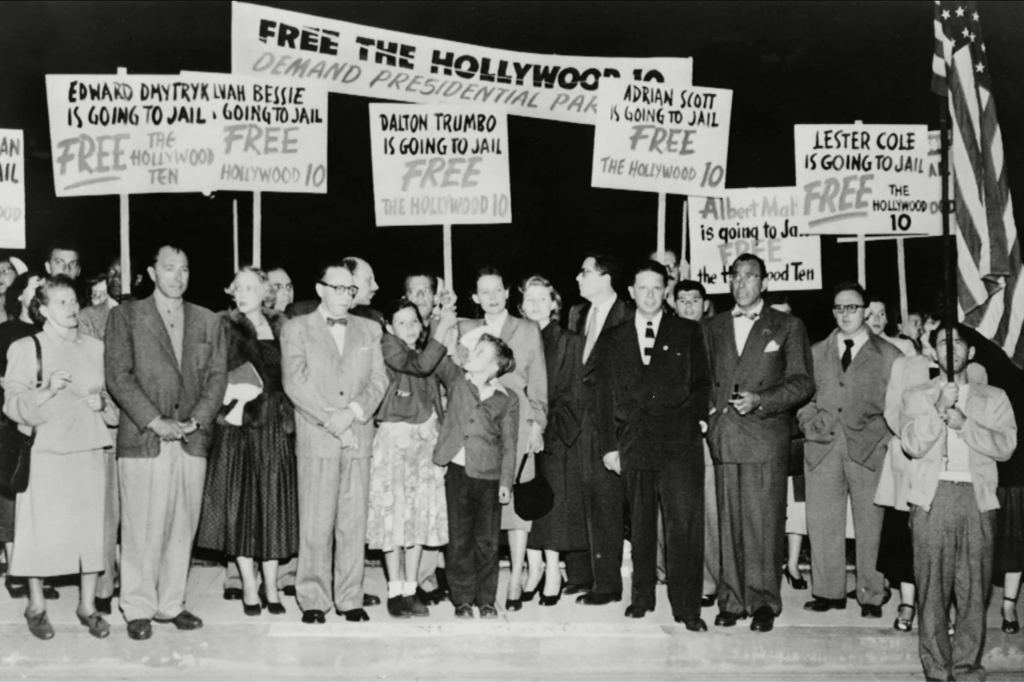
People protesting in favour of the Hollywood Ten. Source: Encyclopaedia Britannica.
HUAC and The Robe
But HUAC lay in his future, as Maltz only worked on this project from 1942-1946. As Smith (2005) has highlighted, while Maltz could not have worked HUAC references into the script before his HUAC experiences, it is possible that the tension over Communism still shaped his draft. There were moves against Communism before the Second Red Scare that swept America in the late 1940s and 1950s, such as the actions of the Tenney Committee in the early 1940s, or the foundation of the right-wing Motion Picture Alliance for American Ideals.
Or perhaps Maltz was more focused on providing a critique of Italian fascism, given the backdrop of World War II? Maltz wrote Cloak and Dagger (1947) immediately after The Robe, which definitely took aim at Italian fascism, whilst exalting the resistance from the Communists. He would also write Crossfire (1947), a film that tackled issues of anti-Semitism within the USA.
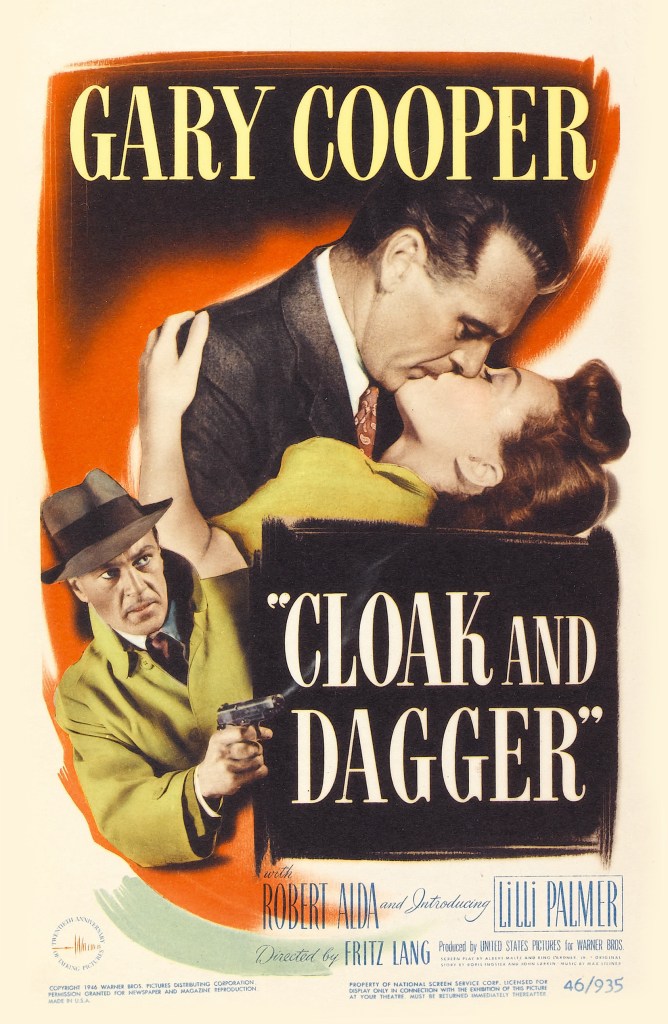
Film poster for Cloak and Dagger (1947)
Is it possible that the next screenwriter to work on The Robe worked in some sick burns? Phillip Dunne followed Maltz and would eventually receive sole credit for the film, thanks to the blacklist. He was known to be a liberal and helped to establish the Committee for the First Amendment. This group formed in reaction to the HUAC hearings in 1947. Fellow members included other Hollywood luminaries such as William Wyler, Lucille Ball, Lauren Bacall, Bette Davis and Dorothy Daindridge.
However, Dunne was not a Communist; quite the opposite. He may have intended The Robe to be a veiled criticism of HUAC, but he may also have seen the repression of the Romans as being akin to Stalin and the Communist regime.
References
- Reinhartz, A. (2013). Bible and Cinema: Fifty Key Films. Routledge. https://doi.org/10.4324/9780203083260
- Richards, J. (2008). Hollywood’s Ancient Worlds. Continuum.
- Smith, J. (2005). ‘Are You Now or Have You Ever Been a Christian?: The Strange History of The Robe As Political Allegory‘, Film Studies, Winter: 7, 1-15.
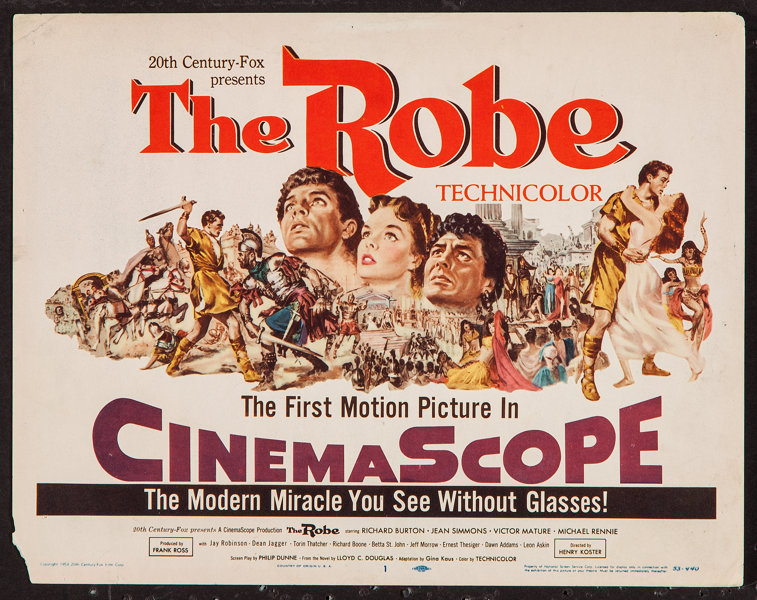
A lobby card for The Robe
Automated Transcript
Provided by Otter AI
Dr Rad 0:16
Welcome to the Partial Historians, we explore all the details of ancient Rome. Everything from the political scandals, the love of ours, the battles waged, and when citizens turn against each other. I'm Dr. Rad.
Dr G 0:34
And I'm Dr. G. We consider Rome as the Romans saw it by reading different authors from the ancient past and comparing their stories. Join us as we trace the journey of Rome from the founding of the city.
Dr Rad 1:03
Welcome to a special episode of The Partial Historians, I am one of your hosts, Dr. Rad.
Dr G 1:10
And I am a somewhat healthy, Dr. G.
Dr Rad 1:15
I know this is true dedication, Patreons, Dr G has been suffering from the vid.
Dr G 1:22
I've been on my deathbed. But I've bounced back. Thank goodness.
Dr Rad 1:27
It was Rome that calls you for and said live live another day.
Dr G 1:33
And one must always follow the commands of Rome. And here I am. as ever.
Dr Rad 1:39
Well, I suppose luckily, or unluckily. I'm not sure. We're not doing our normal narrative today. But instead, we're taking a journey into Hollywood land, which could be good for a sick person, or maybe not.
Dr G 1:54
I look, I think it's gonna be it's gonna be good. I'm excited for this golden era. Hollywood is one of my favorite times in Hollywood.
Dr Rad 2:03
We all love it. We all adore it. So let's get into this special episode where we get to talk all about The Robe 1953.
Dr G 2:50
What a film. I mean, I think the best thing about it is Richard Burton.
Dr Rad 2:54
Definitely let's let's give a bit of a cast rundown. So in typical Partial Historians fashion, we're doing this slightly backwards in that we looked at the sequel first. But that was only for our Patreon. So for everybody else, we're just doing The Robe. So first of all, we have Richard Burton playing the lead male character Marcellus Gallio.
Dr G 3:19
A fine specimen of a young Roman if I ever saw one.
Dr Rad 3:21
Indeed. And then we have my favorite Jean Simmons playing the lead female part, Diana, I think she's actually really good in this role. Yeah, well, you know, she's got that pure beauty about her. She looks very innocent.
Dr G 3:39
She does.
Dr Rad 3:39
Yeah. And then, of course, we've got the hero of our Patreon bonus episode Demetrius and the Gladiators, because, of course, being a sequel, he's in this one too big to mature, playing Demetrius,
Dr G 3:53
And he does look mature, doesn't he?
Dr Rad 3:57
He does have a mature look about him. But lest we forget, he retired at 44. So I guess he was in his 30s at this point in time.
Dr G 4:04
Oh, wow.
Dr Rad 4:06
And then we have Michael Rennie playing St. Peter.
Dr G 4:11
Yeah, I feel like that was a bit of a that's a bit of a throw into the sequel as well, isn't it?
Dr Rad 4:18
I believe so. I think he was in both. Yeah, definitely. I mean, they knew they were filming both when they started, as I discovered last time. And then we have Jay Robinson playing Caligula.
Dr G 4:30
Hmm. Yeah. We'll come back to that one.
Dr Rad 4:33
Yeah. And then I think the main ones that we have to deal with there are major characters. Yeah, I think that kind of covers it. Yeah, yeah, definitely. So The Robe 1953 is a big film in many ways. Not only is an epic from the age of epics, the Golden Age of Hollywood epics, but it also has won some fame for some of the other milestones that are associated with this film. Now, just to give us an idea of exactly how big a smash it was, it costs a smidgen over $4 million to make. And, yeah, it took in $17 million in the US a market and $36 million world wide.
Dr G 5:25
Okay, so this was a profit making engine?
Dr Rad 5:29
Well, yeah, I mean, it has a cycle that's going to tell something
Dr G 5:35
built in, apparently, as well. So yeah,
Dr Rad 5:37
I do like this detail, though, that some of the ticket sales would have been to teachers who were pressed into going to see this movie for their students, or with their students, maybe?
Dr G 5:50
Yeah, goodness. I mean, that kind of made up the bulk of sales, surely.
Dr Rad 5:56
Anyway, so let's talk a little bit about this ethic, Dr. G. So what were your initial impressions? I'm dying to know,
Dr G 6:03
Oh, look, I think longtime listeners of this show will be well aware that I tend to classify myself as a pagan, and my position has not changed. As a result of watching the Rome, it did feel like very much that they were utilizing Roman history as a vehicle for getting to the Christian story. And I'm not a fan of that, to be honest. Christianity is not huge. In this initial face, like this is set sort of right at the moment of the passing of the Messiah.
Dr Rad 6:39
Jesus is alive in this film. That tells us something. Yeah,
Dr G 6:43
Jesus starts alive in this film. Yeah, he doesn't stay alive. So that gives us almost everything we need to know about what moment in history we're in. But the sense in which there is a really strong Christianizing moment that comes over all of the players who've been closely associated with that moment of Jesus's death is really interesting. Yeah, and I would say, anachronistic.
Dr Rad 7:09
For sure. I mean, it's historically accurate to place Jesus's life in his time period. So the time period we're talking about is the tail end of the reign of Tiberius, aka the best period ever. And we then end up going into some of calculus, rain as well. And calculus, definitely around this whole movie. He's not, you know, off to the side, and Tiberius is a circle regular, I think, is definitely the main Roman imperial character that we get to know over the course of this film. And that is historical. As far as we can tell, Jesus was indeed around in the latter half of Tiberius, his reign. So anyway, the general setting for Jesus's lifetime, and when he starts to become a problem for Rome, all is accurate. And so we've got our major players, you know, being where they should be. But as you say, this is a classic Hollywood epic in that in order for you to have a good guy and a bad guy, you know, someone to root for and someone to despise while still enjoying the things that they get up to. It's pretty normal for Hollywood to go to a Christians versus Romans storyline, or at least Christians slash Jewish people. Question Mark versus Romans?
Dr G 8:30
Yeah. And this leads us into some like really interesting directorial choices, or maybe casting decisions as well, because the Romans quintessentially played by the English. So they've got that very sort of RP accent going on. Yeah, but then the people of Palestine appear to be American. Where, I mean, it's something
Dr Rad 8:53
But I think that that actually does keep into the whole accent divide. Because I think it's kind of meant to be the people who are on the side, that you're meant to be rooting for generally American.
Dr G 9:06
Hmm. So Hollywood would want you to believe.
Dr Rad 9:09
Yeah, yeah, I mean, it's not. It's not uncommon for the movies of this era to have that accent divided so that it's super clear, just in case you were thinking of rooting for the Romans that were crucifying Jesus, just in case you had a moment where you thought maybe I'm on their side. They go for the accent just to make it very clear.
Dr G 9:30
That and the way that they decide to portray particular were Romans. Now, Caligula, as we know, doesn't have heaps of redeeming features, ultimately, and the Romans themselves get pretty jack of them very quickly, they do. So this is what what is about to follow is not the saving of Caligula. Now, when I say I think he might have been overplayed a little bit in this film.
Dr Rad 9:59
Oh, Though I have to admit, though, I kind of enjoy the guy who played here. And he does have the kind of voice that really grates on you in a way that makes you think, yeah, I could assassinate this guy after a few years. I think I'd be annoyed enough.
Dr G 10:15
He is frustratingly inept in his presentation, and because we don't get a good read on motivation from Caligula, and because it just feels like he's being played for the sort of the hysterical, maniacal, power driven figure that is portrayed as in this film. It makes him feel a little bit unbelievable, whilst also holding down the position as the bad guy.
Dr Rad 10:46
Yeah, fair enough. Well, before we get too much further into Ahala, we probably should say something about the general storyline of this film. So why don't you tell us about the the story of Digi
Dr G 10:57
Okay, all right. Well, I mean, it starts off great opening scene. It seems like we're in the Roman Forum. Everyone's having a good time. It's clearly slave-buying season. Not that anybody should be excited about that.
Dr Rad 11:11
I say Why does it not slave-buying season in Rome?
Dr G 11:14
It seems to b a particularly busy time at the moment. And this sets up the few really important dynamics. It allows us to see Marcellus re-meeting his childhood sweetheart, Diana, they haven't seen each other for many years. So that sets up that relationship. We learn about Diana's connection as a ward of Tiberius to calendula, potentially as a love interest for him. But we also learn about myself versus ongoing tension with Caligula as well apparently those two don't get along. And then we have this sort of moment with the slave market, which introduces us to Demetrius as well, who is perhaps the most stoic character in this whole
Dr Rad 12:00
Oh, my God, yes.
Dr G 12:01
So stoic, and this guy kind of just accepts his fate as it is, doesn't seem to fight one way or the other. But does seem to be motivated by an internal set of principles. And for whatever reason, Demetrius ends up coming to the attention of both Marcellus and Caligula during this slave sail. And this becomes an important point because it's this moment. And this tension between Marcellus and Caligula, which turns Demetrius is fate. So you technically gets freed in a slave auction through being purchased at such a high price for Marcellus to sort of jab coelicolor A little bit. But because Demetrius feels that this isn't appropriate to be bought at such a high price just to be set free, he decides to become the manservant of Marcellus anyway. So these two are now bound up together in what appears to be a kind of odd duo, because my Seles then goes on to be like, let's be friends, if we're going to hang out together like this. Demetrius is, like, we are not friends. I really owe you. It's different.
Dr Rad 13:15
I do like the pairing, though. I mean, Burton's got the voice and Mature's got this shoulder.
Dr G 13:22
Yeah, so these two end up on adventures together, which are all bound up with calendula in particular ways Caligula is annoyed at Marcellus for this whole debacle in the slave market. So he sends him to Palestine as a bit of a punishment. While he's there, he ends up in a situation with Pontius Pilate, so that's good news. Everybody likes it when Pontius Pilate enters the enters the scene, Pontius Pilate sort of commands myself is to be in charge with the crucifixion of Jesus, which is awkward, but also at the same time has a Lady Macbeth moment, which is kind of beautiful, where he's washing his hands, and he's like, I need to wash my hands. And he's slaves like you just wash your hands. Yeah, like the bloods invisible but he's having trouble guys. He's ordered the death of Jesus. Then we have some really interesting moments in Palestine, one of which is this trading of the robe. So pivotal to this entire film, it would seem is that we don't see Jesus very much. We don't really see his face. We sometimes hear his voice, but we he's a mysterious figure who seems to have an effect on Demetrius straightaway. When he is on the cross, the robe that he had been wearing has been laid at the bottom of it. One of the Roman soldiers picks it up and it's like that. We could throw this into the old gambling table. Let's when the robe of Jesus and Marcellus wins it, but is then sort of overcome when he tries to put it on himself when it's raining and he wants To protect himself it seems like it has a huge negative effect on him like almost like burns his skin or something. Anyway, it's it's horrifying to him and Demetrius just wanders off with the robe in the end does like I'll take that.
Dr Rad 15:14
But he does have that amazing scene because there's all that storm happening around them and I must have been I think this is probably one of Victor Mature's finest moments on screen, where he sort of screams and Richard Burton's face as he's, you know, dealing with the effects of the robe and all of that kind of stuff. And he does that whole “murderers, thieves, jungle animals. Masters of the world you call yourselves. I'm curse on you. I curse on your empire.” Mwahahahaha
Dr G 15:51
Lightning strikes in the background and this thunder?
Dr Rad 15:54
Yeah, it's great. Yeah, the evil laughter was my addition, I should say.
Dr G 16:00
Very intense moment. And Demetrius ends up walking off with the robe, completely unharmed by it, because clearly it's there's a connection between his faith and one's capacity to hold this garment. Sacred as it is. Marcellus ends up back in Rome and seen Tiberius on the Isle of Capri being like what I do, I've got this madness. And the Romans in the wisdom decide that the road must be cursed, which is for the Romans had excellent choice really. It's like that would explain it. So Marcellus is given an imperial commission to destroy this robe. And it's like, use whatever means you need to.
Dr Rad 16:45
So this is great guys, how many people might have tried it on by now? Yeah,
Dr G 16:48
it's a disaster. We've got to find it as soon as possible.
Dr Rad 16:52
If anybody finds out about this garment, it's going to be a PR nightmare.
Dr G 16:56
That's basically what Tiberius says, when when everybody leaves. And he's like, this is the worst thing that has ever happened in my entire rule.
Dr Rad 17:03
And I've had some stuff happen.
Dr G 17:06
We must deal with this instantly.
Dr Rad 17:08
I mean, my brother died, I had to divorce the wife that I loved. I then had to marry a woman I hated the child that we had died, then both my natural son and my adopted son birthday, that was pretty bad. But this this robe. Okay.
Dr G 17:25
It is up there. Yeah. So Marcellus finds himself back in Palestine, because that's where he last saw Demetrius with the robe. It is like, Well, I'm gonna go back to the source that look for more clues. And this leads to a whole bunch of unfoldings. There's storytelling things. There's this slow journey of Marcellus from like quintessential Roman, to like, somebody, embodied in faith, very dedicated Christian, very dedicated across this journey. Yeah, he meets some villagers who really shift his perspective on things. He finds Demetrius again. And all of this sort of nourishes his flourishing belief. So by the time he does get back to Rome, he's now committed to the cause. And he also hasn't told anybody that he's back for ages as well. So
Dr Rad 18:16
Well, yeah, he's got he's got new friends now, the Christians. And so Peter,
Dr G 18:20
yeah. And you know, when Diana finds out about this, because she's been waiting for him this whole time, that he's hidden, his return from her. She's not happy about that, and she is that she demands to be taken to him. And that's when we find out that the Christians are living in the catacombs. Yes. Which, which is awkward, because they should not really exist. Yeah.
Dr Rad 18:47
Minor details, minor details. Yeah,
Dr G 18:50
Look, I was I was all fine for them to just be underground caves, like, Rome is literally riddled with natural springs and cave systems anyway, it's completely, completely fine and legitimate, but they do refer to them as catacombs. And I was like, guys, you know, that people would have have to be buried in them for them to be catacombs. And the people that we know are buried in the catacombs are. And you guys are the first Christians in Rome. So
Dr Rad 19:17
There's been a lot of persecution already.
Dr G 19:21
So much, so much persecution already. Anyway, as it turns out, one of the things it's getting more complicated as the film goes on, but Demetrius has been captured and the Christians have to save him, cuz he's been tortured for information. Yeah, yeah. And calendula has Demetrius in his grass. Yeah. And is turning the screw as it were. So the Christians all gather together and they managed to pull off a very effective saving of Demetrius and they hide him weirdly at Marcellus his dad's house. Yeah, although,
Dr Rad 19:57
I was going to say it's, I like the I like the infiltration because they use myself as a mole. You know, he's got the clothes, he's got the accent, he can penetrate into the palace itself in order to rescue Demetrius, which I did appreciate,
Dr G 20:14
Although it is a concern to me that throughout this entire film, Marcellus has been known consistently as the Tribune. So he's pretty low down on the cursus honorum. And he's definitely not progressing any higher, because for him after this film, but the thing is that I feel like given the nature of the events, we've had two trips to Palestine, at least in the course of this film, that we are looking at over a year. Oh, it's way more in terms of time. Yeah. And as a magistrate holding the tribuncianship, it seems very unlikely that Marcellus would continue to be attributed over the whole course of this film, or that given the way that he's behaved, that people would continue to recognize him as Tribune.
Dr Rad 21:03
Yeah, I definitely think it's meant to be more than a year for sure. But do we think that he is tribune of the plebs or just a military Tribune? That? I don't know. I feel like I kind of figured he was like a military Tribune.
Dr G 21:17
Well, that is an unfortunate place for the son of a senator to have ended up in terms of his career.
Dr Rad 21:23
I could be wrong, but that because they never really clarify that. But
Dr G 21:27
They don't. They don't. And he continues to be attributed throughout the whole that's true.
Dr Rad 21:31
Yeah, that is true. I think they do use that more than his actual name. Tribune. Give me Yeah, Tribune. I'm having some trouble
Dr G 21:39
You sir, Tribune. I want you to do the crucifixions. today. I'm bored. Yeah. So our final scene. Ultimately, the plot leads us to this moment where it's the ultimate showdown between Caligula and Marcellus.
Dr Rad 21:56
Yes. Because he's been captured, he ends up getting captured when he's trying to get everybody safely. Well, out of Rome, I think they're going after.
Dr G 22:04
Yeah, he's trying to get Demetrius safely out of Rome. Yeah. And in the course of that, they're being run down by some cavalry. And Marcellus chooses to sacrifice himself. Yeah, that his friend can get away. Absolutely. It's never really been clarified that they are friends now. But what assumes over the course of the travails that they've encountered that they now like each other, I think they do. Yeah. Yeah. This means that there is a huge public trial. Myself, his parents are there. All of the elite of Rome there.
Dr Rad 22:38
Yeah, all of them. It's a massive crowd.
Dr G 22:40
It's a huge crowd. So many people. Caligula comes in, in what is the reddest garment that has ever been seen on film,
Dr Rad 22:51
that the marvels of Technicolor for you?
Dr G 22:53
It's incredible. Everybody else looks pale and washed out in comparison. But Caligula Boy, that is some Imperial read that he's got. This leads into our whole sort of three ways sort of struggle between Diana, Marcellus and Caligula verbally duking it out, essentially.
Dr Rad 23:15
Actually, we should perhaps mentioned that Diana was meant to marry Caligula for a little while there. So yeah, yeah, it's a triangle or
Dr G 23:24
it's a triangle. And she certainly makes it clear where she stands to Caligula to the point that he changes his mind about being unwilling to punish her to her definitely having to die.
Dr Rad 23:37
Yeah, well, I mean, it's a no brainer, really. I mean, when you're choosing between Richard Burton's sultry tones, and those of Jay Robinson, I mean, can you imagine that in the bedroom data, add data?
Dr G 23:54
It's quite something. I mean, I hope he's got an indoor voice. Just whispered to me, Caligula.
Dr Rad 24:03
Yeah, yeah. So basically clears like, you know what, you guys believe so much in this afterlife and this kingdom of heaven and being saved. No big deal if I execute the both of you, and so they match off quite happily just chip off into the clouds.
Dr G 24:18
Yeah, it's the way this film ends is a little bit surprising. I felt like after two and a quarter hours of viewing time, I was not expecting the end scene to be a gentle walk by Marcellus and Diana, out of the trial into heaven.
Dr Rad 24:41
I know, I know, but I guess I guess because they knew the sequel was coming. That maybe they felt that that was okay. And look, you know, it's kind of an anti Hollywood ending. I mean, it's a happy ending. But it's not your typical Hollywood ending, I suppose.
Dr G 24:56
Yeah, they do get to stay together forever in love, I suppose. Oh,
Dr Rad 25:01
there's that. But I mean, I think if you were going for a real Hollywood ending that somehow they would both survive and Galio would become the emperor or something like that. And also maybe the Pope.
Dr G 25:14
Yeah, look, I mean, if you're gonna rewrite history, I mean, lean in guys.
Dr Rad 25:19
Yeah, exactly. So that's the rough storyline, which, as you can tell by the fact that it took us 13 minutes to tell you the story. But you know what, we're saving you from watching a two and a quarter hour movie. So although if you want to it could be fun. I'm not saying you shouldn't watch it. But you know, 13 minutes on two and a quarter hours. It's not too bad. So let's maybe talk about where this movie came in from Dr. G. So whilst Hollywood does love a Christians slash Jewish people versus Romans storyline, it did not come out of thin air is of course, based on a book, of course. Yeah. So it was actually written by a guy called Lloyd C. Douglas. And he was the son of an Indiana pastor. And he became a Lutheran minister himself, before moving over to the Congregational Church, for his career. But he started writing as we got into the like, the late 1920s, he started writing, he wrote this book called “Magnificent Obsession”, and it sold 3 million copies. Oh, my goodness. Yeah. And so by 1933, he was like, You know what, I don't think I need to be a minister anymore. I think I'm going to be a novelist.
Dr G 26:35
I've got a winning formula. And all I need to do is write my books. Yeah,
Dr Rad 26:39
he honestly became one of the most popular novelists in America in this time period. And this is not the Rube is not the only one of his books that was adapted into a film. So well, well, well, they're not they don't they're not only popular in terms of people reading them. They are popular in terms of being picked up and made into Hollywood films. So the robe had been a best seller from 1942 until 1945.
Dr G 27:09
Wow, okay. Yeah. It was on the bestseller list for years.
Dr Rad 27:13
Yeah, absolutely. I presume that publication was maybe slightly slower for like the big novels. I know. They were dying novels and stuff out, you know, in the 1950s that people could buy. And they were turned out very quickly. But I feel like it is a slightly less crowded market, perhaps at this point in time.
Dr G 27:31
It's a very interesting time for the novel to come out as well, like you're in the middle of the Second World War.
Dr Rad 27:38
Yeah, you are indeed. So it was eventually bought by RKO. However, they didn't really act on it. They just sort of bought the rights to it. And you know, by the late 1940s, it's still something that they're just sort of sitting on at that. At that point in time. Howard Hughes is in charge of RKO biblical films were not really his thing. He wasn't as into them as other people seem to have been at the time.
Dr G 28:06
Sounds like how would use it, I might get along. Exactly, yeah.
Dr Rad 28:10
But eventually, Darryl Zanuck and Fox Studios step in. And this is how the film finally kind of gets off the ground and gets made. So that's just sort of a little bit of background to the film. But as a result, and not, to be honest, this is pretty common for Hollywood movies of this time. There are a number of people who ended up working on the script for the film, because it has such a long production process. But even with the ones that were shorter, it was pretty common to have more than one person, you know, take a look at the script and give their input and that sort of thing. When the film was finally made, it definitely got a huge publicity campaign. So we're talking radio ads, we're talking television, we're talking newspapers, everywhere you look there's an ad for the road.
Dr G 28:58
Have you seen Cinemascope?
Dr Rad 29:02
Nobody has. It's the first one to have it. So of course, it's going to be viewing this new widescreen format which the studios are hoping is going to keep people coming to the movies rather than sitting at home and watching their televisions which of course the becoming a big thing in this post World War Two era and so they make the film's bigger, more colorful, more extravagant, the kinds of thing that television which is generally a little square, black and white box just can't really offer you know, we're talking about also sound you know, stereophonic sound, it's it's all a big thing. And it's given this huge premiere, where it's like a freaking circus. We're talking about, you know, the spotlights outside the cinema, the stars are attending, you know, it's a very, very big deal.
Dr G 29:53
There's gladiators playing games.
Dr Rad 29:58
Yeah, so it's definitely a huge to do when it when it comes out. So as you highlighted when this novel was first written, and people were maybe first toying with the idea of making this film, it was a world war two time. And that seems to have been thought to be part of the message of the film when they were first, you know, throwing it around that in some way, Caligula and Rome are meant to be this sort of, you know, decadent place, that they're somehow the way they're treating Jewish people slash Christians, because of the crossover. It's kind of meant to be like the persecutions that were carried out, in particular, I suppose, by Hitler, but also to some extent by Mussolini. So this was definitely meant to be something that people were, I think, picking up on when they were first, you know, developing this into a film.
Dr G 30:59
Look, I think that sounds reasonable. Yeah. Yeah, you do get the sense that the way that the Romans are being positioned in this film is quite particular. And it's quite different from other epics of this era that I've watched so far, because I'm not going to pretend that I'm conversant in all the Hollywood epics.
Dr Rad 31:20
But there are quite a few now.
Dr G 31:22
I have watched a few but I wouldn't say I'm in any way an expert at this point in time. But it did feel to me like the Romans were being very much positioned in a particular way. And it was, in part to do with, obviously, the focus is on the Christian story. So the Romans are, by default, the bad guys here, but also, that it's coming out of that sort of post Second War mindset. Well, how do we understand conflict? How do we understand the persecution of peoples? And so while I wasn't really consciously thinking about it, when I watched it, the vibe that the Romans are giving off in this film is intriguing.
Dr Rad 32:04
Yeah. And I think it's kind of one of those things as well, where were these sorts of moralizing films, it's kind of that thing of people get to enjoy watching the Romans have this very fancy schmancy life that they have, whilst also being like, Oh, isn't a terrible, look at what they're doing to those poor Christians. So it's like they because the moral is there, they get to enjoy watching the decadence of Rome. But I didn't feel like it was as over the top in the robe, as it has been in some of the other movies, we've watched, like quovadis, and that sort of thing.
Dr G 32:38
And I feel like the decadence was actually a little bit pared back in this film, like note that it didn't have like all of the highly colored interior scenes and the layering of different stones and things like that it was obviously trying to be quite opulent in its way. But it also felt like maybe they didn't have quite as much budget as some other films for some of that stuff. Yeah, definitely.
Dr Rad 33:00
Now, the other interesting thing I'm going to throw in contextually Dr G is that so when this film was purchased, and when it was being made, we're still in the time of the studio system. So this is a period where you've got kind of like five major movie studios that really dominate the production of movies in Hollywood, there are some minor studios. And then there are also some truly budget, you know, just pump out these really crappy movie studios, they do exist. But the major films, particularly the ones that most people would be familiar with today, they're going to be made by one of these major studios. And it's kind of that idea of it being like the dream factory time of Hollywood, you know, where they're manufacturing movies. And so they're in charge of who gets hired to be director who's the producer, who's on contract, like the stars are all under contract at various studios, and they have to make so many pictures per year, and they get paid this much to do it and all that kind of stuff. So huge amount of control. Now, most of these Hollywood studios, these major ones are owned by Jewish movie moguls. This puts them I suppose in an interesting position in the 20th century. Now, of course, I think part of the reason why that ended up being the case is that typically, when when movies first sort of became a thing, it wasn't necessarily the most admired or respectable profession to be involved in, you know, I mean, it wasn't the theater.
Dr G 34:33
In the same way that actors in ancient Rome were suffering under the pool of a lack of respect for their craft. Exactly. So too, did early filmmakers, people like that's not
Dr Rad 34:46
exactly yeah, and I think it's so it's something that you do tend to get people that perhaps aren't risking a wider reputation, I suppose, or aren't too concerned about what this wider society You may or may not think we're also talking about people who are potentially immigrants. You know, there's a whole bunch of reasons why you might end up getting maybe a higher percentage of Jewish people getting involved in the film industry in the early days. And their investment, of course really pays off, because everyone starts to really fall in love with movies, which makes, which makes the people that got involved in the early film industry, very wealthy when they rise to the top. Now, it's not by any means only Jewish people that are involved. But there is a trend where a lot of the big movie Americans at the studios are Jewish people. Now, they don't want to be seen to be putting prou Jewish propaganda into their films or things like that, particularly once we get into this time period that we're talking about, you know, with, obviously, World War Two, I mean, even I mean, obviously, we talk about American history, obviously, there's always been, I think, a certain stigma against anybody who's perceived to be an outsider. But particularly in the early 20th century, we know that we see a spike in terms of racism, not just directed against African American groups, but also directed against any immigrant groups, and Jewish people in the 1930s, are increasingly being associated Well, in the 1920s, and the 1930s. Really, they're increasingly being associated with communism. So especially with everything that's happened with World War Two, especially, it's not really a great time, I suppose, to be seen, to be putting out film sort of openly, you know, Pro, the Jewish course. 1919 48, I think makes it particularly touchy issue. Because, of course, this is when we get the creation of the State of Israel. So with the creation of the State of Israel, there was actually a film release that was touching on these sorts of issues, and was kind of pro Israel called the sword in the desert. But there was a riot that broke out in a London cinema when it was shown. And so it was actually withdrawn. And so I think that showed a message of, you know, people aren't really going to want to see these sorts of films, or at least that's the feeling. And obviously, we're talking about Hollywood, it's a business, you've got to, you know, make your money somehow. So a way I suppose, of dealing with that was by making biblical epics, where there is a bit of a focus on, say, the Old Testament. So we do see a lot of Jewish heroes turning up in some of these 1950s epics, another one, of course, played by Victor mature Samson, Samson and Delilah. And then of course, we've got Moses turning up in the 10 commandments. And then you've got characters like Joshua Solomon, and even in terms of women, you've got people like Ruth and Esther turning up in some of these biblical epics. So the robe is kind of an interesting one, because it is obviously crossing that, that line between Old Testament days and entering the New Testament led by one Jesus Christ.
Dr G 38:02
Yeah, we're in this very interesting storyline. I suspect, and it doesn't necessarily, I don't think it's over in this film. But it's clear as well, that this is about the genesis of Christianity. And it emerges out of Palestinian culture, that's clear, both from the geographic location. And it's clear from the way in which the robe engages with this story as well, like Marcellus goes on this journey, which involves him going into Palestine as part of his job as a Roman, but also learning and discovering things about himself while he is there. Yeah. And for him, that's not necessarily about Jesus in the beginning. It's a much longer journey. And so I think part of what this film is trying to do is to try to capture what does this historical moment really mean? For so that sense in which we know that there are people in Palestine during this time period historically, who are being crucified? And what kind of effect does that have on the people who are there at the time? And what kind of stories are they telling about these people? Because one of these stories ends up becoming very influential, and being retold and retold. So this is an interesting way to tackle it, I think, through the eyes of somebody who is Roman, and also through the eyes of someone who is not Roman, but he's also an outsider.
Dr Rad 39:34
Yeah, it is a really interesting film in that respect. And I think also the choice of having it I mean, obviously, they had to place it when they did if they were going to be accurate about when Jesus was supposedly alive and when he was being crucified. But I think there is also a tendency to set these sorts of movies during the Empire, not just because historically it makes sense, but also because there are publican era of Rome had been such a model for the USA itself. And they like to think of themselves as you know, inheriting some of those Republican Roman values. So a way I suppose dealing with the fact that they like, we're like the Romans, they're like, oh, wait a second. Not those Romans. Yeah. When like their republic and Romans, not those decadent, Imperial Roman, it's not the USA.
Dr G 40:26
I mean, they're very lucky in that regard that the timeline is what it is. Because imagine if this had happened in the Republic, and it very well could have because
Dr Rad 40:35
Their heads would literally explode
Dr G 40:38
We are not that far into the imperial period.
Dr Rad 40:44
Now, of course, for that there were some minor contextual factors. So the rivalry from television, we've got the studio system, and the people that are behind the studio system, follow the money, did you?
Dr G 40:57
Well, yeah. Like I hear Jean Simmons had to, like, break contract and get a different contract in order to do partly to be in this film.
Dr Rad 41:04
That's generally what they had to do. There's always sort of like they it was, it was almost as though the celebrities were like trading cards. And, you know, studios would be like, Look, I really want so and so from this picture, they be just right for the role. What can you do I will trade you these two women for that woman for six months? Or? Or yeah, they will, they had to renegotiate their contracts. Because often their contracts would be like for seven years. So it's quite a substantial chunk of time. So we've got television, we've got the studio system, we've got the creation of Israel, whilst this film is very slowly being developed. And then of course, the big thing that we need to talk about is the Red Scare of the 1950s. Don't know. Thank you, thank you, I needed a sound effect. So by the time the room is finally like properly in production, which is by the early 1950s, we're looking at a second round of huge hearings, which is the house of UnAmerican Activities Committee. And these are the people that are most notorious for trying to root out communists in various industries in America, but in particular, in Hollywood, and I say in particular, in that it was probably obviously the most widely publicized.
Dr G 42:23
Yeah, it's a horrifying time to be for the progressive political nature.
Dr Rad 42:27
Yes. So there's been a lot of talk about the robe and the whack hearings. Because of course, there are some key scenes in the room, which some people have taken to mean, that this film was trying to talk about the present happenings in America, whilst extensively talking about the past. I'm wondering if you can guess which scenes I'm talking about Dr. G. I
Dr G 42:53
don't know that I can. I didn't have this moment where I was like, aha, that's a clear us moment. I had moments where I was like, this is another Lady Macbeth reference.
Dr Rad 43:04
Very possibly,
Dr G 43:05
maybe they're the same. Look, there is this scene on the ship back to Italy, where Barcellos seems to be involuntarily moaning a bit like a lady while he's asleep. As there is the sound of the hammer on the deck of the ship. Could this be a hammer and sickle reference that I've missed? Could this? Could this be a recollection of his role in the crucifixion? Where the sounds are the hammer of minds him of the of the nails that he drilled into Jesus's body? Anyway? I don't know. But that was a great scene.
Dr Rad 43:43
Well, basically, it is the scene where Tiberius is talking to Marcellus, the Tribune, about finding out about the road, like tracking it down. Yeah, reaching out all the Christians, all of that kind of stuff. So he explicitly says to Marcellus