Special Episode - Augustus' Mausoleum with Dr Victoria Austen
In this episode, we talked about the style and function of Augustus' mausoleum and how it was repurposed over time with Dr Victoria Austen. This unique monument has as much to tell us about later periods as it does about Augustus himself.
The Partial Historians · The Partial Historians
Audio is streamed directly from the publisher (sphinx.acast.com) as published in their RSS feed. Play Podcasts does not host this file. Rights-holders can request removal through the copyright & takedown page.
Show Notes
It is not often that we are fortunate enough to get to chat to one of our amazing guests a second time, but sometimes the gods are just that kind. We sat down to speak to the one and only Dr Victoria Austen about Augustus’ mausoleum.
Special Episode – Augustus' Mausoleum
Dr Victoria Austen holds a MA and PhD from King’s College London. She has lectured in the Classics at the University of Winnipeg and is currently the Robert A. Oden, Jr. Postdoctoral Fellow for Innovation in the Humanities and Classics at Carleton College, Minnesota. Her monograph Analysing the Boundaries of the Roman Garden: (Re)Framing the Hortus’ was released in 2023 as part of the Bloomsbury Ancient Environments Series. Vicky has recently been speaking for the American Institute of Archaeology on gardens and commemoration.
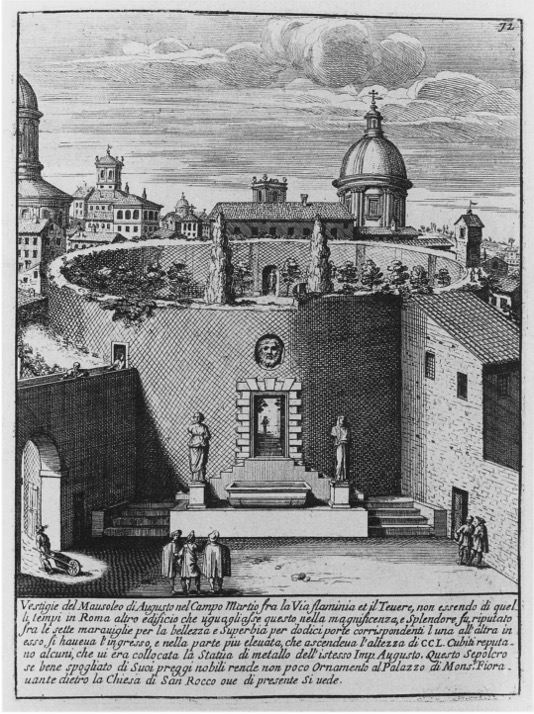
‘The Mausoleum of Augustus’ from Pietro Santi Bartoli, Gli antichi sepolcri ii, 1727. courtesy of Carleton College Special Collections.
What is Augustus' mausoleum?
Augustus did not rest on his laurels after winning the Battle of Actium against Cleopatra and Mark Antony. He set about consolidating his political position and figuring out exactly what that would entail.
Augustus set about transforming the city itself as part of his political machinations. Some of his key monuments include the Ara Pacis, the Horologium Augusti (think giant sun dial), and the mausoleum.
He started construction on this tomb in 28 BCE and positioned it on the Campus Martius (Field of Mars). This is much earlier than you might expect. Augustus’ position was not unchallenged and there was still much to be decided regarding his status in Rome. Nonetheless, Augustus set about building this large circular mausoleum, intending to use it not just for himself, but his family.
Eventually the tomb would house the remains of numerous members of Augustus' family, as well as the princeps himself. Names you might recognise include Agrippa (his BFF and the husband of his daughter Julia), Marcellus (his nephew), Octavia (his sister), and Gaius and Lucius (his adopted sons).
After Augustus’ death, his family continued to use the mausoleum. Livia (his wife), the emperors Tiberius and Claudius, Germanicus, Antonia Minor and Britannicus would all find their way to this monument.
However, there was not an open-door policy for anyone with Julio-Claudian blood. The mausoleum became a sort of litmus test of who had fallen from grace and would be punished with exclusion… forever! You might already have spotted that Julia, Augustus’ only biological child, and her daughter Julia, did not make the cut. Ouch! Nor did the emperors Caligula and Nero. You had to earn your spot.

Donati, A. (1584-1640) Roma vetus ac recens, courtesy of Carleton College Special Collections.
What happened to the mausoleum?
As with so many ancient monuments, the mausoleum has been repurposed many times. Tune in to hear about the Soderini family and their resurrection of the space, as well as good old Mussolini, who just loved to forge connections between himself and figures like Augustus.
Things to Look Out For:
- Augustus getting BURNT by Dr Rad on numerous occasions.
- Good-natured tolerance from Drs A and G about afore-mentioned Augustan burns.
- Deep-seated longing to see inside the mausoleum.
- Discussion of the recent restoration project.
- The need to pay more attention to the plants and green spaces in the ancient world. Won’t someone think of the greenery???
- The importance of green spaces in urban environments in both ancient and modern times
Sound Credits
Our music is by the highly talented Bettina Joy de Guzman.
Automated Transcript
Dr Rad 0:12
Welcome to the partial historians.
Dr G 0:15
We explore all the details of ancient Rome.
Dr Rad 0:20
Everything from political scandals to love affairs, the battles waged and when citizens turn against each other. I'm Dr. Read. And
Dr G 0:30
I'm Dr. G. We consider Rome as the Roman saw it by reading different ancient authors and comparing their accounts.
Dr Rad 0:41
Join us as we trace the journey of Rome from the founding of the city.
Dr G 1:01
Hello, and welcome to a very special episode of the partial historians. Dr. Rad and myself, Dr. G are thrilled to welcome back Dr. Victoria Austen to the show. And you might remember her fantastic conversation with us a little while back now about Augustus and temporal space and representation. And today we're going to be looking at Augustus his mausoleum. So a quick bio. Dr. Victoria Austen holds an MA and a PhD from King's College London. She has lectured in the classics at the University of Winnipeg and is currently the Robert A Odin Junior Postdoctoral Fellow for innovation in the humanities and classics at Carleton College Minnesota. Her research interests span the Latin literature of the late Republic and early empire, ancient Roman gardens and landscapes race and ethnicity in the ancient world, the reception of classical myth and the integration of digital humanities into the classroom. Austen's monograph Analysing the Boundaries of the Roman Garden: Reframing the Hortus was released in 2023, as part of the Bloomsbury ancient environment series, and coming up, Vicky is currently partway through a series of talks for the American Institute of Archaeology on gardens and commemoration. Welcome back, Vicky.
Dr Victoria Austen 2:34
Yeah, it's so great to be back. I'm so so excited to talk more things, Augustus as we know, I'm a big fan.
Dr G 2:41
Me too. Dr. Rad is already
Dr Victoria Austen 2:44
Eye roll already.
Dr Rad 2:46
I was I was going to say, Look, I'm very happy to see you again, but less happy to see your friend. Look, you know what, I am going to embrace it because I have some fantastic dad jokes here. So Augustus is mausoleum, you might say that everyone in the Julio Claudian period is just dying to get in.
Dr Victoria Austen 3:14
I mean, I
Dr Rad 3:20
so Look, let's start with the basics. Dr. Austen, or Vicky, if I may be so what is this thing? How did it come about?
Dr Victoria Austen 3:30
Yeah, so this is basically where Augustus wants to be buried. bold move in that, you know, he creates it when he's still living like this is very much his project. It's not like something that people put up for him. He's like, No, I'm gonna create my own team structure. And I'm gonna model it on potentially one of the seven ancient wonders of the world. Because, you know, he never He doesn't do anything small. So this is why it's called the mausoleum of Augustus, because it's based on we think maybe the Mausolus tomb, which was one of the seven ancient wonders of the world. So timewise it was finished in 28 BCE. So this is, you know, still kind of pretty early on actually, in his principle, you know, when you think he was there for you know, good, good more 30 years or so. So he was he was thinking about his afterlife, very concerned about his commemoration.
Dr Rad 4:26
Yeah. Like, yeah, like an Egyptian ruler. Yeah, thing. He's just very focused on that end goal.
Dr Victoria Austen 4:34
And kind of like structurally as well. It's obviously it's very impressive. It's like this huge kind of concrete structure, which and concrete in itself is a kind of Roman innovation, which was kind of relatively still new at this time period. You know, they're still experimenting with oh, we can use this new material. So we can do round things instead of like, oh, square things. So it's this big kind of dark, circular structure. domed and it's planted kind of all the way around, we think to kind of emulate what create a kind of monumental version of a traditional elektrischen type tomb, which is called a timless, which is, you know, in its most primitive form, that would be kind of like just a mound of earth. That was kind of your tomb spot. So August just kind of seems to have taken that idea, and then just done it, you know, huge, huge monumental scale as as he likes to do with everything.
Dr Rad 5:29
It sounds extremely presumptuous. Yeah. Within keeping of his character, yes.
Dr G 5:36
Very much. So. And I'm particularly thinking about the date of 28 BCE, because this is right before 27, which is usually considered a landmark for him in terms of like sealing the deal on his power. And he's already out there being like, oh, no, guys, I am a big deal. I know it, you guys know it, I've killed everybody who hates me by now.
Dr Victoria Austen 5:57
And I think particularly because there's this idea of it's such a big structure that clearly he was thinking of it in terms of it wasn't just going to be for him, it was going to be for other family members. So it's like, it's going to be like a dynastic kind of monument in itself. And I think, like you said, the fact that he's creating that so early in his principles that kind of speaks to, oh, he may have been doing all of his, I'm just restoring the Republic schtick. But, you know, I'm beside he's like, No, actually, I'm going to create this huge monument to the my family, or my heirs. So like that idea of like the family, dynastic structure, I think is very telling that he's already creating a very obvious building and structure like super early.
Dr Rad 6:48
Really to be fair, he wasn't a well man. Well, no,
Dr Victoria Austen 6:52
I think I think that's part of it. He had so much anxiety over death. And you know, then all of his heirs keep dying, as we know, along the way,
Dr Rad 7:01
it came in handy.
Dr Victoria Austen 7:02
He didn't die, you know. So I think I think it also the early day also represents a bit of that anxiety over you know, I've got to start thinking about my death and what happens when I die. Like, pretty early on. Really? Yeah,
Dr Rad 7:18
definitely. Yeah, Look, that's
Dr G 7:20
tough, isn't it that anxiety and and also that monumental ism, what a fascinating character. Yeah, I don't understand Dr. Rad while you're not so interested. I
Dr Rad 7:29
am intrigued, but it's more of a fact that I'm like, Why can't people just see through him?
Dr Victoria Austen 7:37
This last time, like I like I love him to study. But doesn't mean I think he's a great guy. I also see through him.
Dr Rad 7:47
Yeah, I think it's well, I think it's more Dr. G. I'm talking to me, she she genuinely likes him.
Dr G 7:56
I think it's just because in the portraiture, he comes across as being relatively good looking. So I'm willing to forgive him from things. So, but that's just me being really basic. Yeah. But thinking about the mausoleum and its location, like To what extent is it sort of part of his broader sort of sense of building sort of like a topographical thing for himself in a Gustin sort of way of thinking about Rome? Yeah.
Dr Victoria Austen 8:20
And so I think I was actually talking about this very topic with my students, actually, last week, because we were, we were doing the Augustan period, and Roman Art and Archaeology. And I was, I was saying that one of his innovations really is, you know, late Republican building projects, like kind of Pompey's theatre complex, Julius Caesar had his forum. You know, it's this idea that you're kind of entering a bit of a zone that is, it's like the Pompey zone, or the Julius Caesar zone, and we're kind of entering those spaces, and it's framed by that individual power. But what Augustus does is he's like, all of Rome is now my zone. It's not just a small bar. It's like, I'm doing this everywhere. So again, like in terms of scale, that's what's kind of innovative and the mausoleum is part of the Campus Martius which he is one of his kind of three main areas in the city that he really focuses on for his redevelopment. So we have the mausoleum, but we also have the our pockets, which I spoke a lot about on the last time I was with you. And then there's also this monumental sundial as well the heartland and they're all very close together in this Campus Martius area and I think again, it speaks to this kind of projection of a new type of power, because you know, you have your mausoleum, which is thinking about kind of commemoration long term, but at a family kind of dynastic level, you've got the altar of peace, the our parkas eventually, which is, you know, commemorating I've bought peace to Rome for the first time. And then with the sundial, I think that's, that's particularly interesting because it kind of I think it's also symbolic that he is kind of not just In charge of space, but also his controlling time, as well as all these three monuments, kind of we're all working together kind of past, present, future, there's like this temporal element. And I think so you can't just think of the mausoleum, you know, as a static kind of isolated entity in itself, I think a lot of its meaning also comes from the fact that it's connected to these other very important Augusto monuments. And you have to imagine, if you're a Roman, you're walking through the Campus Martius, like, you're gonna be able to see all three of these things within a very short walk, you'll be able to see them from each other, like they're very, very close together,
Dr G 10:40
and this association with the Campus Martius, in particular, this idea that there is a whole Augustan precinct and there is a really long history of how the Campus Martius is used. And now it's being sort of it's evolving under Augustus is sort of building regime as well.
Dr Victoria Austen 10:56
Yeah, absolutely. And I think what, what I think is fascinating, and also just kind of very telling about the building project in the campus. Martius is it's very representative of so many things that will go sisters in that he's kind of seen kind of political figures kind of use art and architecture and space and these building projects, to project their own individual power, but they never had the opportunity to kind of extend that on mass scale. And so now he's in this position where he can start to do this, in a way he kind of takes all of the seeds that have been done at an individual level. And he's just putting it all together, doing it to a huge, huge scale, and just really hammering it home, like everywhere you go. There's this sense of Augustus kind of framing your experience of the city like you have to imagine that there's not many places like right in the core, where you're not far from an Augusten building project because if you're not in the Campus Martius you might be near the Palatine Hill, that's where his house is, or you're in the forum and he redevelop the forum. So there's like, everywhere you go, there's this kind of just presence of him. And kind of framing your experience of the whole city, I think, which is very, very innovative. I
Dr Rad 12:14
think of him. It sounds like my waking nightmare.
Dr G 12:19
You're surrounded on
Dr Rad 12:21
escape. But I do appreciate I do appreciate that long before Doc Brown and Marty McFly, Augustus was thinking about the space time continuum and how to disrupt it. Yes,
Dr Victoria Austen 12:31
he really was. And I think there's there's a famous that kind of famous theory, I suppose about these kinds of three, three monuments, or kind of like working together in the campus. Martius is it has been suggested that the shadow of the sundial would go directly through the entrance of the Ara Pacis on Augustus' birthday. So it's like, yeah, it's basically I have conquered time, like I am in charge. And I think, you know, Julius Caesar, his uncle had her redone the calendar. And so the sundial was now with the Julian calendar in mind. And so again, it's just this Yeah, it's the way that space and time and with the mausoleum, there's then this idea of like an afterlife. Like, even though I'm not there, you're going to still be thinking about me. And it's the same with our parkas. You know, it was set up with this annual sacrifice in mind, and that's going to keep going on even when Augustus dies. So there's this again, it's like a kind of cyclical, eternal presence. I think that he's trying to establish there.
Dr Rad 13:37
I'll give it to him. He certainly does pay attention to detail and it suddenly hit me that Dr. G being an absolute Virgo. This must be what appeals to her. Oh my god.
Dr Victoria Austen 13:47
This is this is the connection. It's I'm
Dr G 13:54
it is all beginning to make sense. I use just so organised. He's thought of everything.
Dr Rad 14:01
I get it now and I will stop giving you crap about it.
Dr Victoria Austen 14:06
We can't help it. It's in the stars. Absolutely.
Dr Rad 14:09
Yeah. And I Look, this is probably my favourite part of Augustus has more saline to talk about because I mean, I'm sorry, there's no other way to say it. But he's such a dick, in that it's very much about who's allowed in who's not. It's my club. I'm gonna control that. Are you on the VIP list? Or are you not So who gets buried in this thing in the end and who gets left out because they've done something to upset him?
Dr Victoria Austen 14:35
Oh, that's a really good question. I'm trying to think exactly. Who was in there. I know the last person that is in there is Nerva actually, but in terms of in terms of like the Julian accordions, I don't know who is who
Dr Rad 14:49
we know that famously Julia obviously,
Dr Victoria Austen 14:53
does not. I bet she doesn't get in there.
Dr Rad 14:55
She does not say for those of you who haven't listened to our Millions of discussions about Augustus Julia is his one and only actual child, you'd think she'd be a shoo in. But no,
Dr Victoria Austen 15:08
yeah, but no, she's, she's morally Not, not on. Yeah, you would
Dr G 15:13
think in the end that, that in depth that he might allow it, you know, like, there'll be some sort of forgiveness, but he's absolutely no.
Dr Victoria Austen 15:21
And I think it really speaks to like the harshness of that like relationship and that he like, the the ability to, like, cut off the personal from the political that like, I'm, again, this speaks to its a dynastic monument, which is different from a family monument. And obviously, there are times when that overlaps, but the fact that as you said, it's not a, it's not by default that you get in there, like there are choices being made.
Dr G 15:53
And we see some like tragic moments, because obviously, Augustus is thinking about his own mortality, but he's also spending a lot of his time trying to figure out who's going to sort of come into place after him and a whole bunch of them die early. So like, my seller sends up in their Gaius and looses end up in there, you know, and it's like, in a way, despite the fact that Augustus is probably a terribly power hungry kind of individual, you have to feel a little bit of compassion for the fact that he's burying a lot of his young, male relatives that he had great hopes for. Yeah. And
Dr Victoria Austen 16:26
I think there is this sense that, you know, again, this may be speaks to why this was such an important building for him and that anxiety over the succession, you know, his entire project, it was only ever going to reach its complete fruition, if there was some kind of succession because the, you know, if that had not been secured, then there's nothing to say that you couldn't have just like gone back to a republic system, like, you know, it's not until that moment that Tiberius actually comes in, and he becomes like the next emperor, that it's like, oh, we can actually say now that we're doing something different here than just like a one man thing. So I think I think it's kind of possibly underestimated the amount of anxiety around that and just pick Yeah, he keeps picking these people, and then it's like a curse and then they die. Like, I choose you, and now you're dead. Like
Dr Rad 17:26
at the touch of death is like when Augusto says you're gonna succeed me.
Dr Victoria Austen 17:30
And then he's just left with Tiberius by the end.
Dr G 17:33
So it says explains Tiberius is reluctance you've seen the pattern. And he's like, just say, No,
Dr Rad 17:38
yeah, don't don't Look at me. Yeah. But I mean, it to be fair, to be fair, because I suppose it functioned in this way during Augustus lifetime. It's not just during Augustus, his lifetime that it is used as like a who's in favour and who's not kind of monument, that whole dynasty continue to use it in this way. Yeah.
Dr Victoria Austen 18:01
Yeah. So again, it's like that idea of so much. It's when we're thinking about commemoration. And I think this idea of like memory, and who is allowed to be part of that memory, like so many, that is a political choice that is being made along the way. And I think I think that's why I'm kind of fascinated with this temporal aspect and the the playing of time, because, you know, commemoration in general, it's something you're you're doing in the present, but it obviously engages with the past, because it's about kind of ancestors, but it also looks, Augustus is kind of looking to the future when he creates it, because it's this idea of any kind of ironically ends up burying their, like, who would have been the future and then the future is kind of like changing in real time. And so I think there's this really interesting, dynamic there with time. And, you know, one of the things that I'm particularly interested in, obviously, thinking about Gardens is that, you know, it's created with lots of plants and greenery around it, which I think, again, speaks to this temporal kind of cyclical aspect that, you know, the plants are always there, but they, so they kind of are the same, but they're not because they're continuing because nature is continually evolving. So it's like, it kind of appears to be this ever present feature, but that that feature isn't itself kind of always moving. It's not static. And so I think, again, he kind of taps into the power of plants, I suppose in that way to really enhance that kind of temporal aspect of the commemoration.
Dr Rad 19:38
Yeah, and it is kind of interesting to think that a lot of the people that end up getting buried in there are younger members of the of the dynasty, which I think kind of speaks to the fact that if you're if you grow up to be an adult, if you live long enough, you're gonna tick somebody off. Someone's gonna
Dr Victoria Austen 19:57
Yeah, all the all the young ones, it's just like didn't have enough time to do anything?
Dr Rad 20:01
No, no, they were like, Well, you were five. We didn't. We
Dr G 20:06
didn't hate you. Yeah, except for Agrippa Postumus. Yes, you know, there's always the exception.
Dr Victoria Austen 20:12
He's, he's, you know, he's, he's okay. He doesn't annoy anyone.
Dr G 20:19
But I getting back to this aspect of plants. So when we think about the Roman architectural landscape, it tends to be the case that people talk about the buildings a lot. And sometimes trees get mentioned. So in people's like, sort of imagination of that space of Rome, it's kind of like marble structures, clean streets, you know, it's all happening. There's carts and everything everywhere. And there's not necessarily a lot of room or space to think about how nature is incorporated into some of that, but with Augustus is mausoleum, there is a deliberate incorporation of nature into parts of the structure. And I'm wondering if you could speak a little bit to that. Yeah.
Dr Victoria Austen 21:00
And I think the mausoleum is like a microcosm of what is going on in the Campus Martius, in general, in that there's this idea of, rather than how our modern eyes might see it, as you said, it's like a series of individual monuments and the monuments that comes first. And that's the kind of thing that you focus on. And then maybe ideas of plantings and stuff are more peripheral, or you're like, Oh, sure, they planted some trees. But I think we need to kind of invert that idea. And think of the Campus Martius itself is this huge kind of landscaped green kind of Park, almost like a kind of sacred grove, the sacral Adeleke type landscape, and within that are dotted a series of monuments. So I feel like actually, we need to think of it as the monuments are kind of part of this broader, kind of sacred esque type landscape, as opposed to, there are these monuments, and then there happens to be a few plantings around it. And I think that's really crucial to kind of understanding the experience of the Campus Martius in general, because, you know, Augustus wants people to experience the sights and be there. And so you, you're giving this kind of broad, open green space to a population who if you're living in the city of Rome, you know, you don't have your own garden. I mean, I think you have Roman Gardens is like from Pompeii, where you've got these individual houses, and they each have their own little nice courtyard garden. If you're living in Rome, you're in a stuffy apartment complex, sharing one room with, you know, 10,010 other people, and you don't have access to nature in that way. And so these kinds of more, quote, unquote, public areas become really important. And I think Augustus really understood the importance of like, putting greenery and kind of open space as part of that, because it creates this distance, I suppose, from their very urban, maybe small scale reality. And then suddenly, you can go to this wide open space that you're very much aware, I presume that Augustus is kind of its public, but you know, he's allowing us to be here, in that he's opened it up in this way. But it's just dotted by all of these reminders of Augustus being there. So I think, I think the plantings are actually, we shouldn't think of them as being, you know, marginal, I think actually, that's kind of like, that's the main thing. And then the monuments are within that. Interesting,
Dr G 23:39
interesting. All right, I will hold on to these thoughts because you're giving me food for thought. And now and, and I'm thinking about the kind of potential for a natural fallacy to emerge that somehow Augustan power is immersed and is part of and it's coming from nature. And but I won't go too far down that path that is an unformed thought. No,
Dr Victoria Austen 24:02
I completely agree because like so much of his imagery, and like we spoke about this on the previous episodes, so much of his imagery and kind of this connection to the gods he he created through the use of symbolic plants like plants were plants as symbols were so central to his kind of image image making in that way. And in fact, on the mausoleum, we don't have much of the kind of decoration that would would have gone on the exterior. It wasn't just like plain concrete, there would have been kind of marble decoration. And we know that either side of the entrance way. There were kind of carved marble panels that featured Laurel and like this is very probably symbolic of the fact that he has two Laurel trees either side, you know either side of the entrance to its house, which itself is meant to mimic the use of Laurel trees outside of religious buildings. And you know, the Laurel is associated with Apollo Augustus sees himself as Apollo. You know, even on coins, there's just these two Laurel trees and it's like that's an Augustan coin, like that's a symbol for him. And so I think the fact that it's like consciously on his mausoleum, like flanking the entrance, again, it kind of speaks to this idea that he's kind of harnessing these planty symbols. And and it's not by accident. There's like these repeated patterns. And so, yeah, with these two Laurel trees, it's like they're at my mausoleum. They're at my house. They're on coins. I wear them in my trial for crowns. You know, it's like, this is my plant. It's effing everywhere.
Dr Rad 25:39
Yeah, Branding! Well, I mean, this, this is this is not quite the same thing. But there is also that idea that comes through or Gustus that urban city life is not what made room great, it's an eight shades, the rural existence, it's being connected to the land and agricultural practice and that sort of thing as well, which is not quite the same thing. But
Dr Victoria Austen 26:05
But I think it's part of it, because I mean, the fact that he's doing this in the Campus Martius, which in itself is like representative of this kind of like it's like original kind of public type land. There's a lot of kind of literary by, say a lot, there's pieces of literary evidence from this kind of late Republican into the Augustan period, where one of the kind of moral tropes that kind of comes up is, there's a lot of anxiety about the loss of kind of sacred landscapes in the context of the Civil War. And so I think he plays a you know, he's a smart move, he's creating a new sacred landscape within his marshes, and he's like, I am at the centre of it. So my guess is, and again, that's, you know, about as close to declaring yourself a god as you can get.
Dr Rad 26:54
Like, I think I think I'm also sensing one of the reasons why I've perhaps instinctively disliked Augustus and that's the Australian in me is very uncomfortable with someone who's so openly being like, yeah, I am at the centre of everything. I am the shit.
Dr G 27:10
You want to some tall poppy syndrome.
Dr Rad 27:14
There is actually honestly, it is a cultural thing that Australians aren't comfortable with ambitious people.
Dr Victoria Austen 27:22
Interesting. Okay. Yeah. But I think yeah, Augustus would not fit in there then.
Dr G 27:29
Definitely not.
Dr Rad 27:31
I actually to come back to our earlier thing, I just thought her out of interest, I would have a have a Look at the list of people that ended up making it in his lifetime. So obviously, we know Marcellus Yeah, he's, yeah, he he's intended as numero uno, who unfortunately died very, very young and unexpectedly, the son of his sister Octavia Octavia. Of course, yes.
Dr Victoria Austen 27:56
There is in there. Yeah. So it's not just limited to men as well. We know it's quite like they allow he does allow some women in there. Yeah. Well, I
Dr Rad 28:03
mean, I get Octavia because after all, she's like the opposite of Julia the elder his daughter, and that she's very dutiful. Does what what is asked of her, you know, does her bid for the succession? Agrippa who is not a blood relative? Of course.
Dr G 28:21
No, but they're like brothers in that. Yeah. Say?
Dr Rad 28:24
Anyone deserves it. Yeah. Yeah, I don't think I've asked this would have been Augustus without Agrippa. But he acknowledged that that much. And then of course, my man, Tiberius after Augustus. His death obviously, yeah. ends up in there, but so do people like Germanicus? Yeah. Yeah. Who we might expect as well. And Antonia Minor, huh? Yeah. Mother of Claudius Britannicus.
Dr G 28:55
Oh, yeah. Poor Britannicus.
Dr Rad 28:57
Tragically murdered by one of his own relatives, which is why it's kind of weird that he ends up in this really
Dr G 29:01
well, first I killed him. And then I put him in the mausoleum because that's the right thing to do.
Dr Rad 29:06
Exactly. Yeah. And, of course, of course, Claudius himself. Now I'm just going to point out, we are missing Of course, yeah. Nero, and he doesn't he's not in there. No, no, he's definitely not.
Dr G 29:21
So being a relative is not enough to get you in there it is, being an emperor
Dr Rad 29:25
isn't enough to get you on.
Dr Victoria Austen 29:27
And again, this is this is the point about that. A dynastic monument. We think of it because I think we're so maybe skewed by our idea of like modern monarchy, which is very kind of like family oriented, oriented and this idea that then it's the family and the dynastic part, they're not one in the same and obviously when it ends as well overlap, but you know, no one is there's no father son succession in the junior accordions, it seems, it's that's true. He's alive and who would we not want to merge I think you'll be the next one.
Dr G 30:02
Congratulations, you survived. Yes.
Dr Rad 30:05
It would be fascinating if the modern British monarchy was run along the same lines who's alive? And who do we not want to? Pick? Yeah, yeah. Oh,
Dr G 30:15
that would open up the field goodness not really worth it. So thinking about the mausoleum, not just in the Augustan period, but it does have a huge legacy over time. Like there's obviously part of the structure still remains to this day. And it's not like people after Ancient Rome or like, you know what, never going in there don't know what that's about. It was definitely it had many afterlives if you. And I'm wondering if you can take us through some of the ones that have really appealed to you when you've been thinking about this structure.
Dr Victoria Austen 30:47
I mean, I think this is this is what I found so fascinating. And this, this really started as a very small I was like, Well, what did kind of happen after the Augustan period, and it has opened up this whole new world of research to me, and now I'm looking at Pope's, and Who's In Who's in charge of Rome in the pre modern period. And it's, it's fascinating, it's but it's not like a linear kind of journey. It, yeah, it kind of comes and goes in these cycles in a really, really fascinating way. So as I think I just said, like the last burial that we can kind of officially associate with it is Nerva in 96 CE, and then it kind of, we have very, very fragmentary and limited evidence from when from that kind of peak use period as a burial plot. And then it really kind of like drops off. And we don't have like a tonne of information, it pops up in the 10th century. It's called the mons Augusta. By Gregorius, I think it is. And he refers to the site as this, like Mons Augusta. And then in the 12th century, we have this really interesting reference in the Mirabilia. Urbis Romae, which is essentially like a guidebook to the ancient city. And it's referred to as the Augustan. But it also includes this really interesting legend, which is actually not found in the ancient sources, but it's described in the Mirabilia, and it says that the mound itself has been is special, and people still, like kind of go to it and worship it. And it's still a special site, because he talks about the author of the memorabilia of that Augustus bought mounds of earth from all different parts of the empire, and put it on top of his put it as part of the plantings of the cool, so fascinating. And like, I wish we had any kind of hardly any hint of this in the ancient sources, but I mean, the, they obviously got this idea from somewhere in the mirror, but it's discussed as something it's like, this is the well known site that you're gonna go visit and you know, said that Augustus bought these mounds of earth from all over and like, that is such an imperial statement, again, this like, control of space and time, he's like, I'm literally bringing the Earth from all of the places and putting it on my tomb where
Dr Rad 33:13
I was gonna say sounds so on brand
Dr Victoria Austen 33:16
on land. And so I think it's also just really interesting that in the mirror abelia, it's like, the earthy part, is seen as the most kind of famous part of the commemoration. It's not the structure, he like talks about the Earth as being like, this central thing that they're gonna Look at, which again, when I think about these kind of the temporal aspects of plantings is and why people use them in commemoration, again, it's like it's always there. But it's changed over time. So yeah, that's a really fascinating little reference in the 12th century. And then we basically have like, nothing, and we don't really know what happened. This is a contentious time and in pre modern Rome, you know, the city in itself goes through various phases or kind of decline, and then people try and, you know, put more effort into it and all this kind of stuff. And you know, there's lots of anxiety kind of from the 12th to the 14th centuries about, oh, Rome, it was so great. And now we've let it go to ruin and, and you can kind of think about the mausoleum in that way. What we do then know is that then in the 16th century, when you know the Pope's they've been away in France, and then they come back to Rome, and they start to like really rejuvenate the city. And so as part of that kind of regeneration in the 16th century, it gets the site in itself gets bought by an elite gentleman called miss your Soderini is part of this Florentine family. And they're like, We want to invest in Rome and so we're gonna buy we're gonna buy some ancient sites. We're gonna make our mark in Rome and and The Soderini family they buy the mausoleum. And this is the kind of thing that I've been looking at the most is that they then Soderini turns it into his own sculpture gallery slash garden. So he kind of uncovers it. And there's this amazing letter, I'm going to bring it up so I can read it to you from 1549. And there's an Italian Giovanni Battista Vicini, and he writes to his friend, and he says, I am writing this letter to you in the middle of the tomb of Augustus, which my once in your Soderini has undertaken to redo and he has transformed it into a rather lovely garden with some rooms there for eating. And this is his past time, this place called the mausoleum is now a vegetable garden. And there are some fine salad leaves here. He's using the language of like a vegetable garden and leaves, but he's talking about the sculpture. So he's like, again, super interesting for me in terms of the language because he's playing on that dynamic, which Augustus did as well, of like, we're being all rustic, and, and old school, and we're tapping into old school nature. And he's describing these very aesthetic kind of sculptures, as like the rustic salad leaves. And so in terms of like commemoration, for me, this is really interesting as well, because by turning it, he has his like, private collection of ancient sculptures, and then they're being displayed inside the tomb. So it's like, it becomes like a site of commemoration to the ancient world in general, but also still to Augustus, because they still refer to it as the mausoleum of Augustus. But then it's also now starting to commemorate sort of renew his own identity, as well as like this elite kind of culture, like, I can collect all of these ancient sculptures. And again, it's a private collection, but then he opens it up to the public, and it becomes this site, it then again, it gets featured in a load of guidebooks from like the 16th to the 18th century. As like, this is a place to go like you got to go to the mausoleum. You got to see the sculptures. And yeah, so just think that's really fascinating that he like, kind of took took the outside plantings from the Augustan period. It's kind of turn the concept inside out to some extent now the gardens inside, and it's got all of his quote unquote salad leaves for us to Look.
Dr Rad 37:33
Well, you Look, I'm gonna thank you, because you've just given me a great idea for Dr. G's next birthday, so I'm going to start saving so that I can buy the mausoleum and turn it into a little place for her, you know, little thing with you. Honestly,
Dr Victoria Austen 37:47
I want someone to buy the mausoleum that will actually let me in there because I had such high this summer when I was there. And I met Dr. G. And we were like, yes, we're here. We're gonna do what Augustan things. And then once again, the mausoleum was closed, it's close to the public, because they are doing even more renovation work. I was gonna
Dr G 38:07
say there was a moment a few years ago, pre COVID, where it had reopened. Ah, I'm so excited because I was just about to go. And then I had to cancel the trip because of COVID. Thank you very much. And then by the time I could get back, it was closed again. I was like, Oh, no.
Dr Victoria Austen 38:23
I was like, This is my moment. And, and what's really fascinating though, one thing I did notice, when I was there in the summer is around the kind of construction they obviously have kind of barriers and on the barriers they have highlighted, like key dates in the mausoleum's history. And they've got dates related to Augustus. Obviously, they've got dates related to Mussolini, which we can come on to. But then also one of the key dates in this timeline is this 1549 day they actually have it as as a key kind of date. So this Soderini garden, I'm kind of interested when it's reopened if they're going to make a bit more of that part of its history in terms of like exhibitions or something like that, because there is like not a lot written on this. The kind of want one kind of key article kind of speaks more about trying to identify the sculptures that were in it, as opposed to like thinking about it as I am as this kind of continuation of garden, space and commemoration. But I think yeah, I was really surprised to see that the government or the kind of museum like it had this 1549 date on as part of like, the kind of key timeline and I was like, because I'm pretty sure not many people know about that. So yeah,
Dr G 39:41
I think it speaks to what is this broader legacy because there is something about circular buildings. It sounds like a segway. But there is something about the attraction of circular buildings or oval shaped buildings, which because they're quite rare. In terms of the architecture, generally speaking, they tend to stand out and they tend to garner attention. But this also affects how they might be repurposed and how people think about their repurposing as well. And so there is something about the visual of having a circular gallery, that you can kind of wind your way through and around. And that allows sort of ready to do this moment where he's like, Look, I'm a bit like Augustus here, and I've created this space, which allows you to engage with time and, and all of this kind of stuff as well. And perhaps there are some replanting is going on, who knows.
Dr Victoria Austen 40:37
And again, we don't have any evidence for this particular like the remnants of how Santorini had utilised it, there's no physical evidence of it, because as we can go on to like, it's then it goes through other phases of redevelopment, and it gets buried and built on and attached to and all of this stuff, but we do have a lot of engravings from these guidebooks are very consistent in terms of the imagery. And so I think we do have a pretty good idea of what it may be Look like. And so like, I'm looking at one on my screen now, and I can send you on for the for the website, is this idea of you've got this kind of walkway up to the front, and it's flanked by ancient statues, and then you kind of go in through the entrance way. And then the interior, it kind of looks like the sculptures were kind of round the edge. And then you've got like a planted series of kind of walkways, and like box hedges in the interior. And as you said, it's like you're guiding, you know, different pathways. And you're maybe you know, leisurely strolling round. And yeah, I just think it's, it's really, really fascinating I and yeah, just the kind of consistency of the engravings, I think, from this couple of centuries, I think we can get a fairly good idea of what it maybe looks like. But for some reason, from the 18th, kind of century onwards, it goes into another period of decline. And we don't really get much going on then until kind of, we get a period of like 100 years of kind of decline. And then we've got the next kind of key, infamous phase, I think, is when Mussolini comes along. I'm again, in terms of like commemoration and memory and identity. You can see this building is being used by different people at different times. You know, Augustus does it. Santorini is doing it in his own way. And then you've got Mussolini coming in. And his whole shtick is that, oh, it's gone into disrepair. Again, this idea of it being like buried and earthen. It's like undercover. And then miscellaneous thing was he comes along, and he's got his pickaxe, and he's like, I am uncovering or revealing the ancient city and it's like a make Rome, great, again, kind of idea. He's like, we have let our history go into disrepair. And so the Campus Martius area for him, become central to his whole kind of reorganisation of Rome. And like, this is an area that had been kind of turned into almost like a residential district. And he basically just cleanse like cleared it out completely. You know, people didn't get a choice. It's like, No, I'm going in there. I'm getting rid of all of the residential stuff. And yeah, I actually went down a rabbit hole a few weeks ago on YouTube and found some amazing YouTube footage of, I guess they were kind of like those, like Italian Government, like type newsreel type things that would have been shown. And it's like, here's Mussolini, like going and he's like walking up this what looks like this kind of mound of earth. And he's got his pickaxe, and it's like, Mussolini is revealing the mausoleum of Augustus. And it's like, caught on camera. And this is one of the things that he goes to and it becomes part of his whole kind of memory and, and his use of the ancient city, and recovering quote, unquote, the ancient city to regain this kind of power for himself, kind of again, shows this idea of like, the space time continuum.
Dr Rad 44:22
Well, Look, this will be familiar to many students of ancient history in Australia, and probably other places, but I know the syllabus in Australia, because we have close Look at the way that Mussolini and his cronies are involved in Pompeii and Herculaneum. Okay, so yeah, that the idea that Mussolini obviously is connecting to ancient rumours, propaganda, basically for his own regime will be will be familiar territory to them. Yeah,
Dr Victoria Austen 44:51
um, I mean, I don't think it's not unsurprising that he also really wanted to uncover Augustan monuments, like He's my guy like, yeah.
Dr Rad 45:03
Like, you're-a speaking my language. Yeah.
Dr Victoria Austen 45:05
You know, he would probably have called him a fascist, it doesn't come as a surprise to me that like, that is that is a particular area and like he wanted to do with the Ara Pacis as well, like he actually bought. He's the, I mean, he's the reason why we have it all nicely kind of reconstructed in the nice, beautifully air conditioned museum that it's in now. I mean, it's, it's just kind of fascinating to me that, that Augustus, these Augustan, monuments are kind of they keep being reus