
Special Episode – Ancient Athenian Women with Associate Professor Rebecca Futo Kennedy
What was life like for women in ancient Athens? In this episode we explore the lives of women with Associate Professor Rebecca Futo Kennedy!
The Partial Historians · The Partial Historians
Audio is streamed directly from the publisher (sphinx.acast.com) as published in their RSS feed. Play Podcasts does not host this file. Rights-holders can request removal through the copyright & takedown page.
Show Notes
We sat down recently with Associate Professor Rebecca Futo Kennedy to talk all about Ancient Greek women, specifically in relation to Athens.
Futo Kennedy teaches in Classical Studies, Women’s and Gender Studies, and Environmental Studies at Denison University. Kennedy holds a BA in Classical Studies, an MA in Greek and Latin, and completed her PhD on the representation of Athena in the tragedies of Aeschylus and Sophocles at Ohio State University. Kennedy’s most recent monograph is entitled Immigrant Women in Athens: Gender, Ethnicity, and Citizenship in the Classical City.
Special Episode – Ancient Greek Women with Rebecca Futo Kennedy
In this conversation we explore the terminology and semantic fields of meaning connected with women in Ancient Greece including some of the persistent misconceptions and assumptions that come along with language. For example, the word hetaira is quite well-known, but what did the ancient Greeks really mean when they used the term?
How did women fit into the social structures and hierarchies of the ancient Greek city of Athens? What were women's lives like and what does the remaining evidence suggest about how they lived and the meaning they saw in their own experiences?
We also delve into the complexities attendant upon understanding metics – foreigners in Athens and what this category meant when you were also a woman. And the conversation rounds out with a consideration of poverty in ancient Athens and the challenges in studying this subject.
Some Sources
A number of sources and scholars are mentioned in this episode. Here's a few that come up:

Jean-Leon Gerome Greek Interior 1848
- Brown, Peter 1989. The World of Late Antiquity: AD 150-750
- Cecchet, Lucia 2015. Poverty in Athenian Public Discourse: From the Eve of the Peloponnesian War to the Rise of Macedonia
- Meyer, Elizabeth A. 2010. Metics and the Athenian Phialai-inscriptions: A Study in Athenian Epigraphy and Law
- Osborne, Robin 1997. ‘Law, the Democratic Citizen and the Representation of Women in Classical Athens' Past and Present 155, pp 3-33
- Pomeroy, Sarah B. 1995. Goddesses, Whores, Wives, and Slaves: Women in Classical Antiquity – pretty readable, we recommend it if you're looking for a way to dip further into this subject.
- Taylor, Claire 2017. Poverty, Wealth, and Well-Being: Experiencing Penia in Democratic Athens
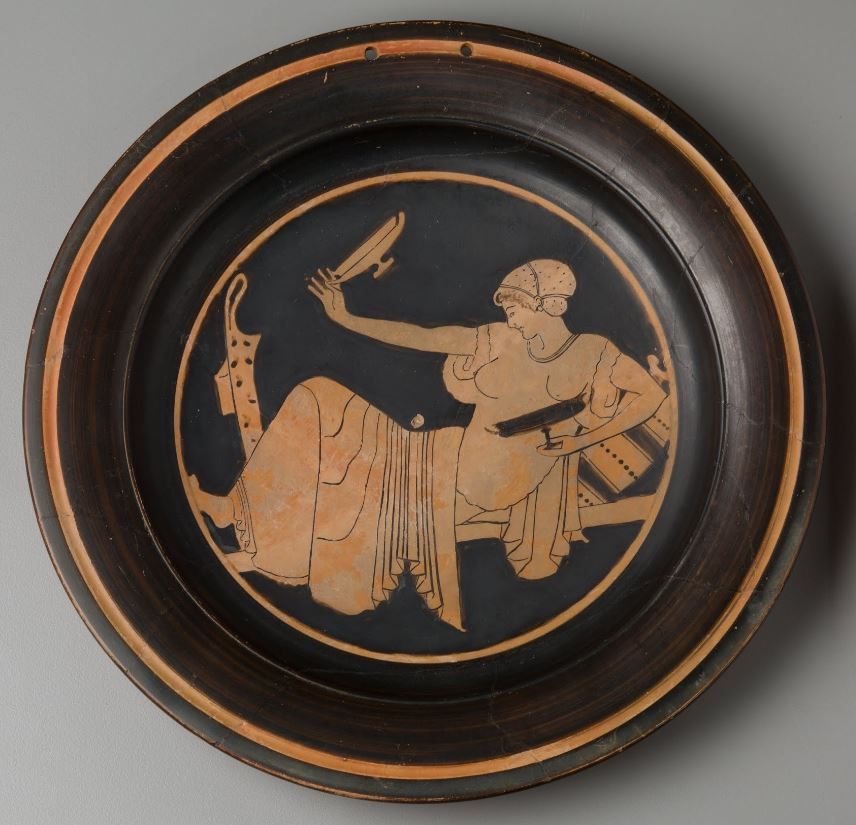
Woman playing kottabos. Painting attributed to the Bryn Mawr Painter, c. 480 BCE
Sound Credits
Thanks to the thrilling Bettina Joy de Guzman for our theme music.
Transcript
We're playing around with auto-generated transcripts. This one was generated by Otter AI.
Dr Rad 0:16
Welcome to the Partial Historians,
Dr G 0:20
we explore all the details of ancient Rome.
Dr Rad 0:23
Everything from the political scandals, the love of ours, that battles waged, and when citizens turn against each other. I'm Dr. Rad.
Dr G 0:34
And I'm Dr. G. We consider Rome as the Roman Sword by reading different authors from the ancient past and comparing their stories.
Dr Rad 0:43
Join us as we trace the journey of Rome from the founding of the city.
Dr G 0:57
Thank you so much for joining us. Dr. Rad and I are super thrilled to welcome Associate Professor Rebecca Futo Kennedy to the show. Professor Rebecca Futo Kennedy teaches in Classical Studies, women and gender studies and environmental studies at Denison University. Kennedy holds a BA in Classical Studies, and MA in Greek and Latin and completed her PhD on the representation of Athena in the trailer tragedies of Aeschylus and Sophocles at Ohio State University. Kennedy's most recent monograph is entitled immigrant women in Athens, gender, ethnicity, and citizenship in the classical city. And it's the subject of Athenian women and non Athenian women, that will be the subject of the conversation that we have today. So thank you so much for joining us, Rebecca.
Professor Futo Kennedy 1:52
Thank you for having me on. I really appreciate it. And I appreciate the the logistics of scheduling with such vast timezone differences. Yeah, I was looking at it today, it's like a 14 hour time difference. So it's somewhat of a miracle that we mathematically were able to work it out at all, to be honest. I know, I know, when we should have scheduled – when I was in Greece.
Dr G 2:18
To get started on this subject of Athenian women, and also non Athenian women, I want to talk to you about language as a first step, because it's a really important window on to how we understand society. And this is true as much today as it was in ancient Greece, words carry certain connotations, and they start to reveal certain values to us and sense of community start to emerge from that usage as well. So as a first step, I wanted to ask you about what are some of the terms that are used for women in ancient Greece? How are women socially coded?
Professor Futo Kennedy 2:56
Yeah, it's actually a really interesting thing. One of the things I discovered back when I was a graduate student, many, many years ago, is that there is no word for woman default, you have the word octopus, which is the word for either man or human. And you can throw a feminine article in front of it, but it's actually very rarely done. We see it in medical texts, when you're really just talking about a body, right? Or the female. Like there's a word for female, but that works for humans and Non Humans, like. So the fact that you don't really have a general word, to just say woman is, is, of course, a quite interesting thing. So what you actually have are a series of words that basically code them by marital status or relationship to children.
So the word parthenos, for example, which we often translate as virgin actually doesn't mean virgin. It's an unmarried girl who hasn't had a child yet. But you can't actually the problem is you have to think about what the word means versus how you translate it. And there's always a gap between there because for translations, we always look for it. They all sort of pity, like one word or a short phrase. And this inevitably warps what the word actually means in context, right? So parthenos is for your sort of younger set. These are the girls who would wear their hair down and wear sleeveless tunics, and often short tuna, but it's really for unmarried girls. And one of the things that, that some scholars have talked about is that you don't switch over to being a gyne, which is the word that we is they often translated as woman, but it really means life is it's childbirth, that actually does the transition, not marriage versus not married. Once you once you have a child, that's your sort of coming of age, and that usually would have occurred in Athens, which is different from other cities sometime around 14 or 15 or 16. That's sort of the zone for marriage for girls. We would come So there's that child marriage now. But this is just, it's just this it was basically, okay, they have had puberty and now it's like a little bit out. So you're a parthenos, you know, 13 to 14 year old. And then by the time she sort of gets married and has her first child, then she would switch to being gyne.
And then you have widows, which is pretty easy to you have a word for old women, which isn't necessarily have any, that's one of the ones that's really good to grouse. It doesn't actually have much to do with marriage status or not marriage status, it's just old. Right, just old people. When you see it in context, it's often used of formerly enslaved women. So you'll see it in like the Odyssey of the old nurse of Odysseus, or in tragedy of these older former nannies for more wet nurses, characters, and then you have a series of words that are for people who are outside of the marriage track. And those can be super confusing. So one of them is the word Paula kiss or Paula Kay. There's actually two spelling of the word. And that word is often translated as concubine. And the reason why it is translated that way is because our dictionaries are made with 19th century. Right?
Dr Rad 6:23
Right, yeah. And there's Victorians. Yeah, so
Professor Futo Kennedy 6:26
they refer to them, because it appears in Herodotus in the context of in one particular context of the Persian harem. And so it gets coded as concubine. But then you see it in lots of different Greek contexts and Roman Greek contexts. So we have some Roman era inscriptions, in which the word appears, that are actually probably temple attendance. Because it's a it's a generational inscription at a temple, saying, you know, thanking the Goddess. And definitely Boudin has argued, based on the context for this, that these can't have been generations of concubines, in the same family or us, sometimes scholars will just say, oh, it just means prostitute. Like everything is code for prostitute if it's not wife. And so and so, it seems to actually be an attendant or a companion to the Goddess, right, as you will. And then you see it in Athenian context, where you'll see it in tragedy to refer to and drama key. And so this idea that she's the concubine of Achilles, son, me autonomous in the play. But and then you see is founded on a tombstone, which is super rare. And I think what it has to be that because there's only a couple of words that go, if you're missing letters, we're missing some major. So apparently, when a tomb was first study, published in the 1920s, there were more letters there. But it's in the Piraeus museum. And who knows, you know, during World War Two, they hid all the objects and tried to like hide all the different strap all the objects down when the Nazis were marching. And so I'm sure damage occurred to some of the objects but there's a big hole where there used to be a letter. So I'm pretty sure it says politicus, because the only other option is really pull Lacus, which just means often and you wouldn't put that on your tombstone, to list your status in relationship to a man I am often have a man talking to work. So translation pavlakis, here and also into other contexts in a CDN. Court speeches, suggests that the term also means a contracted relationship. So a not a marriage, like relationships for people who can't actually contract a marriage. Some scholars have argued that it's a powerless relationship. But most of the ones that I found are of non citizen women in a relationship, but there was a law in Athens. That goes back apparently to Solon, where this particular type of woman, it was a legally binding contract, and children were considered legitimate. Even if they weren't citizens, they were still legitimate children. So arguments have been made that these were enslaved women, typically, but they wouldn't have been able to have legitimate children, with a with their owner with their own flavour, if it was such. So I think there's that word has like three different meanings. But everybody conflates it to concubine, thanks to our dictionaries. And then of course, probably the most well known and most contentious one is hiera, which everybody translates as core design, which is not necessarily, again, 19th century dictionary. You know, often I asked my students like, Do you know what a concubine is? Do you know two quarters of this? And they're like, no idea.
Dr G 9:45
Yeah, like, what's the fine grain of nuance there for the 19th century that were missing?
Professor Futo Kennedy 9:49
Yeah, right. And in the shade, it seems to be between those two words in the 19th century is one is a Turkish woman in the Ottoman Empire as foreign and one Is your your sort of grind horizontally your demi-monde girlfriend or something? But that's the 19th century? Not, you know?
Dr G 10:11
Yeah. How do we get that into ancient Athens? Really?
Dr Rad 10:15
Yeah, absolutely. Perhaps you could tell us a little bit about how the definition of hetaira has changed over time.
Professor Futo Kennedy 10:23
Yeah, it's a funny one too, because the got coded in the 19th century by our lexicon writers, you know, Liddell and Scott and Jones as courtesans. But in like 1929, Gong wrote an article that was like, there was no like, trained finishing school for like, fine courtesans, ends and assets, like no such thing like, you know, so even in the 1920s, people were like, this is ridiculous. But it got really picked up in the 1980s by feminist scholars in the field, as part of a movement to sort of bring for scholarship of non elite women. And so this whole industry basically developed around studying prostitution in the ancient world. Part of this is part of the modern movement to de stigmatise sex work. But what they ended up doing was taking all these women who are called hetaira, in any context, even being called this thing by people who are attacking them in court, right, and treating it as a status category. First off, and then treating a cortisone as an independent, educated woman, as if they were sort of looking for, you know, someone like these 19th century women, who often were able to live outside of marriages and, and held salons and things you know, in Paris, and in London, I often think of a good example is Elizabeth Armitage, who ended up marrying a former prime minister and we had so many legacies left to her by her former partners that she was able to buy her own house in the countryside and sort of lived out her life, happily married to the man of her dreams, to an aristocrat, you know, etc. So they sort of imagined this grand courtesan, educated, liberated, and they use a spacia as the sort of model for this. Basically, misunderstanding, Athenian law. And the leading Plutarch, who 700 years after she had lived, basically said that she held a she random harem in Paris Leazes house after telling us the territories was so worried about public opinion that he wouldn't even go to party and drink.
Dr G 12:32
So if it's over here, this is fine.
Professor Futo Kennedy 12:34
Yeah. The harem like, she's, she's running, she's running a brothel out of his living room.
Dr Rad 12:40
But you don't have one of these, you gotta get
Professor Futo Kennedy 12:42
A girl's gotta get educated. Right, so everybody became a hetaira. And then of course, we had this famous article in the 90s from Leslie Kirk, which is like inventing the hetaira, where she like makes this grand distinction between the courtesan and the hetaira. Oh, porne is another word for women, which she classified as the sort of streetwalker, sort of the really poor, lower class, sex worker versus the hetaira who was the high class. But, you know, you've looked at these dictionaries, and these words have like one word listed. The new Cambridge lexicon, actually has a really nice full definition of attire that takes into consideration the last like three decades of four decades of scholarship. So that's one nice thing that they've done in that. But you see that like, The Word Appears in Sappho. And it refers to Artemis and Hera is like, hetairae. So clearly, they're not courtesans. So it has to mean something else. So what are the things that you see that in earlier texts, a lot of contexts, it probably just means girlfriend, as in your friends who are girls on the equivalent of the word hetairos, which is your buddies that you hang out, listen to requests at parties, and we actually have this whole class of women in the sort of early fifth century, late sixth century and Athens who were like the wives and sisters and daughters of the wealthiest of the wealthy. People like Pisistratus' daughter Coesyra, people like Elpinice, who was Miltiades, the general's daughter and the sister of Kimon and she was married to the wealthiest man in Athens. They are not courtesans but they're we you know, they're clearly public figures. And we have inscriptions referring to them ostracism inscriptions, like they want their husbands or their brothers or their sons to be kicked out of the city. They're like, take your mother with you. Take your sister with you. And so there's all these rumours they have bad reputations like, openly gay supposedly like was having an affair with Pollack noticed the painter gasp scandal and there's actually a vase painting in the Naples museum storage facility that at one point had her name carved on it, a painting a painting by Polacnotis. My ad shows a woman playing a flute while dancing girls are dancing and a man is looking on. Someone's like this is a brothel scene. It's like it's probably a music school or a school for Young girls
Dr G 15:04
this is a bit like it's pillow fights at a slumber party. And it's like that's not what the girls are doing.
Professor Futo Kennedy 15:10
It sort of reminds me though of a famous painting by Jerome called Greek interior, which basically has a bunch of, of Greek, odourless style women like you know, Aphrodite, the needy and Aphrodite posed women like all standing around naked with each other. In their bedroom. It's like, Yeah, this is what happened in the interiors of the Divi homes,
Dr Rad 15:29
right? Yeah, as you do. That's why no one else is allowed inside.
Professor Futo Kennedy 15:33
What's interesting about the word had hetaira is that by the fourth century, we see it showing up in oratory. And on the comic stage. In the comic stage, it seems to refer to a transmitted as girlfriend like a girl you date, but you can't marry or that you wouldn't marry like the kind of girl you wouldn't take home to mom. And but then, in the orations, it's often an accusation. And so it seems to have this by the time you get to this to the fourth century, it seems to carry the connotation of it could be sex worker, but it could also just be a sort of all around, disreputable woman, I often translate it when I see it as whore, because it sort of captures the negative connotation, like, the one thing she had to talk to think about when you deal with this kind of material is it isn't actually about sex work, when you're dealing in the orations, right? It's actually about people who are trying to attack these women and make their lives miserable, and in some cases have been sold into enslavement. So it's can't be you can't translate his high res sex worker. And the idea that they're calling these women hetaira, they can't be these like high class respectable corazones educated women, that's got to be imaginary. These are women who are outside of the marriage circuit, for some reason or other, and women whose whose status within the city is really tentative and fraught, and, and very dangerous, that they can be open to these tax. So it sort of moves and loses this sort of meaning of like, you know, goddesses hanging out with each other rich girls hanging out with each other. But I almost feel like, if you follow the evidence around the, the things that we see that happen, because about you know, seventh century later in the second sophistic, with people like Lucien and Athenaeus, and Plutarch, you see, you know, agonises dinner parties, all of these ideas, chord isms, quote, unquote, hentai hanging out. And same thing with Lucien has satire, the chattering quarters, and that there's this imaginary past in Athens, which is essentially that they're imagining in the second century CE, of the grand salon, and of all these sort of women sitting around, educated and witty, you know, women sitting around, but you can all like, drop in and dine with, you know, and you sort of have, you know, Socrates being able to sort of like, drop in and, and, and have a conversation. So you have the sort of imaginary world, that the word, that's where it really gets this meaning, I think the court is on as we imagine it in the 19th century, it's that's not in our earlier texts. But what you actually have is a bunch of probably rich women whose hard headed up and, and we're pretty public figures and like, sort of pushed against the boundaries of what was acceptable behaviour. And then by the time you get to the fourth century, that word, that behaviour is like, being the leader of women who have no choice but to be in public. Right. And so they're, they're sort of hitting them with this accusation of being publicly available women, as it were.
Dr Rad 16:19
Yeah, that's so fascinating, because it kind of flies in the face of, I suppose the popular image of what an Athenian citizen woman would do in her in her life. I mean, we usually have this image of their being highly secluded, and very modest, and, you know, really, really toeing the line.
Professor Futo Kennedy 18:52
Yeah, I mean, that's rich women, rich women probably, right. There's a there's a double edged sword there. So and this is one of the things that you learn when you read oration and spend a lot of time trying to deal with Athenian inheritance law, is that because married women were expected to remain mostly within that the compound to the home, right? I mean, most weeding probably took place outside they weren't like stuck in a bedroom, or like in locked into quarters. You set up the big looms out on your outdoor space, because they're like six feet, eight feet, and you can't just like, take that down when you're gonna go to bed. So in the summertime, and when weather was appropriate, they would set them up outside. And then there's also evidence of like women going to each other's houses in their neighbourhoods, right? So they weren't completely secluded, but they always had a companion with them of some sort. And they did veil when they went out in public if you were a married woman, so like, if you went to a ritual, an important ritual or something, or you went out to visit a grave, which was your duty to go out and visit great, you would wear a veil. But then you have this whole world of women Who actually fill public spaces? But in the inheritance cases, what happens is that so many marriages are mismatched, right? So you got a guy who's like, originally, original marriage might be first marriage for a man might be 35 or 40. And the girls like 15, right? Well, guy wants a second marriage, maybe his wife died in childbirth, right? So he marries again. And he's married another 15 year old and now he's, you know, 50. All right. So you have these mismatch in ages that you see these inheritance cases where there's a woman, a young woman with an incident or a small child, who inherits the child is inheriting right, and it's coming to the marriage with a woman. And they're trying to attach a woman to prove like district cousins all come out of the woodwork. And they're like, just like magically appearing cousins. And they are trying to prove that this woman is in fact, not the wife of this person. In some cases, they're trying to prove that the woman never doesn't exist, like you can claim citizenship to your grandmother, but that woman never existed. Because what happens is that these women live their lives separated off from the public spaces, they're not presented to the Diems. For citizen registration, there are no records of their citizenship, you have the option, if you're like, super wealthy guy, you might present your wife, or your daughter to your tribe. But that's a sec, that's about a civic organisation. It's more of kinship groups. And so everything is dependent on witnesses. And there are no witnesses, because all your witnesses are like 70 years old, and you know, and they've died by the time you're inheriting or your child is inheriting this. And there's nobody to witness their lives. Because neither women, nor children, nor the enslaved count as witnesses, they don't count. So it has to be adult citizen men. So there's, it's a double edged sword, where you have this whole class of women who are public and outside who are denigrated for that very thing. And then you have the women who are where property moves through in the city who are constantly in a precarious status, if they don't have male protectors, because their lives are meant to be lived in private.
Dr G 22:02
So I think this really heads in towards this idea of like, how do we understand where women sort of sit in Athenian society, because we've got these like fine grained distinctions for citizen women, where it seems like the situation that you've just described to us is like, even when they are doing everything, right. And let's say that they're living a relatively secluded life, they've entered marriage at the appropriate age, they're not seeing that much in public. But when they go into public, they veil themselves, nobody has a chance to really witness what is going on. Is one woman just simply replaceable for another in that kind of scenario? Like how do you distinguish individuality if they're never really properly seen? And, and if they don't have brothers that might also be looking after them in some way, and they don't survive? Whatever reason, it seems hugely problematic. But there are other categories as well. And you've hinted at some of them already. And I was wondering if you could expand a little bit on it, like we see things like citizen women, but we've also hinted at that there are non citizen women. There's definitely poor women and there's enslaved women, and what sort of positions are we thinking about within if we're thinking holistically about Athenian society and what it looks like for women? What are the sort of realms they inhabit?
Professor Futo Kennedy 23:20
Yeah, so one of the things that's important is that women were in public everywhere. We talked about public versus private, but it doesn't mean isolated in a space in a house. Right? Versus being outside. When we talk about public spaces, we mean civic spaces. So like, women were not allowed to go within a certain zone within the agora. Right? Foreigners were not allowed to go in Oh, the only citizen men could go in, but that was not the space where the markets weren't necessarily or warehouses where that's the space where the assembly Administration Building was, right. So you know, there are fountain houses in what we call the Athenian agora today, but the boundary stones for what counts as the Agra civic space versus the entourage generally is very different. So we have to remember that women will be outside. So over unmarried girls, they do go to the fountain houses, they you know, they do go to public rituals. They're not veiled, they're not hidden away. And then once you have your first child, so this is really interesting speech. Lipsius one against Aristophanes. Aristophanes was caught having an affair with the speaker's wife. And the law in Athens is that if you are caught having an affair, if you're caught in the act in bed with your someone's wife, she can kill you on the spot. And this is a this family brings the lawsuit though, because he didn't kill it or toss these in bed. He learned that his wife had a guest over and the thing we learned about is the setup of the house and how the sort of structures and he goes and gets witnesses brings them back and then children as he's getting out of bed, and so The family sues and says what's not in the act. So you committed murder. So it's on our atrocities. But what we learned in there is that he tells the story of how his wife got freedoms basically to, like, well, you know, we married and then you know, she was a good girl and my mother lives in the house and she had to live with her mother in law. So just imagine a space where you will your father is like, 90 and your mother is like 30. So, your mother's 40 year, you know, whatever. So you these women are going to be because the marriage age mismatches, there's gonna be a lot of mother in law's wife. And you know, as we learn from things like Xenophon texts, this idea is that the older woman would train the younger woman to run a household, right kind of thing. So she's living with her mother in law, she's behaving herself. Mother-in-law goes out with her whenever she goes somewhere. And then she has her first child, right? So she has the first child. And at that point, he decides that it's okay for her. She's proven herself basically. So it's okay for her to like, she's become a proper gyne. She's no longer a parthenos. So she can do stuff. And one thing she does though, is that she will be here in the sense that she goes over to a neighbor's house at night to get candles, you know, my cat, our wax burnt out. So I needed to go get, so my wick burnt down, so I had to go to the neighbor's house and borrow a wick or something, right. So we learned that they have this sort of mobility around the neighbourhoods, right. And then we also learn that he actually switched bedrooms with her. So we often imagine the women's quarters on the second floor, the door locks from the outside, not from the inside. But he swapped with her because the baby didn't live in the room with her, the baby was downstairs with with others, and she needed to be able to move back and forth to nurse at night. So he switched bedrooms with her and he moved into the upstairs room, and she moved into the downstairs room. But so what we will we get a picture of a household and this deck. So we also learned about the other women who live in the house, some of whom would have been enslaved, but some of whom were not. So one of the main characters is this old woman who used to work for the household but doesn't anymore. And she's now free. And she's the one who rents the wife out.
The husband, but also we learned that the wife met Aristosphanes at a funeral with her mother, like she went with her mother in law to a funeral. And that's where she were Aristosphanes first met and saw her behind her veil. And this is when they began their affair. So it's a sort of tale but you sort of little, all these little details. There's like there's still these women who live in the houses, right, then there's their neighbours and the people who live in their neighbourhoods, and they're all gonna have varying levels of status and income, right. Some of the houses are two stories, some of them are only one story, right? Depending on on who you are, and where you are. Property can only land land and houses can only be owned by citizens. They can be rented, though, by people we call medics who are the resident, foreigners. And the metaclass is made up of anyone who is either an immigrant or an initial immigrant. If you're there for something like 10 days or two weeks, you have to register in the city or you risk sale into enslavement if you're sort of hiding out in the city. It's made up of people who are multi generations like their their grandparents immigrated, you can't there's no pathway to citizenship, you're a perennial immigrant or perpetual immigrant. And then there's anybody who is freed from enslavement enters this class as well. So you can have people from ranging from Lipsius, who, whose father was invited to the city of Athens by terraclean, to set up a factory, he made cheap, they're extremely wealthy, they made shields for the hoplites. And they were extremely wealthy, to, you know, a formerly a former enslaved woman from a brothel, who is just like making a life trying to make a life for herself in the port of forest. So it can sort of have this vast range of people that can exist in it. And back in the 1970s, when people first started really sort of paying attention to medics than Athens. They basically they were dismissed in the one book that had really been written on it to you dismisses medic, women's like, we're not gonna talk with him because they're like an insignificant part of the population and didn't really impact it. But then if you look at inscriptions over time, the population of medics seems to become more and more women. And this is probably because one freed slaves, the the freedom, freeing women from enslavement, because we know that women were targeted more directly in warfare for enslavement, women and girls for sale into the market. So you're going to have more women who are enslaved versus men, you're typically going to kill the men of military age. In a city when you take it or in battle. You're not going to leave them alive and enslave them, but you're going to target and collect women and pregnant women were especially valuable because they would be nursing. Right? And then you could have have a wet nurse, but then you're gonna have them freed after they no longer need a nanny in the house or you know, for various reasons. Feel free them, they enter into the pot, so the medic population, and there seem to be more and more of them. But also importantly, the laws around citizenship and acids, which evolved over the course of the fifth and fourth centuries, explicitly target the women, men and women by trying to exclude them from marriage and exclude them from the ability to have children with citizen men. And so you don't target laws at a population that doesn't exist. It's just not going to happen. So we have a lot of inscriptions, for women who sort of are on this line between like, we're not sure if they're free immigrants, or if they were formerly enslaved, they're clearly no longer slaves. Because the inscriptions, there's this group of Inscriptions called the Fiat lie inscriptions, which for decades, people have thought they were Manumission decrees. But Elizabeth Meyer argued a few years ago that they're more likely actually dedications by people who won lawsuits by people who were trying to claim that they were not really free. So there's a law in Athens, that a former owner or anyone actually, it doesn't have to be your former and slaver. It can be any citizen can say that you are actually only pretending to be free, but you're actually enslaved. And they can turn you in. And if they win the lawsuit, they get half the sale amount, from selling you into enslavement, back.
Dr G 31:28
This seems hugely problematic.
Professor Futo Kennedy 31:31
Yes. And we have evidence of that, like people who did this, like who like that's how they made their money. And some of them are interesting because this one guy Arista guidance, he may actually be the son of a man who had made assistance. So his parents had been medics, because his mother was sold into enslavement, according to Democrates, for pretending to be a citizen. And he investigated himself tried to sell his sister to enslavement, but his other brother apparently tried to stop them. Totally disreputable. So they all these women on these inscriptions. So either they are they won their emancipation case, or they won against charges, they were pretending to be free. So they're all in this population. And there are something like 192 Women listed on this, I can't remember the exact there was like 172, or 192. And they all almost all of them have occupations listed next to them. And they most of them are woodworkers, textile workers, weavers, and but then there's also women who are clearly working as part of a family business because you've got three people in a row listed as definitely sellers, or perfume sellers. So you have like a man, a woman and a child like this is a family sort of a small family business. Right. But my favourite thing about those inscriptions is that one scholar argued that you couldn't possibly need that many Weaver's and so the word Weaver must also be code for prostitute.
Dr Rad 33:02
Ah, that's harsh.
Professor Futo Kennedy 33:06
But as I saw, I'm like, wow, so that means that you need for sex workers per citizen man. In order like if this is the correct magic, but nobody needs clothing. Because they imagined
Dr Rad 33:18
as a prostitute you don't?
Dr G 33:22
Um, you certainly don't need
Professor Futo Kennedy 33:25
I've seen as your own painting. I know they all hang out in the house naked.
Dr Rad 33:29
Exactly. Yeah.
Professor Futo Kennedy 33:31
Weavers. But it but it's a funny thing, right? Because they all imagine this world where these wives all live in seclusion in their houses, and all they do is sit around with their slaves waiting, right? It's Penelope. They're all Penelope. But it takes like weeks to make a single like six foot cloth.
Dr G 33:51
Yeah, this is people who haven't thought about the complexities of actually waving. I think
Professor Futo Kennedy 33:56
what this is the other thing too, is that we have inscriptions that list people who are seamstresses, like why do you need seamstresses, you're all making your own clothes.
Dr Rad 34:07
There after something more fun.
Professor Futo Kennedy 34:10
We also have an industry where it's like you'd have to make like 300 sales a year and both seem to have new rope rigging and things like the sailors aren't taking the off season and like making ropes. Like that's not what they're doing. Right. So I'm pretty sure there's industrial scale, weaving down in Piraeus and a lot of these women who maybe they were enslaved, initially, right, so we have this big population of enslaved people who are being brought in to do work. But then at some point, they're freed and they enter into the non citizen population. And some of them are having relationships with citizens. And some of them are having relationships with other medics, and some of them are marrying other freed slaves, who are also medics, but we have evidence of all of those things going on. But marriage is not banned between citizens and non citizen women. Until like this 380. So there's this whole period of starting in 451, where a medical woman could not give birth to a citizen child. But they were still, they were still allowed to marry, and they were still having relationships with citizens. And there are a lot of reasons why you would do this particular citizen inheritance law, you have to, you're required by law to divide your property amongst all of your male children. So if you have two male children, but you're like 50, and your wife dies, or you don't like your wife anymore, as in the case of Pericles, he actually helped his wife find a new husband, the academics are curious. And then he married dysphasia, because you don't want any more citizen children, because you already have two who are going to divide the property. Empirically this case, his two citizen sons died in the play. But he had to son by this foreign woman, who was his wife, who he petitioned the court to make a citizen and they didn't just make his son a citizen, they made a law that basically said that if your citizen sons die, right, any child that you have, by another marriage, can be made a citizen to inherit. And so we had this whole period during the Peloponnesian War, when foreign women's children, from marriages with citizen men were being made citizens to, you know, in the emergency situation. And then in 380, they finally just banned marriage because they're not in this crisis of a 30 year war anymore. So it's interesting that the law passes after not just the Peloponnesian War, but a second set of war that we call the Corinthian War, that doesn't end until 387. And then all of a sudden, now you've got this law passed. So there must be this population of women who are marrying the citizens. And we always think that this is an elite practice. But the inscriptions tell us that these women are working in shops, you know, as shopkeepers, they're working as tavern keepers, like they're working in family businesses. So you know, this is probably happening at all levels of society. Because the other thing too, is that when the marriage ban is pulled out, and the citizenship laws ended, in the second century, we start seeing a slew of tombstones, particularly of my Legion women. So they're, they're in tune with them as my leader, but they're married to a senior. So like it starts happening immediately after the law was repealed. So they're having all this stuff having just all this interaction, they're out in the shops, they're working in temples, they're working as your wet nurses, we have these wonderful stories of citizen men like in Athens, there's a whole slew of tombs that have the word tip day on them. These are citizen people who are making tombs for the woman who was their witness who dies. Right? We have one story of a guy who is a citizen, man, wealthy, he was in the highest tax bracket, his old wet nurse, she had been fried, she got married her husband and died. So she had her move back in the house with a family. Right. So sort of all these sort of different relationships, we imagine these elite sort of secluded citizen women and and then or as Pomeroy put it, you know, goddesses, wives, slaves and horrors. But you know, really, the slaves and horrors are sort of the same category. And in the public imagination, anybody who's not a married woman is like, sort of over here. But we have this sort of integrated into all walks of life, in the city and into the fabric of the economy, whether it's as property in the case of the enslaved women, or as actual workers in the economy, and part of the people who actually make the economy run in assets, because obviously, your citizen wife is not out selling you perfume, but you need a woman to sell your wife for fuel. Because you can't go buy it from that
Dr Rad 38:40
damn straight you do. So you've highlighted really well, I think, in your work, and in that outline, that when you go looking for them, there are these nuances and women everywhere. And there's just such a huge diversity of experience, you know, in terms in terms of the class that they might be sent to occupy in terms of whether they were wealthy or whether they were poor, whether they had really tight connections to the citizen body or not. But regardless of where they were, as these non citizen people as these metrics, they were still really vulnerable, weren't they?
Professor Futo Kennedy 39:16
Yeah, so, I mean, obviously, they're, you know, there are laws of start getting targeted at them. Starting around the four 451 is like the most famous, which is the citizenship loss hair, please. The irony being that he had to have a trial by a foreign woman made US citizen. But that's the law that basically said that to be a citizen. You have to have to citizen parents. Now, some people have imagined, Robin Osborn wrote on this that when this happened, citizen women's lives got better, because they were more valuable, but in fact, they probably got worse, because they were now more valuable. You don't have DNA testing. How do you prove a child as yours? Well, you don't let your wife talk to any man. Ever. Good. to relatives. So you have, you have these laws, and then you have the laws relaxed at the beginning of the Peloponnesian War is relaxed again, later on. Some people think that this law that happened after the Sicilian disaster in 411 was actually a law allowing bigamy, but it's actually just allowing, basically seems to be the case where it's just allowing any person who has a child, regardless of whether the person is a citizen or not, is gets to be the act of one citizen parent. Because then in 404, they sort of reinforced the law. And then you have the abandoned marriage is not till 380. So what seems to be happening this century, there seems to be some laxity about the laws. And we don't have a lot of evidence. One of the biggest problems is we don't have any courtroom documents in the courtroom speeches from the fifth century, other than like, on the mysteries from and often, and that's like at the tail end of the fifth century. So we don't have sort of the beef of that period. So there's not a lot of evidence for what these women were doing. Most of the women that we see who are medics are actually being represented on the tragic stage. And you see different types of women represented there from the heroic daughter of Hera Cleves who's going to sacrifice herself to save the city of Athens from like, during the Peloponnesian War period, to people like Chandramukhi, who's enslaved. So there's a sort of Oh, very, Matthias probably the most famous medic onstage in Athens out there, killing everybody. But she, but what's interesting about the play that she's invited to Athens, right to come and help the king, at this period at the beginning of the Peloponnesian War, when the law is being relaxed,
and he or she is being brought in to help. So it's a very strange thing. But then starting in the fourth century, things seem to be getting more draconian, like that's when the marriage restrictions are passed. And we see a lot of prosecutions and we have three laws on the books, they variously target medics or the enslaved. So there's a law, that if you don't register, as a medic, and you're reported, you can be taken into custody and sold into enslavement. So you have to register, you have to law those people who are pretending they are pretending to be free, but aren't really. And then you have the one for one away in Slate. So these are three laws that are used, basically to police the population, and to keep them in check. And so you have a these laws are being more highly enforced. We see in court speeches, a lot of accusations of this kind of thing against women, we see citizen women b