Seneca's Medea with MythTake
Medea is powerful, semi-divine, and has an axe to grind with Jason!
The Partial Historians · The Partial Historians
Audio is streamed directly from the publisher (sphinx.acast.com) as published in their RSS feed. Play Podcasts does not host this file. Rights-holders can request removal through the copyright & takedown page.
Show Notes
Medea is one of the most memorable characters in Greek mythology. She is powerful, has associations with magic, and capable of taking drastic action. Most people are familiar with the version of Medea crafted by the Athenian playwright Euripides, but today we turn to a lesser known interpretation.
Special Episode – Seneca's Medea with MythTake
Seneca's Medea
A quick synopsis may be handy before diving into the episode!
Prior to the play
Medea is a semi-divine princess of Colchis (a land on the shores of the Black Sea). As a young woman, Medea fell in love with Jason while he is on his quest for the Golden Fleece. Medea used her gifts to aid Jason in completing the impossible tasks set by her father, King Aeëtes. Medea helped Jason to yoke the fiery bulls, win a competition with the giants, and slay the dragon that guarded the Fleece. In her love for Jason, she defied her father and decides to run away with him to Greece. To escape unnoticed from Cholcis, Medea kills her brother to distract her father. From there Jason and Medea travelled together to meet Pelias, king of Iolcus, who had agreed to give Jason his throne if he returned with the Fleece. But when Pelias saw the Fleece he refused to fulfil the agreement. Jason and Medea then worked together to bring about the downfall of Pelias, but needed to flee Iolcus after suspicion falls upon them. They finally settled in Corinth and have two sons.
So Jason and Medea are bound together, not only by their children and their marriage, but by acts of violence which were often planned together but executed by Medea with her semi-divine skills and pharmaka (knowledge of herbs and drugs). A healthy relationship, this is not!
Medea in Seneca's play
Jump ahead a few years and, in order to climb the political ladder, Jason decides to leave his marriage with Medea to marry Creusa the daughter of King Kreon of Thebes. The play opens with Medea cursing both Creusa and Kreon and seeking time to prepare for her exile. Kreon grants Medea one day before she is exiled which she immediately uses to plan her revenge on Jason for leaving her after everything they've been through together.
She laces a stunning robe with poison and sends it to Creusa as a gift for her wedding with Jason. The Chorus describe Medea's rage and frustration in great detail and pray to the gods that Jason is spared from her vengeance. But Medea's pharmaka is extensive and the robe kills Creusa by catching on fire when she puts it on. Kreon tries to save his daughter but he catches on fire too when he touches the robe. But in the wake of their deaths, Medea does not feel any better; her need for vengeance remains. Medea resolves to sacrifice their children in a final act to help Jason understand the depth of pain he has caused by leaving her. This blood sacrifice seems to transform her and to reveal her divine form, as Medea escapes in a dragon chariot while she throws the bodies of the boys down to Jason. Jason observes that there are no gods because otherwise such acts would be impossible.
Seneca the Younger
Seneca the Younger was a Stoic philosopher who witnessed a lot of the ups and downs of the Julio-Claudian emperors during his lifetime. After a couple of trips into exile, Seneca ended up rising to a position of immense influence. He was appointed tutor of Nero, the son of Agrippina the Younger and adopted heir of her husband, the emperor Claudius. When Nero succeeded Claudius, Seneca experienced a career high in the early years of his reign. However, stability was not a feature of Nero’s rule, and Seneca was eventually forced to commit suicide by his former pupil. As we consider Seneca's Medea, it's worth considering how his context influenced his work. Certainly he has plenty of strong women to draw upon from his own experience and the recent politics of ancient Rome!
If there's two things that we love, it's women in the ancient world and the Julio-Claudian period in Rome. So understandably, we jumped at the chance to talk to Alison Innes and Darrin Sunstrum from the MythTake podcast about Seneca the Younger's interpretation of Medea.
What did this man make of Medea’s story? Tune in to find out!
Thanks as always to our Patreon and Ko-fi supporters.
Sound Credits
Thanks to the lovely Bettina Joy de Guzman for our theme music.
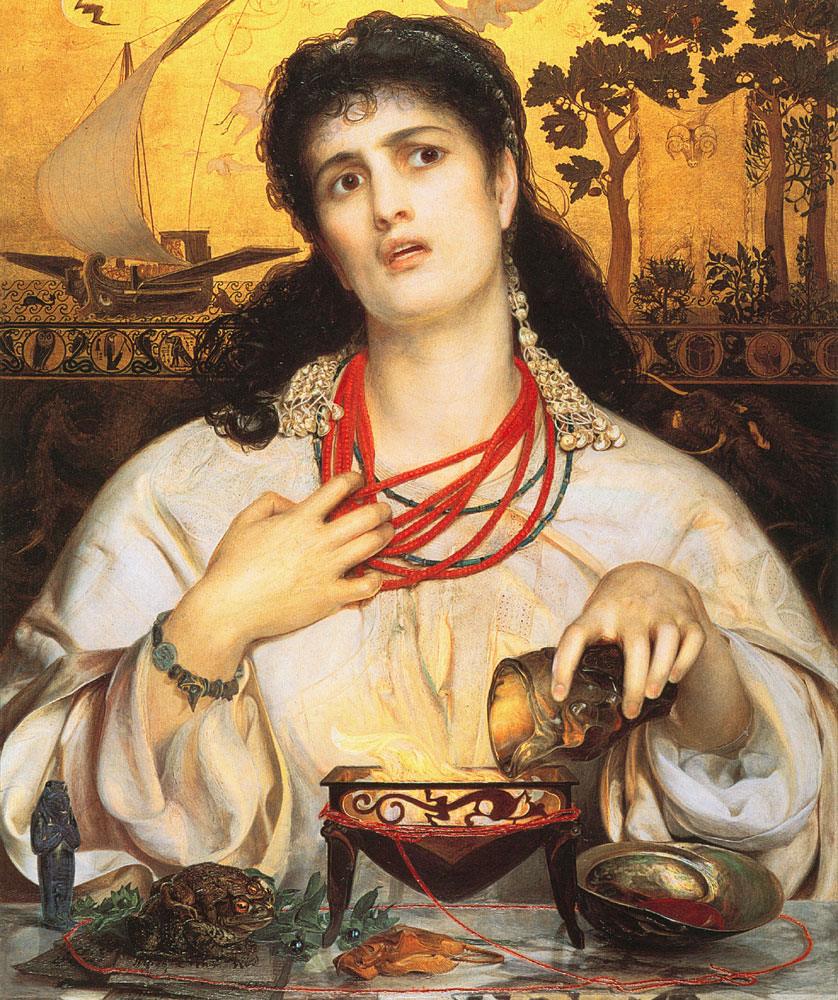
Frederick Sandys between 1866 and 1868. Medea
Medea has a connection with pharmaka and this idea sets up her early interaction with Jason and has numerous consequences.
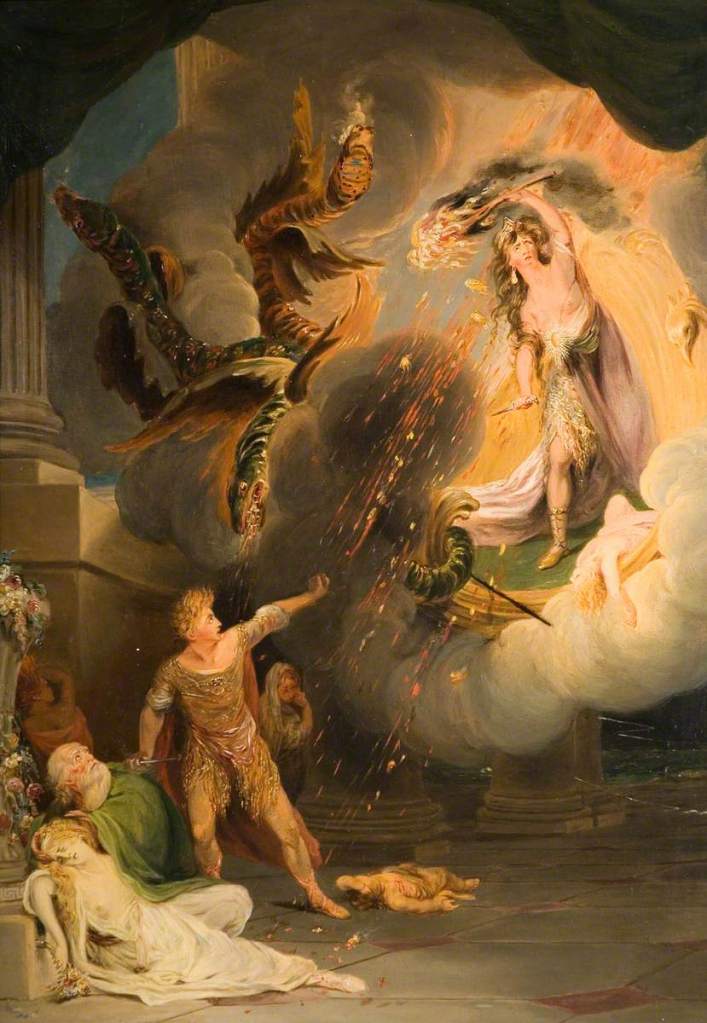
John Downman 1750-1824 An Episode from the Story of Jason and Medea.
Medea ascends to a higher plane after her suffering and Jason is left to bear the consequences of his choices.
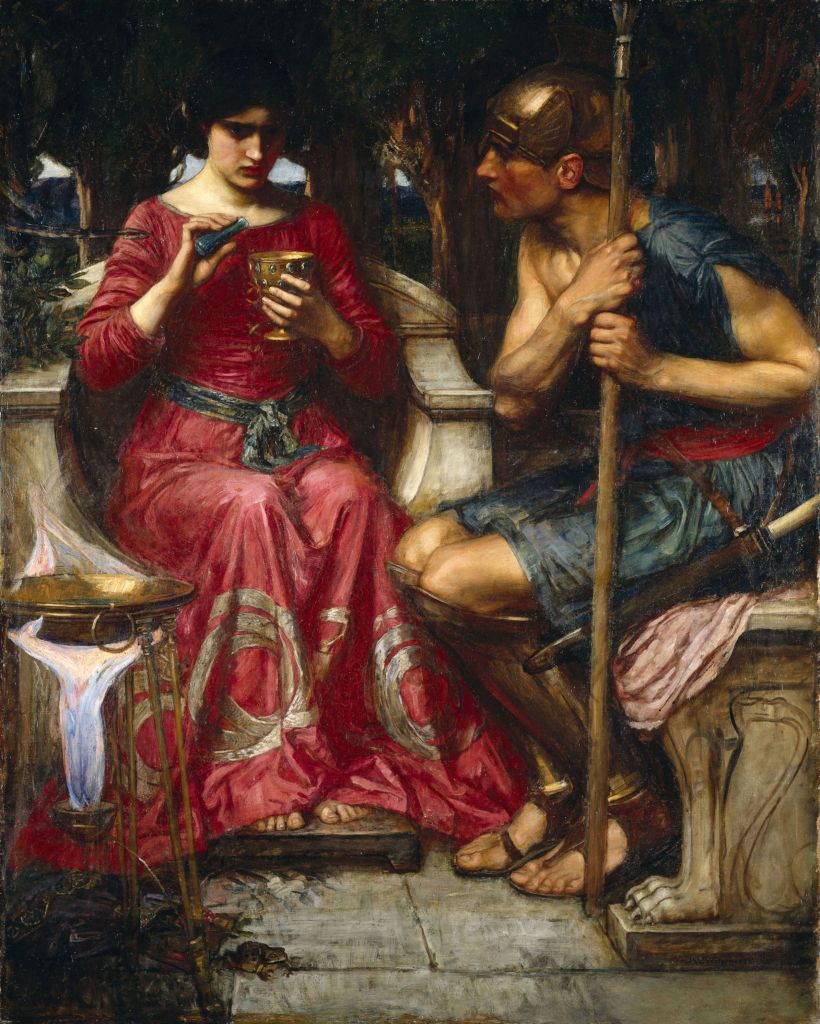
John William Waterhouse 1907. Jason and Medea
Jason watches on as Medea utilises her skills in pharmaka in order to aide his quest to obtain the golden fleece.
Automated Transcript
Generated by Otter AI with some light editing! We know the Greek and Latin can be tough for automated transcripts, so apologies in advance for inadvertent mistakes (hopefully they'll make you giggle!).
Dr Rad 0:15
Welcome to a special episode of The Partial Historians. Today we sit down with the hosts of the amazing podcast MythTake to discuss all aspects of Seneca the Younger's Medea. We hope that you enjoy
Alison Innes 0:40
Good morning.
Darrin Sunstrum 0:41
Good afternoon.
Alison Innes 0:42
Good evening,
Darrin Sunstrum 0:43
and good night.
Alison Innes 0:45
Welcome to a another episode of MythTake,
Darrin Sunstrum 0:48
A fresh take on ancient myths.
Alison Innes 0:50
We still got it, Darren.
Darrin Sunstrum 0:53
It's been a while. I forgot.
Alison Innes 0:54
It has been it has been a little while since we have done an episode. But I am really excited about tonight's episode. We have two special guests from halfway around the world joining us by the virtue of or by the miracle of technology. We have Dr. Fiona Radford and Dr. Peta Greenfield from The Partial Historians podcast. They are experts in ancient Rome, which we are very much not experts. They look at various aspects of Roman life and reception in their own podcast Partial Historians. So we're very pleased to have you. Hello.
Dr Rad 1:31
Hey, thank you so much for having us.
Dr G 1:34
That was Dr Rad!
Dr Rad 1:36
To distinguish my voice.
Dr G 1:38
We'll just set that up straight. Yeah.
Dr Rad 1:40
Any stupid thing said by this voice are the property of Dr. Radford.
Dr G 1:45
And I'm Dr. G, thank you so much for having us.
Alison Innes 1:48
Well, we are very pleased to be connecting with you and I'm glad that we could work out the timezone difference. We're recording from Canada, as usual, in Ontario, and you're all the way around in Australia. So I we're very glad to be connecting with you.
Dr Rad 2:01
It's a it's a Commonwealth podcast.
Alison Innes 2:04
Yes. Yes, that truly international.
Dr Rad 2:06
Exactly.
Alison Innes 2:07
And I'm also excited to have you because we are going to talk about Medea, which everybody who listens to this probably knows by now is one of my favourite characters, but we're going to do it a little bit differently and have a look at Seneca's, Medea, and Darren and I are not as strong. Well, Darren, Darren knows knows this play better than I do. I have never formally taught or really studied this play. So I'm kind of, I'm the real student here. But we are really excited to have some Roman experts on board for this conversation.
Dr Rad 2:38
Excellent. Let's get into it.
Dr G 2:40
Yeah, so I think we should start with just a consideration briefly of who is Medea. Let's locate Seneca within the context of the subject matter.
Dr Rad 2:50
Yeah, true.
Alison Innes 2:51
All right. Well, Medea goes back a very long ways. Darren, do you want to give us a quick rundown on on her mythology?
Darrin Sunstrum 2:58
Well, in Medea, yeah. Like you said, she's one of those sort of older characters that that, you know, been probably kicking around since the Archaic period, more than likely. We, we encounter her at least on the Greek side of things in Euripides work about 431 BC. There were other playwrights like Nephron, for example, that wrote about Medea as a figure from this woman from Colchis from the Black Sea region, who is a foreigner, barbarian and mysterious sort of “Other” type character with associations and magic. And then her relationship with Jason and the Argonauts, which is a very old myth. Right, is picked up and, you know, use time and time again. So we see Medea, you know, in different iterations and tragedy, and lyric poetry, you know, here in our discussion with Seneca all the way into the Imperial Roman period, which I don't live in very much, but so it's a long stretch of time to have, you know, one sort of character called Medea. And you know what she is, and I think everyone knows what she's probably most responsible for, or her infamy or her fame. So, you know, she's a non-Greek character, but a very compelling and powerful female heroine in a catalogue of heroes that are primarily male.
Dr Rad 4:26
Yeah, the Romans seem to really be attracted to the story of Medea. I mean, obviously, when I say attracted, I don't necessarily mean in a hugely positive way. Because as you say, she is quite infamous. But yeah, they definitely seem to enjoy going back and back to the story of Medea.
Dr G 4:43
And I think there's something very compelling about Medea's story as well because bound up with it is the whole spectrum of human feeling. From everything from intense attraction and affection and love to like the bitterest of human sorrow possible. And she captures this within the arc of her life. And so there are so many elements of her story, I think, that people can hook into and repurpose. And when we talk about attraction, I think it's that compulsion. It's almost like things become so devastating in her life and in her mythic tales, that it's hard to look away.
Alison Innes 5:24
Yeah. And there's there are some key events that all of the different authors who we have, and presumably, from what I've read, there were a lot more plays and tales about Medea in the ancient world than survive that then have come down to us. But the broad outline, of course, is that Jason shows up with his Argonauts and he needs to get the Golden Fleece. Medea betrays her father and helps them out and in their flight from Chlocis back to Greece with Jason. She marries him and kills her brother. And then we are of course, located in Corinth, where Jason is now married the princess, but depending on which author you have, there's different nuances and different interpretations and different details for each of those. So it's a really flexible story that gets retold in a lot of different ways.
Dr G 6:22
Yeah, and I think we see this coming through with Seneca's Medea, it's a very formal kind of play. Very Roman, I would say in its structure. If we're, inevitably people will make comparisons with Seneca's work with the very famous Euripides play. And they're very different in structure, even though some of the messaging is similar. They get to the conclusion in very different ways. And one of the things that I think that tells us about Medea is just how she can be reinterpreted consistently over time for different audiences, while keeping some core features of the story. But while also shifting a lot of the contextual details around how that story unfolds,
Darrin Sunstrum 7:08
I like that because like, like, like any good myth, it's true. It's sort of adapts its dynamic, and it sort of serves its shape sort of fills the vessel in. And by that, I mean, it serves the audience at the time, or at least the narrator's agenda, whatever that might be. So I think the Medea characters are really plastic in that way.
Dr G 7:26
Yeah. So I think it's probably a good place to think about just the basic plot of Seneca's play. And we sort of we start off with a conversation happening outside between Medea she's alone on stage, actually, I should say, it's not a conversation just yet. But she's sort of like locating herself through this kind of soliloquy.
Dr Rad 7:52
She does like to have conversations with herself,
Dr G 7:54
She does like to have conversations, there's, it's a very, it's a very ancient play thing to do. Popular all the way through for centuries, really discussing sort of positioning the audience to understand history in a particular way, and help everybody come to grips with where we're at where we're up to in her life. And she's in Corinth. And this is a very typical place for plays about Medea to start as well. But from there, we sort of get into a whole sequence of events. And Seneca seems to like a sort of a really particular structure to his plays. And some editors of the Latin collections do like to divide it up like that, as well. So it feels like that we have distinct scenes, even though we're not really sure what any of the stage directions might have been. And so one of the really important character devices in Seneca's Medea is the role of the Chorus and the way that they tend to set up how you might interpret a particular set of action. And they also tend to be a marker point for a change of scene as well, either towards the end or towards the beginning. So the chorus has a lot to do with this. And we see this sort of like ebb and flow between Medea expressing herself having a conversation with Kreon, the king of Corinth about needing time before her exile takes place, having a conversation with Jason, where he's kind of like, you gotta get out of here. And she's like, I need more time to get organised. Where am I gonna go how I'm gonna live my life? And it's like, it's really important that you leave. And she's like, you know, You dumped me, right? I don't know that I should necessarily be bearing the brunt of your poor decision making because the reason why she has been asked to leave is she's now the third wheel, essentially, in her own life.
Dr Rad 9:48
Yeah, Jason no longer needs her. I mean, he's he's got a new wife and you shiny wife,
Dr G 9:51
Jason's about to marry a woman. He hasn't really told Medea about that. She's found out because she's about to be exiled. Like you need to leave and she's like, Excuse me?
Dr Rad 10:00
if only all breakups could go this way.
Alison Innes 10:04
Medea is really front and centre in this play too. Not only does she start off with the with the opening, but I have cannot put my finger on the exact statistic at the moment, but she has the vast majority of speaking lines in this play. So it's very much her driving the story.
Dr Rad 10:22
Oh, massively, it's definitely the Medea show. It definitely puts her more forward than you Euripides did, even though obviously, she's a huge part of Euripides as well.
Dr G 10:32
But we do get some sense from the sort of secondary characters that there are some concerns about how she's coping with the situation that she finds herself in. Rightly so as it turns out, so there's some good foreshadowing presented through the character of the Nurse, and discussions that happen that relate to the tutor of the children, they've got some concerns about what's happening. And fair enough. She's not taking things well. And she makes that abundantly clear through her spoken time on stage as well. But she does manage to negotiate with Kreon to have a day to get herself organised. And she makes it pretty clear early on that she's going to use this for vengeance. This is a pretty standard moment for Medea in terms of her representation in literature, first of all, buying the time, and then being like, Alright, now for the plan. And she does the grand reveal of well, the plan is this, it's going to be bad. And I'm looking forward to it, you know, I'm going to find a way to poison that new wife. And then I'm going to take things to the next level because you know, who's really responsible here, Jason? Jason is the real issue.
Dr Rad 11:44
I kind of disagree with her in someways.
Dr G 11:46
In that sense. It's a very modern kind of representation as well. She refuses to take a sort of a victim blaming position. I mean, she does take vengeance against the second wife. Yeah, that is all part of her plan to take down Jason. It inevitably, it goes well, in the sense that it all happens.
Dr Rad 12:07
Yeah, the plan works!
Dr G 12:08
The plan works. That might be the worst part of all, perhaps.
Dr Rad 12:12
And bonus points. She takes out Kreon when she takes out the new wife. Oh, yeah, they go down together. Yeah.
Dr G 12:21
Father steps into try to save the daughter: doesn't go well. This is all described vividly by people who come into the play to like deliver messages. And we end up at this final set piece, which is the moment where she executes the children that she and Jason have produced together. One of them directly in front of Jason.
Dr Rad 12:44
Which again, is in contrast to what happens in Euripides' play as far as we can tell where the murder of the children would happen offstage.
Dr G 12:53
Yeah. So there is a transition of the violence to the stage.
Alison Innes 12:58
Yeah, and Jason's Jason's a very different character as well in Seneca as I know, we're trying not to compare but it's really really it's very difficult not to but he's been his circumstances different he's not marrying the princess so much out of love or desire to step up in the world. But he can only get safety for them if from Kreon if he is marrying Kreon's daughter. So there's, there's a different there's a different motivation behind the marriage, correct?
Darrin Sunstrum 13:29
Yeah, there's something like that going on self preservation, the mood is very different, right, the function that fibre framework is very different from an Attic drama, like Medea is in your face, like right at the very beginning, and she doesn't leave your face, till you know, she's stepping in the chariot. So like, you know, you get a little Jason and you get a little Kreon and you get some Chorus thrown in, but, you know, she's right your eyes for the whole play. And it's not like Euripides where, you know, some of there's some circular motion lines and characters are coming and going slightly. And there's negotiation with chorus. But But here in Seneca', it's Medea from from beginning to end. And it's extremely compelling. But like I said, there's a very different type of Jason that's being presented here. A lot of people like to throw a lot of dirt on Jason and Euripides. I'm not a big fan of that. But here in Seneca he's a pretty sympathetic character, at least from my reading of it, you know, he's he can't do much of anything but but suffer. Right? But you know, that in the face of such overwhelming hatred and violence, what can what can one man do you know, even if he is the hero of the Argo, right? Who Medea lays out quite plainly in Seneca that not only does Jason, owe his success as a hero, but so does every single Argonaut on that expedition also, you know, all their success to her, you know that that's pretty hard to overlook.
Alison Innes 15:02
And so many of them have come to unfortunate ends.
Darrin Sunstrum 15:04
And they have. Medea in the Seneca play too. There's something strange and about it in the sense that you can get overwhelmed with lots of the magic and the details and the artefacts and so on in the terrible ferocity of that character. That sort of when I use the word terrible I don't mean in a in a moralistic way I mean awe inspiring power. And she has a number of moments of that are transformative within the play itself. Euripides' Medea is much more of a slow reveal. I think Seneca is is has those but there's blinding flashes where she's no longer herself in the play become something much more terrible. I use that word again. So yeah, I just like I like the contrasting element of and I really did enjoy revisiting Seneca's Medea again.
Alison Innes 15:54
Well, his Medea is much more emotional and passionate right from the beginning, I would say and, and I wonder, does this have to do with Senecas own philosophical leanings?
Dr Rad 16:07
Yeah, I think I think this is probably a good time to talk a little bit about who Seneca actually was, and maybe give him a bit of historical context, because that could possibly help us to decode his interpretation of Medea a little bit. So as I think you guys mentioned earlier, Seneca is writing much later than Euripides. He was born as far as we can tell, towards the end part of Augustus' life, and therefore he got to see a little bit of Augustus, but he was probably, obviously a child, then he certainly would have experienced the reigns of Tiberius, Caligula, and then most famously, Claudius and Nero. Now, it's probably worth mentioning that there has been a bit of dispute about whether Seneca actually authored a lot of these plays that are ascribed to him, but we weren't worried going into that.
Dr G 16:56
Let's not create too much touble for ourselves!
Dr Rad 16:58
We're not gonna go into that. But presuming that he did write this particular play that we're looking at. It's very possibly something that he wrote, whilst he was in exile during the first half of the Emperor Claudius' reign.
He had gotten himself into a little bit of trouble.
Alison Innes 17:17
Yes, adultery was-
Dr Rad 17:20
Yeah, he fell afoul of both Caligula and Claudius, for very different reasons. As at least, that's what the sources tell us. There is something I think to be said for the fact that he might be exploring certain themes relating to his own experiences under the Julio-Claudians, which we can come back to in a sec. But he's also most famous, obviously, and this is probably what you were getting at Alison, for his very stoic philosophy, is that what you were referring to in terms of his own beliefs?
Dr G 17:48
Yeah, and, and so like that stoicism that is coming, that sort of underpins a lot of his writing, I think we can see the effects of this in terms of the way that he structures his plays, and also the kinds of messages he might be trying to have the audience take away. The one of the key ideas that really drives the Stoic framework is like how you think about the way that you feel really shapes everything about your world. And that becomes like, a piece of advice as a stepping stone for like, well, how can I think about the world and my feelings in a way that might be reasonable and useful to me. And what we see in Medea is a character, and indeed, a whole cast of characters very much bound up in their emotions and trying to figure out how to respond to them. And while Medea is obviously the central figure in all of this, she is by no means the only character who is trying to figure out how to respond to their feelings about the world. She eventually places Jason in that position. And he also details moments of his own struggle with reaching the decision to take another woman as a wife. And we also see Kreon and his concerns about you know, wanting to have a stable situation, which is only possible if Medea is no longer there physically in the city.
Dr Rad 19:19
How interesting that she was being exiled while Seneca was himself in exile…
Dr G 19:26
Could there be a parallel?
Alison Innes 19:29
And Seneca had an interesting life in the course of his kind of rise to prominence and exile and return because he's he was originally from Spain, was he not? And he spent time in Egypt as well. So presumably, he would have been exposed to various versions of this story from various sources from different places.
Dr G 19:52
Yeah, so he, I mean, he ends up in Rome as a child and is educated there. But as you say, he is born in Hispania. And so there is a sense in which this is a period in Roman history where there's a lot of shifting from the periphery into the centre. And we get a sense that one of the ways that you could read this play is also through that idea of the outsider versus the insider. And Seneca, for all of his education, to what extent does he consider himself absolutely a Roman? is a good question to ask. And he becomes very involved in the imperial family and the legacy. And this might play into things as well. So like being close to power, how you self identify could produce interesting resonances for how he thinks about Medea. And to what extent he might empathise with her situation, on a certain level.
Dr Rad 20:52
We're especially dealing with Kreon as well, I believe there might be some messages there as well about how a ruler conducts themselves, which as I said, probably might have might have had something to do with his personal situation because he does seem to fall afoul of Caligula, perhaps because he's a little too good with the words.
Dr G 21:10
Hello!
Dr Rad 21:11
Yeah. And then And then, of course, he seems to be caught up in some sort of sexual scandal or at least suspected sexual scandal with Claudius' nieces and Caligula sisters aren't really-
Dr G 21:24
You always have to be careful of those sorts of notions. And yeah, political invective, often takes the form of this kind of sexual innuendo. Yeah, and sort of salacious accusations. So it's hard to know.
Dr Rad 21:38
I think it's fair to say, though, based on his other writings, because he did obviously take a lot of this time, eight years to write, he definitely wasn't happy about being exiled. And funnily enough, you know, he might have been channelling a bit of Ovid, who also read extensively about Medea and was exiled.
Dr G 21:56
And if there's anything that we know about Seneca is that he is a very literary man,
Dr Rad 22:01
Definitely.
Dr G 22:01
And he structures a lot of his writings, Stoic and otherwise it seems, around a conscious engagement with literary tradition. So I think it's a real shame, actually, that we don't have Ovid's Medea as a point of comparison. Ovid is a very engaging and nuanced writer. And to be able to compare those two plays from a Roman perspective would be amazing, I think, for all of the things that are very interesting about Seneca's play, if you asked me. If I wanted to go to the theatre to watch Seneca's production of Medea I would probably say no.
Darrin Sunstrum 22:39
For what reason?
Dr G 22:41
I don't find her a psychologically compelling version of Medea in this play. And it's weird because it's not like the plot is necessarily different. Yeah, in all of its sort of overarching points from say Euripides, but reading Euripides, together with Seneca, I would go and see Euripides' Medea, in an instant, it feels like there is a real psychological insight and development of character of Medea onstage in Euripides. And I feel like what we get in Seneca, for me as a as a modern person in the 21st century, it doesn't feel psychologically compelling. It feels very literary. And it feels very Imperial Roman, and I can appreciate it on those levels. But it doesn't feel powerful in that way.
Dr Rad 23:30
That does raise the question as well about how much Seneca actually ever envisioned this play being performed, per se as a play? And how much was it meant to be recited or read? If you know what I mean.
Alison Innes 23:44
I was just about to ask. I was just about to ask him about that. And you beat me to it. Yeah. So it seems that it was a bit of a trend as well that at some point, literary men would dabble in writing, writing a tragedy, but it wasn't necessarily intended for performance and sometimes intended for reading, which is would be a slightly different approach.
Dr G 24:09
Yeah. And I think we can see that almost instantly in the depth of like intertextual and mythological referencing that's going on in Seneca's piece. Like, it's not an easy read. I went into this preparation, thinking, Ah, you know, I'll sit down with Euripides, I'll sit down with Seneca and then I was like, oh, no, oh, no, I got to Seneca and I was like, I need a critical edition of this work. Like there is it is very dense in the sort of information that it's offering line by line, in some cases, in whole speeches where you're like, Okay, if I can't piece together this whole mythological web that is being offered to me, I'm going to have a very difficult time understanding the nuance of what Seneca is trying to get at here. And that makes it a play that is not for people who are just going to the theatre for a good time, or people who are not really quite across all of this mythological depth that Seneca is bringing to the table here.
Alison Innes 25:14
Yeah, it's like he's showing off a little bit about his own depth and breadth of knowledge of the myth. And you mentioned Ovid earlier. And we unfortunately don't have his Medea. That's what that that's one of those plays that, you know, if you could save one thing from the ancient world, right, but he does deal with the myth as well, in the Metamorphosis, and in Heroides as well. And I know Darren is pretty familiar with those sources.
Darrin Sunstrum 25:42
Well, yeah, a little bit. I reread Heroides 12. You know, we're not talking about it exclusively today. But like in that, in that sort of, era, you know, in that area, as far as a Roman author who's concerned dealing with this topic, it's not a play, obviously, it's the letters, you know, the between Jason and Medea, in this case, it's Medea writing to Jason. That's a very different one and very different to, to speak about, because it's, there's not a lot of agreement on whether or not it's of even a tragic tone. Some people think that it's that it's a more satirical or comic but you know, there's, there's definitely no love lost between the two, that's for sure, in that letter.
Dr G 26:28
Yeah, this is true. And and I think the thing to me that's really interesting about the way that Ovid is navigating Medea in that letter is that it does feel like she's attempting to come to grips with everything about her life in a way that that does encompass some of the anger. But letter writing itself allows for moments of reflection, which when we think about what happens with a play, a play is more like, well, we've got to jump from the thought to the action quite quickly. Having people write letters, for instance, or have a journal doesn't really work so much on stage. And so the letter is able to accomplish something that I'd be interested to. Yeah, now I need Ovid's Medea: the play.
Alison Innes 27:20
Maybe somebody will be unwrapping a mummy somewhere and they will find, will find it!
Darrin Sunstrum 27:26
You know, what struck me as I read, the sequence that we read them sometimes affects your perception of them. So I had read Heroides 12 in preparation, and then a couple of days passed, and then I read over the course of two nights, Seneca's play, and that one two punch there was very striking in the sense that one I have Euripides, of course, in my mind. But when I read Heroides 12, when I read Ovid, Medea, in that one is leaving the door open very often for a return to this sort of idealised husband and wife situation to she wants Jason to come back to her on a number of occasions. And I was kind of struck by that. And then when I went into Seneca, you know, you don't really get it, there's like a line, there's like one line, after you know, Kreon comes and Medea talks to him. And Jason comes back and she says something like, “Castus is coming. One King is against us, there's another. Come with me. And, you know, the two of us together will will will flee, right?” And I went whoa, really? Even after all that magic and hatred and passion and, and everything else. She still she still says to Jason like one line. Let's let's leave together. Jason says, No, obviously. But her her response to him there I thought was like wild because everything else is all snakes and fire. And then in one line she's like, but you might want to come in it'll, it'll preserve you right now preserve you.
Dr G 29:07
And I think that's the thing about Medea that that makes her such a compelling character, to be honest, because that what she has always longed for, is to be with Jason. And that has shaped the way that she behaves in response to everybody around her. And so there's this sort of compulsive codependency for her, which she she finds it impossible to break and despite her anger and her frustration and the remorse that seems to be quite genuine at times that she feels for the acts that she has committed in pursuit of this relationship. She still ultimately it doesn't mean anything for her if he doesn't stay and in a way that that gives her I mean, that's part of the tragedy of it. But it also gives us a really keen insight into into her state of mind. She has to double down and when she can't, and that that's taken away from her as well. It sort of pushes her beyond the sort of thresholds of morality as we tend to see them.
Dr Rad 30:21
But that's why I agree. I actually do agree with you, Dr. G. I have I when I read I read both Euripides' Medea and I read Seneca's Medea in preparation for this episode. And I have to agree with you that even though there are some interesting elements to Seneca, I agree with you that I don't find Medea as psychologically compelling, because she just comes out all guns blazing from the get go. She is so strong, and she is less sympathetic. I think, for me, looking back, I know Euripides is very complicated and the way that he handles her status both as you know, as a potential barbarian as this person who's not exactly like what you you know, like a mortal woman or anything, like there's obviously a lot of complexity there, which I just think is lacking in Seneca to a certain extent and I think feel
Dr G 30:42
Because you don't get that character build
Dr Rad 31:16
No and you don't get that arc of her actions, you know, of what path is she actually going to take. But I see much more coming through Seneca's Medea, him dealing with that classic Stoic idea of the need to moderate emotion to, to learn how to deal with an emotion as powerful as anger, and the disaster that can result if people don't learn to, to handle that in a in a productive way or, or a way of handling your emotions, in a sense of what point is that in getting so worked up over situations that you yourself, have no control over? You cannot control? What you know what the king is doing. You can't control what Jason is doing here? Why are you getting yourself so worked up about this, look at what happens when you allow emotions like love and rage to run rampant?
Alison Innes 32:13
Yeah. And I think he's definitely showing us the danger of passionate love that it's a very, it's it and this violent anger are two sides of the same coin. And that in some ways, her anger shows how deeply she loves, as you say, she's she's unable to step back from that and to, to detach herself that she's, she, when one source I read described it as she's opened a hole in in in the wall of herself. And that both lets Jason in, but it also means that it makes her weaker for that. And that. So she turns to these to this passionate anger, when that love doesn't work out how she wants it to.
Darrin Sunstrum 32:58
Well, you know, there's something about that Medea and Seneca that I think we're either overlooking or attributing to something else. And, you know, I think simply might be, you know, it's uniquely Roman in the sense that especially a connected Roman, like Seneca, who's used to being in the presence of powerful figures, like an emperor like Nero, you know, like, you got to know how to walk around these guys, you got to know how to talk, you got to know how to keep them, you know, at bay, but because they they're extremely powerful, like with a whim, like Medea, they could destroy you. And we've seen We've seen what's happened there, their hair triggers, they're like the opposite at times of what it means to be Stoic. So like if a character like Medea in this play is someone who's like bottled lightning, you know, they're a lot like a Roman imperial figure themselves. And the character of Jason and Kreon and all the rest of them are just the people that are in the orbit of someone with incredible imperial power. You know, you, they Medea goes through a transformation at the beginning, she asked herself, who am I? And then about, I don't know, like Act Four, I guess she says, I am Medea. And that means something completely different. When we look at that concept, there's that heroic concept or theological concept called Art to Kea, right. And that means, like a complete sort of release of freedom, a shedding of the bonds, where you become something that is, you know, that requires no support, you know, like, like, what does an emperor need? Nothing, because they have everything. Right. So that's a transformative moment. That's something that struck me when when I read Seneca along with all the witchcraft and the crazy stuff that was in there, too, but
Dr G 34:49
I think this is a fantastic sort of perspective to to adopt this idea of Medea as like the Imperial figure,
Dr Rad 34:57
and how intriguing that she that Seneca might have used a track like Medea to try and teach nearer to, you know, reign it in, reign it in.
Dr G 35:05
but also as a warning to like because this allows you then to read Jason, as the guy that bumbles through the Imperial Court, and is the Senecan figure who gets himself exiled.
Darrin Sunstrum 35:20
feel like, well correct me if I'm wrong, but doesn't Ovid sort of do the same sort of thing, when like in his Metamorphosis as an overarching theme, is it not really sort of like a treatment in some ways about: Be careful who you upset because, you know, if they transform you like the gods themselves, right, these encounters with these powerful beings, sometimes they're good, sometimes they're bad, but they're always met them. They're always changing. They're always about metamorphosis, right? Like, that could also apply if we use that as a, as a model for Seneca in some regards as a somewhat of that era. Maybe
Dr G 35:58
Definitely. And Medea herself is, is going through her own transformation all the time. And this is something that Seneca has definitely leveraged from Euripides and surely has been popular from Euripides onwards, this idea that Medea is not simply a mortal woman, that she that the divine streak in her is significant, and it will have really particular effects. And it means that she goes beyond in many respects, what anybody thinks that she could be capable of.
Dr Rad 36:34
I think that's one thing that did strike me more front and centre in Seneca is that emphasis on on the witchcraft and the connections to like Hecate and that kind of thing. Whilst Euripides doesn't obviously neglect to mention those aspects to Medea, I feel like she comes across as much more of a quote unquote, “normal woman” in the situation that she's in, up into the point up to the point where she flies away.
Alison Innes 36:59
Yeah, it's interesting. There's, there's almost a continuum from Euripides' Medea Medea through to Apollonius Rhodius' Argonautica. And then to this play, like building on that, on that witchcraft. In Apollonius, he pulls out a lot more of that magic aspect of her. Now granted, it's not this episode that he's dealing with but with with the other episodes he deals with, he he pulls out that magic, but it's almost an innocent mass. And like almost as though she's a young girl who doesn't quite know what she's doing. Whereas here in Seneca's Medea, we have a mature Medea, who knows exactly what she's exactly what she's doing. And, and the magic, the way it's described feels much more nefarious to me and then than it did in the Argonautica.
Dr Rad 37:55
I think it's so interesting that Seneca is emphasising that angle. I mean, it'd be completely anachronistic, obviously to say anything about Agrippina the Younger here, because of course, it's before she potentially murders Claudius using those sorts of elements. But certainly, what Seneca might have witnessed in Imperial Rome, I mean, this is the age of Lucasta, the poisoner, you know, it's not like these methods of particularly women, eliminating people that wouldn't be unknown to him, I would say.
Dr G 38:26
Yeah, there are definitely rumours about this kind of thing. And there are definitely you there are street corners, where you can find these people selling their skill set, as it were. But I do like this consideration of the fact that Medea in Seneca's play and also in Euripides, because well, we're seeing her at that edge in both of these plays, is that she is in the mature phase of her life, you know, she has become a mother herself. She's married, you know, she's lived a good deal of her adult life. Whereas the thing that is the landmark for her in terms of how her life unfolds, is potentially a mistake of a young woman, potentially on the cusp of adulthood, taking a risk for a boy that she liked. And it being the mistake that sets off in consequence, the rest of her life in a tragic fashion. And because the mistakes start to build,
Dr Rad 39:30
oh, don't look, I mean, it's I'm being completely anachronistic, but I can't help but look at it through the eyes of, you know, a modern person and it does it does sound like that old story of that girl that got mixed up with that guy started doing things that she didn't really want to, you know, didn't not knows maybe not and didn't want to do but start doing things that she might not have done if not for him. And Medea does seem to she does dwell on those things that she did, obviously, as you said earlier, she does keep thinking about, “But I did these things for you; I did these things for us. And And now where are we?”
Dr G 40:03
Yeah, so she gets trapped in like a sort of a young woman psychology where she hasn't come into her full sense of herself. And she does make a choice, which, initially, I mean, it doesn't seem so bad. You know, she's helping a boy out that the monsters are involved. And it's like, you know, there's no, there's no big risks there. I mean, the monsters are risky, but like in terms of like, the moral question, yeah, like, you can overlook that and be like, well, you know, somebody had to deal with the dragon. But that sort of slides into like, Okay, well, how are we going to get out of here? We now need to leave.
Dr Rad 40:38
Yeah.
Dr G 40:38
And that leads to a really pivotal moment,
Dr Rad 40:42
Which totally haunts her definitely.
Dr G 40:44
Yeah. And she's, she does seem to be haunted by the treatment of her brother and how she has navigated that. And that's the thing that re