Exploring Place in Regal Rome with Neil, The Ancient Blogger - Part 1
The topography of regal Rome was very different to today. We sit down with Neil, the Ancient Blogger, to explore the details.
The Partial Historians · The Partial Historians
Audio is streamed directly from the publisher (sphinx.acast.com) as published in their RSS feed. Play Podcasts does not host this file. Rights-holders can request removal through the copyright & takedown page.
Show Notes
We are thrilled to sit down with Neil, The Ancient Blogger and host of the Ancient History Hound podcast to explore space and place in the Roman regal period.
Neil, or ancientblogger as he's more commonly known, studied ancient history at degree level and then completed an MA in Classical Civilisation. Though he has a full time job he spends most of his time creating content on Instagram, X, YouTube and TikTok – just search for ancientblogger. He also has a website ancientblogger.com and several years ago started what is now the Ancient History Hound podcast, where he covers a wide array of topics from ancient history.
He also gets the chance to volunteer at schools around Brighton where he helps students with Greece and Rome, the latter usually whilst wearing his legionary armour. As his website states – he's all about ancient history and passionate about making the topic accessible to one and all.”
Special Episode – Exploring Place in Regal Rome with Neil, The Ancient Blogger – Part 1
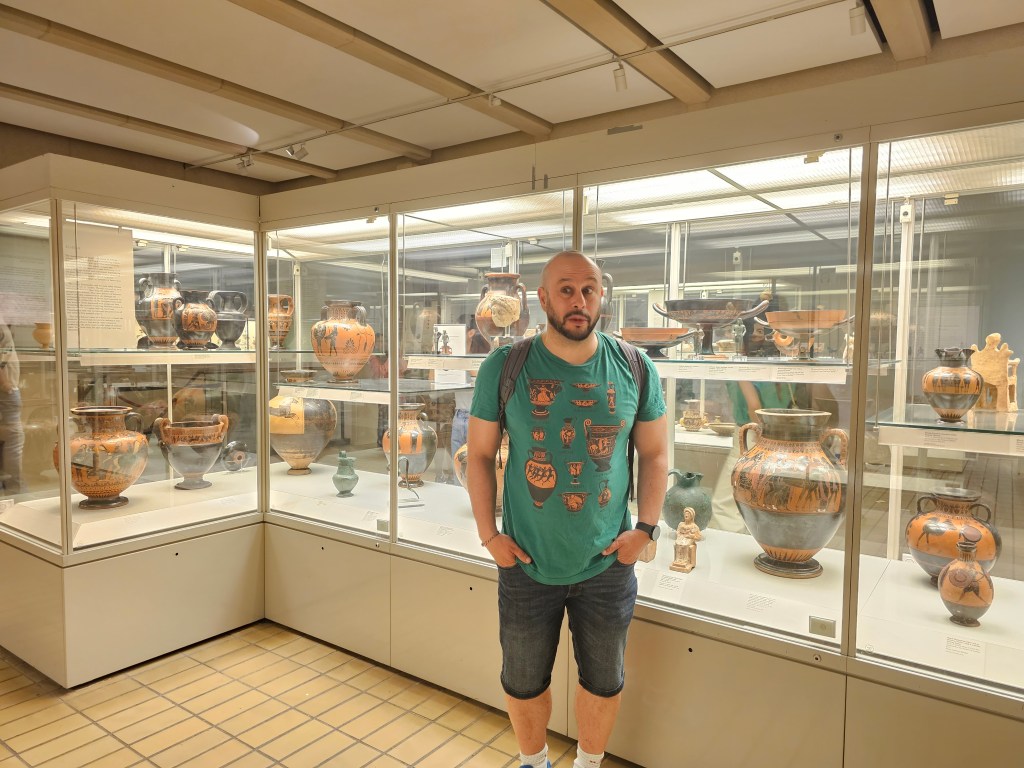
Neil seems to have found himself in a museum of ancient vases while wearing a tshirt of ancient vases!
What was the landscape of regal Rome like?
There's no doubt that the topography of ancient Rome was very different to what we are able to see today. With the restraints around archaeological work you can expect in a city that is still as important and vibrant as the capital of Italy, it is partly through evidence on the ground and partly through reading the ancient sources that we can come to grips with what ancient Rome may have been like in its very early iterations.
The Palatine and the Aventine
Neil takes us through the importance of hills in general, in Italy, and for Rome in particular. Romulus has a connection with the Palatine hill and Remus is connected with the Aventine. Neil delves into the details of the wolves in this area including the development of the Lupercalia rites and the significance attached to blood sacrifice in cultivating the meaning of place.
The early pomerium
How did it the sacred boundary of Rome work? Where was it? What were the implications for trying to cross it with early armies? None of these questions can be answered definitely because evidence is thin on the ground archaeologically speaking, but considering later written sources offers some ways into the topic. Looking to read more on this topic, consider Koortbojian, M. 2020. Crossing the Pomerium: The Boundaries of Political, Religious, and Military Institutions from Caesar to Constantine (Princeton University Press)
The Campus Martius
The campus Martius ‘Field of Mars’ was the site of the potential murder of Romulus, Rome’s first king. The area covers a fair amount of land next to the Tiber and we consider some of its historical details.
The Tarpeian Rock
Bound up with the early defence of Rome is the Capitoline Hill where the earliest defences of the city were thought to have been built. We explore the stories that the Romans told about how the rock got its name. This leads into a consideration of how death was treated in respect to place.
The First Bridge over the Tiber
The Pons Sublicius was the first bridge recorded to cross the Tiber. Not only was the bridge of strategic importance, but it was also connection with rituals. Neil takes us through some of the geographical features of the Tiber and how understanding the ancient river is quite a different proposition to understanding the Tiber as it can be observed today.
The Janiculum and the Caelian
The importance of the Janiculum being on the far side of the Tiber as far as the Romans are concerned and the etymological possibilities for the names of some of the hills. The Caelian hill is often overlooked, but maybe it needs to find its spotlight especially for its connection to Numa, the second king.
Things to listen out for:
- The Oracle at Dodona
- Pallantium in Arcadia (Greece) and Evander
- Zeus Xenia and Lyacon
- The cultural significance of place and the development of the sacred
- The sacrifice of Iphigenia
- The clock face approach to understanding where the ancient hills of Rome were
- Hercules and Cacus the Giant
- Aelius Gellius’ Attic Nights
- Miasma, the Ancient Greek understanding of pollution
- Quintilian on the Tarpeian Rock
- Horatius Cocles
- The brontoscopic calendar of the Etruscans
Sound Credits
Our theme music was composed by Bettina Joy de Guzman.
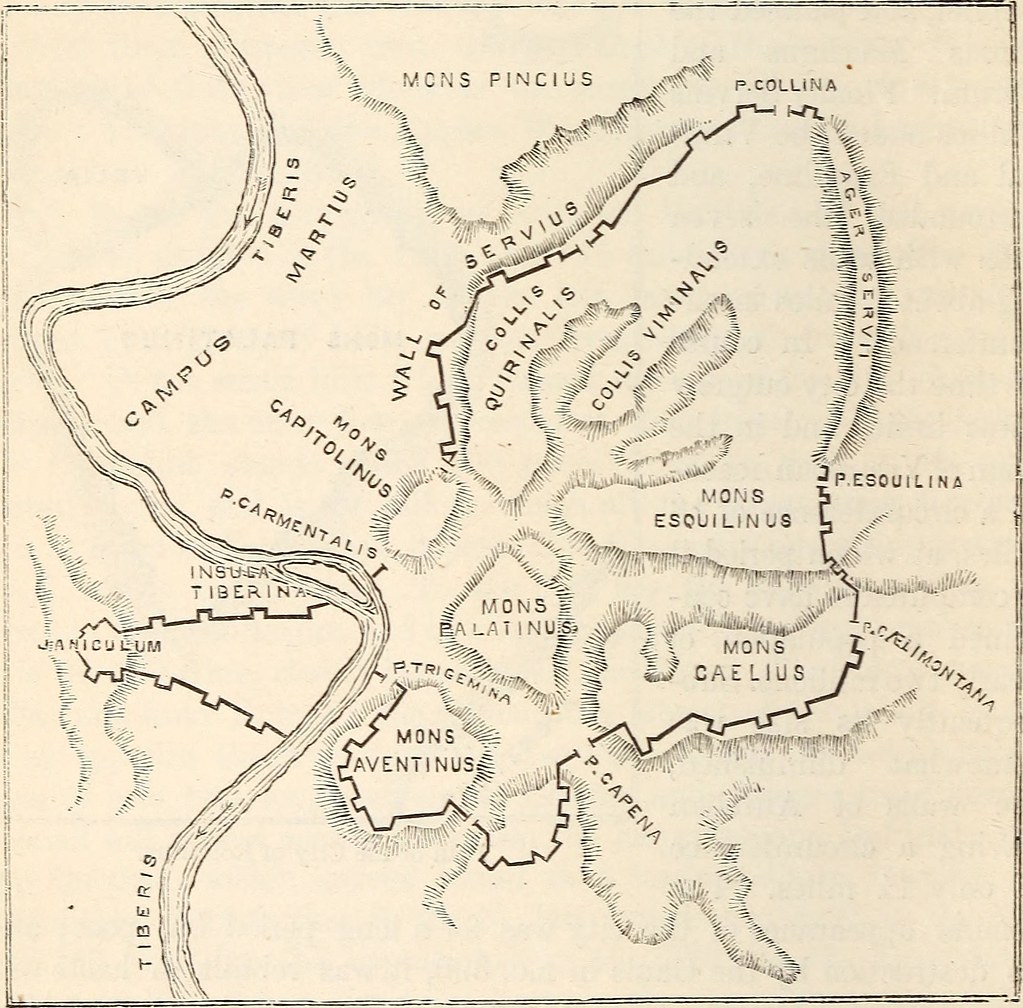
Map of ancient Rome showing the theorised extent of the Servian Walls built by Rome's sixth king.
The various hills and significant gates (porta) are also indicated. Note that the Janiculum is on the far side of the Tiber from Rome proper. Source Flickr.

Automated Transcript
Automated transcript lightly edited for our wonderful accents and the tricky terms in Latin!
Dr Rad 0:12
Welcome to the Partial Historians.
Dr G 0:15
We explore all the details of ancient Rome.
Dr Rad 0:20
Everything from political scandals to love affairs, the battles waged, and when citizens turn against each other. I'm Dr. Rad.
Dr G 0:30
And I'm Dr. G. We consider Rome as the Romans saw it by reading different ancient authors and comparing their accounts.
Dr Rad 0:41
Join us as we trace the journey of Rome from the founding of the city.
Dr G 1:03
Hello, and welcome to this special episode of the partial historians. I am Dr. G.
Dr Rad 1:10
And I am Dr. Rad.
Dr G 1:13
And we are super thrilled to be joined by a special guest today. Welcome, Neil.
Neil – History Hound 1:21
Hello, thanks very much for having me on and call me special, which is something I haven't heard for years.
Dr G 1:27
We meant it in a good way.
Neil – History Hound 1:28
Oh I'm sure it was.
Dr G 1:31
So Neil holds a MA in classics and history from Birkbeck, University of London, and is the founder of the popular Ancient Blogger website. And for the last six years, he has also been the host of the Ancient History Hound podcast. So Neil has experience in ancient Roman reenactment. And yes, he does own a suit of legionary armor, we're so glad you've already asked. And he also engages in school outreach programs, bringing the ancient Roman world to life for the next generation. And we're super thrilled to be sitting down and talking today about a little bit of typography when it comes to ancient Rome, and thinking about exploring place, and particularly going right back into the Regal period of ancient Rome to do it. So welcome, Neil.
Neil – History Hound 2:23
Thank you. Yeah. Just on that, yeah. It's great to be able to go out and visit schools and do some volunteering work at schools wearing Roman armor. My back does not forgive me. Oh, it's, it's great fun. And it does make a difference. Because sometimes, I think if you introduce history, ancient history, to new people in a different way, that whatever age, I think it disrupts some preconceptions, because one of the questions I've asked, I asked, when I've had guests on my podcast, how did you get into ancient history? And for the most part, people tend to think, Oh, I was translating Cicero at the age of five on my father's knee. The reality is, I think, I think the one of my guests that she said that it was because she watched ‘The Mummy'. And it can be it can be stuff like that. So it's so important that people realize that it's somewhat the sometimes the incidental actions and events in your life that can lead you to becoming really fascinated by a particular subject. And so yeah, so it's good to be able to try and help with that. This is my only my second time I think I've ever been on a podcast that first time was right at the beginning. So I hope I'm a I'm a good guest. Anyway. So thanks again.
Dr Rad 3:33
Well, we're predisposed to like you is to teachers, I think it's very admirable that you are volunteering your time in such a way.
Dr G 3:41
Yes, I really hang out with children when they pay me.
Neil – History Hound 3:44
The I got to be honest with you, I don't know how the teachers do it. I always say that to them. But I get bossed around by a bunch of kids for the best part of sort of three hours or so. I've got I'm visiting a school in a couple of weeks. And we've got to the invasion of Britain for a bunch of nine year olds, which is easy and difficult, because there's some really interesting stuff there. But at the same time, it's quite difficult because you want to avoid the gruesome things, which is fundamental to what the Roman army did. So it's talking about other areas, and also try and develop extension exercises and things that different kids will do, generally trying to spread the enjoyment of the subject. And that's something I've always tried to do through my podcasts and everything else is just trying to get people who haven't necessarily come across the topic interested in the topic, and they can feel like an input because after all, ancient history is about people. And we sometimes forget that there. We have our basic emotions, and they would have been exactly the same in antiquity. People got up in the morning, they got worried about their jobs people had, you know, loves their breakups and everything else. And I'm just finishing on that there was an episode. I'm not gonna keep plugging my episode, by the way, but I went I just went I went through the oracle at Dodona. They found a bunch of lead sheets and the where people had written down their questions. And the questions, generally speaking, though, came from all sections of society, including women, which is great, because we don't have a great deal about that kind of information. But it was questions such as did, should I get a new job? Should I change my career? Should I move? Should one of them we should have an affair? There was quite a lot of can I? Who do I pray to to make my kids better? But these were genuine questions that people have today. So again, it's about trying to tie in what was ancient or what is modern and sort of shortening the distance between the two? So yeah, there we go. Anyway, we'll be we'll be talking about, as he said, about Rome, early Rome, about the typography and how important the typography was, and some of the spaces and areas in that and some of the discussions we can probably have that might throw a different perspective on things. So yep, looking forward to I've got my notes, and I'd be doing lots of research. So fingers crossed.
Dr G 5:54
Excellent, excellent. Well, we're pretty excited to explore this topic. Because as you know, we wrote a book recently on the Roman kings, and we're really focused on the human character side of it. So very much like you were saying, engaging with school children and bringing that curiosity to the subject. It's the people factor that really drives a lot of the work that we do as well. And so I think taking this different geographic angle is really interesting way to think about the whole thing from a totally different perspective. So one of the things that stands out when you think about Rome, and usually something that people tend to know about Roman geography, if they know anything at all, is that it's got seven hills. This is apparently a very special number gets bandied about a lot. But in the traditional foundation story, we have Romulus and Remus, and they start on different hills. And there are only two guys, one of them set up on the Palatine Hill, and one of them set up on the Aventine Hill. And I'm interested in what might be the significance of these two locations? And what could we know about them in this really early period, if anything at all.
Neil – History Hound 7:06
A great start, great place to start. Just before I go any further, I should say I bought your book downloaded onto my Kindle and loved it, it was very, very good. So if anyone's listening out there, this is not a promo, this is a genuine review, I really enjoyed it, because it does that thing of engaging people. It's got some really interesting stories in there. And it's got some interesting questions as well, which I think you should always be able to take away from a book. Before I start on the whole seven hills thing. I want to just cover a few basics about that, because people always think of hills and Rome, but not necessarily in the context of the causality and the importance of them. So to start with having hills was generally a good idea, because hills mean hillside forts, or hill forts, which means you've got a very good defensive position. That was a really popular thing. At that time the Etruscans are on it, you can pretty much go anywhere around the Mediterranean people like higher places because they're easy to defend. You can stick a wall around them, you can stick the important buildings in there, hey, presto, life is good. Where it becomes even more interesting and significant for Rome, or the area which became Rome is the actual location of Rome, because Rome is in Rome, it is at a affordable part of what you could fold the river Tiber around Rome. Why is that important? Well, if you think of the Italian peninsula, the Italian peninsula is quite narrow. It's around 180 kilometers, which is about 111 miles. I did a bit of working this out. And apparently that's the distance from Sydney to Mollymook. And it's also the distance from-
Dr Rad 8:39
Wow, thank you for the local reference.
Neil – History Hound 8:41
That's right. Yeah, I looked it up. And I always liked spending time on maps. And it's also if you're in Chicago, that's a distance from Chicago to Lafayette. So it's that it's quite narrow. And the problem or advantage the Italian peninsula has is down the center of that you've got the Appenine Mountains. So generally speaking, if you're traveling up and down Italy, you either do it on the eastern coast, or you do on the western coast, if you're doing on the western coast. At some point, you will have to pass and and traverse as it were the Tiber River. So just to just come back to it all. You've got a set of defensive positions right next to an incredibly strategic, important location. On that side on the western side of the app and ions. This is a great place. People sometimes ask why did Rome develop? Well, it developed for a number of reasons, and it achieved what it did for a number of reasons. But these were all fundamentally underpinned by the fact of where it was at this great starting location. And if anyone's listening who has ever played Civilization, the computer game…
Dr G 9:41
I was gonna say I was just having a Civ 6 moment.
Neil – History Hound 9:45
This is this is the ideal start position. This is riverside, plains, hills, your part is great. You've even in theory got some salt then nearby, which just makes yeah, the ears will be picking up for anyone who plays civilization on any of the versions. It's just a great start position. So that was really important. And we'll come shortly to the whole issue of the Tiber and how that changed and shifted, because that's really important to understand with early Rome. So you've got these these two hills, you've got the Aventine and the Palatine. So we start with the with the Palatine. The Palatine is very interesting in the way that it's handled. mythologically speaking, because it seems to have a prequel because it's linked to a number of events that happen prior to Romulus and Remus. But it also stitches in nicely with certain points in their lives. It stitches in with sort of Rites of Passage, which I'll get to shortly. So what you have, apparently, according to I think it's both Dionysus Halicarnassus and Livy. They both refer to Pallantium. Pallantium was a city or a small settlement whatnot, in Arcadia in central Greece, and it said that originally, Evander and some other Greeks came over, and they settled there. And I completely agree with the point you made in your book, Dionysius of Halicarnassus sees Greeks everywhere. He just did to him everything is greek.
Dr Rad 11:05
I see Greek people…
Neil – History Hound 11:07
Yeah, totally. Totally. He's, everything is great. Yeah, they just did it with a different language a bit later on. And in Pallantium, you have this initial settlement. Now that ties into Pallantium and Arcadia. Why is that interesting? It's interesting because Arcadia in the Peloponnese was an odd place. And it had some odd characters, even by the standards of Greek myth. One of them was King Lycaon. Now, people might have heard of him. King like Rome was famous because he did that one thing that you should rarely never ever do. And that's try it on with a God. He invites Zeus round for lunch, and to test if he's really that clever, he feeds in human flesh, which is just the more I mean, if you think that's a bad idea, just a map, just remember that Zeus was Zeus Xenia was an aspect of Zeus whereby he was the god of good good guests and hosts. So incredible amount of importance was based on being a good guest and a good host, presumably serving them human human flesh, bad idea that somewhat sort of crosses the line a bit, and you're doing it with a God who is in charge of that particular element. Zeus does not take this well, as you might imagine, changes him into a wolf. Now on Mount Lycaon, which is in Arcadia you had as an altar to Zeus, which was an a very long ash altar. And there were lots of things said about it. Without trying to go on a tangent. If you've ever listened to episodes on any podcast I've done by myself on werewolves, and werewolf myth. That is the that is the point that you always arrive at because people say, well, that's where you had some sort of wolf based ritual. Now tying that back in, why is that? Why do you tie that in with with Rome? Well, it's not necessarily just a tangent. It's because Rome obviously itself has some form of wolf cult, it has a wolf association, and in fact, I think it's living again who says that Lupercalia the festival where men would run around naked and hit people with goat hide thongs originated from the Lupercal, the cave of the wolf on the Aventine. And in fact, there's the Lupercalia is a very interesting festival because it seems to be one that existed prior to Romulus and Remus. It probably had them both of them grafted on to it. It has two functions. It seems to be a lustral rite, that is a purification, rite. But it also has some sort of fertility basics to it. So it was one of these, one of these things that by the first century BC/AD, people are trying to work out what it may have looked like but the reality is, like many Roman things, including the Saturnalia, for example, it started out in something very different, and ended up with something quite, quite divorced or estranged from its origin, shall we say? And yeah, so you've got this right before Romulus and Remus rock up. When they do. That's where they, they end up as babies. They're washed up there in their basket, which was a bit of a trope in antiquity, and also speaks to the point of flooding in ancient Rome, which again, is an important thing that we'll come to. It's also the place where they have their auguries, so you may have heard of the story where Remus goes the Aventine and sports has many eagles he can. Romulus does it on the Palatine, he spots more he wins, he gets to found Rome, it's possibly the location as well of where Remus is killed. What is interesting is there are a number of different myths. We have different versions for it. We have the version where it's just a straight out fight, because the two brothers are just not going to go on mainly because they're brothers and that's what brothers tend to do, though probably not that extreme. But also because their Romans and Romans were very good at civil war. They were very good at infighting and again, we have to remember that many of these myths have been created and worked on in the later periods or several centuries afterwards. We have Fabius Pictor at the end of the third century BC as the first acknowledged Roman historian who's writing in Greek. And then you have Livy's and Dionysius of Halicarnassus writing centuries after that. So the reality is they're getting to a point where they're trying to work everything out retrospectively, and they're seeing what what works for them in the modern world. Rome was a place of a lot of inner tension. And we have a lot of civil wars. So of course, it made sense that brothers would fall out and perhaps that would lead to a very nasty end. So there's a fight there, where Remus ends up, ends up it ends very badly for him. But there's also an element there of and this is something I'd like to check in with with either of your good selves of the pomerium, of this sacred boundary, because it's one of those things that sometimes it's a bit of an overreaction. Romulus killed his brother, because he jumped over his wall. And he mocked his foundations when I've been around. I've been round to relatives' new conservatory. I wasn't that impressed? I was not that impressed with it. But they didn't murder me. And so why is that? Why, why did you have this extreme reaction? And I think the thing is, we don't get the context. So foundations, particularly those associated walls had a sacred element to them. You didn't, You didn't mock them, it was it would be the equivalent mean there is no great equivalence, but perhaps it would be going to a cultural location where you just considered it on its as a physical presence. So for example, going to Uluru and just go and ask just a sandstone feature without realizing that that is Uluru. That's that's much more than what it is. Perhaps, I was thinking of the Statue of Liberty, you know, that's just a statue. But you don't get the cultural connotations, or the cultural connotations around those around that wall around that area. What's that it was incredibly important. And so by Remus mocking it and jumping over, it was committing a real crime, which, you know, instigated that response from Romulus, in that context, it doesn't sound too bad, again, extreme, but Romanus, as well, as you'll find, as you well know, wasn't, wasn't the most temperate of individuals, he often reacted-
Dr G 16:57
He was not a chill dude, Not a chill guy at all.
Neil – History Hound 17:00
But bearing in mind how he grown up, I mean, his entire existence, and the myth prior to them, it's basically family members falling out and hurting each other in various ways. So again, this sits within this whole myth of, if you've got a relative, it's gonna go Game of Thrones at some point, it's as simple as just a case of when rather than if. And yeah, so we have that there's also and something I always go to, and I, I apologize for this, because I got obsessed with human sacrifice after doing an episode on it. Not so much obsessed. Actually, that's probably that might get that
Dr G 17:30
That doesn't sound like a great way to phrase it.
Dr Rad 17:34
I was gonna say, Yeah, I'd stop, right there.
Neil – History Hound 17:36
Yeah, yeah, probably need to rephrase that. The, I found when I started looking and researching it, I saw it occurring more. Now, it occurs a lot in Greek myth, but they try and tidy it up. Great example, is Iphigenia, who's stolen away by Artemis, when she said to be sacrificed, and that was the idea of substitute sacrifice. So, you know, the Greeks do a kind of a good job of tidying up, though, occasionally leave it right in the open and just move on, such as Achilles in the Iliad, where he gets rid of the Trojan princess, and where Achilles is involved in the sacrifice of effort, you know, at the beginning, and where Achilles' involved in the sacrifice of Polyxena at the end of the Trojan War. So Achilles, yeah, he wasn't he wasn't particularly nice, or he had that element to him. But there is something of an argument to talk about how Remus dying is almost an essential requirement. Now, you can move that out into a conversation about how sometimes when cities were established large settlements, there is an argument that someone was ceremonially sacrificed to ensure the health of it, particularly around walls, Particularly around those liminal spaces. But I don't want to go into that too much, because I'm not entirely comfortable with the research on that I'm not that well acquainted to it. But when you look at the myth, and obviously, this is where I move fully within the realm of your respective expertise on this, the founding of the of the Republic, well, that was bloodshed that was that you have the death of Lucretia. You also have the death of Brutus' sons, you have these sort of repeated actions of if you're going to find something big, if you're gonna have this big, big setup, it requires a great cost. And that great cost can often be an individual being killed or being moved on as it were. So I think that's an important thing to notice about the Palatine. But there's also a good one Plutarch, Plutarch, it gives a more sort of amusing, and I wouldn't say he's throwing a bit shade but Remus gets annoyed at Romulus because he thinks he's cheated.
Dr G 19:38
I love that version of the story. That's my favorite one.
Dr Rad 19:41
I say I guess. Make sense. Yeah. Yeah.
Neil – History Hound 19:46
Yeah, it's a bit of a strange competition. It's like me going right? That we're going to win a car. The three of us gonna win a car, you just got to think of the highest number, but we'll say in order and I get to go last. I'm not saying one. I'm just gonna say the highest and yeah, so it's also interesting as vultures will often we have associations of eagle with ancient Rome, particularly with Tarquin when he gets his cap snatched by an eagle. But these were vultures, which again, is it? People may not know that much, but a trivia impress your friends stand stand your relatives. So we have that the so that's where we come to the Palatine. It was obviously pretty much where Rome is founded, and it becomes an incredibly important location. And before I go to the Aventine. Have I missed anything on that you think? Or is there anything?
Dr G 20:33
No I don't think so. I think there's something quite interesting about the idea of the blood sacrifice as a necessity, in terms of like establishing a sacral border. And what that means for other rituals that the Romans then participate in later on, for sure. And I think this extended narrative that has a way of connecting Rome back to Greece is something that Greeks across the ancient world would be very keen about, for sure.
Neil – History Hound 21:09
Yeah. Yeah, it's very difficult to really understand Rome without considering it through the filter of Greece and the Mediterranean was a real cultural melting pot, people were constantly exchanging ideas, cultures, you had Greeks in the south of Italy, and Magna Grecia, the Etruscans, who were heavily influential on Rome, big Greek fans. In fact, if you're, I guarantee, if you're listening to this, and you have a favorite Greek vase, the chances are, it was found in an Etruscan tomb. That's why it survived.
Dr G 21:37
They did love that stuff. It's everywhere there.
Neil – History Hound 21:39
Yeah, when I, when I first started studying I just studied all those years ago, I couldn't get my head around it: But this is an Attic vase, but it was found … what the heck was going to be? How did that work? And obviously, there's cultural transmission. But the stuff in Athens didn't necessarily survive as much. Or rather, if you're looking for, for an object to survive, you need to it needs to be in a tomb or somewhere away from everyone for a long time, and hopefully, dodge tomb robbers, and hopefully gets excavated, and it's still there in one piece. So the other thing about the Palatine is, when you're looking at the topography of Rome, it's quite important to understand where the hills were. Now I'm going to do a really basic thought experiment here, which is either going to fail or do well. You could see the looks on your faces. So when you think of the hills of Rome, the way that I try and do it is a clock face. And sort of, if you think at 12 o'clock, and going up north, you've got the field of Mars, that kind of thing. In the center of the clock face, you've got the Tiber which winds round from around 11 o'clock disappears around seven o'clock, and intersects with the Forum Boarium, which that's the main crossing point into Rome. At nine o'clock, you've got the Janiculum Hill, at six o'clock, you've got the the Aventine. And then you've kind of got that the Palatine just to the center just to the right sort of three o'clock ish, if you think of it like that. So if you're on the Palatine Hill, the Palatine Hill strategically is really important because you're right dead center on that crossing. So again, it is the most one of the most important hills, I mean, the Capitoline Hill is close as well. So is the Aventine Hill, they're not going to the Janiculum. These are not far from that that crossing. But if you're going to choose one first, you'd probably choose the Palatine Hill as being that initial place that you'd want to be. So again, we need to tie this in the myths into the sort of pragmatism of it all. Now I'm going to move to the Aventine. The Aventine Hill is interesting, mainly because it will it has an association with an unnecessary it's known right, so feel free to laugh with Cacus or Cacus, the giant who Hercules fights, and it's associated with him because again, you have a Hercules at Rome quite early on was certainly prior to Romulus and Remus. It also became a bit of a staging post, it became an emptying this is where people settle the Latins who were defeated on the anchors the third, fourth, fourth Roman king was given mixed up, a settles in there because he can't stop them anywhere else. So it's sort of a bit of a staging post overspill, that's where people are going to go and live. But the weirdest thing I found out about this when I there was something I hadn't realized. And again, I'm gonna defer to your expertise on this until the reign of Claudius in the first century AD. It was outside of the City's pomerium. This was not inside this, it was in there's discussion, it might have been enclosed by walls, but it wasn't inside the pomerium. And could you just for a moment just given because I've tried to find good definitions of what the pomerium was, but you able to just distill that if you can?
Dr G 24:48
Yeah, so the pomerium is, because it's the sacral boundary, it is marked out physically in certain ways. But it is is not something that is a physical barrier as such, so there's marker points for it. We understand it through archaeological evidence. And in order to shift, it becomes a huge deal, because that would be expanding the sacral boundaries of the city. So that has to be a very deliberate choice. The Romans are fundamentally a highly religious and God fearing people. So they don't make decisions without consulting the gods on any level, it doesn't really matter what it is. Whether it's in your home, whether it's in public, whether it's going to war, the gods have to approve, they need to feel that sense that their relationship is right with the gods. And so the pomerium is both an indication of what is inclusively believed to be part of sacral Rome, versus what is considered to be foreign and outside. So in the worst case scenario, it's not the physical walls of Rome that ultimately need to be upheld and defended, although they're very important, but it's making sure that that sacral boundary is never violated. So having the Aventine outside of that for a very long time, is conducive to the sorts of things that you're saying in terms of people coming into Rome, when they're slightly foreign. And they're considered to be migrant populations, they settle in the Aventine, because they're allowed to be there. And they're allowed to worship their own gods there without any problems. As soon as they cross that sacral boundary, it becomes an issue. You can't have foreign gods inside the pomerium. So everything to do with a multicultural life, which Rome increasingly becomes known for is going to be happening at those bleeding edges around the outside of the pomerium. And so having the Aventine outside of that for a long time super useful and will become super useful for the Struggle of the Orders. And I'm using my flash rabbits.
Dr Rad 26:57
I was I was going to say I remember thinking about this when we were talking about the second secession, the Aventine as a place in that particular narrative where there'll be an answer like, “You know what, screw you guys, we're not going to be proud of this thing anymore,” became important.
Dr G 27:13
“We're just gonna leave this whole town!”
Dr Rad 27:16
“We're just gonna leave and we're going to go to the Aventine,” Yeah.
Dr G 27:19
Yeah, “This is not Rome anymore. The Aventine is its own place, thank you very much.”
Dr Rad 27:27
“Yeah, it's its own thing. It's got different vibes, guys.”
Neil – History Hound 27:31
I live in Brighton. And there's a bit of a thing with Brighton because it's alongside Hove. And I know if you've you might have heard of this. But there's a sort of thing where people, whenever they say, Oh, you live in Brighton people would always say I actually, Hove actually. And “Hove, actually” became its own little thing. It got printed on T shirts. And I didn't grow up. I didn't grow up in Brighton, so I'm not aware of it all that much. But when I first started to talk to people, where do you live? Well I live in Brighton but I actually live in Hove. But I'm not saying that to be that person who's “Actually, Hove,” you know, that sort of thing. So we should get “Aventine, actually” T shirts. There we go.
Dr G 28:08
Yeah, probably!
Neil – History Hound 28:10
The idea of and I did a bit of obviously digging to work out why this might be so why wasn't wasn't included. And the general consensus in the sources seems to be no one actually knew. But they had some ideas. And there was a sort of historian who wrote called Aulus Gellius who write “Attic Nights”, which sounds like sounds like saying you find on Netflix and not know if she'd watch in front of your parents. I don't know. It's not quite sure when there's and he said he wasn't sure he said there are a number of reasons however, he quoted Messala who was a consul back in 53 BC, and apparently according to Messala he said that it was because of ill owned birds. The point of when that augury was taken.
Dr G 28:52
Right from the beginning Remus was wrong.
Neil – History Hound 28:55
Yeah, it was it was abandoned, and the whole hill that he did, and somehow that that had some association with it. But there is probably a more practical reason for this. And for this, I need to go back to that clock face I did earlier. So as you remember, you've got Field of Mars around 12 o'clock. And then you've got around nine o'clock, you've got the Tiber, and then you've got the Aventine at around sort of six o'clock. Now, when it came to moving troops around the field of Mars was where you marshal troops early on in Rome. At that point, Rome was obviously conducting military activities in a number of locations, but a lot to the south. If you take your soldiers from that point south, you face a big problem. Because if you have to cross the pomerium, as I understand it, and again, this is this is something I'm not entirely aware of. You've got to do a bunch of sacrifices and general rituals to cross over the pomerium. So you'd be it's a bit like when I suppose in some cities where you have a zone where you have to you can't you know, drive between these certain hours or whatnot or your car needs to be this type of setup or perhaps it's just pedestrianized, so you need to cross it, you'd be crossing it twice. And that could really forestall an army because it could take time. However, if the Aventine wasn't in the pomerium, then you can kind of take your men down the side of the eastern bank of the Tiber. And they don't have to worry about that. And they don't want to go the other routes because the two other routes from the Field of Mars if there was a pomerium immediately to the South would mean well, you've got across the Tiber, well, you can't cross the Tiber south, you've got to go all the way north and finding a decent crossing point. If you want to go east you've got to loop north and east around the hills. It that that when you're moving a large number of individuals, and again the logistics the Roman army is always an interesting thing, perhaps more so than what they actually did. On the battlefield though (I never said that). You move the slowest move the slowest thing in your army is the fastest you move. And often this will oxen, oxen, don't sprint, they don't move very quick. So you could lose a good day or two just making that progression, albeit if you have to cross the pomerium. If the pomerium isn't to the south, you've got easy dibs going. It's much easier to move troops. So why does Claudius do it? Well, apparently Claudius does it for a couple of reasons. Primarily because he's so amazing and he's expanded the Empire. Also it doesn't really matter it no one apparently really was that bothered by it. Because Rome at that time if you're an army you weren't stationed at Rome you weren't station really near Rome, you were stationed on the on the borders. So it didn't really have that same impact in terms of army and I think it's one of those things he he has his his big thing that he does or a big thing and everyone's like Yeah, cheers. Thanks for that. Yeah
Dr G 31:31
Whoooo
Dr Rad 31:34
New area code – yay
Neil – History Hound 31:36
Yeah, a really sad kind of a sad popper everything goes up in the background. And it's kind of just yeah, thanks for that. So yeah, so that's, that's primarily the to the to hills, or rather, that's the Aventine and that the Palatine. And it's interesting to see how I wouldn't say they necessarily take on the characteristics of their, of their forbearers, as it were, but there is something there to them. One is associated with everything about Rome, and how great it was. The other one is, yeah, well, and he's a bit weird. It's a sort of a black sheep of the Roman hills.
Dr Rad 32:11
I like that idea. So this is actually a good segue for us because we were going to ask you a bit about something to do with Romulus and to do potentially with troops and that sort of thing. So as you know, Romulus seems to come to a sticky end on the Campus Martius. So let's think about how the Romans might have understood Romulus as connection to this place and his legacy later on, because as you as you've already hinted at, the Romans are kind of trying to sometimes fit pieces together retrospectively.
Neil – History Hound 32:46
Yeah, it's really difficult as well, I think this is why I find the story of love the kings of the Regal period, so fascinating. Because it's a big disaster movie. That's what it is. It doesn't you know, it's not going well, you know, what's going to happen? They're not getting off the plane, it's, that's what's gonna happen. It's just how are they not gonna get off the plane? And sorry, if that sounded tasteless, by the way, but if you're gonna, if you're gonna put it within the context of modern day disaster movies, that kind of thing, this doesn't end well. And it's weird, because you have this internal tension in the narrative of isn't Rome, fantastic? Wasn't it founded, by the way, it's amazing. But also, it's not very good, because it ends really badly, because the thing that starts at all is ultimately a very bad thing, come come the seventh King. I mean, even if you make a good case for Servilius, the sixth king, he he's he does things, but he still acts in a sort of pseudo dictator fashion at points, because he does cheat the system. He doesn't have the proper elections and the interregnum and whatnot. It's just because everyone likes him that it's okay. So if you look at it from that the process is pretty broken by that point, in terms of how you elect a monarch, and what the monitor should be doing. And the idea of supreme power, and how it's wielded becomes a, you know, an issue, then it's not always just that when it's with the bad guys, and particularly the seventh King, it's more obvious because you were automatically not liking him. But it's one of those things that if your friends doing something that isn't morally good, you can be a bit more forgiving. But obviously, if somebody don't like doing it, well, then you're going to be entirely damaged. And I think that's that's what you have here. So it's interesting with a narrative of how how we move across with Romulus, and then you mentioned the Field of Mars, I find it and I again, it's laugh out loud funny when you hear the story of how he goes missing in the Field of Mars or alternatively is hacked to pieces depending on which you think's more likely, given that it's Rome, or we have Rome, where you never have political violence where it's always everyone's really happy with each other. And then afterwards, you have that senator appearing and telling the masses who are a bit worried about it. Don't worry, the ghost of Romulus appeared to me just mean no one else and told me don't worry, everyone, it's all good. Life is good. Don't kick up a fuss I've gone now be happy and that's it. But in terms of the actual location itself, nothing much happens. The Field of Mars in terms of have been developed until the late Republican period, simply because it's this big, marshy land, it's got lots of mosquitoes, very difficult to drain. And it's also useful. It's a useful kind of area where no one really knows what to do with it. Because you can have horse riding events there. They have some, they have a festival called the October Horse, which comes in later, I think, I don't think we can really date it to this period. But that that's linked to sort of horse races, and it doesn't enter work too well, to the winning horse. I should add, so I won't go much further than that. But in either case, it's a space that I think you've you've you said about how the promotion was important. This is outside so you can kind of anything, anything goes that you can get up to stuff.
Dr G 35:44
Oooo you can get away with hacking someone.
Neil – History Hound 35:45
Yeah, yeah. In theory, allegedly, allegedly, though, he know, he went up to heavens in a storm, because that's what you do. And I also found it interesting, because I think there and I haven't been able to get into going into this, but that's where you have the Theatre of Pompey, which is where Caesar met his end. So I think again, if someone listen to this, and they're tutting, I apologize. I didn't get a chance to look into this too much. But I know obviously, Caesar assassinated in the Pompey's Theatre, and I think that's where Pompey's Theatre was based. So if so you have two distinct events in Romans history where a a person in charge meets a rather unfortunate end, both in the Field of Mars. And it's also the only other thing that I can think of or found within the Regal period is it seems to have been the property of the seventh Quinctius Tarquinius Super-bus. Superbus obviously to have super bus because he's got a cape on.
Dr G 36:41
Superbus, I believe is how the Latin would would take it, but
Dr Rad 36:45
he's always Superbus to us.
Neil – History Hound 36:49
Put a cape on him, he's fine. It that's apparently that's that was his land. And when we're gonna call it Livy says the after he was dealt with, they took it back and dedicated it to Mars. So exactly what he was likely to do with that began perhaps that's, that was his land, perhaps had something to do with the the army perhaps it had something to do with controlling. It's not an area around really needs to develop at that point, certainly within a legal period, they've got more important places, which we'll, we'll speak about in a moment. Yeah. So that's the that's the I think, the Campus Martius or as much as we can, much as I've got anyway to talk about it.
Dr G 37:23
I mean, it's an interesting place, because it does have this famous sort of idea about it as this sort of area where people get together. And it's where a lot of voting happens later on. And things like that be precisely because it's outside the pomerium. But yeah, it's interesting that for the Romans, this idea that people could potentially be murdered, there doesn't necessarily mean that it changes the way that y