
The Mixtape with Scott
152 episodes — Page 2 of 4

S3E21: Ashesh Rambachan, Predictive Algorithms and Causal Inference, MIT
Greetings listeners! It is a pleasure to introduce this week’s guest on the podcast, Ashesh Rambachan, an assistant professor of economics at MIT. I wanted to talk to Ashesh for two main reasons. First, because I wanted to, and second, because I was aware of some of his recent work in econometrics. His recent article on evaluating the fragility of parallel trends in difference-in-differences just came out in the Review of Economic Studies. I’m also intrigued by his work with Sendhil Mullainathan on machine learning, algorithmic fairness as well as generative AI. Having a specialist in both causal inference, artificial intelligence and machine learning is rare, so I thought sitting down with him to learn more about his story would be a lot of fun, not just for me, but for others too. With that said, here you go! I hope you enjoy the interview! Thank you again for all your support!Scott's Substack is a reader-supported publication. To receive new posts and support my work, consider becoming a free or paid subscriber. Get full access to Scott's Mixtape Substack at causalinf.substack.com/subscribe

S3E20: Henry Farber, Labor Economist, Princeton
This week’s guest on the Mixtape with Scott is esteemed labor economist, Henry Farber, the Hughes-Rogers Professor of Economics at Princeton University. Dr. Farber’s accolades are numerous: a Fellow of the Econometric Society, the Society of Labor Economists, and the Labor and Employment Relations Association, past President of the Society of Labor Economists, and recipient of the 2018 Jacob Mincer Award for Lifetime Contributions to the Field of Labor Economics. You can find more information about his background here in this short biography.But ironically, it was for a different reason that I wanted to reach out to him. I was interested in reaching out to Dr. Farber because of his traditional approach to labor economics, such as his seminal work on labor unions and the behavior of New York City taxi drivers (to name just two). His research provides a distinct perspective on labor economics, one that doesn't fall squarely into the natural experiment momentum of his contemporaries at Princeton, despite being part of the Industrial Relations Section there. I hope you enjoy this interview as much as I did! Thank you again for all your support!Scott's Substack is a reader-supported publication. To receive new posts and support my work, consider becoming a free or paid subscriber. Get full access to Scott's Mixtape Substack at causalinf.substack.com/subscribe

S3E19: Sarah Miller, Health Economist, Michigan
This week's episode of "The Mixtape with Scott" features a conversation with Sarah Miller, a health economist at the University of Michigan. Sarah has made significant contributions to the field of economics, particularly in understanding gender dynamics and reproductive health. Her research has been influential in shaping public policy, and her groundbreaking study on the effect of Medicaid on mortality, conducted with Laura Wherry and Norman Johnson and published in the Quarterly Journal of Economics, stands out as a seminal work. In this episode, we delve into her academic journey, the personal experiences that have shaped her interests, and the impactful research that drives her career.Beyond her impressive scholarly achievements, we explore the passion and curiosity that fuel her work, as well as her vision for future research. Sarah shares reflections on her personal life, offering a glimpse into the challenges and triumphs that have defined her path. Join us as we uncover the story of a dedicated scholar whose work not only advances economic theory but also has tangible impacts on public health and gender equity. This episode was a thought-provoking exploration of Sarah Miller's remarkable career and the innovative research that continues to inspire her.Scott's Substack is a reader-supported publication. To receive new posts and support my work, consider becoming a free or paid subscriber. Get full access to Scott's Mixtape Substack at causalinf.substack.com/subscribe

S3E18: E. Glen Weyl, Economist and Author, Microsoft
This week's episode of "The Mixtape with Scott" features an insightful conversation with E. Glen Weyl, a distinguished economist whose career has spanned academia and industry. Glen earned his PhD from Princeton, spent three years at the Harvard Society of Fellows, and served as an assistant professor at the University of Chicago, where he made significant contributions to micro theory applications to industrial organization. However, Glen’s journey took a transformative turn when he left academia to join Microsoft, where he currently leads the Plural Technology Collaboratory, focusing on technological solutions for societal cooperation.Many listeners might recognize Glen from his influential book "Radical Markets," co-authored with Eric Posner. This work introduced the innovative voting mechanism known as quadratic voting, reflecting Glen's deepening interest in democratic processes and governance. His latest book, "Plurality: The Future of Collaborative Technology and Democracy,” (Amazon link) co-authored with Taiwan's Digital Minister Audrey Tang, serves as a manifesto for harnessing digital technology to foster social unity and diversity. The book presents bold ideas, from digitally empowered communication to transforming global trade, aiming to enrich relationships and ensure inclusivity.In addition to his writing, Glen has also ventured into film as an executive producer of the documentary "Good Enough Ancestor," which highlights Audrey Tang's work in digital democracy. That trailer can be found here; Glen was executive producer on it.Throughout our interview, Glen shares his experiences and insights from his varied projects, illustrating his renaissance man persona. From his academic roots to his pioneering efforts at Microsoft and beyond, Glen’s story is a testament to his innovative spirit and dedication to leveraging technology for societal good. This episode promises to be an engaging exploration of his remarkable career and visionary ideas.So thank you for once again for tuning into the podcast! I hope you enjoy this interview as much as I did. Don’t forget to subscribe, follow, all that and tell people about it! Thank you for reading Scott's Substack. This post is public so feel free to share it. Get full access to Scott's Mixtape Substack at causalinf.substack.com/subscribe

S3E17: Matthew Jackson, Economics of Networks, Stanford
This week on the podcast, Matthew Jackson from Stanford University is the guest and it was such a delight for me to talk to him and get to know his story a little better. I’d met him before, but only briefly, but I’d read a lot of his work because I once developed and taught a class on networks for our masters of economics students. His textbook on the economic and social networks is excellent but he also has a general interest book on networks if you’re wanting something more accessible. As the podcast is technically both listening to the stories of living economists and an oral history project, maybe it is worth noting this (though I think it’s obvious to most listeners) that Matt is a micro theorist whose work has empirical content. Not all micro theory does and not all empirical work is necessarily theoretically driven, which is why I make that technical distinction. Networks are also, I think, so clearly an important part of human existence. We make friends, we catch diseases, we learn about opportunities (and maybe as importantly, don’t learn about opportunities) because of networks. And so in a very real sense, even the classical definition of economics proposed by Lionel Robbins, that economics is the study of the allocation of scarce resources by people with unlimited desires, can alone justify the study of networks if networks, as opposed to merely markets and market prices, are actually an important part of that resource allocation process itself. It’s so interesting — as someone nearly 50 to consider all the ways economics evolved over the last 50 years and continues to evolve while still remaining at its core connected to core questions like “how do humans manage to survive on this planet given they have so little time and so little resources?” Anyway, one last thing. At the end of the podcast, I ask Matt about his new work on artificial intelligence. The paper is at PNAS and is currently unlocked. It’s entitled “A Turing Test of Whether AI Chatbots are Behaviorally Similar to Humans” and it’s by Matt, Qiaozhu Mei, Yutong Xie, and Walter Yuan. They had ChatGPT-4 play a variety of classic games, like dictator games, prisoner’s dilemma, and so on. And they mapped the way the chatbot played to the way humans have planed these games in the lab. The one thing that I found really interesting in what they found was that ChatGPT-4 is altruistic. “It” appears to play the game altruistically in the sense that it attempts to maximize a weighted average of both its payouts and its opponent’s payouts. What then should we expect if we in the long run end up with a network of chatbots? Hard to say what the general equilibrium will be as game theoretic equilibria are often surprising and not immediately intuitive and usually depend on institutions and incentives, but still it’s quite fascinating to me. I hope you liked this interview! Scott's Substack is a reader-supported publication. To receive new posts and support my work, consider becoming a free or paid subscriber. Get full access to Scott's Mixtape Substack at causalinf.substack.com/subscribe

S3E16: Bruce Sacerdote, Labor Economist, Dartmouth
Welcome to this week’s episode of the Mixtape with Scott where I get to interview Bruce Sacerdote, the Richard S. Braddock 1963 Professor in Economics at Dartmouth. Bruce is a prolific labor economist whose work spans the range of crime, education and peer effects. Some of his papers have been some of my favorite, even. His early work on crime with Ed Glaeser used to really interest me. But it was his work on peer effects that I found really fascinating. This old paper in the QJE about how friendships form I must have read almost 20 years and it still sticks in my head. I think Bruce, though, was one of the first people that I ever encountered after graduating that was very clearly part of this credibility revolution. His papers, if it used instruments, typically would use lotteries as instruments. Or if he was studying peer effects, it was lotteries. Well, not surprisingly, Bruce was there at Harvard as a PhD student in the first class that Imbens co-taught with Don Rubin on causal inference. His classmates in that class were Rajeev Dehejia and Sadek Wahba, authors of classic applied papers on the propensity score. In fact, Bruce’s own project for that class was also published — a paper estimating the causal effect of winning lottery prizes on labor market outcomes (published in the 2001 AER). So this was fun, and I hope you enjoy it too. Apologies I ramble for so long at the start. Not sure what got into me.Scott's Substack is a reader-supported publication. To receive new posts and support my work, consider becoming a free or paid subscriber. Get full access to Scott's Mixtape Substack at causalinf.substack.com/subscribe

S3E15: Peter Boettke, Austrian Economics, George Mason University
This week’s guest on the Mixtape with Scott is someone I’ve admired for a very long time, even before I entered graduate school in 2002. Peter J. Boettke is the Distinguished University Professor of Economics and Philosophy, the Director of the F. A. Hayek Program for Advanced Study in Philosophy, Politics and Economics and the BB&T Professor for the Study of Capitalism at the Mercatus Center at George Mason University. It’s hard to summarize just how important Peter has been to the story of Austrian economics, but in my mind, he’s been one of the most influential people in that long tradition, both for his scholarly work on political economy, public choice and institutions, his leadership at George Mason, where the Austrian tradition has continued to thrive, and as a mentor to young people. I can only speak to myself, but I have looked up to Peter for a very long time as it was always very clear that he was a humble and serious scholar who also gave an incredible amount of time and mentorship to his students. All of those are to me examples of what I find to characterize some of the best of the profession’s larger story, and so it was a real pleasure for him to sit down with me to talk about his career. I found it so interesting to hear his story in his own words, the economists he looked up to as a young person, his genuine love of economics, as a field, and how much he holds up his students and colleagues. Thank you, as always, for taking the to tune in. I hope you enjoy this time with Peter as much as I did. Scott's Substack is a reader-supported publication. To receive new posts and support my work, consider becoming a free or paid subscriber. Get full access to Scott's Mixtape Substack at causalinf.substack.com/subscribe

S3E14: Jesse Rothstein, Labor Economist, UC Berkeley
This week’s guest on the Mixtape with Scott is Jesse Rothstein, the Carmel P. Friesen Chair in Public Policy at UC-Berkeley and the Faculty Director of the California Policy Lab. Jesse has a long list of things to which he’s made meaningful contributions, ranging from labor economics, to discrimination, to education, to causal inference and more. He’s also one of the “students of David Card” guests that I wanted to have on the podcast, as Card was his adviser way back in the day. For those curious about the paper we are talking about towards the end (“augmented synthetic control”), it’s one of my favorites in the synthetic control literature. The link to it is here. Good luck everyone this week and thanks for tuning is as always!Scott's Substack is a reader-supported publication. To receive new posts and support my work, consider becoming a free or paid subscriber. Get full access to Scott's Mixtape Substack at causalinf.substack.com/subscribe

S3E13: Martin Gaynor, Health Economist, Carnegie Mellon/DOJ
Welcome to the Mixtape with Scott! We are getting closer to the hundredth episode! This is our 91st interview if I include Adam Smith (played by ChatGPT-4), which I absolutely will be counting. And the guest is someone I have admired for a long time — Martin Gaynor, or “Marty”. Marty is the J. Barone University Professor of Economics and Public Policy at Carnegie Mellon both in the economics department and their policy school, Heinz College. But he is also special adviser to Jonathan Kanter, assistant attorney general for the Antitrust Division at the federal Department of Justice, and it is not the first time that Marty has served in government as a public servant. He is also a former Director of the Bureau of Economics at the U.S. Federal Trade Commission. You can read some about his new position in the Department of Justice here. Marty works on the supply side of health, you might say, as opposed to the demand side. He studies markets and concentration, hospitals, firm competition, pricing — not just our health behaviors, but also the supply of healthcare through a mixture of market and non-market processes. If you go through his vita, you can see he’s racked up a lot of awards and publications over the years. There are many things you can say about Marty, and after this interview, two came to mind — resilient and kind. It was actually almost not the case that he would become as successful as an economist as he became, as he will share in this interview. He struggled initially to get a tenure track job, and even left academia briefly as a result. He is remarkably upbeat and realistic about the good fortune that he has had, though. And as you will see in this interview, it is very clear that he is a genuinely kind and warm hearted person.Marty also is a survivor in a more literal sense. He was nearly murdered in the antisemitic terrorist attack at the Tree of Life synagogue in Pittsburgh. That is his story to tell in this interview, not mine, but I will leave it at that. All of our stories matter. No matter who is listening or reading this, their personal story matters, and I hope that this interview is interesting and that you enjoy getting to know Marty a bit better. Thank you for all your support!Scott's Substack is a reader-supported publication. To receive new posts and support my work, consider becoming a free or paid subscriber. Get full access to Scott's Mixtape Substack at causalinf.substack.com/subscribe

S3E12: Daniel Chen, Political Economy, Toulouse
Welcome to the 12th episode of the third season of the Mixtape with Scott, a podcast devoted to listening to the stories of living economists. This week's guest is Daniel Chen, an economist at the Toulouse School of Economics. I had a chance to meet Daniel when he came to Baylor and presented to use a tour de force of his body of scholarship, and I was mesmerized by it. Except for one other person, I had not met someone with that level of productive scholarly energy before. I was really stunned by how much work he had crammed into a career, spreading so many topics, and yet all held together under this umbrella of "political economy". I knew of many of Daniel's works by reputation and one in particular we discuss which is about a law and economics program that trained federal judges, but I hadn't met him before, and I did not put two and two together that he had gone to MIT and had on his committee Bannerjee, Duflo, Kremer and Angrist -- four key Nobel laureates in the history of causal inference and the natural experiment movement that really captured the profession. So I asked him if we could talk and I could hear his story and he agreed. Daniel will share it in this talk as we go through the kind of kid he was, and probably frankly still is, a deeply curious, very meticulous, thoughtful, and creative person. We talked about his childhood, majoring in applied math at Harvard, being very drawn to theory and yet people, making economics a surprising and unexpected opportunity for him, and eventually becoming what he told me was a "data rat" who collected datasets. He also fits with this other part of the professional story that I’ve been wanting to share with people which are these economists that also go to law school and JDs. He after finishing MIT decided to get a JD at Harvard law school, and his explanation for it is kind of interesting because it all feels somehow unplanned and yet clearly he is, in my opinion anyway, driven by his own goals. I loved meeting him, loved talking to him, loved listening to his story, and I hope you do too! Thank you for tuning in as always!Scott's Substack is a reader-supported publication. To receive new posts and support my work, consider becoming a free or paid subscriber. Get full access to Scott's Mixtape Substack at causalinf.substack.com/subscribe

S3E11: Peter Klein, Entrepreneurship, Baylor
Welcome to the Mixtape with Scott! To set up this week’s guest, let me just share real quick a personal anecdote. When I graduated college, I got a job as a qualitative research analyst doing focus groups and in-depth interviews. I had majored in literature, so this was my first exposure to anything related to the social sciences. I loved the freedom the job gave me to collect my own data and develop my own theories about why people did the things they did. In the evenings I would read articles and books in sociology and anthropology as I felt more grounding in the social sciences could help me in doing a better job. One night I read Gary Becker’s Nobel Prize speech, “The Economic Way of Looking at Life”, at the University of Chicago’s John M. Olin working paper series. I was hooked. By the time I finished his speech, I knew I wanted to be an economist. But then I read other things too, like a quantitative paper by John Lott and David Mustard’s quantitative study on concealed carry laws and crime, and was equally mesmerized. And in that working paper series, I kept coming across references to someone named Ronald Coase and I then went elsewhere to learn about him and his prolific work. David Mustard was a Gary Becker student, and his paper on concealed carry had left an impression on me. He was an assistant professor at the University of Georgia so I applied there and one other school that used his county level crime data for studies on crime. I got into both and went with my ex-wife to visit the school and the faculty. In preparing for the trip, I read a paper by a professor at the University of Georgia named Peter Klein. The paper was entitled “New Institutional Economics” and it drew extensively on that Nobel Prize winning economist I had been learning about, Ronald Coase, another Nobel Laureate named Doug North at Washington University, and Oliver Williamson, a professor at Berkeley. The article was fascinating. It was about a field called “New Institutional Economics”, which I’d never heard of, and Klein explained it well. It was about the endogenous evolution of “institutions” to support and facilitate the organization of human interactions at a high level, most often to support commerce and trade though not just that. The ideas were deep and fascinating. I remember reading that article with a pen and highlighter, going over it and over it, hanging on every word. Not only was the topic fascinating, the author writing it was an excellent writer. There was not a wasted word in it. So when I met with the faculty, including Peter, I was sold on Georgia. But unfortunately, Peter was leaving Georgia for Mizzou and so I just barely missed being in the department with him. So that is a long winded bit of background into telling you that today’s guest is someone I’ve known now for over 20 years — Peter Klein, the W. W. Caruth Endowed Chair at Baylor University in the Entrepreneurship department. Peter is now a professor as well as the department chair at Baylor in our Entrepreneurship department. And so it is my pleasure to introduce you to him. Peter did a PhD at Berkeley and studied under Oliver Williamson, who I mentioned earlier. Williamson would go on to win the Nobel Prize for extending Coase’s theory of the firm and helping develop a more robust theory based on transaction cost economics. Peter’s work on the firm extends a lot of this work on transaction cost economics continues in that line focusing on the organization of the firm. He is the author of countless articles as well as a new book entitled Why Managers Matter: The Perils of the Bossless Company (with Nicolai Foss). It has been a real joy having him here since I missed him the first time around.As long time listeners know, though, I typically am doing a “mini-series” within the podcast, though, and Peter fits into one of those mini-series. Those mini-series are “the econometricians”, “causal inference and natural experiment methodology”, “Becker’s students”, “economists going to tech”, and then “public policy”. But another one I’m slowly picking at has to do with the wings of the profession that fall outside of the exclusively neoclassical tradition, one of which is Austrian economics. And Peter comes from that tradition, though he has mixed it with mainstream economics and made it into something of his own. So, with that being said, let me now turn you over to the podcast! Thanks again for tuning in!Scott's Substack is a reader-supported publication. To receive new posts and support my work, consider becoming a free or paid subscriber. Get full access to Scott's Mixtape Substack at causalinf.substack.com/subscribe

S3E10: Richard Blundell, Labor Economist, University of College London
This week’s guest on the Mixtape with Scott is famed labor economist, Richard Blundell, the David Ricardo Professor of Political Economy at the University of College at London. Dr. Blundell’s accolades are extensive: a Fellow of the Econometric Association, Fell of the American Academy of Arts and Science, former President of SOLE, of the Royal economic Society, recipient of the 2000 Frisch Prize, the 2020 Jacob Mincer Prize in Labor Economics, and on and on. You can find more information about his background here at this short biography. But ironically, it was for a different reason that I wanted to reach out to him. I was interested in reaching out to Dr. Blundell because of some research I had been doing on the history of difference-in-differences and throughout the 1990s, I kept coming back to him. He had several things he wrote in the 1990s that left me with the distinct impression that he was attempting to educate others about the bridging of causal inference and natural experiment methodologies, so I was just curious to learn more about him. I hope you enjoy this interview as much as I did! Thank you again for all your support! Scott's Substack is a reader-supported publication. To receive new posts and support my work, consider becoming a free or paid subscriber. Get full access to Scott's Mixtape Substack at causalinf.substack.com/subscribe

[Reposting S1E14]: Interview with Petra Todd, Econometrician, University of Pennsylvania
Welcome to the Mixtape with Scott! Due to a technical difficulty with my producer’s computer, this week’s interview was not ready in time. So we are going to do another repeat from season one. This is with Petra Todd, a labor economist, econometrician and author of a new book on causal inference entitled, Impact Evaluation in International Development with Paul Glewwe. She was also elected to the Academy of Arts and Sciences last 2023. And she is Jim Heckman’s former student and coauthor, which fits with my slowly building deck of interviews on “Heckman’s students” (along with John Cawley and Chris Taber). But I also just loved this interview and so it’s also nice just to repost it. Plus, it’s probably nice I think to give people some breathing room given the pace at which these come out. Next week, though, I should be back on track with new episodes. Thanks again for tuning in!Scott's Substack is a reader-supported publication. To receive new posts and support my work, consider becoming a free or paid subscriber. Get full access to Scott's Mixtape Substack at causalinf.substack.com/subscribe

[Reposting] S1E27: Interview with Kyle Kretschman, head of economics at Spotify
I’m still recovering from my travels over spring break, so I decided to repost an old interview I did in August 2022. This was my 27th podcast interview at the time and part of my “Economists in Tech” series, which has died down somewhat. The guest was Kyle Kretschman whose title at Spotify reads “Head of Economics”. This was a popular interview when it first came out, and I thought for newer listeners, they might like to listen to it again. Kyle came to Spotify after spending around 6-7 years at Amazon first. He graduated from the University of Texas at Austin with a PhD in economics in 2011. PhD economists going into tech in the early teens was really just at the beginning — the flow and the stock was much smaller than it is now. So it was really interesting to listen to Kyle’s story about that move away from academia into tech when it was not quite as common a story as it is now. And I think the story really resonated with a lot of people, in general, when it first came out so I thought I’d share it again. Here’s a Q&A that UT Austin did with him in December 2022 if you want to read more of his story there too. Thanks again for tuning in!Scott's Substack is a reader-supported publication. To receive new posts and support my work, consider becoming a free or paid subscriber. Get full access to Scott's Mixtape Substack at causalinf.substack.com/subscribe

S3E9: Pierre Chiappori, Micro Theorist, Columbia University
This week’s guest on the Mixtape is Pierre Chiappori, a micro theorist at Columbia University. While Pierre is not technically a student of Gary Becker’s, there are many people who counted Becker as a colleague that probably at times did consider them also Becker’s student, and I suspect Pierre is one such person. I learned of Dr. Chiappori in graduate school while studying economics of the family. His collective models of the household always seemed a little bit outside of what I was studying, which was typically the Nash bargaining models of marriage, but I was also very interested too. It’s a run of papers he did in the 1990s, overlapping with when he was at Chicago with Becker, that sort of was the catalyst to ask him on the show. When I learned that he grew up in Monaco under the shadow of Princess Grace Kelly, and that he like me also loved Rear Window, I knew it was going to be an interesting talk. I hope you all enjoy it. Remember, the story of economics has been tributaries, many eddies, and listening all of them is in my opinion a way to show consideration to those people where consideration is nothing more than allowing their story to become real to us. I continue to believe that it is in the act of listening to stories that we are transformed and learn our own way. So I encourage you to listen closely to the story of Dr. Pierre Chiappori. Oh and this is our 87th interview. 13 more and we hit 100! Scott's Substack is a reader-supported publication. To receive new posts and support my work, consider becoming a free or paid subscriber. Get full access to Scott's Mixtape Substack at causalinf.substack.com/subscribe

S3E8: Marianne Bitler, Public Economist, UC Davis
Welcome to this week’s episode of the Mixtape with Scott. One of the new themes I’m hoping to pursue is the students of the 2021 winners of the Nobel Prize. And today’s interview is with Marianne Bitler, professor of economics at University of California Davis. Dr. Bitler was in the first cohort of Josh Angrist’s PhD advisees at MIT. She graduated in 1998 from MIT where Angrist was one of her advisors before going into a career in government. She took the long way to get into academia, moving through UC Irvine and landing at UC Davis. Her career has been marked by an interest in means tested poverty programs as well as reproductive health, but it’s also been marked by early interest in heterogenous treatment effects from a methodological perspective, making her contributions some of the earlier work that I think highlights some of the challenges we face when focusing exclusively on means. It was a pleasure talking to Marianne and I hope all of you find this as interesting to listen to as I did. Thanks again for tuning in!Scott's Substack is a reader-supported publication. To receive new posts and support my work, consider becoming a free or paid subscriber. Get full access to Scott's Mixtape Substack at causalinf.substack.com/subscribe

S3E7: Wilbert van der Klaauw, Research Economist, NY Federal Reserve
Welcome to season three of the Mixtape with Scott — a podcast devoted to listening to the stories of living economists and creating an oral history of the last 50 years of the profession. This week’s interview is with Wilbert van der Klaauw, economic research advisor in the Household and Public Policy Research Division and the director of the Center for Microeconomic Data with the New York Fed. Wilbert has an interesting story for many reasons. He fits with my longstanding interest in causal inference for his early work on regression discontinuity design, both alone and with Hahn and Todd in their 2001 Econometrica. But I also wanted to hear his story because of his decision to leave academia as a full professor at UNC Chapel Hill to work at the Federal Reserve. (Which again brings to mind that part of the story of the profession is the Federal Reserve itself but that’s for another day). So it was a real interesting experience to get to talk with Wilbert and hear more about his life coming from the Netherlands to study at Erasmus, where he met a young Guido Imbens — a detail I didn’t know about either — and studied econometrics as his undergraduate major (a major I also didn’t know existed apart from economics). So I hope you enjoy this interview! Scott's Substack is a reader-supported publication. To receive new posts and support my work, consider becoming a free or paid subscriber. Get full access to Scott's Mixtape Substack at causalinf.substack.com/subscribe

S3E6: Bruce Hansen, Econometrician, Univ of Wisconsin
Welcome to the Mixtape with Scott! A podcast devoted to the personal stories of living economists and relaying an oral history of the profession (or at least a selected oral history of a selected part of the profession). Still working on an easy to say phrase that combines those two ideas of the micro and the macro. Anyway, today is part of the longer series on econometricians, and I am pleased to have on the show Bruce Hansen, the Mary Claire Aschenbrener Phipps Distinguished Chair and the Trygve Haavelmo Professor of Economics at the University of Wisconsin. Bruce has been a prolific and highly impactful econometrician for decades now, as well as the author of two new books. The first is an econometrics textbook that all of you should check out, especially if you’re teaching econometrics and especially if you’re taking econometrics, and especially if you’re wanting to learn more econometrics. So I guess that’s to say, especially if you are interested in what I do on this substack. The second book is a book on probability and statistics and I would say that book also is for those three groups of people, but also add to it people who teach probability and statistics and want to have a stronger background in this subjects. For years, Bruce provided both books for free on his website, and it was a real inspiration for me to do the same with my book. Bruce and I discussed a lot about his career, including the large changes that happened in econometrics starting in the 1990s and early 2000s, which he suggested was monumental in a lot of ways. I won’t spoil it. So thank you for tuning in and I hope you enjoy today’s interview as much as I did!Scott's Substack is a reader-supported publication. To receive new posts and support my work, consider becoming a free or paid subscriber. Get full access to Scott's Mixtape Substack at causalinf.substack.com/subscribe

S3E5: Chris Taber, Labor Economist, Wisconsin
This week’s guest on the Mixtape with Scott is Christopher Taber. Chris is a professor of economics at the University of Wisconsin where he is department chair, the James Heckman professor of economics and the Walker Family chair. Chris is a labor economist and econometrician who has made numerous contributions to both areas such as the returns to education, difference-in-differences with small numbers of interventions, techniques for evaluating claims of selection on observables and more. In addition to fitting into my long running interest in econometrics and labor economics, though, I wanted to talk with Chris because this year I’m wanting to interview more “the students of [BLANK].” And Chris was Jim Heckman’s student as a grad student at the University of Chicago and this year in addition to interviewing the students of Orley, Card, Angrist and Imbens, I am also want to interview the students of Jim Heckman as I continue to flesh out the causal inference revolution that began in labor economics in the 1970s, 1980s and 1990s at Princeton, Harvard, MIT, Chicago and Berkeley. Thanks for tuning in! I hope you enjoy this chance to listen to Chris’s story as much as I did.Scott's Substack is a reader-supported publication. To receive new posts and support my work, consider becoming a free or paid subscriber. Get full access to Scott's Mixtape Substack at causalinf.substack.com/subscribe

S3E4: Andrew Baker, Professor, UC Berkeley Law
Welcome to another episode of the Mixtape with Scott! This week I have a guest who some of you know, and some of you don’t know (I suppose making them no different than anyone else) — Andrew Baker. Andrew is now an assistant professor in the law school at the University of California Berkeley. He specializes in topics at the intersection of law, policy and finance. And one of his papers, “How Much Should We Trust Staggered Difference-In-Differences Estimates?”, published in the Journal of Financial Economics, was the winner of the Jensen Prize for the best paper published in Corporate Finance. He is for many people permanently part of the last five year’s or so “credibility crisis in difference-in-differences” for both this paper, as well as other things he’s written and done. So I thought it would be great to have him on the show as part of the larger material on causal inference in economics. But Andrew is not an economist. He has a joint JD/PHD from Stanford, but the PhD is in Business Administration with a special focus on accounting. I nonetheless included him in this series as part of the “story of economics” because like Carlos Celinni last week’s guest, Andrew started out in economics as an undergraduate at Georgetown, then went to work for an economic consulting firm, then did a predoc with John Donohue III, professor of law at Stanford and PhD economist from Yale. But then he instead went into Stanford’s law school before migrating into their doctoral program in business administration. And I thought this kind of story — the story of people staying in, but also of people exiting — is really a part of the larger economics story too. It’s still somewhat challenging to find these stories, so I’m going to keep trying, but I wanted to if I could by circling people who I knew it applied to. But, as with others, the point of Andrew being a guest on the show is simply because I think he does have an interesting story, and I wanted to hear it. I hope others of you hear it too. Thanks again for tuning into the podcast. Please like share etc!Scott's Substack is a reader-supported publication. To receive new posts and support my work, consider becoming a free or paid subscriber. Get full access to Scott's Mixtape Substack at causalinf.substack.com/subscribe

S3E3: Carlos Cinelli, Statistician, University of Washington
Philosophy of the PodcastWelcome to the Mixtape with Scott, a podcast devoted to hearing the stories of living economists and a non-randomly selected oral history of the economics profession of the last 50 years. Before I introduce this week’s guest, I wanted to start off with a quote from a book I’m reading that explains the philosophy of the podcast. “For the large m majority of people, hearing others’ stories enables them to see their own experiences in a new, truthful light. They realize — usually instantaneously — that a story another has told is their own story, only with different details. This realization seems to sneak past their defenses. There is something almost irresistible about another person’s facing and honoring the truth, without fanfare of any kind, but with courage and clarity and assurance. The other participants feel invited, even emboldened, to stand unflinching before the truth themselves. By opening ourselves even a little to the remarkable spectacle of other people reconsidering their lives, we begin to reconsider our own.” — Terry Warner, Bonds That Make Us FreeThe purpose of the podcast is not to tell the story of living economists. The purpose of the podcast is to hear the stories of living economists as they themselves tell it. It is to make an effort to without judgment just pay attention to the life lived of another person and not make them some non-playable character in the video game of our life. To immature people, others are not real, and the purpose of the podcast is, if for no one else, to listen to people so that they become real, and in that process of listening, for me to be changed.They may sound heavy or it may sound even a little silly. After all, isn’t this first and foremost a conversation between two economists? But economists are people first, and the thing I just said is for people. And let’s be frank — aren’t man of us feeling, at least some of the time, alone in our work? And isn’t, at least some of the time, the case that our work is all consuming? I think there are people in my family who still don’t understand what my job is as a professor at a university, let alone what my actual research is about. There are colleagues like that too. Many of us are in departments where we may be the only ones in our field, and many of us are studying topics where our networks are thin. And so loneliness is very common. It is common for professors, it is common for students, it is common for people in industry, it is common for people non-profits and it is common for people in government. It is common for people in between jobs. And while the purpose of the podcast is not to alleviate loneliness, as that most likely is only something a person can do for themselves, the purpose is to share in the stories of other people on the hypothesis that that is a gift we give those whose stories we listen to, but it’s also maybe moreso the gift we give the deepest part of ourselves. Scott's Substack is a reader-supported publication. To receive new posts and support my work, consider becoming a free or paid subscriber.Carlos Cinelli, PhD Statistics, University of Washington’s Statistics DepartmentSo, with that said, let me introduce this week’s guest. Carlos Cinelli may seem like a guest who does not quite fit, but his is the story of the economics profession in a couple of ways. First, he is someone who left economics. Carlos was an undergraduate major in economics who then did a masters in economics and after doing so left economics (and econometrics) to become a statistician. The leaving of economics is not the road less traveled. By talking to Carlos, and hearing his story, the hope is that the survivor bias of the podcast guests might be weakened if only a tad bit. But Carlos also fits into one of the broader themes of the podcast which is causal inference. Carlos studied at UCLA under two notable figures in the history of econometrics and causal inference: Ed Leamer in the economics department and Judea Pearl in the computer science department. And Carlos is now an assistant professor at University of Washington in the statistics department whose work consistently moved into domains of relevance in economics, such as his work in the linear of econometric theory and practice by Chris Taber, Emily Oster and others. That work is important and concerns sensitivity analysis with omitted variable bias. And he has also written an excellent paper with Judea Pearl and Andrew Forney detailing precisely the kinds of covariates we should be contemplating when trying to address the claims of unconfoundedness. So without further ado, I will turn it over to Carlos. Thank you again for your support of the podcast. Please like, share and follow!Scott's Substack is a reader-supported publication. To receive new posts and support my work, consider becoming a free or paid subscriber. Get full access to Scott's Mixtape Substack at causalinf.substack.com/subscribe

S3E2: Caitlin Myers, Labor Economist, Middlebury College
The Mixtape with Scott is a weekly podcast devoted to building out a selected part of the collective story of the last 50 years of the economics profession by listening to the personal stories of living economists. And this week's guest is a the John G. McCullough Professor of Economics at Middlebury College in Vermont, Caitlin Myers who I am fortunate to count as both a coauthor and friend, as well as an professional admirer. Caitlin is a graduate of the University of Texas's economics department and is one of those young economists who hit the ground running and has only gotten faster. A senior economist told me recently she is *the* abortion researcher at this moment in time having made major contributions to both the scientific record and the policy discussion regarding abortion policy, its causes and its consequences. She is as far as economists go meticulous, thoughtful, passionate, principled and creative, and while she is not directly a student of Gary Becker, or Claudia Goldin for that matter, she is very clearly part of their influence on labor economics and on Caitlin in turn. Thank you again for tuning in to the podcast. If you like it, please share, follow and all that.Scott's Substack is a reader-supported publication. To receive new posts and support my work, consider becoming a free or paid subscriber. Get full access to Scott's Mixtape Substack at causalinf.substack.com/subscribe

S3E1: Richard Freeman, Labor Economist, Harvard
Welcome to season 3 of The Mixtape with Scott! A podcast about the personal stories of economists and the collective story of economics of the last 50 years. We are kicking off season 3 with a bang: an interview with the distinguished labor economist, Richard Freeman, from Harvard University. Dr. Freeman holds is the Herbert Ascherman Professor of Economics at Harvard University and serves as the Co-Director of the Labor and Worklife Program at Harvard Law School. As you’ll learn, his educational journey started with a B.A. from Dartmouth in 1964 and went into a Ph.D. in Economics from Harvard University which he competed in 1969.Freeman's work has been pivotal in reshaping perspectives on labor economics and industrial relations. His book "What Do Unions Do?" co-authored with James Medoff in 1984, challenged prevailing economic views by suggesting that unionism could enhance social efficiency. This groundbreaking work has been supported by subsequent studies, highlighting the positive impact of unions on productivity in various fields. Freeman has also made significant contributions to understanding the internationalization of science, the dynamics of the scientific workforce, and the implications of an overeducated American labor market.This was a super fun and at times funny interview, and I hope you like listening to it as much as I had being in it. Thanks again for tuning in! Don’t forget to like, share, follow, etc.! Scott's Substack is a reader-supported publication. To receive new posts and support my work, consider becoming a free or paid subscriber. Get full access to Scott's Mixtape Substack at causalinf.substack.com/subscribe

S2E44: Cristine Pinto, Econometrician, Inspir in Brazil
And with that, season 2 of the Mixtape with Scott is complete! What a journey! Our final guest this year is an econometrician named Christine Pinto. Christine is an econometrician at INSPER Institute of Education and Research in São Paolo Brazil. And I know of Christine because of her work on synthetic control making her fit with my larger interest in causal inference. But ironically, Christine also was briefly a Guido Imbens student at Berkeley before he left, which makes her also part of the story of how causal inference spread through labor markets and not merely textbooks. It was a delight getting to talk to Christine and I hope you find this interview as enjoyable as I did. Thank you again for all your support these last two years. I have thoroughly enjoyed this journey throughout the world, hearing the stories of living economists, and helping broadcast them for whoever else out there that needs and wants to hear them. I hope all of you can leave behind the things that are no longer needed from 2023 and take only with you those things into 2024 that are essential. Best of luck to all you of you. Peace.Scott's Substack is a reader-supported publication. To receive new posts and support my work, consider becoming a free or paid subscriber. Get full access to Scott's Mixtape Substack at causalinf.substack.com/subscribe

S2E43: Interview with Marianne Wanamaker, Economic Historian and Dean, University of Tennessee Knoxville
Welcome to the Mixtape with Scott! This week is a blast. I’m talking this week Dr. Marianne Wanamaker, professor of economics at the University of Tennessee Knoxville and the new dean at the Howard H. Baker Jr. Center for Public Policy. Marianne has had a spectacular run since graduating from Northwestern in 2009: NBER, IZA, a stint in the White House (former chief domestic economist at Council of Economic Advisors and senior labor economist), a ton of other stuff. She’s an economic historian by training, a specialist in American economic history specifically and demography, and won the 2019 Kenneth J. Arrow award (with Marcella Alsan) for a paper published in the Quarterly Journal of Economics on the lasting impacts of the Tuskegee Syphilis Experiment on trust in the healthcare system among African-Americans. She is a brilliant and creative young economist, an excellent instructor, and a mix of entrepreneur and civil servant. I had a great time in this interview getting to know her better, and hope you are inspired to hear her story like I was. And as always, thank you for your support of the show! Scott's Substack is a reader-supported publication. To receive new posts and support my work, consider becoming a free or paid subscriber. Get full access to Scott's Mixtape Substack at causalinf.substack.com/subscribe

S2E42: Interview with Jinyong Hahn, Econometrician, UCLA
Welcome to this week’s episode of the Mixtape, I’m Scott Cunningham, the host. We are in the final stretch! Season two is almost over. When it’s all said and done, there’ll be 45 episodes in season two, and 34 from season which is [does math on a piece paper, scratches it out, starts over, then announces] 79 episodes. Man, what a fun this has been. Today’s interview is with Dr. Jinyong Hahn, the chair of the economics department at University of California Los Angeles and a prominent econometrical. I knew of Dr. Hahn mainly from his 2001 paper in Econometrica with Petra Todd and Wilbert Van der Klauuw on identification and estimation in regression discontinuity designs though he’s been extremely prolific just that one. I learned a lot of new things, and you’ll hear my surprise as a bunch of things click in place. I just wanted to say again thank you for all your support. I hope you have a great week as we head into the holidays. Scott's Substack is a reader-supported publication. To receive new posts and support my work, consider becoming a free or paid subscriber. Get full access to Scott's Mixtape Substack at causalinf.substack.com/subscribe

S2E41: Tymon Słocyński, Econometrician, Brandeis University
Welcome to this week’s episode of the Mixtape with Scott! I’m the host - Scott Cunningham. As some of you have probably seen, I’ve been studying a paper on OLS entitled “Interpreting OLS Estimands When Treatment Effects Are Heterogeneous: Smaller Groups Get Larger Weights” by Tymon Słocyński at Brandeis University. It’s been an interesting paper because of what it taught me about a model I thought was done teaching me. Well this week I am interviewing Tymon, who is a young econometrician who does really interesting work. Tymon is an assistant professor at Brandeis and econometrician and I think one of my favorite young ones to boot. He’s a very deep, thorough econometrician, working on projects in a family of projects stemming from early applied work he did on the Oaxaca-Blinder decomposition, including this R&R of his at Restud on IV and LATE. I’ve learned so much from him and I hope you enjoy this! Don’t forget to like, share and maybe even review the podcast!Scott's Substack is a reader-supported publication. To receive new posts and support my work, consider becoming a free or paid subscriber. Get full access to Scott's Mixtape Substack at causalinf.substack.com/subscribe

[RERUN PODCAST]: Interview with Guido Imbens, Econometrician, 2021 Winner of the Nobel Prize
Welcome to the Mixtape with Scott! I’m the host, Scott Cunningham. This week I decided to do a rerun from season one to give people a little time to catch their breath as I know at one interviewee a week can be like drinking from a firehose. This is an interview I did with Guido Imbens, the co-recipient of the 2021 Nobel Prize in Economics. I am hard pressed to say I have a favorite interview, as I have loved all of them, but I have a deep love and appreciation for Guido and thought if I was to give everyone a break and suggest a rerun, this interview with Guido would probably be one. I wanted to do this also because yesterday I reread Guido’s biographical piece he submitted. LinkedIn’s Nobel Prize account had said it was a “newer” biography, so I read it eagerly, but I think maybe it was the same one. Nevertheless, it reads so well and I recommend you read it too. As longtime listeners know, I am deeply affectionate about the connections between Princeton’s Industrial Relations Section in the 70s and 80s, Harvard’s stats department from the 1970s to 1990s (or at least a few people there), and Guido there in the economics Dept in the early to mid 1990s linking them with Josh Angrist. Maybe all stories are wonderful, and all I am doing by saying how much I love this particular story is revealing my biases. That’s fine. But I do love it. I think maybe some of you having been on this long journey of around 75 interviews over two years will also enjoy this old one again, as it has aged very well. Thanks again everyone for supporting the podcast these last two years. I hope you enjoy this rerun with Guido Imbens!Scott's Substack is a reader-supported publication. To receive new posts and support my work, consider becoming a free or paid subscriber. Get full access to Scott's Mixtape Substack at causalinf.substack.com/subscribe

S2E40: Avi Goldfarb, Economist, University of Toronto
Welcome to this week’s episode of the Mixtape with Scott! This week we have an outstanding guest named Avi Goldfarb of the University of Toronto. Avi is a PhD economist who graduated from Northwestern in the early 2000s specializing in the economics of the internet. He is now at the University of Toronto where he is a professor in the marketing department as well as chief data scientist with a very interesting lab called the Creative Destruction lab that among other things specializes in the economics of artificial intelligence. He is the author of two very popular and probably both best selling books aimed at a general audience on the economics of artificial intelligence: Power and Prediction and Prediction Machines (both with Joshua Gans and Ajay Agrawal). Given the popularity of AI, as well as the recent turn of events with AI giant, OpenAI, I think there couldn’t be a better time to to have him on the show. I loved this interview and accidentally went over, but Avi graciously hung in there with me. I hope you love it too. Don’t forget to like, share and comment! Happy Thanksgiving to all!Scott's Substack is a reader-supported publication. To receive new posts and support my work, consider becoming a free or paid subscriber. Get full access to Scott's Mixtape Substack at causalinf.substack.com/subscribe
S2E39: Adam Smith, Economist, Glasgow University
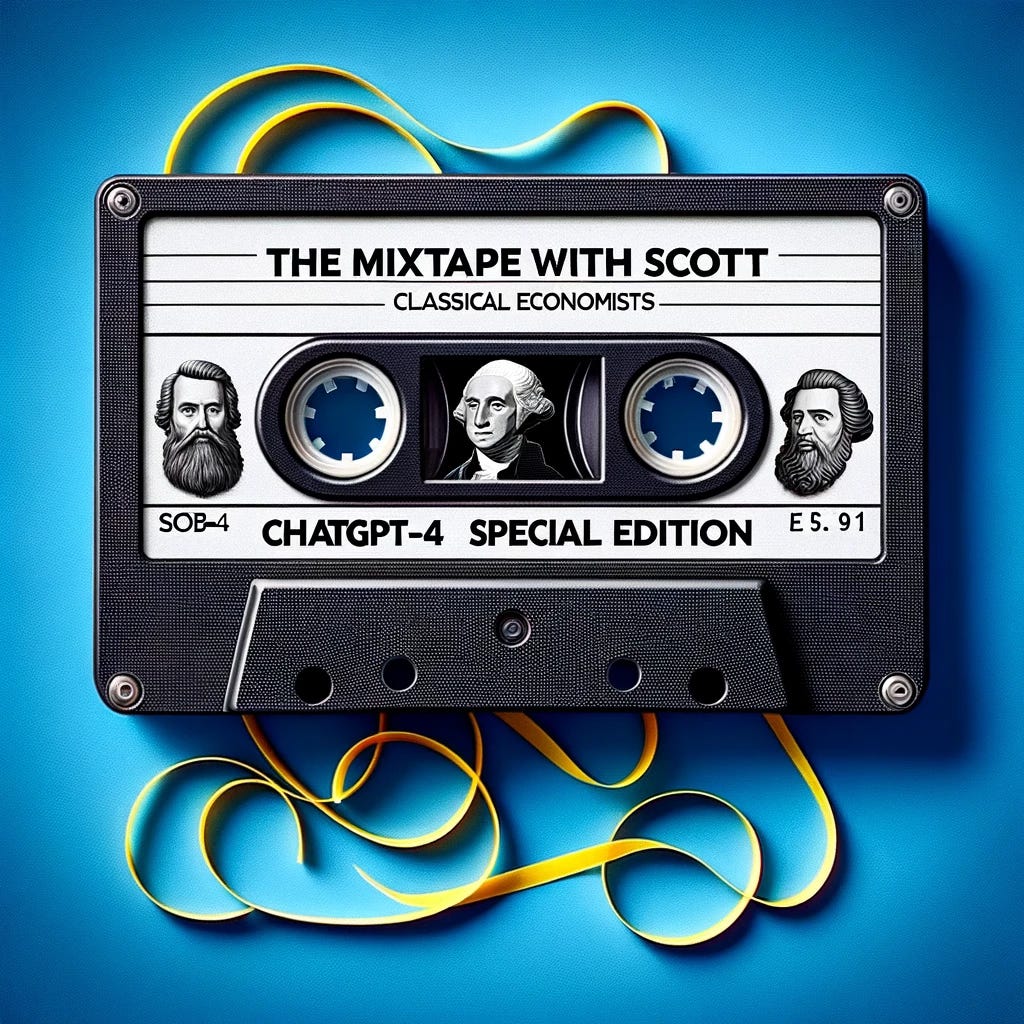
This week on the Mixtape with Scott, I have a very special guest. Adam Smith, the so-called founder of economics, and author of two best selling books, The Theory of Moral Sentiments published in 1759 and An Inquiry into the Nature and Causes of the Wealth of Nations (buy it now for $2800 here at eBay!) published in 1776. I know what you’re thinking. “But Scott, that would make Adam Smith very old, even probably dead, wouldn’t it?” And you’re right on both counts! Adam Smith was a moral philosopher born in 1723 in Scotland so it literally makes him 300 years old, and yes, very dead. But I decided to push through that anyway and a few months ago asked ChatGPT-4 to essentially pretend to be Adam Smith for my podcast without any awareness or surprise. This podcast is somewhere between a seance and a play. It is the ghost in the machine — literally. I did a one hour interview with ChatGPT-4 who played the part of Adam Smith using the same style of interviewing I do with all the economists on the show — personal stories. This was all done in the ChatGPT-4 browser, and it was then recorded using Amazon AWS Polly “text to voice” using a British male’s voice named “Arthur”. This is part of a class assignment I have been doing this semester at Baylor University in my History of Economic Thought class. I got the idea to do this earlier this summer when I saw that the economist, Tyler Cowen, had interviewed Jonathan Swift using ChatGPT-4. So I decided to build into my classes an assignment where the students had to do it too. My students had to interview four 18th to early 20th century economists, with the final project being a recorded interview much like I did, and to show them it could be done, I interviewed Adam Smith. And boy was it fun. It was fun because of how novel it was, but it was also fun because of how thought provoking it was for me to learn about Smith’s first book Theory of Moral Sentiments, and listening to ChatGPT-4 speculate about the book’s connections to other ideas. I was mesmerized by the entire experience and really didn’t know what to make of it. After all, language models hallucinate; I already knew this. But then it dawned on me — this entire interview is a hallucination. What does it mean for a large language model to “be” Adam Smith when in fact Adam Smith never said any of these words? It means for ChatGPT-4 to hallucinate. Question is, though: is this a good hallucination or is it a bad one, and how to we judge that and should we even care? I wonder if hallucinating is a feature, not a bug, of ChatGPT-4. Is this any good? Is it something useful? I think so. Students seemed to have gotten a lot out of it. It requires the suspension of disbelief but then so does watching fantasy, or ready science fiction. Your mileage may vary on how much you enjoy it, and maybe the things we discuss aren’t so profound but I didn’t know a lot about him before doing this. So it was just nice to listen and learn more about the man, though a Smith scholar will need to tell me what’s accurate and what isn’t (as I said, technically it’s inaccurate from start to finish by definition).My PhD student, Jared Black, is in my history of economic thought class and has enjoyed being able to interrogate these old economists and their ideas. He decided to create his own GPT chatbot using OpenAI’s builder environment and said I could share it. https://chat.openai.com/g/g-GJeexE26G-ask-an-economist Ask to talk to Bentham or Nassau or Senior or Say or Marx. Just remember to be polite. A recent RCT found that if you’re nice to ChatGPT-4, it tends to perform tasks better. I swear I saw that study, but now I can’t find it, but it seems true so I’m going to cite it. Thanks again for tolerating me on this podcast. Even though this may seem gimmicky, in a way it is fully consistent with the shows premise. The show is about the personal stories of economists and the hope that by simply listening to economists’ stories, we can better understand our own story. The hope, too, is that in the long run, we hear a story of the profession itself. After all, we use stories to navigate our lives, and though stories like models are in some sense “wrong”, sometimes they are useful. This story is wrong, too, but maybe it’ll be useful. Peace!Scott's Substack is a reader-supported publication. To receive new posts and support my work, consider becoming a free or paid subscriber. Get full access to Scott's Mixtape Substack at causalinf.substack.com/subscribe

S2E38: Andreu Mas-Colell, Micro Theorist, Professor at Pompeu Fabra University
Welcome to the Mixtape with Scott episode 38 of season 2! By my calculations, there have been 72 total episodes in the Mixtape with Scott podcast — 34 episodes in season 1, 38 this year. What better way to celebrate episode 72 (38) than with Dr. Andreu Mas-Colell from Pompeu Fabra University in Barcelona, Spain! If you’re an economist, then you know Dr. Mas-Colell if for no other reason than that his book with Greene and Whinston taught you microeconomics in grad school. If you’re looking for a replacement copy of the textbook to put on your shelf, click here. I wanted to interview Dr. Mas-Colell for a lot of reasons. First, because his book probably unites us all because we all had to take the micro preliminary exam, we all had to use that book for our classes, and many of us depended on it for our livelihoods so we could pass those classes. So in a way, that’s not Mas-Colell’s book — that’s our book too. So I thought that given the podcast is about both the personal stories of economists but also an effort to tell “our story” as economists of the last 50 years, just like I interviewed Bill Greene, the author of a popular textbook in econometrics a few months ago, I wanted to also interview Dr. Mas-Colell. But Dr. Mas-Colell is also an important figure in the history of microeconomic theory and I also wanted those of you whose heroes are theorists to hear his journey, as I know oftentimes the podcast is nearly exclusively conversations with empiricists of various stripes with some exceptions.Dr. Mas-Colell is also, I think, an inspiration to someone who has lived a life defined by his own personal integrity. I think many economists, young and old, but also non-economists too, will be inspired to hear his story of being someone who cared deeply about democracy in the shadow of a dictatorship and the willingness to continue to incur real personal costs for the sake of the body politic. Any day now, we will hear the conclusion to a case dating back to June 2021 when Spain's Court of Auditors found that he was among those responsible for government expenditure on the unconstitutional 2017 Catalan independence referendum. Spain’s courts announced its intention to fine Dr. Mas-Colell millions of euros. This led to a public outcry from the international community of economists two summers ago. The final verdict will be announced, Dr. Mas-Colell says in this interview, probably in the middle of this month. It’s another long interview, and I want to give you a little warning ahead of time. I am not a micro theorist, which you probably guessed. I was surprised, nonetheless, by how little I remembered about the names of economists and departments and how the full history of micro theory fit together. As such, I know I left a ton of opportunities unrealized on the table. But I knew going into it that I was really not going to be able to have more than superficial understandings of the sociological history of micro theory as it had been too long. Anyway, I just wanted you to know that I left some money on the ground I’m sure. But it was a huge life lived, and I really just was wanting to hear as much as I could in what amounted to still a two hour interview. So I hope you enjoy and find this podcast interview inspiring and interesting and helpful as you continue to try and navigate your own life, and your own place in the story of economics. Scott's Substack is a reader-supported publication. To receive new posts and support my work, consider becoming a free or paid subscriber. Get full access to Scott's Mixtape Substack at causalinf.substack.com/subscribe
S2E37: Casey Mulligan, Professor of Economics, University of Chicago
Welcome to this week’s episode of the Mixtape with Scott! Recently, the University of Chicago Press published a book entitled The Economic Approach: Unpublished Writings of Gary S. Becker. It was written obviously by Gary Becker who died almost 10 years ago at the age of 83 after an extremely long and fruitful career as an economist. Dr. Becker had many students — some like me were students from afar, but some, like our guest today, were his actual students. And today’s guest is Casey Mulligan, one of the editors of that aforementioned book, and a professor of economics at the University of Chicago. This was a fun interview to do. Casey walked us through his time at Harvard as an undergrad to his unusually rapid progression through Chicago’s economics PhD program where he stayed on and is now a professor. We discussed his own career but we also spent just a lot of time discussing what it was like with Becker, as well as his own later time at the Council of Economic Advisers. I hope you enjoy it!Scott's Substack is a reader-supported publication. To receive new posts and support my work, consider becoming a free or paid subscriber. Get full access to Scott's Mixtape Substack at causalinf.substack.com/subscribe

S2E36: Sascha Becker, Economic Historian, Monash University
This week’s guest on The Mixtape with Scott is the Xiaokai Yang Chair of Business and Economics at Monash University, Sascha Becker. Sascha is an economist who is hard to pin down into just one field. He’s probably most widely known, across the most general set of economists, as a contemporary economic historian. One of his specializations within economic history has been religion, most notably the Protestantism in Europe and its relationship to long term literacy (particularly among women) and human capital more generally. But even within history, he writes on topics that go far beyond traditional economic questions — like, for instance, his work reexamining Max Weber’s the Protestant work ethic hypothesis, for instance, or his more recent work examining the relationship between the church and national socialism. Sascha studies a topic in religion that overlaps with my own religious tradition (Protestantism and the Reformation churches more specifically), and so it’s drawn me into enjoying a lot of and benefiting from his extensive ongoing research on the topics. But I also have been interested in Sascha because of his role in the spread of causal inference throughout economics, particularly within Europe. As Sascha will share in the podcast, his advisor in graduate school, Andrea Ichino, came to Sascha’s program after graduating from MIT. When Andrea taught, then, a microeconometrics course in the late 1990s, he did not use a book — he used his lecture notes belonging to the class he’d taken in his own PhD program taught by Josh Angrist. Sascha implied, as I have long suspected, that the passing on of causal inference was coming, not through econometrics textbooks, but through the placements of students that could be directly tied back to original proponents, which is why (or rather I have conjectured) the spread of causal inference within economics spread through applied microeconomics fields, like labor, public and development, early on, as opposed to econometricians. Early on, Sascha wrote a package in Stata with Andrea on implementing matching with the propensity score that has almost 4000 citations to this day. And Sascha himself probably did dozens of workshops all across Europe in the early 00’s teaching matching to students and faculty who otherwise didn’t have the red phone direct access to Angrist. As he said, matching was huge back then (no doubt made even moreso by Dehejia and Wahba’s publications), but while he was teaching matching, it now seems more likely he was teaching all over Europe what we consider to be causal inference methodologies based on the Rubin causal model, including matching, IV and the LATE theorem. I continue to remain fascinated by the spread of causal inference in its earliest days throughout economics, and the role that the applied fields, like labor economics, played. But this podcast touches on many topics, including that but much more than that too, and I hope you enjoy listening to it half as much as I enjoyed talking to and learning more about Sascha’s own life and journey. Thanks again for tuning in. If you like the podcast, consider sharing it with others, or leaving a rating on Spotify and Apple. Scott's Substack is a reader-supported publication. To receive new posts and support my work, consider becoming a free or paid subscriber. Get full access to Scott's Mixtape Substack at causalinf.substack.com/subscribe

S2E35: Andrew Goodman-Bacon, Senior Economist, Federal Reserve
Welcome to the Mixtape with Scott! This week's episode has a guest that some of you have come to know and appreciate, and some of you hopefully will after this episode — Andrew Goodman-Bacon (“Bacon”). In addition to having a great nickname, he also has a great job, a great personality and several great papers, one of which after only two years since publication has won an award at the Journal of Econometrics, and already has over 4,000 cites. I really wish I knew how to pull things from google scholar and I could see what other papers in the history of econometrics have had such a meteoric rise in terms of impact and influence. It’s been unusually impactful, though, let’s just say. I have a hunch Bacon wasn’t given the “Most Likely to Actually Use Math After High School” award in high school. But as it turns out, he has, and has become a really great applied economist who works on topics both in econometrics, but also public policy and economic history. The trifecta. But a few years ago, he left academia to go work for the Federal Reserve in Minneapolis at the Opportunity & Inclusive Growth Institute. This interview was a real delight; it even involves Dungeons & Dragons and throwing knives. Scott's Substack is a reader-supported publication. To receive new posts and support my work, consider becoming a free or paid subscriber.Bacon has done a lot for helping a lot of us better understand difference-in-differences — a technique that many of us thought (much to our chagrin) we probably understood better than we did (I know I didn’t). But now some of us better understand it and while Bacon isn’t the only one who helped advance that knowledge, he was one of them. So I hope you enjoy this interview, and if you’re interested in learning more about difference-in-differences, don’t forget to check out Brant Callaway’s workshop on Mixtape Sessions tonight! You can sign up here! Don’t forget also to share the workshop to everybody you’ve ever met in your entire life, as well as post to your online dating profile!Scott's Substack is a reader-supported publication. To receive new posts and support my work, consider becoming a free or paid subscriber. Get full access to Scott's Mixtape Substack at causalinf.substack.com/subscribe

S2E34: Melanie Guldi, Health Economist, Professor, University of Central Florida
Welcome to another episode of the Mixtape with Scott podcast! This week is a special one for the economics community as we celebrate Claudia Goldin's well-deserved Nobel Prize win for her pioneering work on women in the labor market. It's serendipitous, then, that today's guest is Melanie Guldi, associate professor of economics at University of Central Florida, who has spent over 15 years since graduating in 2006 from the University of California — Davis doctoral program in economics carving out a unique path in related terrain focused on the economics of fertility. Melanie’s 2008 job market paper and subsequent publication in Demography examined in greater detail a question that Goldin had earlier suggested — did early access to oral contraception and abortion cause birth rates to decline? Melanie found some evidence it did, at least for some groups. But, while Melanie's work has some thematic intersections with that of Dr. Goldin, Melanie has become an authority in her own right on the complex landscape of health economics and demography. Her expertise touches on a wide range of critical issues, from maternal labor supply to the impact of intensive care on infant survival, and she has developed novel hypotheses that have further enriched our understanding of these topics. So, without further ado, let's dive into this rich tapestry of research and insights with someone who has dedicated a decade and a half to becoming an expert in the field. Melanie, welcome to the show.Scott's Substack is a reader-supported publication. To receive new posts and support my work, consider becoming a free or paid subscriber. Get full access to Scott's Mixtape Substack at causalinf.substack.com/subscribe

S2E33: Jonah Gelbach, Law Professor and Economist, Berkeley
Welcome to this week’s episode of the Mixtape with Scott. I guess I could say “And I am your host Scott Cunningham” but after over 50 of these, I guess you already know I’m the host. When I first became interested in economics, it was through an old working paper series called the John M. Olin working paper series, which was then affiliated with the University of Chicago’s law school. That was where I found Becker’s Nobel Prize speech which caused an immediate 180 on my career and led me into economics myself. But the thing that really stood out to me was that economics was about more than just banking and money; apparently it was also connected to law, and more specifically, there was a field called “law and economics” even. As I read more of the working papers at the working paper series, I became more and more interested with everything there, including law and economics. Which my way of creating a segue into this week’s guest.I first met Jonah Gelbach, the Herman Selvin professor of law at UC Berkeley, at a conference in Paris on crime. He probably doesn’t even remember it. All I really remember of Jonah in that conference was two things. First, he pulled me aside and said a lot of nice things about my paper and told me thought it would publish really well. So that was encouraging and I made a note to myself, “Note to self, this guy said it would publish well. Hold him to it.” Second, I remember him passionately responding to his discussant that the paper he’d written had something called “a surface”. And I made a second note to myself, “Note to self, learn what a surface is.” It was something very clearly related to original, very technical, econometrics, and I made a third note to myself after that. “Note to self, this this guy’s name is Jonah Gelbach, and he apparently is a very good econometrician who also works on applied matters.”Jonah’s an economist and a lawyer. He’s written several very influential articles in both econometrics but also applied economics. He did a PhD at MIT under Josh Angrist, if I remember correctly, during that heady time when causal inference was blossoming in Cambridge in the 1990s (he graduated in 1998). He then took a job at Maryland where he was eventually tenured, then to Arizona where he stayed until 2010. He then took the road less traveled: he quit a tenured job as an economics professor, went to Yale and got a JD in 2013, then went to Penn and is now at Berkeley where he writes in all the areas that he apparently loves — law, economics and econometrics. I asked Jonah to be on the show for a few reasons. First, I made a note to myself to remember this guy for a reason. He’s very talented and very approachable, kind and thoughtful and funny. But two, as I said, he took the road less traveled. Quitting a tenured job in academia, giving up the golden handcuffs as they say, to go to law school to start over — it’s not the most common way to get a JD, arguably. And I guess I just wanted to learn that story a little better as I didn’t know it. But third, law and economics — now circling back where I started — is part of the story of economics of the last 50 years, and the podcast is ultimately about two things: the personal stories of economists building out the collective story of economics. We are a diverse tribe. Law and economics is part of that tribe’s story. And economists sitting inside law schools has also become part of that tribe’s story. And so I asked Jonah, and he graciously accepted, to be on the podcast so here he is! Thanks again for tuning in!Scott's Substack is a reader-supported publication. To receive new posts and support my work, consider becoming a free or paid subscriber. Get full access to Scott's Mixtape Substack at causalinf.substack.com/subscribe

S2E32: Amy Finkelstein, John Bates Clark Award Winner, Health Economist, MIT
Welcome to this week’s episode of the Mixtape with Scott! I’m your host - Scott Cunningham, a professor at Baylor in their economics department. This week's guest is with none other than Amy Finkelstein, the John Bates Clark award and MacArthur Genius grant winner, and professor of economics at MIT. This was a fun interview — super generous, giving guest who shared a lot of her life, how she grew up in New York and then through her own windy road found her way to economics. She has a new book out “We’ve Got You Covered: Rebooting American Health Care” (with Liran Einav).I loved this interview. We talked about the Oregon Medicaid Experiment, which I talk about in my book in the instrumental variables chapter when discussing lotteries. She shares where that idea came from, and it was super exciting to hear about that. I hope you like the interview as much as me.Remember if you like the interview, consider supporting it by subscribing, liking, sharing or even becoming a paying subscriber. Enjoy!Scott's Substack is a reader-supported publication. To receive new posts and support my work, consider becoming a free or paid subscriber. Get full access to Scott's Mixtape Substack at causalinf.substack.com/subscribe

S2E31: Nick Cox, Geographer, Stata Part 2
Welcome to the Mixtape with Scott podcast! That feels strange typing since by now, I shouldn’t have to write it that way, but you never know — maybe someone is coming today for the first time and will be coming upon the second part of a two part interview with Nick Cox, a geographer at Durham in the UK, and longtime contributor to public and club goods around Stata, the software used by many economists at least. This is as I said Part 2 in a two part interview. The point of interviewing Nick as I said last time is that this podcast is an oral history of the economics profession of the last 50 years told through the personal stories of economists, and others that I think otherwise fit into that story. And the software we use to do our work, particularly when it allowed many of us to do empirical work for most of our careers, is a big part of that story. And Stata is a big part of that story, and Nick is a big part of Stata’s story, so I did a two part interview with him. Apologies that I have been slow updating the substack. I’ve had what feels like a lot more grading and administrative work than usual. I’ve also got a tad bit of some personal things coming to a head right now, and I’m hoping that will end soon. Tomorrow I will post some information about a few upcoming workshops at Mixtape Sessions, but while I have your attention, one of them is on shift-share IV with Peter Hull which starts next week September 25 and 27 in the evening from 6-9PM. Details here at this link. Should be great. You’ll learn be essentially brought to the frontier of this material and there’s going to be a lot of coding so that should be fun. So check it out! In the meantime, thanks for supporting the podcast, which as you’ve probably figured out by now is my labor of love, my passion project. I have found that personal grief in my own life has been made more meaningful for some reason through this style of documentary biography of others in our profession. I hope you find it useful and interesting too. If you like this podcast, please consider supporting it. But share it with someone who you think will find it useful too. As I tell myself and others — all of us belong. All of our stories matter. Yours and mine too, as well as the people I talk to. So have a great day.Scott's Substack is a reader-supported publication. To receive new posts and support my work, consider becoming a free or paid subscriber. Get full access to Scott's Mixtape Substack at causalinf.substack.com/subscribe

S2E30: Dr. John Cawley, Health Economist, Becker's Student, Cornell Professor
Apologies I double posted a podcast this morning. I will finish the Nick Cox interview next week. Welcome to this week’s episode of the Mixtape with Scott — where we listen to the personal stories of economists and hope that what bubbles up in the long run is a curated collective story of the economics profession of the last 50 years. This week’s interview guest is part of my “Becker’s Students” series which highlights the students of the late economist, Gary Becker, a legendary giant of microeconomics from both Columbia University as well as the University of Chicago, and who I also personally have admired so much that when I first read his Nobel Prize, I decided I also wanted to be an economist. This week’s interview is with someone I’ve come to count as a friend as well as being a long-time admirer — John Cawley, professor of economics at Cornell University. John has been a force of nature within health economics for several generations contribution to major topics in health like obesity and risky behaviors, as well as labor economics. Friendly and supportive to everyone, to a fault even, it was such a nice opportunity to get to talk to him in this interview. We discussed many things in this interview that I think it is probably just better left for John to share. But I am excited to get to share it with you now. Thank you again for supporting the podcast. I hope if you like it you will share it with others and enjoy the rest of your week too!Scott's Substack is a reader-supported publication. To receive new posts and support my work, consider becoming a free or paid subscriber. Get full access to Scott's Mixtape Substack at causalinf.substack.com/subscribe

S2E29: Dr. Nick Cox, Durham, Geographer, Stata (Part 1)
This week’s episode of the Mixtape with Scott is with a professor at Durham in England in the geography department, Dr. Nick Cox. Many economists will only know of Nick because of his presence on the Stata listserv where he was one of its most prolific contributors and moderators. As economics as a field gradually shifted from theory to empirical work, at least as a share of the total papers written and total people employed, people like Nick and others became more relevant people in our lives as empiricists. We would go to the Stata listserv with questions, and more times than not, it would be Nick answering them. I wanted to interview Nick because as I told him, the purpose of the podcast is to tell the story of the last 50 years of the economics profession by listening to the personal stories of real people. Mostly, that has been economists, but sometimes not. And Nick is one of those sometimes not. He’s a geographer at Durham who, like Bill Greene the econometrician I interviewed a week ago, first began to see his love and aptitude for statistics mature along with a desire to help his colleagues with their own programming problems. That particular kind of worker for whom the latent understanding of statistics and econometrics also selects on skills with computing has and will likely remain a powerful complement, and for Nick it was indeed. We go through his early life, growing up in England, and moving into geography and statistics in college, as well as over two separate interviews travel into his early time finding and becoming more a part of the Stata community. I tell Nick that I saw in him things I wanted for myself — someone who in his own way was part of community development within academia in the odd spaces of work, and had hoped we could talk to discuss more of what that journey was for him. And he graciously agreed. Apologies that my opener is longer than normal; I didn’t have a script so rambled (always a mistake). Thanks again for tuning in; like, share, follow, and consider maybe even becoming a subscriber!Scott's Substack is a reader-supported publication. To receive new posts and support my work, consider becoming a free or paid subscriber. Get full access to Scott's Mixtape Substack at causalinf.substack.com/subscribe

S2E28: Interview with William Greene, Professor Emeritus, Author and Econometrician, New York University
Good morning! Welcome to another episode of the Mixtape with Scott! This week is a lot of fun. I got to interview none other than William Greene, Professor Emeritus at NYU and author of 8 editions of a great textbook on Econometrics, as well as a software developer from an econometrics software called LimDep. What a fun trip through the past — through growing up in Long Island, his family moving to Ohio when a recession cost his dad his job, and moving into grad school where Bill began to realize his skills in computing and econometrics were complements. It was a fascinating story about early computing and applied econometrics software, and his career as an econometrician. I hope you enjoy it as much as I did. Please share! Like! Put it on your phone! Give it to your kids for Christmas!Scott's Substack is a reader-supported publication. To receive new posts and support my work, consider becoming a free or paid subscriber. Get full access to Scott's Mixtape Substack at causalinf.substack.com/subscribe

S2E27: Interview with Ariel Pakes, Professor and Economist, Harvard University
Welcome back to the Mixtape with Scott. I took a little break to let listeners breathe a little, but I’m back with my regular weekly uploads of new interviews with economists as part of my ongoing project (if that’s the right word) to listen to and relay the personal stories of economists and then let those stories then mount up and tell a collective story of the profession. Not “the story”, as there is no such thing as “the story”. Just a curated, selected story. But my hope is that some of you hearing it will have more lights along the path. And today I have the pleasure of introducing you to Ariel Pakes, the Thomas Professor of Economics at Harvard University. This was a fun interview. People either know Dr. Pakes very very well, or they only know him by the letter “P”. He is a structural econometrician and theoretical economist in the industrial organization tradition who has made major contributions to econometrics and theory of the firm as well as applied practices in both. He is also the coauthor with Berry and Levihnson on an extremely popular method for estimating demand called “Berry-Levihnson-Pakes model” or BLP for short. When I asked the chief economist at Spotify, Kyle Kretschman, just as the interview was concluding, what paper in economics continues to have had the most lasting impression on him even all these years after grad school, he just smiled and said “BLP”. And that is hardly a minority position. The 1995 Econometrica by those three economists, “Automobile Prices in Market Equilibrium” has had a major effect within economics and outside. Dr. Pakes has made seminal contributions to areas of lasting relevance to our understanding not just of econometrics but also advanced economies like the United States as he has brought great attention to issues around technological innovation, patents and market competition. And we talked about some of this, particularly towards the end, but we talked about it in a way that I think you’ll find interesting because we talked into it, we talked through and towards it.You see one of the things that I’ve been trying to do in these interviews is to get over the “selection on the dependent variable” inherent in our understanding of the published impactful work of others, and the lasting careers others have had. As we look at these people, and we study their works, and we use them even psychologically and existentially in complex barely discernible ways to navigate our own lives, I think we don’t always notice that we are usually engaged in a form of extreme selection bias called “conditioning on the outcome variable”. That is, we are only observing these people after the work was done. The failures, the false starts, the experimentations, the experiences they had on that road, how they met their collaborators, how they worked together, how they didn’t work so well together, all the trillions of decisions — it isn’t that those things are somehow free of endogeneities either. All of life is endogenous, after all. But if we are wanting to better understand how to get from point A to point B in our own lives, I don’t think it’s all that helpful to just look at people at point C and try to therefore guess where it is we need to reach next. If nothing else, it’s at least also helpful to just listen to their story, watch them as they describe the movement as they remember it. And so I loved this interview with Dr. Pakes. Hearing about his love of NBA basketball, the outdoors with his family, and growing up in a radical socialist youth group. His soft spoken, thoughtful discussions of his life as he shared his love for philosophy as a young man and how his first year at Harvard he was straddling economics and philosophy was fascinating, and just learning that his own approach to live — getting himself way over his head on a problem in economics and having to dig a way out — managed to not just get him out, but maybe get the rest of us out too. It was wonderful and this was a really nice interview. I hope you love it as much as me. Thanks again for tuning in. Good luck to all of you as the new semester starts up. My mom got Wordle on the first try this morning. After having played every single morning since day one, this is the first time she actually got it right on the first try. I have decided that not only is this a good omen for the fall, and not only is it good luck for me, but I have decided to share this good luck with all of you. So consider this as my effort to share the blessing with you all no matter where you are. Have a great new semester learning about our awesome, sometimes hard and tragic but always beautiful world full of amazing people. Scott's Substack is a reader-supported publication. To receive new posts and support my work, consider becoming a free or paid subscriber. Get full access to Scott's Mixtape Substack at causalinf.substack.com/subscribe

S2E26: Interview with Gábor Békés, International Economist and Author at CEU
This week of the Mixtape with Scott, I have the pleasure of introducing you to Gábor Békés, an associate professor at Central European University in Austria and author of an exciting new textbook in data science and causal inference entitled Data Analysis for Business, Economics and Policy (Cambridge Press 2021). I wanted to talk to Gábor for many reasons — one because I am interested in talking with people whose roles in the scientific production function is to create platforms of knowledge sharing. These include editors of journals, department chairs, organizers of conferences, and authors of textbooks. I interviewed Jeff Wooldridge at the start of this year, I’m interviewing Bill Greene later this year, and I’m interviewing Gábor today. And on that point, I also wanted to talk to him about how his book, written with the late Gábor Kézdi who passed away around the time of the book’s publication, came about, what it was about, and who he sees his ideal audience to be. The book is a nearly perfect, flawless piece of writing. Not just in its pedagogy and what feels like an effortless precision, but also in what they cover and how they cover it. Someone who has never really worked with data before could take this book and move from the most fundamental issues around exploring data, from data collection and ensuring data quality, to data visualization, to learning canonical regression models, then moving into more advanced and contemporary areas like machine learning based predictive analytics and causal inference. The care and precision of the book is reflected in its aesthetic too. It’s simply one of the most beautiful books to the touch I’ve seen — the purple and green colors, its width, the glossiness of the pages, and the rich opportunities to learn R coding — are just a wonderful delight. I highly recommend everyone own a copy, and consider assigning it this fall for your statistics courses. It’s the perfect companion, if not the actual textbook.But I also just wanted to learn Gábor’s story, and I got to learn at least some of it. I learned about him growing up in Hungary during the throes communism in his formative years and how witnessing first hand a regime transition shaped his desire to learn economics which ultimately led him into study economic geography and international economics. Thank you again for tuning in. I hope you enjoy this week’s interview as much as I did!Scott's Substack is a reader-supported publication. To receive new posts and support my work, consider becoming a free or paid subscriber. Get full access to Scott's Mixtape Substack at causalinf.substack.com/subscribe

S2E25: Interview with Jonathan Meer, Labor and Public Economist, Texas A&M
Update before introducing the podcast episode.Things have been light on the substack and I apologize for that. I spent two weeks traveling, seeing the country with my two high school aged daughters on a road trip from Waco, to Big Bend, to Marfa Texas, to the Grand Canyon. There at the Grand Canyon, I realized I was old and tired and it was hot and the girls gave it their best shot but sadly, they weren’t being blown away by the scenery, so we decided to then pull the plug a day early and go to Las Vegas. The Vegas trip was always meant to just be a way for me to find an airport for me to fly my youngest back to Waco in time for her camp, but then it turned into three days and two nights on the Strip where I learned you can pay $100 for a hamburger, two cheese steaks, a coke and two water bottles. At which point I told the girls we are going to try a new trick called “intermittent fasting” where none of us eats for the next 48 hours. Psyche! They ate but I did wish I could’ve lugged the Coleman stove and dehydrated beans up from the car at a few points as I had no idea Vegas was that expensive. We did Cirque de Soleil (we saw O which was beautiful). To be honest, the girls hadn’t really ever been out of Texas. I mean they had been on vacations but we usually vacation in Texas — the Hill Country is our special spot, on the rivers. But my heart is for the open road — ever since I read On the Road by Jack Kerouac when I was 16, everything changed for me. I developed a habit of stream of consciousness writing, which I perfected as the years went by on social media, but which made writing the carefully disciplined academic articles much more difficult. And I fell in love with America, and seeing America from behind a steering wheel. And getting to share that with my girls meant the world to me. They’ve beautiful young ladies, 11th and 12th grade, and they wore outfits and we did a lot of pictures in front of the choreographed water fountains, we saw the new massive LED dome, and then the next morning, my daughter flew back, and me and my oldest daughter drove straight to San Francisco, which had always been the destiny. San Francisco. My favorite city in the United States, and one of my favorite in the world. I’d found us a really nice airbnb in the Mission District. My daughter really had no idea what was waiting for her, but I knew that if I could just get us there, and if we could just walk the streets together, moving between neighborhoods and commercial areas, that it would affect her. And it did. She was like me deeply moved by the beauty of the city. Another book that had a major impact on my development was Jane Jacobs’ The Death and Life of Great American Cities, and all I really wanted was my daughter to feel a great American city with her feet and eyes, moving down the streets, navigating the BART. I gave her the job of getting us everywhere we needed to go so that she could master the public transportation system; I sensed that that was all that she needed to really feel her self esteem lift. Navigating public transportation involves going to depots, putting money on a card, going through turn styles, watching the people, getting on the train, reading maps, sit in a seat as a train moves through the dark — all experiences someone who has never had has conjured up feelings that really are new. And we don’t have that in Waco. I doubt my daughter have ever taken a bus in Waco, as Texas is an automobile centered place. So she did, and it was empowering just like I thought it would be. She said all she wanted to do was go to thrift stores, so we did. We went to Haight and for an entire day, all we did was go from thrift and vintage stores, one after another. I got some great Sam Smith Adidas for only $10. Couldn’t believe they fit. And I got a bunch of other things that looked great until I brought them home and then they didn’t, but she found the most beautiful sweater and pants. And I saw my daughter as this young woman and just thought how fortunate I am to be here with her. And so we had four days and three nights there. We even did touristy things — took a ferry to the Golden Gate Bridge and to Alcatraz where I didn’t wear a hat and so my bald head turned red as a beet. But then we drove back. I really did not have a plan for the return trip at all. I had a plan to get there, but not so much to get back. So I decided — okay, where have I never been? And I’d never really been to the northern part of Nevada, or Utah, or even much of Colorado. So that’s what we did. We drove Northern Nevada, through Reno, and then to Utah. I don’t know what I was expecting Utah to be like. Growing up in Mississippi and Tennessee, our lives were either in those states or on vacation to Florida. The middle part of the country, anywhere where there were mountains— I’d never seen. I’d seen the Smoky mountains in college, because I went to UT-Knoxville, but I’d never seen the mountains of the rest of the country. And so as a

E2S24: Interview with Joe Price, Labor Economist, Brigham Young University
This week’s interview is with a professor at Brigham Young University named Joseph Price, or Joe. Joe is a professor who graduated from Cornell around the same time that I graduated from the University of Georgia (i.e., 2007 cohort). He’s a labor economist, Fellow at the Wheatley Institution, NBER research associate, Director of BYU’s Linking Lab, co-editor at Economics of Education Review and the author of something like 45 peer reviewed articles in top economics journals like the Quarterly Journal of Economics, Journal of Labor Economics, Journal of Human Resources, Management Science, as well as countless interdisciplinary journals on numerous topics in sports, the family and more. I will just list two studies that I have for many years found very interesting. One of them with Justin Wolfers made a major splash both in economics on the topic of discrimination as well as the broader public, including the National Basketball Association (NYT link here). who has written on a variety of topics like discrimination in the NBA. “Racial Discrimination Among NBA Referees” with Justin Wolfers appeared in one of the 2010 issues of the Quarterly Journal of Economics and claimed to find evidence of racial discrimination, mostly likely caused by unconscious bias than animus, among NBA referees in calling fouls against players. What impressed me at the time is the same thing that always impresses me: an interesting question, the discovery of some randomness that allows one to plausibly provide some evidence relevant to that question, and the collection of interesting data. Joe and Justin hand collected box scores of every NBA game with specific fouls among other statistics of the players combined with the names (and races) of the officiating referees at each game. While they could not link a referee to a foul called, they used a measure of the percentage of the officiating staff that was White and non-White as a proxy. With random variation in the racial composition, supported by both institutional details and a series of regression analyses, they looked at whether a higher share of White referees “caused” a Black or White player to have a foul called against them more or less often conditional on player fixed effects. You can read the abstract to learn what they find, but given the controversy and antagonism it generated within the NBA, I suppose you can also guess. But it is another paper of his, a solo authored one, at the Journal of Human Resources, that I have always found to be a truly beautiful piece of economics. “Parent-Child Quality Time: Does Birth Order Matter?” was for a long time my favorite empirical paper I’d ever read. It was a simple idea really. Lower birth order, particularly the first born, typically had better academic and labor market outcomes, despite coming from the same family. Sandy Black and coauthors had written about this in a 2005 QJE using Scandinavian registry data, but the mechanisms were largely speculative. Joe’s paper was not so much conclusive as it was a clever descriptive paper showing that lower birth order children received more high quality time from their parents using the American Time Use Survey, which is a time diary and in my opinion one of America’s more interesting repeated cross sections. The patterns he found fit a rule that was well intentioned but likely led to inequities within the family — first borns received all their parents’ time; second borns received half their parents’ time, third borns received a third of their parents time, and on and on. In other words, equity rules with each stage over quality time, or simply budget constraints themselves, leads to American families to spend less time overall in early years with each new child simply because quality time is a scarce resource. Becker might say that instead of equity, we should aim for optimized time spent with children — spent quality time up to the point where marginal benefit equals marginal cost across all children. But such rules, while sensible economists, are likely unethical because of ironically strong bonds of kinship where parents love their children the same. These kinds of questions over deviations from optimizing behavior where emotion and quick thinking drives decision making, as opposed to pure economic calculation, was a hallmark of Joe’s work, but more recently he transitioned into a very ambitious project of using Machine Learning and large genealogical databases to link people with other large datasets like the Census, to track them over time and create a large family tree of what he calls the Human Family. This is the Joe Price I have come to know — a deeply curious man, a man with deep endowments in the skills of our professions, a hard worker (you will not find him on social media), a mentor and a man of vision. To say that I hold him in the highest esteem is an understatement. And because of his character, the lack of guile and a positive and egalitarian spirit, he was for a long t

E2S23: Interview with Miles Kimball, Professor and Economist
This week’s episode of the Mixtape with Scott is with a man I have gotten to become friends somewhat unexpectedly: Miles Kimball (Wikipedia). Miles is currently the Eugene D. Eaton Jr. professor in the economics department University of Colorado Boulder. And we got to know each other through a mutual friend, and discovered that we had many of the same somewhat eccentric interests around mental health, self improvement and a desire to serve the profession in our own personal ways. This is a long interview, but I found it fascinating. I wanted to talk to Miles about his growing up because he grew up in a famous family — his grandfather was named Spencer Kimball, the twelfth President of the Church of Latter Days Saints. Not being Mormon myself, it took me some research to understand the significance, but here’s a wikipedia article about who the President is in the Church of Latter Day Saints. It was an office originally held by the Church’s founder, Joseph Smith, and is their highest governing body. Members of the church consider the President to be also a revelatory person — a prophet and seer — and so I was fascinated both by that background, but also Miles’s own personal story as he left the Mormon church over 20 years ago, an act that I had to imagine was consequential for his life, and very difficult to summarize what it meant for him.Miles research productivity and interests are diverse. It ranges from the furthest parts of our tradition with topics in macroeconomics, the zero lower bound, theoretical elements of human decision making, subjective measures of well being and happiness, measurement, and more. But this is exactly the kind of person I have come to associate with Miles — his passions (and they are passions) range a very broad topic area. He is one of these renaissance types who goes broad and deep — not either/or; rather both/and. He is also, like me under what can only be described as a sense of calling to something bigger than himself to help economists with improving mental health by providing free life coaching “pods” — small groups who meet regularly over zoom going through life coaching curriculum, led by trained life coaches. Given the high rates of depression, anxiety and loneliness documented among our students, I am grateful for him. So let me now introduce you to Miles on this journey through his life. I hope you enjoy it. Thanks again for all your support of the podcast and me. Remember to like, share, follow — all that stuff — if you find these interviews about our economists and the profession interesting. Scott's Substack is a reader-supported publication. To receive new posts and support my work, consider becoming a free or paid subscriber. Get full access to Scott's Mixtape Substack at causalinf.substack.com/subscribe

S2E22: Interview with Dr. William Spriggs, Professor of Economics at Howard University, Chief Economist for the AFL-CIO
This week’s episode of the Mixtape with Scott is from 2019. It is an interview with the late Dr. William Spriggs, an economist who died in June 2023. He was a longtime professor of economics at Howard University and Chief Economist for the AFL-CIO. It was from an old series I wanted to do called “What Economists Do” — the premise being more or less what evolved into my current podcast: tell the stories of living economists and in aggregate hope that the collective story of economics is told. And Dr. Spriggs was the first I reached out to. This was filmed at a conference for mentors and mentees hosted by the American Economics Association and we were both there, so I asked him if he’d be willing to let me interview him and he graciously said yes. For two hours, we talked about Dr. Spriggs’ life — all of which was new to me, as he didn’t know me and I only knew of him by reputation, but not about his personal life. If you aren’t familiar with him, he was a man with a resume. Professor of Economics at Howard University for many years, chief economist to the AFL-CIO, and Assistant Secretary for the Department of Labor in the Obama administration. His scholarly focus was labor economics and public policy, both with an eye towards inequality and persistent structural racism. He was vocal about these things in the world, but also the profession, and he spoke with real courage and so much moral force that it made a real impression on me every time I’d been in his vicinity. Every now and then it seems there is someone like that in America, and Dr. Spriggs was definitely one of those “someones”, at least within our profession.After I did this interview in the summer of 2019, I forgot about it. I guess I wasn’t quite ready to do the series which back then was going to be called “What Economists Do”. I put it in a dropbox folder, but then after a computer switch, had selected to sync it to the cloud rather than locally and so out of sight out of mind. So when he passed away, I searched for it, thinking it must be somewhere, then last week remembered the cloud and there it was. So, join me on this journey back to 2019, to my fascinating conversation with Dr. William Spriggs. Scott's Substack is a reader-supported publication. To receive new posts and support my work, consider becoming a free or paid subscriber. Get full access to Scott's Mixtape Substack at causalinf.substack.com/subscribe

S2E21: Interview with Dave Card, Professor and Labor Economist and 2021 Winner of the Nobel Prize in Economics, UC-Berkeley
Three people were awarded the 2021 Nobel Prize in economics: Josh Angrist, Guido Imbens and David (“Dave”) Card. I have interviewed the first two, and today I have the pleasure of posting the last interview with Dr. Card himself. To most economists, Dr. Card needs no introduction and to be honest I’m really not even sure what to say. I will just say that one time I was having dinner with a well known labor economist who had been on the market the same year as Card, and this economist over dinner without any hint of exaggeration said simply that Card was the greatest labor economist of his generation, bar none. Other than that, I will just say some of the things about his work that has meant a lot to me. Card is “real economist”. Even more than that, he is “real labor economist”, which is the highest praise I know to give people. His knowledge of labor economic theory is deep and expansive. It rolls off his tongue effortlessly. You poke him, he bleeds income elasticities and a myriad of models that he holds to with a light grip. But he was one of the booster rockets on the “credibility revolution”, too, that launched the social sciences into a new level of empirical work. When he began working, labor was in the throes of a fairly deep empirical crisis, and we discussed that in this interview. I learned many things I didn’t know, and he also corrected things I took for granted to be fact, like how I interpreted Bob Lalonde’s job market paper and what it meant. Many of his studies seemed to be lightning rods on multiple levels — both because they were unexpected null results of prevailing neoclassical wisdom, but also because the studies forced the profession to have deeper conversations about epistemology. What is a model? What is evidence? What does it mean to believe something? When are beliefs justified? What makes them warranted? These were not topics that I think Dr. Card himself seemed particularly interested in, but it’s very hard not to see in the anger that surrounded him and those studies people in the throes of being unable, unwilling or incapable of changing their mind even a small bit.This is in fact the story of the practical empirical work of data workers, though — marshaling convincing evidence, going up against a strong scientific blockade, and successful persuasion looking one way at the time that looks very different later. We saw a complete rejection of the facts with Semmelweis’s hand washing hypothesis, and John Snow’s germ theory, for instance. Both men published work that looking back is so obviously correct but at the time seemed to not move the needle on policymaker and scientist’s opinion. I’m not saying that Dr. Card had that experience with his classic works on the minimum wage or immigration — he did after all win the John Bates Clark award and the Nobel Prize. But listening to his story about what he and his colleague and coauthor Alan Krueger experienced at the time when it was published, I can only say that I think sometimes we forget how intense these academic fights can be. We talk a little at different times about this speech he did in 2012 at Michigan about “design vs model based identification”, also, and if you want to read that, it’s here.I hope you enjoy this interview as much as I enjoyed being a part of it. It’s around 90 minutes long, but it felt like 30 minutes. At the 60 min mark, I told him well I guess we need to stop and he graciously gave me another half hour. He also makes an announcement in the interview that I think wasn’t public knowledge, making me feel a little like Matt Drudge with breaking news. But no spoilers — you’ll have to listen for yourself. Thank you again for tuning in. If you like these interviews, please share them! And if you really like them, consider supporting them with a subscription. But no worries if you don’t want to. Have a great rest of your week! And remember — clear eyes, full hearts, can’t lose. Scott's Substack is a reader-supported publication. To receive new posts and support my work, consider becoming a free or paid subscriber. Get full access to Scott's Mixtape Substack at causalinf.substack.com/subscribe

S2E20: Interview with Marina Della Giusta, Labor Economist and Professor
Marina Della Guista is a pioneer in the economics of Sex Work who started her career at the University of Reading and is now a professor at the University of Turin. And when I first started studying sex work, I went looking for what papers economists had written. There weren’t many, but the ones that had been written were fascinating. Many, though not all, were applied theory papers. I remember with great fondness studying new models gaining rich insight into how other economists thought this niche subject in labor economics. One of the studies that left an incredible mark on my orientation in studying sex work was “Who is Watching” by Marina della Giusta, Maria di Tommasso and Steiner Strøm. It was a paper of supply and demand for sex work in which stigma was part of the cost structure but interestingly stigma was also endogenous and determined jointly in equilibrium with the size of the work force and clientele as well as wages paid and received. As the market grew, as the more people engaged in this illicit activity expanded, the stigma penalty itself declined suggesting to me in my own work that if the internet was expanded sex work, or if it was legalized, the stigma under prohibition and clandestine markets might lift some. The degree to which it did would depend on the elasticities in the world.It was the sort of Becker style reasoning that I found so attractive — the idea that things we think of as exogenous and unchanging may be endogenous, governed by formal processes and that technology may shape those norms, for good or bad.Since then, I have become friends with all three authors, and one of them very close. I met all three last November when I visited Turin to do a workshop and serve on a committee. But Marina and I have been friends even before then. She was active on Twitter when I had been too, so we’d deepened our friendship there, but even beyond that I think we just had made regular communication a part of our life. Marina is an excellent labor economist with both sides of the applied skill set — empiricism and applied theory. She has continued to steadfastly worked on stigma in sex work as well as studying the so-called Nordic model, a leading contender in augmenting standard prohibition by lifting the bands on supply but maintaining the prohibition on demand. Traditional tax theory say the impact on wages and the distribution of burden is the same whether you target supply or demand though being the dutiful empiricist she along with Maria have attempted to determine to what degree the end demand approach changes risk attitudes and any evidence of behavioral change using survey data in UK. In this podcast she shares her journey through labor and gender, and not being an American, it reminds I hope everyone that the United States economics community is rich and spreads around the globe. If you find these podcast interviews interesting and valuable, please share it with colleagues and students, and consider following and subscribing and supporting it. These interviews are an oral history of the profession as told through the personal stories of economists. Scott's Substack is a reader-supported publication. To receive new posts and support my work, consider becoming a free or paid subscriber. Get full access to Scott's Mixtape Substack at causalinf.substack.com/subscribe

S2E19: George Selgin, Economic Historian and Monetary Economist
This week’s episode of The Mixtape with Scott is an interview with an old professor of mine from when I was at the University of Georgia, Dr. George Selgin. George was one of several really interesting professors I was fortunate enough to get to know while a PhD student there. One anecdote of the impression he made on me was that he was a handful of people who ever read my dissertation. He gave back to me a massive marked up document full of suggestions and a lot of red underlines — not just to the job market paper, but all three chapters. Which was remarkable for two reasons: he was not an applied microeconomist and he wasn’t even on my dissertation committee. He also came to my defense and was perhaps the single most vocal one there. Being able to answer his questions was one of my happier moments of that late end of that period, as it felt like George took me very seriously and treated me as a peer. He did that with everyone. And that could be a bit intimidating since being George’s peer usually meant some pretty serious conversations. But George was like that — he was extremely engaged in my education, but also to many others as well. I never took any courses from him, because I early on sorted into labor and econometrics, but I watched George closely all the time and interacted with him a lot. He gave each person his full attention, read their papers very closely no matter the field, and in seminars was always on top of everything. It was a lesson in areas I found to be valuable like individuality as an economist and taking ideas serious enough to battle with them. George is a monetary economist and economic historian. He was one of a handful of reasons I decided to go to Georgia at all. He had written a short pamphlet I’d somehow found in college on something obscure (to many anyway) called “praxeology”. That’s something from Austrian economics, and originally I really thought economics was Austrian economics. Coming from a literature background, I’d never had any economics classes, so what I knew, I knew from reading classical liberals like Hayek, Mises, Milton Friedman and a couple others. I was spent a lot of time reading people from the Austrian tradition and the Chicago tradition, from the early to mid 20th century. I knew about George because of that praxeology pamphlet which I read backwards and forwards, over and over, trying to understand everything I could. Imagine my surprise when first year coursework did not involve any praxeology! “I was told there would be no math” I often thought to myself. So George is a hero of sorts of mine. He is an excellent writer, a very careful thinker, a wonderful economist and an inspiring professor. And he’s going to be part of a longer series I’d like to do on what I’ll just be calling “the two wings of the profession: Austrian economics and the heterodox traditions”. Although that’s a mouthful. I am hoping to do interviews with places like George Mason University, as well as U Mass Amherst, the economists from the old Notre Dame economics department (now defunct), Riverside and more. These are important parts of our profession’s history, with many interesting stories, and I don’t think many people know them. But I’m hoping you will find them interesting. They’ll be trickling in as I continue making progress towards them, but expect them to be scattered across season 2 and 3. If you like the podcast, consider liking, following, sharing, and subscribing! The podcast is a labor of love. I love the stories of our profession and the people in our profession a lot. I know others do too and I hope these stories speak to you as you continue navigating your own journey, wherever you are and whoever you are. Peace!Scott's Substack is a reader-supported publication. To receive new posts and support my work, consider becoming a free or paid subscriber. Get full access to Scott's Mixtape Substack at causalinf.substack.com/subscribe