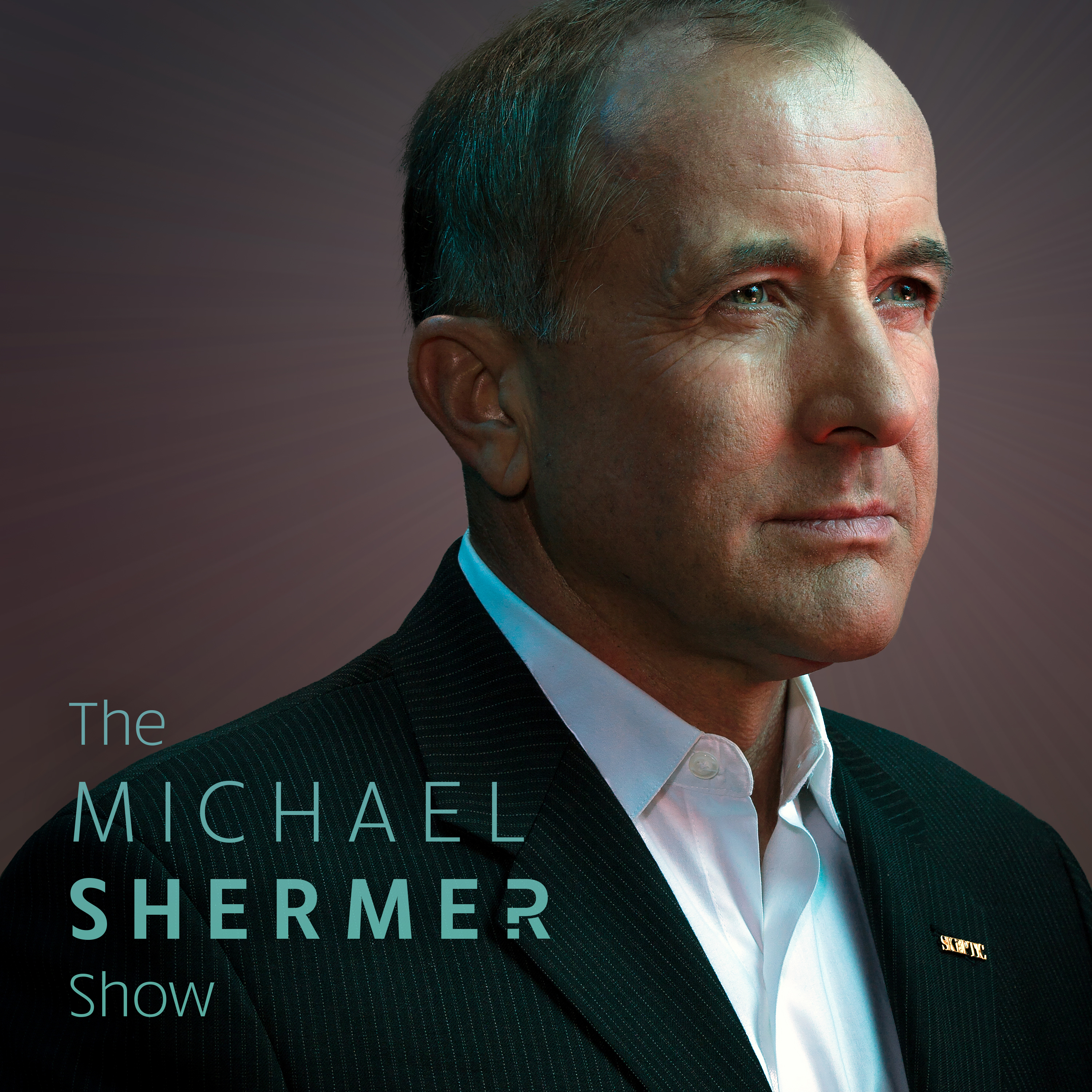
The Michael Shermer Show
637 episodes — Page 5 of 13
Ep 430The Latest Research on Consciousness (Christof Koch)
In Then I Am Myself the World, Christof Koch explores the only thing we directly experience: consciousness. At the book's heart is integrated-information theory, the idea that the essence of consciousness is the ability to exert causal power over itself, to be an agent of change. Koch investigates the physical origins of consciousness in the brain and how this knowledge can be used to measure consciousness in natural and artificial systems. Enabled by such tools, Koch reveals when and where consciousness exists, and uses that knowledge to confront major social and scientific questions: When does a fetus first become self-aware? Can psychedelic and mystical experiences transform lives? What happens to consciousness in near-death experiences? Why will generative AI ultimately be able to do the very thing we can do, yet never feel any of it? And do our experiences reveal a single, objective reality? Christof Koch is a neuroscientist at the Allen Institute and at the Tiny Blue Dot Foundation, the former president of the Allen Institute for Brain Science, and a former professor at the California Institute of Technology. Author of four previous titles — The Feeling of Life Itself: Why Consciousness Is Widespread but Can't Be Computed, Consciousness: Confessions of a Romantic Reductionist, and The Quest for Consciousness: A Neurobiological Approach — Koch writes regularly for a range of media, including Scientific American. He lives in the Pacific Northwest. Shermer and Koch discuss: "subjective experience" • the author's near-death experience changed him • the difficulties of materialism/physicalism • a fundamental theory of consciousness that explains subjective experiences in objective measures • designing a "consciousness detector" for unresponsive patients • why magic mushrooms and Ayahuasca are of so fascinating to neuroscientists • how our minds are shaped by our beliefs, prior experiences, and intentions • insights crucial to those suffering from anxiety, low self-esteem, post-traumatic stress, and depression. • the future of advanced brain-machine interfaces • why digital computers will never be conscious.
Ep 429Everything is Predictable: How Bayesian Statistics Explain Our World
At its simplest, Bayes's theorem describes the probability of an event, based on prior knowledge of conditions that might be related to the event. But in Everything Is Predictable, Tom Chivers lays out how it affects every aspect of our lives. He explains why highly accurate screening tests can lead to false positives and how a failure to account for it in court has put innocent people in jail. A cornerstone of rational thought, many argue that Bayes's theorem is a description of almost everything. But who was the man who lent his name to this theorem? How did an 18th-century Presbyterian minister and amateur mathematician uncover a theorem that would affect fields as diverse as medicine, law, and artificial intelligence? Fusing biography and intellectual history, Everything Is Predictable is an entertaining tour of Bayes's theorem and its impact on modern life, showing how a single compelling idea can have far reaching consequences. Tom Chivers is an author and the award-winning science writer for Semafor. Previously he was the science editor at UnHerd.com and BuzzFeed UK. His writing has appeared in The Times (London), The Guardian, New Scientist, Wired, CNN, and more. He was awarded the Royal Statistical Society's "Statistical Excellence in Journalism" awards in 2018 and 2020, and was declared the science writer of the year by the Association of British Science Writers in 2021. His books include The Rationalist's Guide to the Galaxy: Superintelligent AI and the Geeks Who Are Trying to Save Humanity's Future, and How to Read Numbers: A Guide to Stats in the News (and Knowing When to Trust Them). His new book is Everything Is Predictable: How Bayesian Statistics Explain Our World. Shermer and Chivers discuss: Thomas Bayes, his equation, and the problem it solves • Bayesian decision theory vs. statistical decision theory • Popperian falsification vs. Bayesian estimation • Sagan's ECREE principle • Bayesian epistemology and family resemblance • paradox of the heap • Reality as controlled hallucination • human irrationality • superforecasting • mystical experiences and religious truths • Replication Crisis in science • Statistical Detection Theory and Signal Detection Theory • Medical diagnosis problem and why most people get it wrong.
Ep 428The New Science of Planet Hunting in the Cosmos
For thousands of years, humans have wondered whether we're alone in the cosmos. Now, for the first time, we have the technology to investigate. But once you look for life elsewhere, you realize it is not so simple. How do you find it over cosmic distances? What actually is life? As founding director of Cornell University's Carl Sagan Institute, astrophysicist Lisa Kaltenegger has built a team of tenacious scientists from many disciplines to create a specialized toolkit to find life on faraway worlds. In Alien Earths, she demonstrates how we can use our homeworld as a Rosetta Stone, creatively analyzing Earth's history and its astonishing biosphere to inform this search. With infectious enthusiasm, she takes us on an eye-opening journey to the most unusual exoplanets that have shaken our worldview - planets covered in oceans of lava, lonely wanderers lost in space, and others with more than one sun in their sky! And the best contenders for Alien Earths. We also see the imagined worlds of science fiction and how close they come to reality. With the James Webb Space Telescope and Dr. Kaltenegger's pioneering work, she shows that we live in an incredible new epoch of exploration. As our witty and knowledgeable tour guide, Dr. Kaltenegger shows how we discover not merely new continents, like the explorers of old, but whole new worlds circling other stars and how we could spot life there. Worlds from where aliens may even be gazing back at us. What if we're not alone? Lisa Kaltenegger is the Director of the Carl Sagan Institute to Search for Life in the Cosmos at Cornell and Associate Professor in Astronomy. She is a pioneer and world-leading expert in modeling potential habitable worlds and their detectable spectral fingerprint. Kaltenegger serves on the National Science Foundation's Astronomy and Astrophysics Advisory Committee (AAAC), and on NASA senior review of operating missions. She is a Science Team Member of NASA's TESS Mission as well as the NIRISS instrument on James Webb Space Telescope. Kaltenegger was named one of America's Young Innovators by Smithsonian magazine, an Innovator to Watch by Time magazine. She appears in the IMAX 3D movie "The Search for Life in Space" and speaks frequently, including at Aspen Ideas Festival, TED Youth, World Science Festival and the Kavli Foundation lecture at the Adler Planetarium. Shermer and Kaltenegger discuss: Carl Sagan and his influence • Sagan's Dragon • ECREE Principle • how stars, planets and solar systems form • how exoplanets are discovered • Hubble Space Telescope, Kepler Space Telescope, James Webb Space Telescope • The Origin of Life • Fermi's Paradox: where is everybody (the Great Silence, the Great Filter) • biosignatures • technosignatures • Dyson spheres • Will aliens be biological or AI? • interstellar travel • Kardashev scale of civilizations • how to talk to aliens when we can't even talk to dolphins • Deities for Atheists, Skygods for Skeptics: aliens as gods and the search as religion • why alien worlds matter.
Ep 427The Science of Happines
We all want to be happier, but our brains often get in the way. When we're too stuck in our heads we obsess over our inadequacies, compare ourselves with others and fail to see the good in our lives. In The Science of Happiness, world-leading psychologist and happiness expert Bruce Hood demonstrates that the key to happiness is not self-care but connection. He presents seven simple but life-changing lessons to break negative thought patterns and re-connect with the things that really matter. Alter Your Ego Avoid Isolation Reject Negative Comparisons Become More Optimistic Control Your Attention Connect With Others Get Out of Your Own Head Grounded in decades of studies in neuroscience and developmental psychology, this book tells a radical new story about the roots of wellbeing and the obstacles that lie in our path. With clear, practical takeaways throughout, Professor Hood demonstrates how we can all harness the findings of this science to re-wire our thinking and transform our lives. Dr. Bruce Hood is an award-winning Professor of Developmental Psychology at Bristol University and the author of several books including SuperSense, The Self Illusion, The Domesticated Brain, and Possessed. His course, The Science of Happiness, is the most popular course at Bristol University. He has appeared extensively on TV and radio, including co-hosting the BBC podcast The Happiness Half Hour in 2021. He is a Fellow of the American Psychological Society, the Royal Institution of Great Britain and the British Psychological Society. Shermer and Hood discuss: psychedelic drugs • defining the "good life" or "happiness" • measuring emotions • happiness as social contagion • eudaimonia (the pursuit of meaning) versus hedonism (the pursuit of pleasure) • genetics and heritability • cultural components • WEIRD people • The Big Five (OCEAN) • marriage and health • exercise and stress reduction • what the ancient Greeks got right about living the good life • how failure may actually be a key to more happiness • how to live the life you want—not necessarily the life expected of you.
Ep 426How Rhetoric Shapes Your Opinions
Robin Reames breaks down the major techniques of rhetoric, pulling back the curtain on how politicians, journalists, and "journalists" convince us to believe what we believe—and to talk, vote, and act accordingly. Understanding these techniques helps us avoid being manipulated by authority figures who don't have our best interests at heart. It also grants us rare insight into the values that shape our own beliefs. Reames and Shermer discuss: rhetoric vs. facts (rhetorical truths vs. empirical truths) • the point of reason (to understand reality or to persuade?) • Canons of rhetoric: invention, arrangement, style, memory, delivery • bullshitters vs. liars • induction and deduction • rhetorical, ideological, and metaphorical thinking • how to debate contentious issues Robin Reames is associate professor of English at the University of Illinois at Chicago, specializing in rhetorical theory and the history of ideas. Her new book is The Ancient Art of Thinking for Yourself: The Power of Rhetoric in Polarized Times. SPONSOR: everything-everywhere.com
Ep 425Accomplishment and Happiness (Adam Gopnik, The New Yorker)
We push ourselves toward the highest-paying, most prestigious jobs, seeking promotions and public recognition. As Adam Gopnik points out, the result is not so much a rat race as a rat maze, with no way out. Except one: to choose accomplishment over achievement. Achievement is the completion of the task imposed from outside. Accomplishment, by contrast, is the end point of an engulfing activity one engages in for its own sake. Shermer and Gopnik discuss: mastering the secrets of stage magic (Gopnik's son worked with David Blaine and Jamy Ian Swiss) accomplishment in music family and mentors the concept of the 10,000-hour rule vs. natural talent Adam's new book All That Happiness Is, which offers timeless wisdom against the grain. Adam Gopnik has been a staff writer at The New Yorker since 1986. He is the author of numerous best-selling books, including Paris to the Moon and The Real Work: On the Mystery of Mastery. Sponor: brilliant.org/skeptic
Ep 424Should We Prepare for Nuclear War? (Annie Jacobsen)
Pulitzer Prize finalist Annie Jacobsen investigated this ticking-clock scenario, based on dozens of exclusive new interviews with military and civilian experts who have built the weapons, been privy to the response plans, and are responsible for those decisions should they need to be made. Shermer and Jacobsen discuss: surviving a nuclear explosion • what happens in a nuclear bomb explosion • consequences of a nuclear exchange • Getting to Nuclear Zero • North Korea, China/Taiwan • increasing budgets for more weapons • types and quantities of nuclear weapons • why humans engage in aggression, violence, and war Annie Jacobsen is an investigative journalist, Pulitzer Prize finalist, and New York Times bestselling author. Her new book is Nuclear War: A Scenario. Her other books include: Area 51, Operation Paperclip, and The Pentagon's Brain.
Ep 423An AI... Utopia? (Nick Bostrom, Oxford)
Nick Bostrom's previous book, Superintelligence: Paths, Dangers, Strategies, changed the global conversation on AI and became a New York Times bestseller. It focused on what might happen if AI development goes wrong. But what if things go right? Bostrom and Shermer discuss: An AI Utopia and Protopia • Trekonomics, post-scarcity economics • the hedonic treadmill and positional wealth values • colonizing the galaxy • The Fermi paradox: Where is everyone? • mind uploading and immortality • Google's Gemini AI debacle • LLMs, ChatGPT, and beyond • How would we know if an AI system was sentient? Nick Bostrom is a Professor at Oxford University, where he is the founding director of the Future of Humanity Institute. Bostrom is the world's most cited philosopher aged 50 or under.
Ep 422Life on Mars? (Robert Zubrin)
When Robert Zubrin published his classic book The Case for Mars a quarter century ago, setting foot on the Red Planet seemed a fantasy. Today, manned exploration is certain, and as Zubrin affirms in The New World on Mars, so too is colonization. From the astronautical engineer venerated by NASA and today's space entrepreneurs, here is what we will achieve on Mars and how. Shermer and Zubrin discuss: why not start with the moon? • what it is like on Mars • whether Mars was ever like Earth • how much it will cost to go to Mars • how to get people to Mars • resources on Mars • colonization of Mars • public vs. private enterprise for space exploration • economics, politics, and government on Mars • lessons from the Red Planet for the Blue Planet • liberty in space. Robert Zubrin is former president of Pioneer Astronautics, which performs advanced space research for NASA, the US Air Force, the US Department of Energy, and private companies. He is the founder and president of the Mars Society, leading the Society's successful effort to build the first simulated human Mars exploration base in the Canadian Arctic.
Ep 421Robots and the People Who Love Them
Shermer and Herold discuss: social robots, sex robots, robot nannies, robot therapists • flying cars, jetpacks and The Jetsons • Masahiro Mori • emotions, animism, mind • emotional intelligence • artificial intelligence • large language lodels • ChatGPT, GPT-4, GPT-5 and beyond • the alignment problem • robopocalypse • robo soldiers • robot sentience • autonomous vehicles • AI value systems, and their legal and ethical status. Eve Herold is an award-winning science writer. She has written extensively about issues at the crossroads of science and society, including stem cell research and regenerative medicine, aging and longevity, medical implants, transhumanism, and robotics and AI.
Ep 420The Formation, Diversification, and Extinction of World Religions
Thousands of religions have adherents today, and countless more have existed throughout history. What accounts for this astonishing diversity? This extraordinarily ambitious and comprehensive book demonstrates how evolutionary systematics and philosophy can yield new insight into the development of organized religion. Lance Grande―a leading evolutionary systematist―examines the growth and diversification of hundreds of religions over time, highlighting their historical interrelationships. Combining evolutionary theory with a wealth of cultural records, he explores the formation, extinction, and diversification of different world religions, including the many branches of Asian cyclicism, polytheism, and monotheism. Lance Grande is the Negaunee Distinguished Service Curator, Emeritus, of the Field Museum of Natural and Cultural History in Chicago. He is a specialist in evolutionary systematics, paleontology, and biology who has a deep interest in the interdisciplinary applications of scientific method and philosophy. His many books include Curators: Behind the Scenes of Natural History Museums (2017) and The Lost World of Fossil Lake: Snapshots from Deep Time (2013). His new book is The Evolution of Religions: A History of Related Traditions.
Ep 419The Wisdom and Wonder of Being Uncertain
In an era of terrifying unpredictability, we race to address complex crises with quick, sure algorithms, bullet points, and tweets. How could we find the clarity and vision so urgently needed today by being unsure? Uncertain is about the triumph of doing just that. A scientific adventure tale set on the front lines of a volatile era, this epiphany of a book by award-winning author Maggie Jackson shows us how to skillfully confront the unexpected and the unknown, and how to harness not-knowing in the service of wisdom, invention, mutual understanding, and resilience. Long neglected as a topic of study and widely treated as a shameful flaw, uncertainty is revealed to be a crucial gadfly of the mind, jolting us from the routine and the assumed into a space for exploring unseen meaning. Far from luring us into inertia, uncertainty is the mindset most needed in times of flux and a remarkable antidote to the narrow-mindedness of our day. In laboratories, political campaigns, and on the frontiers of artificial intelligence, Jackson meets the pioneers decoding the surprising gifts of being unsure. Each chapter examines a mode of uncertainty-in-action, from creative reverie to the dissent that spurs team success. Step by step, the art and science of uncertainty reveal being unsure as a skill set for incisive thinking and day-to-day flourishing. Maggie Jackson is an award-winning author and journalist known for her pioneering writings on social trends, particularly technology's impact on humanity. Winner of the 2020 Dorothy Lee Book Award for excellence in technology criticism, her book Distractedwas compared by FastCompany.com to Silent Spring for its prescient critique of technology's excesses, named a Best Summer Book by the Seattle Post-Intelligencer, and was a prime inspiration for Google's 2018 global initiative to promote digital well-being. Jackson is also the author of Living with Robots and The State of the American Mind. Her expertise has been featured in The New York Times, Business Week, Vanity Fair, Wired.com, O Magazine, and The Times of London; on MSNBC, NPR's All Things Considered, Oprah Radio, The Takeaway, and on the Diane Rehm Show and the Brian Lehrer Show; and in multiple TV segments and film documentaries worldwide. Her speaking career includes appearances at Google, Harvard Business School, and the Chautauqua Institute. Jackson lives with her family in New York and Rhode Island.
Ep 418The End of Race Politics (Coleman Hughes)
As one of the few black students in his philosophy program at Columbia University years ago, Coleman Hughes wondered why his peers seemed more pessimistic about the state of American race relations than his own grandparents–who lived through segregation. The End of Race Politics is the culmination of his years-long search for an answer. Coleman Hughes is a writer, podcaster and opinion columnist who specializes in issues related to race, public policy and applied ethics. Coleman's writing has been featured in the New York Times, the Wall Street Journal, National Review, Quillette, The City Journal and The Spectator. He appeared on Forbes' 30 Under 30 list in 2021. Shermer and Hughes discuss: why he is considered "black" if he is "half-black, half-Hispanic" • what it means to be "colorblind" • population genetics and race differences • Base Rate Neglect, Base Rate Taboos • institutionalized neoracism • viewpoint epistemology • affirmative action • gaps in income, wealth, home ownership, CEO representation, Congressional representation • myths of Black Weaknes, No Progress, Undoing the Past • reparations • the future of colorblindness. Contemplative yet audacious, his new book, The End of Race Politics, is necessary reading for anyone who questions the race orthodoxies of our time. Hughes argues for a return to the ideals that inspired the American Civil Rights movement, showing how our departure from the colorblind ideal has ushered in a new era of fear, paranoia, and resentment marked by draconian interpersonal etiquette, failed corporate diversity and inclusion efforts, and poisonous race-based policies that hurt the very people they intend to help. Hughes exposes the harmful side effects of Kendi-DiAngelo style antiracism, from programs that distribute emergency aid on the basis of race to revisionist versions of American history that hide the truth from the public. Read Michael H. Bernstein's review of Coleman Hughes book, The End of Race Politics: Arguments for a Colorblind America: https://www.skeptic.com/reading_room/revisiting-colorblindness/
Ep 417How to Repair America's Broken Democracy
Order the Artificial Intelligence issue of SKEPTIC magazine at https://www.skeptic.com/magazine/archives/29.1/ (available in print or digital format). Looking ahead to the 2024 election, most Americans sense that something is deeply wrong with our democracy. We face extreme polarization, increasingly problematic candidates, and a government that can barely function, let alone address urgent challenges. Maxwell Stearns has been a constitutional law professor for over 30 years. He argues that our politics are not merely dysfunctional. Our constitutional system is broken. And without radical reform, the U.S. risks collapse or dictatorship. The Framers never intended a two-party system. In fact, they feared entrenched political parties and mistakenly believed they had designed a scheme that avoided them. And yet the structures they created paved the way for our entrenched two-party system. that now undermines our basic constitutional structures, with separation of powers and checks and balances yielding to hyper-partisan loyalties. Rather than compromises arising from shifting coalitions, we experience ever-widening policy swings in increasingly combative elections. This two-party stranglehold on our politics is exactly what the Framers feared. To survive as a democracy, we must end the two-party deadlock and introduce more political parties. But viable third parties are a pipe dream in our system given the current rules of the game. Stearns argues that we must change the rules, amend the Constitution, and transform America into a parliamentary democracy. Although difficult to do, Stearns explains why his specific set of proposals is more politically viable than other increasingly prominent reform proposals, which cannot be enacted, will not end our constitutional crisis, or both. Maxwell L. Stearns is the Venable, Baetjer & Howard Professor of Law at the University of Maryland Carey School of Law. He has authored dozens of articles and several books on the Constitution, the Supreme Court, and the economic analysis of law.
Ep 416Bad Therapy: Why the Kids Aren't Growing Up (Abigail Shrier)
In virtually every way that can be measured, Gen Z's mental health is worse than that of previous generations. Youth suicide rates are climbing, antidepressant prescriptions for children are common, and the proliferation of mental health diagnoses has not helped the staggering number of kids who are lonely, lost, sad and fearful of growing up. What's gone wrong with America's youth? In Bad Therapy, bestselling investigative journalist Abigail Shrier argues that the problem isn't the kids—it's the mental health experts. Drawing on hundreds of interviews with child psychologists, parents, teachers, and young people, Shrier explores the ways the mental health industry has transformed the way we teach, treat, discipline, and even talk to our kids. She reveals that most of the therapeutic approaches have serious side effects and few proven benefits. Among her unsettling findings: talk therapy can induce rumination, trapping children in cycles of anxiety and depression social Emotional Learning handicaps our most vulnerable children, in both public schools and private "gentle parenting" can encourage emotional turbulence – even violence – in children as they lash out, desperate for an adult in charge. Mental health care can be lifesaving when properly applied to children with severe needs, but for the typical child, the cure can be worse than the disease. Bad Therapy is a must – read for anyone questioning why our efforts to bolster America's kids have backfired – and what it will take for parents to lead a turnaround. Abigail Shrier received the Barbara Olson Award for Excellence and Independence in Journalism in 2021. Her bestselling book, Irreversible Damage: The Transgender Craze Seducing Our Daughters (2020), was named a "Best Book" by the Economist and the Times. It has been translated into ten languages. Her new book is Bad Therapy: Why the Kids Aren't Growing Up. Shermer and Shrier discuss: Irreversible Damage redux: WPATH Files • what view this book for or against • what is the problem to be solved? • theories: coddling, social media, screen time, generations/life history theory • good and bad therapists and therapies • anxiety, depression, suicidal ideation, autism • ACE (Adverse Childhood Experience) • trauma, stress, PTSD • anti-fragility and resilience • Goodwill Hunting view of therapy • previous quack therapies and psychological pseudoscience that have plagued psychology and psychiatry.
Ep 415An Unfinished History of the Holocaust
The Holocaust is much discussed, much memorialized, and much portrayed. But there are major aspects of its history that have been overlooked. Spanning the entirety of the Holocaust, this sweeping history deepens our understanding. Dan Stone—Director of the Holocaust Research Institute at Royal Holloway, University of London—reveals how the idea of "industrial murder" is incomplete: many were killed where they lived in the most brutal of ways. He outlines the depth of collaboration across Europe, arguing persuasively that we need to stop thinking of the Holocaust as an exclusively German project. He also considers the nature of trauma the Holocaust engendered, and why Jewish suffering has yet to be fully reckoned with. And he makes clear that the kernel to understanding Nazi thinking and action is genocidal ideology, providing a deep analysis of its origins. Drawing on decades of research, The Holocaust: An Unfinished History upends much of what we think we know about the Holocaust. Stone draws on Nazi documents, but also on diaries, post-war testimonies, and even fiction, urging that, in our age of increasing nationalism and xenophobia, it is vital that we understand the true history of the Holocaust. Shermer and Stone discuss: what is unfinished in the history of the Shoah • Holocaust denial • psychology of fascist fascination and genocidal fantasy • alt-right • ideological roots of Nazism and German anti-Semitism • industrial genocide • magical thinking • Hitler's willing executioners • the Holocaust as a continent-wide crime • motivations of the executioners • the banality of evil • Wannsee Conference (1942). Dan Stone is Professor of Modern History and Director of the Holocaust Research Institute at Royal Holloway, University of London. He is the author or editor of numerous articles and books, including: Histories of the Holocaust (Oxford University Press); The Liberation of the Camps: The End of the Holocaust and its Aftermath (Yale University Press); and Concentration Camps: A Very Short Introduction (Oxford University Press). His new book is The Holocaust: An Unfinished History.
Ep 414The Weirdness of the World
Do we live inside a simulated reality or a pocket universe embedded in a larger structure about which we know virtually nothing? Is consciousness a purely physical matter, or might it require something extra, something nonphysical? According to the philosopher Eric Schwitzgebel, it's hard to say. In The Weirdness of the World, Schwitzgebel argues that the answers to these fundamental questions lie beyond our powers of comprehension. We can be certain only that the truth—whatever it is—is weird. Philosophy, he proposes, can aim to open—to reveal possibilities we had not previously appreciated—or to close, to narrow down to the one correct theory of the phenomenon in question. Schwitzgebel argues for a philosophy that opens. According to Schwitzgebel's "Universal Bizarreness" thesis, every possible theory of the relation of mind and cosmos defies common sense. According to his complementary "Universal Dubiety" thesis, no general theory of the relationship between mind and cosmos compels rational belief. Might the United States be a conscious organism — a conscious group mind with approximately the intelligence of a rabbit? Might virtually every action we perform cause virtually every possible type of future event, echoing down through the infinite future of an infinite universe? What, if anything, is it like to be a garden snail? Schwitzgebel makes a persuasive case for the thrill of considering the most bizarre philosophical possibilities. Shermer and Schwitzgebel discuss: bizarreness • skepticism • consciousness • virtual reality • AI, Turing Test, sentience, existential threat • idealism, materialism • ultimate nature of reality • solipsism • evidence for the existence of an external world • computer simulations hypothesis • mind-body problem • truths: external, internal, objective, subjective • mind-altering drugs • entropy • causality • infinity • immortality • multiverses • why there is something rather than nothing. Eric Schwitzgebel is professor of philosophy at the University of California, Riverside. He is the author of A Theory of Jerks and Other Philosophical Misadventures; Perplexities of Consciousness; and Describing Inner Experience?
Ep 413The Story of Female Empowerment & Getting Canceled: Elite Commando and Kickboxing World Champion Leah Goldstein
A conversation with Leah Goldstein on becoming a kickboxing world champion, ultra-endurance cyclist, and an elite commando combating terrorism. For this she was to be honored at the International Women's Day event… until she was disinvited and canceled. This is her story.
Ep 412Who Wrote the Qur'an, Why, and What Does it Really Say?
Over a billion copies of the Qur'an exist – yet it remains an enigma. Its classical Arabic language resists simple translation, and its non-linear style of abstract musings defies categorization. Moreover, those who champion its sanctity and compete to claim its mantle offer widely diverging interpretations of its core message – at times with explosive results. Building on his intimate portrait of the Qur'an's prophet in Muhammad the World-Changer, Mohamad Jebara returns with a vivid profile of the book itself. While viewed in retrospect as the grand scripture of triumphant empires, Jebara reveals how the Qur'an unfolded over 22 years amidst intense persecution, suffering, and loneliness. The Life of the Qur'an recounts this vivid drama as a biography examining the book's obscured heritage, complex revelation, and contested legacy. Shermer and Jebara discuss: who wrote the Qur'an and why • translation and interpretation • Is the Muslim world stagnating? How does this book aim to help? • semitic mindset • Many Westerners believe that the Qur'an endorses violence, Jihad, and Sharia Law over secular laws and constitutions. What does it really say? • Has Islam had its Enlightenment? • Does Islam and the Muslim world need reforming? • women in Islam • what percentage of Muslims want Sharia Law, and where in the world? Mohamad Jebara is a scriptural philologist and prominent exegetist known for his eloquent oratory style as well as his efforts to bridge cultural and religious divides. A semanticist and historian of Semitic cultures, he has served as Chief Imam as well as headmaster of several Qur'anic and Arabic language academies. Jebara has lectured to diverse audiences around the world; briefed senior policy makers; and published in prominent newspapers and magazines. A respected voice in Islamic scholarship, Jebara advocates for positive social change.
Ep 411Purpose in the Eyes of a Psychiatrist
Generations have been taught that evolution implies there is no overarching purpose to our existence, that life has no fundamental meaning. We are merely the accumulation of tens of thousands of intricate molecular accidents. Some scientists take this logic one step further, suggesting that evolution is intrinsically atheistic and goes against the concept of God. With respect to our evolution, nature seems to have endowed us with competing dispositions, what Wilkinson calls the dual potential of human nature. We are pulled in different directions: selfishness and altruism, aggression and cooperation, lust and love. By using principles from a variety of scientific disciplines, Yale Professor Samuel Wilkinson provides a framework for human evolution that reveals an overarching purpose to our existence. Wilkinson claims that this purpose, at least one of them, is to choose between the good and evil impulses that nature has created within us. Our life is a test. This is a truth, as old as history it seems, that has been espoused by so many of the world's religions. From a certain framework, Wilkinson believes that these aspects of human nature—including how evolution shaped us—are evidence for the existence of a God, not against it. Closely related to this is meaning. What is the meaning of life? Based on the scientific data, it would seem that one such meaning is to develop deep and abiding relationships. At least that is what most people report are the most meaningful aspects of their lives. This is a function of our evolution. It is how we were created. Shermer and Wilkinson discuss: • evolution: random chance or guided process? • selfishness and altruism • aggression and cooperation • inner demons and better angels • love and lust • free will and determinism • the good life and the good society • empirical truths, mythic truths, religious truths, pragmatic truths • Is there a cosmic courthouse where evil will be corrected in the next life? • theodicy and the problem of evil: Why do bad things happen to good people? Samuel T. Wilkinson is Assistant Professor of Psychiatry at Yale University, where he also serves as Associate Director of the Yale Depression Research Program. He received his MD from Johns Hopkins School of Medicine. His articles have been featured in the New York Times, the Washington Post, and the Wall Street Journal. He has been the recipient of many awards, including Top Advancements & Breakthroughs from the Brain and Behavior Research Foundation; Top Ten Psychiatry Papers by the New England Journal of Medicine, the Samuel Novey Writing Prize in Psychological Medicine (Johns Hopkins); the Thomas Detre Award (Yale University); and the Seymour Lustman Award (Yale University). His new book is Purpose: What Evolution and Human Nature Imply About the Meaning of our Existence.
Ep 410Does Humanity Function as a Single Superorganism?
Could humans unknowingly be a part of a larger superorganism—one with its own motivations and goals, one that is alive, and conscious, and has the power to shape the future of our species? This is the fascinating theory from author and futurist Byron Reese, who calls this human superorganism "Agora." In We Are Agora, Reese starts by asking the question, "What is life and how did it form?" From there, he looks at how multicellular life came about, how consciousness emerged, and how other superorganisms in nature have formed. Then, he poses eight big questions based on the Agora theory, including: If ants have colonies, bees have hives, and we have our bodies, how does Agora manifest itself? Does it have a body? Can Agora explain things that happen that are both under our control and near universally undesirable, such as war? How can Agora theory explain long-term progress we've made in the world? In this unique and ambitious work that spans all of human history and looks boldly into its future, Reese melds science and history to look at the human species from a fresh new perspective. We Are Agora will give readers a better understanding of where we've been, where we're going, and how our fates are intertwined. Shermer and Reese discuss: • organisms and superorganisms • origins of life • the self • emergence • consciousness • Is the Internet a superorganism? • Will AI create a superorganism? • Could AI become sentient or conscious? • the hard problem of consciousness • cities as superorganisms • planetary superorganisms • Are we living in a simulation? • Why are we here? Byron Reese is an Austin-based entrepreneur with a quarter-century of experience building and running technology companies. A recognized authority on AI who holds a number of technology patents, Byron is a futurist with a strong conviction that technology will help bring about a new golden age of humanity. He gives talks around the world about how technology is changing work, education, and culture. He is the author of four books on technology; his previous title The Fourth Agewas described by the New York Times as "entertaining and engaging." Bloomberg Businessweek credits Reese with having "quietly pioneered a new breed of media company." The Financial Times reported that he "is typical of the new wave of internet entrepreneurs out to turn the economics of the media industry on its head." He and his work have been featured in hundreds of news outlets, including the New York Times, Washington Post, Entrepreneur, USA Today, Reader's Digest, and NPR.
Ep 409The Power of Noticing What Was Always There
Have you ever noticed that what is thrilling on Monday tends to become boring on Friday? Even exciting relationships, stimulating jobs, and breathtaking works of art lose their sparkle after a while. People stop noticing what is most wonderful in their own lives. They also stop noticing what is terrible. They get used to dirty air. They stay in abusive relationships. People grow to accept authoritarianism and take foolish risks. They become unconcerned by their own misconduct, blind to inequality, and are more liable to believe misinformation than ever before. But what if we could find a way to see everything anew? What if you could regain sensitivity, not only to the great things in your life, but also to the terrible things you stopped noticing and so don't try to change? Shermer and Sharot discuss: the best day of her life • the evolutionary origins of habituation • habituation at work, at home, and in the bedroom • Why don't we habituate to extreme pain? • marriage, romance, monogamy, infidelity • depression • depression, happiness, and variety • negativity nias • creativity and habituation disruption • lying and misinformation • illusory truth effect • truth bias • moral progress • preference falsification • pluralistic ignorance. Tali Sharot is a professor of cognitive neuroscience at University College London and MIT.
Ep 408China's Grip on Rare-Earth Elements and the Future of Global Energy Security
To build electric vehicles, solar panels, cell phones, and millions of other devices means the world must dig more mines to extract lithium, copper, and other vital building blocks. But mines are deeply unpopular, even as they have a role to play in fighting climate change and powering crucial technologies. Shermer and Scheyder discuss: • How much rare earth metals will we need by 2050, 2100, and beyond? • How do lithium-ion batteries work compared to lead-acid? What are the alternatives? • Will EVs completely replace all other cars? • Can renewables completely replace fossil fuels without nuclear? • How mining works in the U.S., China, Chile, Russia, elsewhere. Ernest Scheyder is a senior correspondent for Reuters, covering the green energy transition and the minerals that undergird it. He previously covered the US shale oil revolution, politics, and the environment at the Associated Press.
Ep 407mRNA Vaccines, Mask Mandates, and the COVID-19 Response (Paul Offit)
As a member of the FDA Vaccine Advisory Committee and a former member of the Advisory Committee for Immunization Practices to the CDC, Dr. Paul Offit has been in the room for the creation of policies that have affected hundreds of millions of people. Four years after the outbreak of COVID-19, he reflects on our response to the pandemic: what went well and what didn't. Shermer and Offit discuss: mRNA vaccines • loss of trust in medical and scientific institutions • overall assessment of what went right and wrong • mandates vs. recommendations • economic costs • lab leak hypothesis vs. zoonomic hypothesis • debating anti-vaxxers • treatments • high risk vs. low risk groups Paul Offit is the Director of the Vaccine Education Center at the Children's Hospital of Philadelphia and Professor of Vaccinology and Professor of Pediatrics at the University of Pennsylvania. Offit has published more than 170 papers in medical and scientific journals in the areas of rotavirus-specific immune responses and vaccine safety. He is also the co-inventor of the rotavirus vaccine, RotaTeq, recommended for universal use in infants by the CDC and WHO.
Ep 406Foster Care, Family, and Social Class
Rob Henderson was born to a drug-addicted mother and a father he never met, ultimately shuttling between ten different foster homes in California. When he was adopted into a loving family, he hoped that life would finally be stable and safe. Divorce, tragedy, poverty, and violence marked his adolescent and teen years, propelling Henderson to join the military upon completing high school. His greatest achievements — a military career, an undergraduate education from Yale, a PhD from Cambridge — feel like hollow measures of success. He argues that stability at home is more important than external accomplishments, and he illustrates the ways the most privileged among us benefit from a set of social standards that actively harm the most vulnerable. Shermer and Henderson discuss: hindsight bias • genes, environment, luck, contingency • foster care • incarceration rates • marriage, divorce, childhood outcomes • poverty, welfare programs, and social safety nets • the young male syndrome • alcohol, drugs, depression • luxury beliefs of educated elites • wealthy but unstable homes vs. low-income but stable homes • inequality • Henderon's experience in the military, at Yale and Cambridge • the Warrior-Scholar Project. Rob Henderson grew up in foster homes in Los Angeles and the rural town of Red Bluff, California. He joined the US Air Force at the age of seventeen. Once described as "self-made" by the New York Times, Rob subsequently received a BS from Yale University and a PhD in psychology from St. Catharine's College, Cambridge. His writing has appeared in the New York Times, Wall Street Journal, Boston Globe, and more. His weekly newsletter is sent to more than forty thousand subscribers. Learn more at RobKHenderson.com. His new book is Troubled: A Memoir of Foster Care, Family, and Social Class.
Ep 405How U.S. Public Health Has Strayed From Its Liberal Roots
The Covid-19 response was a crucible of politics and public health—a volatile combination that produced predictably bad results. As scientific expertise became entangled with political motivations, the public-health establishment found itself mired in political encampment. It was, as Sandro Galea argues, a crisis of liberalism: a retreat from the principles of free speech, open debate, and the pursuit of knowledge through reasoned inquiry that should inform the work of public health. Across fifty essays, Within Reason chronicles how public health became enmeshed in the insidious social trends that accelerated under Covid-19. Galea challenges this intellectual drift towards intolerance and absolutism while showing how similar regressions from reason undermined social progress during earlier eras. Within Reason builds an incisive case for a return to critical, open inquiry as a guiding principle for the future public health we want—and a future we must work to protect. Dr. Sandro Galea is a physician, epidemiologist, author and the Robert A. Knox Professor at Boston University School of Public Health. He previously held academic and leadership positions at Columbia University, the University of Michigan, and the New York Academy of Medicine. He has published more than 1000 scientific journal articles, 75 chapters, and 24 books, and his research has been featured extensively in current periodicals and newspapers. Galea holds a medical degree from the University of Toronto and graduate degrees from Harvard University and Columbia University. Dr. Galea was named one of Time magazine's epidemiology innovators and has been listed as one of the "World's Most Influential Scientific Minds." He is past chair of the board of the Association of Schools and Programs of Public Health and past president of the Society for Epidemiologic Research and of the Interdisciplinary Association for Population Health Science. He is an elected member of the National Academy of Medicine and the American Epidemiological Society. He is the author of The Contagion Next Time and Well: What We Need to Talk About When We Talk About Health. His new book is Within Reason: A Liberal Public Health for an Illiberal Time.
Ep 404Against the New Politics of Identity
In Against the New Politics of Identity, philosopher Ronald A. Lindsay offers a sustained criticism of the far-reaching cultural transformation occurring across much of the West by which individuals are defined primarily by their group identity, such as race, ethnicity, gender identity, and sexual orientation. Driven largely by the political Left, this transformation has led to the wholesale grouping of individuals into oppressed and oppressor classes in both theory and practice. He warns that the push for identity politics on the Left predictably elicits a parallel reaction from the Right, including the Right's own version of identity politics in the form of Christian nationalism. As Lindsay makes clear, the symbiotic relationship that has formed between these two political poles risks producing even deeper threats to Enlightenment values and Western democracy. If we are to preserve a liberal democracy in which the rights of individuals are respected, he concludes, the dogmas of identity politics must be challenged and refuted. Against the New Politics of Identity offers a principled path for doing so. Shermer and Lindsay discuss: identity politics: identity or politics? • woke ideology • overt racism vs. systemic racism • liberalism vs. illiberalism • woke progressive leftists motivations? • Critical Race Theory (CRT) • Diversity, Equity and Inclusion (DEI) • What is progressive? What is woke? • standpoint epistemology • equality vs. equity • race • class • cancel culture • Christian nationalism. Dr. Ronald Lindsay, a philosopher (PhD, Georgetown University) and lawyer (JD, University of Virginia) is the author of The Necessity of Secularism and Future Bioethics. Although his non-fiction works focus on different topics, two threads unite them: Lindsay's gift for thinking critically about accepted narratives and his strong commitment to individual rights, whether it's the right to assisted dying, the right to religious freedom, or the right of individuals to be judged on their own merit, as opposed to their group identity. In addition to his books, Lindsay has also written numerous philosophical and legal essays, including the entry on Euthanasia in the International Encyclopedia of Ethics. In his spare time, Lindsay plays baseball—baseball, not softball. The good news is he maintains a batting average near .300; the bad news is his fielding average is not much higher. A native of Boston, Ron Lindsay currently lives in Loudoun County, Virginia with his wife, Debra, where their presence is usually tolerated by their cat. His new book is: Against the New Politics of Identity: How the Left's Dogmas on Race and Equity Harm Liberal Democracy and Invigorate Christian Nationalism.
Ep 403What Determines Who Succeeds in the NBA?
Former Google data scientist and bestselling author of Everybody Lies Seth Stephens-Davidowitz turns his analytic skills to the NBA. Shermer and Stephens-Davidowitz discuss: why some countries produce so many more NBA players than others • the greatest NBA players adjusted for height • why tall NBA players are worse athletes than short NBA players • How much do NBA coaches matter and what do they do? • In a population of 8 billion today compared to centuries past, where are all the Mozarts, Beethovens, Da Vincis, Newtons, Darwins, etc.? Seth Stephens-Davidowitz is a contributing op-ed writer for the New York Times, a lecturer at The Wharton School, and a former Google data scientist. He received a BA from Stanford and a PhD from Harvard. He is the author of Everybody Lies: Big Data, New Data, and What the Internet Can Tell Us About Who We Really Are and Don't Trust Your Gut: Using Data to Get What You Really Want in Life.
Ep 402Transforming Mental Health: Little Treatments, Big Effects
If you've ever wanted mental health support but haven't been able to get it, you are not alone. In fact, you're part of the more than 50% of adults and more than 75% of young people worldwide with unmet psychological needs. Maybe you've faced months-long waiting lists, or you're not sure if your problems are 'bad enough' to merit treatment? Maybe you tried therapy but stopped due to costs or time constraints? Perhaps you just don't know where to start looking? The fact is, there are infinite reasons why mental health treatment is hard to get. There's an urgent need for new ideas and pathways to help people heal. Little Treatments, Big Effects integrates cutting-edge psychological science, lived experience narratives and practical self-help activities to introduce a new type of therapeutic experience to audiences worldwide: single-session interventions. Its chapters unpack why systemic change in mental healthcare is necessary; the science behind how single-session interventions make it possible; how others have created 'meaningful moments' in their recovery journeys (and how you can, too); and how single-session interventions could transform the mental healthcare system into one that's accessible to all. Shermer and Schleider discuss: her own experience with mental illness and eating disorder • 80% of people meet criteria for a mental illness at some point in their life • the goal of therapy • navigating therapy modalities, access, payments, insurance • What prevents people from getting the mental health help they need? • outcome measures to test different therapies • traditional therapy vs. single-session interventions • growth mindset • Cognitive Behavior Therapy (CBT) • difference between goals and values • how action brings change. Jessica L. Schleider, Ph.D. is an American psychologist, author, and an associate professor of Medical Social Sciences at Northwestern University. She is the lab director of the Lab for Scalable Mental Health. She completed her PhD in Clinical Psychology at Harvard University and her Doctoral Internship in Clinical and Community Psychology at Yale School of Medicine. She has received numerous scientific awards for her work in this area and her work is frequently featured in major media outlets (Wall Street Journal, The Atlantic, Washington Post). In 2020, she was selected as one of Forbes Magazine's '30 Under 30' in Healthcare. She has developed six evidence-based, single-session mental health programmes, which have served more than 40,000 people to date. She is the author of The Growth Mindset Workbook for Teens and co-editor of the Oxford Guide to Brief and Low Intensity Interventions for Children and Young People. Her new book is Little Treatments, Big Effects: How to Build Meaningful Moments That Can Transform Your Mental Health.
Ep 401Overcoming Self-Censorship in the Age of Outrage
As a society we are self-censoring at record rates. Say the wrong thing at the wrong moment to the wrong person and the consequences can be dire. Think that everyone should be treated equally regardless of race? You're a racist. Argue that people should be able to speak freely within the bounds of the law? You're a fascist. When the truth is no defense and nuance is seen as an attack, self-censorship is a rational choice. Yet, when we are too fearful to speak openly and honestly, we deprive ourselves of the ability to build genuine relationships, we yield all cultural and political power to those with opposing views, and we lose our ability to challenge ideas or change minds, even our own. Katherine Brodsky argues that it's time for principled individuals to hit the unmute button and resist the authoritarians among us who name, shame, and punish. Shermer and Brodsky discuss: growing up Jewish in the Soviet Union and Israel • why liberals (or progressives) no longer defend free speech • cancel culture: data and anecdotes and whether it is an imagined moral panic • free speech law vs. free speech norms • solutions to cancel culture • identity politics • witch crazes and virtue signaling • hate speech and slippery slopes • how to stand up to cancel culture. Katherine Brodsky is a journalist and author. She has contributed to publications such as Variety, the Washington Post, WIRED, The Guardian, and many others. Over the years she has interviewed a diverse range of intriguing personalities, including the Dalai Lama.
Ep 400One Couple's Vacation Caused 100,000 People to Die
If you could rewind your life to the very beginning and then press play, would everything turn out the same? Or could making an accidental phone call or missing an exit off the highway change not just your life, but history itself? How did one couple's vacation cause 100,000 people to die? Brian Klaas explores how our world really works, driven by strange interactions and apparently random events. Drawing on social science, chaos theory, history, evolutionary biology, and philosophy, he provides a fresh look at why things happen. Brian Klaas is a professor of global politics at University College London. He is a regular contributor for The Washington Post and The Atlantic, host of the award-winning Power Corrupts podcast. His new book is Fluke: Chance, Chaos and Why Everything We Do Matters. You can find him at BrianPKlaas.com and on Twitter @brianklaas.
Ep 399Head of TED Talks Shares a New Vision of Generosity
As head of TED, Chris Anderson has had a ringside view of the world's boldest thinkers sharing their most uplifting ideas. Inspired by them, he believes that it's within our grasp to turn outrage back into optimism. It all comes down to reimagining one of the most fundamental human virtues: generosity. What if generosity could become infectious generosity? Chris offers a playbook for how to embark on our own generous acts—whether gifts of money, time, talent, connection, or kindness—and to prime them, thanks to the Internet, to have self-replicating, even world-changing, impact. Shermer and Anderson discuss: what makes TED successful • power laws and giving • charging vs. giving away • altruism • being good without God • billionaires • how the average person can participate • public vs. private solutions to social problems • donor fatigue. Chris Anderson has been the curator of TED since 2001. He holds a degree in philosophy, politics and economics from Oxford University. His new book is Infectious Generosity: The Ultimate Idea Worth Spreading.
Ep 398Are Parallel Universes and Extra Dimensions Real?
Our books, our movies—our imaginations—are obsessed with extra dimensions, alternate timelines, and the sense that all we see might not be all there is. In short, we can't stop thinking about the multiverse. As it turns out, physicists are similarly captivated. In The Allure of the Multiverse, physicist Paul Halpern tells the epic story of how science became besotted with the multiverse, and the controversies that ensued. The questions that brought scientists to this point are big and deep: Is reality such that anything can happen, must happen? How does quantum mechanics "choose" the outcomes of its apparently random processes? And why is the universe habitable? Each question quickly leads to the multiverse. Drawing on centuries of disputation and deep vision, from luminaries like Nietzsche, Einstein, and the creators of the Marvel Cinematic Universe, Halpern reveals the multiplicity of multiverses that scientists have imagined to make sense of our reality. Whether we live in one of many different possible universes, or simply the only one there is, might never be certain. But Halpern shows one thing for sure: how stimulating it can be to try to find out. Shermer and Halpern discuss: definitions of universe and types of multiverses • Is the multiverse science, metaphysics, or faith? • theists claim the "multiverse" is just handwaving around the God answer • many worlds interpretation of quantum mechanics? • inflationary and Darwinian cosmology • infinity and eternity • multiple dimensions • string theory • cyclical universes • Big Bounce • Anthropic Principle (weak, strong, participatory) • time travel • sliding doors, contingency, and the multiverse. Dr. Paul Halpern is the author of 18 popular science books, exploring the subjects of space, time, higher dimensions, dark energy, dark matter, exoplanets, particle physics, and cosmology. The recipient of a Guggenheim Fellowship, a Fulbright Scholarship, and an Athenaeum Literary Award, he has contributed to Nature, Physics Today, Aeon, NOVA's "The Nature of Reality" physics blog, and Forbes "Starts with a Bang!" He has appeared on numerous radio and television shows including "Future Quest," "Science Friday," "Radio Times," "Coast to Coast AM," "The Simpsons 20thAnniversary Special," and C-SPAN's "BookTV." He appeared previously on the show for his book Synchronicity: The Epic Quest to Understand the Quantum Nature of Cause and Effect. His new book, The Allure of the Multiverse, describes the controversial history of higher dimensional and parallel universe schemes in science and culture.
Ep 397Michael Shellenberger Explains Government Censorship of Social Media
Michael Shellenberger explains the role of government agencies in social media censorship, his work on the Twitter files, and the differences between independent and mainstream journalism. PLUS: how to deal with the opioid epidemic, what we can do about homelessness, his take on January 6, George Floyd, UFOs and UAPs, and more. Recorded live in Santa Barbara, CA at the Skeptics Society 2023 conference.
Ep 396Multiculturalism and Lessons From the Rwandan Genocide
As it absorbs record numbers of new immigrants, the U.S. faces critical questions: is it better to promote a unifying, shared identity that transcends ethnic differences or to foster a multicultural salad of distinct group identities? Is it better to minimize ethnic distinctions or to accentuate them with diversity initiatives and ethnic preferences? Out of the Melting Pot, Into the Fire takes a global, historical perspective to address these questions, examining how societies, from ancient Rome to modern Rwanda, have dealt with them. It provides essential analysis and data for America and other countries that are contemplating an increasingly multiethnic future. Shermer and Heycke discuss: • melting pots • culture • multiculturalism • identity politics • cancel culture • cultural appropriation • Critical Race Theory • Affirmative Action • why group preferences tend to last forever • human nature and factionalism • how official recognition and group preferences exacerbate group divisiveness • how group identification is fluid and contextual Jens Heycke was educated in Economics and Near Eastern Studies at the University of Chicago, the London School of Economics, and Princeton University. He worked as an executive in several technology startups, including one that created the first Internet mobile phone. Since retiring from high tech, he has worked as an independent researcher and writer on culture and ethnic conflict, conducting field research around the world, from Bosnia to Botswana. He is the author of Out of the Melting Pot, Into the Fire: Multiculturalism in the World's Past and America's Future.
The Meaning of Life (A Message for the Holidays)
bonusThe meaning of life is in the here and now.
Ep 395A Trial by Media Ended Caylan Ford's Career in 4 Hours
Caylan Ford is a documentary filmmaker, charter school founder, and a former political candidate. She holds a Bachelor's degree (Hons.) in Chinese history from the University of Calgary, a Master's degree in International Affairs from the George Washington University, and a Master's in International Human Rights Law from the University of Oxford. She spent many years in the international human rights field, including by increasing access to anti-surveillance and censorship tools in Iran, China, and Myanmar; working with civil rights lawyers representing political dissidents; supporting refugee and asylum claimants; and conducting and publishing original research on the repression of religious minorities in China. She has written and co-produced two feature documentary films on the themes of religious and political persecution, censorship, forced labor, scapegoating, and mass persuasion under totalitarian regimes. Her new documentary film, When the Mob Came, focuses on her experience of cancel culture following a catastrophic bid for political office. Shermer and Ford discuss: • education reform • public vs. private vs. charter schools • the blank slate • Thomas Sowell's Constrained Vision vs. Unconstrained Vision • French Revolution vs. American Revolution • truth, justice, and reality • what promotes humanity and what degrades it • transhumanism • political correctness • identity politics • cancel culture • totalitarianism • preference falsification • free speech • hate speech • how to stand up to cancel culture.
Ep 394How Not to Age
When Dr. Michael Greger, founder of NutritionFacts.org, dove into the top peer-reviewed anti-aging medical research, he realized that diet could regulate every one of the most promising strategies for combating the effects of aging. We don't need Big Pharma to keep us feeling young―we already have the tools. In How Not to Age, the internationally renowned physician and nutritionist breaks down the science of aging and chronic illness and explains how to help avoid the diseases most commonly encountered in our journeys through life. Physicians have long treated aging as a malady, but getting older does not have to mean getting sicker. There are eleven pathways for aging in our bodies' cells and we can disrupt each of them. Processes like autophagy, the upcycling of unusable junk, can be boosted with spermidine, a compound found in tempeh, mushrooms, and wheat germ. Senescent "zombie" cells that spew inflammation and are linked to many age-related diseases may be cleared in part with quercetin-rich foods like onions, apples, and kale. And we can combat effects of aging without breaking the bank. Why spend a small fortune on vitamin C and nicotinamide facial serums when you can make your own for up to 2,000 times cheaper? Inspired by the dietary and lifestyle patterns of centenarians and residents of "Blue Zone" regions where people live the longest, Dr. Greger presents simple, accessible, and evidence-based methods to preserve the body functions that keep you feeling youthful, both physically and mentally. Brimming with expertise and actionable takeaways, How Not to Age lays out practical strategies for achieving ultimate longevity. Shermer and Greger discuss: • why we age and die • lifespan, vs. healthspan • longevity escape velocity • how to determine causality in aging science • nutrition fads • the anti-aging industry • Centenarians Diet • Mediterranean Diet • Okinawan Diet • Red, White, and Blue Zones • plant-based eating • exercise, sleep, stress • the Anti-Aging 8 • cholesterol and statins • vaccines • brain supplements • UV protection • alcohol • Alzheimer's • social ties, friendships, and marriage. A founding member and Fellow of the American College of Lifestyle Medicine, Michael Greger, MD, is a physician, New York Times bestselling author, and internationally recognized speaker on nutrition, food safety, and public health issues.
Ep 393How to Cultivate Your Imagination as an Adult
Imagination is commonly thought to be the special province of youth―the natural companion of free play and the unrestrained vistas of childhood. Then come the deadening routines and stifling regimentation of the adult world, dulling our imaginative powers. In fact, Andrew Shtulman argues, the opposite is true. Imagination is not something we inherit at birth, nor does it diminish with age. Instead, imagination grows as we do, through education and reflection. The science of cognitive development shows that young children are wired to be imitators. When confronted with novel challenges, they struggle to think outside the box, and their creativity is rigidly constrained by what they deem probable, typical, or normal. Of course, children love to "play pretend," but they are far more likely to simulate real life than to invent fantasy worlds of their own. And they generally prefer the mundane and the tried-and-true to the fanciful or the whimsical. Children's imaginations are not yet fully formed because they necessarily lack knowledge, and it is precisely knowledge of what is real that provides a foundation for contemplating what might be possible. The more we know, the farther our imaginations can roam. As Learning to Imagine demonstrates, the key to expanding the imagination is not forgetting what you know but learning something new. By building upon the examples of creative minds across diverse fields, from mathematics to religion, we can consciously develop our capacities for innovation and imagination at any age. Shermer and Shtulman discuss: • imagination: the capacity to generate alternatives to reality • imagination's purpose and structure • anomalies and counterfactuals • principles: scientific, mathematical, ethical • models: pretense, fiction, religion • development of imagination • how children understand causality • purpose of pretend play • theory of mind • religious practices • AI and creativity • The Beatles • Montessori education. Andrew Shtulman is Professor of Psychology at Occidental College where he directs the Thinking Lab. His award-winning research has been featured in the New York Times and the Wall Street Journal. His previous book was Scienceblind: Why Our Intuitive Theories About the World Are So Often Wrong. His new book is Learning to Imagine: The Science of Discovering New Possiblities
Ep 392Nobel Prize Winner Explains Inequality and Capitalism
When economist Angus Deaton immigrated to the United States from Britain in the early 1980s, he was awed by America's strengths and shocked by the extraordinary gaps he witnessed between people. In this conversation based on his new book, Economics in America, the Nobel Prize-winning economist explains in clear terms how the field of economics addresses the most pressing issues of our time—from poverty, retirement, and the minimum wage to the ravages of the nation's uniquely disastrous health care system—and narrates Deaton's account of his experiences as a naturalized U.S. citizen and academic economist. Deaton is witty and pulls no punches. In his incisive, candid, and funny book, he describes the everyday lives of working economists, recounting the triumphs as well as the disasters, and tells the inside story of the Nobel Prize in economics and the journey that led him to Stockholm to receive one. He discusses the ongoing tensions between economics and politics―and the extent to which economics has any content beyond the political prejudices of economists―and reflects on whether economists bear at least some responsibility for the growing despair and rising populism in America. Blending rare personal insights with illuminating perspectives on the social challenges that confront us today, Deaton offers a disarmingly frank critique of his own profession while shining a light on his adopted country's policy accomplishments and failures. Shermer and Deaton discuss: the science of science is economics • winning a Nobel Prize • what economists do, and how they determine causality • Ludwig von Mises, Friedrich Hayek, Milton Friedman, Ayn Rand • why a college education matters • meritocracy and "Just World" theory • minimum wage • healthcare • poverty • inequality • opioid crisis, alcoholism, suicide • inflation and interest rates • modern monetary theory • think tanks. Angus Deaton, winner of the 2015 Nobel Prize in economics, is the Dwight D. Eisenhower Professor of Economics and International Affairs Emeritus and Senior Scholar at Princeton University. He is the author (with Anne Case) of the New York Times bestselling book Deaths of Despair and the Future of Capitalism, The Great Escape: Health, Wealth and the Origins of Inequality, and his new book Economics in America: An Immigrant Economist Explores the Land of Inequality, all from Princeton University Press.
Ep 391The Purpose of the Universe
Why are we here? What's the point of existence? On the 'big questions' of meaning and purpose, Western thought has been dominated by the dichotomy of traditional religion and secular atheism. In his pioneering work, Philip Goff argues that it is time to move on from both God and atheism. Through an exploration of contemporary cosmology and cutting-edge philosophical research on consciousness, Goff argues for cosmic purpose: the idea that the universe is directed towards certain goals, such as the emergence of life. In contrast to religious thinkers, Goff argues that the traditional God is a bad explanation of cosmic purpose. Instead, he explores a range of alternative possibilities for accounting for cosmic purpose, from the speculation that we live in a computer simulation to the hypothesis that the universe itself is a conscious mind. Goff scrutinizes these options with analytical rigour, laying the foundations for a new paradigm of philosophical enquiry into the middle ground between God and atheism. Ultimately, Goff outlines a way of living in hope that cosmic purpose is still unfolding, involving political engagement and a non-literalist interpretation of traditional religion. Shermer and Goff discuss: • living in a computer simulation • the universe itself as a conscious mind • cosmic purpose • fine-tuning • free will • consciousness (the ground of all being?) • morality and the Is-Ought Fallacy • What is mypurpose in life? • religious vs. secular answers to the purpose question • awe and how to be spiritual but not religious. Philip Goff is Professor of Philosophy at Durham University. His research focuses on consciousness and the ultimate nature of reality. Goff is best known for defending panpsychism, the view that consciousness pervades the universe and is a fundamental feature of it. On that theme, Goff has published three books, Consciousness and Fundamental Reality, Galileo's Error: Foundations for a New Science of Consciousness, and a co-edited volume, Is Consciousness Everywhere? Essays on Panpsychism. Goff has published many academic articles, as well as writing extensively for newspapers and magazines, including Scientific American, The Guardian, Aeon, and the Times Literary Supplement. His new book is Why: The Purpose of the Universe.
Ep 390How Media, Politics, and Identity Drive Our Appetite for Misinformation
Why are so many of us wrong about so much? From COVID-19 to climate change to the results of elections, millions of Americans believe things that are simply not true―and act based on these misperceptions. In Wrong: How Media, Politics, and Identity Drive Our Appetite for Misinformation, expert in media and politics Dannagal Goldthwaite Young offers a comprehensive model that illustrates how political leaders and media organizations capitalize on our social and cultural identities to separate, enrage, and―ultimately―mobilize us. Through a process of identity distillation encouraged by public officials, journalists, political and social media, Americans' political identities―how we think of ourselves as members of our political team―drive our belief in and demand for misinformation. It turns out that if being wrong allows us to comprehend the world, have control over it, or connect with our community, all in ways that serve our political team, then we don't want to be right. Over the past 40 years, lawmakers in America's two major political parties have become more extreme in their positions on ideological issues. Voters from the two parties have become increasingly distinct and hostile to one another along the lines of race, religion, geography, and culture. In the process, these political identities have transformed into a useful but reductive label tied to what we look like, who we worship, where we live, and what we believe. Young offers a road map out of this chaotic morass, including demand-side solutions that reduce the bifurcation of American society and increase our information ecosystem's accountability to empirical facts. By understanding the dynamics that encourage identity distillation, Wrong explains how to reverse this dangerous trend and strengthen American democracy in the process. Shermer and Young discuss: how do you know if you are wrong, or that someone else is wrong • the evolution of reason: veridical perception or group identity? • the 3 "Cs" of our needs: comprehension, control, community • open-minded thinking • intellectual humility • political polarization • echo vs. identity chambers • social media • lies • disinformation • Donald Trump • democracy • science and morality • solutions to identity-driven wrongness. Dannagal Goldthwaite Young is a professor of communication and political science at the University of Delaware. Young is an award-winning scholar and teacher, a TED speaker, an improvisational comedian, and the author of Irony and Outrage: The Polarized Landscape of Rage, Fear, and Laughter in the United States. Her new book is Wrong: How Media, Politics, and Identity Drive Our Appetite for Misinformation.
Ep 389JFK 60th Anniversary of the Assassination
A conversation with Warren Commission Assistant Counsel Burt W. Griffin, Case Closed author and Lee Harvey Oswald scholar Gerald Posner, and JFK conspiracy theory debunker Michel Gagné. Shermer, Griffin, Posner, and Gagné discuss: the nostalgic myth of "Camelot" • Lee Harvey Oswald and why he killed Kennedy • Cuba, Castro, the Bay of Pigs debacle • the CIA and why it is rational to be skeptical of their activities • the "magic bullet," pristine or predictably damaged? • James Hosty and the FBI's files on Oswald before he killed JFK • CIA and FBI coverups • General Edwin Walker • Jack Ruby • Bernard Weissman, • common themes in conspiracy theories • witness intimidation • planted evidence • evidence tampering. Burt W. Griffin, Warren Commission Assistant Counsel was the assistant counsel to the president's commission on the assassination of President Kennedy (popularly known as the Warren Commission) and had primary responsibility for investigating and writing the section of the commission's report (1964) on whether Jack Ruby was engaged in a conspiracy to assassinate either JFK, Lee Oswald, or both. He lives in Shaker Heights, Ohio. Gerald Posner is an award-winning journalist who has written twelve books, including the Pulitzer Prize finalist Case Closed: Lee Harvey Oswald and the Assassination of JFK. His 2015 book, God's Bankers, a two-hundred-year history of the finances of the Vatican, was an acclaimed New York Times bestseller. Posner has written for many national magazines and papers, including the New York Times, The New Yorker, Newsweek, and Time, and he has been a regular contributor to NBC, the History Channel, CNN, CBS, MSNBC, and FOX News. His other books include Killing the Dream: James Earl Ray and the Assassination of Martin Luther King, Jr.; Secrets of the Kingdom: The Inside Story of the Saudi-U.S. Connection; Mengele: The Complete Story; Hitler's Children: Sons and Daughters of Third Reich Leaders; Warlords of Crime: Chinese Secret Societies — the New Mafia; and Why America Slept: The Failure to Prevent 9/11. He lives in Miami Beach with his wife, author Trisha Posner. Michel Jacques Gagné teaches courses in critical thinking, political philosophy, philosophy of religion, and ethics in the Humanities Department of Champlain College Saint-Lambert, a junior college (CÉGEP) located near Montreal, Canada. He has an M.A. in History (Concordia University, Canada, 2005), with a thesis on civil rights protests in Northern Ireland during the 1960s, and undergraduate degrees in Education (McGill University, Canada, 1999) and History and Political Science (with joint-honors, McGill University, Canada, 1995). He has published articles in Skeptic, the National Post, the Encyclopedia of Religion and Violence, and is the author of Thinking Critically About the Kennedy Assassination: Debunking the Myths and Conspiracy. He is also the creator and host of the Paranoid Planet podcast, which discusses conspiracy theories and related phenomena. He resides with his wife and two children in Montreal, Canada.
Ep 388The Scientific Search for Alien Life
Everyone is curious about life in the Universe, UFOs and whether ET is out there. Over the course of his thirty-year career as an astrophysicist, Adam Frank has consistently been asked about the possibility of intelligent life in the universe. We've long been led to believe that astronomers spend every night searching the sky for extraterrestrials, but the truth is we have barely started looking. Not until now have we even known where to look or how. In The Little Book of Aliens, Frank, a leading researcher in the field, takes us on a journey to all that we know about the possibility of life outside planet Earth and shows us the cutting-edge science that has brought us to this unique moment in human history: the one where we go find out for ourselves. Shermer and Frank discuss: origin of Life • Drake Equation • Fermi's Paradox • UFOs and UAPs • Projects Sign, Blue Book, Cyclops, Grudge • AATIP (Advanced Aerospace Threat Identification Program) • Alien Autopsy film • SETI & METI • technosignatures & biosignatures • aliens: biological or AI? • convergent vs. contingent evolution • interstellar travel • Dyson spheres, rings, and swarms • Kardashev scale of civilizations • aliens as gods and the search as religion • why aliens matter. Adam Frank is the Helen F. and Fred H. Gowen Professor in the Department of Physics and Astronomy at the University of Rochester. A Carl Sagan Medal winner from the American Astronomical Society, he is also the author of Light of the Stars and was the science advisor for Marvel's Doctor Strange. Frank is the principal investigator on NASA's first grant to study technosignatures — signs of advanced civilizations on other worlds — and his current work focuses on the evolution of life and planets, the "Astrobiology of the Anthropocene," and the long-term trajectory of civilizations.
Ep 387Ayaan Hirsi Ali Converted to Christianity
On November 11, 2023, my friend, colleague, and hero Ayaan Hirsi Ali released a statement explaining "Why I am Now a Christian". What follows is my response, "Why I am Not a Christian," and why in any case the alternative to theistic morality is not atheism but Enlightenment humanism—a cosmopolitan worldview that places supreme value on human and civil rights, individual autonomy and bodily integrity, free thought and free speech, the rule of law, and science and reason as the best tools for determining the truth about anything.
Ep 386UFO: The Inside Story of the U.S. Government's Search for Alien Life
Ep 385Identity Politics and its Discontents
Get tickets for our event: https://skeptic.com/event For much of history, societies have violently oppressed ethnic, religious, and sexual minorities. It is no surprise that many who passionately believe in social justice came to believe that members of marginalized groups need to take pride in their identity to resist injustice. But over the past decades, a healthy appreciation for the culture and heritage of minority groups has transformed into a counterproductive obsession with group identity in all its forms. A new ideology aiming to place each person's matrix of identities at the center of social, cultural, and political life has quickly become highly influential. It stifles discourse, vilifies mutual influence as cultural appropriation, denies that members of different groups can truly understand one another, and insists that the way governments treat their citizens should depend on the color of their skin. This, Yascha Mounk argues, is the identity trap. Though those who battle for these ideas are full of good intentions, they will ultimately make it harder to achieve progress toward the genuine equality we desperately need. Shermer and Mounk discuss: the identity synthesis/trap • Israel, Hamas, Palestine • why students & student groups are pro-Palestinian and anti-Israel • the rise of anti-Semitism in recent years • proximate/ultimate causes of anti-Semitism • the rejection of the civil rights movement and the rise of critical race theory • overt racism vs. systemic racism • the problem of woke ideology • Trump and the 2024 election • the possibility of another Civil War • What should we do personally and politically about the Identity Trap? Yascha Mounk is a writer and academic known for his work on the rise of populism and the crisis of liberal democracy. Born in Germany to Polish parents, Mounk received his BA in history from Trinity College Cambridge, and his PhD in government from Harvard University. He is a professor of the practice of international affairs at Johns Hopkins University, the founder of the digital magazine Persuasion, a contributing editor at The Atlantic, and a senior fellow at the Council on Foreign Relations. He is the author of numerous books, incl. The Great Experiment: Why Diverse Democracies Fall Apart and How They Can Endure (featured on President Barack Obama's summer reading list).
Ep 384What Makes Rational People Believe Irrational Things? (Dan Ariely)
Tickets for our December event available now: https://skeptic.com/event Shermer and Ariely discuss: What is disinformation and what should we do about it? • How do we know what is true and what to believe? • virtue signaling one's tribe as a misbelief factor • the role of complex stories in misbelief • emotions, personality, temperament, trust, politics, and social aspects of belief and misbelief • the funnel of belief • social proof and the influence of others on our beliefs • a COVID-23 pandemic • social media companies responsibility for disinformation • What would it take to change your mind? Dan Ariely is the bestselling author of Predictably Irrational, The Upside of Irrationality, and The (Honest) Truth About Dishonesty. He is the James B. Duke Professor of Psychology and Behavioral Economics at Duke University and is the founder of the Center for Advanced Hindsight. His work has been featured in the New York Times, the Wall Street Journal, the Washington Post, the Boston Globe, and elsewhere.
Ep 383The Role of Iran in the Israel-Hamas Conflict
In-person event next month: https://skeptic.com/event Shermer and Taleblu discuss: • Iran and Hamas • Hamas and Israel • Does Iran really want to wipe Israel off the map? • Islam, Islamism, Jihadism • Sharia Law • Hamas, Hezbollah, and terrorism in the Middle East • Would Mutual Assured Destruction (MAD) work with Iran? • Do economic sanctions work against Iran? • Trump's strategies in the Middle East: what worked, what didn't and why • the Iran Deal, and why they support terrorists • U.S. support for Israel • Biden Administrations culpability in releasing $16 billion to Iran • how weaker nations can fight stronger nations • the state of democracies in the world • the state of U.S. democracy. Behnam Ben Taleblu is a senior fellow at Foundation for Defense of Democracies (FDD) where he focuses on Iranian security and political issues. Behnam previously served as a research fellow and senior Iran analyst at FDD. Prior to his time at FDD, Behnam worked on non-proliferation issues at an arms control think-tank in Washington. Leveraging his subject-matter expertise and native Farsi skills, Behnam has closely tracked a wide range of Iran-related topics including: nuclear non-proliferation, ballistic missiles, sanctions, the Islamic Revolutionary Guard Corps, the foreign and security policy of the Islamic Republic, and internal Iranian politics. Frequently called upon to brief journalists, congressional staff, and other Washington-audiences, Behnam has also testified before the U.S. Congress and Canadian Parliament. His analysis has been quoted in the Washington Post, the Wall Street Journal, Reuters, Fox News, Associated Press, and Agence France-Presse, among others. Additionally, he has contributed to or co-authored articles for Foreign Affairs, Foreign Policy, Fox News, The Hill, War on the Rocks, The National Interest, and U.S. News & World Report. Behnam has appeared on a variety of broadcast programs, including BBC News, Fox News, CBS Interactive, C-SPAN, and Defense News. Behnam earned his MA in International Relations from The University of Chicago, and his BA in International Affairs and Middle East Studies from The George Washington University's Elliott School of International Affairs.
Ep 382The Secret History of Women at the CIA
Skeptic event this December! Tickets available now: https://shop.skeptic.com/event Shermer and Mundy discuss: • CIA research methods • a brief history of the CIA • the purpose of intelligence agencies • Misogyny and sexism in the early decades • the skills needed to be a spy • what women notice that men don't in the spy business • Lisa Manfull Harper feminine approach to espionage, and finding Osama Bin Laden • how women worked around the restrictions on women advancing in the CIA • Lisa Manfull Harper and the CIA in the 1950s and finding Osama bin Laden in the 2000s • Heidi August and Gaddafi • Shirley Sulick and KGB • Molly Chambers and 9/11. Liza Mundy is an award-winning journalist and the New York Times bestselling author of four books, including Code Girls. A former staff writer for the Washington Post, Mundy writes for The Atlantic, Politico, and Smithsonian, among other publications. Her new book is The Sisterhood: The Secret History of Women at the CIA.