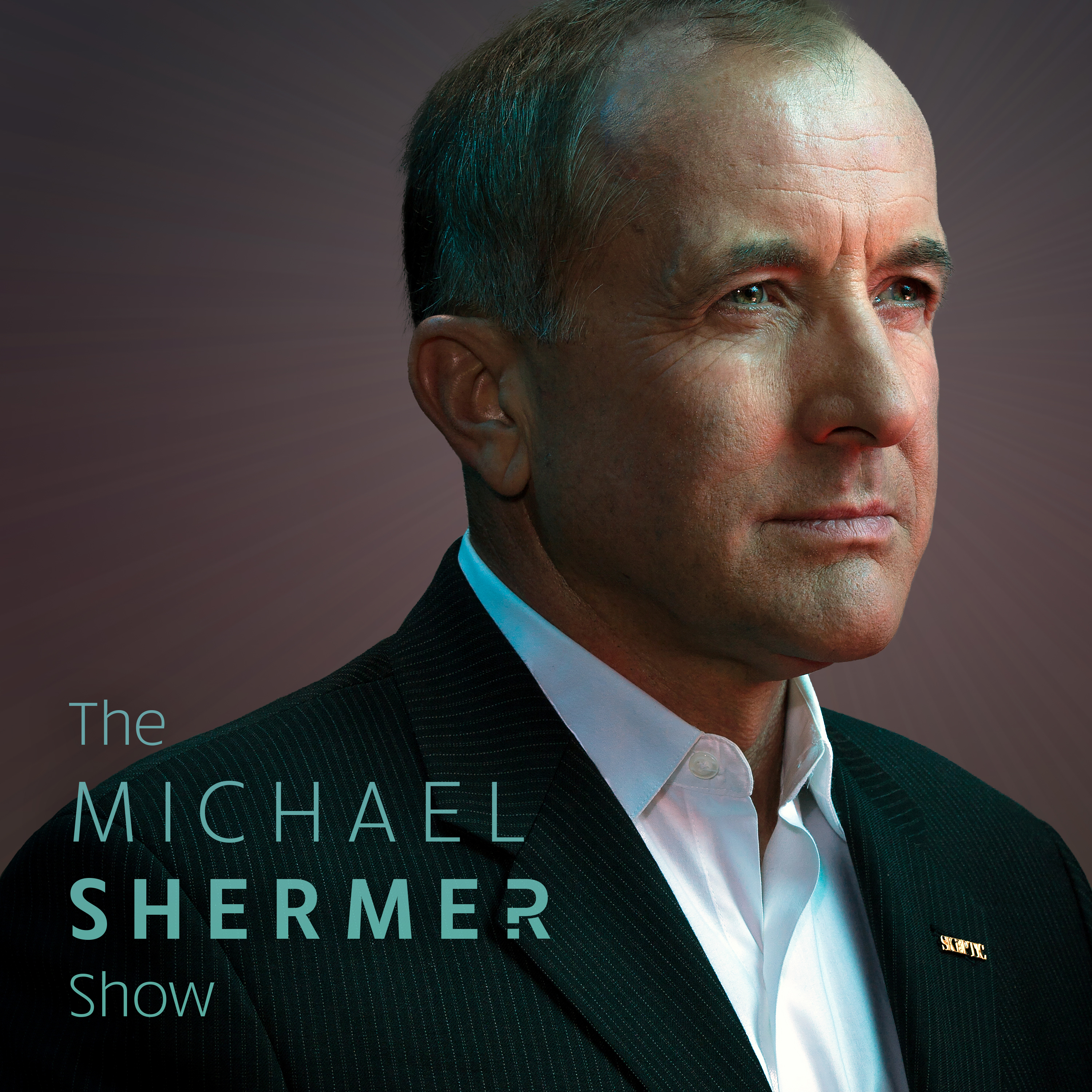
The Michael Shermer Show
637 episodes — Page 11 of 13
Ep 133133. Michael E. McCullough — The Kindness of Strangers: How a Selfish Ape Invented a New Moral Code
In this sweeping psychological history of human goodness — from the foundations of evolution to the modern political and social challenges humanity is now facing — psychologist Michael McCullough answers a fundamental question: How did humans, a species of self-centered apes, come to care about others?Ever since Darwin, scientists have tried to answer this question using evolutionary theory. McCullough shows why they have failed and offers a new explanation instead. From the moment nomadic humans first settled down until the aftermath of the Second World War, our species has confronted repeated crises that we could only survive by changing our behavior. As McCullough argues, these choices weren't enabled by an evolved moral sense, but with moral invention — driven not by evolution's dictates but by reason. Today's challenges — climate change, mass migration, nationalism — are some of humanity's greatest yet. In revealing how past crises shaped the foundations of human concern, McCullough offers clues for how we can adapt our moral thinking to survive these challenges as well. Shermer and McCullough also discuss: Darwin's Dictum: All observation must be for or against some view if it is to be of any service. the problem to solve: why are people kind to strangers (i.e., origins of empathy, altruism, and kindness)? why we don't need "divine command" theory to explain real morality, which can be derived through evolutionary theory plus philosophical ethical systems, evolutionary "by-product" theory: when we help strangers in the modern world we are following ancient rules of thumb that worked well enough in a world in which meeting someone for the first time was a reasonably good indicator that you'd meet them again, Frans deWaal and the "thin veneer" theory of human morality and civilization he thinks Dawkins holds, and why our morals are a thick veneer on our evolved nature, Peter Singer's expanding circle, Norbert Elias' The Civilizing Process and his etiquette books advisories, why stranger-adaptation and blessed-mistake theories are too simplistic, a brief overview of the past 10,000 years of moral progress, our evolved human instincts: (1) our social instincts for helping others in hopes of receiving help in return, (2) our instinct for helping others in pursuit of glory, (3) our ability to track incentives, and (4) our capacity for reason, the 7 Ages of human history: Age of Orphans, Age of Compassion, Age of Prevention, First Poverty Enlightenment, Humanitarian Big Bang, Second Poverty Enlightenment, Age of Impact, and the end of poverty, UBI, and other social tools for creating a more just society of strangers. Michael McCullough is a professor of psychology at the University of California, San Diego. The winner of numerous distinctions for his research and writing, he is a fellow of the American Psychological Association and the Society for Personality and Social Psychology. He lives in La Jolla, California.
Ep 132132. Leonard Mlodinow — Stephen Hawking: A Memoir of Friendship and Physics
One of the most influential physicists of our time, Stephen Hawking touched the lives of millions. Recalling his nearly two decades as Hawking's collaborator and friend, Leonard Mlodinow brings this complex man into focus in a unique and deeply personal portrayal. We meet Hawking the genius, who employed his mind to uncover the mysteries of the universe — ultimately formulating a pathbreaking theory of black holes that reignited the discipline of cosmology and paved the way for physicists to investigate the origins of the universe in completely new ways. We meet Hawking the colleague, a man whose illness leaves him able to communicate at only six words per minute but who expends the effort to punctuate his conversations with humor. And we meet Hawking the friend, who could convey volumes with a frown, a smile, or simply a raised eyebrow. Modinow puts us in the room as Hawking indulges his passion for wine and curry; shares his feelings on love, death, and disability; and grapples with deep questions of philosophy and physics. This deeply affecting account of a friendship teaches us not just about the nature and practice of physics but also about life and the human capacity to overcome daunting obstacles. Shermer and Mlodinow discuss: what it was like working with Stephen Hawking, what Stephen Hawking was like as a person and personality, Hawking's place in the pantheon of great physicists in the history of science, Hawking's major contributions to physics, What is grand about the grand design of the universe? model dependent realism and the philosophy of science, Can we ever know reality? Why is there something rather than nothing? What caused the Big Bang to bang? What there was before time began? Why does the universe look fine-tuned and designed? Is the universe itself a giant black hole? Did the universe begin in a singularity? Hawking's beliefs about God and why the concept isn't necessary to explain the universe. Leonard Mlodinow received his PhD in theoretical physics from the University of California, Berkeley, was an Alexander von Humboldt Fellow at the Max Planck Institute, and was on the faculty of the California Institute of Technology. His previous books include the best sellers The Grand Design and A Briefer History of Time (coauthored with Stephen Hawking), Subliminal (winner of the PEN/E. O. Wilson Literary Science Writing Award), and War of the Worldviews (with Deepak Chopra), as well as Elastic, Euclid's Window, Feynman's Rainbow, and The Upright Thinkers.
Ep 131131. Stuart Ritchie — Science Fictions: How Fraud, Bias, Negligence, and Hype Undermine the Search for Truth
Science is how we understand the world. Yet failures in peer review and mistakes in statistics have rendered a shocking number of scientific studies useless — or, worse, badly misleading. Such errors have distorted our knowledge in fields as wide-ranging as medicine, physics, nutrition, education, genetics, economics, and the search for extraterrestrial life. As Science Fictions makes clear, the current system of research funding and publication not only fails to safeguard us from blunders but actively encourages bad science — with sometimes deadly consequences. Yet Science Fictions is far from a counsel of despair. Rather, it's a defense of the scientific method against the pressures and perverse incentives that lead scientists to bend the rules. By illustrating the many ways that scientists go wrong, Ritchie gives us the knowledge we need to spot dubious research and points the way to reforms that could make science trustworthy once again. Shermer and Ritchie also discuss: why we need to get science right because science deniers will pounce on such fraud, bias, negligence, and hype in science, Daryl Bem's ESP research and what was wrong with it, "psychological priming" and the problem of replication, sleep research and the problems in Matthew Walker's book Why We Sleep, Amy Cuddy and the problem with "Power Posture" research, Andrew Wakefield and the biggest fraud in the history of science linking vaccines & autism, diet and nutrition research and the complication of linking saturated fats, unsaturated fats, cholesterol, and heart disease, Phil Zimbardo's Stanford Prison Experiment, Samuel Morton's skulls showing racial differences in head size, Steve Gould's critique, the critique of Gould, and the critique of the critics of Gould, self-plagiarism, p values / p hacking the Schizophrenia/amaloid cascade hypothesis and why it has been hard to prove, the file-drawer problem, how to detect fraud, and Terror Management Theory and why it is almost certainly wrong. Stuart Ritchie is a lecturer in the Social, Genetic and Developmental Psychiatry Centre at King's College London. His main research focus is human intelligence: how it relates to the brain, how much it's affected by genetics, and how much it can be improved by factors such as education. He is a noted supporter of the Open Science movement, and has worked on tools to reform scientific practice and help scientists become more transparent when reporting their results.
Ep 130130. Debra Soh — The End of Gender: Debunking the Myths About Sex and Identity in Our Society
Is our gender something we're born with, or are we conditioned by society? In The End of Gender, neuroscientist and sexologist Dr. Debra Soh uses a research-based approach to address this hot-button topic, unmasking popular misconceptions about the nature vs. nurture debate and exploring what it means to be a woman or a man in today's society. Shermer and Soh discuss: If you are transitioning to a different gender, but the word "gender" is largely meaningless biologically, then what are you transitioning to and what is the point of hormone therapy and surgery? the 1990s push to find biological basis of homosexuality so it's not a "lifestyle choice" and how this trend has been recently reversed, the problem of putting ideology before science, cognitive creationism on the left (evolution from the neck down), why biology is not destiny, cancel culture, sex and gender, percentages of the population of LGBTQ, what you identify as vs. who you're attracted to, individual behavior vs. collective labels, sexual orientation and gender identity, gender neutral parenting, gender dysphoria, men and women dating, trans bathrooms, prisons, and sports. Dr. Debra Soh is a neuroscientist who specializes in gender, sex, and sexual orientation. She received her doctorate from York University in Toronto and worked as an academic researcher for eleven years. Her writing has appeared in The Globe and Mail (Toronto), Harper's Magazine, The Wall Street Journal, the Los Angeles Times, Scientific American, Playboy, Quillette, and many other publications. Her research has been published in academic journals including the Archives of Sexual Behavior and Frontiers in Human Neuroscience. As a journalist, Soh writes about the science and politics of human sexuality and gender, free speech, and censorship in academia. She lives in Toronto and divides her time between New York and Los Angeles. Follow her on Twitter at @DrDebraSoh and visit her website at DrDebraSoh.com.
Ep 129129. Mona Sue Weissmark — The Science of Diversity
The Science of Diversity uses a multidisciplinary approach to excavate the theories, principles, and paradigms that illuminate our understanding of the issues surrounding human diversity, social equality, and justice. The book brings these to the surface holistically, examining diversity at the individual, interpersonal, and international levels. Shedding light on why diversity programs fail, the book provides tools to understand how biases develop and influence our relationships and interactions with others. Shermer and Weissmark also discuss: What is diversity and how do we understand it? How is diversity related to people's perceptions of fairness and justice? Does respect for diversity promote peace and positive change? psychology and neuroscience of classification/stereotyping, Freudianism to behaviorism to cognitive science to post-cognitive science, the self, consciousness, ai, and free will in the context of a science of diversity, revenge and justice, Israel and Palestine, nationalism: ethnic and civic, just-world theory of inequality, intergenerational justice and reparations, BLM and reparations, and the future after 2020. Mona Sue Weissmark is an American clinical psychologist and social psychologist, researcher, and author whose work on diversity and justice has received global recognition. She is best known for her groundbreaking social experiment of bringing children of Holocaust survivors face-to-face with children of Nazis, and later, grandchildren and great-grandchildren of African American slaves with descendants of slave owners. She is also a professor of psychology and author of numerous journal articles and the books: Doing Psychotherapy Effectively (University of Chicago Press); Justice Matters: Legacies of the Holocaust and World War II (Oxford University Press); The Science of Diversity (Oxford University Press).
Ep 128128. Michael Shellenberger — Apocalypse Never: Why Environmental Alarmism Hurts Us All
Michael Shellenberger has been fighting for a greener planet for decades. He helped save the world's last unprotected redwoods. He co-created the predecessor to today's Green New Deal. And he led a successful effort by climate scientists and activists to keep nuclear plants operating, preventing a spike of emissions. But in 2019, as some claimed "billions of people are going to die," contributing to rising anxiety, including among adolescents, Shellenberger decided that, as a lifelong environmental activist, leading energy expert, and father of a teenage daughter, he needed to speak out to separate science from fiction. His conclusion: "Climate change is real but it's not the end of the world. It is not even our most serious environmental problem." Despite decades of news media attention, many remain ignorant of basic facts. Carbon emissions peaked and have been declining in most developed nations for over a decade. Deaths from extreme weather, even in poor nations, declined 80 percent over the last four decades. And the risk of Earth warming to very high temperatures is increasingly unlikely thanks to slowing population growth and abundant natural gas. Curiously, the people who are the most alarmist about the problems also tend to oppose the obvious solutions. Shermer and Shellenberger also discuss: what's really behind the rise of apocalyptic environmentalism, the powerful financial interests in environmentalism, the desire for status and power among environmentalists, along with the all-too human propensity to moralize and tell other people what to do, Shellenberger's hypothesis that environmentalism is a faux religion primarily followed by secular people searching for transcendence, Environmental Humanism as a replacement worldview, the problems and shortcomings of climate computer models, how much warmer it's going to get and what the consequences of that warming will be, and what we do about it? (hint: nuclear), myths about nuclear power and why people fear it, renewables, solar, wind, geothermal, and why they are not nearly as efficient as nuclear, the Amazon: Are the Earth's lungs burning? plastic straws, recycling, electric cars, and other things, Are we in a Sixth Extinction? How have sweatshops saved the planet? How have technology and capitalism saved the whales? meat eating, Temple Grandin, and happy farms vs. factory farms, the myth of natural: what is natural is good, non-natural is bad, why environmentalism is the dominant secular religion of the educated, upper-middle-class elite in the most developed nations, with good guys and bad guys, heroes and villains, and Environmentalism as Calvinism — Richard Rhodes: "In the sense that the world is an evil place and it would be better if it were destroyed and turned back over to the natural kingdom." Michael Shellenberger is a Time magazine "Hero of the Environment"; the winner of the 2008 Green Book Award from the Stevens Institute of Technology's Center for Science Writings; and an invited expert reviewer of the next Assessment Report for the Intergovernmental Panel on Climate Change (IPCC). He has written on energy and the environment for the New York Times, the Washington Post, the Wall Street Journal, Nature Energy, and other publications for two decades. He is the founder and president of Environmental Progress, an independent, nonpartisan research organization based in Berkeley, California. Listen to Science Salon via Apple Podcasts, Spotify, Google Podcasts, Stitcher, iHeartRadio, and TuneIn.
Ep 127127. William Perry and Tom Collina — The Button: The New Nuclear Arms Race and Presidential Power from Truman to Trump
From authors William J. Perry, Secretary of Defense in the Clinton administration and Undersecretary of Defense for Research and Engineering in the Carter administration, and Tom Z. Collina, the Director of Policy at Ploughshares Fund, a global security foundation in Washington, DC, The Buttonrecounts the terrifying history of nuclear launch authority, from the faulty 46-cent microchip that nearly caused World War III to President Trump's tweet about his "much bigger & more powerful" button. Perry and Collina share their firsthand experience on the front lines of the nation's nuclear history and provide illuminating interviews with former President Bill Clinton, former Secretary of Defense Jim Mattis, Congressman Adam Smith, Nobel Peace Prize winner Beatrice Fihn, senior Obama administration officials, and many others. Shermer, Perry and Collina also discuss: even if Trump loses the 2020 election and we have President Biden, real risks of nuclear catastrophe exist because of the system, not the person, why the Iran deal was a good one to keep that country from developing nukes, how to deal with North Korea and Perry's experience with the Kim dynasty, why the Russians are rational actors who do not want nuclear war, terrorists and the possibility of them getting a nuke, why we must eliminate Launch on Warning and First Strikepolicies, what is in "the football" seen held by men constantly trailing the President? Stanislav Petrov: the man who saved the world, and what this story tells us about the precariousness of our current system, game theory, the logic of deterrence, and how to get around it, why nuclear weapons were not inevitable, and changing the taboo from not using nuclear weapons to not owning them. William J. Perry served as Undersecretary of Defense for Research and Engineering in the Carter administration, and then as Secretary of Defense in the Clinton administration, and has advised presidents all through the Obama administration. He oversaw the development of major nuclear weapons systems, such as the MX missile, the Trident submarine and the Stealth Bomber. His new "offset strategy" ushered in the age of stealth, smart weapons, GPS, and technologies that changed the face of modern warfare. His vision now, as founder of the William J. Perry Project, is a world free from nuclear weapons. Tom Z. Collina is the Director of Policy at Ploughshares Fund, a global security foundation in Washington, DC. He has 30 years of nuclear weapons policy experience and has testified before the Senate Foreign Relations Committee and was closely involved with successful efforts to end U.S. nuclear testing in 1992, extend the Nuclear Non-Proliferation Treaty in 1995, ratify the New START Treaty in 2010, and enact the Iran nuclear deal in 2015. Collina has published hundreds of articles, op-eds, and reports and appears frequently in major media. Listen to Science Salon via Apple Podcasts, Spotify, Google Play Music, Stitcher, iHeartRadio, and TuneIn.
Ep 126126. Sarah Scoles — They Are Already Here: UFO Culture and Why We See Saucers
More than half a century since Roswell, UFOs have been making headlines once again. On December 17, 2017, the New York Times ran a front-page story about an approximately five-year Pentagon program called the Advanced Aerospace Threat Identification Program. The article hinted, and its sources clearly said in subsequent television interviews, that some of the ships in question couldn't be linked to any country. The implication, of course, was that they might be linked to other solar systems. The UFO community—those who had been thinking about, seeing, and analyzing supposed flying saucers (or triangles or chevrons) for years—was surprisingly skeptical of the revelation. Their incredulity and doubt rippled across the internet. Many of the people most invested in UFO reality weren't really buying it. And as Scoles did her own digging, she ventured to dark, conspiracy-filled corners of the internet, to a former paranormal research center in Utah, and to the hallways of the Pentagon. In They Are Already Here we meet the bigwigs, the scrappy upstarts, the field investigators, the rational people, and the unhinged kooks of this sprawling community. How do they interact with each other? How do they interact with "anomalous phenomena"? And how do they (as any group must) reflect the politics and culture of the larger world around them? Funny and colorful, and told in a way that doesn't require one to believe, Scoles brings humanity to an often derided and misunderstood community. Scoles and Shermer discuss: who the "they" are in her title, comparing the UFO community to that of SETI scientists, whom she wrote about in her previous book, Making Contact: Jill Tarter and the Search for Extra-Terrestrial Intelligence? what it was like engaging UFOlogists at conferences, her answer to the Fermi paradox: where is everyone? what it means to "believe" in UFOs vs. ETIs, Project Saucer, Project Sign, Project Grudge, Project Bluebook, Robert Bigelow, Tom DeLonge, and the To the Stars Academy of Arts and Science, the most probable explanation for the USS Nimitz UFO videos, Kenneth Arnold, Roswell, Area 51, and modern myth making, Scoles' Mormon background and how she lost her religion, and what we will replace religion with in the future. Sarah Scoles is a science writer whose work has appeared in The Atlantic, Slate, Smithsonian, The Washington Post, Scientific American, Popular Science, Discover, New Scientist, Aeon, and Wired. A former editor at Astronomy magazine, Scoles worked at the National Radio Astronomy Observatory, the location of the first-ever SETI project. She lives in Denver, Colorado. Listen to Science Salon via Apple Podcasts, Spotify, Google Play Music, Stitcher, iHeartRadio, and TuneIn.
Ep 125125. Bjorn Lomborg — False Alarm: How Climate Change Panic Costs Us Trillions, Hurts the Poor, and Fails to Fix the Planet
Hurricanes batter our coasts. Wildfires rage across the American West. Glaciers collapse in the Artic. Politicians, activists, and the media espouse a common message: climate change is destroying the planet, and we must take drastic action immediately to stop it. Children panic about their future, and adults wonder if it is even ethical to bring new life into the world. Enough, argues bestselling author Bjorn Lomborg. Climate change is real, but it's not the apocalyptic threat that we've been told it is. Projections of Earth's imminent demise are based on bad science and even worse economics. In panic, world leaders have committed to wildly expensive but largely ineffective policies that hamper growth and crowd out more pressing investments in human capital, from immunization to education. False Alarm will convince you that everything you think about climate change is wrong — and points the way toward making the world a vastly better, if slightly warmer, place for us all. In this wide-ranging conversation Shermer and Lomborg discuss: Is the planet warming? What is the cause of the warming? How much warmer is it going to get? What will the consequences of the warming be? What should we do about it? How the public discussion/debate over climate has changed in the past 20 years since Lomborg wrote The Skeptical Environmentalist: Measuring the Real State of the World Precautionary Principle: should we do something "just in case"? What about other existential threats: AI apocalypse, nuclear weapons, pandemics? and Why climate is such a hard problem. The claims: timeline: we have a decade to solve the problem … or else droughts, floods, hurricanes, and extreme weather deforestation/reforestation polar bears/the 6th Extinction, and AOC/Greta Thunberg/Al Gore. Non-Solutions: individual action, why the Green Revolution isn't here yet, why the Paris Agreement is failing, how climate policy hurts the poor, and reducing greenhouse gases. Rational Solutions: carbon tax: a market-based solution, innovation, adaptation, geoengineering, and prosperity. Bjorn Lomborg is the best-selling author of The Skeptical Environmentalist and Cool It. He is a visiting professor at Copenhagen Business School and at the Hoover Institution at Stanford. His work appears regularly in New York Times, Wall Street Journal, the Economist, the Atlantic, and Forbes. His monthly column appears in around 40 papers in 19 languages, with more than 30 million readers. In 2011 and 2012, Lomborg was named Top 100 Global Thinker by Foreign Policy. In 2008 he was named "one of the 50 people who could save the planet" by the Guardian. He lives in Prague. Listen to Science Salon via Apple Podcasts, Spotify, Google Play Music, Stitcher, iHeartRadio, and TuneIn.
Ep 124124. David J. Halperin — Intimate Alien: The Hidden Story of the UFO
UFOs are a myth, says David J. Halperin — but myths are real. The power and fascination of the UFO has nothing to do with space travel or life on other planets. It's about us, our longings and terrors, and especially the greatest terror of all: the end of our existence. This is a book about UFOs that goes beyond believing in them or debunking them and to a fresh understanding of what they tell us about ourselves as individuals, as a culture, and as a species. In the 1960s, Halperin was a teenage UFOlogist, convinced that flying saucers were real and that it was his life's mission to solve their mystery. He would become a professor of religious studies, with traditions of heavenly journeys his specialty. With Intimate Alien, he looks back to explore what UFOs once meant to him as a boy growing up in a home haunted by death and what they still mean for millions, believers and deniers alike. From the prehistoric Balkans to the deserts of New Mexico, from the biblical visions of Ezekiel to modern abduction encounters, Intimate Alien traces the hidden story of the UFO. It's a human story from beginning to end, no less mysterious and fantastic for its earthliness. A collective cultural dream, UFOs transport us to the outer limits of that most alien yet intimate frontier, our own inner space. Shermer and Halperin discuss: What is religion and what role does it play in peoples' lives? What is myth and what role does it play in peoples' lives? what Carl Jung believed about UFOs and why, The Day the Earth Stood Still film as a Christ Allegory, why he's an atheist but fascinated by the power of religion, why he's a UFO skeptic but compelled by the power of alien beliefs, the origin of alien eyes, the origin of alien abductions, the true meaning of the Roswell incident, John Lennon's UFO experience, Will religion fall into disuse with the rise of the nones?, and the future of religion in a post-COVID-19 world. David J. Halperin taught Jewish studies in the Department of Religious Studies at the University of North Carolina, Chapel Hill, until his retirement in 2000. He has published five nonfiction books on Jewish mysticism and messianism, as well as the coming-of-age novel Journal of a UFO Investigator: A Novel (2011). He blogs about UFOs, religion, and related subjects at www.davidhalperin.net. Listen to Science Salon via Apple Podcasts, Spotify, Google Play Music, Stitcher, iHeartRadio, and TuneIn.
Ep 123123. Gerald Posner — Pharma: Greed, Lies, and the Poisoning of America
Pharmaceutical breakthroughs such as antibiotics and vaccines rank among some of the greatest advancements in human history. Yet exorbitant prices for life-saving drugs, safety recalls affecting tens of millions of Americans, and soaring rates of addiction and overdose on prescription opioids have caused many to lose faith in drug companies. Now, Americans are demanding a national reckoning with a monolithic industry. Pharma introduces brilliant scientists, incorruptible government regulators, and brave whistleblowers facing off against company executives often blinded by greed. A business that profits from treating ills can create far deadlier problems than it cures. Addictive products are part of the industry's DNA, from the days when corner drugstores sold morphine, heroin, and cocaine, to the past two decades of dangerously overprescribed opioids. Pharma also uncovers the real story of the Sacklers, the family that became one of America's wealthiest from the success of OxyContin, their blockbuster narcotic painkiller at the center of the opioid crisis. Pharma reveals how and why American drug companies have put earnings ahead of patients. Shermer and Posner also discuss: how Big Pharma companies conspire to hack the FDA regulations, parsing responsibility for the Opioid crisis between manufacturers, distributors, doctors, and patients, the physiology of addiction and dependency, how Arthur Sackler went from liberal do-gooder to greedy capitalist, the polio vaccine and patenting the sun, how valium and anti-depressants were marketed to men and women differently, how the AIDS cocktail was developed, how Viagra® was discovered, why patents and intellectual property rights do not lead to more innovation, the prospects for a COVID-19 vaccine, the current state of the opioid crisis and how to stem it. Gerald Posner is an award-winning journalist who has written twelve books, including the Pulitzer Prize finalist Case Closed: Lee Harvey Oswald and the Assassination of JFK and multiple national bestsellers. His 2015 book, God's Bankers, a two-hundred-year history of the finances of the Vatican, was an acclaimed New York Timesbestseller. Posner has written for many national magazines and papers, including The New York Times, The New Yorker, Newsweek, and Time, and he has been a regular contributor to NBC, the History Channel, CNN, CBS, MSNBC, and FOX News. He lives in Miami Beach with his wife, author Trisha Posner. Listen to the Science Salon Podcast via Apple Podcasts, Spotify, Google Play Music, Stitcher, iHeartRadio, and TuneIn.
Ep 122122. Walter Scheidel — Escape from Rome: The Failure of the Empire and the Road to Prosperity
What has the Roman Empire ever done for us? Fall and go away. That is the striking conclusion of historian Walter Scheidel as he recounts the gripping story of how the end of the Roman Empire was the beginning of the modern world. The fall of the Roman Empire has long been considered one of the greatest disasters in history but Scheidel argues that Rome's dramatic collapse was actually the best thing that ever happened, clearing the path for Europe's economic rise and the creation of the modern age. Shermer and Scheidel range across the entire premodern world and up to the present, discussing: Why did the Roman Empire appear? Why did nothing like it ever return to Europe? Why did Europeans come to dominate the world? the rich diversity of Europe that encouraged political, economic, scientific, and technological breakthroughs why other parts of the world lagged behind how empires are built and why they fail America as an empire. income inequality and the only forces that change it significantly the future of human civilization. Dr. Walter Scheidel is an Austrian historian who teaches ancient history at Stanford University. His main research interests are ancient social and economic history, pre-modern historical demography, and comparative and transdisciplinary approaches to world history. He is the author of The Great Leveler: Violence and the History of Inequality from the Stone Age to the Twenty-First Century, On Human Bondage: After Slavery and Social Death, The Science of Roman History: Biology, Climate and the Future of the Past, The Cambridge Companion to the Roman Economy, The Oxford Handbook of Roman Studies, and Rome, China: Comparative Perspectives on Ancient World Empires, and more. Listen to Science Salon via Apple Podcasts, Spotify, Google Play Music, Stitcher, iHeartRadio, and TuneIn.
Ep 121121. Maria Konnikova — The Biggest Bluff: How I Learned to Pay Attention, Master Myself, and Win
It's true that Maria Konnikova had never actually played poker before and didn't even know the rules when she approached Erik Seidel, Poker Hall of Fame inductee and winner of tens of millions of dollars in earnings, and convinced him to be her mentor. But she knew her man: a famously thoughtful and broad-minded player, he was intrigued by her pitch that she wasn't interested in making money so much as learning about life. She had faced a stretch of personal bad luck, and her reflections on the role of chance had led her to a giant of game theory, who pointed her to poker as the ultimate master class in learning to distinguish between what can be controlled and what can't. And she certainly brought something to the table, including a PhD in psychology and an acclaimed and growing body of work on human behavior and how to hack it. So Seidel was in, and soon she was down the rabbit hole with him, into the wild, fiercely competitive, overwhelmingly masculine world of high-stakes Texas Hold'em, their initial end point the following year's World Series of Poker. But then something extraordinary happened. Under Seidel's guidance, Konnikova did have many epiphanies about life that derived from her new pursuit, including how to better read, not just her opponents but far more importantly herself; how to identify what tilted her into an emotional state that got in the way of good decisions; and how to get to a place where she could accept luck for what it was, and what it wasn't. But she also began to win. And win. In a little over a year, she began making earnest money from tournaments, ultimately totaling hundreds of thousands of dollars. She won a major title, got a sponsor, and got used to being on television, and to headlines like "How one writer's book deal turned her into a professional poker player." In this wide-ranging conversation Konnikova and Shermer discuss: the balance of luck, skill, intelligence and emotions in how lives turn out the real meaning of the marshmallow test time discounting and how to improve yours rapid cognition and intuition how to improve your use of emotions in gambling and in life what it was like being a woman in an almost exclusively male game, and the nature of human nature in the context of the BLM movement and protests. Maria Konnikova is the author of Mastermind and The Confidence Game. She is a regular contributing writer for The New Yorker, and has written for The Atlantic, The New York Times, Slate, The New Republic, The Paris Review, The Wall Street Journal, Salon, The Boston Globe, Scientific American, Wired, and Smithsonian, among many other publications. Her writing has won numerous awards, including the 2019 Excellence in Science Journalism Award from the Society of Personality and Social Psychology. While researching The Biggest Bluff, Maria became an international poker champion and the winner of over $300,000 in tournament earnings. Maria also hosts the podcast The Grift from Panoply Media and is currently a visiting fellow at NYU's School of Journalism. Her podcasting work earned her a National Magazine Award nomination in 2019. Maria graduated from Harvard University and received her PhD in Psychology from Columbia University. Listen to Science Salon via Apple Podcasts, Spotify, Google Play Music, Stitcher, iHeartRadio, and TuneIn.
Ep 120120. Andrew Rader — Beyond the Known: How Exploration Created the Modern World and Will Take Us to the Stars
For the first time in history, the human species has the technology to destroy itself. But having developed that power, humans are also able to leave Earth and voyage into the vastness of space. After millions of years of evolution, we've arrived at the point where we can settle other worlds and begin the process of becoming multi-planetary. How did we get here? What does the future hold for us? Divided into four accessible sections, Beyond the Known examines major periods of discovery and rediscovery, from Classical Times, when Phoenicians, Persians and Greeks ventured forth; to The Age of European Exploration, which saw colonies sprout on nearly continent; to The Era of Scientific Inquiry, when researchers developed brand new tools for mapping and traveling farther; to Our Spacefaring Future, which unveils plans currently underway for settling other planets and, eventually, traveling to the stars. A Mission Manager at SpaceX with a light, engaging voice, Andrew Rader is at the forefront of space exploration. As a gifted historian, Rader, who has won global acclaim for his stunning breadth of knowledge, is singularly positioned to reveal the story of human exploration that is also the story of scientific achievement. Told with an infectious zeal for traveling beyond the known, Beyond the Knownilluminates how very human it is to emerge from the cave and walk toward an infinitely expanding horizon. Rader and Shermer also discuss: the human nature to explore: adaptation or spandrel? what the Greeks and Romans knew about the world that was lost for centuries how dark were the Dark Ages for exploration? the economic and religious drivers of early exploration the political and practical drivers of 20th century exploration Mars direct or to the moon first? how to terraform Mars how to get people to the moons of the outer planets how to get people to the stars are we living in a simulation? should we be worried about A.I.? Andrew Rader is a Mission Manager at SpaceX. He holds a Ph.D. in Aerospace Engineering from MIT specializing in long-duration spaceflight. In 2013, he won the Discovery Channel's competitive television series Canada's Greatest Know-It-All. He also co-hosts the weekly podcast Spellbound, which covers topics from science to economics to history and psychology. Beyond the Known is Rader's first book for adults. You can find him at Andrew-Rader.com. Listen to Science Salon via Apple Podcasts, Spotify, Google Play Music, Stitcher, iHeartRadio, and TuneIn.
Ep 119119. Howard Bloom — Einstein, Michael Jackson, and Me: A Search for the Soul in the Power Pits of Rock and Roll
Howard Bloom — called "the greatest press agent that rock and roll has ever known" by Derek Sutton, the former manager of Styx, Ten Years After, and Jethro Tull — is a science nerd who knew nothing about popular music. But he founded the biggest PR firm in the music industry and helped build or sustain the careers of our biggest rock-and-roll legends, including Michael Jackson, Prince, Bob Marley, Bette Midler, Billy Joel, Billy Idol, Paul Simon, Peter Gabriel, David Byrne, AC/DC, Aerosmith, Queen, Kiss, Grandmaster Flash and the Furious Five, Run DMC, ZZ Top, Joan Jett, Chaka Khan, and one hundred more. What was he after? He was on a hunt for the gods inside of you and me. Einstein, Michael Jackson & Me is Bloom's story — the strange tale of a scientific expedition into the dark underbelly of science and fame where new myths and movements are made. Shermer and Bloom also discuss: What and where is God? the search for God inside us all how an atheist can search for the soul conducting science in everyday life music as an evolutionary adaptation or cheese cake spandrel What makes some musicians successful and others not (hint: it's more than 10,000 hours of practice) what it was like woking with Prince, Billy Joel, Joan Jett, and others Do female rock stars have as much sex with strange men as male rock stars have sex with strange women? why Michael Jackson was a transcendent talent, the Mozart of our time. Based in Park Slope, Brooklyn, Howard Bloom has been called "next in a lineage of seminal thinkers that includes Newton, Darwin, Einstein, [and] Freud" by Britain's Channel 4 TV, and "the next Stephen Hawking" by Gear magazine. One of Bloom's seven books, Global Brain, was the subject of an Office of the Secretary of Defense symposium with participants from the State Department, the Energy Department, DARPA, IBM, and MIT. Listen to Science Salon via Apple Podcasts, Spotify, Google Play Music, Stitcher, iHeartRadio, and TuneIn.
Ep 118118. Stuart Russell — Human Compatible: Artificial Intelligence and the Problem of Control
In the popular imagination, superhuman artificial intelligence is an approaching tidal wave that threatens not just jobs and human relationships, but civilization itself. Conflict between humans and machines is seen as inevitable and its outcome all too predictable. In this groundbreaking book, distinguished AI researcher Stuart Russell argues that this scenario can be avoided, but only if we rethink AI from the ground up. Russell begins by exploring the idea of intelligence in humans and in machines. He describes the near-term benefits we can expect, from intelligent personal assistants to vastly accelerated scientific research, and outlines the AI breakthroughs that still have to happen before we reach superhuman AI. He also spells out the ways humans are already finding to misuse AI, from lethal autonomous weapons to viral sabotage. If the predicted breakthroughs occur and superhuman AI emerges, we will have created entities far more powerful than ourselves. How can we ensure they never, ever, have power over us? Russell suggests that we can rebuild AI on a new foundation, according to which machines are designed to be inherently uncertain about the human preferences they are required to satisfy. Such machines would be humble, altruistic, and committed to pursue our objectives, not theirs. This new foundation would allow us to create machines that are provably deferential and provably beneficial. Shermer and Russell also discuss: natural intelligence vs. artificial intelligence "g" in human intelligence vs. G in AGI (Artificial General Intelligence) the values alignment problem Hume's "Is-Ought" naturalistic fallacy as it applies to AI values vs. human values regulating AI Russell's response to the arguments of AI apocalypse skeptics Kevin Kelly and Steven Pinker the Chinese social control AI system and what it could lead to autonomous vehicles, weapons, and other systems and how they can be hacked AI and the hacking of elections, and what keeps Stuart up at night. Stuart Russell is a professor of Computer Science and holder of the Smith-Zadeh Chair in Engineering at the University of California, Berkeley. He has served as the Vice-Chair of the World Economic Forum's Council on AI and Robotics and as an advisor to the United Nations on arms control. He is a Fellow of the American Association for Artificial Intelligence, the Association for Computing Machinery, and the American Association for the Advancement of Science. He is the author (with Peter Norvig) of the definitive and universally acclaimed textbook on AI, Artificial Intelligence: A Modern Approach. Listen to Science Salon via Apple Podcasts, Spotify, Google Play Music, Stitcher, iHeartRadio, and TuneIn.
Ep 116117. Matt Ridley — How Innovation Works: and Why It Flourishes in Freedom
Innovation is the main event of the modern age, the reason we experience both dramatic improvements in our living standards and unsettling changes in our society. Forget short-term symptoms like Donald Trump and Brexit, it is innovation itself that explains them and that will itself shape the 21st century for good and ill. Yet innovation remains a mysterious process, poorly understood by policy makers and businessmen, hard to summon into existence to order, yet inevitable and inexorable when it does happen. In his new book, How Innovation Works, Matt Ridley argues that we need to change the way we think about innovation, to see it as an incremental, bottom-up, fortuitous process that happens to society as a direct result of the human habit of exchange, rather than an orderly, top-down process developing according to a plan. Innovation is crucially different from invention, because it is the turning of inventions into things of practical and affordable use to people. It speeds up in some sectors and slows down in others. It is always a collective, collaborative phenomenon, not a matter of lonely genius. It is gradual, serendipitous, recombinant, inexorable, contagious, experimental and unpredictable. It happens mainly in just a few parts of the world at any one time. It still cannot be modelled properly by economists, but it can easily be discouraged by politicians. Far from there being too much innovation, we may be on the brink of an innovation famine. Ridley derives these and other lessons, not with abstract argument, but from telling the lively stories of scores of innovations, how they started and why they succeeded or in some cases failed. He goes back millions of years and leaps forward into the near future. Some of the innovation stories he tells are about steam engines, jet engines, search engines, airships, coffee, potatoes, vaping, vaccines, cuisine, antibiotics, mosquito nets, turbines, propellers, fertiliser, zero, computers, dogs, farming, fire, genetic engineering, gene editing, container shipping, railways, cars, safety rules, wheeled suitcases, mobile phones, corrugated iron, powered flight, chlorinated water, toilets, vacuum cleaners, shale gas, the telegraph, radio, social media, block chain, the sharing economy, artificial intelligence, fake bomb detectors, phantom games consoles, fraudulent blood tests, faddish diets, hyperloop tubes, herbicides, copyright, and even a biological innovation: life itself. Shermer and Ridley discuss all this and: why the 2nd Law of Thermodynamics is the First Law of Life why the patent/intellectual property rights concept is antithetical to innovation why innovation is so much more important than invention why the Chinese system of innovation works even though it's government is anti-freedom why musical innovation did not decline with the advent of Napster the difference between scientific discoveries and artistic/musical creations vaccine innovation in the era of COVID-19 why innovations are postdictable but not predictable, and how the future may change after this pandemic. Matt Ridley is the award-winning, bestselling author of several books, including The Rational Optimist: How Prosperity Evolves; Genome: The Autobiography of a Species in 23 Chapters; and The Red Queen: Sex and the Evolution of Human Nature. His books have sold more than one million copies in thirty languages worldwide. He writes regularly for The Times (London) and The Wall Street Journal, and is a member of the House of Lords. He lives in England. Listen to Science Salon via Apple Podcasts, Spotify, Google Play Music, Stitcher, iHeartRadio, and TuneIn.
Ep 116116. Howard Steven Friedman — Ultimate Price: The Value We Place on Life
How much is a human life worth? Individuals, families, companies, and governments routinely place a price on human life. The calculations that underlie these price tags are often buried in technical language, yet they influence our economy, laws, behaviors, policies, health, and safety. These price tags are often unfair, infused as they are with gender, racial, national, and cultural biases that often result in valuing the lives of the young more than the old, the rich more than the poor, whites more than blacks, Americans more than foreigners, and relatives more than strangers. This is critical since undervalued lives are left less-protected and more exposed to risk. Howard Steven Friedman explains in simple terms how economists and data scientists at corporations, regulatory agencies, and insurance companies develop and use these price tags and points a spotlight at their logical flaws and limitations. He then forcefully argues against the rampant unfairness in the system. Readers will be enlightened, shocked, and, ultimately, empowered to confront the price tags we assign to human lives and understand why such calculations matter. Friedman and Shermer also discuss: the COVID-19 pandemic and the economic tradeoffs in the context of putting a price on human life how long should the economy be kept shut down in social isolation private vs. public calculations of the value of a human life the tradeoffs between conflicting moral values related to the value of human life (abortion, capital punishment, etc.) 9/11 and the calculations used to determine the value of each life lost calculating the devil we know (coal-related deaths) vs. the devil we don't know (possible future nuclear-power related deaths) how the price of $10 million was determined for the current value of a human life organ sales as a form of human life valuation Should you have life insurance? When should you start collecting social security? why all lives should be treated equally in terms of statistical valuation, but why they are not. Howard Steven Friedman, a leading statistician and health economist, is an expert in data science and applications of cost-benefit analysis. He teaches at Columbia University. Listen to Science Salon via Apple Podcasts, Spotify, Google Play Music, Stitcher, iHeartRadio, and TuneIn.
Ep 115115. Matthew Cobb — The Idea of the Brain: The Past and Future of Neuroscience
For thousands of years, thinkers and scientists have tried to understand what the brain does. Yet, despite the astonishing discoveries of science, we still have only the vaguest idea of how the brain works. In The Idea of the Brain, scientist and historian Matthew Cobb traces how our conception of the brain has evolved over the centuries. Although it might seem to be a story of ever-increasing knowledge of biology, Cobb shows how our ideas about the brain have been shaped by each era's most significant technologies. Today we might think the brain is like a supercomputer. In the past, it has been compared to a telegraph, a telephone exchange, or some kind of hydraulic system. What will we think the brain is like tomorrow, when new technology arises? The result is an essential read for anyone interested in the complex processes that drive science and the forces that have shaped our marvelous brains. Cobb and Shermer also discuss: panpsychism the hard problem of consciousness free will and determinism mind uploading near death experiences (NDEs) and other paranormal experiences quantum consciousness the history of neuroscience and how we got to where we are today brain mapping and localization why the new phrenology (brain localization and modules) is still wrong why neurons are not digital like computer chips, and why the brain is not like a computer, and why we're still nowhere near understanding how the brain works. Matthew Cobb is a professor in the School of Biological Sciences at the University of Manchester, where he studies olfaction, insect behavior, and the history of science. He earned his PhD in psychology and genetics from the University of Sheffield. He is the author of five books: Life's Greatest Secret, Generation, The Resistance, Eleven Days in August, and Smell: A Very Short Introduction. He lives in England. Listen to Science Salon via Apple Podcasts, Spotify, Google Play Music, Stitcher, iHeartRadio, and TuneIn.
Ep 114114. Katherine Stewart — The Power Worshippers: Inside the Dangerous Rise of Religious Nationalism
For too long the Religious Right has masqueraded as a social movement preoccupied with a number of cultural issues, such as abortion and same-sex marriage. But in her deeply reported investigation, Katherine Stewart reveals a disturbing truth: America's Religious Right has evolved into a Christian nationalist movement. It seeks to gain political power and to impose its vision on all of society. It isn't fighting a culture war, it is waging a political war on the norms and institutions of American democracy. Stewart shows that the real power of the movement lies in a dense network of think tanks, advocacy groups, and pastoral organizations, embedded in a rapidly expanding community of international alliances with likeminded, anti-democratic religious nationalists around the world, including Russia. She follows the money behind the movement and traces much of it to a group of super-wealthy, ultraconservative donors and family foundations. The Christian nationalist movement is far more organized and better funded than most people realize. It seeks to control all aspects of government and society. Its successes have been stunning, and its influence now extends to every aspect of American life, from the White House to state capitols, from our schools to our hospitals. Shermer and Stewart also discuss: how the Moral Majority of the Reagan era 1980s morphed into the Christian Nationalists of today wWhy 81% of white evangelicals voted for Trump, one of the least religious presidents in U.S. history follow the money: where these many christian nationalist organizations get their funding Betsy DeVos, big money, and school vouchers: what's really going on with so-called "school choice" how conservatives use pastors to "get out the vote" When did Jesus become a conservative? Christian nationalists and the poor Christian nationalists and homosexuality how Christian nationalists made abortion a modern political cause how conservatives like Barry Goldwater used to support a woman's right to an abortion why conservatives are actually in favor of big government…when it suits their ideological and religious agendas (military, police, prisons, courts, immigration, corporate welfare, etc.) Who's next? Mike Pence, Ted Cruz? The future of democracy in an age of Christian nationalism. Katherine Stewart's work has appeared in The New York Times, Washington Post, American Prospect, The Atlantic and other publications. She is the author of The Good News Club, an investigation of the religious right and public education.
Ep 113113. Dave Rubin — Don't Burn This Book: Thinking for Yourself in an Age of Unreason
The left is no longer liberal. Once on the side of free speech and tolerance, progressives now ban speakers from college campuses, "cancel" people who aren't up to date on the latest genders, and force religious people to violate their conscience. They have abandoned the battle of ideas and have begun fighting a battle of feelings. This uncomfortable truth has turned moderates and true liberals into the politically homeless class. Dave Rubin launched his political talk show The Rubin Report in 2015 as a meeting ground for free thinkers who realize that partisan politics is a dead end. He hosts people he both agrees and disagrees with — including those who have been dismissed, deplatformed, and despised — taking on the most controversial issues of our day. As a result, he's become a voice of reason in a time of madness. Now, Rubin gives you the tools you need to think for yourself in an age when tribal outrage is the only available alternative. Shermer and Rubin discuss: why he left the Left how progressive leftism is illiberal how identity politics makes people more racist, misogynist, homophobic, bigoted, and less tolerant liberalism and classical liberalism how to stand up to the mob when it comes after you for not perfectly toeing the PC line individual rights and limited government immigration, abortion, gun rights, foreign policy, income inequality, and other hot-button issues, and why Jordan Peterson is not the anti-Christ despite what progressives say. Dave Rubin is the creator and host of The Rubin Report, the most-watched talk show about free speech and big ideas on YouTube. A former progressive turned classical liberal, he speaks to millions all over the world, including touring with Dr. Jordan Peterson, and performs stand-up comedy in cities around the United States. Originally from Long Island, New York, he currently lives in Los Angeles with his husband, David, and their dog, Emma. This is his first book. Listen to Science Salon via Apple Podcasts, Spotify, Google Play Music, Stitcher, iHeartRadio, and TuneIn.
Ep 112112. Ann Druyan — Cosmos: Possible Worlds
In this sequel to Carl Sagan's beloved classic and the companion to the hit television series hosted by Neil deGrasse Tyson, the primary author of all the scripts for both this season and the previous season of Cosmos, Ann Druyan explores how science and civilization grew up together. From the emergence of life at deep-sea vents to solar-powered starships sailing through the galaxy, from the Big Bang to the intricacies of intelligence in many life forms, Druyan documents where humanity has been and where it is going, using her unique gift of bringing complex scientific concepts to life. With evocative photographs and vivid illustrations, she recounts momentous discoveries, from the Voyager missions in which she and her husband, Carl Sagan, participated to Cassini-Huygens's recent insights into Saturn's moons. This breathtaking sequel to Sagan's masterpiece explains how we humans can glean a new understanding of consciousness here on Earth and out in the cosmos — again reminding us that our planet is a pale blue dot in an immense universe of possibility. Druyan and Shermer also discuss: how to write a script for a television series her 20 years with Carl Sagan and what their collaboration meant how she dealt with her grief after Carl's death (and how any of us can deal with such pain) who the Voyager records were really for Breakthrough Starshot science and religion God and morality free will and determinism the hard problem of consciousness the Fermi Paradox (where is everybody?) women in science how we can eventually settle on other worlds, and how to reach the stars … and beyond. Ann Druyan is a celebrated writer and producer who co-authored many bestsellers with her late husband, Carl Sagan. She also famously served as creative director of the Voyager Golden Record, sent into space 40 years ago. Druyan continues her work as an interpreter of the most important scientific discoveries, partnering with NASA and the Planetary Society. She has served as Secretary of the Federation of American Scientists and is a laureate of the International Humanist Academy. Most recently, she received both an Emmy and Peabody Award for her work in conceptualizing and writing National Geographic's first season of Cosmos. Listen to Science Salon via Apple Podcasts, Spotify, Google Play Music, Stitcher, iHeartRadio, and TuneIn.
Ep 111111. Scott Barry Kaufman — Transcend: The New Science of Self-Actualization
When psychologist Scott Barry Kaufman first discovered Maslow's unfinished theory of transcendence, sprinkled throughout a cache of unpublished journals, lectures, and essays, he felt a deep resonance with his own work and life. In this groundbreaking book, Kaufman picks up where Maslow left off, unraveling the mysteries of his unfinished theory, and integrating these ideas with the latest research on attachment, connection, creativity, love, purpose and other building blocks of a life well lived. Kaufman's new hierarchy of needs provides a roadmap for finding purpose and fulfillment—not by striving for money, success, or "happiness," but by becoming the best version of ourselves, or what Maslow called self-actualization. While self-actualization is often thought of as a purely individual pursuit, Maslow believed that the full realization of potential requires a merging between self and the world. We don't have to choose either self-development or self-sacrifice, but at the highest level of human potential we show a deep integration of both. Transcend reveals this level of human potential that connects us not only to our highest creative potential, but also to one another. Shermer and Kaufman also discuss: human nature good and evil the good side of psychopathy the illusion of self as a useful fiction security, attachment, and self-esteem ego and narcissism how to quantify and measure internal states how to practice mindfulness without meditation humanistic psychology as a science-based alternative to religious practices characteristics of self-actualization how to be a self-actualized person. Scott Barry Kaufman, PhD is a humanistic psychologist who has taught at Columbia University, the University of Pennsylvania, NYU and elsewhere. He received his Ph.D. in cognitive psychology from Yale University, and an M.Phil in experimental psychology from the University of Cambridge under a Gates Cambridge Scholarship. He writes the column Beautiful Minds for Scientific American and hosts The Psychology Podcast, which has received more than 10 million downloads. His writing has appeared in The Atlantic and Harvard Business Review, and his books include Ungifted, Wired to Create (with Carolyn Gregoire), and, as editor, Twice Exceptional and, as co-editor, The Cambridge Handbook of Intelligence. In 2015, he was named one of "50 Groundbreaking Scientists who are changing the way we see the world" by Business Insider. Listen to Science Salon via Apple Podcasts, Spotify, Google Play Music, Stitcher, iHeartRadio, and TuneIn.
Ep 110110. Bart Ehrman — Heaven and Hell: A History of the Afterlife
According to a recent Pew Research poll, 72% of Americans believe in a literal heaven and 58% in a literal hell (more evidence of the over-optimism bias and self-serving bias). Worldwide, over two billion Christians believe that because of their faith they will have a glorious afterlife. And nearly everyone wonders about what, if anything, comes after death. In Heaven and Hell, renowned biblical scholar and historian of religion Dr. Bart Ehrman investigates the powerful instincts that gave rise to the common ideas of heaven and hell and that help them endure. From the Epic of Gilgamesh to the writings of Augustine, Ehrman recounts the long history of the life after death. In different times, places, and cultures, people held a wide variety of views, and Ehrman is adept at showing how these influenced one another and changed in response to their historical, social, and cultural situations. His driving question is why and how Christians came up with the idea that souls will experience either eternal bliss or everlasting torment. Ehrman shows that the historical Jesus, Paul, and the author of Revelation would have been utterly perplexed by such ideas. These ideas are later Christian developments. Shermer and Ehrman also discuss: Ehrman's personal journey from Christian to nonbeliever the earliest writings on the afterlife why the Old Testament says nothing about Heaven and Hell what the New Testament says about Heaven and Hell early pagan influences on Judaism and Christianity who invented the afterlife and why what Jesus really said about the afterlife, souls, and immortality what commoners believed about the afterlife in Greek, Roman and biblical times myths, stories, and parables: their original meaning and use the real meaning of the resurrection Is the Kingdom of Heaven within us all? What does a nonbeliever say to a believer about the (non-existence) of the afterlife? Bart D. Ehrman is a leading authority on the New Testament and the history of early Christianity, and the author or editor of more than thirty books, including the New York Times bestsellers Misquoting Jesus, How Jesus Became God, and The Triumph of Christianity. A Distinguished Professor of Religious Studies at the University of North Carolina at Chapel Hill, he has created eight popular audio and video courses for The Great Courses. He has been featured in Time, The New Yorker, and The Washington Post, and has appeared on NBC, CNN, The Daily Show with Jon Stewart, the History Channel, the National Geographic Channel, BBC, and NPR.
Ep 109109. Neil Shubin — Some Assembly Required: Decoding Four Billion Years of Life, from Ancient Fossils to DNA
The author of the best-selling Your Inner Fish gives us a lively and accessible account of the great transformations in the history of life on Earth — a new view of the evolution of human and animal life that explains how the incredible diversity of life on our planet came to be. Over billions of years, ancient fish evolved to walk on land, reptiles transformed into birds that fly, and apelike primates evolved into humans that walk on two legs, talk, and write. For more than a century, paleontologists have traveled the globe to find fossils that show how such changes have happened. We have now arrived at a remarkable moment — prehistoric fossils coupled with new DNA technology have given us the tools to answer some of the basic questions of our existence: How do big changes in evolution happen? Is our presence on Earth the product of mere chance? This new science reveals a multibillion-year evolutionary history filled with twists and turns, trial and error, accident and invention. In Some Assembly Required, Neil Shubin takes readers on a journey of discovery spanning centuries, as explorers and scientists seek to understand the origins of life's immense diversity. Shermer and Shubin also discuss: Darwin's consilience of inductions (convergence of evidence) from multiple lines of inquiry how a scientific theory can gain acceptance without an underlying causal mechanism (evolutionary theory before DNA) what scientists should do with anomalies unexplained by the prevailing theory Does ontogeny recapitulate phylogeny? (What can we learn about evolution from embryology?) What is epigenetics, anyway? the best explanation for the origins of life how information can increase in a genome from microevolution to macroevolution: why creationists are wrong Are there hopeful monsters in evolution? Punctuated equilibrium and what it was like to be Steve Gould's TA women in science, then and now What it's like to do a paleontological dig north of the arctic circle? and Martian paleontology. Neil Shubin is the author of Some Assembly Required, Your Inner Fish, and The Universe Within. He is the Robert R. Bensley Professor of Organismal Biology and Anatomy at the University of Chicago. He was elected to the National Academy of Sciences in 2011. He lives in Chicago. Listen to Science Salon via Apple Podcasts, Spotify, Google Play Music, Stitcher, iHeartRadio, and TuneIn.
Ep 108108. Brian Greene — Until the End of Time: Mind, Matter, and Our Search for Meaning in an Evolving Universe
Until the End of Time is Brian Greene's breathtaking new exploration of the cosmos and our quest to find meaning in the face of this vast expanse. Greene takes us on a journey from the big bang to the end of time, exploring how lasting structures formed, how life and mind emerged, and how we grapple with our existence through narrative, myth, religion, creative expression, science, the quest for truth, and a deep longing for the eternal. From particles to planets, consciousness to creativity, matter to meaning—Brian Greene allows us all to grasp and appreciate our fleeting but utterly exquisite moment in the cosmos. Dr. Greene is a professor of physics and mathematics and director of Columbia University's Center for Theoretical Physics and is renowned for his groundbreaking discoveries in superstring theory. He is the author of The Elegant Universe, The Fabric of the Cosmos, and The Hidden Reality, and he has hosted two Peabody and Emmy Award winning NOVA miniseries based on his books. With producer Tracy Day, Greene cofounded the World Science Festival. He lives in New York. Greene and Shermer also discuss: God and religion why there is something rather than nothing What was there before the Big Bang, and what caused it to bang? Are mathematics and the laws of nature human constructs or in nature? how the 2nd Law of Thermodynamics is the First Law of Life How does consciousness arise from physical particles? panpsychism the Fermi Paradox (where is everybody?) the evolutionary origins of storytelling and myth making free will and determinism finding meaning in a meaningless universe Greene's encounter with J.Z. Knight and her 35,000 year old spirit warrior Ramtha Terror Management Theory and the fear of death Are moral values human constructs and thus relative, or is there a secular/scientific basis for right and wrong? Listen to Science Salon via Apple Podcasts, Spotify, Google Play Music, Stitcher, iHeartRadio, and TuneIn.
Ep 107107. Fred Kaplan — The Bomb: Presidents, Generals, and the Secret History of Nuclear War
From the author of the classic The Wizards of Armageddon and Pulitzer Prize finalist comes the definitive history of American policy on nuclear war — and Presidents' actions in nuclear crises — from Truman to Trump. Fred Kaplan takes us into the White House Situation Room, the Joint Chiefs of Staff's "Tank" in the Pentagon, and the vast chambers of Strategic Command to bring us the untold stories — based on exclusive interviews and previously classified documents — of how America's presidents and generals have thought about, threatened, broached, and just barely avoided nuclear war from the dawn of the atomic age until today. Kaplan's historical research and deep reporting will stand as the permanent record of politics. Discussing theories that have dominated nightmare scenarios from Hiroshima and Nagasaki, Kaplan presents the unthinkable in terms of mass destruction and demonstrates how the nuclear war reality will not go away, regardless of the dire consequences. Shermer and Kaplan also discuss: Dr. Strangelove The Doomsday Machine Mutual Assured Destruction game theory and the logic of deterrence proliferation, non-proliferation, and the evolution of nuclear weapons and strategy North Korea and why Kim Jong Un is not a madman President Trump and how he has reminded us that The Bomb is here to stay Israel and Iran Reagan and Gorbachev how conventional wars can escalate to nuclear war…but haven't…yet, and why we will never get to Nuclear Zero. Fred Kaplan is the national-security columnist for Slate and the author of five previous books, Dark Territory: The Secret History of Cyber War, The Insurgents: David Petraeus and the Plot to Change the American Way of War (a Pulitzer Prize finalist and New York Times bestseller), 1959: The Year Everything Changed, Daydream Believers, and The Wizards of Armageddon. He lives in Brooklyn with his wife, Brooke Gladstone. Listen to Science Salon via Apple Podcasts, Spotify, Google Play Music, Stitcher, iHeartRadio, and TuneIn.
Ep 106106. Daniel Chirot — You Say You Want a Revolution? Radical Idealism and its Tragic Consequences
Why have so many of the iconic revolutions of modern times ended in bloody tragedies? What lessons can be drawn from these failures today, in a world where political extremism is on the rise and rational reform based on moderation and compromise often seems impossible to achieve? In You Say You Want a Revolution?, Daniel Chirot examines a wide range of right- and left-wing revolutions around the world — from the late eighteenth century to today — to provide important new answers to these critical questions. From the French Revolution of the eighteenth century to the Mexican, Russian, German, Chinese, anticolonial, and Iranian revolutions of the twentieth, Chirot finds that moderate solutions to serious social, economic, and political problems were overwhelmed by radical ideologies that promised simpler, drastic remedies. But not all revolutions had this outcome. The American Revolution didn't, although its failure to resolve the problem of slavery eventually led to the Civil War, and the collapse of communism in Eastern Europe was relatively peaceful, except in Yugoslavia. Chirot and Shermer also discuss: why violent radicalism, corruption, and the betrayal of ideals won in so many crucial cases, but why it didn't in some others Did most Germans really believe in Nazi ideology or did they just go along out of social pressure and political convenience? No Hitler, No Holocaust? How do you get people to commit genocide? Anti-semitism in history and today how the logic of utopian radicalism leads to violence the difference in belief and action between Marx, Lenin, Stalin, and Trotsky the difference between the American and French Revolutions We think of the American revolution as liberal, but its chief English defender, Edmund Burke, is the founder of modern conservatism. lessons to learn from centuries of violent vs. nonviolent revolutions. Daniel Chirot is the Herbert J. Ellison Professor of Russian and Eurasian Studies at the Henry Jackson School of International Studies at the University of Washington. He is the author of many books, most recently, The Shape of the New: Four Big Ideas and How They Made the Modern World (with Scott L. Montgomery) (Princeton), which was named one of the New York Times Book Review's 100 Notable Books of the Year. Listen to Science Salon via Apple Podcasts, Spotify, Google Play Music, Stitcher, iHeartRadio, and TuneIn.
Ep 105105. Diana Pasulka — American Cosmic: UFOs, Religion, Technology
More than half of American adults and more than 75 percent of young Americans believe in intelligent extraterrestrial life. This level of belief rivals that of belief in God. American Cosmicexamines the mechanisms at work behind the thriving belief system in extraterrestrial life, a system that is changing and even supplanting traditional religions. Over the course of a six-year ethnographic study, Dr. Pasulka interviewed successful and influential scientists, professionals, and Silicon Valley entrepreneurs who believe in extraterrestrial intelligence, thereby disproving the common misconception that only fringe members of society believe in UFOs. She argues that widespread belief in aliens is due to a number of factors including their ubiquity in modern media like The X-Files, which can influence memory, and the believability lent to that media by the search for planets that might support life. American Cosmic explores the intriguing question of how people interpret unexplainable experiences, and argues that the media is replacing religion as a cultural authority that offers believers answers about non-human intelligent life. Pasulka and Shermer also discuss: the definition of religion fictional religions and historical religions Jediism as a religion new religious movements and cults Mormonism and Christianity Scientology as a UFO religion how to be spiritual without religion Nietzsche, Jung, and archetypes scientific truths and mythical truths astronomical observatories and medieval cathedrals UFOs as Sky Gods for Skeptics; aliens as deities for atheists, and the rise of the Nones and the future of growth of new religions. Diana Pasulka is a professor of religious studies at the University of North Carolina Wilmington, and chair of the Department of Philosophy and Religion. Her current research focuses on religious and supernatural belief and practice and its connections to digital technologies and environments. She is the author and co-editor of numerous books and essays, the most recent of which are Believing in Bits: Digital Media and the Supernatural, co-edited with Simone Natalie and forthcoming from Oxford University Press, and Posthumanism: the Future of Homo Sapiens, co-edited with Michael Bess (2018). She is also a history and religion consultant for movies and television, including The Conjuring (2013) and The Conjuring II (2016). Listen to Science Salon via Apple Podcasts, Spotify, Google Play Music, Stitcher, iHeartRadio, and TuneIn.
Ep 104104. Judith Finlayson — You Are What Your Grandparents Ate: What You Need to Know About Nutrition, Experience, Epigenetics and the Origins of Chronic Disease
In this wide ranging conversation Judith Finlayson reviews the research she writes about in her new book that takes conventional wisdom about the origins of chronic disease and turns it upside down. Rooted in the work of the late epidemiologist Dr. David Barker, it highlights the research showing that heredity involves much more than the genes your parents passed on to you. Thanks to the relatively new science of epigenetics, we now know that the experiences of previous generations may show up in your health and well-being. Shermer and Finlayson discuss: epigenetics and the link to epidemiology why it is so difficult determining causality in medical sciences why correlation is not necessarily causation, but how it can be used to advise on diet and lifestyle changes How many of the risks for chronic diseases, including obesity, type 2 diabetes, high blood pressure, heart disease and dementia, can be traced back to your first 1,000 days of existence, from the moment you were conceived? the association between these diseases and the experiences parents and even grandparents had fruits and vegetables or meat and fat? how poverty affects epigenetics, and epigenetic exaggerations and incautious extrapolations — no miracles promised! Judith Finlayson is a bestselling author who has written books on a variety of subjects, from personal well-being and women's history to food and nutrition. She is a former national newspaper columnist for The Globe and Mail, magazine journalist and board member of various organizations focusing on legal, medical and women's issues. Judith lives in Toronto, Canada. Listen to Science Salon via Apple Podcasts, Spotify, Google Play Music, Stitcher, iHeartRadio, and TuneIn.
Ep 103103. Robert Frank — Under the Influence: Putting Peer Pressure to Work
Psychologists have long understood that social environments profoundly shape our behavior, sometimes for the better, often for the worse. But social influence is a two-way street — our environments are themselves products of our behavior. Under the Influenceexplains how to unlock the latent power of social context. We are building bigger houses, driving heavier cars, and engaging in a host of other activities that threaten the planet — mainly because that's what friends and neighbors do. In the wake of the hottest years on record, only robust measures to curb greenhouse gases promise relief from more frequent and intense storms, droughts, flooding, wildfires, and famines. Robert Frank describes how the strongest predictor of our willingness to support climate-friendly policies, install solar panels, or buy an electric car is the number of people we know who have already done so. Frank and Shermer also discuss: luck and how lives turn out circumstances of behavior peer pressure and pressures on peers free will, volition, and self-control positive behavioral exernalities, e.g., solar panels happiness vs. purpose/meaning/comfort utilitarianism vs. natural rights theory abortion, capital punishment, polygamy, prostitution, and the selling of organs behavioral contagions: smoking, problem drinking, obesity, tax cheating, bullying, and wasteful energy use. same-sex marriage and other areas of moral progress arms races: good and bad climate change belief in god and religion in decline, and UBI (universal basic income) Robert H. Frank received his M.A. in statistics from the University of California at Berkeley in 1971, and his Ph.D. in economics in 1972, also from U.C. Berkeley. He is the Goldwin Smith Professor of Economics at Cornell University, where he has taught since 1972 and where he currently holds a joint appointment in the department of economics and the Johnson Graduate School of Management. He has published on a variety of subjects, including price and wage discrimination, public utility pricing, the measurement of unemployment spell lengths, and the distributional consequences of direct foreign investment. For the past several years, his research has focused on rivalry and cooperation in economic and social behaviour. Listen to Science Salon via Apple Podcasts, Spotify, Google Play Music, Stitcher, iHeartRadio, and TuneIn.
Ep 102102. Christopher Ryan — Civilized to Death: The Price of Progress
Most of us have instinctive evidence the world is ending — balmy December days, face-to-face conversation replaced with heads-to-screens zomboidism, a world at constant war, a political system in disarray. We hear some myths and lies so frequently that they feel like truths: Civilization is humankind's greatest accomplishment. Progress is undeniable. Count your blessings. You're lucky to be alive here and now. Well, maybe we are and maybe we aren't. Civilized to Deathcounters the idea that progress is inherently good, arguing that the "progress" defining our age is analogous to an advancing disease. Prehistoric life, of course, was not without serious dangers and disadvantages. Many babies died in infancy. A broken bone, infected wound, snakebite, or difficult pregnancy could be life-threatening. But ultimately, Ryan argues, were these pre-civilized dangers more murderous than modern scourges, such as car accidents, cancers, cardiovascular disease, and a technologically prolonged dying process? In Civilized to Death, Ryan makes the claim that we should start looking backwards to find our way into a better future. Ryan and Shermer also discuss: human nature: peaceful or violent? humans: spectrum or binary? what hunter-gatherers were really like and why it is so hard to know hunter-gatherers and…children, women, the elderly, sex, religion, politics and economics how egalitarian were hunter-gatherers? why hunter-gatherers don't think of work as "work" in the way we do the lottery test: if you won the lottery would you work at your job, live in your neighborhood, live your life? was civilization the biggest mistake humans ever made? the "Big Gods" theory of religion vs. the communal theory of religion, and how we can learn from our ancestors to lead more balanced and healthier lives. Christopher Ryan, Ph.D., and his work have been featured on MSNBC, Fox News, CNN, NPR, The New York Times, The Times of London, Playboy, The Washington Post, Time, Newsweek, The Atlantic, Outside, El Pais, La Vanguardia, Salon, Seed, and Big Think. A featured speaker from TED to The Festival of Dangerous Ideas at the Sydney Opera House to the Einstein Forum in Pottsdam, Germany, Ryan has consulted at various hospitals in Spain, provided expert testimony in a Canadian constitutional hearing, and appeared in well over a dozen documentary films. Ryan puts out a weekly podcast, called Tangentially Speaking, featuring conversations with interesting people, ranging from famous comics to bank robbers to drug smugglers to porn stars to authors to plasma physicists. Listen to Science Salon via Apple Podcasts, Spotify, Google Play Music, Stitcher, iHeartRadio, and TuneIn.
Ep 101101. Hugo Mercier — Not Born Yesterday: The Science of Who We Trust and What We Believe
Not Born Yesterday explains how we decide who we can trust and what we should believe — and argues that we're pretty good at making these decisions. Hugo Mercier demonstrates how virtually all attempts at mass persuasion — whether by religious leaders, politicians, or advertisers — fail miserably. Drawing on recent findings from political science and other fields ranging from history to anthropology, Mercier shows that the narrative of widespread gullibility, in which a credulous public is easily misled by demagogues and charlatans, is simply wrong. Why is mass persuasion so difficult? Mercier uses the latest findings from experimental psychology to show how each of us is endowed with sophisticated cognitive mechanisms of open vigilance. Computing a variety of cues, these mechanisms enable us to be on guard against harmful beliefs, while being open enough to change our minds when presented with the right evidence. Even failures — when we accept false confessions, spread wild rumors, or fall for quack medicine — are better explained as bugs in otherwise well-functioning cognitive mechanisms than as symptoms of general gullibility. In this lively and provocative conversation Shermer and Mercier discuss: If we're not as gullible as we've been led to believe, then why do so many people apparently believe in ESP, astrology, the paranormal, the supernatural, conspiracy theories, and the like? Epistemic Vigilance and skepticism why most Germans did not believe in Nazi ideology honest signaling, costly signaling, and virtue signaling Malcolm Gladwell's book Talking to Strangers and why the "default to truth" theory is wrong. folk biology and why creationism is intuitive and evolutionary theory counterintuitive conspiracy theories and why we believe them (or not) the real meaning of conformity experiments in which people appear to go along with the group why people join cults … or ISIS. why people belong to religions, and why we are not living in a post-truth era, and why access to accurate information has never been so good. Hugo Mercier is a cognitive scientist at the Jean Nicod Institute in Paris and the coauthor of The Enigma of Reason. He lives in Nantes, France. Twitter @hugoreasoning Listen to Science Salon via Apple Podcasts, Spotify, Google Play Music, Stitcher, iHeartRadio, and TuneIn.
Ep 100100. Episode Special: Ask Me Almost Anything
In this 100th episode of the Science Salon podcast Dr. Shermer gives a brief overview and history of the salon and how it evolved from the Distinguished Science Lecture Series at Caltech, which began in 1992, along with the founding of the Skeptics Society, a 501(c)(3) nonprofit science education organization, and it's publication Skepticmagazine. Following this brief history Dr. Shermer answers questions sent to him on social media, on such topics as: ETIs and the chances we've been visited by aliens Generic Subjective Continuity, a secular version of reincarnation, and what happens after we die Trump-style propaganda and how to deal with it Should we separate artist from artwork, e.g., Michael Jackson's music or Adolf Hitler's paintings? Eliminative Materialism (a type of determinism) and its implication for moral progress How reliable are eyewitnesses, particularly those in the Bible, particularly with regard to stories about miracles? When did you first learn that we are made of stardust and how did this change your thinking? How much power do Christian Nationalists have in the U.S. today? Have you changed your mind about science, religion, health, and politics in the past ten years? Will we ever reach an end of scientific knowledge and understanding? Listen to Science Salon via Apple Podcasts, Spotify, Google Play Music, Stitcher, iHeartRadio, and TuneIn.
Ep 9999. Bobby Duffy — Why We’re Wrong About Nearly Everything: A Theory of Human Misunderstanding
What percentage of the population are immigrants? How bad is unemployment? How much sex do people have? These questions are important and interesting, but most of us get the answers wrong. Research shows that people often wildly misunderstand the state of the world, regardless of age, sex, or education. And though the internet brings us unprecedented access to information, there's little evidence we're any better informed because of it. We may blame cognitive bias or fake news, but neither tells the complete story. In Why We're Wrong About Nearly Everything, Bobby Duffy draws on his research into public perception across more than forty countries, offering a sweeping account of the stubborn problem of human delusion: how society breeds it, why it will never go away, and what our misperceptions say about what we really believe. We won't always know the facts, but they still matter. Why We're Wrong About Nearly Everything is mandatory reading for anyone interested making humankind a little bit smarter. Duffy and Shermer also discuss: cognitive biases and how they distort what we think about the world do men really have more sexual partners than women (and if so, who are they having sex with?) why we lie to ourselves and others about almost everything fears about immigrants and immigration Brexit: leave or remain and why people vote each way why we are more polarized politically than ever before (and what we can do about it) the "backfire effect": the bad news and the good why we are not living in a post-truth era why facts matter and why free speech matters, and kids these days… Bobby Duffy is director of the Policy Institute at King's College London. Formerly, he was managing director of the Ipsos MORI Social Research Institute and global director of the Ipsos Social Research Institute. He lives in London. Listen to Science Salon via Apple Podcasts, Spotify, Google Play Music, Stitcher, iHeartRadio, and TuneIn.
Ep 9898. Robert Pennock — An Instinct for Truth: Curiosity and the Moral Character of Science
An exploration of the scientific mindset — such character virtues as curiosity, veracity, attentiveness, and humility to evidence — and its importance for science, democracy, and human flourishing. Exemplary scientists have a characteristic way of viewing the world and their work: their mindset and methods all aim at discovering truths about nature. In An Instinct for Truth, Robert Pennock explores this scientific mindset and argues that what Charles Darwin called "an instinct for truth, knowledge, and discovery" has a tacit moral structure — that it is important not only for scientific excellence and integrity but also for democracy and human flourishing. In an era of "post-truth," the scientific drive to discover empirical truths has a special value. Taking a virtue-theoretic perspective, Pennock explores curiosity, veracity, skepticism, humility to evidence, and other scientific virtues and vices. Shermer and Pennock discuss: the nature of science why Intelligent Design creationists are not doing bad science — they're not doing science at all what to do with anomalies not explained by the current paradigm the role of outsiders in science what scientific training does to develop the virtues of science how authority is different from expertise when experts pronounce on ideas outside their field fraud in science and why it happens why scientists are skeptical of UFOs, ESP, bigfoot, and the like falsification of a scientific hypothesis vs. positive evidence in support of a scientific hypothesis the naturalistic fallacy and the Is-Ought problem, and the ethics of autonomous vehicles and the trolley problem. Robert T. Pennock is University Distinguished Professor of History, Philosophy, and Sociology of Science at Michigan State University in the Lyman Briggs College and the Departments of Philosophy and Computer Science and Engineering. He is the author of Tower of Babel: The Evidence Against the New Creationism. Listen to Science Salon via Apple Podcasts, Spotify, Google Play Music, Stitcher, iHeartRadio, and TuneIn.
Ep 9797. Amber Scorah — Leaving the Witness: Exiting a Religion and Finding a Life
In this revealing conversation Amber Scorah opens the box into the psychology of religious belief to show how, exactly, religions and cults convince members that theirs is the one true religion, to the point, she admits, that she would have gladly died for her faith. As a third-generation Jehovah's Witness, Amber Scorah had devoted her life to sounding God's warning of impending Armageddon. She volunteered to take the message to China, where the preaching she did was illegal and could result in her expulsion or worse. Here, she had some distance from her community for the first time. Immersion in a foreign language and culture — and a whole new way of thinking — turned her world upside down, and eventually led her to lose all that she had been sure was true. As a proselytizer in Shanghai, using fake names and secret codes to evade the authorities' notice, Scorah discreetly looked for targets in public parks and stores. To support herself, she found work at a Chinese language learning podcast, hiding her real purpose from her coworkers. Now with a creative outlet, getting to know worldly people for the first time, she began to understand that there were other ways of seeing the world and living a fulfilling life. When one of these relationships became an "escape hatch," Scorah's loss of faith culminated in her own personal apocalypse, the only kind of ending possible for a Jehovah's Witness. Shunned by family and friends as an apostate, Scorah was alone in Shanghai and thrown into a world she had only known from the periphery — with no education or support system. A coming of age story of a woman already in her thirties, this unforgettable memoir examines what it's like to start one's life over again with an entirely new identity. Scorah and Shermer also discuss: the legals and logistics of writing a memoir the rise of the nones and disbelief and why stories like hers provide social proof for living without religion what Jehovah's Witnesses believe and why they believe it what it's like to go door-to-door witnessing for a religion Armageddon and what doomsayers do when the world doesn't end the mindset of the fundamentalist why religions are obsessed with female sexuality why religions forbid homosexuality the psychology of deconversion the problem of evil, or why bad things happen to good people how she would try to talk someone out of joining ISIS what it's like to be expelled from a religion and be an apostate, and how to start your life over when you've lost everything. Amber Scorah is a writer living in Brooklyn, NY. Her articles have been published in The New York Times, The Believer, and USA Today. Prior to coming to New York, Scorah lived in Shanghai, where she was creator and host of the podcast Dear Amber: An Insider's Guide to Everything China. Leaving the Witness is her first book. Listen to Science Salon via Apple Podcasts, Spotify, Google Play Music, Stitcher, iHeartRadio, and TuneIn.
Ep 9696. Catherine Wilson — How to Be an Epicurean: The Ancient Art of Living Well
In this wide-ranging conversation the philosopher Catherine Wilson makes the case that if the pursuit of happiness is the question, Epicureanism is the answer. Not the mythic Epicureanism that calls to mind gluttons with gout or an admonition to eat, drink, and be merry. Instead, in her new book How to Be an Epicurean, Wilson shows that Epicureanism isn't an excuse for having a good time: it's a means to live a good life. Although modern conveniences and scientific progress have significantly improved our quality of life, many of the problems faced by ancient Greeks — love, money, family, politics — remain with us in new forms. To overcome these obstacles, the Epicureans adopted a philosophy that promoted reason, respect for the natural world, and reverence for our fellow humans. By applying this ancient wisdom to a range of modern problems, from self-care routines and romantic entanglements to issues of public policy and social justice, Wilson shows us how we can all fill our lives with purpose and pleasure. Wilson and Shermer also discuss: the hedonic treadmill and the problem of pursuing material goods why money will not bring you happiness or meaning eternal moral truths judging figures from the past by modern moral standards why she thinks everyone from Thomas Jefferson to Joe Biden should have known better and acted differently why she thinks Jeffrey Epstein committing suicide was a rational choice for him how to think about the abortion issue why we need not fear death, and how to lead a meaningful life. Catherine Wilson received her PhD in philosophy from Princeton University and has taught at universities in the US, Canada, and Europe. She has published more than 100 research papers and eight books, including A Very Short Introduction to Epicureanism and Metaethics from a First-Person Standpoint: An Introduction to Moral Philosophy. She has two children and lives in New York City, where she is currently Visiting Presidential Professor of Philosophy at the Graduate Center at CUNY. Listen to Science Salon via Apple Podcasts, Spotify, Google Play Music, Stitcher, iHeartRadio, and TuneIn.
Ep 9595. John Martin Fischer — Death, Immortality and Meaning in Life
John Martin Fischer's Death, Immortality, and Meaning in Lifeoffers a brief yet in-depth introduction to the key philosophical issues and problems concerning death and immortality. In this wide-ranging and thoughtful conversation, Shermer and Fisher discuss: meaning in life meaning in death the badness of death different philosophical, religious, and scientific ideas on immortality near-death experiences extending life through medical technology medical immortality vs. real immortality the problem of identity for immortality (who or what becomes immortal?) living for 100 years vs. 1000 years vs. forever responding to the theistic argument that without God anything goes, there is no objective morality, and no meaning to life If you don't believe in God or the afterlife, what do you say to someone who is dying or has lost a loved one? Is immortality, like existence, one thought too many? John Martin Fischer is Distinguished Professor of Philosophy at the University of California, Riverside, and a University Professor at the University of California. He is coauthor of Near-Death Experiences: Understanding Visions of the Afterlife (OUP, 2016), and coeditor of Introduction to Philosophy: Classical and Contemporary Readings(Eighth Edition, OUP, 2018). He was Project Leader of The Immortality Project (John Templeton Foundation). Listen to Science Salon via Apple Podcasts, Spotify, Google Play Music, Stitcher, iHeartRadio, and TuneIn.
Ep 9494. David Leiser — How We Misunderstand Economics and Why it Matters
This is the first book to explain why people misunderstand economics. From the cognitive shortcuts we use to make sense of complex information, to the metaphors we rely on and their effect on our thinking, this important book lays bare not only the psychological traits that distort our ability to understand such a vital topic, but also what this means for policy makers and civil society more widely. Shermer and Leiser dive into the mismatch between the complexities of economics and the constraints of human cognition that lie at the root of our misconceptions, as well as explore: folk economics and why our intuitions are so often wrong the evolutionary origins of our thinking about economics and why we are not prepared cognitively to understand complex economic ideas Universal Basic Income income inequality CEO pay and why we think it's too high the importance of trust in economic exchanges tariffs and Trump China, and reparations for slavery vs. reparations for the Holocaust. David Leiser is Full Professor of Economic and Social Psychology at Ben-Gurion University of the Negev, Israel. He is Past President of the International Association for Research in Economic Psychology, and President of the Economic Psychology Division of the International Association of Applied Psychology. He studies lay conceptions, especially in the economic domain. Listen to Science Salon via Apple Podcasts, Spotify, Google Play Music, Stitcher, iHeartRadio, and TuneIn.
Ep 9393. Geoffrey Miller — Virtue Signaling: Essays on Darwinian Politics & Free Speech
Michael Shermer talks with the polymathic polyamorous sapiosexual classically liberal evolutionary psychologist Geoffrey Miller about: virtue signaling and why we all do it how the phrase "virtue signaling" became a derogatory political meme how virtue signaling really works and why it is not a bad thing why evolutionary psychology is not based on "just so" story telling how multiple traits can be selected at once individual selection vs. group selection the role of virtue signaling in the evolution of the moral sentiments how virtue signaling helps produce real morality (and not just fake altruism) abortion, immigration, Trump, the Far Right, the Far Left, and other topical controversies gender differences in career preferences neurodiversity and speech codes cultural diversity and the Harvard lawsuit over discrimination why social groups tend to splinter and defenestrate members who are not virtuous enough. Geoffrey Miller is a tenured evolutionary psychology professor at University of New Mexico. He's been writing and teaching about the origins and functions of moral virtues for decades. His previous books include The Mating Mind, Spent, Mating Intelligence, and What Women Want. He got his B.A. from Columbia University, and his Ph.D. from Stanford University. He's also worked at NYU Stern Business School, UCLA, University College London, and the London School of Economics. He has over 110 publications about sexual selection, mate choice, signaling theory, fitness indicators, consumer behavior, marketing, intelligence, creativity, language, art, music, humor, emotions, personality, psychopathology, and behavior genetics. He has also given 200 talks in 16 countries, and his research has been featured in Nature, Science, The New York Times, The Washington Post, New Scientist, and The Economist, on NPR and BBC radio, and in documentaries on CNN, PBS, Discovery Channel, National Geographic Channel, and BBC. Listen to Science Salon via Apple Podcasts, Spotify, Google Play Music, Stitcher, iHeartRadio, and TuneIn. You play a vital part in our commitment to promote science and reason. If you enjoy the Science Salon Podcast, please show your support by making a donation, or by becoming a patron.
Ep 9292. Tim Samuels — Future Man: How to Evolve and Thrive in the Age of Trump, Mansplaining, and #MeToo
If ever there was an urgent need for a frank understanding of what's going on with men, it is now. Male rage and frustration have driven resurgent populism, mass shootings, and epidemics of addiction and violence. Powerful men who have abused their positions for decades have been and are being #MeToo-outed and dismissed. The patriarchy, that solid bedrock of male power for thousands of years, seems to be crumbling. In Future Man, with his characteristic intelligence and humor, Tim Samuels assesses the state of contemporary manhood, its conflicts, confusions, and challenges. Trapped in bodies barely changed since cavemen days, men are contending with the stresses of corporate culture, lifelong commitment, rampant depression, and crazy expectations to be successful at work and at home. But how can you hunt and gather in an open-plan office? Why do men make up to 95 percent of Fortune 500 CEOs yet 93 percent of the prison population? Why do men commit suicide at more than three times the rate of women? Shermer and Samuels discuss: why it's time for men to listen to women why it is also time for women to listen to (non-toxic) men why the treatment of women and men is not zero-sum fatherhood violence and how to curb it war and what it does to men porn and the problems it causes why men need sports mental health toxic masculinity gender roles divorce, child custody, alimony, and spousal support. Tim Samuels is an award-winning documentary filmmaker, broadcaster, and journalist. He won three Royal Television Society awards and best documentary at the World Television Festival as well as the "Making a Difference" award at the Mind Media Awards for his work on mental health. He created the BBC Radio 5 call-in show Men's Hour and has been a host for eight years. He recently became a correspondent for National Geographic Channel's Explorer, based out of New York, and he contributes to such US publications as GQ, New York Times Magazine, and Huffington Post. He lives in London. Listen to Science Salon via Apple Podcasts, Spotify, Google Play Music, Stitcher, iHeartRadio, and TuneIn. You play a vital part in our commitment to promote science and reason. If you enjoy the Science Salon Podcast, please show your support by making a donation, or by becoming a patron.
Ep 9191. James Traub — What Was Liberalism? The Past, Present, and Promise of a Noble Idea
In this wide-ranging conversation James Traub and Michael Shermer discuss: the changing meaning of "liberalism" over the centuries and decades why the first liberals were deeply skeptical of majority rule how, by the second half of the 20th century, liberalism become the national creed of the most powerful country in the world why this consensus did not last the giants of liberalism: James Madison, Thomas Jefferson, John Stuart Mill, Isiah Berlin Karl Popper, the Open Society, and the paradox of tolerance (that tolerating intolerance is self-defeating) Donald Trump as the first American president to regard liberal values with open contempt illiberalism in the UK, Italy, Hungary, Poland, Turkey, and Germany why liberalism lost the support it once enjoyed the intolerance of the illiberal left, identity politics, and political correctness what a potential future for liberalism would look like. James Traub has spent the last forty years as a journalist for American's leading publications, including the New Yorker and the New York Times magazine. He now teaches foreign policy and intellectual history at New York University and at NYU Abu Dhabi, and is a columnist and contributor at Foreign Policy. He is the author of six previous books on foreign and domestic affairs. His most recent work is John Quincy Adams: Militant Spirit. He lives in New York City. Listen to Science Salon via Apple Podcasts, Spotify, Google Play Music, Stitcher, iHeartRadio, and TuneIn. You play a vital part in our commitment to promote science and reason. If you enjoy the Science Salon Podcast, please show your support by making a donation, or by becoming a patron.
Ep 9090. Melvin Konner — Believers: Faith in Human Nature
World renowned biological anthropologist Mel Konner examines the nature of human nature, including and especially in his new book the nature of religiosity. In Believers, Konner, who was raised in an orthodox Jewish home but has been an atheist his entire adult life, responds to attacks on faith by some well-meaning scientists and philosophers, most notably the "new atheists" Richard Dawkins, Daniel Dennett, Sam Harris, and Christopher Hitchens―known for writing about religion as something irrational and ultimately harmful. Konner explores the psychology, development, brain science, evolution, and even genetics of the varied religious impulses we experience as a species. Konner and Shermer discuss: the nature of human nature what is religion? what is faith? is religion and faith adaptive or the byproduct of some other evolved adaptation? his experience living among hunter-gatherers how hunter-gatherers conceive of religion vs. modern peoples the "Big Gods" theory of religion the "God Module" theory of religion the group selection theory of religion why faith is not for everyone the rise of the nones, but why religion will never completely die out the upside of religion … and the downside were our paleolithic ancestors warlike or peaceful? would you want to switch places and live in a hunter-gatherer society? why for at least a large minority of humanity, the belief in things unseen neither can nor should go away. Melvin Konner, MD, is Samuel Candler Dobbs Professor in the Department of Anthropology and the Program in Neuroscience and Behavioral Biology at Emory University. He is the author of Believers, Women After All, Becoming a Doctor, and The Tangled Wing, among other books. Listen to Science Salon via Apple Podcasts, Spotify, Google Play Music, Stitcher, iHeartRadio, and TuneIn. You play a vital part in our commitment to promote science and reason. If you enjoy the Science Salon Podcast, please show your support by making a donation, or by becoming a patron.
Ep 8989. Richard Dawkins — Outgrowing God: A Beginner's Guide
In 12 fiercely funny, mind-expanding chapters, Richard Dawkins explains how the natural world arose without a designer — the improbability and beauty of the "bottom-up programming" that engineers an embryo or a flock of starlings — and challenges head-on some of the most basic assumptions made by the world's religions. In this wide-ranging conversation Shermer and Dawkins discuss: how Outgrowing God encapsulates his life's work in two broad areas: (1) science, reason, and evolution theory; (2) God, Religion, and Faith. A "Dawkins 101" book and a perfect gift to friends and family. his commitment to the truth, as best explained by science. Is the Bible a "Good Book"? Is adhering to a religion necessary, or even likely, to make people good to one another? why religion is over-determined separating religion from God beliefs Is religion and belief in God an evolutionary adaptation or a byproduct (or both)? Why we don't need God in order to be good How do we decide what is good? human nature: selfish/selfless, violent/peaceful, better angels/inner demons breaching the Is-Ought barrier the future of atheism career advice for young scientists and scholars getting courage from science the multiverse: "You Cannot be Serious!" Richard Dawkins is a fellow of the Royal Society and was the inaugural holder of the Simonyi Chair for the Public Understanding of Science at Oxford University. He is the acclaimed author of many books, including The Selfish Gene, The God Delusion, The Magic of Reality, Climbing Mount Improbable, Unweaving the Rainbow, The Ancestor's Tale, The Greatest Show on Earth, and Science in the Soul. He is the recipient of numerous honors and awards, including the Royal Society of Literature Award, the Michael Faraday Prize of the Royal Society, the Kistler Prize, the Shakespeare Prize, the Lewis Thomas Prize for Writing about Science, the Galaxy British Book Awards Author of the Year Award, and the International Cosmos Prize of Japan. Listen to Science Salon via Apple Podcasts, Spotify, Google Play Music, Stitcher, iHeartRadio, and TuneIn. You play a vital part in our commitment to promote science and reason. If you enjoy the Science Salon Podcast, please show your support by making a donation, or by becoming a patron.
Ep 8888. Daniel Oberhaus — Extraterrestrial Languages
The endlessly fascinating question of whether we are alone in the universe has always been accompanied by another, more complicated one: if there is extraterrestrial life, how would we communicate with it? In his book Extraterrestrial Languages, Daniel Oberhaus leads readers on a quest for extraterrestrial communication. Exploring Earthlings' various attempts to reach out to non-Earthlings over the centuries, he poses some not entirely answerable questions. If we send a message into space, will extraterrestrial beings receive it? Will they understand? What languages will they (and we) speak? If we can't even communicate with dolphins and whales, which are mammals, or chimpanzees and gorillas, which are primates, how are we going to communicate with sentient beings that evolved on another planet? If we want to send a message to far-future humans to, say, warn them not to open a container of radioactive waste from a nuclear plant, what would we put on the container to communicate the danger within? Is there not only a universal grammar (as Noam Chomsky has posited), but also a grammar of the universe? In this incredibly fascinating conversation Shermer and Oberhaus also discuss: the late-19th-century idea to communicate with Martians via Morse code and mirrors the emergence in the 20th century of SETI (the search for extraterrestrial intelligence), CETI (communication with extraterrestrial intelligence), and finally METI (messaging extraterrestrial intelligence) the one-way space voyage of Ella, an artificial intelligence agent that can play cards, tell fortunes, and recite poetry different media used in attempts at extraterrestrial communication, from microwave systems to plaques on spacecrafts to formal logic, and our attempts to formulate a language for our message, including the Astraglossa and two generations of Lincos (lingua cosmica) how philosophy, linguistics, mathematics, science, and art have informed the design or limited the effectiveness of our interstellar messaging. Daniel Oberhaus is a science and technology journalist whose work has appeared in Wired, the Atlantic, Popular Mechanics, Slate, the Baffler, Nautilus, Vice, the Awl, and other publications. Listen to Science Salon via Apple Podcasts, Spotify, Google Play Music, Stitcher, iHeartRadio, TuneIn, and Soundcloud. You play a vital part in our commitment to promote science and reason. If you enjoy the Science Salon Podcast, please show your support by making a donation, or by becoming a patron.
Ep 8787. Douglas Murray — The Madness of Crowds: Gender, Race, and Identity
In his devastating new book The Madness of Crowds, Douglas Murray examines the 21st century's most divisive issues: sexuality, gender, technology and race. He reveals the astonishing new culture wars playing out in our workplaces, universities, schools and homes in the names of social justice, identity politics and intersectionality. We are living through a postmodern era in which the grand narratives of religion and political ideology have collapsed. In their place have emerged a crusading desire to right perceived wrongs and a weaponization of identity, both accelerated by the new forms of social and news media. Narrow sets of interests now dominate the agenda as society becomes more and more tribal — and, as Murray shows, the casualties are mounting. Readers of all political persuasions cannot afford to ignore Murray's masterfully argued and fiercely provocative book, in which he seeks to inject some sense into the discussion around this generation's most complicated issues. He ends with an impassioned call for free speech, shared common values and sanity in an age of mass hysteria. Shermer and Murray discuss: gay: born this way? race: why current attitudes are an inversion of Martin Luther King Jr.'s dream gender: is it really all about power? Men and women in the workplace trans: how big an issue is this and how many trans people are there? Reversing trans surgeries the problem of intersectionality, or the oppression olympics campus craziness: how big a problem is it really? political correctness and free speech the problem of "overcorrection" in moral progress, and the way forward. Douglas Murray is an author and journalist based in Britain. His previous book, The Strange Death of Europe: Immigration, Identity, Islam, was a No. 1 bestseller in non-fiction. Murray has been a contributor to the Spectator since 2000 and has been Associate Editor at the magazine since 2012. He has also written regularly for numerous other outlets including the Wall Street Journal, the Times, the Sunday Times, the Sun, Evening Standard and the New Criterion. He is a regular contributor to National Review and has been a columnist for Standpoint magazine since its founding. Listen to Science Salon via Apple Podcasts, Spotify, Google Play Music, Stitcher, iHeartRadio, TuneIn, and Soundcloud. You play a vital part in our commitment to promote science and reason. If you enjoy the Science Salon Podcast, please show your support by making a donation, or by becoming a patron.
Ep 8686. Neil deGrasse Tyson — Letters from an Astrophysicist
Astrophysicist Neil deGrasse Tyson has attracted one of the world's largest online followings with his fascinating, widely accessible insights into science and our universe. Now, Tyson invites us to go behind the scenes of his public fame by revealing his correspondence with people across the globe who have sought him out in search of answers. In this hand-picked collection of 101 letters, Tyson draws upon cosmic perspectives to address a vast array of questions about science, faith, philosophy, life, and of course, Pluto. His succinct, opinionated, passionate, and often funny responses reflect his popularity and standing as a leading educator. Tyson's 2017 bestseller Astrophysics for People in a Hurry offered more than one million readers an insightful and accessible understanding of the universe. Tyson's most candid and heartfelt writing yet, Letters from an Astrophysicist introduces us to a newly personal dimension of Tyson's quest to explore our place in the cosmos. Shermer and Tyson discuss: killing Pluto killing God science and religion why he takes a relatively conciliatory approach to religion why he takes a hard-line against science deniers in religion (and elsewhere) progress in science how vs. why questions race and racial progress why the arc of the moral universe still bends toward justice race and IQ and the curious letter he received about how to address this sensitive subject his middle name and why one correspondent objected to it Neil's father and why he ends the book with a eulogy. Listen to Science Salon via iTunes, Spotify, Google Play Music, Stitcher, iHeartRadio, TuneIn, and Soundcloud. You play a vital part in our commitment to promote science and reason. If you enjoy the Science Salon Podcast, please show your support by making a donation, or by becoming a patron.
Ep 8585. Deepak Chopra — Metahuman: Unleashing Your Infinite Potential
In this conversation long-time adversaries and now friends Michael Shermer and Deepak Chopra make an attempt at mutual understanding through the careful unpacking of what Deepak means when he talks about the subject-object split, the impermanence of the self, nondualism, the mind-body problem, the nature of consciousness, and the nature of reality. Shermer also pushes Deepak to translate these deep philosophical, metaphysical, and psychological concepts into actionable take-home ideas that can be put to use to reduce human suffering and help people lead lives that are more meaningful and purposeful. In the book Deepak includes a survey called Nondual Embodiment Thematic Inventory (NETI), final scores of which range from 20 to 100, on "how people rank themselves on qualities long considered spiritual, psychological, or moral." Shermer scored a 62, which Chopra said is "not bad". Take the test yourself in the book or Google it online to read more about it. Listen to Science Salon via iTunes, Spotify, Google Play Music, Stitcher, iHeartRadio, TuneIn, and Soundcloud. You play a vital part in our commitment to promote science and reason. If you enjoy the Science Salon Podcast, please show your support by making a donation, or by becoming a patron.
Ep 8484. Christof Koch — The Feeling of Life Itself: Why Consciousness is Widespread but Can't Be Computed
In this fascinating discussion of one of the hardest problems in all of science — the hard problem of consciousness, that is, explaining how the feeling or experience of something can arise from neural activity — one of the world's leading neuroscientists Christof Koch argues that consciousness, more widespread than previously assumed, is the feeling of being alive, not a type of computation or a clever hack. Consciousness is experience. Consciousness is, as his book title states, The Feeling of Life Itself — the feeling of being alive. Shermer and Koch discuss: the Neural Correlates of Consciousness (NCC) where consciousness is located in the brain (or, more precisely, where it is not located) what comas and vegetative states teach us about consciousness what brain injuries and diseases teach us about consciousness what hallucinogens teach us about consciousness what split-brain surgeries teach us about the nature of the self and identity Koch's experience with psilocybin and what he learned about consciousness Koch's experience in a flotation tank and what he learned about consciousness why computers as they are currently configured can never create consciousness why mind-uploading cannot copy or continue consciousness Integrated Information Theory of Consciousness Global Workspace Theory of Consciousness why consciousness is not an illusion, and mysterian mysteries. Christof Koch is President and Chief Scientist of the Allen Institute for Brain Science in Seattle, following twenty-seven years as a Professor at the California Institute of Technology. He is the author of Consciousness: Confessions of a Romantic Reductionist (MIT Press), The Quest for Consciousness: A Neurobiological Approach, and other books. Listen to Science Salon via iTunes, Spotify, Google Play Music, Stitcher, iHeartRadio, TuneIn, and Soundcloud. You play a vital part in our commitment to promote science and reason. If you enjoy the Science Salon Podcast, please show your support by making a donation, or by becoming a patron.