
The Learning Scientists Podcast
100 episodes — Page 2 of 2
Ep 50Episode 50 - Metacognitive Monitoring of Adolescents and Young Adults
In today’s episode, Althea covers a paper about metacognitive monitoring and differences between adolescents (ages 11-12) and traditional university-aged adults (ages 18-25) when using different learning strategies.
Ep 49Episode 49 - Learning Styles and Dual Coding
In today’s episode, Megan and Althea cover a paper that tests learning styles and dual coding theories within one experiment.
Ep 48Episode 48 - Prevalence-Induced Concept Change
In today’s episode, Cindy talks about prevalence-induced concept change and implications for society and the classroom!
Ep 47Episode 47 - Emergency Distance Learning
In this episode, Megan shares her current thoughts about the pivot to distance learning during the COVID-19 pandemic.
Ep 46Episode 46 - The Application of Research with Pooja Agarwal
In today’s episode, Cindy interviews Pooja Agarwal (@PoojaAgarwal).
Ep 45Episode 45 - Bite-Size Research on Seductive Details
In this bite-size research episode, Carolina discusses research on seductive details—the details we include in our teaching that are not necessarily relevant for understanding the topic but make the lesson more interesting.
Ep 44Episode 44 - Literacy and Making Mistakes with Kristen McQuillan
In this episode, Cindy Nebel interviews Kristen McQuillan, her student in the Vanderbilt EdD program in Leadership and Learning in Organization. Kristen is a director at TNTP, a non-profit organization that helps schools reach goals for students. Cindy and Kristen talk about learning mistakes in literacy.
Ep 43Episode 43 - Evidence-based Strategies and the Whole Learning Process
In this episode, Megan and Althea discuss a listener question about the focus on evidence-based strategies and other important aspects of the whole learning process.
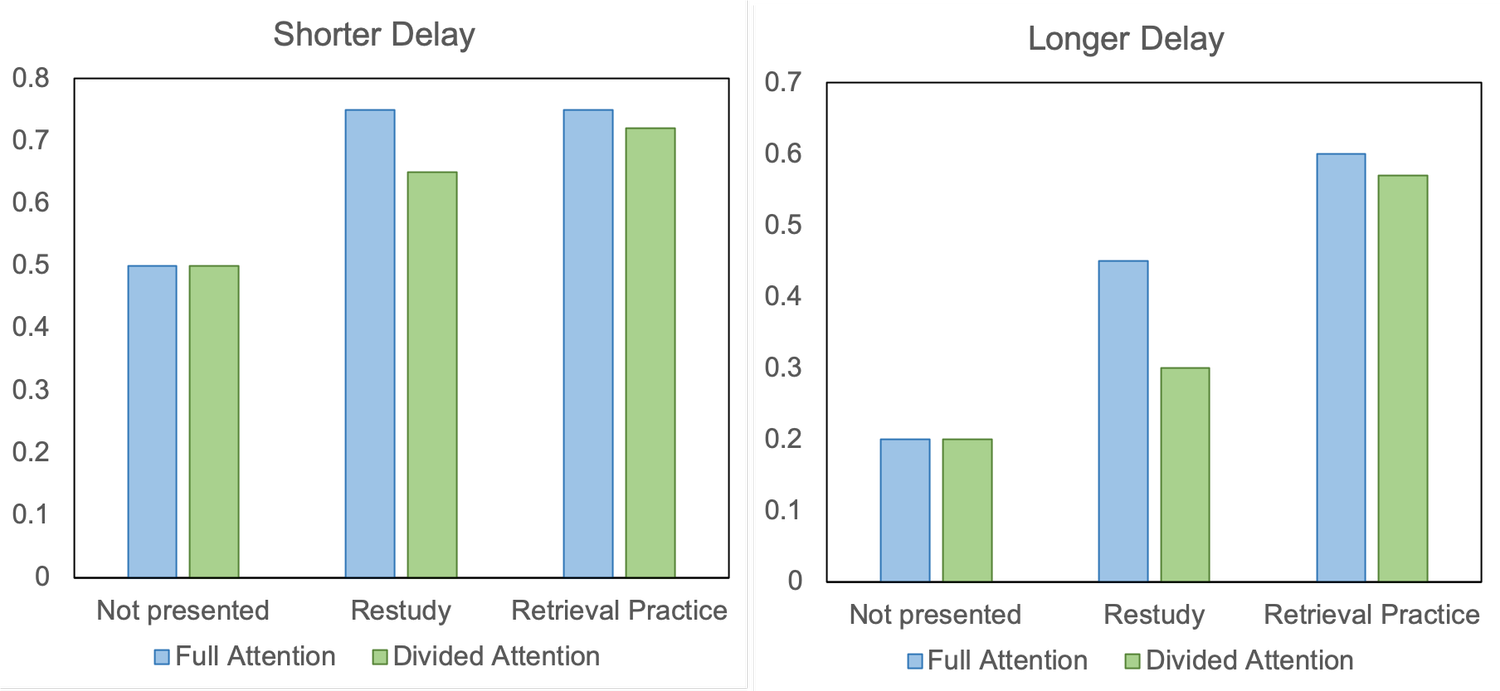
Ep 42Episode 42 - Bite-Size Research on Attention and Retrieval Practice
In this bite-size research episode, Althea describes a study about how attention affects learning with retrieval practice when students are studying on their own by Neil Mulligan and Milton Picklesimer (2016).
Ep 41Episode 41 - Feedback with Dr. Naomi Winstone
In this episode, Carolina Keupper-Tetzel interviews Dr. Naomi Winstone (@DocWinstone) an expert in assessment and feedback.
Ep 40Episode 40 - Memorizing Facts vs Using Information with Dr. Jared Cooney Horvath
In this episode, Cindy Nebel interviews Dr. Jared Cooney Horvath (@JCHorvath), neuroscientist and educator affiliated with University of Melbourne and author of Stop Talking Start Influencing: 12 Insights From Brain Science to Make Your Message Stick. During the interview, they discuss how we take information in, and how do we use it, or transfer it to new situations.
Ep 39Episode 39 - Bite-Size Research on Awareness of Evidence-Based Practice
In this Bite-Size Research Episode, Megan describes a paper by Kayla Morehead and colleagues (2016) about student and instructor knowledge about evidence-based study strategies.
Ep 38Episode 38 - A (pseudo) Randomized Control Experiment about Teaching Effective Learning Strategies
In this episode, Megan and Cindy talk about their massive research project at Washburn University investigating the effectiveness of an intervention to teach first-year college students effective study strategies.
Ep 37Episode 37 - Bite-Size Research on Learning to Learn Effectively
In this episode, Megan describes a paper by Dr. Jennifer McCabe investigating whether students understand what learning strategies are most effective, and whether we can teach this to students.
Ep 36Episode 36 - Carolina's Research on CPD and Service Learning
In this episode, Megan and Carolina chat about Carolina's CPD research, her Service Learning projects, and the TILE network.
Episode 35 - Implementing Effective Strategies
This episode was funded by the Chartered College of Teaching, and listeners like you. For more details on how to help support our podcast and gain access to exclusive content, please see our Patreon page.Listening on the web? You can subscribe to our podcast to get new episodes each month! Go to our show on iTunes or wherever you get your podcasts.RSS feed: http://www.learningscientists.org/learning-scientists-podcast/?format=rssShow Notes:In this episode, Megan and Althea discuss things to keep in mind when trying to implement evidence-based learning strategies into your classroom.We start out with a brief description of the six strategies for effective learning. If you haven’t listened to previous episodes yet, we recommend going back to the first set of episodes, 1 through 13, to hear more about each strategy in depth. The purpose of the review is to provide a bit of spaced practice!Some tips to keep in mind: Don’t try to implement all of the strategies all at once or all of the time. Don’t try to overhaul your entire course! Start with small changes and see how it goes. You can keep making little changes with each iteration of the course.Remember, each strategy works because it encourages processing that promotes learning. So, implementing these strategies are all about encouraging useful processing. When looking from the outside, two groups of students can look like they’re doing the exact same thing, but in reality one group may be doing something useful and the other not. Using the strategies in the classroom also won’t always look the same.
Ep 34Episode 34 - An Introduction to our Team in 2019!
Listen as Megan, Cindy, Althea, and Carolina discuss our workshops during our England 2019 tour, and the excitement around talking with teachers about the science of learning.
Ep 33Episode 33 - Bite-Size Research on Using Laptops to Take Notes
In this bite-size research episode, Megan covers a research article that finds taking notes by hand to lead to more learning than taking notes on laptops.
Ep 32Episode 32 - Attention, Learning, and Memory with Althea Kaminske
In this episode, Megan interviews Dr. Althea Kaminske, the newest member of the Learning Scientists and Assistant Professor at St. Bonaventure University in New York.
Ep 31Episode 31 - Bite-Size Research on Retrieval Practice and Complex Content
This is a bite-size research episode, where we briefly describe research findings on a specific topic. This week, Yana talks research findings about the benefits of retrieval practice when learning complex materials.
Ep 30Episode 30 - Learning and Applying Medical Knowledge with MD PhD student Alexander Chamessian
In this episode, Yana interviews Alexander Chamessian, an MD PhD student who has been consistently utilizing evidence-based learning strategies.
Ep 29Episode 29 - Developments in Brain Imaging to Foster Learning with Julien Mercier
In this episode, we interview Julien Mercier at the EARLI conference in London about his work with brain imaging and Education.
Ep 28Episode 28 - Technology and the Brain with Miriam Reiner
In this episode, we interview Miriam Reiner at the EARLI conference in London about her work with technology and the brain. Miriam is the head of the Virtual-Reality & NeuroCognition at the Israel institute of Technology.
Ep 27Episode 27 - Dyslexia, Dyscalculia, and Dyspraxia with Jane Emerson
In this episode, we interview Jane Emerson at the EARLI conference in London about her work with those who suffer from dyslexia, dyscalculia, and dyspraxia. Jane is the founder of Emerson House, a teaching center helping children who need extra help with literacy and numbers.
Ep 26Episode 26 - Classroom Noise and Learning with Jessica Massonnié
In this episode, we interview Jessica Massonnié at the EARLI conference in London about her research on noise in the classroom, and how noise affects student learning and creativity.
Ep 25Episode 25 - An Interview with Two Teachers
In this episode, we interview two teachers at the EARLI conference in London about their teacher learning and student learning communities.
Ep 24Episode 24 - The Golden Spiral of Lifelong Learning with Ignatius Gous
In this episode, we interview Ignatius Gous at the EARLI conference in London about his framework to assist in lifelong learning.
Ep 23Episode 23 - Executive Function and Computational Thinking with Rina Lai
In this episode we interview Rina Lai in London!
Episode 22 - Attention and the Classroom with Michael Hobbiss
This episode was funded by The Wellcome Trust, and supporters like you. For more details, please see our Patreon page. In today's episode, we feature one of our patrons, Bob Reuter.Listening on the web? You can subscribe to our podcast to get new episodes each month! Go to our show on iTunes or wherever you get your podcasts.RSS feed: http://www.learningscientists.org/learning-scientists-podcast/?format=rssShow Notes:This is the second episode in a series recorded in London! In June 2018 we attended the European Association for Research on Learning and Instruction conference (or, more simply, EARLI) for the special interest group on Neuroscience and Education (@EarliSIG22). While there, we recorded live interviews with teachers and researchers. This episode features Michael Hobbiss. (Check out Episode 21 for our first interview with Dr. Emma Blakey!)Please excuse any issues with sound quality. We were quite literally recording on the fly! Michael Hobbiss started his career as a teacher for 8 years, teaching psychology and biology in the UK and abroad. He is now back in the UK, pursuing his PhD with Dr. Nilli Lavie at University College London. His focus is on attention, distraction, and cognitive control in adolescents. Mike tweets at @mikehobbiss and blogs at The Hobbolog.In the beginning of the episode, Mike describes the two main ways attention is captured:Bottom-up: the object or stimulus itselfTop-down: your prior knowledge, interest, motivationBoth of these processes are prone to distraction. But surprisingly, Mike says, we don't know all that much about how students get distracted during learning. We do know that attention is related to important educational outcomes: for example, teacher ratings of children's attention at age 5 correlate with the children's later academic success (although, teacher ratings are not always reliable and tend to vary between cultures). We also know that inattention can be related to being unhappy. For his PhD, Michael has set out to investigate attention processes in adolescents.The irrelevant distractor taskMike uses the "irrelevant distractor" task in his research. In this task, participants have to pick a particular object out of a visual display. For example, they might have to pick out the letter O from an array of Xs. This would be an easy task - one with low "perceptual load", because the other letters (Xs) do not look similar to the target letter (O). In a high perceptual load version of this task, participants would need to pick out the letter X from, say, letters like K or M, which are more similar. At the same time, during this task, random irrelevant distractors such as Sponge Bob will pop up on the screen. Image from a presentation by Dr. Sophie Forster Typically, when the task has higher perceptual load, people are less likely to notice and be distracted (in other words, slowed down) by the irrelevant distractor (1). However, Mike didn't find this pattern in his research with adolescents - in the episode he describes a very different pattern of results that involved adolescents' accuracy as well as speed. Interestingly, Mike found a relationship between students' self-reported level of distraction during class and their performance on this task.While these results are exciting, Mike warns against acting on these findings immediately in the classroom - we need to understand a lot more about how distraction varies within and between children before we build interventions to address it.The big takeawayWe tend to think of attention as a resource that we either have or don't have; this may not be a useful way to think about it. Many factors in the environment influence attention, so there is enormous potential to improve attention - for example, putting your phone away when you're trying to work, choosing what type of music you are listening to, and using pictures effectively.References:(1) Forster, S., & Lavie, N. (2009). Harnessing the wandering mind: The role of perceptual load. Cognition, 111, 345-355.Previous Episodes from this series:Episode 21 with Dr. Emma Blakey
Ep 21Episode 21 - Executive Function Development with Emma Blakey
In this episode, we interview Emma Blakey at the EARLI conference in London about executive function development in young children.
Ep 20Episode 20 - Sleep, Learning, and Self Care
In this Episode, we discuss the importance of sleep for learning and self care, and talk about tips for bed time.
Ep 19Episode 19 - Bite-Size Research on Benefits of Retrieval with Medical Residents
This is a bite-size research episode, where we briefly describe research findings on a specific topic. This week, Megan talks research findings showing that medical residents benefit from retrieval practice after didactic conferences.
Ep 18Episode 18 - Effective Studying in Medical School with Alyssa Smith
Alyssa Smith, a 3rd year medical student at Chicago Medical School, talks about using evidence-based learning strategies.
Ep 17Episode 17 - For Parents Interested in Student Learning Part 2
In this episode for parents, we first briefly review spaced practice, interleaving, and retrieval practice. We then talk about elaboration, concrete examples, and dual coding. We talk about what parents might see their children doing if their teachers or schools are encouraging these effective learning strategies. We also talk about ways parents can help their kids use these effective learning strategies.
Ep 16Episode 16 - For Parents Interested in Student Learning Part 1
In this episode for parents, we cover spaced practice, a little bit about interleaving, and retrieval practice. We talk about what parents might see their children doing if their teachers or schools are encouraging these effective learning strategies. We also talk about ways parents can help their kids use these effective learning strategies.
Ep 15Episode 15 - How Students Can Use Interleaving, Elaboration, Dual Coding, and Concrete Examples
In this episode for students, we briefly recap how students can use spacing and retrieval practice. Then, we shift into explaining how students might use other effective study strategies, interleaving, elaboration, dual coding, and concrete examples, to make study sessions more effective and efficient.
Ep 14Episode 14 - How Students Can Use Spacing and Retrieval Practice
MEGAN SUMERACKI: Welcome to the Learning Scientist Podcast, a podcast for teachers, students, and parents about evidence-based practice and learning.YANA WEINSTEIN: The Learning Scientist Podcast is funded by the Wellcome Trust.MEGAN SUMERACKI: Hi. I'm Dr. Megan Sumeracki, a professor at Rhode Island College.YANA WEINSTEIN: And I'm Dr. Yana Weinstein, a professor at UMass Lowell. MEGAN SUMERACKI: And together, we co-founded the Learning Scientists. We apply cognitive psychology to education for teachers, students, and parents but today's episode is specifically for students. We're going to be talking about how we can take the research on learning and memory and apply it to student studying to try to improve how much you're learning and how well you're performing on tests and exams, as well as other types of assessments. YANA WEINSTEIN: So, we're assuming that students at different stages in their education might be listening to this. You might be still in high school, you might be at the beginning of your college career or maybe towards the end. Or maybe you're in a different stage of your life, but still learning something. We hope that this episode will be applicable regardless of what age you are or what you're studying. We're going to be talking about a few different strategies that are based in research from cognitive psychology that has been conducted over the past few decades. So, the strategies we'll be talking about are ones that have been repeatedly demonstrated as effective. First of all, we'd like to talk to you about two very important strategies. They're called spaced practice and retrieval practice. Don't worry about that specific terminology. We'll define it and repeat the definitions as we go through the podcast episode.MEGAN SUMERACKI: And so there are six and you can use them all together. But if you were only going to start with two and probably you want to start with just a couple. It's going to be difficult for you to listen to one podcast and then completely overhaul the way you are studying or trying to guide your own independent learning. So if you're just going to take two, spaced practice and retrieval practice really are the gold standard study strategies. They're the ones that have the most evidence to support their effectiveness. These are the two strategies that are the most widely applicable to students at different stages within their education and also across different subjects, from history to math, to engineering,YANA WEINSTEIN: to sport,MEGAN SUMERACKI: to psychology,YANA WEINSTEIN: to a musical instrument learning,MEGAN SUMERACKI: to dancing, and so on.YANA WEINSTEIN: So let's talk about space practice first. The idea of spaced practice or spacing out your studying over time is basically the opposite of something you might be familiar with, cramming. Think back to the last exam or test that you took. Did you spend a while doing some studying a little bit over time? So maybe half an hour a day for a few weeks? Or did you perhaps spend one day right before the exam, a long, long day of studying and then maybe even studying late into the night? Generally, we find that students tend to prefer that second method, or maybe they don't prefer it, but certainly the one that they default to simply because, well, various reasons. But one of them is that we're all quite deadline-driven. So when that test comes up and it's tomorrow, that's when we sort of get in gear to study. MEGAN SUMERACKI: It's a lot easier throughout the weeks when the test isn't coming up to say, oh, I don't need to do my half hour today. Oh, I'll do it tomorrow. Well, I'll double up over the weekend. And if you keep doing that over and over again, eventually you end up right before the test not having studied very much and needing to try to cram.YANA WEINSTEIN: And space practice is the opposite of that. It involves setting aside small chunks of time to practice over a period of at least a few weeks leading up to the exam. Now, the thing about spaced practice is that even if you spend the same amount of time studying that information spaced out as compared to cramming it on that last day, you are likely to remember more of it on the exam. So in reality, you won't be studying more, you'll be studying the same amount of time, but spread out over longer.MEGAN SUMERACKI: And when you spread out your study episodes over longer periods of time, you learn more in the same amount of time than you would if you crammed. The other benefit of spacing is that the stuff that you're learning actually becomes more durable. You're learning for the long term, not just for the test right now. And a lot of times, we are really mostly worried about the test right now. So if it's the night before an exam, you just want to cram it in, get through the test, and you don't really care if you remember it later. Or maybe that's your future self's problem. But in reality, eventually you're going to need that material again, even if it's
Ep 13Episode 13 - Bite-Size Research on Dual Coding vs Learning Styles
This is a bite-size research episode, where we briefly describe research findings on a specific topic. This week, Yana Weinstein talks about dual coding vs. learning styles. You don't have to be a "visual learner" to benefit from the combination of visuals and words! (In fact, there's no such thing as a "visual learner".)
Ep 12Episode 12 - Dual Coding
In this episode, we talk about the last strategy, dual coding. We talk about ways teachers and students can utilize dual coding, and distinguish this from learning styles.
Ep 11Episode 11 - Bite-Size Research on Providing Multiple Concrete Examples
This is a bite-size research episode, where we briefly describe research findings on a specific topic. This week, Megan Sumeracki talks about the need for providing multiple concrete examples to facilitate students' ability to transfer the underlying idea to new problems.
Ep 10Episode 10 - Concrete Examples
In this episode, we introduce Concrete Examples. Most teachers probably use concrete examples, but in this episode we talk about why it is important to use more than one!
Ep 9Episode 9 - Bite-Size Research on Interleaving Categories
This is a bite-size research episode, where we briefly describe research findings on a specific topic. This week, Yana Weinstein talks about interleaving while trying to learn to categorize, such as paintings by different painters or chemical categories such as alcohol.
Ep 8Episode 8 - Interleaving
In this episode, we introduce the concept of interleaving. We explain when it works, why it works, and open questions.
Ep 7Episode 7 - Bite-Size Research on Elaborative Interrogation
In this bite-size research episode, Megan Sumeracki talks about a research study where 6th and 7th grade students used elaborative interrogation independently and with a partner. Elaborative interrogation improved learning compared to reading and students picking their own learning strategy. The effects were durable, and students who used elaborative interrogation still knew more than other groups 60 days later.
Ep 6Episode 6 - Elaborative Interrogation
In this podcast, we discuss elaboration, specifically elaborative interrogation. We also talk about how teachers might implement elaborative interrogation in the classroom, and some things to watch out for when students are using this strategy.
Ep 5Episode 5 - Bite-Size Research on Spaced Retrieval
In this bite-size research episode, Yana Weinstein talks about the learning benefits of combining spaced practice and retrieval practice. Assessment of both fact learning and application of knowledge is discussed.
Ep 4Episode 4 - Spaced Practice
In this podcast, we discuss what spaced practice is and how to utilize it to promote learning. We share some ways teachers can help students use spaced practice on their own, and ways for teachers to integrate spacing into their own teaching. Finally, we share some personal stories about spacing out learning or cramming before important events.
Ep 3Episode 3 - Bite-Size Research on Retrieval Practice Formats
In this bite-size research episode, Megan Sumeracki discusses research comparing short-answer, multiple-choice, and hybrid quiz formats. She addresses the question, do some formats produce more learning than others?
Ep 2Episode 2 - Retrieval Practice
In this podcast, we discuss what retrieval practice is and how it benefits learning. We also talk about ways to implement retrieval-based learning activities in the classroom and for independent studying.
Ep 1Episode 1 - Welcome to the Learning Scientists Podcast!
In this episode, the two of us – Dr. Yana Weinstein (UMass Lowell) and Dr. Megan Sumeracki (formerly Megan Smith; Rhode Island College) – introduce ourselves and tell you a bit about our backgrounds, how we came to start the Learning Scientists project, and what we’ll be talking about on this podcast.