
The Jim Rutt Show
The Jim Rutt Show
Show overview
The Jim Rutt Show has been publishing since 2019, and across the 7 years since has built a catalogue of 461 episodes, alongside 57 trailers or bonus episodes. That works out to roughly 570 hours of audio in total. Releases follow a weekly cadence.
Episodes typically run an hour to ninety minutes — most land between 1h 3m and 1h 31m — though episode length varies meaningfully from one episode to the next. Roughly 43% of episodes carry an explicit flag from the publisher. It is catalogued as a EN-US-language Science show.
There hasn’t been a new episode in the last ninety days; the most recent episode landed 5 months ago. The busiest year was 2020, with 101 episodes published.
From the publisher
Crisp conversations with critical thinkers at the leading edge of science, technology, politics, and social systems.
Latest Episodes
View all 461 episodesEP 346 Cory Doctorow on Why the Internet Got Worse and What to Do About It
EP 345 Worldviews: Tyson Yunkaporta on Ceremony, Skepticism, and Seeing in 3D
EP 344 Lisa Buckingham on Hiring for the AI Era
EP 343 Worldviews: Peter Wang on the Metaphysics of Quality, Sucker’s Bets, and Ofness
EP 342 Worldviews: Jordan Hall on Reality as Relationship and Why the Dead Are Still With Us
EP 341 Worldviews: Bonnitta Roy on Post-Formal Actors, Stage Theory, and the Character Void in Leadership
EP 340 Worldviews: Liv Boeree on Poker, Moloch, and the Art of Finding Win-Wins
EP 339 John Krakauer on Why Neuroscience Needs Behavior

S1 Ep 338EP 338 Jeff Giesea on Dionysian Futurism, Reading Great Books in the AI Era, and Rebalancing Generational Power
EJim talks with Jeff Giesea, entrepreneur, writer, and founder of the Boyd Institute, about his essay "Dionysian Futurism" and the broader question of what's missing from our visions of the future. They discuss Nietzsche's Apollo/Dionysus framework from The Birth of Tragedy, the critique that techno-optimist futures are lifeless and sterile, Jim's extension of that critique to Game B and adjacent social change spaces, the distinction between positive Dionysian energy and mere degeneracy, Jim's concept of decadence as wire-heading on dopamine traps and gambling apps, generational decline in conviviality, Gen Z statistics on less sex and fewer dates, the structural economic pressures of student debt and housing unaffordability, the shift in college freshman values away from meaningful philosophy of life toward financial success, the dinner party versus restaurant ratio and what's been lost, the vanished culture of Georgetown dinner salons and political hostesses like Pamela Harriman, the trade-off between women entering the workforce and the loss of socially maintained conviviality infrastructure, the call to bring back the host or hostess curating eight to twelve people around a topic, Jeff's "The Humanities Revolution Has Already Begun" essay and the Kairos Project's decentralized open-source great-books discussion groups, Hannah Arendt's The Human Condition and its relevance to AI and what it means to be human, the tent-revival quality of the new bottom-up humanities movement, Homer and the bards as evidence that great books were never meant only for scholars, Substack as Renaissance Florence, self-gatekeeping around the humanities and the call to read great books at any phase of life, Jim's return to the Iliad and Odyssey and current reading of Zen and the Art of Motorcycle Maintenance, audiobooks and the opportunity to produce better audio versions of copyright-free great works, Foucault as a poisoner of two generations of scholars, the woke turn in university humanities departments and Jacob Savage's essay "The Lost Generation," three drivers of the humanities revolution in pushback against woke academia, digital technology, and AI, AI as a tool for reading difficult books versus the risk of delegating critical thinking, Pirsig's concept of quality as a North Star for deciding when to use AI, taste as the Silicon Valley word for quality, Jeff's "goddamn Boomers" trilogy on the Boomer reckoning and the long Boomer farewell, the Boomer paradox of holding society together while holding it back, the gerontocracy problem of spending six dollars on old people for every one dollar on young people, entitlement spending flowing to the wealthiest demographic, Social Security couples at the top receiving over a hundred thousand dollars a year, California's real estate tax caps and their effect on schools, the political power of older voters and the absence of an AARP for young people, Gen X's failure to produce a presidential contender, Don Draper in Mad Men as a hinge figure between Greatest Generation and Boomer values, Boomer narcissism versus Gen X grandiosity, Jim's reframe of the core Boomer failing as hyper-individualism rather than narcissism, and much more. Episode Transcript "Dionysian Futurism," by Jeff Giesea The Boyd Institute Jeff Giesea (Twitter) "The Lost Generation," by Jacob Savage "The Boomer Reckoning No One's Ready For," by Jeff Giesea "Boomer Caregiving Will Wreck Our Politics," by Jeff Giesea "The Long Boomer Farewell," by Jeff Giesea "The Broligarchy Will Either Save the World or Destroy It," by Jeff Giesea Jeff Giesea is an entrepreneur, investor, and writer. A Stanford graduate, he has built several successful businesses and recently founded the Boyd Institute, a policy lab for America's future. You can read his essays on his Substack.
S1 Ep 337EP 337 Worldviews: Philip Rosedale on Emergent Worlds, Localism, and What Building Second Life Taught Him About Humanity
Jim talks with Philip Rosedale, founder and CEO of Linden Lab and creator of the game Second Life, about the nature of self, society, and the design of virtual worlds. They discuss the phenomenology of waking up and coalescing into a self, the polycrisis and whether to work on AI or on software that helps people get along better, Philip's role-based sense of identity, his messianic feeling during Second Life's early days versus a more Zen perspective now, humanity's place in the cosmic timeline, resistance to the techie utopian view that humans are merely a stepping stone to AI, the duty to "think local" and align at the scale of immediate community, Doug Rushkoff's "team human" concept, shared objective reality as social glue, the danger that technology has reduced the coherence of our collective worldview, Jim's "minimum viable metaphysics" and the reality assumption as operationally necessary, overapplying quantum mechanics to produce anti-realist worldviews, Philip's founding vision for Second Life as an emergent system contrasted with Old Testament god-game design, Craig Reynolds' Boids flocking rules and the tattoo encoding cohesion, separation, and alignment, emergent currency as a feature rather than a bug, the demand for beautiful avatars and identity expression as the first break from the simulation dream, why low-fidelity text platforms became massive while Second Life became big but not huge, the uncanny valley problem and its origins, AI video generation as a potential breakthrough for real-time believable face animation in virtual worlds, the whites of human eyes as a social signaling adaptation, the topology of connectivity producing different social emergence, Second Life's local topology versus Twitter's power-law scale-free network, the Game B concept of the membrane and voluntary strong-sauce agreements within small groups, Facebook groups as an early moment of rightness before the bleaching phenomenon took hold, crypto's attraction of bad actors and Vitalik Buterin's recent admission that Ethereum didn't serve humanity as intended, anonymity as generally harmful and the need for identity through group belonging, the trillion-dollar opportunity of a personal agent as a defensive membrane, the mid-nineties fork in the road on micropayments versus free, neutral infrastructure decisions having massive emergent cultural effects, what Jim learned from the Santa Fe Institute about the limits of confident long-range prediction, Karl Friston's work on consciousness and the membrane around something alive, world-model building as fundamental to selfhood, consciousness as discovering the self inside the world model, lucid dreams as a visceral analogy for the strange loop, and much more. Episode Transcript Free, by Chris Anderson Gödel, Escher, Bach: An Eternal Golden Braid, by Douglas Hofstadter "What Is It Like to Be a Bat?", by Thomas Nagel Awakening the Angels", by Philip Rosedale Team Human, by Douglas Rushkoff Philip Rosedale is the founder of Second Life, where he served as CEO for a decade and recently rejoined as CTO. He previously created FreeVue, an early videoconferencing app acquired by RealNetworks, where he became CTO and led the creation of RealVideo. He later co-founded High Fidelity, an open-source VR platform that pivoted to spatial audio. His current projects include FairShare, a group-based digital currency aimed at reducing wealth inequality, and the California Institute of Machine Consciousness, a research initiative exploring consciousness in machines.
S1 Ep 336EP 336 Rufus Pollock on the Wisdom Gap and the Second Renaissance
EJim talks with Rufus Pollock—entrepreneur, activist, Zen practitioner, founder of Life Itself and the Open Knowledge Foundation, and author of Open Revolution—about the metacrisis, the wisdom gap, and what a Second Renaissance might look like. They discuss Jim's own early belief that accessible information would produce a renaissance of democracy, the realization that "open knowledge does not make open minds," the printing press and Gutenberg as a historical parallel to today's breakdown of sense-making, why today's epistemic crisis is exponentially harder than 1520 because any formulation you want is on offer, the breakdown of trust in science and rational bureaucracy as parallel to the collapse of Catholic epistemic authority, Christopher Alexander's work as the best analogy for wisdom and his claim that beauty and wholeness are real, Rufus's three elements of wisdom—"valuception," discernment, and the capacity to act—applied both individually and collectively, how humans have solved collective action problems by culturally hijacking kin-care genetics to imagine a larger we, culture as scaffolding for people who can't or won't do inner work themselves, Joseph Henrich's framing of humans as the imitation ape rather than the smart ape, the distinction between surface culture and deep civilizational paradigms, Life Itself's conscious co-livings as experiments in new cultural practices, the personal-institutional spiral and why retreat benefits evaporate without external scaffolding, the three layers of the metacrisis, distinguishing the polycrisis from the metacrisis using the HIV/AIDS analogy, modernity's core assumptions and how in the endgame the light becomes a shadow, the five features of a Second Renaissance worldview compared to modernity, technology as the de facto religion of modernity, the Buddhist distinction between waking up and growing up and the aspiration for an awakening society, AI as a case study in the multipolar trap at the company, capital, and geopolitical levels, the historical engine of group enlargement and why war can no longer serve that function, and much more. Episode Transcript Open Revolution, by Rufus Pollock Rufus Pollock's Website Life Itself Life Itself Hubs for Conscious Community A Pattern Language, by Christopher Alexander The Nature of Order, by Christopher Alexander The Timeless Way of Building, by Christopher Alexander Open Knowledge Foundation Second Renaissance Second Renaissance White Papers Introduction to Developmental Spaces (information and paper) Metacrisis: An Introduction Rufus Pollock is an entrepreneur, activist and author as well as a long-term zen practitioner. He is passionate about finding wiser, weller ways to live together. He has founded several for-profit and nonprofit initiatives including Life Itself, Open Knowledge Foundation, and Datopian. His book Open Revolution is about making a radically freer and fairer information age. Previously he has been the Mead Fellow in Economics at the University of Cambridge as well as a Shuttleworth and Ashoka Fellow. A recognized global expert on the information society, he has worked with G7 governments, IGOs like the UN, Fortune 500s as well as many civil society organizations. He holds a PhD in Economics and a double first in Mathematics from the University of Cambridge.
S1 Ep 335EP 335 Worldviews: Samantha Sweetwater
Jim talks with Samantha Sweetwater about her book True Human: Reimagining Ourselves at the End of Our World and the question of what it means to be human at this moment in planetary history. They discuss her verb-based rather than noun-based self-identity, Lisa Feldman Barrett's construction theory as a framework for understanding the entanglement of body, brain, mind, and relationship as the fabric of lived experience, Samantha's identity as a "Gaian" and humans as a creator-destroyer class of organism, the Fermi paradox and the gigantic moral freight of potentially being the only general intelligence in the universe, the meaning of the sacred and John Vervaeke's formulation that "sacred is how the world is to us when we see it through the eyes of love," Jim's own definition of the sacred as the appropriate stance toward things too complex for reductionist analysis, the metacrisis as fundamentally a crisis of separation, the four generator functions of separation including stories of separability, structures of separability, win-lose game-theoretic dynamics, and dominator ideologies, the forager operating system and Chris Boehm's account of how egalitarian societies historically defeated hierarchy, the hinge of agriculture and henchmen enabling dominator systems, Luke Kemp's Goliath's Curse and the contrast between fluid civilizations and Goliaths, role-based non-hierarchical leadership in forager societies and whether it can scale, Audrey Tang as an emergent archetype of life-centric coordination, psychedelics as allies and teachers rather than mere tools, Samantha's personal healing path through sacrament, community, and prayer, the neuroscience of heightened neural entropy and the brain's wash cycle, the ontological reframe of one's own importance, the hard problem of machine consciousness and the California Institute for Machine Consciousness, the space of minds and the n=1 problem of one planet and one biochemistry, the MoltBook experiment of AI inventing languages and religions, relationality as the core practice available to people in their actual lives, humans as a custodial species and co-orchestrators rather than dominion-holders, Tyson Yunkaporta's Sand Talk, and much more. Episode Transcript True Human: Reimagining Ourselves at the End of Our World, by Samantha Sweetwater Goliath's Curse, by Luke Kemp Sand Talk, by Tyson Yunkaporta JRS Currents 010: Tyson Yunkaporta on Humans as a Custodial Species Samantha Sweetwater is the author of True Human: Reimagining Ourselves at the End of Our World, a meta-relational educator, leadership mentor, and the founder of One Life Circle, a ministry of remembering. For over three decades, she has facilitated individual and collective transformational experiences across diverse cultures and communities on five continents. As the founder of Dancing Freedom and Peacebody Japan, she pioneered a global movement of embodied awakening and trained hundreds of facilitators worldwide. Her work bridges ecology, complexity, spirituality, and technology with lived experience, inviting a re-imagining of what it means to be human in a time of planetary techno-cultural transformation. Through teaching, writing, and attuned presence, she helps people restore relationship with their bodies, each other, and the living world as a foundation for wise action in uncertain times.
S1 Ep 334EP 334 Worldviews: Joscha Bach
Jim talks with cognitive scientist and AI researcher Joscha Bach about the computational and representational foundations of consciousness, mind, and reality. They discuss the phenomenology of waking up and coalescing into a self, language as a representational architecture and natural language as "a genre of music," the brain as a game engine constructing a simulated world, the "feeling of realness" as a hallucination, "to be real means to be implemented" as a criterion for reality, money as an AI and a mechanism for reward allocation, the need for multi-dimensional organizational signaling beyond money, the apparent reversibility of the universe as an emergent observational artifact, the block universe and its incompatibility with stacked emergence, causality as a model property and retrocausality at the level of agents, computation vs. the simulation hypothesis, the brain's object engine and the perceptual choice to see textures vs. named objects, aphantasia and metacognition about perception, why only simulations can be conscious, Christof Koch's shift from physicalism to panpsychism and the unreliability of revelatory mental states, consciousness as second-order perception distinct from selfhood, panpsychism's resurgence and its failure to formalize "the consciousness of a particle," consciousness as happening at neuronal communication speeds, intelligence vs. consciousness as relatively orthogonal dimensions, the Waymo as highly intelligent but not conscious, François Chollet's argument that deploying skills is not itself intelligent, consciousness as a consensus algorithm analogous to blockchain, whether a bacterium or a cat needs a self-model to achieve coherence, emotion and motivation as core to cognition in MicroPsi, Karl Friston's free energy principle and its limits at higher emergent levels, humans as "multicellular at the next level" forming transcendental agents, the global optimum of collectively enacted agency as "God" as the ultimate source of meaning, and much more. Episode Transcript California Institute for Machine Consciousness (CIMC) Principles of Synthetic Intelligence, by Joscha Bach JRS EP 72 - Joscha Bach on Minds, Machines & Magic JRS EP 87: Joscha Bach on Theories of Consciousness - JRS EP Currents 83: Joscha Bach on Synthetic Intelligence Joscha Bach is a cognitive scientist and AI researcher, and the founder of the California Institute for Machine Consciousness. In the past, he researched and taught at Humboldt University of Berlin, the Institute of Cognitive Science in Osnabrück, MIT Media Lab, the Harvard Program for Evolutionary Dynamics and Intel Labs. He has helped build several startups and created the cognitive architecture MicroPsi, which studies the relationship between emotion, motivation and cognition. He currently lives in the Bay area in California.
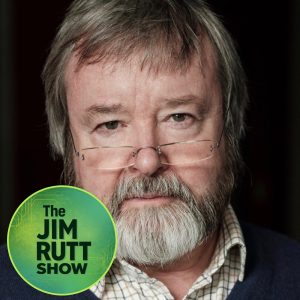
S1 Ep 333EP 333 Worldviews: Iain McGilchrist
EIn this Worldviews episode, Jim talks with Iain McGilchrist about consciousness, matter, and the nature of reality. They discuss consciousness as the basis of everything we know, matter as a phase of consciousness that provides resistance and persistence, pan-experientialism and the belief that everything in the cosmos experiences in some form, the whirlpool metaphor for individual consciousness within a broader field, emergent naturalism and nested levels of organization, the question of whether the universe is continuous or granular at the Planck scale, consciousness in animals including chimps and corvids, language as the principal difference between human and animal consciousness, John Vervaeke's distinction between propositional and participatory knowing, the divided brain and how the left and right hemispheres attend to the world differently, the left hemisphere's focus on decontextualized abstractions versus the right hemisphere's grasp of interconnected wholes, how the left hemisphere deals with representations while the right hemisphere experiences presences, living in a world dominated by the relatively stupid left hemisphere, the relationship between consciousness and reality as an encounter rather than naive realism or idealism, relations coming before things, Lee Smolin's argument that time cannot be an illusion, assembly theory's challenge to the block universe, values as ontological primitives that cannot be derived from a valueless cosmos, the distinction between value and values, teleology as a lure rather than determinism using Waddington's creodes metaphor, the three elements of a fulfilled life (belonging to a coherent social group, belonging in nature, and belonging in the cosmos), the breakdown of collective sense making despite increased education levels, the decline in the caliber of political leaders, the distinction between information and wisdom, and much more. Episode Transcript The Master and His Emissary, by Iain McGilchrist The Matter with Things, by Iain McGilchrist JRS EP 154 - Iain McGilchrist on The Matter With Things JRS EP 155 Iain McGilchrist Part 2: The Matter With Things The Emergence of Everything, by Harold Morowitz Time Reborn, by Lee Smolin JRS EP 5 Lee Smolin - Quantum Foundations and Einstein’s Unfinished Revolution Iain McGilchrist is a former Fellow of All Souls College, Oxford, an associate Fellow of Green Templeton College, Oxford, a Fellow of the Royal College of Psychiatrists, a Fellow of the Royal Society of Arts, a Consultant Emeritus of the Bethlem and Maudsley Hospital, London, a former research Fellow in Neuroimaging at Johns Hopkins University Medical School, Baltimore, and a former Fellow of the Institute of Advanced Studies in Stellenbosch. He now lives on the Isle of Skye, off the coast of North West Scotland, where he continues to write, and lectures worldwide. He is committed to the idea that the mind and brain can be understood only by seeing them in the broadest possible context, that of the whole of our physical and spiritual existence, and of the wider human culture in which they arise – the culture which helps to mould, and in turn is moulded by, our minds and brains.
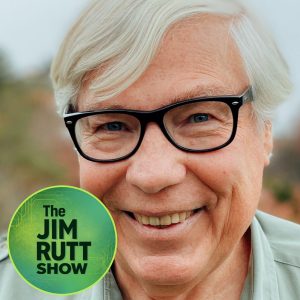
S1 Ep 322EP 332 Worldviews: Jim Rutt
EIn a special edition of the new Worldviews series, Brendan Graham Dempsey asks Jim about his life and worldview using a faith development interview. They discuss Jim's life chapters from growing up through becoming a complexity guy and GameB advocate, his age 11 epiphany that religion is bullshit after researching world religions at the library, the formative influence of his wife and parents who built lives from poverty, his realization that exponential growth on a finite planet driven by advertising and economic systems is destructive, understanding the limits of knowledge through complexity science and rejecting naive Newtonianism, his three core values of human well-being, ecological richness, and preserving humanity's path to bring the universe to life, the belief that humans may be the only general intelligence in the universe, the sacred as high-dimensional experiences that can't be explained scientifically, the importance of humility given how often we're wrong, the decision-making method of studying enough for a bullshitter's understanding then walking until reaching a conclusion, utilitarian deontology, human life as a leaf node on the tree of emergence, language and science as major transitions with AI as a potential third, disbelief in the supernatural, explaining evil through game theory, psychopathy as evil by nature, humans as mesoscale entities, a universe fine-tuned for emergence, and much more. Episode Transcript Institute of Applied Metatheory A God That Could be Real: Spirituality, Science, and the Future of Our Planet, by Nancy Ellen Abrams Brendan Graham Dempsey is Director of Research at the Institute of Applied Metatheory, where he studies the complexification of worldviews and human meaning-making systems across scales. He holds an advanced degree from Yale University, where he studied religion and culture. His books include Emergentism: A Religion of Complexity for the Metamodern World and the multi-volume Evolution of Meaning series. He is Managing Editor of Integration: The Journal of Big Picture Theory and Practice and a founding editor of Metamodern Theory & Praxis.

S1 Ep 331EP 331 Worldviews: Michael Shermer
Jim talks with Michael Shermer about his worldview and his new book, Truth: What It Is, How to Find It, and Why It Still Matters. They discuss Michael's self-identification as a monist and realist who believes in a physical objective world, the concept of fallibilism, intersubjective verification of the interobjective, reliance on authorities and institutions, the battle between the book of authority versus the book of nature, balancing rationality with empiricism, the dependence of mathematical truths on axioms, January 6 as an example of people acting rationally on false beliefs, Shermer's journey from born-again Christian to atheist and Jim's opposite journey from Catholicism to atheism, treating religious literature like great literature with deeper truths, the study of consciousness and the hard problem versus the easy problem, separating intelligence from consciousness, consciousness as a biological process like digestion, the question of machine sentience, a critique of Donald Hoffman's interface theory, evidence for veridical perception through mimicry in nature and animals climbing trees, skepticism about brain-in-a-vat and simulation scenarios, minimum viable metaphysics, Thomas Nagel's concept of one thought too many, Jonathan Rauch's constitution of knowledge, the replication crisis in psychology, the breakdown of trust in institutions due to COVID and the noble lie, the problem of scaling laws with followership, moral realism and the survival and flourishing of sentient beings, the principle of interchangeable perspectives, discovering moral values through problem-solving, the evolution of ethics and the expanding moral sphere, and much more. Episode Transcript Truth: What It Is, How to Find It, and Why It Still Matters, by Michael Shermer The Michael Shermer Show Why People Believe Weird Things, by Michael Shermer The Believing Brain, by Michael Shermer Why Darwin Matters, by Michael Shermer The Science of Good and Evil, by Michael Shermer Conspiracy: Why the Rational Believe the Irrational, by Michael Shermer "A Minimum Viable Metaphysics," by Jim Rutt JRS EP 287 - Jonathan Rauch on the Epistemic Crisis Dr. Michael Shermer is the Founding Publisher of Skeptic magazine and the host of the podcast The Michael Shermer Show. For 30 years he taught college and university courses in critical thinking, and for 18 years he was a monthly columnist for Scientific American. He is the author of New York Times bestsellers Why People Believe Weird Things and The Believing Brain, Why Darwin Matters, The Science of Good and Evil, The Moral Arc, Heavens on Earth, Giving the Devil His Due, and Conspiracy: Why the Rational Believe the Irrational. His new book is Truth: What it is, How to Find it, Why it Still Matters. Follow him on X @michaelshermer.

S1 Ep 330EP 330 Worldviews: Ben Goertzel
EJim talks with Ben Goertzel about his worldview. They discuss Ben's morning experience of consciousness crystallizing from ambient awareness, his identification as a panpsychic, the concept of pattern being more fundamental than stuff, Charles Peirce's ontology of first/second/third, the idea of uryphysics as a broader notion of physics beyond metaphysics, parapsychology and psi phenomena including remote viewing and Project Stargate, reincarnation-like phenomena and cases from India, experimental design in parapsychology research, the legitimation of both AGI and psi research, the consciousness explosion occurring alongside AI/ASI development, Jeffrey Martin's work on fundamental well-being and persistent nonsymbolic experience, the immense design space of possible minds, human cognitive limitations like seven plus or minus two short-term memory, the single-threaded nature of human consciousness versus potential multi-threaded ASI, scenarios for beneficial superintelligence and options for humans to remain in human form or upload, the question of how long human existence would remain interesting post-singularity, psychedelics as tools for accessing different states of consciousness and insights into mind construction, the absence of shamanic institutions in modern culture, experiences with DMT and heroic doses, holding multiple contradictory perspectives simultaneously, Walt Whitman's notion of containing multitudes, Ben's intuitive sense that consciousness and the basic ground of being are fundamentally joyful and compassionate, arguments for why superintelligence will likely be good based on efficiency of mutually trusting agents, and much more. Episode Transcript The Consciousness Explosion, by Ben Goertzel JRS EP 217 Ben Goertzel on a New Framework for AGI JRS EP 211 Ben Goertzel on Generative AI vs. AGI JRS Currents 072: Ben Goertzel on Viable Paths to True AGI Evidence for Psi: Thirteen Empirical Research Reports, ed. Damien Broderick & Ben Goertzel Dr. Ben Goertzel is a cross-disciplinary scientist, entrepreneur and author. Born in Brazil to American parents, in 2020 after a long stretch living in Hong Kong he relocated his primary base of operations to a rural island near Seattle. He leads the SingularityNET Foundation, the OpenCog Foundation, and the AGI Society which runs the annual Artificial General Intelligence conference. Dr. Goertzel’s research work encompasses multiple areas including artificial general intelligence, natural language processing, cognitive science, machine learning, computational finance, bioinformatics, virtual worlds, gaming, parapsychology, theoretical physics and more.
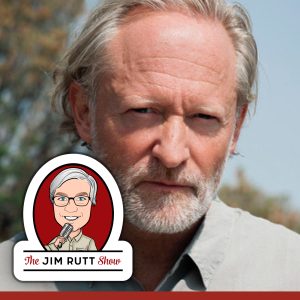
S1 Ep 329EP 329 Worldviews: David Krakauer
In the inaugural episode of a new series, Jim talks with David Krakauer about his intellectual formation and worldview. They discuss what woke up as David this morning, his commitments to chance and pattern seeking, his epiphany about the idea of the idea at age 12 or 13, his perverse attraction to the arcane and difficult, evolution as integral to intelligence, the risk-averse character of scholars and the sociology of science, the Santa Fe Institute's attempt to maintain revolutionary science, the Ouroboros concept challenging foundationalism in epistemology, the standard model of physics as foundational versus the view that you can establish foundations anywhere, string theory as a slowly dying pseudoscience, whether beauty is a useful guide in science, emergence and broken symmetries, Phil Anderson's "More is Different" paper, the Wigner reversal and the shift from law to initial conditions, rejecting both weak and strong emergence, effective theories and causally justified concepts, downward causality, micrograining versus coarse graining, the distinction between abiotic and biotic systems, games and puzzles as model systems for complexity, combinatorial solution spaces, heuristics as dimensional reducers and potentially the golden road to AGI, Isaiah Berlin's influence on David's worldview, negative versus positive liberties, value pluralism and historicity, the Fermi paradox and the possibility of alien life, the rational versus the irrational in human life, and much more. Episode Transcript JRS EP 192 - David Krakauer on Science, Complexity and AI JRS EP10 - David Krakauer: Complexity Science The Complex World: An Introduction to the Foundations of Complexity Science, by David Krakauer Worlds Hidden in Plain Sight: The Evolving Idea of Complexity at the Santa Fe Institute, 1984–2019, by David Krakauer History, Big History, & Metahistory, by David Krakauer "A Minimum Viable Metaphysics," by Jim Rutt "More Is Different," by P.W. Anderson The Emergence of Everything, by Harold Morowitz David Krakauer’s research explores the evolution of intelligence and stupidity on Earth. This includes studying the evolution of genetic, neural, linguistic, social, and cultural mechanisms supporting memory and information processing, and exploring their shared properties. President of the Santa Fe Institute since 2015, he served previously as the founding director of the Wisconsin Institutes for Discovery, the co-director of the Center for Complexity and Collective Computation, and professor of mathematical genetics, all at the University of Wisconsin, Madison.
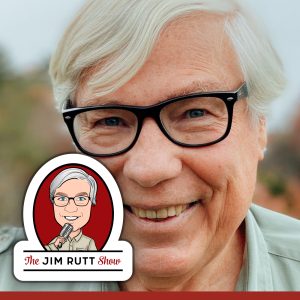
S1 Ep 328EP 328 Brendan Graham Dempsey Interviews Jim Rutt on Minimum Viable Metaphysics
EIn this flipped episode, Brendan Graham Dempsey interviews Jim about the ideas in his recent Substack essays "A Minimum Viable Metaphysics" and "What I Mean by 'Metaphysics'." They discuss metaphysics as assumptions for learning and reasoning, the difference between deduction, induction, & abduction, Jim's belief that there are no paradoxes in the real world, the reality principle, the asymmetry principle, the lawfulness principle, the potential stochastic nature of reality, why determinism and lawfulness aren't the same, consciousness in the tree of emergence, why emergence is important, causal time, downward causality as the main claim of emergence, temporal reciprocal emergence, Jim's reputation for drawing a firearm when the word metaphysics is used, the weak & strong anthropic principles, and much more. Episode Transcript "A Minimum Viable Metaphysics," by Jim Rutt "What I Mean by 'Metaphysics'," by Jim Rutt JRS EP 322 - Brendan Graham Dempsey on Psyche and Symbolic Learning Institute of Applied Metatheory The Beginning of Infinity: Explanations That Transform the World, by David Deutsch JRS Currents 100: Sara Walker and Lee Cronin on Time as an Object Brendan Graham Dempsey is Director of Research at the Institute of Applied Metatheory, where he studies the complexification of worldviews and human meaning-making systems across scales. He holds an advanced degree from Yale University, where he studied religion and culture. His books include Emergentism: A Religion of Complexity for the Metamodern World and the multi-volume Evolution of Meaning series. He is Managing Editor of Integration: The Journal of Big Picture Theory and Practice and a founding editor of Metamodern Theory & Praxis.
S1 Ep 327EP 327 Nate Soares on Why Superhuman AI Would Kill Us All
EJim talks with Nate Soares about the ideas in his and Eliezer Yudkowsky's book If Anybody Builds It, Everyone Dies: Why Superhuman AI Would Kill Us All. They discuss the book's claim that mitigating existential AI risk should be a top global priority, the idea that LLMs are grown, the opacity of deep learning networks, the Golden Gate activation vector, whether our understanding of deep learning networks might improve enough to prevent catastrophe, goodness as a narrow target, the alignment problem, the problem of pointing minds, whether LLMs are just stochastic parrots, why predicting a corpus often requires more mental machinery than creating a corpus, depth & generalization of skills, wanting as an effective strategy, goal orientation, limitations of training goal pursuit, transient limitations of current AI, protein folding and AlphaFold, the riskiness of automating alignment research, the correlation between capability and more coherent drives, why the authors anchored their argument on transformers & LLMs, the inversion of Moravec's paradox, the geopolitical multipolar trap, making world leaders aware of the issues, a treaty to ban the race to superintelligence, the specific terms of the proposed treaty, a comparison with banning uranium enrichment, why Jim tentatively thinks this proposal is a mistake, a priesthood of the power supply, whether attention is a zero-sum game, and much more. Episode Transcript If Anybody Builds It, Everyone Dies: Why Superhuman AI Would Kill Us All, by Eliezer Yudkowsky and Nate Soares "Psyop or Insanity or ...? Peter Thiel, the Antichrist, and Our Collapsing Epistemic Commons," by Jim Rutt "On Targeted Manipulation and Deception when Optimizing LLMs for User Feedback," by Marcus Williams et al. Attention Sinks and Compression Valleys in LLMs are Two Sides of the Same Coin," by Enrique Queipo-de-Llano et al. JRS EP 217 - Ben Goertzel on a New Framework for AGI "A Tentative Draft of a Treaty, With Annotations" Nate Soares is the President of the Machine Intelligence Research Institute. He has been working in the field for over a decade, after previous experience at Microsoft and Google. Soares is the author of a large body of technical and semi-technical writing on AI alignment, including foundational work on value learning, decision theory, and power-seeking incentives in smarter-than-human AIs.