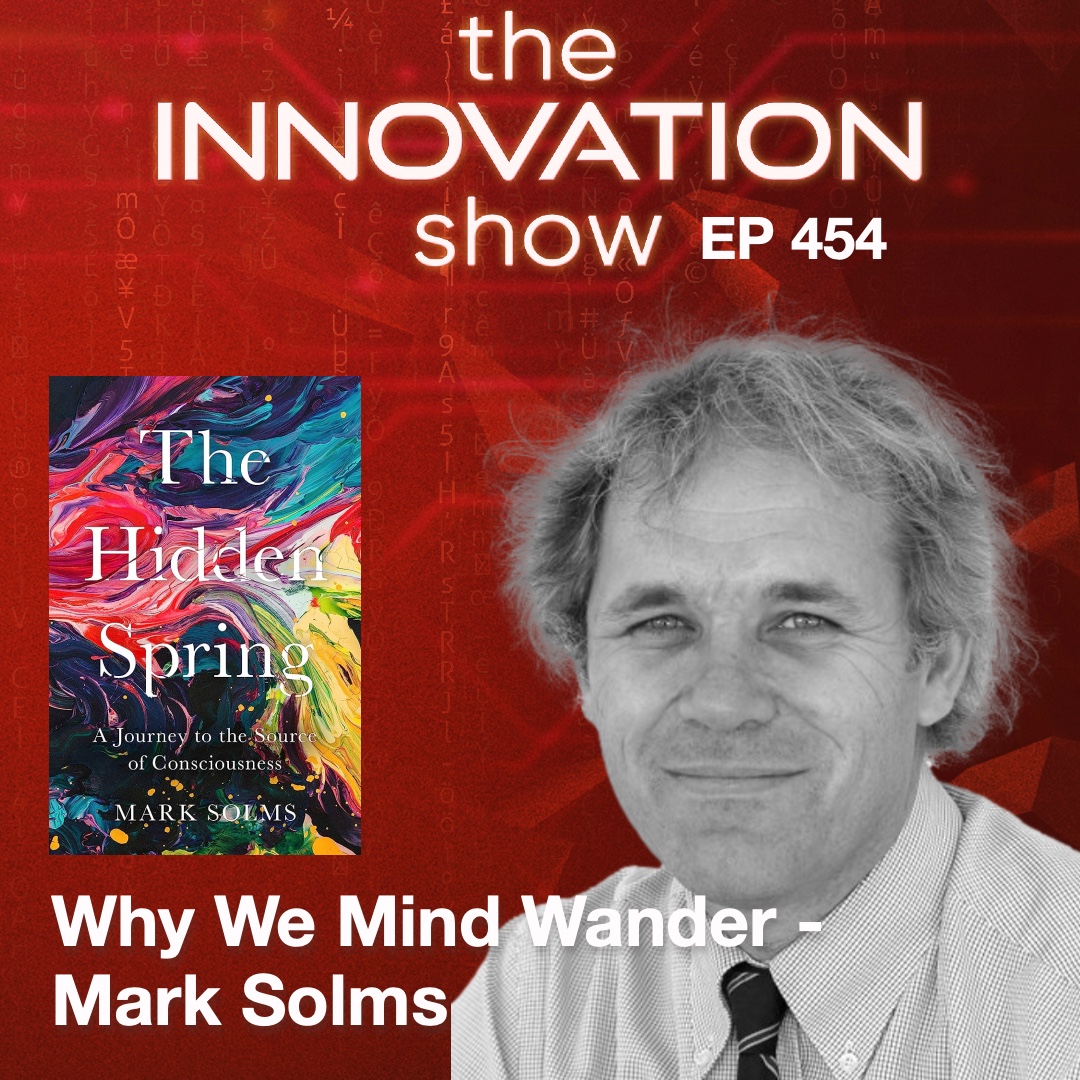
Why We Mind Wander - Mark Solms
The Innovation Show · The Innovation Show
Audio is streamed directly from the publisher (traffic.libsyn.com) as published in their RSS feed. Play Podcasts does not host this file. Rights-holders can request removal through the copyright & takedown page.
Show Notes
The aim of mind-wandering, odd as it might sound, is to improve the efficiency of your generative model. As ordained by the Free Energy Principle, a model is only efficient if it uses the minimum resources necessary to perform the work of self-organisation. That boils down to finding the simplest model that successfully predicts sensory samples of the world. The simplest model does not arise naturally from voluntary action. Voluntary action is a haphazard process. Simplicity is increased by pruning redundant synaptic connections that formed while we learned from experience. We are cutting them back to avoid 'overfitting' our models to noisy data, needlessly preserving eccentric and weak correlations. The shears are the by-now familiar mechanisms of memory consolidation and reconsolidation: by activating memories, we can strengthen, alter and even erase them. Mind-wandering is one means by which this is achieved. It involves spontaneous forebrain activity (the 'resting state' or 'default mode'), which occurs without any specific external stimulus. This kind of activity often goes on in the background through an 'imaginative exploration of our own mental space'.