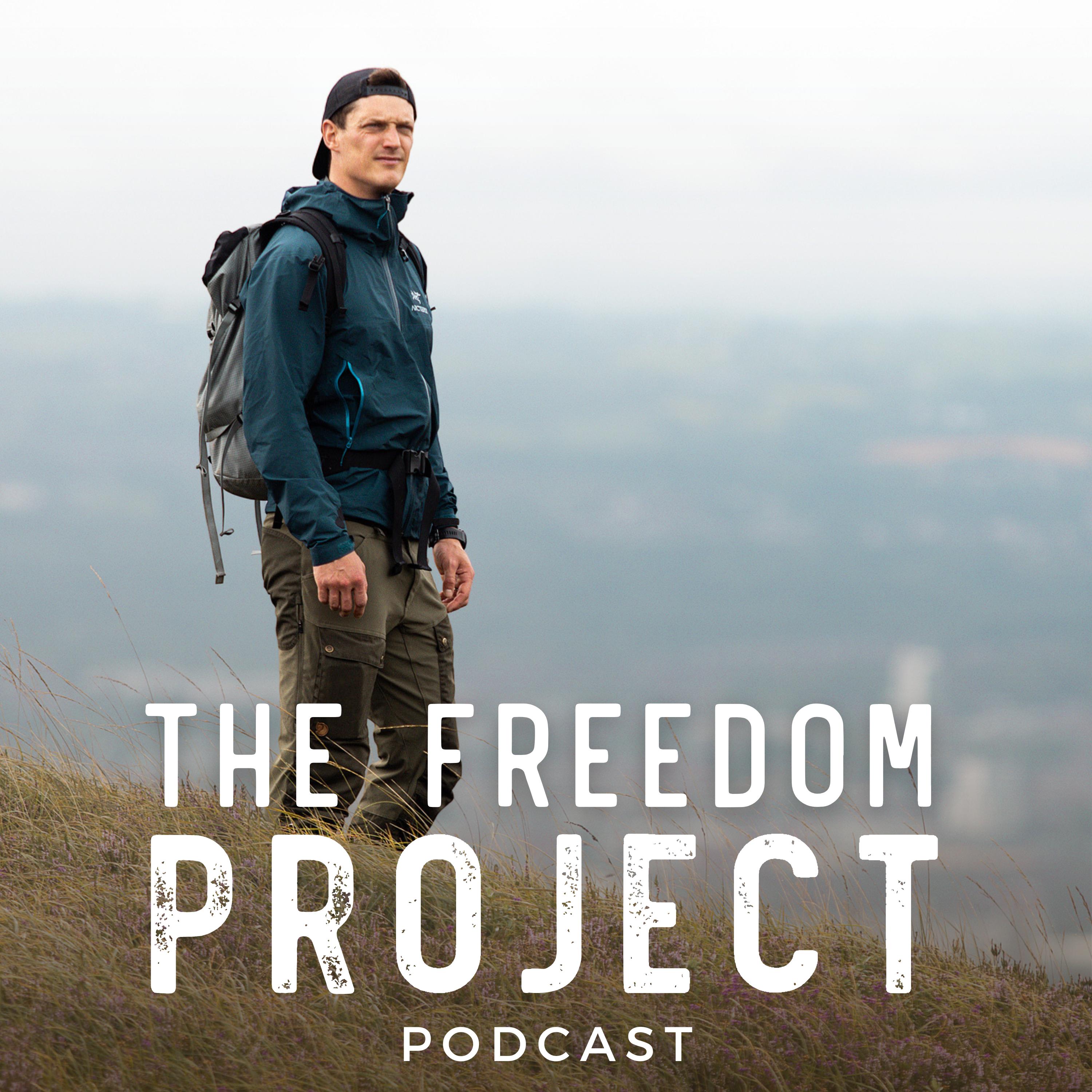
The Freedom Project
Tom Foxley, Mental Fitness Coach for Business Owners
Show overview
The Freedom Project has been publishing since 2021, and across the 5 years since has built a catalogue of 363 episodes. That works out to roughly 160 hours of audio in total. Releases follow a weekly cadence, with the show now in its 3rd season.
Episodes typically run ten to twenty minutes — most land between 5 min and 47 min — with run-times ranging widely across the catalogue. The publisher flags most episodes as explicit, so expect adult themes or strong language throughout. It is catalogued as a EN-language Business show.
The show is actively publishing — the most recent episode landed 3 days ago, with 38 episodes already out so far this year. The busiest year was 2025, with 105 episodes published. Published by Tom Foxley, Mental Fitness Coach for Business Owners.
From the publisher
Do you crave freedom & want to hit peak mental fitness? The Freedom Project is here fore those of you who live for adventure and freedom. Your host, Tom Foxley, is a mental fitness coach, former Royal Marines Commando, a freedom seeker, skier, mountaineer, and climber who lives for adventure. Tom has been coaching elite performers for more than a decade. In The Freedom Project, Tom aims to uncover what it takes to hit peak mental fitness for freedom seekers. Once per week, Tom will also get highly tactical and teach you strategies you can deploy into your own life. If you want to learn peak mental fitness, and love creating freedom, this is the podcast for you. www.instagram.com/tomfoxley
Latest Episodes
View all 363 episodesThe GP's Mouthwash — Why Business Owners Keep Treating the Wrong Problem
2am, a Wet Giraffe and What It Clarified About Resilience
Emotions Are Data — What the Most Successful Operator Tom Knows Does Differently
I'll Be Present When Things Settle Down — The Most Expensive Lie in Business
Two Kinds of Operator — And the Training That Separates Them
You Can't See It From Inside It — The Hidden Operating System of Every Business Owner
Why Your Business Mentor Might Be Killing Your Business
Why Business Owners Can't Let Go — And What It's Really Costing Them
Awake Heart Surgery, the Royal Marines and the Handbrake on Your Business
Why Business Owners Need to Do Hard Things — A Weekend in the Brecon Beacons
Stop Avoiding the Hard Stuff — What the Research Actually Says About Business Growth
Sprinting in Every Direction and Going Nowhere — What Hustle Fragility Actually Looks Like
Learning to Love the Fear — What It Takes to Break Through Your Next Ceiling
Ep 326What Mental Fitness Actually Does to a Business — A Client's Honest Take
EHe knew he was the bottleneck. He could see himself drifting back to the coaching floor, sitting on decisions, staying too hands-on. He just didn't know how to stop. In this episode, Tom sits down with a gym owner he's been working with for an honest conversation about what brought him to mental performance coaching, what surprised him when he got there, and what's actually changed in his business, his leadership, and his life since. This isn't a highlight reel. It's a real account of what it looks like to go from self-doubt and anxiety-driven decision-making to clarity, capacity, and a business that's performing at its best. Including the moment he realised freedom was something he'd always wanted and never let himself admit — and how becoming a father for the first time made that impossible to ignore. Topics covered: - What was really going on before they started working together - Why the strategy was never the problem — and when he realised that - The shift from coach identity to business owner identity - What changed in his leadership, his team, and his own mental load - What he'd say to anyone who knows they're capable of more but can't access it
Ep 325Why Resilience Isn't Enough — The Case for Becoming Anti-Fragile
EMost business owners think resilience is the goal. It isn't. In this episode, Tom Foxley opens with a story from the Biosphere 2 project in 1990s Arizona — a sealed, controlled environment designed to create perfect conditions for growth. The trees grew faster than anything in the wild. They also fell over before reaching maturity. The reason: no wind. No stress. No stress wood. Without resistance, the trees never developed the structural density they needed to stand on their own. Drawing on Nassim Taleb's three-level framework — fragile, resilient, anti-fragile — Tom makes the case that the business owners who plateau aren't the ones who face too much stress. They're the ones who've spent years trying to insulate themselves from it. Resilience means you can absorb the hit. Anti-fragility means the hit makes you stronger. That's the goal — and it requires a fundamentally different relationship with hardship, pressure, and discomfort. Topics covered: - The Biosphere 2 experiment and what it reveals about performance under pressure - Fragile vs resilient vs anti-fragile — and why most owners are stuck at level two - Why stress is not the enemy of growth — it's the mechanism of it - What dosing yourself with the right stress actually looks like - One question to ask yourself this week
Ep 324Dan Holder on The Flexible Mindset: Why Mental Toughness Is the Wrong Goal
EMost high performers are chasing the wrong thing. Not more discipline. Not a tougher mindset. Dan Holder — Royal Marines veteran, Bronze Star recipient, Arctic Spine finisher — would argue the thing that keeps you going isn't strength at all. It's flexibility. We cover PTSD recovery, leaving special forces, surviving extreme endurance, and why the parts of yourself you'd rather not look at are where your real capacity lives.
Ep 323The Identity That Built Your Business Is Now the Ceiling On It
EMost business owners who are stuck think they have a team problem. They don't. They have an identity problem. In this episode, Tom Foxley breaks down a real coaching case — a business owner with his finger in every pie, always overworked, always the one everyone defaulted to. His team weren't taking ownership. He assumed they weren't good enough. When they looked under the hood, they found something different entirely. He was manufacturing the dependency. His need to be seen as important, competent, in control — his self-image — was the system producing the exact behaviour he resented. He'd never cut the umbilical cord, because cutting it would mean no longer being the hero. And here's the trap: it had worked. That identity — the hustler, the person who does everything, the one the business can't run without — got him to a genuinely successful level. The same identity was now the cap on everything he was trying to build next. Tom unpacks the pattern, the three-step process for catching it in real time, and the principle that runs underneath every plateau he sees in high-performing business owners: we all have a skin that once kept us safe — and at some point, we have to shed it. Topics covered: - The self-image trap and how it manufactures team dependency - Why hustle and urgency are fragility in disguise - How the same identity that builds the business becomes the ceiling on it - The snake shedding its skin — and why it's meant to be uncomfortable - One action this week: write down the identity that got you here
Ep 322Why You're Training Your Team to Underperform (And How to Stop)
EMost leaders think their team has a performance problem. They don't. They have a reinforcement problem. In this episode, Tom Foxley breaks down a real coaching case — a business owner whose team kept falling short of the standards he expected. Tasks not done. Gym floor not cleaned. Google reviews not chased. And every time, he stepped in and picked up the slack. What looked like a team problem was actually a system problem. And he'd built the system. Tom unpacks the Child Effects Model — the psychological loop that explains how leadership cultures form without anyone consciously choosing them — and makes the case for why the halftime team talk style of leadership actively suppresses the performance it's trying to produce. He also shares two stories that reframe how most leaders think about recognition: one from a weightlifting gym, and one from a military stalking exercise — both of which show why public praise is one of the most underused performance tools in business. Topics covered: - The Child Effects Model — how you accidentally trained your team to underperform - Why criticism suppresses performance and praise compounds it - The shaping principle — rewarding steps toward the standard, not just the standard - Criticise privately. Praise publicly. What that actually looks like. - One thing to hand back to your team this week — and not pick back up
Ep 321The Protection Racket: Why the Part of You Avoiding Decisions Thinks It's Helping
EMost business owners think indecision is a confidence problem. It isn't. In this episode, Tom Foxley breaks down a real coaching case — a business owner stalling on decisions he already knew how to make. Not because he lacked knowledge. Not because the decisions were unclear. But because a part of him was actively blocking action to protect something more important to it than progress: his image. Knowledgeable. Trustworthy. A leader people respect. That's what it was trying to preserve. And its logic was airtight — if you make a wrong call, people see you differently. So don't make the call. The cruel irony: by protecting the image of a decisive leader, it was making him less of one. Tom unpacks the psychological mechanism underneath chronic indecision, the hidden belief that keeps high performers paralysed, and the two tools he used in the session to move from stalling to a clear decision in real time — including Fear Setting and the Decision Journal. Topics covered: - The protection mechanism underneath indecision — and why it made sense once - The belief "I need to feel confident to decide well" — and why it's backwards - Fear Setting — how to make a clear call when you're stuck in your head - The Decision Journal — building the track record that teaches you to trust yourself - One daily rep to start building the decisiveness muscle
Ep 320The Identity Ceiling: Why the Thing That Built Your Business Is Now Holding It Back
EMost business owners assume plateaus are strategy problems. Wrong market. Wrong model. Wrong team. Wrong timing. But the most common plateau Tom Foxley sees in high-performing business owners has nothing to do with strategy. It's an identity problem — and it's one of the hardest to see, because the identity causing the ceiling is the same one that built the business in the first place. In this episode, Tom breaks down a real coaching case — a business owner coming off his best month ever, who kept finding himself drawn back to the work he'd built his identity around, even as the business needed something different from him entirely. The craftsman who needs to become the CEO. The coach who needs to become the leader. The expert who needs to step back and orchestrate instead of play. It's not a promotion. It's a death and a rebirth. And most people avoid it. Tom unpacks the three layers underneath the pattern, introduces a research-backed tool for navigating identity-level transitions, and closes with the one question every business owner needs to sit with when growth stalls. Topics covered: - Why identity plateaus are more stubborn than strategy plateaus - The hidden grief underneath every major business transition - The military 30,000 foot view — leading from elevation, not from the weeds - Expressive writing — what it is, why it works, and when to use it - One action this week to start identifying your own ceiling