The Freedom Analects
Written works exploring truth, power, freedom, money, economics, virtue, sovereignty, philosophy, and other enigmas of existence.
by Robert Breedlove
Show overview
The Freedom Analects has published 16 episodes during 2022. That works out to roughly 2 hours of audio in total. Releases follow a several-times-a-week cadence.
Episodes typically run under ten minutes — most land between 6 min and 8 min — and the run-time is fairly consistent across the catalogue. None of the episodes are flagged explicit by the publisher. It is catalogued as a EN-language Education show.
The catalogue appears to be on hiatus or wound down — the most recent episode landed 4.6 years ago, with no new episodes in over a year. Published by by Robert Breedlove.
From the publisher
Written works exploring truth, power, freedom, money, economics, virtue, sovereignty, philosophy, and other enigmas of existence. breedlove22.substack.com
Latest Episodes
Money Messiah (Part 16)
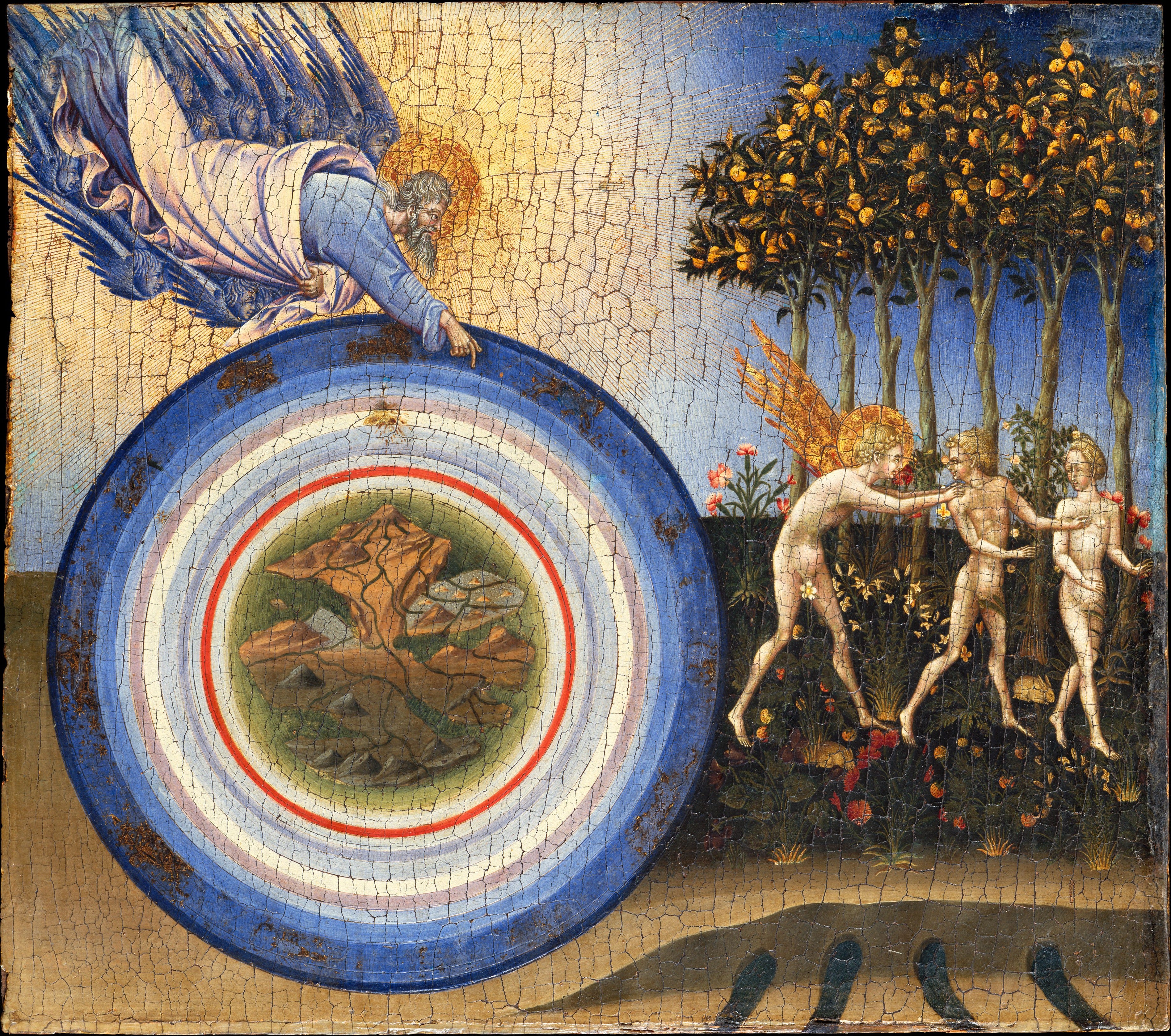
*In this multi-part special edition of The Freedom Analects, we will be featuring the excellent written work of author John Vallis titled “Money Messiah: God, Bitcoin, and The Evolution of Consciousness.” This essay beautifully depicts the deeper aspects of value and money, their indispensability to human action, and demonstrates why corrupt money is such a destructive force. John’s original work is available in its entirety here.The WordJohn 1:1“In the beginning was the Word, and the Word was with God, and the Word was God.”John 1:14“And the Word was made flesh, and dwelt among us, (and we beheld his glory, the glory as of the only begotten of the Father), full of grace and truth.”I always struggled to interpret these lines, what was meant by them, and what kind of process they were attempting to describe.Of course, this may be quite understandable, as they are, presumably, attempting to convey some kind of profound wisdom or insight pertaining to the creation of the ‘world’ — even if only the world of (human) experience and meaning.However, after considering the manner in which digital worlds are constructed today, I’m struck by a peculiar similarity.After all, digital environments are simply ‘lines of code’ — words — by which worlds are constructed.Is it really so different a concept as ‘in the beginning was the word’? The truth, the ultimate source of meaning, the fundamental ordering principle(s) — the code — which created the ‘world’?It’s interesting to consider how this relates to what Satoshi did in creating bitcoin.* Just announced, I am giving away 10M sats (~$4K) to one lucky person who buys a conference ticket using one of the links below. Join me at the biggest event of the year, Bitcoin 2022. See below for 10% discount on tickets*“Bitcoin 2022 Conference is the biggest gathering of the Bitcoin ecosystem in the world. Join me and the movers and shakers shaping the Bitcoin future next April 6-9th in Miami Florida for Bitcoin 2022 Conference.”Paying with Fiat? 10% Affiliate link: http://tixr.com/pr/robertbreedlove/26217Paying with Bitcoin? Use promo code: BREEDLOVE.Satoshi took a set of principles that he believed were ‘right’ or ‘true’, and, consciously or not, built them into his system. The principles which he built in to that system are clearly communicated by the resultant architecture of it, which enforce: The same rules for everyone, no cheating, no theft, no discrimination, among other things. These are principles which, in my opinion, cohere with those that similarly imbue the foundations of many formal religions, which taken together, seem to communicate a fundamental axiom, or faith — that the divine sovereignty and equality of each individual should be respected, and is indeed the optimal premise, or highest value, by which to foster individual actualization and social harmony.Where a historical counterpart, who felt similarly about such ideals as he, may have preached about them, or embodied them, Satoshi’s revelation, given the tools at his disposal, could actually be made manifest in a new domain — the digital world.The sentiment is the same, and the ideals are those ‘divine’ principles that have indeed been preached throughout the ages, but the method of ‘expressing’ them — their form — has evolved, and represents one more suited for the cultural and technological circumstances, and possibilities, of this age.Do these principles, which (might) eternally govern our experience of reality, always seek to emerge within individual consciousness, through the symbols and technologies extant within the landscape of meaning of any given time?Is the enterprise of culture, or the emergent phenomenon it represents, more than anything else, the very mechanism for the construction of a more high-fidelity representation of these principles, and the ‘richer’ experience of life which greater clarity or understanding of them fosters?If so, is it possible that Bitcoin is a higher resolution ‘implementation’ of the fundamental principles which are represented in Christ, The Philosopher’s Stone, or the central hero or symbol of other cultural traditions?If ‘Code is law’, has ‘god’s law’ now been instantiated in code?A preposterous notion, perhaps.But is it so easily dismissed?Will Bitcoin Become a Religion?Well, it depends how we interpret that word.If we view religion as simply orienting ourselves (our perception of value) around the greatest truth possible — or around the greatest generator of truth possible — and allow such truth to guide us in the construction of maximally meaningful lives, then perhaps bitcoin will play a prominent role in such pursuits.Furthermore, if we believe that there will always be something at the top of our value hierarchies, and that, whatever it is, will be the prime determinant of how we ‘experience reality’, then determining what it is to be, is of the utmost importance.The idea of ‘religion’, simply asserts that there is a qualitative distinction with regards to wha

Money Messiah (Part 15)
*In this multi-part special edition of The Freedom Analects, we will be featuring the excellent written work of author John Vallis titled “Money Messiah: God, Bitcoin, and The Evolution of Consciousness.” This essay beautifully depicts the deeper aspects of value and money, their indispensability to human action, and demonstrates why corrupt money is such a destructive force. John’s original work is available in its entirety here.Bitcoin is HopeWhy was Christ’s example, real or narrative, so powerful?Because it showed how each individual could transcend their suffering, and foster harmonious cooperation with others. It revealed the path to liberation, by bringing the ideal (or most truthful principles) into light, and thereby making more explicit ‘proper aim’.It represented a greater perception of the ‘truth’, which helped to transcend ‘illusion’, and it produced one of the most transformative ideas that can possess a human being — HOPE — the knowledge that more goodness can and will emerge, and that the degree to which it does so is determined by the actions of each individual.This is the very hope that bitcoin is motivating in so many bitcoiners — that through accepting it’s rules (and embodying its principles), and engaging with them properly, a far better life for themselves, and for everyone else, is possible.Such a belief, or vision, not only pulls us more enthusiastically and energetically forward, toward actualizing such a future, but greatly enriches the process of doing so. This occurs because the value and meaning ascribed to the future being sought, directly determines the salience and vibrance of the present environment, bringing it to life with potentially useful information, to be used for the more expedient or efficient movement toward it.The ‘ordering principle’, whether found in Christ, the Lapis, or any of a number of other representations throughout history, is the information which permits the closest union possible with the truth of reality — it is the greatest ‘access to god’. It permits optimal congruence with the constituent components of that reality — via the proper ordering and interaction of all value hierarchies — and fosters maximal individual liberation and social harmony.*Ledn has recently launched a Bitcoin-based home mortgage product. Now you can buy your dream home without selling your Bitcoin!Sign up with Ledn to get started today: https://mortgage.ledn.io/That is, it’s:“The truthful information that rectifies pathological hierarchies, to confront the chaos of being itself, and generate habitable order.”It seems possible to me that bitcoin may very well be the next stage in the evolution of this idea — of the truth which expands our access to the generative forces of reality — or what might also be called, the ‘divine’.A Messiah for the Digital AgeIs this what Eliade meant by a change in the ‘ontology’ of the age — an expansion of the ‘spiritual’ dimension of reality?This seems to me to be a recurring theme in the history of human civilization — religion — the continual enterprise of identifying the most meaningful or truthful principles, and updating them periodically, or at least their representation, as the landscape of meaning evolves.Perhaps this occurs because as technology changes, relatively novel or complex environments for human action emerge, and the ‘world of meaning’ expands, necessitating new modes or methods of relating to it optimally.Eliade explains the influence of such a change in a previous era:“..the discovery of metals and the progress of metallurgy radically modified the human mode of being in the universe. Not only did the manipulation of metals contribute considerably to man’s conquest of the material world; it also changed his world of meaning. The metals opened for him a new mythological and religious universe. A similar, though even more radical, modification was effectuated through the discovery of agriculture. I cite this example because it better illustrates what I mean by saying that an important technological discovery ‘opens’ for man a new spiritual world. It is useless to insist on the revolutionary character of the discovery of agriculture and on its economic, technological, and social consequences. They are evident, and are laboriously repeated in all books and textbooks on the subject. But no less important are the ‘spiritual’ consequences of the discovery of agriculture. A new world of meaning was grasped through agricultural work. A number of analogies and homologies suggested themselves naturally: for instance, the relations between women, field, sexual life, human fertility, agriculture, lunar phases, death and rebirth etc. The early farmer expressed his specific mode of being in the world through plant symbolism and in vegetal terminology — and we will conserve something of this archaic heritage in our language, allegory, and symbolism….The symbologies, mythologies, and rituals accompanying these technological discoveries played
Money Messiah (Part 14)
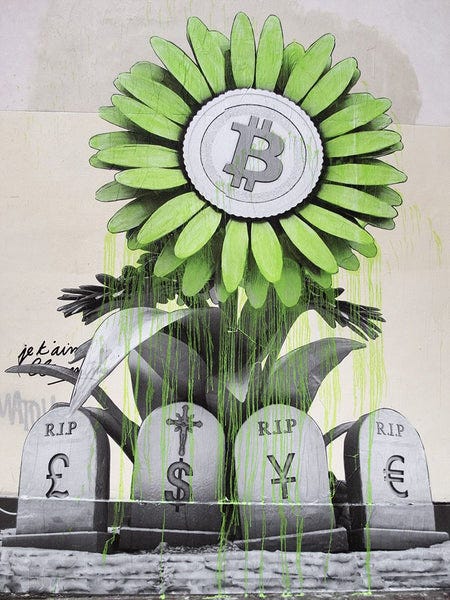
*In this multi-part special edition of The Freedom Analects, we will be featuring the excellent written work of author John Vallis titled “Money Messiah: God, Bitcoin, and The Evolution of Consciousness.” This essay beautifully depicts the deeper aspects of value and money, their indispensability to human action, and demonstrates why corrupt money is such a destructive force. John’s original work is available in its entirety here.What is Bitcoin?Given this, how should we answer the question ‘What is bitcoin?’Mircea Eliade coined a fascinating term that may be useful in answering this question — ‘Hierophanies’ — which he described as ‘breakthroughs of the sacred into the world’, which go on to ‘ontologically found the world’.However, such things are not always obvious or easy to identify.Eliade:“The paradox of the hierophany consists in the fact that it manifests the sacred and incarnates the transcendental in a ‘base thing’…The same paradox is evident in the Philosopher’s Stone: it is beyond the comprehension of the uninitiated…although it is everywhere, it is the most elusive of things.”He goes on to comment on the significance of such a discovery:“In the mind of many alchemists, the procuring of the Philosophers Stone is equated with the perfect knowledge of God. This, moreover, is why the stone makes possible the identification of opposites.”According to another alchemist; “evil must become the same as good”,and yet another describes the Stone as the “reconciliation of contraries, a making of friendship between enemies.”A ‘base thing’, difficult to ‘see’, which provides access to profound truth, ‘reconciles opposites’, unites even the competing motivations of enemies, and in doing so, establishes a new ‘ontological foundation’ by which to perceive and engage the world.Is this what bitcoin ‘is’?Perhaps.The Orange PillIf so, and as anything we value is also inherently a judge (used to determine the value of other things), what would be the impact of something of such great value — something with the qualities and capabilities of bitcoin — on, or perhaps ‘entering’, our perception?* Just announced, I am giving away 10M sats (~$4K) to one lucky person who buys a conference ticket using one of the links below. Join me at the biggest event of the year, Bitcoin 2022. See below for 10% discount on tickets*“Bitcoin 2022 Conference is the biggest gathering of the Bitcoin ecosystem in the world. Join me and the movers and shakers shaping the Bitcoin future next April 6-9th in Miami Florida for Bitcoin 2022 Conference.”Paying with Fiat? 10% Affiliate link: http://tixr.com/pr/robertbreedlove/26217Paying with Bitcoin? Use promo code: BREEDLOVE.Well, the simple answer seems to be that it would, acting as a new kind of ‘ideal’, restructure our value hierarchies.More specifically, as valuation is the (mostly automatic) promotion or demotion of things of value in relation to one another, the consequence of perceiving extreme value, would be the diminution of all things of relatively lesser value — of anything that can’t ‘stand up’ to such contrast.So, which values remain, or which, by virtue of their ability to ‘stand up’ to other value(s), can ascend and reside at the top of such a value hierarchy?It seems obvious to me that it would be primarily those things of equally transcendent or ‘priceless’ value — love, beauty, joy, family, health, freedom, wisdom, time etc.Effectively, these are things which seem to be most difficult or impossible ‘to value’, and therefore cannot easily be subject to comparison. Further, it appears that in this way, the things (or ideas) of highest transcendent value, seem to become that by which more of ‘their kind’ are to be discovered and integrated. It’s almost as though they ‘recognize’ them, and ‘pull them up’ the value hierarchy, rather than ‘push them down’.This would seem to result in a consciousness which experiences an increasing concentration of the things of greatest meaning, playing off one another for their continued refinement and amplification. These then become the very things that consciousness most orients itself around, and as a result, which become imbued or manifest in the lives of those in whom such a process is occurring.Perhaps this is why the continual process of discovering the thing of greatest value, or motivational significance, is so important, and why choosing or pursuing the ‘right god’, as portrayed in mythic story, is so often seen as being rewarded by access to infinite wealth (value), love, fulfillment etc.*Ledn has recently launched a Bitcoin-based home mortgage product. Now you can buy your dream home without selling your Bitcoin!Sign up with Ledn to get started today: https://mortgage.ledn.io/Mathew 13:11:“For whosoever hath, to him shall be given, and he shall have more abundance: but whosoever hath not, from him shall be taken away even that he hath.”It may seem an exaggeration, but as we’ve explored thus far, money is far more than a simple economic to
Money Messiah (Part 13)
*In this multi-part special edition of The Freedom Analects, we will be featuring the excellent written work of author John Vallis titled “Money Messiah: God, Bitcoin, and The Evolution of Consciousness.” This essay beautifully depicts the deeper aspects of value and money, their indispensability to human action, and demonstrates why corrupt money is such a destructive force. John’s original work is available in its entirety here.BitcoinersThis, of course, is no small assertion. If true, and if the primary pursuit of the alchemists was individual transformation, would we not expect to see dramatic changes in those who first encounter and engage with the ‘truth’ of bitcoin?I believe we would, and that indeed is precisely what I’ve been observing in the so-called ‘Bitcoin Maximalists’.This is not mere analogy. It seems to me that understanding and engaging with bitcoin represents a literal encounter with certain fundamental transcendent principles, similar to those sought by the alchemists, which is eliciting a powerful re-framing of value, and thus perception and behaviour.It would seem that it’s this initial cohort in which the impact of bitcoin’s emergence on the psyche of modern people, and the transformation that it motivates, is being first, and most powerfully, represented.Peterson:“The hero is the first person to have his ‘internal structure’ (that is, his hierarchy of values and his behaviours) reorganized as a consequence of contact with an emergent anomaly….the information he now carries (or perhaps is) will appear disruptive and destructive long before it proves redemptive…the individual troubled by anomalous and anxiety-provoking experience is suffering equally from the disintegration, rigidity or senility of the society within….It is very likely, however, that he will be viewed with fear and even hatred, as a consequence of his ‘contamination with the unknown’, particularly if those left behind are unconscious of the threat that motivated his original journey.”Carl Jung refers to these people, who are first to encounter such novelty, as the ‘most refined and differentiated minds of the age’, who ‘detect emergent anomaly, and begin the process of adaptation to it, long before the average person notices any change whatsoever in circumstance.’Engagement with this anomaly doesn’t inspire change solely by contrast with the ‘corrupt’ world in which it emerges (though that certainly plays a role), but it also seems to transmit the very principles which animate it, into those who ‘explore’ it most deeply.* Just announced, I am giving away 10M sats (~$4K) to one lucky person who buys a conference ticket using one of the links below. Join me at the biggest event of the year, Bitcoin 2022. See below for 10% discount on tickets*“Bitcoin 2022 Conference is the biggest gathering of the Bitcoin ecosystem in the world. Join me and the movers and shakers shaping the Bitcoin future next April 6-9th in Miami Florida for Bitcoin 2022 Conference.”Paying with Fiat? 10% Affiliate link: http://tixr.com/pr/robertbreedlove/26217Paying with Bitcoin? Use promo code: BREEDLOVE.Arnold of Villanova, an alchemist from the 13th century offers an insight as to why:“There abides in nature a certain pure matter which, being discovered and brought by art to perfection, converts to itself all imperfect bodies that it touches.”Bitcoiners, it would seem, are being ‘converted to’ the qualities and principles which have been ‘brought to perfection’ in bitcoin.Why is this?It seems logical to me that the extent to which something is (non-coercively) ‘successful’, reveals the degree of congruence with the truth of the environment in which it’s operating or acting (whether that be, say, the demands of customers in a market, or the unseen forces of reality).Even if this is not consciously appreciated, the ‘success’ of the item (in this case bitcoin) in achieving such a congruence, may subconsciously communicate, perhaps necessarily, that the attributes or properties by which it does so, are ‘good’, ‘valid’ or ‘true’. It may be the case then, that the more successful the item, actor or system, and therefore the more valuable it becomes, the more its attributes or properties will be perceived as being congruent with a deeper truth. For this reason it seems likely, or at least possible, that they might be emulated by the individual (who values, or comes to value the same truths), or in some capacity be transmuted into them, for the very reason that the deepest truths are likely to be resonant (similarly valued) across the broadest scales.Put simply, bitcoin is founded on and instantiates certain principles, and its success may serve to confirm the deep and broad validity of them.Do you believe in the power of truth, fairness and freedom to deliver a better world for you and all others?This would seem to be the proposition which bitcoin poses to people, and you might say that the simple perception of that proposition, combined with it’s apparent
Money Messiah (Part 12)
*In this multi-part special edition of The Freedom Analects, we will be featuring the excellent written work of author John Vallis titled “Money Messiah: God, Bitcoin, and The Evolution of Consciousness.” This essay beautifully depicts the deeper aspects of value and money, their indispensability to human action, and demonstrates why corrupt money is such a destructive force. John’s original work is available in its entirety here.Satoshi the AlchemistIf all this sounds strange to you (as it does to me), you may be interested in knowing that many before us have encountered and wrestled with very similar ideas.For example, such a proposition, that discovering and engaging with an ‘incorruptible’ substance could somehow reveal and instantiate a fundamental ‘ordering truth’, in the same manner as did ‘Christ’ (or any other ‘Messiah’ character), is actually not new. In fact, it was the primary pursuit of the ‘Alchemists’ for millennia.Contrary to common perception, the alchemists were not simply a bunch of medieval European pre-chemists, greedily seeking riches through the transformation of ‘base metals’ into gold. ‘Alchemy’ was a diverse system of philosophy, ritual, history and proto-scientific experimentation, which was practiced in ancient China, India, Egypt, Europe, the Muslim world, and likely elsewhere.Far from some kind of ‘get rich quick’ scheme, by and large the pursuits of the alchemists were of a much more ‘spiritual’ nature.Peterson:“Alchemy — considered most generally as the precursor of modern chemistry — was in fact a twenty-centuries-long endeavour to understand the ‘transformations of matter’. The alchemical matter, however, was not the matter of modern science — logically enough, as the ancient alchemist practiced in the absence of the presumptions and tools of modern science. It was a substance more like Tao — ‘that which produced or constituted the flux of being’; something more like ‘information’ in the modern sense.”Georg von Welling, a notable alchemical writer from the 16th century, elaborates:“That our intentions are not directed towards teaching anyone how to make gold, but towards something much higher, namely how nature may be seen and recognized as coming from God, and God in nature.”While a number of interpretations and proposed etymologies exist, a common definition of Alchemy reinforces this view, by describing it as ‘the process of transmutation, by which to fuse or reunite with the divine or original form.’To the alchemists, gold represented a ‘pristine’ state of matter, and the act of taking relatively ‘imperfect’ matter, and speeding up the natural processes of nature (which were seen as perfecting all things with sufficient time), by refining it and eliminating its ‘corruptive’ influences, was tantamount to doing the same for the ‘self’.The alchemists interpreted reality as having a fractal-like structure, and that therefore truths revealed in the microcosm, could be applied to the macrocosm, and visa versa.As a result, and as man is inextricably a part of nature, ‘purifying nature’ — accelerating the ‘perfection of matter’ — necessitated, and even unavoidably facilitated, the ‘purification’ of oneself.*Ledn has recently launched a Bitcoin-based home mortgage product. Now you can buy your dream home without selling your Bitcoin!Sign up with Ledn to get started today: https://mortgage.ledn.io/Mircea Eliade, a Romanian philosopher and religious historian, expands:“We should not forget that the transmutation of metals into gold also has a spiritual aspect; gold being the imperial metal, ‘perfect’, freed from impurities, the alchemical operation must seek to imitate the perfection of nature which is, in the final instance, its absolution and its liberty… Since alchemical processes play out their part in the very body of the adept, the perfectibility and transmutation of metals correspond to the perfection and transmutation of men.”Here again, subject and object are not seen as exclusively separate, but rather consisting of a relationship of the (potentially) utmost meaning, and, if constituted properly, cultivating both immense value, and profound transformation.As a result, it was in ‘matter’ which the alchemists searched for a closer relationship with a ‘fundamental’ ordering principle or truth — a closer relationship with ‘god’.Unsurprisingly, this was not always a popular or socially-sanctioned pursuit.Peterson:“The alchemists were searching for a method to redeem corruption. They applied their fantastical reasoning to redemption of corrupt matter, which seems absurd from the modern viewpoint. However, experience of the physical world had been formally damned by the church — for reasons which had their own logic — and the lost value this experience represented stood therefore in dire need of redemption. The search for lost value led the alchemists deep into consideration of the nature of corruption, or limitation, and past that, into its transformation, and redemption. Thei

Money Messiah (Part 11)
*In this multi-part special edition of The Freedom Analects, we will be featuring the excellent written work of author John Vallis titled “Money Messiah: God, Bitcoin, and The Evolution of Consciousness.” This essay beautifully depicts the deeper aspects of value and money, their indispensability to human action, and demonstrates why corrupt money is such a destructive force. John’s original work is available in its entirety here.How Does This Relate To Bitcoin?Well, no ‘thing’ (which we engage with) exists in isolation — our involvement is part of the chorus of forces which constitute its ‘environment’, and give it its ‘form’.Furthermore, and as we said at the beginning, things aren’t things, what they mean to us, are what they represent for action.In this sense, we are not ‘separate’ enough from bitcoin to call it ‘incorruptible’ by itself. It’s an extension of ‘us’ (the individuals who use it and uphold, or opt-into, its rules), and we are therefore a critical component of it.The question then, is how do we keep ourselves, and more accurately, the faults, delusions, fears, presumptions, and ego’s within us, from ‘destroying’ bitcoin?How do we keep even our best-intentioned logic from presuming to know everything about ‘what it is’, and what it ‘could’ and ‘should’ be?Peterson:“Since the unknown always transcends the limits of the known, no final statement about the nature of existence (John’s note: Or any creation) is possible.”So, how should this circumstance inform our actions with regards to bitcoin? How do we account for the ‘eternally unknown’ aspect of our relationship to it?*Join me at the biggest event of the year, Bitcoin 2022. See below for 10% discount on tickets*“Bitcoin 2022 Conference is the biggest gathering of the Bitcoin ecosystem in the world. Join me and the movers and shakers shaping the Bitcoin future next April 6-9th in Miami Florida for Bitcoin 2022 Conference.”Paying with Fiat? 10% Affiliate link: http://tixr.com/pr/robertbreedlove/26217Paying with Bitcoin? Use promo code: BREEDLOVE.It would seem to me to suggest that ‘ossification’ is of paramount importance. This means increasing resistance to, or total refusal of, changes to its existing core rules — especially those with ‘economic’ (Read: value-hierarchy-relevant) consequences, like monetary policy, block size, and Proof of Work — is of paramount importance. This is not because it will never seem as though ‘it could be better’, through some change or optimization. There are many who already believe this, and most likely will continue to be in the future. This is even quite rational and to be expected, given the (seemingly) arbitrary nature of some of bitcoins fundamental parameters.It should not be changed (alternative rules accepted by users), because it may be the case that the key ingredient that makes it incorruptible, is our humble submission to what we cannot (and will never) comprehend about both it, and ourselves.It should not be changed, because the value of such an absolute (limitation) is, paradoxically, likely far greater — that is, fosters far more complex and generative order — than any transient, subjective understandings, and the meddling they might inspire.As a corollary, would we prefer that the laws of physics were always changing, or changeable? Or, is their permanence more desirable?While it might at first seem favourable to be able to transcend them at will, it seems to me that this would, perhaps counterintuitively, be detrimental. Their changeability would create chaos, or perhaps is chaos, disallowing any dynamic or complex order to coalesce. Alternatively, a bedrock, unchangeable truth, is what permits all order to form (from chaos), via constant reference to that very permanence. Such a bedrock ‘limitation’ thus promotes the emergence of complex order, motivated via the pursuit of liberation which it inspires, and achieved via perfect coherence, acceptance, or ‘submission’, with/to the absolute unchanging parameter(s).It should be noted, that none of this is about being ‘anti-competition’ or ‘anti-progress’, nor is it about ignoring the incentives or attributes that make bitcoin the most economically competitive system of money.That is to say, bitcoin (or more accurately, ‘bitcoiners’) may never need to invoke or consider such an idea, as bitcoin’s dominance, path dependence, and other components of it’s success, may always be sufficient signal to confirm the value and validity of its defining characteristics, and the dangers in changing them. However, to my mind, this is by no means a certainty.What this is, is the recognition of the critical role of transcendent (or unknowable) value or truth, and the importance of determining how best to leverage it.In this light, it’s interesting to consider why and how bitcoiners make the choice to ‘adopt bitcoin’ (and only bitcoin). Is it not the willingness to be bound by certain rules, to submit to having their time and energy ‘preserved’ by those rules, rath
Money Messiah (Part 10)
*In this multi-part special edition of The Freedom Analects, we will be featuring the excellent written work of author John Vallis titled “Money Messiah: God, Bitcoin, and The Evolution of Consciousness.” This essay beautifully depicts the deeper aspects of value and money, their indispensability to human action, and demonstrates why corrupt money is such a destructive force. John’s original work is available in its entirety here.Does ‘Faith’ Play a Role?What is faith?Well, a dirty word, for starters. It would seem that its abuse and misapplication over many years, combined with its (apparent) decreased utility in an increasingly ‘knowable’ world, has caused this word to elicit a kind of disgust from many people, as though they would never be so naive to engage in such an obviously ridiculous behaviour.But is it that ridiculous?It seems to me that faith is a far more necessary component of engaging reality — of consciousness — than most people credit it with.Is it not the recognition that decisions involve comparing value, and at the base of all value is an assumption about truth, a wager — if you like — that holding certain principles ‘as true’, is the closest to certainty one can get? Furthermore, what one holds ‘as true’ is of the utmost significance — potentially the most important determination one can make — due to how it will direct and guide ones actions and life.Faith, then, would seem to be ‘acting as though’ what one holds as true — is truth — despite never being able to, rationally, reach such a conclusion. The religious enterprise has been, in effect, one that seeks to reduce the likelihood of error in this process, by closing the gulf, or minimizing the ‘leap’, so to speak, that one must take between ‘true enough’ and ‘truth’.Perhaps ‘religion’ is simply the effort to increasingly discover and refine the ‘truest true enoughs’ — motivated by the recognition of the central importance of this set of ‘a priori’ principles or axioms — for the construction of an ‘optimal framework’ by which to ‘best engage reality’.*Ledn has recently launched a Bitcoin-based home mortgage product. Now you can buy your dream home without selling your Bitcoin!Sign up with Ledn to get started today: https://mortgage.ledn.io/Religion seems to, quite rationally, posit that if certain behaviours, grounded in certain principles, lead to the best outcomes (for individual and society), then they must ‘mean something’ in terms of coherence with the primary forces which act upon us, and which serve as some kind of fundamental architecture of reality, at least in so far as human consciousness experiences it.As a simple example, what would be the consequences of having a faith in — or holding as axiomatically true — the primacy of either the ‘divine sovereignty of the individual’ or the ‘well-being of the collective’?It seems obvious that each would yield dramatically different opinions and actions on a variety of issues.Both involve a kind of faith, and the religious enterprise would seem to be devoted to observing the outcomes of holding different things as ‘foundational truths’, and thereby determining which are most ‘valid’, and based on that, making inferences about the ‘structure of reality’ — that is, attempting to determine what ‘makes them’ valid. This is by no means a rudimentary or juvenile pursuit, in fact it’s hard think of one more important, or more challenging.Put another way, the core of the religious enterprise seems to be the process of attempting to ensure that the faith that must necessarily be applied to ‘act as though true’, is done so with the closest approximation to what ‘is true’ — or ‘god’ — as possible.Even the staunchest atheist leverages ‘faith’ in this way, even if subconsciously, as they too must necessarily adopt certain axioms or principles that can only ever be held ‘as though true’, to orient their consciousness and the actions that follow from it.It’s interesting to consider whether, for this reason, faith is what becomes instilled in those who encounter the ‘deepest’ forms of truth, as a kind-of subconscious attempt to integrate them, while accounting for the inability of the mind to fully comprehend them.*Join me at the biggest event of the year, Bitcoin 2022. See below for 10% discount on tickets*“Bitcoin 2022 Conference is the biggest gathering of the Bitcoin ecosystem in the world. Join me and the movers and shakers shaping the Bitcoin future next April 6-9th in Miami Florida for Bitcoin 2022 Conference.”Paying with Fiat? 10% Affiliate link: http://tixr.com/pr/robertbreedlove/26217Paying with Bitcoin? Use promo code: BREEDLOVE.If so, perhaps faith, when you boil it all down, is a practical (and potentially involuntary) means of accounting for our eternally limited knowledge of both ourselves, and the reality we inhabit.It seems unlikely then that, applied properly, it’s simply a placeholder for a temporary ‘ignorance’.It may instead be an unavoidable requirement to adhere to any absolut
Money Messiah (Part 9)
*In this multi-part special edition of The Freedom Analects, we will be featuring the excellent written work of author John Vallis titled “Money Messiah: God, Bitcoin, and The Evolution of Consciousness.” This essay beautifully depicts the deeper aspects of value and money, their indispensability to human action, and demonstrates why corrupt money is such a destructive force. John’s original work is available in its entirety here.Bitcoin and ‘Incorruptible’ MoneyIt is for this very reason that markets have always sought the most ‘incorruptible’ money available, as incorruptibility allows for optimal transmission of the information which money is meant to carry, and thereby best preserves its ‘truth-finding’ function, and the proper ordering of hierarchical relationships into the future.Incorruptibility is the only thing that will allow the original ‘value signal’ to remain pristine, by excluding any extraneous information, and propagate throughout the market in perpetuity, to continue contributing to the manifestation of the greatest possible benefit.The problem, however, is that the usefulness, power, even sacredness of money presents a conundrum; if money is the most useful tool in the human social domain, will it not be subject to endless attempts at corrupting or coopting it in some way? What would result if those attempts were successful? It would be equal to corrupting the will of every person who agrees (or had agreed, or is forced to agree) to use that money. In doing so, the sanctity of the unspoken (and largely unconscious) agreement on which the money’s use is predicated, would be strained, if not broken entirely. The result would be even worse if this corruption occurred unbeknownst to those people.This is why money is in constant evolution, because the utility of it can extract the very best from us in our attempts to obtain it fairly, or the very worst from us in our attempts to obtain it unfairly (we are, rightly, judged by the manner in which we pursue money, or anything else for that matter). This has placed an enormous pressure on money, fostering a historical process of converging on one which seemed to ‘work’ for a time, and then finding out that it’s qualities were not sufficient to keep the worst of us (or in us) from figuring out ways to corrupt it (because of the power which doing so granted).The only way to preserve the integrity of the money, such that what is ‘written’ into the invisible data contained in prices, is not ‘written over’ across time, and to ensure that work done earlier in time is always valued more than work done in the present moment (as all else equal, the former serves as foundation for the latter), is quite simply, not to change the relationship between the money and the individual — that is, not to increase the total supply, and not to inhibit the ability of the individual to use it in whatever manner they choose.That is, to instantiate and preserve the ‘truth and freedom’ in the money, so to speak.This ensures that the relationship between the money, and the sacrifice which it’s attempting to represent, doesn’t change, and that therefore everything is ‘judged’ the same way.*Join me at the biggest event of the year, Bitcoin 2022. See below for 10% discount on tickets*“Bitcoin 2022 Conference is the biggest gathering of the Bitcoin ecosystem in the world. Join me and the movers and shakers shaping the Bitcoin future next April 6-9th in Miami Florida for Bitcoin 2022 Conference.”Paying with Fiat? 10% Affiliate link: http://tixr.com/pr/robertbreedlove/26217Paying with Bitcoin? Use promo code: BREEDLOVE.This is the stunning achievement of bitcoin — the ability to instantiate, for the first time, a constant — a (possibly) unchanging metric — in the realm of inter-subjective ‘value’.Bitcoin’s ongoing (and upgoing!) price discovery, seems to be a testament to the extreme value of such a collectively agreed-upon (and verifiable) ‘truth’.If such a measure can remain impervious to change, will it become the highest-fidelity representation we’ve ever had, of the principle which seems to most animate, propel and order our experience of reality — the truth that permits liberation?The Bitcoin EraWhatever the ultimate answer is to the above question, it seems clear to me that bitcoin is the next, if not the final, stage in the evolution of money (and the antithesis of fiat).Bitcoin propagates pristine information, without prejudice, which reflects the values of all those who use it, as revealed in the interaction facilitated by its exchange. It does this by having discovered the necessary constituents for the establishment and preservation of a perfect measure — an inviolable mirrored representation of our own absolute limitation.This system of truthful communication, which incorruptible money establishes, is not an end, but is instead what permits the heretofore optimal relationship for individuals to have with one another, toward maximizing the benefits of voluntary coopera

Money Messiah (Part 8)
*In this multi-part special edition of The Freedom Analects, we will be featuring the excellent written work of author John Vallis titled “Money Messiah: God, Bitcoin, and The Evolution of Consciousness.” This essay beautifully depicts the deeper aspects of value and money, their indispensability to human action, and demonstrates why corrupt money is such a destructive force. John’s original work is available in its entirety here.The Corruption of MoneyIf money is what transmits the information which mediates the optimal structuring of value hierarchies between people, and we accept that improper, inaccurate or corrupted information creates inharmonious, disordered, and ultimately destructive ‘pathological’ hierarchies, then the most important question in the human social realm becomes;‘What is the most high-fidelity conduit for the information contained in prices, across space and time?’Simply, what will best preserve the information which money ‘transmits’?To determine this, we must be aware of what ‘corrupts’ money:Anything that inhibits, dilutes or alters the ability of the individual to express value (their value hierarchies) to others, or the ability of the market to interpret, integrate and communicate it in unadulterated form, as intended, in perpetuity.To achieve this, the market will attempt to ‘ground’ the money in a commensurate sacrifice to that which it’s attempting to represent — our own.That is, it will seek to instantiate an inviolable (as possible) limitation. After all, our value-hierarchies determine, and are determined by, our sacrifices, and the integrity of any market is determined by the degree to which changes to individual and collective value hierarchies are predicated on the same process.Sacrifice is the ‘cost’ for being able to re-order the hierarchies, as it were, and so sacrifice is used to instantiate the mechanism which does so. Therefore, the less ‘sacrifice’ in the money, the more susceptible to ‘corruption’ it is.The most common form of corruption in money is ‘inflation’ — an increase in the supply.*Ledn has recently launched a Bitcoin-based home mortgage product. Now you can buy your dream home without selling your Bitcoin!Sign up with Ledn to get started today: https://mortgage.ledn.io/Money supply inflation is not necessarily damaging to market signalling or fairness, per se.For example, if all new issuance was (magically) spread out evenly among all market participants, then the relationship between the money in circulation, and all goods and services, wouldn’t change (only the nominal prices would). Of course, there is no rational reason to do this, as it confers no benefit to anyone. In practice, inflation is simply a means of re-distributing the benefits which money confers, by allocating supply increases unevenly, and in doing so, dispossessing those who’s relative share of the total supply of money has shrunk, and advantaging those who’s has grown.The power or privilege to do this is known as ‘seigniorage’: The benefit derived from the ability to create new money, and spend it into the market first (before it’s dilutive pressure causes general pricing to adjust). It’s effectively the profit margin on the production of money, and is always dilutive to some degree, but much less so for ‘market-based’ monies, which generally have low ‘margins’, due to the cost (sacrifice) required to create them.Fiat (meaning: ‘by decree’) money, on the other hand, is a near 100% profit margin, and represents pure appropriation of purchasing power — the primary benefit to the issuer of such money, and its ‘raison d’etre’.Fiat money allows for the manipulation of value hierarchies without any sacrifice by the issuer. It permits absolute privilege to those who impose or coerce its use, to re-allocate the work of ‘normal’ market participants in whatever ways and amounts it pleases.It derives its ability to do so by violating the property rights of money holders, forcing them to relinquish the privileges earned by the sacrifices they’ve made, and involuntarily give them up to one who has not earned them through ‘market-sanctioned’ action. This is the antithesis of the very notion that money is a ‘representation’ of our ‘sovereign selves’, and what caused it to emerge as a useful tool in the first place.This kind of money is not only unfair, but it’s also extremely detrimental to the market’s ability to identify what is most valued, and allow natural incentives to coalesce around them accordingly — that is, it corrupts its truth-finding function.It fails to recognize that the best information which a market can receive, is generated via each individual’s interaction with their environment. It is those actions which, communicated to and through the market via prices, allow for the proper adjustment of the market’s value hierarchies, with and to the conditions of the natural world, and the choices of each individual, such that an optimal equilibrium may emerge and be maintained.Each indivi
Money Messiah (Part 7)
*In this multi-part special edition of The Freedom Analects, we will be featuring the excellent written work of author John Vallis titled “Money Messiah: God, Bitcoin, and The Evolution of Consciousness.” This essay beautifully depicts the deeper aspects of value and money, their indispensability to human action, and demonstrates why corrupt money is such a destructive force. John’s original work is available in its entirety here.Emergence of a MoneySo how do these objects, these emblems of our sacrifices, emerge, and why is there ultimately a convergence on one?Well, anything that results from the expenditure of resources, that is not consumed, is considered ‘surplus capital’.Surplus, ultimately, is a reference to, and representation of, energy and time, and is the very manifestation of the resolving of potential into useful order.It is therefore perhaps unsurprising that humans would attempt to maximize it.Surplus is the outputs of energy and time, in excess of the inputs, that result from some productive effort. It is the transcending of previously ‘imposed’ time and energy limitations, through the application of human work and ingenuity to a given environmental ‘substrate’. Surplus is, in effect, a kind of efficiency reserve.Given our natural inclination to transcend our limitations (to expand order), there is a drive to ‘trade-up’ such a reserve, along the spatio-temporal spectrum, in a continual effort to extend and expand its utility potential.Money is the end result of the continual ‘trading-up’ of this reserve.*Join me at the biggest event of the year, Bitcoin 2022. See below for 10% discount on tickets*“Bitcoin 2022 Conference is the biggest gathering of the Bitcoin ecosystem in the world. Join me and the movers and shakers shaping the Bitcoin future next April 6-9th in Miami Florida for Bitcoin 2022 Conference.”Paying with Fiat? 10% Affiliate link: http://tixr.com/pr/robertbreedlove/26217Paying with Bitcoin? Use promo code: BREEDLOVE.It is the pinnacle of our attempts at increasing the optionality of our own limited resources, as represented in surplus capital. This process ultimately results in the optimization for the ‘monetary properties’ that we’re all familiar with: durability (time/trade), divisibility (trade), portability(trade), fungibility(Trade), scarcity (time) — this final metric would perhaps more appropriately be titled ‘degree and nature of limitation’.In effect, we’re attempting to maximize our ability to manoeuvre (or to ‘expand ourselves’) through space and time, and we do so by ‘projecting’ ourselves onto an object that most mimics the qualities of that which permits the generation of our ‘internal order’, and propels our quest for liberation — most fundamentally, and perhaps counterintuitively — absolute limitation.This is what money is— the result of the search to find that which inviolably reflects our individual limitation, in order to have it ‘represent us’, such that inter-subjective value hierarchies may be optimally ordered, maximizing the ability to transcend those limitations through exchange with others.This ‘trading-up’ of potential monies is quite similar to the process by which we ‘trade-up’, through relative valuation, to the highest ideal, principle or motivation.Both are done to ensure that what sits atop the hierarchy is maximally generative to the order we desire, and all systems of valuation are optimally sensitized toward most efficiently establishing it.Seen in this way, the ‘best money’ and the ‘regenerative hero’ perform a very similar function, and are developed in a very similar way. The difference, perhaps, is that (incorruptible) money becomes not just a symbol or principle (however ‘true’ it may be), but the very means for establishing the highest form of truthful order, balancing all states of motivation, and their progenitors in the natural and social worlds, into a mechanism for the establishment of the greatest possible individual actualization and social harmony.Money, in the ideal (which we’ll likely always only ever strive for, and not achieve), turns a portion of ‘our work, here and now’, into a portion of ‘everyone’s work, anywhere and forever’.*Ledn has recently launched a Bitcoin-based home mortgage product. Now you can buy your dream home without selling your Bitcoin!Sign up with Ledn to get started today: https://mortgage.ledn.io/This represents a near infinite increase in utility, or if you like — a kind of liberation.Furthermore, as limitation is the primary counterforce to all action, that which most transcends it, will most command value — that is money.Indeed, it is precisely the degree of limitation — the inviolability of its supply — of a potential money, that determines its utility to us. This is because money, most fundamentally, is information, and the preferential selection for certain monetary attributes, limitation being chief among them, is the process of discovering the best vector for that information.The information whi
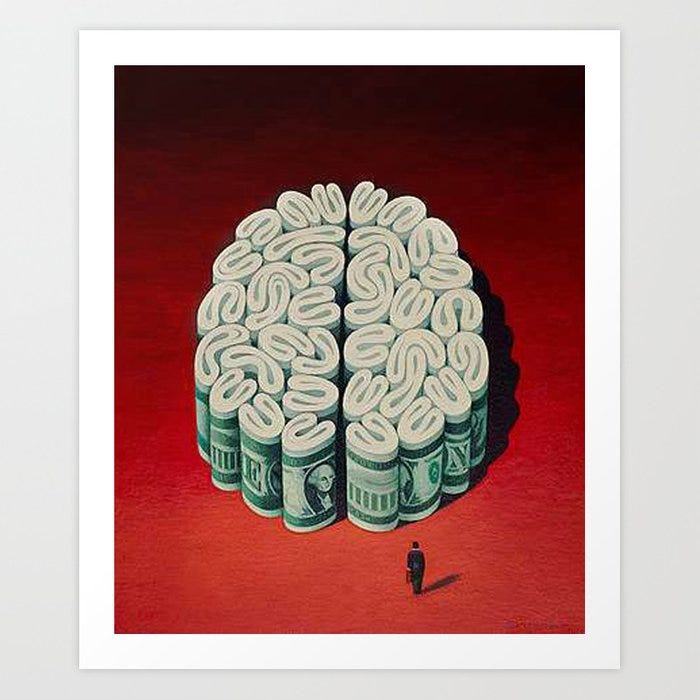
Money Messiah (Part 6)
*In this multi-part special edition of The Freedom Analects, we will be featuring the excellent written work of author John Vallis titled “Money Messiah: God, Bitcoin, and The Evolution of Consciousness.” This essay beautifully depicts the deeper aspects of value and money, their indispensability to human action, and demonstrates why corrupt money is such a destructive force. John’s original work is available in its entirety here.Money and ConsciousnessAs we’ve been exploring, it seems we humans intuitively see our environment through the lens of value, and we are evolved to compare value to bring order to our perception, and facilitate striving forward toward our goals.Interestingly, the very process that permits us to move forward, would appear to simultaneously be the one which determines the direction of that forward movement. In this way, human consciousness seems to require a ‘god’ (something to sit atop the internal value hierarchy) to function, but is simultaneously striving to discover what that god ought to be, through the constant act of comparative valuation.Paradoxically, any hierarchy then requires something to sit atop it to generate order, but the very process by which it becomes ordered is what determines what sits atop it. It would appear to be a circular process of continually comparing value against some temporary ideal, until the highest ideal or value is discovered, and union with it achieved (assuming one persists in the pursuit).It may then be the case that the primary mechanism by which consciousness functions, is the drive to ‘get closer to’, or to ‘discover’, ‘god’, and that such a process (again paradoxically) both permits and requires all of its other value-driven functions.Following this line of thought, would such a union, the ‘experience of god’, if/when achieved, halt or pause that process of comparative valuation and hierarchical reorganization?Is this the absolute ‘stillness’, ‘quiet mind’, ‘union with the present moment’, ‘nirvana’ or ‘enlightenment’ that is described by mystics and spiritual adepts throughout the ages?Interesting questions.*Ledn has recently launched a Bitcoin-based home mortgage product. Now you can buy your dream home without selling your Bitcoin!Sign up with Ledn to get started today: https://mortgage.ledn.io/In any case, it seems our consciousness functions in this way for the very purpose of creating order, at least in relation to our individual perspective and biological imperatives.Crucial to this is what could be called an ‘impulse to value’ — a near immediate, mostly subconscious attempt to determine the motivational significance of the objects, people, ideas and other phenomena we encounter. This allows all phenomena to be properly integrated into our hierarchies, and optimally structured for most efficient movement toward our goals.What our minds are really doing, when they value, is trying to erect a hierarchy that leads most efficiently towards states of ever greater motivational / emotional significance.The state of greatest motivational significance is what sits atop the value hierarchy, and would appear to be one’s true god (rooted in the truth of behaviour, rather than, say, what one has been told or wishes to be true).This impulse is not exclusively applied ‘internally’. As the fundamental processes of consciousness are shaped in response to the external world, they naturally seek to extend the domain over which their capacity for generating order may be applied, by optimizing for the compatibility of our value hierarchies as far beyond the borders of our own ‘physical’ control as possible.This process involves many adjustments, and is largely responsible for the ‘socialization’ which integrates all the necessary cultural norms, cues, and assumptions, which limit the expression of certain elements of our ‘personalities’ (internal hierarchies), and promotes others, such that they may be accepted and interact beneficially with those of other people.Relevant to our exploration, is the seeming tendency for this process to elicit a (possibly never-ending) search for an ‘external ideal’, something which most replicates the order-establishing capacity of our ‘internal ideal’ — that is, something to serve as that which is of greatest motivational significance.What the market selects (due to a mutual, if subconscious, recognition of the utility) at any given time to perform that role, is what we call money.In effect, money is the key tool which permits the externalization of the very processes of consciousness, not only by allowing for the establishment of dynamic hierarchies in the market itself, but also by permitting the ‘linking’ or ‘connecting’ of the hierarchies of each person to it. This maximizes the compatibility of ‘map’ and ‘territory’, which makes all the ‘computations’ our minds must do to operate socially, and move toward our goals, maximally efficient, permitting optimal engagement with others who share the terrain. Money is thus
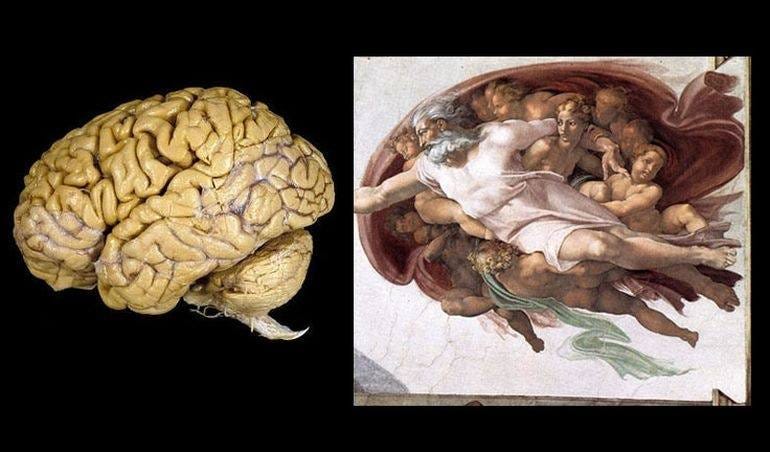
Money Messiah (Part 5)
*In this multi-part special edition of The Freedom Analects, we will be featuring the excellent written work of author John Vallis titled “Money Messiah: God, Bitcoin, and The Evolution of Consciousness.” This essay beautifully depicts the deeper aspects of value and money, their indispensability to human action, and demonstrates why corrupt money is such a destructive force. John’s original work is available in its entirety here.God/Reality is ‘Good’Given the stakes involved, it’s of paramount importance that we contend with the most accurate representation of reality (god) possible. Not doing so, means that our expenditures of limited resources are improperly made, and we fail to ‘sacrifice to’ the precise thing we are intending (at least not as optimally as we could). We therefore sacrifice in vain, by expending our most scarce and precious resources, time and energy, without the optimal return, or even the best corrective feedback.Because the regenerative hero is the one who sees most clearly the ‘truth’ of the reality in which they’re embedded, they are therefore most able to construct a congruent relationship with it. This permits the most efficient possible engagement with that reality, and therefore provides the greatest opportunity to bring forth the best form of ‘good and useful order’, from the eternal well-spring of potential (‘chaos’ / ‘the unconscious’).But who defines ‘good’?We could go through the exercise of identifying and determining the impacts of all actions and their related outcomes, to come to some consensus on what constitutes ‘good’ (and this, indeed, is precisely one of the prime objectives of religious story), however, such an approach may always be stuck in an infinitude of subjectivity. As a result, it seems necessary to invoke an assumption about the nature of reality, which may indeed be the foundational article of faith, which permeates and animates all religious and mythic story, and quite possibly, the nature of reality and existence itself. That assumption, is that god, or whatever force or process generates reality, is fundamentally ‘good’, ‘creative’ or ‘loving’.If we accept this (and I understand many won’t), seeing and acting ‘in truth’ (maximally truthful information about that reality), is the very process through which ‘the good’ emerges. This is because seeing with a more truthful perception increases the ‘bandwidth’, so to speak, by which that force of generative order may emerge in the world.Truth thus becomes the fundamental concept for the identification and refinement of moral principles, as it represents the notion, and means, by which the ‘source’ from which they spring is accessed by consciousness.Perhaps it is for this reason that the pursuit of truth is so often associated with, or even tantamount to, the pursuit of ‘god’.Peterson:“Christ said, put truth and regard for the divine in humanity above all else, and everything you need will follow.”It seems to me that the religious stories are attempts to convey what ‘living in truth’ (living in as perfect a relationship as possible with the primary force(s) of generative order) actually looks like, and they necessarily must do so by articulating, through symbol, dramatic narrative and metaphorical abstraction, the very structure of the reality we experience.This is why the religious stories aren’t so much about ‘how to act’, but ‘how reality works’, leaving the individual, necessarily, with the freedom to determine how best to engage it.*Join me at the biggest event of the year, Bitcoin 2022. See below for 10% discount on tickets*“Bitcoin 2022 Conference is the biggest gathering of the Bitcoin ecosystem in the world. Join me and the movers and shakers shaping the Bitcoin future next April 6-9th in Miami Florida for Bitcoin 2022 Conference.”Paying with Fiat? 10% Affiliate link: http://tixr.com/pr/robertbreedlove/26217Paying with Bitcoin? Use promo code: BREEDLOVE.I stumbled upon a post by an anonymous reddit user that I thought explained this dynamic nicely:“The more attuned you are to truth, ie. the more accurately your internal map reflects outward reality, the better prepared you are to exchange information and actions with that reality. If our internal representation provides an accurate model which reflects God’s properties, we are more capable of interacting with God in relationship.”It is in this light that truthful information, and the truthful perception it fosters, is seen as being of primary importance, as it best determines the validity of the actions we take. It permits us to optimize our ‘exchange’ with reality, as we seek to offer some aspect of our limited selves, for something else that makes us ‘less limited’ (vis a vis our ideal).So when we ask the question, ‘what is the thing of greatest value?’, perhaps it’s simply the thing that every ideal elevates — the truthful information which most permits movement toward it.In this way, if ‘truth’ is the means of mitigating/reducing limitation (by
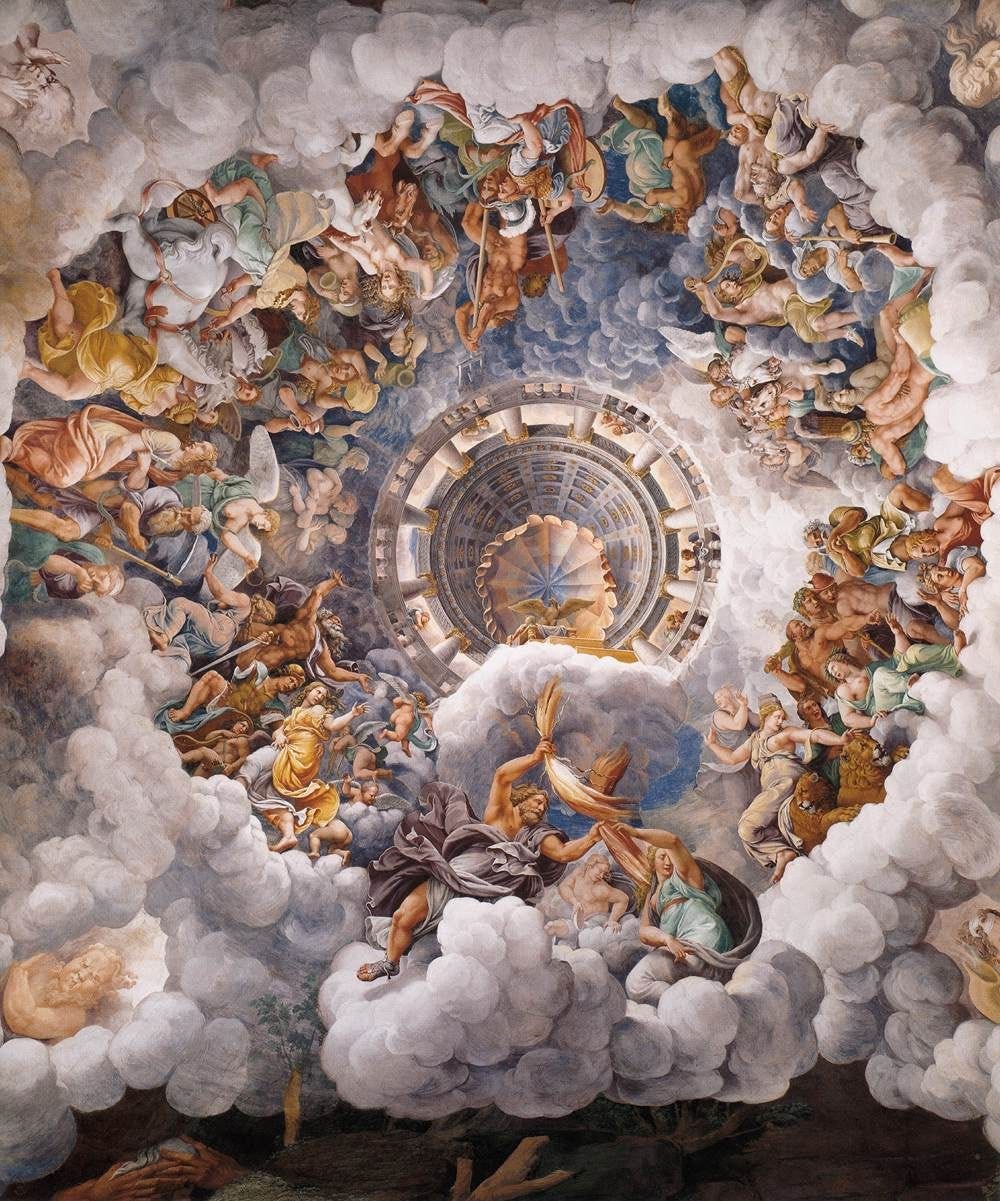
Money Messiah (Part 4)
*In this multi-part special edition of The Freedom Analects, we will be featuring the excellent written work of author John Vallis titled “Money Messiah: God, Bitcoin, and The Evolution of Consciousness.” This essay beautifully depicts the deeper aspects of value and money, their indispensability to human action, and demonstrates why corrupt money is such a destructive force. John’s original work is available in its entirety here.Where is God?While I found Peterson’s perspective on religion and ‘archetypal narrative’ to be extremely fascinating, and a more ‘rational’ explanation than I had ever considered, it also, perhaps strangely, caused me to see bitcoin differently.While several aspects of Peterson’s explorations around this topic have piqued my interest, and helped reframe my thinking in several areas, one insight in particular stuck with me:“God is expressed in the truthful speech that rectifies pathological hierarchies, to confront the chaos of being itself and generate habitable order.”When I first read this sentence, I had no idea what it meant — it was complete gibberish to me.But as I thought about it more, I began to see in it a profound truth. So much so, that I find it difficult NOT to see that truth represented nearly everywhere in the domain of human action today.What I especially can’t stop thinking about, is how this description applies to bitcoin, and more importantly, how it does so in an ‘archetypal’ sense — that is, in the ‘truest’ sense — and what the implications of that might be.The only change I’d make to Peterson’s definition is to swap ‘speech’ for ‘information’ (though he may very well have meant ‘speech’ to encompass all ‘expression of information’).Therefore,“God is expressed in the truthful information that rectifies pathological hierarchies, to confront the chaos of being itself and generate habitable order.’”The Emergence of ValueWhen Peterson mentions ‘pathological hierarchies’, what is he referring to?An understanding of pathological hierarchies necessitates an understanding of ‘value’, as it is value, and values, which ultimately permit the construction and ordering of the hierarchies we establish both internally and externally.So, what is ‘value’, and where does it come from?Value, as well as the ability ‘to value’, is made possible by limitation.All life, indeed all form, is in some way ‘molded’ by the limitations which constitute the parameters of its environment. There is no true ‘vacuum’, as every space is characterized by some, or many, forces or parameters acting upon it.As such, the ‘shape’ of things, be they living or not, is determined, to varying degrees, by such forces.For example, if earth were to have a stronger gravitational pull, our skeletal, muscular and nervous system (among other things) would be different.*Ledn has recently launched a Bitcoin-based home mortgage product. Now you can buy your dream home without selling your Bitcoin!Sign up with Ledn to get started today: https://mortgage.ledn.io/Even in the realm of perception, to focus on something is to create borders around it, such that it stands out from the setting or background in which it exists. If not for these parameters, everything would blur together into one big indefinable mess. These limitations then (which consciousness imposes), permit us to bring order to our perception, by giving everything an ‘independent’ or ‘limited’ existence.Limitation necessitates exclusion (sacrifice).To take any particular action, or to even simply focus on one particular thing, and to gain the benefit or information to be derived from doing so, we must necessarily forego everything else in that same moment, and devote our limited time and energy resources (even if only our attention) to doing so. We must confront the opportunity cost of all we might gain from placing our focused attention elsewhere, when we commit to focussing it somewhere.Sacrifice is thus a critical component of value, as it is the use of one’s own limited resources, as that against which all action is measured and justified.As the Greek philosopher Protagoras rightly noted, “Man is the measure of all things.”Once things are given a unique identity, and with our own limited selves as a necessary measure, we are able to ascribe ‘value’ to things (in fact we can’t avoid it), through the conscious or subconscious recognition of their motivational significance.The relative valuation of any given thing, to that of another, naturally generates a hierarchy (one thing is more ‘affectively significant’ than the other), and such hierarchies reveal themselves through the actions which they impel.These are not static structures. With every action, or with every change to the environment in which we act, these hierarchies (may) shift, fork, and re-orient, as new ‘ideal futures’ — or goals — emerge, on various timelines, and as unexpected events impose changes to the course, and resources, required to achieve them.In each moment we have many of these
Money Messiah (Part 3)
*In this multi-part special edition of The Freedom Analects, we will be featuring the excellent written work of author John Vallis titled “Money Messiah: God, Bitcoin, and The Evolution of Consciousness.” This essay beautifully depicts the deeper aspects of value and money, their indispensability to human action, and demonstrates why corrupt money is such a destructive force. John’s original work is available in its entirety here.Maps of Meaning**(continued from Part 2) proposition, is that far from simple superstitious stories, pre-scientific attempts to explain natural phenomena, or even the account of actual events, the religious stories are (perhaps primarily) humanity’s attempts at conveying in the most powerful, the most meaningful way possible, the answers to the following questions:Given the structure that has shaped us, and that serves as our ‘domain for action’, how should we act?What is the optimal ‘mode of being’ for ‘success’ in this world?What results when we act in a manner that is optimally congruent with the forces (seen and unseen) to which we are adapted?The answer, and the focal point of these stories, is exemplified in the ‘regenerative’, ‘redemptive’ or ‘creative’ hero.This is the character who has optimally mediated the forces of reality (chaos and order), and having done so, is a representation of the mode of being that best establishes ‘good and useful order’, or said another way, the ‘best possible outcome’.The behaviour of this archetypal character is meant to be a representation of the best possible balancing of their individual interests, and those with whom their environment is shared. This character displays an unrivalled understanding of the form and functioning of the reality in which they exist, which may be why they are often said to have the greatest ‘knowledge of god’, be ‘the son of god’, or some variation thereof. Having accomplished this, the regenerative hero serves as an example, the embodiment of certain ideals or principles, for all others to emulate, toward the perpetual maximization of individual flourishing and social harmony.*Join me at the biggest event of the year, Bitcoin 2022. See below for 10% discount on tickets*“Bitcoin 2022 Conference is the biggest gathering of the Bitcoin ecosystem in the world. Join me and the movers and shakers shaping the Bitcoin future next April 6-9th in Miami Florida for Bitcoin 2022 Conference.”Paying with Fiat? 10% Affiliate link: http://tixr.com/pr/robertbreedlove/26217Paying with Bitcoin? Use promo code: BREEDLOVE.Peterson:“The hero organizes the demands of social being and the responsibilities of his own soul into a coherent, hierarchically arranged unit.”As positive as this may sound, it is often the case that the regenerative hero is, at some point, demonized in one way or another. They are ridiculed, fought, or dismissed, because their behaviour, or the ‘new order’ they bring (or represent), is often first seen as being in opposition to the incumbent ‘established order’, and indeed it is.The hero is seeking to instantiate an alternative ‘mode of being’, one which is grounded in a more coherent and high-fidelity perception of ‘what is’ — that is, one which is more truthful. As a result, the hero is often faced with resistance, as most people are not so ready to accept an alternative truth, an alternative set of parameters, an alternative set of possibilities, and an alternative set of responsibilities (from those they have become habituated and accustomed to).Peterson:“The revolutionary produces involuntary alteration in the ‘articles of faith’ of the normal individual. It is this capacity that makes him revolutionary and necessary — and feared and despised.”It’s important not to interpret this dynamic as simply one pertaining to an individual’s relationship to ‘culture’.Erich Neumann, in the book ‘The Origins and History of Consciousness’, delves deeply into how this dynamic also plays out within oneself. In particular, in the relationship between the unconscious and conscious mind, and how it’s best engaged or regulated to yield an optimally ‘integrated self’. In this case, the ‘established’ culture is representative of the current state of the ‘self’, and the ‘hero’ is a representation of the process and products of probing the depths — and dangers — of the unconscious, in order to bring back something which, though initially disruptive, is ultimately of great benefit in the pursuit of a more refined, or evolved, consciousness.Neumann:“The growth of individuality and its development are mankind’s answer to the ‘perils of the soul’ that threaten from within, and to the ‘perils of the world’ that threaten from without. Magic and religion, art, science, and technics are man’s creative efforts to cope with this threat on two fronts… At the centre of all these endeavours stands a creative individual as the hero, who in the name of the collective — even when he is a lonely figure standing out against it — moulds it into sha

Money Messiah (Part 2)
*In this multi-part special edition of The Freedom Analects, we will be featuring the excellent written work of author John Vallis titled “Money Messiah: God, Bitcoin, and The Evolution of Consciousness.” This essay beautifully depicts the deeper aspects of value and money, their indispensability to human action, and demonstrates why corrupt money is such a destructive force. John’s original work is available in its entirety here.My ‘Beliefs’For what it’s worth, personally, I’ve never ascribed to any particular religion, nor any overly specific notion of ‘god’. I see great wisdom in a variety of religions, myths and stories, and believe that very similar fundamental themes sit at the foundation of many of them. This, however, seems to me to invalidate a monopoly claim on ‘truth’ by any one in particular, though their degree of relative sophistication may indeed be extremely consequential.Of course, this doesn’t mean I haven’t been influenced by certain of them more than others, in both conscious and unconscious ways. Culture is tremendously influential in determining how we think and act, and as the religious stories have had an enormous impact on the character of most cultures, I doubt it’s possible to be completely impervious to their influence (nor is such a thing necessarily even desirable).In any case, I’ve come to have a deep appreciation for the contributions that all formal religions have made to both our understanding of the most fundamental components of reality, and, despite their many shortcomings, their contributions to culture and human flourishing.In a world in which various competing or conflicting factions have access to weapons of mass destruction, it seems like a hell of a time to give up on the enterprise of determining how best to engage the reality we all share.The world appears to be in a precarious position, and though many do their best to confront it nobly, many also seem to share a sense that something is fundamentally wrong, and that the outcome will be extremely dire, if a proper solution is not discovered, or revealed, soon.It is from this circumstance (and possibly because of it) that out of the unconscious of a single individual, a counter-force has emerged, to save humanity from itself, possibly just in time.I believe that force is bitcoin.Maps of MeaningSomeone who has been highly influential in opening my mind to an alternative, or perhaps more sophisticated, understanding of religious thought and narrative, is Jordan Peterson.My interest in Peterson’s lectures led to my reading of a book he published in 1998, entitled ‘Maps of Meaning’.*Ledn has recently launched a Bitcoin-based home mortgage product. Now you can buy your dream home without selling your Bitcoin!Sign up with Ledn to get started today: https://mortgage.ledn.io/This book was written long before Peterson’s rise to international notoriety, and therefore up until recently, was quite obscure.I’d been listening to many of Peterson’s lectures, and had heard him reference the book and the material it contained many times. I was particularly intrigued by how much time he claims to have spent writing it, about 15–20 years if I remember correctly, isolating and re-writing each sentence 10 (or more) times to make sure it represented, as precisely as possible, the meaning he was attempting to convey. It’s almost hard to believe someone could tolerate that level of persistence and meticulousness, especially with the ever-looming questions of; ‘What if I’m not seeing this clearly?’, ‘What if nobody reads this?’ (and relatively few did for almost two decades), ‘How can I possibly justify the time I’m spending on this when I have work, family, health, friends etc to attend to?’. The only answer that I can muster, and the obvious one, is that he thought it to be ‘worthwhile’.I suspect he believed that what he was attempting to communicate was a profound truth, and for that reason, he had to make sure it was articulated clearly, no matter the cost. It’s a staggering sacrifice really, a dedication and discipline that relatively few people will probably ever be sufficiently motivated to endure. In any case, knowing his material, and his approach to writing the book, I assumed it would not only be extremely enjoyable, but also profound — I was right.Though I’ve chewed on some of the ‘big questions’, and attempted to integrate whatever insights that’ve come from doing so, my perception of the ‘ground of being’, the setting for these cosmic dramas we call our lives, and it’s influence, was lacking a kind of coherence, and I’ve found Peterson’s framework (and that of others since) to fill that void, if only temporarily, quite nicely.So what IS that framework which I found so useful? Well, let me just distill a 460 page book and 20 years of thought and research into a paragraph or two, shall I? lol. (Forgive me, Jordan)Essentially, Peterson treats the relevant, in fact primary, plane on which to ask the big questions about reality a
Money Messiah (Part 1)
*In this multi-part special edition of The Freedom Analects, we will be featuring the excellent written work of author John Vallis titled “Money Messiah: God, Bitcoin, and The Evolution of Consciousness.” This essay beautifully depicts the deeper aspects of value and money, their indispensability to human action, and demonstrates why corrupt money is such a destructive force. John’s original work is available in its entirety here.What is Bitcoin?‘What is this thing’?That’s the question that’s been rattling around in my head for several years now, as I continue to attempt to understand bitcoin.I first became interested in bitcoin because I saw in it a potential alternative to what I believed to be an extremely unjust system of money, which I saw (and see) as the largest-scale, and therefore most significant injustice facing humanity today.I still believe that ‘the money’ is the largest impediment to individual and collective human flourishing on this planet, and with each passing day I have less and less doubt that bitcoin is, indeed, the solution.However, the significance of this phenomenon extends far beyond a simple replacement or upgrade to an outdated money system (or rather such a thing is far more significant than it initially sounds).Despite constant study, contemplation, and interaction with bitcoin, and the apparently endless related fields, there exists in me a constant nagging feeling that the picture is incomplete, that the full relevance of this thing is yet to be fully appreciated, and this has inspired in me a never-ending appetite for any insights that might elucidate greater clarity — something that might put more coherent understanding to a tremendous ‘felt sense’ of meaning.*Join me at the biggest event of the year, Bitcoin 2022. See below for 10% discount on tickets*“Bitcoin 2022 Conference is the biggest gathering of the Bitcoin ecosystem in the world. Join me and the movers and shakers shaping the Bitcoin future next April 6-9th in Miami Florida for Bitcoin 2022 Conference.”Paying with Fiat? 10% Affiliate link: http://tixr.com/pr/robertbreedlove/26217Paying with Bitcoin? Use promo code: BREEDLOVE.The more I attempt to understand bitcoin, and its various implications, the more I’m drawn toward topics and insights that I never would have anticipated to be relevant to something as mundane as money. And yet, through this journey, I seem to inevitably end up arriving at ideas of the utmost significance and meaning.It would seem many others share my feelings. In fact, many have expressed to me, sometimes hesitantly, surprise, or even disbelief, in the thoughts about bitcoin emerging in their minds.Why is this?Bitcoin seems to represent a great, and possibly unprecedented, mystery, and as a result, insights are sought from nearly every domain of existing knowledge, in an attempt to discover the proper context by which to understand the meaning of it. That is to say, it has inspired in me, and many others, a renewed inquiry, in which nearly everything must be re-considered, recapitulated, and reconstructed. This is not just due to bitcoin’s propensity to cause one to interpret differently (and often critically) the foundational institutions and mechanisms by which culture and society currently operate, but it seems also to be that a renewed interest in such disparate fields of knowledge, is an attempt to try and leverage the ‘truths’ to be found in those fields, to better discover or understand the ‘truth’ of bitcoin.While this may seem to be a daunting, even redundant task, for me it’s actually been incredibly invigorating.It’s such a joy to see so much of the world with fresh eyes, probing it more deeply than ever before, for whatever new meaning it might reveal. It has brought such an elevated richness to my experience of life, and for that I am extremely grateful.But what is going on here?Naturally, the more unprecedented a thing is, the more scouring for clues will have to be done, which necessitates a widening of the surface area of inquiry — a more broad set of ‘data’ is investigated for potentially valuable insights.This is very much the case with bitcoin, and likely why the ‘rabbit hole’ moniker is so ubiquitous.Adding to this mystique, is the fact that bitcoin is concerning ‘money’, which is for many, a very misunderstood and neglected aspect of our lives and cultures.Money, as it turns out, is a far more mysterious, and meaningful, phenomenon than most people realize, and this indeed is what I and others are beginning to appreciate.As it turns out, money, time, value, truth, meaning, energy, and many other fundamental concepts which constitute our experience of reality, are all intimately wrapped up together.It’s becoming clear, that an exploration of this new form of money (bitcoin), necessitates an understanding of these fields, and likely many more.What do we call the search which leads to the revealing of the ‘truth’ of so many things?What do we call a phenomenon, which results