The Far Middle
200 episodes — Page 2 of 4
S1 Ep 151Years, Numbers, and Consistency
Far Middle episode 151 features a series of topics connected by the theme of “by the numbers, through the years, and through the lens of consistency.” That theme begins with the installment’s sports dedication honoring Bill “Wink” Winkenbach. Transforming the way fans watch and follow sports today, Winkenbach invented fantasy football in 1962. Nick looks at fantasy football’s growth, by the numbers and through the years, these past six decades. While Winkenbach was laying the foundation for modern fantasy sports in the 1960s, the Eisenhower administration would start counting the number of foreign nationals “apprehended” or “encountered” when crossing into the U.S. over the southern border. Nick proceeds to examine the immigration crisis by the numbers and through the years to present day. “Being part of a family who got its start here in America through immigration, I always lean toward being pro-immigration, but under, of course, reasonably defined sets of rules and criteria,” says Nick. “And that is far from what we have today… over the past three years, there’s a total of about ten million unauthorized, undocumented immigrants that have entered the United States…By the numbers on the immigration crisis should freak all of us out.” From the sobering and shocking data on America’s immigration crisis, Nick switches gears to World War II and the shocking tally of how many Soviet troops were killed by Stalin in conjunction with his ‘Not a Step Back’ order. Nick suggests a range of 300,000 to 900,000 Soviet troops were killed by their own government and fellow soldiers. Fantasy sports, the immigration crisis, and the Soviets killing their own troops—they reveal the importance of consistency and the danger of inconsistency. This leads to a discussion between the inconsistency of how former President Trump and President Biden were respectively charged and not charged for retaining classified documents. “Rules are rules,” says Nick. “When you break them, account for them. When you enforce them, do so consistently. To do otherwise is asking for trouble, both politically and culturally.” Continuing his focus on Washington, D.C., Nick shifts to the Inflation Reduction Act and specifically the Act’s sections to jumpstart the hydrogen economy. Nick explains the unique opportunity of coal mine methane (CMM) as a hydrogen feedstock and highlights the recent co-authored editorial, “Seizing Western Pa.’s unique hydrogen opportunity.” In the editorial by Matt Smith, Darrin Kelly, and Greg Bernarding, they write, “If properly enabled and maximized, CMM-based hydrogen production will be able to create over 696,000 jobs in the Pittsburgh region over the next two decades and infuse over $213 billion into the regional economy. We have identified over 30 unique projects, each with the potential to create close to 20,000 jobs.” Key to unlocking the economic and environmental benefits of these projects is the U.S. Treasury Department. Nick explains the Department “needs to finalize the 45V hydrogen production tax credits within the IRA. That's consistent with what the law intended. And that will facilitate a significant climate positive set of actions and impacts when it comes to fugitive methane's beneficial use. If you do that, it aligns with the original congressional intent. And it also aligns with President Biden's signa...
S1 Ep 150The Far Middle Journey
Marking the milestone 150th episode of The Far Middle, Nick reflects on the podcast’s nearly three-year journey and inspiration from Dr. James Burke's "Connections" series. “With such a prominent episode number, we need a compelling sports dedication, one that sits atop the greats, as a great of greats, and one that epitomizes and embraces the attributes of doing, achieving, hard work, and being rational,” says Nick, presenting the honor to Gordie Howe, aka “Mr. Hockey.” After reviewing Howe’s legendary career, work ethic, and transformative impact, Nick connects to The Far Middle’s impact on helping foster civil discourse and the importance of expressing diverse opinions. Looking back on the history of The Far Middle, Nick describes his philosophy on strategic thinking akin to that of a chess player, versus a checkers player’s mentality. However, the podcast’s beginnings resembled more of a checkers style before evolving into that of a chess player’s approach. He explains that each Far Middle episode is distinctly unique, with no two episodes exactly alike, yet all 150 episodes tie together a handful of core themes consistently and uniquely connected. “Strangely enough, applying a checkers player's mindset over the years helped me to become better at applying the chess player's mindset when thinking ahead,” says Nick. “It's one of life's interesting ironies.” Next, Nick references Ayn Rand’s essay, “Who Will Protect Us from Our Protectors?”, in discussing a core theme of The Far Middle, which is the state justifying control of the individual under the cover of looking after the helpless individual’s best interests or the public good. “The state is promoted as the protector for the individual, the little guy's shield,” says Nick. “But who then protects the individual from the out-of-control protector when that protector explodes in size and scope?” The episode delves into the Founding Fathers' vision of limited government and individual sovereignty, contrasting it with the growth of bureaucratic control. Drawing parallels to Orwell's "1984" and Huxley's "Brave New World," Nick warns against the dangers of state manipulation and the erosion of individual freedoms. In closing, Nick reaffirms his commitment to advocating for individual liberty and civil discourse as The Far Middle journey continues.
S1 Ep 149Manipulation
The Far Middle episode 149 explores various forms of manipulation across society, spanning government, finance, electric vehicles, real estate, and more. In one of The Far Middle’s more unique sports dedications, the episode highlights an unlikely honoree: Arnold “The Brain” Rothstein. Nick explains that while the manipulative Rothstein didn’t excel in professional sports as a player or coach, his infamous role in fixing the 1919 World Series (which he denied) would transcend the sports world. Beginning this installment’s connections, Nick transitions to the evolution of the International Energy Agency (IEA). The agency “has succumbed to ideological pressures from the Left, the radical environmental movement, and the code red crowd,” says Nick. Those interests have skewed IEA’s demand forecast for global oil and natural gas use, and they then use that manipulated data as evidence there isn’t a need for further oil and natural gas investment. The argument is then parlayed into energy policy decisions, such as the Biden administration’s pause on new U.S. liquefied natural gas export facilities. Revisiting prior episode 148, “Fields of Resistance,” Nick highlights the German government’s budget manipulation attempts that ultimately sparked the German farmer protests. “Manipulation by government is not unique to Europe,” says Nick. “Our government here in the United States is fully capable of manipulation of its own.” This leads to a conversation about the U.S. EPA’s vehicle emissions rule, which is a de facto EV mandate. Nick reviews a paper by Paul Bonifas and Tim Considine, “Analyzing the EV Rule,” which finds, “The EPA’s EV rule would cost the U.S. economy and taxpayers $1,407 billion, an underestimation of $3,007 billion.” Next up is a topic familiar to readers of Precipice, which is the magnitude of public pension underfunding. Examining state and local government unfunded pension obligations, Nick references a Hoover Institution analysis that, “As of fiscal year 2021, the total reported unfunded liabilities of [state and local government pension] plans is $1.076 trillion. In contrast, the market value of the unfunded liability is approximately $6.501 trillion.” Switching from the public sector, Nick explains the manipulative tactics housed in the commercial real estate market to raise property values artificially. Perhaps one of the biggest manipulators is the Federal Reserve, which “has set interest rates far below normal for decades resulting in negative real interest rates, and such monetary manipulation has massive ramifications across society, much of them negative,” says Nick. In closing, Nick questions the absence of the media and journalism who, by not calling out the manipulations discussed, are a willing accomplice by reporting opinions and the image rather than facts and the truth. As episode 149 reaches twilight time, Nick pays tribute to what might be the greatest song in rock and roll history about manipulation.
S1 Ep 148Fields of Resistance
Far Middle episode 148 arrives at a special time: March Madness is here, spring has sprung, and America is celebrating National Agriculture Week. At this time of renewal, farming is the featured theme and focus. Nick begins in “heaven,” aka Iowa, for this episode’s sports dedication, which goes to “the Heater from Van Meter", Hall of Fame pitcher Bob Feller. While Felller eventually landed in Cooperstown, his stretch to more than 2,500 Major League strikeouts began with playing American Legion ball in Iowa, with Nile Kinnick behind the plate. Learn more about Heisman Trophy winner Nile Kinnick in The Far Middle episode 138, “The Truth of the Matter.” Bob Feller, who grew up on a family farm, plants the seed for this episode’s examination of the roots of American farmer activism in the late 19th century and the parallels to Europe today. Nick discusses the recent surge of farmer protests across several European countries, from Ireland to Romania. The conversation further explores Nick’s recent commentary, “Harvesting History: Farmer Activism is Democracy’s Early Warning System.” In this episode, Nick offers both an American agriculture history lesson and an update on current issues and strife affecting European farmers. Learn how and why climate change policies are the singular root cause of today’s European farmer protests, and why other so-called causes are simply associated symptoms of those climate policies. “Farmers matter greatly in society—let's not mess with them,” says Nick. “They’re one of America’s great value creator classes—amongst creators, enablers, and servers—making society function, as I wrote in Precipice. Unfortunately, farmers are finding themselves under attack with this ever-pressing value appropriation by what might some call the takers, and that I reference in Precipice as the Leech.” In closing, Nick wraps with a fitting look back at the first Farm Aid concert. Now nearly 40 years ago, Nick pays tribute to Eddie Van Halen and Sammy Hagar’s first performance together on stage.
S1 Ep 147The Struggle Between Liberty and Authority
The Far Middle episode 147 begins with an only-in-America connection as Nick presents the unique link between U.S. Senator Rand Paul and the installment’s sports dedication, Hall of Fame baseball pitcher Jim Bunning. Nick discusses Bunning’s accomplishments on the diamond that took him to Cooperstown, as well as his post-baseball career that took him to the United States Congress. “It's another sports dedication that isn't so much about sport as it is about the unique journeys and opportunities that present themselves in America,” says Nick. The conversation then transitions into a discussion of John Stuart Mill's "On Liberty," Mill’s formative essay on individual freedom and the role of government in society. Nick’s commentary extends from and expands upon his recent article, “Revisiting On Liberty: Magnificent Guide in Troubling Times.” Nick explores many themes from Mill’s 1859 masterpiece, such as the importance of protecting individual rights from societal and governmental coercion, the dangers of suppressing dissenting opinions, and the need for tolerance of nonconformity. Nick draws connections to present day issues, such as vaccine mandates, censorship on social media, and ideological polarization. Regarding that polarization and today’s thought police, Nick notes that “Mill pointed out that society benefits from genius, but genius, it requires individuality and freedom. Everyone appreciates a genius in art. So, when some musical or literary genius comes on the scene, everybody loves that. But the same people often disdain contemporary genius that disrupts political, economic, religious, or scientific status quo and power. It's quite inconsistent.” In the closing lines of On Liberty, Mill writes, “The worth of a State, in the long run, is the worth of the individuals composing it…a State which dwarfs its men, in order that they may be more docile instruments in its hands even for beneficial purposes, will find that with small men no great thing can really be accomplished.” Nick contends that the individual is going to have to reign once again supreme in the U.S. if we want to secure a bright future. Concluding the episode, Nick connects back to 1859, the publication year of On Liberty, to reflect on another milestone that year. And that breakthrough event took place in Titusville, Pa., where Edwin Drake struck oil giving birth to America’s oil industry.
S1 Ep 146Transformations
The Far Middle episode 146 highlights two contrasting transformations—the first positioned the NFL to become the league it is today, while the other transformation finds New York City on the precipice of ruin. This installment’s sports dedication goes to visionary NFL Commissioner Pete Rozelle. Earning the job at age 33, Nick looks back on Rozelle’s role in transforming the NFL into the immensely popular financial success it is today. Rozelle’s leadership on revenue sharing and new television contracts not only increased the league's revenue and exposure but also made football America’s number one sport. Rozelle shaped the NFL into a cultural and economic powerhouse. “Rozelle is someone who transcended sport and represents what America has to offer, no matter what your profession or cultural interests,” says Nick. That powerhouse’s headquarters, New York City, connects to this episode’s focus, which is the myriad challenges facing the Big Apple largely due to years of leftist policies from the city’s leadership. Nick recounts a trip last month to New York and delves into the city's decline over the past few years, exacerbated by pandemic policies. While only in town for a couple of days, “I made it a point to talk to as many residents and businesspeople and workers and business owners as possible,” says Nick, proceeding to summarize the concerns and frustrations of those he spoke with along with personal observations. Nick first addresses crime, describing the city’s vibe as tense and on edge, followed by a discussion on the controversial leadership of Mayor Eric Adams as he’s “suffering from a host of issues.” Those issues span affordable housing to corruption allegations, but most notably a migrant crisis. That crisis made disturbing national news just before Nick’s visit, after a recent assault by migrants on New York Police officers in Times Square and Manhattan District Attorney Alvin Bragg’s ensuing response. “D.A. Bragg made a mockery of the entire justice system,” says Nick. Nick also examines once again the city’s transportation mess, from the deteriorating condition of the subway to the implementation of the regressive tax that is congestion pricing. Concluding his observations on the headwinds facing New York City, Nick shares troubling insights evidenced from a lunch at a friend’s Little Italy restaurant. And visible from that lunch was the mysterious and windowless Long Lines Building in Tribeca, which serves as an intriguing close for Far Middle episode 146.

S1 Ep 145Wild Ride
Episode 145 of The Far Middle begins with a sports dedication that continues a recent theme of honorees and tributes whose stories transcend beyond sports. Professional baseball pitcher, and longtime Pittsburgh Pirate, Dock Ellis is remembered in this installment. Nick describes Ellis’ intriguing story as one that’s reached urban legend status, but one that’s also sad and tragic. Nick looks back on Ellis’ career, specifically recounting Ellis’ infamous no-hitter from June 12, 1970, which Ellis accomplished after taking LSD earlier in the day. Ellis “was a personality, an advocate for causes, an addict, an individual, a lightning rod, and in many ways, he epitomized much of the late 1960s and 70s,” says Nick, paying respect to Ellis and his “wild ride.” Transitioning from Ellis, Nick notes the geopolitical instability during Ellis’ playing days, and how those trying times—from the Vietnam War to the Cold War—resemble many of the myriad threats and “wall of worry” we face today. And amongst the multi-faceted wall of worry spanning the globe today, Nick delves into his greatest concern, which is China and its potential attack on Taiwan. Nick proceeds to examine a China-Taiwan analysis led by Mark Cancian (Colonel, USMCR, ret.), which looked at “what would happen if China attempted an amphibious invasion of Taiwan?” Cancian, a senior adviser with the Center for Strategic and International Studies’ (CSIS) International Security Program, alongside co-authors Matthew Cancian and Eric Heginbotham, “developed a wargame for a Chinese amphibious invasion of Taiwan and ran it 24 times. In most scenarios, the United States/Taiwan/Japan defeated a conventional amphibious invasion by China and maintained an autonomous Taiwan. However, this defense came at high cost.” After reviewing the CSIS China/Taiwan wargaming report, Nick considers several follow-up questions. Including: How effectively do the Chinese and American militaries fight? If China invades Taiwan and is left vulnerable, will the U.S. attack Chinese military locations on China’s mainland? Will the Taiwanese fight, or will they fold and collapse when confronted with the brute force of a Chinese invasion? Will public opinion in the United States be able to stomach the level of losses likely to be suffered to save Taiwan? How will the conflict end? Does China go all in resulting in a global conflict? If the worry of a potential China-Taiwan conflict is keeping you up at night, Nick has an appropriate 1983 film directed by John Badham for you…shall we play a game?
S1 Ep 144Contrasting Views
Episode 144 of The Far Middle falls just after Presidents’ Day 2024. Accordingly, Nick notes a few U.S. presidents that are underrated, overrated, and a pair he continues to enjoy learning about. Connecting from Presidents’ Day to this installment’s sports dedication, Nick revisits President Jimmy Carter spearheading the boycott of the 1980 Summer Olympic Games in Moscow. Nick examines the many geopolitical dynamics of the boycott that resulted from the Soviet Union’s invasion of Afghanistan. Interestingly, the boycott—a move to force the Soviet Union’s withdrawal from Afghanistan—came just after the U.S. beat the Soviets in Lake Placid in the “Miracle on Ice,” which you can hear more about in prior Far Middle episode 80. Drawing on themes and issues surrounding the 1980 Summer Games boycott, Nick moves to present day and explores the contrasting views of “elites” versus those of average Americans on several economic, social, and political issues. Nick first highlights a comment from Jamie Dimon, who recently called out the insulated progressive elites in a CNBC interview, before next analyzing the results of a sobering poll by RMG Research for the Committee to Unleash Prosperity. That poll, “Them vs. U.S.: The Two Americas and How the Nation’s Elite Is Out of Touch with Average Americans,” offers interesting to shocking to frightening insights on America’s elite demographic. Of those many insights, Nick calls out that “almost 50 percent of elites believe that America provides too much individual freedom. And meanwhile, 60 percent of voters believe that there's too much government control. That's what you call contrasting views.” He also highlights elites’ views of climate change, restating a frequent Far Middle topic that “climate change policies have nothing to do about atmospheric levels of CO2, and they've got everything to do with control of the individual across society and economy.” Unfortunately, the poll results offer a validation of the themes and arguments Nick makes in Precipice: The Left’s Campaign to Destroy America. “Although I wrote that book years ago, looking at where the minds of elites are today and how they are driving Western societies, they serve as proof points for the hypothesis laid out in Precipice…I wish Precipice would have been a false alarm, but instead, what's going on in America, is definitely not a drill,” says Nick. Referencing his discussion on the broken state of college and academia described in Precipice, Nick connects to academia’s unwillingness to reform, using Henderson State University in Arkansas as an example. This leads to a broader look at the societal value of a four-year college degree today, which “has never been worth less.” Moving from elites in academia, Nick discusses elites in bureaucracy, specifically former National Institutes of Health director Francis Collins, who “was as bad as it got when it came to running over science and individual rights to justify draconian pandemic policies.” In closing, Nick flips the conversation to a positive side, telling the story of Pittsburgh’s Paul Mawhinney, his record store Record-Rama, and his three-million-plus record collection.
S1 Ep 143Morphing the Narrative
The Far Middle episode 143, released on Valentine’s Day 2024, begins with a darker reflection from the holiday’s history: the St. Valentine's Day Massacre of 1929. Nick then begins this installment’s connections, shifting from “illegal gangland Prohibition-era fights, with blood flowing and bullets flying on the streets, to another form of tough competition—the legally sanctioned NBA with blood in the paint.” Nick fast-forwards 73 years later to Allen Iverson’s legendary “practice” interview. Nick examines the rest of the story behind Iverson’s interview and explains how it’s “a great example of how media can morph things to fit their desired narrative for whatever reason or for whatever motive.” Incidentally, Allen Iverson joins a select group of repeat Far Middle sports dedication honorees, checkout episode 92 for more. The theme of morphing the narrative then encompasses the episode’s focus as Nick counters many so-called experts’ claims that inflation has been tamed and run its recent short-lived course. Nick’s analysis is an extension from his recent essay, “20 Reasons Why the Worst is Yet to Come with Inflation.” Those 20 contributors of inflation—and their many underlying dynamics—can be broadly categorized into government spending and regulation, monetary policy, and geopolitics. A few of the inflationary drivers include: The growth of the regulatory state making everything more expensive. The impact of languishing worker productivity continuing to increase the costs of goods and services. Higher taxes and fees at every level of government escalating the cost of everything, everywhere, every day. Climate policies fueling energy scarcity and raising energy costs, and more. “Each of these individual factors are their own contributors, but all of them together, that helps drive an incremental step-up of inflation, a cumulative effect that occurs when they all manifest together,” says Nick. In closing, Nick makes one more connection to February 14, as he remembers Richard Stanley Francis. The British champion jockey and author passed away today, 14 years ago.
S1 Ep 142Bring It on Home
In The Far Middle episode 142, Nick once again starts the discussion with a sports dedication honoring an athlete whose accomplishments extend beyond sports. This installment’s honoree is the late Pat Tillman. While recognizing Tillman’s football achievements, Nick focuses on Tillman’s service and principles. Nick describes Tillman as an exemplar of a great American doing exceptional things throughout his very unique life. Nick then shifts the discussion back to his recent video series, “A Rational Thinker’s Guide to Climate Change and Related Policies.” Nick brings home his commentary spanning the prior two Far Middle episodes, and further examines his arguments from the concluding chapter of the series, “Forces Driving Present Climate Policies.” Those forces driving climate policies today can be best categorized as external and internal; with external coming from outside the United States, and internal being pressures and influences within the United States and West. Examining external forces, Nick covers OPEC, dynamics between Russia and Europe, Venezuela's aggression towards Guyana, and of course, China who “clearly is the biggest single example of who benefits the most with respect to climate policies and net zero journeys to really bad places.” Then there’s the internal driver of present climate policies. And the “best way to define it is as the Left within the West itself, whether it's the United States or Europe,” says Nick. “The Left at the end of the day, more than anything, despises the individual and specifically disdains the freedom of the individual to choose for themselves.” Nick proceeds to highlight several trends that are justified as “tackling climate change,” but at their core, they're about curtailing individual rights and greater control over individual choice. Examples today span what you can eat and drink, driving and EV mandates, 15-minute cities, and climate policy bleeding into government use of emergency powers. Nick rambles on with a final music segment, as he pays tribute to Led Zeppelin’s Led Zeppelin II album. Led Zeppelin II would mark the band’s first UK No. 1 album—a milestone occurring today, 34 years ago. For more Led Zeppelin commentary, check out Nick’s reflection on Led Zeppelin IV and Physical Graffiti.
S1 Ep 141Bad Medicine
The Far Middle episode 141 tips off with a sports dedication once again highlighting a great performer both on and off the field (or court).Nick pays tribute to the great David Robinson, aka “The Admiral.” Nick reflects on the two-time NBA champion’s unique path to the Naval Academy, his time with the Spurs and the U.S. national team, and his commitment to education and supporting young people. “David Robinson put his money and actions where his mouth was; you just don't get a better-quality person than David Robinson,” says Nick. “And if more of us are like him, it's a winning formula for the nation and society.”Connecting from Robinson’s service in the Navy, Nick discusses America’s military today, who’s being told by our current leaders that climate change is America’s biggest threat. This sets up the episode’s primary focus, which is the continuing examination of his recent video series, “A Rational Thinker’s Guide to Climate Change and Related Policies.”Nick expands upon his analysis in part two of the series, “Consequences of the Experts' Cures,” beginning with the significant carbon footprint of so-called “renewables,” from their supply chain to installation. Their misunderstood, or perhaps ignored, life cycle carbon footprints are arguably the foundational flaw of the experts’ climate “cures.”The bad medicine, which is those cures, will have materially worse impacts on economies and quality of life for citizens across the globe than the actual symptoms of climate change, whether legitimate, manufactured, or imagined, explains Nick.The ignored carbon footprints of wind, solar, electric vehicles, and batteries underpin why the consequences are not going to be positive by pursuing the medicine or cures that the experts and the elites have prescribed.Nick next connects to how the experts’ cures are driving inflation and destabilizing the geopolitical map. Nick examines the aggression by Russia, China, Iran, Hamas, Venezuela, and others that are rooted in energy policy. Moreover, Nick calls out the hypocrisy of the “experts” who refuse to practice what they preach.In closing, Nick offers a great tribute to “the first president of the United States to enjoy rock star status.” Who was that president? Well not Obama or JFK. Press play to discover who, and rock on.
S1 Ep 140Skating Through the Climate Maze
Episode 140 of The Far Middle is a must-listen for hockey fans as Nick looks back at both the history of the game and the origin of the name "hockey." He recounts the game’s early forms in ancient Greece, 17th-century Holland, and its evolution in North America. While the game began outside of Canada, the Land of Maple refined and popularized hockey into the modern sport we know today. For more hockey talk, check out Nick’s prior dedications to “the Great One,” Martin Brodeur, Sidney Crosby, and Connor McDavid. Nick leaves the rink to spend the bulk of episode 140 revisiting a three-part video series he released earlier this month following the United Nations’ 28th “Conference of the Parties” climate summit (aka “COP 28”). The trilogy, “A Rational Thinker’s Guide to Climate Change and Related Policies,” is available here and also on Nick’s YouTube channel. This Far Middle further explores Nick’s commentary in the trilogy’s first installment, “Diagnosing the Problem and Issue.” Topics include: The poor and inept policies being forced upon society by the climate alarmist movement. Earth’s changing climate throughout history. The shale gas revolution’s role in reducing carbon dioxide emissions. The economic, social, and ecological challenges of so-called 'renewable' energy sources like wind and solar—as well as their low energy density. “We need to have a follow-on conversation about what we know about climate change policies, because those policies, they're advertised as the medicine and the cure to climate change by the climate alarmist crowd,” says Nick previewing next week’s episode. He calls the expert and elites’ cures much worse than the disease of climate change and asks whether those symptoms are real or whether they’re fabricated. In closing, Nick connects to John Bunyan’s “The Pilgrim's Progress." He draws parallels between the challenges faced by dissenters in Bunyan’s classic work to today’s “religion of climate alarmism” and limitations on free thought in the present-day discussion of climate change.
S1 Ep 139Echoes of Greatness
Following Martin Luther King Jr. Day this past Monday, and the anniversary of his January 15th birthday, Nick begins The Far Middle episode 139 with a great story of King’s nonviolence in action, which “no one did better than Martin Luther King Jr. with lasting impact.” For this episode’s sports dedication, Nick again spotlights an athlete whose greatness extends beyond the field, or in this case the pitcher’s mound. That individual is Walter Johnson, “the best pitcher in an era of dominant pitchers, and very well may be the best pitcher of all time.” Johnson was part of the Baseball Hall of Fame’s inaugural Class of 1936 alongside episode 137’s dedication, Honus Wagner. While noting Johnson’s epic baseball stats, Nick focuses on Johnson’s life and leadership off the diamond. Nick then moves from 1910s and ‘20s baseball to World War II, examining Americans’ views of the British military in 1942 versus present-day impressions of British strength during the Second World War. Reverting back to the turn of the century, just after Walter Johnson was born, Nick references American historian John Milton Cooper, and Cooper’s account of America’s thriving economy circa 1900. Nick also notes Cooper’s 2009 biography of Woodrow Wilson that was a finalist for the Pulitzer Prize. “I'd love to pick his brain on Woodrow Wilson, who I consider to be one of the worst performing presidents in our nation's history,” says Nick. “And if you want to know why, read Precipice for a full explanation.” Drawing a connection from the more than 2,000 newspapers at the outset of the 20th century, Nick discusses a December 14, 2023, article in The Economist by former New York Times editorial page editor James Bennett. In the article, "When the New York Times lost its way," Bennett does “a great job of differentiating between classic liberalism and illiberalism,” says Nick, further commenting on the herd mentality and state of journalism today. Drawing connections from journalism, media, and America’s economic might, Nick reflects on a 2021 interview with author Walter Kern and the cultural divide between urban versus rural America. Addressing the divide, Nick calls media a “wedge creator and wedge preserver in America today.” And in closing, Nick wishes a happy birthday to America’s first “polymath,” Benjamin Franklin. “How many people do you know that could be described as all of the following?,” asks Nick. “A writer, scientist, inventor, statesman, diplomat, printer, publisher, and a political philosopher.” In admiring Franklin’s immeasurable accomplishments and contributions, Nick highlights Franklin’s 13 virtues to cultivate his character and achieve not only success but also happiness.
S1 Ep 138Never Surrender
The January 10th release date of Far Middle episode 138 coincides with Save the Eagles Day. Marking the occasion, Nick suggests halting the “taxpayer-subsidized development of what’s become the most murderous aviary campaign in the history of man and since cats: wind turbines,” and even weaves in a Rage Against the Machine reference during the episode’s open. Nick again highlights a standout sports figure whose accomplishments both on and off the field epitomize greatness. And this installment’s sports dedication honors go to Robert Patrick "Rocky" Bleier—a Vietnam veteran, a four-time Super Bowl champion with the Pittsburgh Steelers, an author, the subject of the television movie Fighting Back, and more. After reflecting on Bleier, the discussion makes a jump cut to explore Frances Fukuyama’s 1989 essay, “The End of History.” Nick examines the paper and calls out a series of excerpts and assertions from Fukuyama that were a complete misread and a significant historic blunder. Fukuyama’s conclusions influenced even more historic blunders by those in power who believed the global ideological transformation that Fukuyama professed and subsequently set policy from. “I've said it before, I've said it on The Far Middle in prior episodes, I wrote it in my book Precipice, and I'm going to state it again, never ever underestimate the Left,” says Nick. “It comes at great peril for the individual and for society.” And while the Left might have been on the ropes in the late 1980s and 1990s, it will never surrender. With the supposed fall of communism, socialism, and the Left, Nick notes the irony that in the end of history era, the ideological vacuum in the West has been filled with none other than the tenets and values of the Left. He uses examples of open borders, “tackling climate change,” and the vilification of prior Western values such as capitalism and the individual. In closing, Nick pays tribute to 19th century American author Horatio Alger who was born a few days after today’s episode release, on January 13, 1832. While the Left’s dislike for Alger today borders on hate, he focuses in on the Horatio Alger Association and its promotion of the American dream, which is now under attack by the mainstream media. “Constant listeners, in the words of Public Enemy don't believe the hype when it comes to the Left,” says Nick. “Horatio Alger, and all that he stood for in his stories, they're legitimate and real, as long as policy and culture allow individuals to freely achieve.”
S1 Ep 137The Fellowship of Data and Facts
The Far Middle journey continues into 2024 as Nick celebrates one of the greatest baseball players ever to play the game, Johannes Peter "Honus" Wagner. Nick looks back on "the Flying Dutchman’s” baseball career and southwestern Pennsylvania roots. It’s a dedication “riddled with history,” that will entertain both constant-listener sports fans and non-sports fans alike. “You don't get more Appalachia, more Western Pennsylvania, or more Pittsburgh than Honus Wagner, says Nick. “And you don't get more scrappy, doer, and achiever than the Flying Dutchman.” Nick then takes a minute to discuss his Western Pennsylvania accent before connecting to the more serious topic of air quality in Western Pennsylvania. Nick highlights the organization Pittsburgh Works Together (online at pghworks.com) and their “Clearing the Air” report. “A few years ago Pittsburgh Works Together (PWT) started to think seriously about why all one hears about Western Pennsylvania when it comes to air quality is that it is horrible and that industry, manufacturing, and energy, they're to blame, and we should shut them down,” explains Nick. He proceeds to highlight PWT’s report, which uses 2022 EPA data to dispel the myth (perpetuated by many including the American Lung Association) that the air in the Pittsburgh region is among the worst in the country. “We need to act and set policies and establish goals that are based on facts, not fear or feelings,” says Nick (a repeated theme Far Middle constant listeners know well). Similar to PWT’s analysis of air quality, Nick highlights the ongoing research from the Institute for Energy Research (IER). Specifically, Nick discusses IER’s Environmental Quality Index analysis (available at www.instituteforenergyresearch.org). Per IER’s research, Nick demonstrates how “replacing American domestic production of oil or natural gas with foreign supplies would be an overwhelmingly negative trade-off for the planet, for Code Red, and for the environment.” Staying on data and numbers, Nick shifts to America’s debt and annual deficit. While a recurring Far Middle topic, in this discussion Nick helps provide perspective to just how unsustainable and calamitous America’s financial situation has become. The federal government’s insatiable desire to continue to spend is akin to the draw of Lord Sauron’s magical One Ring. With that, Nick concludes this Far Middle by heading to Middle-earth as he remembers J.R.R. Tolkien on the anniversary of his birthday back in 1892.

S1 Ep 136Broken Finances to Broken Hands
Closing out The Far Middle’s 2023 run, Nick presents a unique sports dedication that continues recent dedications combining sports with several interesting historical angles. For episode 136, Nick explores baseball’s “long forgotten Federal League” of 1913 to 1916. While a failure, it was a “wonderful experiment,” and a great example of “a risk-taking endeavor by doers in the chaotic world of free-market American capitalism.” From the business of early 1900s baseball, Nick connects to the business of baseball today, specifically the broken finances and unsustainable business model of the San Diego Padres. “It is striking how similar the failed business model and state of the Padres is to a government, say like Illinois or New York City, or corporations that are sitting on shaky business plans, or with the higher education model of today,” says Nick. Nick moves from the Padres’ financial mess to examining Argentina who faces a similar and more serious financial situation. “The root causes of Argentina's woes are a toxic cocktail of massive government borrowing and lax monetary policy and inflation,” explains Nick, proceeding to examine the similar economic trouble facing Argentina and the United States. While Nick is hopeful newly elected Argentine President Javier Milei can bring about reform, he worries greatly for America if we don’t course correct. Looking ahead to 2024, Nick explores what the Fed might do with interest rates next year. “Everyone wants a reduction in rates and cuts from the Fed,” says Nick. “But wanting it and getting it are two different things. I'm convinced the Fed will try to start to cut rates soon…But inflation doesn't care. In fact, inflation will flare even more if rate cuts start too soon.” In closing, and as New Year’s Eve looms a few days away, Nick wishes a happy birthday to Sir Philip Anthony Hopkins who will turn 86 this December 31. Nick reflects on Hopkins life and career, including his working-class upbringing. Nick recalls an admirable line Hopkins said about his father that speaks to Hopkins’ character, “Whenever I get a feeling that I may be special or different, I think of my father and I remember his hands – his hardened, broken hands." And if you haven’t seen Hopkins in The Elephant Man, add it to your watchlist this winter.
S1 Ep 135Pushing the Envelope
Hello Far Middle friends, Nick Deiuliis is back to talk with you again. Episode 135 begins with a sports dedication taking listeners from the gridiron to the stars as Nick honors wide receiver turned engineer and astronaut, Leland Melvin. Nick describes Melvin’s career from the football field to NASA as a “made for Far Middle topic and dedication.” The tribute to Melvin follows a recent string of dedications celebrating athletes (such as Ted Williams, Nile Kinnick, Archie Moore) who’ve pushed the envelope to achieve greatness beyond their sports careers. “I've always been interested in space because of the science and the constant innovation found in the associated industries, but I never wanted to be an astronaut,” says Nick. “Just too much risk for me to life and limb, which leads to our first connection for this episode, how innovation and risk in the profession of astronaut, they came together in the late 1960s during the Apollo space missions.” Nick proceeds to discuss how the Apollo astronauts devised an innovative insurance system autographing postage envelopes. Next, Nick recounts a remarkable and inspiring story on the lifelong impact that educators, specifically elementary school teachers, can have on individuals. As for something less inspiring, Nick discusses Encyclopedia Britannica’s grossly misleading Vietnam War timeline. “Encyclopedia Britannica tells only part of the true story and only the part that fits a narrative favored by the Left,” says Nick. “Frankly, it reads as if written by a communist and someone who holds a grudge against the United States. Tell the whole truth, Encyclopedia Britannica, not selected pieces of it to skew the uninformed looking to become informed. Those who served in Vietnam deserve at least that much. As do young students looking for objective and balanced resources to tell a complete story.” Students and education are a frequent theme this episode as Nick next explains how a CNX Mentorship Academy student recently taught him about “sleepy sickness.” Formally known as encephalitis lethargica, the disease was a global epidemic that resulted in hundreds of thousands of deaths in the 1920s. From sleepy sickness Nick connects “to what most people desire to hear when trying to sleep—the sound of silence.” With that, Nick closes by looking back on Simon & Garfunkel’s hit “The Sound of Silence.” And Nick offers “the rest of the story” (a frequent theme this episode) highlighting the connection of the song and album, Wednesday Morning, 3 A.M., to Art Garfunkel’s longtime friend Sandy Greenberg.
S1 Ep 134Education in America
The Far Middle episode 134 honors not only a sports legend whose record-holding World Light Heavyweight Champion reign spanned a decade, but also simply a great American. That individual, born 110 years ago on the date of this installment’s release, is none other than “The Mongoose,” Archie Moore. For those saying, “Archie who,” Nick explains that Moore “basically did it all.” He revisits Moore’s acclaimed boxing career, dedication to youth mentorship, acting roles, and service under the Department of Housing and Urban Development. “Archie Moore set amazing standards for vitality and competitiveness over an extended period of time in his chosen profession,” adds Nick, providing a pivot to this episode’s first connection and principal topic: education in America, and particularly education in our large cities. Nick starts in the Windy City where the city’s Leftist mayor has decided to no longer grade public schools based on student proficiency, but rather on how much schools are spending. Highlighting that per student funding in Chicago public schools sits just below $30,000, “an unbelievable amount for so little in return,” Nick asks where it’s going for so little in return. The answer? Not to the students nor to good teachers, but rather to bloated administrative staff, the bureaucracy, and to the public teachers union coffers (and the politicians they support). Nick leaves Chicago and heads west to Oakland for an insight on what public teachers unions are focused on these days. Not academics, but rather drought resistant trees and climate justice days. From Oakland, Nick heads down to Tempe, Arizona, to discuss a paper from Arizona State’s Walter Cronkite School of Journalism, titled, “Beyond Objectivity: Producing Trustworthy News in Today’s Newsrooms.” Juxtaposed to academia's views on the media, Nick highlights survey data to shed light on where the American public sits with respect to objectivity in journalism and media. The episode’s discussion then connects to a great educator who “very few people today ever heard of, which I suppose is yet another failing of media,” says Nick. “Early November this year marked the 50th anniversary of an assassination of a hero educator in Oakland, California, and his name was Marcus Foster.” Listen as Nick reflects on Dr. Foster’s exemplary career that was tragically cut short when he was assassinated by members of the Symbionese Liberation Army. Nick concludes with one final connection to a “Skunk” who also shares a birthday with “The Mongoose” and this episode’s release date. That individual is Jeffrey “Skunk” Baxter. Nick wishes birthday wishes to the guitar hero and rocket scientist, and recommends giving a watch to his talk on “Asymmetrical Thinking in a Conventional World.”
S1 Ep 133The Truth of the Matter
The Far Middle episode 133 is a fascinating series of connections on the nobility of enterprise and work, capitalism and individual choice, and the associated threats these face in today's global economy.The discussion begins in Iowa for this episode’s sports dedication, which goes to a great American who was a veteran, the 1939 Heisman Trophy winner, and the namesake of the University of Iowa’s football stadium. That individual? Nile Kinnick. Reflecting on Kinnick’s remarkable life, albeit cut too short at age 24, Nick comments that “he made the most of every opportunity and moment in his life, something to celebrate for sure.”Shifting from sports, Nick begins this week’s connections with a quote from Machiavelli’s The Prince: “As my intention is to write something useful for discerning minds, I find it more fitting to seek the truth of the matter, rather than the imaginary conceptions. Many have imagined republics and principalities that have never been seen or heard of.”Nick notes this line from The Prince is a theme and approach that he aims to mimic in his efforts such as The Far Middle and his book Precipice: “to sort of peel back the optics and veneer of image, that so many policies and movements fixate upon, and instead to focus on exposing the realities, and the truth, as in clinical, rational, scientific or mathematical truth, not some squishy definition or version of the truth.” Alongside Machiavelli, a host of thought leaders join the conversation, including Pope John Paul II, Ayn Rand, and Notre Dame Professor Carter Snead. A few of this installment’s key takeaways from Nick: Capitalism isn’t broken. What's broken is how the free market has evolved into a controlled market for the favored class, or the one percent, through policy and machinations between the bureaucrat, the political leader, and the special interest. In a free market, every individual can display their morals with their actions and decisions; it's a platform for the self, the individual, to assert their convictions with every decision made. There's a problem with finding and securing noble, meaningful work these days, as such work has vanished. It's rare and it's hard to find. Why? Most of it was purposely outsourced to our adversary, China, via globalization driven by the elite and expert class. American manufacturing was handed over to China so America could work effortlessly in the knowledge economy. This move is the biggest strategic blunder since the World War Two era and its damage will continue to lay wake. Although the expert political class might just be waking up to the threat of China, don't be fooled into thinking that corporate America has awakened to the threat. Germany’s economy and fiscal state is a warning sign to America. Following a string of poor policy choices, Germany has downshifted from the engine of Europe a decade ago to now idling as the sick man of Europe. In closing, Nick wishes a happy birthday to guitarist and R.E.M. co-founder Peter Buck, and quotes a line from R.E.M.’s “Finest Worksong,” off their album Document: “Take your instinct by the reins; You're better best to rearrange; What we want and what we need; Has been confused, been confused.”
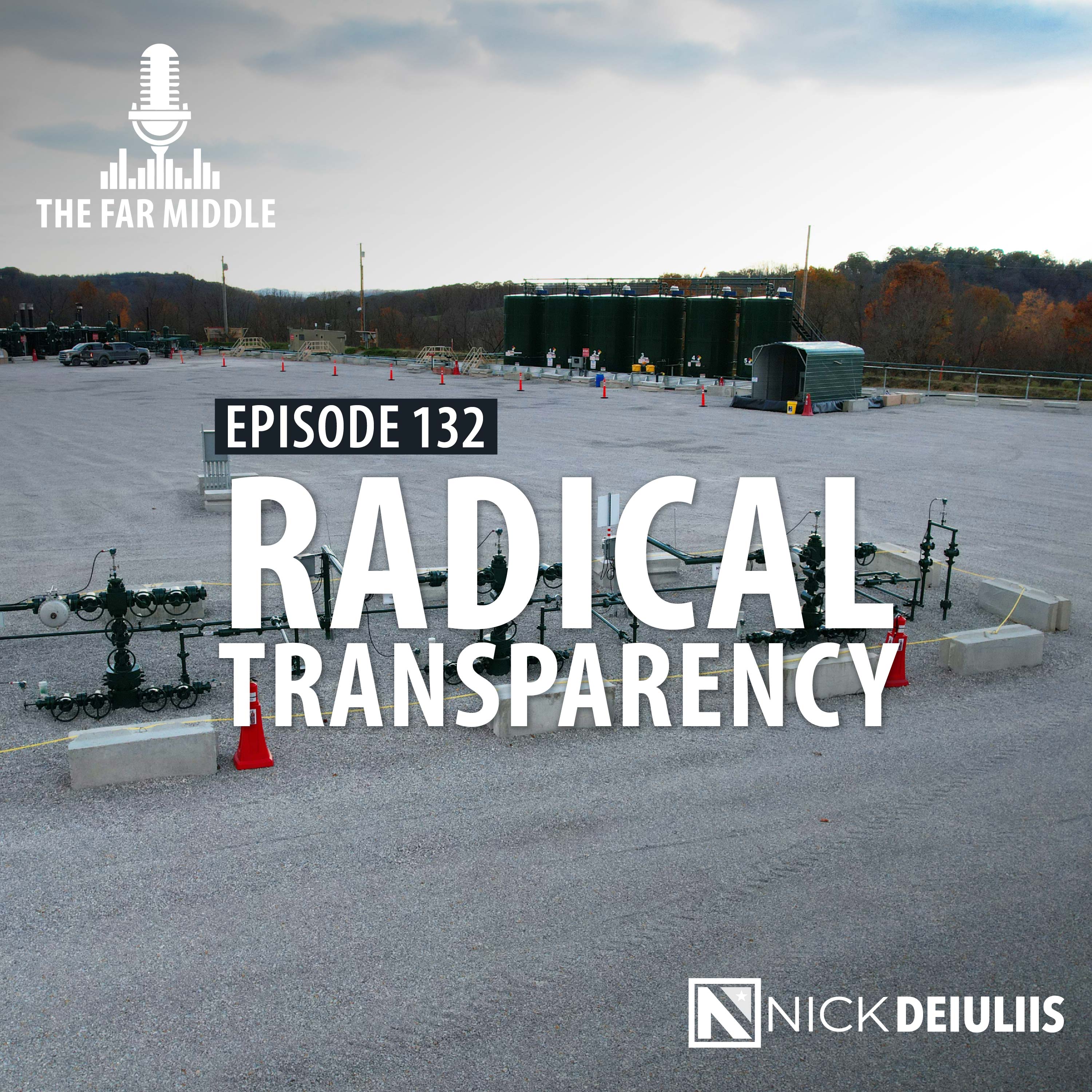
S1 Ep 132Radical Transparency
Episode 132 marks a special installment of The Far Middle as Nick spotlights CNX Resources’ historic and innovative Radical Transparency initiative. But before dropping the puck on the Radical Transparency discussion, Nick pays tribute to the legendary Montreal Forum in this episode’s opening sports dedication. The Forum opened its doors 99 years ago this week, and “was constructed in 159 days, can you believe that,” says Nick. “It would take longer today to draft the permit request for such a venue, and the actual permit review and approval process might not take 159 days, but instead 159 months.” Nick reflects on the property’s history, in particular its seven decades as home to the Montreal Canadiens, as well as other notable hosted events. “What made the Forum in Montreal a shrine,” asks Nick. “Doers building things to last. Seeing those things they built thrive and make history of their own. And sprinkling in fits and starts of innovation and continuous improvement.” With that observation, Nick connects to CNX’s new Radical Transparency initiative. Introduced this month on November 2nd alongside Pennsylvania Governor Josh Shapiro, Radical Transparency is a “partnership and agreement that’s going to move the state of the art forward to a higher and better place when it comes to how responsible manufacturing of domestic energy and natural gas is performed,” explains Nick. Nick looks back on how a data reporting challenge served as the impetus for Radical Transparency. That challenge drove CNX’s performance to a better place as a new regulatory reporting group was established alongside new data and IT platforms. Through those improvements and investments, the foundation was laid for Radical Transparency. The Radical Transparency website is now live at http://www.cnxradicaltransparency.com/ providing background and contextual information about CNX’s operations and development process. As opposed to policy driven by out-of-touch ideology or mysterious and unknown data (recalling episode 124 on the recent University of Pittsburgh’s natural gas studies), Radical Transparency will help craft policy based “on data, and the rational, and the known,” says Nick. Revisiting the initiative’s announcement earlier this month, Nick highlights that extraordinary day alongside many community leaders, including Governor Shapiro, Pennsylvania Environmental Council President Davitt Woodwell, and Boilermakers Local 154 Business Agent Shawn Steffee. Those assembled were “a coalition of the willing, a coalition of doers wanting to get something done on advancing the state of the art.” Nick underscores that this is just the start of Radical Transparency and now the real work begins to make it an engine for continuous improvement. In closing, Nick connects back to the Montreal Forum and the band Rush who played the venue several times. “The trio of Rush is the greatest band pound for pound in the history of rock,” argues Nick. “They weren't afraid to break rock norms through the years to innovate, much like what we're trying to do today with Radical Transparency.” Listen as Nick concludes with a few interesting factoids from the band’s Exit… Stage Left album.
S1 Ep 131Thankful
As family and friends gather to celebrate Thanksgiving, The Far Middle episode 131 examines the numerous reasons Americans have to be thankful. Before delving into the episode’s connections, Nick offers a fitting sports dedication this Thanksgiving eve: the wild NFL game between the Dallas Cowboys and Miami Dolphins from Thanksgiving Day back in 1993. This episode’s discussion follows a recent evening Nick spent in Philadelphia, assessing America’s opportunities and challenges with a group of businesspeople and thought leaders. Nick explains the opportunity stemmed from an invitation to discuss his advocacy efforts, including The Far Middle, his book Precipice, and more broadly the state of doers in America today. “Value creators have much to be thankful for today in America, in places like Pennsylvania, and in cities like Philadelphia,” says Nick. “But there's also a lot to be concerned about when one looks to the future and contemplates troubles, trends, and developments.” Stressing the importance of America’s middle class, Nick calls it “the lifeblood of so much of free enterprise and capitalism and the American dream and the western republican democracy way… the middle class is something to be thankful for today and also something to be worried about.” Nick goes on to address other topics of that recent Philadelphia conversation, including: the forgotten man and woman—a motivator for all; the definition of Liberal versus Leftist; his essay on whether America needs a third party; and, the concept of “institutionalizing.” As the connections conclude, Nick summarizes the many reasons Americans have to be optimistic and thankful, juxtaposed to related reasons for concern and worry. And in a somber closing, Nick goes back 60 years ago today, November 22, to the assassination of President John F. Kennedy. Nick recounts growing up and adults saying how they would never forget where they were on November 22, 1963. “That feeling would unfortunately be experienced by the next generation when September 11th rolled around in 2001,” says Nick. “Then we ended up knowing what it felt like. Let's hope our kids don't get to experience the same thing." Wishing all the constant listeners health and happiness this Thanksgiving!
S1 Ep 130The Hits Keep on Coming
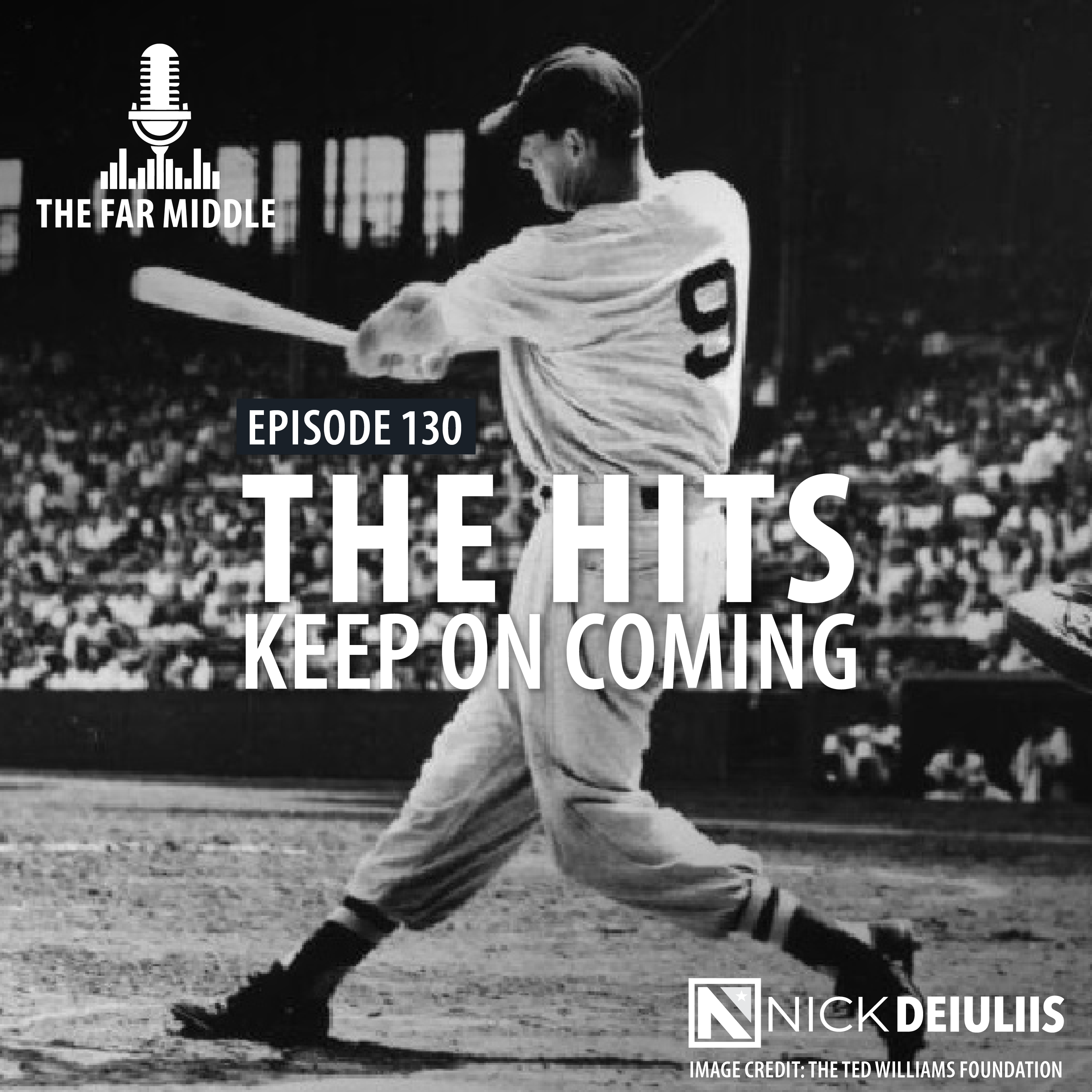
The Far Middle episode 130 begins by going back 77 years ago today, to November 15, 1946, when Ted Williams earned his first American League MVP award, which he would earn again in 1949. “Teddy Ballgame” serves as this episode’s sports dedication. Nick looks back at the awesomeness that was Ted Williams, from the Hall of Famer’s accomplishments on the diamond (nineteen-time All-Star, two-time Triple Crown, the last to hit .400 in a season, the list continues) to his military service off the field during World War II and the Korean War. Nick notes that he’s the only Hall of Famer to have served in two wars. To put it simply, Ted Williams was, “The greatest hitter that ever played the game, a true individual in every sense of the word, and one of the greatest Americans,” says Nick. Williams made hitting a science. Indeed, he wrote a book on it, The Science of Hitting. In true Far Middle fashion, science then continues as a recurring theme across this episode’s connections. Those connections begin with a bit of political science and geopolitics in terms of what people in prominent positions often say or backtrack from once said, highlighting JPMorgan Chase Chairman and CEO Jamie Dimon’s comments regarding communism (and indirectly China) as one recent example. On the topic of China, Nick calls out Climate Czar John Kerry for doing everything in his unelected power to destroy domestic energy and manufacturing jobs, while helping bolster the Chinese workforce in the “interest of tackling climate change.” The episode’s lineup delivers back-to-back-to-back hits on topics ranging from America and the West’s policies on climate and energy, and the resulting heavy price being paid by the developed and developing world; to, examining science as a philosophy that challenges consensus, versus science as an institution driven by ideology. And with college basketball season having tipped off, Nick heads to Durham, NC, to close out the episode. Nick discusses Duke and Coach Mike Krzyzewski’s final game as an example of how much of the dysfunction discussed in this installment’s connections is rooted in academia. “Do you think our rivals in China are focusing on the same things that our supposed best and brightest at Duke are focused on,” asks Nick; concluding that instead of treating American academia as the authority on all things policy and science-related, we should rather be demanding academia’s reform. Notes from the Far Middle: The great Ted Williams was born on August 30, 1918, and was considered for dedication this past August 30th for the release of episode 119. However, legendary Boston Celtics Coach and Executive “Red” Auerbach earned the episode’s honors. As Far Middle connections are a constant, Coach K turned down an opportunity to join the Celtics (and Auerbach) as coach in 1990. He’d go on to win five NCAA Championships, second only in all-time wins to UCLA Coach John Wooden’s ten-championship tally, whose greatness was recognized in episode 121.

S1 Ep 129The Real-World Scoreboard
The Far Middle episode 129 is dedicated to boxing great Billy Conn, better known as “The Pittsburgh Kid.” Nick delves into Conn's career that spanned the 1930s and 1940s—a time when boxing rivaled baseball as America’s most popular sport. Nick highlights Billy Conn’s bouts and relationship with Joe Lewis, in particular their legendary match from June 18, 1941, when Conn attempted to become the first World Light Heavyweight Champion to win the World Heavyweight Championship. For more on Conn, Nick recommends the Sports Illustrated article, “The Boxer and the Blonde.” The outcome of a boxing match is decided either by knockout or by the judges. “Scoring by judges is often subjective,” says Nick. “But you always have the eye test and objective data to compare to the official decision in both boxing and in life.” From there the episode’s connections begin—linked under the theme of the real-world scoreboard and commonsense eye test, versus the manufactured optics of the elite and expert classes. Nick highlights several examples revealing how the divide between reality and manufactured optics sits in plain sight for all to see. The state of America’s cities begins the conversation, a topic regularly addressed by Nick and at length in Precipice. “Our cities are sick, and the decisions urban leadership are making on behalf of urban America is making us sicker,” says Nick, highlighting San Francisco’s new central subway, Pawtucket's under-construction professional soccer stadium, and Chicago’s structural deficit. Ultimately, poor decisions from urban leaders and their ensuing costs will result in taxpayers footing the bill. Next, Nick turns to global energy and climate policy. “The expert judges assured us that if we pour trillions of dollars into the energy transition, carbon use and carbon dioxide emissions would plummet, saving the globe.” However, despite all the unprecedented energy transition spending, carbon emissions tick up with rising energy consumption, but so too does GDP growth, longer life expectancies, and quality of life. “Based on the scorecard, ask yourself what passes the eye and the smell test,” says Nick. “Are climate change and global warming the biggest threats to the U.S. economy, or do they pale in comparison to things like China, nuclear proliferation, technology running amok, banking failures, and so on. It's the elite optics versus real-world scoring constant listeners.” Like Conn and Lewis, the punches continue as Nick examines: the causes resulting in the cost of food and food inflation both domestically and across the globe; attitudes towards the state of America’s economy, and whether things are great (manufactured optics) or do we have a fiscal crisis (reality); experts’ geopolitical missteps on Russia and Ukraine; and, a CIA whistleblower alleging the agency rigged a report on the origins of COVID-19 to clear China's name. In closing, Nick wishes a happy birthday to the late Milton Bradley and foreshadows a top-ten list of his favorite board games (and includes a few likely to make the list).
S1 Ep 128Omnipotent Government
The Far Middle episode 128 premieres on November 1, 2023, coinciding with the anniversary of Chuck Cooper’s NBA debut. Cooper, a Pittsburgh native and this installment’s sports dedication, has several connections to both Nick and prior Far Middle conversations. And if you’re saying, who is Chuck Cooper, then most certainly give this episode a listen. Moving from Chuck Cooper breaking down barriers, Nick calls out the following quote from Thomas Sowell: “Freedom is not simply the right of intellectuals to circulate their merchandise. It is, above all, the right of ordinary people to find elbow room for themselves and a refuge from the rampaging presumptions of their ‘betters.’” Nick explains that Sowell is speaking of the power and benefits associated with capitalism, free markets, and the individual reigning supreme. “Despite the overwhelming data over centuries that prove the superiority of capitalism, the Left continues to make concerning inroads across societies and economies rolling back all that hard-earned progress in the process,” says Nick. “Today the popular trend is toward omnipotent government.” The theme of omnipotent government then permeates the episode’s topics. Nick notes the term is the title of a great book by economist Ludwig von Mises, which you can read more about in Nick’s essay, “Heed the Historical Rhyming of Ludwig von Mises’ Omnipotent Government.” And for further reading, see Precipice, specifically chapter two on “The Deep State.” Nick goes on to examine a host of recent developments illustrating the expanding and intrusive presence of government today, touching on: banking sector regulations, the administrative state’s growth, the White House’s Office of Management and Budget Circulars, President Biden’s regulatory actions and their cumulative costs, the cost to operate and maintain vacant federal government buildings, and more. In closing, Nick offers a birthday shout-out to someone who in many ways represented omnipotent government and then ended up paying a heavy price for it when arrogance got the best of her. This individual also ties back to episode 81 Who is that individual? Press play and find out!

S1 Ep 127Lecturing vs. Personal Behavior
The Far Middle episode 127 is all about heading in the wrong direction. In this installment’s sports dedication, Nick connects the episode’s release date of October 25 to Jim Marshall of the Minnesota Viking’s infamous wrong-way score back on October 25, 1964. “The play epitomized life and the imperfections of human beings even more than it epitomized football in competitive sport,” says Nick. While Marshall’s gaffe 59 years ago today is one of the NFL’s most famous screw-up plays, Nick argues Marshall’s body of football accomplishments most certainly earns him a spot in the Pro Football Hall of Fame. Incidentally, Marshall was a key piece of the Vikings Purple People Eaters defense, which ranks among Nick’s ten greatest NFL defenses of the Super Bowl era. From Marshall, Nick connects to public figures lecturing on how individuals should live their lives and act, while at the same time those same figures’ behavior and lifestyles differ from what they preach. Nick’s case study is Jane Fonda. “This is not a hit piece on Jane Fonda,” says Nick. “But the discussion is designed to expose the utter inconsistency between what she advocates for and what she does, because the stakes are high for society and each of us.” Nick proceeds to expand upon his recently authored essay on Fonda, “Jane Says ‘End Fossil Fuels Now’…But Jane’s Addiction Is to Fossil Fuels.” In his examination of Fonda, Nick discusses a serendipitous moment earlier this year between seeing she’d be speaking in Pittsburgh, while at the same time coming across a lifestyle interview she gave to the Wall Street Journal. Nick then provides an assessment of how her political action committee’s goals, her environmental views and rhetoric run counter to her daily routine and personal behavior. “When one considers the carbon footprint and fossil fuel inputs that come with a day in the life of Jane Fonda, I’m afraid I've got some bad news for the Code Red crowd,” says Nick. As the conversation concludes, Nick dedicates the episode to all those who served in Vietnam, reflecting, “Vietnam vets are getting up there in years these days, and we need to honor them while some of them are still around to enjoy the respect that they so deserved and were so wrongfully denied for too many years.” In closing, Nick wraps with a positive connection to Jane Fonda, highlighting her Oscar performance in Klute, “a dark thriller done right.” Fun Far Middle connection: Jim Marshall and Jane Fonda were born nine days apart back in December 1937.
S1 Ep 126The Battle of Hurtgen Forest
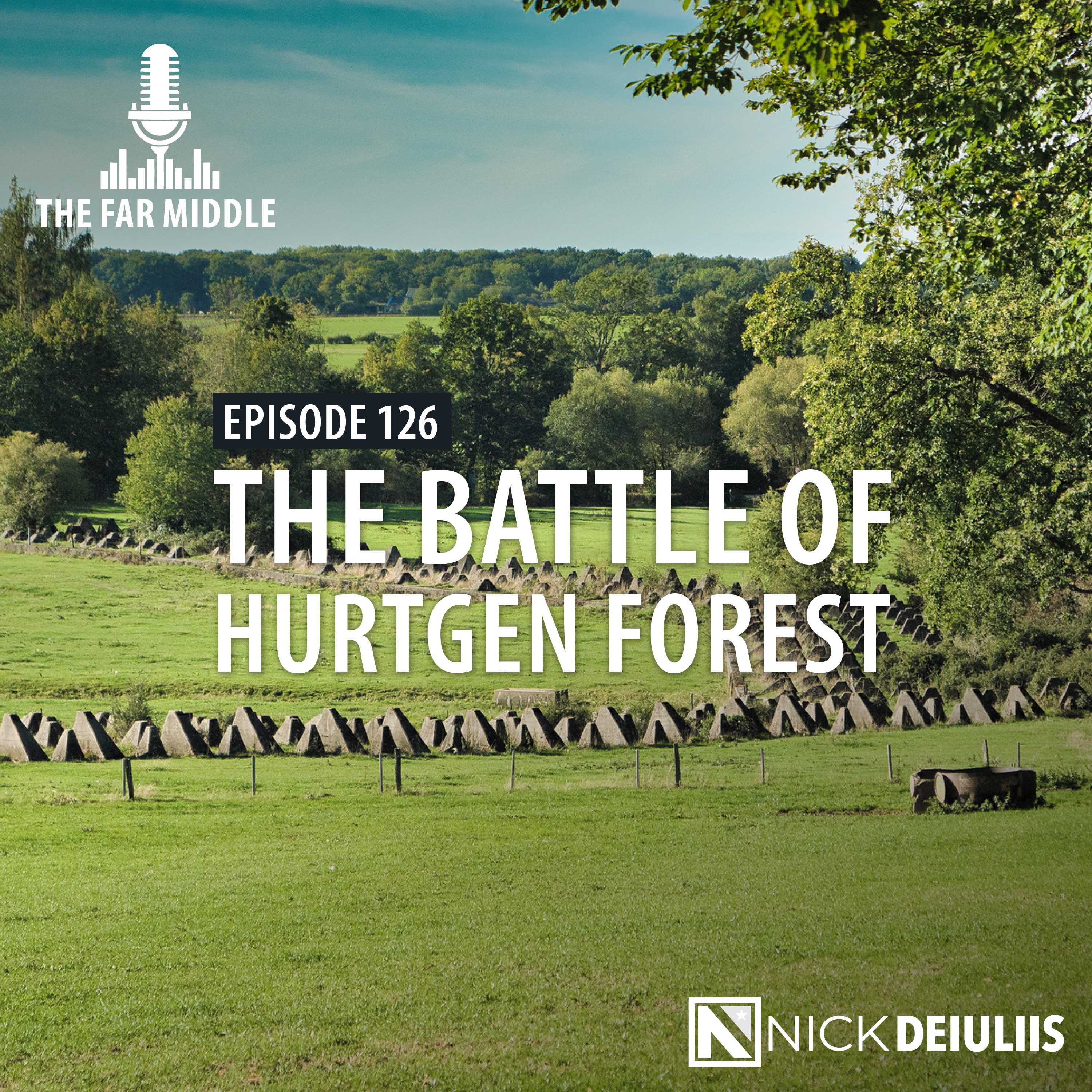
The Far Middle episode 126 lands on the birthday of NFL legend Mike Ditka, providing a no-brainer dedication for this installment. Nick calls Iron Mike a “kindred spirit of The Far Middle,” as he recalls episode 85, which was dedicated to the Super Bowl-winning 1985 Chicago Bears, as well as episode 46 that celebrated Buddy Ryan’s 46 Defense. Following last week’s lightning round episode, the format for The Far Middle episode 126 returns to a special singular focus on a World War II battle that’s often overshadowed by the European Theater’s bigger and more famous Allied campaigns. That battle is the Battle of Hurtgen Forest. Nick proceeds to analyze the battle, its timeline and lessons, building upon his recently released essay, The Battle of Hurtgen Forest: Costly Failure and Lessons Learned. “When it was all said and done, 120,000 American troops were deployed in the Battle of Hurtgen Forest, suffering 33,000 casualties,” says Nick, addressing all that went wrong in the Hurtgen. “The battle’s lessons, they should be remembered if we're to honor those who paid the ultimate price, and thousands of Americans paid that ultimate price.” Those lessons include: Leadership matters, and poor leadership negates inherent advantage. Preparation and homework are prerequisites to success. Avoid terrain and environment that neutralizes your strengths. Supply chain weakness will hamper success in modern warfare and economy. Success demands teams have the proper tools and equipment. Underestimate your adversary’s capacity and will at your own peril. “The Hurtgen Forest was a battle from hell, a disaster Allied leadership should have seen coming,” says Nick before making one final connection to a lighter topic, Meat Loaf’s Bat Out of Hell, an album no one saw coming that was released this week in 1977.
S1 Ep 125Overreach
The Far Middle episode 125 honors Baseball Hall of Famer and Reds legend, Joe Morgan. Nick calls Morgan the greatest second baseman to ever play the game and reflects on Morgan’s stellar career, both on the field and in the broadcast booth. While recent Far Middle episodes have concentrated on singular topics (mentoring young adults, the wisdom of Václav Havel, effective leadership, and speculative natural gas research), this installment is a lighting round episode, catching up on several developments from the last few weeks. Nick leads off the episode highlighting the work of John Ioannidis and his research on the issue of what's become of science and the scientific method. Among Ioannidis’ views, Nick points out his notion that you don't need a Ph.D. in a technical scientific field to play the role of a scientific skeptic. Next, Nick examines the United Nations Development Programme’s iVerify platform, an “automated fact-checking tool.” Nick references author Michael Schellenberger and how iVerify fits into what Schellenberger calls the Censorship Industrial Complex. Staying within the realm of the United Nations, Nick calls out a couple frightening quotes from Piers Forster, a professor of climate physics at the University of Leeds who has helped author Intergovernmental Panel on Climate Change (IPCC) reports. “The United Nations' efforts these days serve as a great connection to what's going on at the World Bank,” Nick continues. “The World Bank has a new leader, Mr. Ajay Banga…he is going to be leading the charge of an effort to expand lending capacity through the World Bank to fight climate change.” Nick moves from the World Bank lending to nations to help their climate change fight, to the Federal Reserve’s compounded annual growth rate, to Treasury Secretary Janet Yellen’s pursuit of a global minimum tax. The theme of government and institutional overreach runs throughout the episode, and comes to a head as Nick reviews consumer product regulations that have come about this year; spanning light bulbs to gas stoves and home furnaces to vehicles. Pivoting off the topic of transportation, Nick addresses congestion pricing in Manhattan, to then commenting on New York City’s iconic Roosevelt Hotel becoming an asylum seeker arrival center. In examining government inefficiency, Nick points out the 2.2 million civilian employees in the federal government. These are career bureaucrats not elected by the American people, but who are making more and more major policy decisions that are affecting everyone. “When the bureaucratic state realizes that there's not going to be a culture of accountability or consequences for things like expanding power base or mission creep, then you start to see illogical outcomes,” says Nick. As the episode winds down, Nick addresses our federal government investing in the Democratic Republic of Congo, climate change negotiations between China and the U.S., China’s growing control of strategic ports, and the benefits of limited government. In closing Nick salutes the late great jazz drummer Art Blakey whose birthday falls on the release date of episode 125. Blakey, “a polyrhythmic percussion powerhouse,” passed away on Oct. 16, 1990, two months after Joe Morgan’s induction into the Hall of Fame.
S1 Ep 124Stacking the Deck
The Far Middle episode 124 arrives as this year’s Major League Baseball playoffs get underway. Accordingly, Nick dedicates the episode to two recent baseball milestones that occurred on October 4, the episode’s first airing date. On Oct. 4, 2021, Barry Bonds hit his 70th home run to tie Mark Maguire for the most home runs in a single season. And then a year ago today, Aaron Judge broke Roger Maris' American League single season home run record with his 62nd blast. While the achievements were notable, Nick sees them as a product of professional baseball’s evolution—"making what was once exceptional, the home run, the norm.” By stacking the deck for a favored outcome, Nick suggests baseball has demoted the essence and purity of the game, becoming more contrived and manufactured entertainment. With that observation, Nick stays on the topic of optics and manufactured outcomes, and pivots from baseball to the episode’s principal topic: the recent University of Pittsburgh’s (Pitt) studies on public health impacts from natural gas development in southwestern Pennsylvania. This episode’s discussion expands upon Nick’s commentary, “Natural Gas Development and Human Health in PA: Let’s Get the Facts Straight.” “The Pitt studies, they left much to be desired and suffered from fatal design flaws, many of them self-inflicted by the research team, despite having the benefit of a $2.6 million taxpayer budget for the effort,” says Nick. He proceeds to examine the studies’ results that found no causation linking natural gas development to health problems, but you wouldn’t know that from the media coverage. Nick highlights the massive body of prior health and environmental research on natural gas development from the last several years before delving into the flaws and limitations of the Pitt studies. Further, Nick addresses reactions from various parties upon the release of the studies, and how, “they provide a window into how this type of research has been co-opted to fulfill predetermined views of the natural gas industry by those opposed to it.” The studies’ release, the ensuing media headlines, and subsequent calls from study authors for more taxpayer-funded research, is another example of the positive feedback loop that perpetuates a desired storyline. Nick concludes by first offering few refreshing doses of truth, and then makes one final connection to Rembrandt who died on October 4, 1669. Nick calls out Rembrandt’s masterpiece, The Anatomy Lesson of Dr Nicolaes Tulp, which, “shows a doctor performing a dissection of a body to instruct other medical colleagues as they looked on,” explains Nick. “I think that this is a fitting final connection for this episode as we’ve dove deep on dissecting a process designed to create opportunity by stoking baseless innuendo when it comes to the health of residents and industries that drive quality of life in western Pennsylvania. This episode in many ways served as an anatomy lesson consistent with the Rembrandt painting and its title.”
S1 Ep 123Effective Leadership
The Far Middle episode 123 is a must-listen installment focused on effective leadership. Nick walks through a series of quotes on leadership by a range of thought leaders and some anonymously attributed, all connected in distinct Far Middle style. And in a Far Middle series first, the full episode is also available as a video to highlight these words of leadership wisdom, which as a group, holistically define effective leadership. For the episode’s dedication, Nick honors Coach Vince Lombardi: “What sports figure has a better association with effective leadership than Lombardi,” says Nick. “Lombardi saw winning as a mindset and a habit that had to be cultivated through leadership.” Nick goes on to quote many others, ranging from Jack Kerouac to Vincent Van Gogh and from General George Patton to Nipsey Hussle. With each quote, Nick helps interpret the lesson to be had. Takeaways include: If you're looking to do something extraordinary, then it's almost a certainty, there are going to be missteps and failures along the way. Effective leaders must be willing and become very good at striking a balance when it's right to move on an opportunity. Just like with a competitive sports team, personnel change from time to time. Winning organizations are ones that are always looking at any opportunity to upgrade their talent level to be the best they possibly can be. What are initially challenges—convert them into opportunities. Great leaders are constantly looking to improve, to advance the state of the art, to get better, and to continually improve. You've got to go make things happen. Too much focus and too much attention beyond learning from a failure—to the point of obsession—can create a paralysis with respect to decision-making, achieving, and getting better. Your words start to lose value when your actions don’t match. Nick closes with an adage from Steve Mehr to think about often: “You get what you focus on. So focus on what you want.” “What do you focus on, what's your team focused on, is it consistent with what you want,” asks Nick. “And if they're not, then that's an opportunity. I wouldn't get frustrated by it as much as I would see as an opportunity to redirect the attention into the appropriate channels and onto the appropriate tasks.”
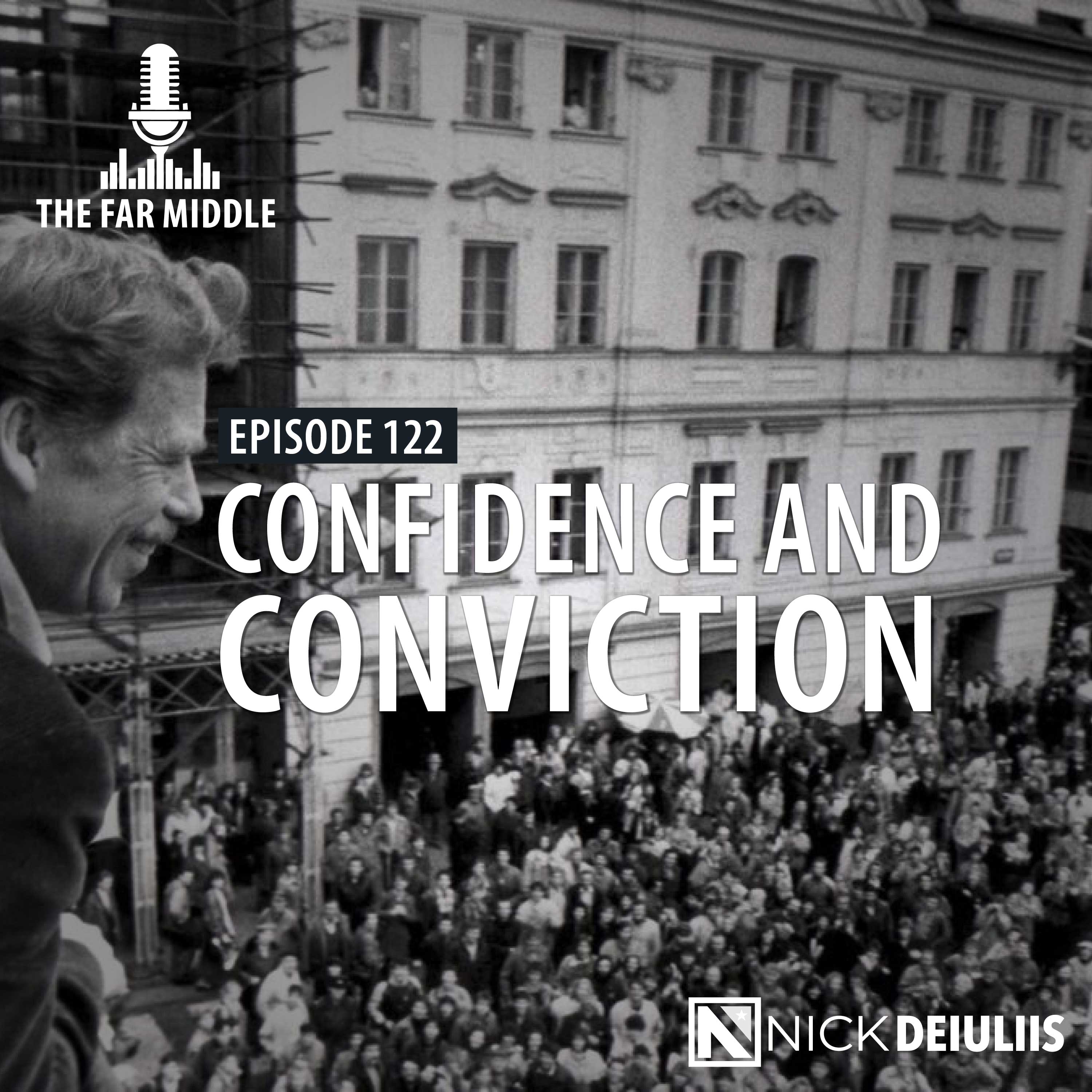
S1 Ep 122Confidence and Conviction
The Far Middle episode 122 begins by rewinding the clock back to the summer of 1978 to celebrate Pete Rose’s magical 44-game hitting streak. While now 45 years ago, Charlie Hustle’s consecutive game-hitting streak remains the closest to overtaking Joe DiMaggio’s 56-game record. Despite coming up short, Nick recalls the never-short-on-confidence Rose saying during his 1978 streak that he “might go on forever.” Unfortunately, that wasn’t the case, and DiMaggio’s 56-game hitting remains one of the unlikeliest MLB records that will ever be broken. Shifting from baseball, Nick continues his recent theme of exploring one central and significant topic in this episode. “I get to settle into one of my ideological North Stars, a person whose thoughts and impact I didn't awaken to until a few short years ago,” explains Nick. That North Star’s name? Václav Havel. Nick proceeds to reflect on Havel’s contributions as an author, poet, dissident, and statesman. Nick connects back to 1978 as he explores Havel’s essay released that year, “The Power of the Powerless.” Nick highlights the essay’s importance at its release, its connections to today, and defines Havel’s concept of “living in truth.” “By deciding to live within the truth, one breaks the rules of the game and then you expose the game as the ruse that it is,” says Nick. “It becomes clear that living a lie is just that. It's living a lie…For the post-totalitarian system, or for government run by the Left in the West today, the ultimate fundamental threat to its power will be individuals daring to live within the truth.” In closing, Nick notes the episode’s release follows Constitution Day, celebrated this past September 17. “I like to think that the Founders in the late 1700s and their product, the Constitution, inspired Havel in the late 1970s in his product, 'The Power of the Powerless,' so that you, constant listeners, and I, have the conviction to be dissidents living within the truth in America in 2023,” concludes Nick. Nick’s discussion in this installment expands upon his recent commentary, “A Dose Of Dissidence And A Pinch Of Living In Truth: Remedy For Troubling Times.”
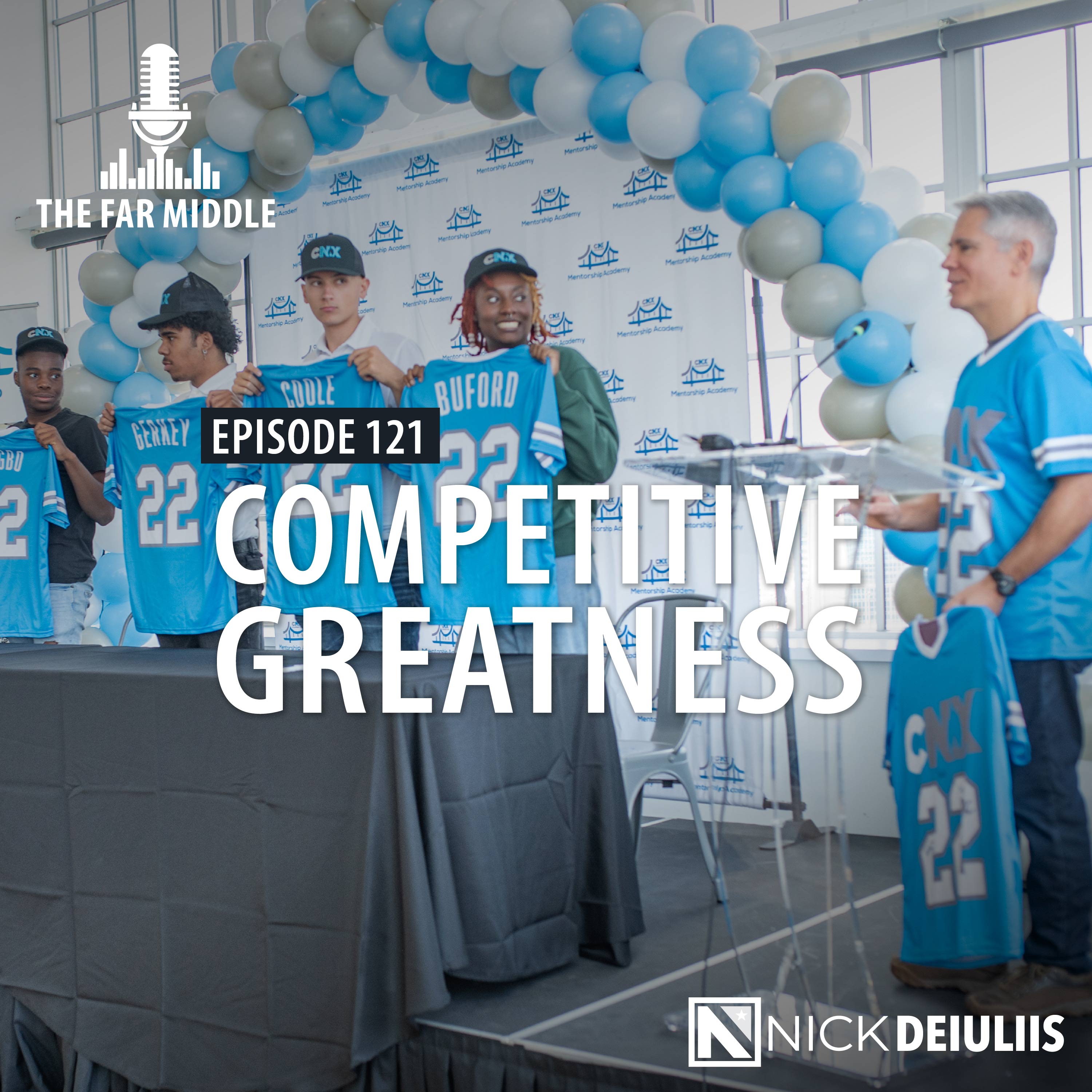
S1 Ep 121Competitive Greatness
Episode 121 is a special edition of The Far Middle as Nick offers insight into the development, growth, goals, and future of the one-of-a-kind CNX Foundation Mentorship Academy. Before diving into the Academy, Nick pays tribute to John Robert Wooden for this installment’s sports dedication. The “Wizard of Westwood” was not only one of the greatest basketball coaches ever and a Hall-of-Fame player, but also a teacher and mentor to countless student athletes. “He was as much Harvard Business School professor as he was UCLA hoops coach,” says Nick. Wooden’s teaching tools and tactics, such as his Pyramid of Success, not only apply to basketball but business, personal success, and organizational leadership. The building blocks of Wooden’s Pyramid of Success—from self-control to initiative and from confidence to competitive greatness—are central focus areas of the CNX Mentorship Academy. Nick proceeds to discuss the Academy’s origins and its aim to assist students from urban and rural economically disadvantaged communities in Western Pennsylvania who don't intend to pursue a college degree right after high school. As the Academy is gearing up for its third year and third class, Nick attributes many keys to its success, including partners spanning the building trades, energy industry, manufacturing, hospitality/ travel, real estate, construction, health care, and more. And then there are the mentors, which Nick describes as, “the glue that holds everything together…no mentors, no success, it’s that simple.” In closing, Nick observes, “I can say without hesitation that every student that enters the Academy, and shows up over the course of the year, they will be in a markedly better place when it comes to life skills, awareness, and confidence than where they were when they came in. It all comes down to how you define success. It's measured in different ways in this thing we called life, and I wish it were more ideal, but this is how it is.”
S1 Ep 120Upside Down Expert Predictions
The Far Middle episode 120 begins with a little Labor Day history, including the debate of whether it was labor leader Peter McGuire or machinist Matthew McGuire who deserves credit for Labor Day’s origination. Nick fondly recalls Peter McGuire’s quote that the holiday is meant to honor those "who from rude nature have delved and carved all the grandeur we behold." And as the boys of summer prepare for fall and postseason play, Nick turns to baseball for this week’s sports dedication. While some listeners hoped “The Miracle Mets” of 1969 would earn honors for Far Middle episode 69, the Mets receive dedication honors this 120th episode. However, it’s for an unfortunate record: the Mets’ 120 losses tallied during their 1962 inaugural season. Nick adds that the 1962 Mets’ starting pitchers recorded just a combined 23 wins all season, which is less than Don Drysdale’s 25 games won—alone—that ’62 season for the Dodgers. And despite the record of the 1962 “lovable losers,” the Mets would of course bloom come the 1969 season for their first World Series Championship. For more on Drysdale, check out Far Middle episode 53. While on the topic of losing in epic fashion, Nick connects to the topic of climate predictions and climate change alarmism. In a unique Far Middle exploration, Nick reviews a century of highlights by “the experts’” climate predictions—beginning in 1923 with the New York Times reporting that Arctic ice was melting and “a radical change in climatic conditions, and hitherto unheard of temperatures in that part of the earth.” Nick then goes decade-by-decade, discussing numerous climate predictions by media, experts, and elites; including the late 1970s shift from predictions of catastrophic global cooling to unavoidable global warming. After examining a century of inaccurate doomsday predictions, Nick offers four takeaways: 1) science is not about consensus; 2) we should not be setting policies impacting decades and trillions of dollars aiming for something we should have zero confidence in being able to accurately know; 3) why aren’t those making these past dead-wrong predictions held accountable; and, 4) where are present-day journalists reporting on the trends identified in this episode. In closing, Nick pays tribute to Diana Ross, who this week in 1980 reached number one on the Billboard Hot 100 with her hit “Upside Down”—a fitting song title for this episode’s discussion on expert predictions.
S1 Ep 119Green Inflation
The Far Middle episode 121 arrives as Labor Day, the unofficial end of summer, approaches. With fall on the horizon, Nick has basketball on his mind, which leads to a special dedication to basketball pioneer Arnold “Red” Auerbach. Nick calls Auerbach, “the most accomplished pro basketball coach and executive in the history of the game, both statistically as well as with respect to impact.”After reflecting on Red’s historic career, Nick pivots to red’s complementary color: green. Specifically, he delves into the concept of green inflation, which is the collective combination of green energy policies, mandates, and subsidies driving general inflation.Nick addresses the impact of waning worker and labor participation on inflation, but underscores that it’s climate change policies that is the single biggest contributor to inflation. “The true aims of climate policies are to manufacture and impose scarcity,” says Nick. “Energy scarcity then transmits to overall economic scarcity, and supply scarcity of everything, because everything needs energy as the fundamental input or feedstock.”Nick highlights several data points illustrating green inflation. These include President Biden’s cancelation of the Keystone XL Pipeline, America’s first proposed cobalt mine being put on hold by its developer, and Ford’s EV business unit’s losses. “The only way for Ford to make money on EVs is for the price of EVs to go up and to force consumers to buy them, which means the supply of gasoline powered vehicles must go down,” explains Nick. “You see, restrict supply of the efficient, enforce the choice of the inefficient, and raise its price. Green inflation 101.”Next, Nick calls out the hidden costs of wind and solar infrastructure on the power grid and how those new transmission infrastructure costs will be paid for. Moving on from power lines, Nick discusses traffic lines and traffic congestion pricing. The origins of traffic congestion pricing is the “hallmark of the Left,” says Nick. “Create a problem, purposely, upon the private sector and then use that created problem to justify more power and control over the private sector. It's simple but effective time and again.”In closing, Nick notes how summer weather these days is described by many as a sign of Armageddon. On the topic of summer heatwaves, Nick draws a connection to the Alfred Hitchcock thriller, “Rear Window.” While Coach Auerbach was preparing for the Celtics’ 1954-55 season, “Rear Window” hit theaters on September 1, 1954. “It should be considered as one of the greatest films ever,” says Nick.
S1 Ep 118Inside Out
As many head back to college this August, so too does the start of Far Middle episode 118 as Nick honors Ohio State Buckeye legend and two-time Heisman Trophy winner Archie Griffin for this Far Middle’s sports dedication. Nick then moves from Ohio State to Stanford, noting Cardinal quarterback Jim Plunkett would earn Heisman honors a few years prior to Griffin’s back-to-back trophies. He then examines Stanford University President Marc Tessier-Lavigne’s forthcoming resignation following “serious flaws” found in his research. “The controversy at Stanford highlights another connection we can jump to which interestingly still involves Stanford, but it also ties to a much broader topic that cuts across the entire western world,” says Nick. He discusses the big difference between science and “The Science,” and the ramifications of scientific journals wading into subjective politics and eroding their reputation of objectivity. Next, Nick explains the “inside out” phenomenon, using examples from Alexis de Tocqueville and the idea of soft despotism, as well as the Spanish Civil War. The theme of “inside out” runs throughout episode 118. From Archie Griffin’s ground game to a Stanford student reporter breaking news of data manipulation to the outside world, and from the Left gaining control from the inside of government, academia, and media to turn society from the inside out. The theme also applies to Nick’s recount of the story of Jonah and the whale (or big fish), as well as his discussion of Big Tech letting in the Left and their subsequent aims to now turn Big Tech inside out. And for a fitting close, Nick looks back on Phil Collins’ single “Inside Out,” from the 1985 album No Jacket Required (released the same year Archie Griffin was closing out his professional career with the USFL’s Jacksonville Bulls). Nick recites the song’s lyrics to take to heart: “Now everybody keeps on telling me how to be, and everybody tells me do what they say, oh I'll help myself it's up to me and no-one else, but till I'm ready just keep out of my way.”
S1 Ep 117The Inevitable Cycle
Far Middle episode 117, released on August 16, coincides with the anniversary of football icon Frank Gifford’s birthday. Nick reflects on Gifford’s legendary career on the field and in the Monday Night Football broadcast booth. In looking back at the eight-time Pro Bowler’s career, Nick also recounts meeting Hall of Fame linebacker Chuck Bednarik who delivered “The Hit” on Gifford in their November 1960 Giants/Eagles matchup. “It seems as if every time we do a dedication on The Far Middle of an exceptional athlete, like a Frank Gifford, it brings to mind a few truths in life,” says Nick. “One being that in competitive worlds and arenas, there is always going to be an inevitable cycle.” In sports, that cycle is players rising to greatness, declining, disappearing, and replaced with the next generation. It’s a cycle also evident in business, technology, empires, and global leadership. Nick proceeds to connect to Europe’s recent sharp economic/societal decline while India is on the rise. After providing numerous indicators of Europe’s regression, including the Eurozone economy only growing about 6% over the past 15 years, Nick pivots to India, and specifically the megacity of Mumbai. “India and Mumbai, in many ways, parallel the United States and its cities a few generations ago,” says Nick. He profiles Mumbai’s challenges, from infrastructure to affordable housing, as well as its bright future. “Few things, actually no things in real life, including progress, are ever going to be perfect, and Mumbai's journey stands to be a net positive to millions of residents, both current and future,” says Nick. “But that journey will also harm many people in its path, that’s always been the case in human history, and that's always going to remain the case.” Nick’s discussion of Mumbai today then pivots back roughly 80 years ago to examine the complicated life and legacy of Indian nationalist Subhas Chandra Bose. While Frank Gifford was turning 15 in Bakersfield, Calif., Bose would pass away this week, on August 18, back in 1945. Nick breaks out a Far Middle Yogi-ism in describing Bose as, “one of the best-known individuals you’ve never heard of.” And in a final connection, episode 117’s release date—August 16—also falls on the anniversary of the passing of two well-known individuals you’ve definitely heard of, Elvis Presley and Aretha Franklin. As Nick paid homage to “The King” in episode 111, he closes by celebrating the “Queen of Soul” and sharing his four favorite Aretha Franklin singles.
S1 Ep 116Off and Running
The Far Middle episode 116 is dedicated to the great Jesse Owens. This episode’s August 9 release coincides with the 87th anniversary of Owens winning his fourth gold medal at the 1936 Summer Olympics. Nick reflects on Owens' historic Olympics performance, including the stark difference in the way Owens was treated in Europe compared to his arrival home.Following the “much-too-late dedication” to Owens, Nick examines a frequent Far Middle topic: the trouble facing many of America’s large cities. “The combination of the policies of the Left, being soft on crime, rampant and open drug use, remote work, broken public transit—those things are cumulatively and slowly squeezing new life out of America's big city centers,” says Nick. He then highlights data points including cell phone activity and office occupancy rates that reaffirm the perilous state of America’s cities.“All this big city financial pain and lack of vitality, it's cascading into states,” says Nick, highlighting the budget woes of New York and California. “Tax revenues in states run by the Left, they’re plummeting big time.”In assessing the cause of municipal, state, and national economic pain, Nick attributes rising interest rates as a key driver. And after a primer on the Federal Reserve and its inflation target, coupled with examples of the Left’s policies that are stoking the inflationary fire, Nick argues the Fed is nowhere near finished increasing interest rates.“If you think that climate policies are not the root cause of inflation, and that inflation is well on its way to being tamed, consider our next connection regarding food prices,” says Nick. He calls out the increased price in items like pretzels, chips, cereal, and other prepackaged foods, which require substantial energy in their production, packaging, and ultimate delivery to grocery store shelves.Nick pivots to Europe and the ECB, which is starting to finally look at reality as the ECB raised interest rates again at the end of July and is predicting inflation “to remain too high for too long.” But unfortunately, “the ECB won't admit that the root of persistent and stubbornly high inflation in the EU emanates from climate policies,” says Nick.Moving on from Europe, Nick comments on China’s recent announcement that it was restricting exports of germanium and gallium.“China runs the supply chains of wind, solar, batteries, and EVs,” says Nick. “Policies in the West that mandate these things necessarily mean China then controls our grids and our roads. How's that a good and desirable thing for us?” On a related topic, he questions a think tank’s study about the preparedness of Taiwan to withstand an attack from China—the study concluded that Taiwan should rely more on wind and solar in its grid to be better prepared for an attack from China.In closing, Nick connects to another anniversary falling on the episode’s August 9 release date: the original 1854 publication date of Henry David Thoreau’s “Walden.” Listen as Nick recounts a few of his favorite lines from Thoreau’s awesome work.
S1 Ep 115Fiery and Feisty
The Far Middle episode 115 arrives on August 2, 2023, which also marks the 50th anniversary of baseball Hall of Famer George Brett’s Major League debut. On August 2, 1973, Brett would bloop a broken-bat single in the top of the 4th to notch his first of more than 3,000 career hits spanning 20 years with the Kansas City Royals. In dedicating the episode to Brett, Nick looks back on Brett’s quest to hit .400 in the 1980 season, the infamous 1983 pine tar incident, and reminisces on Brett’s fiery and feisty personality. From George Brett and his dominance of the left side of the Kansas City infield, Nick connects to the Left’s dominance over many large American cities, including Portland, Oregon. “In Portland, it’s not clean, safe, or even hip anymore—it’s downright dangerous,” says Nick. He adds that one constant during Portland’s demise has been Mayor Ted Wheeler. Wheeler’s been at the helm during Portland’s escalating homeless and violence crisis, and its eroding livability and declining economy. Read more on Portland in Precipice, specifically chapter eight, “Leech Power Centers: Urban Hell.” Next, Nick addresses urban public education—“one of the biggest problems facing our big cities.” He cites public teachers unions protecting bad teachers as part of the problem. Using California as an example, Nick calls out that fewer than 0.002% of teachers in California are dismissed for unprofessional conduct or poor performance in any given year. Asking what or who the education system is designed to benefit, it appears the answer is poor performing teachers, public unions, and politicians. “If you really, really wanted to improve the standing of minority students within the broader education system, don't worry first about college admissions, instead let's focus intensely on public education reform and choice in the K-12 arena in our big cities,” argues Nick. While many American cities crumble, “many mayors and other leaders remain steadfast on obsessing about tackling climate change, even though the cumulative action of any city in America will have negligible impact on climate, and may in fact end up doing more harm than good,” says Nick. This leads into a data- and fact-based look on the myth of Code Red. Staying on energy and climate, Nick spotlights research from the Copenhagen Consensus Center, wades into the Snake River and the debate on removing its dams (a source of reliable and clean hydropower), and then addresses the latest moves in the UK to allow oil and gas production to expand in the North Sea. In closing, Nick gives the smooth sands of monotony a few more stirs as he wishes a happy birthday to the late Peter O’Toole.
S1 Ep 114Crazy
The Far Middle episode 114, released on July 26, 2023, arrives the day before—in 1957—the incomparable Yogi Berra would start his streak of 148 games without an error. The connection serves a fitting opportunity to dedicate this Far Middle installment to the legendary Lawrence Peter Berra, baseball’s “best all-around catcher.” Nick reflects on Berra’s baseball career, military service, his mentorship to young players, and more. All told it was a crazy, remarkable life—an “exemplar in absolute excellence.” From Berra, Nick makes a unique connection, the likes of which you’ll only find on The Far Middle, discussing the Unabomber—Ted Kaczynski—who died last month in prison. Nick examines Kaczynski’s Manifesto, now nearly 30 years later: “Kaczynski was quite the ecowarrior and radical environmentalist. Back then, those environmental views, along with all his other rantings, were viewed as crazy. But today, his views on science and tech and anti-progress and the environment, they’re basically mainstream.” Moving on, Nick adds, “When the state controls decisions, and religions of the Left like environmentalism take root in policy, the crazy becomes the norm. And it's not just with the Unabomber Manifesto. Consider the next connection of what’s going on with Iran and energy.” Nick dissects America’s failing appeasement approach with Iran. Appeasement leads to weakness, leading to more geopolitical risk, which has been evidenced throughout history. Nick then offers three current examples where appeasement and weakness by the U.S. and Biden administration is going to lead to major problems for the planet. These three examples include America’s response to the escalating tensions between China and Taiwan. “China is astute,” says Nick. “It watches this clueless administration, along with Western Europe, on the issues of Iran and Russia-Ukraine, and China begins to think, 'I can certainly take Taiwan right now. And what is the United States or the West going to do about it?'” Discussing America’s trending decline, its lack of leadership, and the Left’s presence everywhere today, Nick comments on the Roman Empire’s decline and fall—making the case that the Empire fell from within. Crazy is this episode’s recurring theme, which allows the episode to land on a high note as Nick presents his Mount Rushmore of best songs/compositions with crazy in the name (along with a few honorable mentions).
S1 Ep 113Unbreakable
The Far Middle episode 113 is dedicated to legendary pitcher Cy Young who collected his 500th win on the episode’s July 19 release date back in 1910. Nick reflects on Cy Young’s stellar career and 511 wins, which Nick calls the most unbreakable record in all professional sports. Nick describes Cy Young as the ultimate exemplar of pitching, and begins the episode’s connections, highlighting that California and Los Angeles, not long ago, were viewed by many as the exemplars of the American dream. Nick then proceeds to summarize his address last month to the Los Angeles County Lincoln Club – Downtown Chapter. Explaining how the event came to fruition, Nick comments, “I remain fond of California and LA, and I'm deeply troubled about both, and I'm troubled about America and my hometown as well. So, I wanted to explain why to these leaders at the Lincoln Club out in Los Angeles.” In recapping the presentation, Far Middle listeners will recognize many themes from recent episodes, such as the Left’s three-pronged attack on today’s domestic energy industry and their “convenient energy myths,” that together, result in energy scarcity, energy inflation, general inflation, and carry geopolitical consequences benefitting America's adversaries. During his talk, Nick reviewed topics from Precipice. He illustrates how, albeit sadly, California and Los Angeles both served as inspiration for his writing the book. After walking through his speech, Nick ends by noting one attendee’s question on how America can course correct. While America can indeed alter its course, he notes that like many once-great empires, America isn’t unbreakable. “Yeah, there is still time to change the road we're on, to paraphrase Robert Plant in Stairway to Heaven,” concludes Nick. “But we better move quick, or else this is not going to be a Stairway to Heaven. Instead, it's going to be a Highway to Hell.”
S1 Ep 112The Great Reset Threat
The Far Middle episode 112 celebrates the Tony Zale and Rocky Graziano boxing trilogy, which spanned a 21-month period between 1946 and 1948. The middleweights’ second match—Zale vs. Graziano II—occurred this week back in 1947. After reflecting on the Zale-Graziano bouts, which exemplified boxing done right, Nick transitions to journalism done wrong. Nick walks through a recent morning news show’s “Protecting Our Planet” segment to illustrate how media sells a problem, its causes, and its cure. In this case, the problem of course was climate change. And the cure? More government. Staying on the so-called climate crisis, Nick offers “a little bit of history and science, which always spices up a Far Middle episode.” Nick highlights historic Earth temperature changes, going back to the Roman Warm Period, Medieval Warm Period, and the more recent Little Ice Age. “Tackling climate change is a scheme that's utilized in many ways by the Left as a convenient opportunity, or perhaps even a pathway, to grow the state and impose control over the individual,” says Nick. “When one thinks about what type of state control the Left prefers over society, the bigger the form of government, the better.” Nick proceeds to delve into the idea of the Great Reset, a concept originated by World Economic Forum Chairman Klaus Schwab (aka “The Godfather of Davos”) who co-authored the book, “COVID-19: The Great Reset.” “Schwab and the World Economic Forum and the Great Reset, they all advocate for the West to forcibly change from free market and individualistic and capitalistic, to something more along the lines of China's form of communism,” says Nick. “Ask yourself if today's federal government and the current bureaucratic state feel more like American capitalism or if they feel more like socialism.” Pivoting to a state that’s all about the Great Reset, Nick highlights California’s famous and thriving Joshua Tree. The state is seeking to thwart private development as the climate change boogeyman could threaten the tree by the end of the century. Nick explains how this is the Great Reset in action: government looking for any issue as an opportunity to tighten its grip little by little, tree by tree, and house by house. And as a U2 fan, Nick ties in an interesting connection to the band’s The Joshua Tree album, which was being recorded back in the summer of 1986. Nick examines the album’s theme, its commercial success, and present-day irony. As episode 112 concludes, Nick predicts the Great Reset will fail in the end, but the question is how far it goes before failing, and how much damage and pain it will ultimately inflict. In closing, Nick makes one final connection to the Whiskey Rebellion in western Pennsylvania that came to a climax this month back in 1794, drawing several comparisons to today.

S1 Ep 111That’s All Right
The Far Middle episode 111 begins with a dedication to the 2008 Wimbledon men’s final—a historic bout (far from just alright) between Roger Federer and Rafael Nadal. The nearly five-hour match marked the third year in a row Federer and Nadal met in the final at the All England Lawn Tennis Club, while Federer won in 2006 and 2007, Nadal would came out on top in 2008. Nick next transitions to present day, moving eastward from England to discuss Russia and Ukraine, exploring the asymmetrical nature of the war that differs from other historical conflicts. The Russia/Ukraine war leads to the question of whether America supports nations resisting our adversaries, or do we instead stay out of foreign entanglements and invest those resources domestically. Subsequently, Nick examines how the federal government budget is evolving quickly—and not in a good way. “Nearly 60 % of the federal budget each year is now going to three things: Social Security, healthcare entitlements, and interest on the debt,” says Nick. “And all three are going up faster than tax receipts are going up, which is going to balloon the deficit. And without entitlement reform, the math can't work. And without higher taxes or less tax credits and less subsidy, the math can't work.” Nick shifts from our federal debt troubles to California, where Governor Newsom wants to remove red tape for the development of favored energy projects—a situation where the Left is trying to save itself from itself. Next up, Nick calls out many potential causes of action for today's youth when it comes to having a bone to pick with government and its policies. But today kids aren't suing governments in America for these wrongs, rather, they're suing over climate change. “Juveniles are stressed about climate, and they want to sue the government,” says Nick. “Stay tuned on this one as time unfolds because we know for sure the Left will ratchet up the intensity and the plaintiffs bar will persistently run down any chance they see for value appropriation.” While talking climate, Nick discusses a recent interview with former Treasury Secretary Robert Rubin, who has a new book out, The Yellow Pad. Nick says Rubin recently delivered a “climate change sermon from the altar of environmentalism.” On the topic of books, Nick notes that today’s episode release date, July 5th, marks the anniversary of the publication of Isaac Newton’s Philosophiæ Naturalis Principia Mathematica. “Principia might just be the most important work in the history of science,” says Nick. He adds that, “We could spend an entire episode or a month's worth of episodes diving deeper on how the climate change racket of today violates Newton's rules time and again.” In closing, Nick celebrates the career of Elvis Presley, who recorded That's All Right on July 5, 1954, making rock history. Listen as Nick lists his Mount Rushmore of Elvis songs from the late 60s and early 70s era.
S1 Ep 110Giant Steps
As The Far Middle episode 110 takes the field on June 28th, Nick goes back to today in 1957 for this episode’s sports dedication. Nick recounts the giant steps the Cincinnati Reds’ fans took to secure eight players in the 1957 All-Star Game starting lineup, and Commissioner Ford Frick’s move to overrule the ballot process and insert Hank Aaron, Willie Mays, and Stan Musial into the National League’s starting nine.Nick moves from the diamond to journalism bias as the “Fauci Focus” Far Middle segment emerges for an encore performance. Nick comments on emails from the editor-in-chief of the journal “Science” to Dr. Fauci. Nick says the editor’s awe of Dr. Fauci creates two problems no matter what your views are of Dr. Fauci.“When science gets transformed into ‘The Science,’ it goes from a valuable source of sober analysis when setting policy, to a blatant cheerleader for uninformed policy and political leanings,” says Nick, stepping into the episode’s next connection: the EPA’s efforts to wreck the U.S. grid and economy.Nick calls the EPA’s proposed power sector regulations “insanity from a technical and scientific and engineering suite of perspectives.” The EPA’s intention? Increase the cost of energy, reduce its availability, and force individual choice to go where government and the bureaucrat desire it to go. Nick continues to examine the power sector, highlighting the warnings from the North American Electric Reliability Corporation’s (NERC) summer reliability report.“With all this hyper focus on climate change, some tangible and real epidemics and crises, they continue unabated in America,” says Nick, leading into a discussion on America’s drug epidemic and China’s role. “China has gone about a methodical poisoning of our people.” This leads into a look at the foolishness of how America’s elite set policy, specifically seven giant steps of policy insanity.Those steps include job loss in the domestic energy and manufacturing sectors, which connects to the U.S. Career Institute’s analysis of which industries will grow/decline the most over the next decade.While episode 110’s topics vary, Nick explains, “they share a common trait, and that is the failure of the expert class and the exposure of the ineptitude of the elite class—their policies do more societal and economic damage than good.” Nick proceeds to make one more policy connection resulting from ex-Silicon Valley Bank Chief Executive Greg Becker’s testimony before the U.S. Senate Banking Committee. Nick suggests banks think for themselves when it comes to differentiating between what the Federal Reserve lectures and what the market might actually do.In closing, Nick makes one final connection to June 28, going back to today in 1846 and a patent granted to Belgian inventor and musician Adolphe Sax.
S1 Ep 109Under Continual Assault
The Far Middle episode 109 follows Father’s Day and arrives with the tip-off of summer. Nick dedicates this installment to “Pistol” Pete Maravich, who was born the day after episode 109’s release (back in 1947), and who also had a special relationship with his father and coach, Press Maravich. Nick calls Pistol Pete “one of the brightest of shining lights to ever dribble a basketball.”After reflecting on Pistol Pete’s stellar collegiate career and Hall of Fame NBA career, Nick says you could apply the same nickname to the Chinese Communist Party and China itself as they, “have a geopolitical gun aimed at the heads of the US, the EU, and the G7, and we gave them the gun with climate change policies.” Nick proceeds to discuss China’s Belt and Road Initiative (BRI), which “significantly broadens China's economic and political influence,” and now the G7 is waking up to a three-part nightmare.“Climate change policies are killing us, along with their distractions,” continues Nick, highlighting the Fed's new obsession with tackling climate change. However, Nick has some surprising news to report coming from Fed Governor Christopher Waller. While Governor Waller offers a rational and logical take on climate change, unfortunately, America has become a place where “free speech is no longer protected unless it fits with the ideology of the Left, and even left of center and liberal thought leaders are picking up on the obvious troubling trend.” Nick says writer Salman Rushdie knows how this works far too well.What's doubly troubling is that free speech isn't the only vital foundation of our Western republican democracy that's under attack by the Left. “Everything and anything that is vital to what is the essence of America is under continual assault. From the poorest to the most successful segments of society.” Nick connects that argument to what’s happening in America’s major cities—the area of America that's been under the control of the Left for perhaps the longest and the deepest.Nick takes the conversation to San Francisco, examining the murder of tech CEO Bob Lee, who is a potential microcosm and singular example of what's going on across our culture today. “I sense the individual is bringing less self-discipline and personal accountability than what was expected or demanded a decade ago, and certainly a generation ago,” says Nick.In closing, Nick notes episode 109’s release also coincides with the anniversary of Japan’s defeat at the Battle of Okinawa in 1945. Nick uses the Battle, and World War II in general, to reinforce the drive and courage of the Greatest Generation. “We know we have what it takes because we demonstrated we had what it took,” says Nick. “Let's make sure we do all we can to protect the ‘it’ factor that makes America special and that we rebut the insidious elements that are out there working constantly, to erode the specialness that is the USA.”
S1 Ep 108A New Constellation
The Far Middle episode 108’s release falls on Flag Day, a coincidence that won’t happen again until June 14, 2028—mark your calendars! Nick discusses the history of Flag Day, its unique Pennsylvania connection, and notes June 14th also marks the birthday of the United States Army. “Flag Day is as American as it gets, and so is baseball,” says Nick, proceeding to present this episode’s unique sports dedication, which goes to a constellation of six baseball perennial all stars for their historic June 14th accomplishments; spanning Gehrig in 1933 to the “Wizard” in 1992. Nick moves from great ball players to not-so-great transportation policy. He says traffic is increasingly being used as justification to tax the driver to the point of no longer driving—highlighting the Biden administration allowing New York City’s proposed congestion pricing plan to proceed. Nick discusses the irony of the plan as the politicians/environmentalists/bureaucrats who advocate the congestion pricing tax to reduce traffic congestion are the same people who created the congestion problems to begin with. He then offers three lessons to learn from the congestion pricing movement. And read more on the dumpster fire that is the New York public transportation system in Nick’s book Precipice. Staying in the transportation lane, Nick examines recent news from Ford on its EV business losses. “Ford is losing more on each EV it sells than most people pay for a new gasoline, combustion engine vehicle,” says Nick as he delves into EV demand trends. Congestion pricing and EV mandates are tactics within the larger portfolio of the Left, which leads into a look at what happens when the Left gains control of the political, bureaucratic, and regulatory process or processes in states. And what happens is people (typically higher-income residents) leave high-tax states for low-tax states like Florida and Texas. Going from data on migration to survey data on renewable energy deployment, Nick highlights a March poll finding 79% of Americans say renewable energy should be rolled out slowly, rather than quickly, and that the conservation of land and wild animals should be prioritized above rapid greenhouse gas reductions. Nick predicts a growing and mounting resistance to wind and solar projects, and examples to that resistance are mounting. “A great leading indicator where you can see how sentiment is catching up to reality, can be found with how shareholders are voting on anti-fossil-fuel proxy proposals at big Wall Street banks’ annual meetings,” says Nick. He calls out several climate-oriented proxy proposals failing to gain traction during recent shareholder votes. While on fossil fuels and climate change, Nick looks back at a few doom-and-gloom climate predictions from the past that didn’t exactly pan out the way the experts predicted. And in closing, Nick moves from talking heads in the Church of Climate to an iconic talking head and one-of-a-kind voice who passed away this week back in 2014—Casey Kasem. Keep reaching for the stars!

S1 Ep 107Turbulence
The Far Middle episode 107 arrives two days following the birthday of the late NFL-great Art Donovan, this Far Middle’s featured dedication. Nick describes the Hall of Fame defensive lineman, aka “the Bulldog,” as an intimidator who played in an era when rough and tough was the official code of professional football. Donovan was part of the Baltimore Colts’ “Magnificent Seven,” who in addition to quarterback Johnny Unitas included Gino Marchetti—Far Middle episode 89’s sports dedication. After reflecting on Donovan’s military service, football career, and larger-than-life personality, Nick offers yet another example of how climate change is no longer about science, and how it has morphed into a religion that is proffered to explain the unpredictable and the complex. The latest example comes from meteorologists suggesting climate change is increasing turbulence during air travel. Continuing to examine the Church of Climate’s playbook, Nick connects the dots from energy inflation stoking general inflation to what’s occurring in Europe where the “experts” and central banks blame business and capitalism for the continent’s inflation turbulence. Nick goes on to offer three economic truths “that have been around as long as there have been economies…and which have been buried and obfuscated by the Left.” Next, Nick addresses student proficiency in civics and history, specifically eighth grade test scores in U.S. history and civics, which fell to their lowest level on record in 2022. “Our society is devolving, from one where logic and rational thought and science and meritocracy prevailed to the benefit of all, into one where mysticism and control of the individual are the new orders of the day,” says Nick. He goes on to offer an example of that state control of the individual, this time from Switzerland where it’s now, “no beef for you!” Staying on global themes, Nick addresses the topic of fairness and equity—delving into the idea of the developing world being compensated by Western developed nations for their historic use of energy and associated emissions. Nick calls this a zero-sum game when it comes to value appropriation, even when done under the banner of fairness or equity. “Notions of fairness, climate changing over millions of years, the mysticism of the left, these issues all roll into something I've been mulling for quite some time,” says Nick as he proceeds to explore some “deep thoughts from a simple mind,” looking back on mankind’s 300,000-year history and a few things that haven’t changed. “Where we are today is insignificant in the big schemes of time and history and the human story. Our differences that we have with one another, they're mostly superficial and largely insignificant. But you are unique and what you do will never be done again. So, make the most of it and take nothing for granted and leave nothing on the field.”In closing, Nick pays tribute to the great Canadian singer-songwriter Gordon Lightfoot who passed away last month. Give a listen to hear Nick’s favorite Lightfoot songs, and check out the documentary, “If You Could Read My Mind.”
S1 Ep 106Always Seeking
The Far Middle episode 106 release date of May 31 coincides with the anniversary of artist Louise Bourgeois’ 2010 passing, as well as the 80th birthday of football great and pop culture icon, Joe Namath. Nick looks back on Broadway Joe’s western Pennsylvania roots, college and pro football accomplishments, and post-football showbiz career as the Super Bowl III MVP is featured for this installment’s dedication. As the episode’s connections begin, Nick explores a recent column on America’s minimum wage by Duke University Professor Michael Munger. Munger puts into surprising context the percentage of U.S. workers who earn the minimum wage and where that puts them in the world income distribution. “Most Americans including myself, are a bit clueless on fundamental, economic matters,” says Nick after learning that fewer than 2 percent of U.S. workers earn the minimum wage, which places them in the top 15 of the world income distribution. After discussing the clear benefits of capitalism and a free market versus those systems that focus on value re-appropriation, Nick connects economic power and strength to the economic, military, and geopolitical rivalry between America and China. Specifically, Nick analyzes a speech from April by Treasury Secretary Janet Yellen on the U.S. - China economic relationship. “Any interconnections economically between 'us and them,' to quote a Pink Floyd song, should not be given the benefit of the doubt and instead should undergo a thorough analysis and diligence to pass muster under the lens of national security interests,” says Nick. “And if we perform such an analysis, guess what? Most, much of those economic ties between China and the United States, they would be viewed as destructive to U.S. interests and would need to go. “What I see is that a drastic lessening of current economic ties between the West and China would not be disastrous for the West and the United States as Dr. Yellen indicates, but it would be advantageous and helpful to our interests. It would make the West stronger, and this is coming from a free trade and capitalism advocate.” Continuing off Secretary Yellen’s remarks, Nick revisits a frequent Far Middle theme: how Western climate change policies strengthen China, and work against America’s economic, military, and geopolitical interests. Nick then takes the conversation into the European/U.S. trade war over subsidies for wind, solar, and electric vehicles. “Expect the EU to double down on their level of subsidy in the energy transition, if they can afford it,” says Nick. Staying on the energy transition, Nick lays out the big three math problems with EV mandates and subsidy. “Climate change policies are being exposed as the commandments of an ideological religion that rejects science.” In closing, Nick reflects on the career of jazz pianist Ahmad Jamal, a Pittsburgh native and “one of the pioneers of the cool jazz movement.” While we lost Ahmad this past April, his work and inspiration live on. Add At the Pershing to your Spotify playlist and continue "always seeking."
S1 Ep 105The Free Exploring Mind
The Far Middle episode 105 falls between Armed Forces Day and Memorial Day—presenting an opportunity to clarify the differences between these military observances, as well as Veteran’s Day. Nick sets the stage by reminding listeners that The Far Middle embodies literary great John Steinbeck’s view that “the free, exploring mind of the individual human is the most valuable thing in the world.” As Memorial Day nears and the start of summer, Nick links this episode’s sports dedication to the boys of summer and a great sports question: If you could attend one game from any sport, from any era, which game would it be for each sport and why? For baseball, Nick’s choice would be going back 95 years today to watch the Yankees take on the A’s at Shibe Park in Philadelphia. Listen as Nick runs down the legends that were featured in the game’s lineup cards—a game that was a true Field of Dreams. Beginning this week’s connections, Nick moves from self-made greats like Gehrig and Ruth (who played in that May 1928 classic) to President Abraham Lincoln who “stated numerous times that there's no more trustworthy person than an individual who rose from poverty because they respected what honestly was earned,” explains Nick. Delving into Civics 101, Nick describes the dereliction of duty by our elected Congress today where vague/cloudy/general laws are passed, which then bolster the size and power of the administrative state as they’re given wide latitude to interpret the law. It’s a devious scheme where politicians enjoy plausible deniability by allowing bureaucrats to unravel vague laws. Nick argues that Congress’ dereliction of duty to lead on straightforward statutes has been the single-biggest contributor to government’s growth and skyrocketing debt—a thesis you can read more about in Precipice. Continuing, Nick asks what would happen if this dereliction of duty by the elected Congress, along with a willing/usurping of legislative power by the administrative state, was coupled with a president who was of Leftist leaning. The answer is what's happening with the current Administration. Nick presents a host of examples where the bureaucratic state is usurping congressional power, thereby killing the private sector, free enterprise, meritocracy, capitalism, and individual achievement. Next, Nick explores a passage by Francis Fukuyama, observing, “how eerily similar today's United States feels and looks compared to Fukuyama’s description of a failing society.” He proceeds to recall the Greek concept of thymos, discussed in episode 97, and sees a system in America today that is increasingly fixated on squelching thymos both individually and as a society. In closing, Nick returns to the topic of summer, reflecting on both the Grease soundtrack and Van Halen’s album 5150. These albums were in many ways the soundtracks to Nick’s respective 1978 and 1986 summers. Whether you’re sittin’ home tonight or out until the mornin’ light, hope you enjoy episode 105!
S1 Ep 104Birds and Rabbit Holes
The Far Middle episode 104 is dedicated to former Major League Baseball pitcher Mark “The Bird” Fidrych who made his first Major League start this week back in 1976. Nick reflects on The Brid’s career, particularly his dominating 1976 all-star season, before drawing a Far Middle connection to the healthcare industry.Nick presents some “brutal math” demonstrating how the laziness in American healthcare efficacy is stacking up to a nearly infinite height of waste, cumulatively totaling trillions of dollars. “Who knows how many lives are negatively impacted by a healthcare system that is less efficient than it could or should be,” says Nick. He goes on to discuss America’s out-of-control healthcare costs coupled with poor health outcomes for patients, and how our healthcare system has morphed from a competitive meritocracy to an unaccountable oligopoly.Next, Nick tackles the religion of the Left infiltrating government and academia. “If you seize the mindset of government and academia you position the ideology to play the long game and start to slowly subsume all other areas of commerce and culture and societal norms,” says Nick. “And you can start to grind away at, materially evolving and permanently altering, something like the healthcare industry as well as all kinds of other Industries and institutions.” Nick proceeds to profile The Fabian Society and Frankfurt School. One of the founding members of The Fabian Society was playwright George Bernard Shaw. Nick offers a few of Shaw’s assessments of historical tyrants representing the extreme left and right—further evidence of how the ends of the ideological spectrums wrap around to meet one another. The interesting rabbit holes of episode 104 wind down with a discussion on Aesop’s Fable, "The Tortoise and the Hare," as well as poet George Murray’s version, “The Hare and the Tortoise.” In Murray’s version, the hare wakes up in time to win the race. Nick says the Murray ending is the version we need if you like individual rights, capitalism, the free market, and if you want them to survive the onslaught of the Left. “It's time to wake up because the race is almost won by the wrong side.” Nick closes by noting this past May 15 was ZZ Top Day, saluting guitarist Billy Gibbons, one of Nick’s top ten rock guitarists. What are Nick’s favorite ZZ Top single and album? Give a listen!
S1 Ep 103Outsized Impacts
The uniqueness of The Far Middle shines in episode 103. In under 30 minutes, Nick covers topics spanning World Donkey Day to sports and from World War II to artificial intelligence. After kicking things off with a little “donkey talk,” Nick dedicates the episode to his Mount Rushmore of the most iconic sports photos, as well as offers a few honorable mentions. The superfecta of legendary pictures includes Ray Lussier’s photograph of Bobby Orr’s overtime goal in game four of the 1970 Stanley Cup finals, which took place 52 years ago today. Next, Nick talks historical versus modern-day geopolitical irony, highlighting that Japan was the most anti-communist nation during World War II. However, it was their aggression into China that gave rise to the Chinese Communist Party, leading to the CCP prowling the planet today. “Let’s hope that the mistakes and the ironies of World War II don't lead to a World War III,” says Nick. Staying in present day, Nick examines outsized impacts in the capital markets. He points out that the market cap weights of Apple and Microsoft, which are in the S&P 500, are double the weights of the entire energy and materials sectors in the S&P 500 combined, “and that's amazing.” Nick says this defies logic, and it’s “a blaring, flashing warning light that something is very wrong with the capital markets and key indices like the S&P.” Continuing on the topic of the energy transition, Nick homes in on the OECD, who’s “starting to figure out there are a plethora of massively large challenges facing the unimaginable scale up its envisioned for wind and solar and electric vehicles across the planet.” He highlights six truths on the energy transition, several of which should be familiar to constant listeners. Nick then pivots to the topic of artificial intelligence, asking several thought-provoking questions, and categorizing his views into three areas: AI’s opportunities, risks, and the threat of government intervention in the field. Connecting artificial intelligence to genuine intelligence, Nick notes the quote by Freddie Mercury: “We are in the golden age of music. There will be a time when technology becomes so advanced that we'll rely on them to make music rather than raw talent. Music will lose its soul.” Nick examines who “them” are, and how that word is defined will again have outsized impacts on the future of society. Nick closes with a unique connection from Freddie Mercury to the “Piano Man,” welcoming Mr. Billy Joel to the stage (who coincidentally celebrated his 74th birthday yesterday). If it’s been a while, give a listen to Joel’s 52nd Street—what are Nick’s two favorite tracks from the album? Press play on this episode!

S1 Ep 102Track Records
As The Far Middle episode 102 lands between National Teachers Day and National Nurses Day, Nick tips off the episode offering his appreciation to both professions before jumping into this week’s dedication: Boston Celtics all-time leading scorer, John Havlicek. Last week, April 25, marked the four-year anniversary of the icon’s passing. Nick celebrates “Hondo’s” career and how he revolutionized the pro game, epitomizing the sixth man. After reviewing the track record of Havlicek, Nick proceeds to examine the track record of the Federal Reserve over the past 25 years and where it’s placed the American economy. “What's amazing, is how bad the Fed’s crystal ball has been at the most crucial of moments,” says Nick. He adds that as government regulation and intervention via Fed policy gets more invasive and pervasive, it's making markets more volatile. Moving from the track record of the Fed, Nick looks at where the track record ends and where future predictions begin in the world of energy demand and carbon emissions. Nick calls out two competing projections: net zero carbon pledges on one hand, with energy demand growing globally for the foreseeable future on the other. Nick says these projections can’t both be true, and we know which one is false. “Despite the zero carbon by 2050 myth being busted by science and reality, the policy insanity with respect to that, it marches on,” says Nick, taking the conversation to the Empire State where state lawmakers are looking to ban natural gas hookups in new buildings. Should the ban be enacted, Nick says it’ll chop off whatever remaining economic activity is left in New York. “Blind adherence to ideology at the expense of logic and science, it exacts a heavy toll and not just when it comes to energy policy,” says Nick. We're seeing the same price being paid in the arena of geopolitics and foreign affairs. Nick proceeds to discuss the current administration’s twisted definition of democracy, that being a nation who subscribes to the correct ideology. “Our government would rather have an ally nation not hold democratic elections but back progressive values, instead of an ally holding open fair elections that doesn't back progressive values. That's not supporting democracy.” Next, Nick recounts a recent evening in Waynesburg, Pa., with VFW Post 4793. Nick says he’s all-in with supporting the region’s veterans through VFW and American Legions; read more about the evening with Post 4793 at nickdeiuliis.com. And staying on the topics of the military and geopolitics, Nick examines the Battle of the Coral Sea as we mark the Battle’s 81st anniversary. “For me, the key to this Battle is that it was the first time the Japanese were turned back since the start of the war,” says Nick and adds that it had implications for the Battle of Midway. And for the episode’s final connection, Nick highlights Jason Robards, the acclaimed actor who also served in the U.S. Navy during World War II.